About Ebykr
Ebykr celebrates classic and vintage lightweight bicycles through provocative imagery and opinion. Ride along with us.
About Ebykr
Ebykr celebrates classic and vintage lightweight bicycles through provocative imagery and opinion. Ride along with us.

Campagnolo says its founder invented the quick release after a snowbound race in 1927 and patented it in 1930. The record tells a richer story: a first patent filed in May 1933, the cam quick release in April 1943, a parallelogram derailleur he perfected rather than invented, magnesium wheels for Lamborghini, a signed account of his life that never mentions the snow and a 1981 conviction that English-language histories leave out.

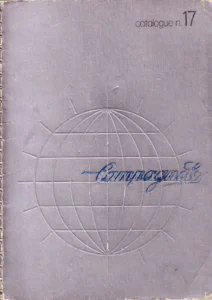
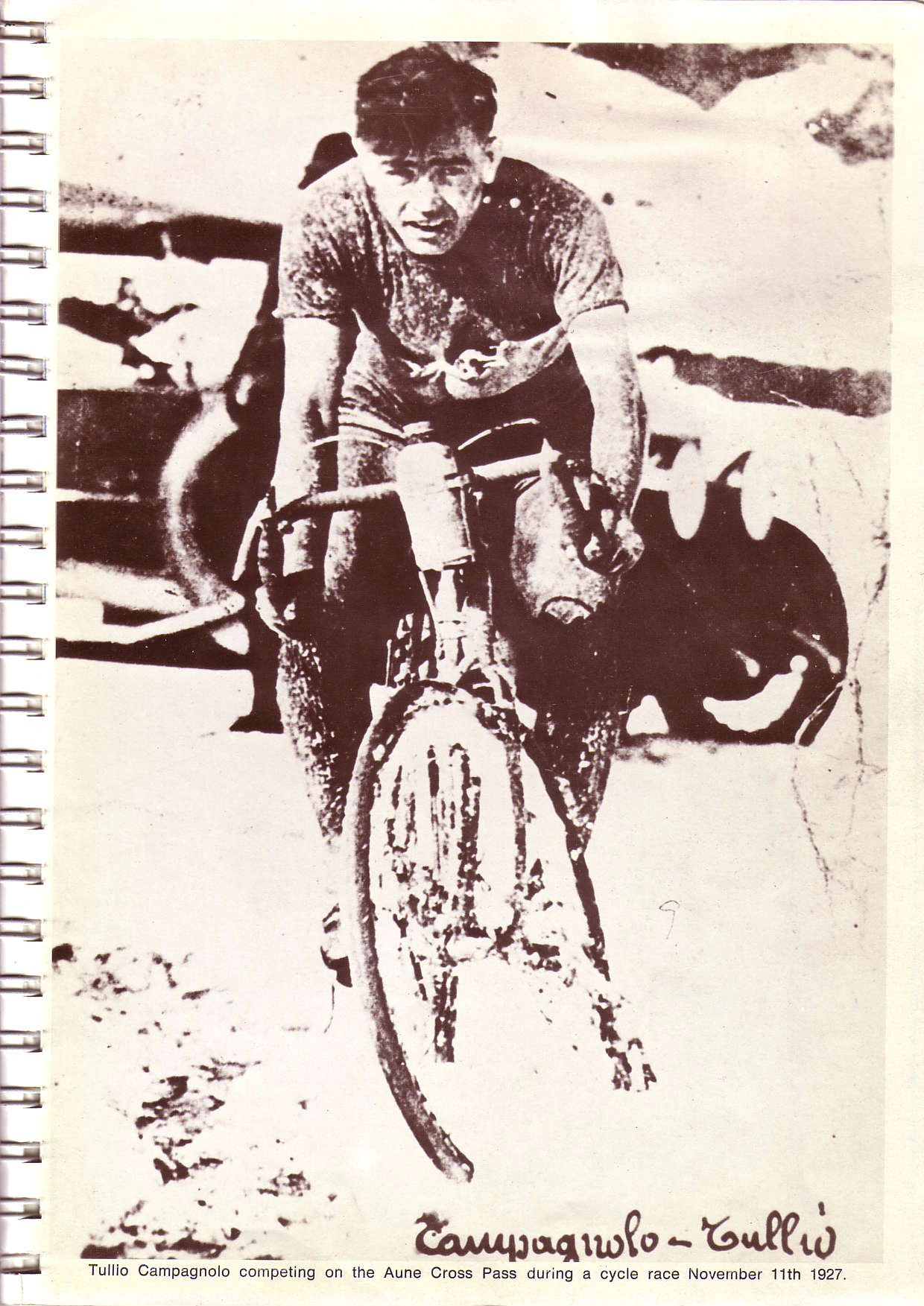
In 1974 Campagnolo printed a photo that has served its name nearly as well as the parts it sells. It fills a page of the firm’s catalog No. 17: a young rider coming straight at the camera through snow and slush, mud-spattered, spare tubulars slung across his shoulders and a support car behind him. The caption puts him on the Croce d’Aune, a pass in the Dolomites above Feltre, on 11 November 1927. The page before it tells the rest. Tullio Campagnolo is riding well when he punctures. His fingers are too numb from the cold to undo the wing nuts holding his rear wheel, he loses time and, in equal parts competitive disappointment and engineering brilliance, he “conceives ideas which will change the mechanics of racing cycles.”
It is among the most famous origin stories in cycling — and like most origin stories, it changed shape each time it was told. This article goes back to what can be checked. Ebykr’s archive holds a run of Campagnolo’s own catalogs from about 1951 to 1986, the French trade press that watched the firm arrive and the catalogs of the frame builders who turned its parts into the gold standard. Behind those documents sit more than a dozen national patent offices, where Tullio Campagnolo filed more than 70 inventions in his own name between 1933 and 1982, and where the paper trail starts three years later than the legend says it should. Behind them again sit the newspapers of his own lifetime and a form he filled in and signed himself.
If these details sound more like clues than simple bike facts, that is because the Campagnolo story is far more complex and colorful than that old, monochrome photo of Tullio. What emerges is a founder more interesting than the parable: a farm laborer’s son from Vicenza who took over the family hardware shop, an independent racer of modest results, a tireless patentee who registered trouser hangers and a grill alongside his transcendental gears, an industrialist whose firm was the measure every other component maker was held against for three decades and a man who ended his life under a criminal conviction that is missing from every English-language history of the firm Ebykr has found.
Tullio was born in Vicenza on 26 August 1901 and registered as Getullio, a name he did not go by. The form he filled in for the national federation of the Cavalieri del Lavoro late in life reads “CAMPAGNOLO Getullio (detto Tullio),” Getullio called Tullio, and the register of the federation and the Italian Ministry of Culture’s archive of business history use the same name. The spelling “Gentullio” that circulates online, Wikipedia included, appears in neither official resource.
His birth act, in Vicenza’s civil register, says more. On 28 August 1901 his father, Valentino Campagnolo, aged 32, declared the birth two days before of a boy he named “Getullio Romano,” a second name the histories of the firm do not print. The act calls Valentino a “villico,” a farm laborer, and the mother, Elisa Paiusco, a “massaia,” a housewife, and it places the birth in their house at Lisiera, on the country edge of the commune, so far out that the registrar excused the father from bringing the baby in, “per la distanza,” because of the distance. “He came from very poor conditions and worked very hard to build something,” Tullio’s son said of him in 2008. That son, Valentino, bears the name of the farm-laborer grandfather.
His family later kept a hardware shop, a ferramenta, on Corso Padova, the road that runs east out of the old city toward Padua, and the business that carries his name began in its back room. He trained as a mechanic at Vicenza’s school of arts and trades, the Scuola d’Arte e Mestieri F. Lampertico, whose board he later joined. At 17, by his own account, he was an “aiuto macchinista,” an assistant locomotive driver, on the state railways “and at the same time an amateur racing cyclist.” After military service in the artillery at Modena, he took over the running of the family hardware shop.
As a racer, he was capable rather than great and the record is thinner than the legend. He rode for the Veloce Club Vicenza, the city’s oldest cycling club, which he later served as president. An Italian sports almanac of 1928 lists him sixth in the 1927 Brenta-Astico, a 225-kilometer race in his own province, riding as an indipendente, the semi-professional class between amateur and professional. A 1952 history of Italian cycling lists him as the winner of the Astico-Brenta in 1928 and cycling databases place him in the big classics of those years as an independent, 65th in Milan-San Remo and 24th in the Giro di Lombardia in 1927. He always described himself as a “dilettante,” effectively an amateur, and his brief racing career was over by 1930 or so. It was the shop that ended it, by the account of the Ministry of Culture’s business archive: the need to run the family’s hardware business made him give up racing.
What he took from racing was a mechanic’s eye. “From the experience gained in this field,” the account he signed continues, “he senses that the racing bicycle needs substantial innovations.” In 1933 he set up “una ditta a carattere artigianale,” an artisan firm, whose first products, he wrote, “il grande Di Paco” used to win brilliantly: Raffaele Di Paco, the Tuscan sprinter who was winning stages of the Giro and the Tour de France in the early 1930s.
The family, according to the business historian Giovanni Luigi Fontana, opposed the venture as a waste of time and money, and regular production of the rod gear began in 1937 and 1938 with money from friends. The first large door into the trade was opened by a hub maker. Fratelli Brivio of Brescia, a precision firm of some 800 workers at the time, made Campagnolo’s hubs and introduced him to Bianchi, which then went on to fit Campagnolo gears across its racing range. Ebykr’s own 1940s Cavalieri with the Cambio Corsa still runs on Fratelli Brivio (or “FB”) hubs. Bianchi’s own catalog of 1940, in the Ebykr archive, already offers its Folgore road racer with a “Comando cambio tipo « Campagnolo »,” a gear control of the Campagnolo type, adding that the model can also be had without it. The ministry’s archive, which summarizes Fontana’s account, counts 36 employees after the war and 123 in 1950. An Italian parliamentary list of 1953 counts about 150 employees.
Campagnolo printed its founding story at least four times in the catalogs Ebykr holds and no two versions agree. The 1974 catalog No. 17 is the fullest. It gives the date, 11 November 1927, and the place, rendered in English as the “Aune Cross Pass.” Tullio is “by that time a recognized amateur racing cyclist,” he is in a good position when he punctures and his frozen fingers cannot unscrew the wing nuts. He loses valuable time and the catalog page leaves the result of the race unsaid.
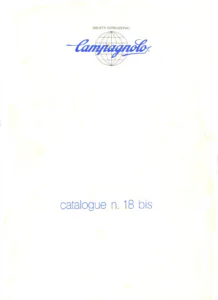
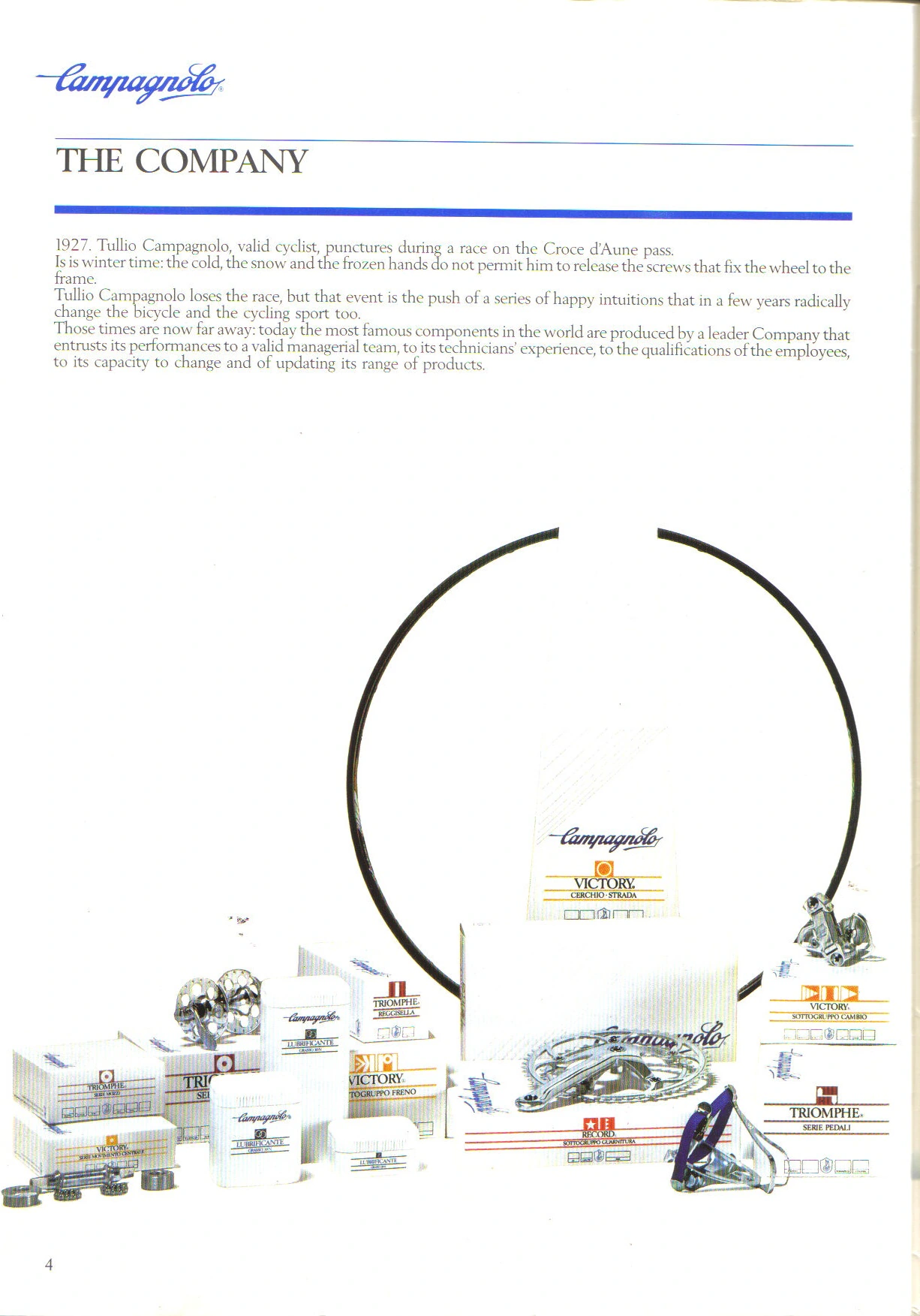
The American edition of the 1982 catalog sold the story on a belt buckle. A limited set made for Tullio’s 80th birthday reproduced the snow photograph with the same date and the copy said only that, “It was during this race that Tullio Campagnolo conceived the ideas” that would change cycling: no punctures and no wing nuts. Then the Italian catalogs No. 18 bis of December 1985 and No. 18 of 1986 tell it a third way, with the date reduced to the year. It is winter, Tullio is “a valid cyclist,” he punctures on the Croce d’Aune, his frozen hands cannot release “the screws that fix the wheel to the frame” and, for the first time in print, “Tullio Campagnolo loses the race.” From it come not one invention but “a series of happy intuitions.” (Note the increasingly expansive origin story over those 12 years, perhaps not incidentally among the most commercially successful in the company’s history.)
None of the four catalog entries names the big race. None mentions a quick release, a patent or a founding year. The newspapers of the early 1980s did no better: in 1981 L’Unità and L’Espresso had him dismount to change gear, in 1983 Time had him fail to change a tire and the version most of the internet now repeats has him stop on the climb to flip his rear wheel to the sprocket on its other side, the usual gear change of the day. Campagnolo’s own authorized biography, written by the great sports journalist Gianni Brera and published by the firm in 1993, after Brera’s death, moves the race to 4 November 1924, and so did Tullio’s son Valentino in a 2011 interview, while the firm’s own website still gives 11 November 1927. Brera’s book is also the earliest known source for the line the legend now gives Tullio on the climb, his cry made in a Venetian dialect: “Bisogna cambià qualcossa de drio!” (“Something has to change at the back!”).
The race on record: a Coppa della Vittoria at Padua, rain, mud and fresh snow on the Croce d'Aune, won by Antonio Negrini. Tullio is not named in the reports.
8Tellings as quoted in the article. The 1925 race from the Italian Olympic Committee's biography of Antonio Negrini.
Is any of it true? The photograph is real enough, and the firm used it while Tullio was alive and running the company, which certainly counts for something. But in 2014, Jan Heine of Bicycle Quarterly, working with the historian David Herlihy, went looking for the race. They reported that Campagnolo is not named among the favorites in any report of the 1920s Coppa della Vittoria and that the snowy edition of that race was run in 1925. The Italian Olympic Committee’s biography of the rider Antonio Negrini fills in that edition: a Coppa della Vittoria at Padua on 8 November 1925, run in rain and mud, with fresh snow on the Croce d’Aune, where Negrini dropped the field and won by more than five minutes. Every detail the legend needs is there, except Tullio’s name. Tullio himself, filling in his own record for the Cavalieri del Lavoro around 1979, mentioned neither the race nor the snow.
The fair verdict is that the Croce d’Aune is a founder’s parable: dated, illustrated and endorsed by the founder, but not documented, and plausibly borrowed from a real race in which he may or may not have ridden. What can be documented is the problem it describes, because Tullio wrote that problem down himself, in a patent application filed five and a half years after the date in the catalog. As so many of us have come to appreciate over the countless miles we have ridden on Campagnolo gear, that part of the story will never be disputed.
Campagnolo’s histories, and indeed the firm itself, date the quick release to a patent of 8 February 1930. No one who repeats the date gives a number, and no such patent has turned up. For this article, Ebykr searched the international patent indexes, which carry the French, Swiss, Austrian, German, Spanish, British and American patents through which Italian inventors of the period protected their work abroad, and read the key documents themselves. Tullio Campagnolo’s name appears on roughly 150 published documents in 14 patent offices, which group into more than 70 separate inventions. The earliest has an Italian priority date of 4 May 1933. Nothing earlier carries his name anywhere. Heine and Herlihy reached the same conclusion in 2014: the 1930 patent, they wrote, simply does not exist. And so the Campagnolo plot thickens.
The one caveat is Italy itself. Italian patents from before 1978 are not in the international databases, and an application filed in Italy and never taken abroad would leave no trace there. But Tullio took his ideas abroad from the start and a 1930 invention important enough to found a company on, never protected outside Italy, would be out of character. His own signed account dates the firm to 1933 and mentions no 1930 patent.
The 1933 invention survives in its British form, patent 415,683, and it is worth reading because it is the real origin of the firm. “I, Tullio Campagnolo, an Italian Subject, of Borgo Padova 5, Vicenza,” it begins, and it describes a racing problem in plain terms. A bicycle with sprockets of different sizes on its rear hub changes gear by moving the chain to another sprocket, which means sliding the wheel along the slots of the dropouts and centering it again, an operation that “may be difficult to perform and entails the expenditure of a considerable amount of time.” Tullio’s answer is a rear axle gripped by “a rotatable eccentric” instead of nuts, in dropouts cut with racks of teeth that engage matching teeth on a sleeve over the axle, so that the wheel moves forward or back without twisting out of line. The objective, in the patent’s words, is a gear change made “with precision and rapidity.”
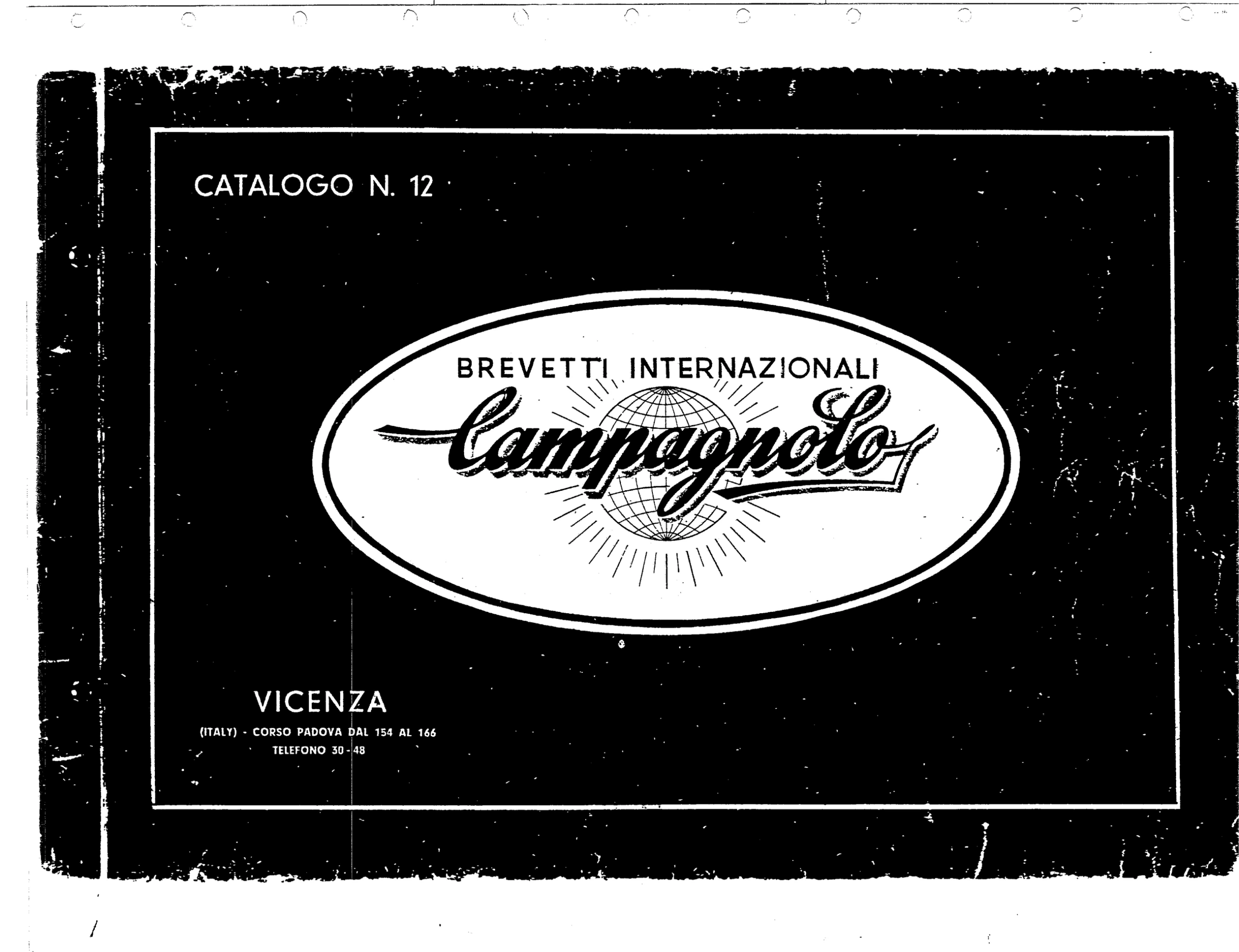
That is the quick release, born as a shifting aid. It is also, in substance, the problem in the Croce d’Aune story, set down by Tullio himself: time lost at the roadside fighting the removal of a rear wheel. The year matters, too. Campagnolo dates its own founding to 1933, the year of this first application. The firm grew out of a patent and said so on catalog after catalog from the 1950s to the 1980s, given its name was Brevetti Internazionali Campagnolo: Campagnolo International Patents, literally.
The device, or a descendant of it, was racing in France within two years. On 8 April 1935, an advertisement in the Paris sports daily L’Auto for F.B.’s patent hubs credited “le blocage CAMPAGNOLO” beside them with the win in the Critérium National de la Route, adding that its first six riders, like the first 11 of Paris-Nice, had trusted their chances to F.B. hubs “et aux Blocages CAMPAGNOLO.” It is the earliest document in Ebykr’s archive to name Campagnolo, eight years before the cam quick release was filed.
The patents also show who owned them. Every family from 1933 to 1980 was filed in Tullio’s personal name, from addresses that follow him along one street: Borgo Padova 5 in 1934, Corso Padova 160 from 1949 to 1966 and Corso Padova 168 from 1972 onward. The first family owned by the company, Campagnolo S.p.A., is a freewheel filed in September 1981, about 18 months before his death. For almost half a century the intellectual property that defined the racing bicycle belonged to one man, who counted 183 patents on the form he signed in 1979.
And they show his range. Beside the hubs, gears, dropouts, cranks, pedals, brakes and tools are inventions the cycling histories pass over. Tullio patented a spring-wire hanger for trousers and skirts (Italian priority June 1958; United States patent 3,070,270, granted on Christmas Day 1962) and returned to clothes hangers in 1972 and 1974. He patented a self-centering corkscrew in 1966, a device to spread oil or melted fat automatically over fried and cooked food in 1971 and a grill in 1972. He patented a disc brake for motor vehicles that combined hydraulic service braking with a mechanical parking brake in one caliper (Italian priority December 1962), a self-servo disc brake for motorcycles (1964), a motorcycle hub with an integral disc and a cast motorcycle wheel. His last applications, in 1982, were for a freewheel and for frame tubing.
Every one of those patent families is charted, with a link to each document, in the Campagnolo Timeline.
If the 1933 patent was the quick release in its embryonic stage, the quick release as every rider really knows it, a hollow axle with a cam lever at one end and a nut at the other, was filed in Italy on 22 April 1943, 11 weeks before the Allied landings in Sicily. The wartime path of the application is remarkable in itself. Tullio filed it in occupied France on 4 November 1943, as French patent 899,401, and in Germany on 5 May 1944, when Vicenza lay inside the German-controlled Italian Social Republic. The German patent, 939,674, was not granted until 1956. Its claims are modest: a cam with a handle, turning inside a protective hood, draws the hood and a threaded cap together and clamps the dropouts, with conical springs and recessed locknuts as refinements.
Tullio does not seem to have claimed more than that. In a Spanish patent filed in Madrid in July 1949, he described the cam lever moving a locking washer to secure the wheel “de manera conocida,” in a known manner, and claimed as new only a lever and cam pressed from one piece of sheet steel to cut the cost. Heine and Herlihy read the narrow wording of his quick-release patents the same way: whatever Tullio did to make the quick release practical, the cam itself was not his to patent. Ebykr’s search did not reach far enough to name an earlier cam-lever hub by someone else, and that question still remains open for now.

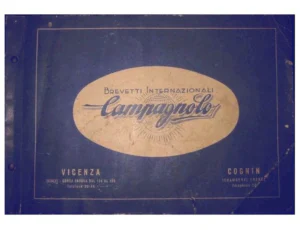
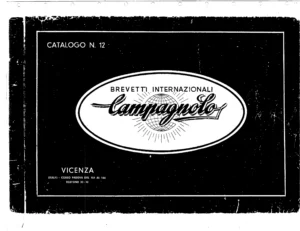
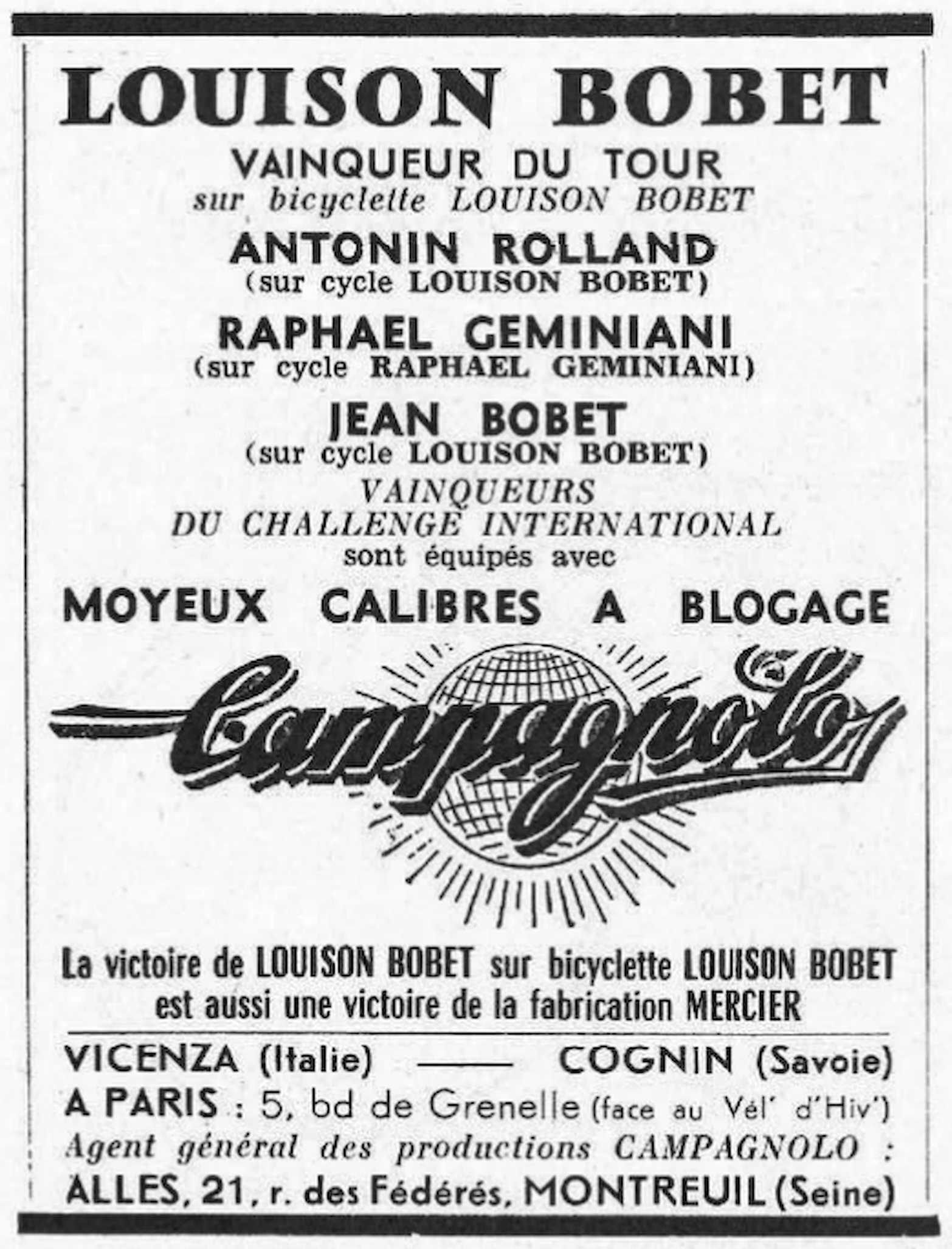
The catalogs show the design moving after the war. Catalogs No. 12 and No. 13, of about 1955 and 1956, sell “mozzi calibrati con bloccaggi originali,” calibrated hubs with original quick releases, already offered with large flanges, and they also list spares for an older quick release “di tipo vecchio,” a pattern still in riders’ hands. An English instruction sheet of about 1960 put the firm’s claim plainly: “The FIRST releasing hub appeared in the world fitted to cycles has been the AUTOMATIC « CAMPAGNOLO ».” That is the company’s word, and the patents, as above, claim less. And in France, it was the quick release, more than the derailleur, that Campagnolo pressed hardest. The firm had a French address by then: the cover of its catalog of about 1951 adds Cognin, near Chambéry in Savoie, to Vicenza, as its French advertisements did from at least 1948, and by July 1951 it had a Paris office too, at 5 boulevard de Grenelle, facing the Vélodrome d’Hiver. When Louison Bobet won the 1955 Tour de France, Campagnolo’s advertisement in Le Cycle announced that he and three other winners rode Campagnolo’s calibrated quick-release hubs. Le Cycle‘s own table of the race’s equipment, published in the same issue, shows that Bobet won on a Huret derailleur. Hey, at least they were compatible, which is more than some modern-day drivetrain makers can say.
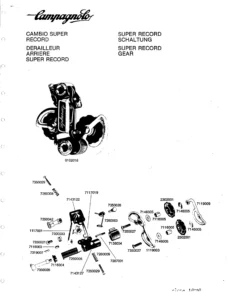
The 1933 idea grew into the first Campagnolo gear to carry a rider to victory in the Tour de France. The Cambio Corsa, the “racing gear,” works with two long levers mounted on the right seat stay. The upper lever opens the quick release. The lower one moves a fork that guides the chain across the freewheel. To shift, the rider opens the hub, backpedals while moving the chain fork and lets the change in chain tension draw the wheel forward or back along the toothed dropouts, then closes the lever again. It sounds absurd and it took practice, but a strong rider could change gear in a few pedal strokes without stopping, in mud and cold that could defeat the spring-tensioned derailleurs of the day.

Its dates run earlier than the usual story. Histories commonly give 1946, but the printed record starts sooner. The Touring Club’s magazine Le Vie d’Italia, in its issue of March 1935, already describes a Campagnolo gear built on an automatic pin that frees the wheel in the dropout, and Bianchi’s 1940 catalog offers the “tipo « Campagnolo »” control. The company’s own heritage timeline gives 4 May 1940 for the rod gear’s debut, and the Disraeli Gears derailleur archive lists the Campagnolo Corsa among the gears reported from the Milan cycle show of late 1941. The two-rod form was patented in April 1943, on the same day as the quick release and with the next French number, 899,402.
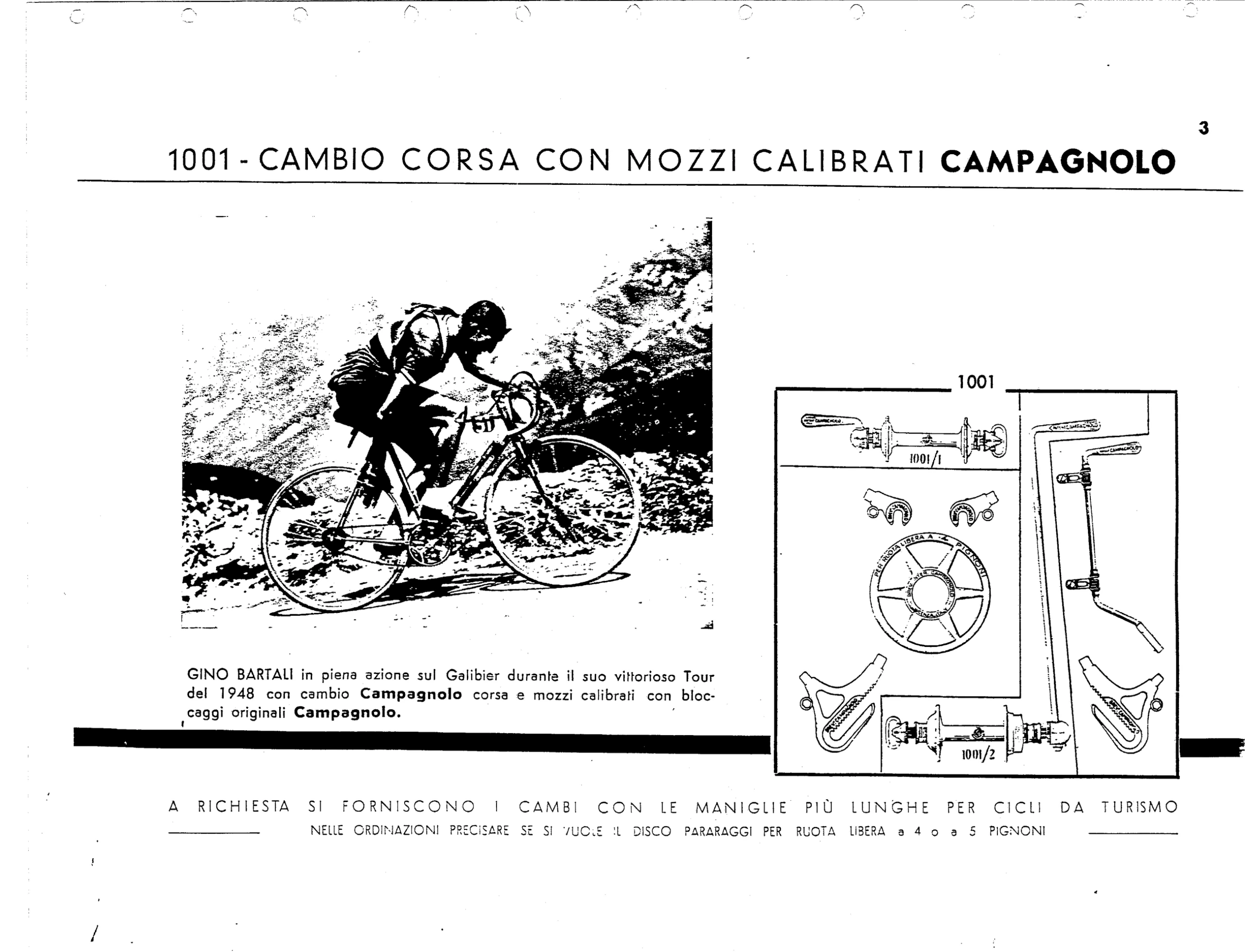
After the war, it became the gear of Italian champions. A Rome dealer’s advertisement in L’Unità of 11 January 1949 lists a “SUPERCORSA Campagnolo” at 39,000 lire, the dearest bicycle on the page, against 25,000 for a sport model “con cambio velocità.” Campagnolo’s catalog No. 12 opens with Gino Bartali on the Galibier “durante il suo vittorioso Tour del 1948,” during his victorious Tour of 1948, riding the Corsa with Campagnolo’s calibrated hubs. Disraeli Gears’ table of Tour de France winners and their gears begins with that win. (Bicycle Quarterly has dated Campagnolo’s first Tour to Hugo Koblet in 1951, apparently counting only the derailleur that followed.) Campagnolo made the claim in France at the time. The day after the 1948 Tour ended, its advertisement in L’Équipe credited Bartali’s win in part to its gear without chain tension, “qui a toujours merveilleusement fonctionné dans la boue des Alpes,” which always worked wonderfully in the mud of the Alps, and an advertisement of July 1946 had already claimed that every finisher of that year’s Giro d’Italia, won by Bartali, rode the Campagnolo gear.
The Paris-Roubaix followed: a single-lever refinement in which the first part of the lever’s travel frees the wheel and the rest shifts the chain. Its patent family has an Italian priority of 19 July 1949, after a prototype filed the previous October, and it took its name, in Campagnolo’s words, from the great race. The firm’s catalog of about 1951, the earliest in the Ebykr archive, already titles it “Cambio Campagnolo tipo Paris-Roubaix” and shows Fausto Coppi “durante la sua vittoriosa Paris-Roubaix con il cambio che ha preso il nome dalla grande prova,” during his victorious Paris-Roubaix with the gear that took its name from the great race, a caption catalog No. 12 repeats. Fausto won Paris-Roubaix once, on 9 April 1950, and before that the gear had no race in its name: when Le Cycle showed it in the autumn of 1949, its captions called it only “le nouveau CAMPAGNOLO” and a “nouveau dérailleur 1950 à une seule manette,” a new single-lever gear for 1950. So the name most likely honors Fausto’s win rather than the 1949 race his brother Serse shared with André Mahé after a protest. The same 1951 book shows Toni Bevilacqua winning that year’s Paris-Roubaix on the gear named for it, with a Gran Sport front derailleur beside the rod.

Campagnolo’s two rod gears, the Corsa and the Paris-Roubaix, also stayed on sale longer than the usual story allows. The parallelogram Gran Sport is often said to have replaced them around 1950, yet both have their own spreads in the firm’s catalog of about 1951 and both still come first in its catalogs No. 12 (about 1955) and No. 13 (about 1956), each with its own page of spare parts. They are gone from catalog No. 14, of about 1958, onward.
The derailleur that carried Campagnolo’s name beyond Italy was not the first of its kind and the record is clear on that. Parallelogram derailleurs had been patented in France since 1933, and built there by Nivex and others before the war, while in Italy Francesco Ghiggini patented his own between 1937 and 1941. Heine traces Tullio’s design to the French Nivex. Disraeli Gears, citing Frank Berto’s history of the derailleur, The Dancing Chain, reports that Campagnolo bought Ghiggini’s patents in 1951, the year the Gran Sport went into production.
The catalyst, by the usual telling, was losing Coppi, who by most accounts won the Giro and the Tour of 1949 on a French Simplex. A twin-cable prototype, one cable to shift and one to tension the chain, was shown that autumn at the Milan show, where Daniel Rebour drew it for Le Cycle with “CAMPAGNOLO GRAN SPORT” already lettered on its body. The first Gran Sport patent family has an Italian priority of 21 November 1950 and the single-cable production model followed in 1951. What the patents claim is not the parallelogram but its construction: links pivoting on hollow cylindrical bodies, a single cable on an arm of one link working against a return spring that can be unhooked, two adjustable stop screws, the cage spring housed inside the lower body and bronze bushings. The Gran Sport’s novelty was execution, robust enough for racing and precise enough to trust in the moment.
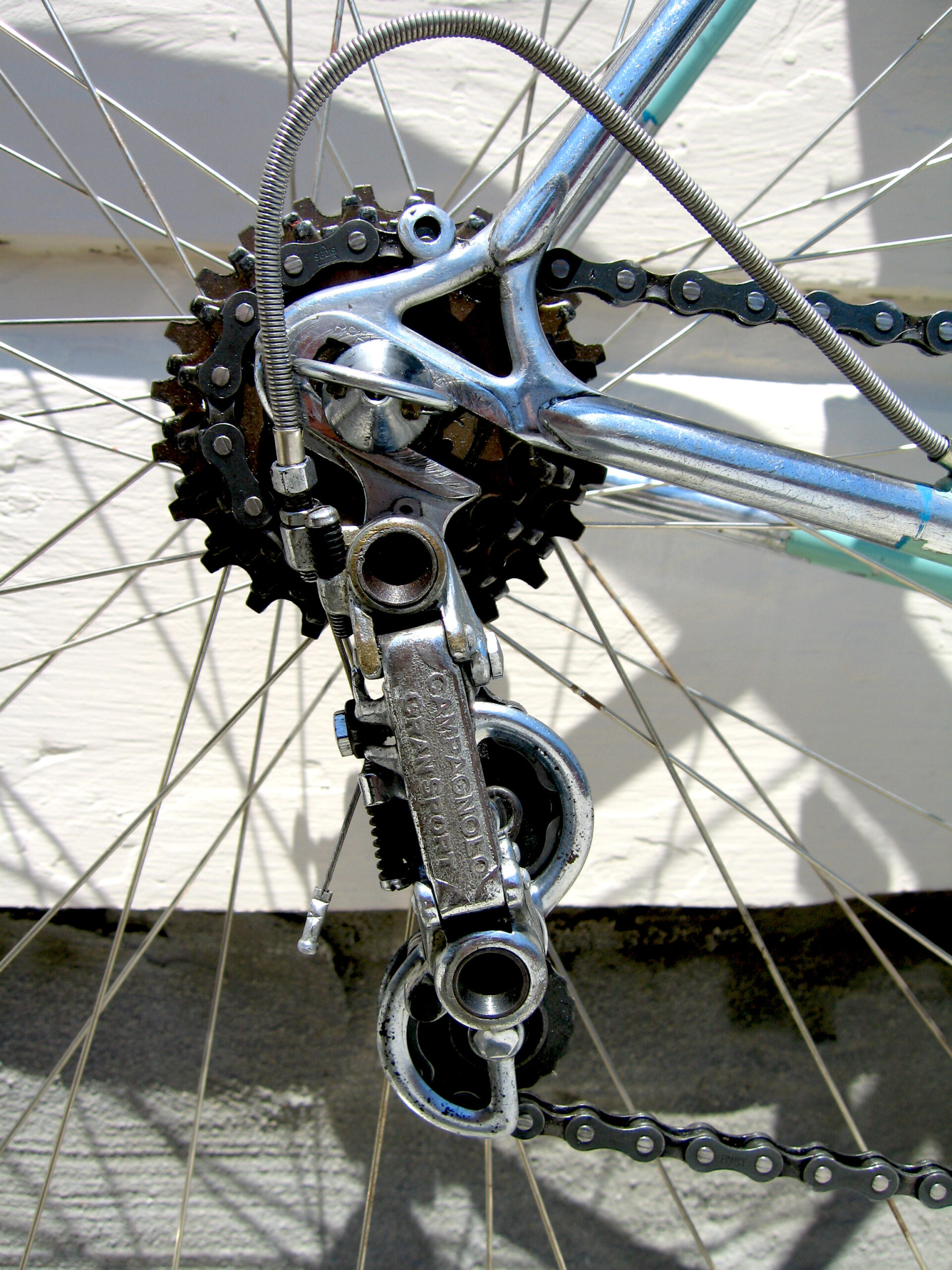
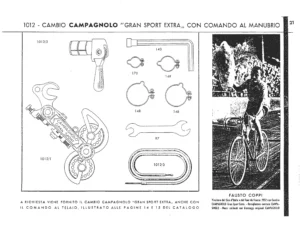
Campagnolo’s own catalog of about 1951 shows how the firm sold it. It opens with Coppi and Hugo Koblet riding the Tour de France on it, sells it as a “Gruppo Campagnolo Gran Sport” with a matching front changer, both worked from the handlebar, and prints the first five finishers of the Giro di Lombardia of 21 October 1951, Bobet, Minardi, Coppi, Soldani and Fornara, all of them on the Gran Sport. A supplement of about 1952 then sells the “Gran Sport Extra” (the name is Campagnolo’s, not only the collectors’) on the bicycle of Coppi, “Vincitore del Giro d’Italia e del Tour de France 1952,” winner of the Giro and the Tour of 1952.
The French noticed right away. Reporting the Paris Salon of 1951 for Englebert Vélo-Magazine, Daniel Rebour recorded the Campagnolo front and rear derailleurs, as worked from the handlebar by “Passevitess” controls, “adoptés par de nombreux coureurs, dont Koblet au Tour de France”: adopted by many racers, Hugo Koblet among them in the Tour he had just won. Campagnolo had made the point during the race: its advertisement in L’Équipe of 23 July 1951, six days before Koblet won, presented the Campagnolo parts on his bicycle as his “précieux auxiliaires,” his precious helpers, with arrows to the quick-release hubs, both derailleurs and the handlebar control. Yet the peloton stayed loyal to the French gears for years. In the 1955 Tour, Le Cycle‘s equipment table credits four stage wins to Campagnolo derailleurs, three of them by riders of the Dutch Locomotief team, against 13 on Simplex and four on Huret, and the two Italians who won stages did so on Simplex.
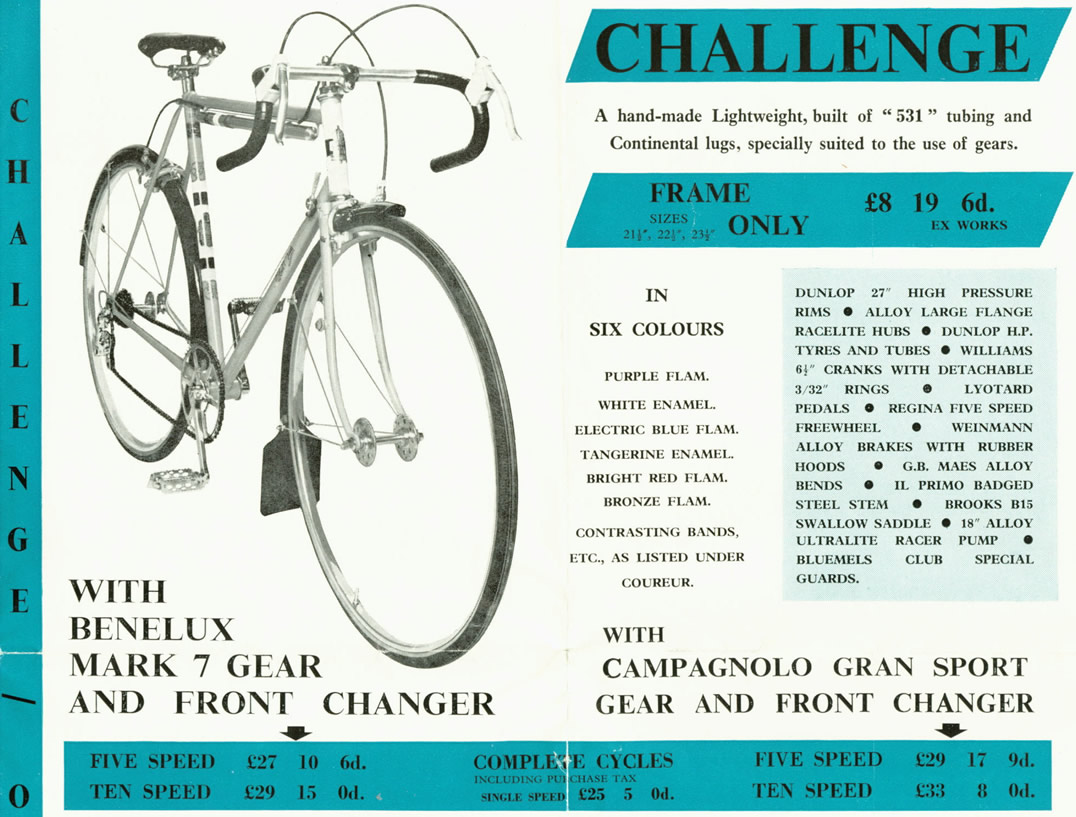
Abroad, the Gran Sport sold at a premium. Claud Butler’s 1961 catalog priced its Challenge with either a Benelux Mark 7 or a Campagnolo Gran Sport: £27 10s 6d against £29 17s 9d with five speeds, £29 15s 0d against £33 8s 0d with ten, a price difference of 9-12% on a complete bicycle. Its Super Coureur was simply, “The fabulous Italian FIVE SPEED Campagnolo Gran Sport Gear Model.”
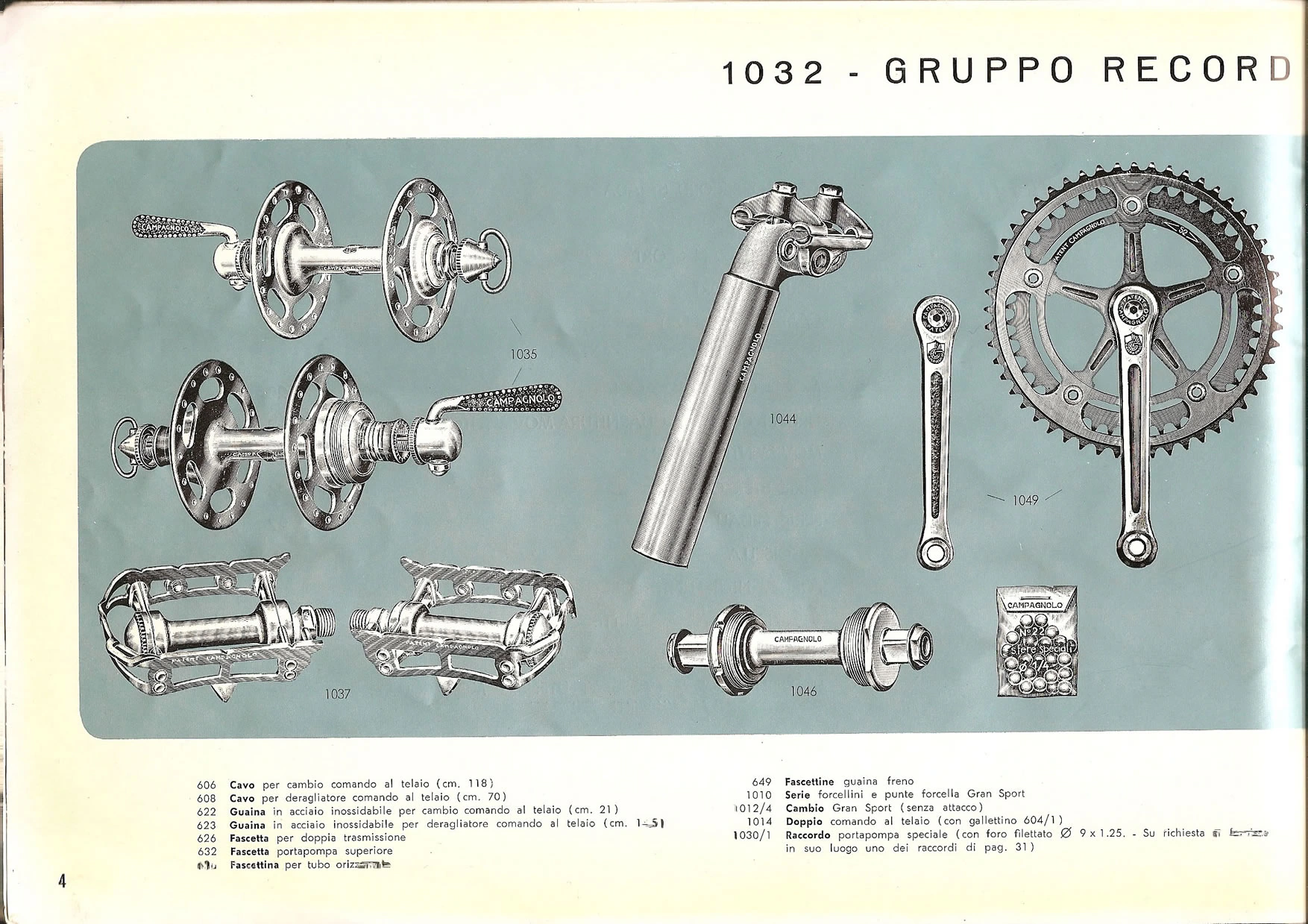
The name that defined Campagnolo for the next 30 years arrived in pieces. Catalog No. 14, of about 1958, introduces the “1032 Gruppo Record strada” and its track twin, the first groups the firm sold under one name, and a decal on the bicycles in its photographs reads “Montata con materiali originali Campagnolo Gruppo Record,” built with original Campagnolo materials. But the rear derailleur of that first Record group is the Gran Sport and its bottom bracket, headset and pedals are still called Gran Sport, too. The Record name belonged at first to the hubs, the front derailleur and, above all, the new cotterless crankset, whose Italian patent application, No. 14.353, was filed on 19 November 1958. Its five-arm spider held the chainrings with hollow bolts and nuts sunk flush, so that a thrown chain had nothing to catch on.
Other makers bought the name the same way. A Frejus catalog of about 1961 offers its racer with Campagnolo Gran Sport derailleurs as standard and a “Campagnolo Record” set of headset, bottom bracket, pedals, large-flange hubs and seat post as the upgrade, with no derailleur in it. The Record rear derailleur itself appears a little later. Daniel Rebour, looking back in Le Cycle in October 1964, recalled the Campagnolo stand at the Paris Salon of 1962 showing the Sportman for touring riders and “le « Record » pour la course, dont la capacité a été accrue,” the Record for racing, its capacity now increased. Campagnolo’s own first print of the derailleur in the Ebykr archive is an English instruction sheet from the years between catalogs No. 14 and No. 15, about 1960 to 1966 by its letterhead, whose parts list opens “1020 Record gear complete”: the number the Nuovo Record later carried as 1020/a. A companion sheet does the same for the Sportman, 1021. A reader who meets a “Record group” of 1958 should not picture a Record derailleur on it, but rather a Gran Sport model.

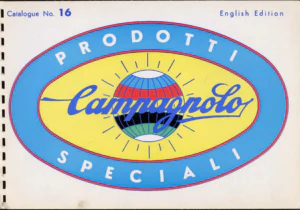
The rest of the classic Campagnolo arrived in a quick run of catalogs. Catalog No. 15, of about 1967 and the first in the run to carry the name “S.p.A. Brevetti Internazionali Campagnolo,” introduces the Nuovo Record, the aluminum-bodied rear derailleur whose ornamental design was registered in Italy in November 1969. The English edition of catalog No. 16, of about 1969, adds Campagnolo’s first brakes, the Record sidepulls with a quick release of their own, and announces “SIX-SPROCKETS HUBS ALSO AVAILABLE.” A four-language supplement of November 1971 brings the Velox and the Gran Turismo, the wide-range touring gear that Berto called “Campy’s Edsel” rather accurately and unceremoniously.
Super Record appears between the November 1971 supplement, which does not have it, and catalog No. 17 of 1974, which does have it. Campagnolo itself gives 1973. The catalog is more precise than the legend about what the group was. Its titanium was confined to axles, spindles and bolts: the hub axles, the pedal and bottom-bracket spindles, the track locknuts and the two pivot bolts of the rear derailleur. There was no Super Record front derailleur. The group used the Record changer, whose part number, 1052/1, had been in the catalog since about 1958. Titanium-axle Super Record hubs were cataloged, though collectors who have studied the parts report that they never went into production, and the hollow titanium bottom-bracket axles were later replaced by solid ones that took nuts instead of bolts, a change explained in the 1982 American catalog.
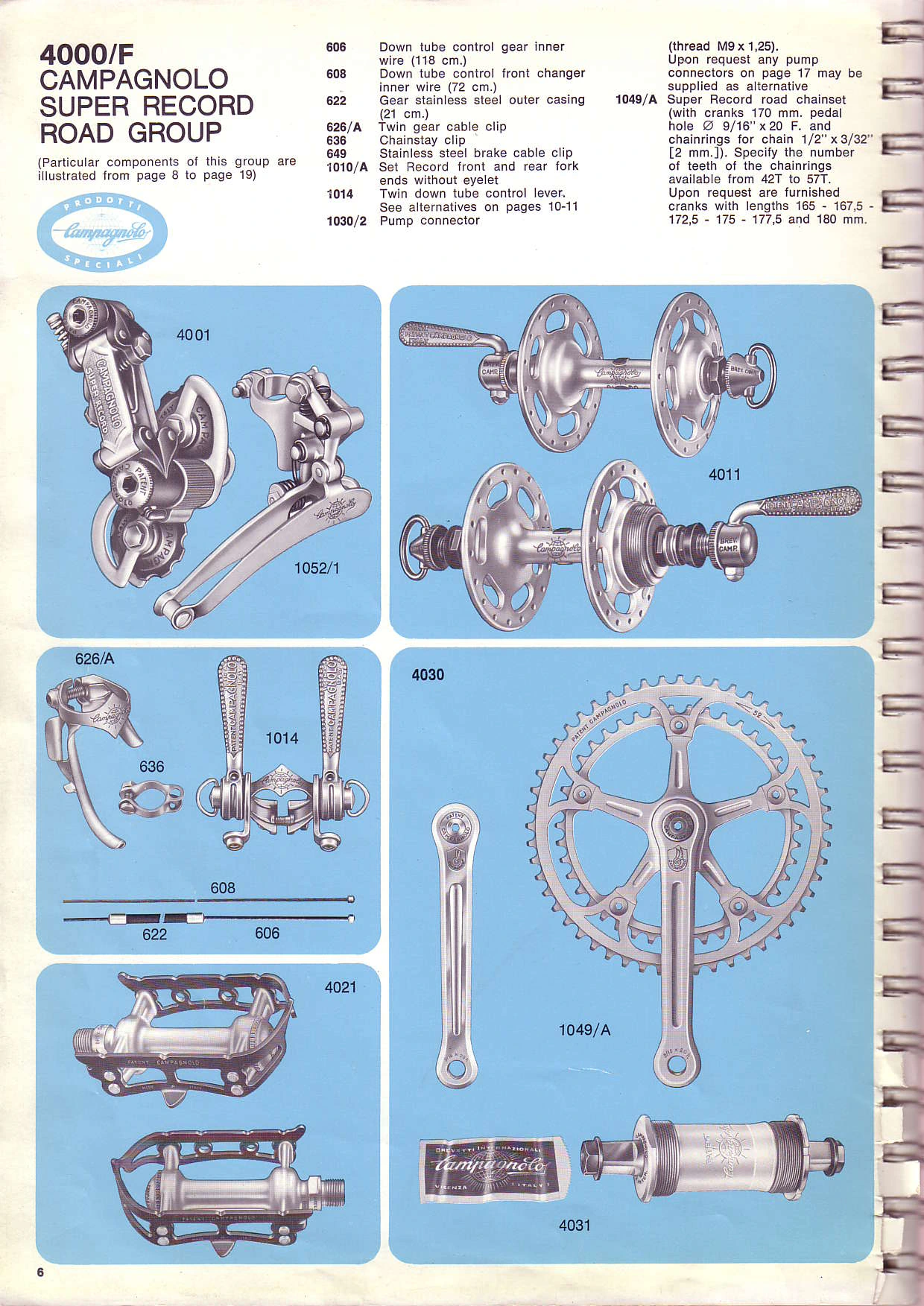
One number tells the story of the period. The top road group was 1032 in catalog No. 14 of about 1958, “1032/F Campagnolo Nuovo Record Road Group” in 1975 and still “1032/F «RECORD» Road Campagnolo Group” in December 1986: nearly three decades under a single part number.
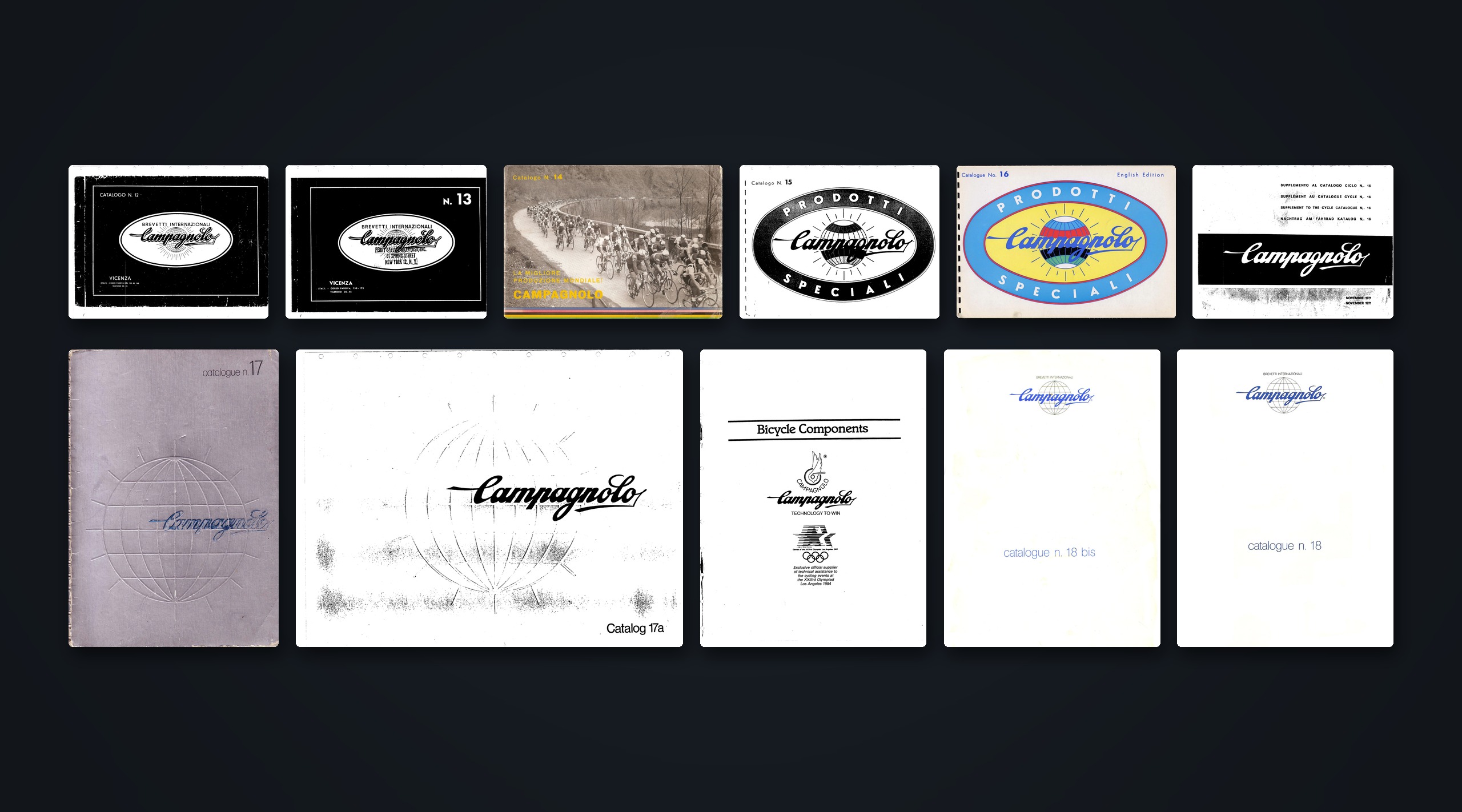
Arranged side by side, the 14 Campagnolo catalogs in the Ebykr archive show the whole run at once: when each line arrived, how long it lasted and where the archive falls silent.
Swipe sideways for all 14 catalogs.
Catalog pages from the Ebykr Catalog Archive. Scans: Campybike, Campy Only, Retrobike and bulgier.net, as each record credits.
By 1974, Campagnolo was much more than a simple bicycle firm and catalog No. 17 opens by saying so. Before a single derailleur appears, six pages describe a company of “more than 2,000 skilled production workers” exporting “approximately 80%” of its output to “approximately 100 countries,” with factories that, it said, made parts for airplanes, helicopters, research rockets, sounding balloons and satellites. For cars, it made wheels of “superlightweight Elektron alloy,” a magnesium alloy, and the company catalog names its customers: Ferrari, Abarth, De Tomaso, Autodelta, Lancia, Alfa Romeo, Maserati, Lamborghini, Tecno and Iso Rivolta, who chose them, it says, because they were “the lightest in weight, the most durable, the safest.”
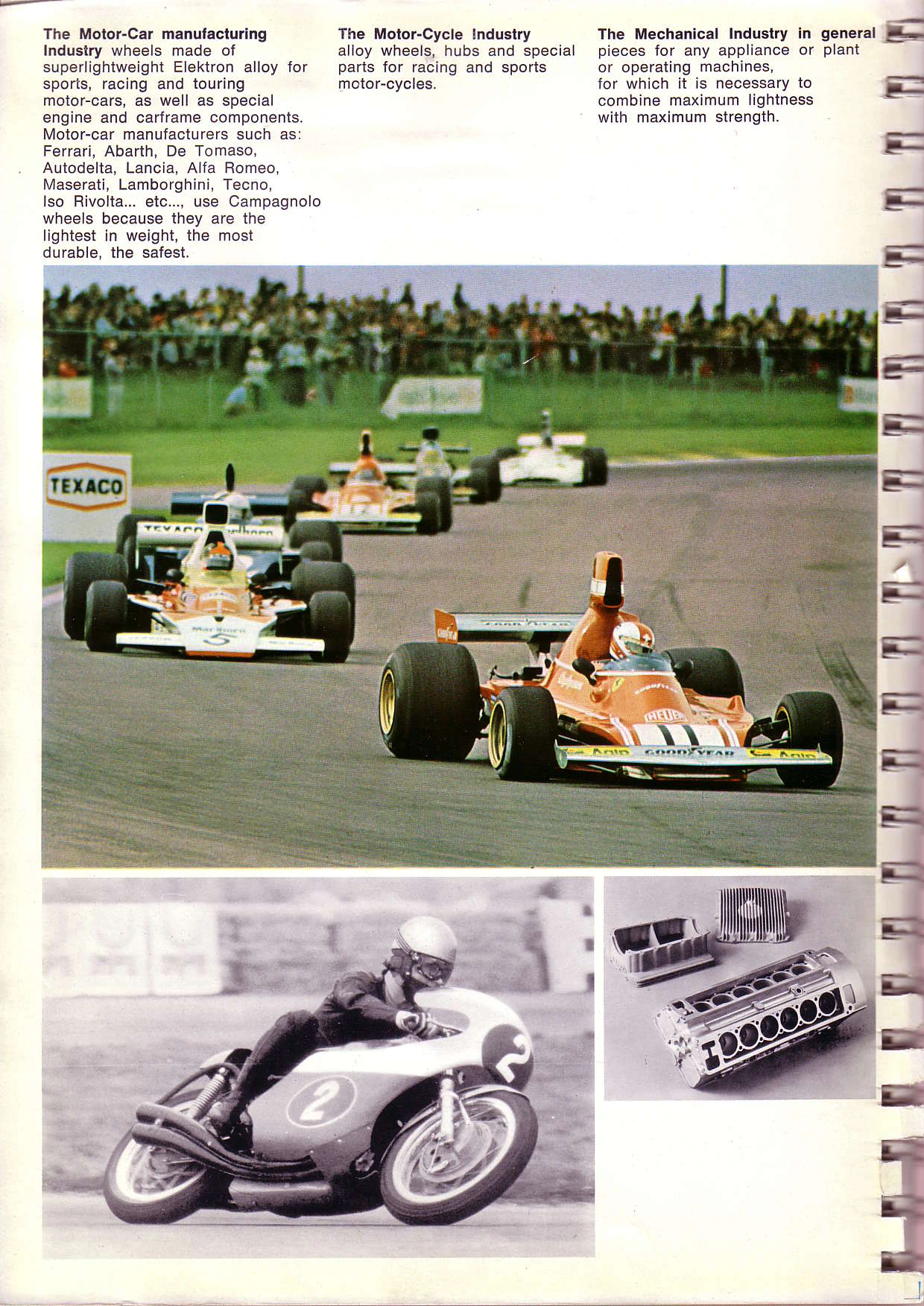
The company’s car business began with a merger. Campagnolo entered it in 1961 by joining Ruote Amadori of Bologna, a maker of cast alloy wheels and disc brakes, and the motoring press of the time reported that the partners could not agree on a name and settled on both: Amadori Campagnolo S.p.A., founded at San Lazzaro di Savena outside Bologna. When L’Unità‘s motoring column visited the plant in December 1973, it called it the only firm in the world casting magnesium parts by low pressure, and reported a fatigue rig on which a steel wheel lasted 45 minutes and a Campagnolo magnesium wheel eight hours. In 1975, in Detroit, Tullio received the magnesium industry’s Design and Applications Award for that low-pressure process. He spoke no English, so, by his son’s account, the firm’s technical paper to the association was read by Valentino, then just 25.
The wheels themselves are well attested. Campagnolo magnesium wheels replaced Borrani wire wheels on the Lamborghini Miura in 1966, came as standard on the De Tomaso Pantera from 1971 and gave the Lamborghini Countach its “telephone dial” wheels. BMW fitted them to the M1. Motorcycles took Campagnolo cast wheels and disc brakes, too, among them Ducati’s 900 SS from 1979, and Tullio’s own patents for vehicle disc brakes run from 1962 to 1979.
The aerospace claim is harder to pin down and the vague version that circulates today, that Campagnolo built “chassis for NASA satellites,” is the least useful form of it. Kompass, the Italian business directory, listed Campagnolo magnesium castings “per l’industria automobilistica ed aerospaziale” in 1970, and L’Unità in 1981 and 1983 spoke of accessories made for NASA. The most specific account is a 1973 article by Gianni Rogliatti in L’Automobile Speciale, which, as cited today, names parts for NASA’s Orbiting Solar Observatory OSO-6, launched in August 1969, and castings for the Fiat G.91 jet fighter and two Italian helicopters. Ebykr has not seen that article itself and the catalog’s aerospace photographs carry no captions.
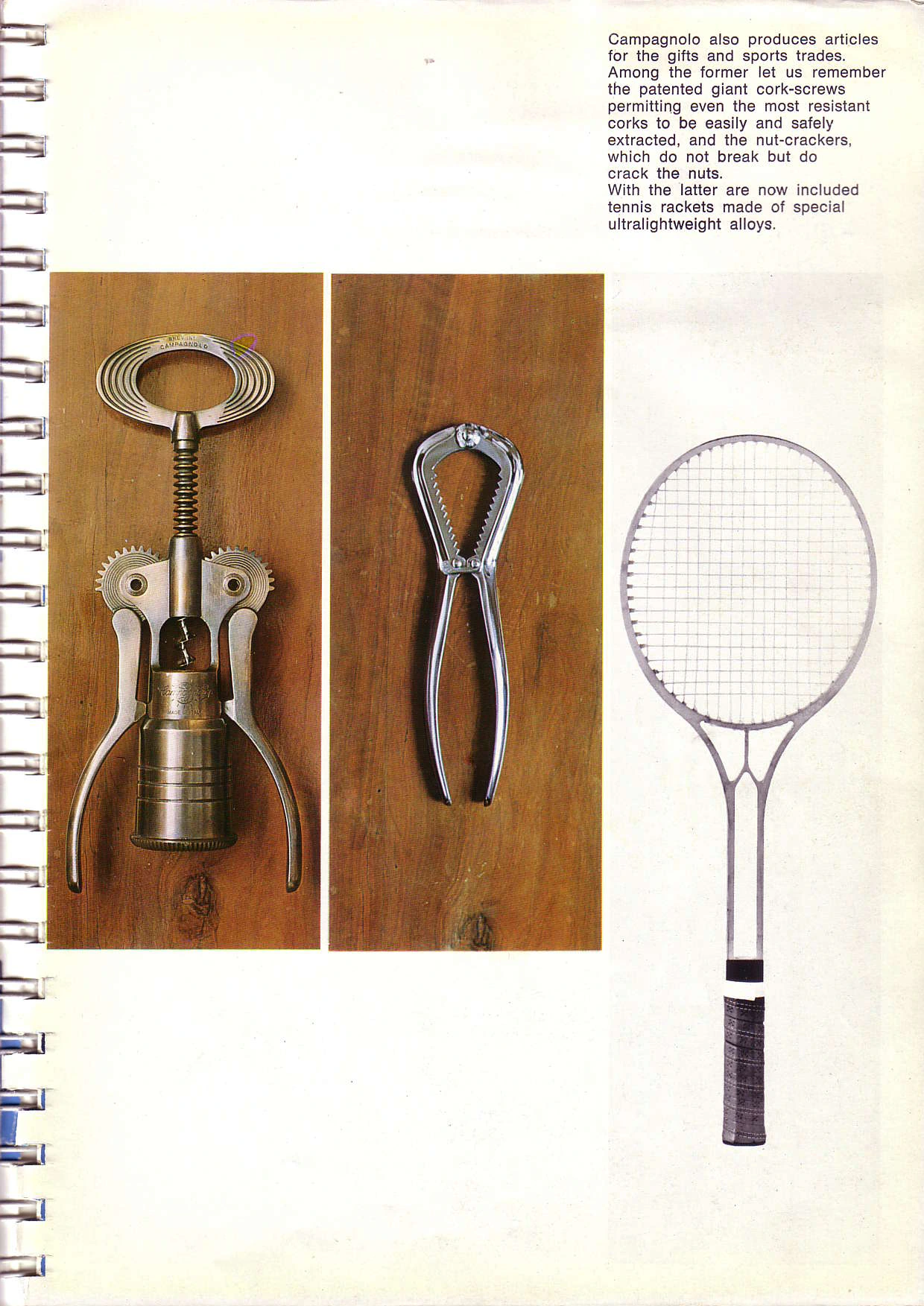
Then there is the corkscrew, the most famous Campagnolo object never fitted to a bicycle. The firm’s story is that Tullio hurt his hand on a stubborn cork in 1966 and designed a better corkscrew in a few minutes. The patent bears out the year, an Italian application of 5 August 1966, but not the claim, sometimes made, that he invented the winged two-lever corkscrew, which Domenico Rosati had patented in 1930. Tullio’s contribution was a telescoping bell that keeps the worm centered in the cork. In 1981 about 20 workers were making the “Big,” as the corkscrew was known. The 1974 catalog sells “patented giant cork-screws” beside nutcrackers “which do not break but do crack the nuts” and tennis rackets “made of special ultralightweight alloys.” Something for everyone, as they say.
Even the earlier bicycle catalogs carried a stray motor part. Catalogs No. 12 to No. 14, of about 1955 to 1958, list a “Tendicatena ciclomotore,” a moped chain tensioner, among the various bicycle racing derailleurs.
The clearest evidence of what Campagnolo achieved is not in its own catalogs but in everyone else’s. Read in date order, the frame builders’ documents in the Ebykr archive trace the brand’s rise from a type to a standard. The standard.
In 1940, it is a type: Bianchi’s “tipo « Campagnolo ».” In 1949, it is an option among equals: Claud Butler offers “Campagnolo Q.R. hubs” on a model with a Simplex gear, and in 1953 and 1954 its rear ends come from “Agrati … or alternatively Campagnolo, Simplex or Benelux ends incorporating gear lugs (to choice).” By 1961, it is a premium with its own price. The first mention aimed at American buyers in the archive is Raleigh’s 1962 catalog for the United States, with a “10 speed Campagnolo Gran Sport” model option. In the January 1964 Le Cycle, Rebour counts Campagnolo among the three great derailleur makers with Huret and Simplex, notes that its headset is seen on most Italian bicycles and names its tools beside those of Var and T.A. By 1966, his roll showcasing the principal component makers begins with Campagnolo.
In the 1970s, Campagnolo became the specification that defined a top model. Raleigh’s American catalogs sell “fully Campagnolo-equipped” bicycles. Holdsworth grades its whole 1976 range by Campagnolo level, from the Valentino Extra to a “Super Record 12 speed.” Schwinn’s 1978 catalog lists its touring Paramount with Weinmann brakes and “Campagnolo available at extra cost.” In 1981, even Fuji, whose range ran on SunTour and Sugino, offered a special-order Professional with the full Super Record group and in 1982 Campagnolo’s sponsorship of the TI-Raleigh team put its gears on Raleigh’s whole range of Reynolds 531 bicycles. A Masi brochure from California put it most memorably: the bicycles came with Campagnolo components, because “Anything less would be like painting flames out of the wheel wells of a Ferrari.”
By 1981, L’Unità reckoned that Campagnolo parts could account for half the price of a racing bicycle and a member of the factory council told the paper that wherever you went in the world, Campagnolo’s products got there before the United Nations did. Even an instruction sheet ran large: the printer of Campagnolo’s four-language sheet for the Record brakes set the code “2.81 – 50.000” at its foot, by the usual form of such codes a run of 50,000 in February 1981.
The racing record says the same thing. By the tally of the Disraeli Gears archive, brought up to date, 42 Tours de France were won on Campagnolo between 1948 and 2021, including 27 of the 31-year run from 1968 to 1998.
The late documents show a quieter kind of dominance. By 1986, Raleigh’s English lightweights carried full Shimano groups on Campagnolo dropouts, and Bob Jackson and Hetchins did the same in 1988. In other words, the dropout outlived the group, somewhat sadly. In 1989, De Rosa offered its Professional SLX with “any Campagnolo or Shimano gruppo.” For the first time in the archive, Campagnolo is one choice of two.
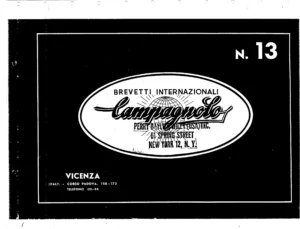
Campagnolo reached American riders through importers long before it had an office here. Ebykr’s copy of catalog No. 13, of about 1956, carries the rubber stamp of “PERRY BAYLISS WILEY (USA) INC.” of Spring Street, New York. A loose-leaf sheet from the Washington, D.C.-area importer Mel Pinto, of about 1970 to 1975, is a paste-up of Campagnolo’s own drawings with the French labels left in. By about 1980, there was a Campagnolo U.S.A., Inc., at a post office box in Houston, Texas, whose parts sheets introduce the seven-digit part numbers that would replace the old system.
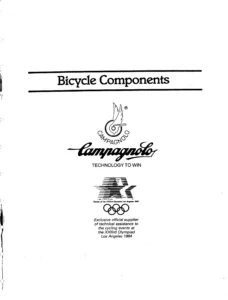
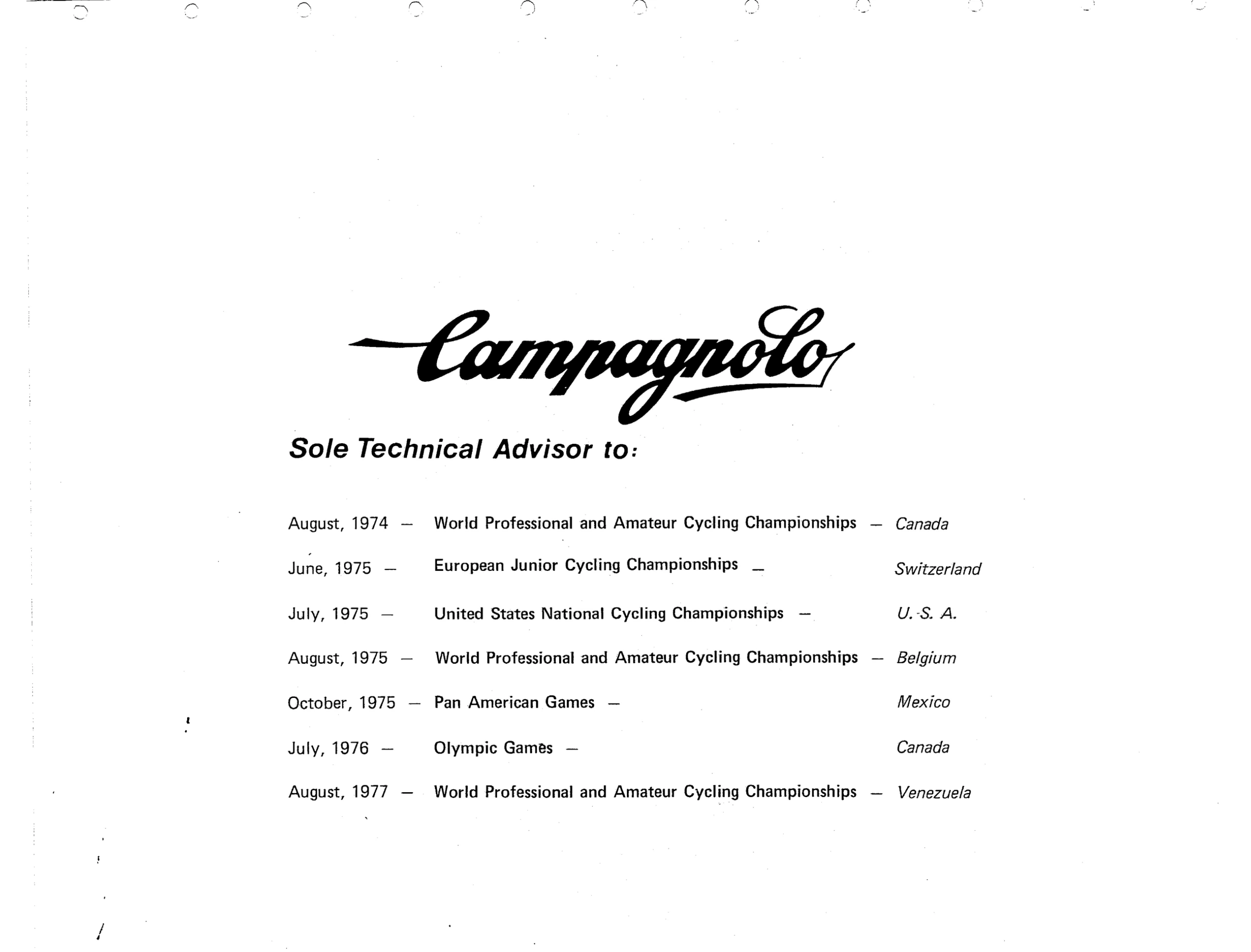
The firm’s work for the Olympic Games movement began earlier than the Los Angeles connection some of you might remember. Catalog 17a of 1975 opens with a page headed “Sole Technical Advisor to:” that lists world championships from 1974 and, booked ahead, the Olympic Games in Canada in July 1976. The 1982 American catalog then put Los Angeles on its cover, “TECHNOLOGY TO WIN,” with Campagnolo as “Exclusive official supplier of technical assistance” to the cycling events of the 1984 Games.
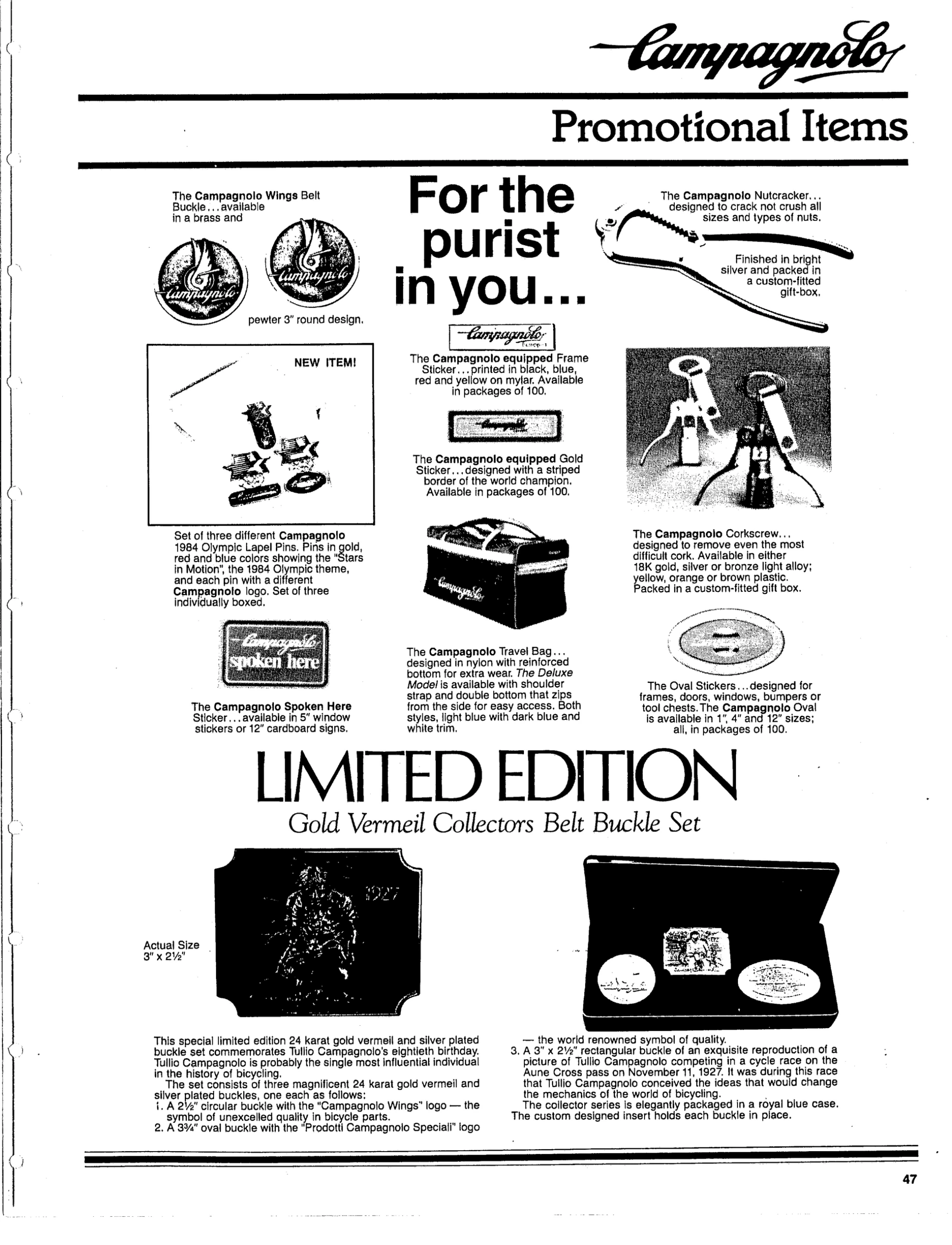
That 1982 catalog is also the only one in the archive that sells Tullio himself. Among its promotional items, beside a Campagnolo nutcracker, a corkscrew and a sticker reading “Campagnolo Spoken Here,” is a limited-edition set of three belt buckles commemorating his 80th birthday, including one reproducing the snow photograph from the Croce d’Aune. The copy calls him “probably the single most influential individual in the history of bicycling.” It was printed the year before he died.
The same book records something the popular histories pass over: a redesign forced by American regulation. “Between 1978 and 1979 Campagnolo changed the design of the right crank arm,” it explains, because the Consumer Product Safety Commission’s rule on protrusions caught the outer plate of the front derailleur, which had to be thickened, and the crank changed to clear it. The new arm has a raised collar 5 to 6 millimeters wide and 2 high, against 10 to 11 and 3 on the old one, a difference any owner can measure.
Those who worked with Tullio describe a man who ran everything himself. His son Valentino, born in 1949 when his father was in his late 40s, remembered an “egocentric” style in which Tullio was technical director, engineer and chairman at once, and a father who taught by example: “guarda quello che io faccio,” or watch what I do. The son, who studied economics, told Cycling Weekly in 2010 that his father had a gift for imagining and planning products that he did not share. Alberto Masi, son of the Milan builder Faliero Masi, called him “a volcano” with an idea every minute, who would pull out paper and pen in the middle of a conversation and start drawing. Valentino’s earliest memory is of Fausto Coppi staying two nights at the family home, for what sounds like a near-mythical coming together of these two greats.
That style had a cost. The Ministry of Culture’s business archive, following Fontana, records a deep financial crisis in the middle 1960s, blamed on the inefficiencies of a firm built around the centralizing figure of its founder, which brought layoffs and a reorganized management. It is the one episode the golden-age story leaves out, and the recovery that followed was nothing short of spectacular: more than 450 employees by 1971 and some 550 by the middle of the decade, when a new plant for motorcycle wheels opened. By 1981, L’Unità counted 560 workers in Vicenza and 200 at the Bologna foundry, and a turnover of 27 billion lire (or $32.8 million USD) in 1979.
Those who dealt with him in Vicenza remembered his exactness. A lawyer who met him as a young trainee in the middle 1950s recalled him arriving half an hour early for a five o’clock appointment, refusing to go in before time and then explaining, in dialect, his three reasons for punctuality: respect for other people’s time, that a latecomer starts at a disadvantage and that a man who arrives early, and seems a little distracted, can tell which way the wind is blowing.
Outside the factory he was a civic figure in the Veneto. By his own account he had been president of the Rovigo football club, sat on the boards of the Lampertico school and of Vicenza’s home for the elderly, presided over the Veloce Club Vicenza and served on the Italian cycling federation’s commission for the development of the sport. The organizers of world championships and Olympic Games, he noted, asked for his “personal collaboration” and that of his technicians. The Italian Olympic Committee named him a Benemerito dello Sport in 1959 and gave him its Stella d’Oro in 1978. He was made a Grande Ufficiale of the Order of Merit of the Italian Republic in 1970 and on 2 June 1979 he was named a Cavaliere del Lavoro, Italy’s highest honor for an industrialist, an honor his son Valentino received in turn in 2025.
Less than two years after that honor, Tullio Campagnolo was arrested. Late on the evening of Monday, 2 February 1981, as L’Unità reported two days later, a captain of the Guardia di Finanza, Italy’s financial police, served him with a warrant from the prosecutors of Milan at his factory at Porta Padova and took him into custody. The charge was illegal export of currency, it seemed to Switzerland, and the sum spoken of was 13 billion lire (or about $11 million USD). On 24 June 1981 a Milan court convicted 46 of the 99 defendants in the case. Tullio, “tra i principali imputati,” among the principal defendants, was sentenced to two years’ imprisonment and a fine of 5 billion lire (or about $4.4 million USD). By the account of his obituary, he went through jail, the trial and the payment of the fine, and was released on grounds of health. Ebykr has not found the outcome of any appeal. The episode was reported across the Italian press of the day and appears in no English-language history of the firm Ebykr has been able to find.
Tullio Campagnolo died on 1 February 1983, aged 81. Wikipedia and most of the web give 3 February, but L’Unità of 2 February reported him dead “ieri mattina,” yesterday morning, and the register of the Cavalieri del Lavoro and the ministry’s business archive also give 1 February. The 3rd was the day of the funeral, held in Vicenza at 10 o’clock, with his body lying in state in a chapel set up inside the new Campagnolo plant. L’Unità placed his death in Vicenza, while Time and Panorama placed it at the hospital in Monselice, at the foot of the Colli Euganei, where he kept a wine estate. The obituary in L’Unità called him the father of the modern bicycle and said he had ended his life bitterly, under the weight of the conviction. In 1981 the same paper had described “il signor Tullio” showing off his empire with the pride of a man who had come up “dalla gavetta,” from the bottom, and pouring a Colli Euganei wine that bore his name for friends at his “grande villa.” Looking back, the obituary called him “un padrone all’antica,” an old-style boss, and said that after his release he had lost the good-natured smile with which he received those friends: even the wine with his name, it supposed, must have seemed in poor taste to him.
His firm’s 50th anniversary fell in the year of his death. Campagnolo marked it with a commemorative 50th Anniversary group, with gold-plated details and numbered certificates, and according to collectors set No. 2 was presented to Pope John Paul II.
The catalogs printed after Tullio’s death fall silent about him. The company page of catalog No. 18 bis, December 1985, moves in one breath from the 1927 puncture to “a leader Company” that relies on “a valid managerial team,” and (somewhat oddly in our view) names neither Tullio’s death nor his son Valentino, who succeeded him. The same book carries the new address, Via della Chimica 4 in the Vicenza industrial zone, evidently the new plant begun in the spring of 1980 in which his body had lain in state, and a share capital of 16 billion lire (or about $8.4 million USD) against 1.1 billion (or about $1.7 million USD) in 1974.
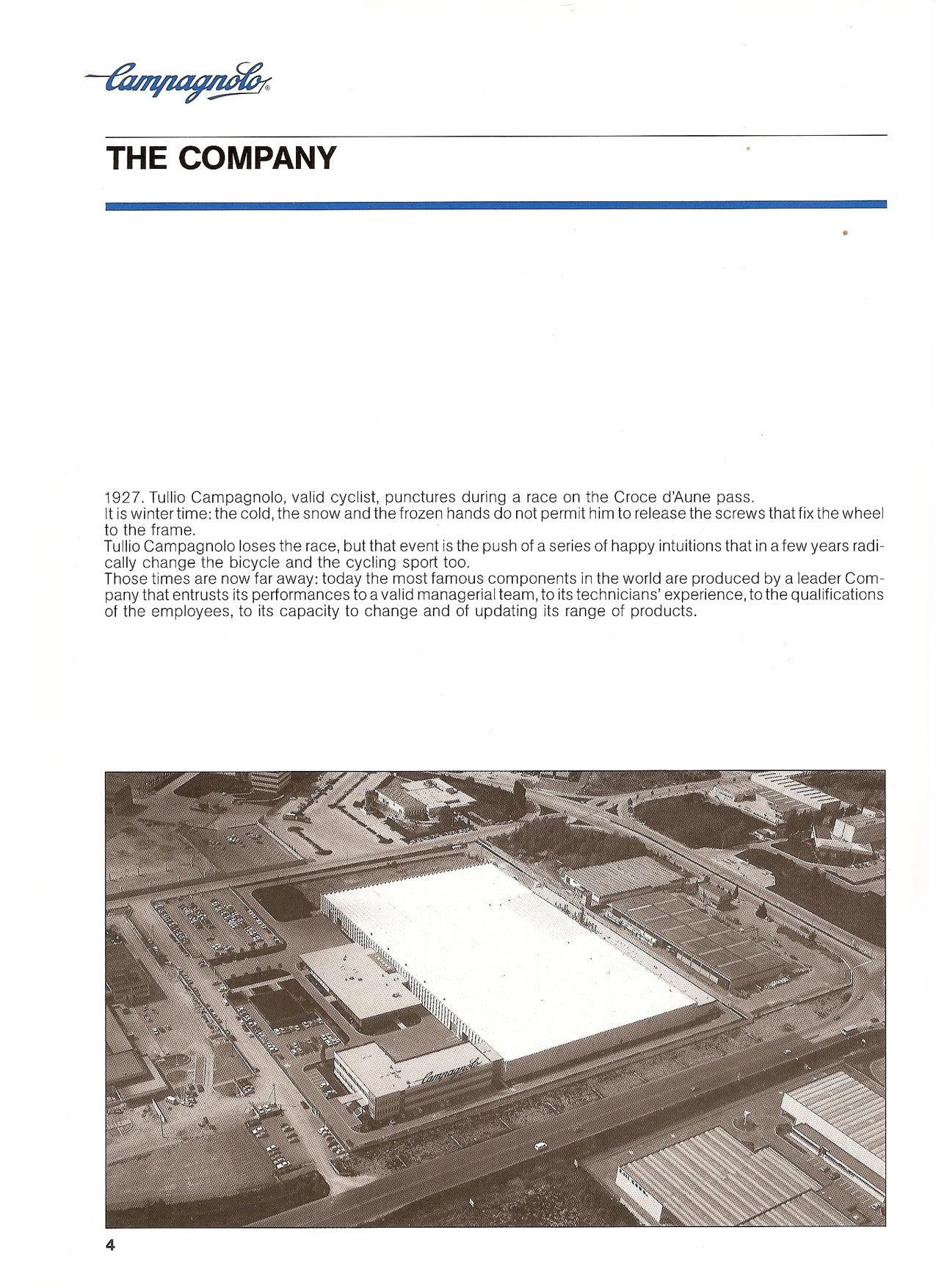
It also records the strain of the new decade. The top road group of the C-Record range was printed simply as “180 RECORD corsa group” and its new brake, the one collectors call the Delta, was not yet ready: “The brakes set 315/101 is not available when printing this catalogue” and the group shipped with a Super Record brake in its place. The word Delta appears in neither catalog and in the archive it first turns up in a Masi dealer’s catalog of 1988. The C-Record road crank moved to a 135-millimeter bolt circle. Catalog No. 18, reprinted in December 1986, marks the Gran Sport group “No more available and replaced by the “Victory” range,” one of two new middle groups, Victory and Triomphe, aimed at a market Shimano was by then capturing year over year, innovation over innovation.
The Japanese challenge had been building since Shimano’s Dura-Ace of 1973. Campagnolo answered Shimano’s indexed shifting of 1985 with its own Syncro system late in 1986, and Shimano’s integrated STI levers with Ergopower, shown in September 1991 for the 1992 season.
The years in between were among the hardest the firm had known. In October 1989 L’Unità reported from Vicenza that orders had fallen from 44 billion lire (or about $32 million USD) in the first quarter to 16 billion (or about $12 million USD) in the second, that 127 of the 500 workers had been put on reduced pay and that the heads of personnel, sales, administration and production had left within weeks. Valentino, “figlio del leggendario Tullio,” the son of the legendary Tullio, had not seemed able to control events, the paper wrote. The Benetton group, fresh from buying the ski-boot maker Nordica, came forward, but by the paper’s account it wanted to swallow the firm, while Campagnolo wanted financial backers. “Non sempre per i figli le orme dei padri sono facili da seguire,” the report ended: the fathers’ footsteps are not always easy for the sons to follow.
Ergopower is generally credited with restoring the firm and every Tour from 1991 to 1998 was won on Campagnolo. Valentino Campagnolo led the company for four decades. In a 2025 interview his son Davide said he had taken over as chief executive about 18 months earlier, marking the second such patriarchal transition in the company’s storied 90-year history.
The 21st century brought 11-speed groups in 2008, 12-speed in 2018, the 13-speed Ekar gravel group in 2020, the wireless Super Record in 2023 and 13-speed road groups from 2025. It also brought hard years for the firm financially. Campagnolo reported losses of more than €24 million (or $27 million USD) across its 2023 to 2025 financial years, and in November 2025 it proposed cutting 120 of about 300 jobs in Vicenza. A solidarity contract of reduced hours, approved by 77% of the staff, avoided dismissals through 2026. On 2 September 2026 the firm announced that SPAC SA, a Zurich holding company that several outlets link to the Pinarello owner Ivan Glasenberg, would take a minority stake, with the Campagnolo family keeping control. Three weeks later, at a regional labor meeting on 23 September, Campagnolo confirmed that 90 of its 259 Vicenza employees face redundancy when the solidarity contract ends on 31 December 2026. May this be a warm holiday season for all those whose lives are impacted by this change.
For owners of Campagnolo componentry, the record above turns into a few practical tells.
This article rests on documents and where the documents stop it says so. These questions remain open, with what would settle each one.
Ebykr’s research for this article drew on the 2014 reappraisal of Tullio Campagnolo by Jan Heine and David Herlihy in Bicycle Quarterly, on the Disraeli Gears derailleur archive, on the catalog archives of Campybike, Campy Only, bulgier.net and Retrobike, on the archive of L’Unità and on the federation of the Cavalieri del Lavoro, whose archive holds the form Tullio signed. Readers who hold a 1920s race report, an Italian patent file or an early Campagnolo document can send it to Ebykr through the Docs Drop.
Ebykr Catalog Archive
Campagnolo catalog, un-numbered, about 1951
Campagnolo catalog supplement, about 1952
Campagnolo parts sheets of about 1980, Vicenza edition
Campagnolo quick release hubs instructions, about 1960
Campagnolo Record gear instructions, about 1963
Campagnolo Sportman gear instructions, about 1963
Campagnolo Record brake instructions, February 1981
Campagnolo Record braze-on lever instructions, about 1982
Campagnolo Catalogo N. 12, about 1955
Campagnolo Catalogo N. 13, about 1956
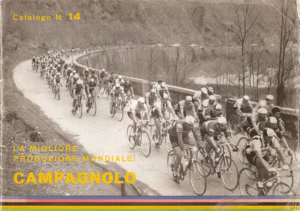
Campagnolo Catalogo N. 14, about 1958
Campagnolo Catalogo N. 15, about 1967
Campagnolo Catalogue No. 16, English Edition, about 1969
Campagnolo Supplement to Catalogue No. 16, November 1971
Campagnolo Catalogue No. 17, 1974
Campagnolo Catalog 17a, 1975
Campagnolo U.S.A. parts sheets, about 1980
Campagnolo 1982 catalog for the United States
Campagnolo Catalogue No. 18 bis, December 1985
Campagnolo Catalogue No. 18, December 1986 printing
Advertisement for F.B. hubs and Campagnolo blocages, L’Auto, 8 April 1935
Campagnolo advertisement, L’Équipe, 9 July 1946
Campagnolo advertisement, L’Équipe, 26 July 1948
Campagnolo advertisement, L’Officiel du cycle, 21 October 1950
Campagnolo advertisement, L’Équipe, 23 July 1951
Campagnolo advertisement, L’Officiel du cycle, Salon issue of 1951
Campagnolo advertisement, L’Équipe, 21 July 1952
Campagnolo advertisement, Le Cycle, 13 August 1955
The sporting and industrial record of the 1955 Tour de France, Le Cycle, 13 August 1955
Daniel Rebour, Le Salon de Paris 1951, Englebert Vélo-Magazine, November 1951
Daniel Rebour, the racing frame, Le Cycle, January 1964
Daniel Rebour, the 1964 Salon, Le Cycle, October 1964
Daniel Rebour, Le Salon de Paris 1966, Le Cycle, October 1966
Bianchi 1940 catalog
Claud Butler 1961 catalog
Mel Pinto catalog, Campagnolo page
Masi World Wide brochure
Ebykr
How to Date a Vintage Bicycle by Its Components
Tech Specs: 1940s Cavalieri Cambio Corsa
Tech Specs: 1951 Legnano Tipo Roma
Tech Specs: 1955 Bianchi Campione del Mondo
Tech Specs: 1963 Cinelli Mod. Super Corsa
Patents
GB 415,683, convention date (Italy) 4 May 1933, scanned at Disraeli Gears
DE 939,674, the cam quick release, Italian priority 22 April 1943
ES 189,005, filed in Madrid 9 July 1949
ES 222,339, the Gran Sport, filed 10 June 1955
ES 253,411, the Record crankset, Italian application No. 14.353 of 19 November 1958
US 3,070,270, clothes hanging device, granted 25 December 1962
US 3,182,755, hydraulically and mechanically operated disc brake
US 3,373,845, high performance friction disc brake
US Des. 231,518, the Nuovo Record derailleur design
US 4,486,184, freewheel, assigned to Campagnolo S.p.A.
Disraeli Gears, who invented the parallelogram derailleur
Records and press
Archivio di Stato di Vicenza, civil birth act 930 of 1901 (Portale Antenati)
Federazione Nazionale dei Cavalieri del Lavoro, Getullio Campagnolo
Federazione Nazionale dei Cavalieri del Lavoro, archive form signed by Tullio Campagnolo
Federazione Nazionale dei Cavalieri del Lavoro, Valentino Campagnolo
SAN Archivi d’impresa, Campagnolo, Getullio (Tullio)
CONI, Antonio Negrini
Le Vie d’Italia, 1935 volume (Touring Club Italiano), Biblioteca Digitale Lombarda
Daniel Rebour and Le Cycle, 27 October, 26 November and 17 December 1949
L’Unità, 11 January 1949
L’Unità, 24 December 1973
L’Unità, 4 February 1981
L’Unità, 25 June 1981
L’Unità, 2 February 1983
L’Unità, 26 October 1989
Time, Milestones, 14 February 1983
Road Bike Action, interview with Valentino Campagnolo (2008)
Cycling Weekly, Valentino Campagnolo: The Big Interview, December 2010
Il Giornale di Vicenza, letter of Ugo Dal Lago, 5 February 2012
Jan Heine, A Reappraisal of Tullio Campagnolo (Bicycle Quarterly, Summer 2014)
Campy Only, Campagnolo catalogs
Campagnolo heritage
BikeRadar, SPAC SA investment, 2 September 2026
Bicycle Retailer, 1 September 2026
Velora, November 2025
Brújula, February 2026
Bikeitalia, 1 October 2026
 Campagnolo
Ebykr documents this marque across the archive. Here is the rest of it.
The Ebykr Digest
New articles, timelines, catalog finds and registry activity — assembled from the archive once a month. Your address is never shared.
Double opt-in. One email per month. Unsubscribe at any time with one click.