About Ebykr
Ebykr celebrates classic and vintage lightweight bicycles through provocative imagery and opinion. Ride along with us.
About Ebykr
Ebykr celebrates classic and vintage lightweight bicycles through provocative imagery and opinion. Ride along with us.

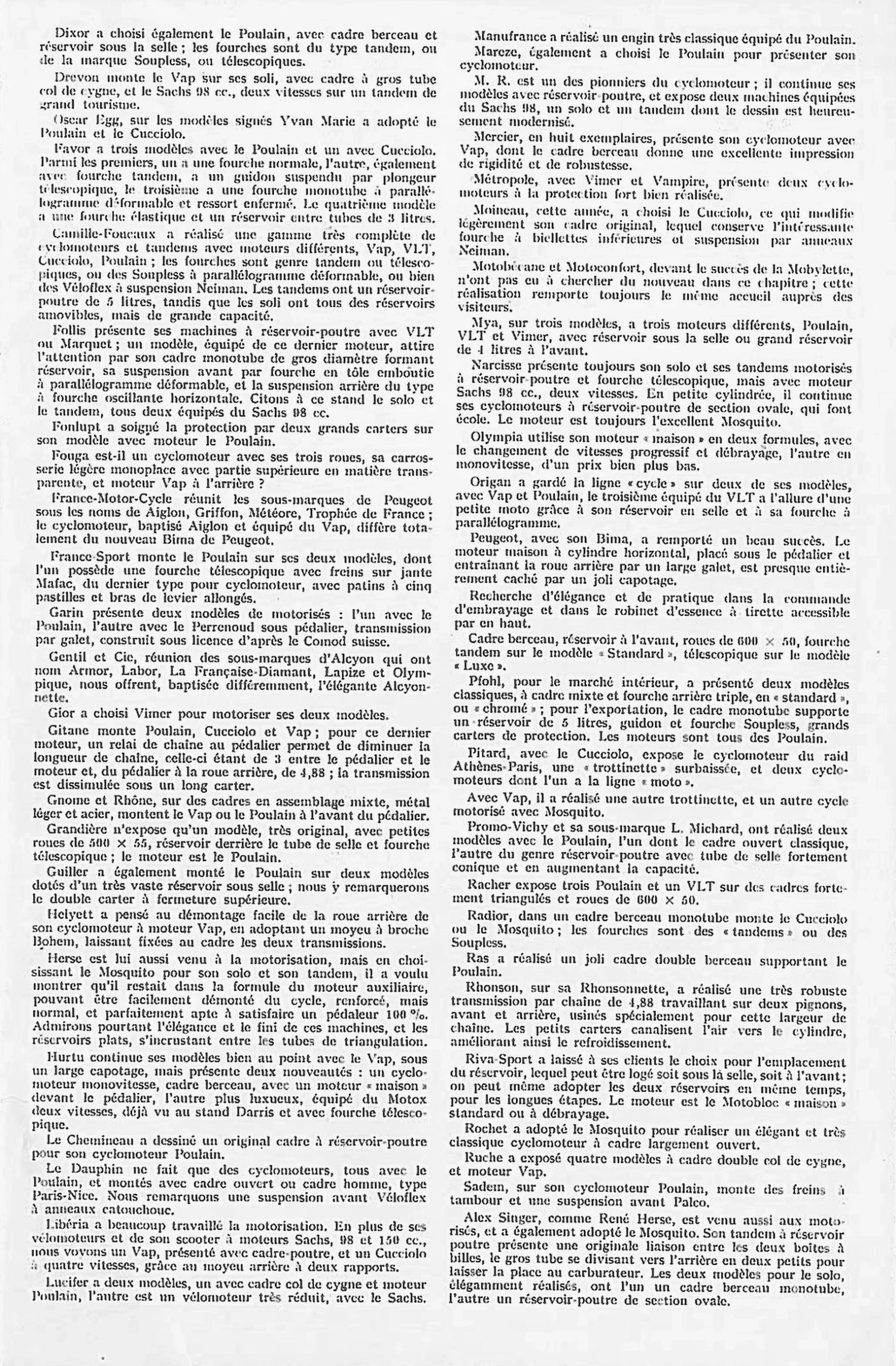
Source: Englebert Vélo-Magazine, n° 16, November 1951, pages 5, 6, 7, 8, 9, 10, 11 and 12 (the issue prints no folios: pages counted from the front cover); scan of the issue from Cycle Memory (Mémoire du Cycle), Collection privée
| Type | Review |
|---|---|
| Year | 1951 |
| Publisher | Englebert Vélo-Magazine |
| Artist | Daniel Rebour |
| Country | France |
| Language | French |
| Pages | 8 |
| Source | Englebert Vélo-Magazine, n° 16, November 1951, pages 5, 6, 7, 8, 9, 10, 11 and 12 (the issue prints no folios: pages counted from the front cover); scan of the issue from Cycle Memory (Mémoire du Cycle), Collection privée |
| Credit | Ebykr archive |
| Identifier | Permalink https://cyclememory.org/fr/search-coll-list.php?collectionID=1999&docID=B-1-0000000980 |
| Transcription | Headings and specifications transcribed; article text summarized |
LE SALON DE PARIS 1951 par notre correspondant de France DANIEL REBOUR. * * * * * * * * * Au Salon de Paris 1951 1 · 2 · 3 · 4 · 5 · 6 · 7 (Documents graphiques « Le Cycle ».) LES CYCLOMOTEURS 1. · 2. · 3. · 4. · …
This is a magazine article, so its running text is summarized here rather than reproduced; the headline, byline, specifications and scores are transcribed as printed.
Daniel Rebour’s report on the 1951 Paris Salon du Cycle et de la Moto, “Le Salon de Paris 1951”, in Englebert Vélo-Magazine, n° 16, November 1951: vélomoteurs, cyclomoteurs, cycles and accessories maker by maker, with three of his plates of numbered drawings, reprinted from Le Cycle, and photographs of the stands. The title, headings, plate captions’ numbers and signature are transcribed as printed; the text and captions are summarized in Ebykr’s words, and the page images carry them in full.
— Page 1 —
LE SALON DE PARIS 1951
par notre correspondant de France DANIEL REBOUR.
* * *
* * *
* * *
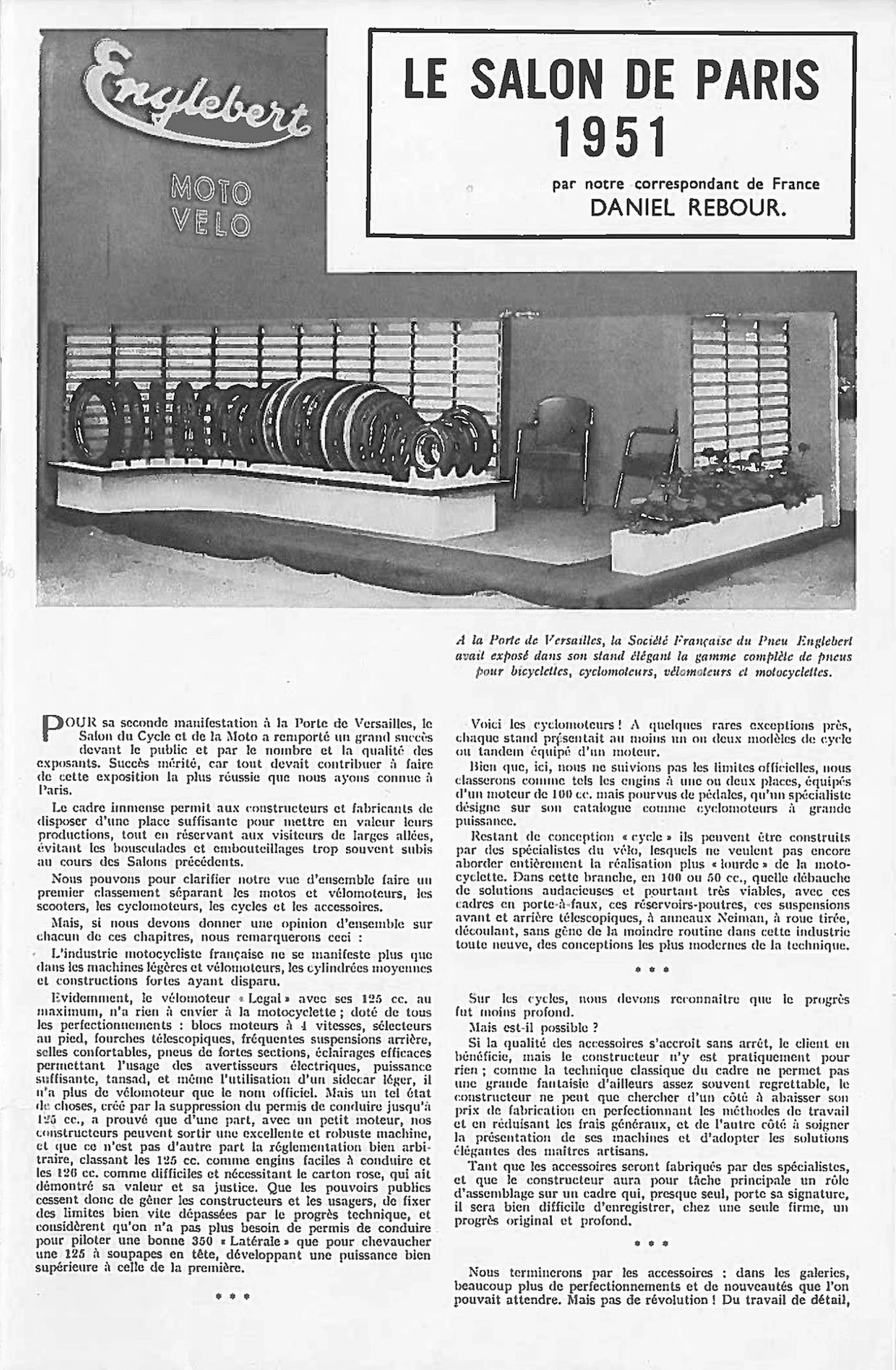
[Ebykr summary; the article’s text is not reproduced. Daniel Rebour opens his report on the Paris show of 1951, the Salon du Cycle et de la Moto, held for the second time at the Porte de Versailles. He calls it a great success with the public and in the number and quality of its exhibitors, the most successful show he has seen in Paris, and credits the vast hall, which gave makers room to display their products and visitors wide aisles, without the crushes of earlier Salons. He sorts the show into motorcycles and vélomoteurs, scooters, cyclomoteurs, cycles and accessories. The French motorcycle industry, he says, now builds only light machines and vélomoteurs; medium and large capacities have disappeared. The “Legal” vélomoteur, limited to 125 cc., lacks nothing of a motorcycle: four-speed engine units with foot change, telescopic forks, frequent rear suspension, comfortable saddles, large-section tires, lighting strong enough for electric horns, a tansad (pillion seat) and even a light sidecar. He argues that the abolition of the driving license up to 125 cc. proved that small engines make excellent machines, and he attacks the arbitrary rule that treats a 125 cc. as easy to ride and a 126 cc. as needing the pink license, urging the authorities to stop hampering makers and riders: a side-valve 350 (“Latérale”) needs no more skill than an overhead-valve 125 that is more powerful. On cyclomoteurs, nearly every stand showed one or two motorized cycles or tandems; he counts as cyclomoteurs one- and two-seat machines with engines up to 100 cc. that keep their pedals, which one maker catalogs as high-powered cyclomoteurs. Being of cycle design they can be built by bicycle specialists not yet ready for the heavier motorcycle, and in 100 and 50 cc. form they show bold but practical ideas: cantilever frames, beam-type tanks, telescopic front and rear suspension with Neiman rings and leading-link (pulled-wheel) forks. On cycles, he finds progress less deep, and asks whether more is possible: accessories improve constantly, but the frame builder gains little, since classic frame technique allows little fantasy; the maker can only cut costs through better methods and lower overheads and polish presentation by adopting the elegant solutions of the master craftsmen (artisans). As long as specialists make the accessories and the maker mainly assembles them on a frame that alone carries his name, original progress from a single firm will be hard to find. He turns finally to the accessories in the galleries: many refinements and novelties, but no revolution, only detail work (the sentence continues overleaf; the print gives no page reference).]
[A wide photograph shows the Englebert stand: a large script “Englebert” sign above the words “MOTO VELO” on the back wall, a long curved white plinth carrying a row of tires of graded sizes in front of slatted screens and at the right two tubular chairs and a planter of flowers. The italic caption beneath says that at the Porte de Versailles the Société Française du Pneu Englebert showed, on its elegant stand, its complete range of tires for bicycles, cyclomoteurs, vélomoteurs and motorcycles. The page carries no drawing and no “Rebour” signature.]
— Page 2 —
Au Salon de Paris 1951
1 · 2 · 3 · 4 · 5 · 6 · 7
(Documents graphiques « Le Cycle ».)
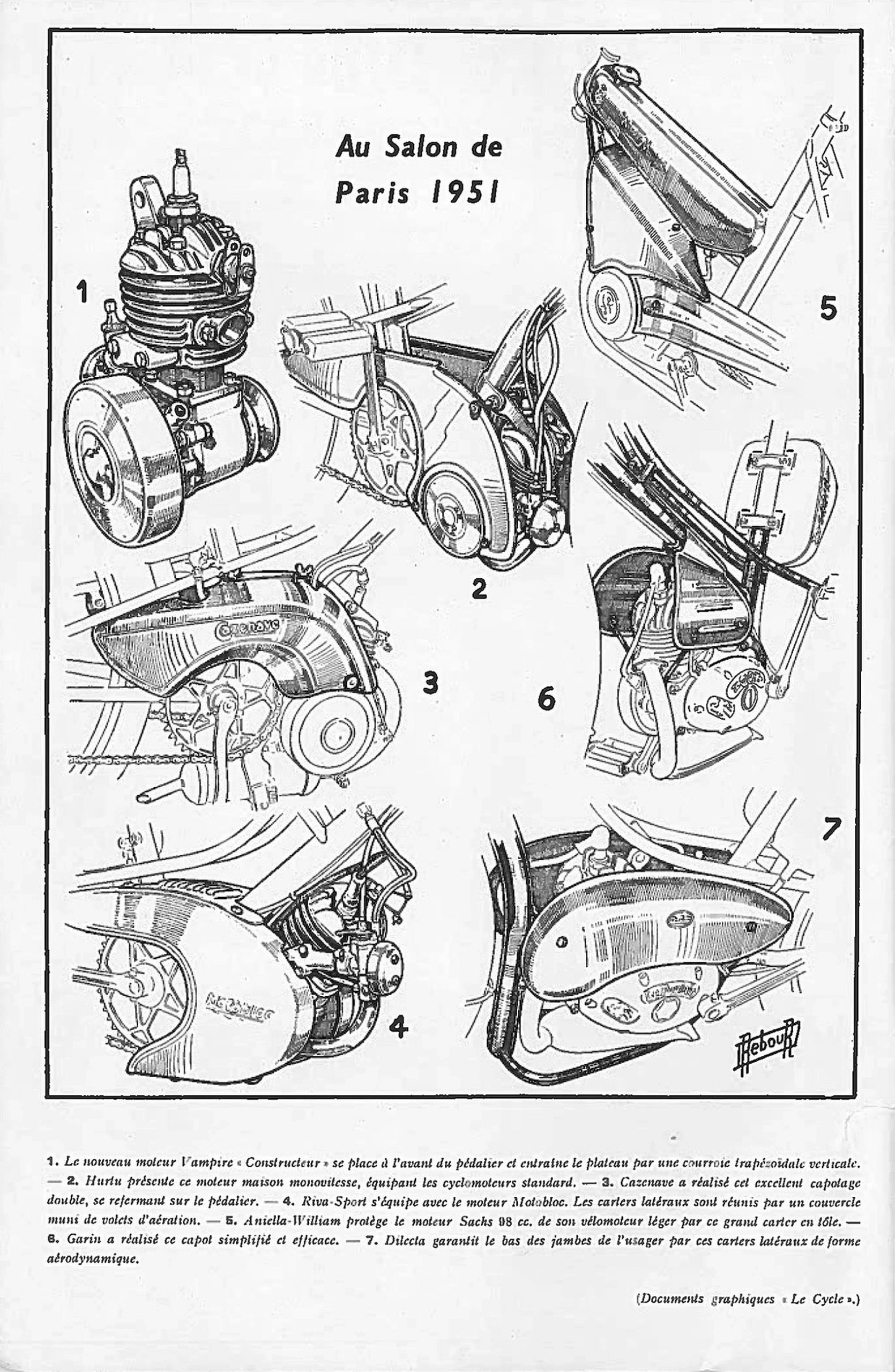
[Ebykr summary; the article’s text is not reproduced. The page is a plate of seven numbered drawings with a numbered caption list (1 to 7) beneath it. 1: the new Vampire “Constructeur” engine, mounted ahead of the bottom bracket and driving the chainwheel by a vertical V-belt. 2: Hurtu’s own single-speed engine, fitted to its standard cyclomoteurs. 3: Cazenave’s double engine cowling, which closes over the bottom bracket. 4: Riva-Sport’s machine with the Motobloc engine; its side casings are joined by a cover fitted with ventilation louvers. 5: Aniella-William’s large sheet-metal casing enclosing the Sachs 98 cc. engine of its light vélomoteur. 6: Garin’s simplified and effective engine cowl. 7: Dilecta’s streamlined side casings, which protect the lower legs of the rider.]
[A framed plate of seven pen drawings, each numbered in bold, shows engine installations on cyclomoteurs and light vélomoteurs seen at the show. 1 is a three-quarter view of a bare finned single-cylinder engine with its round flywheel cover; 2 is a small engine under the bottom bracket of a bicycle frame, with its rear pulley and chain; 3 is a cowled engine at the bottom bracket whose casing bears the name “Cazenave”; 4 is a fully cased engine and chainwheel whose casing bears the name “Motobloc”; 5 is a diagonal frame tube with a long tank and large sheet casing above a crankcase cover carrying a round emblem; 6 is an engine with a dark cowl behind the cylinder and an emblem on its crankcase cover, with a rounded box clamped to the seat tube above; 7 is a streamlined side casing seen from low on the right. The plate carries one signature, “Rebour”, in block capitals within his ruled-fence monogram, at the lower right corner of the frame beside drawing 7. The credit line sits below the captions at the lower right.]
— Page 3 —
LES CYCLOMOTEURS
1. · 2. · 3. · 4. · 5.
(Pneus Englebert).
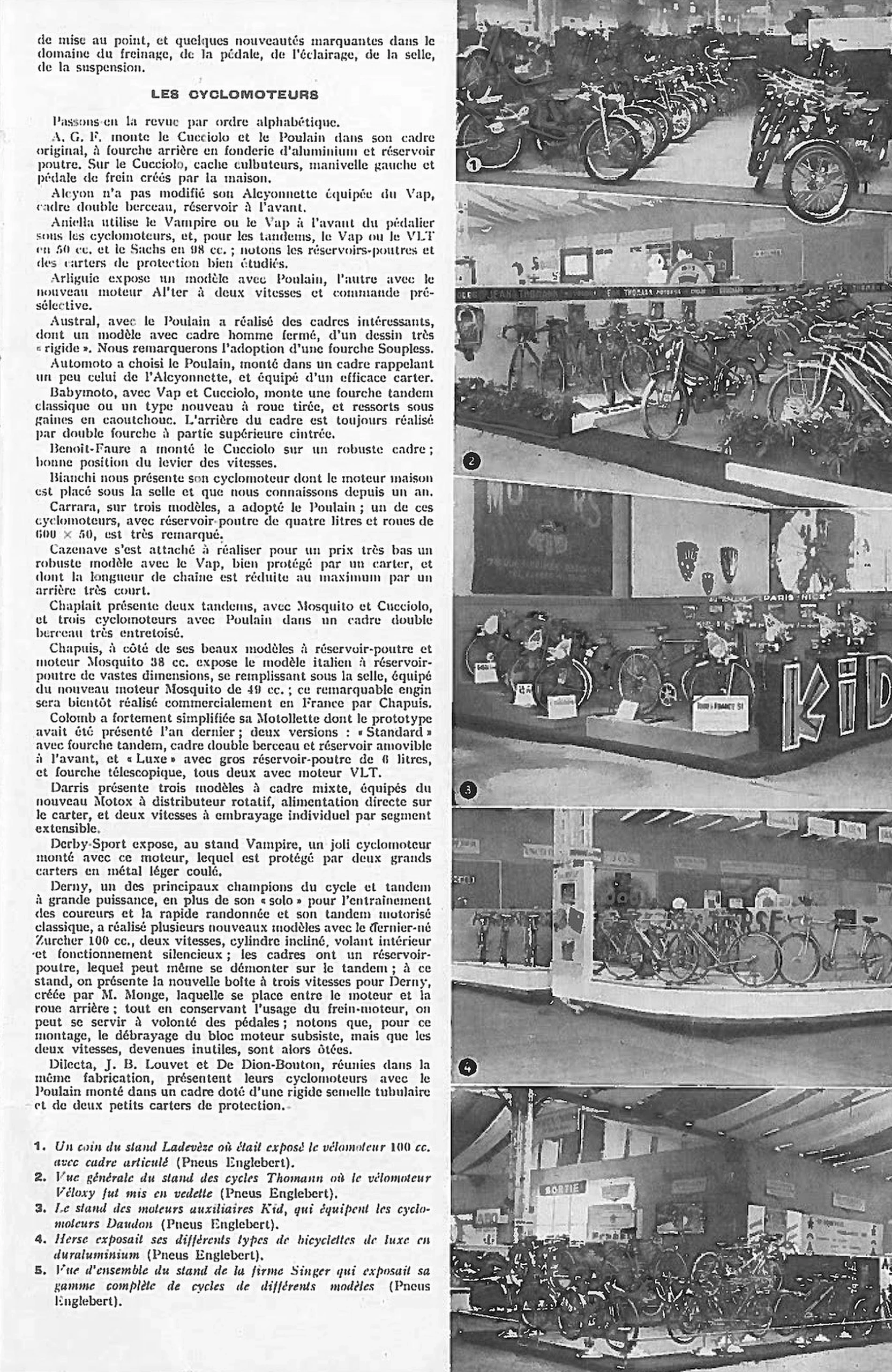
[Ebykr summary; the article’s text is not reproduced. The page opens by finishing the sentence begun at the foot of the title page: the accessories show detail work and refinement, with a few notable novelties in brakes, pedals, lighting, saddles and suspension. Under the heading on cyclomoteurs, Rebour reviews the makers in alphabetical order. A. G. F. fits the Cucciolo and the Poulain in its own frame with a cast aluminum rear fork and a beam tank, and adds its own rocker cover, left-hand crank and brake pedal to the Cucciolo. Alcyon keeps its Alcyonnette unchanged, with the Vap, a double-cradle frame and a front tank. Aniella uses the Vampire or the Vap ahead of the bottom bracket on its cyclomoteurs, and for tandems the Vap or the VLT in 50 cc. and the Sachs in 98 cc., with well-designed beam tanks and protective casings. Arliguie shows one model with the Poulain and another with the new two-speed Al’ter engine with preselector control. Austral builds interesting Poulain-engined frames, among them a closed men’s frame of very rigid design, and adopts a Soupless fork. Automoto uses the Poulain in a frame recalling the Alcyonnette, with an effective casing. Babymoto, with Vap and Cucciolo, fits either a classic tandem fork or a new leading-link type with springs in rubber sleeves; its rear frame is a double fork with a curved upper part. Benoit-Faure mounts the Cucciolo on a sturdy frame with a well-placed gear lever. Bianchi shows its cyclomoteur with the house engine under the saddle, known for a year. Carrara uses the Poulain on three models, one with a four-liter beam tank and 600 x 50 wheels. Cazenave offers a cheap, sturdy Vap model with a protecting casing and a very short rear end that minimizes chain length. Chaplait shows two tandems with Mosquito and Cucciolo and three cyclomoteurs with the Poulain in a heavily braced double-cradle frame. Chapuis, beside its beam-tank models with the Mosquito 38 cc., shows an Italian model with a very large beam tank filled under the saddle and the new 49 cc. Mosquito, soon to be built in France by Chapuis. Colomb has much simplified its Motollette, shown as a prototype the year before, in two versions with the VLT engine: “Standard” (tandem fork, double-cradle frame, removable front tank) and “Luxe” (large 6-liter beam tank, telescopic fork). Darris shows three mixte-frame models with the new Motox rotary-valve engine, direct crankcase induction and two speeds with individual expanding-segment clutches. Derby-Sport shows, on the Vampire stand, a cyclomoteur with that engine under two large cast light-alloy casings. Derny, a leading builder of high-powered cycles and tandems, besides its “solo” for pacing riders and fast touring and its classic motorized tandem, shows new models with the latest Zurcher 100 cc. (two speeds, inclined cylinder, internal flywheel, quiet running), with beam tanks that can be removed on the tandem; the stand also shows a new three-speed gearbox for Derny designed by M. Monge, set between engine and rear wheel, which keeps engine braking and free use of the pedals, retains the engine unit’s clutch and removes its two speeds. Dilecta, J. B. Louvet and De Dion-Bouton, now built together, show cyclomoteurs with the Poulain in a frame with a rigid tubular sole and two small protective casings. Photograph captions: 1, a corner of the Ladevèze stand with its 100 cc. vélomoteur with articulated frame; 2, the Thomann cycles stand, featuring the Véloxy vélomoteur; 3, the stand of Kid auxiliary engines, which power Daudon cyclomoteurs; 4, Herse showing its duralumin luxury bicycles; 5, the Singer stand with its full range of cycles. Each caption ends with the credit “(Pneus Englebert)”.]
[Five numbered photographs run down the right side of the page, each number in a black disk at the lower left. 1 shows rows of cyclomoteurs and a motorized tricycle on the Ladevèze stand; 2 shows the Thomann stand, with bicycles and cyclomoteurs below a banner lettered “JEAN THOMANN” and “THOMANN”; 3 shows the Kid engine stand, with motorized bicycles and engines on display, large illuminated letters “KiD” at the corner and a “PARIS – NICE” banner above; 4 shows the Herse stand, with lightweight bicycles and a tandem against a wall lettered with the name; 5 shows the Singer stand, a corner display of bicycles under a sign reading “SORTIE”. The page carries no drawing and no “Rebour” signature.]
— Page 4 —
Au Salon de Paris 1951
1 · 2 · 3 · 4 · 5 · 6 · 7 · 8 · 9
(Documents graphiques « Le Cycle ».)
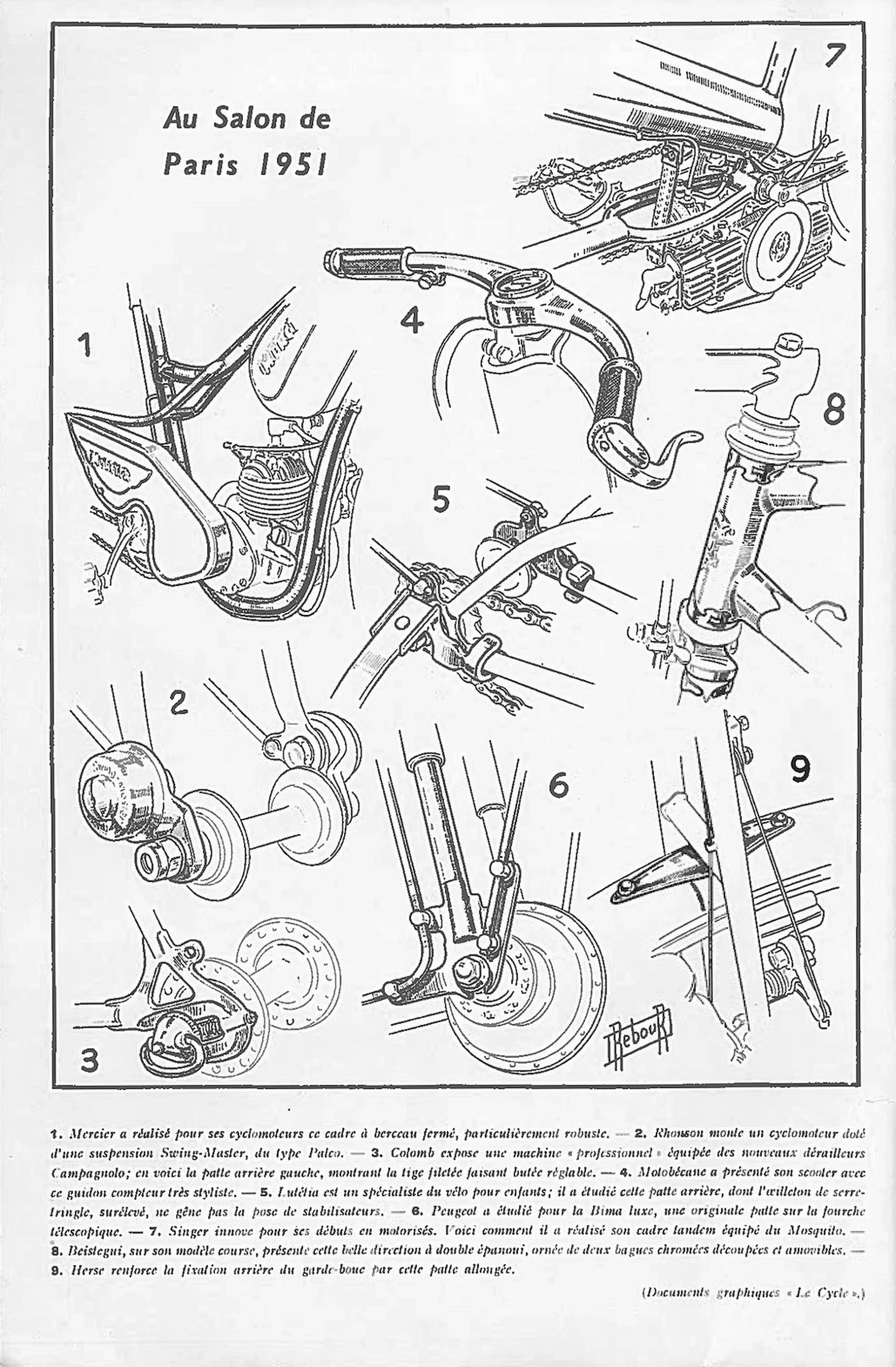
[Ebykr summary; the article’s text is not reproduced. The page is a second plate of nine numbered drawings with a numbered caption list (1 to 9) beneath it. 1: the closed-cradle frame, notably sturdy, that Mercier built for its cyclomoteurs. 2: a Rhonson cyclomoteur fitted with Swing-Master suspension of the Palco type. 3: Colomb’s “professionnel” machine with the new Campagnolo derailleurs, shown by its left rear dropout with the threaded rod that serves as an adjustable stop. 4: the very stylish handlebar with built-in speedometer on the Motobécane scooter. 5: a rear dropout by the children’s-bicycle specialist Lutétia, whose raised chain-stay eyelet leaves room to fit stabilizers. 6: Peugeot’s original dropout on the telescopic fork of the Bima luxe. 7: Singer, new to motorized machines, and its tandem frame fitted with the Mosquito. 8: the handsome double-flared head set on Beistegui’s racing model, trimmed with two removable cut-out chromed rings. 9: Herse’s lengthened bracket strengthening the rear mudguard fixing.]
[A framed plate of nine pen drawings, each numbered in bold, shows details seen at the show. 1 is a cyclomoteur engine in a closed tubular cradle below a tank and a casing, each bearing a name too small to read; 2 is a rear hub and dropout with a sprung housing lettered “Swing-Master”; 3 is a rear dropout with a derailleur and a perforated hub flange; 4 is a curved scooter handlebar with a round speedometer set at its center; 5 is a rear dropout and chain stay with a derailleur and chain; 6 is the lower end of a telescopic fork leg with its dropout and front hub; 7 is the lower part of a tandem frame with the Mosquito engine and its chain; 8 is a head tube with ornate lug rings and the head set; 9 is a long bracket fixing a mudguard to the rear stays. The plate carries one signature, “Rebour”, in block capitals within his ruled-fence monogram, at the lower center beside the wheel of drawing 6 and left of drawing 9. The credit line sits below the captions at the lower right.]
— Page 5 —
[Ebykr summary; the article’s text is not reproduced. The page carries no heading: it continues, in two columns, the alphabetical review of cyclomoteurs (motor-assisted cycles) begun under LES CYCLOMOTEURS earlier in the article, running from Dixor to Alex Singer. Dixor fits the Poulain engine in a cradle frame with the tank under the saddle, on tandem-type, Soupless or telescopic forks. Drevon mounts the Vap on its solos, with a big-tube swan-neck frame, and the Sachs 98 cc two-speed on a grand-touring tandem. Oscar Egg uses the Poulain and the Cucciolo on models signed Yvan Marie. Favor shows three Poulain models and one Cucciolo: a normal fork; a tandem fork with a handlebar suspended on a telescopic plunger; a monotube parallelogram fork with enclosed spring; and an elastic fork with a 3-liter tank between the tubes. Camille-Foucaux has a full range of cyclomoteurs and tandems with Vap, VLT, Cucciolo and Poulain engines, on tandem, telescopic, Soupless parallelogram or Véloflex forks with Neiman suspension; the tandems have a 5-liter beam tank, the solos large removable tanks. Follis shows beam-tank machines with VLT or Marquet; the Marquet model has a large-diameter monotube frame forming the tank, a pressed-steel parallelogram front fork and a horizontal swinging-fork rear suspension; a solo and a tandem carry the Sachs 98 cc. Fonlupt protects its Poulain model with two large casings. Fouga shows a three-wheeled single-seat cyclomoteur with a light body, a transparent upper part and a rear Vap engine. France-Motor-Cycle groups the Peugeot sub-brands Aiglon, Griffon, Météore and Trophée de France; its Vap-powered cyclomoteur, named Aiglon, is quite unlike the new Peugeot Bima. France-Sport fits the Poulain on two models, one with a telescopic fork and the latest Mafac rim brakes for cyclomoteurs, with five-pad shoes and lengthened lever arms. Garin shows a Poulain model and one with the Perrenoud engine under the bottom bracket, with roller drive, built under license from the Swiss Comod. Gentil et Cie, grouping the Alcyon sub-brands Armor, Labor, La Française-Diamant, Lapize and Olympique, offer the Alcyonnette under other names. Gior motorizes two models with the Vimer. Gitane fits the Poulain, Cucciolo and Vap; for the Vap a chain relay at the bottom bracket shortens the chain (3 between bracket and engine, 4,88 from bracket to rear wheel, units not printed), hidden under a long casing. Gnome et Rhône mount the Vap or the Poulain ahead of the bottom bracket on mixed light-alloy and steel frames. Grandière shows one original model with small 500 × 55 wheels, a tank behind the seat tube, a telescopic fork and the Poulain. Guiller fits the Poulain to two models with a very large under-saddle tank and a double casing closing at the top. Helyett makes the rear wheel of its Vap cyclomoteur easy to remove with a Bohem through-spindle hub that leaves both drives on the frame. Herse has taken up motorization with the Mosquito on a solo and a tandem, keeping to the removable auxiliary engine on a reinforced but normal cycle fit for a 100 % pedaler; the writer admires their finish and the flat tanks set between the frame tubes. Hurtu continues its Vap models under a wide cowling and shows two novelties: a single-speed cradle-frame cyclomoteur with a house engine ahead of the bottom bracket, and a deluxe model with the two-speed Motox (already seen at the Darris stand) and a telescopic fork. Le Chemineau has an original beam-tank frame for its Poulain cyclomoteur. Le Dauphin makes only cyclomoteurs, all with the Poulain, in open or men’s frames of the Paris-Nice type, with a Véloflex front suspension on rubber rings. Libéria shows vélomoteurs and a scooter with Sachs 98 and 150 cc engines, a Vap with a beam frame and a four-speed Cucciolo using a two-ratio rear hub. Lucifer has a swan-neck-frame model with the Poulain and a very small vélomoteur with the Sachs. Manufrance shows a very classic machine with the Poulain, and Mareze also chose the Poulain. M. R., one of the pioneers of the cyclomoteur, keeps its beam-tank models and shows a solo and a tandem with the Sachs 98, their lines modernized. Mercier, showing eight examples, presents its Vap cyclomoteur with a rigid, robust cradle frame. Métropole shows two well-protected cyclomoteurs with the Vimer and the Vampire. Moineau has adopted the Cucciolo, slightly changing its original frame, which keeps the fork with lower links and the Neiman ring suspension. Motobécane et Motoconfort, given the success of the Mobylette, show nothing new; it still draws visitors. Mya fits three engines (Poulain, VLT and Vimer) to three models, with the tank under the saddle or a large 4-liter tank in front. Narcisse still shows its solo and motorized tandems with beam tank and telescopic fork, now with the Sachs 98 cc two-speed, and in the small class its oval-section beam-tank cyclomoteurs with the Mosquito. Olympia offers its house engine in two versions, one with progressive gear change and clutch, the other single-speed and much cheaper. Origan keeps a “cycle” line on two models with the Vap and the Poulain; the third, with the VLT, looks like a small motorcycle with its tank at the saddle and a parallelogram fork. Peugeot had a great success with its Bima: the house engine with horizontal cylinder sits under the bottom bracket and drives the rear wheel by a wide roller, almost wholly hidden under a cowling; the clutch control and a pull-knob fuel tap are reachable from above; cradle frame, front tank, 600 × 50 wheels, tandem fork on the “Standard” model and telescopic fork on the “Luxe”. Pfohl shows two classic models for the home market with a mixte frame and triple rear stays, “standard” or “chromé”, and for export a monotube frame carrying a 5-liter tank, Soupless handlebar and fork and large protective casings, all with Poulain engines. Pitard shows, with the Cucciolo, the cyclomoteur of the Athènes-Paris raid, a lowered “trottinette” and two cyclomoteurs (one in the “moto” style), and with the Vap another trottinette, plus a motorized cycle with the Mosquito. Promo-Vichy and its sub-brand L. Michard show two Poulain models, one with a classic open frame, the other a beam-tank type whose strongly conical seat tube adds capacity. Racher shows three Poulain and one VLT on strongly triangulated frames with 600 × 50 wheels. Radior fits the Cucciolo or the Mosquito in a monotube cradle frame with tandem or Soupless forks. Ras has a double-cradle frame carrying the Poulain. Rhonson, on its Rhonsonnette, uses a very robust 4,88 chain drive on two sprockets machined for that chain width, with small casings that duct air to the cylinder for cooling. Riva-Sport lets buyers place the tank under the saddle, in front or both for long stages; its engine is the house Motobloc, standard or with clutch. Rochet uses the Mosquito in an elegant, classic, wide-open frame. Ruche shows four Vap models with a double swan-neck frame. Sadem fits drum brakes and a Palco front suspension to its Poulain cyclomoteur. Alex Singer, like René Herse, has turned to motorized machines with the Mosquito; his beam-tank tandem has an original link between the two bottom-bracket shells, the big tube dividing toward the rear into two small tubes to clear the carburetor, and his two solo models have a monotube cradle frame and an oval-section beam tank.]
[The page carries no drawings or photographs: it is two columns of text.]
— Page 6 —
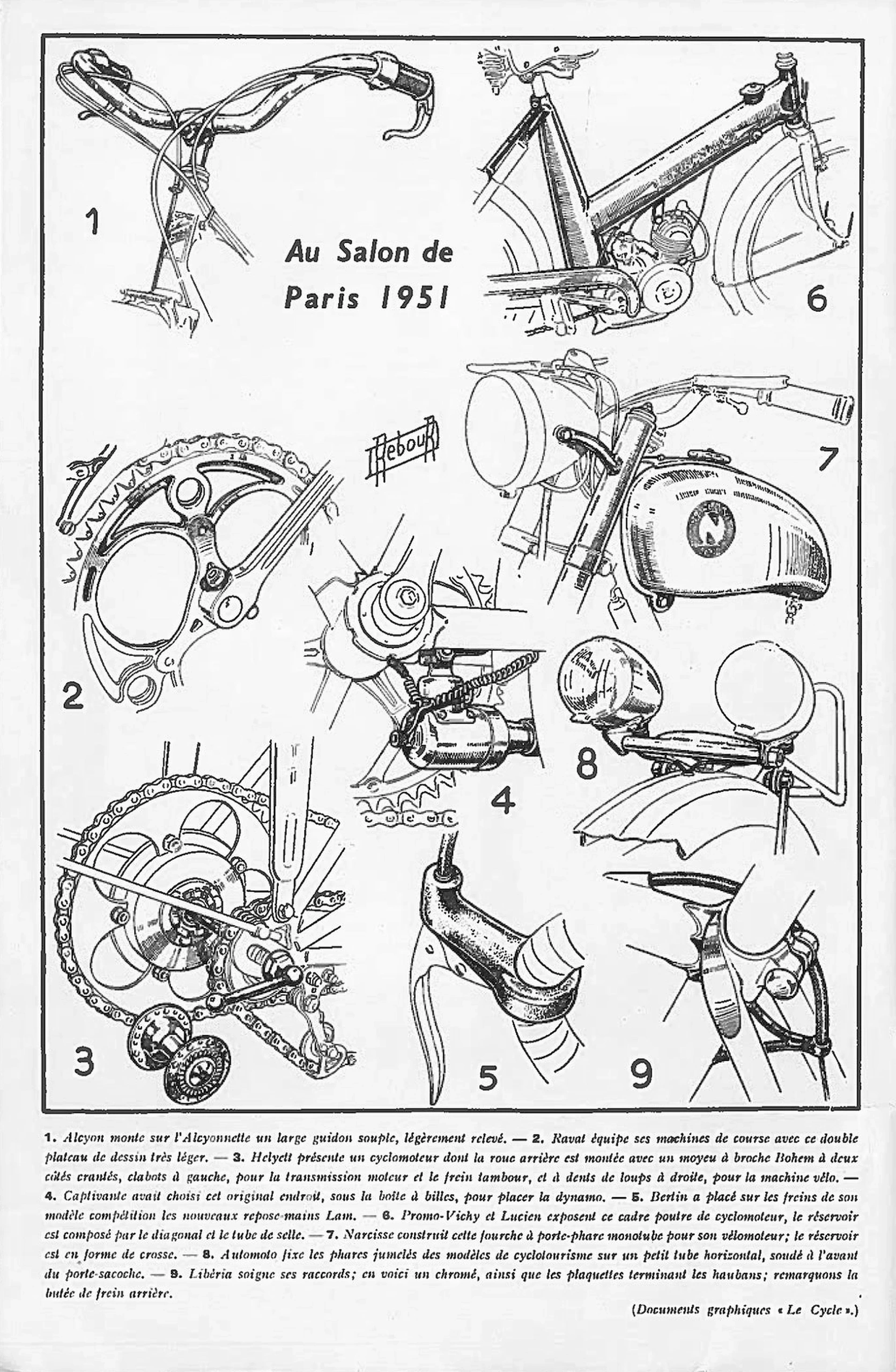
Au Salon de Paris 1951
1.
2.
3.
4.
5.
6.
7.
8.
9.
(Documents graphiques « Le Cycle ».)
[Ebykr summary; the plate’s captions are not reproduced. A numbered caption list under the plate explains its nine drawings. 1: Alcyon fits the Alcyonnette with a wide, flexible handlebar, slightly raised. 2: Ravat equips its racing machines with a double chainring of very light design. 3: Helyett shows a cyclomoteur whose rear wheel is mounted on a Bohem through-spindle (broche) hub with toothed ends, dogs on the left for the engine drive and the drum brake, and wolf-tooth splines on the right for the pedal drive. 4: Captivante chose an original place for the dynamo, under the bottom-bracket shell. 5: Bertin fits the new Lam hand rests to the brakes of its competition model. 6: Promo-Vichy and Lucien show a cyclomoteur beam frame whose tank is formed by the down tube and the seat tube. 7: Narcisse builds a monotube fork with headlamp carrier for its vélomoteur, with a crook-shaped tank. 8: Automoto fixes the twin headlamps of its touring models on a small horizontal tube welded to the front of the bag carrier. 9: Libéria takes care over its lugs, here a chromed one, and over the plates that end the seat stays, with a rear-brake cable stop.]
[A full-page plate in a ruled frame, its heading set in two lines at the upper left beside drawing 1, shows nine numbered pen drawings of details seen at the show: 1, a raised flexible handlebar with brake levers and cables above the head of an Alcyonnette; 2, a lightweight double chainring with cut-out spider, chain and crank; 3, a rear hub with chain, sprocket, drum brake and removable wheel, the hub shown separately below; 4, a dynamo mounted beneath the bottom-bracket shell, driven at the chainring; 5, a brake lever with a hand rest on a dropped bar; 6, a beam-type cyclomoteur frame with the engine below the down tube and a chain guard; 7, a headlamp mounted on a monotube fork ahead of a curved fuel tank with a round “N” badge; 8, twin headlamps on a horizontal bar above a front mudguard; 9, a chromed lug, stay plates and brake stop at the rear of the frame. The plate carries one signature, “Rebour” in his boxed script monogram, in open space near the center of the plate, above drawing 4 and to the right of drawing 2. The credit line “(Documents graphiques « Le Cycle ».)” sits at the lower right under the captions.]
— Page 7 —
* * *
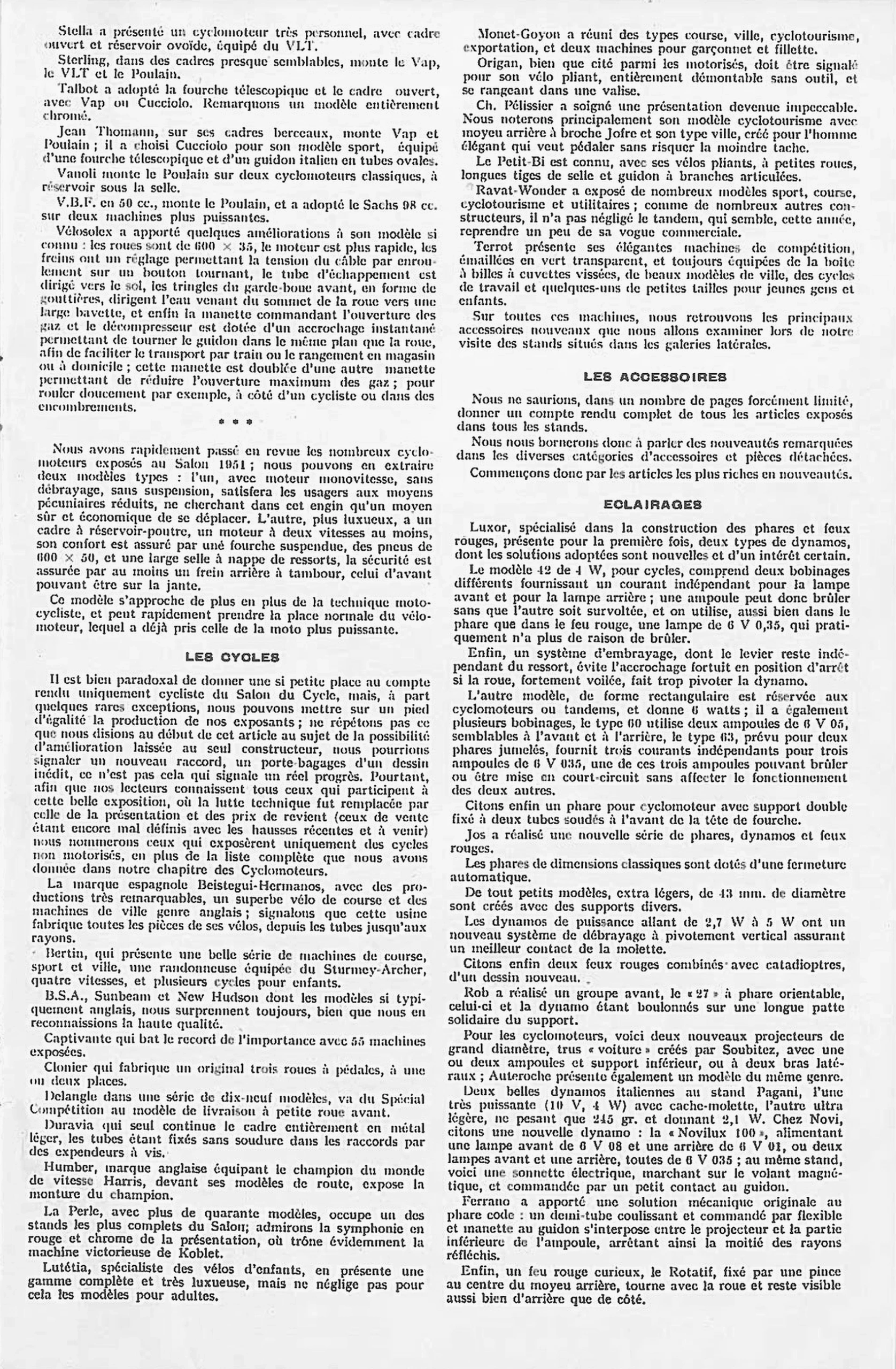
LES CYCLES
LES ACCESSOIRES
ECLAIRAGES
[Ebykr summary; the article’s text is not reproduced. The left column finishes the alphabetical review of cyclomoteurs. Stella shows a very individual cyclomoteur with an open frame and an egg-shaped tank, powered by the VLT. Sterling fits the Vap, the VLT and the Poulain in almost identical frames. Talbot adopts the telescopic fork and the open frame with the Vap or the Cucciolo, including an all-chromed model. Jean Thomann fits the Vap and the Poulain in cradle frames and the Cucciolo in a sport model with a telescopic fork and an Italian handlebar of oval tubing. Vanoli fits the Poulain to two classic cyclomoteurs with the tank under the saddle. V.B.F. fits the Poulain in its 50 cc and the Sachs 98 cc in two more powerful machines. Vélosolex has improved its well-known model: 600 × 35 wheels, a faster engine, brakes adjusted by winding the cable on a turning knob, an exhaust pipe aimed at the ground, gutter-shaped front mudguard stays that lead water to a wide flap and a throttle and decompressor lever with a quick release that lets the handlebar turn in line with the wheel for train transport or storage, plus a second lever that limits the throttle opening for riding slowly beside a cyclist or in traffic. After a row of asterisks, the writer draws two typical cyclomoteurs from the 1951 Salon: a cheap single-speed one without clutch or suspension for buyers of limited means, and a deluxe one with a beam-tank frame, at least two speeds, a sprung fork, 600 × 50 tires, a wide saddle on a spring mattress and at least a rear drum brake, the front brake possibly on the rim; this type is nearing motorcycle practice and may take the place of the vélomoteur. Under LES CYCLES the writer finds it paradoxical to give so little room to unpowered cycles at the Salon du Cycle, but most exhibitors are on an equal footing; a new lug or carrier is not real progress, and the contest this year was in presentation and cost price (selling prices still unsettled by recent and coming price rises). He names the makers who showed only unpowered cycles, the motorized makers having been listed in the Cyclomoteurs chapter. The Spanish make Beistegui-Hermanos shows a superb racing bicycle and English-style town machines, making every part itself from tubes to spokes. Bertin shows racing, sport and town machines, a randonneuse with the four-speed Sturmey-Archer and several children’s cycles. B.S.A., Sunbeam and New Hudson show typically English models of recognized high quality. Captivante holds the record with 55 machines shown. Clonier makes an original pedal tricycle for one or two riders. Delangle shows 19 models, from the Spécial Compétition to a delivery model with a small front wheel. Duravia alone continues the all-light-alloy frame, its tubes held without welding in the lugs by screw expanders. Humber, the English make that equips the world sprint champion Harris, shows the champion’s mount ahead of its road models. La Perle, with more than 40 models, has one of the most complete stands, presented in red and chrome around the winning machine of Koblet. Lutétia, a children’s bicycle specialist, shows a complete luxury range without neglecting adult models. In the right column, Monet-Goyon shows racing, town, touring and export types and two machines for a small boy and a small girl. Origan, though listed with the motorized makers, has a folding bicycle that comes apart without tools and packs into a suitcase. Ch. Pélissier has an impeccable presentation, notably a touring model with a Jofre through-spindle rear hub and a town model for the elegant man who wants to ride without a stain. Le Petit-Bi is known for folding bicycles with small wheels, long seat posts and a handlebar with jointed arms. Ravat-Wonder shows many sport, racing, touring and utility models and, like many builders, the tandem, which seems to be regaining some popularity. Terrot shows elegant competition machines enameled in transparent green, still with its screwed-cup bottom bracket, handsome town models, work cycles and small sizes for young people and children. The new accessories on all these machines are to be examined on the stands in the side galleries. Under LES ACCESSOIRES the writer says space forbids a complete report, so he will cover only the notable novelties by category, starting with the richest. Under ECLAIRAGES: Luxor, a headlamp and rear-lamp maker, shows two dynamos for the first time. Its 4 W Model 42 for cycles has two separate windings feeding the front and rear lamps independently, so one bulb can fail without overloading the other, and uses a 6 V 0,35 bulb in both lamps; a clutch whose lever is independent of the spring prevents accidental engagement when a badly buckled wheel swings the dynamo. The rectangular second model, for cyclomoteurs or tandems, gives 6 watts: type 60 feeds two identical 6 V 05 bulbs front and rear, and type 63, for twin headlamps, gives three independent currents for three 6 V 035 bulbs, any one of which can fail or short without affecting the others. Noted next, apparently still at Luxor, is a cyclomoteur headlamp on a double bracket fixed to two tubes welded to the front of the fork crown. Jos has a new series of headlamps, dynamos and rear lamps: classic headlamps with automatic closing, very small extra-light models of 43 mm. diameter with various brackets, dynamos of 2,7 W to 5 W with a new vertically pivoting release giving better roller contact and two combined rear lamps with reflectors. Rob has a front group, the “27”, with an adjustable headlamp and the dynamo bolted to a long bracket fixed to the support. For cyclomoteurs Soubitez has two new large-diameter projectors in the “voiture” style, with one or two bulbs and a lower bracket or two side arms, and Auteroche shows a similar model. At the Pagani stand there are two Italian dynamos, one very powerful (10 V, 4 W) with a roller cover, the other ultra-light at 245 gr. giving 2,1 W. At Novi, the new “Novilux 100” dynamo feeds a 6 V 08 front and a 6 V 01 rear lamp, or two front lamps and one rear, all 6 V 035; the same stand shows an electric bell worked from the magneto flywheel and a small handlebar push. Ferrano has a mechanical dipped beam: a sliding half-tube, worked by cable and lever, comes between the reflector and the lower part of the bulb to stop half the reflected rays. Finally the Rotatif, an unusual rear lamp clamped at the center of the rear hub, turns with the wheel and can be seen from behind and from the side.]
[The page carries no drawings or photographs: it is two columns of text, the left column broken by a row of three asterisks.]
— Page 8 —
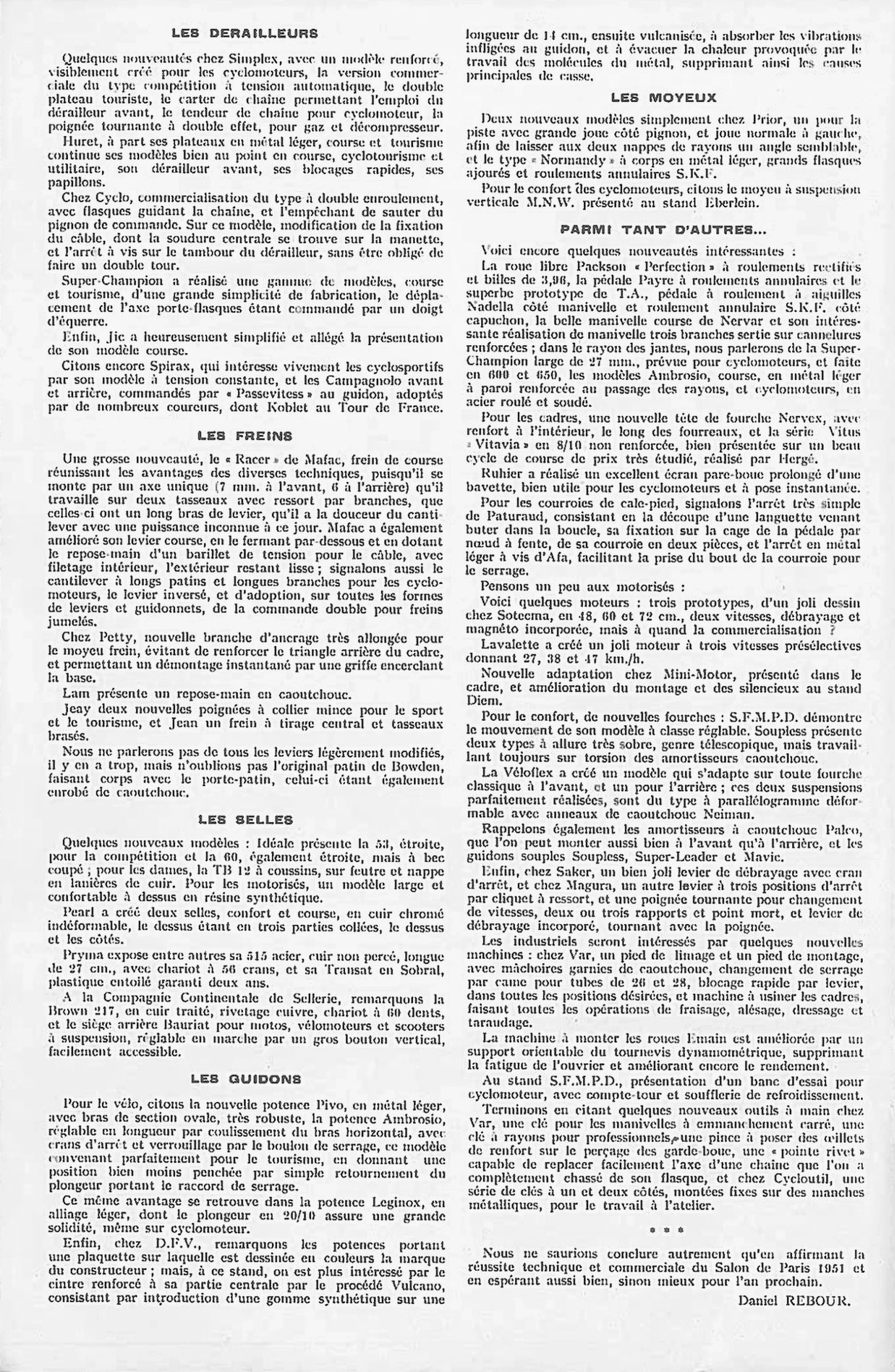
LES DERAILLEURS
LES FREINS
LES SELLES
LES GUIDONS
LES MOYEUX
PARMI TANT D’AUTRES…
* * *
Daniel REBOUR.
[Ebykr summary; the article’s text is not reproduced. The page ends the accessory review, section by section, and closes the article. Under LES DERAILLEURS: Simplex shows a reinforced model plainly made for cyclomoteurs, the production version of its automatic-tension competition type, a touring double chainring, a chain case that allows a front derailleur, a chain tensioner for cyclomoteurs and a double-action twist grip for throttle and decompressor. Huret, besides its light-alloy racing and touring chainrings, continues its proven racing, touring and utility models, its front derailleur, quick releases and wing nuts. Cyclo now sells its double-winding type with plates that guide the chain and keep it from jumping off the control sprocket, with a changed cable fixing (the central nipple at the lever, a screw stop on the derailleur drum, no double turn needed). Super-Champion has a range of racing and touring models of very simple construction, the plate-carrying spindle moved by a square finger. Jic has simplified and lightened its racing model. Spirax interests cyclosportifs with its constant-tension model, and the Campagnolo front and rear derailleurs, worked by “Passevitess” levers at the handlebar, have been adopted by many racers, Koblet among them in the Tour de France. Under LES FREINS: the big novelty is the Mafac “Racer”, a racing brake that combines several systems, mounted on a single pivot (7 mm. front, 6 rear) and acting on two bosses with a spring on the arms, with long lever arms giving cantilever smoothness and new power. Mafac has also improved its racing lever, closed underneath, with a cable-tension barrel in the hand rest (threaded inside, smooth outside), and shows a long-shoe, long-arm cantilever for cyclomoteurs, a reversed lever and a double control for paired brakes adaptable to all levers and auxiliary levers. Petty has a much-lengthened anchor arm for the brake hub, avoiding reinforcement of the rear triangle and allowing instant removal by a claw around its base. Lam shows a rubber hand rest. Jeay shows two new thin-clamp grips for sport and touring, and Jean a center-pull brake with brazed bosses. Among many slightly altered levers the writer singles out the original Bowden shoe, made in one with its holder and also coated in rubber. Under LES SELLES: Idéale shows the 53, narrow, for competition, and the 60, also narrow but with a cut-away nose; for women the TB 12 with cushions on felt and a mattress of leather strips; and for motorized machines a wide, comfortable model with a synthetic-resin top. Pearl has two chromed-leather saddles, confort and course, that keep their shape, the top made of three glued parts (top and sides). Pryma shows its 515 steel saddle with unpierced leather, 27 cm. long, with a 56-notch clip, and its Transat in Sobral, a cloth-backed plastic guaranteed two years. At the Compagnie Continentale de Sellerie the Brown 217 has treated leather, copper rivets and a 60-tooth clip, and the Bauriat sprung pillion for motorcycles, vélomoteurs and scooters adjusts on the move by a large vertical knob. Under LES GUIDONS: the new Pivo light-alloy stem with oval-section arm is very strong; the Ambrosio stem adjusts in length by sliding its horizontal arm, with locking notches secured by the clamp bolt, and gives touring riders a more upright position by simply turning the quill round; the light-alloy Leginox stem has the same advantage, its 20/10 quill strong enough even for a cyclomoteur. D.F.V. shows stems with a plate carrying the maker’s mark in color, and a bar reinforced at the center by the Vulcano process, in which a synthetic rubber insert 14 cm. long, then vulcanized, absorbs vibration and carries off the heat of metal fatigue, removing the main causes of breakage. Under LES MOYEUX: Prior has two new hubs, a track hub with a large flange on the sprocket side and a normal one on the left so both spoke sets meet at the same angle and the “Normandy” with a light-alloy body, large drilled flanges and S.K.F. ball bearings; for cyclomoteur comfort the M.N.W. vertical-suspension hub is shown at the Eberlein stand. Under PARMI TANT D’AUTRES…: the Packson “Perfection” freewheel with ground races and 3,96 balls; the Payre pedal with ball bearings; a superb T.A. prototype pedal with a Nadella needle bearing at the crank end and an S.K.F. ball bearing at the dust-cap end; the fine Nervar racing crank and its three-arm crank crimped on reinforced splines; among rims the 27 mm. Super-Champion for cyclomoteurs in 600 and 650, and the Ambrosio rims, light alloy reinforced at the spoke holes for racing and rolled welded steel for cyclomoteurs. For frames, a new Nervex fork crown reinforced inside along the blades and the Vitus “Vitavia” series in plain 8/10 tubing, shown on a keenly priced racing cycle built by Hergé. Ruhier has an excellent quick-fitting mudguard screen with a flap, useful on cyclomoteurs. For toe straps, Paturaud has a simple stop (a cut tongue that catches in the buckle, fixed to the pedal cage by a slotted knot, on a two-piece strap) and Afa a light-alloy screw stop that makes the strap end easy to grip. For motorized machines: three Sotecma prototype engines of 48, 60 and 72 cm. (as printed), two-speed with clutch and built-in magneto, not yet on sale; a Lavalette three-speed preselector engine giving 27, 38 and 47 km./h.; a new frame-mounted Mini-Motor fitting with better mounting and silencers at the Diem stand. New forks for comfort: S.F.M.P.D. demonstrates its adjustable model, Soupless two sober telescopic-looking types still working on rubber shock absorbers in torsion and La Véloflex a deformable-parallelogram unit for any ordinary front fork and one for the rear, with Neiman rubber rings; also recalled are the Palco rubber shock absorbers for front or rear and the flexible Soupless, Super-Leader and Mavic handlebars. Saker has a neat clutch lever with a stop notch, and Magura a three-position spring-ratchet lever and a twist-grip gear change (two or three ratios and neutral) with a built-in clutch lever that turns with the grip. For the trade: Var shows a filing stand and an assembly stand with rubber-lined jaws, cam clamping for 26 and 28 tubes and lever quick-locking, and a frame-machining machine for milling, boring, facing and tapping; the Emain wheel-building machine gains a swiveling support for its torque screwdriver; S.F.M.P.D. shows a cyclomoteur test bench with rev counter and cooling blower; Var’s new hand tools include a wrench for square-taper cranks, a professional spoke key, pliers for fitting reinforcing eyelets in mudguard holes and a “pointe rivet” chain tool that can refit a pin driven fully out of its plate; and Cycloutil shows single- and double-ended wrenches fixed on metal handles for the workshop. After a row of asterisks, the writer concludes that the Paris Salon of 1951 was a technical and commercial success and hopes for as good or better next year. The article is signed Daniel REBOUR.]
[The page carries no drawings or photographs: it is two columns of text under section headings, ending with the printed signature at the foot of the right column.]
Ebykr presents this material for research and education. If you hold rights to it or notice an ownership issue, please contact us and we will respond promptly.
The Ebykr Digest
New articles, timelines, catalog finds and registry activity — assembled from the archive once a month. Your address is never shared.
Double opt-in. One email per month. Unsubscribe at any time with one click.