About Ebykr
Ebykr celebrates classic and vintage lightweight bicycles through provocative imagery and opinion. Ride along with us.
About Ebykr
Ebykr celebrates classic and vintage lightweight bicycles through provocative imagery and opinion. Ride along with us.

Practical guides to working out what a bicycle is and when it was built, using the frame, the components, the decals and the catalogs rather than guesswork. Start with the date codes below, then read the guide for your marque.
When each code applied, 1945 to 2001. Every year and mark is copied from the guide or history its maker links to, where the full method is set out.
The rule behind every reading: a frame can be no older than the newest original part fitted to it.
No date on anything before the end of the 1950s, so date the model instead · from about 1959 a letter and two digits on the cantle plate: the digits are the year, so C64 is 1964, and the letter is probably the quarter, A = January to March · the practice did not run forever, and the number, letter, number stamp in the leather of a modern saddle is a production lot, not a date
Undated 1958–1972 · last digit of the year in a diamond 1973–1979 · in a circle 1980–1984 · from 1985 a rectangle: 11 = 1985, 22 = 1986, 33 = 1987
PATENT with no year before 1970 · PAT. 70 or similar from 1970 on
27 78 is the 27th week of 1978 · the Normandy name gave way to Maillard around 1981
First letter the year, A = 1976 to Z = 2001 and then A again · second letter the month, A–L = January–December, so VI is September 1997
49D from about 1936 to 1984, although the name came into general use only after the war · 93 1968–1978 · 105 1976–1983 · 106 from 1984, so a 106 crank means 1984 or later
Before 1980 the number indicated neither the date nor the sequence · from 1980 five digits, the first two the year of manufacture and the last three the frame’s number for that year · a bottom bracket grease port was taken out of the design in 1965
The month is a letter, A = January to L = December · 1971–1974: a factory letter, the last digit of the Japanese imperial year (6 = 1971 through 9 = 1974), then the month, so K9B10021 is February 1974 · 1975–1979: two digits of the year, then the month, so 77B13425 is February 1977 · 1980–1987: a facility letter, the month, then the last digit of the year, so FB125349 is February 1981 · a separate short scheme covers the limited hand-built models of 1984 and 1985, and later numbers are much less well documented
From the Veteran-Cycle Club: for the first two years of post-war production a six, seven or eight digit number, the first two digits the year of build · from 1947 a letter for the build month, then a number beginning with the year digit, so B7500 is July 1947 · frame building ended some years before the firm closed in the late 1950s
Before 1976 the serial is an identifier and nothing more: 1355592 was built in 1975 · from 1976 the frame number carries a digit for the year and two for the month, so 605 is May 1976 and 904 is April 1979 · a factory letter often comes first, B for Beaulieu or Y for Romilly-sur-Seine
Raleigh reused older numbers, and those from roughly 1963 to 1973 are particularly unreliable · from 1973 the first letter is the factory (N Nottingham, W Worksop, E Enid), the second the month (A = January) and the numeral the year (3 = 1973), so ND5 is Nottingham, March 1975 · the higher Reynolds 531 and 753 frames from 1974 used a Worksop W followed by a letter for the fortnight · SBDU team frames read SB and four digits, with no date
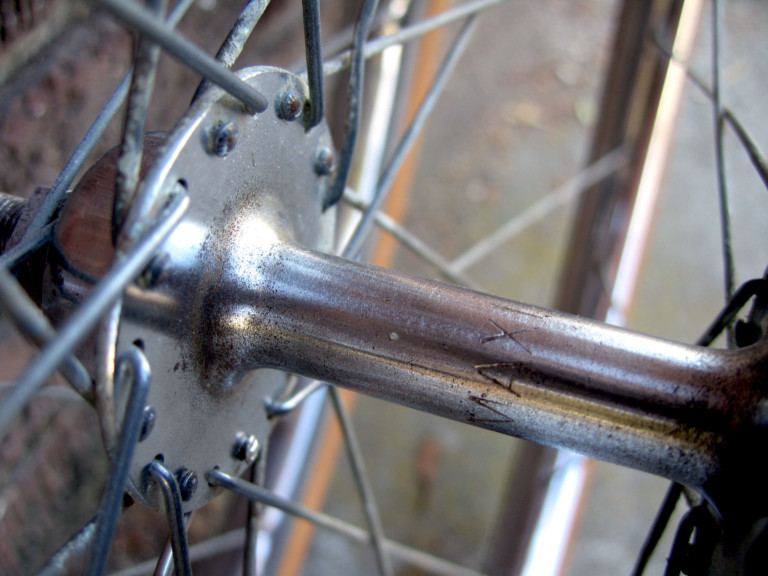 Cross-marque referenceHow to Date a Vintage Bicycle by Its Components
Choose a guide to see its method at a glance. Every reading comes from the guide itself.
Before 1976 an identifier and nothing more · from 1976 a digit for the year and two for the month, so 605 is May 1976 · the number confirms; it does not decide
The PX-10 was introduced as a model in 1953 and carried as Peugeot’s flagship for three decades · the UO-8, the entry 10-speed, was sold into the United States from the 1960s through to about 1980 · the PR-10 gave way to the PKN-10 around 1980
Nervex Professional lugs with the blackened heads mark the 1960s and early 1970s · from about 1974 plainer Nervex lugs, sometimes outlined in gold on the LE, ran through 1983 · chrome fork crowns and chromed tips belong to that later lugged period
The seat-tube Reynolds 531 decal was dropped around 1973 · the PX-10DU used Vitus 979 aluminum tubing in 1981 and 1982 and made its last catalog appearance in 1983 · 1984 was the last year for a lugged and brazed Reynolds 531C frameset, the PX-10L · the lugged flagships of the mid 1980s switched to Columbus SLX
Arc-en-Ciel rainbow bands appeared on the down-tube transfers after Tom Simpson took the 1965 World Championship · the white frame with black lugs and the damier band reached consumer models from 1967 · a scheme frequently belongs to a span of only two or three years, so compare it with dated advertising
There was never a consistent Stronglight date stamp, so date the model: the 49D ran from about 1936 to 1984, the 93 arrived for 1968 and finished in 1978, the 105 followed in 1976 and the 106 not until 1984
An open date, two digits for the week and two for the year, so 27 78 is the 27th week of 1978 · the Normandy mark gave way to Maillard around 1981
The worked example: plain Nervex lugs, the damier band, hubs stamped 27 78 and a Stronglight 105 crank, built and sold for the 1979 season
Every reading here comes from How to Identify and Date a Vintage Peugeot.
From 1973
Reads ND5: Nottingham, March 1975
From 1974, the higher 531 and 753 frames
Reads A related Worksop system, dated by the fortnight
Ilkeston team frames
Reads No date at all: read the decals and the equipment instead
Every reading here comes from How to Identify and Date a Vintage Raleigh.
On the cantle plate, from about 1959
Reads C64: 1964, the letter probably a quarter
In the leather of a modern saddle
Reads Not May 1999: Brooks’ own leaflet calls it the production lot
The letter, read two ways
Every reading here comes from How to Identify and Date a Vintage Brooks Saddle.
Every reading here comes from How to Identify and Date a Vintage Pierce Bicycle.
| The transfer reads | Main tubes | Stays | Fork blades |
|---|---|---|---|
| FORK BLADES, STAYS & BUTTED FRAME TUBESThe starred rectangle, or REYNOLDS laid across a large 531: the two top marks mean the same thing | Butted 531 | 531, plain gauge | Taper-gauge 531 |
| FORKSThe small triangle near the crown, usually with one of the top marks | Not this mark | Not this mark | Taper-gauge 531 |
| BUTTED FRAME TUBESThe top, seat and down tubes only | Butted 531 | Of lesser quality: may not be Reynolds | Of lesser quality: may not be Reynolds |
| PLAIN GAUGE TUBES FORKS & STAYSAll 531, none of it butted | 531, plain gauge | 531, plain gauge | 531, plain gauge |
| FRAME TUBINGLater 1970s: unbutted main tubes, “even scarcer” | 531, plain gauge | Not stated | Not stated |
Every reading here comes from How to Identify and Date Vintage Reynolds Tubing.
1971 to 1974
Reads Factory K, February 1974, frame 10021
1975 to 1979
Reads February 1977, frame 13425
1980 to 1987
Reads Factory F, February 1981, frame 25349
1984 and 1985, limited hand-built models
Reads February 1985, frame 14
The month is always a letter
Every reading here comes from How to Identify and Date a Vintage Fuji.
First digit: the blade
Second digit: the body
Third digit: the clamp and the hood
| Hood | Simplified clamp | Patented clamp |
|---|---|---|
| No hood | 0 | 5 |
| A hood with a small adjuster | 1 | 6 |
| A hood with a large adjuster | 2 | 7 |
| A black wraparound hood | 3 | 8 |
| A translucent wraparound hood | 4 | 9 |
Every reading here comes from How to Identify and Date Vintage MAFAC Brakes.
Every reading here comes from How to Identify and Date a Vintage Idéale Saddle.
 How to Identify and Date a Vintage Raleigh
 How to Identify and Date a Vintage Brooks Saddle
 How to Identify and Date a Vintage Pierce Bicycle
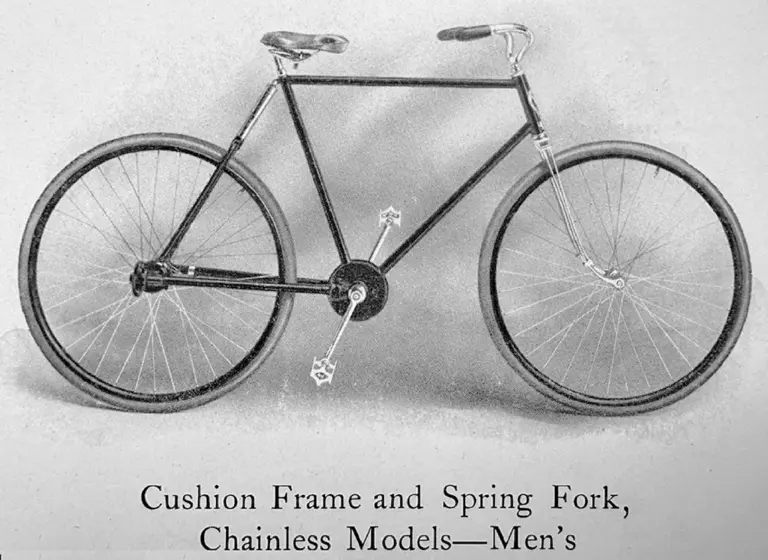 How to Identify and Date Vintage Reynolds Tubing
 How to Identify and Date a Vintage Fuji
 How to Identify and Date Vintage MAFAC Brakes
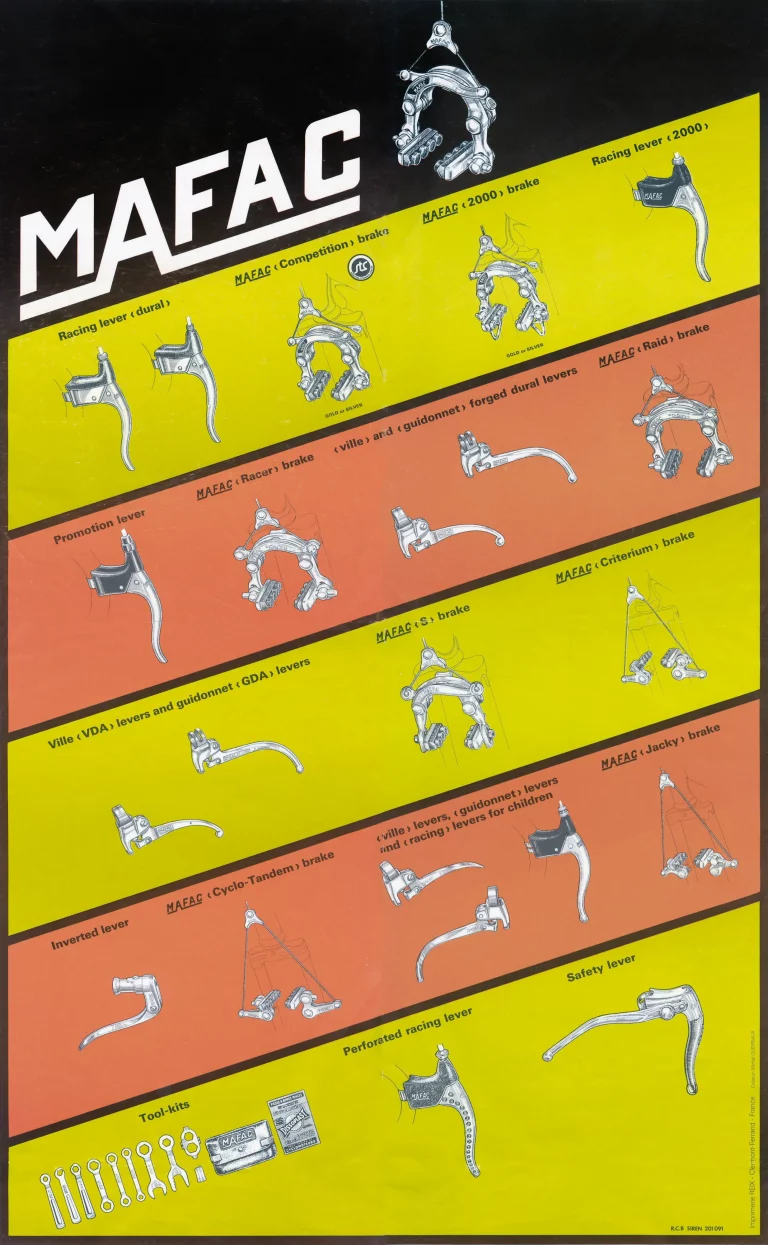 How to Identify and Date a Vintage Idéale Saddle
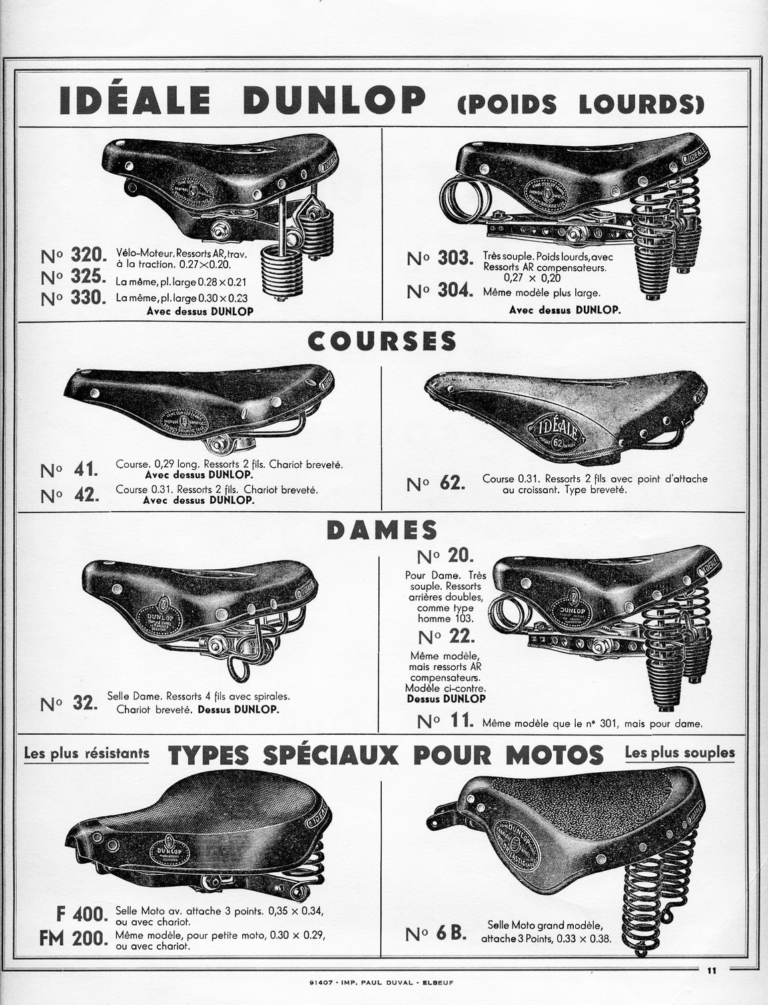
Log the serial number so the next owner of a machine like yours has something to read, or bring the question to the forums and let somebody look at your photographs.
The Ebykr Digest
New articles, timelines, catalog finds and registry activity — assembled from the archive once a month. Your address is never shared.
Double opt-in. One email per month. Unsubscribe at any time with one click.