About Ebykr
Ebykr celebrates classic and vintage lightweight bicycles through provocative imagery and opinion. Ride along with us.
About Ebykr
Ebykr celebrates classic and vintage lightweight bicycles through provocative imagery and opinion. Ride along with us.

A practical guide to dating a vintage Fuji — finding and reading the serial number that carries its build month and year, telling the build year from the model year and confirming it all against the model, the decals, the components and the catalogs.
Good news first. A vintage Fuji is one of the friendliest classic lightweights you will ever try to date. Where a Peugeot shrugs and a Brooks keeps us guessing until the end of the 1950s, a Japanese-built Fuji of the 1970s and 1980s usually carries its year and month stamped right onto the frame, in a code anyone can learn to read over a California roll. In an industry whose history is often based on educated guesses, that is a rare gift.
The less good news is that the code was punched in by hand, in several different formats, and the year it gives you is the year the frame was built, which is not always the year it was sold. So the method is the one that works everywhere else on Ebykr: read the serial number, then let the model, the decals, the components and the catalogs agree with it. When they do, you can name the season. When they do not, at least one of them is telling you something worth knowing.
The Fujis this guide is about were built in Japan and sold in the United States under their own name, which Fuji America began doing in 1971 with the S10-S. The years from 1971 to roughly 1987 are the ones collectors mean when they say “a vintage Fuji” and they are the years the serial-number formats below were worked out for. Production later moved to Taiwan and a Taiwanese Fuji is a different bicycle with a different story.
Three things are worth knowing before you go hunting for numbers. Look for the Mount Fuji emblem on the head badge. Do not panic if you cannot find a serial at all: Bill Reavis, who compiled the most thorough guide to Fuji serial numbers, records machines with no number, which he thinks were late 1960s and early 1970s bicycles imported by Fuji America in 1971, before its first catalog appeared that fall for the 1972 season. And remember that for roughly 15 years before that, Fuji-built bicycles reached American households under other names, through retailers like Sears, Roebuck and Montgomery Ward. A well-made Japanese frame wearing a department-store badge may be a Fuji in disguise, but the formats below were compiled from Fuji-badged bicycles, so a private-label machine is outside of their reach.

Turn the bicycle over. Most Fuji serial numbers are stamped into the underside of the bottom bracket shell, where they have spent the better part of 50 years collecting road grime, so a rag and a little solvent may come in handy before much anything else. Reavis notes that on some earlier models, the number sits on the back of the seat tube, low down near the shell, and a rear dropout is also worth a look if both come up empty.
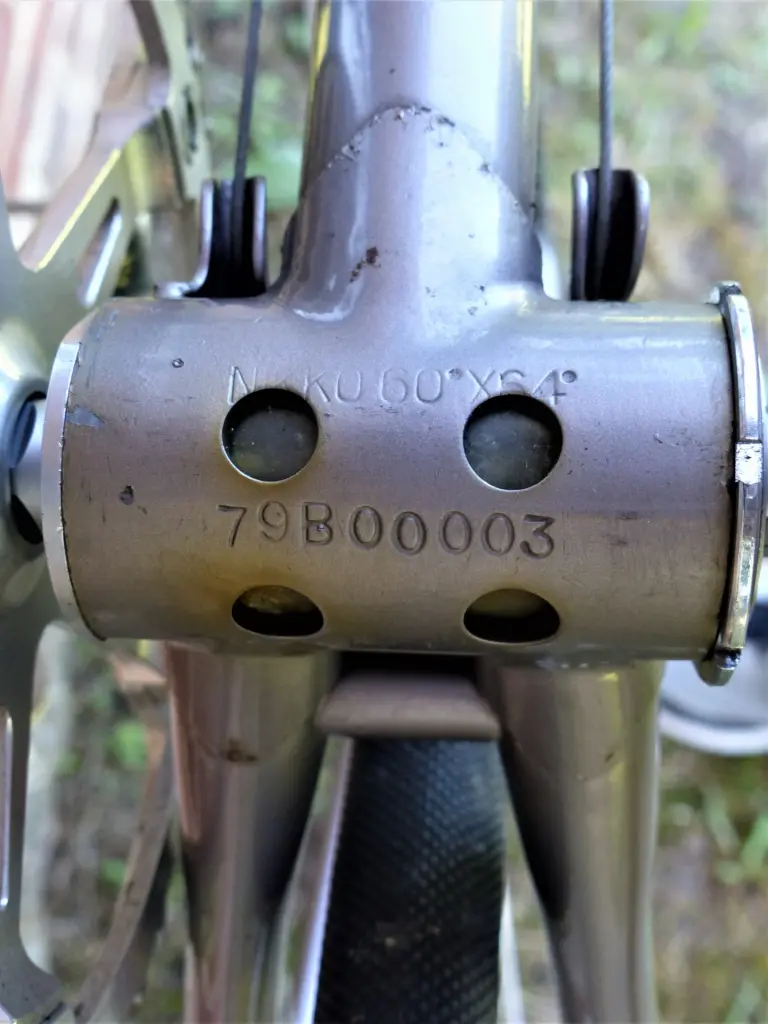
Every Fuji serial number of the period is built from the same three ingredients, reshuffled every few years: a letter for the factory, a letter for the month and a number for the year. Whatever follows them is the frame’s own production number.
The month is the easy part. It is always a letter, A for January through L for December, and that makes a useful sanity check: if the character sitting in the month position is not a letter between A and L, either you or the person holding the Kool-Aid has misread something. The year is where the formats differ.
| Built | What to look for | Example | Reads as |
|---|---|---|---|
| 1971 to 1974 | Factory letter, year digit, month letter, frame number | K9B10021 | Factory K, February 1974, frame 10021 |
| 1975 to 1979 | Two-digit year, month letter, frame number | 77B13425 | February 1977, frame 13425 |
| 1980 to 1987 | Factory letter, month letter, last digit of the year, frame number | FB125349 | Factory F, February 1981, frame 25349 |
| 1984 and 1985, limited hand-built models | Month letter, year digit, frame number | B514 | February 1985, frame 14 |
The single digit in the earliest format is not a misprint. Until 1974, Fuji counted years the Japanese way, by the era of the Shōwa emperor, and stamped only the last digit: Shōwa 46 was 1971, so a 6 means 1971 and a 9 means 1974. From 1975, the stamp switches to the Western calendar and Reavis’s tables run the two-digit year from 75 through 79, before the single-digit format takes over in 1980.
The factory letters recorded so far are K, F, I, M, S, J and G. Reavis lists them as presumed manufacturing facilities and nobody has published which letter was which works, so treat the letter as a fingerprint rather than an exact address. After 1987, the trail goes cold: the later formats are much less well documented, and Reavis records several from the end of the 1980s and the early 1990s that look consistent but have not been confirmed.
Two habits will save you some grief. First, read the month position as a letter even when it looks like a number. The 79B00003 above is a B, not an 8, which is obvious once you know the third character of that format is always a month. Second, expect the occasional surprise. Reavis built his guide from more than 300 Fujis checked against catalog photographs, and he found variations in nearly every year, most of them transposed letters and numbers stamped by hand. A serial that refuses to decode cleanly is often a slip of the system as much as a true mystery.
Here is the wrinkle most decoding charts leave out. Fuji built the next season’s bicycles from late summer on, and Reavis’s guide spells out what that means for the stamp. Frames built from January through June belong to the catalog year the serial gives you. Frames built from September through December were for the following year’s catalog. July and August sit in between, and occasionally a frame from those months was a following-year model too.
So a frame stamped 77K was built in November 1977 and was very probably sold as a 1978 model. When you go looking for its catalog, start with the 1978 book, not the 1977 one.
With a date in hand, work out what the bicycle is, because the model tells you which parts and finishes are correct for it. Fuji’s names confuse newcomers, partly because several of them are superlatives rather than nouns. The Newest, The Finest and The America are all real models, and they were positioned as such on purpose.
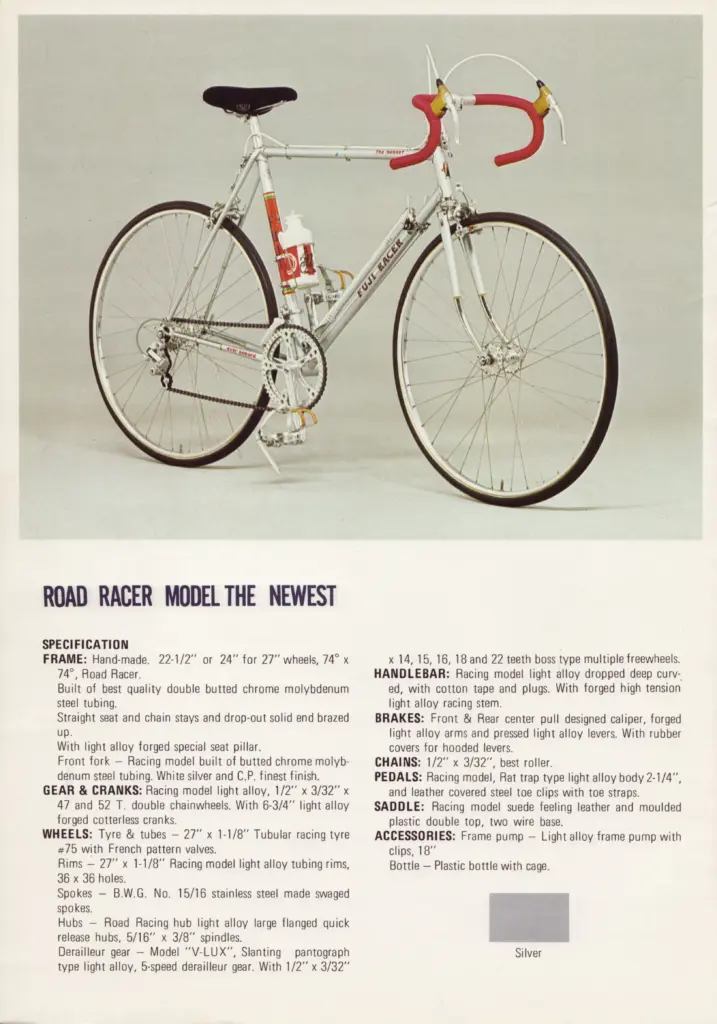
The two earliest books in the Ebykr Catalog Archive, for 1972 and 1973, show how the range began. The Newest sat at the top: hand-made in double-butted chrome-molybdenum on 74 degree angles, finished in silver, running on tubular tires and weighing about 23 pounds. The Finest was the semi-hand-made alternative, also double-butted chrome-molybdenum, on 73 degree angles in white or Rainbow Blue. The S10-S was the bicycle that made the reputation, built of high-tension steel with steel rims and clincher tires, offered in white, red, blue, yellow and green and weighing about 29 pounds. The 1973 book adds the S10-SL, the same machine on a mixte-style frame in 19 or 21 inch sizes, and both years list a track model, the TRS in 1972 and the TS in 1973.
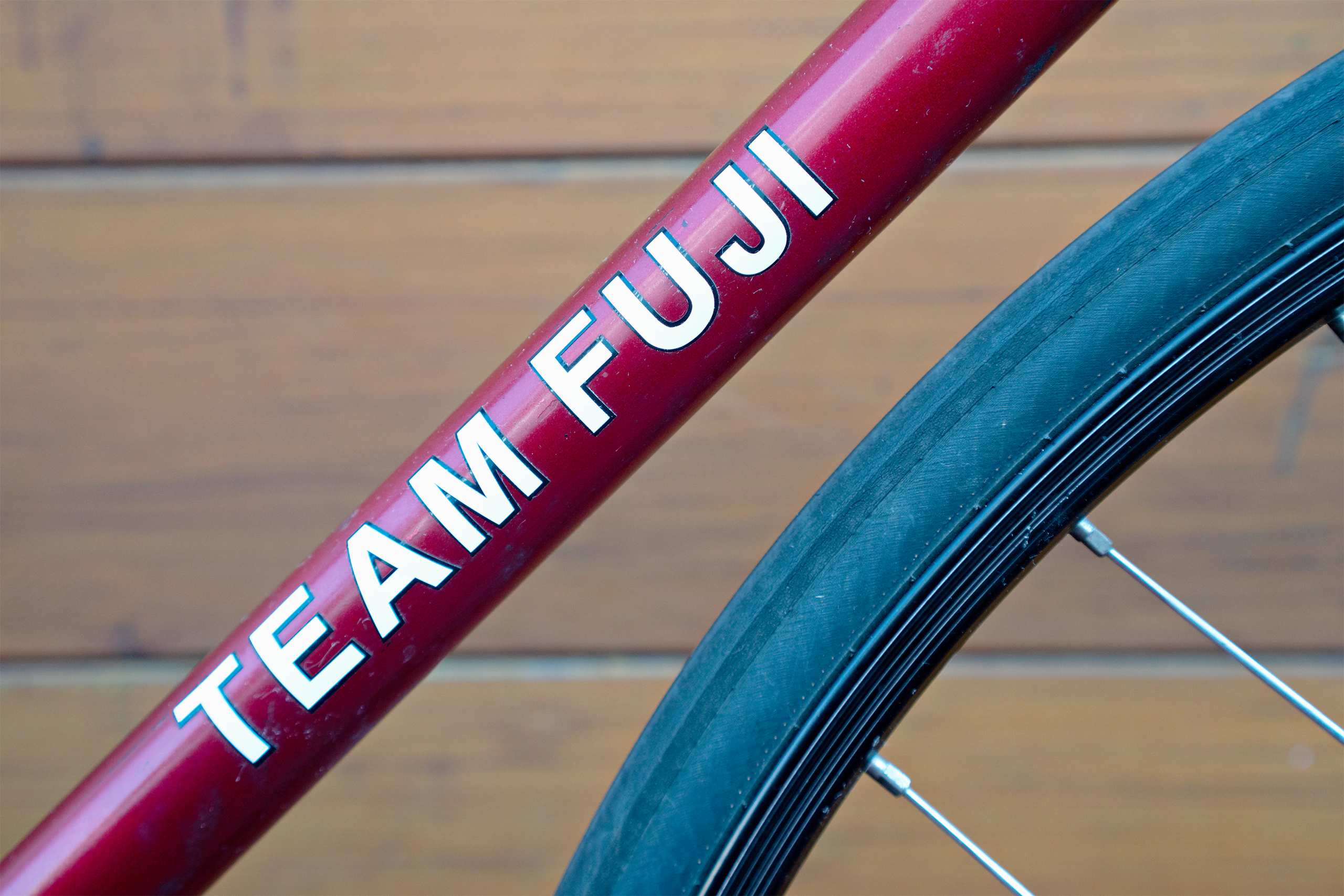
The range grew quickly from there. The America arrived in 1975 as a purpose-built tourer and moved from 27 inch wheels to 700C in 1977, one of the handiest dating markers on any Fuji. The 12-speed S12-S came in the mid 1970s and the S10-S itself moved from high-tension steel to double-butted chrome-molybdenum on later examples from around 1978. Through the late 1970s and the 1980s, the top of the range belonged to the Finest, the Professional, the Opus and the Team Fuji, and from 1986 to the Titanium Dura-Ace.
Fuji’s decals are worth reading as carefully as the stamp. In the 1972 and 1973 catalogs, the S10-S carries FUJI in white capitals down the seat tube under a checkered transfer, with a script on the down tube that appears to read “Special Road Racer.” The Newest wears FUJI RACER on the down tube, its own name in red script on the top tube, a red seat-tube panel and the motto ever onward on the chain stay. The Finest has its name in gold script on the top tube and chromed panels on the tubes. A frame whose decals match the catalog photograph for its model year has a strong case for originality, while one that does not may have been repainted somewhere along the way.
The tubing transfer deserves special attention, because Fuji designated much of its own tubing and the number on the decal is information rather than decoration. Valite, the seamless quad-butted chromium-vanadium tubing introduced in the early 1980s, states its wall schedule in its number: Valite 1769 is a tube of 1.0, 0.7, 0.6 and 0.9 mm walls. The 1983 Professional was built of FUJI 9658 quadruple-butted chrome-molybdenum and the 1970s Team Fuji track frame in the Tech Specs database still wears its Fuji 331 double-butted chrome-molybdenum transfer. One note: Valite was positioned as a value alternative, so a Valite decal is not automatically an upgrade on an unmarked early 1970s chrome-molybdenum frame.
The catalogs make one thing very clear: a Fuji of this era was Japanese from end to end. The 1973 specification table names SunTour derailleurs and shifters, Sugino cranks, Dia-Compe and Gran-Compe brakes, Nitto bars and stems, Mikashima pedals, Ukai rims, Sanshin hubs and Fuji or Fujita saddles. That makes the first question about any part a simple one: does it belong? A French derailleur on a 1973 S10-S is not a mystery to be solved, it is almost certainly a later swap.
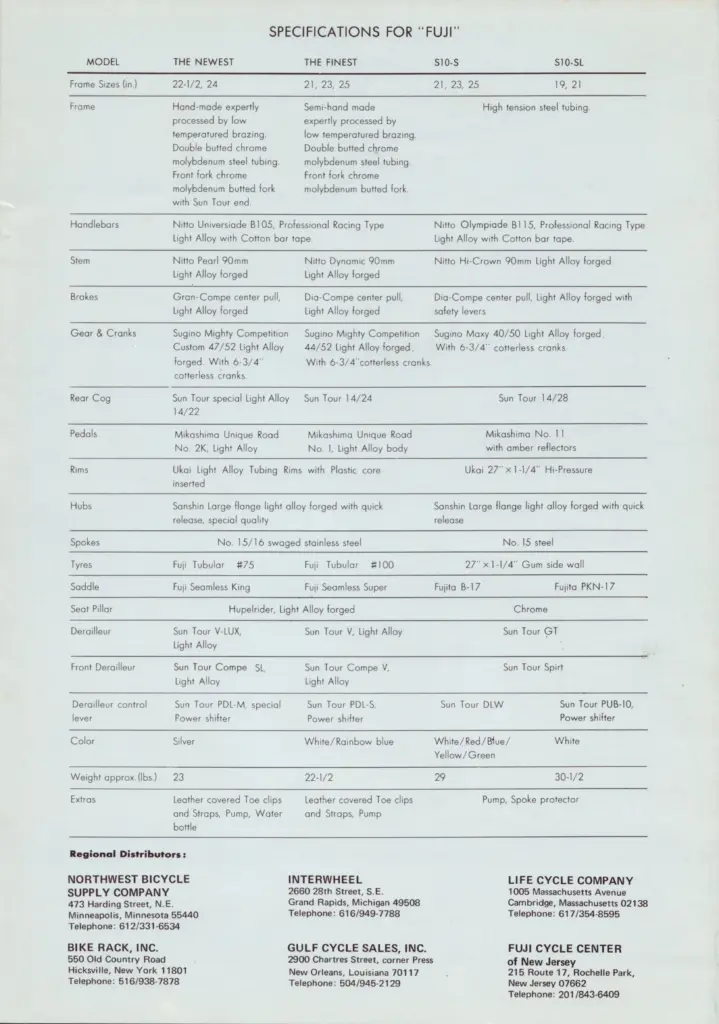
Read the saddle before you assume anything about it. The 1973 S10-S was specified with a Fujita B-17, a Japanese saddle sharing the most famous model number in saddle-making, so a leather B-17 on an early S10-S may well be original and not a Brooks at all. If it does turn out to be a Brooks, our guide to identifying and dating a Brooks saddle takes it from there.
Dated parts then narrow the window, on the rule that runs through this whole series: a frame can be no older than the newest original part fitted to it. Shimano parts are the most legible, with a two-letter code in which the first letter is the year, A for 1976 through Z for 2001, and the second is the month, A to L, so a part stamped EH was made in August 1980. SunTour and Sugino parts often carry stamped codes as well, but the readings that circulate are collectors’ reconstructions, and they do not even agree on which year SunTour’s letters start from, so treat any reading of one as support for a date rather than proof of it. The maker-by-maker method is set out in How to Date a Vintage Bicycle by Its Components.
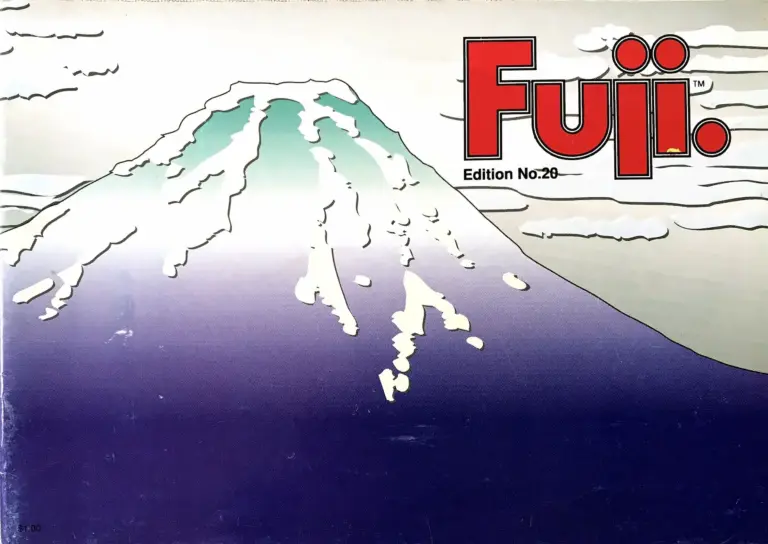
The last step is the most satisfying one: lay the bicycle beside the catalog for its model year and check the color, the decals and the parts. Fuji published a US catalog every year, and from the mid 1970s the covers print an edition number, No. 4 on the 1974 book, No. 6 on the 1976 and No. 14 on the 1984. Add 1970 to the edition number and you have the year. The whole run, from 1972 to 1991, is laid out on Scott Ryder’s Classic Fuji archive, in scans made by the same Bill Reavis whose serial-number guide anchors this one.
Do not try to date a Fuji book by its cover art, though. The 1972, 1973, 1974 and 1976 covers all reuse one painting of a racing pack, and only the small print changes. The 1972 book names no importer at all, only the Tokyo maker, on its back cover. The 1973 book names Fuji America as sole importer on the front and adds Munich to the Olympic Games in the biography of Dr. Shoichiro Sugihara, Fuji’s technical advisor, on the back. By 1976 the importer box reads Exclusive Importer. Little changes like these place an undated book, and the Ebykr Catalog Archive holds the 1972 and 1973 books, transcribed and searchable. If you have a Fuji catalog, price list or brochure, please add it using Docs Drop so it becomes a dating tool for everyone to benefit from.
Suppose a yellow S10-S turns up with K9B10021 stamped under the bottom bracket.
Answer: an S10-S built in February 1974 and sold as a 1974 model, with a printed reason behind every step. Now change one letter. Had the stamp read K9K10021, the frame would have been built in November 1974 and almost certainly sold as a 1975 model, and the 1975 book would be the one to open. One letter, one whole model year, which is why it pays to read the stamp s-l-o-w-l-y.
Once you have read your Fuji, record it. Fujis are still thin on the ground in the Ebykr Serial-Number Registry, which makes yours more useful, not less: every decoded number logged with its model and a catalog match sharpens the picture for the next owner, and the odd formats of the late 1980s will only be cracked by examples. If yours will not decode, bring clear photographs of the stamp to the Ebykr forums.
For the marque behind the bicycle, read Fuji: The Japanese Lightweight That Changed America’s Mind and its timeline, and compare your machine part by part with the 1970s Team Fuji track frame in the Tech Specs database. The rest of the Identify and Date series covers Peugeot, Raleigh, the Brooks saddle and dating a bicycle by its components.
Bill Reavis — Fuji Serial Number Identification 1971–1991 (Classic Fuji Bicycle Archive)
Classic Japanese Bicycles — Fuji Serial Numbers
Classic Fuji Bicycle Archive — the US catalog run, 1972 to 1991 (Scott Ryder; scans by Bill Reavis)
Fuji catalogs of 1972 and 1973 in the Ebykr Catalog Archive; scans by Bill Reavis, courtesy of Scott Ryder and the Classic Fuji archive
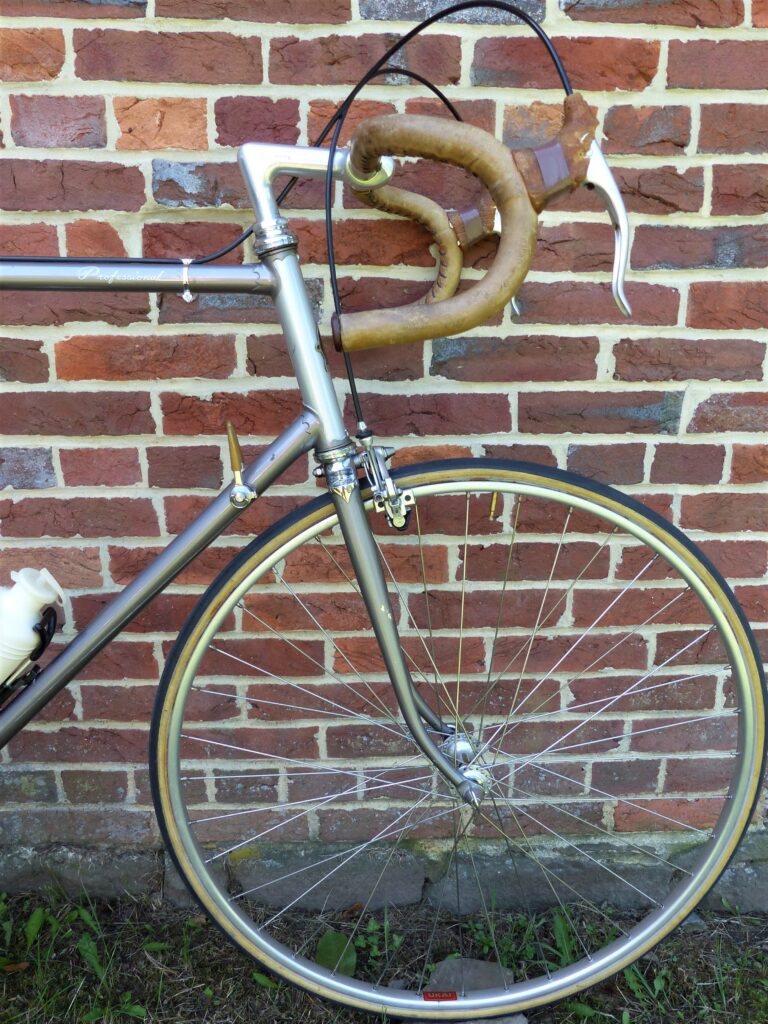
Wikimedia Commons — Fuji Professional bicycle, 1979 (ktk17028, CC BY 2.0)
Ebykr — Fuji: The Japanese Lightweight That Changed America’s Mind
Ebykr — How to Date a Vintage Bicycle by Its Components
 Fuji
FujiEbykr documents this marque across the archive. Here is the rest of it.
The Ebykr Digest
New articles, timelines, catalog finds and registry activity — assembled from the archive once a month. Your address is never shared.
Double opt-in. One email per month. Unsubscribe at any time with one click.