About Ebykr
Ebykr celebrates classic and vintage lightweight bicycles through provocative imagery and opinion. Ride along with us.
About Ebykr
Ebykr celebrates classic and vintage lightweight bicycles through provocative imagery and opinion. Ride along with us.

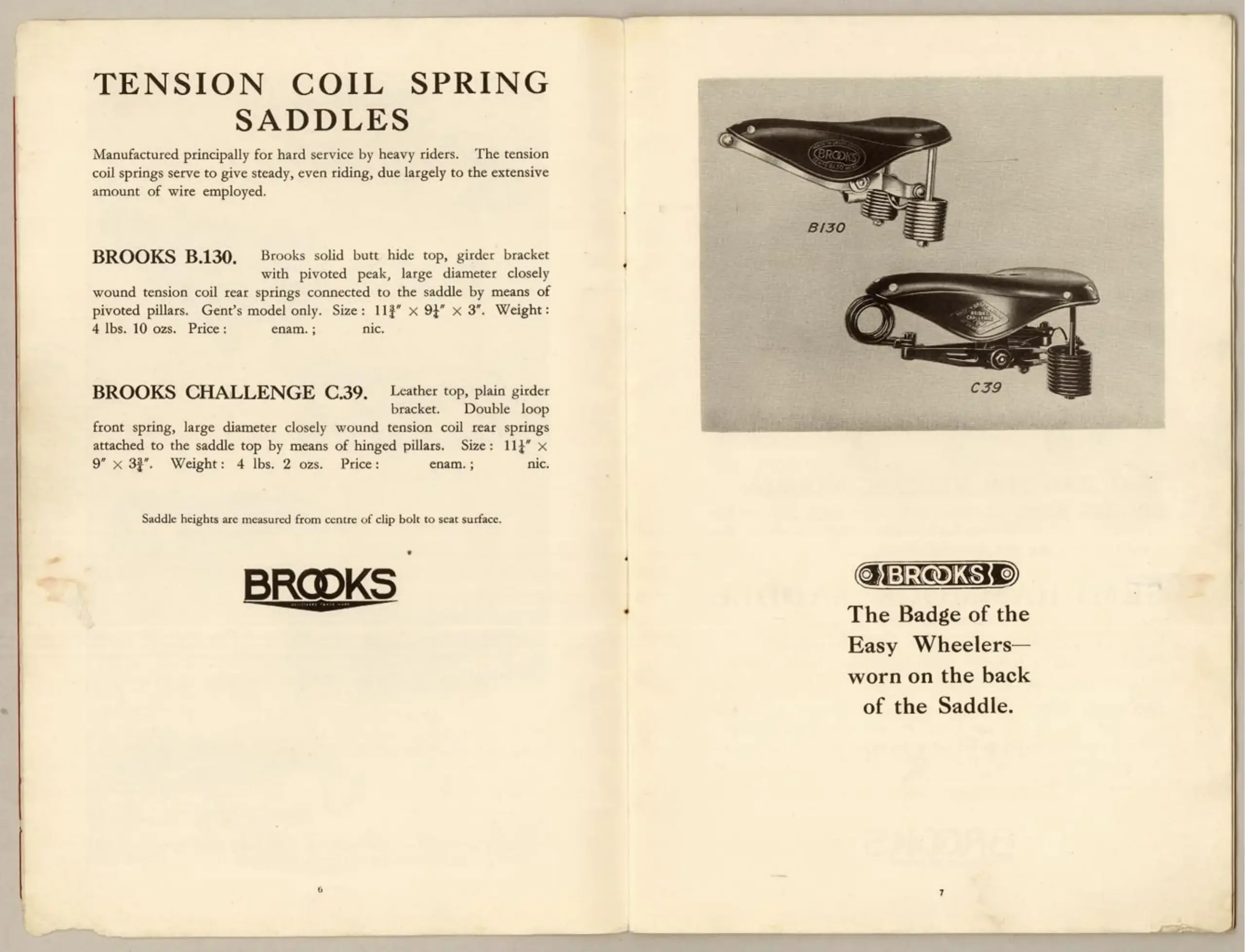
Brooks has been making saddles under the same name since 1866, in a range that has changed slowly and looked similar throughout. That is wonderful for riders and awkward for anyone holding a saddle and wondering what it is. Two Brooks saddles 60 years apart can look very alike, and the company did not stamp a date on anything until the end of the 1950s.
So this guide is organized around what a Brooks will actually tell you, in the order it will tell you. Some of it is precise. A good deal of it is a bracket rather than a year and the honest answer for a great many pre-war saddles is a range of a decade or more. To be clear: anyone offering you a confident year for an Edwardian Brooks may be reading something that is not there.
It helps to know the ceiling before you start. In rough order of reliability:
What you will not get, for most pre-1959 saddles, is a year. Brooks did not serialize saddles the way Raleigh serialized frames, and the early leather codes that do exist cannot currently be read, for a reason given below.
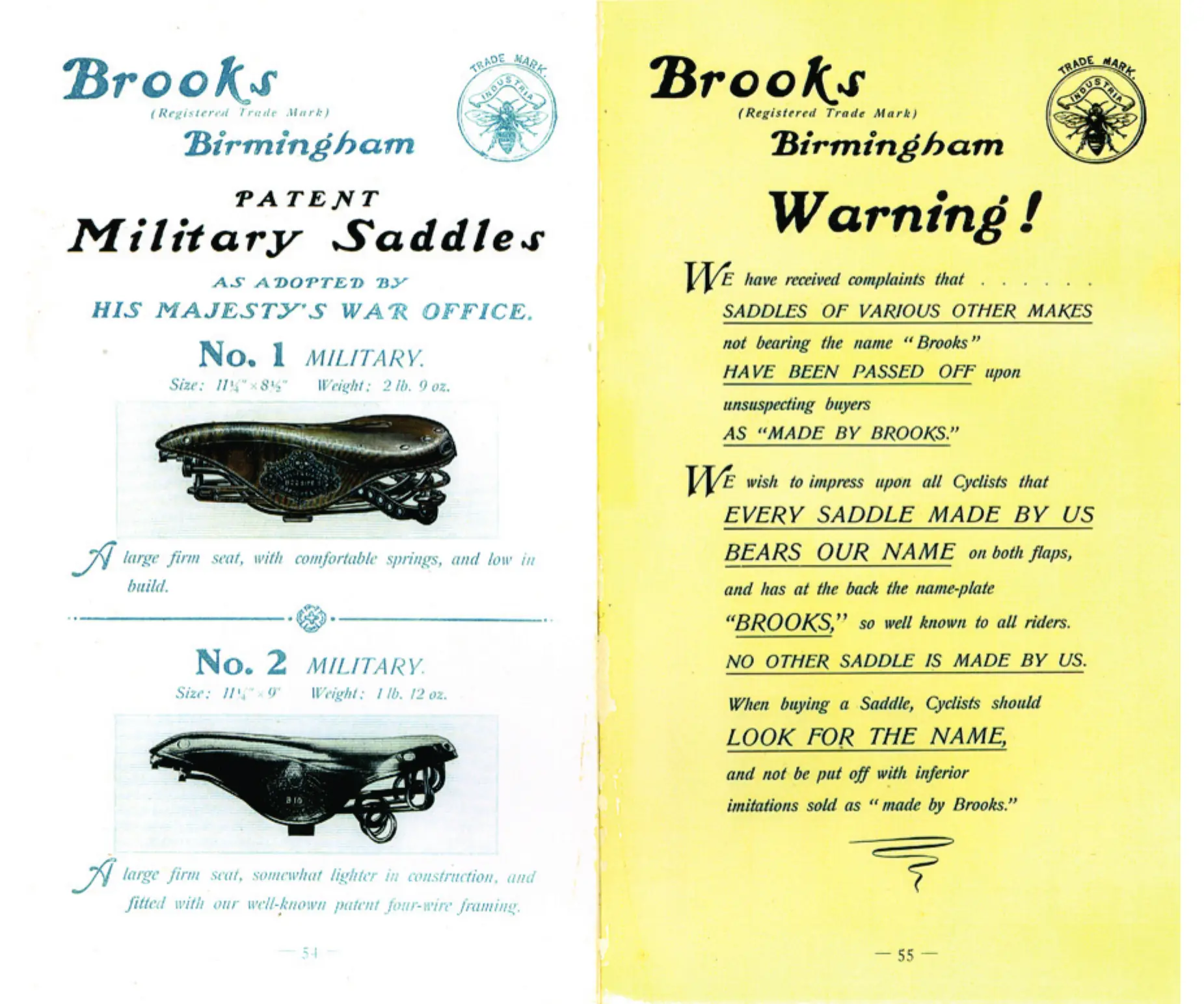
Start here, because Brooks itself did. The company printed an identification test in its catalogs for at least 17 years, and it still works. The 1904 book gives it on printed page 44, under the heading Warning:
We have received complaints that saddles of various other makes, not bearing the name “Brooks,” have been passed off upon unsuspecting buyers as “Made by Brooks.” We wish to impress upon all cyclists that every saddle made by us bears our name on both flaps, and has at the back the name-plate, “Brooks,” so well known to all riders. No other saddle is made by us.
Name on both flaps, nameplate at the rear. The 1903 catalog gives the same test a leaf of its own, the 1904 and 1906 books put it on the title page and repeat it inside, and the 1920 book is still printing it in nearly the same words. If a saddle presented as an early Brooks lacks both marks, the burden of proof has moved.
The other mark to know is the trade mark itself: a bee inside the motto INDUSTRIA. It is a Birmingham emblem of industry long before it was a Brooks one, and it heads nearly every page of the Edwardian catalogs.
This is the part most people are looking for, so here it is with its uncertainties attached.
Brooks began stamping a code into the metal at the end of the 1950s. It is usually described as appearing from 1959, on the cantle plate at the rear of the saddle underside, and it takes the form of a letter and two digits. The two digits are the year. On a saddle marked C64, the 64 is 1964.
The letter is where the sources part company, and you should know that before you quote a month to anybody.
The two cannot both be right, and the quarter reading is the more defensible: a month scheme needs 12 letters and would produce saddles stamped E through L, which do not appear to turn up. But Brooks has published neither, so the correct thing to write on a listing or a registry entry is the code itself, plus the year, plus a note that the letter is probably a quarter.
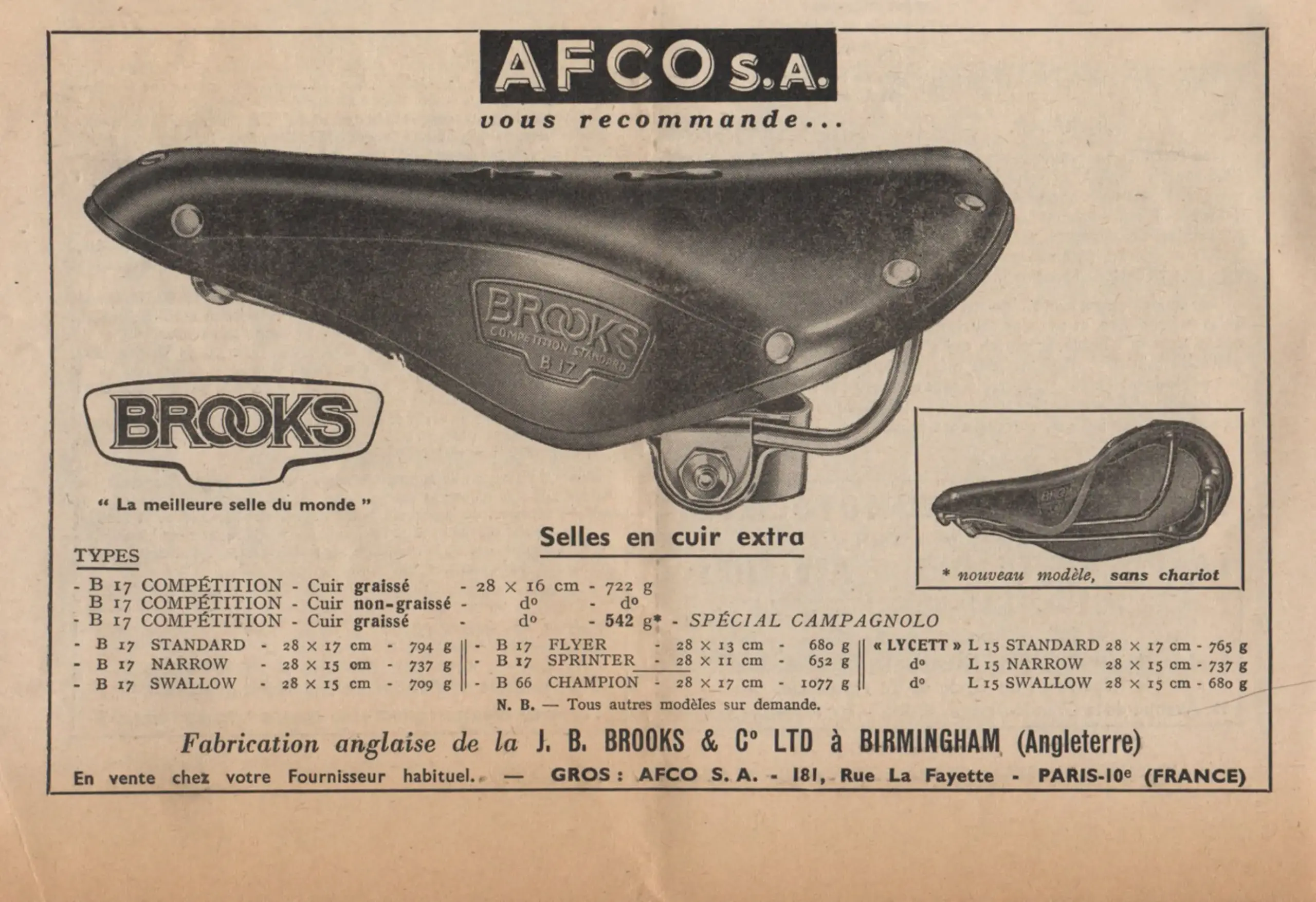
One observation worth making, since it is easy to check and nobody seems to draw it. The stamping starts at almost exactly the moment the Brooks family sold the saddle division to the Raleigh Cycle Company. Brooks dates that sale to 1958 and Grace’s Guide records it in 1959, and the year is genuinely unsettled — but a firm that had never dated a saddle in 90 years began doing so as it passed into a much larger group with its own production controls. That is a coincidence worth noticing and not, on this evidence, a proven cause.
The practice did not run forever. Riders report later saddles with no stamp on the metal at all, and the modern range marks the leather instead, which brings us to the code that causes the most confusion of any Brooks marking.
Turn a modern Brooks over and there is a short code stamped into the underside of the leather top, in the form number, letter, number. A saddle might read 9E9.
It is very widely explained online as a date, with the letter as the month and the digits as the year, so 9E9 becomes May 1999. That reading is tidy and it may sometimes be right. It is not what Brooks says the code is. The company’s own product information and guarantee leaflet, supplied with current saddles, describes it like this:
In order to register you need to know the production lot of your saddle. It is a 3 digit code which is stamped on the bottom of the leather top. This code is a sequence of “number, letter, number”.
A production lot, asked for so that Brooks and the dealer can identify a batch when a guarantee claim is made. Not a date, and not described as one anywhere in the leaflet. Careful observers have said the same thing for years: that the leather codes were batch codes and did not necessarily encode a manufacturing date.
The practical rule: use it to identify a lot and to register a saddle. Do not date a saddle from it alone, and do not put a month in a sale listing on its authority. If the year it implies happens to agree with the badge style and the model, you have corroboration. If it does not, believe the badge.
On the cantle plate, from about 1959
Reads C64: 1964, the letter probably a quarter
In the leather of a modern saddle
Reads Not May 1999: Brooks’ own leaflet calls it the production lot
The letter, read two ways
Every reading here comes from “The date code, 1959 onward” in this guide.
For everything earlier, the object will not give you a year, so the method changes. You establish what the model is, then use the catalogs to find the window in which Brooks was selling it. That is a bracket, and a bracket honestly stated is worth more than a year invented.
Early saddles do carry codes stamped in the leather. They are not currently readable: the collector consensus is that the key to them was lost, and no published concordance exists. If somebody offers to decode an Edwardian leather stamp for you, ask what they are reading it against.
Some Brooks numbers changed on a date the catalogs pin exactly. Where they do, the number on the saddle is a dating tool on its own. These are read directly off books in the Ebykr Catalog Archive.
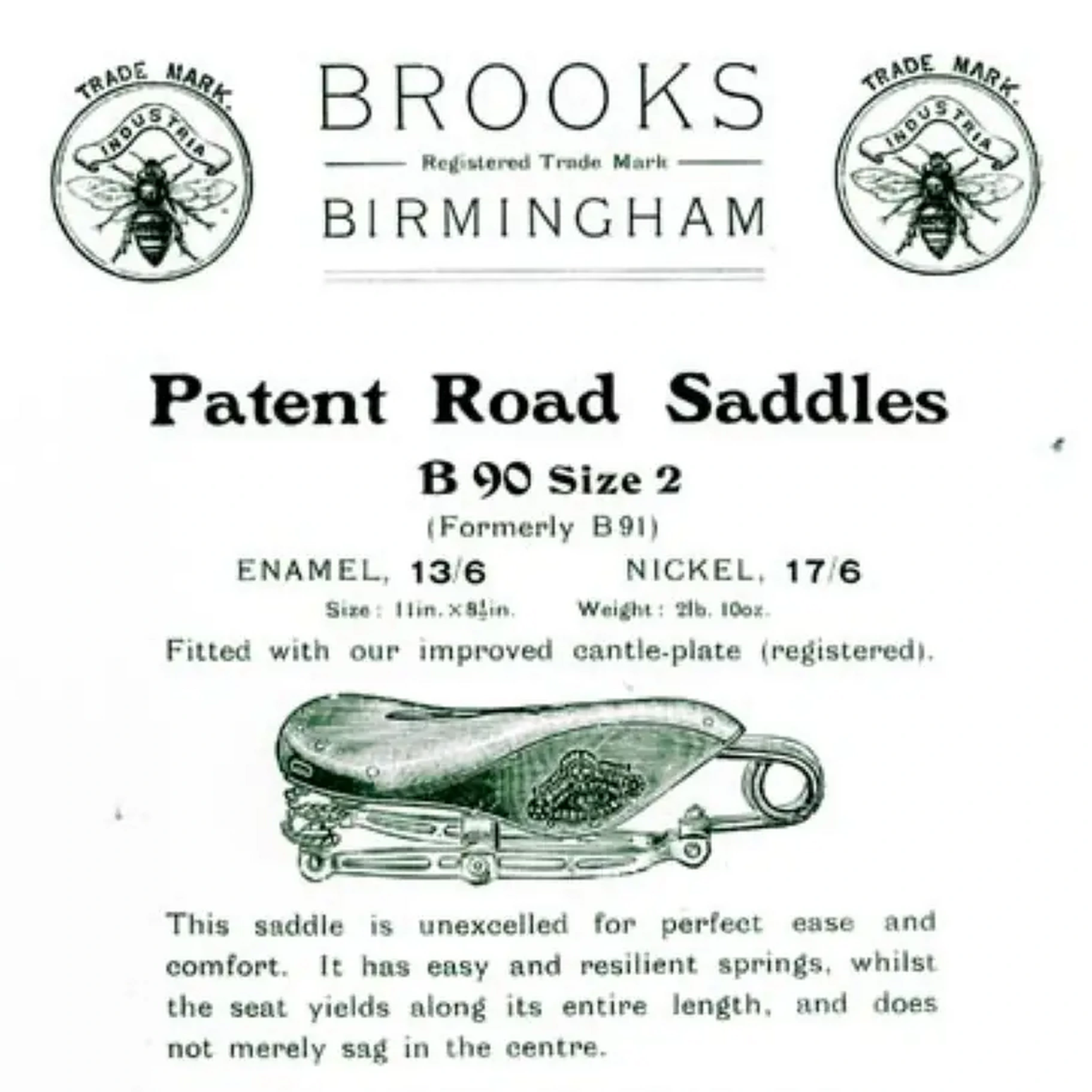
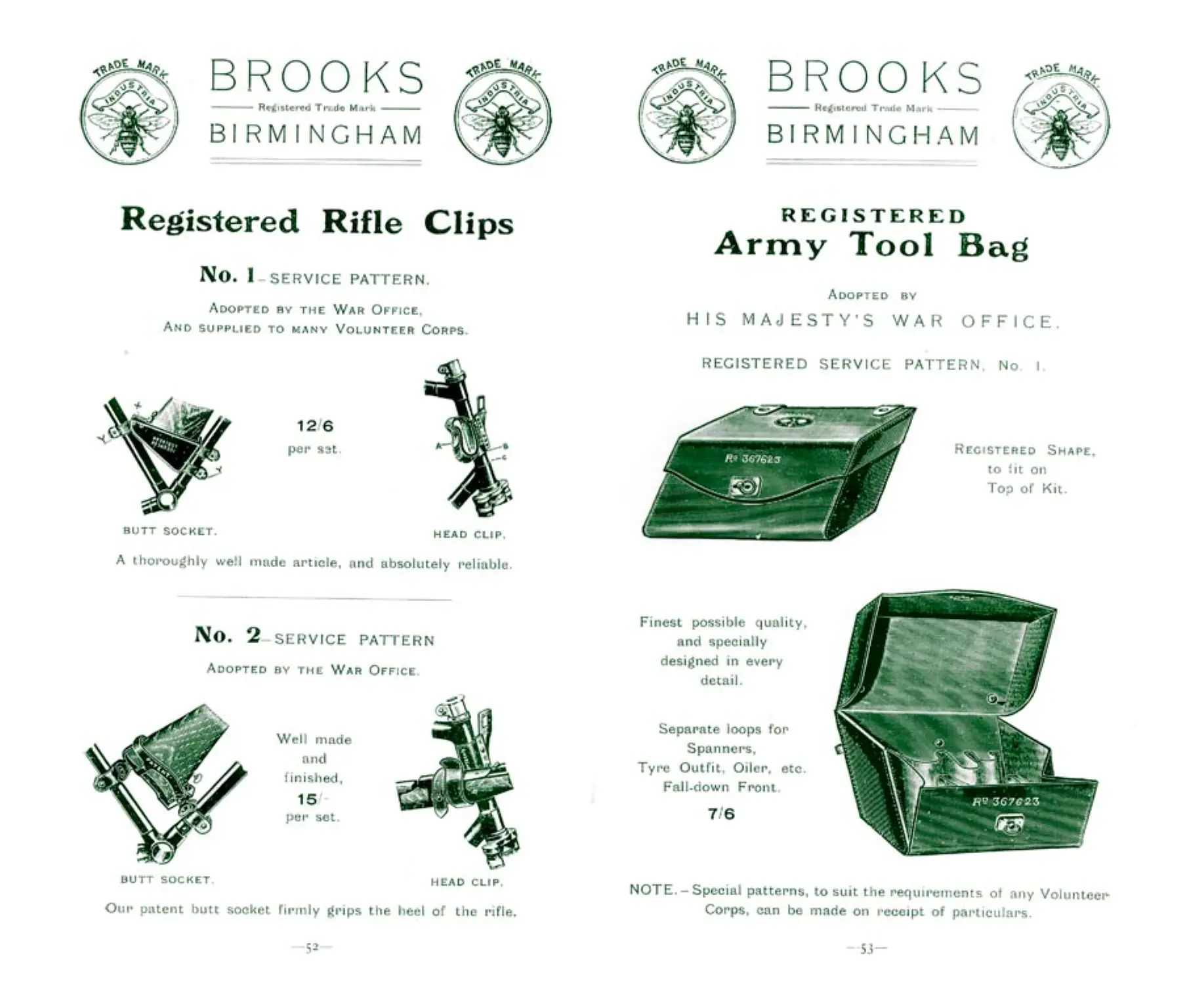
Military saddles have their own sequence, and it is unusually tight:
| Catalog year | What the military range holds |
|---|---|
| 1902 | The civilian B 22 Size 3 with bronzed fittings, carrying no number of its own |
| 1903, 1905, 1907 | A No. 1 and a No. 2, and no No. 3 |
| 1908, 1910 | The No. 2 alone. The No. 1 is dropped after 1907 and never returns |
| 1911 to 1914 | A No. 2 and a No. 3. The No. 3 arrives between 1910 and 1911 |
| 1916 | No numbered military saddles in the cyclists’ catalog at all |
So a numbered Brooks military saddle brackets itself to within a few years, which is better than almost anything else in the pre-war range. Note that the widely repeated claim that Nos. 1, 2 and 3 were all introduced in 1903 fails against the 1903 catalog itself, which carries the first two and says so twice in its own index.
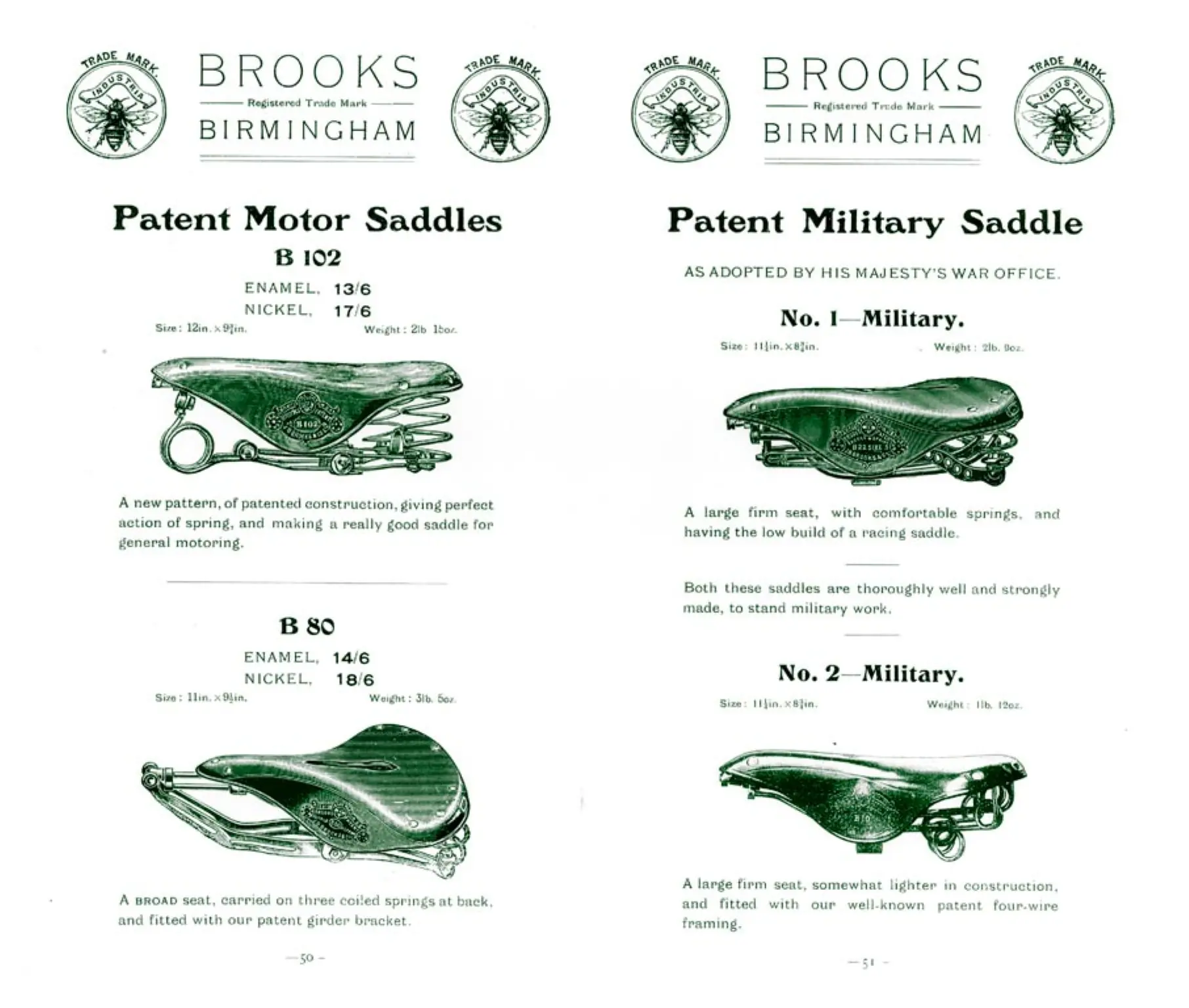
Brooks made a great deal more than saddles and the bags are easier to date than the saddles are because the numbering changed wholesale in a single year.
Through 1913 the accessory range carried four digit numbers in the 7000s, 8000s and 9000s. For 1914 the same items were renumbered into a 2000 series. The Ebykr copy of the 1913 catalog carries the change in manuscript, in red ink, item by item, and the 1914 book then prints the new numbers. Seven pairs have been checked against that printing:
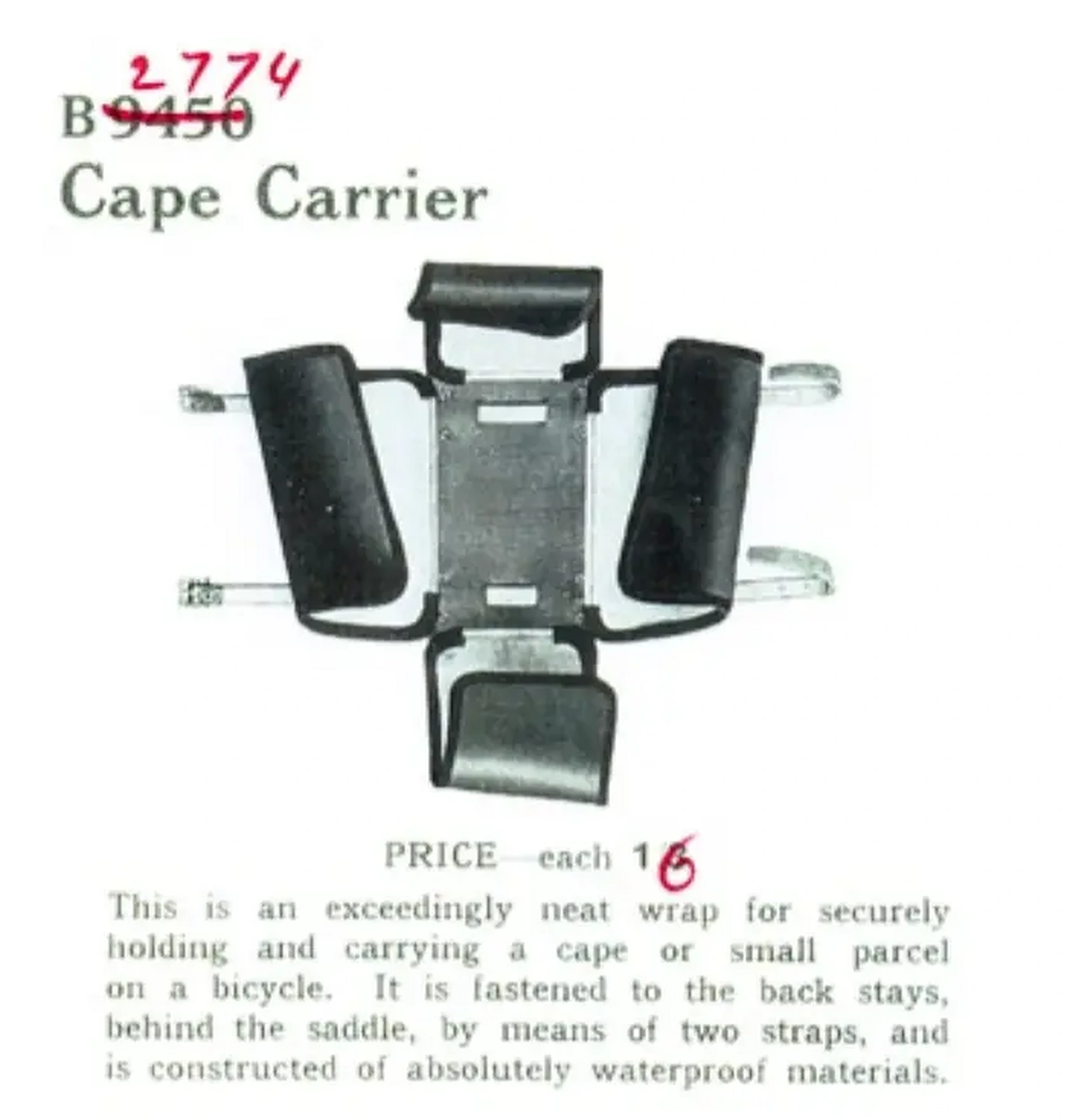
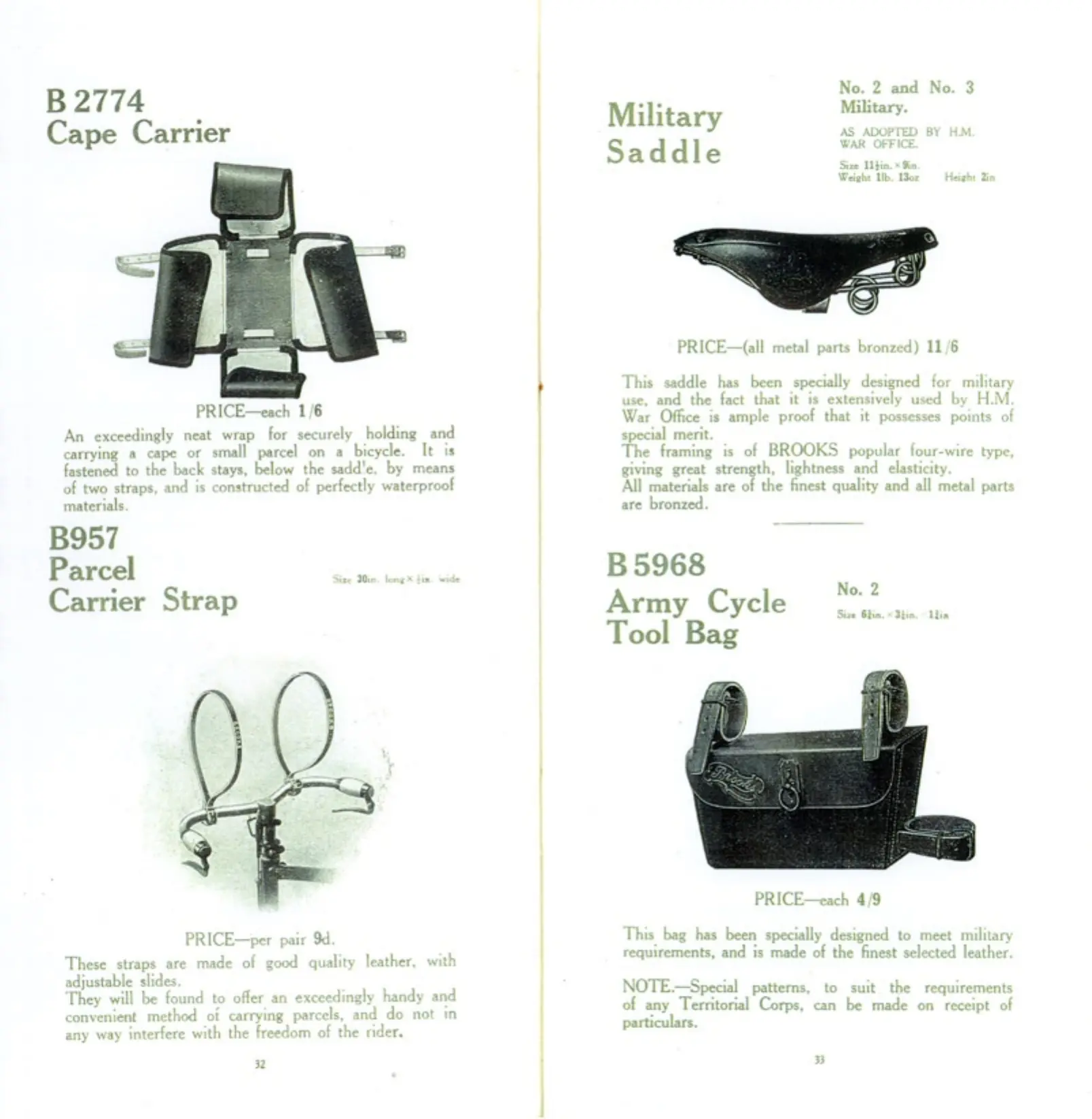
The practical use is blunt. A Brooks accessory carrying a four digit number in the 7000s to 9000s is 1913 or earlier. The same item in the 2000 series is 1914 or later. Seven verified pairs do not prove the renumbering was exhaustive across the whole range, so treat an unlisted number as consistent with the pattern rather than proved by it.
There is one trap here that has caught careful people, including this site. Brooks ran several No. 1 and No. 2 series at once. In the 1903 catalog alone, three of them appear within six pages: military saddles on printed page 54, rifle clips on page 57 and army tool bags on pages 58 and 59. All three are described as adopted by the War Office and only the first are saddles. When you meet a numbered Brooks military item, establish whether it is a saddle, a clip or a bag before you record the number.
The 1904 catalog folded three saddles into one and printed the fact under each: Formerly B 92 under the new B 90 Size 1, Formerly B 91 under Size 2 and Formerly B 90 under Size 3 · so a B 91 or a B 92 predates 1904
The B 28 L runs through the 1901, 1902 and 1903 books and is gone from the 1904 range, which renumbered the ladies’ line completely, so it is 1903 or earlier
In the range from 1901 through 1908, absent from 1910, 1911 and 1912 entirely and back from 1913, so a B 28 is either pre-1909 or post-1912, and the fittings usually say which
1902: the civilian B 22 Size 3 with bronzed fittings, carrying no number of its own · 1903, 1905 and 1907: a No. 1 and a No. 2, and no No. 3 · 1908 and 1910: the No. 2 alone · 1911 to 1914: a No. 2 and a No. 3 · 1916: no numbered military saddles in the cyclists’ catalog at all
Through 1913 four digit numbers in the 7000s, 8000s and 9000s; for 1914 the same items were renumbered into a 2000 series, so B 9450 became B 2774, the Cape Carrier · seven pairs are verified, so treat an unlisted number as consistent with the pattern rather than proved by it
Criterion Works, Birmingham runs through the Edwardian books, and the 1913 book adds Lionel Street to the address · Downing Street Works, Smethwick from 1962 · Established 1866 is printed in the books from 1900 to 1916
The worked example: a saddle numbered B 91, most likely 1902 or 1903
Every reading here comes from “Model numbers that date themselves” in this guide.
Nameplate style is the standard broad dating tool for post-war Brooks saddles: brass plates with particular lettering give way to later designs, and the plates were made in brass, then in plastic and chromed steel, with plastic generally fitted to cheaper models. Later plates also stop naming England as the place of manufacture, which is itself a rough marker.
An important caveat, and the reason this section is shorter than it should be. The reference everybody cites for this, Kurt Kaminer’s The Evolution of Brooks Saddle Badges, is no longer at its own address: that address now redirects to a different site, and the entire Brooks section went with the move. The page itself survives. The last good capture in the Internet Archive, taken in March 2026, is complete and its badge photographs still load, so use that and cite it rather than the dead address — search results and a great many articles, including our own until recently, still point at the original.
Even with the archived copy, badge dating remains a decade-level judgment made against photographs rather than a lookup against a published table and it should be described that way. If you hold good photographs of a dated badge on a dated saddle, they are worth more than they used to be. Please consider posting them.
Where a Brooks says it was made is a coarse but reliable bracket and it changes rarely enough to be memorable.
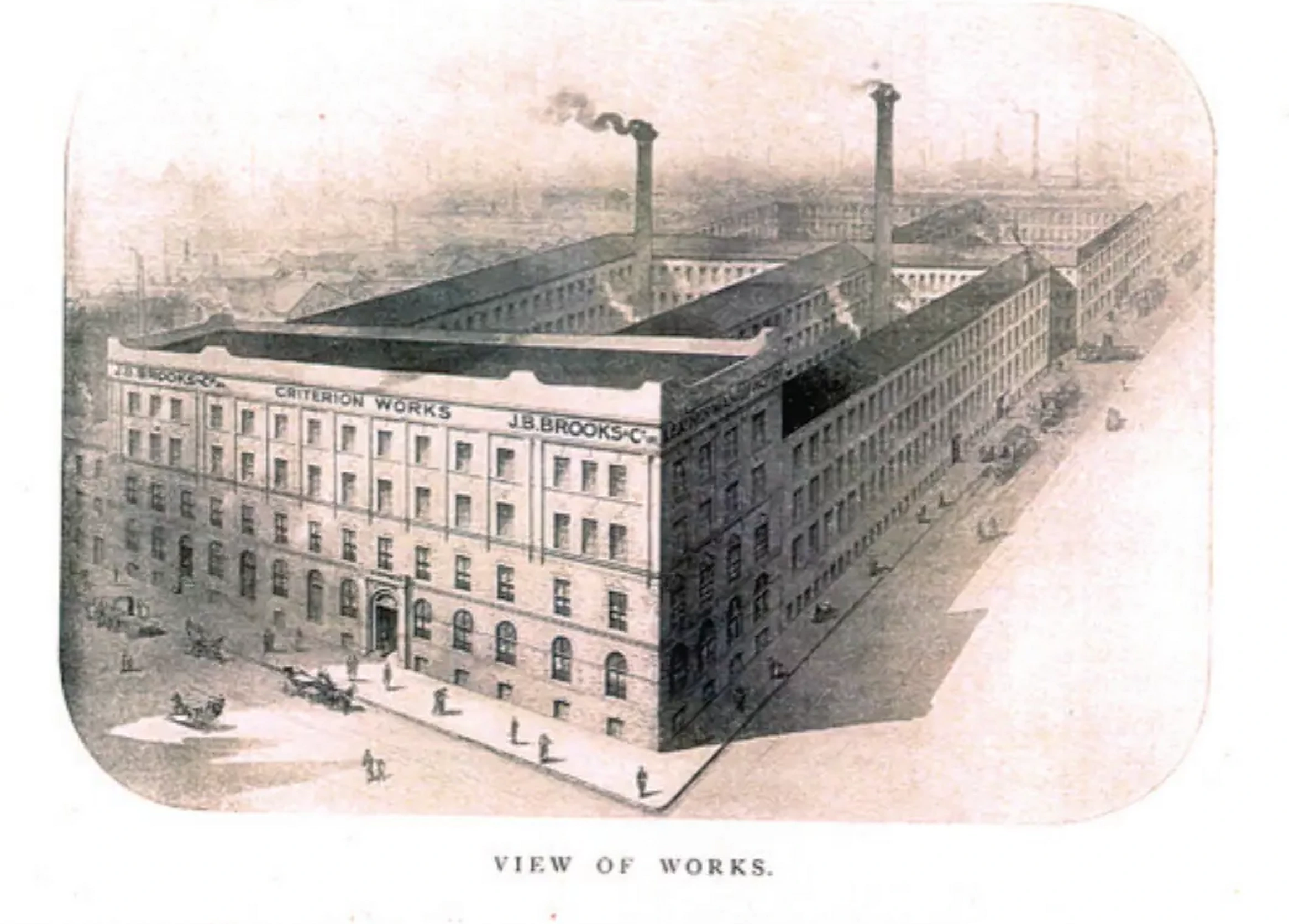
Brooks has also stated its founding date on the page for well over a century. Established 1866 appears on the 1900, 1903, 1905, 1907, 1908, 1910, 1911, 1912, 1913, 1914 and 1916 books, so a Brooks claiming an earlier or later founding is worth a second look.
Once you have a model and a rough window, the catalogs close it. The Ebykr Catalog Archive holds Brooks books and advertisements from 1890 to 1955, page by page and searchable, and the model plates carry sizes, weights and prices you can measure a saddle against.
Two cautions before you compare figures across books, because both will mislead you otherwise.
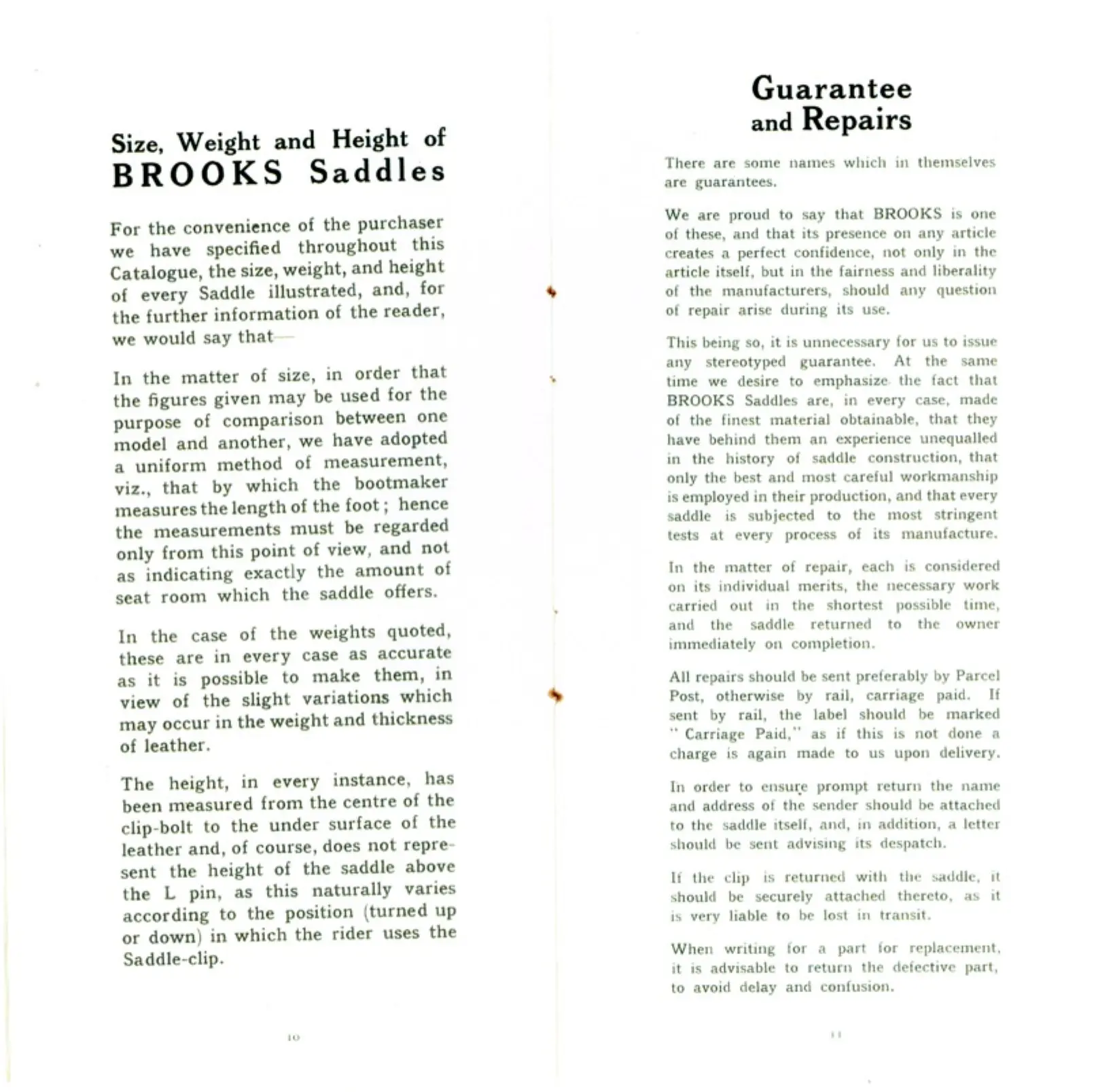
There is also a way to date an undated Brooks catalog, if what you are holding is a book rather than a saddle. The telephone number, the printer’s imprint and the List No. on the cover each move at known moments, and that toolkit is set out in Brooks England: The Eternal One.
Say you have a sprung leather saddle with the name on both flaps, a rear nameplate, no code on the cantle plate, and the number B 91 on the plate.
Answer: an early Edwardian B 90 Size 2 under its old number, most likely 1902 or 1903. Not a year, but a defensible three year window with a printed reason behind every step.
If you have dated a Brooks, the details are worth recording where somebody else can find them. The Ebykr Serial Number Registry takes crowdsourced entries, and dated code-and-badge pairs are exactly what the badge reference above no longer reliably supplies. The Brooks forum topic is the place for a saddle you cannot pin down, particularly with photographs of the cantle plate and both flaps.
For what a given model is and when it was cataloged, the Brooks Saddle Database and Model Guide carries several hundred models with citations. For the company behind them, read Brooks England: The Eternal One and its timeline. For keeping the saddle you have just dated, see how to care for a Brooks saddle. And the rest of the Identify and Date series covers Peugeot, Raleigh and dating a bicycle by its components.
Brooks catalogs 1890 through 1955, read page by page in the Ebykr Catalog Archive; the model-number, military and accessory findings above are cited to the 1901, 1902, 1903, 1904, 1905, 1907, 1908, 1910, 1911, 1912, 1913, 1914 and 1916 books
Brooks England Ltd. — Leather Saddles: Product Information & Guarantee (leaflet supplied with current saddles), Ebykr collection
Brooks England
Grace’s Guide — J. B. Brooks and Co.
Retrobike — Dating Brooks saddles
The Retrogrouch — My New Old Brooks
Kurt Kaminer — The Evolution of Brooks Saddle Badges (archived; original offline as of August 2026)
Classic Lightweights — the Brooks B17
 Brooks
Ebykr documents this marque across the archive. Here is the rest of it.
The Ebykr Digest
New articles, timelines, catalog finds and registry activity — assembled from the archive once a month. Your address is never shared.
Double opt-in. One email per month. Unsubscribe at any time with one click.