About Ebykr
Ebykr celebrates classic and vintage lightweight bicycles through provocative imagery and opinion. Ride along with us.
About Ebykr
Ebykr celebrates classic and vintage lightweight bicycles through provocative imagery and opinion. Ride along with us.

Source: Ebykr archive.
| Marque | Brooks |
|---|---|
| Type | Catalog |
| Year | 1904 |
| Publisher | J. B. Brooks & Co., Ltd. |
| Country | England |
| Language | English |
| Pages | 12 |
| Source | Ebykr archive. |
| Credit | Ebykr archive |
| Transcription | Transcribed by eye |
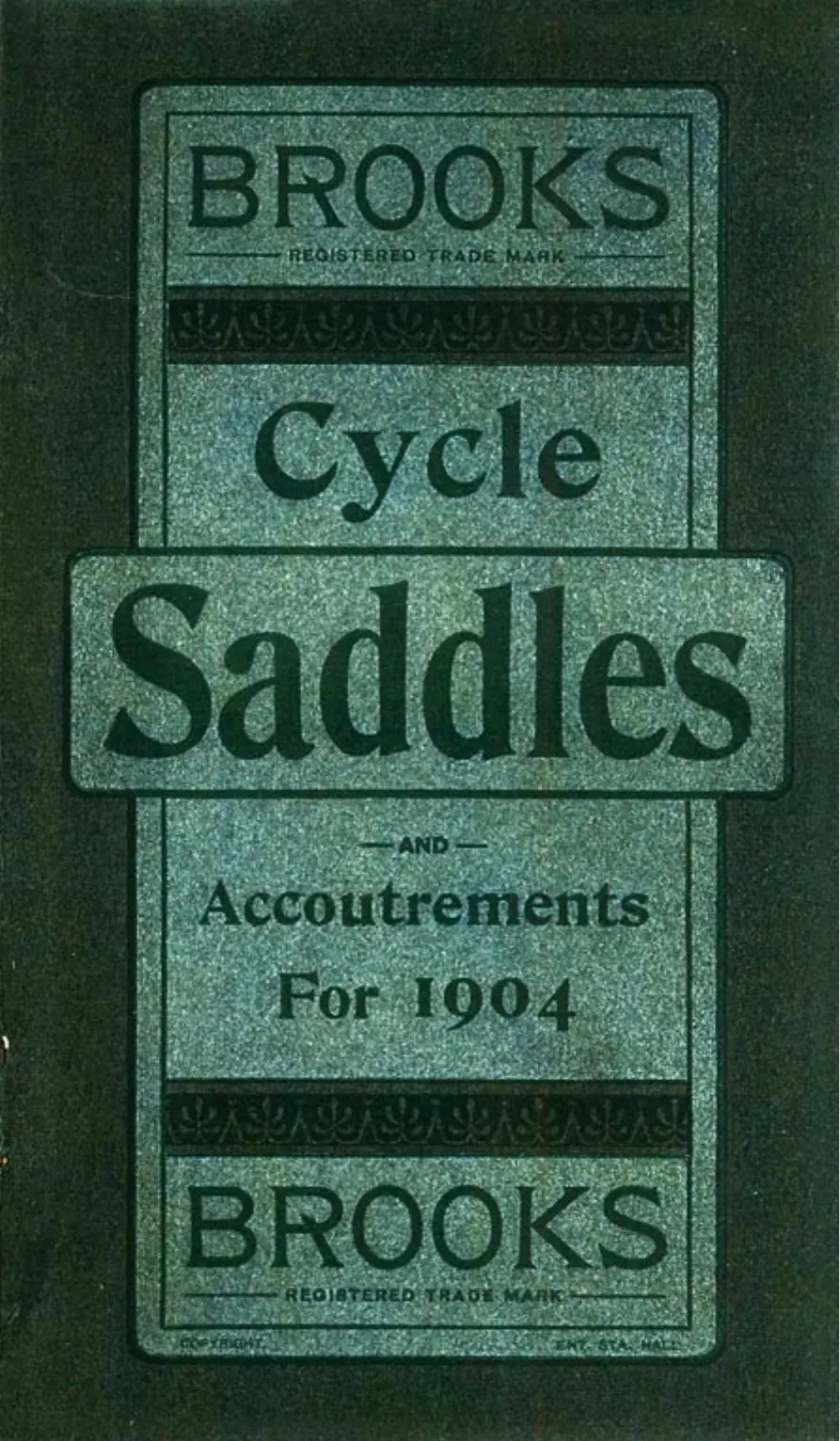
Cycle Saddles and Accoutrements For 1904, from J. B. Brooks and Co. Ld. of Birmingham. Seventy-three printed pages between printed card covers, including two interpolated leaves numbered 48A and 48B. Printed by Cond Bros., Birmingham. This book was opened to answer a single question left by the 1903 catalog: when the Brooks saddles got bigger, …
Cycle Saddles and Accoutrements For 1904, from J. B. Brooks and Co. Ld. of Birmingham. Seventy-three printed pages between printed card covers, including two interpolated leaves numbered 48A and 48B. Printed by Cond Bros., Birmingham.
This book was opened to answer a single question left by the 1903 catalog: when the Brooks saddles got bigger, and why. It answers both, and it answers them in Brooks’ own words on printed page 20.
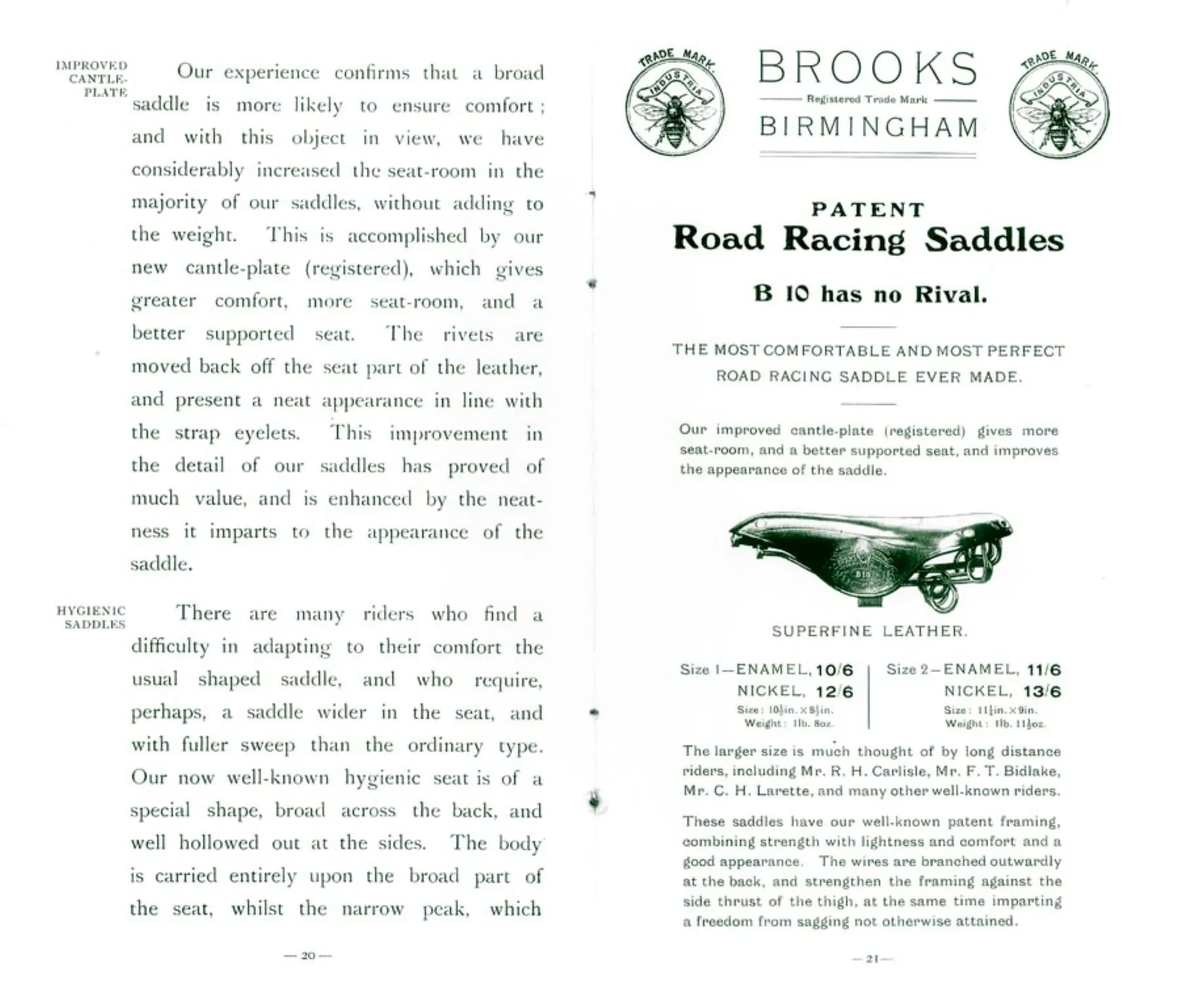
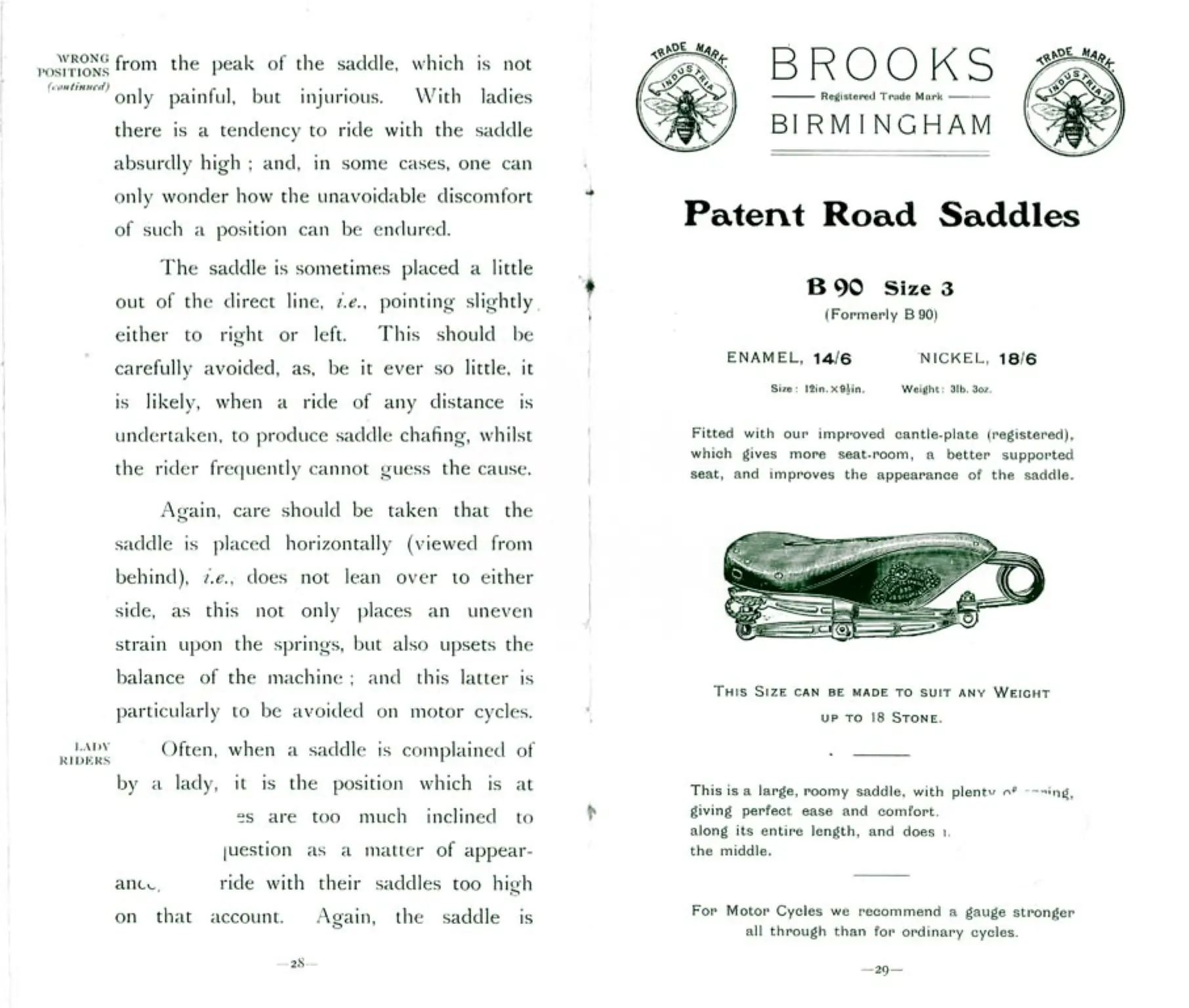
Under the marginal heading IMPROVED CANTLE-PLATE the page reads: Our experience confirms that a broad saddle is more likely to ensure comfort; and with this object in view, we have considerably increased the seat-room in the majority of our saddles, without adding to the weight. This is accomplished by our new cantle-plate (registered), which gives greater comfort, more seat-room, and a better supported seat. The rivets are moved back off the seat part of the leather, and present a neat appearance in line with the strap eyelets. This improvement in the detail of our saddles has proved of much value, and is enhanced by the neatness it imparts to the appearance of the saddle.
The claim is then made good, model by model, across the range. Sixteen of this book’s model plates carry the line fitted with our improved cantle-plate (registered), and several add the explanation: which gives more seat-room, and a better supported seat. The B 10 page says it plainly. So does the B 302, the B 11, the B 14, the B 19, the B 83, the B 28 and all three sizes of the B 90.
The figures agree with the words. The B 90 Size 1 was 10 1/2 by 7 1/2 in. at 2 lb. 6 oz. in the 1903 book; here it is 10 1/2 in. by 8 and a fraction at 2 lb. 8 oz. The B 90 Size 3 was a flat 12 by 9 in. at 3 lb. 3 oz. in 1903; here the length figure carries a fraction where 1903 printed a whole number, while the weight stays at exactly 3 lb. 3 oz. and the price stays at exactly 14/6 enamelled and 18/6 nickelled. More seat-room, same weight, same price, which is what the page promised.
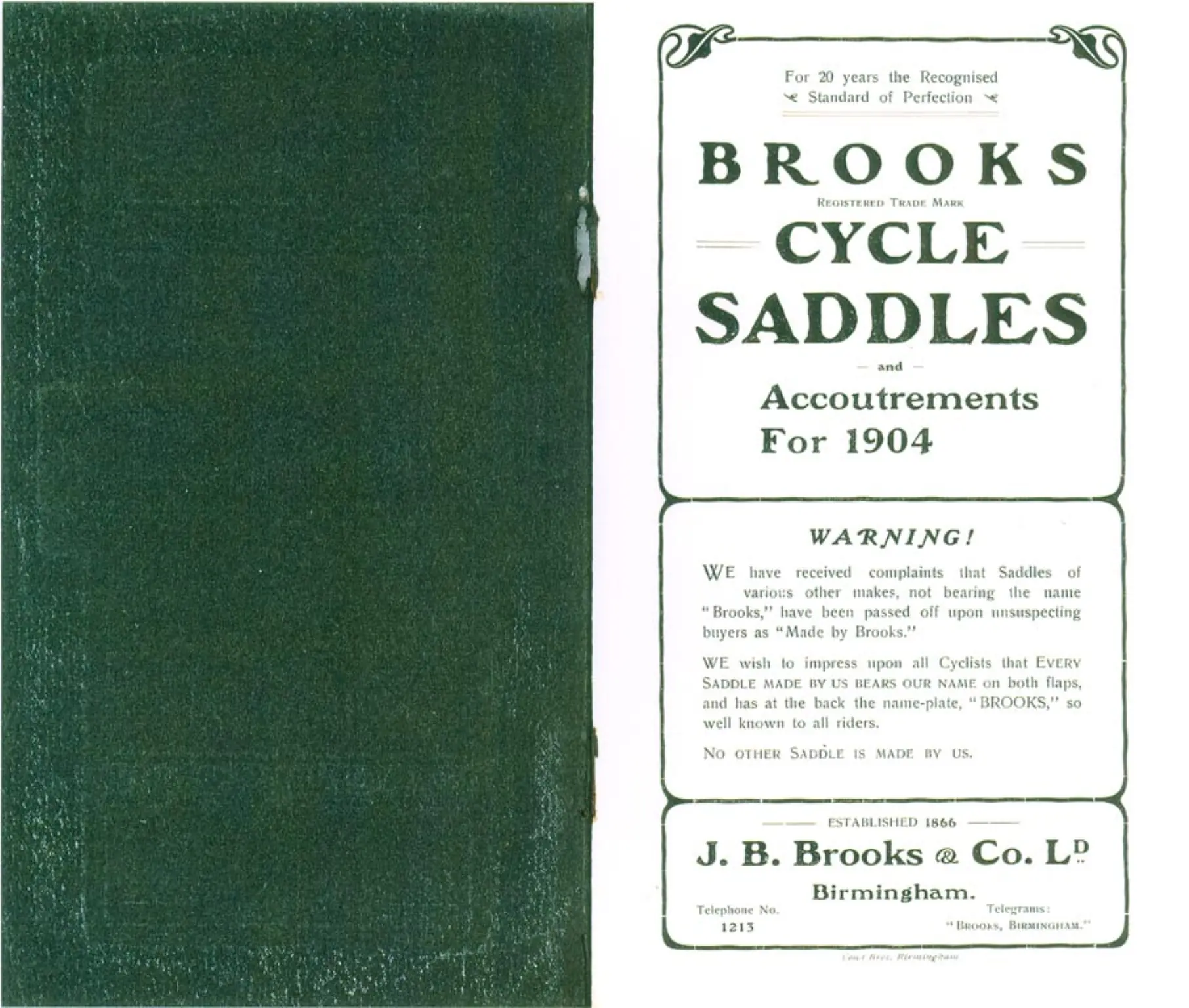
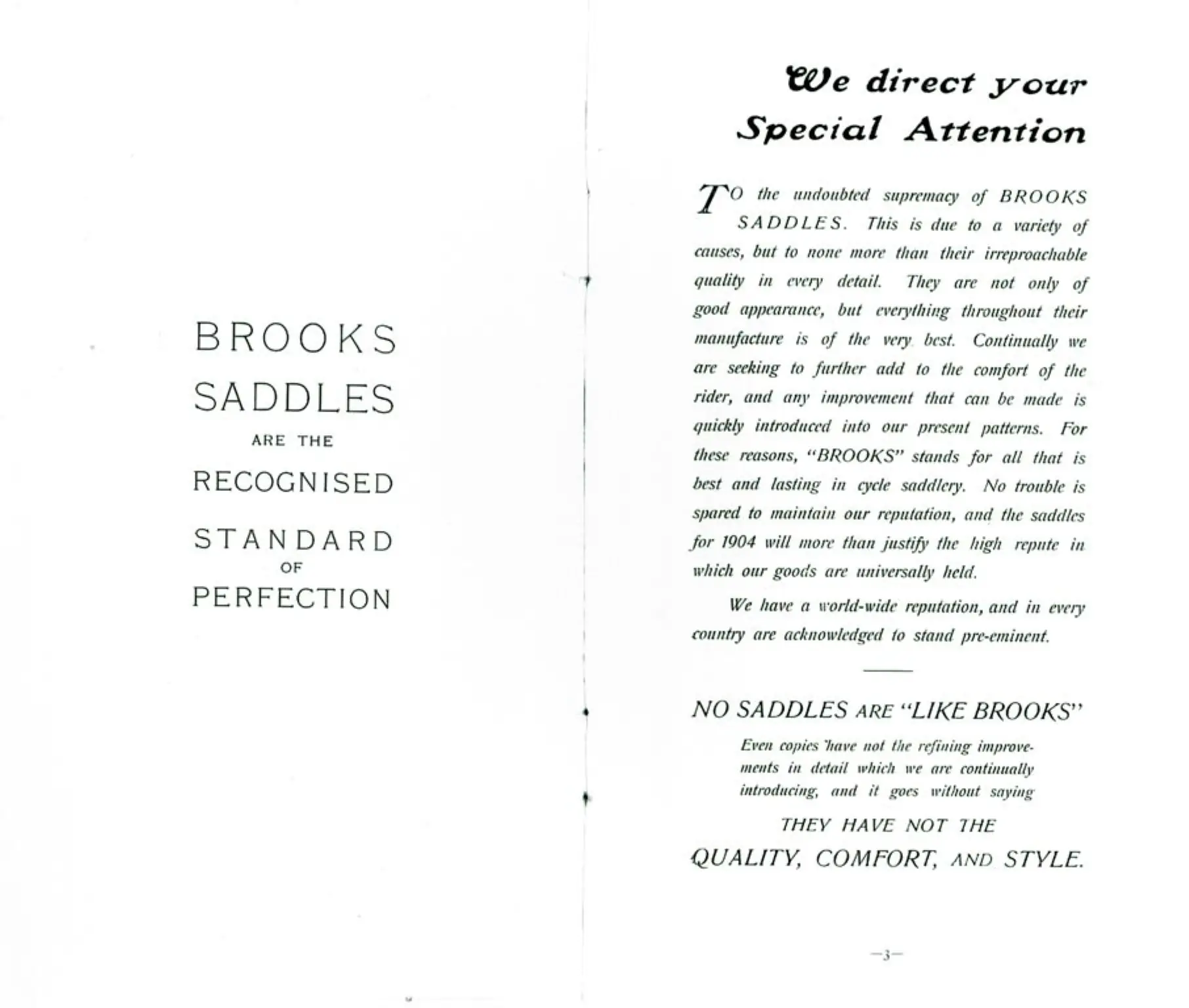
A DATING CORRECTION, TO THIS PROJECT’S OWN NOTES. This catalog had been recorded as one of the two books in the run whose title page carries nothing, the year being recoverable only from a sentence in the body. That is wrong. The year is printed on the front cover, as part of the cover title Cycle Saddles and Accoutrements For 1904. It is printed again on the title page, in the same words. And it is printed a third time in the body of printed page 3: the saddles for 1904 will more than justify the high repute in which our goods are universally held. Three independent statements of the year, two of them on the outside of the book.
A SECOND CORRECTION, ALSO TO THIS PROJECT’S NOTES. The 1904 catalog does have an index. It is on printed page 7, two leaves further in than the 1905 to 1908 books put theirs, which is why checking printed pages 3 and 5 and stopping had missed it. It is a subject index without the model-number concordance those later books carry, but it is enough to settle the military question on its own.
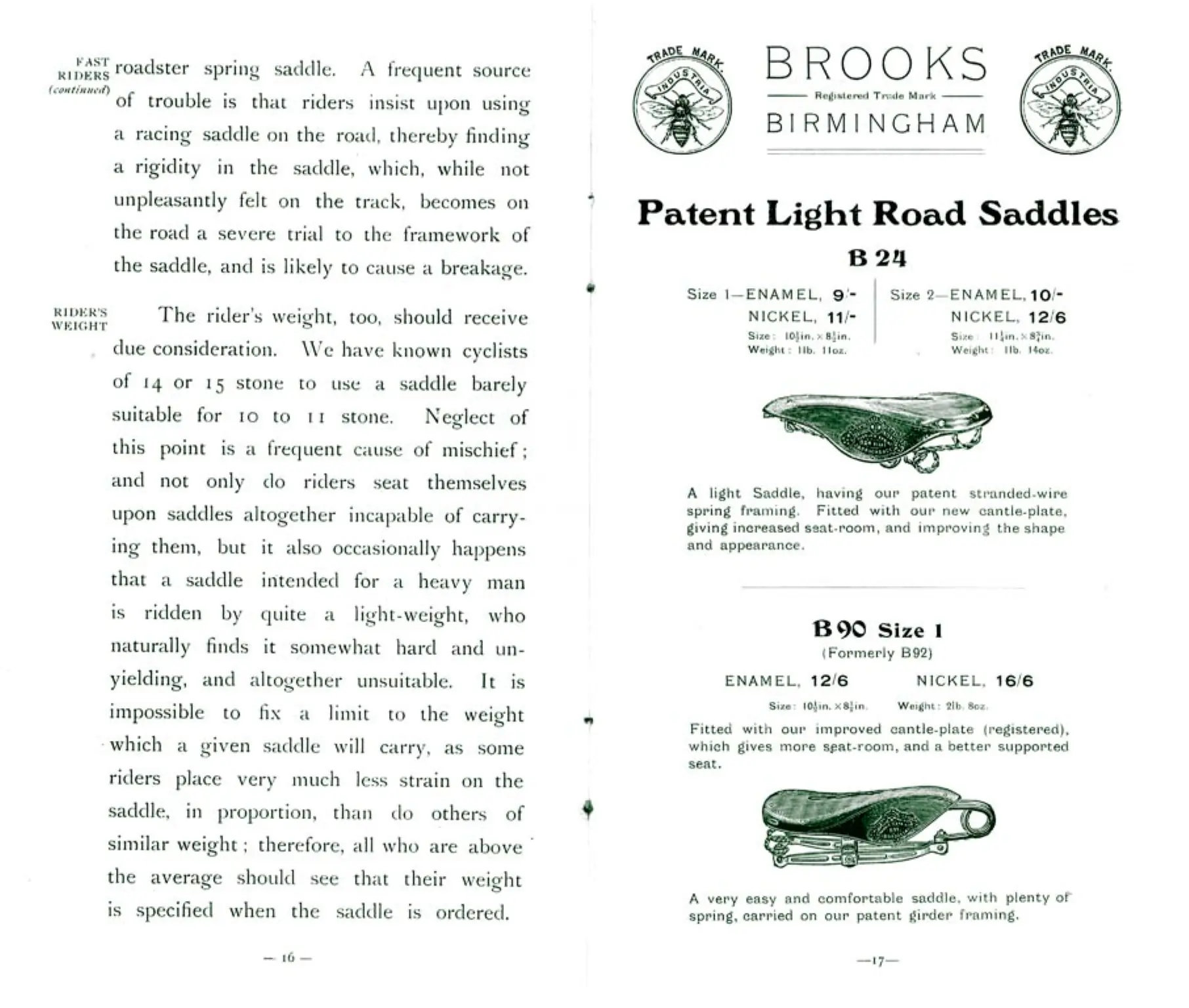
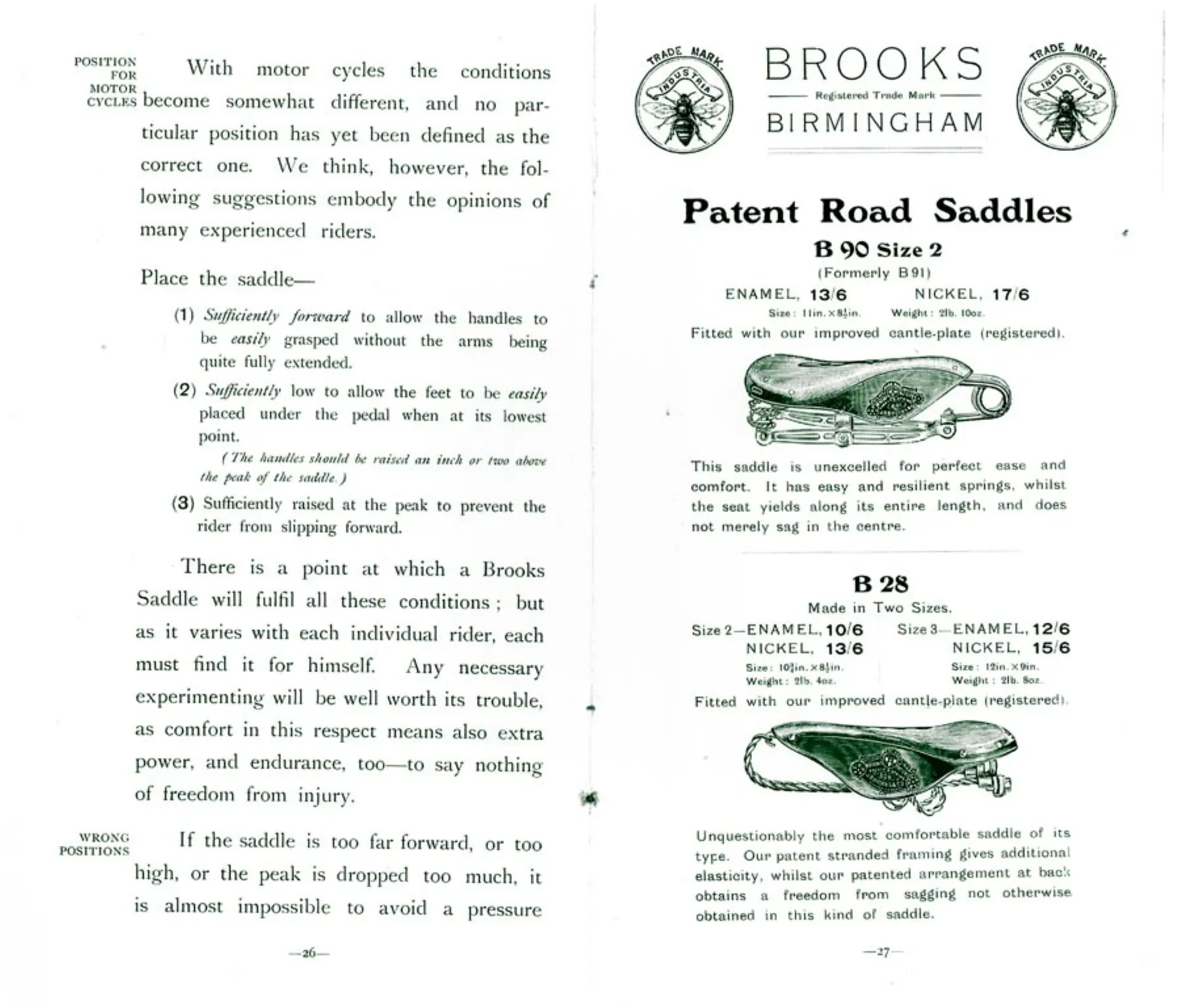
THE B 90 NUMBERING, IN BROOKS’ OWN WORDS. Each of the three B 90 sizes in this book carries a parenthetical note under its model number. Size 1 on printed page 17 reads Formerly B 92. Size 2 on printed page 27 reads Formerly B 91. Size 3 on printed page 29 reads Formerly B 90. So the three separate catalog numbers B 90, B 91 and B 92 were folded into one model sold in three sizes, and Brooks told its dealers so on the page. A stray note in this project’s records reading B 90 formerly B 92, carried for four working sessions without a source, is the B 90 Size 1 line and nothing else.
THE B 28 IS STILL 12 BY 9 IN 1904, AND STILL HAS NO RUBBER BUFFERS. Printed page 27 carries the B 28, Made in Two Sizes. Size 2 is 10/6 enamelled or 13/6 nickelled, 10 1/2 in. by 8 and a fraction, 2 lb. 4 oz. Size 3 is 12/6 or 15/6, a clean 12 by 9 in. with no fraction after the 9, 2 lb. 8 oz. Both are fitted with our improved cantle-plate (registered).
Two things follow. The first is that the B 28 Size 3 was still 12 by 9 in. in 1904 and is 12 by 9 1/2 in. from 1905, so the enlargement of that model happened inside a single year rather than across the two-year window this project had been carrying. The second is the closing sentence: Unquestionably the most comfortable saddle of its type. Our patent stranded framing gives additional elasticity, whilst our patented arrangement at back obtains a freedom from sagging not otherwise obtained in this kind of saddle. That is the 1905 wording, not the 1907 one. Rubber buffers are not named. The 1907 book is still the earliest naming of the rubber buffer in this collection, and it now has three genuine negatives behind it rather than two: 1903, 1904 and 1905.
THE COMPOUND SPRING IS EXPLAINED HERE, AND ON AN INSERTED LEAF. The two extra pages this book carries, 48A and 48B, sit between printed pages 48 and 49 and were inserted into a book that had already been paginated. What they carry is the compound spring.
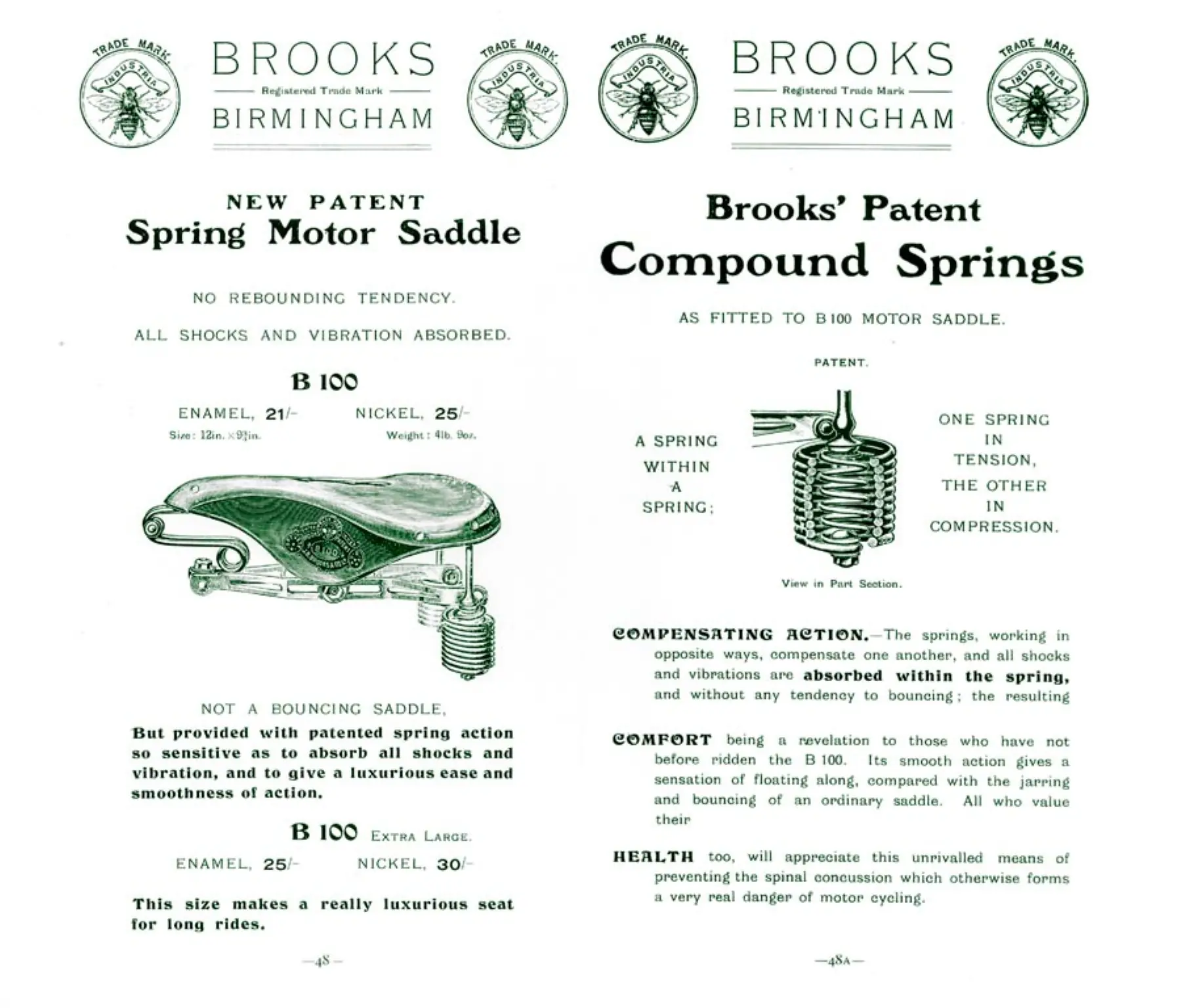
Printed page 48 is the B 100 New Patent Spring Motor Saddle, at 21/- enamelled or 25/- nickelled, with a B 100 Extra Large at 25/- or 30/-. Its headings run NO REBOUNDING TENDENCY and ALL SHOCKS AND VIBRATION ABSORBED, and its text reads NOT A BOUNCING SADDLE, but provided with patented spring action so sensitive as to absorb all shocks and vibration, and to give a luxurious ease and smoothness of action.
Printed page 48A is headed Brooks’ Patent Compound Springs, As Fitted To B 100 Motor Saddle, and it explains the device with a cutaway drawing captioned View in Part Section. Beside the drawing: A spring within a spring; one spring in tension, the other in compression. Beneath it three paragraphs that read as one running sentence. COMPENSATING ACTION. The springs, working in opposite ways, compensate one another, and all shocks and vibrations are absorbed within the spring, and without any tendency to bouncing; the resulting COMFORT being a revelation to those who have not before ridden the B 100. Its smooth action gives a sensation of floating along, compared with the jarring and bouncing of an ordinary saddle. All who value their HEALTH too, will appreciate this unrivalled means of preventing the spinal concussion which otherwise forms a very real danger of motor cycling.
This matters because the compound spring is the Brooks technology that genuinely moved from motor saddle to bicycle saddle, and it did so in 1905, when the B 120 was produced out of the B 100. The 1904 book is where the mechanism is first set out, and the explanation it gives, one spring in tension and one in compression, is not the explanation the 1919 and 1920 books give, which is that the two springs have different natural periods and cancel each other’s bounce. Two accounts of the same device, fifteen years apart.
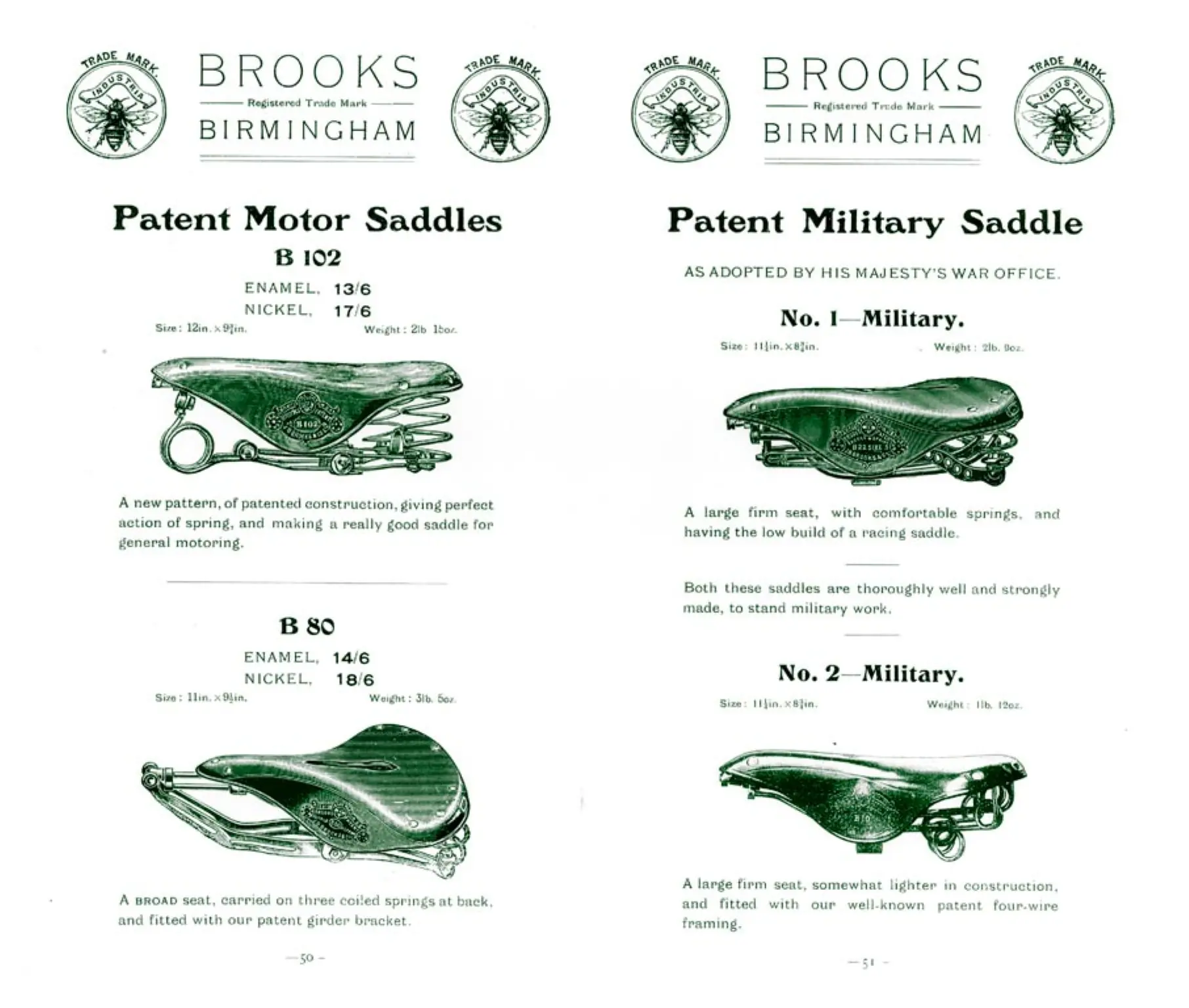
THE MILITARY RANGE IS No. 1 AND No. 2, AND THERE IS NO No. 3. Printed page 51 is headed Patent Military Saddle, AS ADOPTED BY HIS MAJESTY’S WAR OFFICE. It carries the No. 1 Military, a large firm seat, with comfortable springs, and having the low build of a racing saddle, at 2 lb. 9 oz.; and the No. 2 Military, a large firm seat, somewhat lighter in construction, and fitted with our well-known patent four-wire framing, at 1 lb. 12 oz. Between them: Both these saddles are thoroughly well and strongly made, to stand military work. Neither is priced, where the 1906 book prices them at 14/- and 11/-. The index on printed page 7 gives Military Saddles at page 51 alone, and under SADDLES it gives Military 51.
The Brooks military range is therefore now known without a gap for fourteen years: No. 1 and No. 2 in 1903, 1904, 1905, 1906 and 1907; No. 2 alone in 1908 and 1910; No. 2 and No. 3 from 1911 through 1914; and no military range at all by 1916.
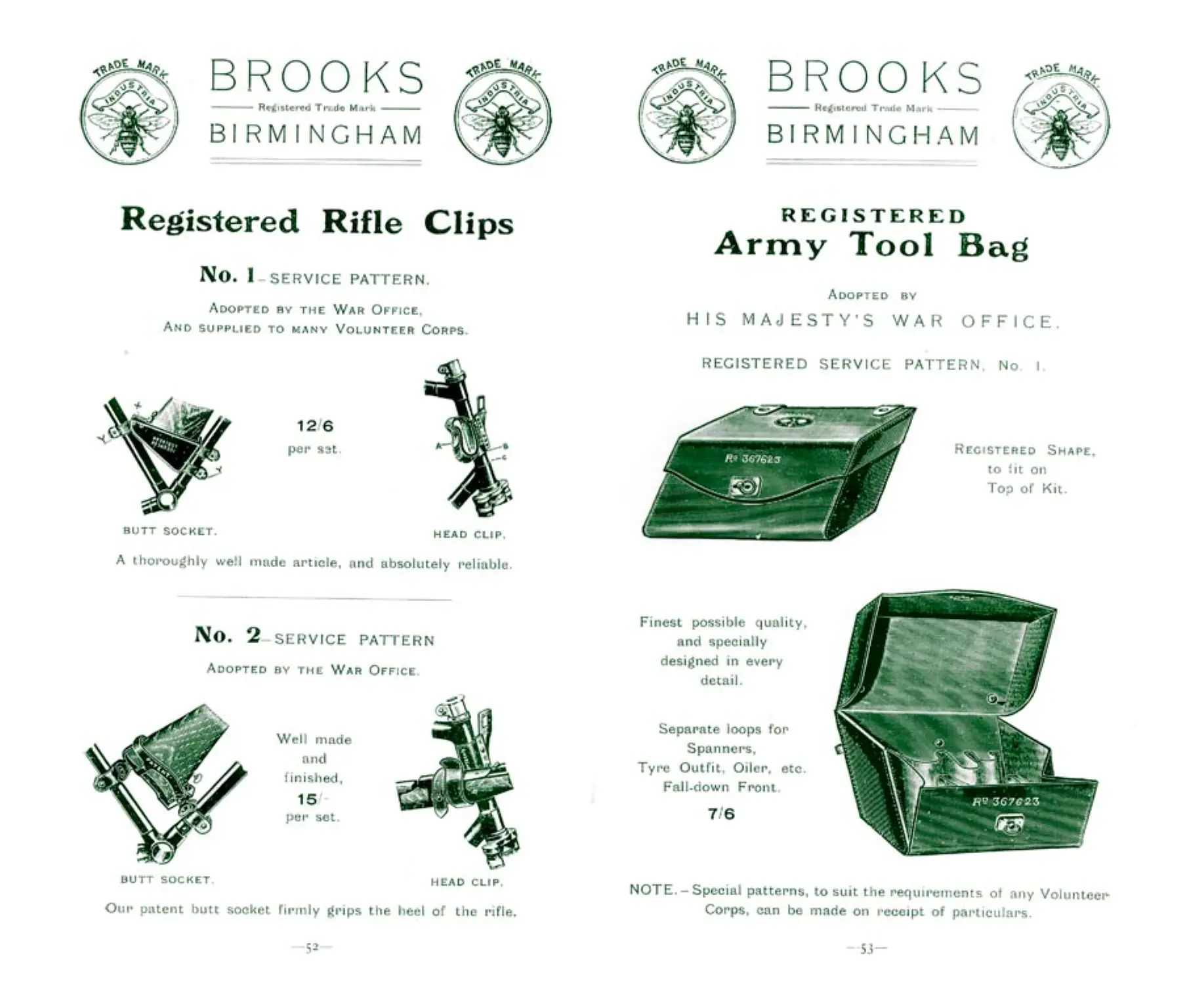
AND THE REASON SURVEYS OF THAT RANGE KEEP GOING WRONG IS ON THE NEXT TWO PAGES. Printed page 52 is headed Registered Rifle Clips and carries a No. 1 Service Pattern at 12/6 per set, adopted by the War Office, and supplied to many Volunteer Corps, and a No. 2 Service Pattern at 15/- per set, adopted by the War Office, with the note that our patent butt socket firmly grips the heel of the rifle. Printed page 53 is headed Registered Army Tool Bag, adopted by His Majesty’s War Office, Registered Service Pattern, No. 1, at 7/6, of registered shape, to fit on Top of Kit, with separate loops for spanners, tyre outfit, oiler and a fall-down front, and a closing note that special patterns, to suit the requirements of any Volunteer Corps, can be made on receipt of particulars. The bag carries the registered design number Rd 367623 in the engraving, the same number the 1903 book shows.
Three separate No. 1 and No. 2 series on three consecutive pages, all of them adopted by the War Office, and only the first are saddles. The 1903 book spreads the same trap over six pages; here it is on three facing leaves, and the index on page 7 separates the four classes by name.
THE NICKEL PREMIUM. This book prices every saddle twice, enamelled and nickelled, and the premium is a flat shilling amount per model rather than a percentage. The B 17 goes 7/6 to 9/6, the B 302 8/- to 10/6, the B 11 10/- to 12/-, the B 24 Size 1 9/- to 11/-, the B 90 Size 1 12/6 to 16/6, the B 90 Size 2 13/6 to 17/6, the B 90 Size 3 14/6 to 18/6, the B 40 19/6 to 24/-. Worked as percentages those run from about 20 per cent at the cheap end to about 32 per cent on the B 90 Size 1, which is the same shape the 1900 and 1903 books show. The 1906 book is where that changes.
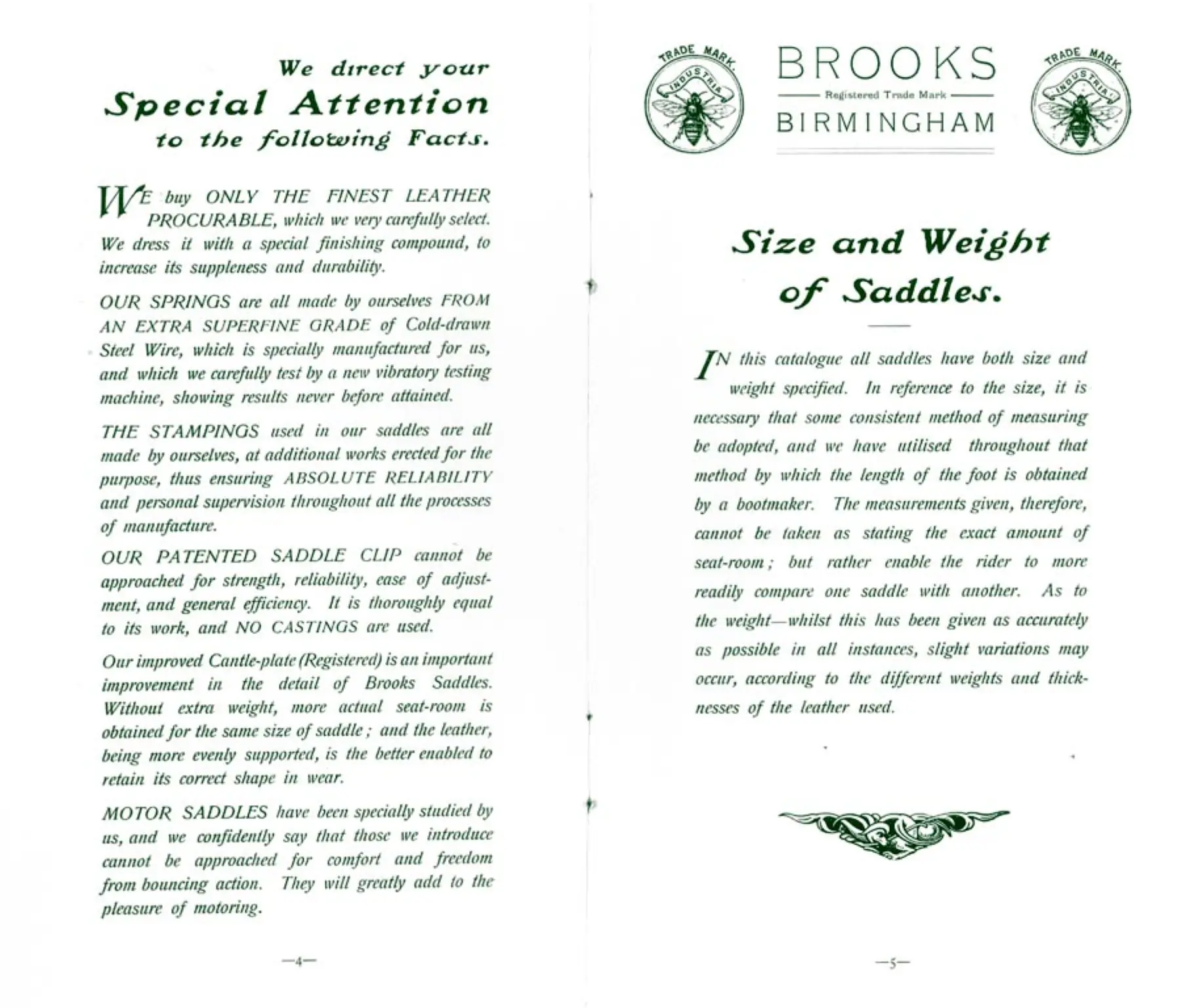
OTHER THINGS THIS BOOK SETTLES. The measuring convention is declared on printed page 5, in this catalogue all saddles have both size and weight specified, and we have utilised throughout that method by which the length of the foot is obtained by a bootmaker. That is the fifth attestation of the bootmaker rule in this run. Note what the sentence does not include: height. The 1906 book adds height to the same sentence, so the height figure enters the Brooks specification between 1904 and 1906.
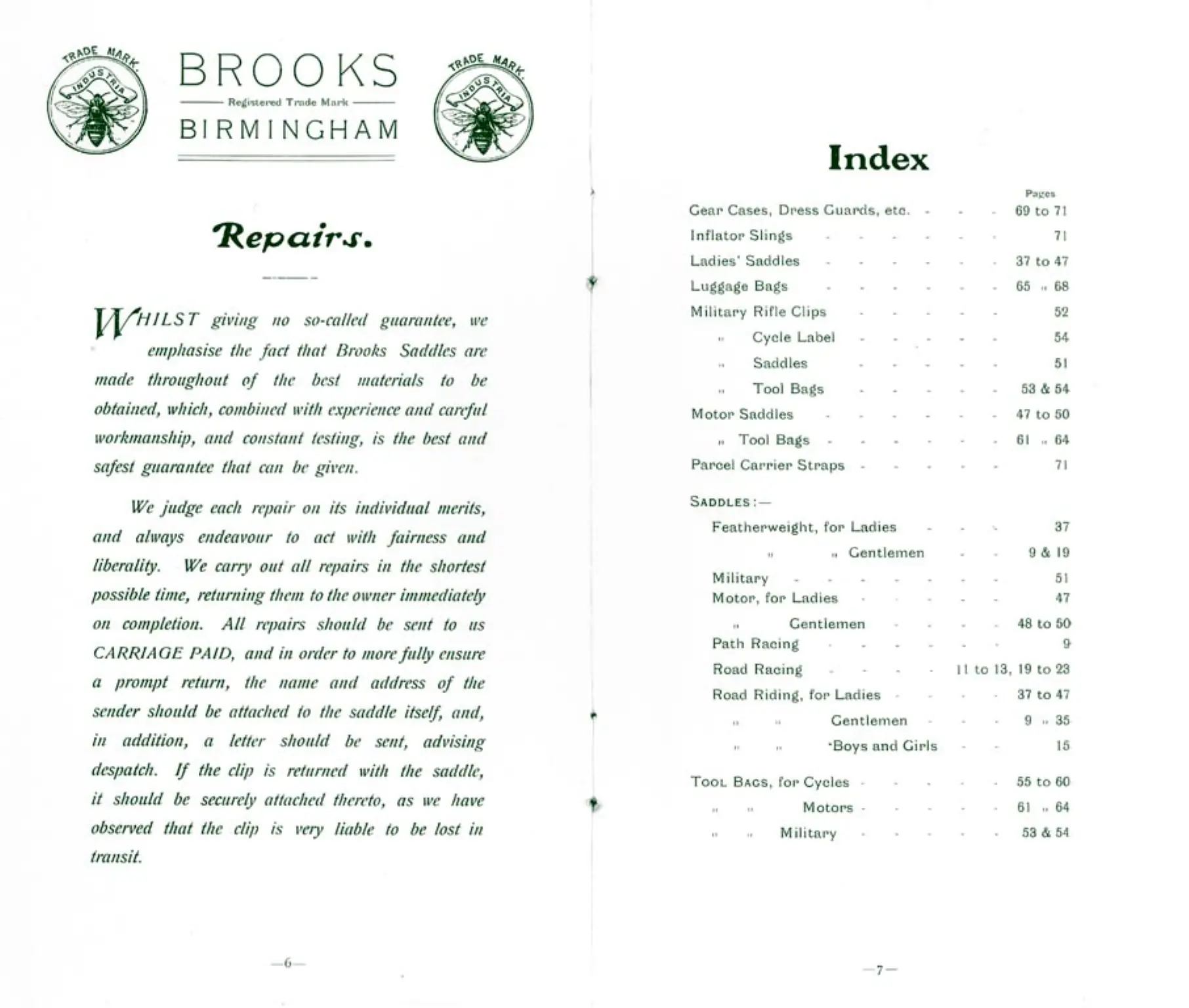
The counterfeit warning is on the title page, headed WARNING! and running: WE wish to impress upon all Cyclists that EVERY SADDLE MADE BY US BEARS OUR NAME on both flaps, and has at the back the name-plate, BROOKS, so well known to all riders. NO OTHER SADDLE IS MADE BY US. The same claim in almost the same words appears in the 1903 book, in the 1906 book and again in 1920, seventeen years later.
The title page also carries the line For 20 years the Recognised Standard of Perfection, the same round twenty-year figure the 1903 book prints on its page 56, and the firm’s establishment date, ESTABLISHED 1866. The telephone is a single number, 1213, which runs through the 1900, 1903, 1904 and 1905 books; the 1906 book prints 1213 and 5174, use either number, so the second line arrives a year earlier than this project had recorded.
Two named riders appear on printed page 21, beside the larger size of the B 10: Mr. R. H. Carlisle, Mr. F. T. Bidlake and Mr. C. H. Larette. Bidlake is the timekeeper and journalist the Bidlake Memorial Prize is named for.
SCAN CONDITION. Sheets 28 and 29 of the PDF are a byte-identical duplicate pair, both carrying printed pages 50 and 51. The printed page sequence nevertheless runs unbroken from 2 through 71 with 48A and 48B interpolated, so the duplicate costs nothing and no page is missing. An exact-duplicate scan across all forty-one sheets found no other repeat, and an adjacent-sheet difference scan found nothing else. The book is reproduced as scanned; no de-yellowing was needed. Vulgar fractions sit at the resolution floor of a 100 ppi scan, and where a figure could not be resolved past the whole number it is described above as a fraction rather than guessed.
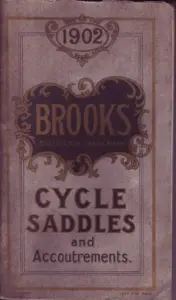 Brooks 1902 Catalog — Cycle Saddles and Accoutrements for 1902
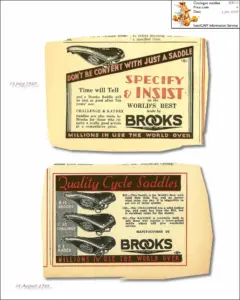 Brooks 1935 Advertisement — Specify and Insist, and Quality Cycle Saddles with Challenge and Kaydex
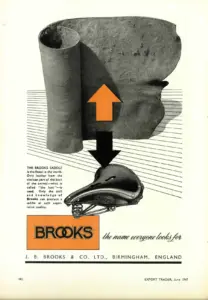 Brooks 1947 Advertisement — The Name Everyone Looks For (Export Trader)
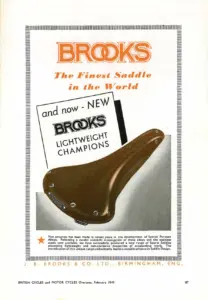 Brooks 1949 Advertisement — The New Lightweight Champions (British Cycles and Motor Cycles Overseas)
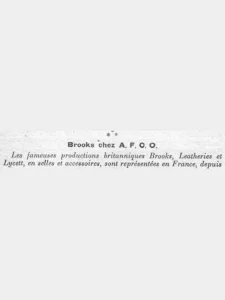 Brooks chez A.F.C.O. — L’Officiel du cycle, 3 November 1951, Brooks Represented in France by AFCO
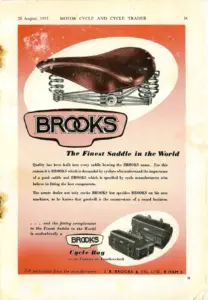 Brooks 1955 Advertisement — It’s the Saddle that Sells the Cycle (Motor Cycle and Cycle Trader)
Ebykr presents this material for research and education. If you hold rights to it or notice an ownership issue, please contact us and we will respond promptly.
The Ebykr Digest
New articles, timelines, catalog finds and registry activity — assembled from the archive once a month. Your address is never shared.
Double opt-in. One email per month. Unsubscribe at any time with one click.