About Ebykr
Ebykr celebrates classic and vintage lightweight bicycles through provocative imagery and opinion. Ride along with us.
About Ebykr
Ebykr celebrates classic and vintage lightweight bicycles through provocative imagery and opinion. Ride along with us.

Source: Ebykr archive.
| Marque | Brooks |
|---|---|
| Type | Catalog |
| Year | 1902 |
| Publisher | J. B. Brooks & Co., Ltd. |
| Country | England |
| Language | English |
| Pages | 9 |
| Source | Ebykr archive. |
| Credit | Ebykr archive |
| Transcription | Transcribed by eye |
1902 TRADE MARK Brooks (REGISTERED TRADE MARK) Cycle Saddles - AND - Accoutrements for 1902 ESTABLISHED 1866 J. B. Brooks & Co. Ltd. Birmingham TELEPHONE No. 1213 TELEGRAMS Brooks, Birmingham BIRMINGHAM : PRINTED BY COND BROS. MOOR STREET. WE HAVE PLEASURE IN PLACING BEFORE YOU OUR NEW CATALOGUE FOR 1902, AND WE ARE ENCOURAGED BY …
Brooks Cycle Saddles and Accoutrements for 1902, from J. B. Brooks and Co. Ltd. of Birmingham. The printed sequence runs to page 71, between limp card covers, printed by Cond Bros. of Moor Street, Birmingham. The year is printed three times, on the front cover inside an ornamental cartouche, on the title page, and in the foreword.
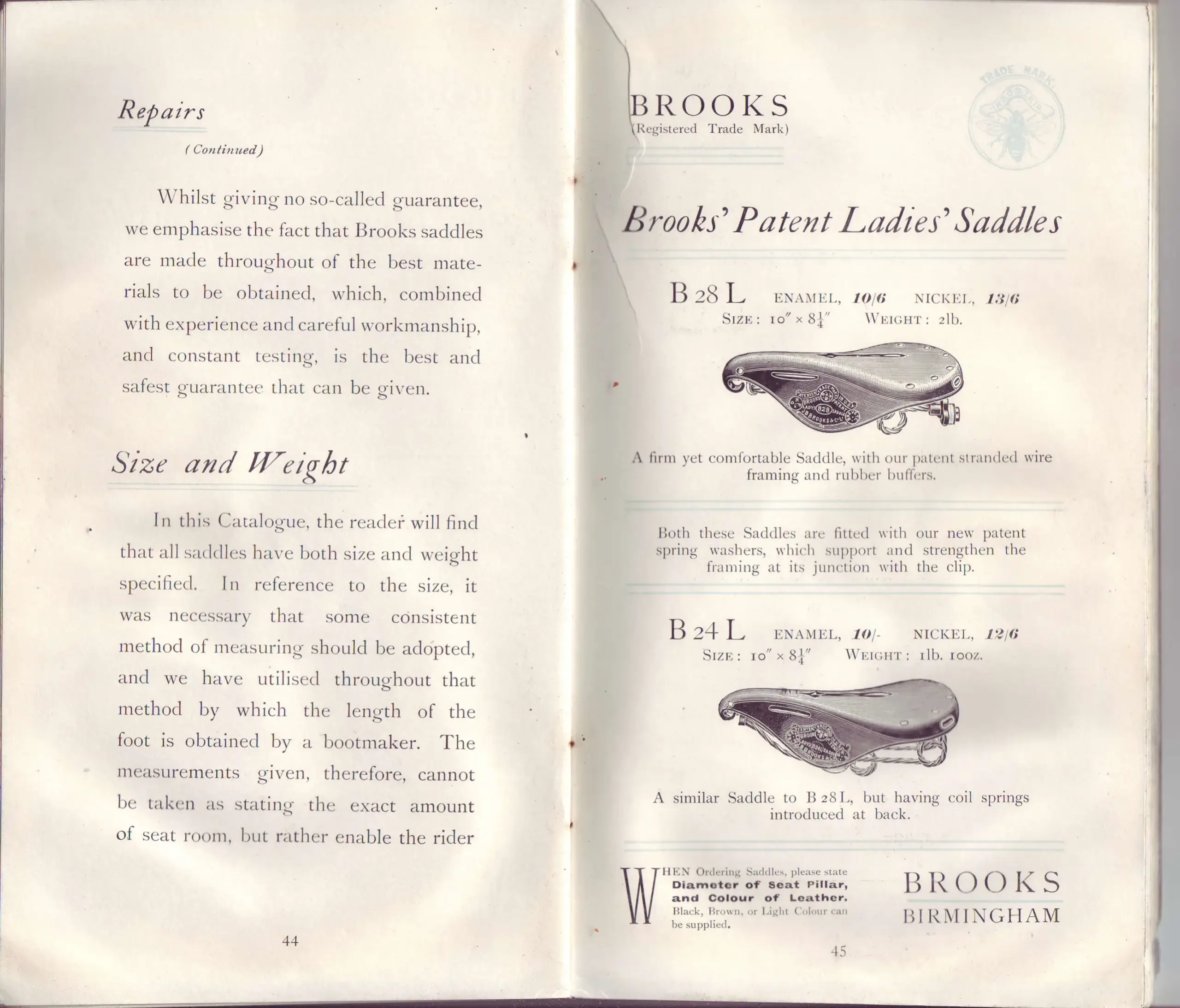
THIS BOOK NAMES THE RUBBER BUFFER, AND IT DOES SO FIVE YEARS EARLIER THAN THIS PROJECT HAD READ IT. Printed page 45 carries the ladies B 28 L and describes it as a firm yet comfortable Saddle, with our patent stranded wire framing and rubber buffers. The standing bound for the rubber buffer in this collection was the 1907 book, printed page 17, and the 1903, 1904 and 1905 books were recorded as genuine negatives. Every one of those readings was taken from the gentlemen’s B 28 entry. The ladies’ section was never read. The 1903 book names the device too, on printed page 43, where the B 28 L is a comfortable saddle, having our patent rubber buffer arrangement at back, and our patent stranded-wire spring framing. That sentence also settles what the shorter phrase means: the gentlemen’s B 28 in the same 1903 book is credited on printed page 25 with our patented arrangement at the cantle, and the ladies’ page forty pages later calls the same thing our patent rubber buffer arrangement. The two phrases are the same device, named at different lengths in one book, so the negatives were never negatives. A negative is only as wide as the pages that were read.
THE 1901 BOOK IS A GENUINE NEGATIVE, AND IT IS A CONTROLLED ONE. Printed page 33 of the 1901 catalogue carries the same B 28 L in the same slot and reads only: A firm yet comfortable Saddle. Has our Patent Stranded Wire Framing. The 1902 sentence is that sentence with the words and rubber buffers added. Two consecutive books, one model, one sentence, three words of difference. On the pages read so far the rubber buffer therefore enters the Brooks catalogue between 1901 and 1902.
THE SPECIFICATION BLOCK ARRIVES IN THIS BOOK. The 1901 catalogue prints no size, no weight and no height for any model. This one prints a size and a weight for every saddle, and explains itself on printed page 44 under the heading Size and Weight: In this Catalogue, the reader will find that all saddles have both size and weight specified. So the Brooks printed specification arrives in the single year between the two books. Height is not part of it and does not become part of it until between 1904 and 1906.
AND THE BOOTMAKER MEASURING RULE IS HERE, WHICH MAKES 1902 ITS EARLIEST ATTESTATION. The same printed page 44 continues: In reference to the size, it was necessary that some consistent method of measuring should be adopted, and we have utilised throughout that method by which the length of the foot is obtained by a bootmaker. The measurements given, therefore, cannot be taken as stating the exact amount of seat room, but rather enable the rider to more readily compare one saddle with another. The rule was previously attested nine times, from the 1903 book to the 1913 book, and 1903 puts it on printed page 44 as well. This is a tenth attestation and the earliest, and it cannot be pushed back further, because the 1901 book has no sizes to measure.
THE GUARANTEE REACHES BACK A YEAR TOO. Printed page 44, immediately above the Size and Weight heading and under Repairs, prints the formula word for word as the 1903, 1907 and 1908 books print it: Whilst giving no so-called guarantee, we emphasise the fact that Brooks saddles are made throughout of the best materials to be obtained, which, combined with experience and careful workmanship, and constant testing, is the best and safest guarantee that can be given. That makes the first of the two Brooks guarantee wordings a standing formula from 1902 to 1908 at least.
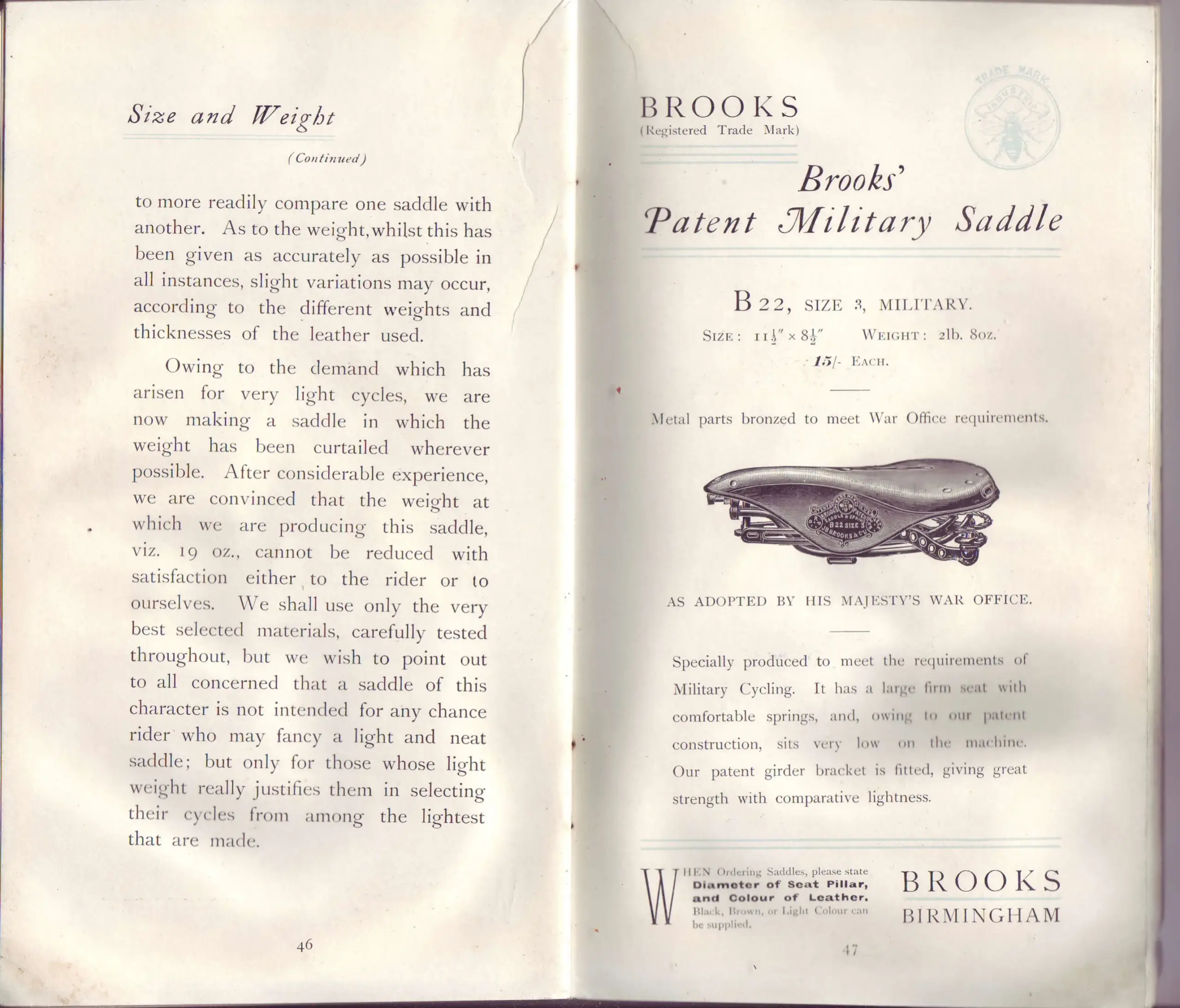
THE MILITARY SADDLE IS NOT YET NUMBERED. Printed page 47 carries a single military model and it is not a No. 1, a No. 2 or a No. 3. It is headed B 22, SIZE 3, MILITARY, priced 15/- each, with metal parts bronzed to meet War Office requirements and the line AS ADOPTED BY HIS MAJESTY’S WAR OFFICE. It is the civilian B 22 Size 3 of printed page 15 with bronzed fittings, at the same size of 11 1/4 by 8 1/2 inches, an ounce lighter and sixpence dearer. The numbered military series of No. 1 and No. 2 appears in the 1903 book and not here, so on the books this collection holds the numbering begins between 1902 and 1903. Post 1111 says the military saddles Nos. 1, 2 and 3 were introduced in 1903. The No. 3 part of that is wrong, as the 1903 book itself shows, but the year is right for the numbered series.
THE PRICES DO NOT MOVE BETWEEN THE TWO BOOKS. Every model that appears in both the 1901 and 1902 catalogues carries the same enamel price and the same nickel price in both: the B 40 at 19/6 and 24/-, the B 90 at 14/6 and 18/6, the B 91 at 13/6 and 17/6, the B 92 at 12/6 and 16/6, the B 28 at 10/6 and 13/6, the B 28/3 at 12/6 and 15/6, the B 60 at 15/6 and 19/6, the B 65 at 13/6 and 16/-, the B 22 at 12/6 and 16/6, the B 22/3 at 14/6 and 18/6, the B 28 L at 10/6 and 13/6 and the B 24 L at 10/- and 12/6. The nickel surcharge is unchanged model by model as well.
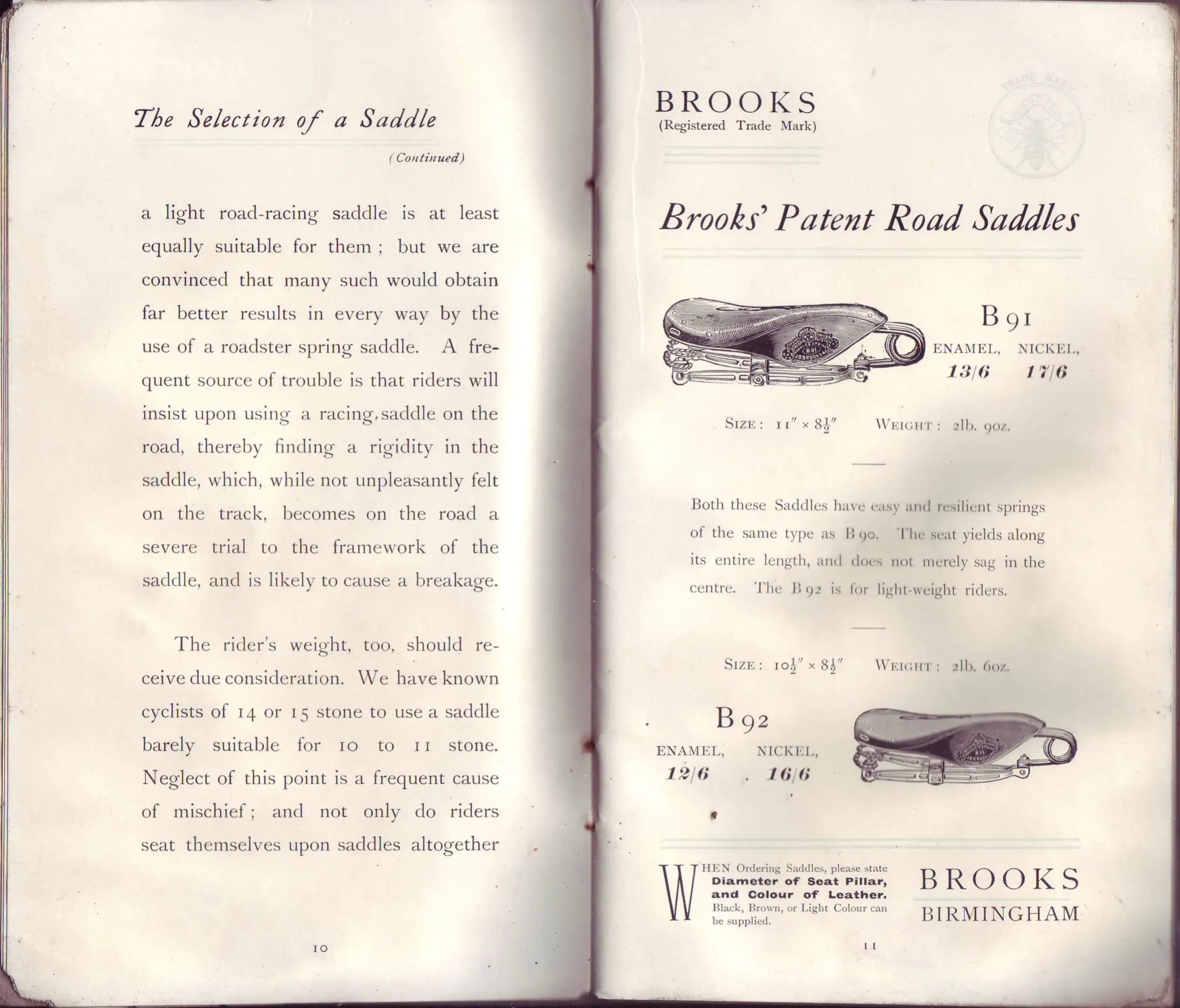
WHAT THE BOOK GIVES THE B 90 FAMILY. Because it prints figures, the three saddles the 1904 catalogue renamed as B 90 Sizes 1, 2 and 3 can be measured here for the first time in this collection: B 90 at 12 1/4 by 9 1/2 inches and 3lb. 2oz., B 91 at 11 by 8 1/2 inches and 2lb. 9oz., B 92 at 10 1/2 by 8 1/2 inches and 2lb. 6oz. The B 92 footprint of 10 1/2 by 8 1/2 is the same footprint the 1906 book gives the B 90 Size 1, so that size is stable across at least four years. The B 28 is 10 3/4 by 8 1/2 inches at 2lb. 4oz. and the B 28/3 is a clean 12 by 9 inches at 2lb. 8oz., which is exactly what the 1904 book gives the B 28/3 and exactly the weight the saddle database carries for it from another source. That corroborates the finding that the B 28 Size 3 grew to 12 by 9 1/2 inches inside the single year between 1904 and 1905.
ZAPHO IS NOT IN THIS BOOK. The 1901 catalogue devotes printed pages 54 and 55 to the Zapho range and badges them with a stag device lettered THE CHALLENGE in place of the Brooks bee. A survey of the head of all thirty-eight sheets of this book found no Zapho heading and no stag anywhere; every page carries the bee. That is a heading-level survey rather than a page-by-page reading, so it is stated as such, but a range with its own two pages and its own trade mark is the kind of thing a heading survey does find. Post 1111 says Zapho was gone by 1903, and on this evidence it was gone a year earlier.
SCAN AND CAVEATS. Shipped as-scanned; no de-yellowing was applied and none is needed. This is much the best scan in the pre-1903 part of the run, at about 300 ppi against the 100 ppi of the 1900, 1901 and 1903 books, so a printed page carries about 1,416 pixels of width and the vulgar fractions in the size column are firm. Every figure quoted above was re-read from the native rendering rather than from a montage. The sheets are stored rotated ninety degrees in the source file and have been turned upright here. The exact-duplicate check found no repeated image anywhere in the book and the printed page sequence is unbroken on the house mapping of sheet N to printed pages 2N-4 and 2N-3, so the scan is clean. There is no index; printed pages 3, 5 and 7 were all checked, and printed page 3 carries the foreword. The printer’s imprint is on printed page 2, set small in the vertical middle of an otherwise blank page, exactly as in the 1901 and 1903 books.
— Front cover —
[Limp card front cover, rubbed and stained, printed in a darker tone. A rectangular double-rule border encloses an ornamental cartouche of scrollwork within which the year is set in large figures.]
1902
[Printed page 1, the title page, letterpress within a triple green rule border.]
TRADE [roundel of a bee on a scroll lettered INDUSTRIA] MARK
Brooks
(REGISTERED TRADE MARK)
Cycle Saddles
– AND –
Accoutrements for 1902
ESTABLISHED 1866
J. B. Brooks & Co. Ltd.
Birmingham
TELEPHONE No. 1213
TELEGRAMS Brooks, Birmingham
[Two page opening. The left page is blank except for a three-line imprint set in small capitals in its vertical centre. The right page carries the foreword, set in spaced small capitals beneath the trade mark device.]
[Printed page 2.]
BIRMINGHAM :
PRINTED BY COND BROS.
MOOR STREET.
[Printed page 3.]
[At the head, a roundel showing a bee with outspread wings encircled by the word INDUSTRIA, flanked by rules.]
WE HAVE PLEASURE IN PLACING BEFORE YOU OUR NEW CATALOGUE FOR 1902, AND WE ARE ENCOURAGED BY THE APPROVAL WITH WHICH OUR FIRST ATTEMPT HAS BEEN RECEIVED, TO AGAIN INCLUDE A FEW HINTS ON THE SELECTION, ADJUSTMENT, AND CARE OF A CYCLE SADDLE.
WE EMPHASISE THE IMPORTANCE OF ATTENTION TO THE SUGGESTIONS WE HAVE GIVEN, THAT THEY MAY BECOME MORE APPRECIATED, AND THUS ENABLE MANY RIDERS TO FIND INCREASED COMFORT AND ENJOYMENT IN CYCLING.
BROOKS’ SADDLES HAVE A WORLD-WIDE REPUTATION, AND IN EVERY COUNTRY ARE ACKNOWLEDGED TO STAND PRE-EMINENT.
WE SHALL BE AHEAD IN IMPROVEMENTS FOR 1902, WHILST NEITHER TROUBLE NOR EXPENSE WILL BE SPARED IN ORDER TO RETAIN OUR ENVIABLE POSITION.
J. B. BROOKS & CO. LTD.
[Two page opening. The left page opens the fitting essay, the right page opens the model plates. Every model plate in the book carries the same running head and the same standing footer, transcribed here once.]
[Printed page 4.]
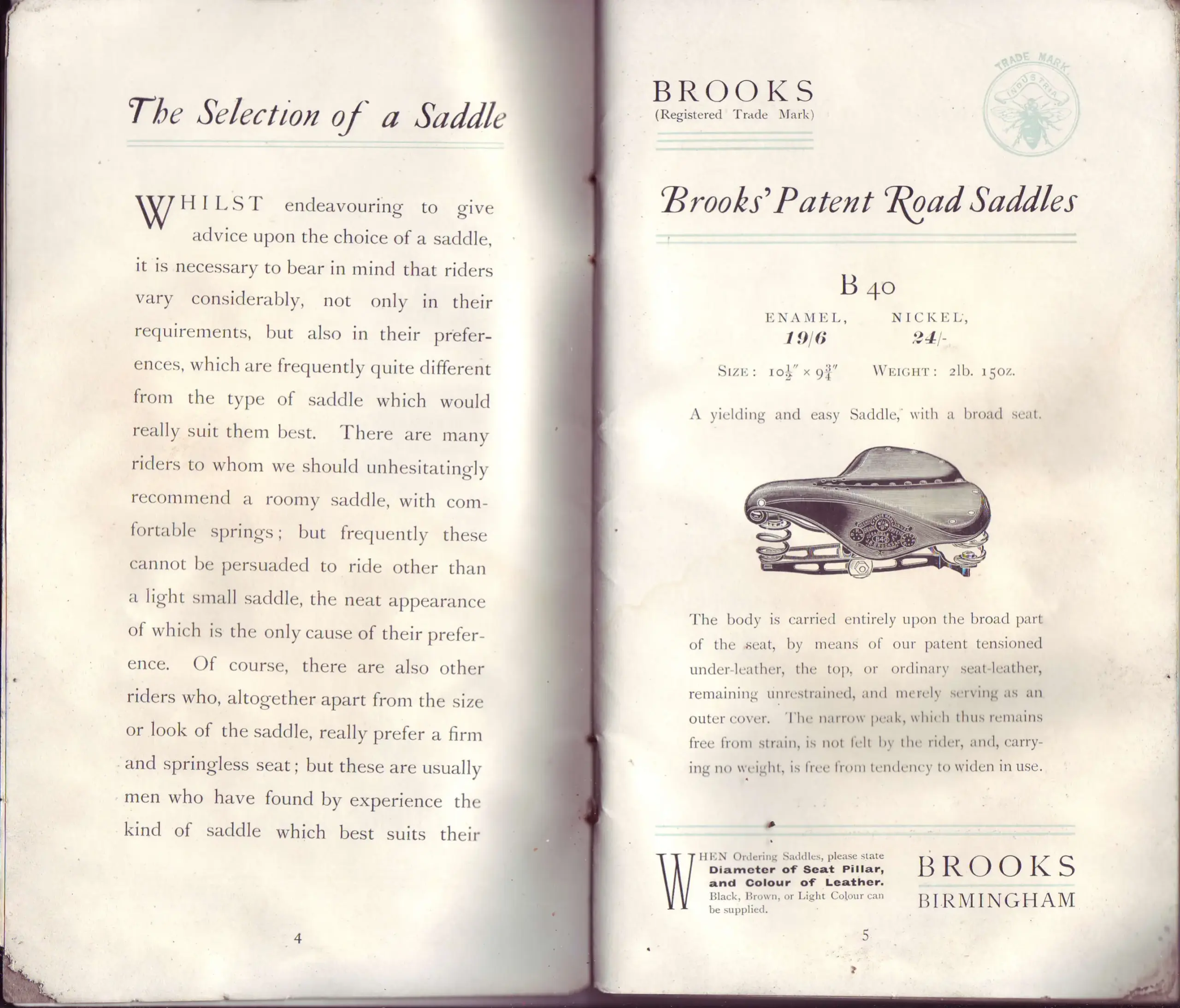
The Selection of a Saddle
WHILST endeavouring to give advice upon the choice of a saddle, it is necessary to bear in mind that riders vary considerably, not only in their requirements, but also in their preferences, which are frequently quite different from the type of saddle which would really suit them best. There are many riders to whom we should unhesitatingly recommend a roomy saddle, with comfortable springs; but frequently these cannot be persuaded to ride other than a light small saddle, the neat appearance of which is the only cause of their preference. Of course, there are also other riders who, altogether apart from the size or look of the saddle, really prefer a firm and springless seat; but these are usually men who have found by experience the kind of saddle which best suits their
[Printed page 5.]
BROOKS (Registered Trade Mark) [roundel of a bee on a scroll lettered INDUSTRIA, marked TRADE MARK]
Brooks’ Patent Road Saddles
B 40
ENAMEL, 19/6 . . . NICKEL, 24/-
Size: 10 1/2″ x 9 3/4″ Weight: 2lb. 15oz.
A yielding and easy Saddle, with a broad seat.
The body is carried entirely upon the broad part of the seat, by means of our patent tensioned under-leather, the top, or ordinary seat-leather, remaining unrestrained, and merely serving as an outer cover. The narrow peak, which thus remains free from strain, is not felt by the rider, and, carrying no weight, is free from tendency to widen in use.
WHEN Ordering Saddles, please state Diameter of Seat Pillar, and Colour of Leather. Black, Brown, or Light Colour can be supplied.
BROOKS BIRMINGHAM
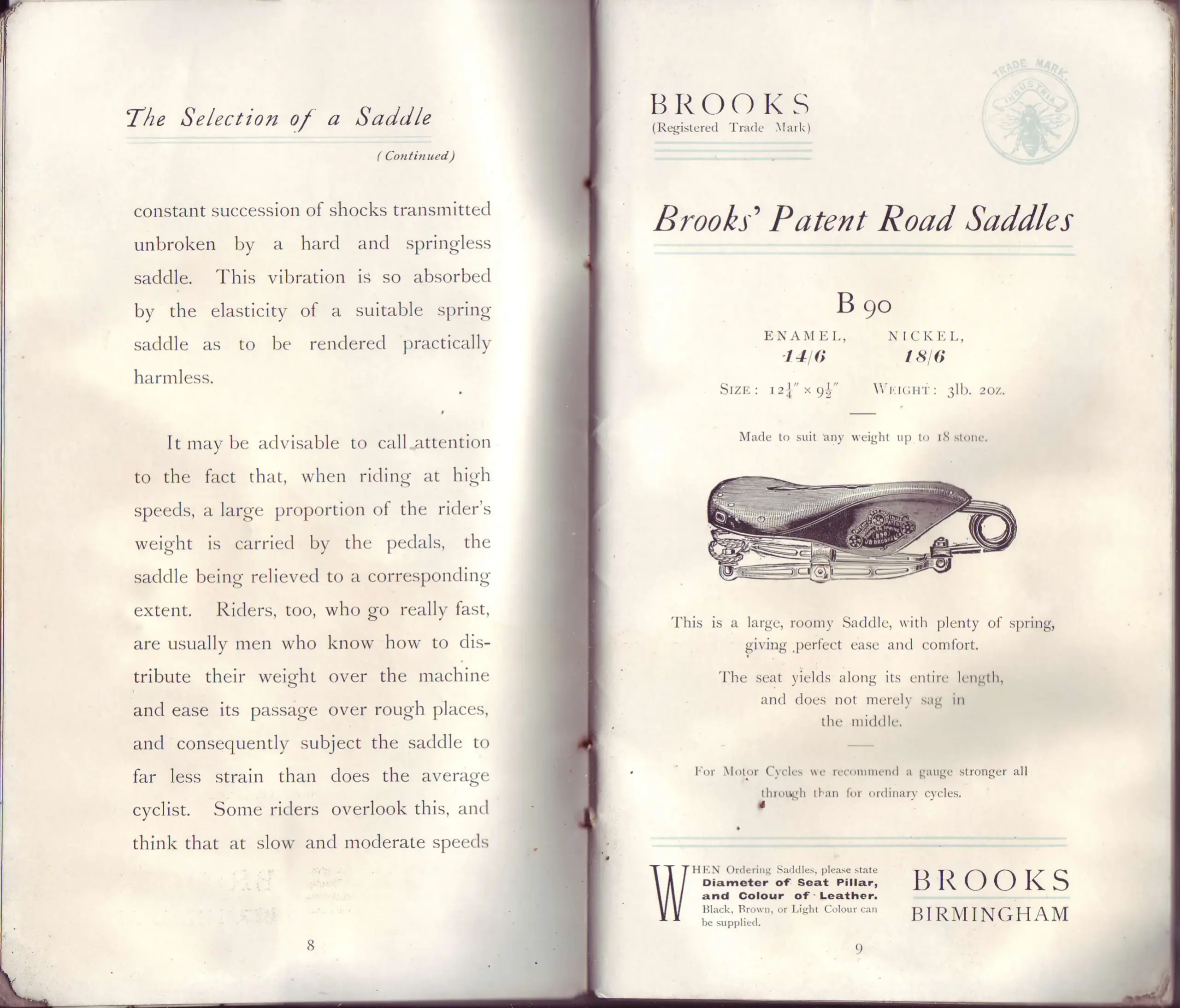
[Two page opening. The left page continues the fitting essay, the right page carries the B 90 alone, the largest saddle in the range.]
[Printed page 8.]
The Selection of a Saddle (Continued)
constant succession of shocks transmitted unbroken by a hard and springless saddle. This vibration is so absorbed by the elasticity of a suitable spring saddle as to be rendered practically harmless.
It may be advisable to call attention to the fact that, when riding at high speeds, a large proportion of the rider’s weight is carried by the pedals, the saddle being relieved to a corresponding extent. Riders, too, who go really fast, are usually men who know how to distribute their weight over the machine and ease its passage over rough places, and consequently subject the saddle to far less strain than does the average cyclist. Some riders overlook this, and think that at slow and moderate speeds
[Printed page 9.]
Brooks’ Patent Road Saddles
B 90
ENAMEL, 14/6 . . . NICKEL, 18/6
Size: 12 1/4″ x 9 1/2″ Weight: 3lb. 2oz.
Made to suit any weight up to 18 stone.
This is a large, roomy Saddle, with plenty of spring, giving perfect ease and comfort.
The seat yields along its entire length, and does not merely sag in the middle.
For Motor Cycles we recommend a gauge stronger all through than for ordinary cycles.
[Two page opening. The left page continues the fitting essay, the right page carries the B 91 above the B 92. With the B 90 on printed page 9 these are the three saddles the 1904 catalogue renamed as B 90 Sizes 3, 2 and 1.]
[Printed page 10.]
The Selection of a Saddle (Continued)
a light road-racing saddle is at least equally suitable for them; but we are convinced that many such would obtain far better results in every way by the use of a roadster spring saddle. A frequent source of trouble is that riders will insist upon using a racing saddle on the road, thereby finding a rigidity in the saddle, which, while not unpleasantly felt on the track, becomes on the road a severe trial to the framework of the saddle, and is likely to cause a breakage.
The rider’s weight, too, should receive due consideration. We have known cyclists of 14 or 15 stone to use a saddle barely suitable for 10 to 11 stone. Neglect of this point is a frequent cause of mischief; and not only do riders seat themselves upon saddles altogether
[Printed page 11.]
Brooks’ Patent Road Saddles
B 91
ENAMEL, 13/6 NICKEL, 17/6
Size: 11″ x 8 1/2″ Weight: 2lb. 9oz.
Both these Saddles have easy and resilient springs of the same type as B 90. The seat yields along its entire length, and does not merely sag in the centre. The B 92 is for light-weight riders.
Size: 10 1/2″ x 8 1/2″ Weight: 2lb. 6oz.
B 92
ENAMEL, 12/6 NICKEL, 16/6
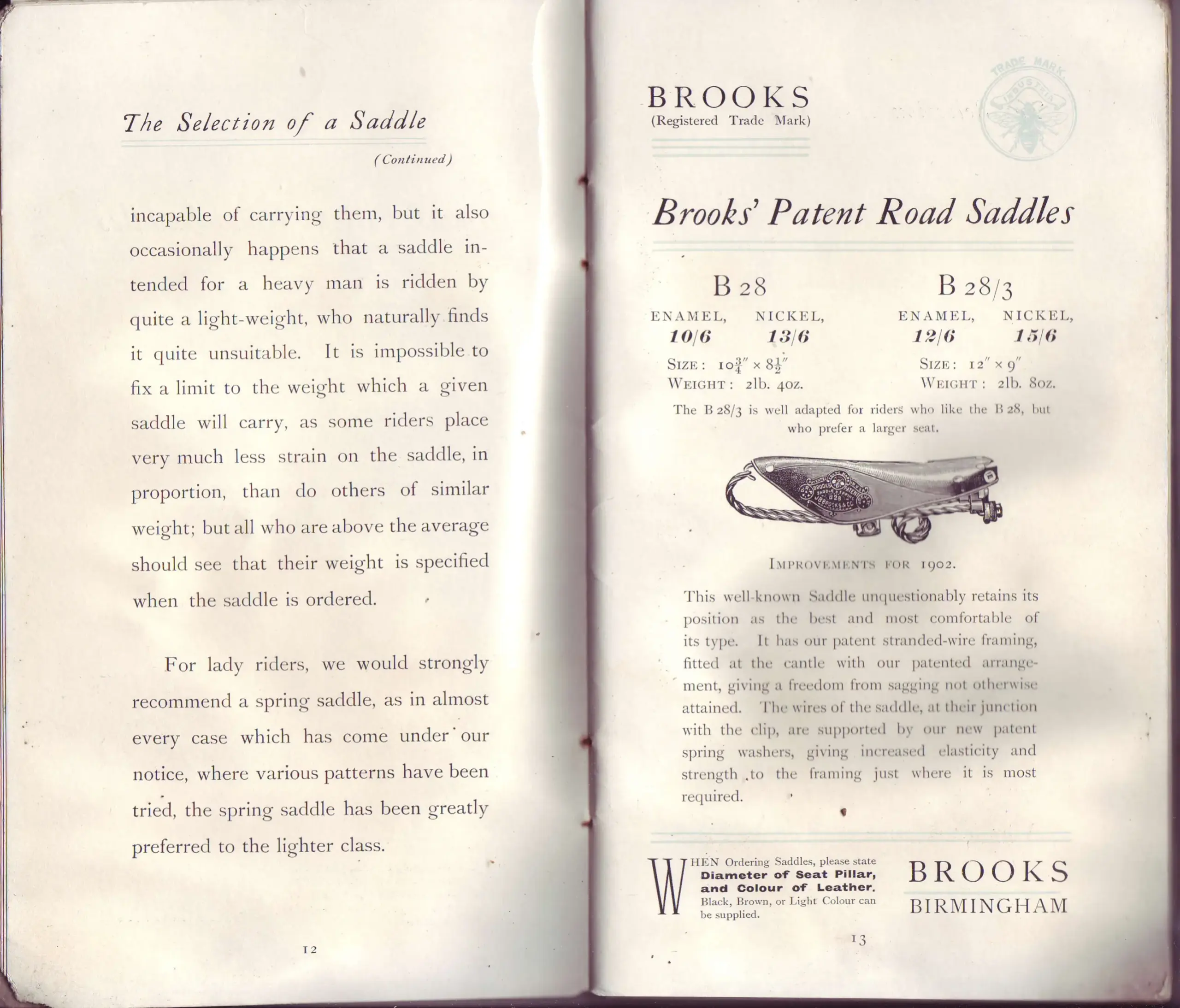
[Two page opening. The left page continues the fitting essay, the right page carries the B 28 beside its larger size, under a heading announcing the year’s improvements.]
[Printed page 12.]
The Selection of a Saddle (Continued)
incapable of carrying them, but it also occasionally happens that a saddle intended for a heavy man is ridden by quite a light-weight, who naturally finds it quite unsuitable. It is impossible to fix a limit to the weight which a given saddle will carry, as some riders place very much less strain on the saddle, in proportion, than do others of similar weight; but all who are above the average should see that their weight is specified when the saddle is ordered.
For lady riders, we would strongly recommend a spring saddle, as in almost every case which has come under our notice, where various patterns have been tried, the spring saddle has been greatly preferred to the lighter class.
[Printed page 13.]
Brooks’ Patent Road Saddles
B 28
ENAMEL, 10/6 NICKEL, 13/6
Size: 10 3/4″ x 8 1/2″ Weight: 2lb. 4oz.
B 28/3
ENAMEL, 12/6 NICKEL, 15/6
Size: 12″ x 9″ Weight: 2lb. 8oz.
The B 28/3 is well adapted for riders who like the B 28, but who prefer a larger seat.
IMPROVEMENTS FOR 1902.
This well-known Saddle unquestionably retains its position as the best and most comfortable of its type. It has our patent stranded-wire framing, fitted at the cantle with our patented arrangement, giving a freedom from sagging not otherwise attained. The wires of the saddle, at their junction with the clip, are supported by our new patent spring washers, giving increased elasticity and strength to the framing just where it is most required.
[Two page opening, and the most important leaf in the book. The left page closes the section on repairs with the guarantee formula and opens the section on size and weight, where the bootmaker measuring rule is declared. The right page opens the ladies’ range, and its first model is the entry that names the rubber buffer.]
[Printed page 44.]
Repairs (Continued)
Whilst giving no so-called guarantee, we emphasise the fact that Brooks saddles are made throughout of the best materials to be obtained, which, combined with experience and careful workmanship, and constant testing, is the best and safest guarantee that can be given.
Size and Weight
In this Catalogue, the reader will find that all saddles have both size and weight specified. In reference to the size, it was necessary that some consistent method of measuring should be adopted, and we have utilised throughout that method by which the length of the foot is obtained by a bootmaker. The measurements given, therefore, cannot be taken as stating the exact amount of seat room, but rather enable the rider
[Printed page 45.]
Brooks’ Patent Ladies’ Saddles
B 28 L
ENAMEL, 10/6 NICKEL, 13/6
Size: 10″ x 8 1/4″ Weight: 2lb.
A firm yet comfortable Saddle, with our patent stranded wire framing and rubber buffers.
Both these Saddles are fitted with our new patent spring washers, which support and strengthen the framing at its junction with the clip.
B 24 L
ENAMEL, 10/- NICKEL, 12/6
Size: 10″ x 8 1/4″ Weight: 1lb. 10oz.
A similar Saddle to B 28 L, but having coil springs introduced at back.
[Two page opening. The left page closes the section on size and weight and describes a nineteen-ounce lightweight saddle, the right page carries the military saddle, which is a size of the B 22 rather than a numbered model.]
[Printed page 46.]
Size and Weight (Continued)
to more readily compare one saddle with another. As to the weight, whilst this has been given as accurately as possible in all instances, slight variations may occur, according to the different weights and thicknesses of the leather used.
Owing to the demand which has arisen for very light cycles, we are now making a saddle in which the weight has been curtailed wherever possible. After considerable experience, we are convinced that the weight at which we are producing this saddle, viz. 19 oz., cannot be reduced with satisfaction either to the rider or to ourselves. We shall use only the very best selected materials, carefully tested throughout, but we wish to point out to all concerned that a saddle of this character is not intended for any chance rider who may fancy a light and neat saddle; but only for those whose light weight really justifies them in selecting their cycles from among the lightest that are made.
[Printed page 47.]
Brooks’ Patent Military Saddle
B 22, SIZE 3, MILITARY.
Size: 11 1/4″ x 8 1/2″ Weight: 2lb. 8oz.
15/- Each.
Metal parts bronzed to meet War Office requirements.
AS ADOPTED BY HIS MAJESTY’S WAR OFFICE.
Specially produced to meet the requirements of Military Cycling. It has a large firm seat with comfortable springs, and, owing to our patent construction, sits very low on the machine. Our patent girder bracket is fitted, giving great strength with comparative lightness.
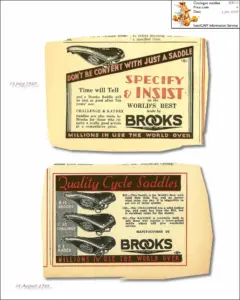 Brooks 1935 Advertisement — Specify and Insist, and Quality Cycle Saddles with Challenge and Kaydex
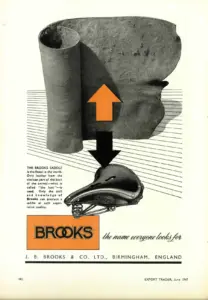 Brooks 1947 Advertisement — The Name Everyone Looks For (Export Trader)
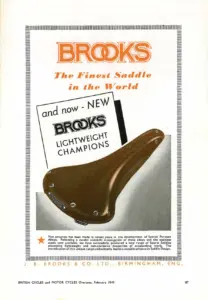 Brooks 1949 Advertisement — The New Lightweight Champions (British Cycles and Motor Cycles Overseas)
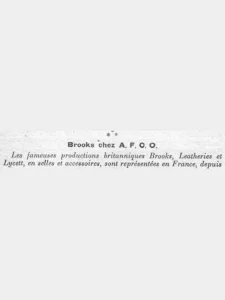 Brooks chez A.F.C.O. — L’Officiel du cycle, 3 November 1951, Brooks Represented in France by AFCO
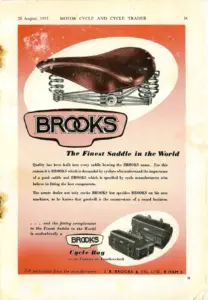 Brooks 1955 Advertisement — It’s the Saddle that Sells the Cycle (Motor Cycle and Cycle Trader)
Ebykr presents this material for research and education. If you hold rights to it or notice an ownership issue, please contact us and we will respond promptly.
The Ebykr Digest
New articles, timelines, catalog finds and registry activity — assembled from the archive once a month. Your address is never shared.
Double opt-in. One email per month. Unsubscribe at any time with one click.