About Ebykr
Ebykr celebrates classic and vintage lightweight bicycles through provocative imagery and opinion. Ride along with us.
About Ebykr
Ebykr celebrates classic and vintage lightweight bicycles through provocative imagery and opinion. Ride along with us.

Source: Ebykr archive.
| Marque | Brooks |
|---|---|
| Type | Catalog |
| Year | 1901 |
| Publisher | J. B. Brooks & Co., Ltd. |
| Country | England |
| Language | English |
| Pages | 12 |
| Source | Ebykr archive. |
| Credit | Ebykr archive |
| Transcription | Transcribed by eye |
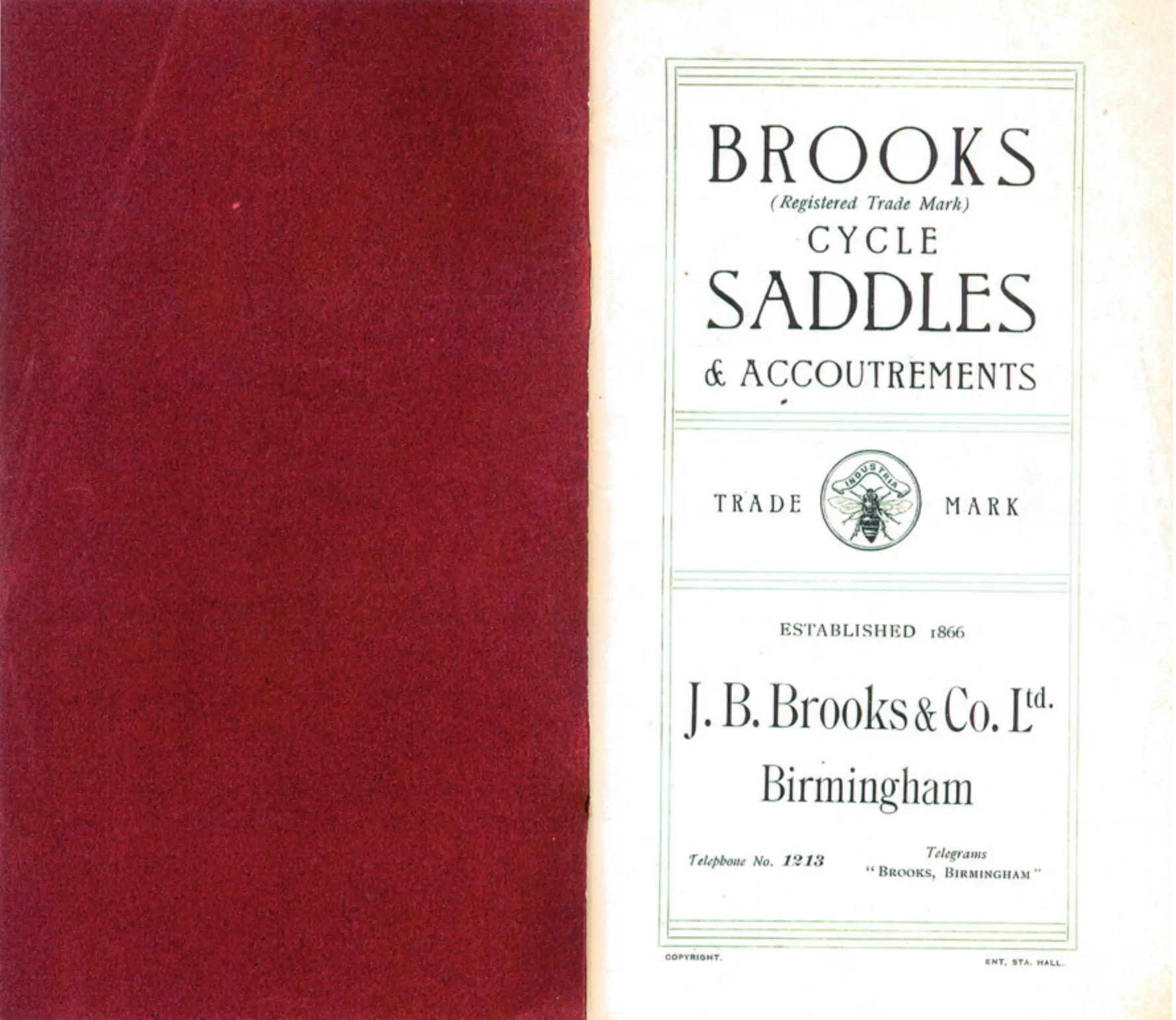
BROOKS (Registered Trade Mark) CYCLE SADDLES & ACCOUTREMENTS TRADE MARK ESTABLISHED 1866 J. B. Brooks & Co. Ltd. Birmingham Telephone No. 1213 Telegrams "BROOKS, BIRMINGHAM" COPYRIGHT. ENT. STA. HALL. BIRMINGHAM : PRINTED BY COND BROS. MOOR STREET WE have pleasure in bringing to your notice a hand-book of useful information about Saddles, and the choosing …
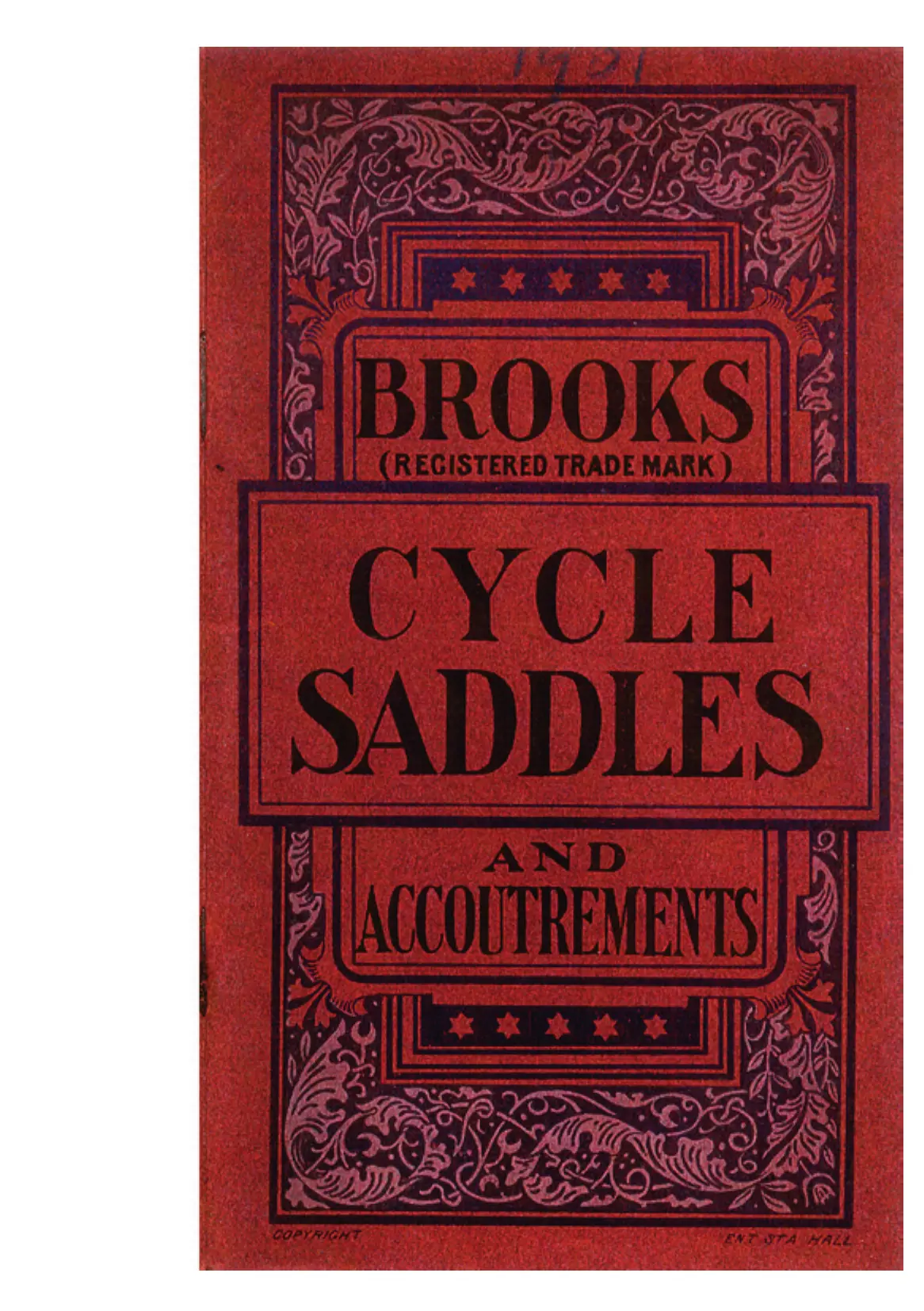
Brooks Cycle Saddles and Accoutrements, 1901, from J. B. Brooks and Co. Ltd. of Birmingham. Fifty-six printed pages between limp red card covers, printed by Cond Bros. of Moor Street, Birmingham. This is the earliest Brooks catalog in the Ebykr collection after the 1900 book, and it is the book that carries the Zapho range.
THE YEAR IS PRINTED, BUT NOT WHERE ANY OTHER BOOK IN THIS RUN PRINTS IT. There is no year on the front cover, no year on the title page, no year in the foreword and no year on the back cover. The 1901 written on the front cover is a hand in ink and not print. The year is printed on printed page 11, inside the model text for the B 60, which opens: This Saddle has been much improved for 1901, both in action and in appearance. Brooks used that formula as boilerplate, and the 1907 and 1908 books both apply it to the same B 28, so no product change should ever be inferred from it. As a dating tell it is sound, because the boilerplate always names the book’s own year. This is the sixth dating convention found in the run and the only one in which the year appears solely on an interior model plate.
THE BOOK IS A HAND-BOOK AS MUCH AS A CATALOG. Printed pages 4 to 35 run a fitting essay down the left-hand page and a model plate down the right, in five sections: The Selection of a Saddle, The Adjustment of a Saddle, The Saddle Clip, The Saddle Leather and Repairs. From printed page 36 both pages carry product plates. The foreword calls the book a hand-book of useful information about Saddles, and the choosing and using of them in a proper manner, and it is not dated and does not call itself an annual, where the 1900 foreword is dated January 1900 and does call itself the Annual Catalogue. That difference should not be built into a publication history, because the year of publication count that would settle it does not begin until 1910.
NO SIZE, NO WEIGHT AND NO HEIGHT ARE PRINTED ANYWHERE. Every model entry in this book gives a model number, the word ENAMEL or NICKEL, and a price, and nothing else. There is no length, no width, no weight and no height on any model plate. That matters for two standing questions. The Brooks printed specification block therefore arrives in 1902, the single year after this book: the 1902 catalogue prints a size and a weight for every model and declares on its printed page 44 that all saddles have both size and weight specified. The height is added to that block later, between 1904 and 1906, so the two are separate steps. That same printed page 44 of the 1902 book also carries the bootmaker measuring rule, which makes 1902 the earliest attestation of the rule and takes the count to ten; it cannot be pushed back past this book, because there are no sizes here to measure. The book is not silent about fit, only about figures, and it gives sixteen pages of fitting advice including a numbered three-point rule for saddle position on printed page 12.
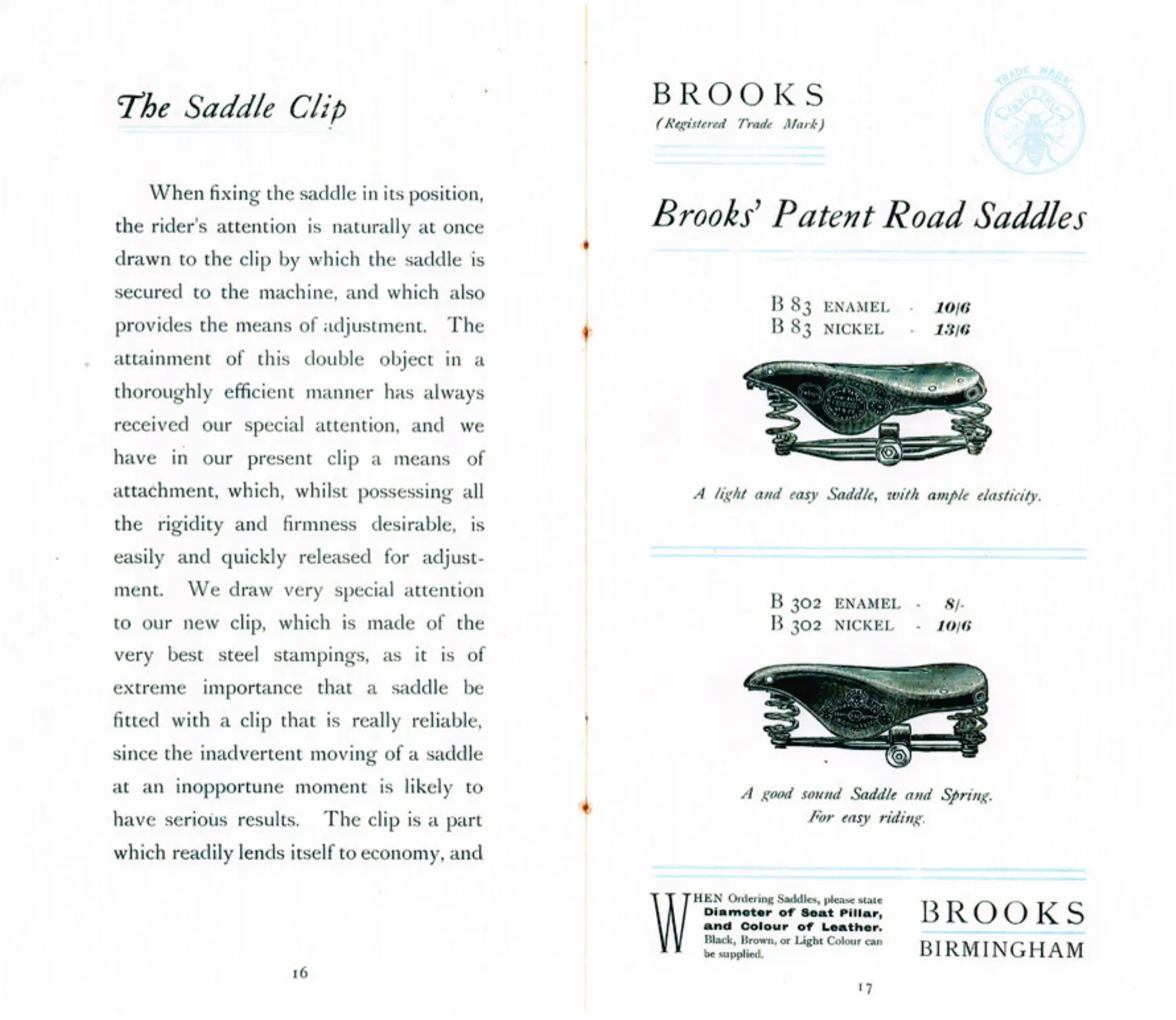
THE B 28, THE B 90, THE B 91 AND THE B 92 ARE ALL HERE, TWO YEARS EARLIER THAN THIS PROJECT HAD READ THEM. The B 28 is on printed page 9 at 10/6 in enamel and is already called this well-known Saddle, the same phrase the 1903 book uses. No rubber buffer is named on that page, and neither is the patented arrangement at back that the 1903 and 1905 books credit, the entry being two lines long in a book that prints no construction detail for any model. The stronger negative is on printed page 33, where the ladies B 28 L reads only that it has our Patent Stranded Wire Framing, because the 1902 catalogue prints that same sentence for that same model with the words and rubber buffers added. Two consecutive books, one model, one sentence, three words of difference. On the pages read so far the rubber buffer therefore enters the Brooks catalogue between 1901 and 1902, five years earlier than this project had it, and the 1903, 1904 and 1905 negatives that bound rested on were every one of them taken from the gentlemen s B 28 entry while the ladies section went unread. The B 90, B 91 and B 92 appear as three separate models at 14/6, 13/6 and 12/6 in enamel, described as suitable for any weight up to 18 stone, as giving plenty of spring, and as suitable for light-weight riders. The price ladder and the descriptions run in the same direction as the 1904 renaming, in which Brooks printed that B 92 became Size 1, B 91 Size 2 and B 90 Size 3. That is independent support for the renaming three years before Brooks printed it, and it is support only, because there are no dimensions here to compare.
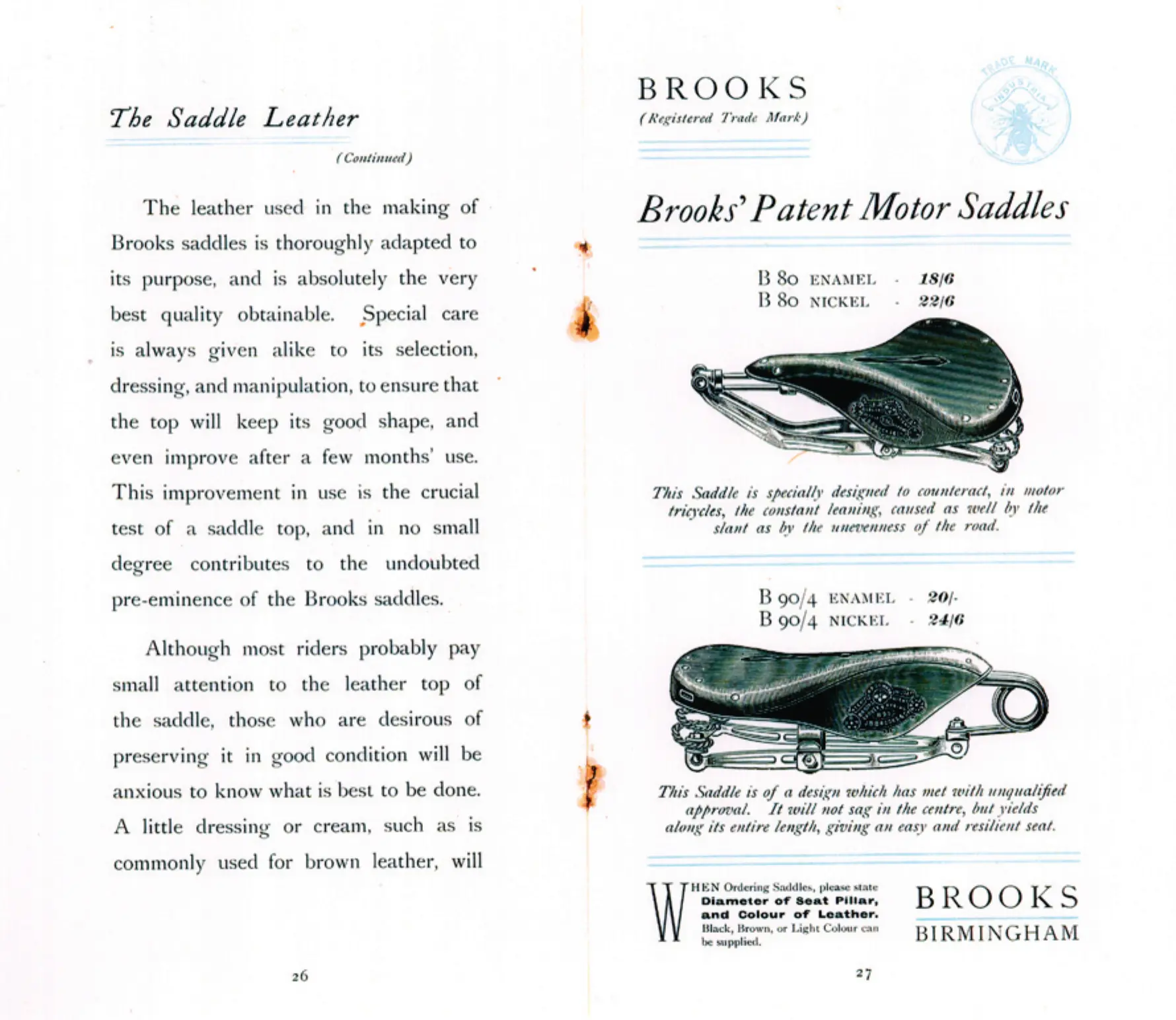
THE B 90/4 IS PRINTED, AND IT IS A MOTOR SADDLE. The Brooks saddle database carries a B 90/4 row dated 1899 from another source. Printed page 27 prints the model outright, on the Brooks Patent Motor Saddles page, at 20/- in enamel against the road B 90’s 14/6. The suffix is therefore not doing one job in this book: B 28/3, B 22/3 and B 9/2 are each labelled Size larger, and B 90/4 is not labelled as a size at all. A Brooks suffix should not be read as a size without checking the page it sits on. The same page names motor tricycles explicitly, and the motor range is the B 80 and the B 90/4 only, with no B 100, so the compound spring motor saddle that becomes the bicycle B 120 in 1905 arrives after 1901.
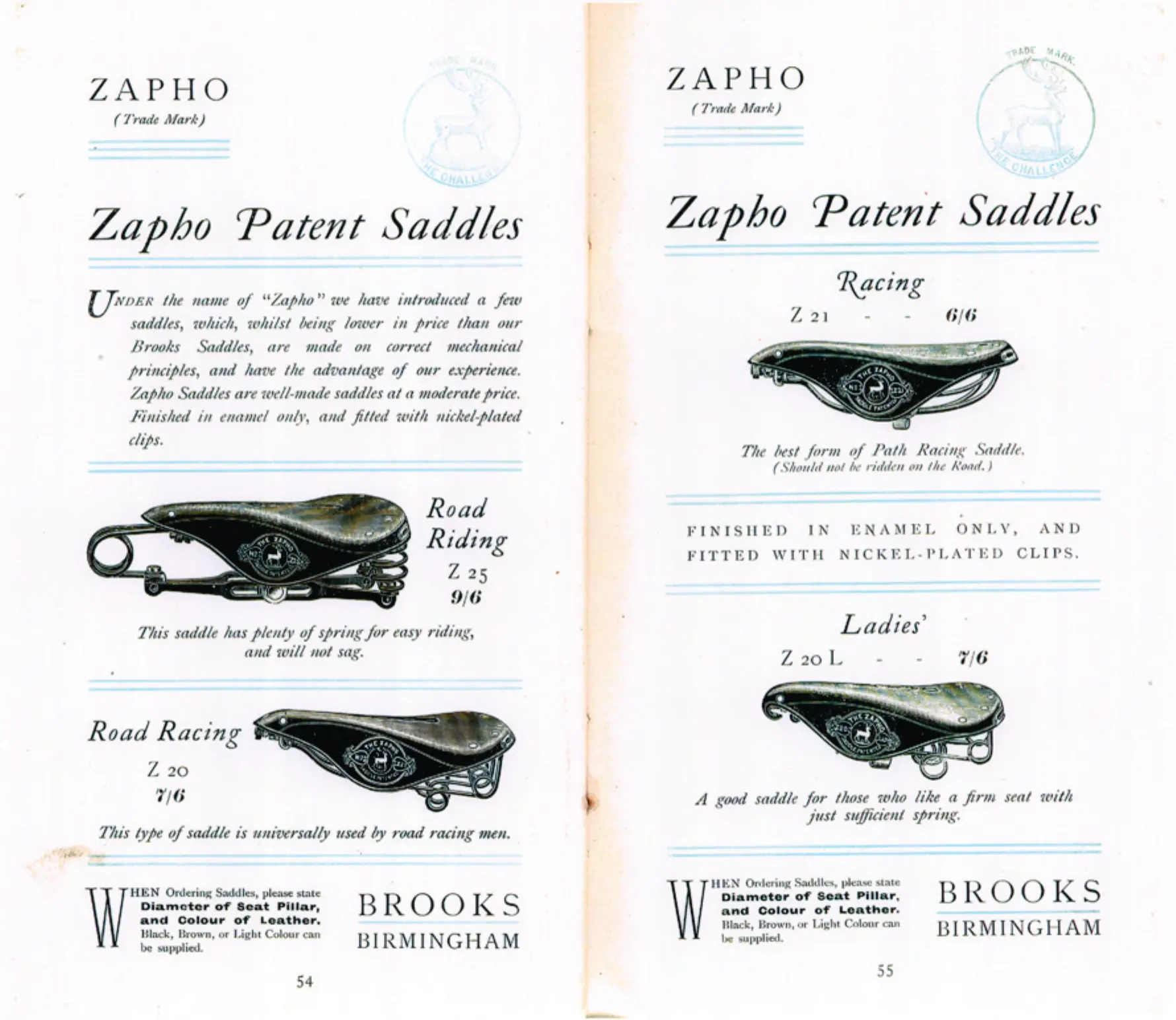
ZAPHO IS ON PRINTED PAGES 54 AND 55, AT THE VERY BACK OF THE BOOK. The range is four saddles, Z 25 at 9/6, Z 20 at 7/6, Z 21 at 6/6 and Z 20 L at 7/6. Brooks introduces them as saddles which, whilst being lower in price than our Brooks Saddles, are made on correct mechanical principles, and have the advantage of our experience. They are finished in enamel only and fitted with nickel-plated clips, and no colour of enamel is named anywhere on either page. Every Brooks model in the book carries two prices, one for enamel and one for nickel; the Zapho saddles carry one, and that is a large part of what lower in price means. The two Zapho pages are also badged differently from the rest of the book. Every Brooks page carries the word BROOKS marked Registered Trade Mark and a roundel of a bee on a scroll lettered INDUSTRIA. The Zapho pages carry the word ZAPHO marked Trade Mark only, and a roundel of a stag lettered THE CHALLENGE. Challenge is therefore a Brooks trade-marked device in 1901, one year after the 1900 book uses Challenge as a name on tool bags, and thirty-two years before the Challenge saddle range. That the device appears on the Zapho pages does not make Zapho and Challenge the same range and does not date the later Challenge saddles.
NICKEL PLATING IS A FLAT SURCHARGE SET PER MODEL. Because both prices are printed for every Brooks model, the whole range can be read. The surcharge is 2/-, 2/6, 3/-, 4/- or 4/6, and as a proportion it runs from about 15 per cent to about 32 per cent. It does not fall smoothly as the saddle gets dearer. The cheapest saddle in the book, the B 25 at 6/6, carries about 31 per cent, and so does the B 302 at 8/-, while the B 9 at 11/6 carries about 17 per cent and the B 9/2 at 13/6 about 15 per cent, the racing saddles carrying the smallest surcharge in the book regardless of price. Any percentage span quoted for a whole book therefore depends on which models happen to be in it, which is worth remembering when comparing this book with 1900, 1903 and 1906.
THE SCAN IS DEFECTIVE IN TWO PLACES AND ONE OF THEM IS INVISIBLE TO BOTH DUPLICATE CHECKS. Printed pages 50 and 51 are absent, and the sheet in that slot is a byte-identical duplicate of printed pages 52 and 53; the exact-duplicate check found that at once. Printed pages 22 and 23 are also absent, and there the leaf was simply skipped with no placeholder, so the sheets either side are genuinely different images and neither the adjacent-sheet comparison nor the exact-duplicate check can see it. Only the footer strip catches a skipped leaf. The book jumps from printed page 21 to printed page 24, and the sheet to printed page mapping shifts by one from that point on. Neither gap touches the Zapho pages or any model plate cited here, but the range roll-call below is incomplete because printed page 23 carried a model plate. Never cite 1901 printed pages 22 and 23 or 50 and 51.
THE RANGE AS READ, in printed order: Road Saddles B 40, B 30, B 35, B 91, B 90, B 28, B 28/3, B 24, B 60, B 65, B 22, B 22/3, B 92, B 83, B 302, B 24/1 and B 25; Road Racing B 9 and B 9/2; Path Racing B 11 and B 17; Motor B 80 and B 90/4; Zapho Z 25, Z 20, Z 21 and Z 20 L. Also catalogued, at heading level only and not transcribed here, are the Brooks Patent Ladies’ Saddles, the Brooks Patent Spanner, Brooks Gear Cases, Brooks Patent Dress Guards, Brooks Luggage Bags, Brooks Motor Bags, Brooks Tool Bags and Brooks Labels and Sundries.
SCAN AND CAVEATS. Shipped as-scanned; no de-yellowing was applied and none is needed. The book scans at about 100 ppi across a two-page spread, so a printed page carries roughly 445 pixels of width. That is enough for the model numbers and the shilling and pence prices, which were re-read at high magnification where a reading carried weight, and the outlying premiums on the B 9, B 9/2, B 65, B 25, B 302, B 24/1 and B 83 were each verified that way. The book prints no vulgar fractions in any specification, because it prints no specifications. There is no index; printed pages 3, 5 and 7 were all checked. The printer’s imprint is on printed page 2, in the vertical middle of an otherwise blank page, where neither a heading strip nor a footer strip can see it, and it was nearly recorded as absent.
— Front cover —
[Limp red card front cover, blind-blocked in a darker tone with an Art Nouveau border of scrolling foliage enclosing a panel of stars and rules. No lettering is legible in the blocking as scanned. The figure 1901 is written across the head of the cover in ink, in a hand, and is not part of the printing.]
[Two page opening. The left page is the blank inside front cover in plain red. The right page is the title page, letterpress inside a triple green rule border.]
[Printed page 1.]
BROOKS
(Registered Trade Mark)
CYCLE
SADDLES
& ACCOUTREMENTS
TRADE MARK [roundel of a bee on a scroll lettered INDUSTRIA]
ESTABLISHED 1866
J. B. Brooks & Co. Ltd.
Birmingham
Telephone No. 1213
Telegrams “BROOKS, BIRMINGHAM”
COPYRIGHT.
ENT. STA. HALL.
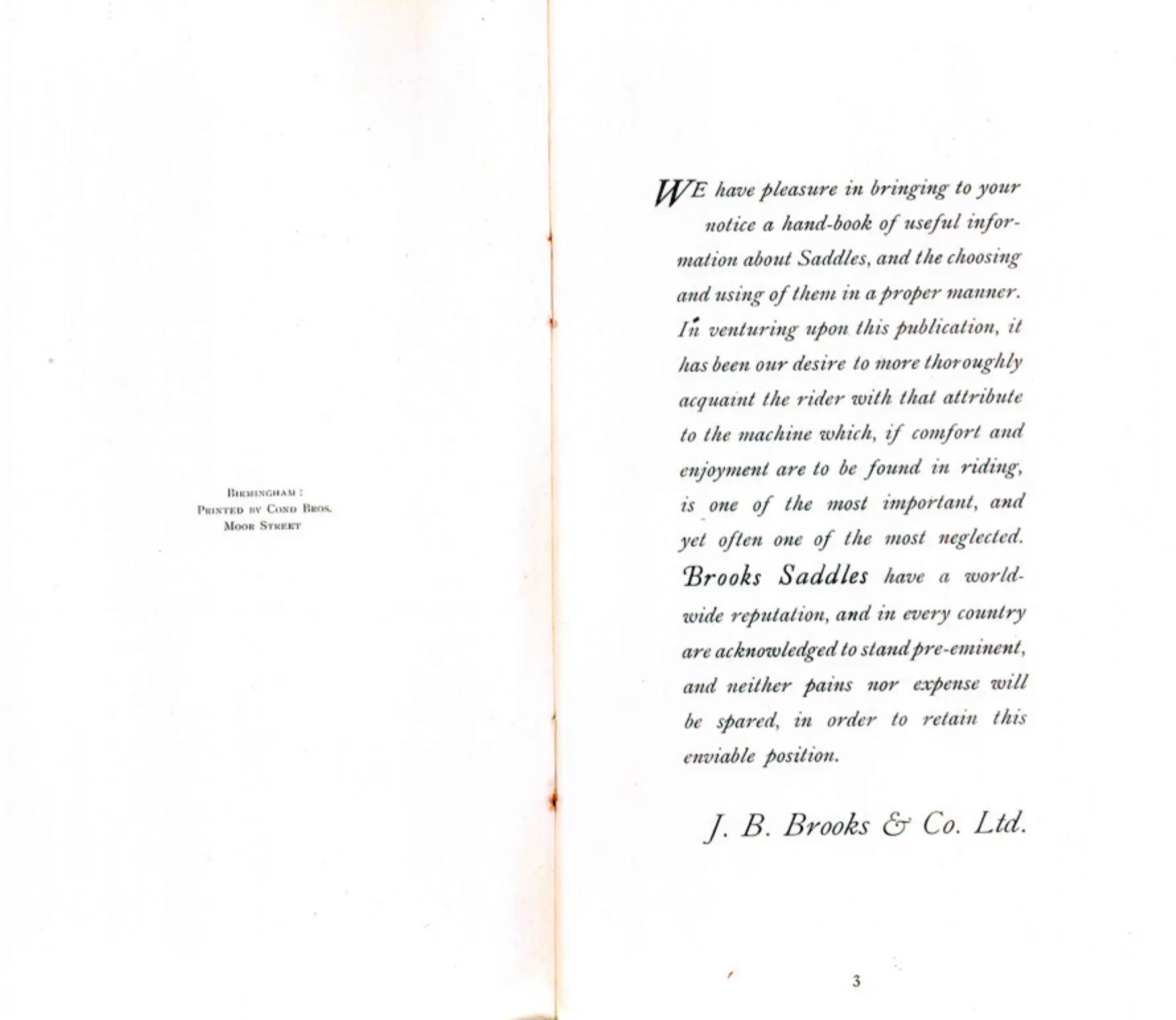
[Two page opening. The left page is blank except for a three-line imprint set in small capitals in its vertical centre, which is the only printing on the page and is invisible to both a heading crop and a footer crop. The right page carries the foreword, set in an italic face, unheaded and undated.]
[Printed page 2.]
BIRMINGHAM :
PRINTED BY COND BROS.
MOOR STREET
[Printed page 3.]
WE have pleasure in bringing to your notice a hand-book of useful information about Saddles, and the choosing and using of them in a proper manner. In venturing upon this publication, it has been our desire to more thoroughly acquaint the rider with that attribute to the machine which, if comfort and enjoyment are to be found in riding, is one of the most important, and yet often one of the most neglected. Brooks Saddles have a world-wide reputation, and in every country are acknowledged to stand pre-eminent, and neither pains nor expense will be spared, in order to retain this enviable position.
J. B. Brooks & Co. Ltd.
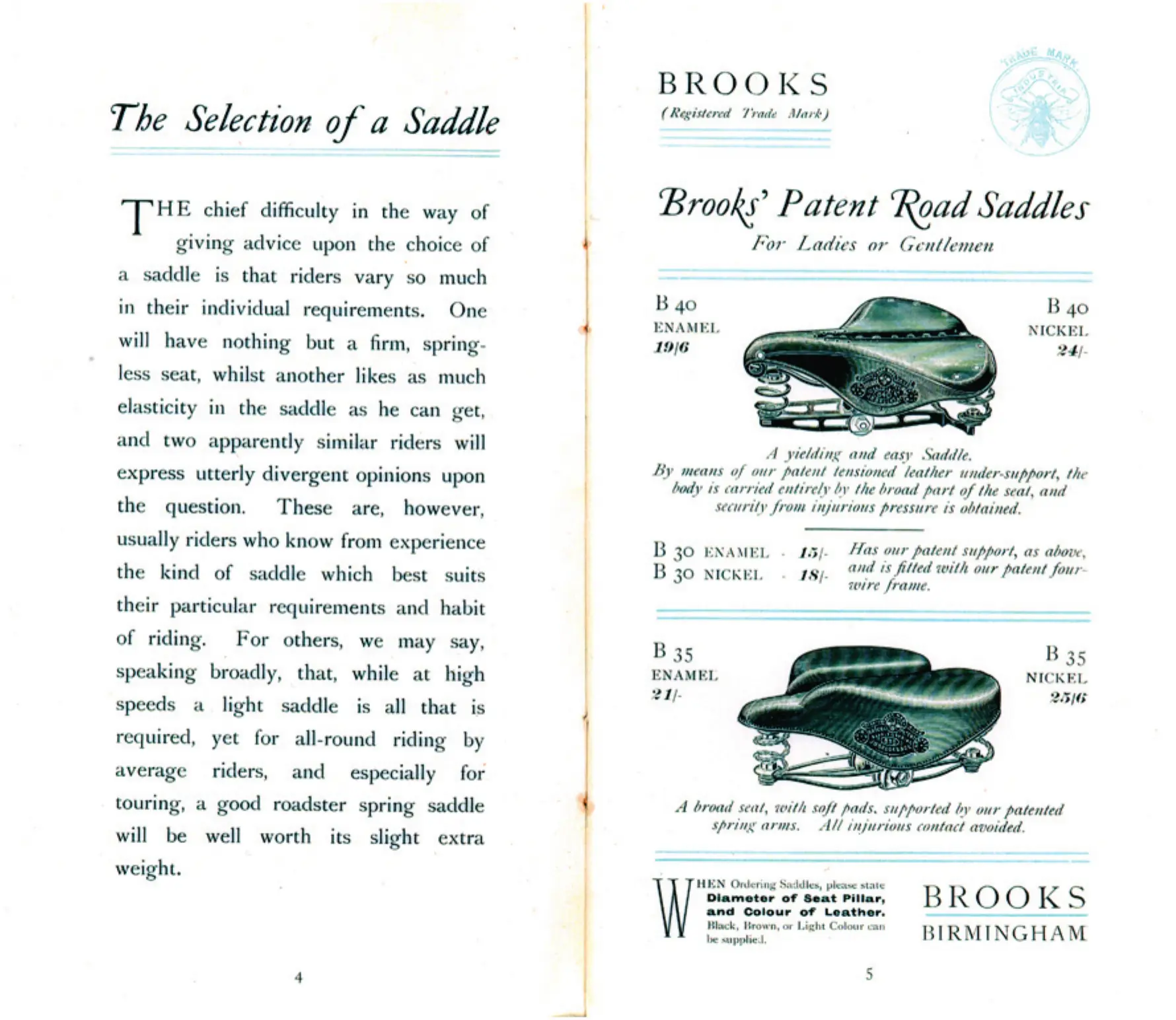
[Two page opening. The left page opens the fitting essay, the right page opens the model plates with three saddles, each priced in enamel and in nickel. The running head and the standing footer on the right page are repeated on every model plate in the book and are transcribed here once.]
[Printed page 4.]
The Selection of a Saddle
THE chief difficulty in the way of giving advice upon the choice of a saddle is that riders vary so much in their individual requirements. One will have nothing but a firm, springless seat, whilst another likes as much elasticity in the saddle as he can get, and two apparently similar riders will express utterly divergent opinions upon the question. These are, however, usually riders who know from experience the kind of saddle which best suits their particular requirements and habit of riding. For others, we may say, speaking broadly, that, while at high speeds a light saddle is all that is required, yet for all-round riding by average riders, and especially for touring, a good roadster spring saddle will be well worth its slight extra weight.
[Printed page 5.]
BROOKS (Registered Trade Mark) [roundel of a bee on a scroll lettered INDUSTRIA, marked TRADE MARK]
Brooks’ Patent Road Saddles
For Ladies or Gentlemen
B 40 ENAMEL 19/6 . . . B 40 NICKEL 24/-
A yielding and easy Saddle. By means of our patent tensioned leather under-support, the body is carried entirely by the broad part of the seat, and security from injurious pressure is obtained.
B 30 ENAMEL 15/-
B 30 NICKEL 18/-
Has our patent support, as above, and is fitted with our patent four-wire frame.
B 35 ENAMEL 21/- . . . B 35 NICKEL 25/6
A broad seat, with soft pads, supported by our patented spring arms. All injurious contact avoided.
WHEN Ordering Saddles, please state Diameter of Seat Pillar, and Colour of Leather. Black, Brown, or Light Colour can be supplied.
BROOKS BIRMINGHAM
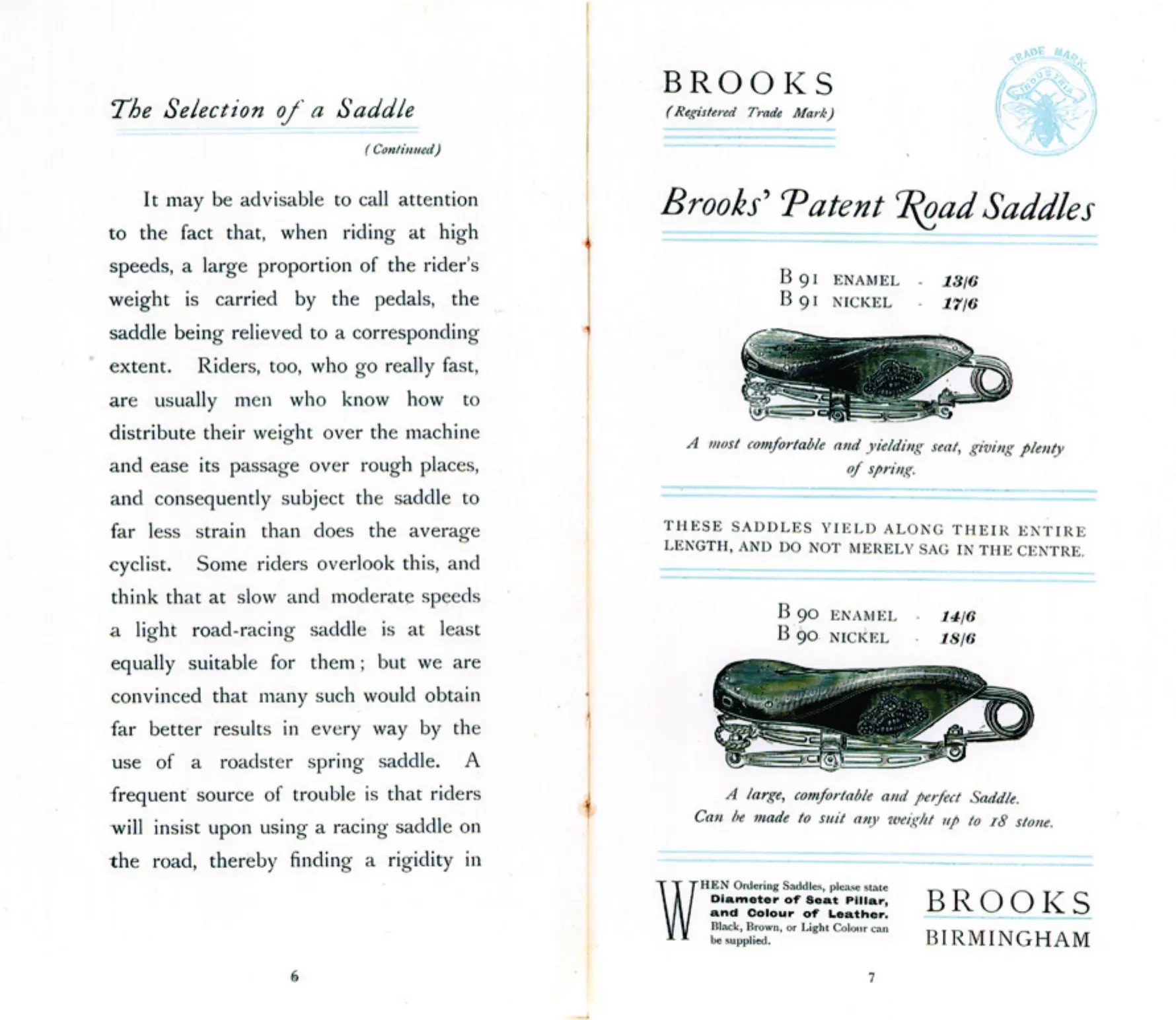
[Two page opening. The left page continues the fitting essay, the right page carries the B 91 above the B 90. This is the leaf that puts the B 90 and the B 91 in the collection two years earlier than the 1903 book.]
[Printed page 6.]
The Selection of a Saddle (Continued)
It may be advisable to call attention to the fact that, when riding at high speeds, a large proportion of the rider’s weight is carried by the pedals, the saddle being relieved to a corresponding extent. Riders, too, who go really fast, are usually men who know how to distribute their weight over the machine and ease its passage over rough places, and consequently subject the saddle to far less strain than does the average cyclist. Some riders overlook this, and think that at slow and moderate speeds a light road-racing saddle is at least equally suitable for them; but we are convinced that many such would obtain far better results in every way by the use of a roadster spring saddle. A frequent source of trouble is that riders will insist upon using a racing saddle on the road, thereby finding a rigidity in
[Printed page 7.]
Brooks’ Patent Road Saddles
B 91 ENAMEL 13/6
B 91 NICKEL 17/6
A most comfortable and yielding seat, giving plenty of spring.
THESE SADDLES YIELD ALONG THEIR ENTIRE LENGTH, AND DO NOT MERELY SAG IN THE CENTRE.
B 90 ENAMEL 14/6
B 90 NICKEL 18/6
A large, comfortable and perfect Saddle. Can be made to suit any weight up to 18 stone.
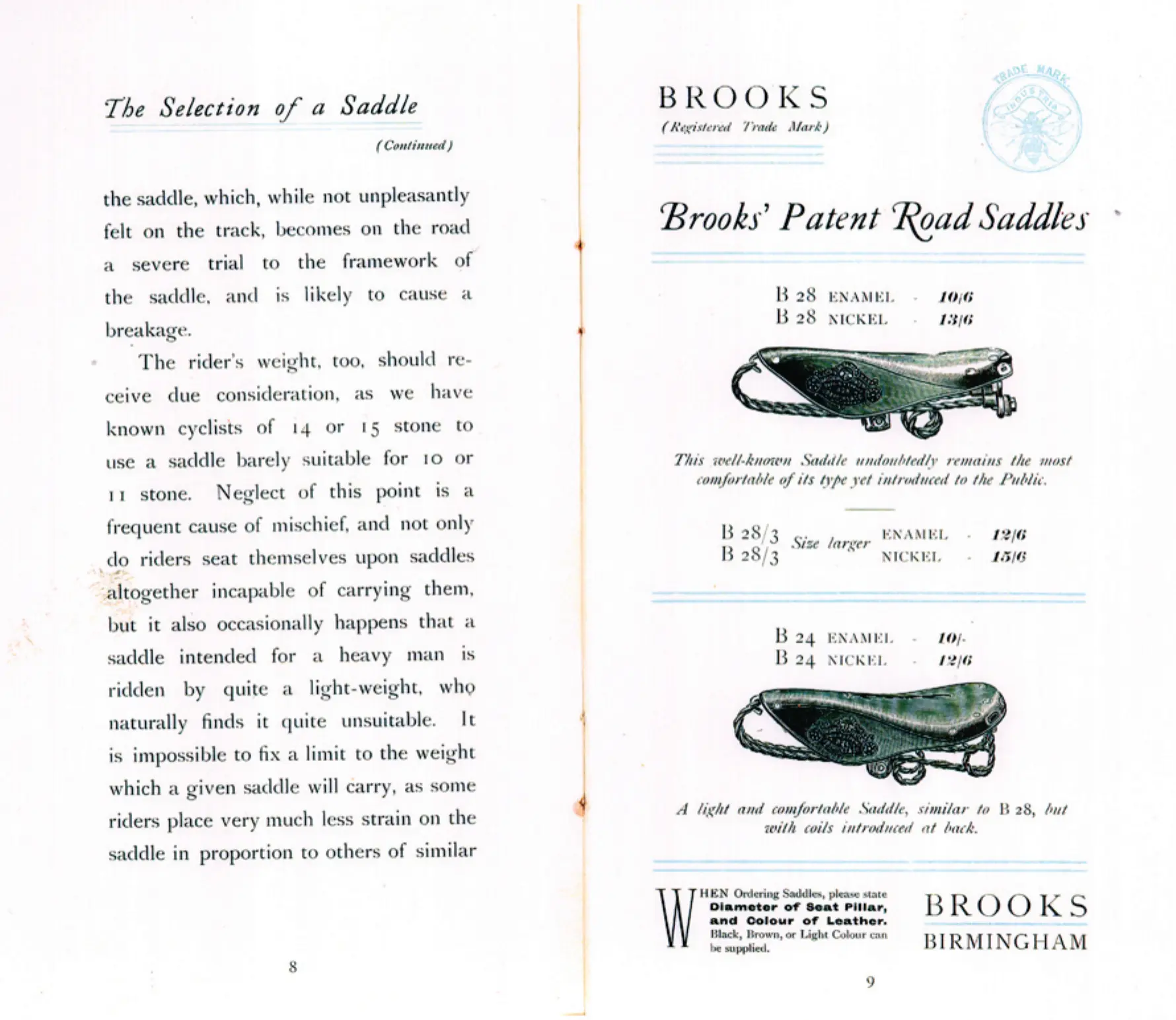
[Two page opening. The left page continues the fitting essay, the right page carries the B 28 with its larger size above the B 24. This is the earliest reading of the B 28 in this collection.]
[Printed page 8.]
The Selection of a Saddle (Continued)
the saddle, which, while not unpleasantly felt on the track, becomes on the road a severe trial to the framework of the saddle, and is likely to cause a breakage.
The rider’s weight, too, should receive due consideration, as we have known cyclists of 14 or 15 stone to use a saddle barely suitable for 10 or 11 stone. Neglect of this point is a frequent cause of mischief, and not only do riders seat themselves upon saddles altogether incapable of carrying them, but it also occasionally happens that a saddle intended for a heavy man is ridden by quite a light-weight, who naturally finds it quite unsuitable. It is impossible to fix a limit to the weight which a given saddle will carry, as some riders place very much less strain on the saddle in proportion to others of similar
[Printed page 9.]
Brooks’ Patent Road Saddles
B 28 ENAMEL 10/6
B 28 NICKEL 13/6
This well-known Saddle undoubtedly remains the most comfortable of its type yet introduced to the Public.
B 28/3 Size larger ENAMEL 12/6
B 28/3 NICKEL 15/6
B 24 ENAMEL 10/-
B 24 NICKEL 12/6
A light and comfortable Saddle, similar to B 28, but with coils introduced at back.
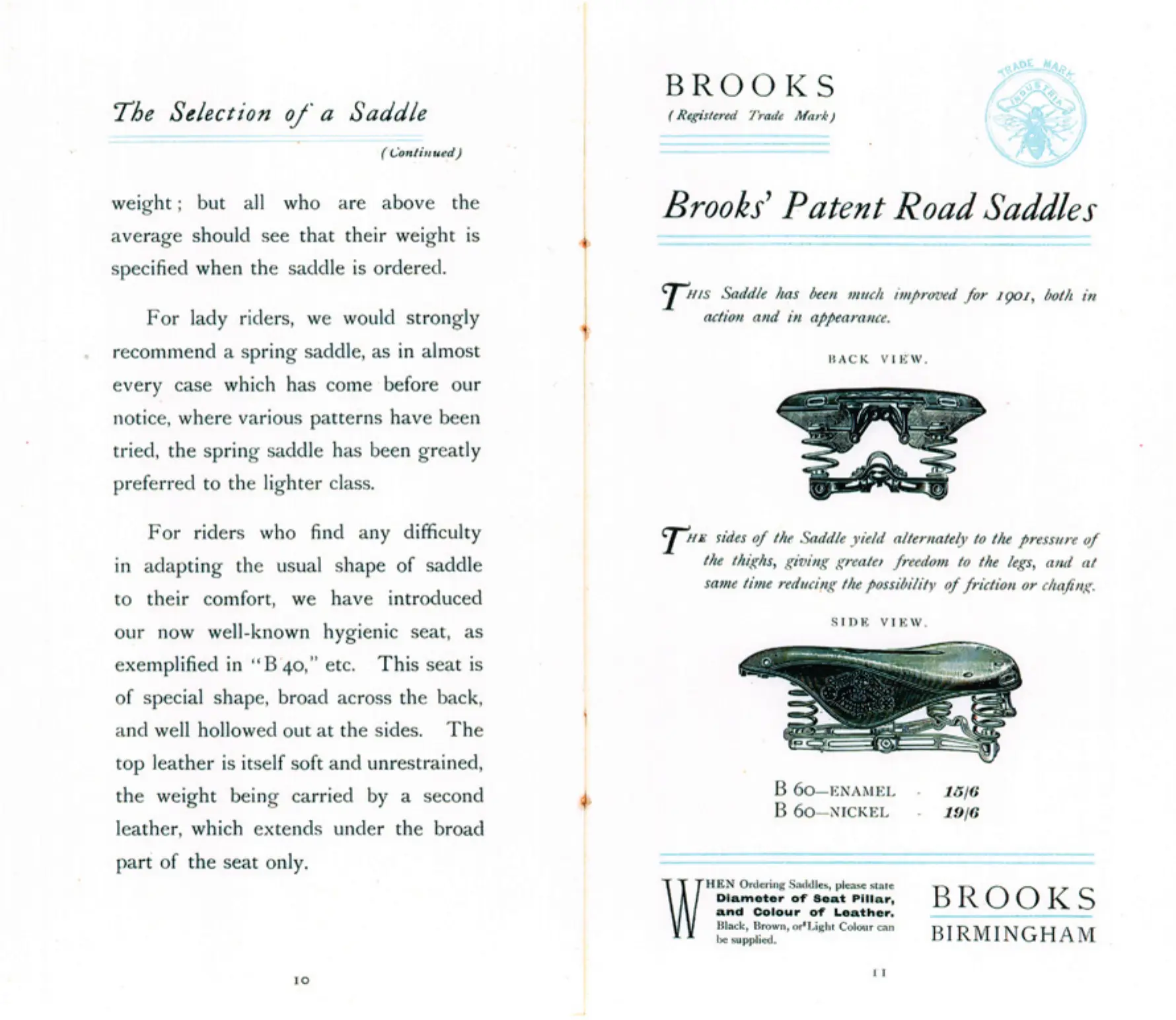
[Two page opening. The left page closes the section on selecting a saddle and describes the hygienic seat, the right page carries the B 60 in two views. The right page is where the year is printed.]
[Printed page 10.]
The Selection of a Saddle (Continued)
weight; but all who are above the average should see that their weight is specified when the saddle is ordered.
For lady riders, we would strongly recommend a spring saddle, as in almost every case which has come before our notice, where various patterns have been tried, the spring saddle has been greatly preferred to the lighter class.
For riders who find any difficulty in adapting the usual shape of saddle to their comfort, we have introduced our now well-known hygienic seat, as exemplified in “B 40,” etc. This seat is of special shape, broad across the back, and well hollowed out at the sides. The top leather is itself soft and unrestrained, the weight being carried by a second leather, which extends under the broad part of the seat only.
[Printed page 11.]
Brooks’ Patent Road Saddles
THIS Saddle has been much improved for 1901, both in action and in appearance.
BACK VIEW.
THE sides of the Saddle yield alternately to the pressure of the thighs, giving greater freedom to the legs, and at same time reducing the possibility of friction or chafing.
SIDE VIEW.
B 60 – ENAMEL 15/6
B 60 – NICKEL 19/6
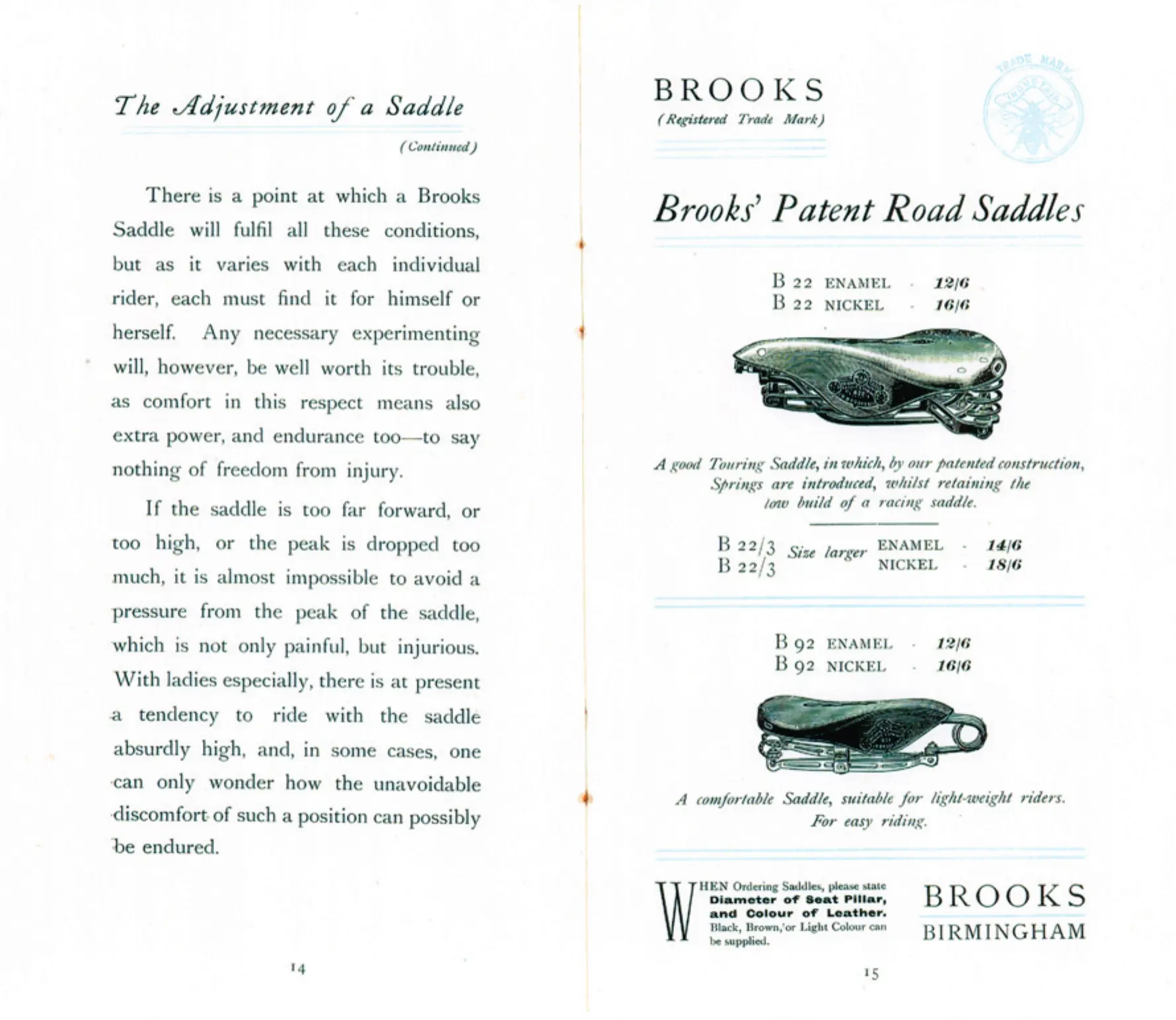
[Two page opening. The left page continues the section on adjusting a saddle, the right page carries the B 22 with its larger size above the B 92. This is the leaf that puts the B 92 in the collection, completing the three models the 1904 book renamed as B 90 Sizes 1, 2 and 3.]
[Printed page 14.]
The Adjustment of a Saddle (Continued)
There is a point at which a Brooks Saddle will fulfil all these conditions, but as it varies with each individual rider, each must find it for himself or herself. Any necessary experimenting will, however, be well worth its trouble, as comfort in this respect means also extra power, and endurance too, to say nothing of freedom from injury.
If the saddle is too far forward, or too high, or the peak is dropped too much, it is almost impossible to avoid a pressure from the peak of the saddle, which is not only painful, but injurious. With ladies especially, there is at present a tendency to ride with the saddle absurdly high, and, in some cases, one can only wonder how the unavoidable discomfort of such a position can possibly be endured.
[Printed page 15.]
Brooks’ Patent Road Saddles
B 22 ENAMEL 12/6
B 22 NICKEL 16/6
A good Touring Saddle, in which, by our patented construction, Springs are introduced, whilst retaining the low build of a racing saddle.
B 22/3 Size larger ENAMEL 14/6
B 22/3 NICKEL 18/6
B 92 ENAMEL 12/6
B 92 NICKEL 16/6
A comfortable Saddle, suitable for light-weight riders. For easy riding.
[Two page opening. The left page opens the section on the saddle clip, the right page carries the B 83 above the B 302, which is the cheapest saddle on any plate read in this book after the B 25.]
[Printed page 16.]
The Saddle Clip
When fixing the saddle in its position, the rider’s attention is naturally at once drawn to the clip by which the saddle is secured to the machine, and which also provides the means of adjustment. The attainment of this double object in a thoroughly efficient manner has always received our special attention, and we have in our present clip a means of attachment, which, whilst possessing all the rigidity and firmness desirable, is easily and quickly released for adjustment. We draw very special attention to our new clip, which is made of the very best steel stampings, as it is of extreme importance that a saddle be fitted with a clip that is really reliable, since the inadvertent moving of a saddle at an inopportune moment is likely to have serious results. The clip is a part which readily lends itself to economy, and
[Printed page 17.]
Brooks’ Patent Road Saddles
B 83 ENAMEL – 10/6
B 83 NICKEL – 13/6
A light and easy Saddle, with ample elasticity.
B 302 ENAMEL – 8/-
B 302 NICKEL – 10/6
A good sound Saddle and Spring. For easy riding.
[Two page opening. The left page continues the section on saddle leather, the right page is the whole motor range for the year, two saddles. This is the leaf that prints the B 90/4.]
[Printed page 26.]
The Saddle Leather (Continued)
The leather used in the making of Brooks saddles is thoroughly adapted to its purpose, and is absolutely the very best quality obtainable. Special care is always given alike to its selection, dressing, and manipulation, to ensure that the top will keep its good shape, and even improve after a few months’ use. This improvement in use is the crucial test of a saddle top, and in no small degree contributes to the undoubted pre-eminence of the Brooks saddles.
Although most riders probably pay small attention to the leather top of the saddle, those who are desirous of preserving it in good condition will be anxious to know what is best to be done. A little dressing or cream, such as is commonly used for brown leather, will
[Printed page 27.]
Brooks’ Patent Motor Saddles
B 80 ENAMEL – 18/6
B 80 NICKEL – 22/6
This Saddle is specially designed to counteract, in motor tricycles, the constant leaning, caused as well by the slant as by the unevenness of the road.
B 90/4 ENAMEL – 20/-
B 90/4 NICKEL – 24/6
This Saddle is of a design which has met with unqualified approval. It will not sag in the centre, but yields along its entire length, giving an easy and resilient seat.
[Two page opening carrying the whole Zapho range, the last priced matter in the book. Both pages are headed ZAPHO and both carry a roundel of a stag lettered THE CHALLENGE in place of the Brooks bee that heads every other plate in the book. The saddles’ own cast badges carry a stag as well.]
[Printed page 54.]
ZAPHO
(Trade Mark)
[roundel of a stag, lettered TRADE MARK above and THE CHALLENGE below]
Zapho Patent Saddles
UNDER the name of “Zapho” we have introduced a few saddles, which, whilst being lower in price than our Brooks Saddles, are made on correct mechanical principles, and have the advantage of our experience. Zapho Saddles are well-made saddles at a moderate price. Finished in enamel only, and fitted with nickel-plated clips.
Road Riding
Z 25
9/6
This saddle has plenty of spring for easy riding, and will not sag.
Road Racing
Z 20
7/6
This type of saddle is universally used by road racing men.
[Printed page 55.]
ZAPHO
(Trade Mark)
[roundel of a stag, lettered TRADE MARK above and THE CHALLENGE below]
Zapho Patent Saddles
Racing
Z 21 – – 6/6
The best form of Path Racing Saddle. (Should not be ridden on the Road.)
FINISHED IN ENAMEL ONLY, AND FITTED WITH NICKEL-PLATED CLIPS.
Ladies’
Z 20 L – – 7/6
A good saddle for those who like a firm seat with just sufficient spring.
[Two page opening closing the book. The left page carries a single halftone of the works, printed rotated ninety degrees on the sheet, with the caption set to read up the page. The right page is the blank inside back cover in plain red. The outer back cover is plain red and carries no printing at all.]
[Printed page 56.]
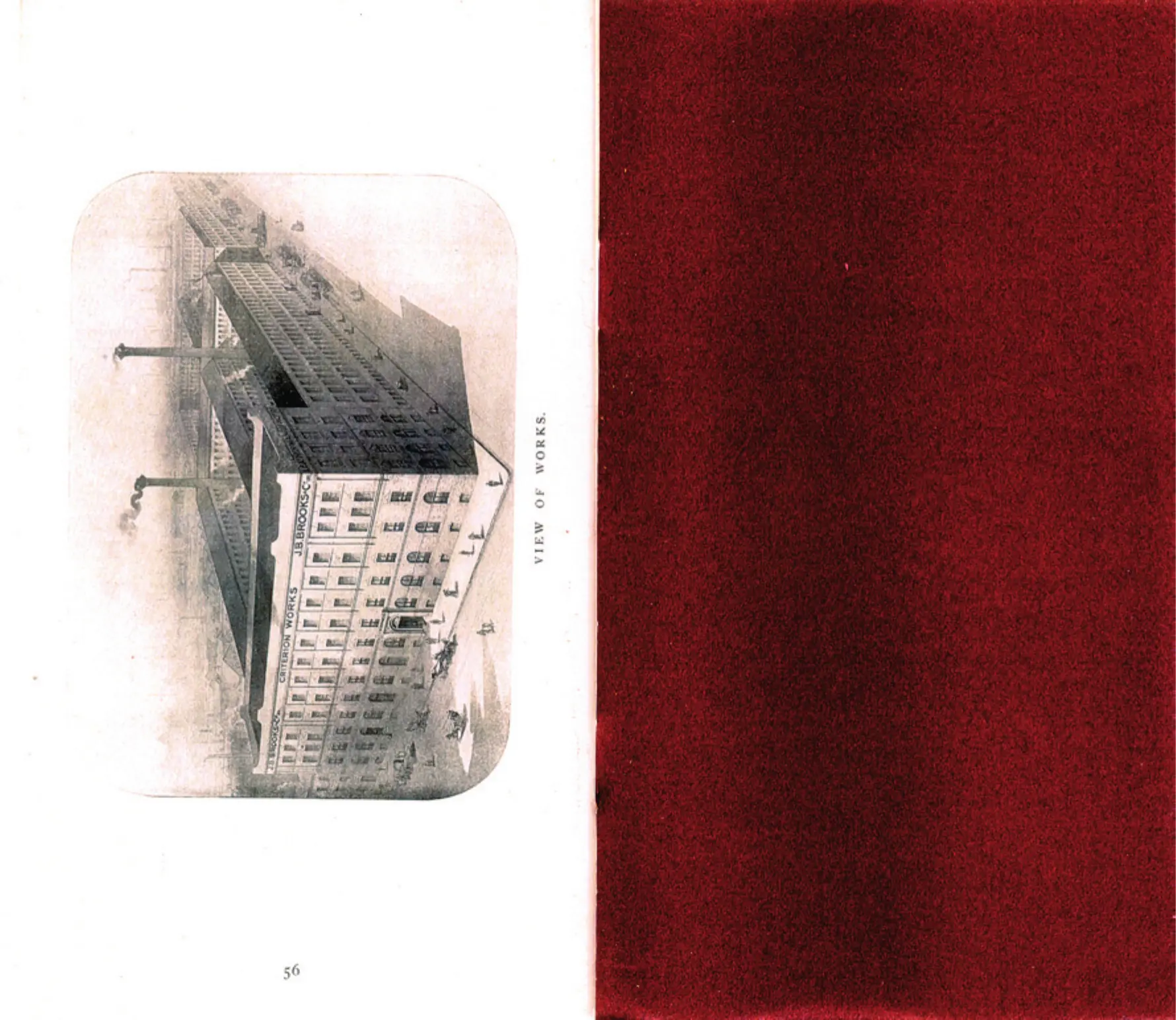
VIEW OF WORKS.
[Halftone of a large multi-storey brick factory seen obliquely from the street, with two tall chimneys behind it and figures and a horse-drawn vehicle in the road. The building is lettered J. B. BROOKS & Co. along the upper facade and CRITERION WORKS along the lower.]
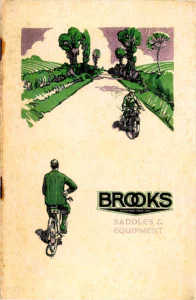 Brooks 1926 Catalog — The Brooks Book of Saddles and Equipment
 Brooks chez A.F.C.O. — L’Officiel du cycle, 3 November 1951, Brooks Represented in France by AFCO
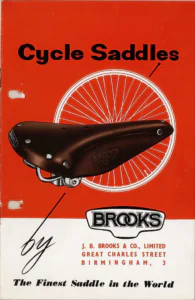 Brooks 1957 Catalog — Cycle Saddles, The Finest Saddle in the World
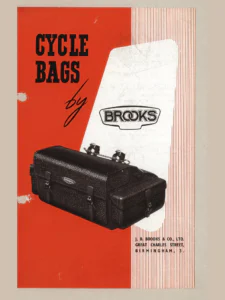 Brooks 1959 Leaflet — Cycle Bags by Brooks
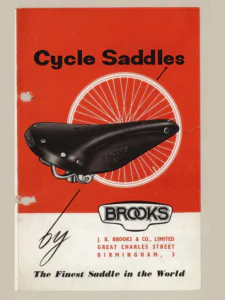 Brooks 1959 Leaflet — Cycle Saddles, The Finest Saddle in the World
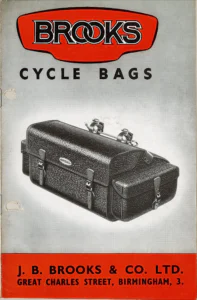 Brooks Catalog — Cycle Bags: Millbrook to Kingsbrook, the P.V.C. Shield and the Quick Release Rod
Ebykr presents this material for research and education. If you hold rights to it or notice an ownership issue, please contact us and we will respond promptly.
The Ebykr Digest
New articles, timelines, catalog finds and registry activity — assembled from the archive once a month. Your address is never shared.
Double opt-in. One email per month. Unsubscribe at any time with one click.