About Ebykr
Ebykr celebrates classic and vintage lightweight bicycles through provocative imagery and opinion. Ride along with us.
About Ebykr
Ebykr celebrates classic and vintage lightweight bicycles through provocative imagery and opinion. Ride along with us.

Source: Ebykr archive.
| Marque | Brooks |
|---|---|
| Type | Catalog |
| Year | 1903 |
| Publisher | J. B. Brooks & Co., Ltd. |
| Country | England |
| Language | English |
| Pages | 11 |
| Source | Ebykr archive. |
| Credit | Ebykr archive |
| Transcription | Transcribed by eye |
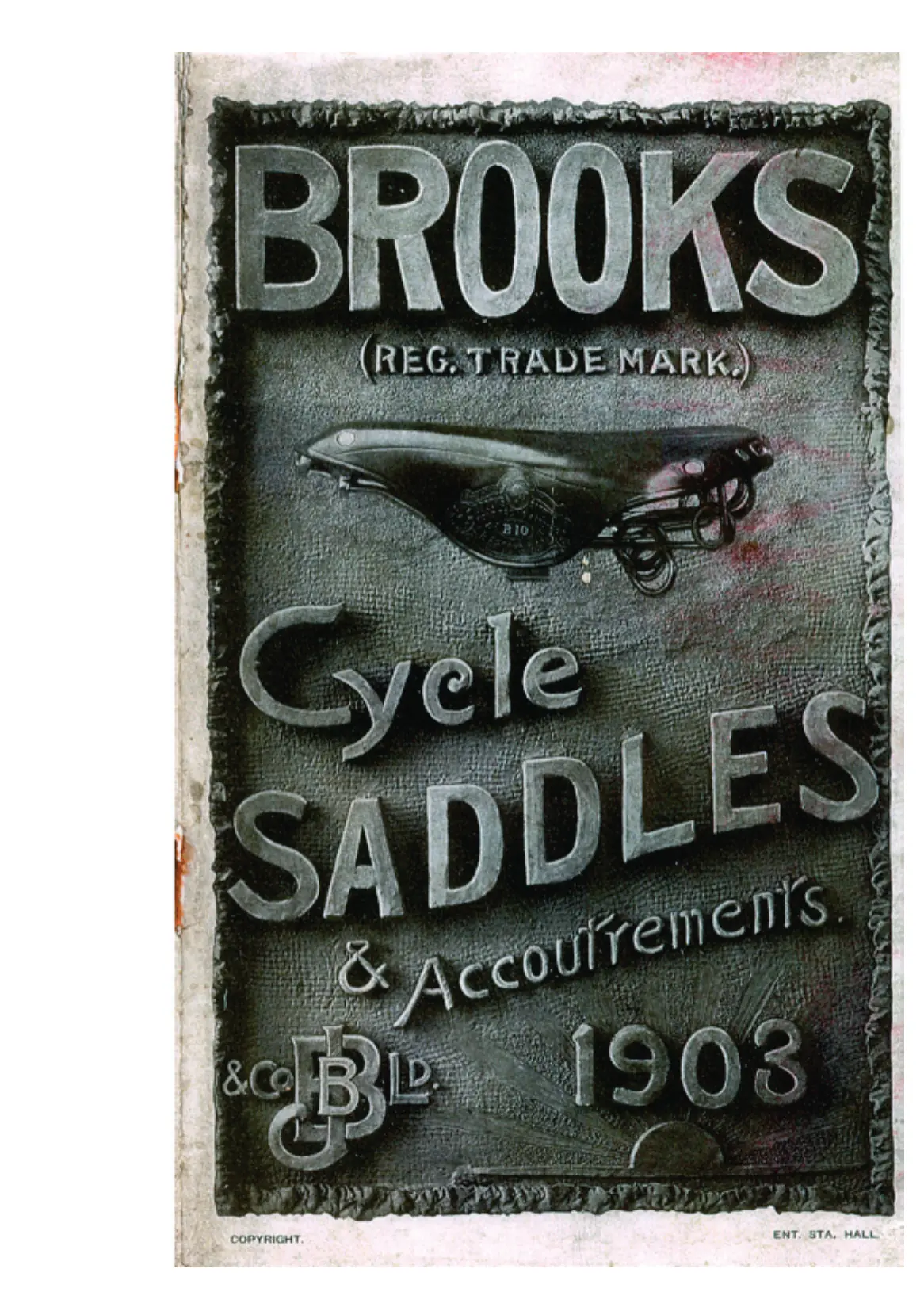
BROOKS (REG. TRADE MARK.) Cycle SADDLES & Accoutrements. & Co. Ld. 1903 COPYRIGHT. ENT. STA. HALL. BIRMINGHAM: PRINTED BY COND BROS. MOOR STREET. TRADE MARK WE have pleasure in presenting our New Catalogue for 1903, with which will again be combined a few hints on the Cycle Saddle. Brooks' Saddles have a world-wide reputation, and …
Cycle Saddles and Accoutrements for 1903, from J. B. Brooks and Co. Ltd. of Birmingham. Seventy-seven printed pages between printed card covers, the year moulded into the cover design itself and repeated in the foreword on printed page 3, which opens We have pleasure in presenting our New Catalogue for 1903. Printed by Cond Bros., Moor Street, Birmingham.
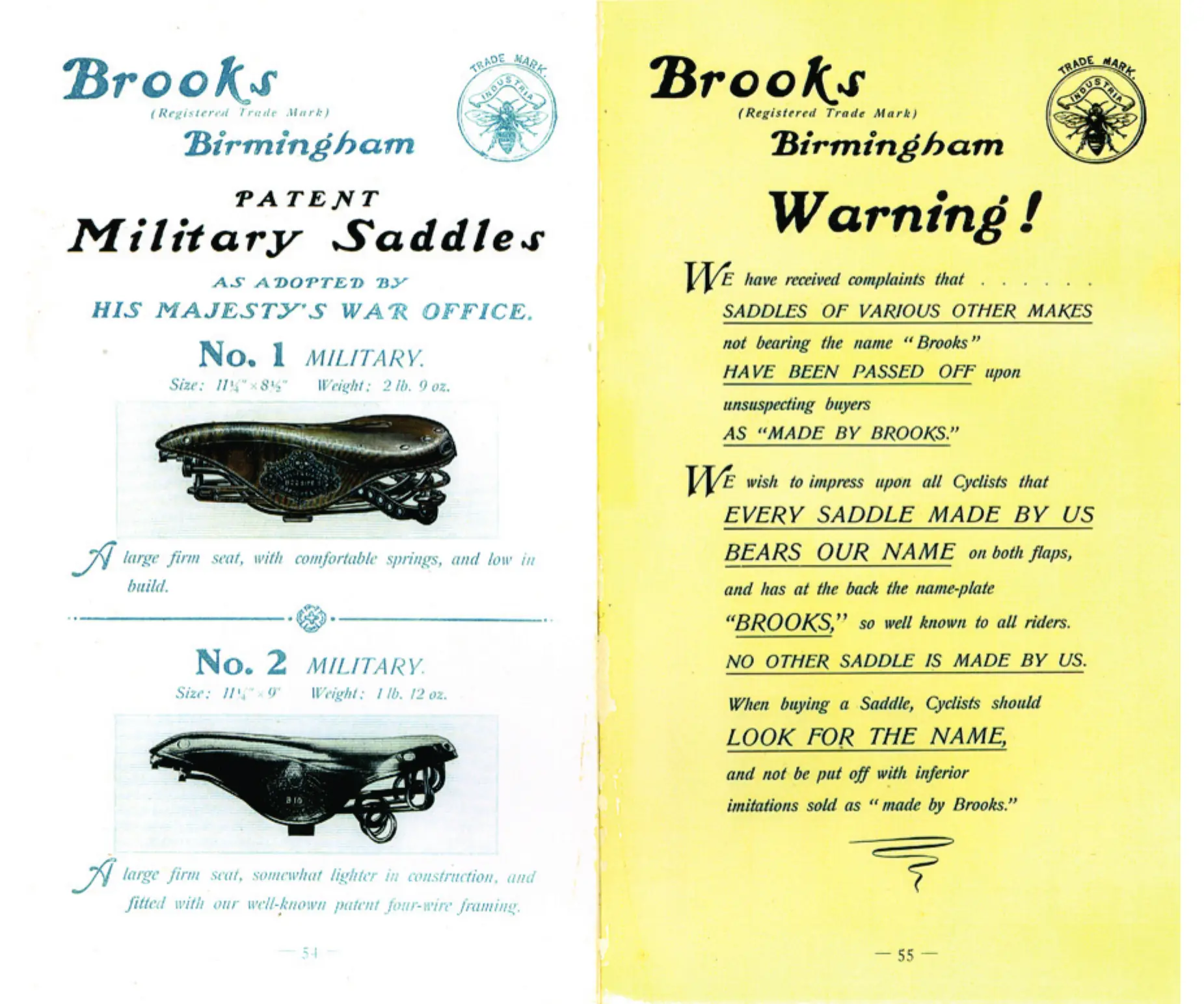
This is the earliest Brooks catalog in the Ebykr collection after the 1900 book, and it was opened to answer one question: what the Brooks military range looked like before 1905. The answer is on printed page 54, and it is unambiguous. The page is headed PATENT Military Saddles, AS ADOPTED BY HIS MAJESTY’S WAR OFFICE, and it carries two models and no more. No. 1 Military, 11 1/4 by 8 1/2 in., 2 lb. 9 oz., a large firm seat with comfortable springs and low in build. No. 2 Military, 11 1/4 by 9 in., 1 lb. 12 oz., a large firm seat somewhat lighter in construction and fitted with our well-known patent four-wire framing. There is no No. 3. The index on printed page 5 confirms the location twice over, giving Military Saddles 54 and, under SADDLES, Military 54.
That settles a claim this project has been chasing across four books. The Brooks military range is now known year by year: No. 1 and No. 2 in 1903, 1905 and 1907; No. 2 alone in 1908 and 1910; No. 2 and No. 3 from 1911 through 1914; and no military range at all by 1916. The No. 3 does not exist in 1903, and no Brooks catalog held here introduces three numbered military saddles in that year.
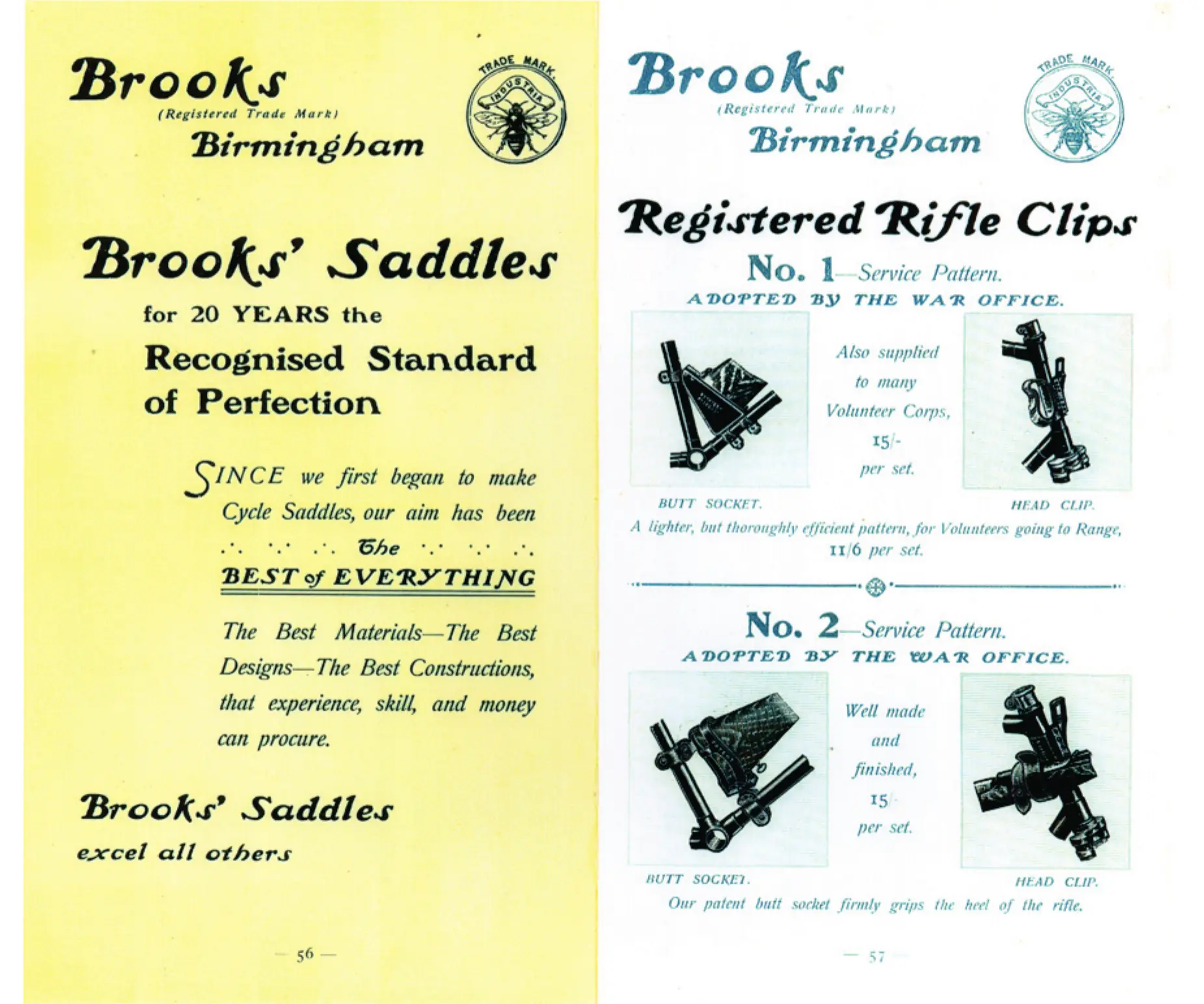
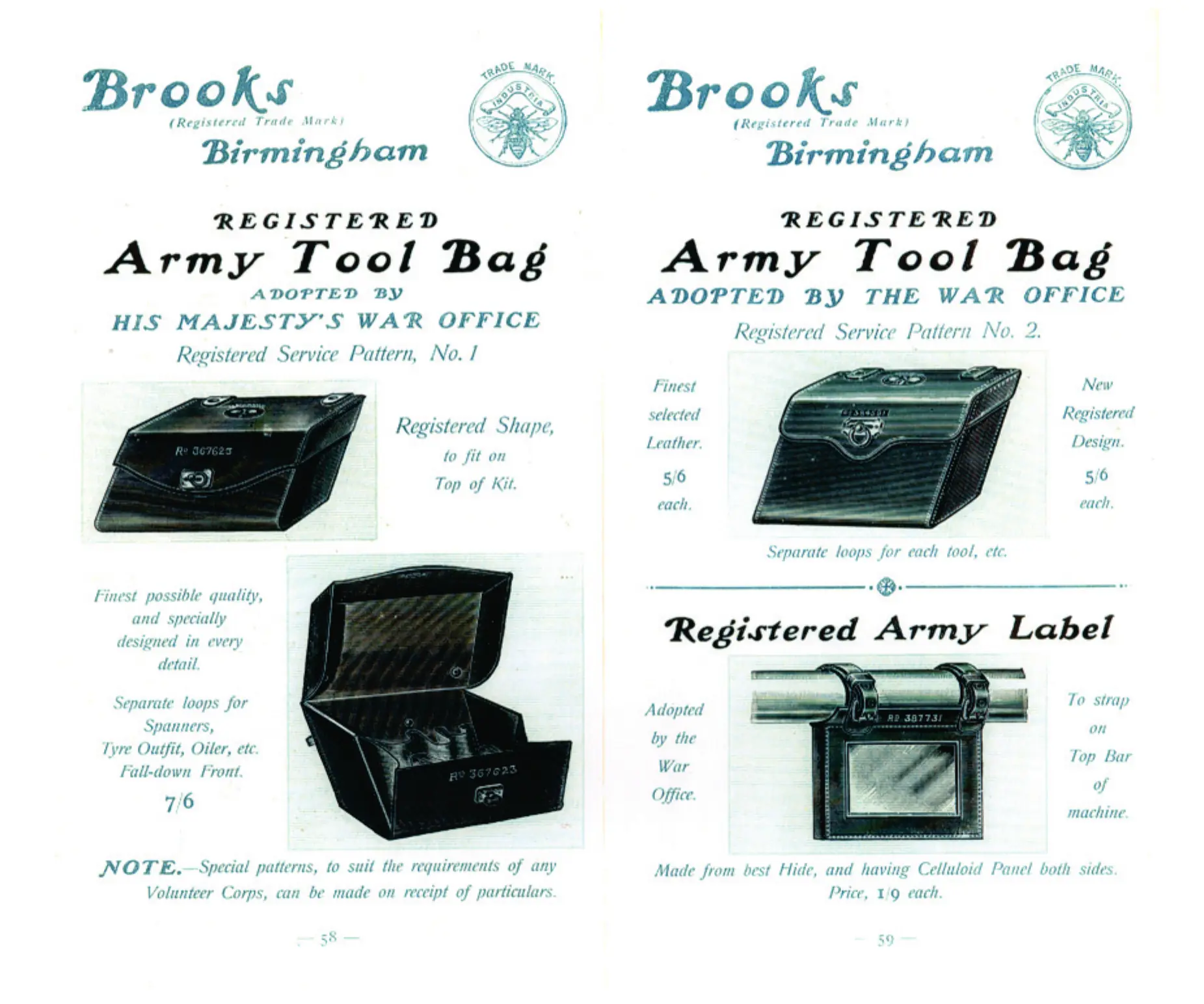
The same pages explain how the error most likely arose, and the explanation is worth recording because it has caught this project once already. The 1903 military section runs three separate No. 1 and No. 2 series across six pages, and only the first is saddles. Printed page 54 has Military Saddles No. 1 and No. 2. Printed page 57 has Registered Rifle Clips, No. 1 Service Pattern and No. 2 Service Pattern, both adopted by the War Office. Printed pages 58 and 59 have the Registered Army Tool Bag, Registered Service Pattern No. 1 and Registered Service Pattern No. 2. A reader moving quickly through that section meets the numerals one and two three times in six pages, attached to three different kinds of object.
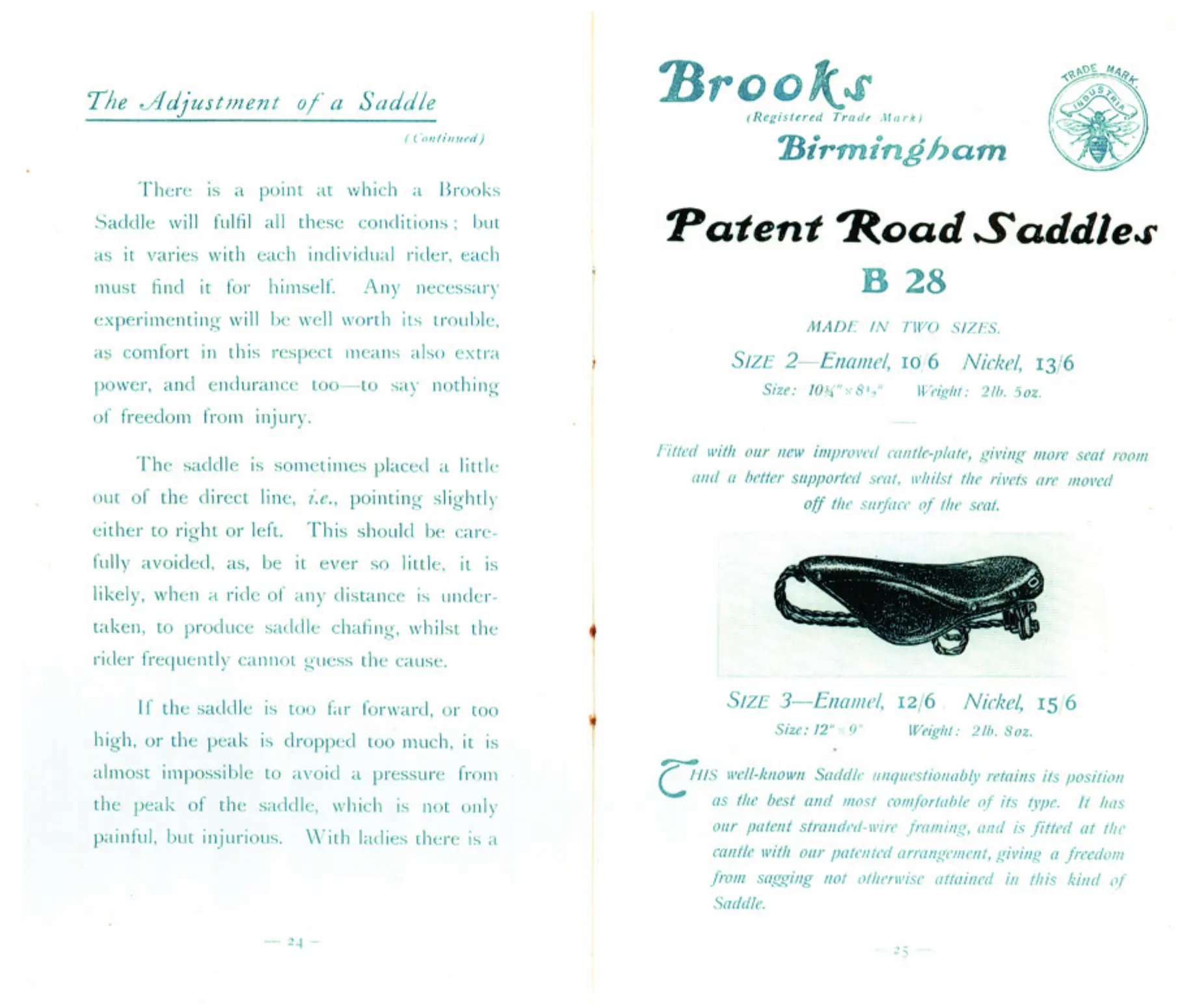
The B 28 is the second finding, and it reaches further back than this project had it. The B 28 is on printed page 25, made in two sizes, and the text calls it THIS well-known Saddle, so the model is older than this book. Its anti-sag device is described as our patented arrangement at the cantle, giving a freedom from sagging not otherwise attained in this kind of Saddle. Rubber buffers are not named. That is the same generic wording the 1905 book uses and it is not the wording of 1907, which is the first book in the run to name the rubber buffers outright. So 1903 is a second genuine negative standing behind the 1905 one, and the rubber buffer remains a 1907 attestation.
The third finding concerns size, and it began as a hypothesis that the evidence then refuted. The B 28 Size 3 measures 12 by 9 in. here and 12 by 9 1/2 in. in 1905, 1907, 1908, 1913 and 1914. The B 90 moves the same way and further: its Size 1 is 10 1/2 by 7 1/2 in. here against 10 1/2 by 8 1/2 in. from 1910, its Size 2 is 11 by 8 1/2 in. here against 11 1/2 by 9 in., and its Size 3 is 12 by 9 in. here against 12 by 9 1/2 in. Two different models gaining half an inch in the same window is the signature of a change in how the saddles were measured rather than of two independent product changes, and the 1907 book is explicit that a method has to be adopted before figures mean anything. The test for that hypothesis is whether the 1903 book declares the same method, and it does. Printed page 44 states that Brooks has utilised throughout that method by which the length of the foot is obtained by a bootmaker, in almost the words of 1907, 1908 and 1910, with the same caveat that the figures cannot be taken as stating the exact amount of seat room. The declared convention is therefore constant from 1903 to 1910, the hypothesis fails, and the growth of these saddles between 1903 and 1905 reads as a real enlargement. It is the fourth attestation of the bootmaker statement and the earliest by four years.
The weights point the same way. The B 90 Size 1 weighs 2 lb. 6 oz. here, 2 lb. 13 oz. in 1910, 2 lb. 13 oz. in 1914 and 3 lb. in 1916. It gains seven ounces before 1910 and three ounces across the following six years. Session seven read the 1914 to 1916 weight gain as heavier wartime stock and session eight already qualified that; the 1903 figures show most of the climb is Edwardian and accompanies a saddle that was physically getting bigger.
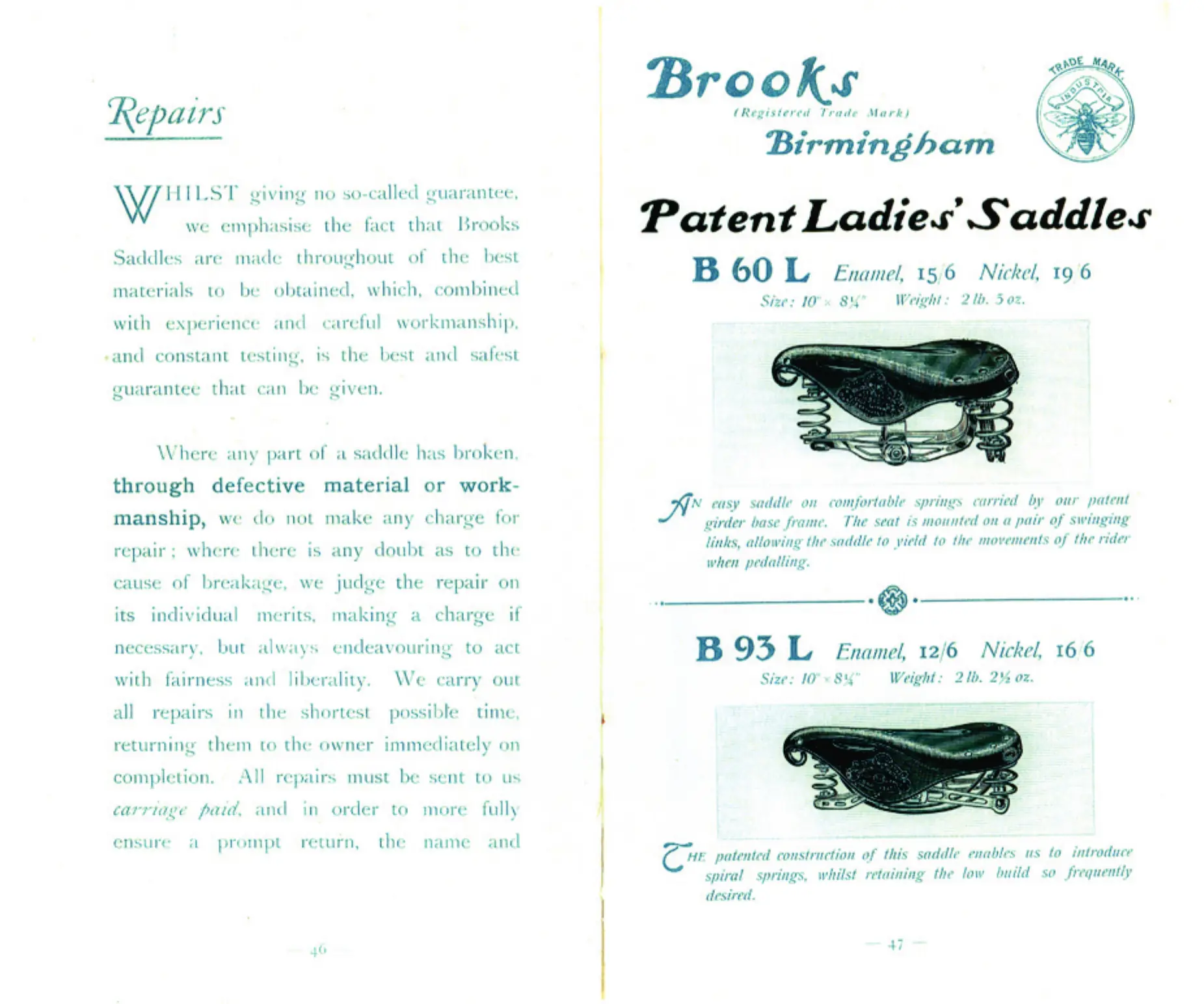
The guarantee formula is here too, four years earlier than any previous attestation. Printed page 46, under the heading Repairs, opens WHILST giving no so-called guarantee, we emphasise the fact that Brooks Saddles are made throughout of the best materials to be obtained. The 1907 and 1908 books print that sentence word for word, and the 1910 book rewrites it. So the formula was stable across at least 1903 to 1908 rather than rewritten from year to year, and the epigraph in post 1111, which paraphrases it and attributes it to a title Brooks did not use in 1907, is paraphrasing a long-standing house formula.
Two smaller things. Printed page 56 says Brooks Saddles have been for 20 YEARS the Recognised Standard of Perfection, and dates that from when we first began to make Cycle Saddles, which puts the start of saddle making about 1883, independent of the year-of-publication series that places the first Brooks Book in 1885. And the rifle clips and army tool bags of printed pages 57 to 59 are supplied to many Volunteer Corps, the wording that gives way to Territorial Corps in the 1910 and later books after the 1908 army reforms.
Nickel plating is priced on every model in this book, at a flat premium of 2s. to 4s. above the enamel price, which works out between about 20 and 32 per cent depending on the model. That is the same structure the 1900 book uses and close to the same range, and it remains well above the 15 to 20 per cent figure post 1111 gives.
THE SCAN IS DEFECTIVE IN FOUR PLACES. Printed pages 28 to 31 are absent, the sheet that should carry them being a byte-identical duplicate of the sheet carrying printed pages 32 and 33. Printed pages 36 and 37 are absent, the book running from 34 and 35 straight to 38 and 39. Printed pages 49 to 52 are absent, one sheet pairing printed page 48 with printed page 53. Printed pages 74 and 75 are absent. Printed page 35 is also imperfect: it carries the B 83 and its caption and then stops, with a blank lower half and no page number, and because this book has no model concordance there is no way to prove what else belonged on it. None of those pages should ever be cited. The defect was confirmed three ways, by a labelled footer strip over every sheet, by an adjacent-sheet difference scan and by a checksum comparison of every embedded image, which found exactly one duplicate pair and no others.
This record reproduces eleven leaves: the cover, the printer imprint and foreword, the index, the B 90, the B 28, the ladies featherweight models, the size and weight statement, the repairs and guarantee page, the military saddles with the counterfeit warning, the rifle clips, and the army tool bags. The remaining pages, covering the path and road racing saddles, the rest of the gentlemen’s and ladies’ ranges, the motor saddles, the selection and adjustment essays, the tool bags, luggage bags, gear cases and dress guards, are held in the Ebykr collection but are not reproduced here.
The scan runs about 890 pixels across per two-page spread, roughly 445 pixels per printed page, and the images are presented at twice that, the house ratio for this run. The book is printed in a blue-green ink throughout with model numbers, prices and headings in a heavier face, and two leaves are printed on yellow paper. Headings, model numbers, prices and specification figures read cleanly at twice scale. Shipped as scanned, with no white point normalization.
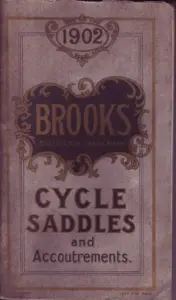
[Front cover. A photograph of a moulded plaque, the lettering and the saddle standing in relief against a coarse pebbled ground, reproduced across the whole card.]
BROOKS
(REG. TRADE MARK.)
[Beneath the name, a saddle in side elevation, its cantle plate lettered B 10.]
Cycle
SADDLES
& Accoutrements.
[At the foot, an interlaced monogram reading J B and flanked by the words:] & Co. Ld.
1903
COPYRIGHT. ENT. STA. HALL.
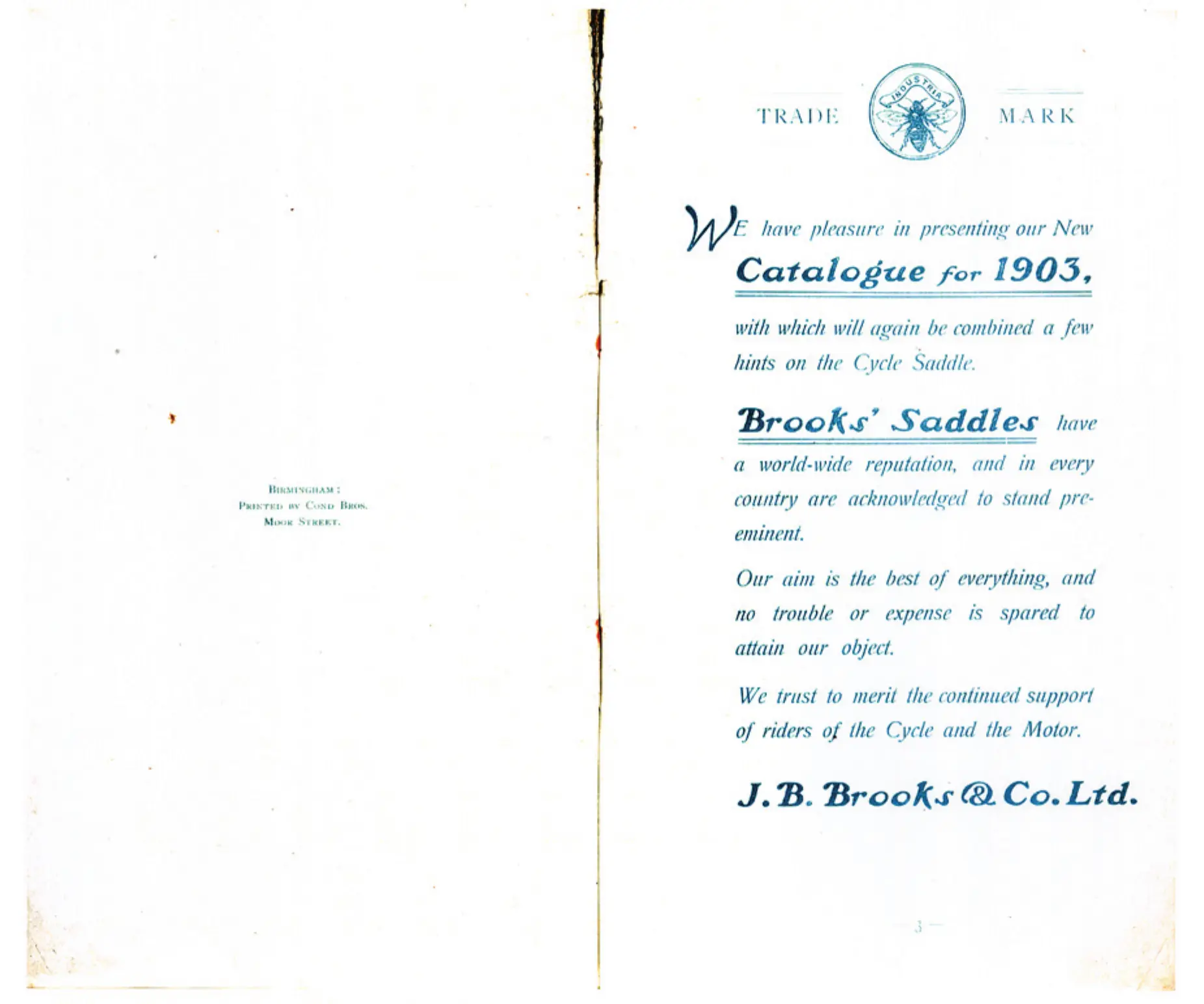
[Printed page 2, verso. The page is otherwise blank, carrying only the printer’s imprint set small at the middle of the page.]
BIRMINGHAM:
PRINTED BY COND BROS.
MOOR STREET.
[Printed page 3, recto. The foreword, set in italic beneath the trade mark device.]
[At the head, a roundel showing a bee with outspread wings encircled by the word INDUSTRIA, flanked by the words:] TRADE MARK
WE have pleasure in presenting our New Catalogue for 1903, with which will again be combined a few hints on the Cycle Saddle.
Brooks’ Saddles have a world-wide reputation, and in every country are acknowledged to stand pre-eminent.
Our aim is the best of everything, and no trouble or expense is spared to attain our object.
We trust to merit the continued support of riders of the Cycle and the Motor.
J. B. Brooks & Co. Ltd.
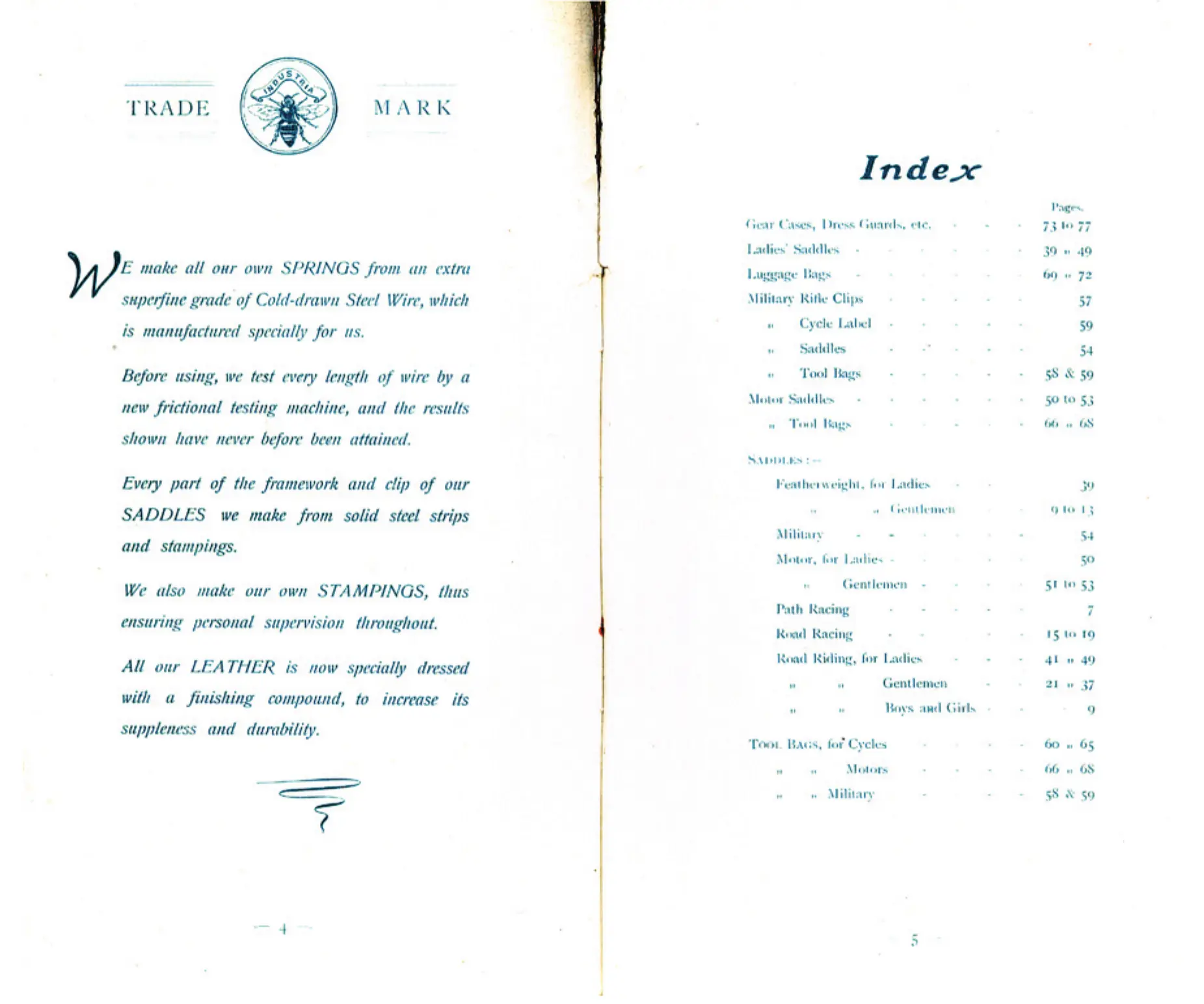
[Printed page 4, verso. Blank but for the trade mark device set at the head.]
[Roundel showing a bee encircled by the word INDUSTRIA, flanked by the words:] TRADE MARK
[Printed page 5, recto. The index. This is a subject index only; unlike the 1905, 1906, 1907 and 1908 books it carries no concordance of model numbers to pages.]
Index
Pages.
Gear Cases, Dress Guards, etc. – – – 73 to 77
Ladies’ Saddles – – – – – – 39 ” 49
Luggage Bags – – – – – – 69 ” 72
Military Rifle Clips – – – – – 57
” Cycle Label – – – – – 59
” Saddles – – – – – 54
” Tool Bags – – – – – 58 & 59
Motor Saddles – – – – – – 50 to 53
” Tool Bags – – – – – 66 ” 68
SADDLES :-
Featherweight, for Ladies – – 39
” ” Gentlemen – – 9 to 13
Military – – – – – – 54
Motor, for Ladies – – – – 50
” Gentlemen – – – 51 to 53
Path Racing – – – – 7
Road Racing – – – – 15 to 19
Road Riding, for Ladies – – – 41 ” 49
” ” Gentlemen – – 21 ” 37
” ” Boys and Girls – – 9
TOOL BAGS, for Cycles – – – – 60 ” 65
” ” Motors – – – – 66 ” 68
” ” Military – – – – 58 & 59
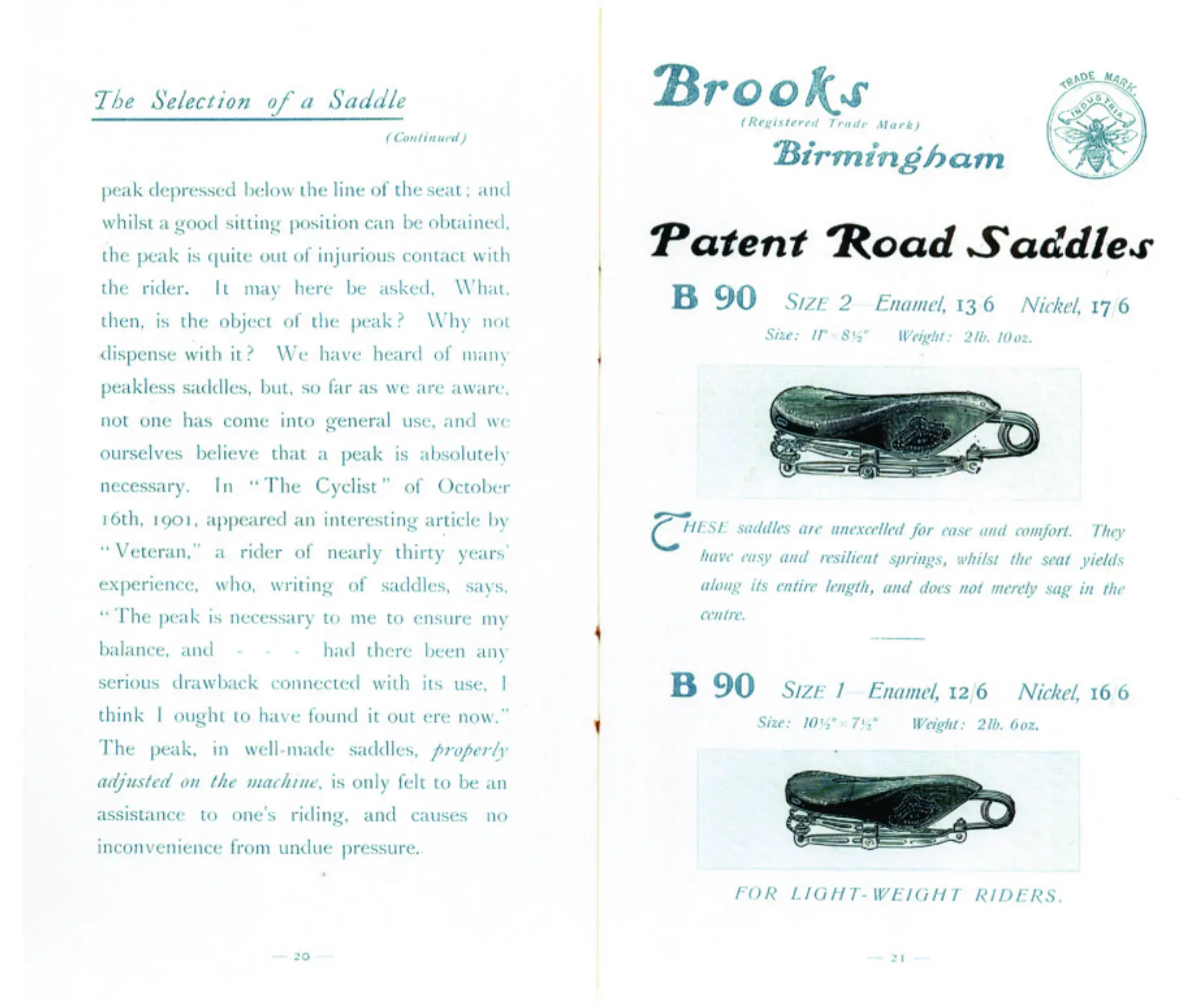
[Printed page 20, verso. Running essay text.]
The Selection of a Saddle
(Continued)
peak depressed below the line of the seat; and whilst a good sitting position can be obtained, the peak is quite out of injurious contact with the rider. It may here be asked, What, then, is the object of the peak? Why not dispense with it? We have heard of many peakless saddles, but, so far as we are aware, not one has come into general use, and we ourselves believe that a peak is absolutely necessary. In “The Cyclist” of October 16th, 1901, appeared an interesting article by “Veteran,” a rider of nearly thirty years’ experience, who, writing of saddles, says, “The peak is necessary to me to ensure my balance, and – – – had there been any serious drawback connected with its use, I think I ought to have found it out ere now.” The peak, in well-made saddles, properly adjusted on the machine, is only felt to be an assistance to one’s riding, and causes no inconvenience from undue pressure.
[Printed page 21, recto. Two models, each with a photographic illustration in side elevation.]
Brooks
(Registered Trade Mark)
Birmingham
[Roundel showing a bee encircled by the word INDUSTRIA, flanked by the words TRADE MARK.]
Patent Road Saddles
B 90 SIZE 2-Enamel, 13/6 Nickel, 17/6
Size: 11″ x 8 1/2″ Weight: 2 lb. 10 oz.
THESE saddles are unexcelled for ease and comfort. They have easy and resilient springs, whilst the seat yields along its entire length, and does not merely sag in the centre.
B 90 SIZE 1-Enamel, 12/6 Nickel, 16/6
Size: 10 1/2″ x 7 1/2″ Weight: 2 lb. 6 oz.
FOR LIGHT-WEIGHT RIDERS.
[Printed page 24, verso. Running essay text.]
The Adjustment of a Saddle
(Continued)
There is a point at which a Brooks Saddle will fulfil all these conditions; but as it varies with each individual rider, each must find it for himself. Any necessary experimenting will be well worth its trouble, as comfort in this respect means also extra power, and endurance too-to say nothing of freedom from injury.
The saddle is sometimes placed a little out of the direct line, i.e., pointing slightly either to right or left. This should be carefully avoided, as, be it ever so little, it is likely, when a ride of any distance is undertaken, to produce saddle chafing, whilst the rider frequently cannot guess the cause.
If the saddle is too far forward, or too high, or the peak is dropped too much, it is almost impossible to avoid a pressure from the peak of the saddle, which is not only painful, but injurious. With ladies there is a
[Printed page 25, recto. The B 28, in two sizes, with one photographic illustration between the two specification blocks.]
Brooks
(Registered Trade Mark)
Birmingham
[Roundel showing a bee encircled by the word INDUSTRIA, flanked by the words TRADE MARK.]
Patent Road Saddles
B 28
MADE IN TWO SIZES.
SIZE 2-Enamel, 10/6 Nickel, 13/6
Size: 10 3/4″ x 8 1/2″ Weight: 2 lb. 5 oz.
Fitted with our new improved cantle-plate, giving more seat room and a better supported seat, whilst the rivets are moved off the surface of the seat.
SIZE 3-Enamel, 12/6 Nickel, 15/6
Size: 12″ x 9″ Weight: 2 lb. 8 oz.
THIS well-known Saddle unquestionably retains its position as the best and most comfortable of its type. It has our patent stranded-wire framing, and is fitted at the cantle with our patented arrangement, giving a freedom from sagging not otherwise attained in this kind of Saddle.
[Printed page 38, verso. The opening of the leather essay. The lower third of the page is obscured by foxing and staining along the gutter, and the last line of the second paragraph cannot be read with confidence; it is given here only as far as it is legible.]
The Saddle Leather
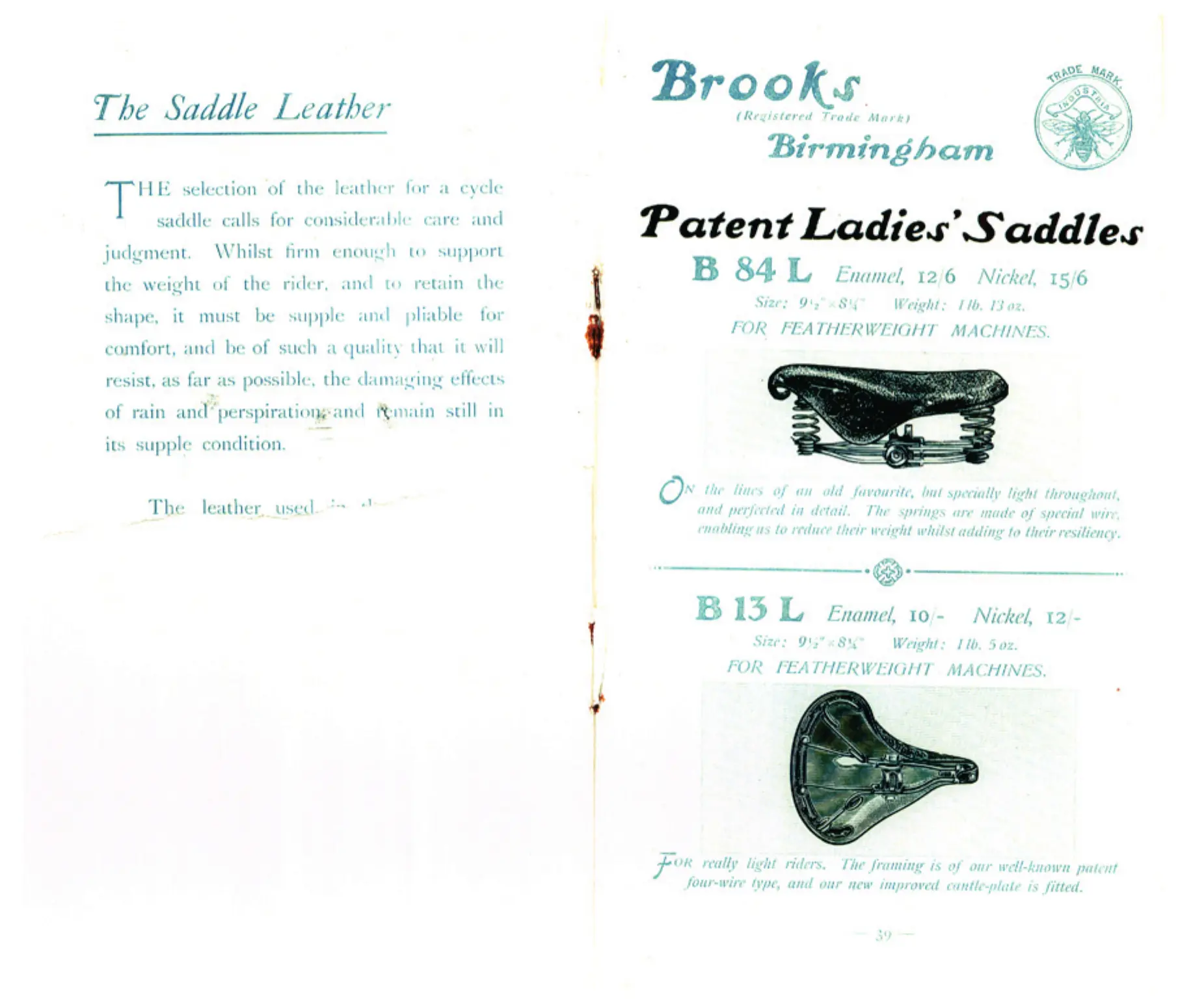
THE selection of the leather for a cycle saddle calls for considerable care and judgment. Whilst firm enough to support the weight of the rider, and to retain the shape, it must be supple and pliable for comfort, and be of such a quality that it will resist, as far as possible, the damaging effects of rain and perspiration and remain still in its supple condition.
The leather used [remainder of the line illegible in this copy]
[Printed page 39, recto. Two ladies’ featherweight models, each with a photographic illustration.]
Brooks
(Registered Trade Mark)
Birmingham
[Roundel showing a bee encircled by the word INDUSTRIA, flanked by the words TRADE MARK.]
Patent Ladies’ Saddles
B 84 L Enamel, 12/6 Nickel, 15/6
Size: 9 1/2″ x 8 1/4″ Weight: 1 lb. 13 oz.
FOR FEATHERWEIGHT MACHINES.
ON the lines of an old favourite, but specially light throughout, and perfected in detail. The springs are made of special wire, enabling us to reduce their weight whilst adding to their resiliency.
B 13 L Enamel, 10/- Nickel, 12/-
Size: 9 1/2″ x 8 1/4″ Weight: 1 lb. 5 oz.
FOR FEATHERWEIGHT MACHINES.
FOR really light riders. The framing is of our well-known patent four-wire type, and our new improved cantle-plate is fitted.
[Printed page 44, verso. The continuation of the size and weight statement. This is the earliest attestation in the Ebykr collection of the bootmaker measuring convention, which the 1907, 1908 and 1910 books all restate in almost the same words.]
Size and Weight
(Continued)
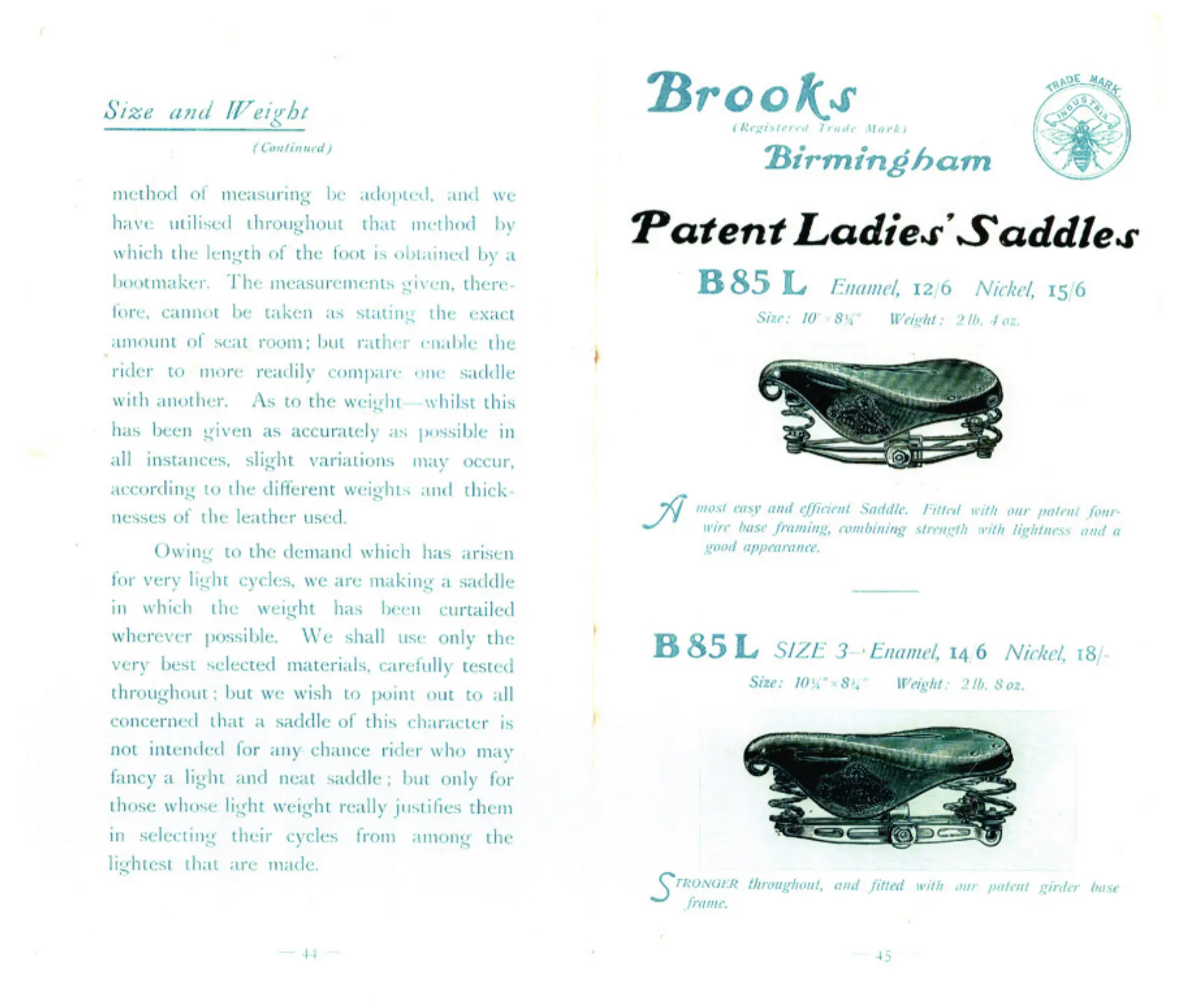
method of measuring be adopted, and we have utilised throughout that method by which the length of the foot is obtained by a bootmaker. The measurements given, therefore, cannot be taken as stating the exact amount of seat room; but rather enable the rider to more readily compare one saddle with another. As to the weight-whilst this has been given as accurately as possible in all instances, slight variations may occur, according to the different weights and thicknesses of the leather used.
Owing to the demand which has arisen for very light cycles, we are making a saddle in which the weight has been curtailed wherever possible. We shall use only the very best selected materials, carefully tested throughout; but we wish to point out to all concerned that a saddle of this character is not intended for any chance rider who may fancy a light and neat saddle; but only for those whose light weight really justifies them in selecting their cycles from among the lightest that are made.
[Printed page 45, recto. Two ladies’ models, each with a photographic illustration.]
Brooks
(Registered Trade Mark)
Birmingham
[Roundel showing a bee encircled by the word INDUSTRIA, flanked by the words TRADE MARK.]
Patent Ladies’ Saddles
B 85 L Enamel, 12/6 Nickel, 15/6
Size: 10″ x 8 1/4″ Weight: 2 lb. 4 oz.
A most easy and efficient Saddle. Fitted with our patent four-wire base framing, combining strength with lightness and a good appearance.
B 85 L SIZE 3-Enamel, 14/6 Nickel, 18/-
Size: 10 1/4″ x 8 1/4″ Weight: 2 lb. 8 oz.
STRONGER throughout, and fitted with our patent girder base frame.
[Printed page 46, verso. The repairs and guarantee statement. The words through defective material or workmanship are set in a heavier face in the original.]
Repairs
WHILST giving no so-called guarantee, we emphasise the fact that Brooks Saddles are made throughout of the best materials to be obtained, which, combined with experience and careful workmanship, and constant testing, is the best and safest guarantee that can be given.
Where any part of a saddle has broken, through defective material or workmanship, we do not make any charge for repair; where there is any doubt as to the cause of breakage, we judge the repair on its individual merits, making a charge if necessary, but always endeavouring to act with fairness and liberality. We carry out all repairs in the shortest possible time, returning them to the owner immediately on completion. All repairs must be sent to us carriage paid, and in order to more fully ensure a prompt return, the name and
[Printed page 47, recto. Two ladies’ models, each with a photographic illustration.]
Brooks
(Registered Trade Mark)
Birmingham
[Roundel showing a bee encircled by the word INDUSTRIA, flanked by the words TRADE MARK.]
Patent Ladies’ Saddles
B 60 L Enamel, 15/6 Nickel, 19/6
Size: 10″ x 8 1/4″ Weight: 2 lb. 5 oz.
AN easy saddle on comfortable springs carried by our patent girder base frame. The seat is mounted on a pair of swinging links, allowing the saddle to yield to the movements of the rider when pedalling.
B 93 L Enamel, 12/6 Nickel, 16/6
Size: 10″ x 8 1/4″ Weight: 2 lb. 2 1/2 oz.
THE patented construction of this saddle enables us to introduce spiral springs, whilst retaining the low build so frequently desired.
[Printed page 54, recto in the original opening but the left-hand page of this leaf. The military saddle page. Two models, each with a photographic illustration in side elevation, separated by a small printer’s ornament. No price is quoted for either model, and there is no third model on the page or anywhere near it.]
Brooks
(Registered Trade Mark)
Birmingham
[Roundel showing a bee encircled by the word INDUSTRIA, flanked by the words TRADE MARK.]
PATENT
Military Saddles
AS ADOPTED BY
HIS MAJESTY’S WAR OFFICE.
No. 1 MILITARY.
Size: 11 1/4″ x 8 1/2″ Weight: 2 lb. 9 oz.
[Illustration: a large sprung saddle in side elevation, the cantle plate bearing an oval device.]
A large firm seat, with comfortable springs, and low in build.
No. 2 MILITARY.
Size: 11 1/4″ x 9″ Weight: 1 lb. 12 oz.
[Illustration: a lighter saddle in side elevation, the cantle plate lettered B 10.]
A large firm seat, somewhat lighter in construction, and fitted with our well-known patent four-wire framing.
[Printed page 55. This leaf is printed on yellow paper, the whole page in black rather than the blue-green ink used elsewhere in the book. The counterfeit warning.]
Brooks
(Registered Trade Mark)
Birmingham
[Roundel showing a bee encircled by the word INDUSTRIA, flanked by the words TRADE MARK.]
Warning!
WE have received complaints that . . . . . .
SADDLES OF VARIOUS OTHER MAKES
not bearing the name “Brooks”
HAVE BEEN PASSED OFF upon
unsuspecting buyers
AS “MADE BY BROOKS.”
WE wish to impress upon all Cyclists that
EVERY SADDLE MADE BY US
BEARS OUR NAME on both flaps,
and has at the back the name-plate
“BROOKS,” so well known to all riders.
NO OTHER SADDLE IS MADE BY US.
When buying a Saddle, Cyclists should
LOOK FOR THE NAME,
and not be put off with inferior
imitations sold as “made by Brooks.”
[Printed page 56. The second yellow leaf, again printed in black. The house standard claim.]
Brooks
(Registered Trade Mark)
Birmingham
[Roundel showing a bee encircled by the word INDUSTRIA, flanked by the words TRADE MARK.]
Brooks’ Saddles
for 20 YEARS the
Recognised Standard
of Perfection
SINCE we first began to make Cycle Saddles, our aim has been
The
BEST of EVERYTHING
The Best Materials-The Best Designs-The Best Constructions, that experience, skill, and money can procure.
Brooks’ Saddles
excel all others
[Printed page 57, recto. The rifle clips, in two numbered sets. These are clips, not saddles.]
Brooks
(Registered Trade Mark)
Birmingham
[Roundel showing a bee encircled by the word INDUSTRIA, flanked by the words TRADE MARK.]
Registered Rifle Clips
No. 1-Service Pattern.
ADOPTED BY THE WAR OFFICE.
[Two illustrations side by side, the left captioned BUTT SOCKET. and the right HEAD CLIP., showing a rifle carried against the frame tubes of a bicycle.]
Also supplied to many Volunteer Corps, 15/- per set.
A lighter, but thoroughly efficient pattern, for Volunteers going to Range, 11/6 per set.
No. 2-Service Pattern.
ADOPTED BY THE WAR OFFICE.
[Two further illustrations, again captioned BUTT SOCKET. and HEAD CLIP.]
Well made and finished, 15/- per set.
Our patent butt socket firmly grips the heel of the rifle.
[Printed page 58, verso. The army tool bag, in two numbered service patterns across this opening. A third numbered pair, and again not saddles.]
Brooks
(Registered Trade Mark)
Birmingham
[Roundel showing a bee encircled by the word INDUSTRIA, flanked by the words TRADE MARK.]
REGISTERED
Army Tool Bag
ADOPTED BY
HIS MAJESTY’S WAR OFFICE
Registered Service Pattern, No. 1
[Illustration: a closed leather bag, the flap stamped with the registered design number Rd 367623.]
Registered Shape, to fit on Top of Kit.
[Illustration: the same bag shown open, with a fall-down front and fitted tool loops, again stamped Rd 367623.]
Finest possible quality, and specially designed in every detail.
Separate loops for Spanners, Tyre Outfit, Oiler, etc. Fall-down Front.
7/6
NOTE.-Special patterns, to suit the requirements of any Volunteer Corps, can be made on receipt of particulars.
[Printed page 59, recto.]
Brooks
(Registered Trade Mark)
Birmingham
[Roundel showing a bee encircled by the word INDUSTRIA, flanked by the words TRADE MARK.]
REGISTERED
Army Tool Bag
ADOPTED BY THE WAR OFFICE
Registered Service Pattern No. 2.
Finest selected Leather. 5/6 each.
[Illustration: a ribbed leather bag with a strap and buckle closure.]
New Registered Design. 5/6 each.
Separate loops for each tool, etc.
Registered Army Label
Adopted by the War Office.
[Illustration: a leather label plate strapped to a cycle top tube, stamped with the registered design number Rd 387731 and carrying a rectangular panel.]
To strap on Top Bar of machine.
Made from best Hide, and having Celluloid Panel both sides. Price, 1/9 each.
 Brooks 1902 Catalog — Cycle Saddles and Accoutrements for 1902
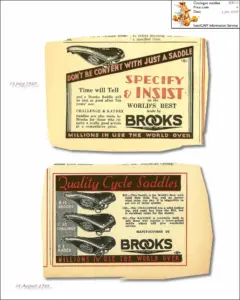 Brooks 1935 Advertisement — Specify and Insist, and Quality Cycle Saddles with Challenge and Kaydex
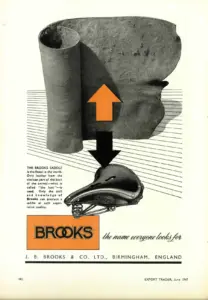 Brooks 1947 Advertisement — The Name Everyone Looks For (Export Trader)
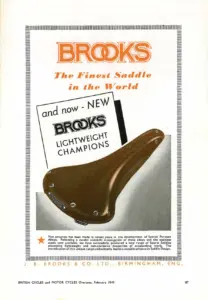 Brooks 1949 Advertisement — The New Lightweight Champions (British Cycles and Motor Cycles Overseas)
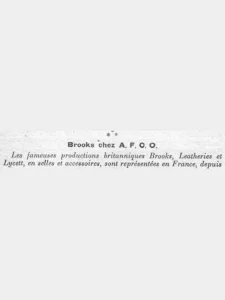 Brooks chez A.F.C.O. — L’Officiel du cycle, 3 November 1951, Brooks Represented in France by AFCO
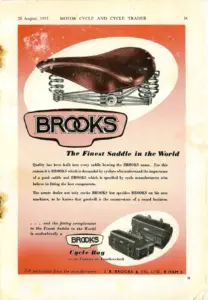 Brooks 1955 Advertisement — It’s the Saddle that Sells the Cycle (Motor Cycle and Cycle Trader)
Ebykr presents this material for research and education. If you hold rights to it or notice an ownership issue, please contact us and we will respond promptly.
The Ebykr Digest
New articles, timelines, catalog finds and registry activity — assembled from the archive once a month. Your address is never shared.
Double opt-in. One email per month. Unsubscribe at any time with one click.