About Ebykr
Ebykr celebrates classic and vintage lightweight bicycles through provocative imagery and opinion. Ride along with us.
About Ebykr
Ebykr celebrates classic and vintage lightweight bicycles through provocative imagery and opinion. Ride along with us.

Source: Ebykr archive.
| Marque | Brooks |
|---|---|
| Type | Catalog |
| Year | 1906 |
| Publisher | J. B. Brooks & Co., Ltd. |
| Country | England |
| Language | English |
| Pages | 11 |
| Source | Ebykr archive. |
| Credit | Ebykr archive |
| Transcription | Transcribed by eye |
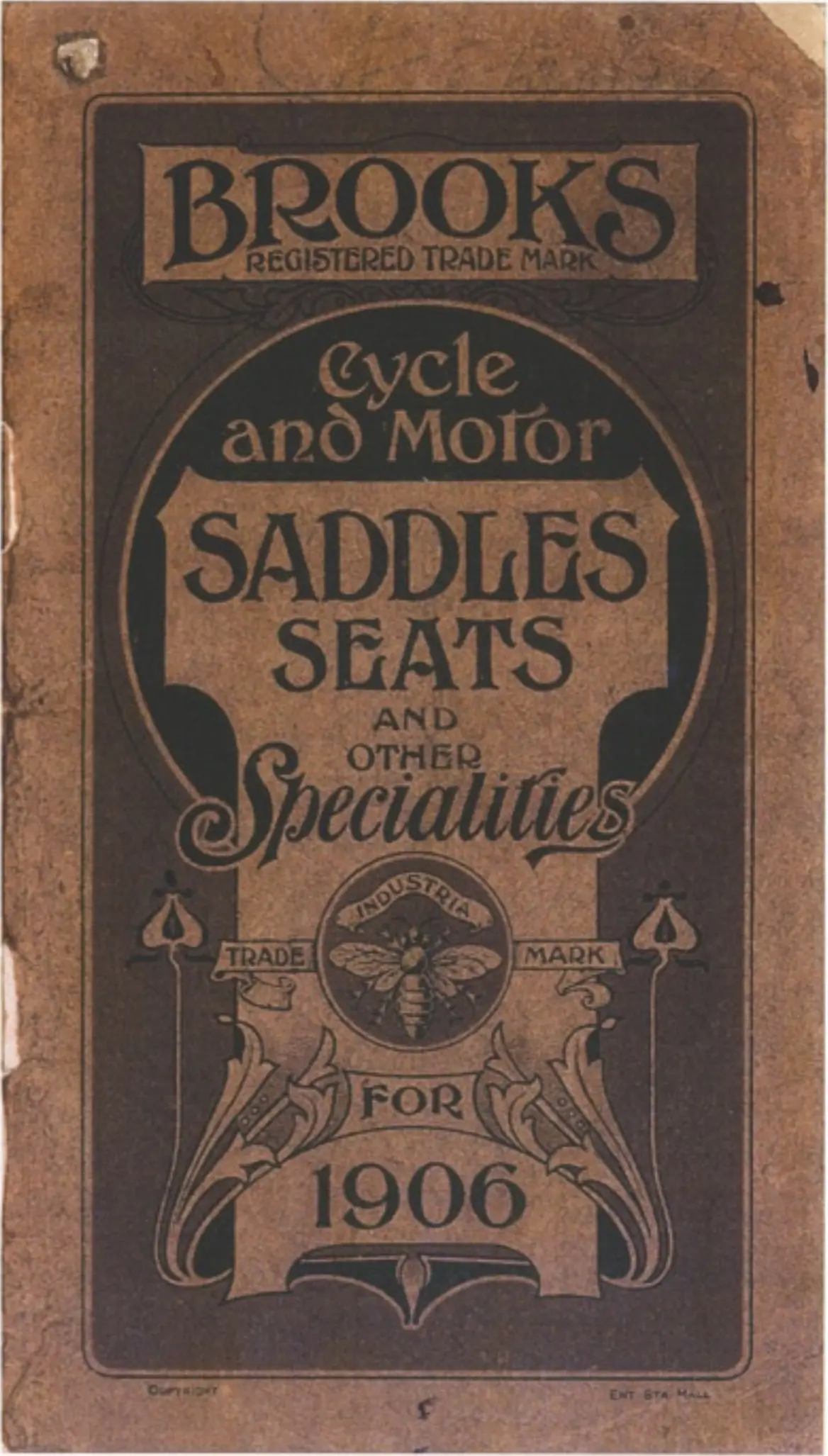
Cycle and Motor Saddles, Seats and other Specialities for 1906, from J. B. Brooks and Co. Ld. of Birmingham. Sixty-seven printed pages between printed card covers, the year on the cover and again on the title page, with a full index and model-number concordance on printed page 3. Printed by Cond Bros., Birmingham. THE HEIGHT …
Cycle and Motor Saddles, Seats and other Specialities for 1906, from J. B. Brooks and Co. Ld. of Birmingham. Sixty-seven printed pages between printed card covers, the year on the cover and again on the title page, with a full index and model-number concordance on printed page 3. Printed by Cond Bros., Birmingham.
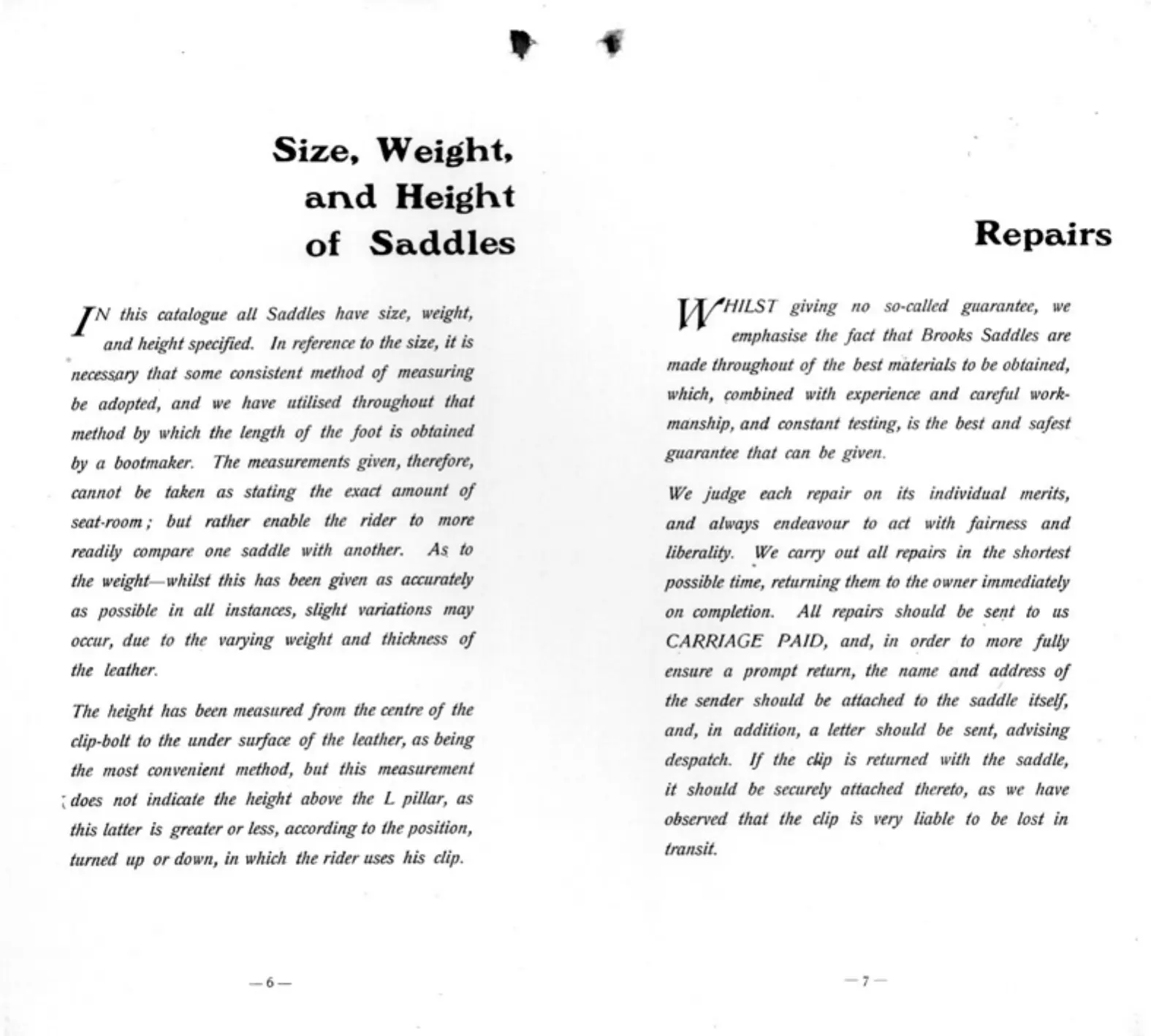
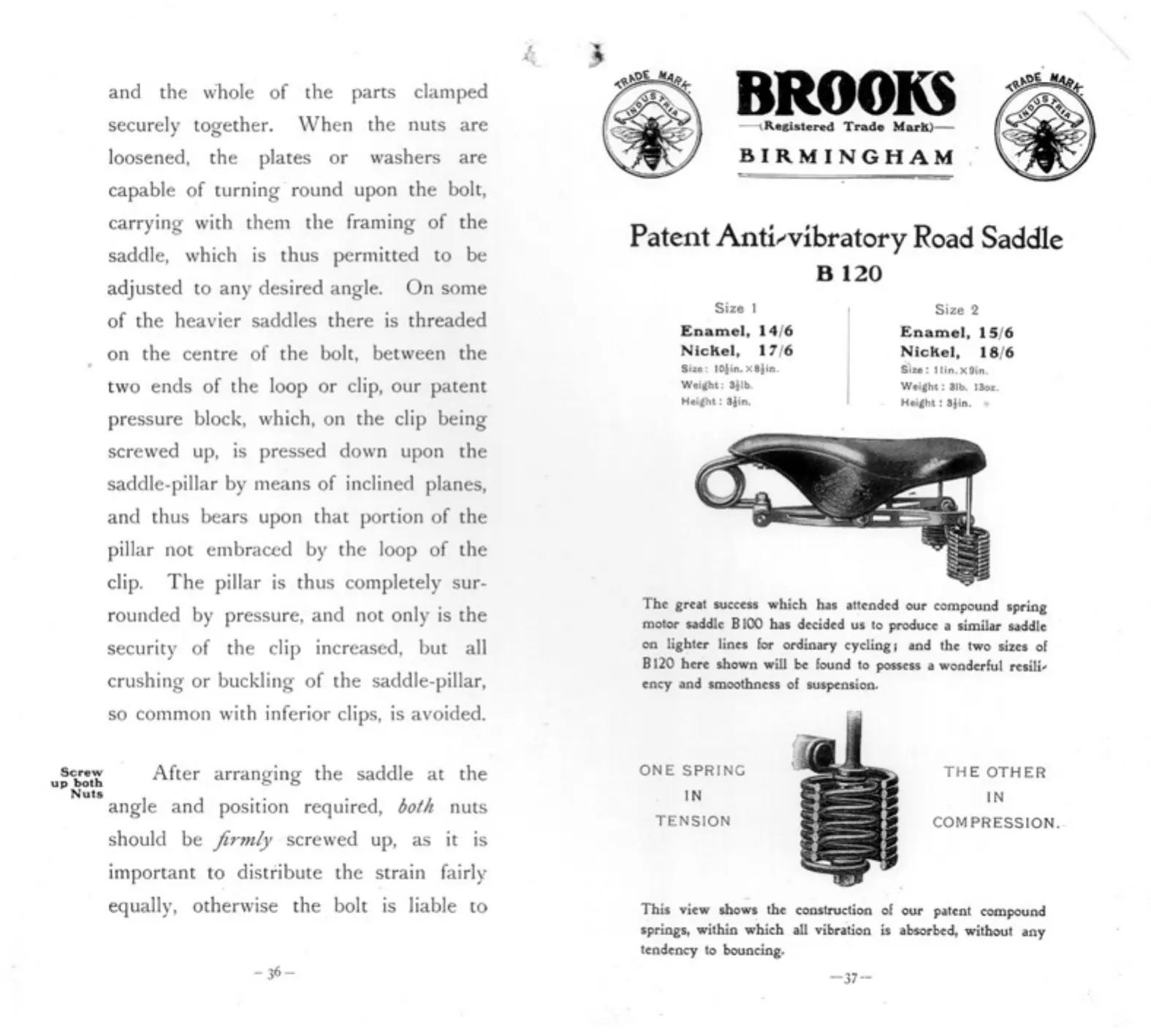
THE HEIGHT CONVENTION IS DEFINED IN 1906, AND IT MEASURES TO THE UNDER SURFACE OF THE LEATHER. Printed page 6, headed Size, Weight, and Height of Saddles, reads in part: The height has been measured from the centre of the clip-bolt to the under surface of the leather, as being the most convenient method, but this measurement does not indicate the height above the L pillar, as this latter is greater or less, according to the position, turned up or down, in which the rider uses his clip.
That correction matters more than it looks. This project had recorded the height convention as first defined in the 1919 book, measuring to the top surface of the leather, and as changing to the under surface only by 1932. The 1906 book is thirteen years earlier than the 1919 one and it already measures to the under surface. So the sequence is not a single change but a return: under surface in 1906, top surface in 1919 and 1920, under surface again in 1932. A height quoted from a Brooks catalog is comparable only with another height quoted under the same convention, and the convention has to be checked book by book rather than assumed from a date.
THE SAME SENTENCE DATES THE HEIGHT FIGURE ITSELF. The 1904 book opens the equivalent passage with In this catalogue all saddles have both size and weight specified. The 1906 book opens it with In this catalogue all Saddles have size, weight, and height specified, and every model plate in the book duly prints a height. So the height enters the Brooks specification between 1904 and 1906, and 1906 is the earliest book in this collection that quotes one.
The rest of printed page 6 declares the measuring rule that governs the size figures, in the words the whole run uses: it is necessary that some consistent method of measuring be adopted, and we have utilised throughout that method by which the length of the foot is obtained by a bootmaker. The measurements given, therefore, cannot be taken as stating the exact amount of seat-room; but rather enable the rider to more readily compare one saddle with another. That is the sixth attestation of the bootmaker rule in this run, after 1903, 1904, and before 1907, 1908 and 1910.
THE GUARANTEE FORMULA IS ON THE FACING PAGE, WORD FOR WORD. Printed page 7, headed Repairs, opens: Whilst giving no so-called guarantee, we emphasise the fact that Brooks Saddles are made throughout of the best materials to be obtained, which, combined with experience and careful workmanship, and constant testing, is the best and safest guarantee that can be given. The 1903 book prints that sentence on its printed page 46, also under the heading Repairs; the 1907 and 1908 books print it on their printed page 7. Four books across six years, unchanged. It is a standing house formula rather than a sentence written for a particular year, which is the point that matters for the epigraph the flagship article attributes to a 1907 Brooks Book.
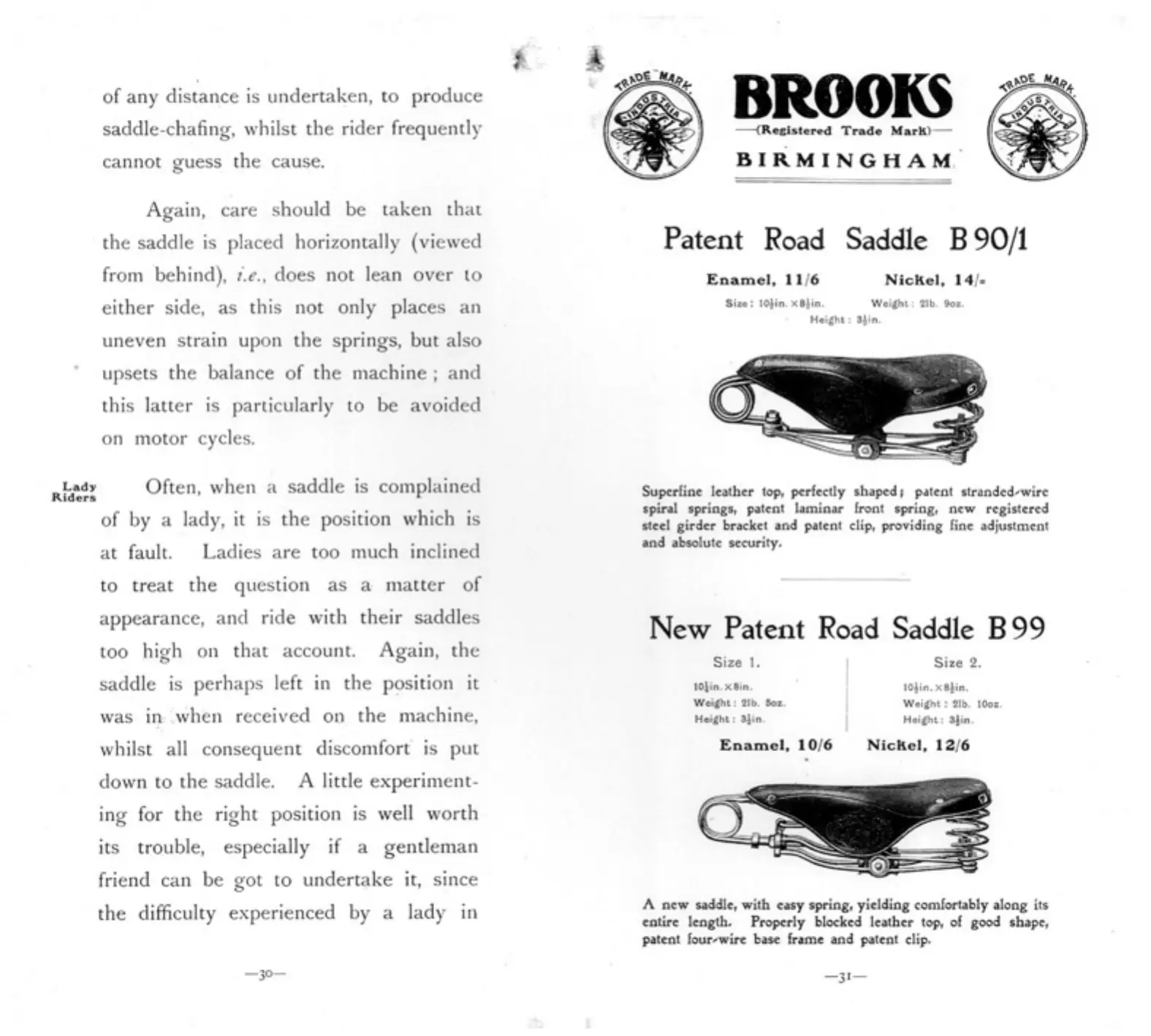
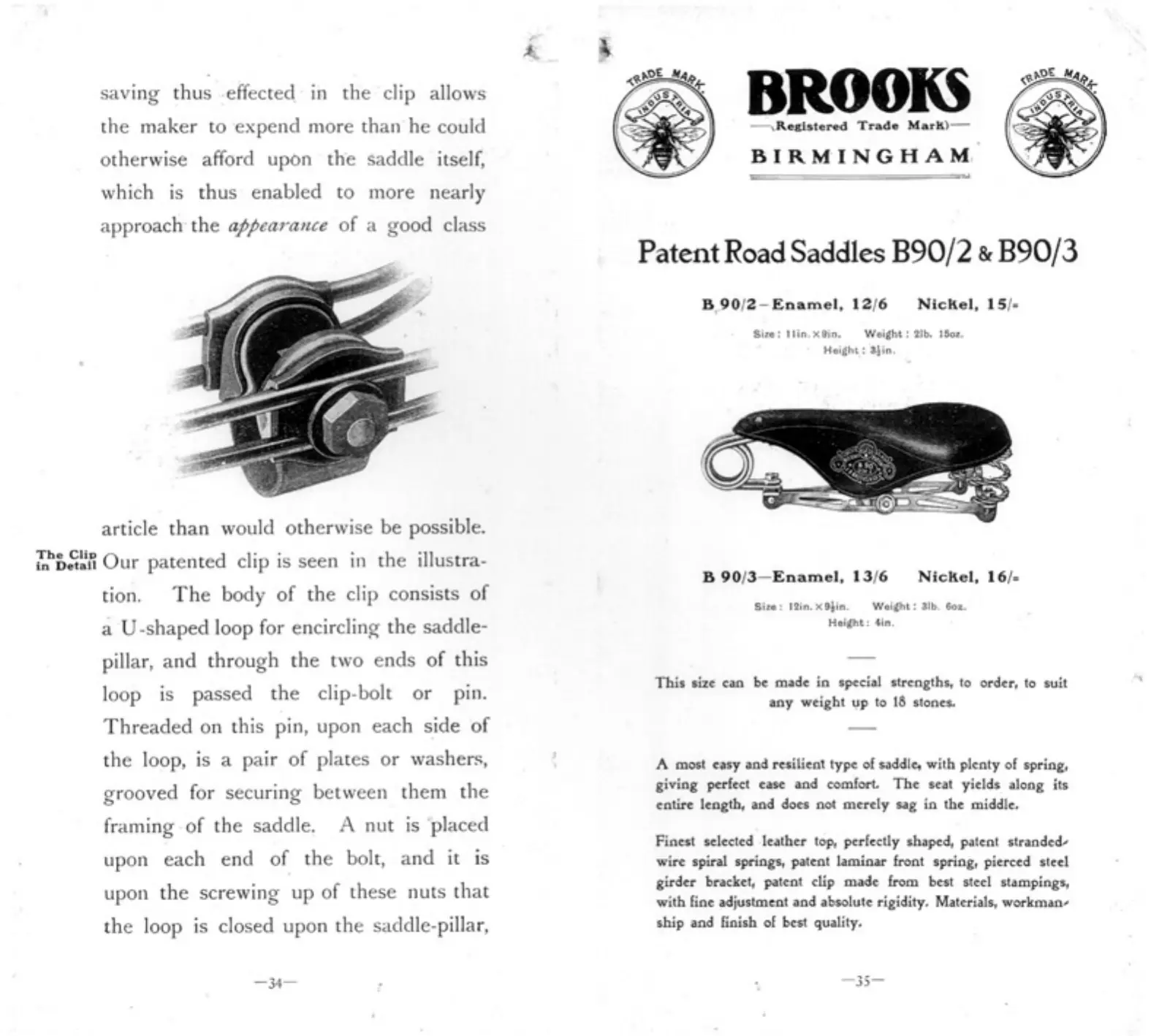
THE B 90 REACHES ITS LONG-RUN DIMENSIONS IN 1906, AND GETS CHEAPER DOING IT. The three sizes are split across two pages. Printed page 31 carries the B 90/1 at 11/6 enamelled or 14/- nickelled, 10 1/2 in. by 8 1/2 in., 2 lb. 9 oz., height 3 3/8 in. Printed page 35 carries the B 90/2 at 12/6 or 15/-, 11 in. by 9 in., 2 lb. 15 oz., height 3 1/2 in., and the B 90/3 at 13/6 or 16/-, 12 in. by 9 1/2 in., 3 lb. 6 oz., height 4 in.
Set against the earlier books that gives the enlargement a shape. In 1903 the three sizes were 10 1/2 by 7 1/2 at 2 lb. 6 oz., 11 by 8 1/2 at 2 lb. 10 oz., and 12 by 9 at 3 lb. 3 oz. The 1904 book widens Size 1 and Size 3 while holding their weights and prices, and says on its printed page 20 that this was done with a new registered cantle-plate that increased seat-room without adding to the weight. The 1906 book completes the movement: Size 1 and Size 3 now stand at exactly the figures they still carry in 1910, 1914, 1916 and 1919, and Size 2 has widened as well.
And the prices go the other way. Every size is a shilling cheaper enamelled and two and sixpence cheaper nickelled than it was in 1904, while being larger and heavier. Size 1 goes 12/6 to 11/6 enamelled and 16/6 to 14/- nickelled; Size 2 goes 13/6 to 12/6 and 17/6 to 15/-; Size 3 goes 14/6 to 13/6 and 18/6 to 16/-.
THAT CHANGES WHAT CAN BE SAID ABOUT THE NICKEL PREMIUM. Brooks charged a flat shilling amount for nickel plating rather than a percentage, so the premium as a percentage varies by model and by year. In 1900, 1903 and 1904 it runs from about 16 to about 32 per cent, and the largest premiums sit on the dearest saddles. In 1906 the same three B 90 sizes carry premiums of about 22, 20 and 18 per cent. So a flat statement that Brooks charged fifteen to twenty per cent more for nickel is too low for the turn of the century and about right for the middle of the decade, and the honest form of the claim gives the range and the direction of travel rather than one figure.
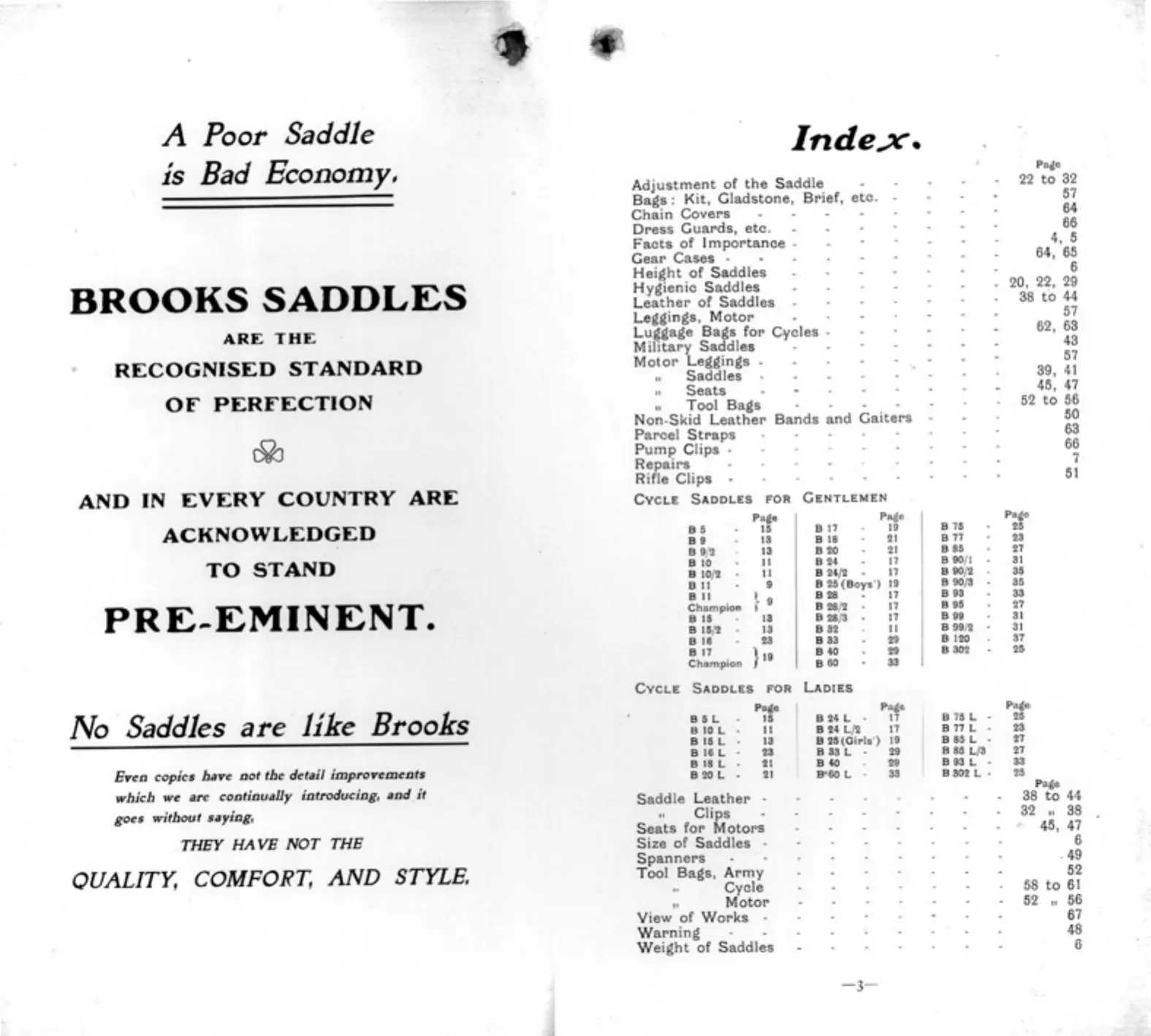
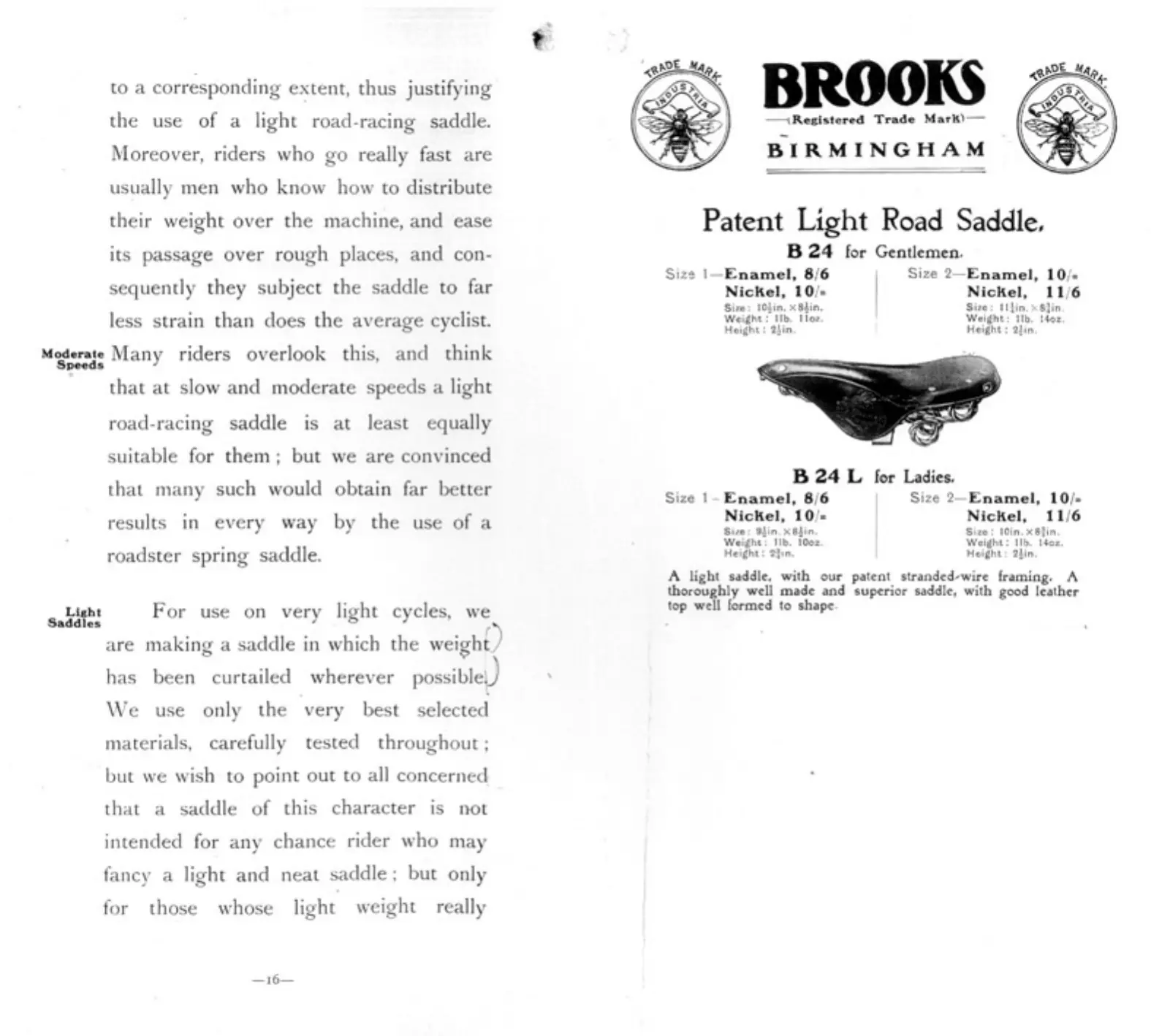
THE B 28 CANNOT BE SETTLED FROM THIS BOOK, AND THE REASON IS WORTH RECORDING. The index on printed page 3 lists B 28, B 28/2 and B 28/3, all three at printed page 17. Printed page 17 carries the B 24 for Gentlemen in two sizes and the B 24 L for Ladies in two sizes, a halftone, a three-line description, and then nothing: its lower two-fifths are blank. No leaf is missing. The sheet before it and the sheet after it run in printed sequence, an exact-duplicate scan of every image in the file found no repeat, and an adjacent-sheet difference scan found nothing. The page as printed simply does not carry the model its own index promises.
So this book is silent on the question that matters most about the B 28, which is when its rubber buffers appear. The 1903, 1904 and 1905 books all credit its freedom from sagging to a patented arrangement at the back without naming rubber; the 1907 book is the first to say at the rear, our patent system of rubber buffers is fitted. 1906 can neither confirm nor move that.
THE COMPOUND SPRING, SHOWN IN SECTION. Printed page 37 carries the B 120 Patent Anti-vibratory Road Saddle in two sizes, at 14/6 enamelled or 17/6 nickelled and 15/6 or 18/6, and explains why the model exists: The great success which has attended our compound spring motor saddle B 100 has decided us to produce a similar saddle on lighter lines for ordinary cycling; and the two sizes of B 120 here shown will be found to possess a wonderful resiliency and smoothness of suspension. Below the saddle sits a second halftone of a coil spring cut away to show a second spring inside it, captioned ONE SPRING IN TENSION, THE OTHER IN COMPRESSION, with the line: This view shows the construction of our patent compound springs, within which all vibration is absorbed, without any tendency to bouncing.
That is the same explanation the 1904 book gives on its inserted page 48A, and it is not the explanation the 1919 and 1920 books give, which is that the inner and outer springs have different natural periods and cancel each other’s bounce. Two rationales for one device, fifteen years apart, and the 1906 page is the one with the picture.
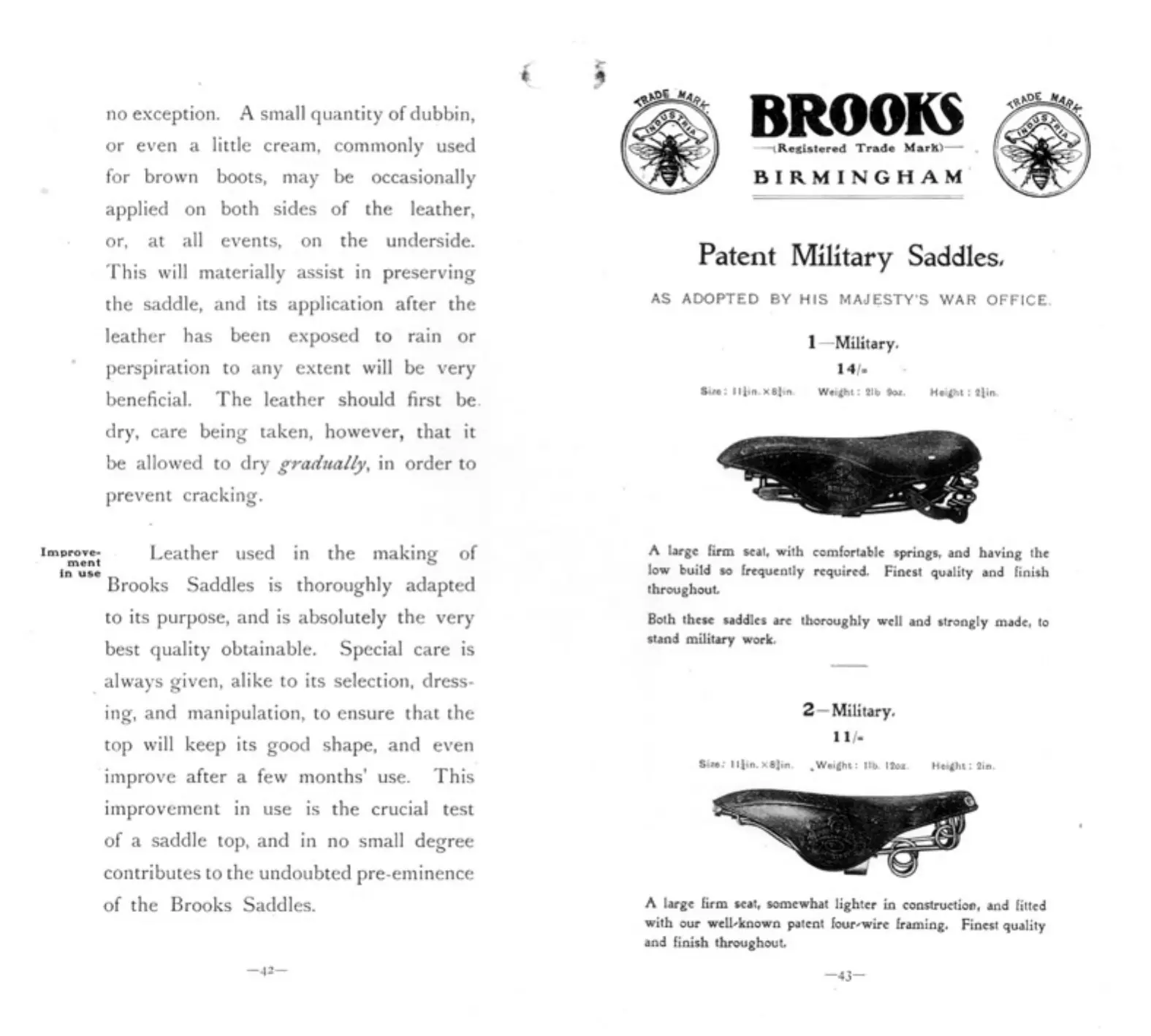
THE MILITARY RANGE IS TWO SADDLES, AND THIS TIME THEY ARE PRICED. Printed page 43 is headed Patent Military Saddles, AS ADOPTED BY HIS MAJESTY’S WAR OFFICE. It carries 1 Military at 14/-, 2 lb. 9 oz., a large firm seat, with comfortable springs, and having the low build so frequently required; and 2 Military at 11/-, 1 lb. 12 oz., a large firm seat, somewhat lighter in construction, and fitted with our well-known patent four-wire framing. Between them: Both these saddles are thoroughly well and strongly made, to stand military work. There is no No. 3, and the index gives Military Saddles at page 43 alone.
The Brooks military range now runs without a gap for fourteen years: No. 1 and No. 2 in 1903, 1904, 1905, 1906 and 1907; No. 2 alone in 1908 and 1910; No. 2 and No. 3 from 1911 through 1914; and none by 1916. The No. 3 arrives between 1910 and 1911, so a claim that all three numbered military saddles were introduced together in 1903 fails against five separate books.
The index also keeps the four War Office classes apart by name, which is the distinction that has caught this project twice: Military Saddles 43, Rifle Clips 51, Tool Bags Army 52, Motor Tool Bags 52 to 56. Only the first are saddles.
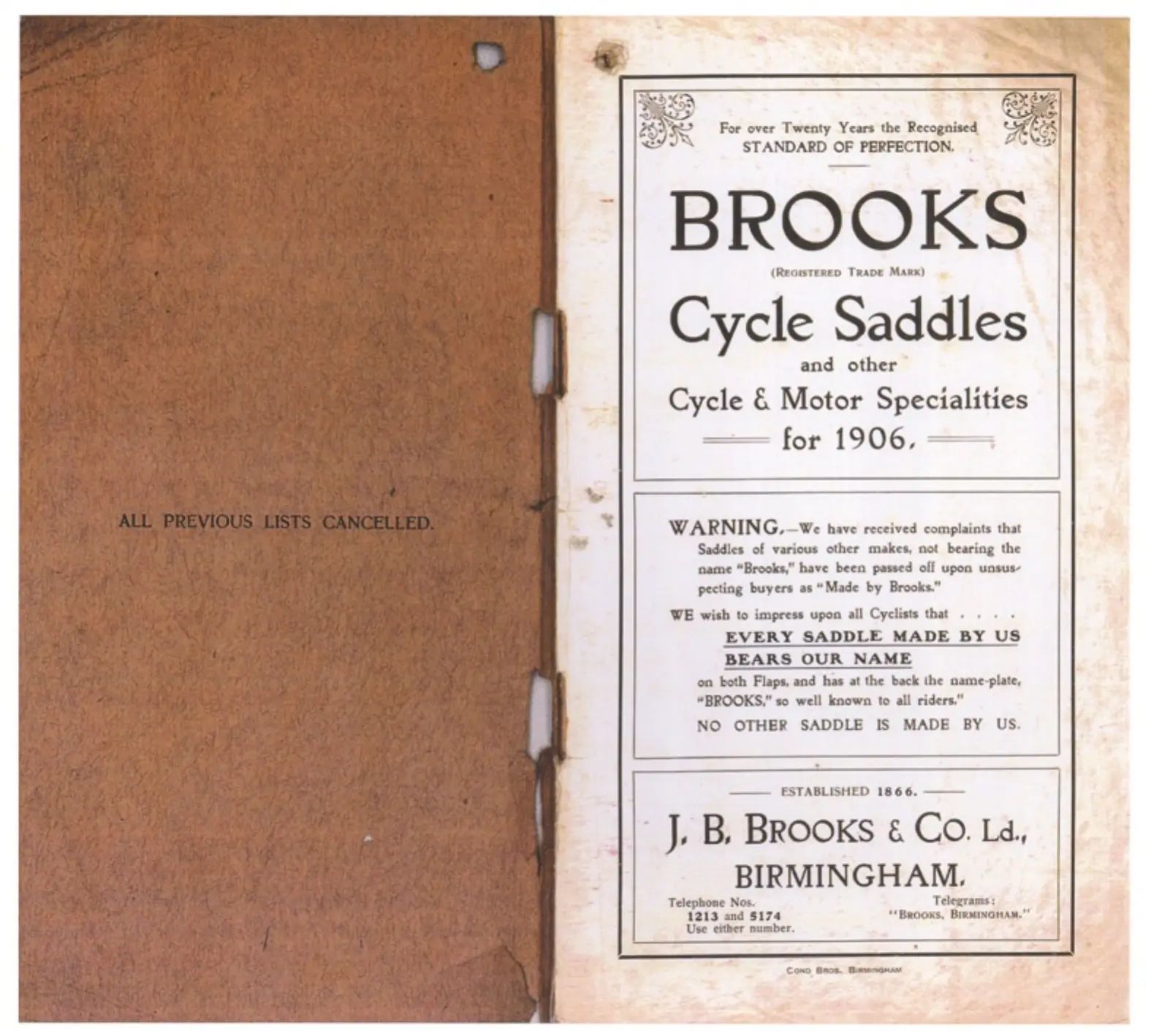
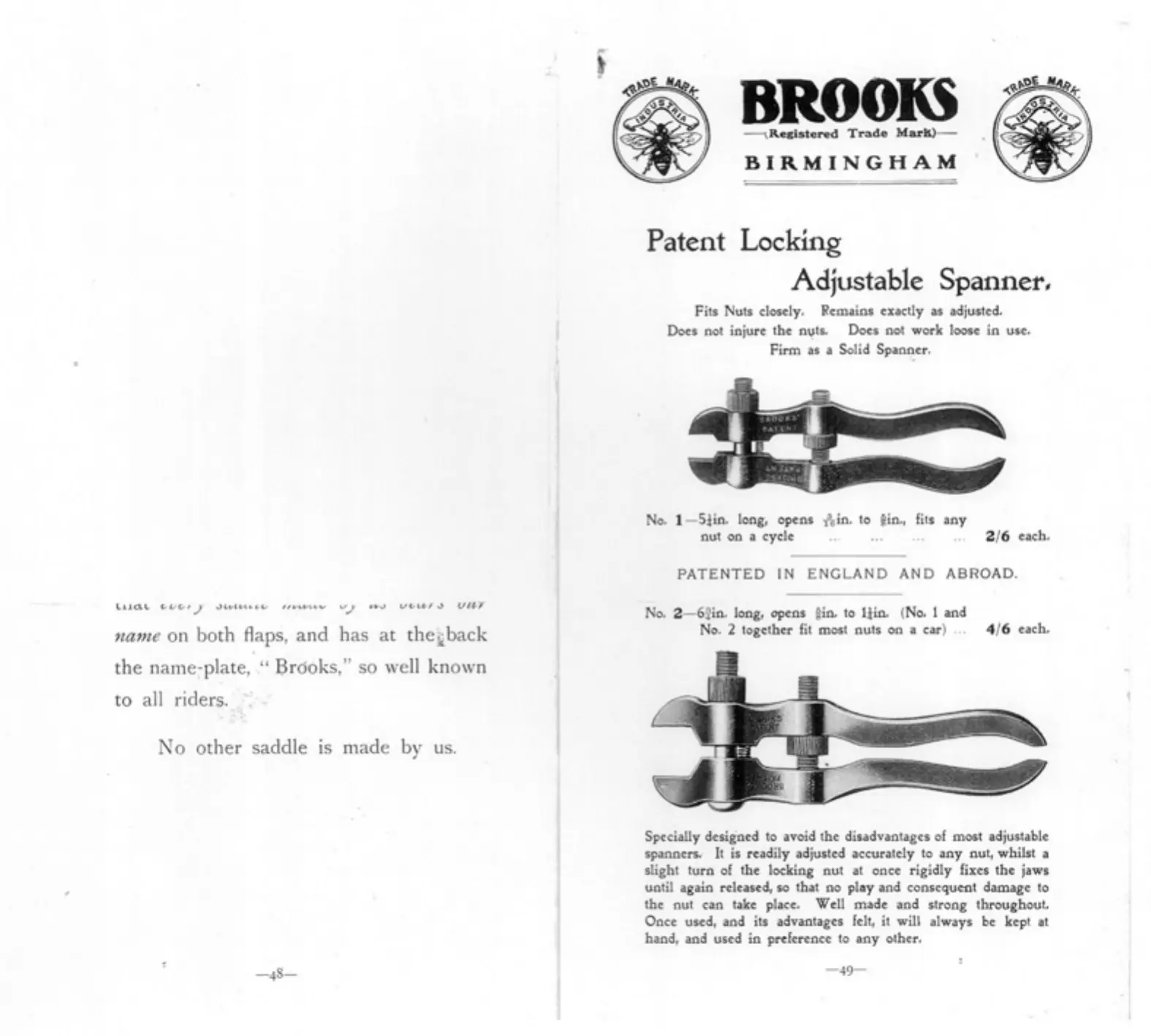
THE COUNTERFEIT WARNING RUNS TWICE, AND IT IS AN IDENTIFICATION TEST. It is on the title page and again on printed page 48: every saddle made by us bears our name on both flaps, and has at the back the name-plate, Brooks, so well known to all riders. No other saddle is made by us. The 1903 and 1904 books say the same thing, and the 1920 book still says it seventeen years later. Name on both flaps, name-plate at the rear.
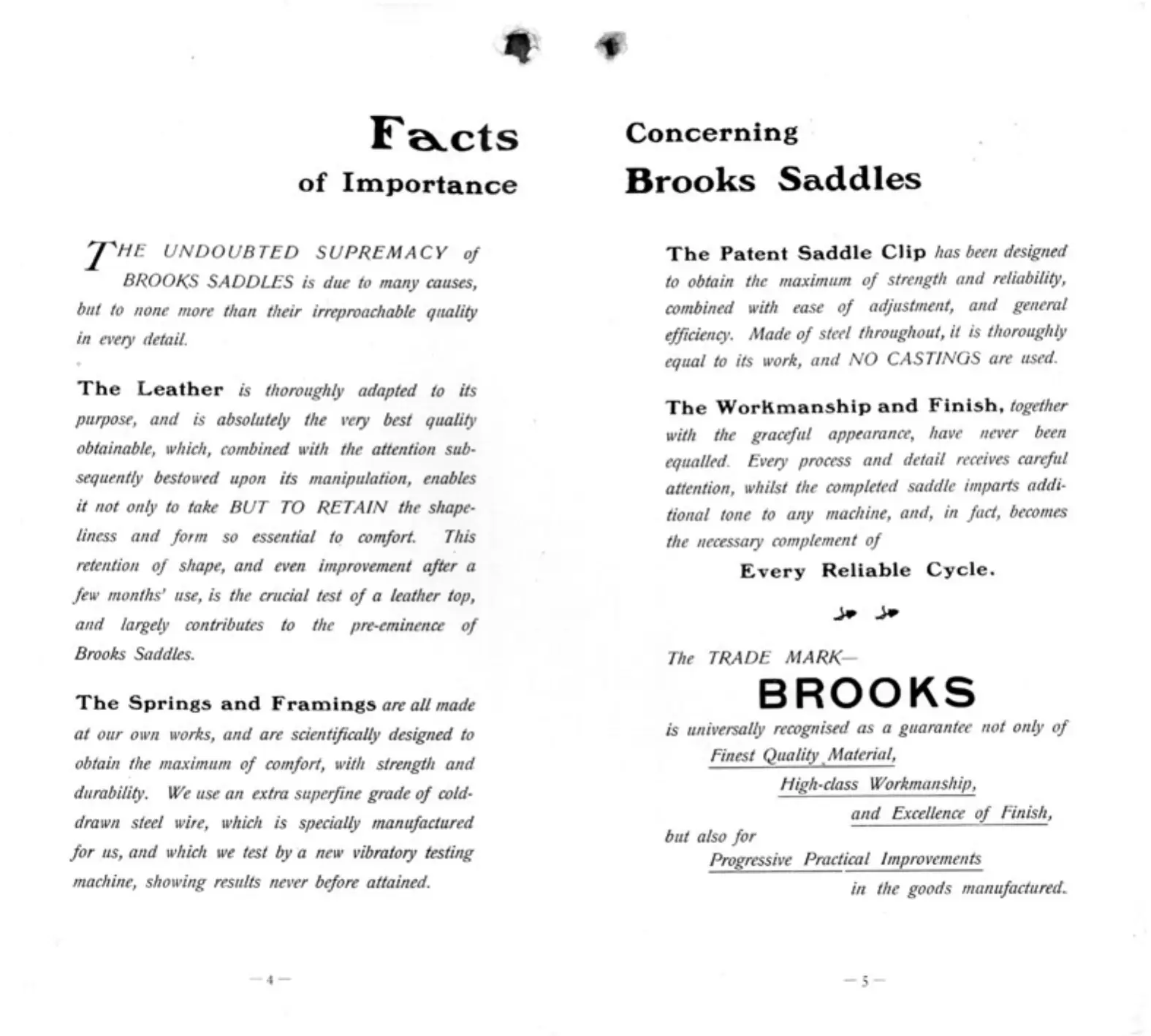
OTHER THINGS THIS BOOK SETTLES. The telephone reads Telephone Nos. 1213 and 5174, Use either number, which moves the two-number stage of the Brooks telephone series back a year, from 1907 to 1906; the single number 1213 runs 1900, 1903, 1904 and 1905. The printer is Cond Bros., Birmingham, which now holds for 1900, 1903, 1904, 1905, 1906 and 1907, with the change to Silk and Terry falling between 1907 and 1908. The firm’s establishment date is given as 1866. The inside front cover carries one line, ALL PREVIOUS LISTS CANCELLED. Printed pages 4 and 5, the Facts of Importance, drop the improved cantle-plate paragraph that was the news of the 1904 book, and close instead on the trade mark: BROOKS is universally recognised as a guarantee not only of Finest Quality Material, High-class Workmanship, and Excellence of Finish, but also for Progressive Practical Improvements in the goods manufactured. Printed page 42 is care advice and recommends a small quantity of dubbin, or even a little cream, commonly used for brown boots, applied on both sides of the leather, with the warning that it be allowed to dry gradually, in order to prevent cracking. Printed page 49 sells a Patent Locking Adjustable Spanner at 2/6 and 4/6, noting that the two together fit most nuts on a car.
SCAN CONDITION. All three defect checks pass. There is no byte-identical duplicate anywhere in the file, no adjacent-sheet duplicate, and the printed page sequence runs unbroken. Two caveats belong with any citation from this book. Printed page 17 reproduces with its lower two-fifths blank, as described above. The upper half of printed page 48 is very faintly printed or faintly reproduced and is only partly legible, though enough survives to read the counterfeit warning through. The book is reproduced as scanned; no de-yellowing was needed. This is the lowest-resolution scan in the Edwardian part of the run at roughly ninety pixels to the printed inch, and eighths in the size and height figures cannot be resolved with confidence; where a fraction is quoted above it is quoted as printed and should be treated as approximate at the eighth.
 Brooks 1902 Catalog — Cycle Saddles and Accoutrements for 1902
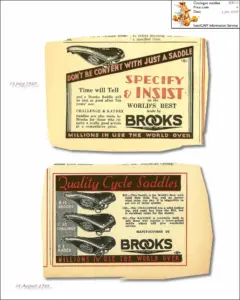 Brooks 1935 Advertisement — Specify and Insist, and Quality Cycle Saddles with Challenge and Kaydex
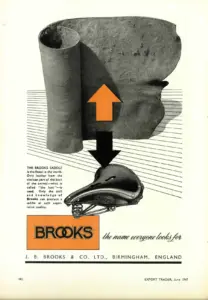 Brooks 1947 Advertisement — The Name Everyone Looks For (Export Trader)
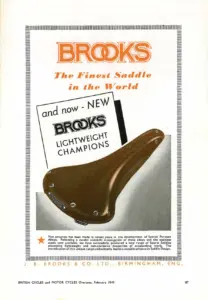 Brooks 1949 Advertisement — The New Lightweight Champions (British Cycles and Motor Cycles Overseas)
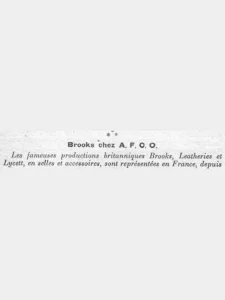 Brooks chez A.F.C.O. — L’Officiel du cycle, 3 November 1951, Brooks Represented in France by AFCO
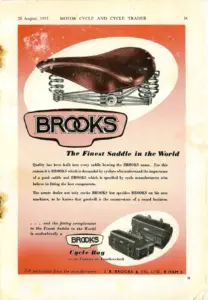 Brooks 1955 Advertisement — It’s the Saddle that Sells the Cycle (Motor Cycle and Cycle Trader)
Ebykr presents this material for research and education. If you hold rights to it or notice an ownership issue, please contact us and we will respond promptly.
The Ebykr Digest
New articles, timelines, catalog finds and registry activity — assembled from the archive once a month. Your address is never shared.
Double opt-in. One email per month. Unsubscribe at any time with one click.