About Ebykr
Ebykr celebrates classic and vintage lightweight bicycles through provocative imagery and opinion. Ride along with us.
About Ebykr
Ebykr celebrates classic and vintage lightweight bicycles through provocative imagery and opinion. Ride along with us.

Source: Ebykr archive.
| Marque | Brooks |
|---|---|
| Type | Catalog |
| Year | 1914 |
| Publisher | J. B. Brooks & Co., Ltd. |
| Country | England |
| Language | English |
| Pages | 6 |
| Source | Ebykr archive. |
| Credit | Ebykr archive |
| Transcription | Transcribed by eye |
BROOKS Saddles Bags etc. for CYCLISTS 1914 COPYRIGHT BROOKS (Regd. Trade Mark.) Cycle Saddles and Bags for 1914. Thirtieth year of publication. Telephone : (Six Lines) 3670 Central. Telegrams : "Brooks, Birmingham." J. B. BROOKS & CO. LTD. Great Charles Street, Birmingham. ESTABLISHED 1866. Contractors to H.M. Government, The War Office, India Office, Post Office …
Brooks Cycle Saddles and Bags for 1914, from J. B. Brooks & Co. Ltd. of Great Charles Street, Birmingham. The printed sequence runs to page 39, between olive cloth-grain card covers, with the year on the front cover and printed again on the title page, and the title page adding Thirtieth Year of Publication.
This is the book that closes the first of the two changes in the Brooks height convention, and it closes it as far as this collection can. The convention runs from the under surface of the leather to the top surface and back again. The 1913 book still measures to the under surface, and this book does too, so the change falls after 1914 and no later than 1916. The collection holds no 1915, so that is the final answer these sources can give, and the bracket should be treated exactly as the second change and the List No. start are treated: answered as far as it can be answered.
The definition very nearly went unrecorded, and how it was found is worth keeping. This book is a complete redesign. The typography is new, the section headings are new, and the long fitting essay of the 1911 to 1913 books is compressed into four pages. There is no heading anywhere in the book reading Size, Weight and Height of BROOKS Saddles in the display type the earlier books use. A survey of the head of all twenty-three sheets found nothing, and the book was one step from being recorded as silent on the definition. The specification note is in fact on printed page 5, in the lower half of the page, under a small capitals heading, below two other sections. A heading crop cannot see it. The rule this earns is the same rule the padded models earned, pointed the other way: a book that appears silent may simply have moved the sentence down the page.
The wording is also new, and it is not the 1910 sentence with a word changed. The height is the distance between the centre of the saddle clip bolt and the underside of the saddle top. The datum is the same as 1913 and the phrasing is fresh.
Four other things make the book worth citing.
The first is that the size convention changes even though the height convention does not. Every book from 1903 to 1913 declares that Brooks measures a saddle as a bootmaker measures the length of the foot, nine attestations in all. This book drops that sentence and says instead that the sizes given, length and width, are over-all dimensions. It is a real change of stated method. It did not change the printed figures: the B 28 and the B 90 carry exactly the dimensions they carried in 1913, to the fraction. Whether the two descriptions describe the same practice or Brooks simply did not re-measure cannot be told from the page, and this record does not claim to tell.
The second is that the top surface exception survives the redesign. Printed page 19 carries the B 90 above the B 90 Padded. The plain B 90 gives an unqualified height governed by the general rule on printed page 5; the B 90 Padded gives its height to the top surface and says so, at the same size and 4 1/2 oz. heavier. So in 1914 the general rule and the flagged exception are both printed, as they were in 1911, 1912 and 1913. The datum that becomes general in 1916 had by then been in continuous use for padded models for at least four years, and the 1916 change generalized a standing practice rather than inventing a measurement.
The third is the guarantee, which disappears. The 1903 to 1908 books print one standing guarantee formula and the 1910 to 1913 books print another, under the heading Guarantee and Repairs. This book keeps the repair instructions, on printed page 3 under the heading Repairs, and drops the guarantee paragraph altogether. In its place, on printed page 6, is a new section headed The BROOKS Policy, which opens: The BROOKS Policy is, and has been since the firm was founded in 1866, Quality first. That is a quality statement rather than a guarantee, and it is the third stage of a sequence this project had read as two.
The fourth is that the book names its companion volume. Printed page 39 carries two motor cycle saddles, the B 170 and the B 500, in a cycle book, and tells the reader to get the BROOKS Book for Motor Cyclists, which gives full details of Saddles and Bags for Motor Cyclists. The 1912 and 1913 books had listed the separate catalogues Brooks issued without naming them as books; this one names the motor edition. It also shows that a cyclists’ edition is not sealed against motor content, so an absence from one of these books should be written as an absence from the cycle edition and not from the Brooks range.
SCAN AND CAVEATS. Shipped as-scanned; no de-yellowing was applied and none is needed, the book being printed in green ink on cream and reading cleanly. The scan passes all three defect checks, with no exact duplicate image anywhere in the book, no adjacent duplicate and an unbroken printed page sequence on the house mapping of sheet N to printed pages 2N-4 and 2N-3, verified off the footer strip at both ends and in the middle. There is no index; printed pages 3, 5 and 7 all carry running text. The book scans at about 100 ppi across a two-page spread, so a printed page carries roughly 430 pixels of width, and the vulgar fractions in the height column do not survive at any magnification. Every B 90 height prints as three and a fraction inches and the fraction is deliberately omitted rather than guessed, while integers, halves, and the quarters and eighths in the size column are firm and are recorded.
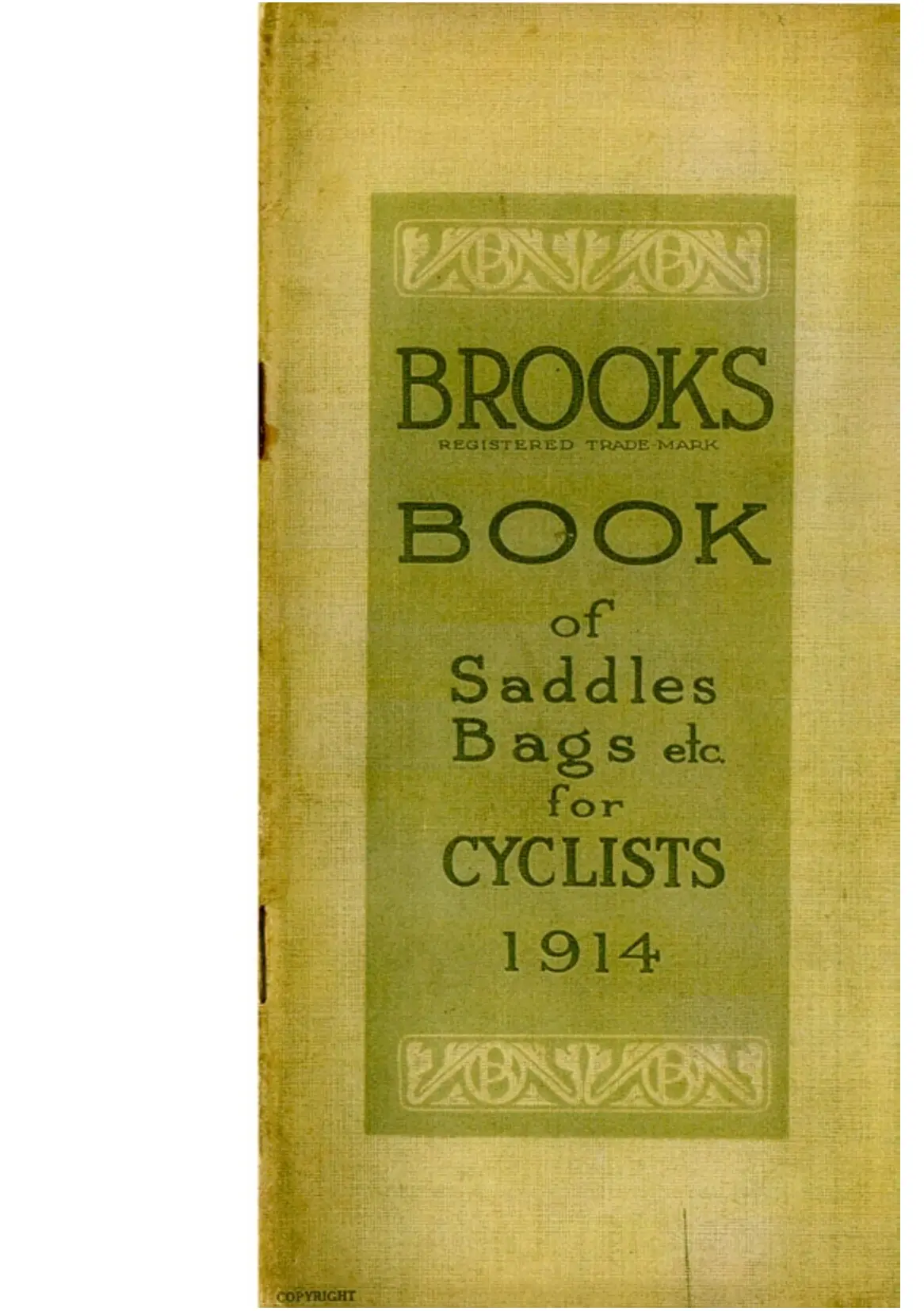
[Olive cloth-grain card cover printed in darker green. A rectangular tint panel fills the centre, lettered in a light Arts and Crafts face, with an interlaced ornamental band beneath the date. The word COPYRIGHT is printed in small type at the lower left of the cover, outside the panel. The cover is rubbed at the fore-edge and the spine edge is worn through in two places.]
BROOKS
Saddles Bags etc.
for
CYCLISTS
1914
COPYRIGHT
— Sheet 2. Inside front cover and printed page 1, the title page —
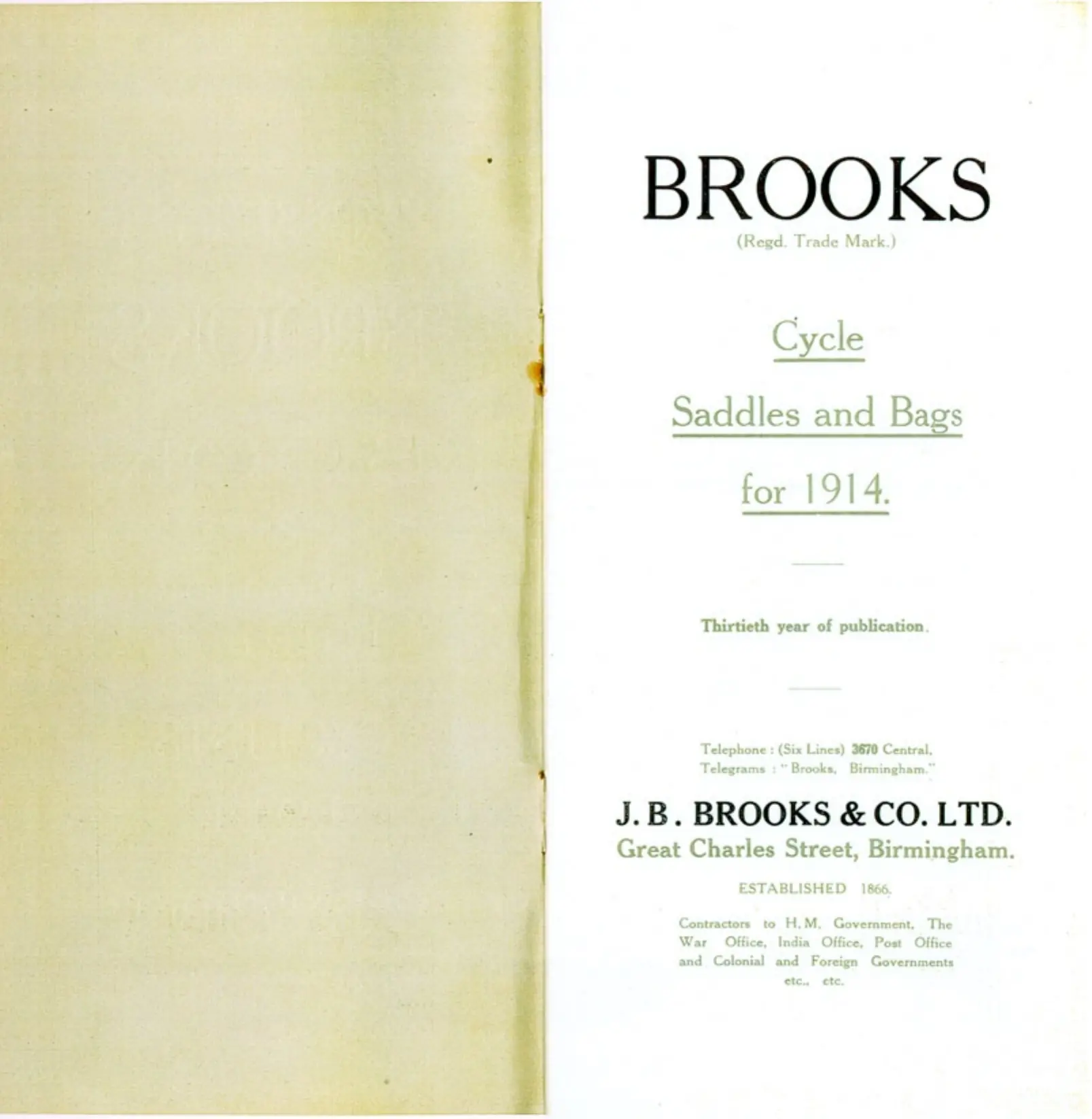
[Two page opening. The left page is the blank inside front cover. The right page is the title page, letterpress with the trade mark in heavy roman and the descriptive lines underlined by rules.]
[Printed page 1.]
BROOKS
(Regd. Trade Mark.)
Cycle
Saddles and Bags
for 1914.
Thirtieth year of publication.
Telephone : (Six Lines) 3670 Central.
Telegrams : “Brooks, Birmingham.”
J. B. BROOKS & CO. LTD.
Great Charles Street, Birmingham.
ESTABLISHED 1866.
Contractors to H.M. Government, The War Office, India Office, Post Office and Colonial and Foreign Governments etc., etc.
— Sheet 4. Printed pages 4 and 5 —
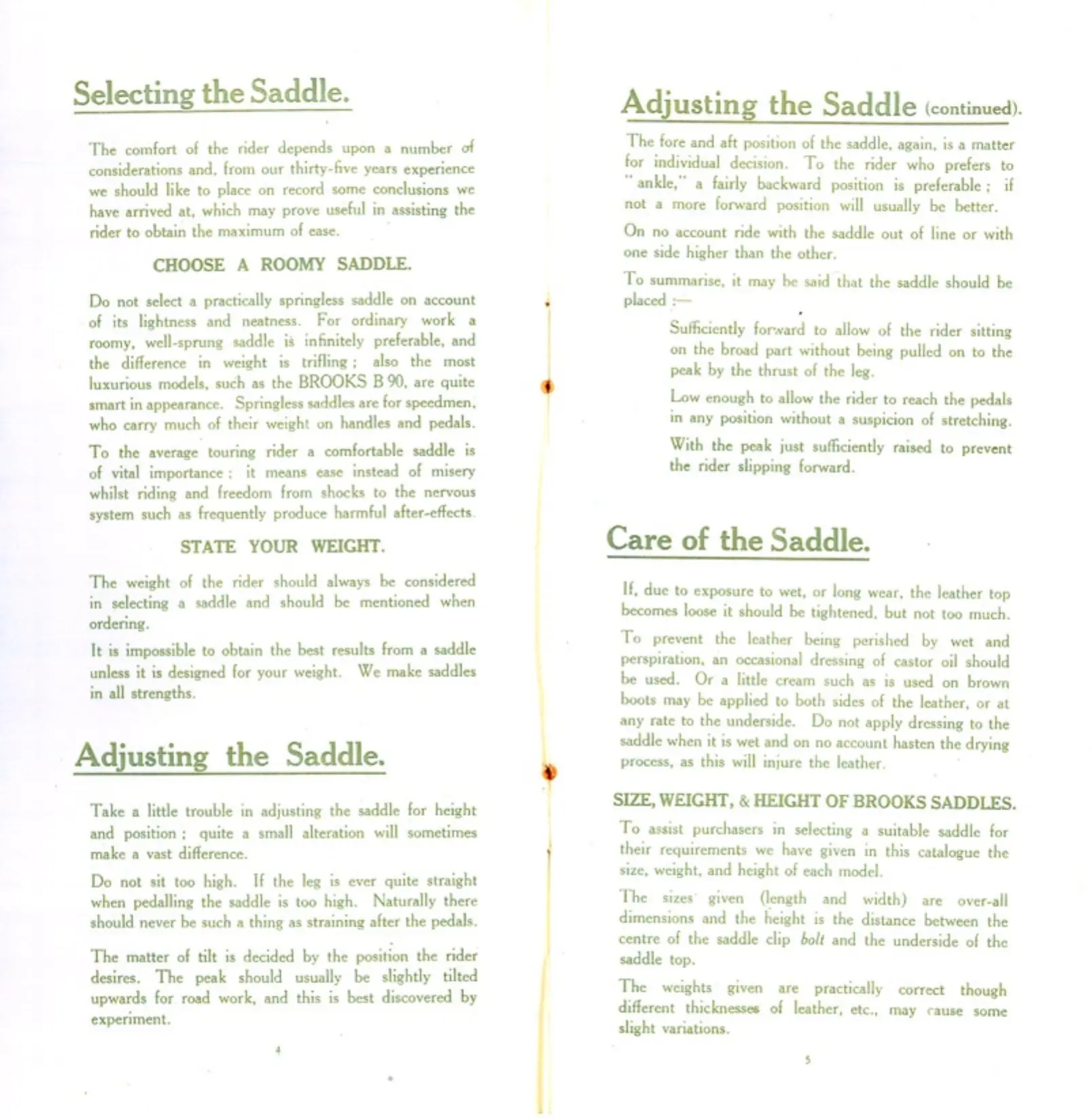
[Two page letterpress opening, no illustration. Four sections run across the two pages, two to a page. The specification note is the last section on the right page and sits in the lower half of it, under a small capitals heading, which is why it is invisible to a heading crop. This is the reason this leaf was ingested.]
[Printed page 4.]
Selecting the Saddle.
The comfort of the rider depends upon a number of considerations and, from our thirty-five years experience we should like to place on record some conclusions we have arrived at, which may prove useful in assisting the rider to obtain the maximum of ease.
CHOOSE A ROOMY SADDLE.
Do not select a practically springless saddle on account of its lightness and neatness. For ordinary work a roomy, well-sprung saddle is infinitely preferable, and the difference in weight is trifling; also the most luxurious models, such as the BROOKS B 90, are quite smart in appearance. Springless saddles are for speedmen, who carry much of their weight on handles and pedals.
To the average touring rider a comfortable saddle is of vital importance; it means ease instead of misery whilst riding and freedom from shocks to the nervous system such as frequently produce harmful after-effects.
STATE YOUR WEIGHT.
The weight of the rider should always be considered in selecting a saddle and should be mentioned when ordering.
It is impossible to obtain the best results from a saddle unless it is designed for your weight. We make saddles in all strengths.
Adjusting the Saddle.
Take a little trouble in adjusting the saddle for height and position; quite a small alteration will sometimes make a vast difference.
Do not sit too high. If the leg is ever quite straight when pedalling the saddle is too high. Naturally there should never be such a thing as straining after the pedals.
The matter of tilt is decided by the position the rider desires. The peak should usually be slightly tilted upwards for road work, and this is best discovered by experiment.
[Printed page 5.]
Adjusting the Saddle (continued).
The fore and aft position of the saddle, again, is a matter for individual decision. To the rider who prefers to “ankle,” a fairly backward position is preferable; if not a more forward position will usually be better.
On no account ride with the saddle out of line or with one side higher than the other.
To summarise, it may be said that the saddle should be placed :-
Sufficiently forward to allow of the rider sitting on the broad part without being pulled on to the peak by the thrust of the leg.
Low enough to allow the rider to reach the pedals in any position without a suspicion of stretching.
With the peak just sufficiently raised to prevent the rider slipping forward.
Care of the Saddle.
If, due to exposure to wet, or long wear, the leather top becomes loose it should be tightened, but not too much.
To prevent the leather being perished by wet and perspiration, an occasional dressing of castor oil should be used. Or a little cream such as is used on brown boots may be applied to both sides of the leather, or at any rate to the underside. Do not apply dressing to the saddle when it is wet and on no account hasten the drying process, as this will injure the leather.
SIZE, WEIGHT, & HEIGHT OF BROOKS SADDLES.
To assist purchasers in selecting a suitable saddle for their requirements we have given in this catalogue the size, weight, and height of each model.
The sizes given (length and width) are over-all dimensions and the height is the distance between the centre of the saddle clip bolt and the underside of the saddle top.
The weights given are practically correct though different thicknesses of leather, etc., may cause some slight variations.
— Sheet 11. Printed pages 18 and 19 —
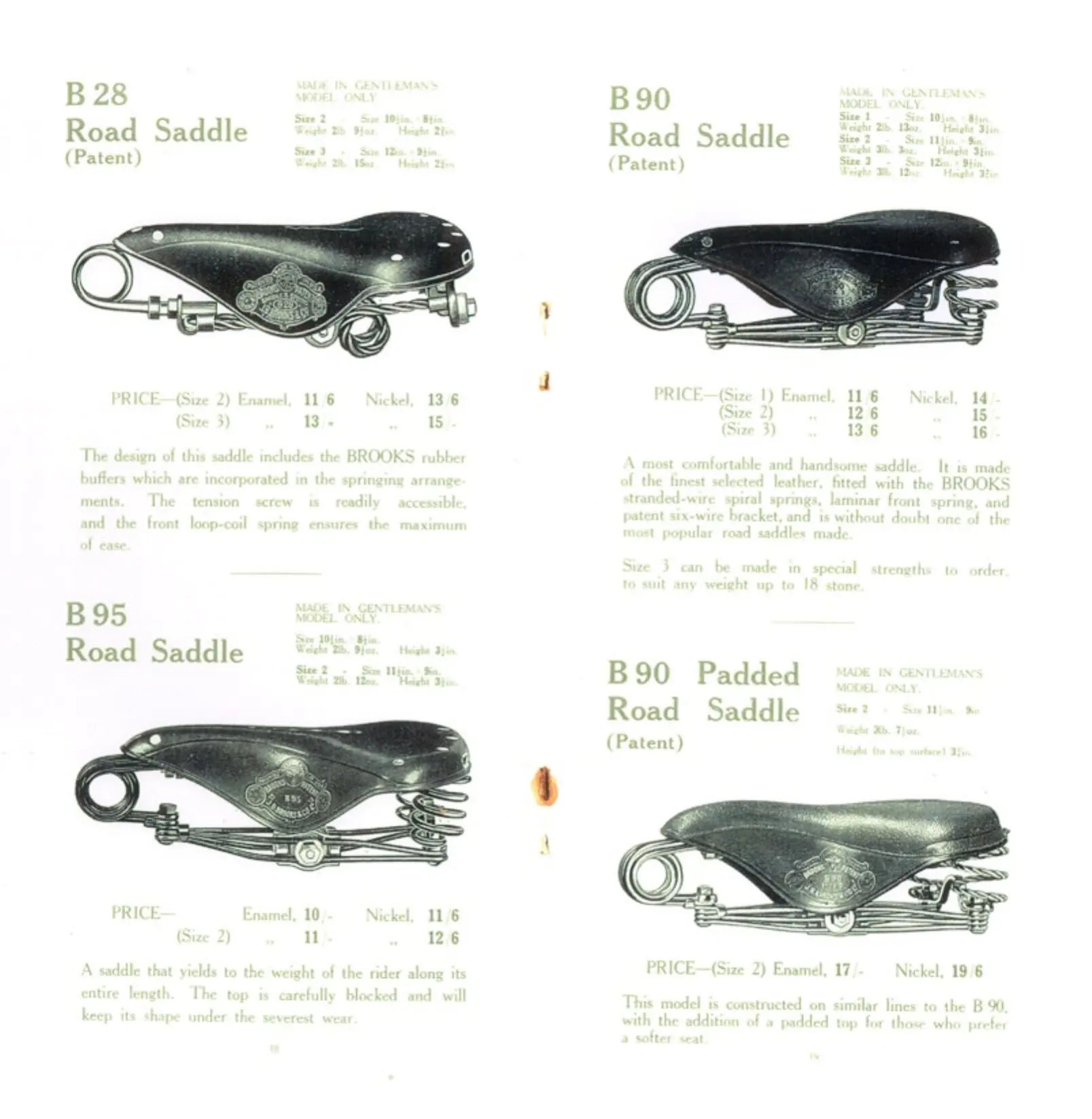
[Two page opening, two model entries to a page, each with a halftone side view and a spec block at the head. The left page carries the B 28 above the B 95, the right page the B 90 above the B 90 Padded. This is the leaf that carries the B 90 control and the flagged top surface exception.]
[Printed page 18.]
B 28 Road Saddle (Patent)
MADE IN GENTLEMAN’S MODEL ONLY
Size 2 – Size 10 1/2 in. x 8 1/2 in.
Weight 2lb. 9 1/2 oz. Height 2 3/8 in.
Size 3 – Size 12 in. x 9 1/2 in.
Weight 2lb. 15oz. Height 2 7/8 in.
PRICE-(Size 2) Enamel, 11/6 Nickel, 13/6
(Size 3) ” 13/- ” 15/-
The design of this saddle includes the BROOKS rubber buffers which are incorporated in the springing arrangements. The tension screw is readily accessible, and the front loop-coil spring ensures the maximum of ease.
B 95 Road Saddle
MADE IN GENTLEMAN’S MODEL ONLY.
Size 10 1/2 in. x 8 1/2 in.
Weight 2lb. 9 1/2 oz. Height 3 1/8 in.
Size 2 – Size 11 1/2 in. x 9 in.
Weight 2lb. 12oz. Height 3 1/8 in.
PRICE- Enamel, 10/- Nickel, 11/6
(Size 2) ” 11/- ” 12/6
A saddle that yields to the weight of the rider along its entire length. The top is carefully blocked and will keep its shape under the severest wear.
[Printed page 19.]
B 90 Road Saddle (Patent)
MADE IN GENTLEMAN’S MODEL ONLY.
Size 1 – Size 10 1/2 in. x 8 1/2 in.
Weight 2lb. 13oz. Height 3 in. [and a fraction not resolved by the scan]
Size 2 – Size 11 1/2 in. x 9 in.
Weight 3lb. 3oz. Height 3 in. [and a fraction not resolved by the scan]
Size 3 – Size 12 in. x 9 1/2 in.
Weight 3lb. 12oz. Height 3 in. [and a fraction not resolved by the scan]
PRICE-(Size 1) Enamel, 11/6 Nickel, 14/-
(Size 2) ” 12/6 ” 15/-
(Size 3) ” 13/6 ” 16/-
A most comfortable and handsome saddle. It is made of the finest selected leather, fitted with the BROOKS stranded-wire spiral springs, laminar front spring, and patent six-wire bracket, and is without doubt one of the most popular road saddles made.
Size 3 can be made in special strengths to order, to suit any weight up to 18 stone.
B 90 Padded Road Saddle (Patent)
MADE IN GENTLEMAN’S MODEL ONLY.
Size 2 – Size 11 1/2 in. x 9 in.
Weight 3lb. 7 1/2 oz.
Height (to top surface) 3 3/8 in.
PRICE-(Size 2) Enamel, 17/- Nickel, 19/6
This model is constructed on similar lines to the B 90, with the addition of a padded top for those who prefer a softer seat.
— Sheet 18. Printed pages 32 and 33 —
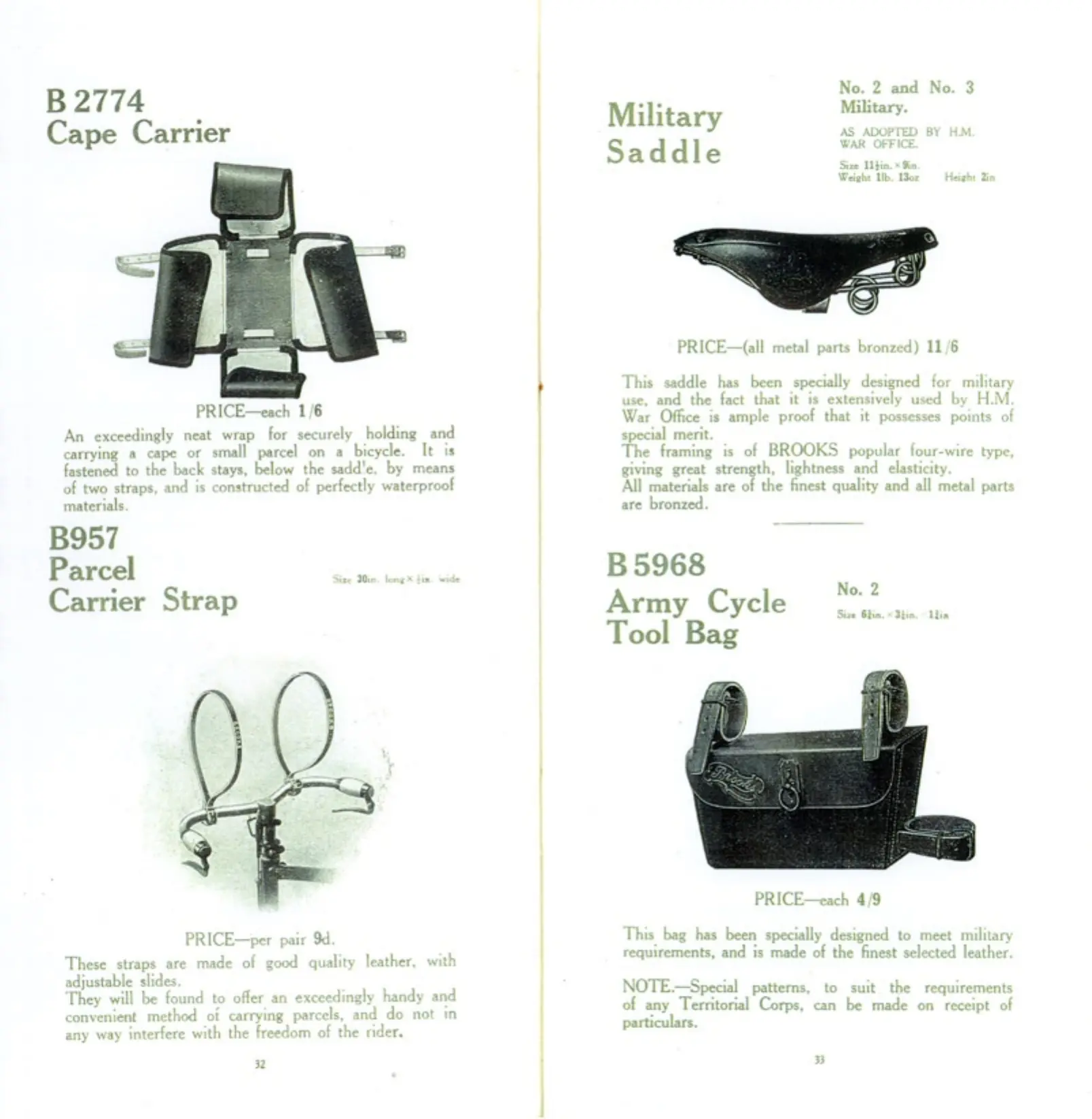
[Two page opening, two entries to a page, each with a halftone. The left page carries the Cape Carrier above the Parcel Carrier Strap, the right page the Military Saddle above the Army Cycle Tool Bag. The Cape Carrier here is the model whose number and price were both amended in red ink in the 1913 copy, and this book prints both amendments.]
[Printed page 32.]
B 2774 Cape Carrier
PRICE-each 1/6
An exceedingly neat wrap for securely holding and carrying a cape or small parcel on a bicycle. It is fastened to the back stays, below the saddle, by means of two straps, and is constructed of perfectly waterproof materials.
B 957 Parcel Carrier Strap
Size 30 in. long x 1/2 in. wide
PRICE-per pair 9d.
These straps are made of good quality leather, with adjustable slides.
They will be found to offer an exceedingly handy and convenient method of carrying parcels, and do not in any way interfere with the freedom of the rider.
[Printed page 33.]
Military Saddle
No. 2 and No. 3 Military.
AS ADOPTED BY H.M. WAR OFFICE.
Size 11 1/2 in. x 9 in.
Weight 1lb. 13oz. Height 2 in.
PRICE-(all metal parts bronzed) 11/6
This saddle has been specially designed for military use, and the fact that it is extensively used by H.M. War Office is ample proof that it possesses points of special merit.
The framing is of BROOKS popular four-wire type, giving great strength, lightness and elasticity.
All materials are of the finest quality and all metal parts are bronzed.
B 5968 Army Cycle Tool Bag
No. 2
Size 6 3/4 in. x 3 1/4 in. x 1 3/4 in.
PRICE-each 4/9
This bag has been specially designed to meet military requirements, and is made of the finest selected leather.
NOTE.-Special patterns, to suit the requirements of any Territorial Corps, can be made on receipt of particulars.
— Sheet 21. Printed pages 38 and 39 —
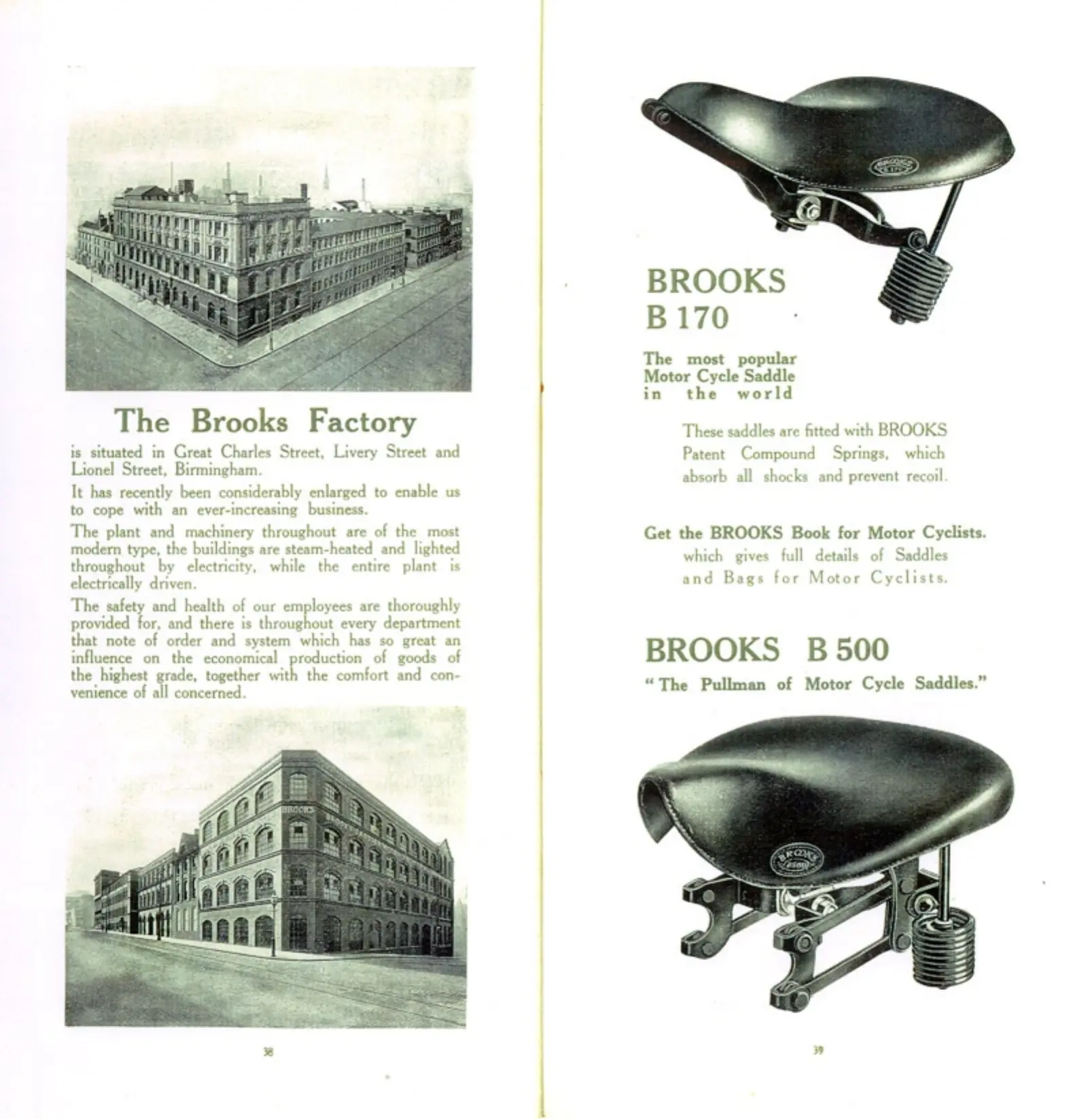
[Two page opening closing the priced matter. The left page carries two halftones of the works, an oblique view above and a street-corner view below, with the factory description between and beneath them. The right page carries two motor cycle saddles in a cycle book, with a line directing the reader to the separate motor edition.]
[Printed page 38.]
The Brooks Factory
is situated in Great Charles Street, Livery Street and Lionel Street, Birmingham.
It has recently been considerably enlarged to enable us to cope with an ever-increasing business.
The plant and machinery throughout are of the most modern type, the buildings are steam-heated and lighted throughout by electricity, while the entire plant is electrically driven.
The safety and health of our employees are thoroughly provided for, and there is throughout every department that note of order and system which has so great an influence on the economical production of goods of the highest grade, together with the comfort and convenience of all concerned.
[Printed page 39.]
BROOKS B 170
The most popular Motor Cycle Saddle in the world
These saddles are fitted with BROOKS Patent Compound Springs, which absorb all shocks and prevent recoil.
Get the BROOKS Book for Motor Cyclists.
which gives full details of Saddles and Bags for Motor Cyclists.
BROOKS B 500
“The Pullman of Motor Cycle Saddles.”
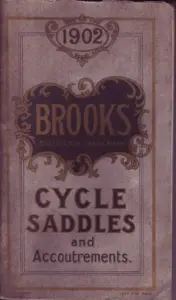 Brooks 1902 Catalog — Cycle Saddles and Accoutrements for 1902
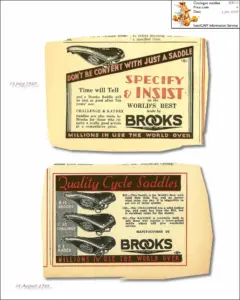 Brooks 1935 Advertisement — Specify and Insist, and Quality Cycle Saddles with Challenge and Kaydex
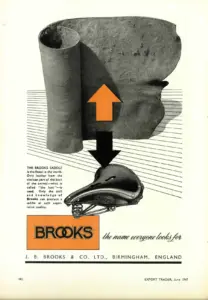 Brooks 1947 Advertisement — The Name Everyone Looks For (Export Trader)
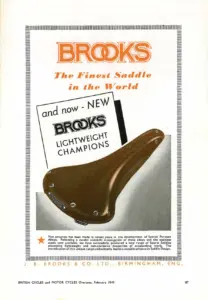 Brooks 1949 Advertisement — The New Lightweight Champions (British Cycles and Motor Cycles Overseas)
 Brooks chez A.F.C.O. — L’Officiel du cycle, 3 November 1951, Brooks Represented in France by AFCO
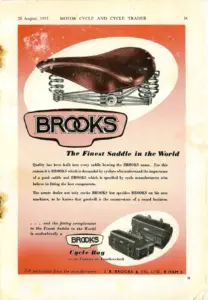 Brooks 1955 Advertisement — It’s the Saddle that Sells the Cycle (Motor Cycle and Cycle Trader)
Ebykr presents this material for research and education. If you hold rights to it or notice an ownership issue, please contact us and we will respond promptly.
The Ebykr Digest
New articles, timelines, catalog finds and registry activity — assembled from the archive once a month. Your address is never shared.
Double opt-in. One email per month. Unsubscribe at any time with one click.