About Ebykr
Ebykr celebrates classic and vintage lightweight bicycles through provocative imagery and opinion. Ride along with us.
About Ebykr
Ebykr celebrates classic and vintage lightweight bicycles through provocative imagery and opinion. Ride along with us.

A practical, honest guide to working out what your Peugeot is and when it was built — reading the model, the frame, the components and the decals together, because the serial number alone will not tell you.
Few names cover as much ground as Peugeot. The lion badge sat on the gas-pipe roadster a teenager rode to school and on the Reynolds 531 racer a professional rode in the Tour de France, and it sat on both in the same model year. So the first thing to accept about dating a vintage Peugeot is that there is no single lever to pull. The serial number will not simply hand you a year, whatever a forum post may promise, and a bike that looks ordinary may be a good deal older or newer than it appears.
What does work is triangulation. You read the model, the frame, the components and the decals together, and each one narrows the window until the answer sits inside a year or two. This guide walks through that process in the order an experienced eye actually uses it, and it is honest about where the evidence runs out. Dating a Peugeot from before the late 1970s is closer to an art than a science, and an estimate is often the correct answer.
Before you look for a date, work out what the bicycle is. Peugeot built a whole ladder of models at once, and where a bike sat on that ladder tells you which parts, which tubing and which finishes are correct for it — which in turn brackets the era. Identify the model first and everything after it becomes easier.
The famous rungs give the range. The UO-8 was the entry 10-speed of the bike-boom years, a mild straight-gauge steel frame with steel cranks and steel rims, sold into the United States market from the 1960s through to about 1980 and remembered less for its weight than for how well it handled. The PR-10 sat in the middle, with a butted Reynolds 531 main triangle and an alloy Stronglight crank, and gave way to the PKN-10 around 1980. At the top was the PX-10, introduced as a model in 1953 and carried as Peugeot’s flagship for three decades: a full Reynolds 531 frameset, chrome stays and professional-grade equipment, in variants such as the PX-10E, PX-10LE and PX-10S.
Peugeot’s letter-and-number model codes do follow a rough internal logic, but that logic was never published in a form worth trusting, so treat the code as a label rather than a decoder. The model matters because it points you at the correct catalog and the correct parts. The date comes from those, not from the name.
The frame carries several clues that move in step with the calendar. The tubing decal is the first. A butted Reynolds 531 transfer marks the better road frames through the 1960s and 1970s; the seat-tube “Reynolds 531” decal was dropped around 1973, which is a useful hinge on its own. Later flagships moved off steel entirely — the PX-10DU used Vitus 979 aluminum tubing in 1981 and 1982 and made its last catalog appearance in 1983, and the lugged flagships of the mid 1980s switched to Columbus SLX. An entry frame with a Carbolite decal or no tubing transfer at all is telling you it is a lower rung, and usually a later one.
Look next at the lugs and the fork. Nervex Professional lugs, with the blackened heads, are the mark of the 1960s and early 1970s frames; from about 1974 Peugeot moved to plainer Nervex lugs, sometimes outlined in gold on the LE, and those smooth lugs ran through 1983. The following year closed the era: 1984 was the last for a lugged and brazed Reynolds 531C frameset, the PX-10L in its chevrons paint scheme. Chrome fork crowns and chromed tips belong to that later lugged period. The rear dropouts are another tell: Simplex dropouts with an integral gear hanger are common across the range, while the highest models wore Campagnolo ends. None of these dates a bike to the year on its own, but together they place it firmly in a decade before you have touched a single component.
Here is where most people start, and where most people are led astray. Peugeot stamped a number on the underside of the bottom-bracket shell. It is genuinely useful for identifying a frame, and genuinely poor at dating one.
The common claim is that the number of digits reveals the decade, or that the first digit reveals the year. It does not. This has been disproved many times over. A frame carrying the serial 1355592 was built in 1975, so the leading “1” points nowhere. As a rule the serial rarely makes a bike look newer than it is, but it will happily make one look older, which is exactly the trap. For anything built before the late 1970s, read the serial as an identifier and nothing more.
From 1976 the picture improves. That year Peugeot split what had been one number into two. The first is a seven-digit frame number, stamped into the bottom-bracket shell or a dropout or set on a riveted alloy plate, and it does carry a build date: a single digit for the year followed by two for the month. A code of 605 reads as May 1976, 607 as July 1976 and 904 as April 1979. The second is a typed paper label, first stuck to the bottom bracket and later to the chainstay, carrying the model designation and the frame size in centimeters but no date at all.
Two things will trip you up. The date group is not always the first thing on the frame: a factory letter often comes before it, B for Beaulieu and Y for Romilly-sur-Seine, and a good many frames from 1976 to 1979 carry no factory letter at all, as do the Prestige and PSV models of the early 1980s and the custom racing frames. And the reading itself is a reconstruction from surveyed frames rather than a table Peugeot ever published. So a date pulled from the frame number is a strong lead to confirm against the components, not a verdict on its own. The number confirms; it does not decide.
Before 1976
Reads Built in 1975, so the leading 1 points nowhere
From 1976, the frame number
Reads 605 is May 1976, 607 July 1976 and 904 April 1979
From 1976, the paper label
Reads The model designation and the frame size, but no date at all
Every reading here comes from “The serial number, honestly” in this guide.
This is the reliable backbone of the whole exercise, and it rests on one simple principle: a frame can be no older than the newest original part bolted to it. Many French components of the period carried their own date codes, and unlike the frame number those codes were meant to be read.
Maillard and Normandy hubs are the most helpful. They were stamped with an open date in a week-and-year form — two digits for the week of the year followed by two for the year, so 27 78 means the twenty-seventh week of 1978. Normandy was the budget branding and Maillard the same firm’s own name; the Normandy mark gave way to Maillard around 1981, which is a dating clue in itself. Simplex derailleurs, the Prestige in particular, carry a month-and-year code on the back face. Stronglight cranks are the awkward exception: there was never a consistent Stronglight date stamp, so you date them by model instead. The 49D ran from about 1936 to 1984, although the 49D name itself came into general use only after the war; the 93 arrived for 1968 and finished in 1978; the 105 followed in 1976 and the 106 not until 1984.
The method is to gather two or three parts whose codes agree. If the hubs read 78 and a dated derailleur agrees, the frame was almost certainly assembled the following year, in 1979. The one thing to guard against is a bike that has been re-parted over its life: a replaced hub or a swapped derailleur will point at the repair, not the build, so weigh originality before you trust a code. The full maker-by-maker method is set out in the companion reference on dating a bicycle by its components.
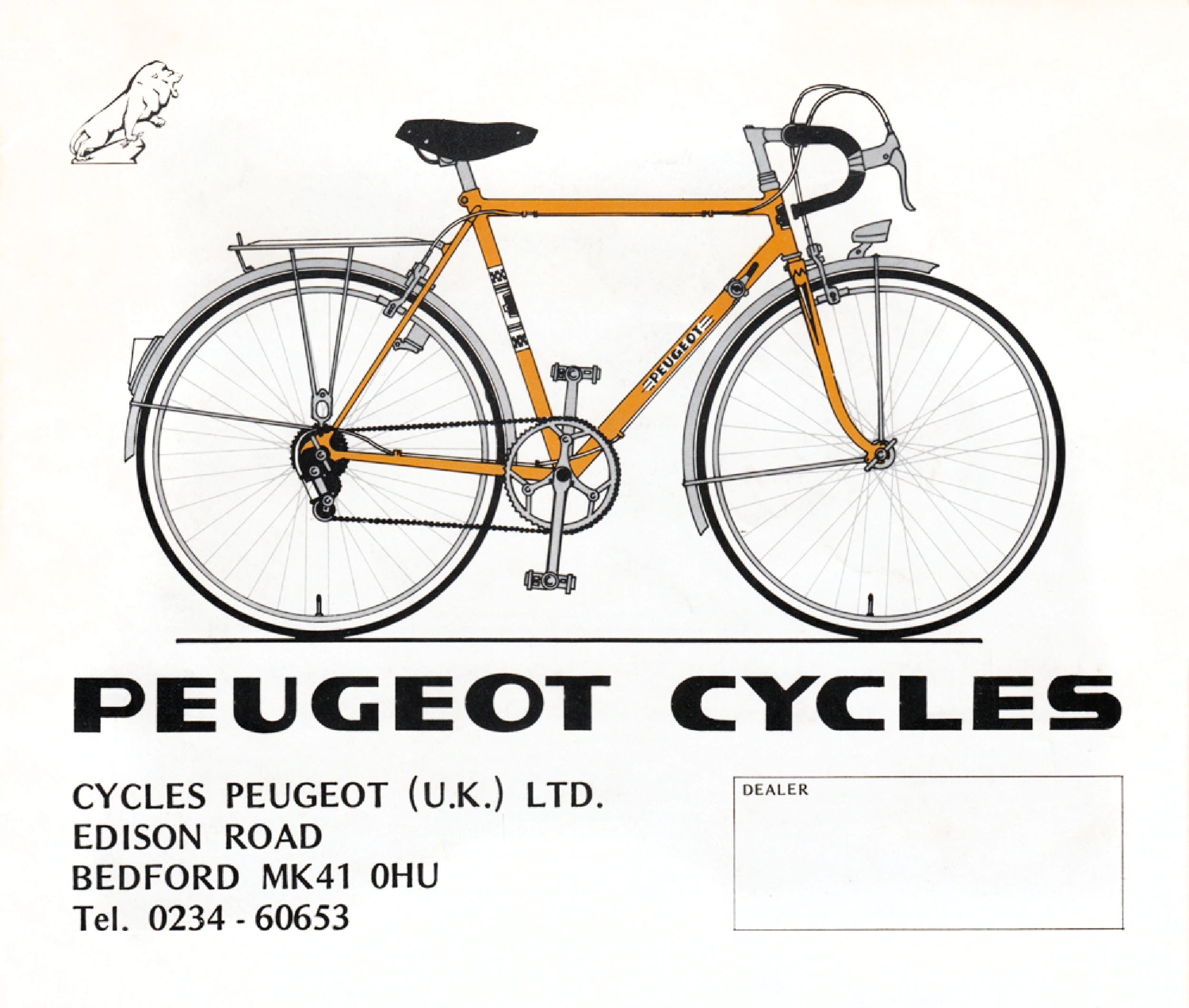
Peugeot changed its paint and transfers often, and that restlessness is a gift to anyone dating a bike, because a scheme frequently belongs to a span of only two or three years. The white frame with black lugs and the checkerboard damier band — the look most people picture when they hear “vintage Peugeot” — reached consumer models from 1967, in the wake of the marque’s racing success. Arc-en-Ciel rainbow bands appeared on down-tube transfers after Tom Simpson took the 1965 World Championship. The lion badge itself was redrawn across the decades, so its exact form is worth comparing against dated advertising. A decal scheme will rarely give you a single year, but laid over the frame and component evidence it usually settles which of two candidate years is right.
The final and most satisfying step is to match the whole machine — model, color and specification together — against the manufacturer’s catalog for a given year. Peugeot revised its line annually, and a period catalog or brochure records exactly which finish and which parts belonged to which model in which season. When the frame, the components and the livery all agree, the right catalog page turns an estimate into a confirmation.
This is precisely where a digitized, searchable catalog archive earns its place, and it is the part of the record that grows only when collectors share what they own. If you have a Peugeot catalog, price list or brochure — even a single loose page — it becomes a dating tool for everyone the moment it is transcribed. You can browse what is already gathered in the Ebykr Catalog Archive, and add your own through Docs Drop.
Suppose a white PX-10 comes in wearing the checkerboard band, plain Nervex lugs and a chromed fork crown, with Simplex retrofriction shifters, Maillard 700 hubs stamped 27 78 and a Stronglight 105 crank. The livery and the plain lugs place it after the mid-1970s change. The hubs read the twenty-seventh week of 1978, and nothing on the bike is newer than that, so the frame was almost certainly built and sold for the 1979 season. A glance at the 1979 catalog, confirming that the color and the parts match that year’s PX-10, closes the case. No single clue decided it; the agreement between them did.
Before 1976 an identifier and nothing more · from 1976 a digit for the year and two for the month, so 605 is May 1976 · the number confirms; it does not decide
The PX-10 was introduced as a model in 1953 and carried as Peugeot’s flagship for three decades · the UO-8, the entry 10-speed, was sold into the United States from the 1960s through to about 1980 · the PR-10 gave way to the PKN-10 around 1980
Nervex Professional lugs with the blackened heads mark the 1960s and early 1970s · from about 1974 plainer Nervex lugs, sometimes outlined in gold on the LE, ran through 1983 · chrome fork crowns and chromed tips belong to that later lugged period
The seat-tube Reynolds 531 decal was dropped around 1973 · the PX-10DU used Vitus 979 aluminum tubing in 1981 and 1982 and made its last catalog appearance in 1983 · 1984 was the last year for a lugged and brazed Reynolds 531C frameset, the PX-10L · the lugged flagships of the mid 1980s switched to Columbus SLX
Arc-en-Ciel rainbow bands appeared on the down-tube transfers after Tom Simpson took the 1965 World Championship · the white frame with black lugs and the damier band reached consumer models from 1967 · a scheme frequently belongs to a span of only two or three years, so compare it with dated advertising
There was never a consistent Stronglight date stamp, so date the model: the 49D ran from about 1936 to 1984, the 93 arrived for 1968 and finished in 1978, the 105 followed in 1976 and the 106 not until 1984
An open date, two digits for the week and two for the year, so 27 78 is the 27th week of 1978 · the Normandy mark gave way to Maillard around 1981
The worked example: plain Nervex lugs, the damier band, hubs stamped 27 78 and a Stronglight 105 crank, built and sold for the 1979 season
Every reading here comes from “Put it together: a worked example” in this guide.
Once you have placed your Peugeot, record it. The more serial numbers, models and dates that sit side by side, the sharper everyone’s estimates become — that is the whole idea behind the Ebykr Serial-Number Registry, where you can log your frame number and what you have worked out about it. If you want to compare your machine against documented builds part by part, the Tech Specs database lays out full specifications side by side.
For the story behind the marque, read Two Wheels and a Lion: the complete history of Cycles Peugeot and its companion timeline of key events. The series continues with How to Identify and Date a Vintage Brooks Saddle, on the one component that carries its own maker’s marks, with How to Care for a Brooks Saddle alongside it.
BikeBoomPeugeot — Serial Numbers and Dates
Palaeobicycleology — Cycles Peugeot date code: frame number versus serial number, 1976
Palaeobicycleology — Identifying Cycles Peugeot factory codes
Classic Rendezvous — Peugeot PX-10 History
Wikipedia — Peugeot UO-8
Classic Lightweights — Stronglight 5-arm crankset timeline
Classic Lightweights — Hilary Stone, Stronglight cotterless cranks
 Peugeot
Ebykr documents this marque across the archive. Here is the rest of it.
The Ebykr Digest
New articles, timelines, catalog finds and registry activity — assembled from the archive once a month. Your address is never shared.
Double opt-in. One email per month. Unsubscribe at any time with one click.