About Ebykr
Ebykr celebrates classic and vintage lightweight bicycles through provocative imagery and opinion. Ride along with us.
About Ebykr
Ebykr celebrates classic and vintage lightweight bicycles through provocative imagery and opinion. Ride along with us.


A practical guide to dating vintage Campagnolo parts from the firm's own catalogs of about 1951 to 1986: when each model came and went, the changes you can measure on the part and what the numbers, the patent words and the address on a catalog or a box can tell you.
Campagnolo parts sit on more classic lightweights than any other maker’s and they are among the hardest to date by eye. The names ran for decades. The top road group was sold under the number 1032 from about 1958 until at least December 1986 and a part labeled Record can come from almost any year in between. The plainest date Campagnolo ever put on a part is the code on the back of its crank arms, starting in 1973, and Ebykr’s guide to dating a bicycle by its components explains how to read it, with the year on the hub lock nuts and the patent line on the Nuovo Record.
Everything else has to be read from what Campagnolo printed about its own parts. The Ebykr Catalog Archive holds 14 Campagnolo catalogs, from about 1951 to a December 1986 printing, every page transcribed and linked below. They show when each model entered and left the range, two changes the firm explained in print and what the lettering on a part does (and does not) tell you. They also have limits and those come first because a catalog dates the moment a part was offered, not necessarily the date yours was made.
In rough order of reliability:
What the catalogs cannot give is a year for an undated part. More than half of the 14 carry no printed date at all and the run has a gap of about nine years between catalog No. 14, of about 1958, and No. 15, of about 1967. Anything that came and went in those years is invisible to this system.
The catalog evidence below is cited to these books by page, and every page opens in the archive’s reader.
| Catalog | Date | How it is dated |
|---|---|---|
| Un-numbered catalog | About 1951 | Estimated: the latest event it prints is the Giro di Lombardia of 21 October 1951 |
| Supplement to the un-numbered catalog | About 1952 | Estimated: it names Coppi winner of the 1952 Giro and Tour |
| Catalogo N. 12 | About 1955 | Estimated: its Trofeo Baracchi caption counts Coppi and Filippi’s second win |
| Catalogo N. 13 | About 1956 | Estimated: the same caption now counts the third win in a row |
| Catalogo N. 14 | About 1958 | Estimated; nothing is printed, and another host dates it 1960 |
| Catalogo N. 15 | About 1967 | Estimated; nothing is printed |
| Catalogue No. 16, English edition | About 1969 | Estimated; nothing is printed |
| Supplement to Catalogue No. 16 | November 1971 | Printed on the cover |
| Catalogue No. 17 | 1974 | “Copyright © 1974” printed twice |
| Catalog 17a | 1975 | © 1975 printed |
| Campagnolo U.S.A. parts sheets | About 1980 | Estimated from their seven-digit part numbers, which the 1982 book still calls new |
| Catalog for the United States | 1982 | © 1982 printed |
| Catalogue No. 18 bis | December 1985 | Printer’s code 12/85 |
| Catalogue No. 18 | December 1986 printing | Printer’s code 12/86; the book first appeared in 1984 |
Two cautions before you lean on it. A first appearance here means first in these 14 books, not first made, so a part can be older than the catalog that first shows it. And the books are not one series: the parts sheets and the 1982 catalog are Campagnolo U.S.A.’s, and a part missing from them may simply not have been sold in the United States. Ugh!
Beside the catalogs, the archive holds some of Campagnolo’s own parts and instruction sheets: the Vicenza edition of the parts sheets of about 1980 and six instruction sheets from about 1960 to about 1982. They are cited below where they add a date.
The rear derailleur is the part most owners want to place and the catalogs set its models in order:
| Model | Number | In the catalogs held |
|---|---|---|
| Cambio Corsa, rod operated | 1001 | About 1951 to No. 13 (about 1956); gone from No. 14 |
| Paris-Roubaix, rod operated | 1002 | About 1951 to No. 13; gone from No. 14 |
| Gran Sport | 1012 | About 1951 to No. 14; gone from No. 15 |
| Sport | 1013 | The supplement of about 1952 to No. 14; gone from No. 15 |
| Record | 1020 | In no catalog held; Campagnolo’s instruction sheet of about 1960 to 1966; on show at the Paris Salon of 1962 |
| Sportman | 1021 | In no catalog held; Campagnolo’s instruction sheet of about 1960 to 1966; on show at the Paris Salon of 1962 |
| Nuovo Record | 1020/a, later 1020/A | From No. 15 (about 1967) to No. 18 (1986) |
| Valentino Super and Nuovo Sport | 2150/1, 2230 | No. 15 only |
| Valentino Extra | 2170 | From No. 16 (about 1969) to No. 18; not in the 1982 American book |
| Sport Extra | 2180 | No. 16 only |
| Velox and Gran Turismo | 2250, 2270 | The November 1971 supplement and No. 17a (1975); not in No. 17 |
| Super Record | 4001, later 0102018 | From No. 17 (1974) to No. 18; not in the November 1971 supplement |
| Nuovo Gran Sport | 3500 | From No. 17 (1974) to No. 18 |
| Rally | 3450 | Nos. 17 and 17a; replaced in 1982 by the Gran Sport Rally, 5011/06 |
| 980 | 6011/00 | 1982 to 1986 |
| C-Record, Victory, Triomphe and 990 | 0102050 and others | From No. 18 bis (December 1985) |
The earliest books: names first, numbers later. The catalog of about 1951 sells the Corsa, the Paris-Roubaix and the Gran Sport by name alone. It numbers the spare parts page by page, and its inside cover asks buyers to quote “i numeri e la pagina,” the numbers and the page, but no model has a number of its own. The first model numbers in the archive come with the supplement of about 1952: 1012 for the “Gran Sport Extra” (1012/1 the derailleur, 1012/2 its handlebar control, 1012/3 the cable), 1013/2 for the Sport rear gear and 1013/1, 1014 and 1015 for the frame controls. “Gran Sport Extra” is therefore Campagnolo’s own name, not only a collectors’ one. The 1951 book also sells the Gran Sport group “comandato dal manubrio,” shifted from the handlebar, with frame controls as the alternative, so a handlebar control on an early Gran Sport can be original equipment.
The first Record group shifted with a Gran Sport. Catalog No. 14, of about 1958, is the first to sell a “1032 – GRUPPO RECORD”, and its rear derailleur is the “1012/4 Cambio Gran Sport”. The bottom bracket, headset and pedals of that group are called Gran Sport too. The Record name belongs at first to the hubs, the new cotterless crankset and the front changer, “1052/1 Deragliatore centrale Record.” The other parts are renamed Record only in catalog No. 15. So a bicycle sold as Record equipped around 1960 should carry a Gran Sport rear derailleur and a Gran Sport on such a bicycle is not by itself a sign of a later swap.
The Record rear derailleur arrived in the gap. None of the 14 catalogs shows it: No. 14 has only the Gran Sport and No. 15 already sells the Nuovo Record. The earliest dated sighting in the archive is Daniel Rebour’s. Looking back in Le Cycle in October 1964, he recalled the Campagnolo stand at the Paris Salon of 1962 showing the Sportman for touring riders and the Record for racing, “dont la capacité a été accrue,” whose capacity had been increased. That wording suggests the Record was not new even then. A Record rear derailleur therefore belongs to the years after catalog No. 14 and was on sale by the Salon of 1962. The archive cannot place its first year, but Campagnolo’s own instruction sheet for it narrows the span. Its letterhead, “CORSO PADOVA, 158 – 172” and “TELEFONI: 28.985 (3 linee con ricerca automatica)”, falls between catalog No. 14’s telephones and catalog No. 15’s four lines, and its parts list numbers the derailleur “1020 Record gear complete.” The Nuovo Record’s 1020/a continues that number.

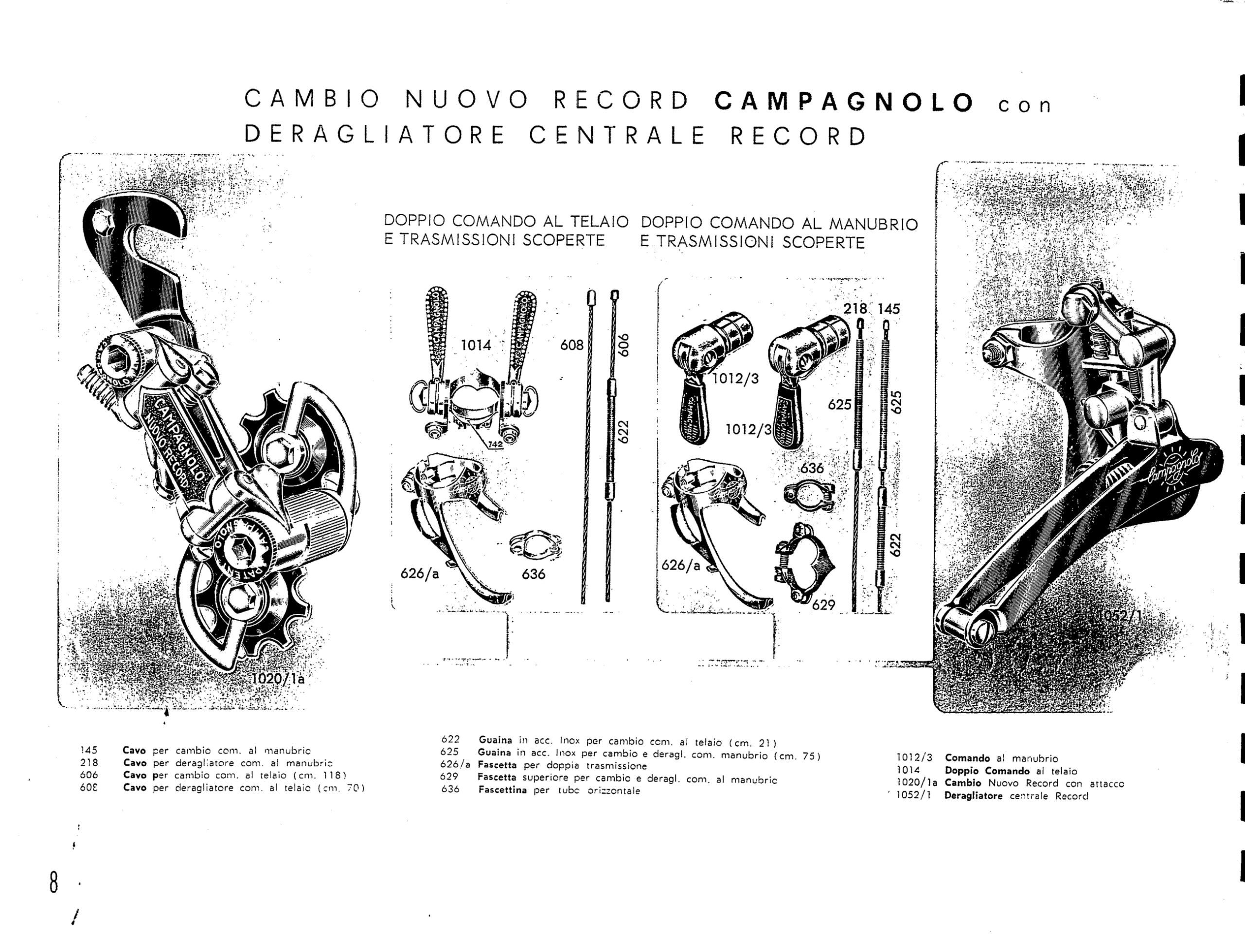
The Nuovo Record from catalog No. 15. It first appears as the “1020/a Cambio Nuovo Record” in catalog No. 15, of about 1967, as the standard rear derailleur of the Record group. Ebykr’s components guide reads the patent line on its body: “PATENT” with no year before 1970 and “PAT. 70” or similar from 1970. That fits the patent record, in which the ornamental design of the Nuovo Record was filed in Italy on 15 November 1969 (application 10543 B/69, cited on United States design patent 231,518). No catalog pictures the line clearly enough to read, so that reading rests on collector observation rather than Campagnolo print.
Super Record between November 1971 and 1974. The four-language supplement of November 1971 has no Super Record, while catalog No. 17, printed in 1974, has the whole group. Its rear derailleur, 4001, carries two titanium bolts, the “Upper pivot Titanium bolt” and the “Spring cage Titanium bolt.” In about 1980, it took the seven-digit number 0102018 and the 1982 American catalog weighs it at 182g with a 28-tooth capacity, against 199g and 26 teeth for the Nuovo Record. The often quoted 1973 for the group is neither confirmed nor ruled out by the catalogs.
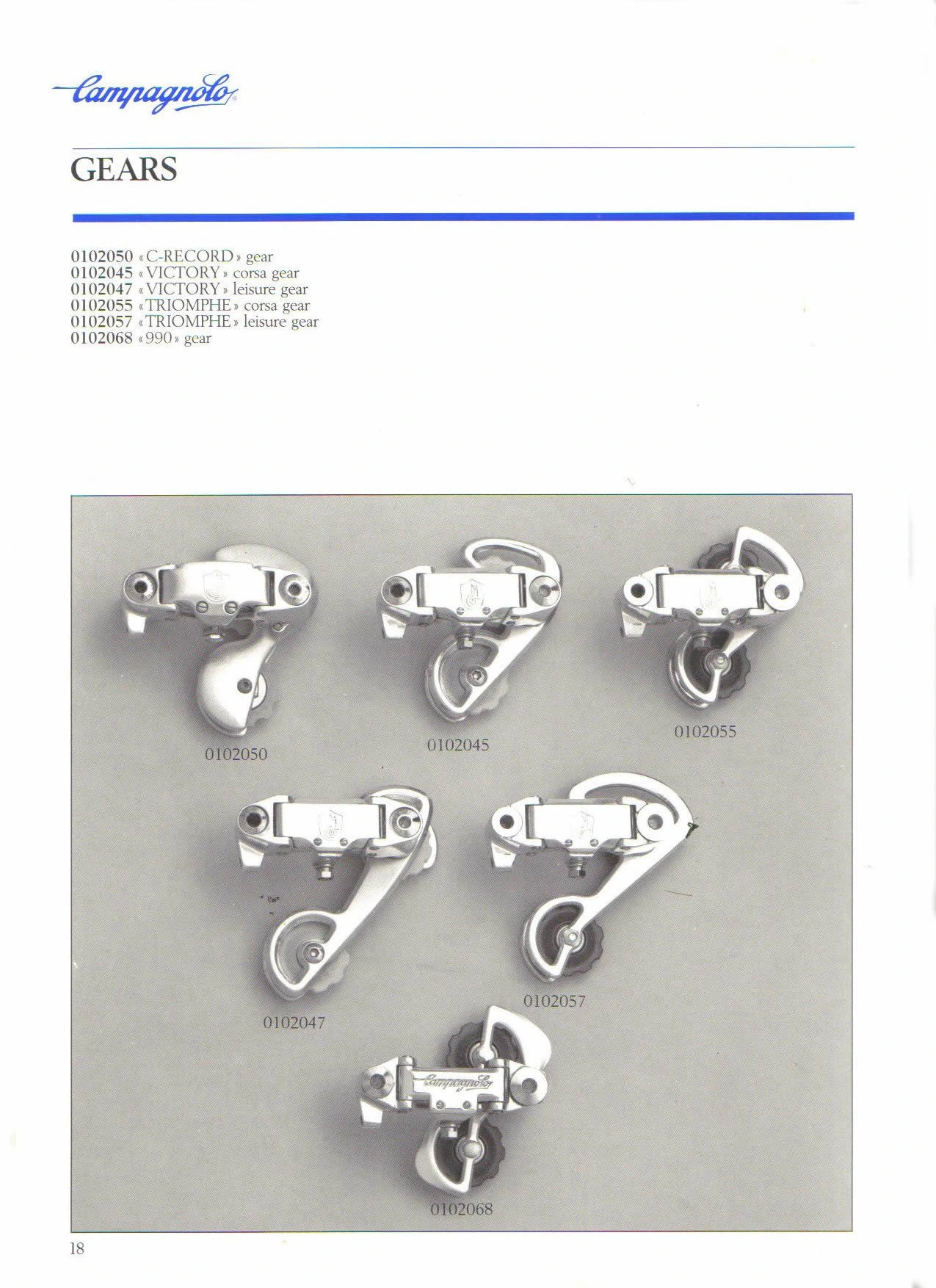
The ranges of the 1980s. The 1982 American catalog adds the 980 and the Gran Sport Rally, a touring gear with a 32-tooth capacity. Catalogue No. 18 bis, printed in December 1985, is the first in the archive with the C-Record, Victory, Triomphe and 990 rear derailleurs, and the December 1986 printing of No. 18 marks the Gran Sport group “No more available and replaced by the ‘Victory’ range.” The archive holds no Campagnolo catalog between 1982 and December 1985, so it cannot rule out an earlier start for those ranges, only show that they were on sale by the end of 1985.
The front changer moved more slowly than the rear. The cable-worked Gran Sport front derailleur 1005 and the Sport 1011 worked by a lever on the derailleur itself, run from the catalog of about 1951, which calls each a “deragliatore centrale,” to No. 14. The Record front changer, 1052/1, appears in No. 14 and outlived them all. It is still the only front changer of the 1974 Super Record group, which had none of its own. The 1982 American catalog is the first to list a Super Record front derailleur, with the note “Available only in gruppo,” and the December 1986 printing of No. 18 sells it in braze-on (0104011) and clamp/clip-on (0104010) versions. A Super Record front changer is therefore later than the group itself given the catalogs of 1974 and 1975 do not have one, and the 1982 catalog does. The Valentino front changer, numbered 2050, runs from catalog No. 15 and the parts sheets of about 1980 add a Nuovo Valentino 0104008 and a Gran Sport 0104006.
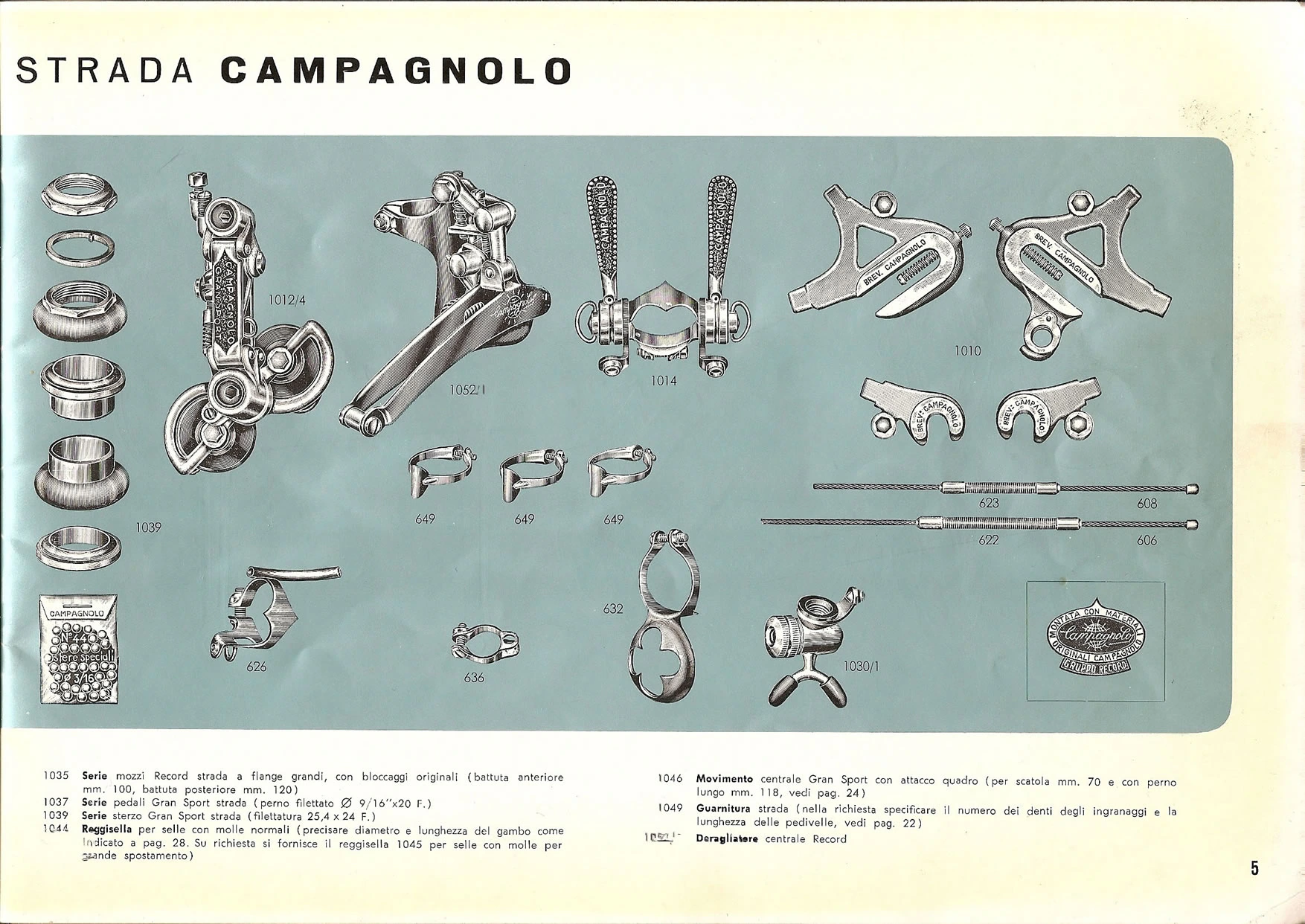
The forged dropouts carry the maker’s name on the part, drawn as “Brev. Campagnolo” in the catalogs from No. 13 onward. The Gran Sport dropouts already carry an adjuster screw in the catalog of about 1951, and the 1010 set with adjuster screws is the Gran Sport set in Nos. 12 to 14 and the Record set from No. 15. A set without eyelets, numbered 1010/a, first appears in the November 1971 supplement and the short Nuovo Record fork ends, numbered 1010/B, in 1982. The parts sheets of about 1980 add the “Portacatena,” a chain holder screwed to the right dropout to park the chain while the wheel is out, in a one-screw version for Record fork ends and a two-screw version for Nuovo Record ends. Tullio Campagnolo’s patent for it has an Italian priority of 6 July 1976 and the parts sheets, which also sell a twin lever “with hook” to match, are its first appearance in the catalogs held.
Cotterless from catalog No. 14. The Record crankset, numbered 1049, and its square-taper bottom bracket first appear in catalog No. 14 of about 1958 and the same book still sells a cottered Gran Sport bottom bracket, numbered 1047, beside them. The Italian patent application for the crankset, No. 14.353, was filed on 19 November 1958 (Spanish patent 253,411 prints it), which supports the usual 1958 for its introduction. Arms made from then until 1972 carry no date.
The date code, 1973 onward. From 1973 the back of the arm carries the last digit of the year inside a shape: a diamond from 1973 to 1979, a circle from 1980 to 1984 and, from 1985, a rectangle in which “11” means 1985, “22” means 1986 and “33” means 1987. A second digit sometimes sits beside the first and is generally read as the quarter of the year, though that reading is collector inference rather than anything Campagnolo has published. None of the 14 catalogs mentions the code. The full key and how to weigh it against the other parts of a bicycle is in How to Date a Vintage Bicycle by Its Components.

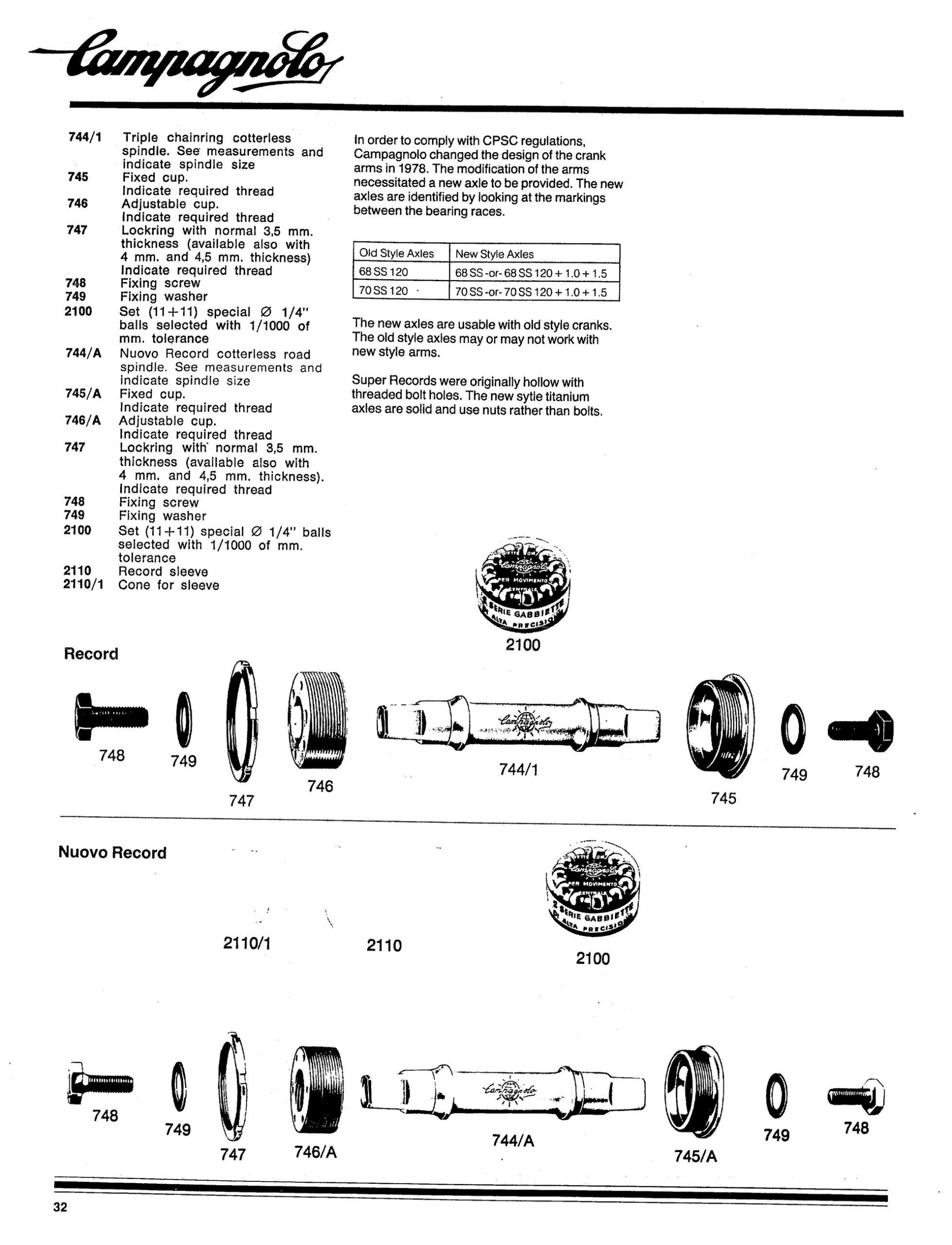
The collar change of 1978 and 1979. The 1982 American catalog explains a change no date code shows. “Between 1978 and 1979 Campagnolo changed the design of the right crank arm,” because the United States Consumer Product Safety Commission’s rule on protrusions caught the outer plate of the front derailleur. The plate was thickened, the arm reshaped to clear it and a new axle made to keep the chain line. Turn the arm over and look at the collar around the axle hole: the new style has a raised collar 5 to 6 mm wide and 2 mm high, the old style one 10 to 11 mm wide and 3 mm high. The same book says “in 1978” on its bottom-bracket page, so read a new-style collar as 1978 or later rather than as a single year.
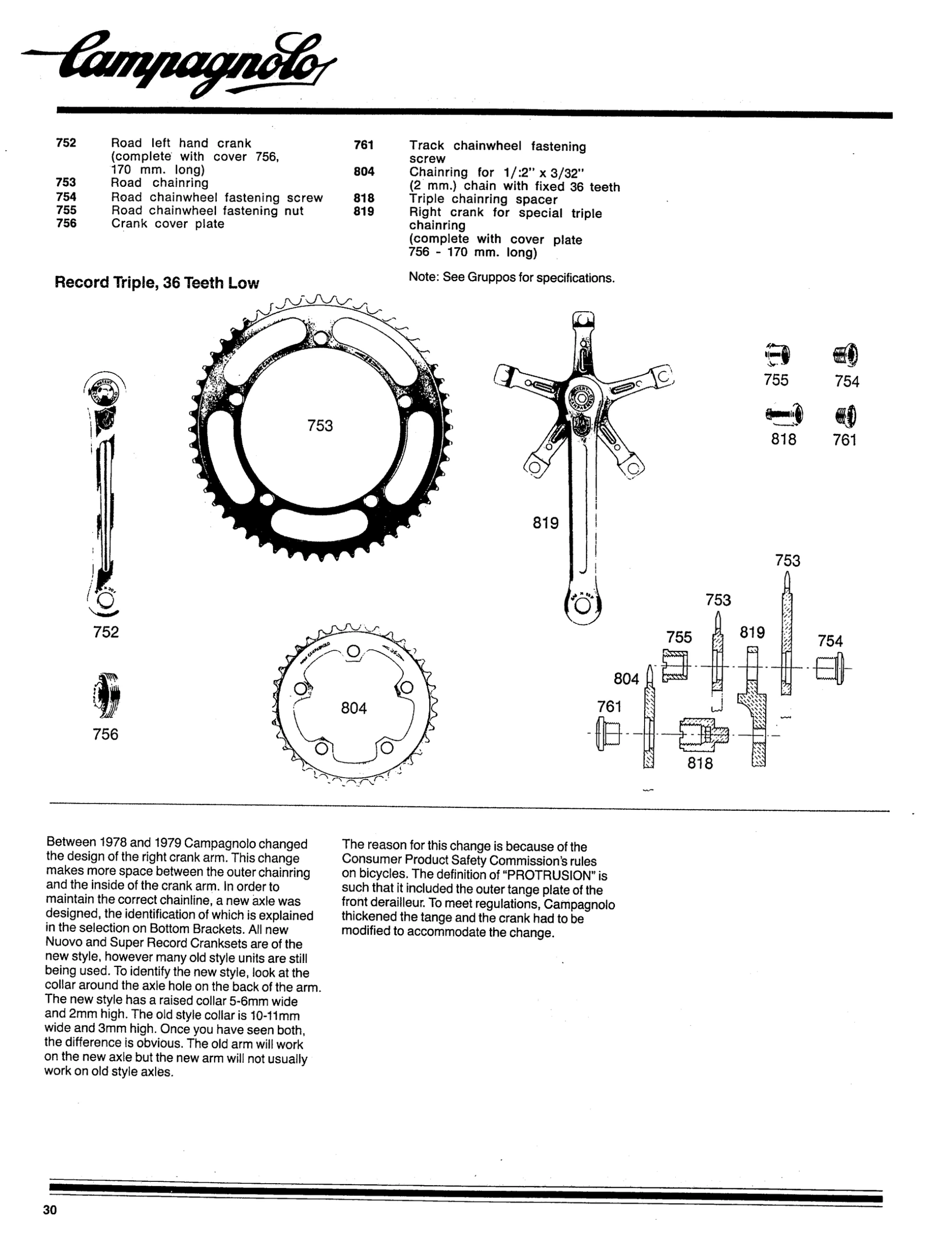
The axle markings. Campagnolo marks its cotterless axles with a code: the shell width, a letter and a number. Catalog No. 14 explains it. In “65-P-110” the 65 is the width of the bottom-bracket shell, the P stands for pista (track) and the 110 is the rear hub width the axle suits for a straight chain line. Road axles carry S in No. 14 (“70-S-120”) and SS from No. 15 on, where the photograph of the Nuovo Record axle shows it marked “70-SS-120”; a C for cyclocross appears in No. 17. After the crank change the new road axles read “68 SS” or “70 SS”, alone or followed by “120 + 1.0 + 1.5”, where the old ones read “68 SS 120” or “70 SS 120” (1982 catalog). An axle marked “68 SS” or “70 SS” with no 120 after it, or with the added figures, is a new-style axle of 1978 or later. Ebykr has not yet seen an axle marked with the single S of catalog No. 14, so treat that reading as the catalog’s rather than the part’s.
The Super Record titanium axle. The 1974 catalog sells the Super Record bottom bracket, number 4031, with its titanium spindle held by fixing screws and the 1975 catalog draws it with bolts in the spindle ends. The 1982 American catalog lists the same set with a fixing nut, number 7161104, and explains why: “Super Records were originally hollow with threaded bolt holes. The new sytle [sic] titanium axles are solid and use nuts rather than bolts.” No catalog dates the change more closely than between 1975 and 1982, but the difference is plain at a glance — a bolt into the end of the axle is the early type, a nut on the axle the later one.
The bolt circle. Measure across the chainring bolts. Catalogue No. 18 bis gives the C-Record road chainset a 135mm circle, against 144mm for the C-Record track chainset and 116mm for the Victory and Triomphe; the 1982 American catalog already puts the Gran Sport touring triples on 116mm. Among the cranks in these catalogs only the C-Record road crank uses 135mm, so a five-arm Campagnolo road crank on that circle is December 1985 or later in Campagnolo’s own books. The circle carried on into later ranges, so it sets a floor, but not a model.
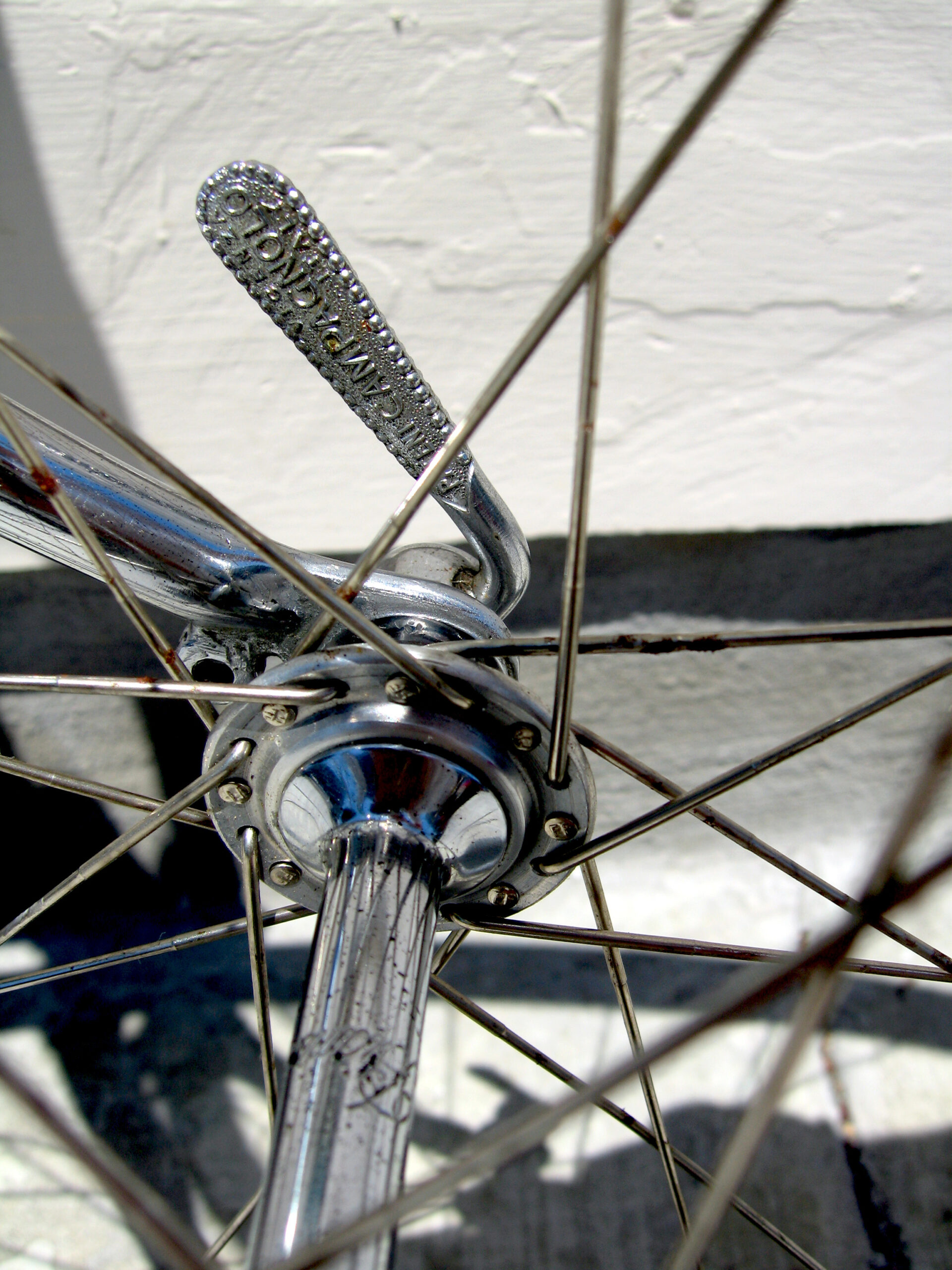
Hubs. Large flanges are older than many assume: catalog No. 12, of about 1955, already sells the calibrated 1006/G set “a flange grandi” with quick releases. The Record hubs, numbers 1034 small flange and 1035 large, appear in No. 14 and run through 1986, and the Nuovo Tipo hubs, numbers 1250 to 1253, from No. 15. The rear spacing follows the number of sprockets. The Record rear hub is 120mm in No. 14, and the Super Record rear hub is still 120mm in 1974, with a 125mm hub for six sprockets on request. Catalogue No. 16, of about 1969, is the first to say “SIX-SPROCKETS HUBS ALSO AVAILABLE,” and the 1982 American catalog prints “121.5mm 5-speed or 126.5mm 6-speed”. Seven speeds first appear in the catalogs held in December 1985, when the quick releases of No. 18 bis come in “five, six, seven speed” versions. Ebykr’s components guide adds a year on the hub itself: the lock nut is usually stamped “CAM.” and the last two digits of the year, so “CAM 65” reads as 1965. The catalogs neither show nor explain that stamp. Catalog No. 12 draws its lock nuts lettered “Brev. Camp.” with no year shown.
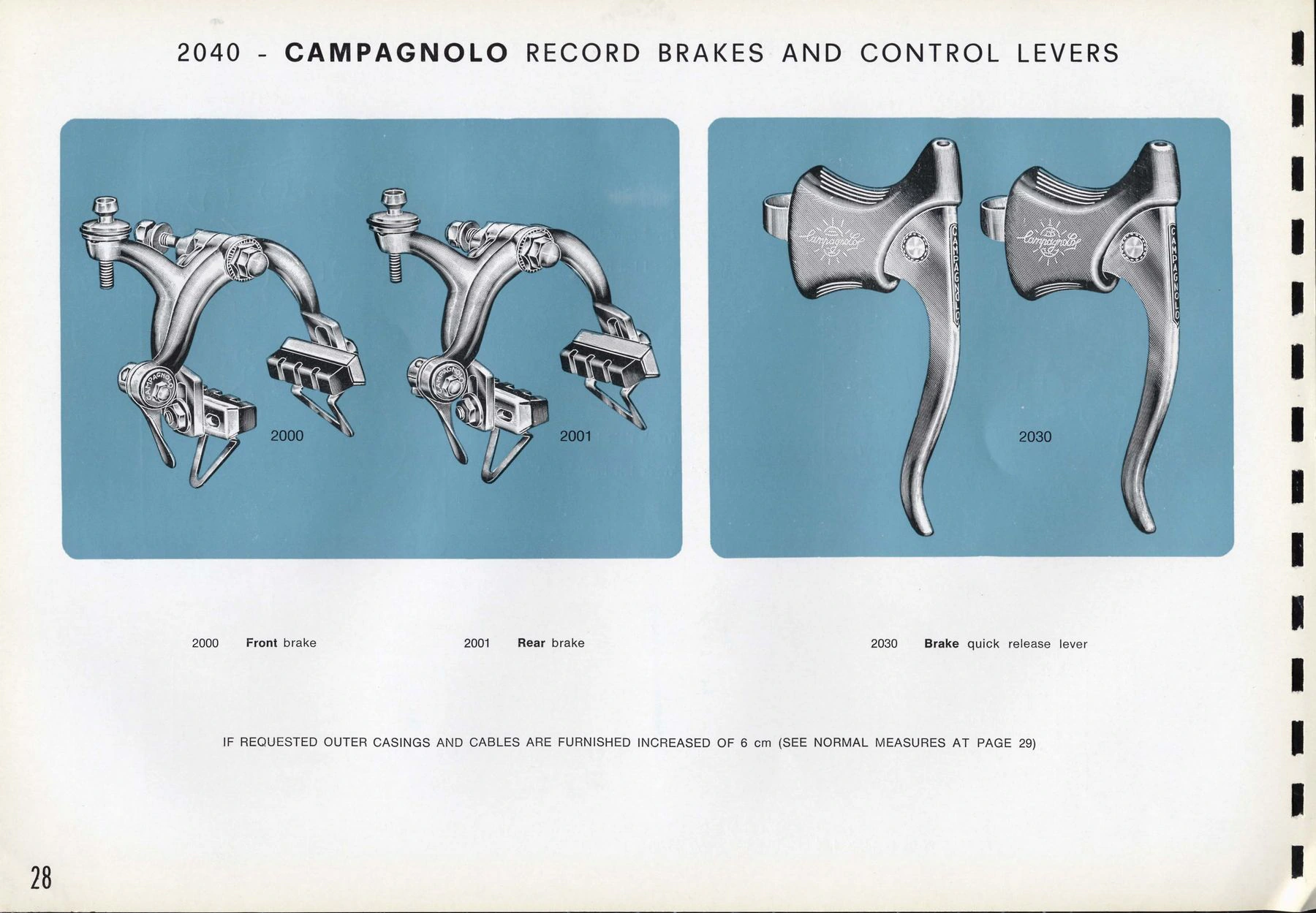
Brakes. Campagnolo made no brake before catalog No. 16, with No. 15 having no brake section at all. The English edition of No. 16, of about 1969, introduces the Record sidepulls, number 2040, with their own quick-release lever. A short-reach Record of 47mm against the standard 52 and the Super Record set, number 4061, with “drilled levers”, follow in 1974. The 1982 American catalog offers brakes “with recessed allen bolts”, ordered by adding an A to the part number. The C-Record brake was not ready at the end of 1985: “The brakes set 315/101 is not available when printing this catalogue,” says No. 18 bis, and the group shipped with a Super Record brake instead. Campagnolo’s four-language instruction sheet for the Record brakes, “Il freno «RECORD» Campagnolo”, carries the printer’s code “2.81”, February 1981. The name collectors give that brake, Delta, is printed in none of the catalogs held.
Pedals. The Gran Sport road and track pedals of catalog No. 14 are renamed Record in No. 15, and the catalogs picture them with “Patent Campagnolo” on the cage plates. Superlight Record pedals, number 1037/a, come with the November 1971 supplement, and titanium-spindle Super Record pedals, number 4021, with the 1974 catalog.
Seat pins. The seat pin is one of the easiest parts to place by length. The first Super Record pin, number 4051, is fluted and 147mm long, “147 mm only” in the 1975 catalog. The parts sheets of about 1980 replace it with the Nuovo Super Record pin, 180mm long with a single fixing bolt, which the 1982 catalog sells as number 4051/1. The C-Record pin of December 1985 is again a one-bolt design, a “seat pillar with one fixing screw”. So a fluted Super Record pin of 147mm belongs to the mid 1970s, and a 180mm one-bolt pin to about 1980 or later.
Part numbers. From the supplement of about 1952 until 1975, Campagnolo numbered its parts with three or four digits, often with a suffix: 1032, 1020/a, 4061/1. The parts sheets of about 1980 are the first in the archive with seven-digit numbers, such as 0102018 for the Super Record rear derailleur, and the 1982 American catalog prints old and new side by side, “[Numbers in brackets are new identification numbers]”. Catalog No. 18 bis adds short set numbers for the new ranges, such as 306/101 for the C-Record road chainset, in which the first digit appears to mark the range (3 for C-Record, 4 for Victory, 9 for Triomphe). Still, the catalog does not explain the scheme. A box, packet or parts list carrying a seven-digit number is therefore of about 1980 or later. The numbers are rarely on the parts themselves.
The patent words mark the maker, not the year. “Patent Campagnolo,” “Brev. Camp.,” “Brev. Campagnolo,” “BREV. INTER.” and “CAMPAGNOLO PATENT” appear on quick-release levers, dropouts, cranks, pedal cages and even brake blocks. The firm’s very name, Brevetti Internazionali Campagnolo, means international patents. But none of the 14 catalogs prints a patent number or date for any part, so the words alone say Campagnolo and nothing more.
Patent dates as a floor. Where a feature can be matched to its patent, the filing date is the earliest the design can be. The Record crankset was filed for in Italy on 19 November 1958, the Nuovo Record design on 15 November 1969, the peg on the inner chainring that stops a thrown chain from jamming against the crank arm on 13 November 1973 (Spanish utility model 207,393); and the chain holder on 6 July 1976 (United States patent 4,135,727). A filing date says when the idea was protected, not when your part was made, so use it only to rule a part out of the years before.
If what you hold is a catalog, a box or a packet label, the address and the telephone line date it better than anything on a part. Every change below is printed:
| Catalog | What it prints |
|---|---|
| Advertisement in L’Équipe, 26 July 1948 | “CAMPAGNOLO – VICENZA (Italie), et pour la France : à COGNIN (Savoie)”: the first French address in print |
| Advertisement in L’Équipe, 23 July 1951 | “A PARIS, 5, bd de Gre[nelle]” (the end is lost in the binding of the scan), with Vicenza and Cognin: the first Paris address. The Salon issue of L’Officiel du cycle later that year prints it whole, “PARIS, 5, Boulevard de Grenelle”, and the advertisement of 1955 still gives it |
| About 1951 | “Corso Padova” (the house numbers are not clearly legible on the only scan), with a second address at “Cognin (Chambery) France” |
| No. 12, about 1955 | “Corso Padova dal 154 al 166”, telephone “30-48” |
| No. 13, about 1956 | “Corso Padova, 158 – 172”, still “30-48” |
| No. 14, about 1958 | “Corso Padova, 168”, telephones “23048 – 32536”; the same on the Gran Sport and quick release instruction sheets |
| Record and Sportman instruction sheets, about 1960 to 1966 | “Corso Padova, 158 – 172”; “TELEFONI: 28.985 (3 linee con ricerca automatica)” |
| No. 15, about 1967 | “S.p.A.” for the first time; telephone 28985, four lines |
| No. 16, about 1969 | The postcode 36100 and the telex “48074 CAMPA” |
| Supplement, November 1971 | “Casella Postale 822”; telephone 44144, five lines; share capital 1,000,000,000 lire |
| No. 17, 1974 | “P.O. Box No. 822”; telephone 500055, eight lines; capital 1,100,000,000 lire |
| No. 17a, 1975 | No address at all |
| About 1980 and 1982 | “Campagnolo-U.S.A., Inc.”, P.O. Box 37426, Houston, Texas, on the American books |
| Parts sheets, Vicenza edition, about 1980 | “Corso Padova, 168”; telephone 500.055, eight lines; telex 480074 (48074 on some sheets); capital 1,850,000,000 lire (1,820,000,000 on some) |
| Braze-on lever instructions, about 1982 | “CORSO PADOVA, 168”; capital 2,775,000,000 lire |
| No. 18 bis, December 1985 | “Via della Chimica, 4”; 16 lines; telex 480074; capital 16,000,000,000 lire |
| No. 18, December 1986 | The same, with a “Telefax” number added |
The move from Corso Padova to Via della Chimica falls between about 1982, when the braze-on lever instructions still print Corso Padova 168, and December 1985.
Say a road bicycle carries a Super Record group and you want to know when it was built.
Answer: the crank sets the floor at 1979, and the seat pin and the front changer fit a build of 1979 or a year or two after, provided they are original. Not a single year, but a narrow window with a printed reason behind every step. That is the rule from the components guide applied to one maker — a frame can be no older than the newest original part fitted to it.
The catalogs are the fastest way to settle a part. Every Campagnolo catalog Ebykr holds can be read page by page in the Catalog Archive. The run’s biggest hole is the years between catalog No. 14 and No. 15, about 1958 to 1967. If you own a Campagnolo catalog or price list from that span, adding it through Docs Drop would date the Record rear derailleur and much else. For a part you cannot place, the Component Deep-Dives forum is the place to ask, with photographs of the lettering and the back of the crank arm.
For the man and the firm behind the parts, read Tullio Campagnolo: The Legend, the Patents and the Record and the Campagnolo timeline. To compare a bicycle with documented builds part by part, the Tech Specs database lists full specifications. And the rest of the Identify and Date series covers dating a bicycle by its components, Brooks saddles, Peugeot and Raleigh.
Ebykr Advertisement Archive — Campagnolo advertisement, L’Équipe, 26 July 1948
Ebykr Advertisement Archive — Campagnolo advertisement, L’Équipe, 23 July 1951
Ebykr Advertisement Archive — Campagnolo advertisement, L’Officiel du cycle, Salon issue of 1951
Ebykr Advertisement Archive — Campagnolo advertisement, Le Cycle, 13 August 1955
Ebykr Catalog Archive — Campagnolo catalog, un-numbered, about 1951
Ebykr Catalog Archive — Campagnolo catalog supplement, about 1952
Ebykr Catalog Archive — Campagnolo parts sheets of about 1980, Vicenza edition
Ebykr Catalog Archive — Campagnolo Gran Sport gear instructions, about 1960
Ebykr Catalog Archive — Campagnolo quick release hubs instructions, about 1960
Ebykr Catalog Archive — Campagnolo Record gear instructions, about 1963
Ebykr Catalog Archive — Campagnolo Sportman gear instructions, about 1963
Ebykr Catalog Archive — Campagnolo Record brake instructions, February 1981
Ebykr Catalog Archive — Campagnolo Record braze-on lever instructions, about 1982
Ebykr Catalog Archive — Campagnolo Catalogo N. 12, about 1955
Ebykr Catalog Archive — Campagnolo Catalogo N. 13, about 1956
Ebykr Catalog Archive — Campagnolo Catalogo N. 14, about 1958
Ebykr Catalog Archive — Campagnolo Catalogo N. 15, about 1967
Ebykr Catalog Archive — Campagnolo Catalogue No. 16, English edition, about 1969
Ebykr Catalog Archive — Campagnolo Supplement to Catalogue No. 16, November 1971
Ebykr Catalog Archive — Campagnolo Catalogue No. 17, 1974
Ebykr Catalog Archive — Campagnolo Catalog 17a, 1975
Ebykr Catalog Archive — Campagnolo U.S.A. parts sheets, about 1980
Ebykr Catalog Archive — Campagnolo 1982 Catalog (United States)
Ebykr Catalog Archive — Campagnolo Catalogue No. 18 bis, December 1985
Ebykr Catalog Archive — Campagnolo Catalogue No. 18, December 1986 printing
Ebykr Catalog Archive — Daniel Rebour, “Les principales nouveautés au Salon 1964”, Le Cycle, October 1964
Spanish patent 253,411 (Record crankset; Italian application No. 14.353 of 19 November 1958)
United States design patent 231,518 (Nuovo Record derailleur; Italian priority 15 November 1969)
Spanish utility model 207,393 (chainring peg; Italian priority 13 November 1973)
United States patent 4,135,727 (chain holder; Italian priority 6 July 1976)
Ebykr — How to Date a Vintage Bicycle by Its Components (Campagnolo crank date codes)
 Campagnolo
Ebykr documents this marque across the archive. Here is the rest of it.
The Ebykr Digest
New articles, timelines, catalog finds and registry activity — assembled from the archive once a month. Your address is never shared.
Double opt-in. One email per month. Unsubscribe at any time with one click.