About Ebykr
Ebykr celebrates classic and vintage lightweight bicycles through provocative imagery and opinion. Ride along with us.
About Ebykr
Ebykr celebrates classic and vintage lightweight bicycles through provocative imagery and opinion. Ride along with us.

Source: Le Cycle, n° 51, October 1964, pages 33, 34, 35, 36, 37, 38, 39, 41, 42, 43, 44, 45, 47, 48, 49; scan of the issue from Cycle Memory (Mémoire du Cycle), Collection privée H.D.
| Type | Review |
|---|---|
| Year | 1964 |
| Publisher | Le Cycle |
| Artist | Daniel Rebour |
| Country | France |
| Language | French |
| Pages | 15 |
| Source | Le Cycle, n° 51, October 1964, pages 33, 34, 35, 36, 37, 38, 39, 41, 42, 43, 44, 45, 47, 48, 49; scan of the issue from Cycle Memory (Mémoire du Cycle), Collection privée H.D. |
| Credit | Ebykr archive |
| Identifier | Permalink https://cyclememory.org/fr/search-coll-list.php?collectionID=773&docID=B-1-0000000810 |
| Transcription | Headings and specifications transcribed; article text summarized |
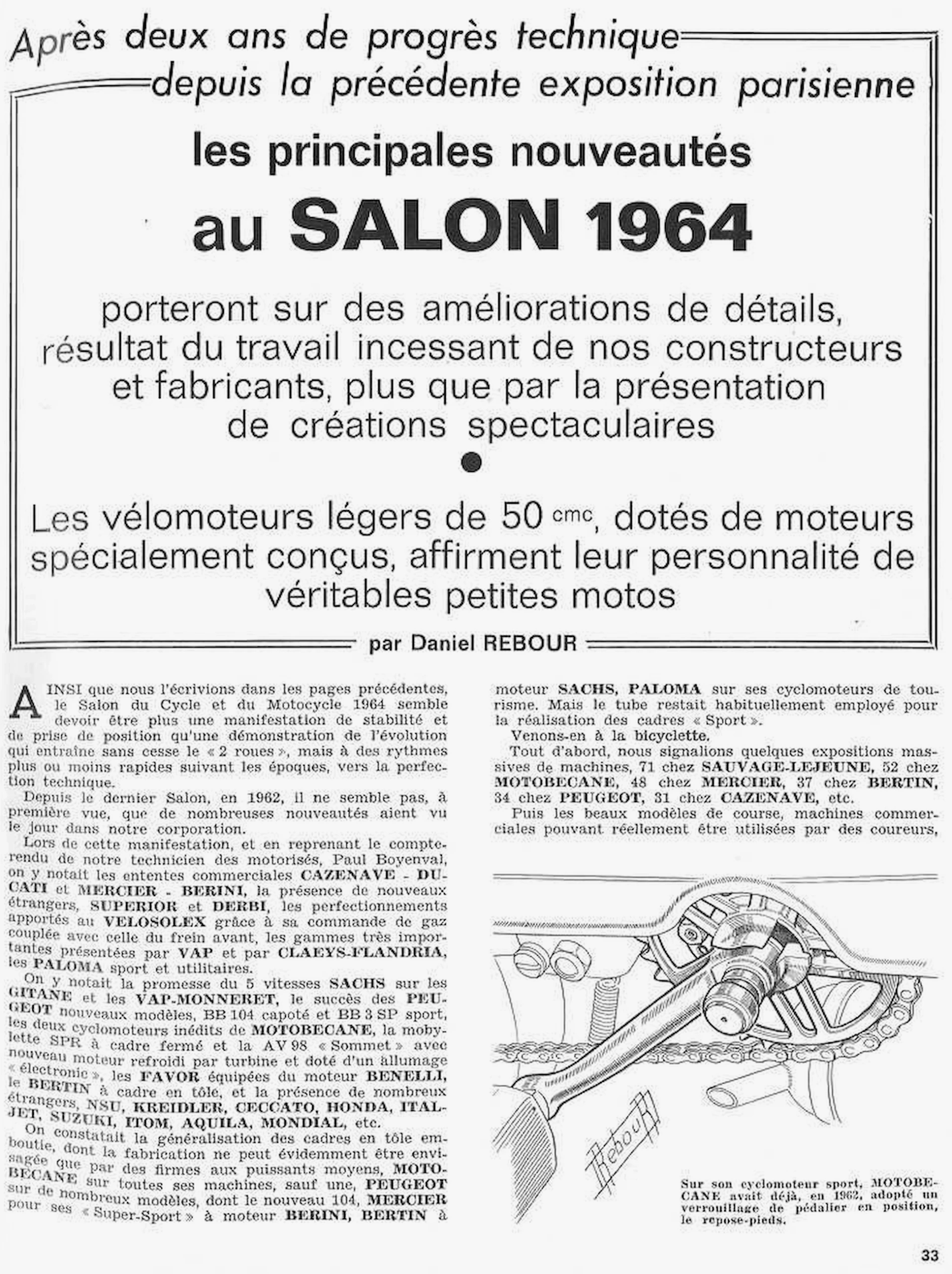
Après deux ans de progrès technique depuis la précédente exposition parisienne les principales nouveautés au SALON 1964 porteront sur des améliorations de détails, résultat du travail incessant de nos constructeurs et fabricants, plus que par la présentation de créations spectaculaires • Les vélomoteurs légers de 50 cmc, dotés de moteurs spécialement conçus, affirment leur personnalité …
This is a magazine article, so its running text is summarized here rather than reproduced; the headline, byline, specifications and scores are transcribed as printed.
Daniel Rebour’s report on the 1964 Paris Salon du Cycle et du Motocycle, the first held in the new Hall S at the Porte de Versailles, ran on 14 pages of Le Cycle n° 51, October 1964, the magazine he edited, between pages 33 and 48, followed by the magazine’s “Parmi les stands” column on pages 48 and 49. He goes through the new derailleurs, brakes (the Mafac Top 63 among them), chainsets, lighting and folding bicycles, with his pen drawings and exploded part plates. The title, running heads, byline, part numbers and folios are transcribed as printed; the text and captions are summarized in Ebykr’s words, and the page images carry the article in full.
— Page 1 —
Après deux ans de progrès technique
depuis la précédente exposition parisienne
les principales nouveautés
au SALON 1964
porteront sur des améliorations de détails, résultat du travail incessant de nos constructeurs et fabricants, plus que par la présentation de créations spectaculaires
•
Les vélomoteurs légers de 50 cmc, dotés de moteurs spécialement conçus, affirment leur personnalité de véritables petites motos
par Daniel REBOUR
[Ebykr summary; the article’s text is not reproduced. Rebour opens by saying that the 1964 Salon du Cycle et du Motocycle looks set to be a show of consolidation rather than of novelty, and that few innovations have appeared in the trade since the previous Salon in 1962. He recalls that 1962 show through the report of the magazine’s technician for motorized machines, Paul Boyenval: the commercial agreements CAZENAVE – DUCATI and MERCIER – BERINI; the arrival of the new foreign makes SUPERIOR and DERBI; the improvements to the VELOSOLEX, whose throttle control was coupled with the front brake; the very large ranges shown by VAP and by CLAEYS-FLANDRIA; the PALOMA sport and utility models; the promised five-speed SACHS gear on the GITANE and VAP-MONNERET machines; the success of the new PEUGEOT models, the BB 104 capoté and the BB 3 SP sport; two new MOTOBECANE mopeds, the mobylette SPR with a closed frame and the AV 98 « Sommet » with a new turbine-cooled engine and « électronic » ignition; the FAVOR machines with BENELLI engines; the BERTIN with a sheet-metal frame; and many foreign makes: NSU, KREIDLER, CECCATO, HONDA, ITALJET, SUZUKI, ITOM, AQUILA and MONDIAL. Pressed-steel frames had become general, a technique open only to well-funded firms: MOTOBECANE on all its machines but one, PEUGEOT on many models including the new 104, MERCIER for its « Super-Sport » with a BERINI engine, BERTIN with a SACHS engine and PALOMA on its touring mopeds, while tube frames remained usual for « Sport » models. Turning to the bicycle, he recalls the massive displays of 1962: 71 machines at SAUVAGE-LEJEUNE, 52 at MOTOBECANE, 48 at MERCIER, 37 at BERTIN, 34 at PEUGEOT and 31 at CAZENAVE, and then begins on the fine racing models that real riders could use (the sentence continues on the next page). The caption reports that MOTOBECANE had already adopted on its sport moped, in 1962, a lock holding the crankset in position so that the pedals serve as footrests.]
[One line drawing, signed “Rebour” in script at its lower left: a close-up of the crank and bottom-bracket area of the MOTOBECANE sport moped named in the caption, showing the crank arm with a locking collar on the axle, the chainring with its chain and, above them, the frame and engine fittings. The page carries one signed drawing.]
33
— Page 2 —
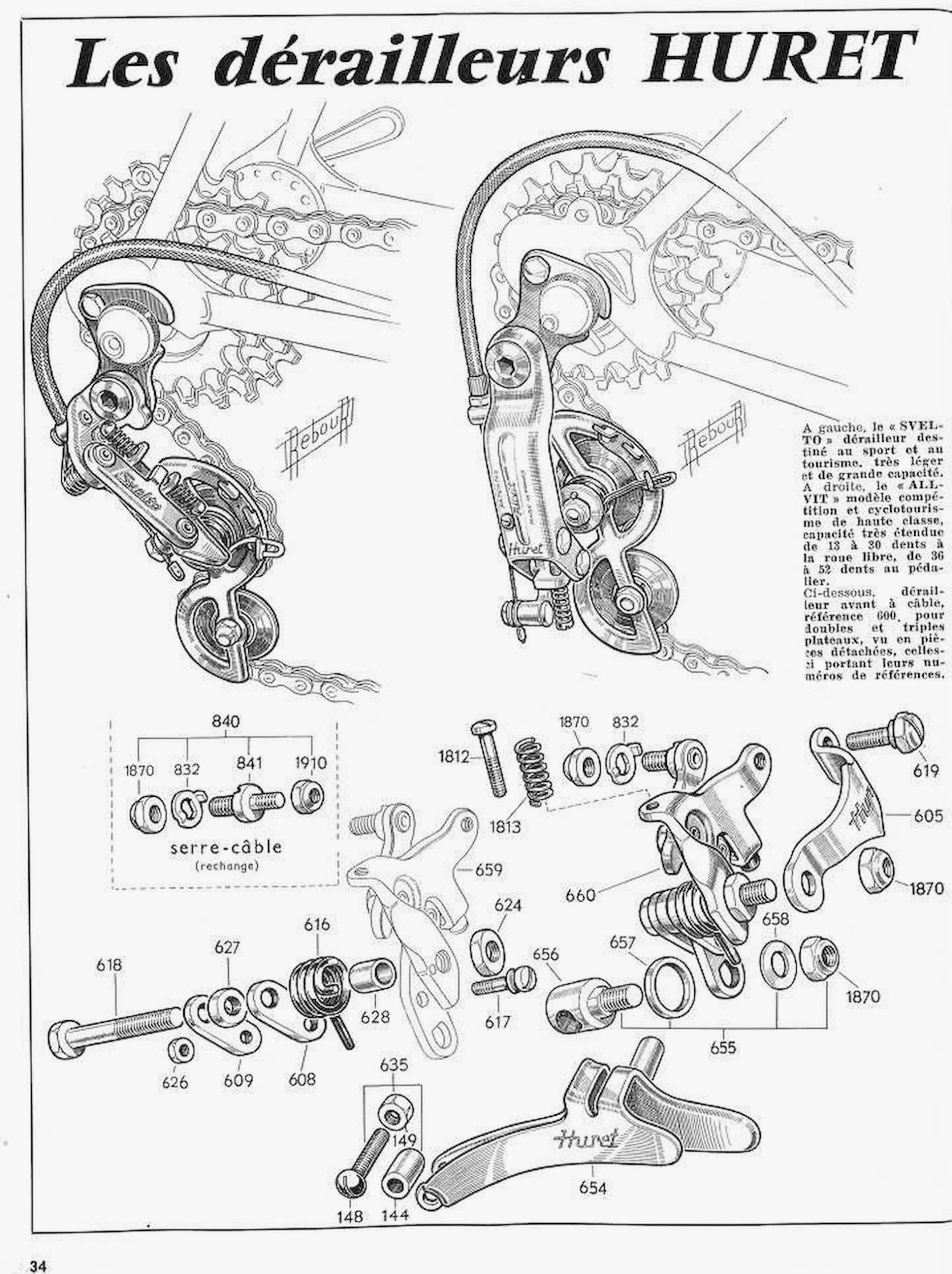
Les dérailleurs HURET
840
1870
832
841
1910
serre-câble
(rechange)
618
626
627
609
616
608
628
659
635
148
149
144
624
617
1812
1813
656
654
1870
832
660
657
655
658
1870
619
605
1870
[Ebykr summary; the article’s text is not reproduced. A full-page plate of HURET derailleurs. The caption identifies the drawing at the left as the « SVELTO », a derailleur for sport and touring use, very light and of large capacity, and the drawing at the right as the « ALLVIT », a high-class model for competition and cyclotouring with a very wide capacity: 13 to 30 teeth at the freewheel and 36 to 52 teeth at the chainwheel. Below them is the cable-operated front derailleur, reference 600, for double and triple chainrings, shown exploded, each part carrying its reference number.]
[Three drawings. At the top left, the « SVELTO » rear derailleur mounted on a frame with its chain, multiple freewheel and cable, the name “Svelto” drawn on its body; at the top right, the « ALLVIT » in the same setting, “Huret” drawn on its body. Each of these two drawings is signed “Rebour” in script, to the right of the derailleur. The lower half of the page is an exploded view of the front derailleur, every part labeled with its reference number: a dashed box at the upper left holds the spare cable clamp (840, made up of 1870, 832, 841 and 1910); small brackets group 635 with 149 and the washers and nut under 655; the cage (654) and a plate (605) carry the “Huret” name. The exploded view is unsigned. The page carries two signed drawings.]
34
— Page 3 —
TENDANCES AU SALON 64 — TENDANCES AU SALON 64
1858
111
1838
1856
1855
1865
1854
1851
902
1849
1842 (Ø 28=1″ 1/8)
1987 (Ø 25,4=1″)
1852 (Ø 28=1″ 1/8)
1988 (Ø 25,4=1″)
1106
1868
1857
(Ø 28=1″ 1/8)
1989
(Ø 25.4=1″)
1853
1840 (Ø 28=1″ 1/8)
1986 (Ø 25,4=1″)
1868
1106
1851
1850
1855
1856
1838
1858
111
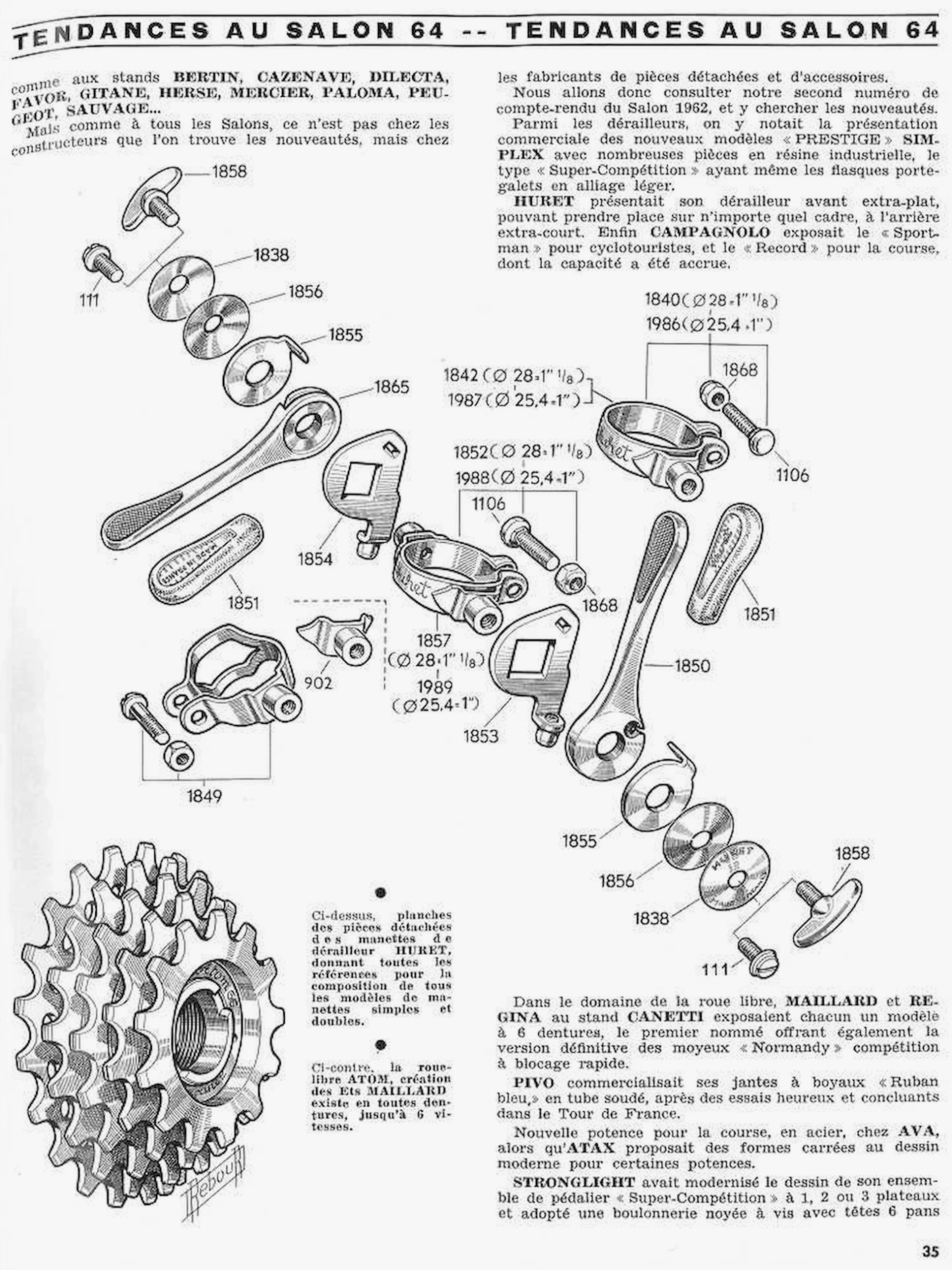
[Ebykr summary; the article’s text is not reproduced. Continuing the look back at the 1962 Salon, Rebour lists the stands that showed fine racing machines, BERTIN, CAZENAVE, DILECTA, FAVOR, GITANE, HERSE, MERCIER, PALOMA, PEUGEOT and SAUVAGE, then observes that, as at every Salon, the novelties come from the makers of parts and accessories rather than from the cycle builders, and turns to the second installment of the magazine’s 1962 report. Among derailleurs, SIMPLEX had launched its new « PRESTIGE » models with many parts in industrial resin, the « Super-Compétition » type even having light-alloy pulley-cage plates; HURET showed its extra-flat front derailleur, able to fit any frame, even one with very short rear stays; and CAMPAGNOLO exhibited the « Sportman » for cyclotourists and the « Record » for racing, the latter with increased capacity. In freewheels, MAILLARD and REGINA, on the CANETTI stand, each showed a six-sprocket model, and MAILLARD also showed the final version of its « Normandy » competition quick-release hubs. PIVO was marketing its « Ruban bleu » tubular rims in welded tube after successful trials in the Tour de France. AVA had a new steel racing stem, while ATAX offered squared shapes of modern design for some of its stems. STRONGLIGHT had modernized its « Super-Compétition » crankset, offered with one, two or three chainrings, and adopted recessed hexagon-head bolts (the sentence continues on page 37). The captions explain that the plates above give the exploded parts of the HURET derailleur levers with every reference needed to assemble all the single and double models, and that the ATOM freewheel, made by the Ets MAILLARD, exists in every tooth combination up to six speeds.]
[The upper two-thirds of the page carries exploded views of HURET derailleur control levers, a lever with its washers and fittings at the left, a second at the right and their frame clamps between them, every part labeled with its reference number; the frame clamps carry references for 28 mm and 25.4 mm tubes, are lettered “Huret” and are grouped by brackets with their bolts and nuts; one part (902) sits in a dashed box. These exploded views are unsigned. At the lower left, a drawing of a multiple-sprocket ATOM freewheel seen from the threaded side, signed “Rebour” in script at its lower right. The page carries one signed drawing.]
35
— Page 4 —
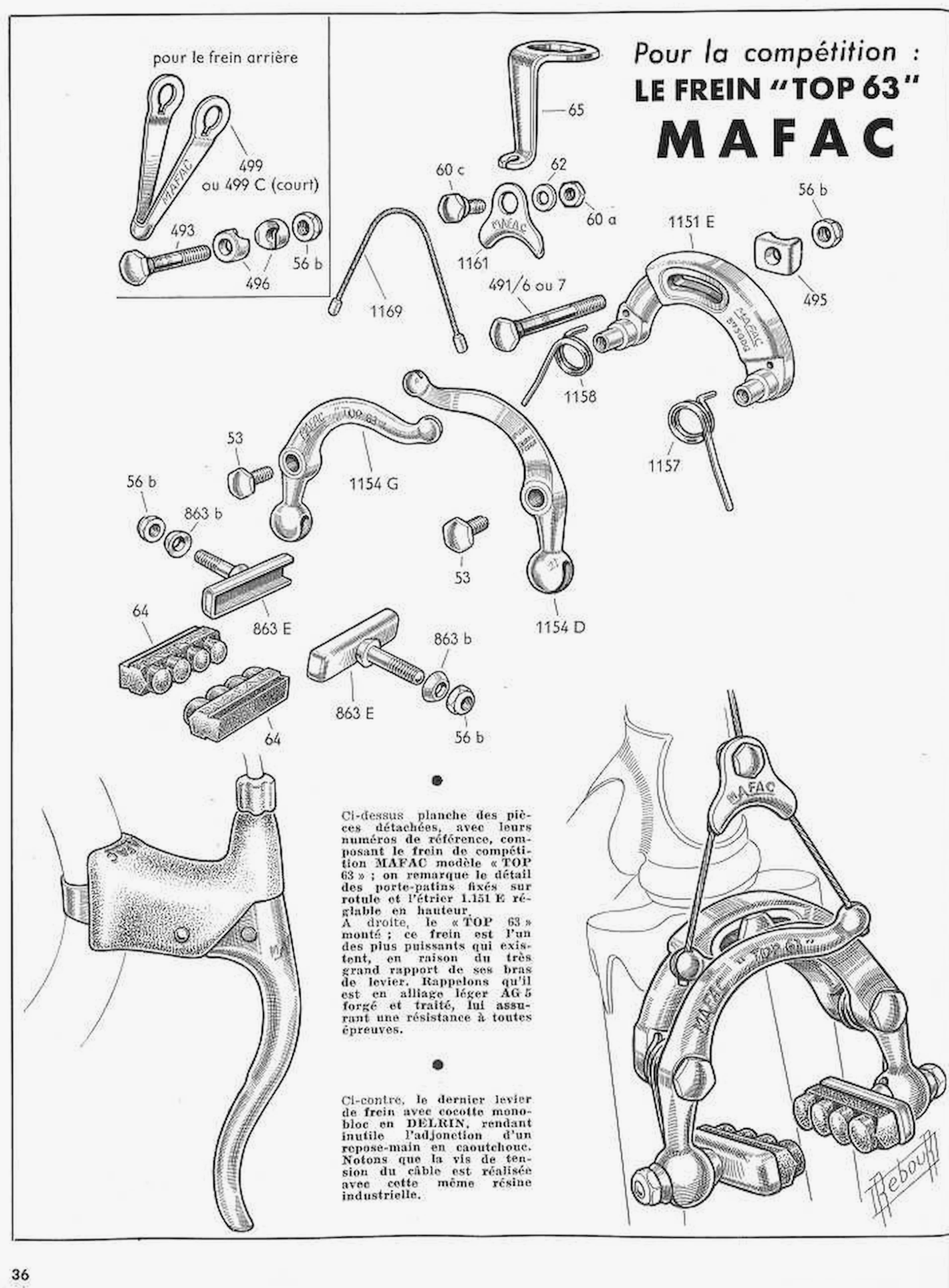
Pour la compétition :
LE FREIN “TOP 63”
MAFAC
pour le frein arrière
499
ou 499 C (court)
493
496
56 b
65
60 c
62
60 a
1161
1169
491/6 ou 7
1151 E
56 b
495
1158
1157
53
1154 G
56 b
863 b
863 E
53
1154 D
64
863 E
863 b
56 b
64
[Ebykr summary; the article’s text is not reproduced. A full-page plate of the MAFAC « TOP 63 » competition brake. The first caption explains that the plate shows the brake in exploded parts with their reference numbers, and points out the shoe holders mounted on a ball joint and the caliper arm 1.151 E, which is adjustable for height. It then describes the « TOP 63 » shown mounted at the right as one of the most powerful brakes in existence, owing to the very high ratio of its lever arms, and recalls that it is made of AG 5 light alloy, forged and heat-treated, which gives it great strength. The second caption presents the latest brake lever, whose one-piece hood is made of DELRIN, so that no rubber hand rest needs to be added, and notes that the cable-tension screw is made of the same industrial resin. A boxed inset gives the parts for the rear brake, including 499 or the short 499 C.]
[Three drawings. The upper half of the page is an exploded view of the MAFAC « TOP 63 » brake, every part labeled with its reference number, with a boxed inset at the upper left for the rear-brake parts; “MAFAC” is drawn on the straddle-cable yoke, on the rear-brake part 499 and on the arms, and “TOP 63” on arm 1154 G. At the lower left, the brake lever with its one-piece hood, clamped to a handlebar. At the lower right, the assembled brake mounted on a bicycle frame with its straddle cable, the yoke lettered “MAFAC” and the front arm “MAFAC” and “TOP 63”, signed “Rebour” in script at its lower right. The exploded view and the lever drawing are unsigned. The page carries one signed drawing.]
36
— Page 5 —
TENDANCES AU SALON 64 — TENDANCES AU SALON 64
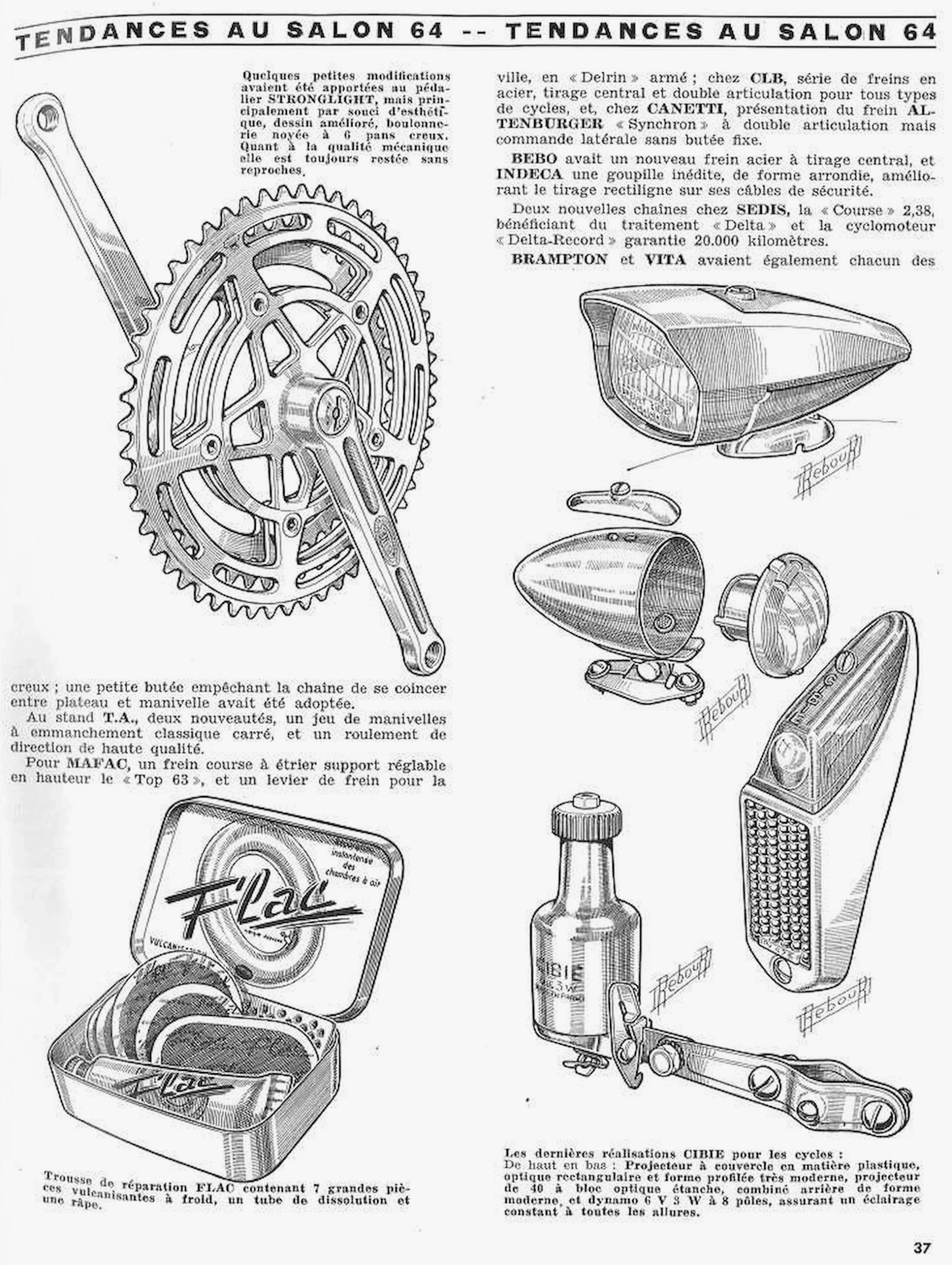
[Ebykr summary; the article’s text is not reproduced. The review of the previous Salon continues with STRONGLIGHT, whose crankset had also gained hexagon-socket recessed bolts and a small stop that keeps the chain from jamming between the chainring and the crank. At the T.A. stand there were two novelties, a crankset with the classic square-taper fitting and a high-quality headset. MAFAC showed a racing caliper brake with a height-adjustable mounting, the « Top 63 », and a brake lever for town use in reinforced « Delrin ». CLB had a series of steel brakes, center-pull and double-pivot, for every type of cycle, and CANETTI presented the ALTENBURGER « Synchron » brake, double-pivot but operated from the side without a fixed stop. BEBO had a new center-pull steel brake, and INDECA a new rounded pin that improves the straight pull of its safety cables. SEDIS had two new chains, the « Course » 2,38 with the « Delta » treatment and the moped chain « Delta-Record », guaranteed for 20.000 kilometers. BRAMPTON and VITA each also had (the sentence continues on the next page of text). The captions say that the STRONGLIGHT crankset had received a few small changes, chiefly for looks (an improved design and recessed hexagon-socket bolts), while its mechanical quality remained beyond reproach; that the FLAC repair kit holds seven large cold-vulcanizing patches, a tube of rubber solution and a rasp; and that the latest CIBIE lighting for cycles comprises, from top to bottom, a headlamp with a plastic cover, rectangular lens and streamlined modern shape, a headlamp « de 40 » with a sealed optical unit, a modern combined rear light and a 6 V 3 W eight-pole dynamo giving constant light at every speed.]
[Six drawings. At the top left, the STRONGLIGHT crankset with both cranks; at the lower left, an open FLAC repair-kit tin holding patches and a tube, its lid carrying the brand’s script logo. Neither of these two is signed. In the right column, four CIBIE lighting items: a streamlined headlamp with a rectangular lens; a bullet-shaped headlamp shown with its bracket, lens unit and top cap; a combined rear light with a large reflector grid; and a bottle dynamo lettered “CIBIE” on its mounting bracket. Each of these four is signed “Rebour” in script. The page carries four signed drawings.]
37
— Page 6 —
TENDANCES AU SALON 64 — TENDANCES AU SALON 64
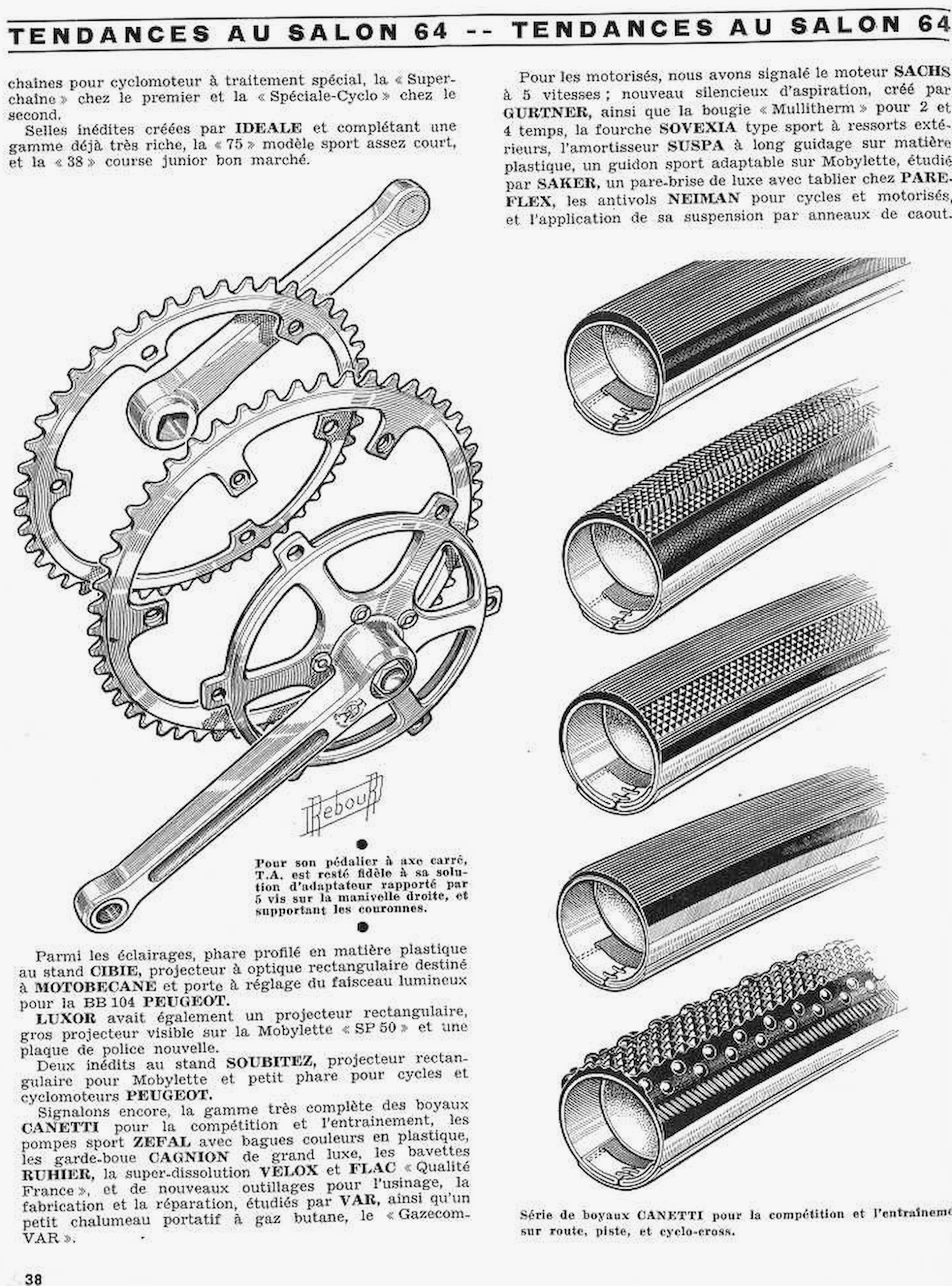
[Ebykr summary; the article’s text is not reproduced. Continuing from the previous page, BRAMPTON and VITA each had specially treated moped chains, the « Super-chaîne » from the first and the « Spéciale-Cyclo » from the second. IDEALE created new saddles to complete an already very rich range: the « 75 », a fairly short sport model, and the « 38 », an inexpensive junior racing saddle. Among lighting, CIBIE had a streamlined plastic headlamp, a rectangular-lens headlamp intended for MOTOBECANE and a beam-adjusting mount for the PEUGEOT BB 104; LUXOR also had a rectangular headlamp, a large headlamp seen on the Mobylette « SP 50 » and a new number plate; and SOUBITEZ had two novelties, a rectangular headlamp for the Mobylette and a small lamp for PEUGEOT cycles and mopeds. Rebour also notes the very complete range of CANETTI tubulars for racing and training, the ZEFAL sport pumps with colored plastic rings, the luxury CAGNION mudguards, the RUHIER mud flaps, the super rubber solution of VELOX and of FLAC « Qualité France », new tools for machining, manufacture and repair designed by VAR and a small portable butane torch, the « Gazecom-VAR ». For motorized machines he recalls the five-speed SACHS engine, a new intake silencer created by GURTNER together with the « Mullitherm » spark plug for two- and four-stroke engines, the SOVEXIA sport fork with external springs, the SUSPA shock absorber with long guidance on plastic, a sport handlebar adaptable to the Mobylette designed by SAKER, a luxury windshield with apron at PARE-FLEX, the NEIMAN locks for cycles and motorized machines and the application of its suspension by rubber rings (the sentence continues on the next page of text). The captions say that, for its square-axle crankset, T.A. has stayed with its solution of a spider fixed by five bolts to the right crank to carry the chainrings, and that the series of CANETTI tubulars shown serves racing and training on road, track and cyclo-cross.]
[Six drawings. At the left, an exploded view of the T.A. square-axle crankset, the right crank separated from its five-arm spider and two chainrings, with the left crank behind; the T.A. emblem is drawn on the right crank. It is signed “Rebour” in script at its lower right. In the right column, five cutaway sections of CANETTI tubular tires, each with a different tread from smooth through fine file patterns to a studded cyclo-cross tread; these are unsigned. The page carries one signed drawing.]
38
— Page 7 —
TENDANCES AU SALON 64 — TENDANCES AU SALON 64
NOUVEAUTES DEPUIS LE SALON 1962…
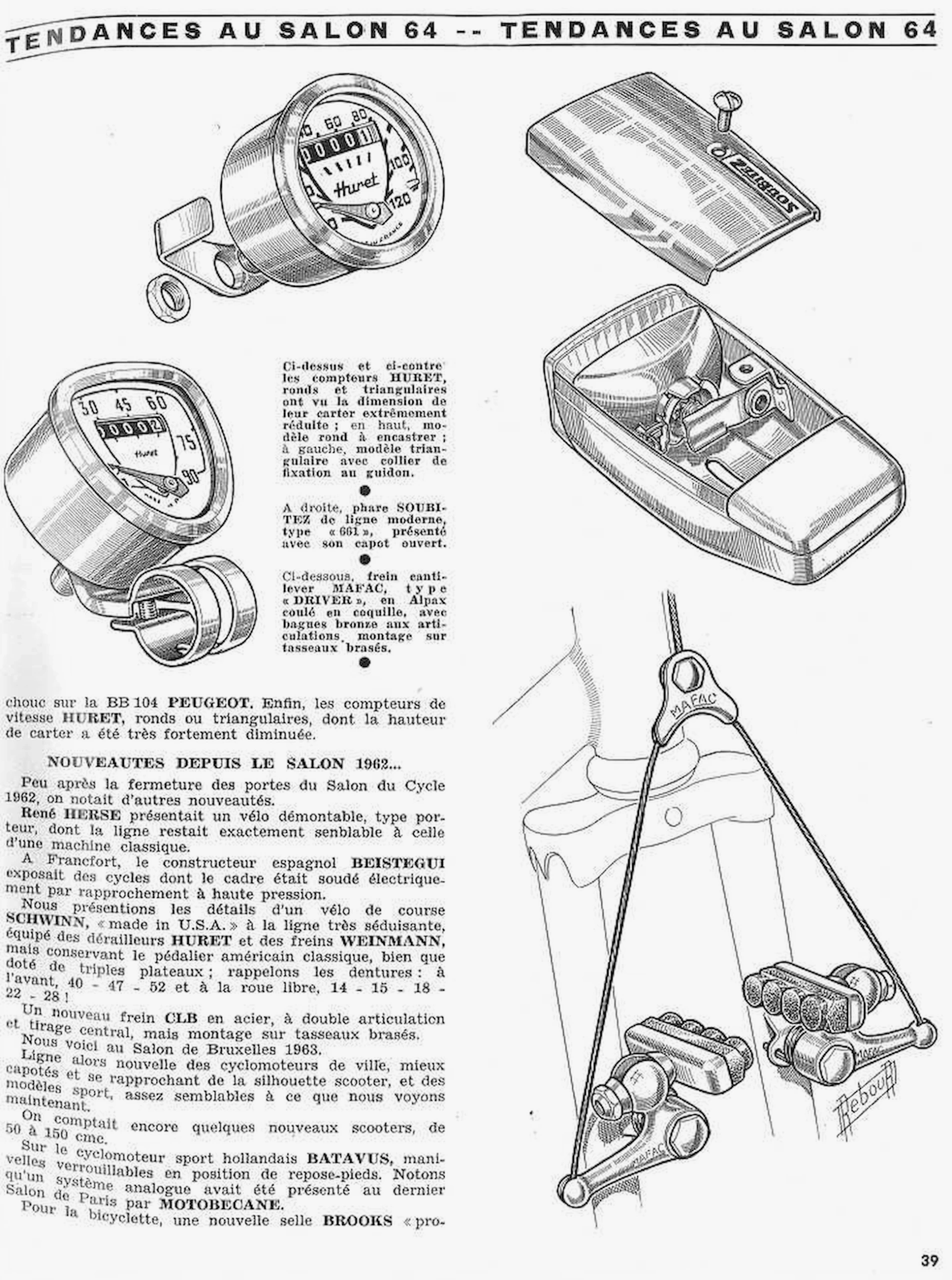
[Ebykr summary; the article’s text is not reproduced. The list of motorized novelties from 1962 ends with a suspension by rubber rings on the PEUGEOT BB 104 and the HURET speedometers, round or triangular, whose case height had been sharply reduced. Under the heading on novelties since the 1962 Salon, Rebour reports what appeared after that show closed: René HERSE presented a take-apart bicycle of the porteur type that looked exactly like a conventional machine; at Frankfurt (Francfort) the Spanish builder BEISTEGUI showed cycles with frames electrically welded under high pressure; the magazine had described a SCHWINN racing bicycle, « made in U.S.A. », with HURET derailleurs and WEINMANN brakes but keeping the classic American crankset, here fitted with triple chainrings of 40 – 47 – 52 teeth and a freewheel of 14 – 15 – 18 – 22 – 28; and CLB had a new steel brake, double-pivot and center-pull but mounted on brazed-on bosses. At the Brussels Salon of 1963 (Salon de Bruxelles 1963) there was a new line of town mopeds, better enclosed and closer to the scooter silhouette, sport models much like those of today and a few new scooters of 50 to 150 cmc. The Dutch BATAVUS sport moped had cranks that lock in place as footrests, a system that MOTOBECANE had shown at the last Paris Salon. For the bicycle there was a new BROOKS saddle (the sentence continues on page 41). The captions say that the HURET speedometers, round and triangular, have much smaller cases, the round one being for flush mounting and the triangular one having a handlebar clamp; that the modern SOUBITEZ headlamp, type « 661 », is shown with its cover open; and that the MAFAC « DRIVER » cantilever brake is cast in Alpax in a permanent mold, with bronze bushings at its pivots, and mounts on brazed-on bosses.]
[Five drawings. At the upper left, two HURET speedometers: a round one with a mounting bracket and nut, and a triangular-faced one with its handlebar clamp, each dial lettered “Huret”. At the upper right, the SOUBITEZ headlamp, its lid lettered “SOUBITEZ” shown lifted above and the lamp shown open below. At the lower right, the MAFAC « DRIVER » cantilever brake mounted on a fork with its straddle cable and a yoke lettered “MAFAC”, signed “Rebour” in script at its lower right. The speedometer and headlamp drawings carry no visible signature. The page carries one signed drawing.]
39
— Page 8 —
TENDANCES AU SALON 64 — TENDANCES AU SALON 64
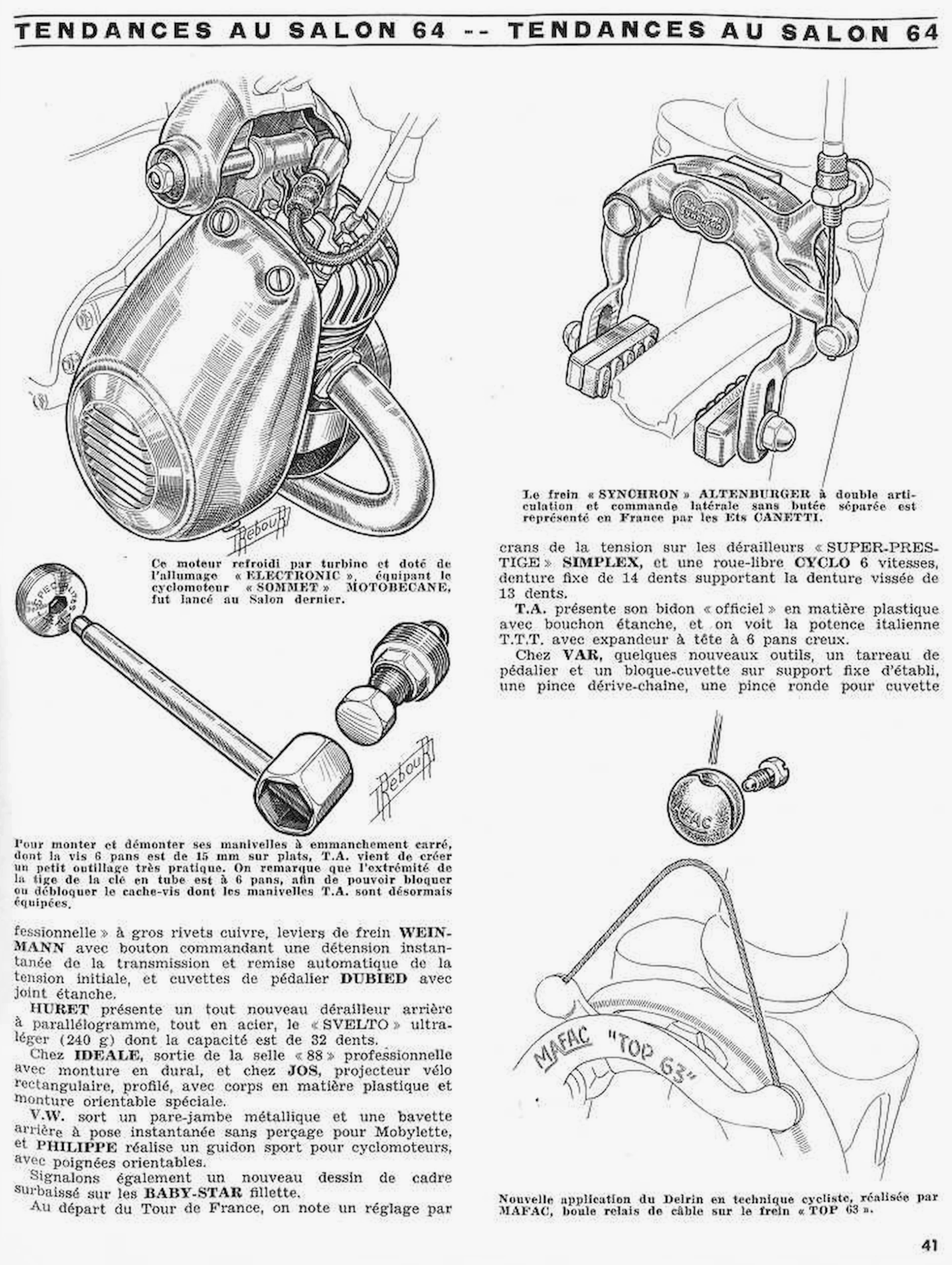
[Ebykr summary; the article’s text is not reproduced. Continuing the novelties of the 1963 Brussels Salon, the new BROOKS saddle « professionnelle » had large copper rivets; WEINMANN brake levers had a button that slackens the cable instantly and restores the original tension automatically; and DUBIED offered bottom-bracket cups with a watertight seal. HURET presented an entirely new all-steel parallelogram rear derailleur, the ultralight « SVELTO » (240 g), with a capacity of 32 teeth. IDEALE brought out the professional saddle « 88 » with a dural frame, and JOS a rectangular streamlined bicycle headlamp with a plastic body and a special swiveling mount. V.W. produced a metal leg shield and a rear mud flap for the Mobylette that fits without drilling, and PHILIPPE a sport handlebar for mopeds with adjustable grips. A new low-frame design appeared on the girls’ BABY-STAR. At the start of the Tour de France there was notched tension adjustment on the SIMPLEX « SUPER-PRESTIGE » derailleurs and a CYCLO six-speed freewheel whose fixed 14-tooth sprocket carries a screwed-on 13-tooth sprocket. T.A. presented its « officiel » plastic bottle with a watertight stopper, and the Italian T.T.T. stem was seen with an expander bolt taking a hexagon key. VAR had some new tools: a bottom-bracket tap, a cup holder on a fixed bench mount, a chain rivet extractor and a round pliers for cups (the sentence continues on the next page). The captions say that the turbine-cooled engine with « ELECTRONIC » ignition, fitted to the MOTOBECANE moped « SOMMET », was launched at the last Salon; that T.A. has created a very practical small tool for fitting and removing its square-taper cranks, whose hexagon bolt measures 15 mm across flats, the end of the tube-spanner shaft being hexagonal so that it can also tighten or loosen the dust caps now fitted to T.A. cranks; that the ALTENBURGER « SYNCHRON » brake, double-pivot with side operation and no separate stop, is represented in France by the Ets CANETTI; and that MAFAC has made a new use of Delrin in cycle engineering, a cable-relay ball on the « TOP 63 » brake.]
[Four drawings. At the upper left, the turbine-cooled MOTOBECANE « SOMMET » moped engine with its finned cylinder, ignition lead and exhaust pipe, signed “Rebour” in script at its lower right. Below it, the T.A. crank tool, a long tube spanner with a hexagonal socket beside a crank dust cap and the threaded extractor, also signed “Rebour” in script at its lower right. At the upper right, the ALTENBURGER « SYNCHRON » side-pull brake mounted on a fork crown, an oval badge on its arm. At the lower right, the MAFAC cable-relay ball, lettered “MAFAC” and shown with its fixing screw above a « TOP 63 » brake mounted on a frame, the brake arm lettered “MAFAC” and “TOP 63”. The two right-hand drawings carry no visible signature. The page carries two signed drawings.]
41
— Page 9 —
TENDANCES AU SALON 64 — TENDANCES AU SALON 64
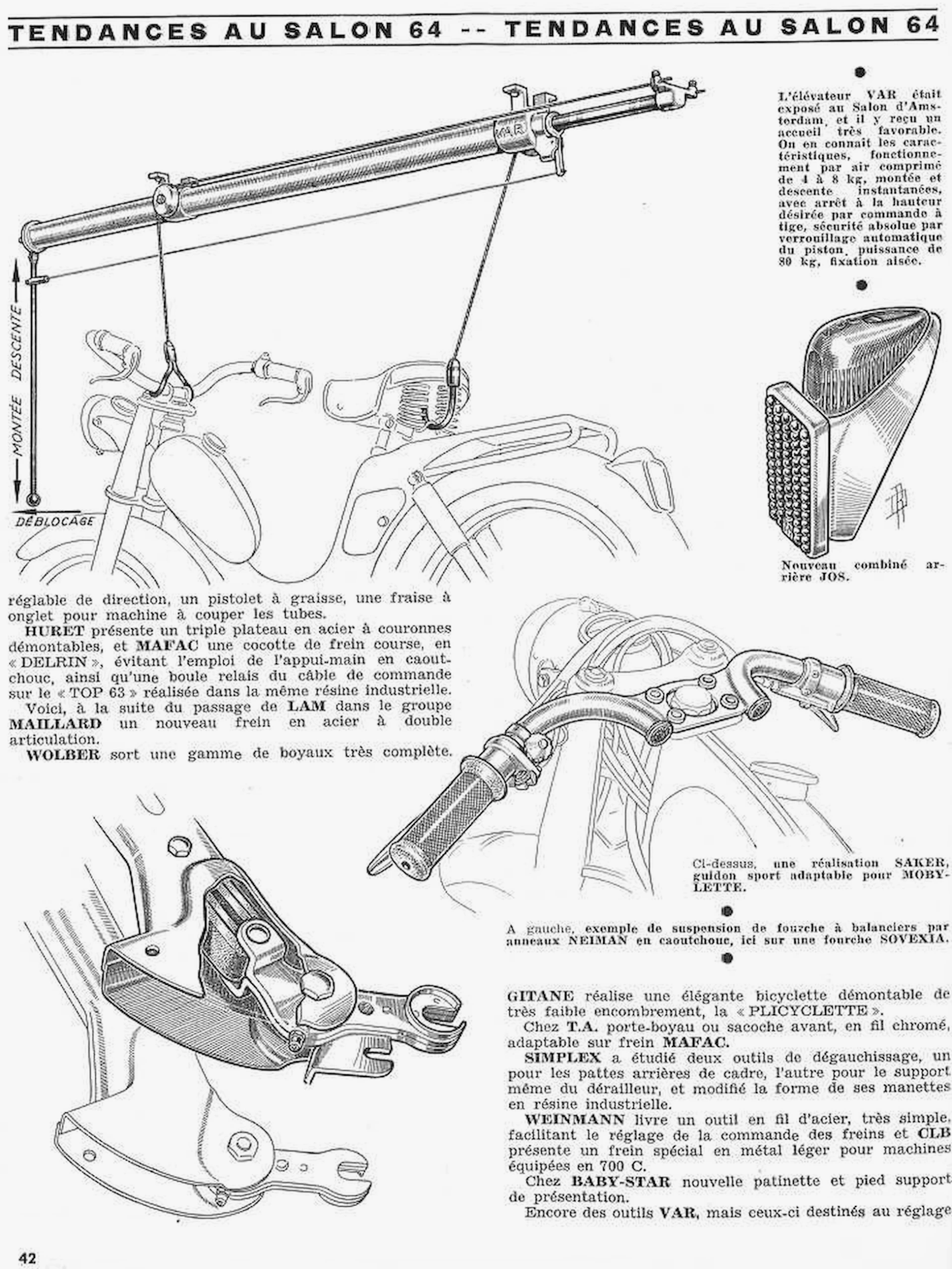
[Ebykr summary; the article’s text is not reproduced. The left column opens mid-sentence, finishing the list of new VAR workshop tools begun at the foot of the previous page: round pliers for the adjustable headset cup, a grease gun and a miter cutter for a tube-cutting machine. HURET presents a steel triple chainring with removable rings. MAFAC shows a racing brake-lever body (a “cocotte”) molded in « DELRIN », which does away with the rubber hand rest, as well as a cable relay ball for the « TOP 63 » brake made of the same industrial resin. Following the move of LAM into the MAILLARD group, a new double-pivot steel brake is shown. WOLBER brings out a very complete range of tubular tires. In the right column GITANE makes an elegant take-apart bicycle that packs very small, the « PLICYCLETTE ». T.A. has a chromed-wire front carrier for a spare tubular or a bag that fits the MAFAC brake. SIMPLEX has designed two alignment tools, one for the rear dropouts of the frame and one for the derailleur hanger itself, and has reshaped its shift levers in industrial resin. WEINMANN supplies a very simple steel-wire tool that eases the adjustment of the brake cables, and CLB presents a special light-alloy brake for machines built for 700 C wheels. BABY-STAR shows a new scooter (patinette) and a display stand. The column ends on further VAR tools, these meant for adjustment, the sentence running on to the next page. Captions: the VAR elevator had been exhibited at the Salon d’Amsterdam, where it was very well received; it works on compressed air at 4 to 8 kg, rises and descends instantly, stops at the chosen height by a rod control, is made safe by an automatic piston lock, lifts 80 kg and is easy to mount. A new JOS combined rear lamp. A SAKER sport handlebar adaptable to the MOBYLETTE (printed “MOBY-LETTE” across a line break). An example of swinging-link fork suspension by NEIMAN rubber rings, here on a SOVEXIA fork.]
[Four drawings. The VAR elevator, a long cylinder hung from the ceiling, lifting a moped by its handlebar and saddle on two cables, with the control rod at the left lettered “MONTÉE DESCENTE” and “DÉBLOCAGE”; a small label on the cylinder appears to read “V.A.R”. The JOS combined rear lamp with a studded reflector panel below the lens. The SAKER sport handlebar mounted on a moped. The swinging-link suspension with NEIMAN rubber rings on the leg of a SOVEXIA moped fork, with an open-ended link arm. None of the four drawings carries the full script signature “Rebour”; the JOS lamp drawing carries at its lower right a small hatched mark resembling the capital R that opens Rebour’s signature.]
42
— Page 10 —
TENDANCES AU SALON 64 — TENDANCES AU SALON 64
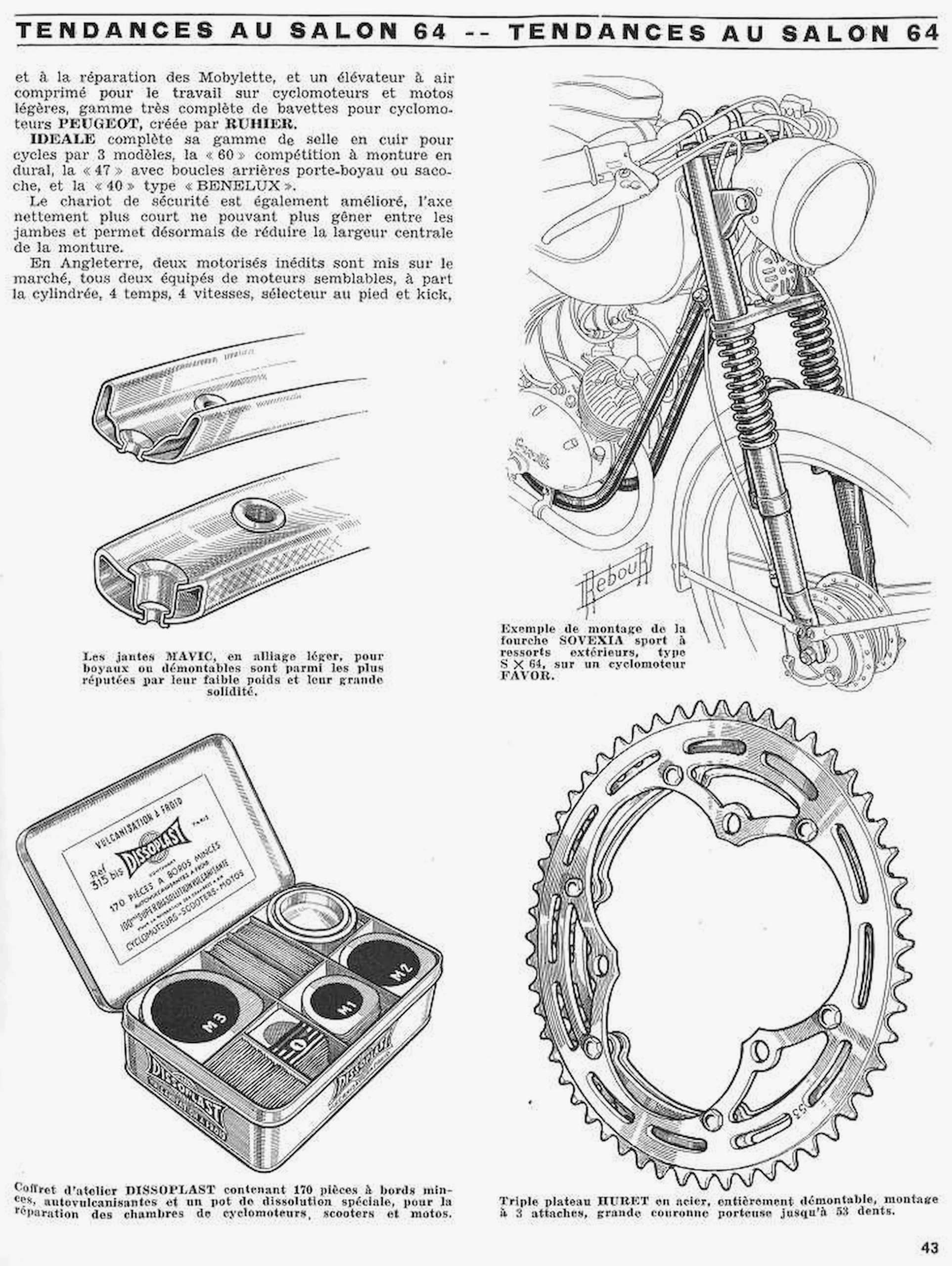
[Ebykr summary; the article’s text is not reproduced. The column opens by finishing the VAR sentence from the previous page: the new VAR tools are for adjusting and repairing the Mobylette, and VAR also has a compressed-air elevator for work on mopeds and light motorcycles. A very complete range of mudflaps for PEUGEOT mopeds is made by RUHIER. IDEALE rounds out its range of leather bicycle saddles with three models: the « 60 » competition saddle on a dural frame, the « 47 » with rear loops for carrying a spare tubular or a bag and the « 40 » type « BENELUX ». In the next paragraph the safety clamp (chariot de sécurité) is said to be improved as well: a much shorter bolt no longer gets in the way between the legs and allows the center of the saddle frame to be made narrower. From England come two new motorized machines with similar engines differing only in displacement, four-stroke, with four speeds, foot gear selector and kick-starter; the description continues on the next page. Captions: MAVIC light-alloy rims, for tubulars or for clinchers (démontables), are among the most highly regarded for their low weight and great strength. The SOVEXIA sport fork with external springs, type S × 64, fitted to a FAVOR moped. A DISSOPLAST workshop kit holding 170 thin-edged self-vulcanizing patches and a pot of special solution, for repairing the inner tubes of mopeds, scooters and motorcycles. The HURET steel triple chainring, fully demountable, on three-arm mounting, with a large ring of up to 53 teeth.]
[Four drawings. Two sectioned lengths of MAVIC rim, one for a clincher tire and one for a tubular. The SOVEXIA sport fork with its exposed springs on the front of a FAVOR moped, with headlamp and engine; this drawing is signed “Rebour” at its lower left. The DISSOPLAST workshop tin shown open, its lid label lettered with the brand, “VULCANISATION A FROID”, “Ref 315 bis”, “170 PIÈCES A BORDS MINCES” and “CYCLOMOTEURS – SCOOTERS – MOTOS”; its compartments hold patches marked M1, M2, M3 and O. The HURET steel chainring with slotted arms. One of the four drawings is signed “Rebour”.]
43
— Page 11 —
TENDANCES AU SALON 64 — TENDANCES AU SALON 64
NOUVEAUTES AU SALON 1964
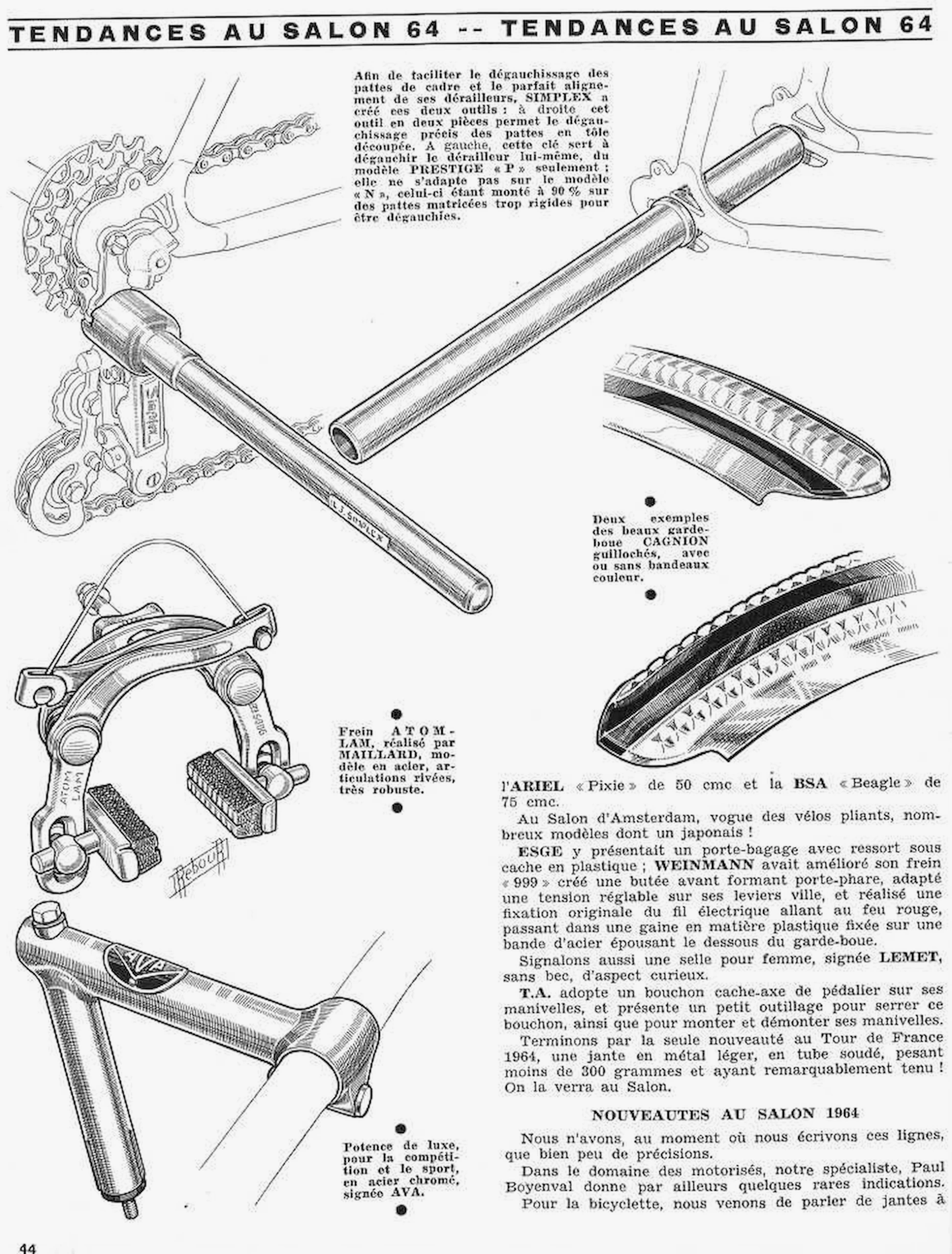
[Ebykr summary; the article’s text is not reproduced. The right column opens by naming the two new English motorized machines introduced on the previous page: the ARIEL « Pixie » of 50 cmc and the BSA « Beagle » of 75 cmc. At the Salon d’Amsterdam folding bicycles were in fashion, with many models including a Japanese one. ESGE showed a carrier with its spring hidden under a plastic cover. WEINMANN had improved its « 999 » brake, created a front stop that doubles as a lamp bracket, fitted adjustable tension to its town levers and devised an original routing for the wire to the red rear lamp, run in a plastic sleeve fixed to a steel strip that follows the underside of the mudguard. A noseless women’s saddle of curious appearance by LEMET is noted. T.A. adopts a dust cap covering the bottom-bracket axle on its cranks and offers a small tool for tightening that cap and for fitting and removing its cranks. The section closes on the only novelty seen at the Tour de France 1964: a light-metal rim of welded tube weighing under 300 grams that held up remarkably well and is to be shown at the Salon. Under the heading NOUVEAUTES AU SALON 1964 the magazine says that, at the time of writing, it has very few details; for motorized machines the magazine’s specialist Paul Boyenval gives some indications elsewhere in the issue, and for the bicycle the text turns back to rims, the sentence running on to the next page. Captions: SIMPLEX has created two tools to straighten frame dropouts and align its derailleurs precisely; at right a two-piece tool for exact alignment of dropouts cut from sheet steel, at left a key for straightening the derailleur itself, for the PRESTIGE « P » model only, since it does not fit the « N » model, which is fitted 90 % of the time to forged dropouts too stiff to be straightened. Two examples of the handsome engine-turned CAGNION mudguards, with or without colored bands. The ATOM-LAM brake (printed “A T O M -” at a line end, then “LAM”), made by MAILLARD, a very sturdy steel model with riveted pivots. A luxury chromed-steel stem for competition and sport, signed AVA.]
[Four drawings. The two SIMPLEX alignment tools: a long bar fitted over the derailleur hanger beside a SIMPLEX derailleur and freewheel, its shaft carrying a small label ending in “SIMPLEX”, and a second tube engaged across the rear dropouts of the frame. Two CAGNION mudguards with engine-turned surfaces, one with a dark central band. The ATOM-LAM sidepull brake with its pads, “ATOM LAM” lettered on one arm and a smaller marking on the other; this drawing is signed “Rebour” below the right pad. The AVA chromed stem with its AVA badge, shown on a handlebar. One of the four drawings is signed “Rebour”.]
44
— Page 12 —
TENDANCES AU SALON 64 — TENDANCES AU SALON 64
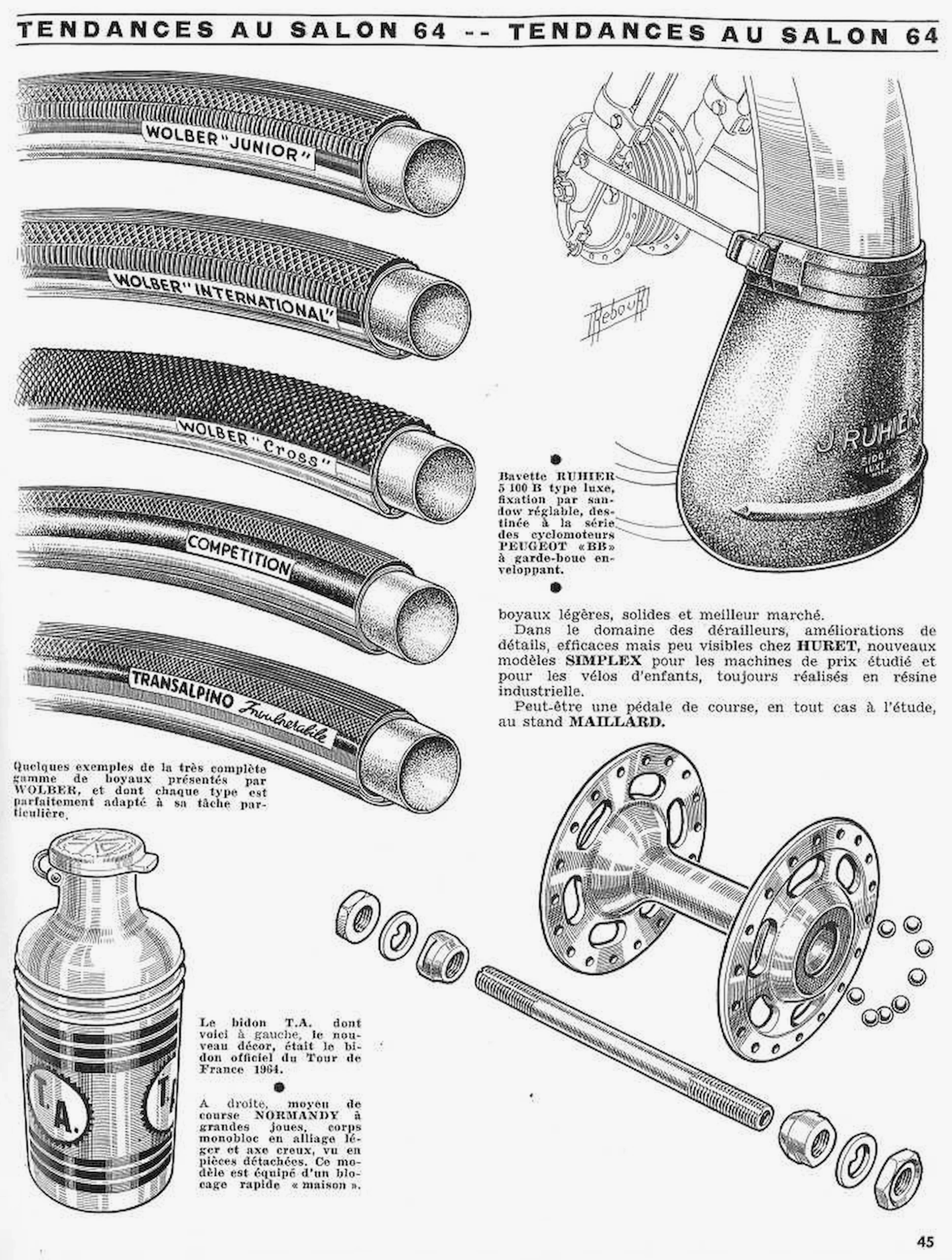
[Ebykr summary; the article’s text is not reproduced. The short right column completes the sentence begun on the previous page: for the bicycle, the magazine has just mentioned tubular rims that are light, strong and cheaper. In derailleurs, HURET has made detail improvements that work well but show little, and SIMPLEX has new models for keenly priced machines and for children’s bicycles, still made in industrial resin. A racing pedal may appear at the MAILLARD stand, or is at least being studied. Captions: a few examples from the very complete range of tubular tires shown by WOLBER, each type suited to its own job. The RUHIER 5 100 B mudflap, luxury type (type luxe), held by an adjustable shock cord (sandow) and intended for the PEUGEOT «BB» series of mopeds with enclosing mudguards. The T.A. bottle, shown at left in its new decoration, was the official bottle of the Tour de France 1964. At right, a large-flange NORMANDY racing hub with a one-piece light-alloy body and hollow axle, shown in exploded view and fitted with a quick release of the firm’s own design (« maison »).]
[Four drawings. A stack of five tubular tires on rim sections, their labels reading WOLBER “JUNIOR”, WOLBER “INTERNATIONAL”, WOLBER “Cross”, COMPETITION and TRANSALPINO with the script word “Invulnerabile”. The RUHIER mudflap strapped around the mudguard of a moped above its rear hub, the flap lettered “J. RUHIER” over a small model number beginning “5100” and the word “LUXE”; this drawing is signed “Rebour” at its left. The T.A. bottle with a hinged cap, banded decoration and “T.A.” in cog-edged roundels. The NORMANDY hub in exploded view: the shell with large flanges pierced by oval cut-outs and spoke holes, the threaded axle, cones, washers, a locknut and loose balls; the quick release is not drawn. One of the four drawings is signed “Rebour”.]
45
— Page 13 —
TENDANCES AU SALON 64 — TENDANCES AU SALON 64
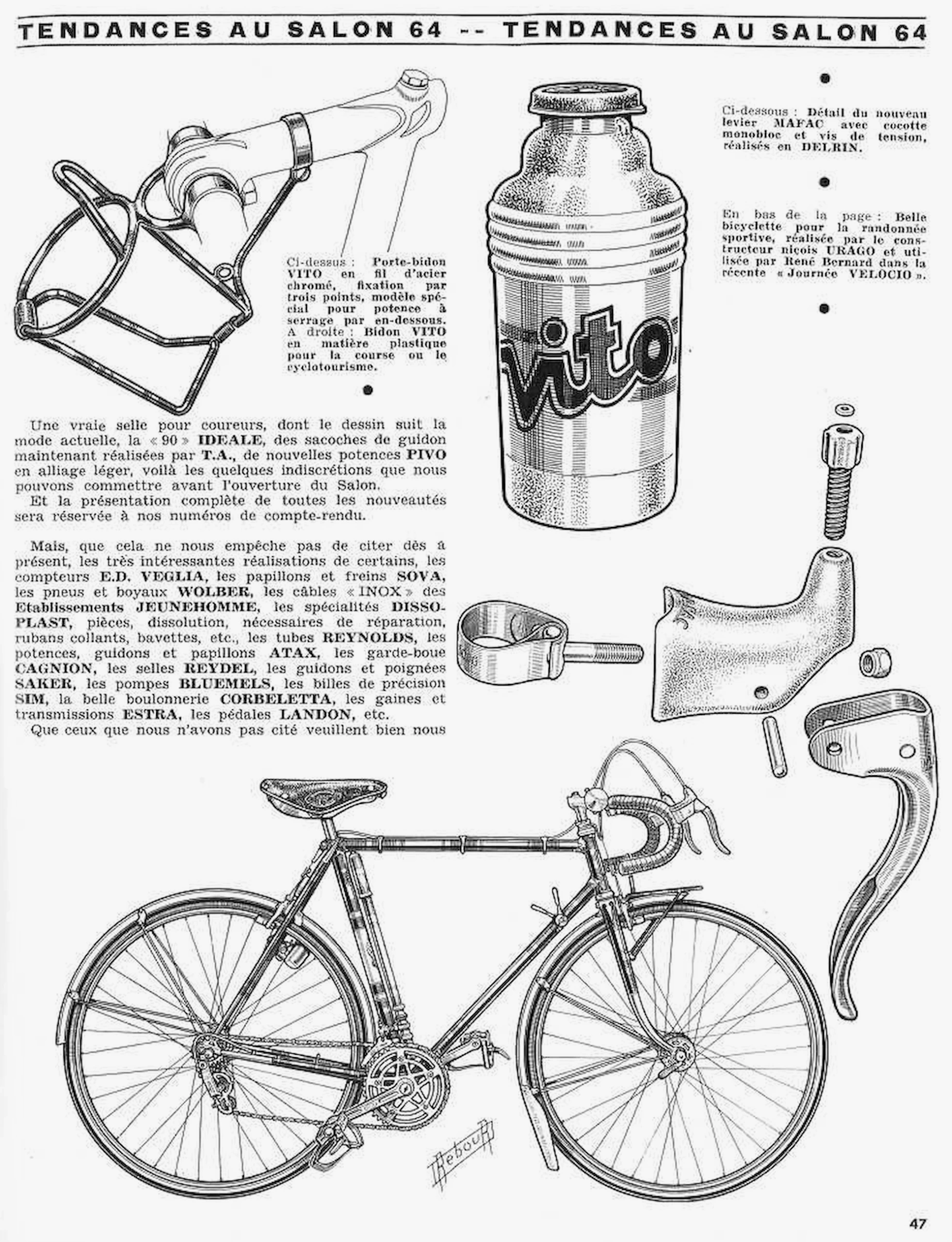
[Ebykr summary; the article’s text is not reproduced. The text resumes on this page after the advertisement page 46. It lists the few advance indiscretions the magazine can make before the Salon opens: a true racing saddle in the current style, the IDEALE « 90 », handlebar bags now made by T.A. and new light-alloy PIVO stems. The full presentation of every novelty is held over for the issues reporting on the Salon. Even so, the text already names the very interesting work of several firms: E.D. VEGLIA counters (compteurs), SOVA wing nuts (papillons) and brakes, WOLBER tires and tubulars, the « INOX » cables of the Etablissements JEUNEHOMME, the DISSOPLAST specialties (printed “DISSO-PLAST” across a line break), namely patches, solution, repair kits, adhesive tapes and mudflaps, REYNOLDS tubes, ATAX stems, handlebars and wing nuts, CAGNION mudguards, REYDEL saddles, SAKER handlebars and grips, BLUEMELS pumps, SIM precision balls, the fine CORBELETTA bolts and fittings (boulonnerie), ESTRA cable housings and transmissions and LANDON pedals. The last line begins an apology to the firms not named, which runs on to the next page. Captions: a VITO bottle cage in chromed steel wire with three-point fixing, a special model for a stem that clamps from below; at right, a VITO plastic bottle for racing or touring. Detail of the new MAFAC lever, its one-piece body (cocotte) and tension screw made of DELRIN. At the foot of the page, a handsome bicycle for sporting touring (randonnée sportive) built by the Nice constructor URAGO and ridden by René Bernard in the recent « Journée VELOCIO ».]
[Four drawings. The VITO wire bottle cage fixed under a handlebar stem. The VITO plastic bottle with its screw cap, lettered “vito” in large script across a checked band. The new MAFAC brake lever in exploded view: handlebar clamp band and bolt, molded body, tension screw, pivot pin, nut and lever blade. The URAGO touring bicycle in side view, with drop handlebars, a bell, mudguards with a front mudflap, a pump along the seat tube, a dynamo on the seat stay, a leather saddle, a double chainwheel and a rear derailleur; this drawing is signed “Rebour” below the chainwheel. One of the four drawings is signed “Rebour”.]
47
— Page 14 —
TENDANCES AU SALON 64 — TENDANCES AU SALON 64
D. REBOUR.
PARMI LES STANDS
ANDRE BERTIN
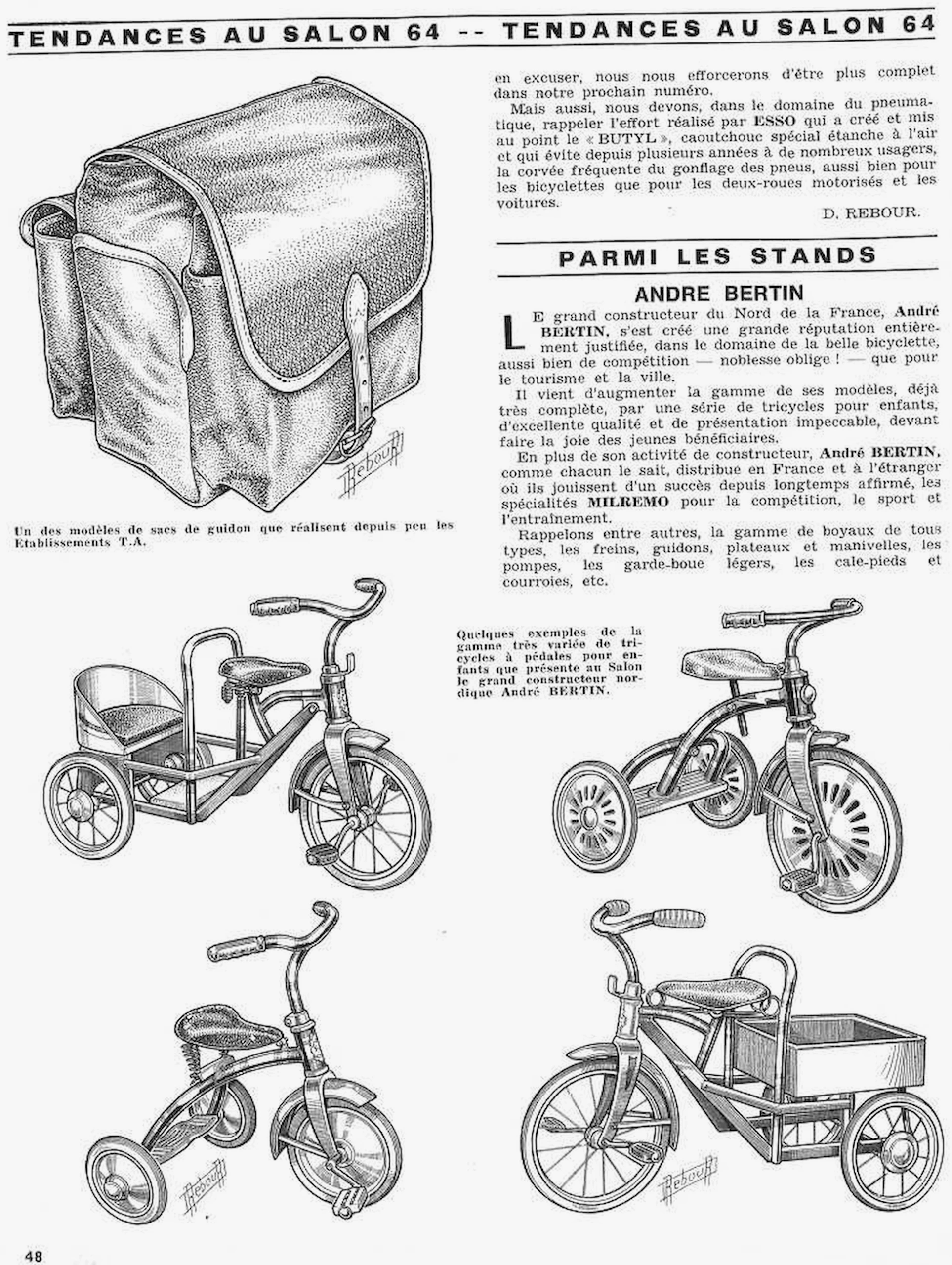
[Ebykr summary; the article’s text is not reproduced. The top of the right column ends Daniel Rebour’s article. It completes the apology begun on the previous page: the firms not named are asked to excuse the omission, and the magazine promises to be more complete in its next issue. Rebour then recalls, in the tire field, the work of ESSO, which created and developed « BUTYL », a special airtight rubber that for several years has spared many users the frequent chore of pumping up tires, on bicycles as well as on motorized two-wheelers and cars. The article is signed “D. REBOUR.” and ends there. Below a rule begins the magazine’s separate, unsigned stand column, PARMI LES STANDS, with its first entry, ANDRE BERTIN. The great constructor from the north of France, André BERTIN, has earned a well-deserved reputation for fine bicycles, for competition as well as for touring and town use. He has just added to his already very complete range a series of children’s tricycles of excellent quality and impeccable finish. Besides building, André BERTIN distributes in France and abroad the MILREMO specialties for competition, sport and training, long successful there, and the column recalls among them a range of tubular tires of every type, brakes, handlebars, chainrings and cranks, pumps, light mudguards, toe clips and straps. Captions: at left, beside the end of Rebour’s article and illustrating the handlebar bags he mentions on the previous page, one of the handlebar bag models recently made by the Etablissements T.A.; in the stand column, a few examples from the very varied range of children’s pedal tricycles shown at the Salon by the great northern constructor André BERTIN.]
[Five drawings. A T.A. canvas handlebar bag with a buckled flap and side pockets, signed “Rebour” at its lower right. Four children’s tricycles from the André BERTIN range: one with a tub seat for a passenger at the rear, one with a step platform and slotted disc wheels, one with a sprung saddle and one with a box carrier at the rear; the two lower tricycles are each signed “Rebour” low down between their wheels. Three of the five drawings are signed “Rebour”.]
48
— Page 15 —
PARMI LES STANDS — PARMI LES STANDS
IDEALE
VELOX ET FLAC
CANETTI
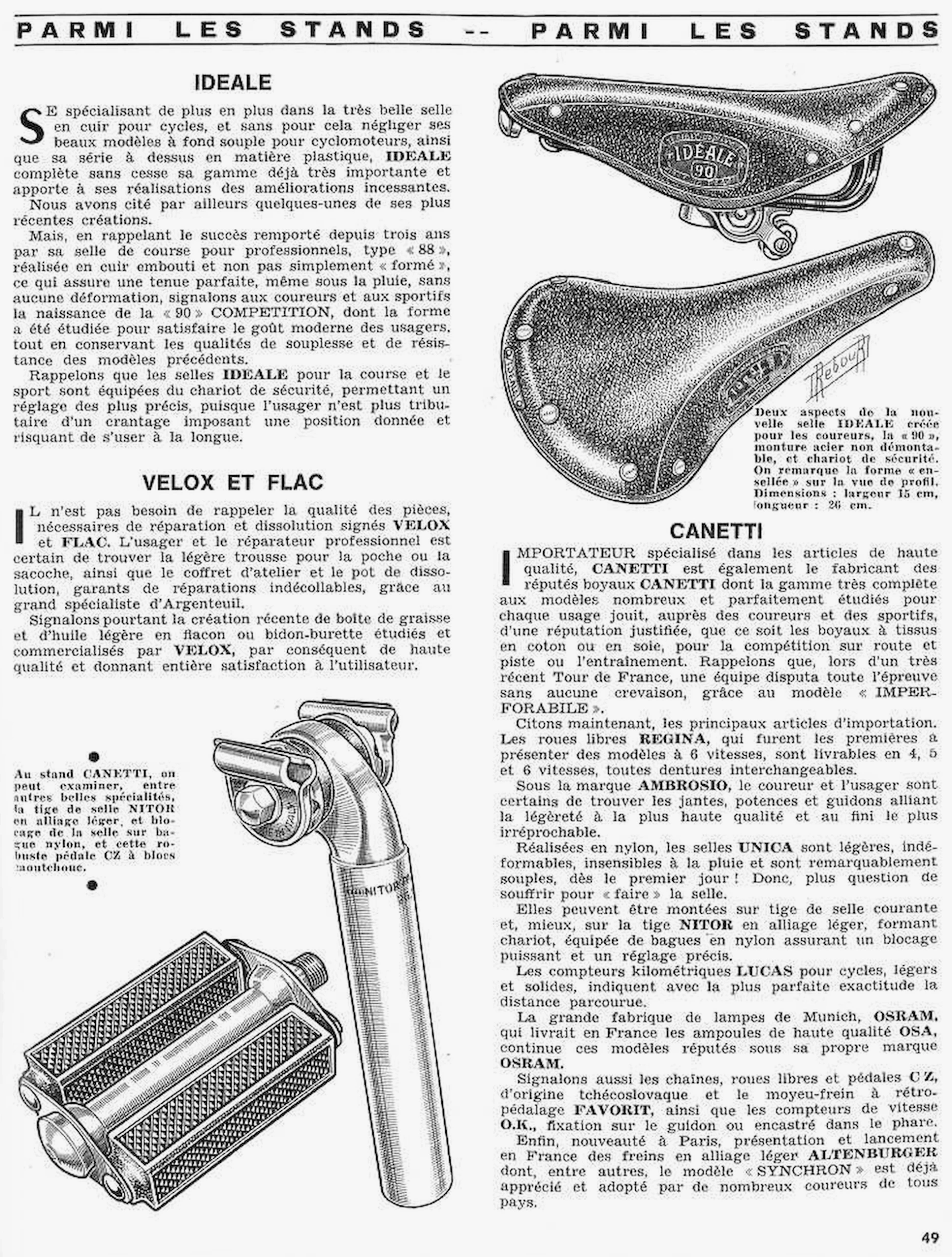
[Ebykr summary; the article’s text is not reproduced. The magazine’s unsigned stand column continues with three entries. IDEALE: specializing more and more in fine leather cycle saddles while keeping its soft-base moped saddles and its series with plastic tops, IDEALE keeps widening and improving its range; some of its latest creations are noted elsewhere in the issue. Recalling the three-year success of its racing saddle for professionals, type « 88 », made of pressed (embouti) leather rather than merely formed leather so that it keeps its shape even in rain, the column announces the « 90 » COMPETITION, shaped for modern taste while keeping the suppleness and strength of the earlier models. IDEALE racing and sport saddles have the safety clamp (chariot de sécurité), which allows very precise adjustment without a notched setting. VELOX ET FLAC: the parts, repair kits and solution signed VELOX and FLAC need no introduction; riders and repairers find the light pocket or bag kit, the workshop box and the pot of solution from the great specialist of Argenteuil, and VELOX has recently created a grease box and a light oil in a flask or oil-can bottle (bidon-burette). CANETTI: an importer of high-quality goods and maker of the well-known CANETTI tubulars in cotton or silk for road, track and training; in a very recent Tour de France one team rode the whole race without a puncture on the « IMPERFORABILE » model (printed “IMPER-FORABILE” across a line break). Imports: REGINA freewheels, the first to offer six speeds, in four, five and six speeds with interchangeable sprockets; AMBROSIO rims, stems and handlebars; UNICA nylon saddles, light, rainproof and supple from the first day, for an ordinary seatpost or better the light-alloy NITOR post with nylon bushes; LUCAS cycle odometers; OSRAM of Munich, which used to supply OSA bulbs to France and now continues them under its own name; CZ chains, freewheels and pedals from Czechoslovakia; the FAVORIT coaster-brake hub; O.K. speedometers for the handlebar or built into the headlamp; finally, new in Paris, the launch in France of ALTENBURGER light-alloy brakes, among them the « SYNCHRON », already adopted by many riders of every country. Captions: two views of the new IDEALE saddle for racing, the « 90 », with a non-demountable steel frame and the safety clamp, its saddle-backed (« ensellée ») shape visible in profile, measuring 15 cm wide and 26 cm long. At the CANETTI stand, the light-alloy NITOR seatpost with saddle clamping on a nylon ring and the sturdy CZ pedal with rubber blocks.]
[Two drawings. The new IDEALE « 90 » saddle in two views, from the side and from above, its riveted leather top carrying an oval badge lettered “IDEALE” and “90”; this drawing is signed “Rebour” at the right of the lower view. A composite drawing of the NITOR seatpost with its integral clamp, lettered “NITOR” on the shaft, beside a CZ rubber-block pedal; it is not signed. One of the two drawings is signed “Rebour”.]
49
Ebykr presents this material for research and education. If you hold rights to it or notice an ownership issue, please contact us and we will respond promptly.
The Ebykr Digest
New articles, timelines, catalog finds and registry activity — assembled from the archive once a month. Your address is never shared.
Double opt-in. One email per month. Unsubscribe at any time with one click.