About Ebykr
Ebykr celebrates classic and vintage lightweight bicycles through provocative imagery and opinion. Ride along with us.
About Ebykr
Ebykr celebrates classic and vintage lightweight bicycles through provocative imagery and opinion. Ride along with us.

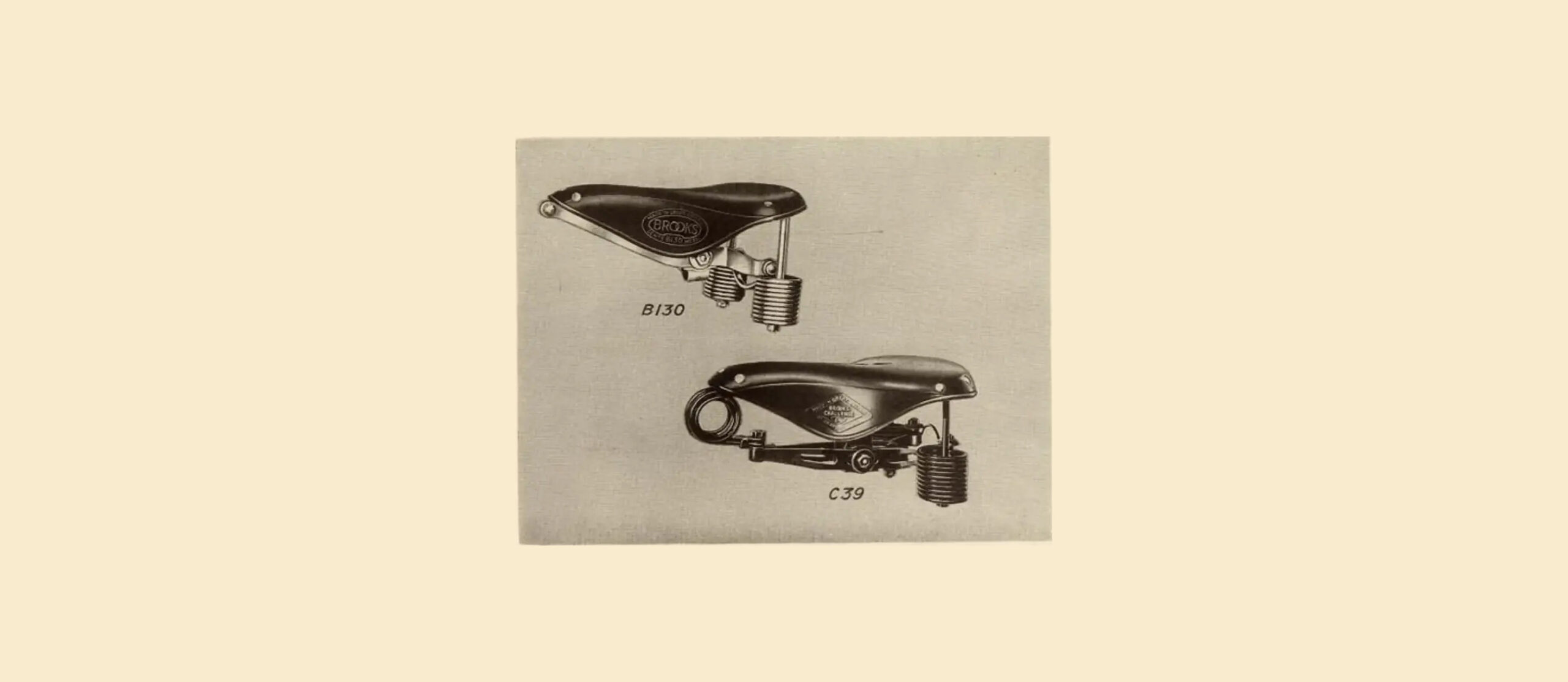
A Brooks saddle is the only part of a bicycle that is expected to change shape while you own it. That is the whole idea. The leather is not upholstery stretched over a shell, it is a single hide top, tensioned between a nose and a cantle plate, and it is meant to take the shape of the rider sitting on it. Everything below is in service of that one process and almost every Brooks that fails early fails because somebody hurried it.
There is a great deal of folklore about how to look after these saddles and a fair amount of it will damage yours. So this guide leans on what Brooks itself prints and says plainly where a popular method is folk practice rather than the maker’s advice. Where the modern instruction and the Edwardian one differ, both are given, because the difference is often the most useful thing on the page.
Before any of the specifics, it is worth knowing how settled this subject is. Brooks has been printing essentially the same fitting advice since the Edwardian period and the resemblance is not general. It is line by line.
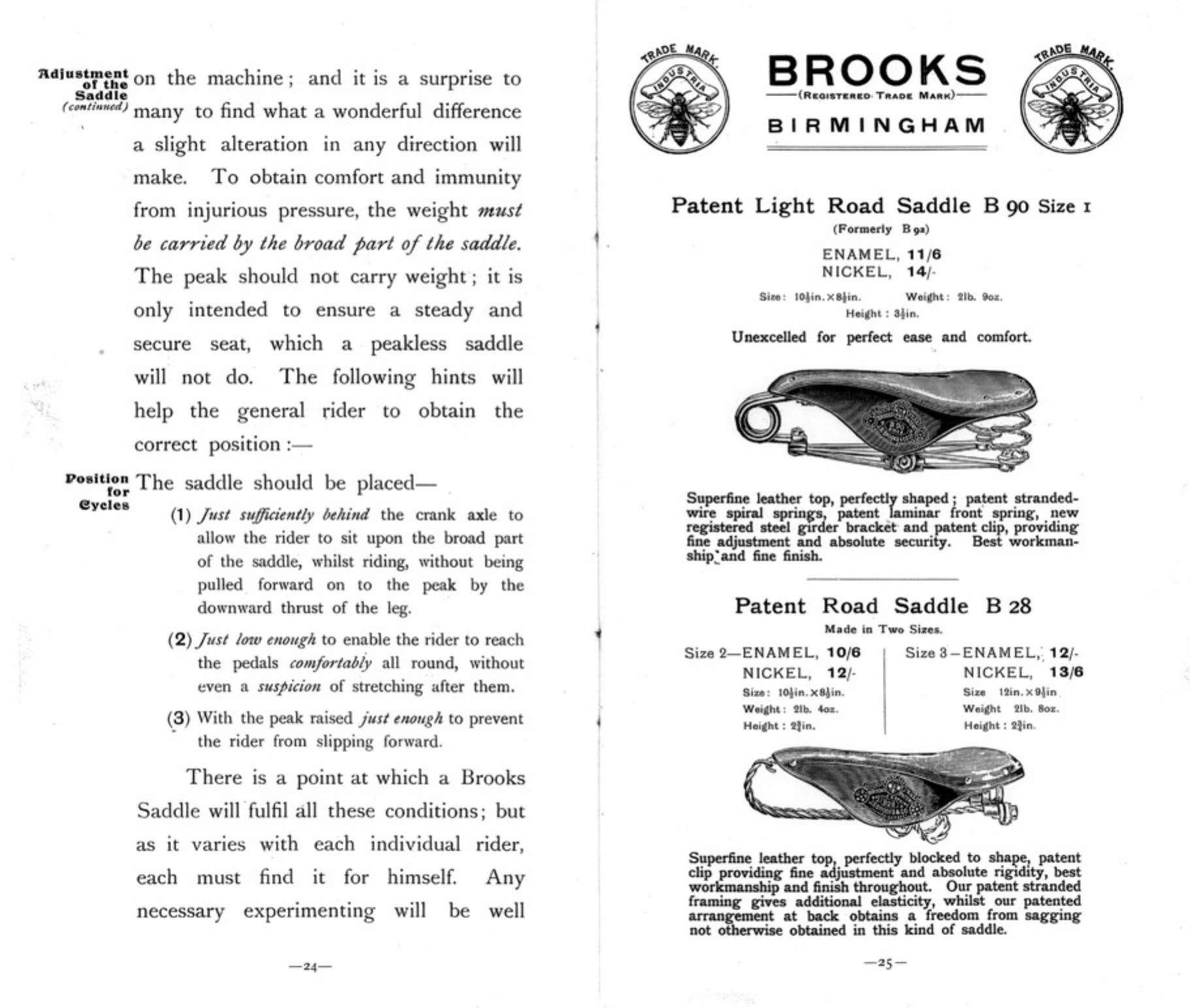
Here is the 1905 catalog, printed page 24, held in the Ebykr archive:
To obtain comfort and immunity from injurious pressure, the weight must be carried by the broad part of the saddle. The peak should not carry weight; it is only intended to ensure a steady and secure seat, which a peakless saddle will not do.
And here is the leaflet packed with a Brooks saddle in the 2010s:
The great thing to bear in mind is that, to obtain comfort and avoid injurious pressure, the weight must be carried on the broad apart [sic] of the saddle. The peak should carry as little weight as possible. The nose is mainly intended to ensure a steady and secure seat, which a peakless saddle would not do.
That is the same sentence, lightly modernized, more than a century apart. The broad apart is genuinely printed that way in the current leaflet, which gets it right in the numbered rule three lines further down. The leaflet has several such slips and this guide quotes it as printed. The numbered three-point rule that follows survives too, with points two and three swapped and a knee angle added. One word drifted along the way: in 1905 the rider is pulled forward on to the peak by the downward thrust of the leg, and in the modern leaflet by the onward thrust.
The practical value of that is simple. When a modern leaflet and an Edwardian catalog agree, you are not reading marketing. You are reading something the company has had 120 years to disprove and has not.
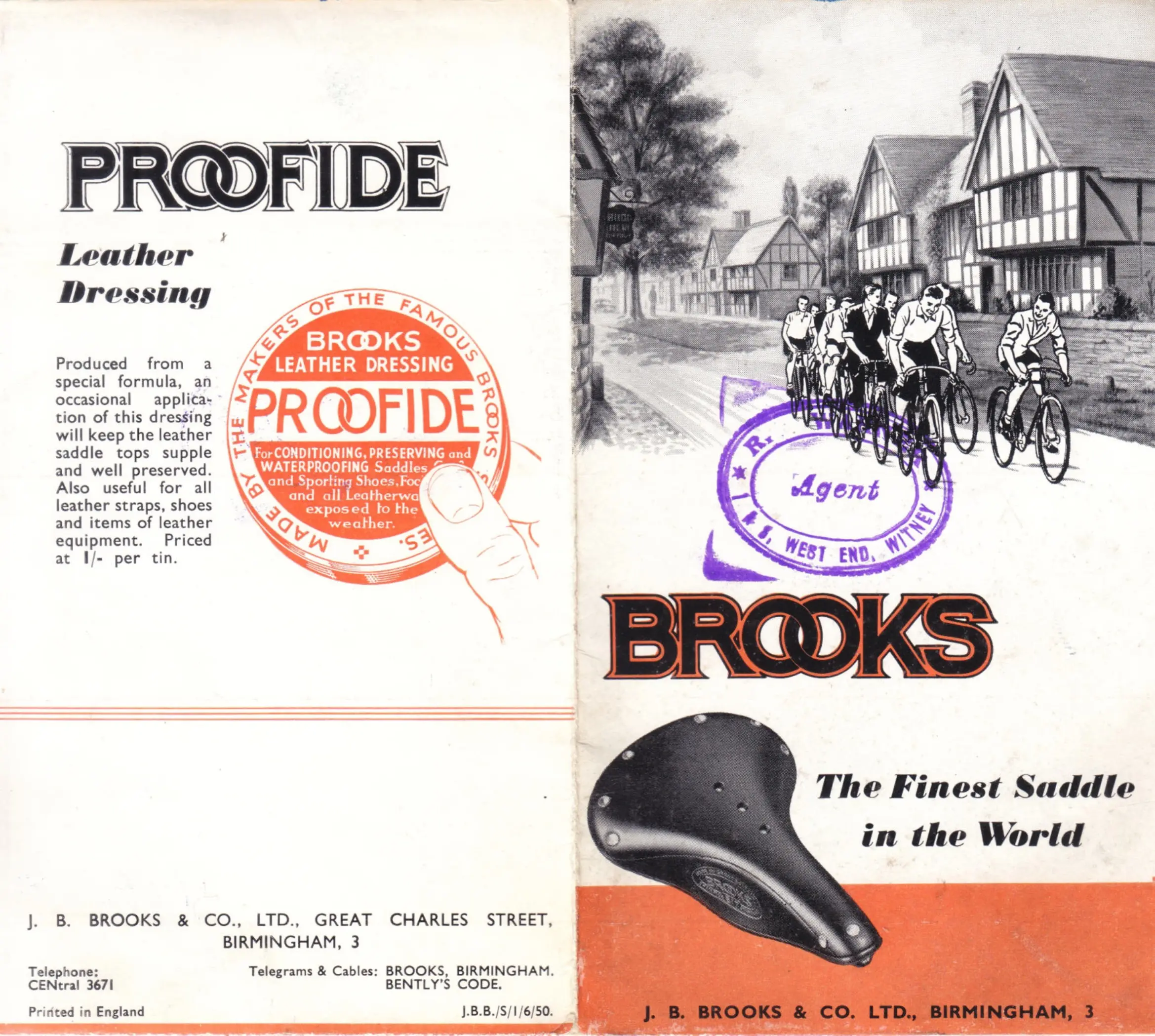
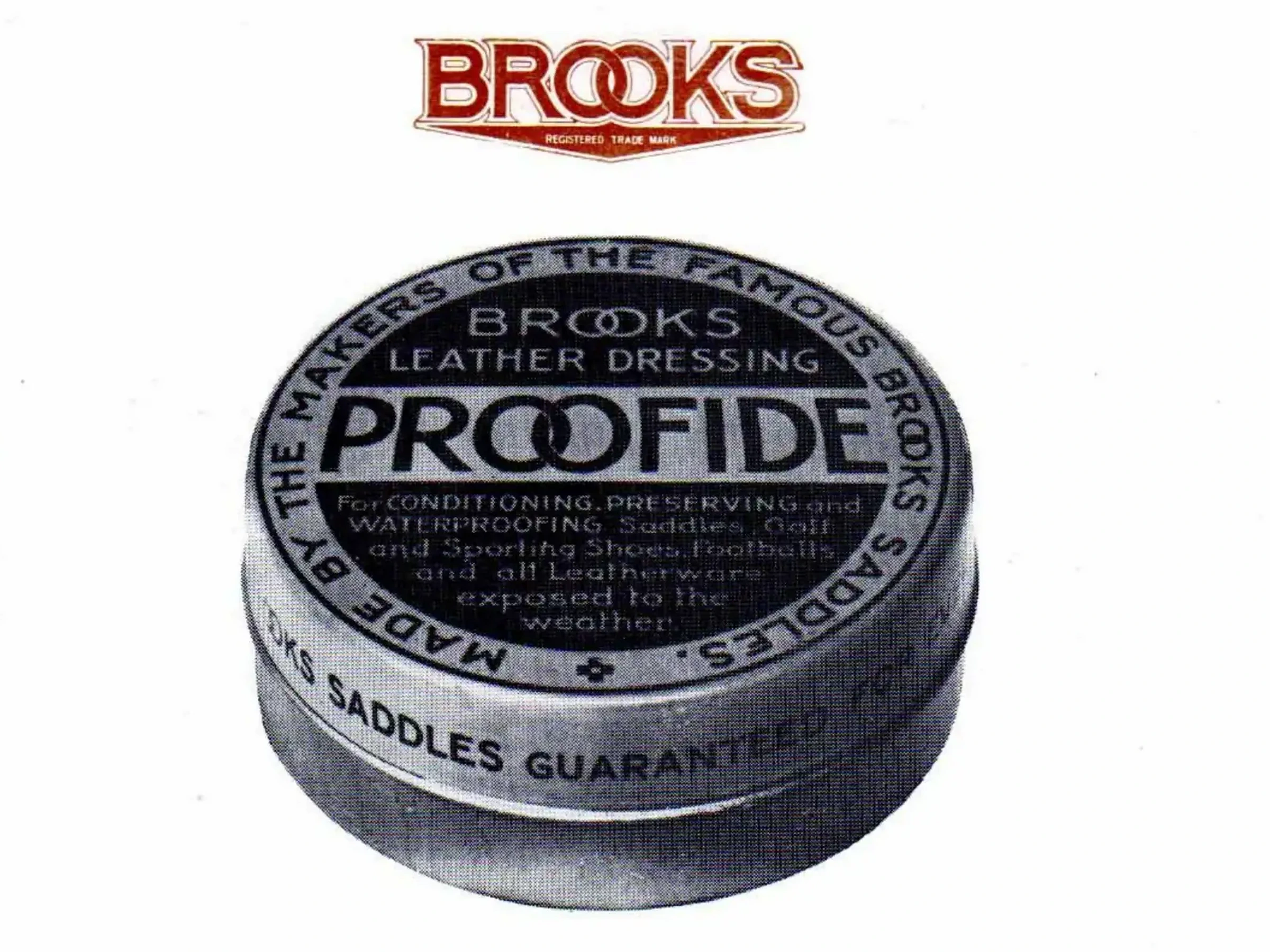
Proofide is Brooks’ own leather dressing and the company is unusually blunt about its place:
Brooks Proofide is the only substance that should be used to care for your saddle.
Treat that as a manufacturer’s position rather than a proven chemistry, but treat it seriously, because it is the only dressing whose behavior on this particular leather Brooks has any reason to have tested.
The part most riders get wrong is that the two sides of the saddle are treated differently.
Frequency is modest: several times during the break-in, and every few months after that. It is a dressing rather than a feed and Brooks has always described it that way. The 1932 book puts the mechanism plainly: its use enables the natural greases to be retained, thus lengthening the life of all leatherware to which it is applied. Nothing is being added to the hide. Something is being kept in it. The failure mode of over-application is a soft top that sags early.
One absolute: never apply Proofide to a wet saddle.
Breaking in is not a procedure you perform. It is riding, and the dressing exists to assist it rather than to replace it. Brooks describes Proofide as helping to assist the process and keeping the leather supple, and says the saddle will adapt itself to you and retain its support and comfort if the instructions are followed. The 1927 book is blunter about the same point: the best way to preserve a saddle is to use it, that is to say, ride it.
Two things are worth setting against the folklore here. The first is that the modern Aged and Imperial models are pre-softened, and Brooks says they break in faster and may need tensioning more often than the rest of the range. The second is that a new saddle should be polished with a cotton cloth before first use, and that new leather can shed color: Brooks specifically advises against riding a new saddle in white or light colored trousers, and warns that a wet saddle may stain clothing.
That last warning is older than the product. The 1927 book gives the same caution about brown boot polish, which will impart a showerproof surface, but should not be used if light coloured clothing is to be worn. A century later the dye has changed and the advice about pale trousers has not.
Marks, minor scratches and variation in color across the top are not defects. Leather varies within one hide and between hides, and Brooks says so on the leaflet.
If you take one thing from this guide, take this: the tension bolt is the fastest way to destroy a Brooks saddle and the damage is not reversible.
Brooks’ instruction is specific and conservative:
To tension the leather top, turn the nose bolt nut 90° at a time, check tension. You can use the tension spanner or an Allen key to do this, depending on the saddle model. Over-tensioning a saddle will stretch the leather fibres and may damage their structure. A little tension, not too often is the key.
A quarter turn, then stop and look. Not a full turn and definitely not a series of turns because the first one did not seem to do anything.
That sentence about a little tension is not modern marketing copy. It is the oldest continuously repeated instruction in the Brooks literature. The 1911 book says the top can be tightened by the tensioning device provided but should never be tensioned over tightly as, if this is done, it will become hard and uncomfortable. The 1927 book is closer still:
In tensioning the leather top allowance should be made for the shrinking of the leather in drying. A slight adjustment occasionally is better than excessive adjustment after a long lapse; do not, however, pull the leather too taut, and do not adjust when the leather is wet.
Three further points, all from the maker:
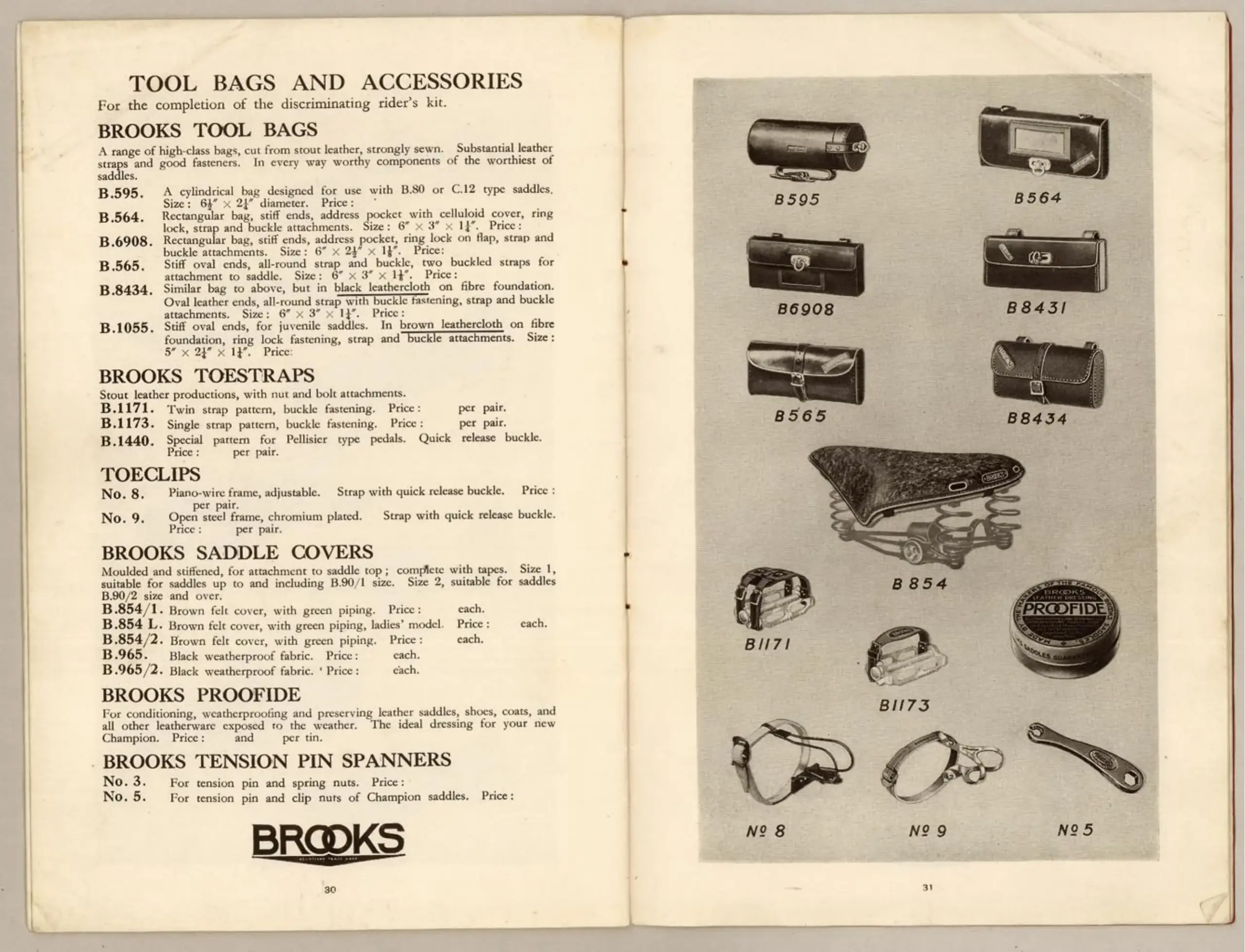
Use the right tool. The modern leaflet allows a tension spanner or an Allen key and Brooks sold the spanner itself: the 1933 and 1937 books both list a No. 3 spanner for the tension pin and spring nuts and a No. 5 for the tension pin and clip nuts of Champion saddles, priced in 1937 at tenpence and one and eightpence. The 1911 book had already explained why it matters, in a line that applies to the seat clip as much as the nose bolt: use an efficient spanner for adjustment, otherwise a lack of security will follow and the movement which results will inevitably damage the gripping surfaces of the clip.
On the Aged and Imperial models there is a second adjustment, and it is easy to miss. Both are delivered with a lace through the skirts, and Brooks says the lace should always be tied, to prevent premature sagging of the leather. An untied lace on an Imperial is a saddle spreading at the sides while the rider blames the nose bolt.
Brooks’ position, in both 1905 and today, is that comfort depends on saddle position to a much greater extent than is generally imagined and that the weight belongs on the broad part of the saddle rather than the nose. The modern three-point rule reads:
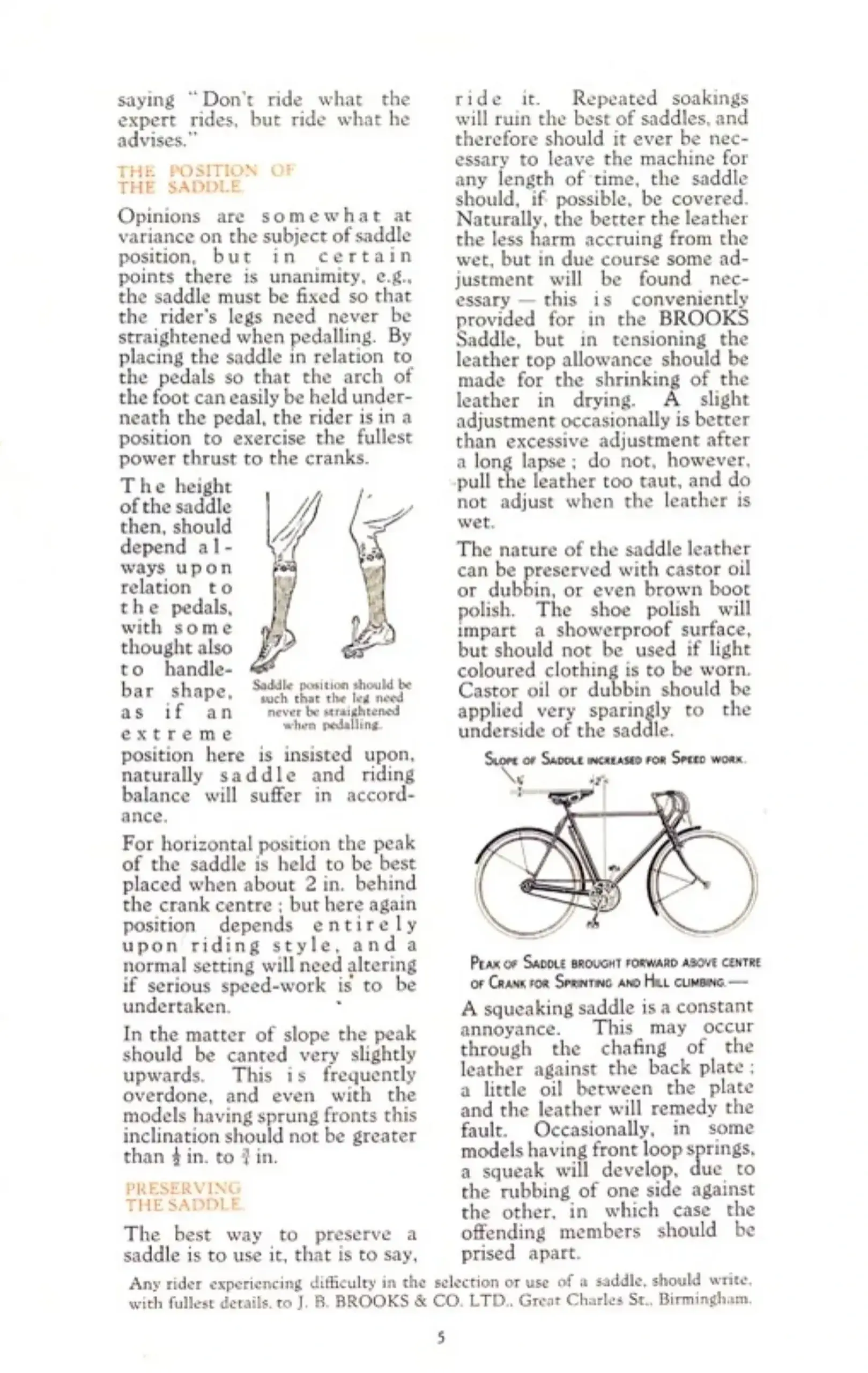
The period books put numbers on two of those, and the numbers are worth having. The 1927 book holds that the peak is best placed about two inches behind the crank center and that the peak should be canted very slightly upward, an inclination it says is frequently overdone and should not exceed half an inch to three quarters of an inch even on saddles with sprung fronts. Read next to the modern instruction to set the top parallel to the ground, that is a tolerance rather than a contradiction.
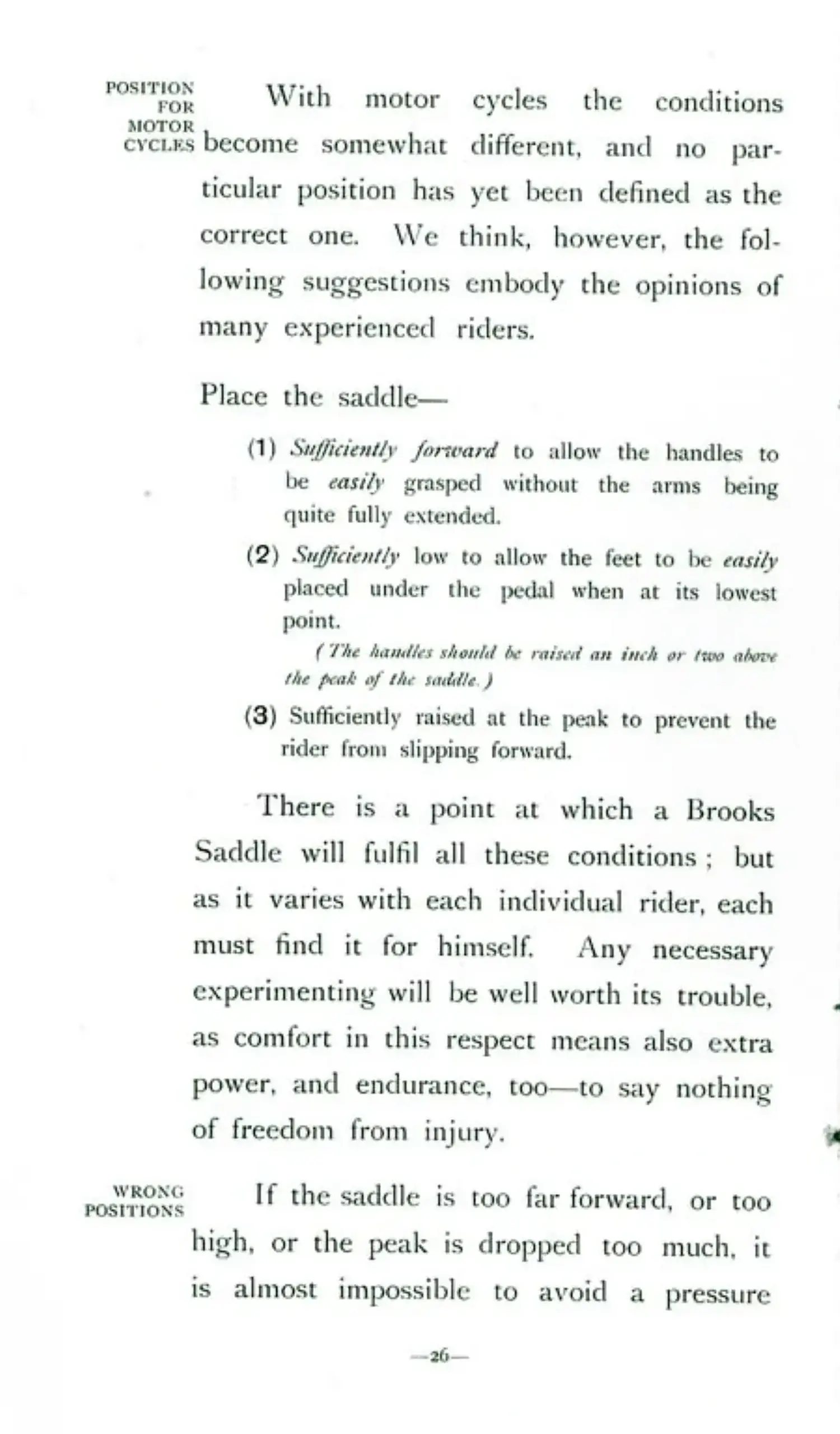
The Edwardian books add a caveat the modern leaflet drops and it is a good one: there is a point at which a Brooks saddle will fulfil all these conditions, but as it varies with each individual rider, each must find it for himself. The 1911 book turns that into an instruction — never take for granted that the position of the saddle is correct when the machine is delivered from the manufacturers, but experiment to find that which is most comfortable.
One hardware note that is genuinely a safety matter. Brooks makes saddles with single, double and even triple wire rails. A single rail model can be used with a micro-adjust seat post, but with double and triple rail saddles the clip provided should always be used, because it supports the saddle and rider correctly and prevents excessive stress on the rails. After any adjustment, check that the nuts on the clip bolt are firmly and equally tightened again, which is advice Brooks was already printing in 1911.
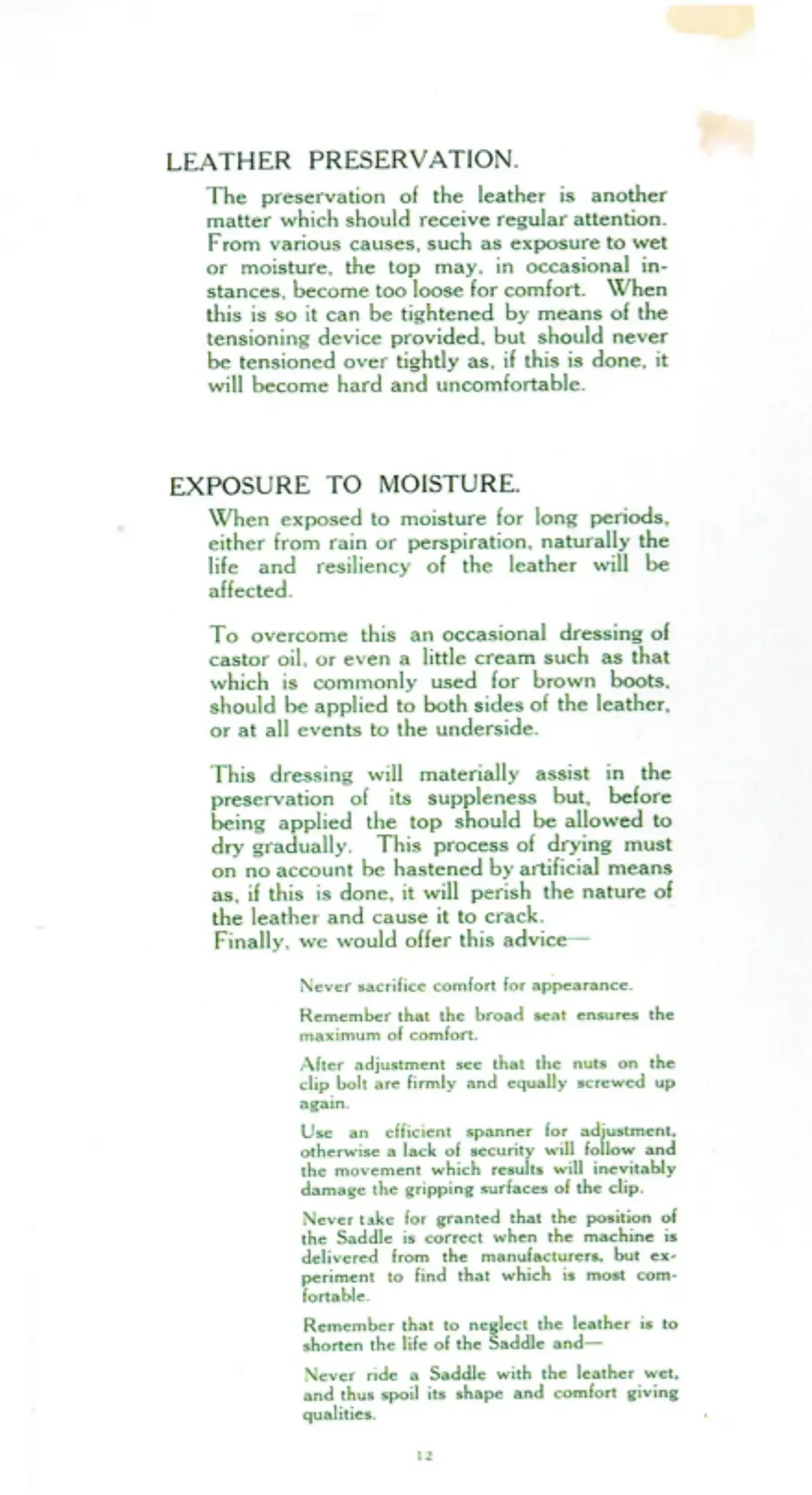
Leather and standing water are a poor combination, and Brooks’ advice is short. Protect the saddle from moisture with a cover. If it does get wet, allow it to dry naturally, away from direct heat. Do not tension it and do not dress it until it is dry.
This is the least contested part of the subject and the most often ignored. A saddle ridden hard while soaked, then tensioned to take up the resulting sag, is the classic route to a top that has stretched past recovery.
It is also the part the old books are most emphatic about, and they give a reason the modern leaflet does not. The 1911 book warns that drying must on no account be hastened by artificial means as, if this is done, it will perish the nature of the leather and cause it to crack. So a radiator, a hair dryer or a sunny windowsill is not a shortcut. Rather, it is the mechanism by which a saddle eventually cracks. The 1927 book adds the storage case: repeated soakings will ruin the best of saddles, so a machine left standing for any length of time should have the saddle covered if possible. Brooks sold a felt saddle cover for exactly this and the modern leaflet still tells you to use one.
A squeaking leather saddle is the most common complaint that is not a fault and it is the one riders most often try to solve with the tension bolt. It is almost never a tension problem. Brooks diagnosed it in 1927 and named two causes:
A squeaking saddle is a constant annoyance. This may occur through the chafing of the leather against the back plate; a little oil between the plate and the leather will remedy the fault. Occasionally, in some models having front loop springs, a squeak will develop, due to the rubbing of one side against the other, in which case the offending members should be prised apart.
Both remedies are still sound on a vintage saddle and both are worth trying before anything is tightened. The first is a drop of oil where the leather meets the cantle plate, not a dressing of the whole top. The second applies only to sprung models and it is a gentle spreading of two springs that have come to touch, not a lever job. On a modern saddle a squeak more often comes from the rails at the clip, so check the clip bolt before you go near the leather.
Search for Brooks care and you will find neatsfoot oil, mink oil, saddle soap, dubbin, leather conditioners of every kind and a persistent school of thought that recommends soaking a new saddle to speed the break-in. None of these is Brooks’ advice today. The company’s position is the single sentence quoted above: Proofide is the only substance that should be used.
That does not make every alternative worthless and riders have had good results with some of them for decades. It does mean they are folk practice and they carry a shared risk: oils and soaks soften the leather, and a Brooks top that is too soft sags early and cannot be un-sagged. The tension bolt will not save it, because the bolt has a finite travel and softened fibers will simply stretch again. Soaking a saddle is the worst of them, because it combines the softening with the one thing every Brooks book from 1911 onward warns against.
There is a wrinkle here worth knowing, because it cuts against the modern line and it can be dated. Brooks used to recommend other dressings itself, by name, for at least a quarter of a century. Read in order, the books in the Ebykr archive show the advice narrowing:
Here is the 1904 and 1905 passage in full:
All harness, or other leather subject to strains and exposure, receives a certain amount of dressing to keep it in good condition, and a saddle should be no exception. A small quantity of dubbin, or even a little cream, commonly used for brown boots, may be occasionally applied on both sides of the leather, or, at all events, on the underside.
So the honest position is that Brooks’ advice narrowed across the century, from a general dressing regime to a single proprietary product, and it narrowed alongside the arrival of that product rather than in advance of it. That is not a reason to ignore the modern instruction, which reflects the leather Brooks tans and sells today and is the only advice tested against it. It is a reason to be wary of anyone who tells you a dressed saddle is a ruined one, or that a vintage saddle treated with dubbin in 1930 was mistreated. It was treated exactly as its maker advised. Follow older practice knowingly if you choose to, rather than because a forum described it as what Brooks recommends now.
Brooks distinguishes between repairs an authorized bicycle mechanic can carry out and those that need Brooks craftsmen and it asks that repairs go through a mechanic rather than the rider, for safety reasons. Spare parts are listed on the company site and there is a point worth knowing before you write a saddle off:
Not every failure can be repaired, but if the leather top of your saddle is formed and in good condition, chance are [sic] we can save you the cost of buying a new saddle and breaking in a new top.
A broken rail or a cracked cantle plate on a saddle whose top has taken your shape over 10 years is a repair worth pursuing, not a reason to start again.
Current saddles carry a two year guarantee against defects in manufacture or materials, extended to 10 years on registration. Brooks excludes claims arising from crashes, accidents and poor maintenance, and names under-tensioning explicitly among the latter.
While you have the saddle upside down, you will probably notice a short code stamped into the leather. Brooks’ own guarantee text describes it as the production lot, a three digit code in the sequence: number, letter, number. Brooks asks for it when you register a saddle.
It is very widely read online as a date and it is not described that way by Brooks. That distinction matters enough to have its own treatment, so it is covered in the companion guide to identifying and dating a Brooks saddle rather than here.
For the story of the company behind all of this, read Brooks England: The Eternal One and its timeline. For what a given model is and when it was made, the Brooks Saddle Database and Model Guide carries several hundred models with catalog citations, and the dating guide sits alongside the rest of the Identify and Date series.
Every catalog quoted above is in the Ebykr Catalog Archive, page by page and searchable, so you can read the care instructions in the book rather than take them from this page. And if you have a method that has worked on a saddle for 20 years, the Brooks forum topic is the place to put it, particularly if you can say what model the saddle is or was and how old.
Brooks England Ltd. — Leather Saddles: Product Information & Guarantee (maintenance and care leaflet supplied with current saddles), Ebykr collection
Brooks 1904 catalog, Cycle Saddles and Accoutrements, printed pages 26 and 38, in the Ebykr Catalog Archive
Brooks 1905 catalog, Cycle and Motor Saddles, Seats and Accoutrements, printed pages 24, 25 and 40, in the Ebykr Catalog Archive
Brooks 1911 catalog, The Brooks Book, Cyclist’s Edition, printed pages 12, 13 and 14, in the Ebykr Catalog Archive
Brooks 1927 catalog, The Brooks Book, printed page 5, in the Ebykr Catalog Archive
Brooks 1932 catalog, The Brooks Book of Cycle and Motor Cycle Saddles and Equipment (List No. 158), printed page 23, in the Ebykr Catalog Archive
Brooks 1933 catalog, Saddles and Riding Kit (List No. 168), printed pages 30 and 31, and Brooks 1937 catalog (List No. 247), printed pages 38 and 39, in the Ebykr Catalog Archive
Brooks 1950 leaflet, The Finest Saddle in the World, in the Ebykr Catalog Archive
Brooks England
Brooks catalogs and marketing materials, 1890 through 1959, from the Ebykr collection
 Brooks
Ebykr documents this marque across the archive. Here is the rest of it.
The Ebykr Digest
New articles, timelines, catalog finds and registry activity — assembled from the archive once a month. Your address is never shared.
Double opt-in. One email per month. Unsubscribe at any time with one click.