About Ebykr
Ebykr celebrates classic and vintage lightweight bicycles through provocative imagery and opinion. Ride along with us.
About Ebykr
Ebykr celebrates classic and vintage lightweight bicycles through provocative imagery and opinion. Ride along with us.

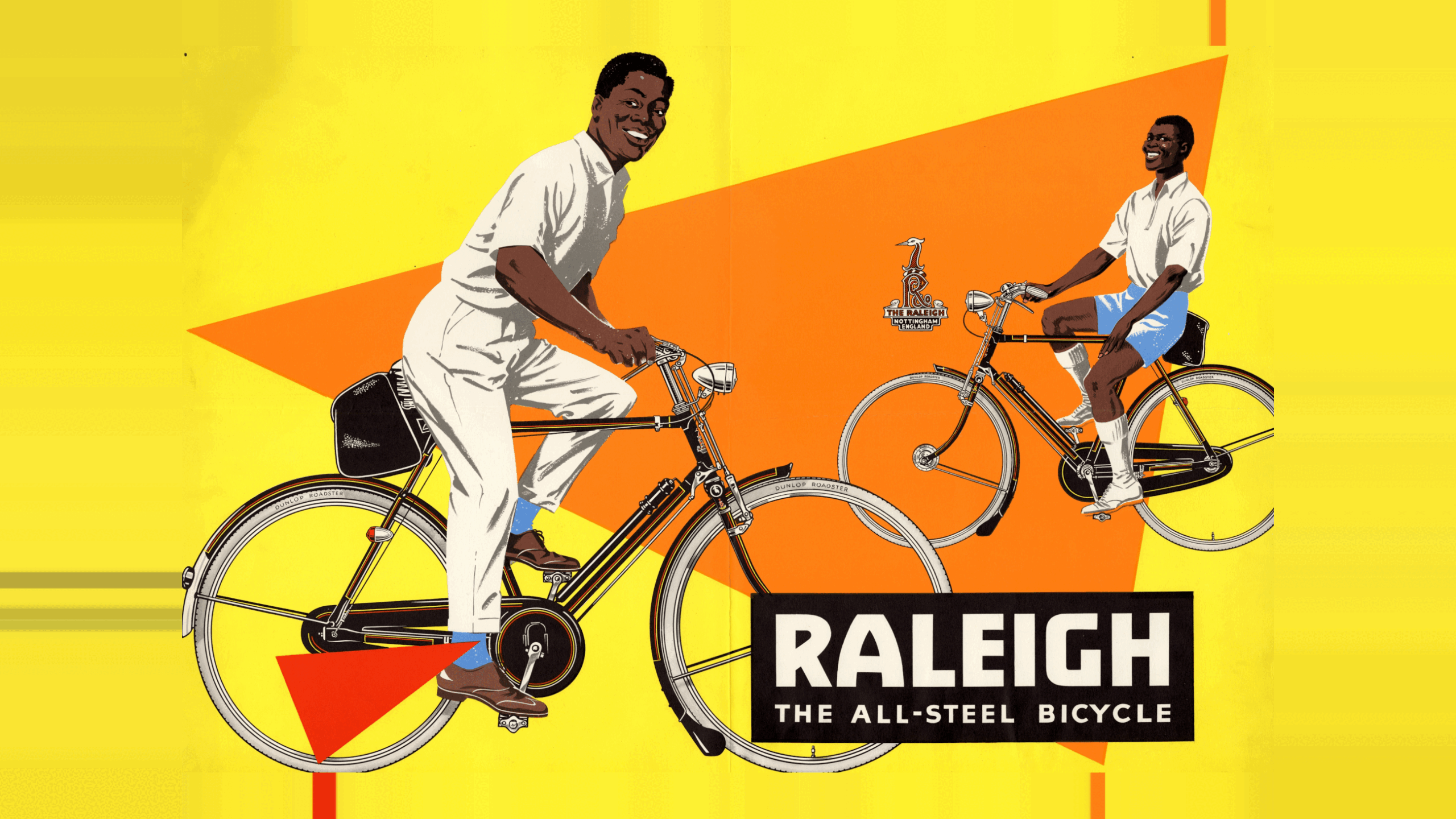
Raleigh went from a twelve-person workshop on a Nottingham back street to the largest bicycle manufacturer in the world, and from there to a brand owned by a Dutch group under lender control. This is the full arc: Sturmey-Archer and the three-speed empire, the export trade, the Moulton fight, the Chopper, the four-man Ilkeston workshop whose frames won the 1980 Tour de France, and the long unwinding that ended manufacturing in Nottingham.

For most of the 20th century, Raleigh was not simply just another bicycle company. It was the bicycle company: the largest maker in the world, the industrial heart of a British city and the badge on more “first bikes” than any other marque has ever managed. At its production height, the Nottingham works covered 75 acres and employed 1,000s of craftspeople. Raleigh built the machine that carried munition workers to their shifts in 1918, the three-speed roadster that colonized half the world, the Chopper that defined a British childhood and the frames that won the Tour de France. Today, the Raleigh name belongs to a Dutch group in the hands of its lenders and no bicycle has been built in Nottingham for more than 20 years.
That historical arc — workshop to empire to brand — is worth following carefully, because Raleigh’s story is really the story of the bicycle industry itself. Almost every force that shaped cycling in the 20th century passed through Nottingham: mass production, patent gearing, export trade, wartime conversion, the motor car’s long shadow, the fashion cycles of the 1970s, the mountain bike and finally the migration of manufacturing to Asia. What follows is a chronological account of how it all went down at Raleigh, and what little remains today. Familiar as these words may sound to us here on Ebykr, the Raleigh story remains distinct enough for one to appreciate on its own merits, if for no other reason than to size up the fullness of their industrial scale when the company was at its peak.
Spoiler alert: big. Really big.
The premises that first gave Raleigh its name were modest to the point of obscurity. In 1885, Richard Morriss Woodhead and a Frenchman named Paul Eugène Louis Angois set up a small bicycle workshop on Raleigh Street in Nottingham. William Ellis joined the partnership in 1887, and the firm traded as Woodhead, Angois and Ellis. Between roughly a dozen people, they turned out some three machines a week in those earliest days. Building bikes from scratch must have been very labor intensive work given these inefficient-seeming numbers, even as compared to other handmade builders just a few decades later.
Enter one Mr. Frank Bowden. The story Raleigh has told about itself for more than a century is that Bowden, a lawyer and businessman who had made a considerable fortune in Hong Kong, returned to England in poor health and was given six months to live. His doctor advised cycling as a cure. Bowden bought a machine from the Raleigh Street workshop, recovered and was impressed enough to buy into the company that had built it. The six month detail is company legend rather than documented medical history, but the essential facts hold up either way: Bowden was a genuine convert who toured France, Italy and England by bicycle in 1887 and 1888, and he put his money where he attributed his recovery came from.
The company’s founding date deserves a note here, because sources disagree and the disagreement is not trivial. Raleigh’s own corporate history has long dated the company to 1887. Grace’s Guide and the Nottinghamshire Archives record that Bowden approached the partners in the autumn of 1888, acquired the enterprise in December 1888 and registered it as a limited liability company in January 1889 with £20,000 of nominal capital. The 1885 workshop date is not in dispute. Where this article gives a year for the company’s formal establishment, it follows the archival (not company) record.
What came next happened extraordinarily fast. Bowden bought out neighboring premises through the early 1890s, and in 1896 and 1897 Raleigh moved into a purpose-built factory of 7.5 acres on Faraday Road in Lenton, on the Radford side of Nottingham. The newly public company employed around 850 workers and produced more than 30,000 bicycles a year, which made it the largest bicycle manufacturing plant in the world. By 1913 Raleigh was, by its own reckoning and most others’, the biggest bicycle manufacturer anywhere, production facilities aside.
Raleigh’s second fortune was neither a bicycle nor a manufacturing breakthrough. It was just a hub. A very special hub, it would turn out.
The epicyclic three-speed hub gear that would carry the Sturmey-Archer name was not invented at Raleigh. The critical design work belonged to William Reilly, whose patents Frank Bowden acquired and backed. The name itself came from two other men entirely: Henry Sturmey, the cycling journalist and editor, and James Archer. Bowden formed the Three-Speed Gear Syndicate in the early 1900s — Grace’s Guide dates it to 1903, while other accounts put the founding of Sturmey-Archer itself at 1902 — and the hub went into production under Raleigh’s considerable wing.
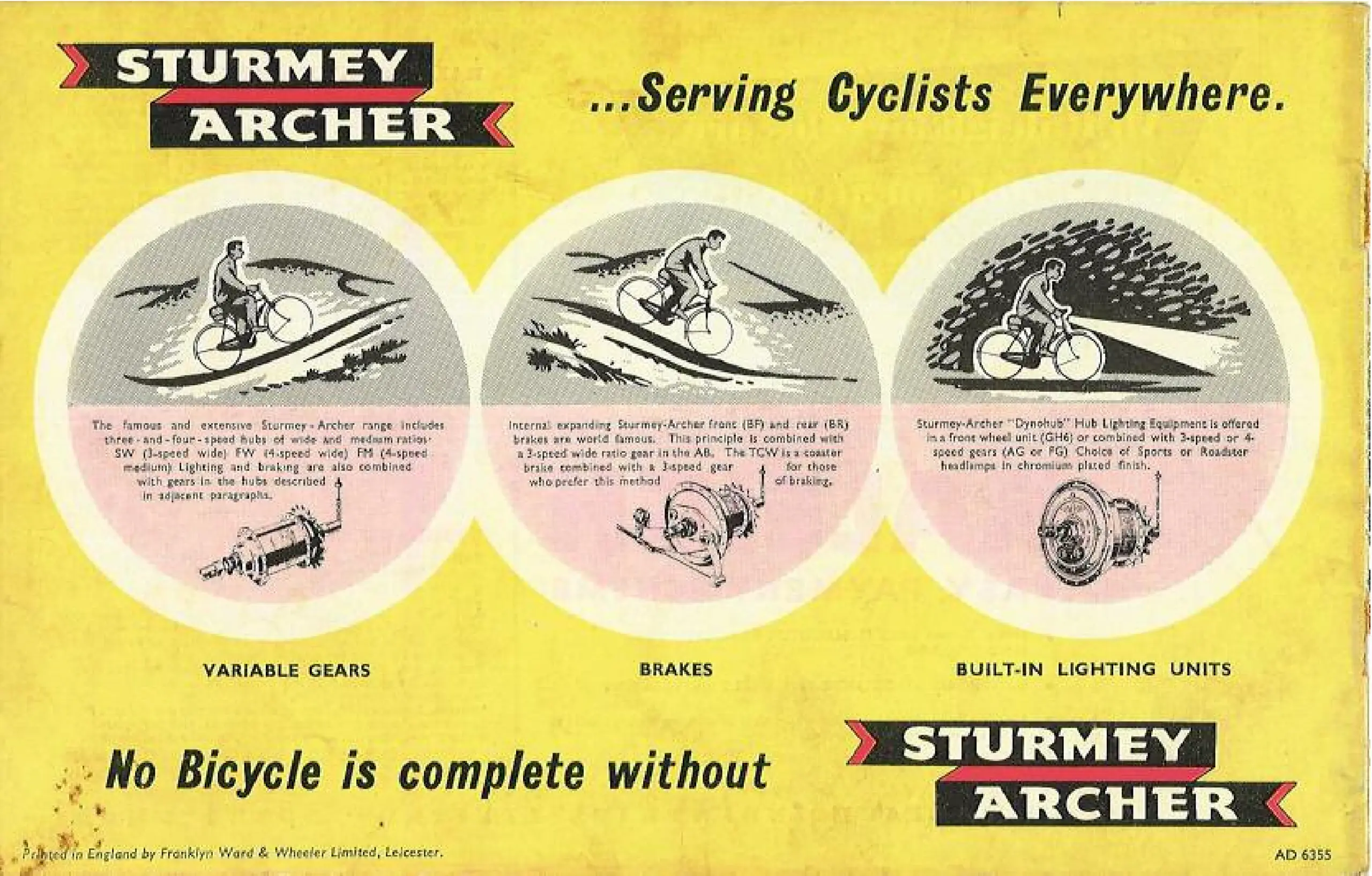
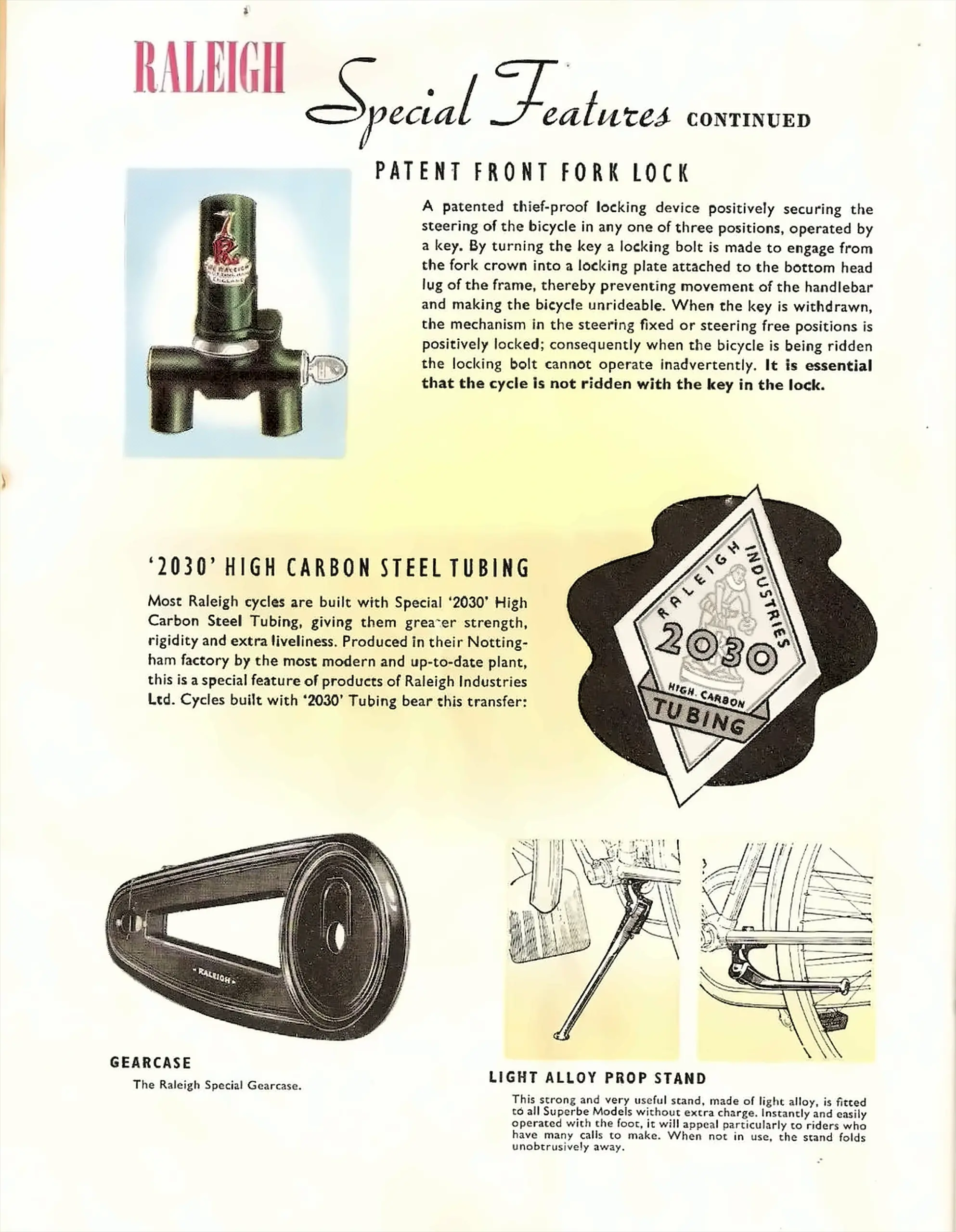
It is difficult to overstate what this did for the company. A three-speed hub is sealed, nearly maintenance-free by the standards of the day, and utterly unbothered by rain, mud or neglect. It made a heavy roadster usable on hills by riders who had no interest in mechanics. Raleigh owned it, fitted it as standard and sold it to everyone else as well. For the next 70 years, the Sturmey-Archer hub was the default transmission of the practical bicycle across the English-speaking world, and its AW model, introduced in 1938, became one of the longest-lived bicycle components ever made. Head mechanics have feared its innards ever since, which is rather the point: it was designed so that the rider never had to look inside.
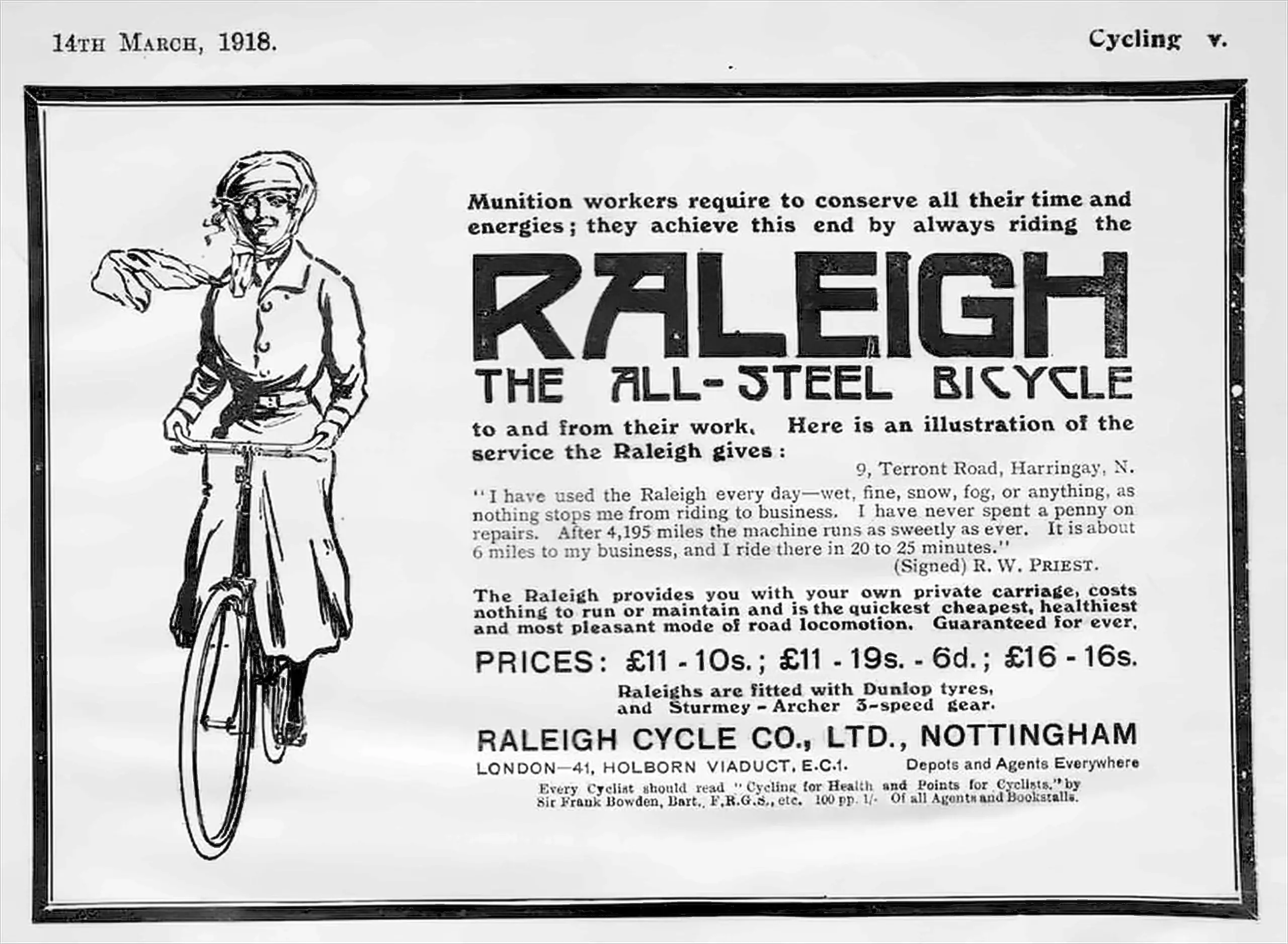
The 1918 advertisement above is worth reading closely. It is addressed to munition workers, it quotes a testimonial from a customer in Harringay who had covered 4,195 miles without spending a penny on repairs, and it names Sturmey-Archer three-speed gear as standard equipment alongside Dunlop tires. It also signs off with a book by “Sir Frank Bowden, Bart.” — the workshop backer of 1888 had become a baronet. The bicycle in the illustration is being ridden by a woman, which was not decorative: the war had put women into factories, and Raleigh was selling them transport.
The interwar years were, counterintuitively, good ones for Raleigh. The Depression hit British industry and export sectors hard, but a cheap, durable bicycle is a recession-proof product in a way that a motor car is not. Raleigh continued to profit. In 1932, it acquired the trademarks of Humber, one of the great names of the Victorian cycle trade, and in 1934 Raleigh Cycle Holdings Co Ltd was formed and floated publicly.
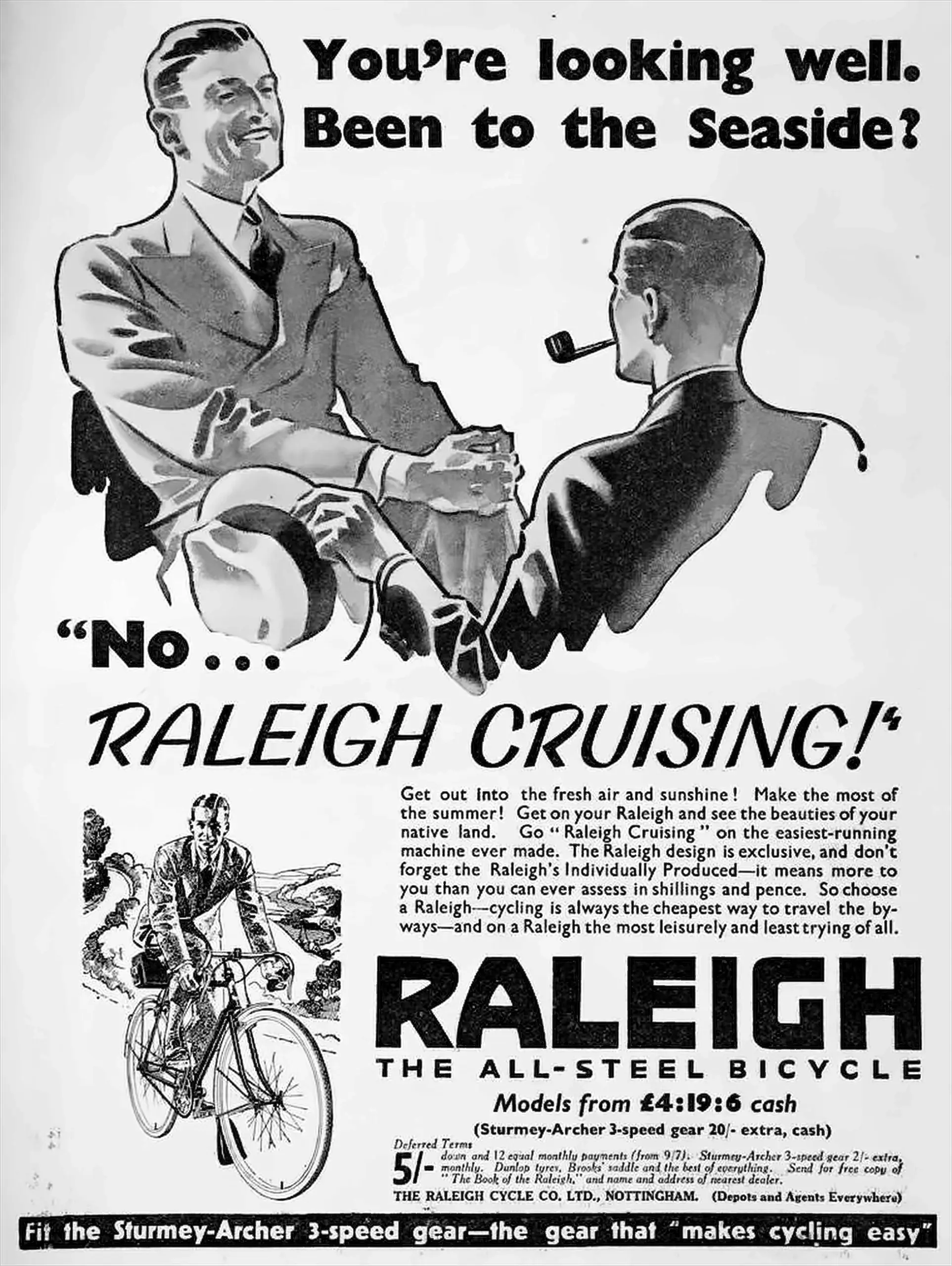
Raleigh also spent the decade flirting with engines. It had built motorcycles before the First World War, and in 1930 it acquired the rights to the Ivy Karryall and produced the Safety Seven, a three-wheeled car. The venture was not a success, and one of its afterlives is a decent pub-quiz answer: T. L. Williams took what remained of the three-wheeler business to Tamworth and founded Reliant. Grace’s Guide records that Raleigh ended car and motorcycle production in 1936, after which the company turned its full attention back to pedal power.
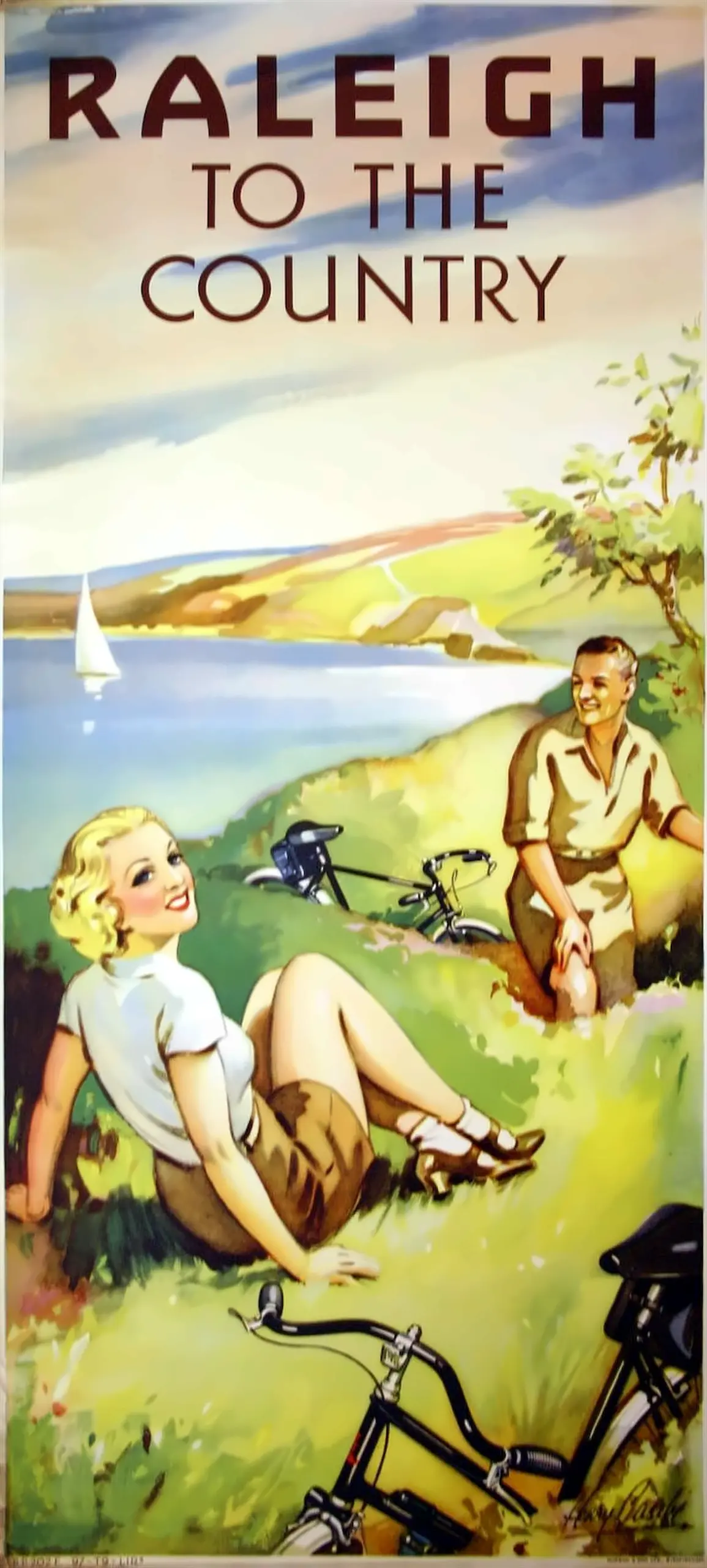
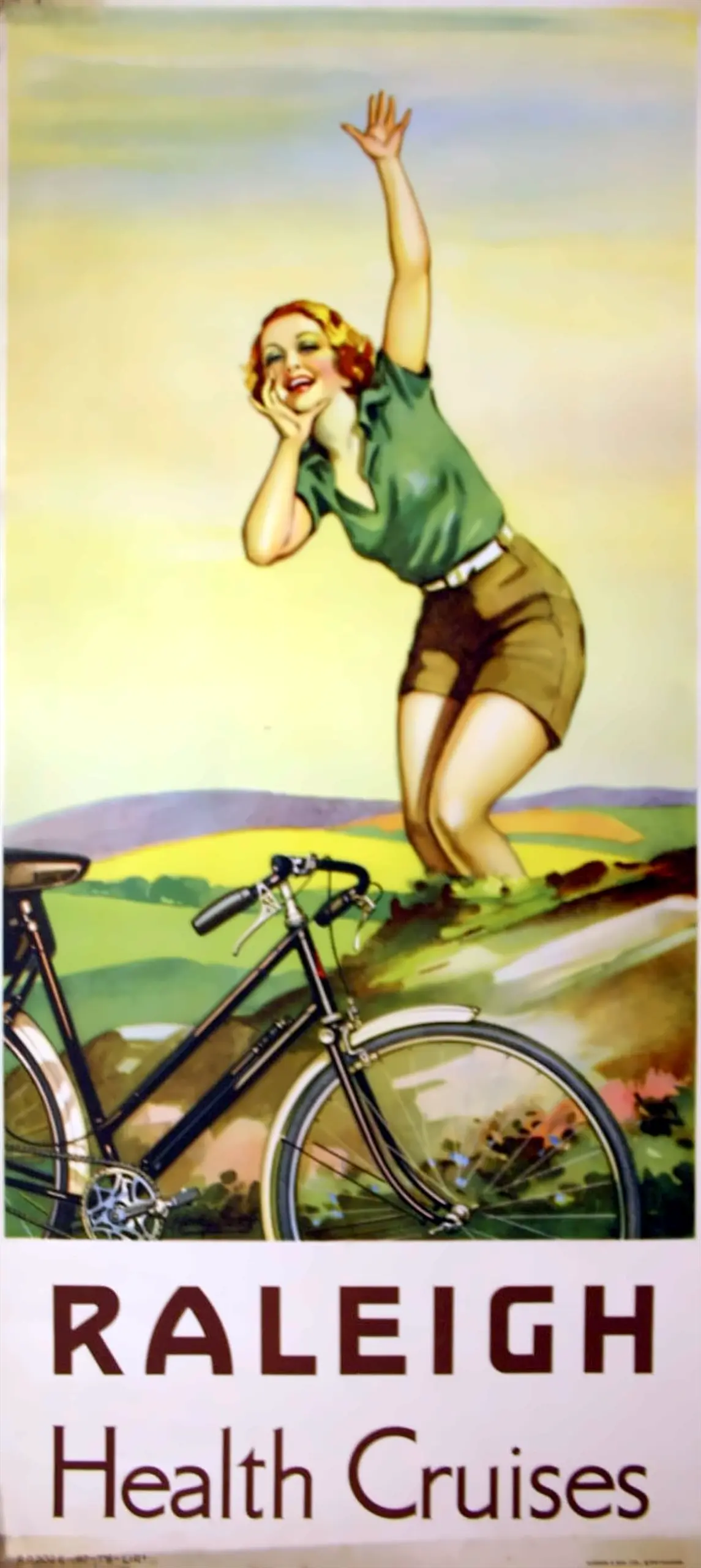
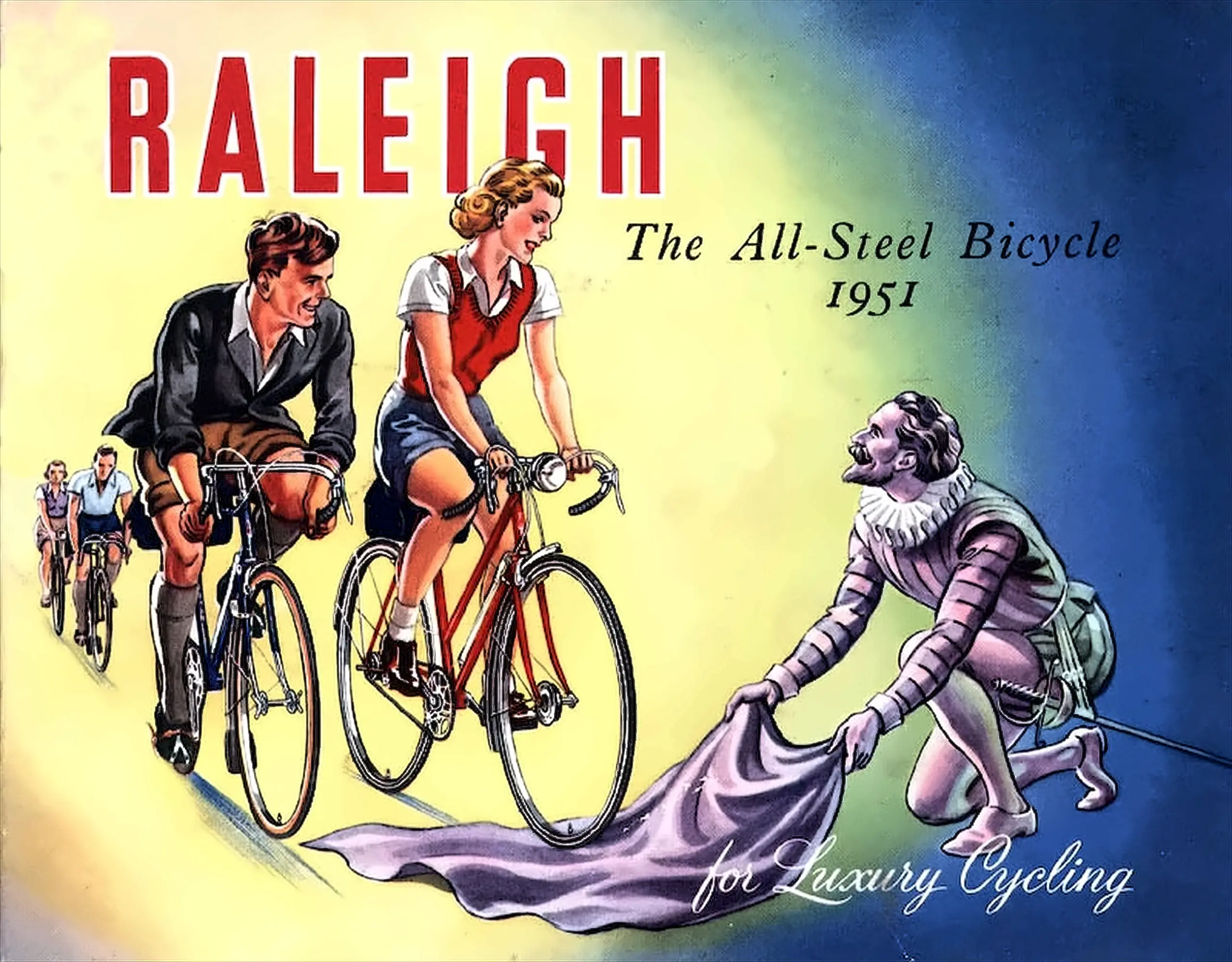
Meanwhile, the export trade was becoming the quiet engine of the business. Raleigh roadsters went out to India, to South East Asia, to the Caribbean and above all to Africa, where the All-Steel Bicycle became a piece of infrastructure. The advertising produced for those markets was some of the most striking commercial art the industry ever commissioned.
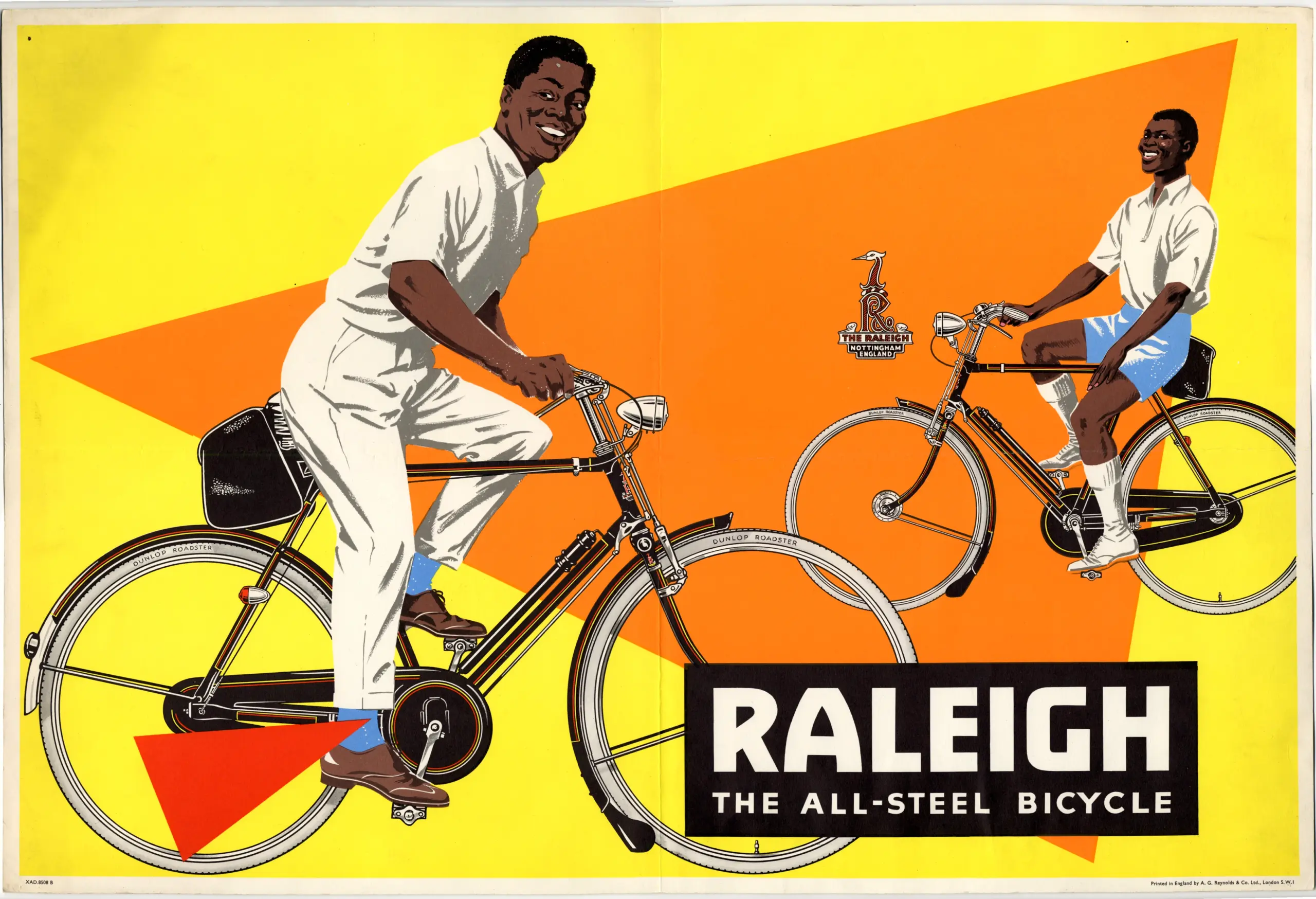
The Second World War turned the Nottingham works over to munitions, as it had a generation earlier. What followed the war was, for a while at least, the best trading period Raleigh ever had. Britain was short of fuel, short of currency and desperate to export. A bicycle needed no petrol and earned dollars. Raleigh pushed production hard and reached an annual export figure approaching 750,000 machines, a level it then sustained well into the 1950s.
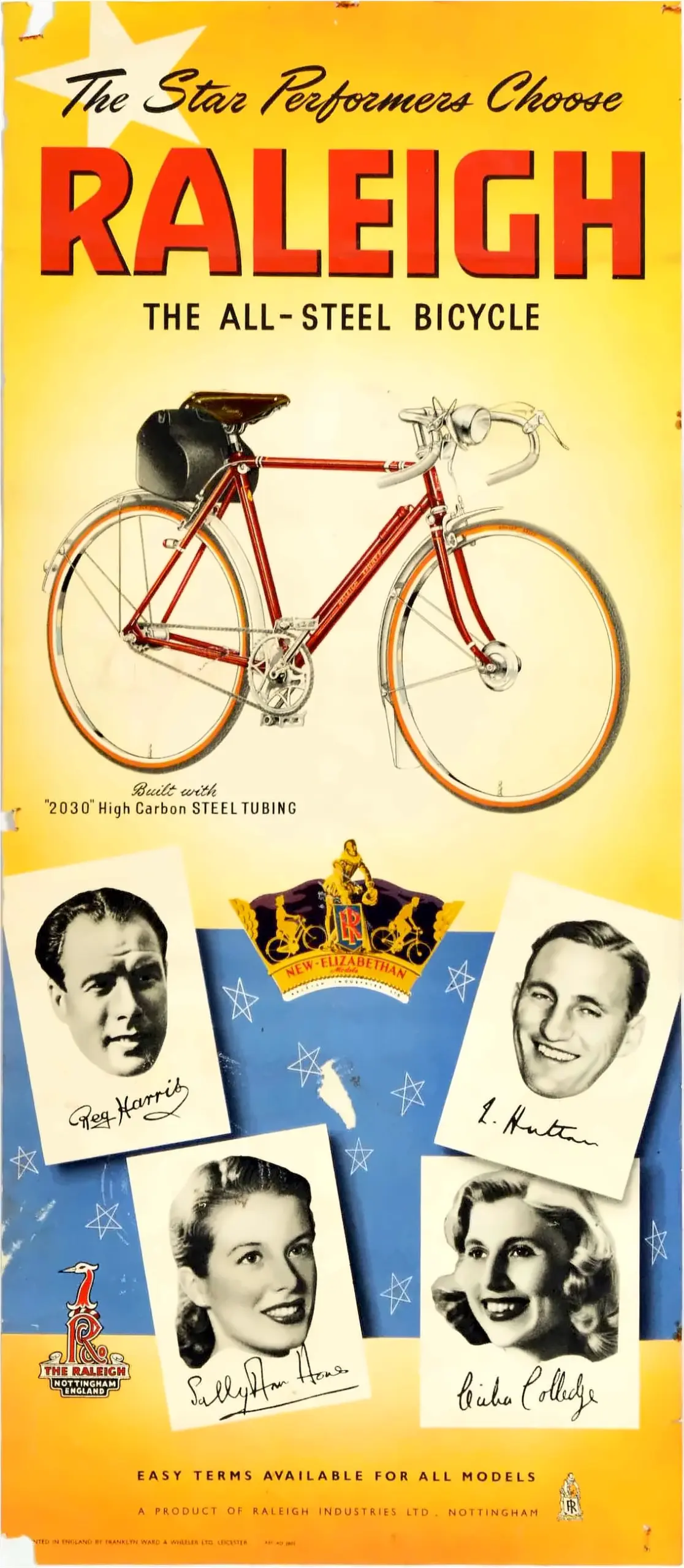
Then the market turned, at least for Raleigh.
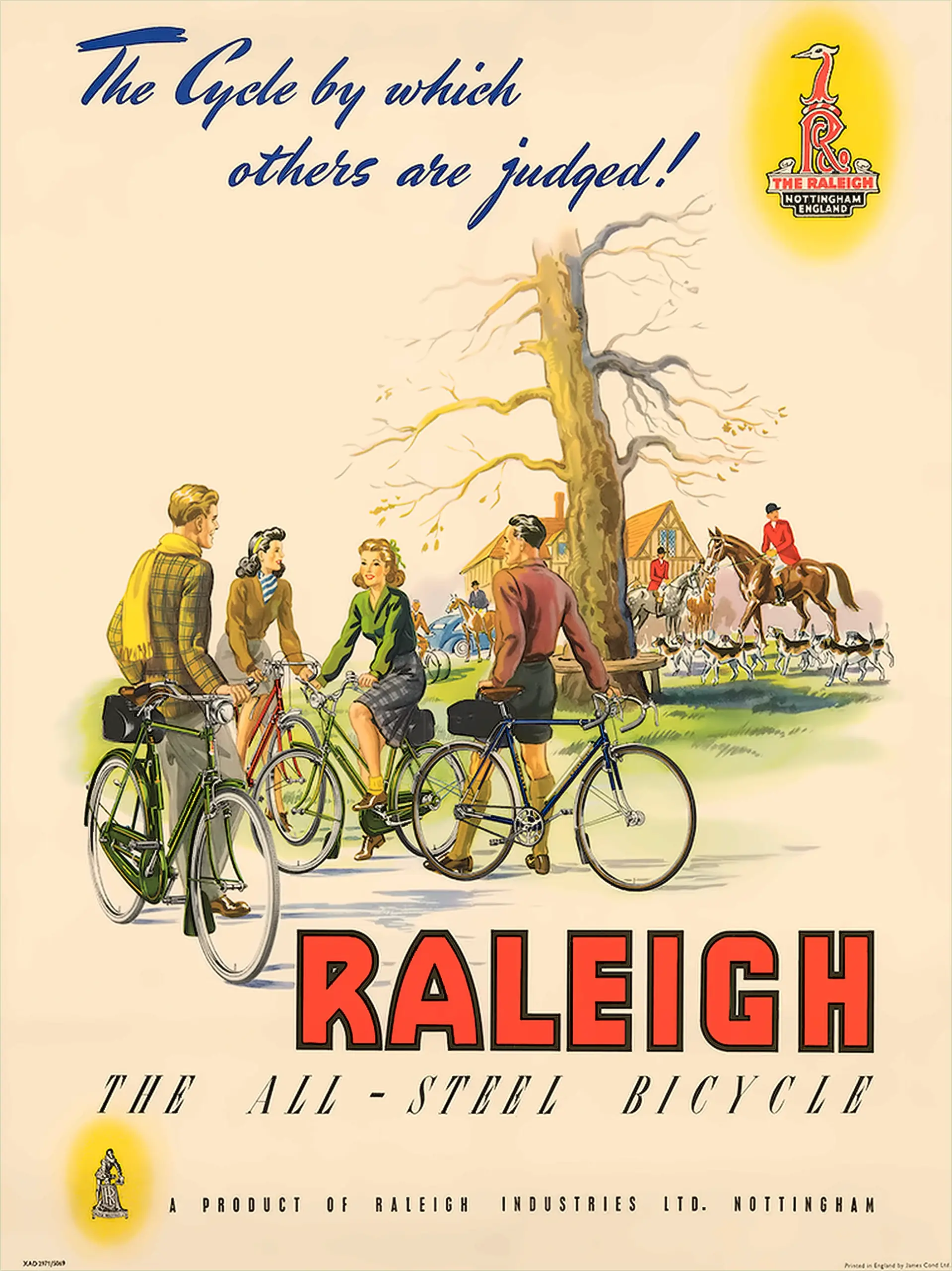
Rising prosperity in Britain and North America put the working population into cars and onto buses, and the utility bicycle — Raleigh’s core product for 60 years — stopped being a necessity for most. Predictively, sales fell sharply. The company’s response was to reach for engines again, building mopeds and motor scooters through the second half of the 1950s. The pivot did not work, though, and by the end of the decade Raleigh was in real trouble.
The Raleigh story so far is that of roadsters, and it would be easy to conclude that the marque built nothing a club cyclist would want until it bought Carlton in 1960. That is not true, and the exception matters a great deal to us aficionados.
Raleigh introduced a quality lightweight called simply the Record around 1931, and the advertising for it is startlingly technical for a company whose reputation rested on gearcases and hub gears. It sells molybdenum-chrome steel tubing, round tapered seat stays, chainstays and fork blades, a radial-spoked front wheel and brazed-on mudguard eyes — the vocabulary of the lightweight trade, not the department store in which roadsters were sold.
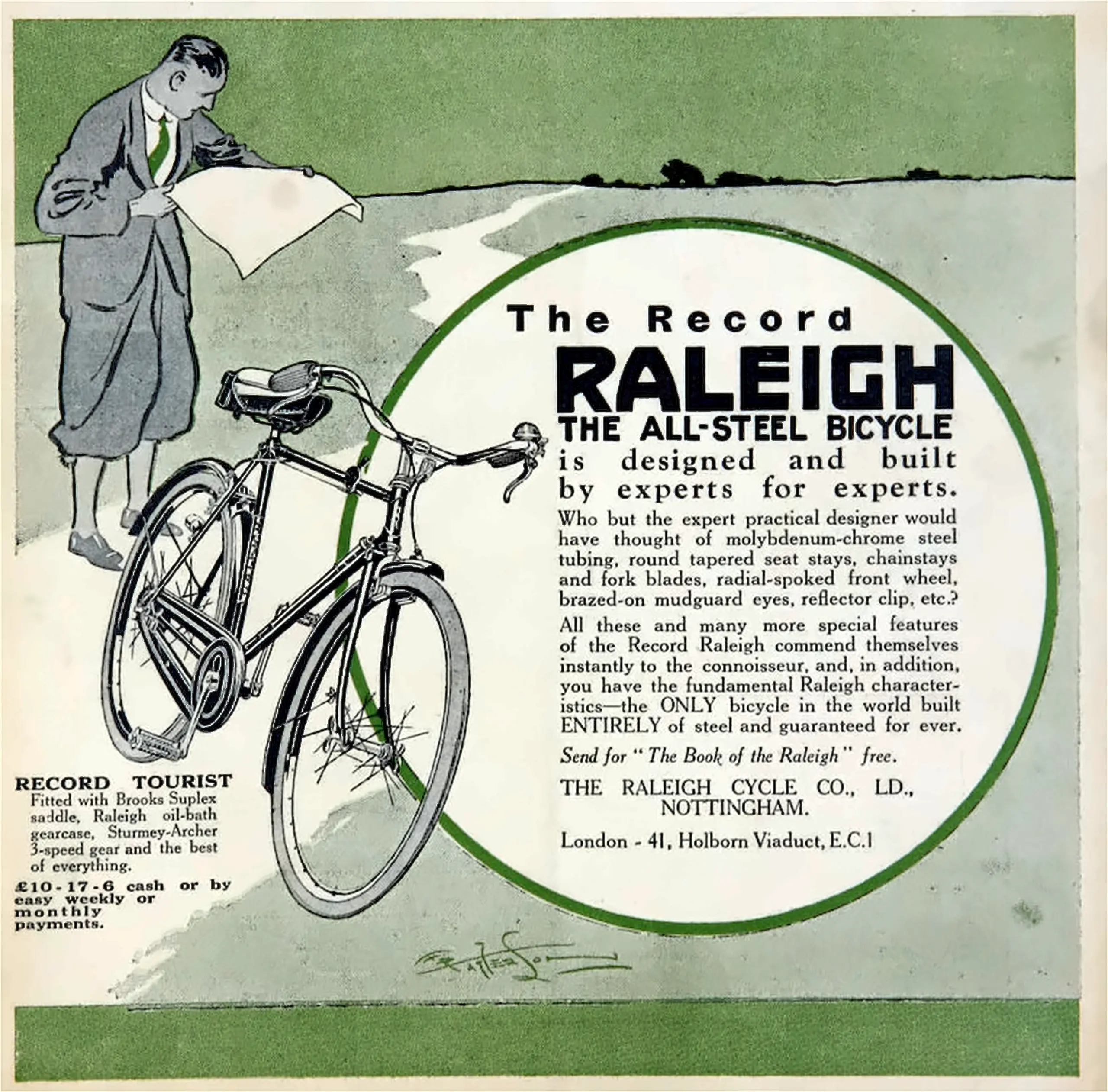
In November 1933, for the 1934 model year, Raleigh turned out an even better version of the Record: the Record Ace, known ever since by its initials, the RRA. The pre-war RRA used a 22-gauge chrome-molybdenum main triangle with Reynolds HM — high manganese, the forerunner of 531 — in the rear triangle and fork blades. It listed at £9 10s against the standard Record’s £7 17s 6d, rising to £9 15s by 1938 and £10 19s 6d by 1940. The 1934 machine kept the old 67-degree frame angles; from 1936 they went to a far more modern 71 degrees parallel.
It earned its name. The RRA became indelibly associated with the British record-breakers of the late 1930s — Sid Ferris, Bert James, Charles Holland and Tommy Godwin among them — and several of the road records set on it stood for decades. Pre-war production ran until October 1942, when Raleigh withdrew its sporting models from civilian manufacture for the duration.
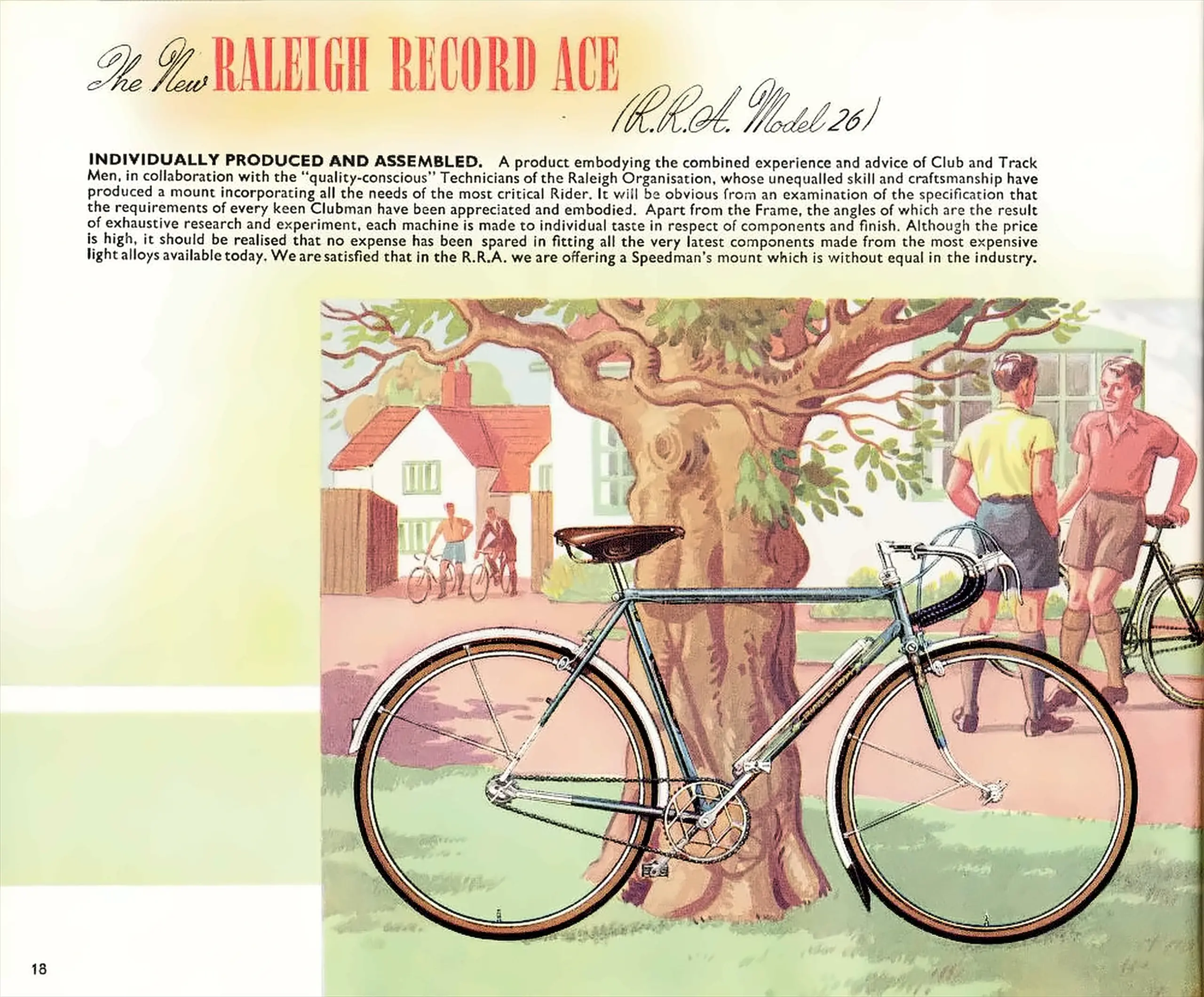
The RRA returned after the war, now on Reynolds 531 through the main triangle, stays and forks, and the 1948 catalog copy is worth reading as a statement of intent from a company otherwise selling three-speed roadsters by the 100,000. The machine is “individually produced and assembled.” It embodies “the combined experience and advice of Club and Track Men.” Each one is “made to individual taste in respect of components and finish.” And the price is high, which the catalog says out loud rather than hiding. Most surviving examples date from 1947 to 1949, which suggests the post-war run started hard and tailed off.
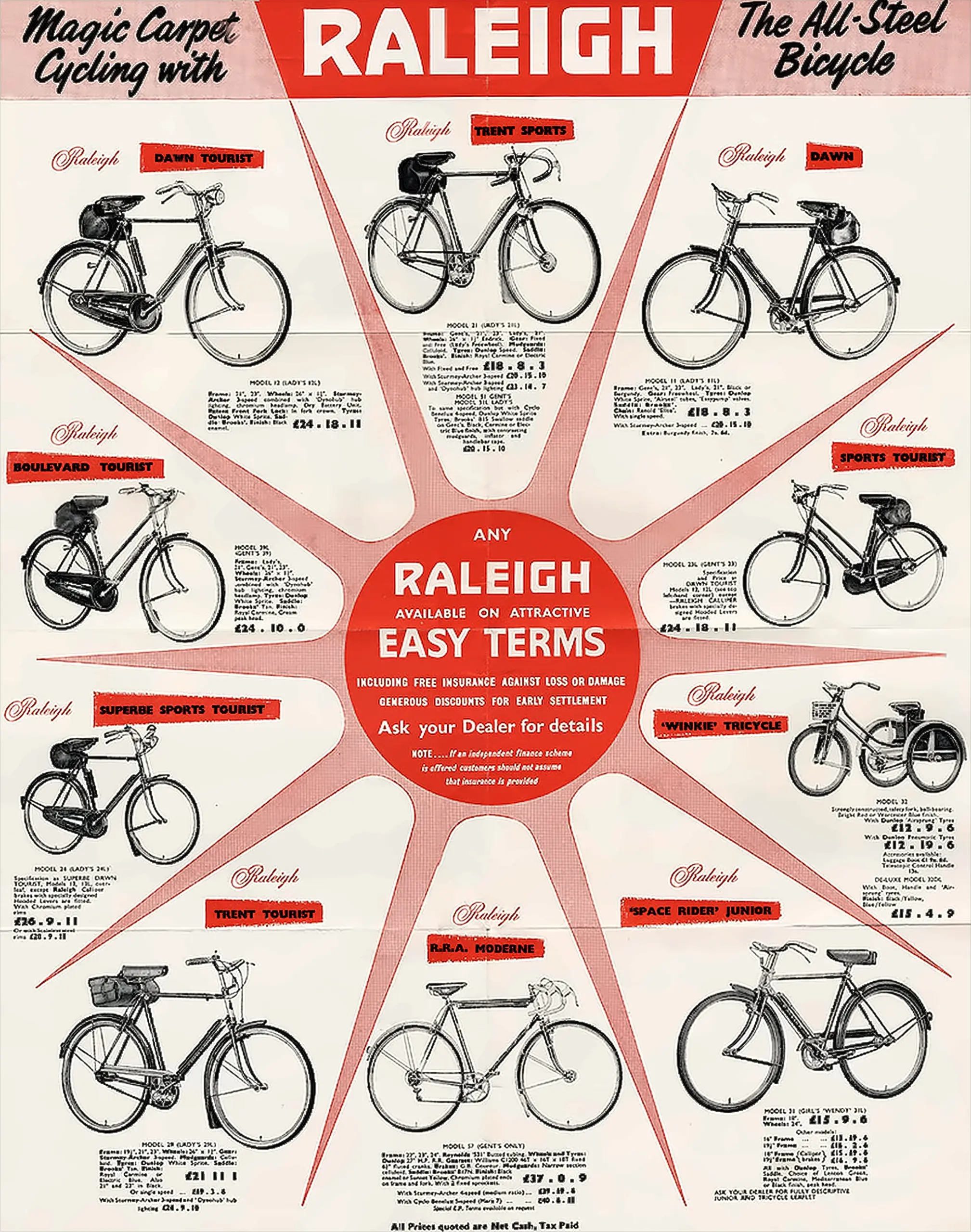
The name survived into the late 1950s as the R.R.A. Moderne, and the 1958 range sheet above places it exactly where it belonged in the business: at £37 0s 9d it was the most expensive thing Raleigh sold, several times the price of the roadsters around it, and it shared the same page with a child’s tricycle. This paradox represents the whole tension of the company in one marketing fold-out. Raleigh could build a machine that record-breakers rode, but the real money was in the Dawn Tourist at £24 18s 11d on attractive, easy terms.
Understanding the RRA also explains what Carlton was actually for. Raleigh did not lack the ability to build a lightweight. What it lacked, by 1960, was a way to build them in small numbers, to changing specifications, without disrupting a factory geared to volume production. Buying a specialist did that — and 14 years later the same logic produced Ilkeston.
The way forward was through consolidation, and Raleigh consolidated ruthlessly. In 1954, it acquired the share capital of the Triumph Cycle Co. In 1957, it bought BSA Cycles Ltd, BSA’s bicycle division, which brought the New Hudson and Sunbeam marques along with it. Between them, these two deals removed Raleigh’s closest domestic competitors and left the company producing something like 80% of all bicycles made in Britain.
This is the point at which the popular telling of Raleigh’s history usually goes astray, so it is worth being precise here on Ebykr. Raleigh did not “join forces” with Tube Investments as an equal. In 1960, Tube Investments acquired Raleigh outright and merged its own British Cycle Corporation — which held Hercules, Phillips, Norman and Sun — into the Nottingham business. Raleigh became the cycle division of a large industrial group, and the group’s initials would in time appear on the most famous racing jerseys the company ever featured in a peloton. In that same year, Raleigh acquired Carlton Cycles, a small specialist race-bike builder based in Worksop some 45km away by motor car. Carlton mattered enormously to what came later, which we will return to shortly.
The scale of the resulting brand portfolio explains a great deal about the badges that turn up on old British bicycles. A machine wearing a Rudge-Whitworth, Humber, Hercules, BSA, Triumph, Phillips, Robin Hood, Sunbeam or Carlton headbadge from the 1960s onward is, more often than not, really a Raleigh.
In 1962, the engineer Alex Moulton launched a genuinely radical bicycle: a unisex open frame, 16″ wheels, and full front and rear suspension. It was a serious piece of design thinking, it sold well and it embarrassed Raleigh a great deal, which offered nothing like it.
Older accounts of this episode, even including an earlier version of this article, credit the resulting Raleigh to “Dave Moulton.” That is a conflation of two unrelated people. Dave Moulton is a respected British frame builder who worked in England and later California. He had nothing to do with the small-wheeled bicycle in discussion here. The actual designer was Alex Moulton, and — critical to a truthful accounting of this historical release — Raleigh’s small-wheeler was not a version of his machine at all, but rather a rival built to beat it.
In June 1964, Raleigh sought a production license from Moulton. Talks ran into the autumn season and covered several possibilities, including Raleigh buying the Moulton operation outright or selling Moulton bicycles through its pervasive network of dealers. None of that happened. Instead, in July 1965, Raleigh launched the RSW16 behind £100,000 of publicity, an enormous sum at the time for promoting the release of a bicycle, let alone one with a radical new design. The RSW had a rigid frame and sidestepped Moulton’s suspension patents by using a 16″ × 2″ balloon tire to soften the ride, at the cost of considerable rolling resistance. The Raleigh was slower and less clever than the Moulton. It was also cheaper, looked the part and worked well commercially. The RSW ran to Mk II and Mk III versions, and sold more than 100,000 units over a nine-year life through 1974.
The competition damaged both firms initially and Raleigh bought Moulton Bicycles in 1967. The following year came the Raleigh Twenty, a simpler small-wheeled machine with caliper brakes, a kickstand and a pump, and it turned into the volume seller the company had been chasing in that market segment. Alex Moulton later returned to independent production and the design he originated is still made in Bradford-on-Avon.
No Raleigh is more famous than the Chopper. And none is more argued over, either.
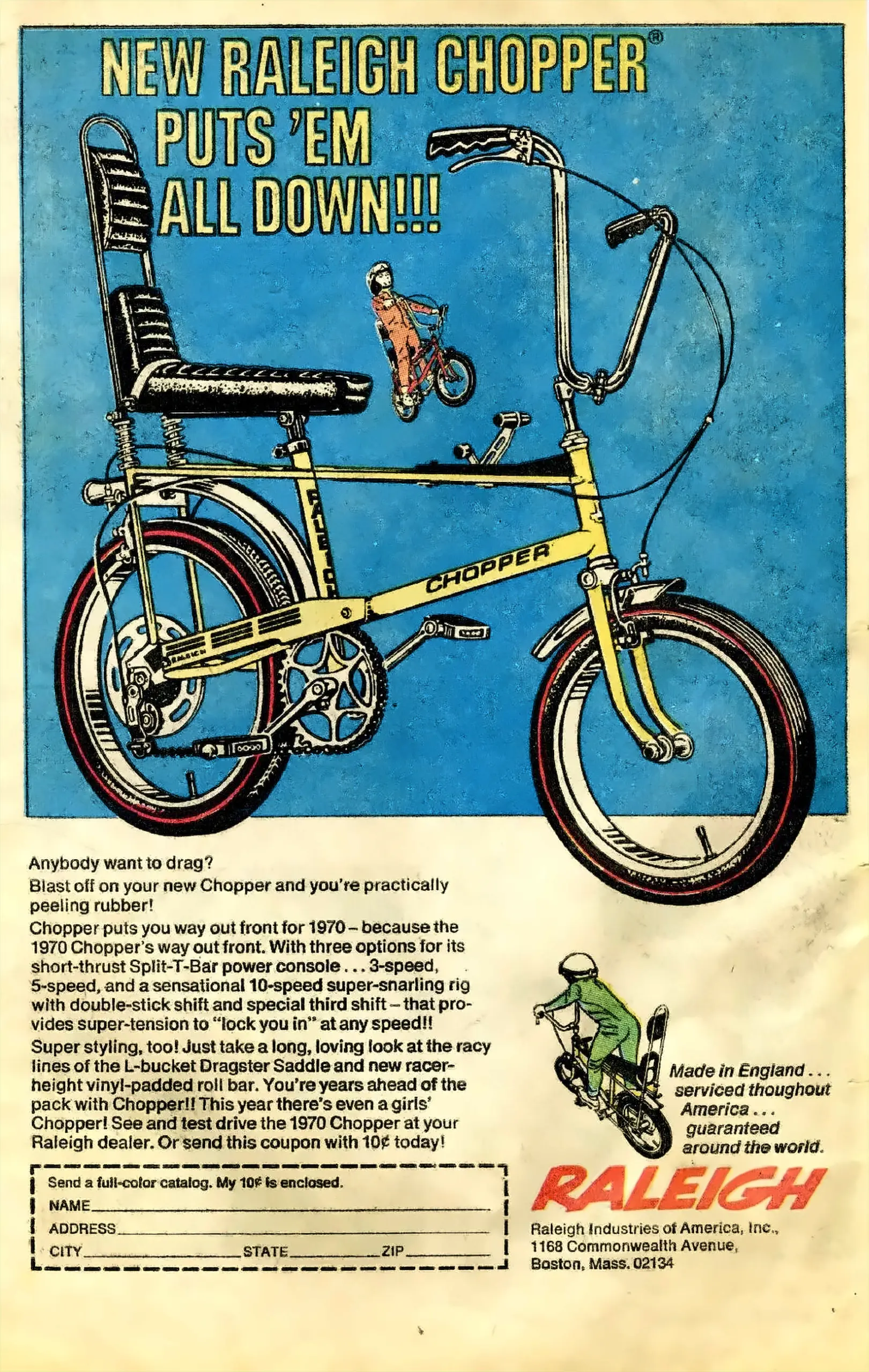
The Chopper went on sale in North America in June 1969 and in the United Kingdom in 1970, priced at £34 19s. It borrowed the high-rise idiom that Schwinn had established in America with the Sting-Ray and pushed it even further: a long dragster saddle with a padded backrest, ape-hanger bars, mismatched wheel sizes, a chromed roll bar and gear selector mounted in a console on the top tube like a car’s shifter. Raleigh sold it as a “wild new fun bike,” and the advertising copy above is closer to Detroit than Nottingham.
It worked to a degree that virtually nobody expected. Around 1.5 million Choppers were sold in the United Kingdom alone across roughly a decade, and the machine became a fixture of British childhood memory in a way no other bicycle has matched since then.
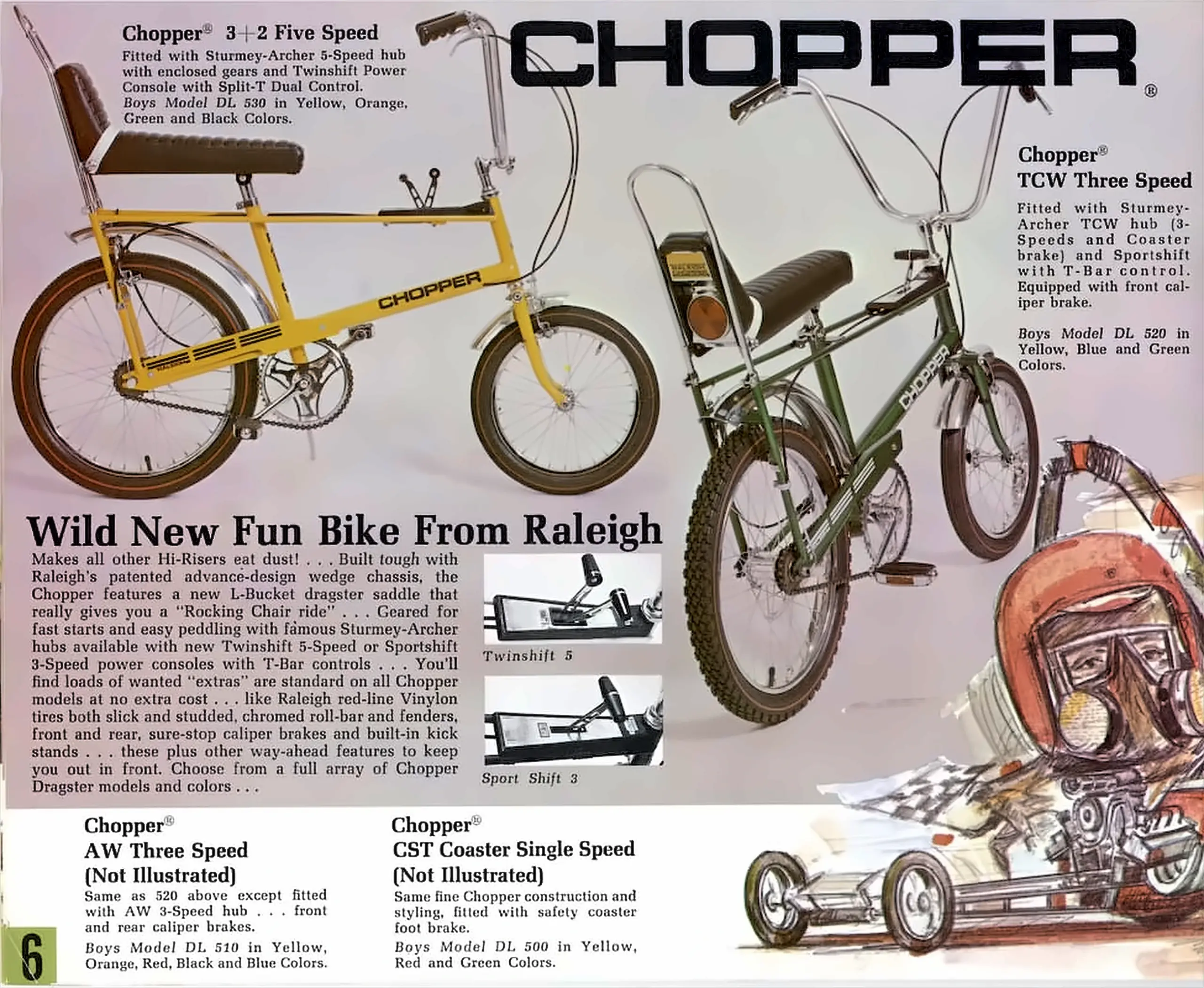
Who designed it remains genuinely contested. Alan Oakley, Raleigh’s chief designer, said he sketched the Chopper on the back of an airmail envelope while flying home from a research trip to the United States in 1967. Tom Karen, then managing director of Ogle Design, said Raleigh came to Ogle in 1968 for something better than its own first attempt at the market, the Rodeo, and produced sketches from his garage in 2014 that look very like the finished machine, along with diaries recording 20 meetings with Raleigh staff including chief designer Oakley. Karen has allowed that Oakley did the engineering needed to make the thing producible; Oakley’s family maintain the concept was his. Both men have now passed and the dispute is unlikely ever to be settled. What is not in dispute is that Raleigh had finally found, almost by accident, that its future lay in selling recreation rather than transport.
While the Chopper was paying the bills, something quite different was happening in a small workshop in Derbyshire — and for readers of this site it is perhaps the most interesting chapter Raleigh has.
The 1960 purchase of Carlton Cycles had given Raleigh a genuine lightweight capability and, in Gerald O’Donovan, a frame man of the highest rank. In 1974, Raleigh established the Specialist Bicycle Development Unit under O’Donovan in its own building at Ilkeston, in premises that had once been part of the prestigious Rolls-Royce works. The SBDU was tiny — four builders, something like 30 frames a week in its first year and roughly 1,000 each year thereafter — and it was set up to do one thing: build the best racing frames in Europe.
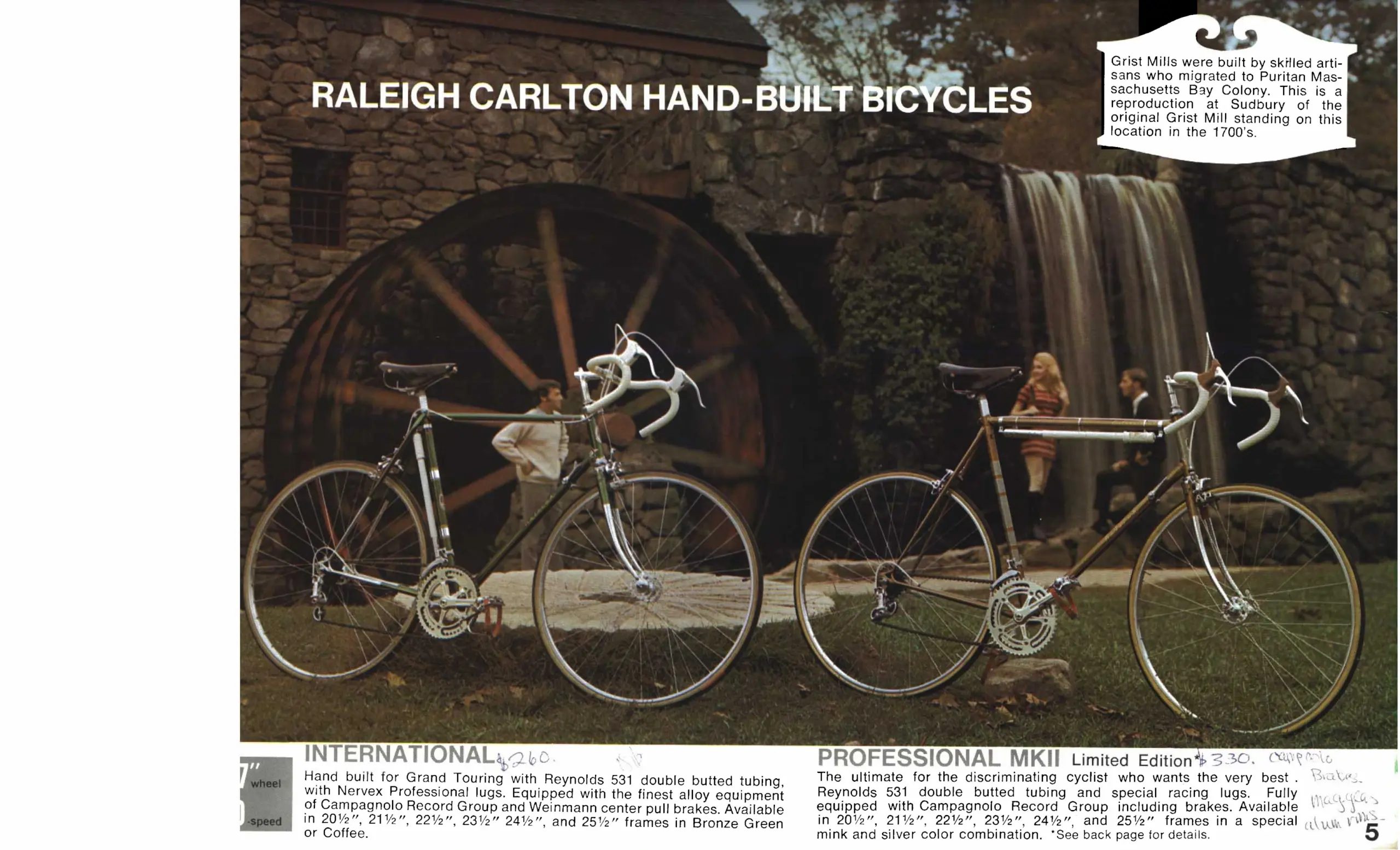
It succeeded in this endeavor. The SBDU proved Reynolds 753, the heat-treated tubing that arrived in 1974 and demanded silver soldering and a builder certified to work with it, and the unit supplied the TI-Raleigh professional team from the 1975 season onward, each rider taking two or three frames per year.
TI-Raleigh itself ran from 1972 to 1983 and was, for a stretch, the most formidable outfit in the cycling’s professional ranks. Registered in the Netherlands and directed by the former champion Peter Post with a discipline that became legendary, the team took more than 900 victories in a decade. It won the Tour de France team time trial eight consecutive times between 1978 and 1982. In 1980, with Joop Zoetemelk finally taking the overall title after a decade of near misses, TI-Raleigh won 11 stages of that year’s Tour. Zoetemelk’s victory remains the only Tour de France ever won on a British-built frame.
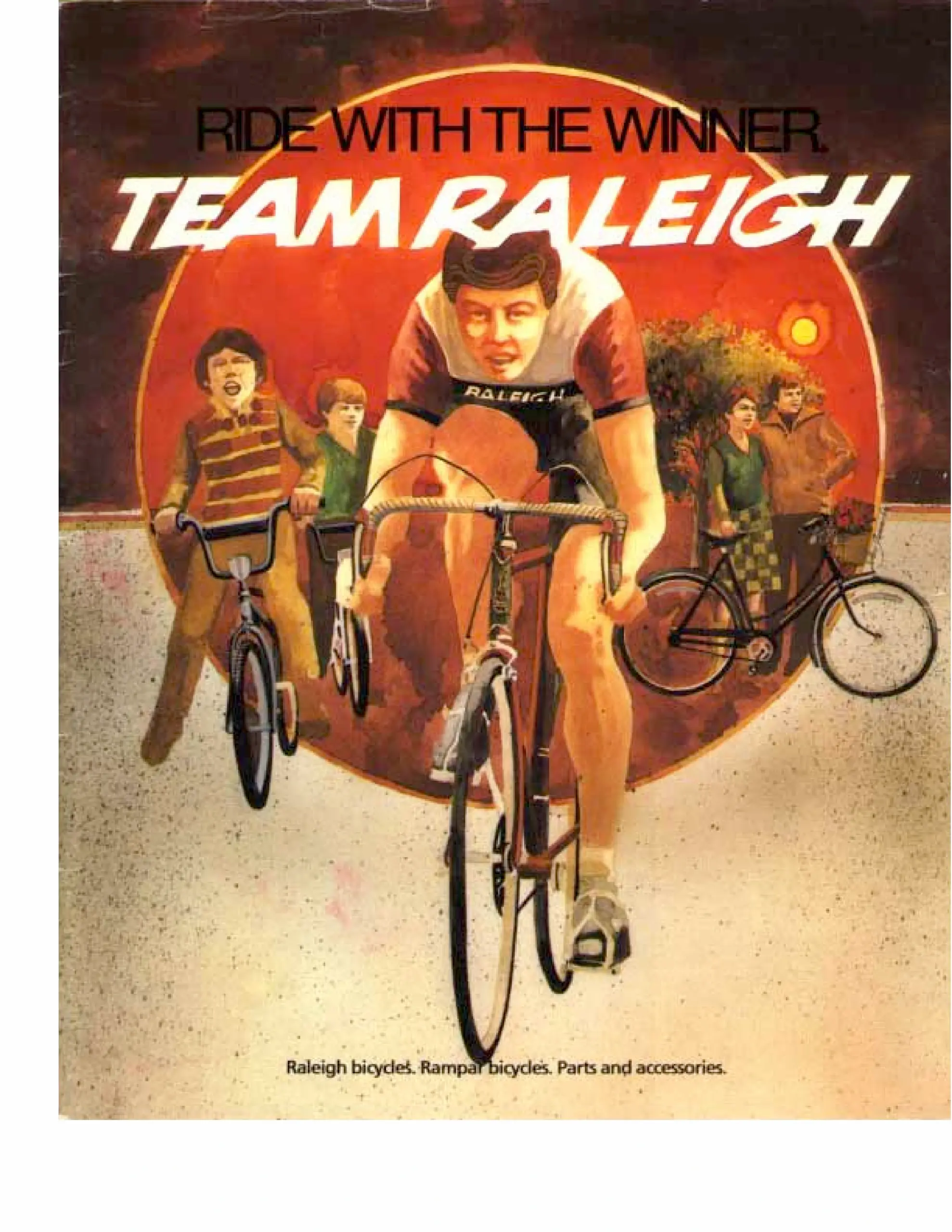
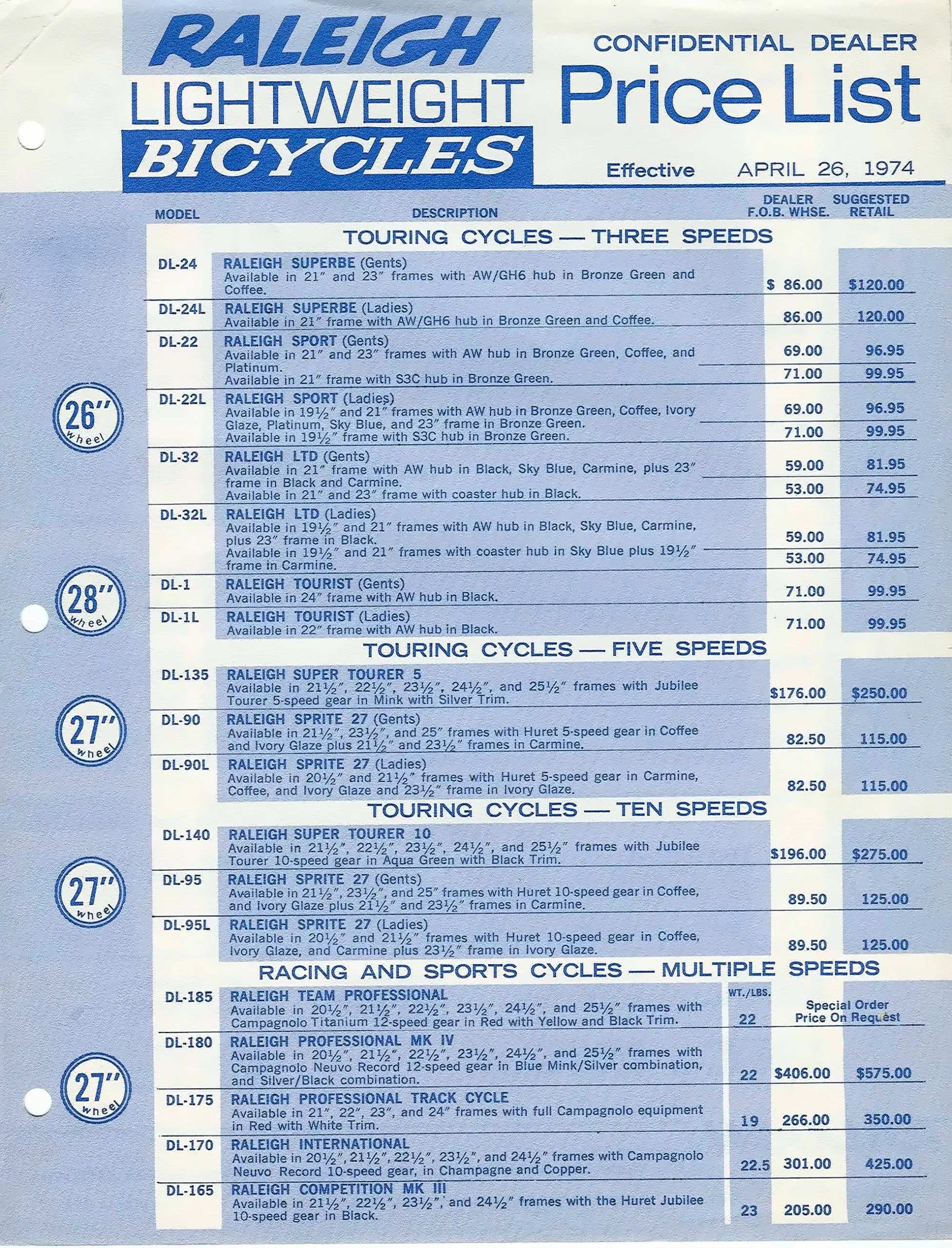
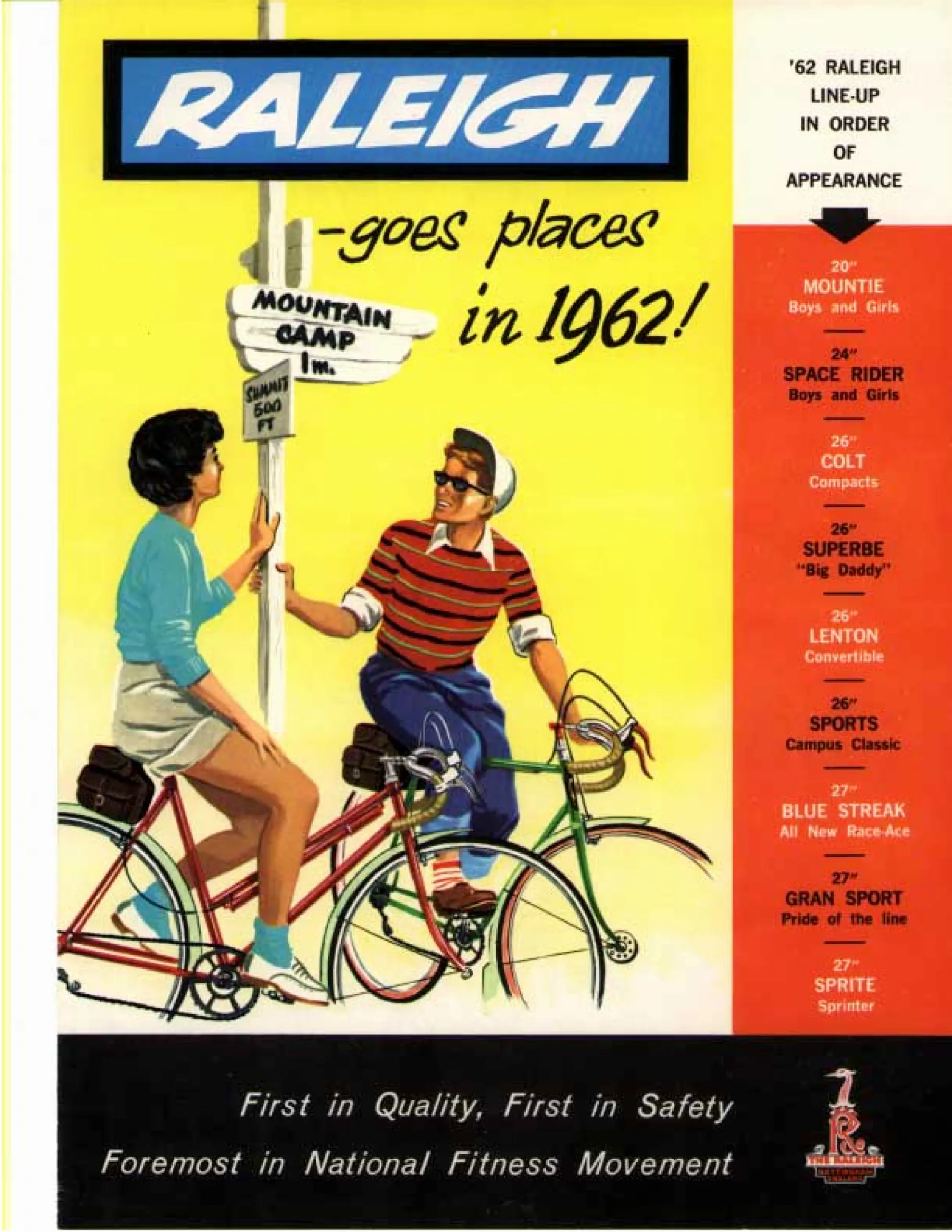
The dealer price list above catches the lightweight range at exactly the right moment. Below the three-speed Superbes and Sports sit the machines that collectors most chase now: the Competition Mk III at $290, the International at $425, the Professional Track Cycle at $350, the Professional Mk IV at $575 in Blue Mink or silver and black, and at the top the Team Professional, all 22 pounds of it, price on request. Ebykr has a full build sheet for a later machine from this lineage, the 1989 Raleigh USA Team Pro Track.
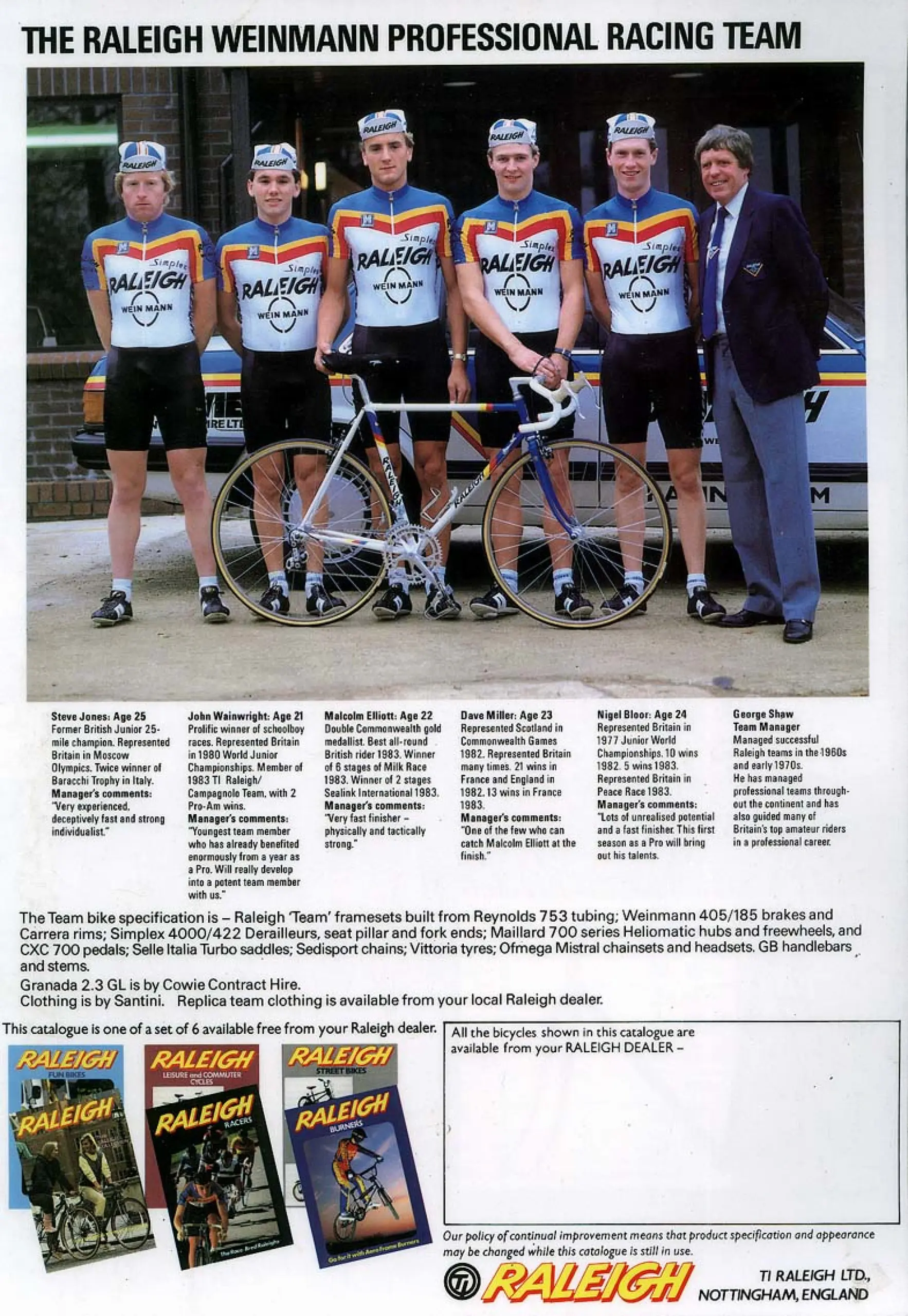
The Ilkeston workshop closed around 1989 and what remained of the specialist work moved to Nottingham. It had lasted 15 years and built perhaps 15,000 frames total, or little more than a rounding error against the 1.5 million Choppers sold in just 10 years. That observed, these Ilkeston frames have been and still remain the reason Raleigh continues to mean something to people who care about lightweight bicycles, perhaps alongside some of the other lighter-weight models produced by the company over its prime four decade run from the late 1940s through the late 1980s.
The mid-1970s were Raleigh’s commercial summit. In 1975, the company sold 599,000 machines in the United Kingdom and held about 54% of the domestic market, from a factory that then covered 75 acres, which equates to nearly 3.3 million square feet.
Its successor to the Chopper arrived in June 1976. The Grifter was a heavy, motorcycle-styled machine with a twistgrip that shifted a three-speed hub, and it sold well — but it was the wrong bicycle for what came next in the market. When BMX arrived from California, it wanted light frames, single gears and robust strength, and Raleigh had bet on a three-speed hub mated to a heavyweight frame. The company missed the first wave of the boom.
It was rescued by an employee whose career deserves better documentation than it has received. Yvonne Rix joined Raleigh in 1962 as secretary to the designer Alan Oakley (of Chopper infamy, as already noted), moved into product management by 1975 and became marketing director in 1988, sitting on the Raleigh board of directors. She pushed the company into BMX, and the result was the Burner, launched in 1982 with a frame making extensive use of ovalized chrome-molybdenum tubing. It was a serious BMX bicycle rather than a fashion imitation of one, and it sold over 1,000,000 units. In 1983, Raleigh’s sales were up 57% compared to 1981, and the company moved close to 1,000,000 machines in the United Kingdom — its best year ever by volume. By 1985, the Burner even had its own Waddingtons board game, a Leeds-based manufacturer of popular card and board games.
The next revolution was already underway and again it started in trend-setting California. Throughout the 1970s, the Morrow Dirt Club in Cupertino had been modifying old balloon-tire machines for off-road use, and on Mount Tamalpais the Repack downhill racers were doing the same. Joe Breeze is credited by most accounts with building the first purpose-made mountain bike, with Tom Ritchey, Gary Fisher and Charlie Kelly among those who turned the idea into an industry. (Several of these mountain bike heroes remain in the Bay Area today, which itself remains one of the sport’s most influential regions.)
Raleigh was slow to believe it, though. The internal objection was that mountain bikes made no sense in a country with no mountains. (As if England was the only market for such bikes at the time.) Rix, who had seen the category taking hold on a trip to the United States, pressed the point for several years before the company finally committed properly. (Even then, the English market was between 4-5X smaller than the US market.) Its first attempt, the Maverick range of spring 1985, sold disappointingly low numbers.
What finally changed was company ownership. On 1 April 1987 — a full 101 years after the Raleigh Street workshop opened — the private group Derby International, founded by the Anglo-American tax lawyer Edward Gottesman, bought Raleigh from Tube Investments and Raleigh USA from Huffy. Derby cleared out much of the existing senior management, promoted Rix and backed the category hard. More than 3,000,000 Raleigh mountain bikes followed. In 1989, the company launched M-Trax as a higher-end competition line with a professional team to support it, and by 1992 Derby was the largest cycle group in the world with around $500 million in annual sales.
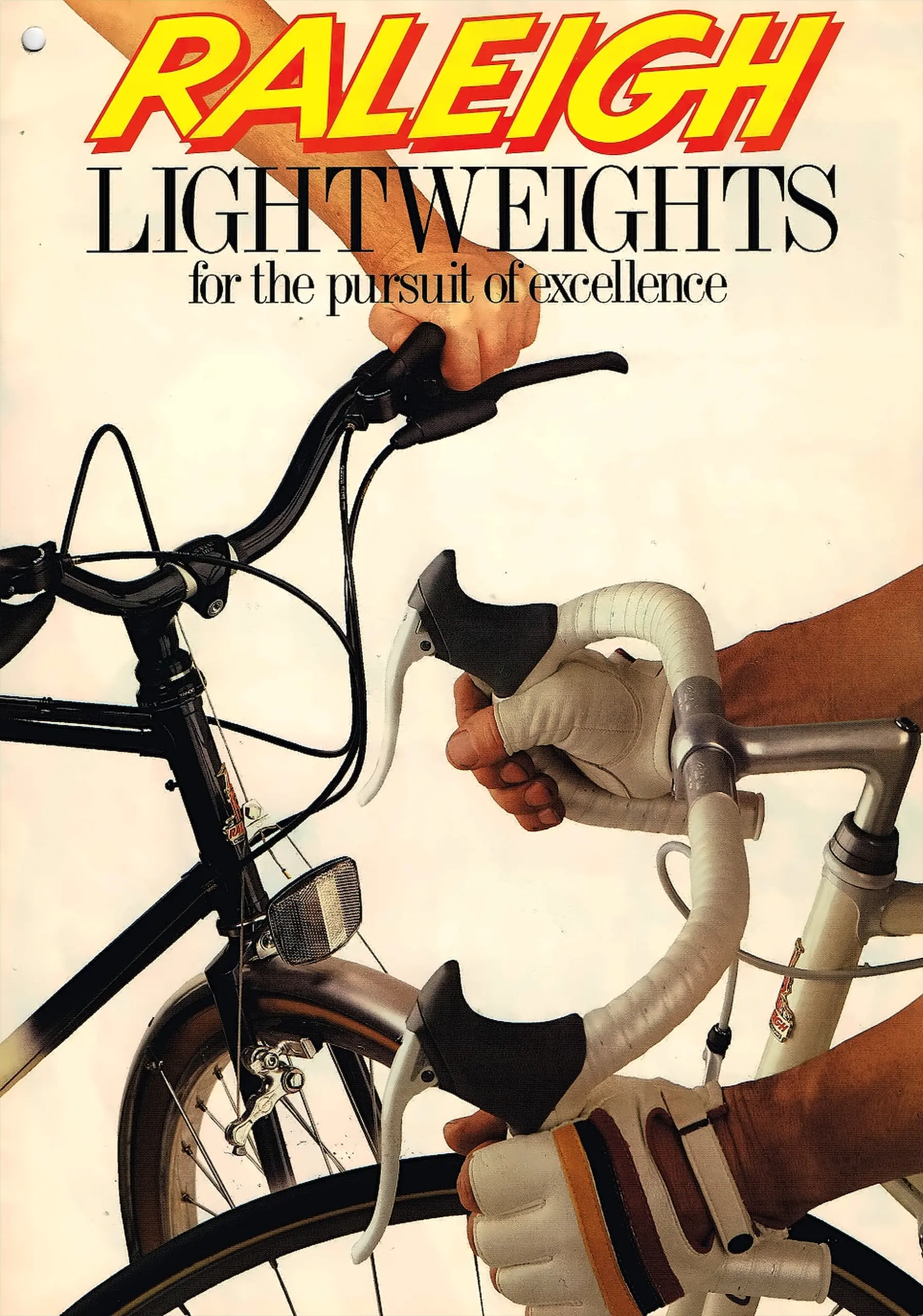
Rix’s most durable insight came next. She judged that ordinary riders wanted the upright position and the wide gear range of a mountain bike, but would quickly tire of the weight and the drag of knobby tires on pavement. The machine she envisaged — mountain bike ergonomics, lighter frame, narrower tires — arrived as the Pioneer in 1991 and helped establish the hybrid as a category. The Activator followed in 1992 with a telescopic fork and widespread television campaign, and then the Max in 1995. She also championed women’s cycles and an early battery-assisted bicycle, which was ahead of both its market and available battery technology at the time, and did not last long. Rix retired in 1998, her tenure a massive boom to the company in what otherwise would have been its twilight years.
The mountain bike explosion masked a structural problem. Raleigh’s Nottingham plant had been built for a vertically integrated company that made its own tubes, its own hubs and its own frames at enormous volume. (Which brings to mind the Auotomoto factory illustration from Le Matin in 1926 showing how that company handled everything in-house themselves, an industry-changing 60+ years earlier.) That model could not survive competition from Far Eastern factories that made frames more cheaply than Raleigh could ever make them at home.
The numbers tell it plainly. Raleigh’s United Kingdom output fell from 599,000 machines in 1975 to 405,000 in 1998, the lowest figure since 1970, and its market share slid from 54% to around 20%. The Nottingham site shrank along with its market share, from 75 acres in 1975 to just 22 acres by the end of 1999.
In May 1999, Derby sadly announced that volume frame production at Nottingham would cease, leaving just painting and some assembly. On 10 December 1999, the frame-making equipment went under the hammer, including three costly, multi-robot welding machines that had been purchased and installed just three years earlier in 1996. In Nottingham, as one might imagine, this all landed as something close to a civic bereavement. For Derby, it was a step toward a company that competed globally rather than nationally, however late this acknowledgement came. The factory site formally passed to the University of Nottingham in 2000. A management buyout led by Alan Finden-Crofts then took on the company in 2001, and by 2003 bicycle assembly in the United Kingdom had ended altogether.
What is perhaps the saddest episode in the Raleigh story came in 2000 and it is not widely enough known given the significant import of the event.
Sturmey-Archer had been a Raleigh division for almost a century, and by the late 1990s it was a liability on the balance sheet rather than the jewel it had once been. Instead of accepting a staged offer from SunRace of Taiwan, Derby sold the business to a British management firm called Lenark — reportedly for a nominal £30 — because an outright sale let it write off the connection immediately and flattered the short-term accounts. Lenark had previously been investigated for fraud and had a less-then-stellar reputation. The business collapsed, the Nottingham production line closed and more than 300 people lost their jobs.
SunRace then bought the assets and trademarks out of the wreckage, moved the machinery to Taiwan and restarted production as Sun Race Sturmey-Archer. The hubs are still made, some to the old patterns and many to new ones. A century-old British component business survived, but not in Britain, and not because anyone in Nottingham had planned it that way.
In April 2012, 25 years after buying the company, the Derby lineage finally sold Raleigh’s United Kingdom, Canadian and United States businesses to the Dutch group Accell for £62 million. Accell was then a large and healthy cycling conglomerate, and Raleigh joined a diverse portfolio alongside Batavus, Koga, Lapierre and Haibike.
The years since have been hard on the marque, and the earlier version of this article stopped before almost all of it. In 2019 Accell sold the Canadian rights to the Raleigh name to Canadian Tire for $16 million and offloaded Diamondback, Redline and IZIP to Regent, sharply reducing its North American footprint. In 2022 a consortium led by the private equity firm KKR took Accell private in a deal valuing it at around €1.6 billion, with a further €250 million committed.
The timing could hardly have been worse. The pandemic cycling boom reversed into an industry-wide glut of unsold inventory, and Accell was carrying heavy debt into a falling market. On 8 November 2023 Raleigh UK began a consultation on redundancies, closed its parts and accessories business, and moved warehousing and logistics to a third party. The owner’s assessment was that the “current strategy and organisational set up is not sustainable in its current form.” In late 2024, Accell reached agreement with its lenders to cut debt from about €1.4 billion to €800 million. In February 2025, Raleigh UK Ltd formally changed its name to Accell UK & Ireland Ltd. KKR has since handed its equity to the lenders and retains no shareholding, having written off a stratospheric €1.1 billion in the process. (The global bicycle market was valued at $34 billion in 2025.)
Raleigh continues to sell bicycles, with electric machines now central to the range, and the brand remains a significant name in the United Kingdom. But the company that now carries the name is a Dutch group under lender control, its Nottingham presence is an office rather than a factory and the legal entity no longer bears the word Raleigh anywhere in it.
There is one genuinely cheerful footnote, though. In June 2023, Raleigh reissued the Chopper as a limited edition. It sold out within minutes, a second batch followed the following month in July, and yet another run came in 2024. The reissue is modeled on the Mk2, complete with top-tube shifter, and to make it all work Raleigh went back to Sturmey-Archer for the hub — which is to say, to a Taiwanese company holding a Nottingham name, selling a gear to a Dutch-owned British brand for a bicycle first sketched in the late 1960s by someone whose identity is still (somewhat) disputed. It is difficult to think of a neater summary of where the highly convoluted, globally integrated bicycle industry somehow ended up.
Raleigh’s modern reputation rests on value. That is not an insult and it is not new: Frank Bowden’s original proposition was a well-made machine that ordinary people could afford, and the All-Steel roadster that went to Africa and India was sold on exactly the same basis. A company that put many 1,000,000s of people on bicycles does not need to be exotic. Call it a confident understanding of oneself and their place in the world.
What makes Raleigh worth studying is the completeness of the record it left. Very few marques let you trace the entire 20th century arc of an industry through one badge — patent gearing to mass export, wartime conversion to postwar boom, consolidation to fashion products, a world-beating race program run out of a four-man workshop and then the slow unwinding of vertical integration until nothing was left in the home city but a name. The Chopper and the Team Professional came out of the same company within five years of each other, which is either an incoherent business or an unusually honest reflection of what people actually wanted to ride at the time, depending on which side of the ledger you most identify with.
And the machines are still out there. Sturmey-Archer hubs from the 1950s keep turning wheels today, 20s are still being converted into shopping bikes, Choppers are still being restored and SBDU frames still come up for sale with their Ilkeston serial numbers intact. For a company that no longer manufactures anything in Nottingham, Raleigh remains remarkably present in our basements, garages, sheds and classifieds — which is the only kind of immortality a bicycle maker can reasonably hope for these days.
For a year-by-year reference version of the events described in this article, please see the companion Raleigh timeline.
This article began life on Ebykr as “Raleigh for the Masses: Evolution of a Bicycle Giant” by Susan Earle. It was rewritten, fact-checked and substantially expanded in August 2026, and the sources are listed at the foot of the page.
From the Chopper to the Ilkeston team frames, Raleigh has shaped more cyclists’ first rides than most any other marque. Share your Raleighs, dating questions and restoration tips with the community.
Grace’s Guide — Raleigh Cycle Co
Wikipedia — Raleigh Bicycle Company
BikeBiz — The Heron Evolves: Raleigh from 1975 to 2002
Three Speed Hub — Raleigh Specialist Bicycle Development Unit (SBDU) Ilkeston
Iceni CAM Magazine — RSW16 bicycle: From Cycle to Moped
Moulton Bicycle Club — Raleigh and Moulton
Wikipedia — TI-Raleigh
Wikipedia — Raleigh Chopper
BikeBiz — “I designed the Chopper,” argues Cambridge inventor
Tony Hadland — Elegy for Sturmey-Archer
Sheldon Brown — Sturmey-Archer hubs
Sheldon Brown — Retro Raleighs
Cycling Industry News — Raleigh UK resets as owner labels it “unsustainable in current form”
road.cc — Private equity firm that invested in Raleigh’s parent company has lost over £1 billion
BikeRadar — The Raleigh Chopper is back by popular demand
LeftLion — The History of Sir Frank Bowden and the Raleigh Cycle Company
Raleigh UK — Where it started
 Raleigh
Ebykr documents this marque across the archive. Here is the rest of it.
The Ebykr Digest
New articles, timelines, catalog finds and registry activity — assembled from the archive once a month. Your address is never shared.
Double opt-in. One email per month. Unsubscribe at any time with one click.
Join the conversation below, or bring longer discussions and photos to the Ebykr Forums.

does Raleigh make any bikes in holland
Hi, If anybody is looking for a beautiful Vintage Raleigh Grand Prix English-made in Nottingham England circa 1977, I found one today browsing craigs list http://albuquerque.craigslist.org/bik/1442330152.html. I am interested in getting my hands on a Grifter at a decent price please let me know johnnymiller01@gmail.com
I have a Raleigh Park Place-ladies bike could you tell me how old this bike is?
The Raleigh history you’ve provided here is comprehensive and a quick read. That is now easy feat! I especially enjoyed the info on the later years.
I just read “The Story of the Raleigh Cycle,” while retrofitting a 1973 Super Course for long distance cycling. The book was written by Sir Frank Bowden’s great grandson, and published in 1975. It is definitely an item the vintage bicycle afficianado should have on the bookshelf or the coffee table. If you are restoring a Raleigh, or updating one as I did, reading this book makes the experience even richer.
Hi Charlie,
Thanks for finding us.
The article you are mentioned in was published exclusively on http://www.ebykr.com. Please support the EBykr effort by telling all your friends about the site.
Kind regards,
Eric
Great read. Thank you for the detailed insight. Raleigh bikes were a big part of my childhood.
Thanks for the mention. Was this article published somewhere other than on the Internet?
Check out my site. How about a link?