About Ebykr
Ebykr celebrates classic and vintage lightweight bicycles through provocative imagery and opinion. Ride along with us.
About Ebykr
Ebykr celebrates classic and vintage lightweight bicycles through provocative imagery and opinion. Ride along with us.

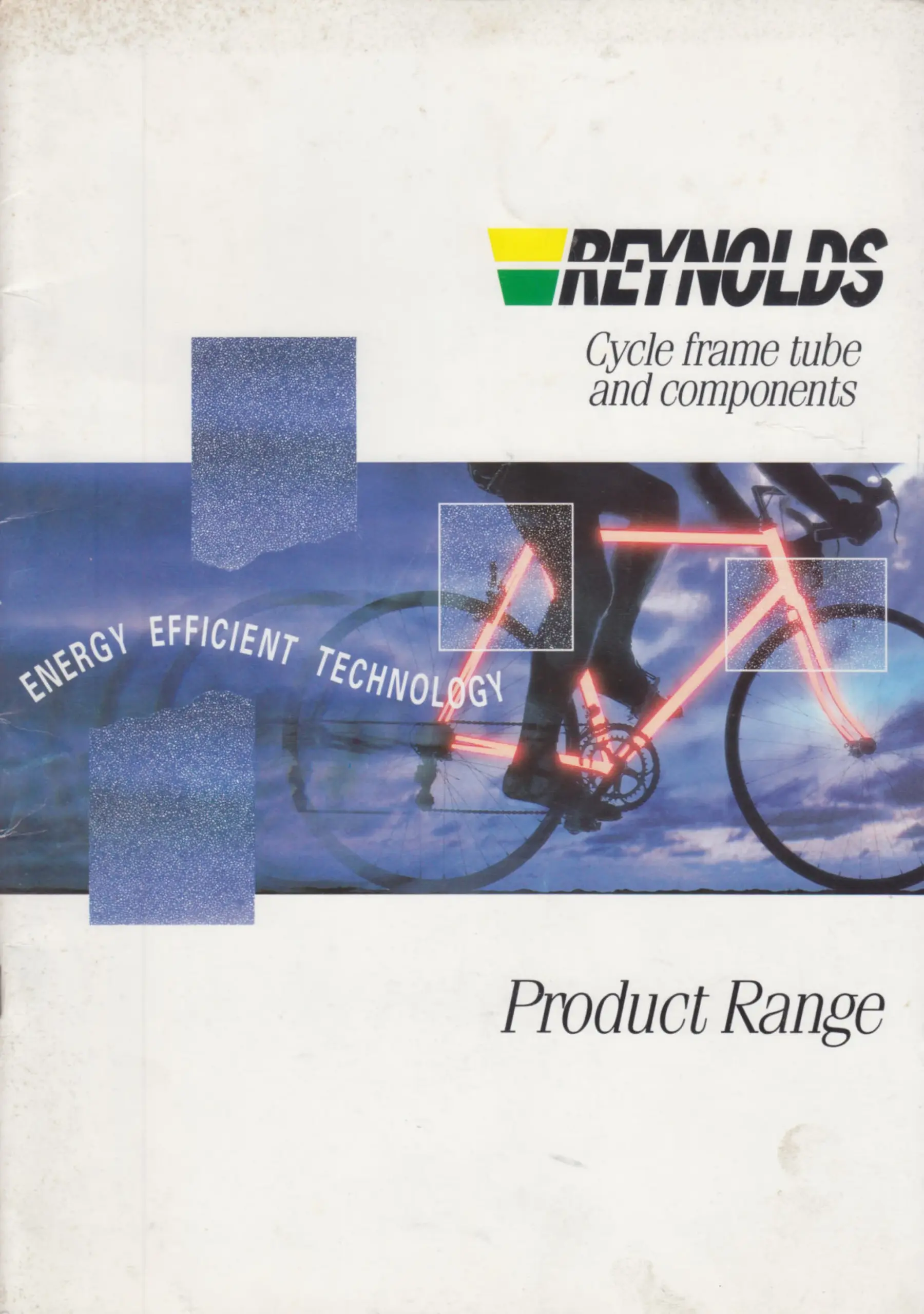
A practical guide to reading a Reynolds transfer — what each mark actually guarantees, how its small print and the tube it names date a frame and how to tell a respray from a reproduction, drawn from Reynolds' own literature of 1972 to 1990.

It is entirely possible that no sticker in cycling has been read more often (or more carelessly) than the Reynolds transfer. Most of us glance at it, see 531 and stop reading, which is a real shame, because Reynolds wrote a great deal more on those transfers than three simple digits. A transfer is a guarantee: it says which tubes are Reynolds, which are butted and which are not, and Reynolds changed both its range and its artwork at moments its own literature records. And records well at that. Read properly, the transfer tells you what a frame is made of and roughly when it was painted, which is usually when it was built.
A word on vocabulary before we continue, borrowed from Reynolds itself: “In Britain they’re transfers. In America, decals.” This guide uses both, and it leans on nine pieces of Reynolds’ own literature held in the Ebykr Catalog Archive, from a 1972 booklet for cyclists to the 1990 product range. Where Reynolds explained its own marks, we sit back and let Reynolds do the talking.
The 1972 Top Tubes booklet gives a whole page to “Reynolds 531 decals explained” and it is the best place to start, because the hierarchy is not what most people assume. Five transfers are shown, all in the green, gold and black the booklet itself describes.
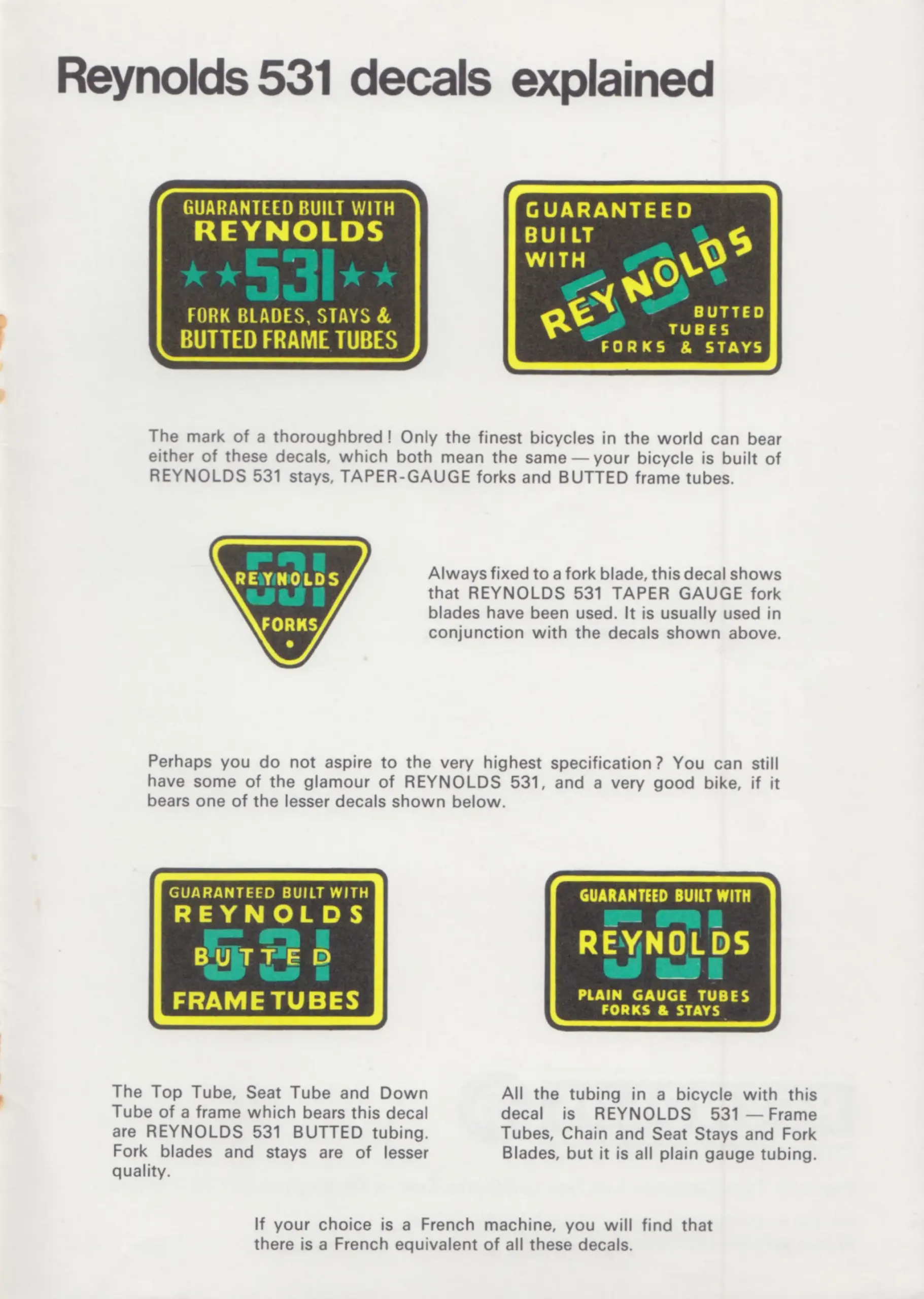
Note what even the top mark does not promise. Reynolds’ later sheets spell out that the frame tubes and steerer are butted while the head tube and stays are plain gauge, so BUTTED TUBES FORKS & STAYS does not mean butted forks and butted stays. The lesser marks are where the overselling happens. On the transfer reading BUTTED FRAME TUBES, the stays and fork blades may not be Reynolds at all, so a frame wearing it is a perfectly good bicycle with three good tubes but not a “full 531” frame, whatever the listing says. The plain-gauge marks are rarer still: by the later 1970s Reynolds described one as “not often seen these days” and the other, a FRAME TUBING mark for unbutted main tubes, as “even scarcer.” And if your bicycle is French, expect the same marks in French: GARANTI CONSTRUIT AVEC REYNOLDS, with TUBES RENFORCÉS for butted tubes and EXTRA LÉGER for Special Lightweight.
| The transfer reads | Main tubes | Stays | Fork blades |
|---|---|---|---|
| FORK BLADES, STAYS & BUTTED FRAME TUBESThe starred rectangle, or REYNOLDS laid across a large 531: the two top marks mean the same thing | Butted 531 | 531, plain gauge | Taper-gauge 531 |
| FORKSThe small triangle near the crown, usually with one of the top marks | Not this mark | Not this mark | Taper-gauge 531 |
| BUTTED FRAME TUBESThe top, seat and down tubes only | Butted 531 | Of lesser quality: may not be Reynolds | Of lesser quality: may not be Reynolds |
| PLAIN GAUGE TUBES FORKS & STAYSAll 531, none of it butted | 531, plain gauge | 531, plain gauge | 531, plain gauge |
| FRAME TUBINGLater 1970s: unbutted main tubes, “even scarcer” | 531, plain gauge | Not stated | Not stated |
Every reading here comes from “Read every word, not just the number” in this guide.
The top-grade frame transfers were meant to travel with a separate fork transfer near the crown and its shape changed with the decades. In 1972, it is a small triangle reading FORKS. By the later 1970s, the 531 triangle reads FORK BLADES, while Special Lightweight and 753 have shields of their own. In the 1980s designs, every grade has a shield, and from 1988 the shield is small and black with an R monogram above the number. Reynolds says the 531 fork mark goes only with the top-grade frame marks, so a 531 fork mark beside a main-tubes-only frame mark deserves a second look. A top-grade frame mark over a bare fork proves nothing on its own, since the 1972 booklet says only that the fork mark is “usually” used with the others, but it is a good reason to ask whether the fork is original.
Here is the part most guides skip. Reynolds redrew its transfers several times and the small print at the foot of each one changed with the company’s name. The archive catches four of the looks in Reynolds’ own print, and a period advertisement and the company register fill the gaps:
| When | What the transfer looks like | Where it is documented |
|---|---|---|
| To 1973 | Green, gold and black, reading GUARANTEED BUILT WITH REYNOLDS 531, with no maker’s name at the foot | The 1972 Top Tubes booklet |
| From 1973, in use by 1975 | A gold box at the foot naming the maker as Reynolds Tube Co. Ltd. of Birmingham, plus a registered mark after the number | A 1975 Reynolds advertisement, in French |
| 1978 to about 1982 | The TI roundel and Manufactured by TI Reynolds Limited, Birmingham, England. 753 is purple with green numerals; Special Lightweight has red numerals | The c.1978 transfers leaflet and 1981 transfers sheet; the company took the TI Reynolds name on 1 January 1978 |
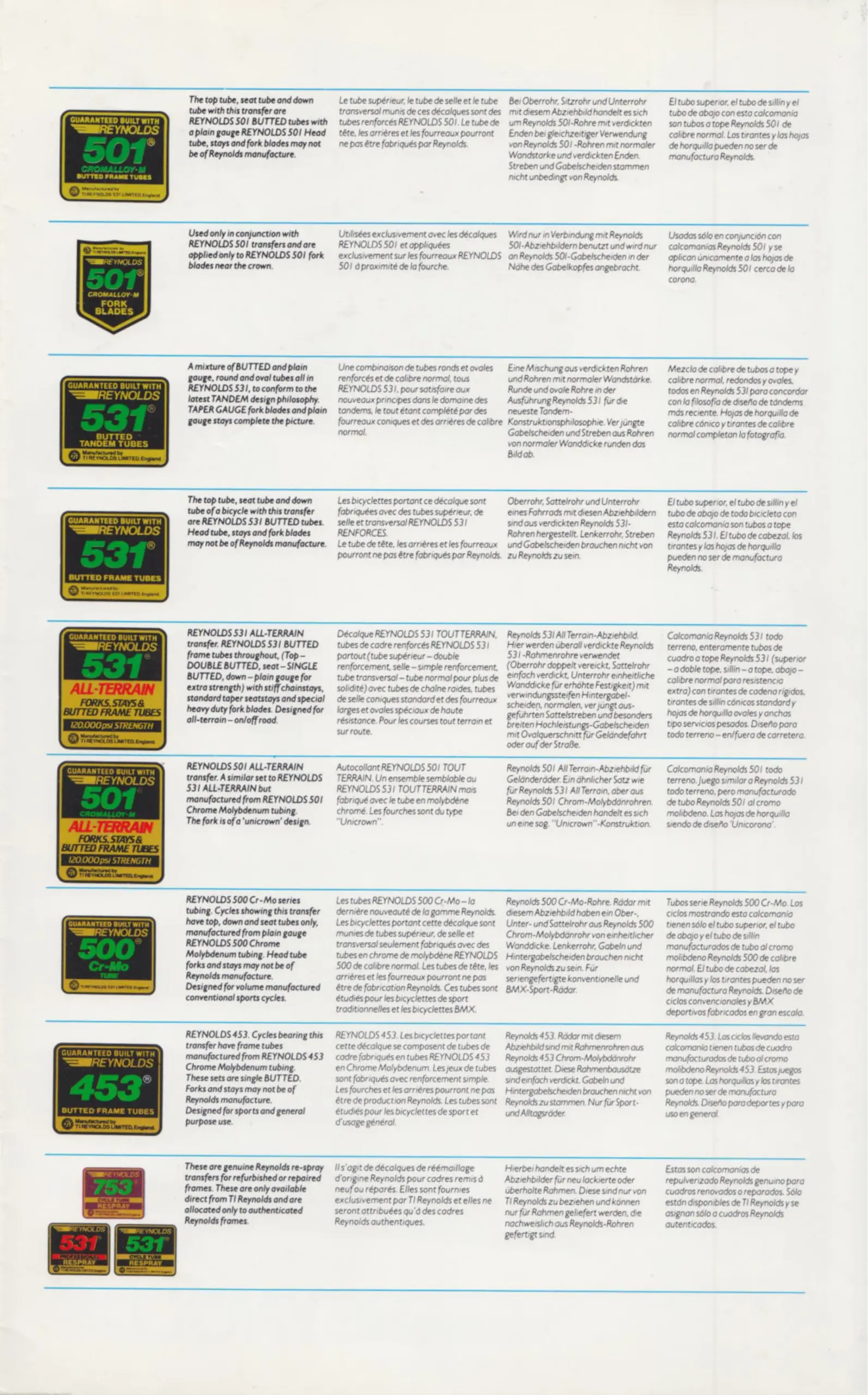
| About 1982 to 1988 | Redrawn, with a stylized gold wing beside an italic REYNOLDS and suffix letters such as 753R and 531C. The maker’s line says England without Birmingham, and from late 1985 some read TI Reynolds 531 Limited | The c.1987 Tube Talk folder, which shows both maker’s lines |
| From 1988 | Black, with a yellow-and-green split bar beside REYNOLDS, magenta or green numerals, no GUARANTEED BUILT WITH and no maker’s name at all | The August 1988 and 1990 product ranges |
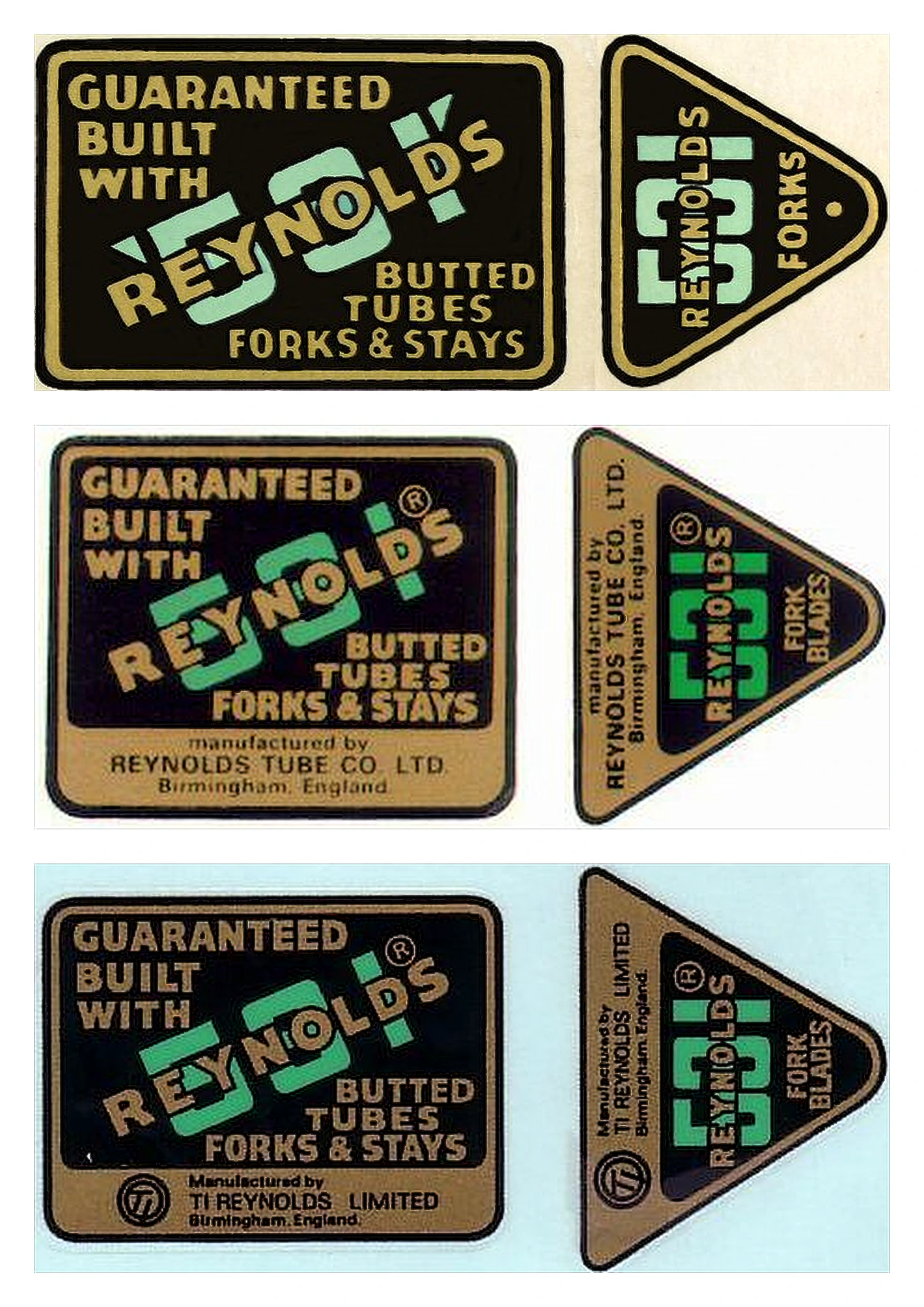
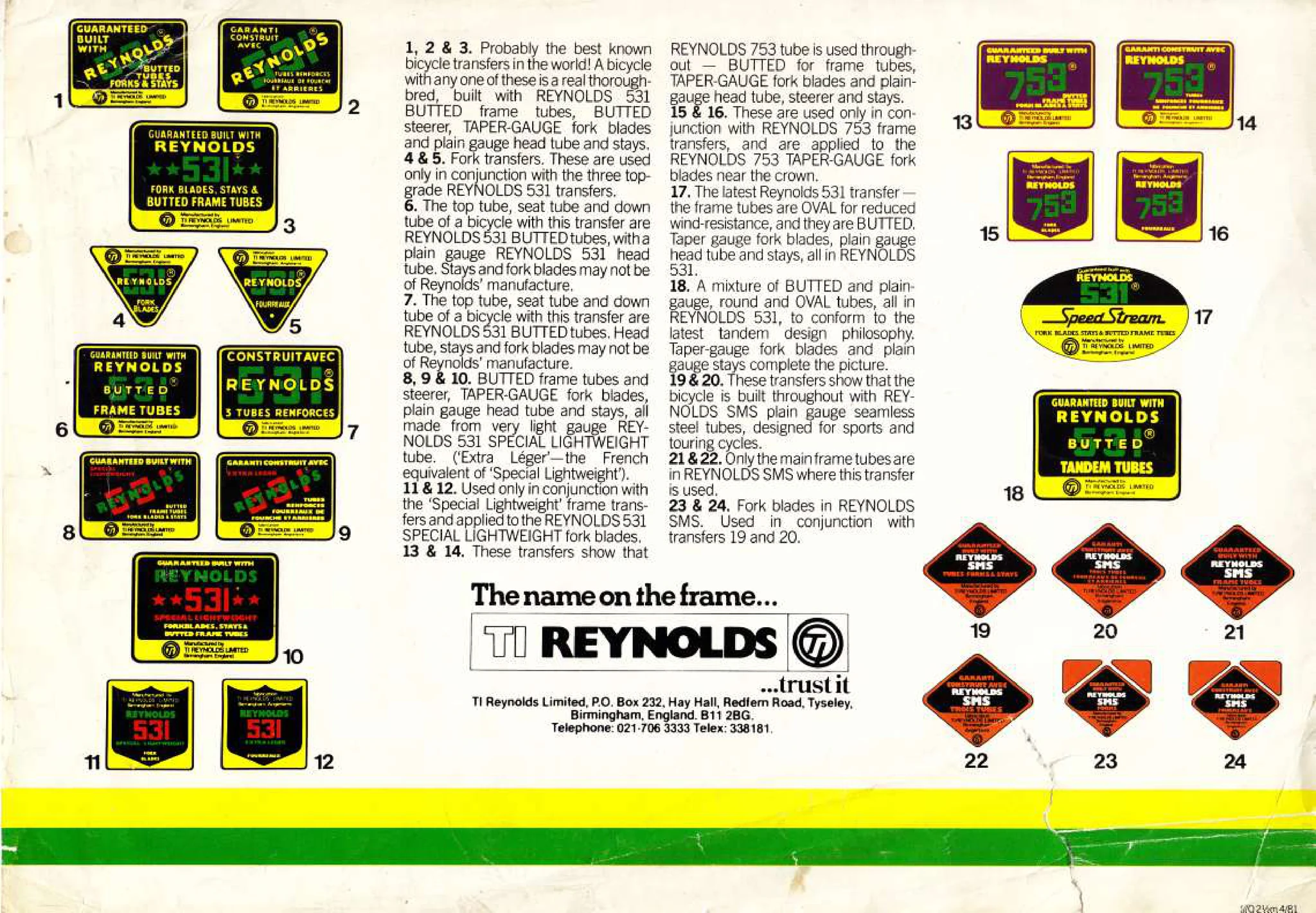
Two things are worth knowing about that table. The version usually repeated, which goes back to a decal history Reynolds itself published in 2009, puts the TI name on transfers from 1981 and the black split-bar design in 1989. Reynolds’ own period print shows both arriving earlier, the TI name on the c.1978 leaflet and the split bar in a brochure dated August 1988. And treat every row as a bracket rather than a birthday. A transfer dates the paint from below, because it cannot have gone on before its design existed, but it cannot date a frame from above: stockists used (ahem, use) old transfers for years after a design changed. A frame whose transfer belongs to a different decade from everything else on it has probably been repainted, or was finished from old stock.
Older frames carry older designs again. Reynolds’ own advertisements of 1936 and 1947 still print the number in quote marks, ‘531’. H Lloyd Cycles, which says it reproduces the old transfers under license from Reynolds, reports that the early transfers did the same and it has published an estimated timeline of more than 200 variants going back to 1935, the best map of the early years available. Treat its ranges as a well-informed collector’s estimates rather than Reynolds’ own record. If you hold Reynolds literature from before 1972, a leaflet, a price list or even a single page, it would fill the biggest gap in this guide and Docs Drop is the place to share it.
The second clock is the range itself. A frame cannot be older than the tube set named on its original transfer and Reynolds printed its own chronology twice, in each the 1988 and 1990 product ranges. Where a date below comes from a transfer sheet or from outside the archive instead, that is stated.
| Name on the transfer | When it appears | What it tells you |
|---|---|---|
| 531 | 1935, on the weight of period evidence; the 1988 range says 1930 and the 1990 range 1935 | Manganese-molybdenum steel, the classic. The words around the number say which tubes are 531 and which are butted |
| 531 Special Lightweight (Extra Léger in French) | In the later 1970s; on the c.1978 transfers leaflet | Very light gauge 531 throughout the frame, with red numerals and its own fork transfer |
| 753 | 1976, by Reynolds’ own chronology; the R and T suffixes from the early 1980s | Specially processed manganese-molybdenum, sold only to builders Reynolds had approved |
| 531 SpeedStream | “The latest Reynolds 531 transfer” on the 1981 sheet | Oval, butted frame tubes for lower wind resistance |
| SMS | On the 1981 sheet | Plain-gauge seamless steel for sports and touring bicycles, sold under its own name rather than as 531 |
| 531 Professional | The early 1980s, replacing 531 Special Lightweight, according to a Reynolds brochure of the time | A racing 531 with red numerals; by the c.1987 folder only its respray mark remains |
| 501 (Cromalloy-M) | 1982 | Chrome-molybdenum, Reynolds’ first non-manganese tube, made for volume builders |
| 531C and 531ST | The early 1980s; both in the c.1987 Tube Talk folder | 531 Competition and 531 Special Tourist, which the 1988 range calls Super Tourist |
| 501SL, 453, 500 and the 531 and 501 All-Terrain | In the c.1987 Tube Talk folder | The wider chrome-molybdenum range and the All-Terrain sets for mountain bikes |
| 653 | 1987, by Reynolds’ own chronology; “new” in the c.1987 folder | The first set with tubes of different strengths in one frame |
| 525, 700 Classic and 531 Designer Select | In the August 1988 Product Range | Chrome-molybdenum 525, special-section 700 Classic and a transfer for builder-chosen 531 sets |
| 708 Classic, 653 ATB and the Magnum range | By 1990; 653 ATB and Magnum launched that year | Special-section 708 Classic and mountain bike tubing, the Magnum sets oversized |
One warning about Reynolds’ own dates. The two product ranges carry the same chronology, almost word for word, and still disagree on the most famous date of all: the 1988 book says the 531 brand was introduced in 1930 and the 1990 book says it was 1935. The period evidence sides with 1935. Reynolds’ advertisements of 1931 offer only its older A, AA and HM tubes, and in April 1936 Cycling reported a touring club award “for 1935” to 531, “the new steel.” Both brochures also fold the butting patent and the founding of the Patent Butted Tube Company into a single year, 1898, where the 1972 booklet separates them: the patent, British No. 24,931, was filed in October 1897, and the company was formed in 1898. When you quote a Reynolds date, you might even say which Reynolds document it came from.
To 1973 green, gold and black with no maker’s name at the foot · from 1973, in use by 1975, a gold box naming Reynolds Tube Co. Ltd. of Birmingham · 1978 to about 1982 the TI roundel and Manufactured by TI Reynolds Limited, Birmingham, England · about 1982 to 1988 a stylized gold wing, suffixes such as 753R and 531C and England without Birmingham · from 1988 black with a yellow-and-green split bar and no maker’s name at all
By the 1980s Reynolds’ replacement transfers for authenticated frames had no GUARANTEED BUILT WITH heading and no tube specification, just a band reading RESPRAY · from 1989, by Reynolds’ own later account, they read RENOVATED · reproductions of the old transfers are sold openly today, so a crisp transfer proves nothing by itself
531 from 1935, on the weight of period evidence · 531 Special Lightweight in the later 1970s · 753 in 1976 · SpeedStream and SMS on the 1981 sheet · 501 Cromalloy-M in 1982 · 531C and 531ST in the early 1980s · 653 in 1987 · 525, 700 Classic and 531 Designer Select in the August 1988 range · 708 Classic, 653 ATB and the Magnum range by 1990
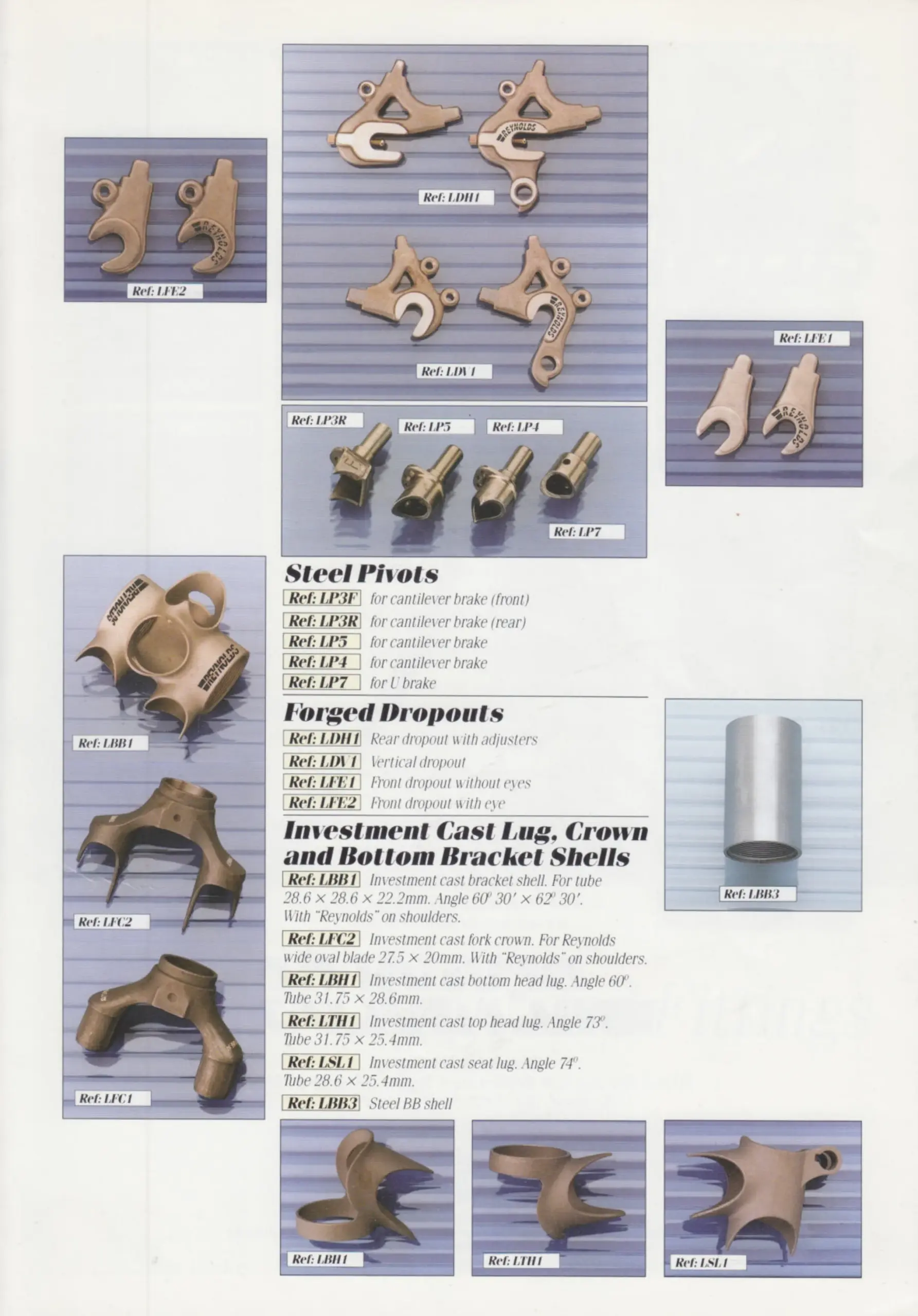
Around 1990 Reynolds launched its own investment-cast lugs, crowns and bottom bracket shells and forged dropouts, with the Reynolds name on them, so a cast or forged Reynolds name points to a frame of about 1990 or later
The worked example: a TI roundel and TI Reynolds Limited, Birmingham at the foot, 1978 to the early 1980s
Every reading here comes from “Date the transfer by its small print” in this guide.
Reynolds guarded its transfers jealously. The c.1978 leaflet is blunt about it: genuine transfers could not be bought, they went from Birmingham direct to bicycle manufacturers and frame set stockists in numbers matched to the tube sets supplied, and “any offered for sale separately are forgeries.” For a well-authenticated repaint, a replacement could be had from Reynolds, but only with the frame number and the manufacturer’s guarantee that the frame was built of Reynolds tube.
By the 1980s those replacements had a look of their own. The c.1987 Tube Talk folder shows three genuine respray transfers, for 753 cycle tube, 531 professional and 531 cycle tube, “allocated only to authenticated Reynolds frames.” They are easy to tell from a build transfer: the GUARANTEED BUILT WITH heading is gone and there is no statement of which tubes are butted; in their place is a band reading RESPRAY. From 1989, by Reynolds’ own later account, replacement transfers read RENOVATED instead. So a frame wearing one has been refinished, and somebody once vouched for it to Reynolds. It also means the paint is younger than the frame, which matters if you were about to date the bicycle by its finish.
Today the old rules have turned upside down. Reproductions of the old transfers, respray marks included, are made and sold openly for restorers, so a crisp, bright transfer on an old frame proves nothing by itself. There is nothing dishonest about a reproduction on a restored frame, but the frame should be judged on its tubes and its build rather than on a sticker anyone can order. The small print is your friend here, too: a transfer whose design belongs to a different decade from everything else on the bicycle deserves a second look.
Transfers wear off, get painted over and get added by hopeful owners, so it pays to know what the frame itself can tell you. Three checks need nothing more than a tape measure and a little care:
Two tube sets leave fingerprints of their own. The 700 Classic used special-section tubes with flats inside and its data sheet notes that “the Reynolds mark will always be above a flat.” And 753 was restricted to approved constructors under Reynolds’ own inspectorate and the 1988 range shows why: it was to be brazed at 650°C, where every other tube in the range was given 950°C or more. A genuine 753 frame came from a builder Reynolds had approved, which is a question worth asking of any 753 transfer on a frame from an unknown hand.
If you hold Reynolds paper of your own—say, a leaflet that came with a frame or a page from a builder’s catalog—it can usually be dated from its imprint even when it carries no year. The 1972 booklet is signed Reynolds Tube Company Ltd., Hay Hall Works. The 1981 sheet is signed TI Reynolds Limited, P.O. Box 232, with a telex number. By the later 1980s the company is TI Reynolds 531 Limited at P.O. Box 765, and by August 1988 its imprint carries a new telephone number and a fax. A Birmingham telephone number beginning 021 rather than 0121 puts any of them before April 1995, and the printer’s codes help too: 15 M/12/72 on the 1972 booklet means 15,000 copies printed in December 1972.
One more period detail that brings these sheets to life. The 1981 agents list names The Holdsworthy Co. Ltd. of Oakfield Road, London SE20, as Reynolds’ main agent in the United Kingdom for orders of 500 sets or less, the same firm whose catalogs and advertisements fill a good part of the archive. If you have a Reynolds leaflet, price list or catalog, please add it through Docs Drop and it becomes a dating tool for everyone.
Suppose a British club frame comes in with a green, gold and black transfer on the seat tube reading GUARANTEED BUILT WITH REYNOLDS 531 BUTTED FRAME TUBES, with a TI roundel and Manufactured by TI Reynolds Limited, Birmingham, England at its foot. There is nothing at all on the fork.
Answer: a frame with butted 531 main tubes, finished between 1978 and the early 1980s, with a fork and stays of unknown provenance. It is an honest club frame, and the transfer said so all along, as long as you understand what it means.
All nine Reynolds documents are in the Ebykr Catalog Archive, transcribed and searchable, with every transfer reproduced. The marque guides lean on them: the Raleigh and Peugeot guides both read the tubing transfer as part of dating a frame, and the Tech Specs database lets you filter documented builds by their tubing. If you have a transfer you cannot place, photograph it straight on, small print and all, and bring it to the Ebykr forums. And the rest of the Identify and Date series is waiting when you are ready for the rest of the bicycle (or others in your collection).
Reynolds literature in the Ebykr Catalog Archive, courtesy of the National Cycle Archive in partnership with the Veteran-Cycle Club: the 1972 Top Tubes booklet, the c.1978 transfers leaflet, the 1981 transfers and agents sheet, the c.1987 Tube Talk, the 1988 Product Range, the c.1989 set leaflets, the c.1990 Constructors Tube Guide, the c.1990 Lugs and Fittings brochure and the 1990 Product Range
Grace’s Guide — Reynolds Tube Co. (Reynolds advertisements of 1931, 1936, 1947 and 1975; Cycling, 8 April 1936)
Companies House — TI Reynolds Limited, formerly Reynolds Tube Company Limited
Companies House — company 00418872, formerly TI Reynolds 531 Limited
Google Patents — GB 1897 No. 24,931, A. M. Reynolds and J. T. Hewitt
Equus Bicycle — TI Reynolds transfer chart and early-1980s brochure
Reynolds Technology — The development of the Reynolds decal style (2009)
Reynolds Technology — history
H Lloyd Cycles — 531 history (2015)
Cycle (CTC), April/May 2011 — Dan Farrell, Made in Britain
 Reynolds
Ebykr documents this marque across the archive. Here is the rest of it.
The Ebykr Digest
New articles, timelines, catalog finds and registry activity — assembled from the archive once a month. Your address is never shared.
Double opt-in. One email per month. Unsubscribe at any time with one click.