About Ebykr
Ebykr celebrates classic and vintage lightweight bicycles through provocative imagery and opinion. Ride along with us.
About Ebykr
Ebykr celebrates classic and vintage lightweight bicycles through provocative imagery and opinion. Ride along with us.

Source: National Cycle Archive, in partnership with the Veteran-Cycle Club.
| Marque | Reynolds |
|---|---|
| Type | Catalog |
| Year | 1978 |
| Publisher | TI Reynolds Limited |
| Country | England |
| Language | English |
| Pages | 1 |
| Source | National Cycle Archive, in partnership with the Veteran-Cycle Club. |
| Credit | National Cycle Archive, in partnership with the Veteran-Cycle Club |
| Transcription | Transcribed by eye |
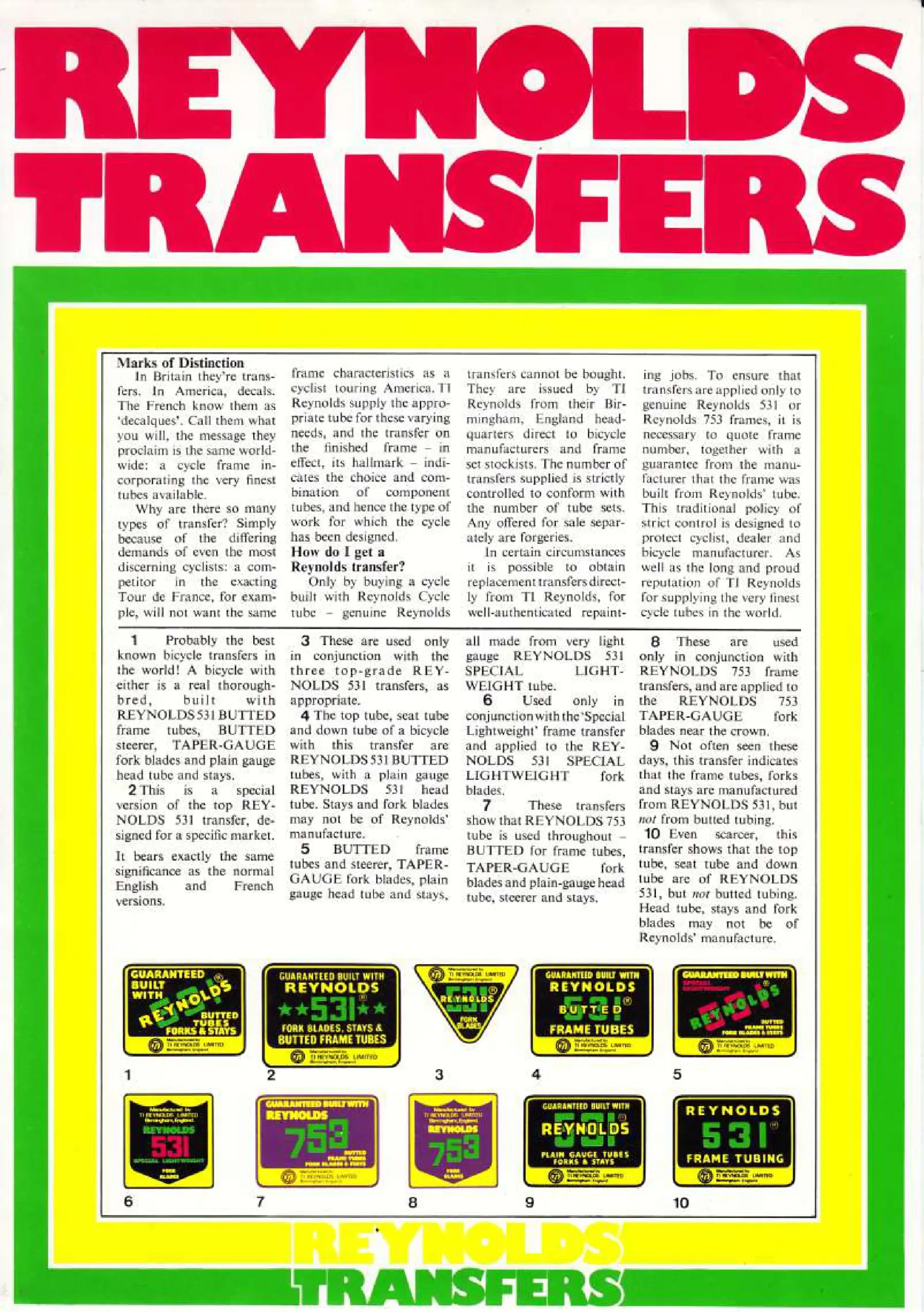
REYNOLDS TRANSFERS Marks of Distinction In Britain they're transfers. In America, decals. The French know them as 'decalques'. Call them what you will, the message they proclaim is the same worldwide: a cycle frame incorporating the very finest tubes available. Why are there so many types of transfer? Simply because of the differing demands of …
A single printed sheet issued by TI Reynolds setting out 10 numbered frame transfers and stating, one by one, exactly what each of them certifies. It is undated.
Two things make it worth holding. The first is the anti-forgery passage. Reynolds states plainly that genuine transfers cannot be bought: they are issued from Birmingham direct to bicycle manufacturers and frame set stockists, in numbers strictly controlled to match the number of tube sets supplied, and any offered for sale separately are forgeries. Replacements for a well-authenticated repaint require the frame number and a guarantee from the manufacturer that the frame was built from Reynolds tube. That is the firm’s own account of a control policy that collectors still argue about.
The second is the bottom of the range. Transfers 9 and 10 are described by Reynolds itself as rarely seen, and both mark frames that are 531 but not butted — 9 for frame tubes, forks and stays in plain 531, and 10 for a frame whose top, seat and down tubes are 531 while the head tube, stays and fork blades may not be Reynolds at all. Those two are the ones most often over-read today.
Dating. The sheet is later than 1975, because Reynolds 753 appears on it. It is earlier than the companion agents sheet in this collection, which carries a printer code ending 4/81 and adds the SpeedStream oval, the tandem transfer and the whole Reynolds SMS group, none of which appear here. The company’s name narrows it further. The sheet calls the firm TI Reynolds throughout and every transfer on it reads Manufactured by TI REYNOLDS LIMITED, while Companies House records the company’s earlier name, Reynolds Tube Company Limited, as ending on 31 December 1977. That places the sheet between 1978 and April 1981; 1978 is the earliest year it can be, not a documented year.
The sheet reached the Ebykr collection through the National Cycle Archive in partnership with the Veteran-Cycle Club, whose courtesy card is the first page of the source file. That card is not reproduced here. The scan is at the resolution floor and the body text was read by enlargement.
— Page 1 —
REYNOLDS TRANSFERS
Marks of Distinction
In Britain they’re transfers. In America, decals. The French know them as ‘decalques’. Call them what you will, the message they proclaim is the same worldwide: a cycle frame incorporating the very finest tubes available.
Why are there so many types of transfer? Simply because of the differing demands of even the most discerning cyclists: a competitor in the exacting Tour de France, for example, will not want the same frame characteristics as a cyclist touring America. TI Reynolds supply the appropriate tube for these varying needs, and the transfer on the finished frame – in effect, its hallmark – indicates the choice and combination of component tubes, and hence the type of work for which the cycle has been designed.
How do I get a Reynolds transfer?
Only by buying a cycle built with Reynolds Cycle tube – genuine Reynolds transfers cannot be bought. They are issued by TI Reynolds from their Birmingham, England headquarters direct to bicycle manufacturers and frame set stockists. The number of transfers supplied is strictly controlled to conform with the number of tube sets. Any offered for sale separately are forgeries.
In certain circumstances it is possible to obtain replacement transfers directly from TI Reynolds, for well-authenticated repainting jobs. To ensure that transfers are applied only to genuine Reynolds 531 or Reynolds 753 frames, it is necessary to quote frame number, together with a guarantee from the manufacturer that the frame was built from Reynolds’ tube. This traditional policy of strict control is designed to protect cyclist, dealer and bicycle manufacturer. As well as the long and proud reputation of TI Reynolds for supplying the very finest cycle tubes in the world.
[Ten transfers are reproduced across the foot of the sheet in green, gold and black, numbered 1 to 10, with the explanations below keyed to those numbers.]
1. Probably the best known bicycle transfers in the world! A bicycle with either is a real thoroughbred, built with REYNOLDS 531 BUTTED frame tubes, BUTTED steerer, TAPER-GAUGE fork blades and plain gauge head tube and stays.
2. This is a special version of the top REYNOLDS 531 transfer, designed for a specific market. It bears exactly the same significance as the normal English and French versions.
3. These are used only in conjunction with the three top-grade REYNOLDS 531 transfers, as appropriate.
4. The top tube, seat tube and down tube of a bicycle with this transfer are REYNOLDS 531 BUTTED tubes, with a plain gauge REYNOLDS 531 head tube. Stays and fork blades may not be of Reynolds’ manufacture.
5. BUTTED frame tubes and steerer, TAPER-GAUGE fork blades, plain gauge head tube and stays, all made from very light gauge REYNOLDS 531 SPECIAL LIGHTWEIGHT tube.
6. Used only in conjunction with the ‘Special Lightweight’ frame transfer and applied to the REYNOLDS 531 SPECIAL LIGHTWEIGHT fork blades.
7. These transfers show that REYNOLDS 753 tube is used throughout – BUTTED for frame tubes, TAPER-GAUGE fork blades and plain-gauge head tube, steerer and stays.
8. These are used only in conjunction with REYNOLDS 753 frame transfers, and are applied to the REYNOLDS 753 TAPER-GAUGE fork blades near the crown.
9. Not often seen these days, this transfer indicates that the frame tubes, forks and stays are manufactured from REYNOLDS 531, but not from butted tubing.
10. Even scarcer, this transfer shows that the top tube, seat tube and down tube are of REYNOLDS 531, but not butted tubing. Head tube, stays and fork blades may not be of Reynolds’ manufacture.
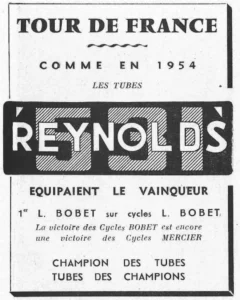 Reynolds 1955 Advertisement — The 531 Tubes of the Tour Winner, as in 1954
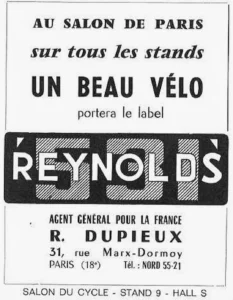 Reynolds 1964 Advertisement — A Fine Bicycle Will Carry the Reynolds 531 Label
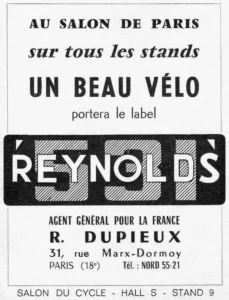 Reynolds 1966 Advertisement — A Fine Bicycle Will Carry the Reynolds 531 Label
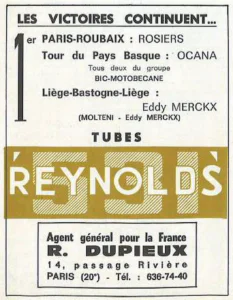 Reynolds 1971 Advertisement — The Victories Continue
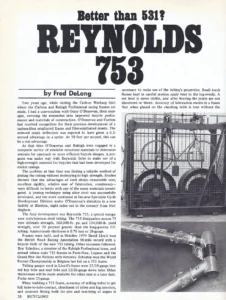 Better than 531? Reynolds 753 — Bicycling!, March 1976, by Fred DeLong
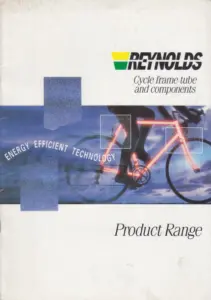 Reynolds 1990 Product Range — Every Tube Set by Part Number, and the Brazing Temperatures
Ebykr presents this material for research and education. If you hold rights to it or notice an ownership issue, please contact us and we will respond promptly.
The Ebykr Digest
New articles, timelines, catalog finds and registry activity — assembled from the archive once a month. Your address is never shared.
Double opt-in. One email per month. Unsubscribe at any time with one click.