About Ebykr
Ebykr celebrates classic and vintage lightweight bicycles through provocative imagery and opinion. Ride along with us.
About Ebykr
Ebykr celebrates classic and vintage lightweight bicycles through provocative imagery and opinion. Ride along with us.

Source: National Cycle Archive, in partnership with the Veteran-Cycle Club.
| Marque | Reynolds |
|---|---|
| Type | Catalog |
| Year | 1972 |
| Publisher | Reynolds Tube Company Ltd. |
| Country | England |
| Language | English |
| Pages | 12 |
| Source | National Cycle Archive, in partnership with the Veteran-Cycle Club. |
| Credit | National Cycle Archive, in partnership with the Veteran-Cycle Club |
| Transcription | Transcribed by eye |
Top tubes by REYNOLDS Top Tubes — by Reynolds When bicycle builders the World over specify one particular type of tubing for their finest lightweight cycles, when bicycles made of that same tubing consistently win the World's major cycle races, including the Tour de France, most gruelling cycle race of all, then behind that tubing …
A 12-page booklet issued by the Publicity Department of Reynolds Tube Company Ltd. from Hay Hall Works, Tyseley, Birmingham, and printed by CBE Printers Ltd. Its printer code, 15 M/12/72, gives both the print run and the date: fifteen thousand copies, December 1972.
It is a piece of consumer explanation rather than a trade catalog. There are no part numbers and no set tables. Instead Reynolds walks a cyclist through how a tube is made, from pierced ingot to finished fork blade, in plain language and with cartoons, and then explains what the decal on the finished frame is actually promising.
Three things make it valuable beyond its charm.
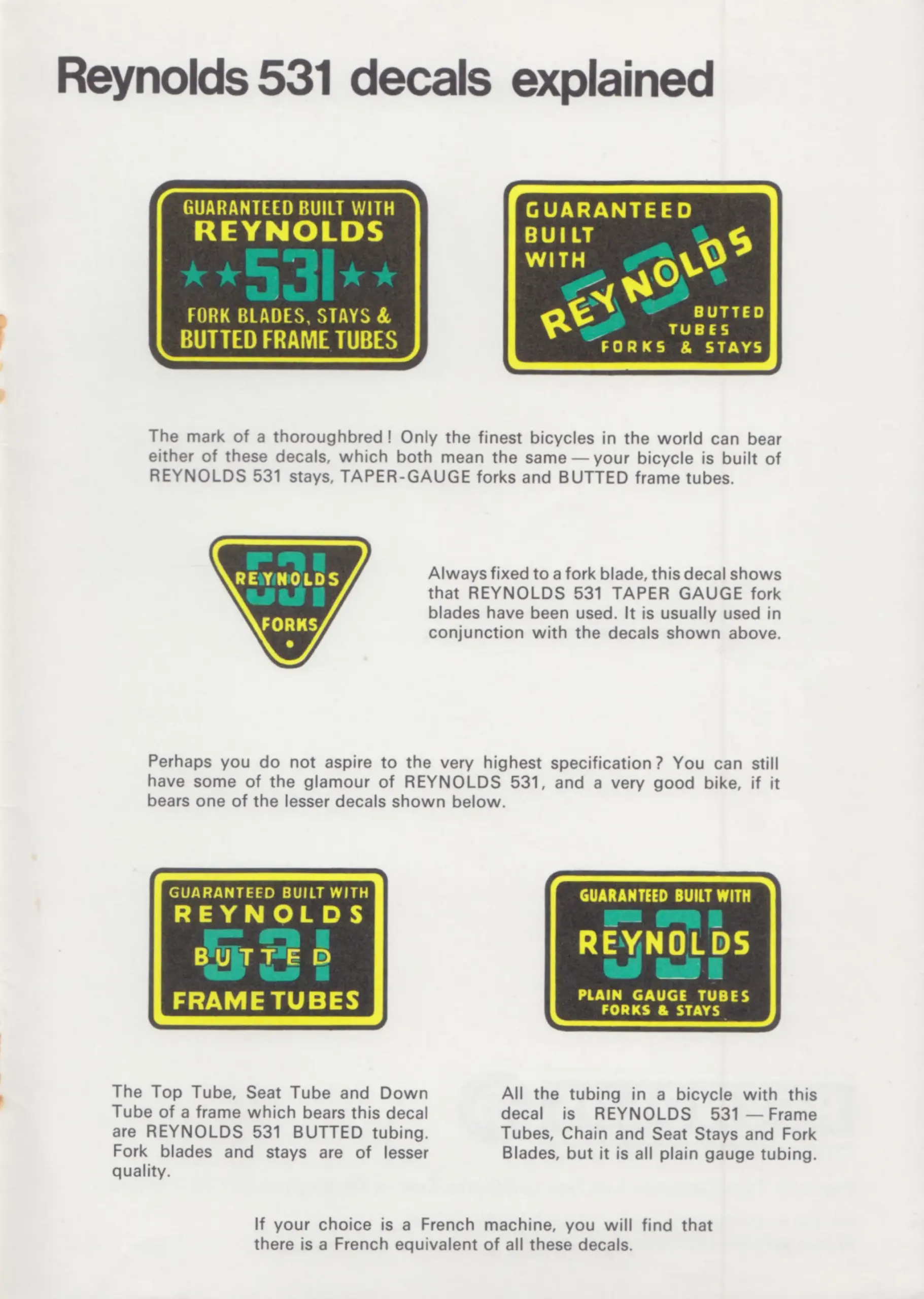
The first is the decal page. Reynolds sets out five transfers and states exactly what each one guarantees, and the hierarchy is not intuitive. The two top decals, the starred rectangle and the diagonal, mean the same thing: 531 stays, taper-gauge forks and butted frame tubes. The small triangular fork decal is always fixed to a fork blade and certifies taper-gauge blades. Below those sit two lesser marks that are routinely misread today. A frame reading BUTTED FRAME TUBES has 531 butted tubing in the top, seat and down tubes only, with fork blades and stays of lesser quality. A frame reading PLAIN GAUGE TUBES is 531 throughout, frame tubes, stays and fork blades, but all of it plain gauge. Reynolds adds that a French machine carries a French equivalent of all of these.
The second is the origin account in Reynolds’ own words. Alfred Milward Reynolds, working in his father’s nail factory in Birmingham, invented the butting process in the 1890s to stop thin-gauge frames buckling near the joints, patented it in 1897 and began manufacture in his father’s works. A separate company, The Patent Butted Tube Company Limited, was formed in 1898 to make and market the tubes, which were nevertheless still sold as Reynolds Butted Tubes, and the company was eventually renamed Reynolds Tube Company Limited to match. The booklet also gives the alloy sequence that led to 531: ‘A’ quality, then ‘AA’ quality with higher carbon, then ‘HM’ high manganese, then the manganese-molybdenum 531, whose distinction was that its crystal structure changed very little at brazing temperature. It even tells the reader how to say it, five-three-one.
The third is the imprint itself. This booklet is signed Reynolds Tube Company Ltd., under the Tube Investments group. The undated set leaflets elsewhere in this collection are signed TI Reynolds 531 Limited. The change of name is a dating marker for any undated Reynolds paper.
The booklet reached the Ebykr collection through the National Cycle Archive in partnership with the Veteran-Cycle Club, whose courtesy card is the first page of the source file. That card is not reproduced here. Several leaves are versos printed on thin stock and show heavy strike-through from the page behind; that is a property of the original, not of the scan.
— Page 1 —
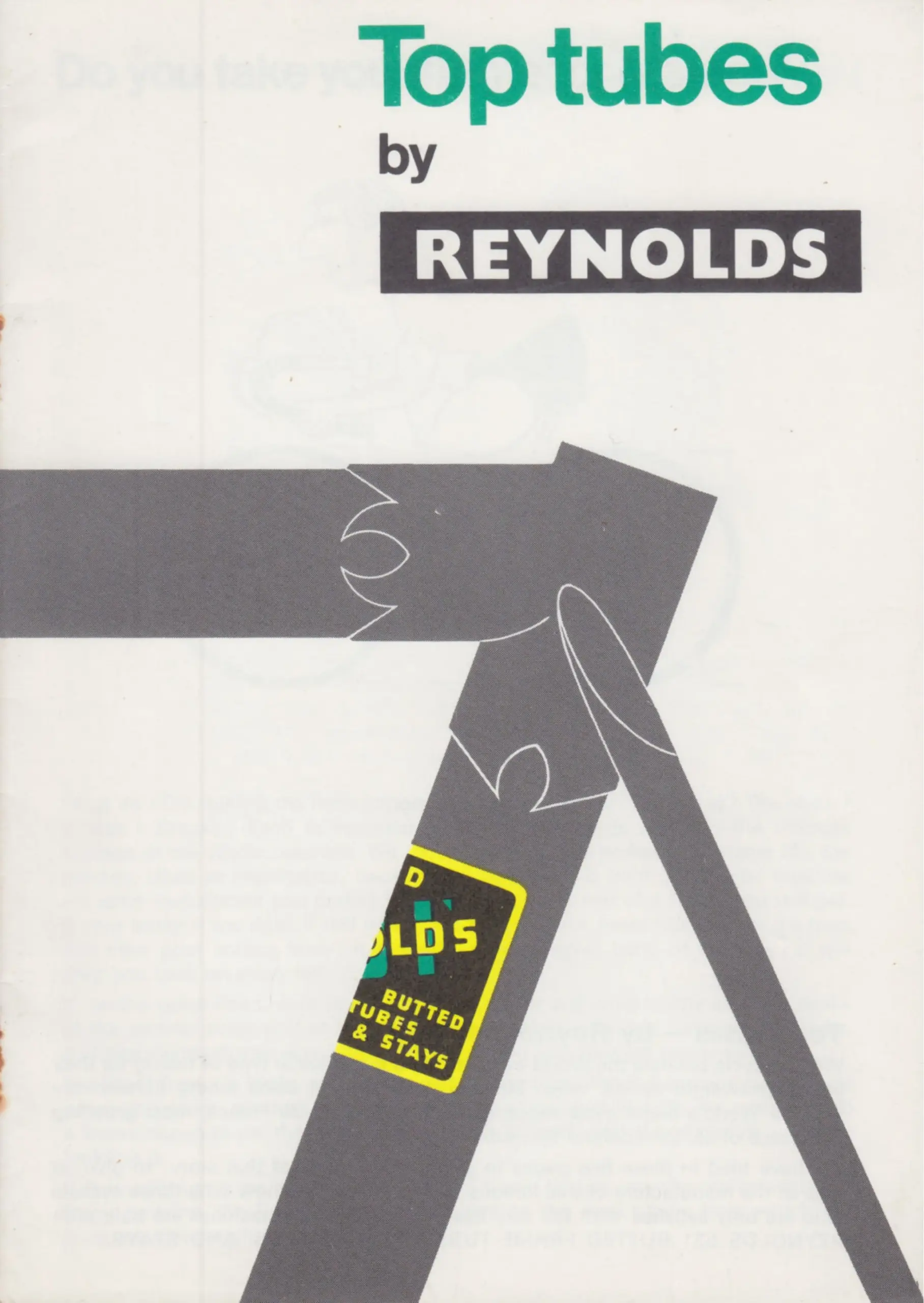
[Front cover. A heavy gray arrow doubles as a frame joint, a seat cluster where the top tube, the seat tube and a wrapover seat stay meet, with a REYNOLDS BUTTED TUBES & STAYS decal applied to the seat tube.]
Top tubes by REYNOLDS
— Page 2 —
[A verso printed on thin stock; the cover artwork shows through from behind.]
Top Tubes — by Reynolds
When bicycle builders the World over specify one particular type of tubing for their finest lightweight cycles, when bicycles made of that same tubing consistently win the World’s major cycle races, including the Tour de France, most gruelling cycle race of all, then behind that tubing must lie a story.
We have tried in these few pages to sketch the outline of that story; to give an idea of the manufacture of this famous tubing, and so to show why those cyclists who are only satisfied with the very best, insist that their machines are built with REYNOLDS 531 BUTTED FRAME TUBES, FORK BLADES, AND STAYS.
— Page 3 —
Do you take your frame for granted?
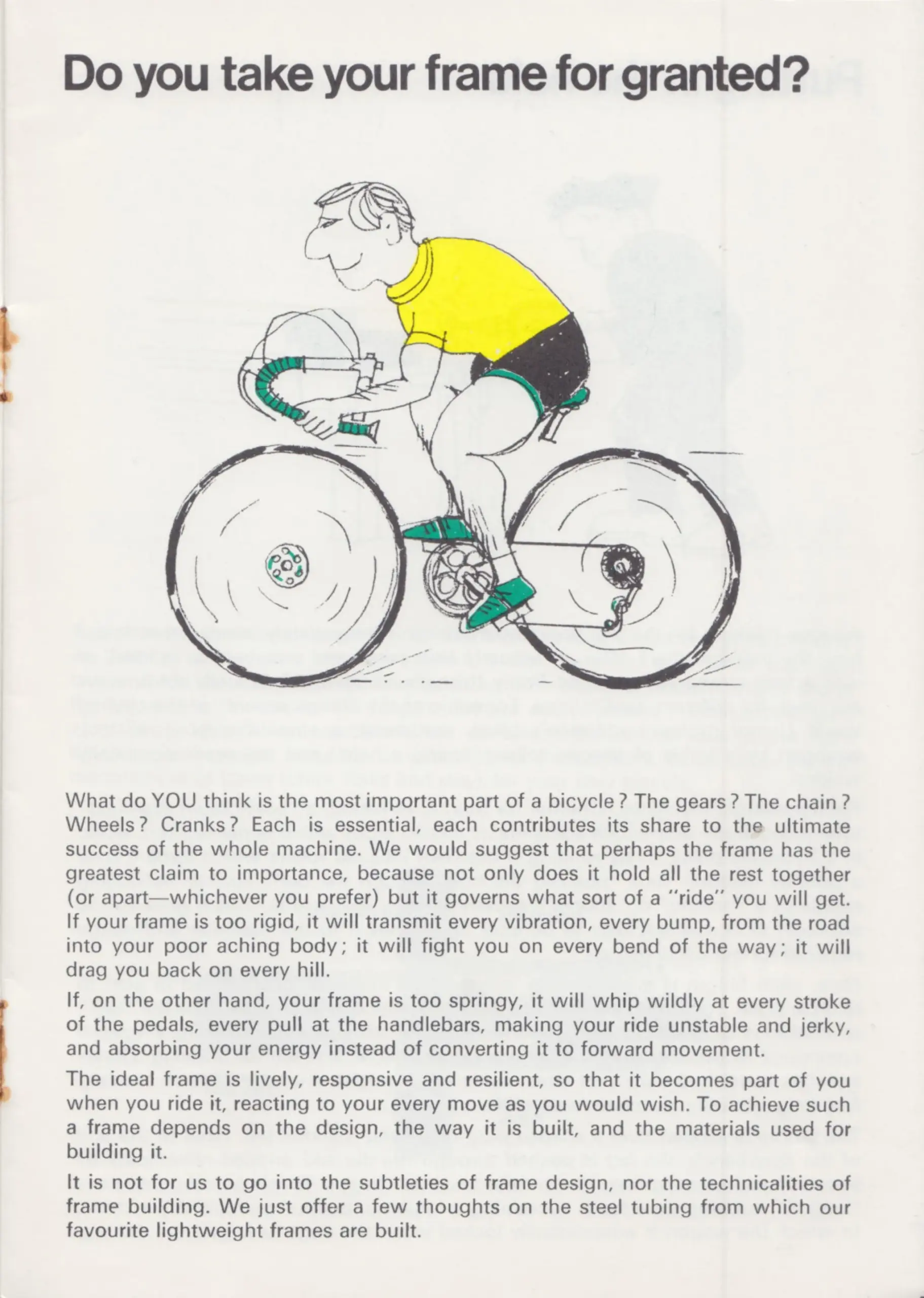
[A cartoon of a rider in a yellow jersey, head down on the drops, wheels blurred with speed.]
What do YOU think is the most important part of a bicycle? The gears? The chain? Wheels? Cranks? Each is essential, each contributes its share to the ultimate success of the whole machine. We would suggest that perhaps the frame has the greatest claim to importance, because not only does it hold all the rest together (or apart—whichever you prefer) but it governs what sort of a “ride” you will get. If your frame is too rigid, it will transmit every vibration, every bump, from the road into your poor aching body; it will fight you on every bend of the way; it will drag you back on every hill.
If, on the other hand, your frame is too springy, it will whip wildly at every stroke of the pedals, every pull at the handlebars, making your ride unstable and jerky, and absorbing your energy instead of converting it to forward movement.
The ideal frame is lively, responsive and resilient, so that it becomes part of you when you ride it, reacting to your every move as you would wish. To achieve such a frame depends on the design, the way it is built, and the materials used for building it.
It is not for us to go into the subtleties of frame design, nor the technicalities of frame building. We just offer a few thoughts on the steel tubing from which our favourite lightweight frames are built.
— Page 4 —
Putting in the hole
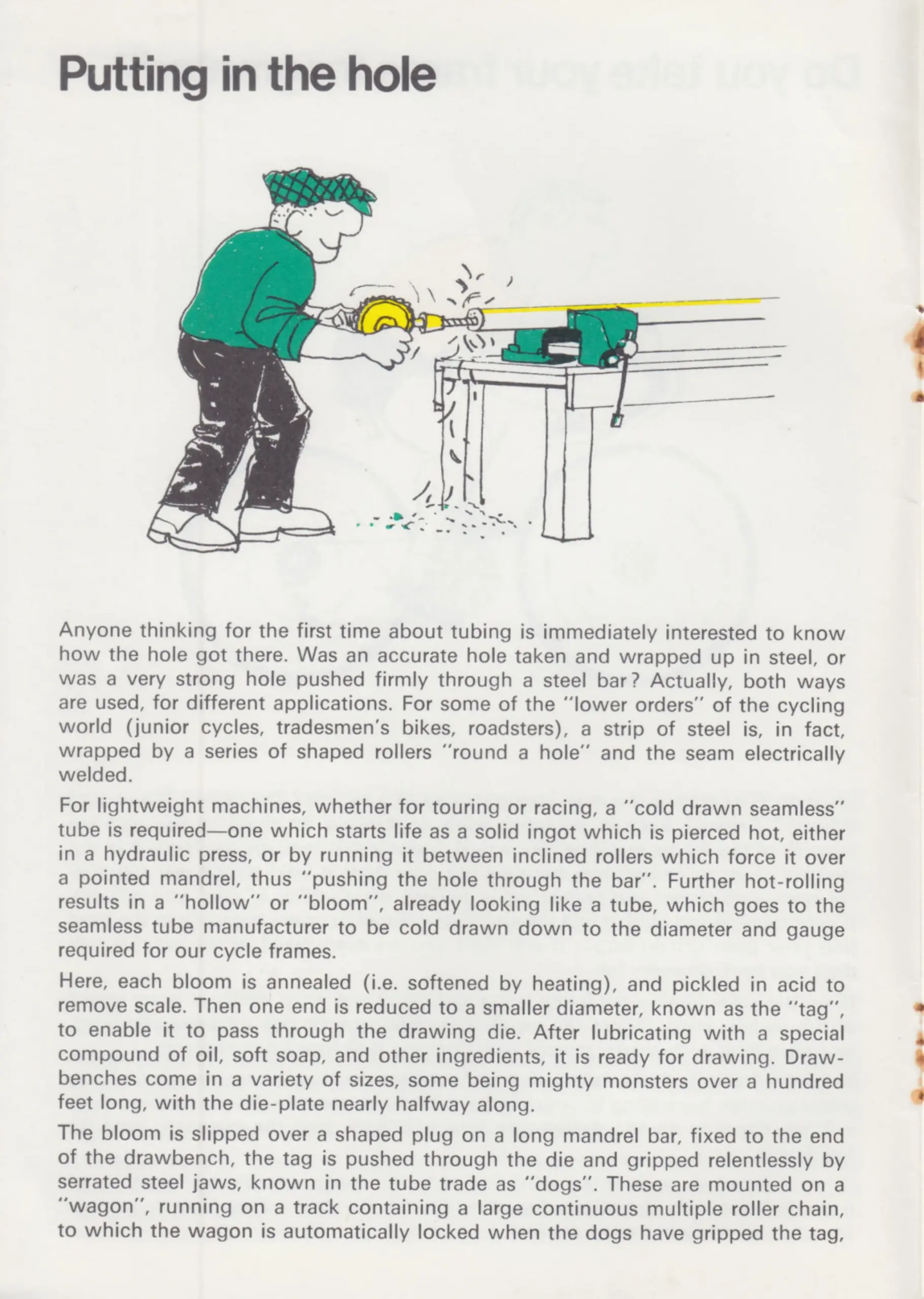
[A cartoon of a workman in a flat cap grinding the end of a long yellow tube held in a bench vice, sparks flying.]
Anyone thinking for the first time about tubing is immediately interested to know how the hole got there. Was an accurate hole taken and wrapped up in steel, or was a very strong hole pushed firmly through a steel bar? Actually, both ways are used, for different applications. For some of the “lower orders” of the cycling world (junior cycles, tradesmen’s bikes, roadsters), a strip of steel is, in fact, wrapped by a series of shaped rollers “round a hole” and the seam electrically welded.
For lightweight machines, whether for touring or racing, a “cold drawn seamless” tube is required—one which starts life as a solid ingot which is pierced hot, either in a hydraulic press, or by running it between inclined rollers which force it over a pointed mandrel, thus “pushing the hole through the bar”. Further hot-rolling results in a “hollow” or “bloom”, already looking like a tube, which goes to the seamless tube manufacturer to be cold drawn down to the diameter and gauge required for our cycle frames.
Here, each bloom is annealed (i.e. softened by heating), and pickled in acid to remove scale. Then one end is reduced to a smaller diameter, known as the “tag”, to enable it to pass through the drawing die. After lubricating with a special compound of oil, soft soap, and other ingredients, it is ready for drawing. Draw-benches come in a variety of sizes, some being mighty monsters over a hundred feet long, with the die-plate nearly halfway along.
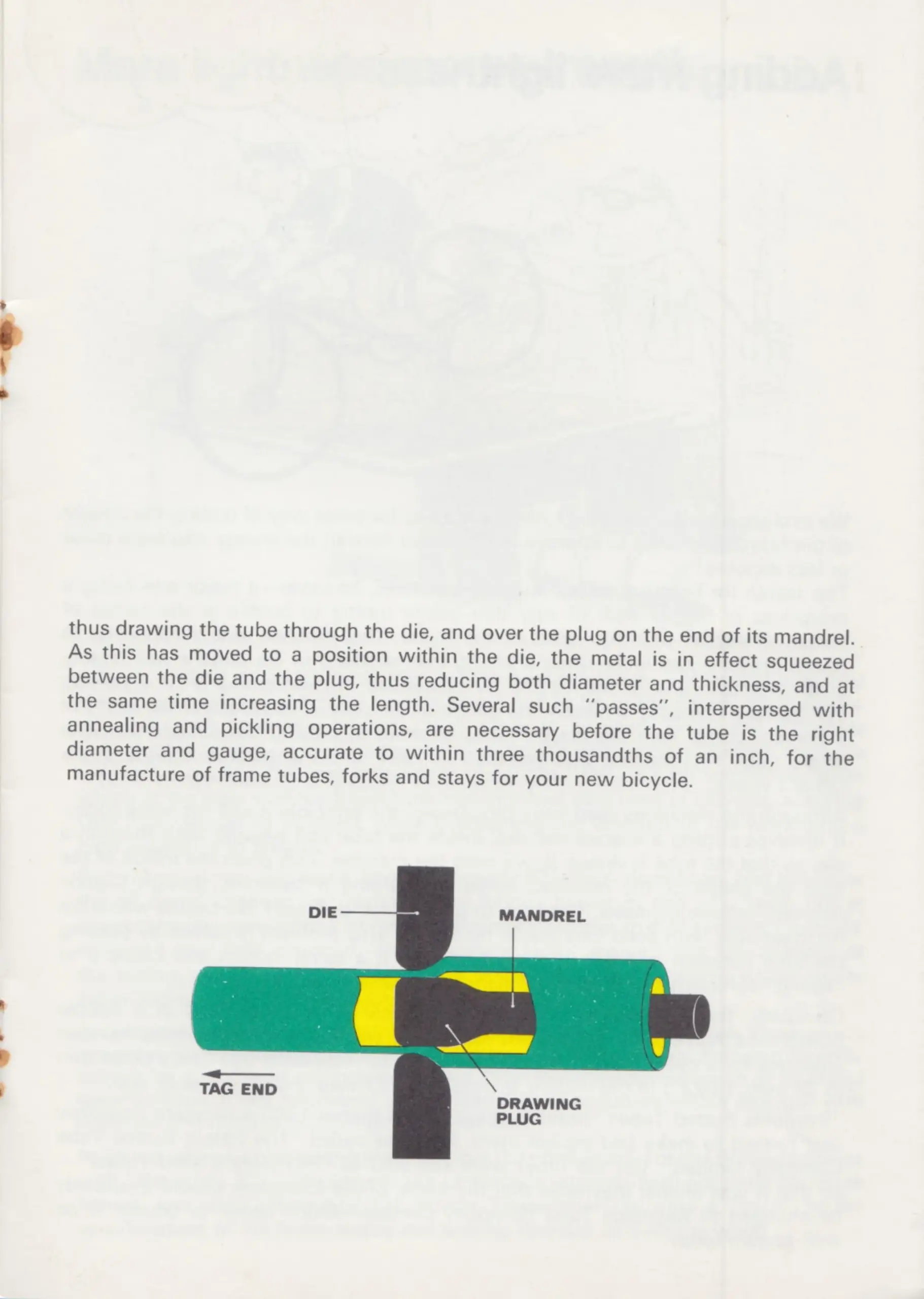
The bloom is slipped over a shaped plug on a long mandrel bar, fixed to the end of the drawbench, the tag is pushed through the die and gripped relentlessly by serrated steel jaws, known in the tube trade as “dogs”. These are mounted on a “wagon”, running on a track containing a large continuous multiple roller chain, to which the wagon is automatically locked when the dogs have gripped the tag,
— Page 5 —
[A verso; the following page shows through. A cutaway diagram sits at the foot of the page, labeled DIE, MANDREL, DRAWING PLUG and TAG END, showing a green tube being pulled left through a black die over a yellow plug.]
thus drawing the tube through the die, and over the plug on the end of its mandrel. As this has moved to a position within the die, the metal is in effect squeezed between the die and the plug, thus reducing both diameter and thickness, and at the same time increasing the length. Several such “passes”, interspersed with annealing and pickling operations, are necessary before the tube is the right diameter and gauge, accurate to within three thousandths of an inch, for the manufacture of frame tubes, forks and stays for your new bicycle.
— Page 6 —
Adding more lightness
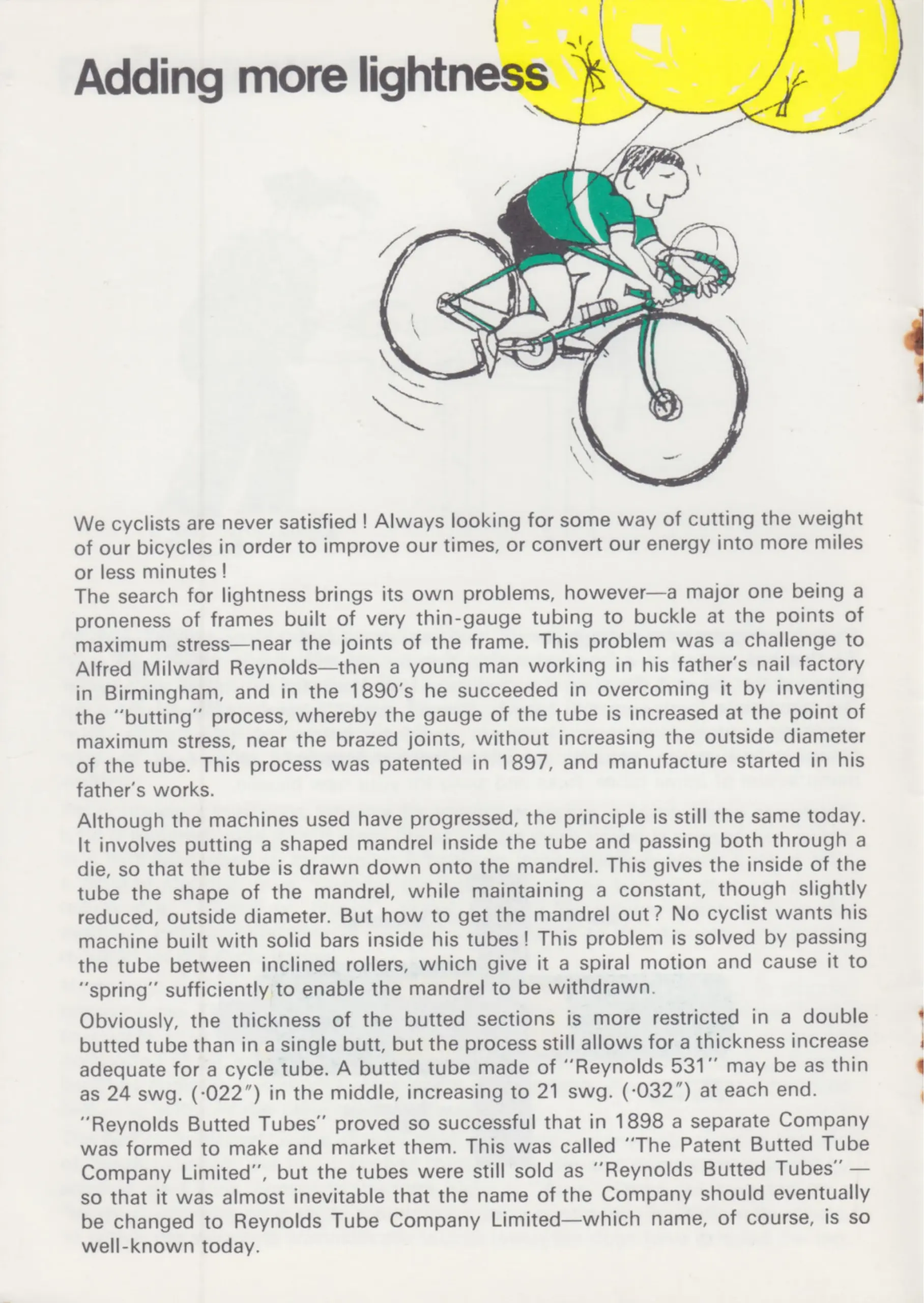
[A cartoon of a rider in a green and white jersey lifted off the road by a bunch of yellow balloons.]
We cyclists are never satisfied! Always looking for some way of cutting the weight of our bicycles in order to improve our times, or convert our energy into more miles or less minutes!
The search for lightness brings its own problems, however—a major one being a proneness of frames built of very thin-gauge tubing to buckle at the points of maximum stress—near the joints of the frame. This problem was a challenge to Alfred Milward Reynolds—then a young man working in his father’s nail factory in Birmingham, and in the 1890’s he succeeded in overcoming it by inventing the “butting” process, whereby the gauge of the tube is increased at the point of maximum stress, near the brazed joints, without increasing the outside diameter of the tube. This process was patented in 1897, and manufacture started in his father’s works.
Although the machines used have progressed, the principle is still the same today. It involves putting a shaped mandrel inside the tube and passing both through a die, so that the tube is drawn down onto the mandrel. This gives the inside of the tube the shape of the mandrel, while maintaining a constant, though slightly reduced, outside diameter. But how to get the mandrel out? No cyclist wants his machine built with solid bars inside his tubes! This problem is solved by passing the tube between inclined rollers, which give it a spiral motion and cause it to “spring” sufficiently to enable the mandrel to be withdrawn.
Obviously, the thickness of the butted sections is more restricted in a double butted tube than in a single butt, but the process still allows for a thickness increase adequate for a cycle tube. A butted tube made of “Reynolds 531″ may be as thin as 24 swg. (·022″) in the middle, increasing to 21 swg. (·032”) at each end.
“Reynolds Butted Tubes” proved so successful that in 1898 a separate Company was formed to make and market them. This was called “The Patent Butted Tube Company Limited”, but the tubes were still sold as “Reynolds Butted Tubes” — so that it was almost inevitable that the name of the Company should eventually be changed to Reynolds Tube Company Limited—which name, of course, is so well-known today.
— Page 7 —
More lightness-more strength
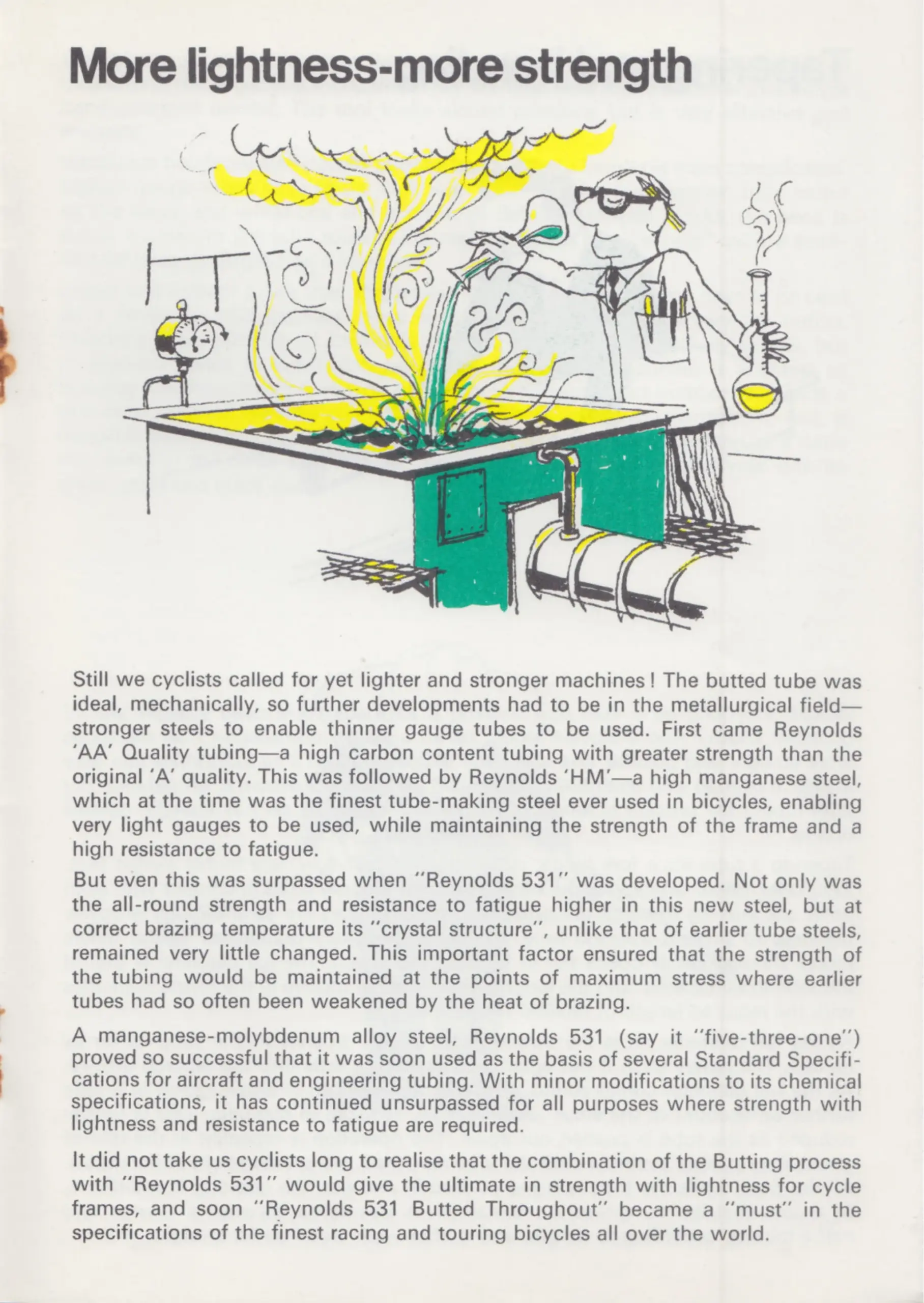
[A cartoon of a bespectacled metallurgist pouring a green liquid into a fuming tray, a flask in his other hand.]
Still we cyclists called for yet lighter and stronger machines! The butted tube was ideal, mechanically, so further developments had to be in the metallurgical field—stronger steels to enable thinner gauge tubes to be used. First came Reynolds ‘AA’ Quality tubing—a high carbon content tubing with greater strength than the original ‘A’ quality. This was followed by Reynolds ‘HM’—a high manganese steel, which at the time was the finest tube-making steel ever used in bicycles, enabling very light gauges to be used, while maintaining the strength of the frame and a high resistance to fatigue.
But even this was surpassed when “Reynolds 531” was developed. Not only was the all-round strength and resistance to fatigue higher in this new steel, but at correct brazing temperature its “crystal structure”, unlike that of earlier tube steels, remained very little changed. This important factor ensured that the strength of the tubing would be maintained at the points of maximum stress where earlier tubes had so often been weakened by the heat of brazing.
A manganese-molybdenum alloy steel, Reynolds 531 (say it “five-three-one”) proved so successful that it was soon used as the basis of several Standard Specifications for aircraft and engineering tubing. With minor modifications to its chemical specifications, it has continued unsurpassed for all purposes where strength with lightness and resistance to fatigue are required.
It did not take us cyclists long to realise that the combination of the Butting process with “Reynolds 531” would give the ultimate in strength with lightness for cycle frames, and soon “Reynolds 531 Butted Throughout” became a “must” in the specifications of the finest racing and touring bicycles all over the world.
— Page 8 —
Tapering and bending
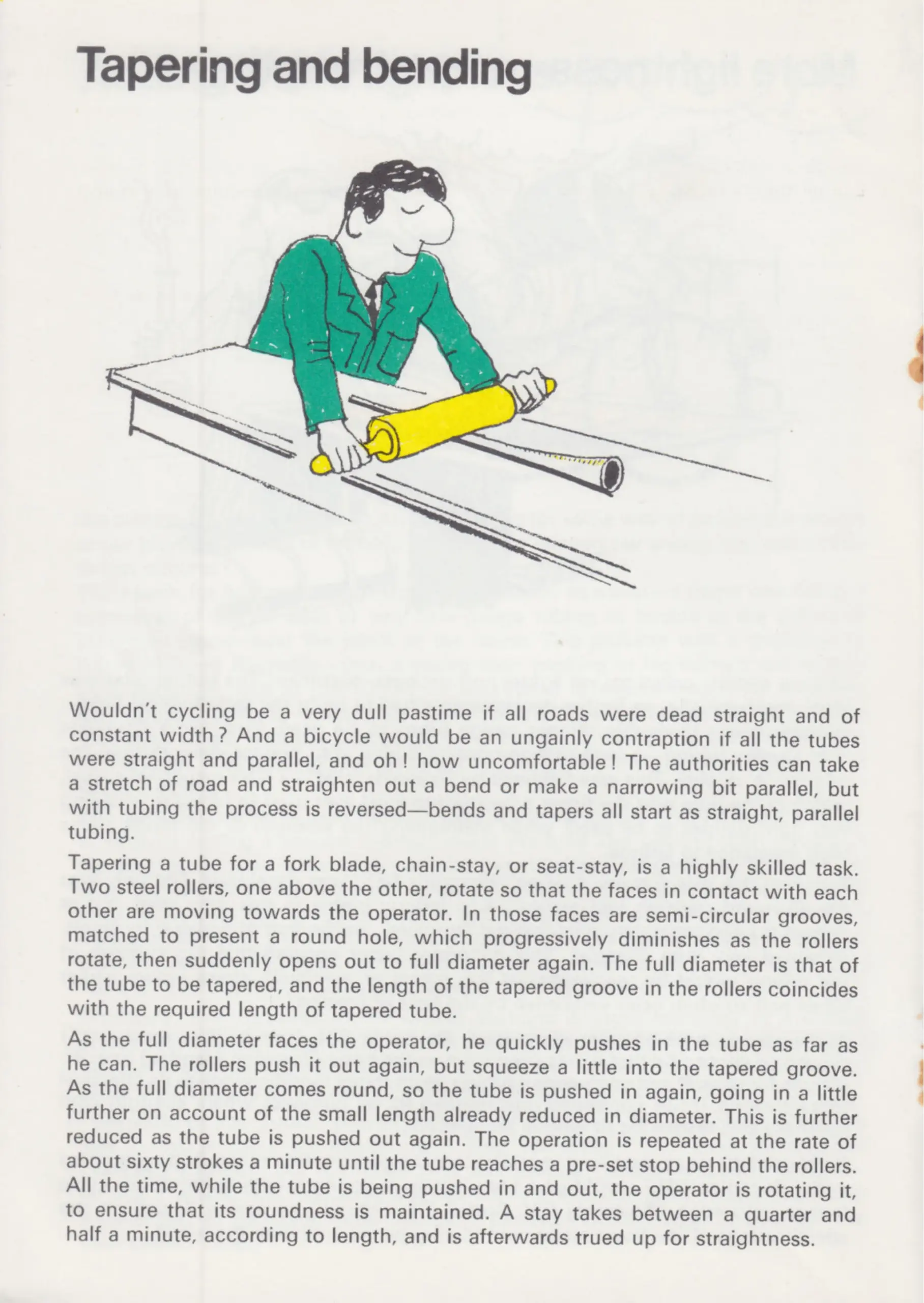
[A cartoon of a man in a green suit leaning over a bench, working a yellow tube between rollers.]
Wouldn’t cycling be a very dull pastime if all roads were dead straight and of constant width? And a bicycle would be an ungainly contraption if all the tubes were straight and parallel, and oh! how uncomfortable! The authorities can take a stretch of road and straighten out a bend or make a narrowing bit parallel, but with tubing the process is reversed—bends and tapers all start as straight, parallel tubing.
Tapering a tube for a fork blade, chain-stay, or seat-stay, is a highly skilled task. Two steel rollers, one above the other, rotate so that the faces in contact with each other are moving towards the operator. In those faces are semi-circular grooves, matched to present a round hole, which progressively diminishes as the rollers rotate, then suddenly opens out to full diameter again. The full diameter is that of the tube to be tapered, and the length of the tapered groove in the rollers coincides with the required length of tapered tube.
As the full diameter faces the operator, he quickly pushes in the tube as far as he can. The rollers push it out again, but squeeze a little into the tapered groove. As the full diameter comes round, so the tube is pushed in again, going in a little further on account of the small length already reduced in diameter. This is further reduced as the tube is pushed out again. The operation is repeated at the rate of about sixty strokes a minute until the tube reaches a pre-set stop behind the rollers. All the time, while the tube is being pushed in and out, the operator is rotating it, to ensure that its roundness is maintained. A stay takes between a quarter and half a minute, according to length, and is afterwards trued up for straightness.
— Page 9 —
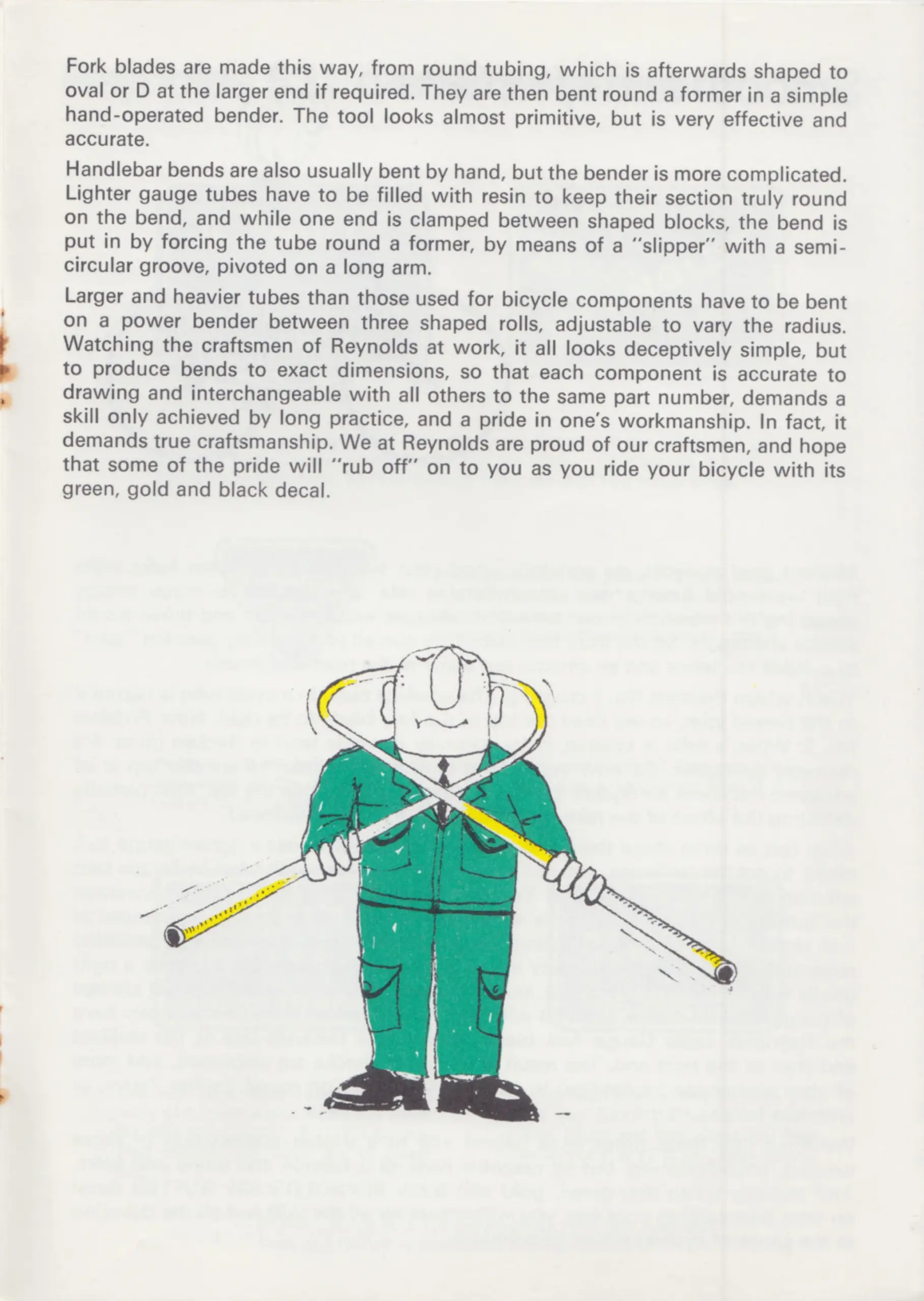
[A cartoon of a glum man in green overalls standing face on, holding two long tapered tubes crossed in front of him.]
Fork blades are made this way, from round tubing, which is afterwards shaped to oval or D at the larger end if required. They are then bent round a former in a simple hand-operated bender. The tool looks almost primitive, but is very effective and accurate.
Handlebar bends are also usually bent by hand, but the bender is more complicated. Lighter gauge tubes have to be filled with resin to keep their section truly round on the bend, and while one end is clamped between shaped blocks, the bend is put in by forcing the tube round a former, by means of a “slipper” with a semi-circular groove, pivoted on a long arm.
Larger and heavier tubes than those used for bicycle components have to be bent on a power bender between three shaped rolls, adjustable to vary the radius. Watching the craftsmen of Reynolds at work, it all looks deceptively simple, but to produce bends to exact dimensions, so that each component is accurate to drawing and interchangeable with all others to the same part number, demands a skill only achieved by long practice, and a pride in one’s workmanship. In fact, it demands true craftsmanship. We at Reynolds are proud of our craftsmen, and hope that some of the pride will “rub off” on to you as you ride your bicycle with its green, gold and black decal.
— Page 10 —
Smooth and effortless
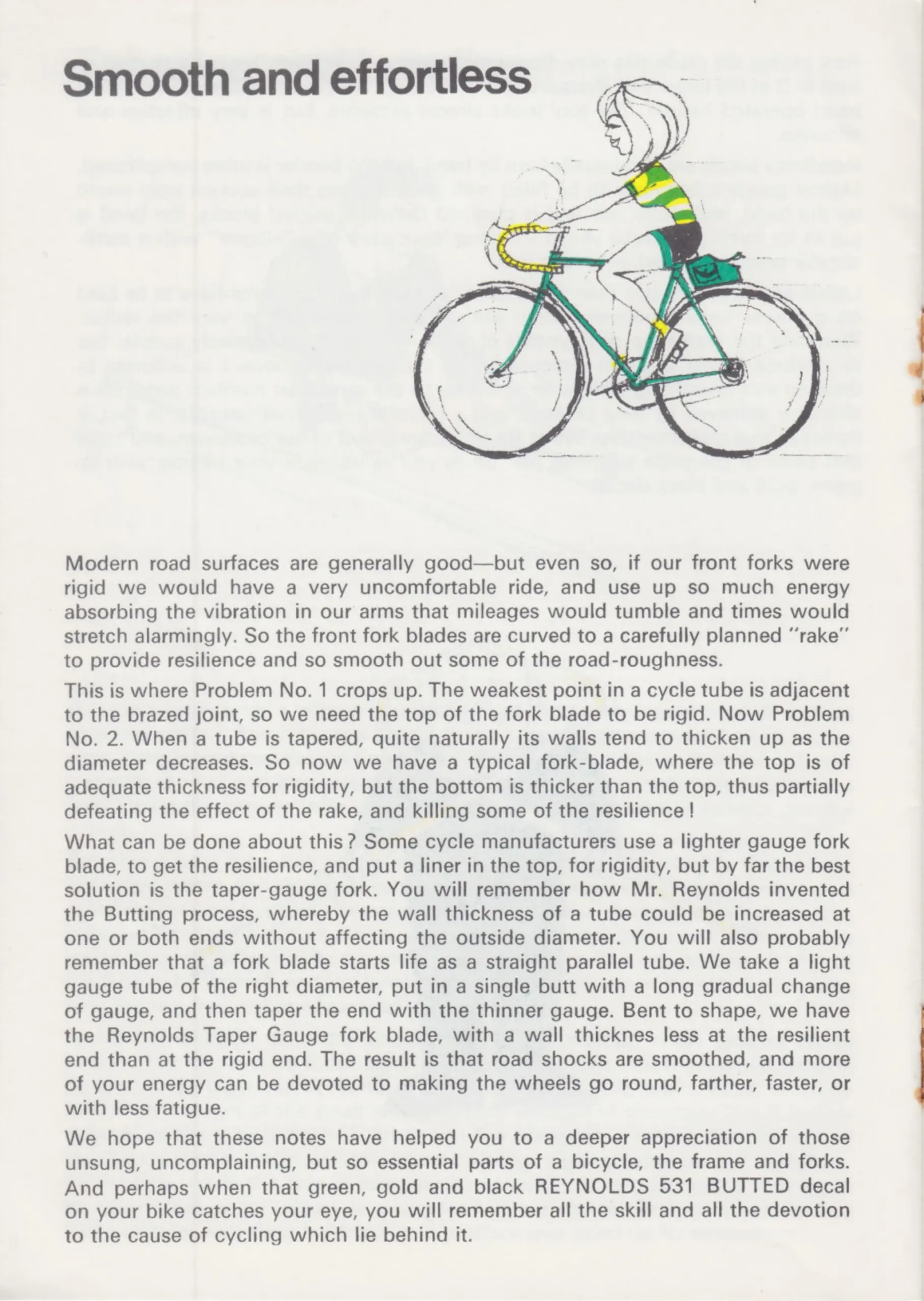
[A cartoon of a woman with long fair hair riding a green touring bicycle fitted with a saddlebag.]
Modern road surfaces are generally good—but even so, if our front forks were rigid we would have a very uncomfortable ride, and use up so much energy absorbing the vibration in our arms that mileages would tumble and times would stretch alarmingly. So the front fork blades are curved to a carefully planned “rake” to provide resilience and so smooth out some of the road-roughness.
This is where Problem No. 1 crops up. The weakest point in a cycle tube is adjacent to the brazed joint, so we need the top of the fork blade to be rigid. Now Problem No. 2. When a tube is tapered, quite naturally its walls tend to thicken up as the diameter decreases. So now we have a typical fork-blade, where the top is of adequate thickness for rigidity, but the bottom is thicker than the top, thus partially defeating the effect of the rake, and killing some of the resilience!
What can be done about this? Some cycle manufacturers use a lighter gauge fork blade, to get the resilience, and put a liner in the top, for rigidity, but by far the best solution is the taper-gauge fork. You will remember how Mr. Reynolds invented the Butting process, whereby the wall thickness of a tube could be increased at one or both ends without affecting the outside diameter. You will also probably remember that a fork blade starts life as a straight parallel tube. We take a light gauge tube of the right diameter, put in a single butt with a long gradual change of gauge, and then taper the end with the thinner gauge. Bent to shape, we have the Reynolds Taper Gauge fork blade, with a wall thicknes less at the resilient end than at the rigid end. The result is that road shocks are smoothed, and more of your energy can be devoted to making the wheels go round, farther, faster, or with less fatigue.
We hope that these notes have helped you to a deeper appreciation of those unsung, uncomplaining, but so essential parts of a bicycle, the frame and forks. And perhaps when that green, gold and black REYNOLDS 531 BUTTED decal on your bike catches your eye, you will remember all the skill and all the devotion to the cause of cycling which lie behind it.
— Page 11 —
Reynolds 531 decals explained
[Five decals are reproduced on this page, each in green, gold and black. The first two sit side by side at the top. The left one is a rounded rectangle reading GUARANTEED BUILT WITH / REYNOLDS / 531, flanked by two stars on each side, over FORK BLADES, STAYS & BUTTED FRAME TUBES. The right one sets GUARANTEED BUILT WITH at the left and lays REYNOLDS across a large 531 on the diagonal, with BUTTED TUBES FORKS & STAYS at the lower right.]
The mark of a thoroughbred! Only the finest bicycles in the world can bear either of these decals, which both mean the same — your bicycle is built of REYNOLDS 531 stays, TAPER-GAUGE forks and BUTTED frame tubes.
[A small downward-pointing triangular decal reading REYNOLDS 531 over FORKS.]
Always fixed to a fork blade, this decal shows that REYNOLDS 531 TAPER GAUGE fork blades have been used. It is usually used in conjunction with the decals shown above.
Perhaps you do not aspire to the very highest specification? You can still have some of the glamour of REYNOLDS 531, and a very good bike, if it bears one of the lesser decals shown below.
[Two more decals side by side. The left reads GUARANTEED BUILT WITH / REYNOLDS / 531 with BUTTED set across the numerals, over FRAME TUBES. The right reads GUARANTEED BUILT WITH / REYNOLDS laid across a large 531, over PLAIN GAUGE TUBES FORKS & STAYS.]
The Top Tube, Seat Tube and Down Tube of a frame which bears this decal are REYNOLDS 531 BUTTED tubing. Fork blades and stays are of lesser quality.
All the tubing in a bicycle with this decal is REYNOLDS 531 — Frame Tubes, Chain and Seat Stays and Fork Blades, but it is all plain gauge tubing.
If your choice is a French machine, you will find that there is a French equivalent of all these decals.
— Page 12 —
[Back cover. The Reynolds wordmark sits beside the TI roundel.]
REYNOLDS
Tube Investments Ltd an advanced engineering group
Reynolds Tube Company Ltd. Hay Hall Works Tyseley Birmingham B11 2BG England.
Planned by the Publicity Dept. of Reynolds Tube Co. Ltd.
Printed in England by CBE Printers Ltd.
15 M/12/72
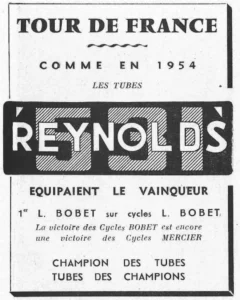 Reynolds 1955 Advertisement — The 531 Tubes of the Tour Winner, as in 1954
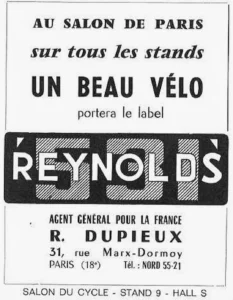 Reynolds 1964 Advertisement — A Fine Bicycle Will Carry the Reynolds 531 Label
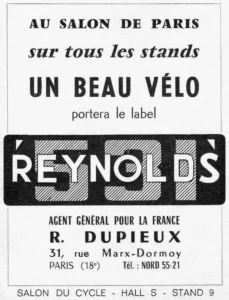 Reynolds 1966 Advertisement — A Fine Bicycle Will Carry the Reynolds 531 Label
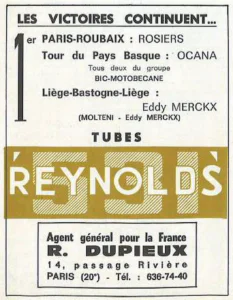 Reynolds 1971 Advertisement — The Victories Continue
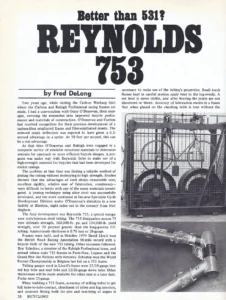 Better than 531? Reynolds 753 — Bicycling!, March 1976, by Fred DeLong
 Reynolds 1990 Product Range — Every Tube Set by Part Number, and the Brazing Temperatures
Ebykr presents this material for research and education. If you hold rights to it or notice an ownership issue, please contact us and we will respond promptly.
The Ebykr Digest
New articles, timelines, catalog finds and registry activity — assembled from the archive once a month. Your address is never shared.
Double opt-in. One email per month. Unsubscribe at any time with one click.