About Ebykr
Ebykr celebrates classic and vintage lightweight bicycles through provocative imagery and opinion. Ride along with us.
About Ebykr
Ebykr celebrates classic and vintage lightweight bicycles through provocative imagery and opinion. Ride along with us.

“Whilst giving no so-called guarantee, we emphasise the fact that Brooks Saddles are made throughout of the best materials to be obtained, which, combined with experience and careful workmanship, and constant testing, is the best and safest guarantee that can be given.”
J.B. Brooks & Co. Ltd., “Repairs,” Brooks catalogs, 1903–1908

It’s official: the Brooks canon is the most substantial body of work in all vintage cycling. Hands down. With hundreds of saddle models, bag models and other cycling accoutrements produced in an unbroken run since 1883, no other bicycle or component manufacturer operating under their original name comes close to having producing as many different “things” as Brooks has and hopefully will long into the future.
That many experienced cyclists will only allow Brooks saddles to touch their hind-quarters begins to reveal why the company’s products have been so popular over the years. Comfortable? Check. That many of the things Brooks produced last century or even the century before still remain in use today further tells the story of why the company’s products have been so popular over the years. Durable? Check.

But it’s something altogether different that really separates Brooks from other manufacturers of cycling things. It’s a lot more difficult to describe than simple attributes like comfort and durability are. That’s because words don’t really do this concept, or philosophy, or worldview the same kind of justice that simply experiencing it does.
Sure, Brooks is the oldest surviving bicycle saddle company in the world, though that run came closer to ending than most people realize, as we shall see. But Brooks saddles and the Brooks brand are part of something much bigger than just bikes or bike seats. They are a cornerstone contributor to a larger belief system that upholds everything great about what cycling is — and what it does for us and for our surroundings. Indeed, how it helps define our place in the universe. Transcendent? Check.
That’s because Brooks saddles evoke real and strong feelings when people touch or even think about them. Feelings of belonging to something larger than any one of us, of having the freedom to explore the wide world around us and of reconnecting with nature as the universe intended for us to do. Brooks is an enabler of the human condition, or at least amplifier thereof.
No, your hundred-year-old bike seat won’t be revealing the meaning of life anytime soon. (That’s a job best left to Monty Python’s troupe). But it will be a primary interface between you and your surroundings, helping reveal hidden facets of philosophy, history, art, sociology, psychology, biology and chemistry, just to name a few of the perspectives bicycles and their trustiest components like Brooks saddles invite exploration of.

Brooks and those behind the company are cognizant of the special place the brand and its products hold in many people’s hearts, minds and souls. While it may be difficult to deny such an illustrious and well-documented past, the company nonetheless captures its historical zeitgeist in its current product line and marketing materials alike.
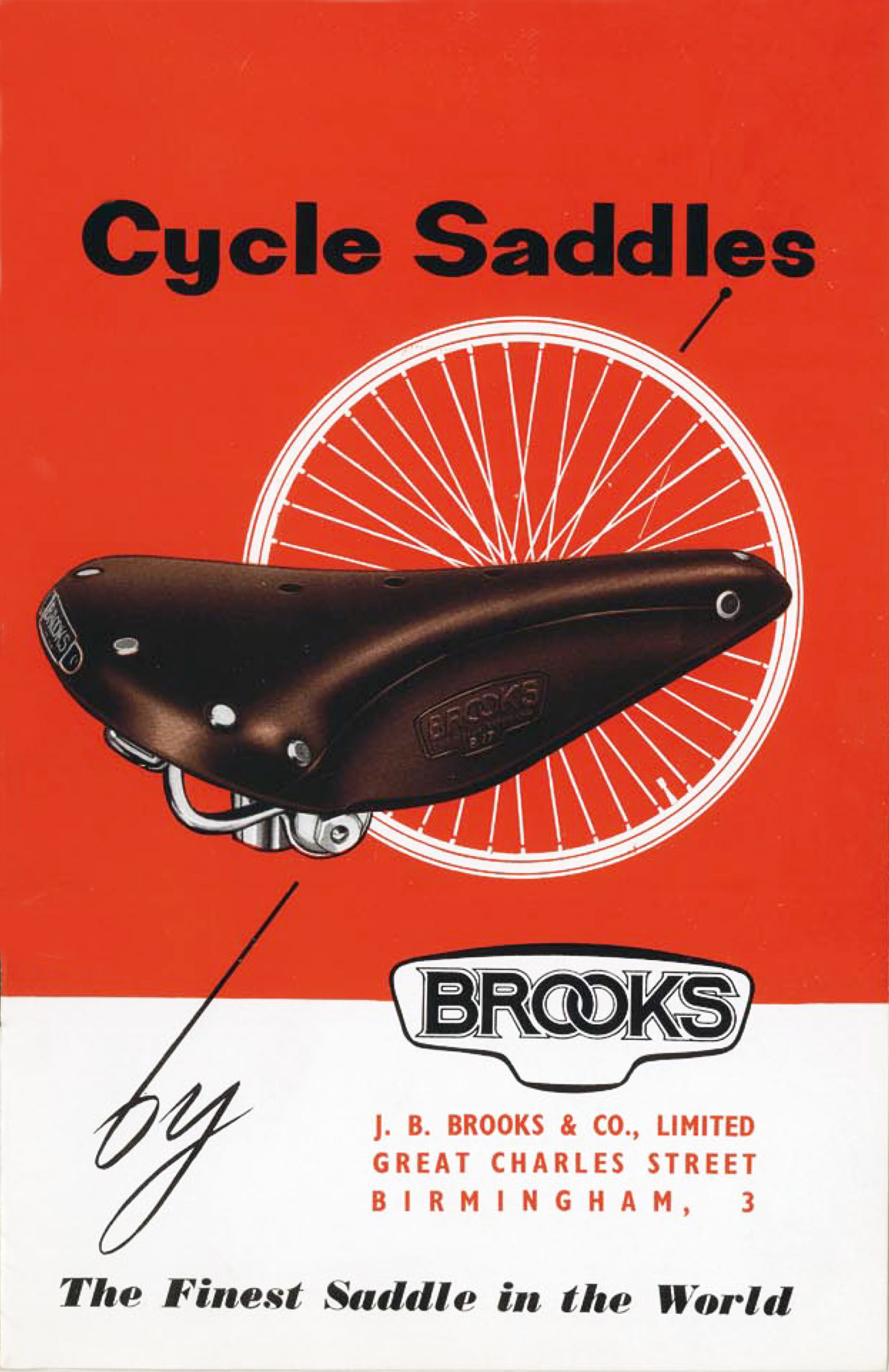
One place it does so — very well, if we might observe — is in Brooks product catalogs, or what have come to be known as The Brooks Book. The 2016 Book for Cyclists, published for the company’s 150th anniversary, celebrates an unbroken tradition of manufacturing in the West Midlands area of England dating back to 1866. (Never mind the company made horse harnesses and general leather goods until the winter of 1882-1883).

It features the company’s wide saddle and bag range interspersed with historical insights, delightful stories and lovely watercolor illustrations. Except for a few indecipherable whiz-bang icons below some of the product descriptions and really high-res photos, it would be equally at home in 1866 as it is today.
Says Brooks themselves in the 2016 Book for Cyclists:
“The Book for Cyclists has been published in various forms since the 1880’s. It has been an invaluable reference point for us as a company, a testament to the ingenuity and flair for communication born forth from our halls throughout our history. Today, as we look forward to the newest golden era for the bicycle, we happily continue this proud tradition, contributing the latest chapter to a long company narrative.”
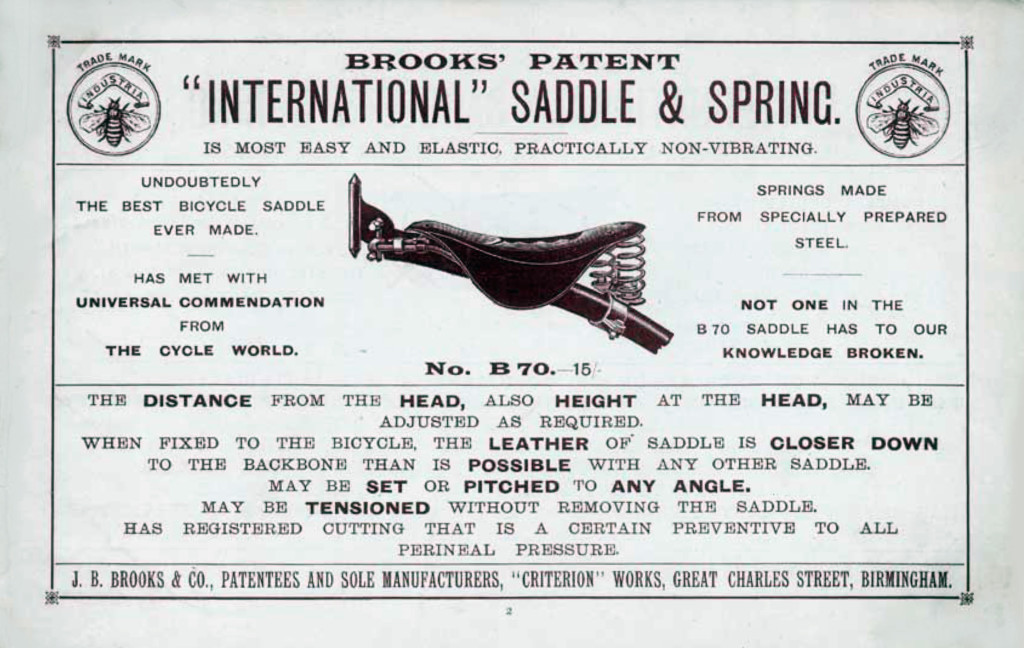
That long company narrative represents all phases of bicycle saddle evolution. Defines it, more like. From early models like the original B. 70 in 1890 — made to be mounted to the sloped backbone of high-wheel bicycles — all the way forward to today’s performance-oriented Cambium C. 13 — with its carbon rails and vulcanized rubber deck keeping things feathery — the historical family of Brooks saddles and accoutrements offers a wonderful reflection of cycling itself over the years.
To call that family prolific would be an understatement. Brooks saddles embody just about every idea that has gone into bike saddles since the great Baron Karl von Drais first wobbled down that bumpy road in Mannheim in 1817. Thankfully their zeal stopped at the pneumatic saddle craze that afflicted so many of their early contemporaries in the 1890s. Now, agonize over the thought of getting that kind of puncture when riding on those kind of roads.
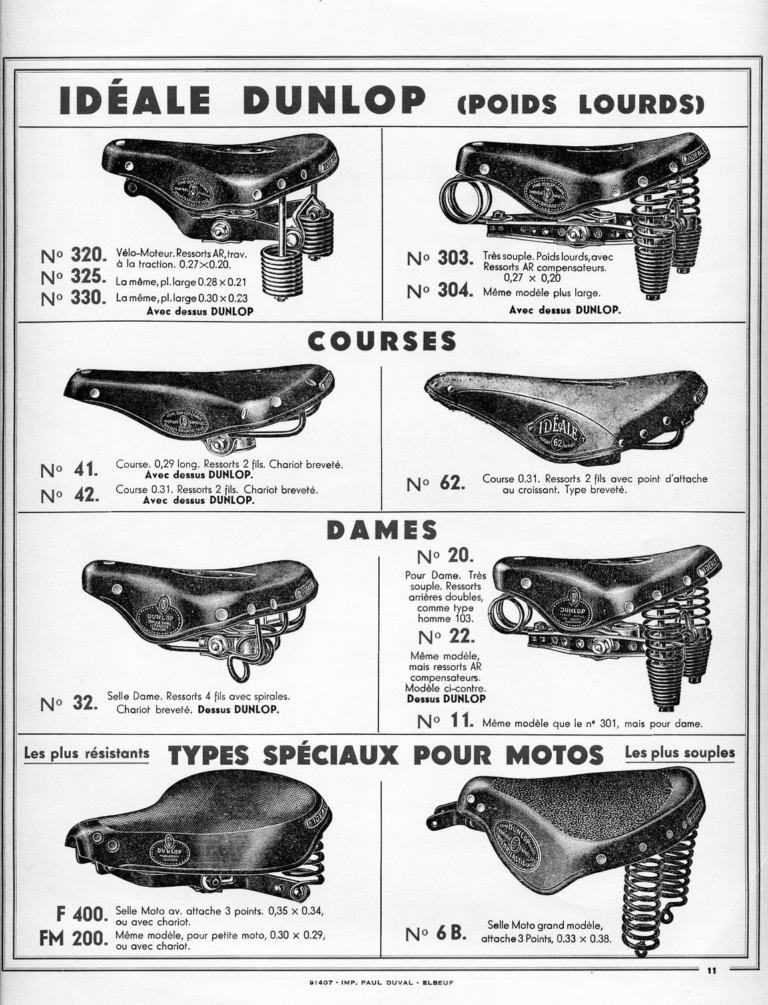
The Brooks canon would include all manner of saddle suspension systems, from vertical loop springs located front of the seat top’s nose to horizontal coil springs located rear of the nameplate to everything and anything in between. It would also include just about every chassis design used in bicycle saddles through present, not to mention chassis finishes or seat tops themselves. Tighten your toe straps, we have a lot of ground to cover.

First, a quick primer on Brooks corporate history. John Boultbee Brooks founded his namesake company in 1866 in Birmingham, England to make horse harnesses and leather goods. After an oft-cited sequence of events between 1878 and 1882 where his horse died, he was unable to buy a new horse, he borrowed a friend’s bike to get to work and he disliked the saddle on that borrowed bike, the proverbial die was cast.
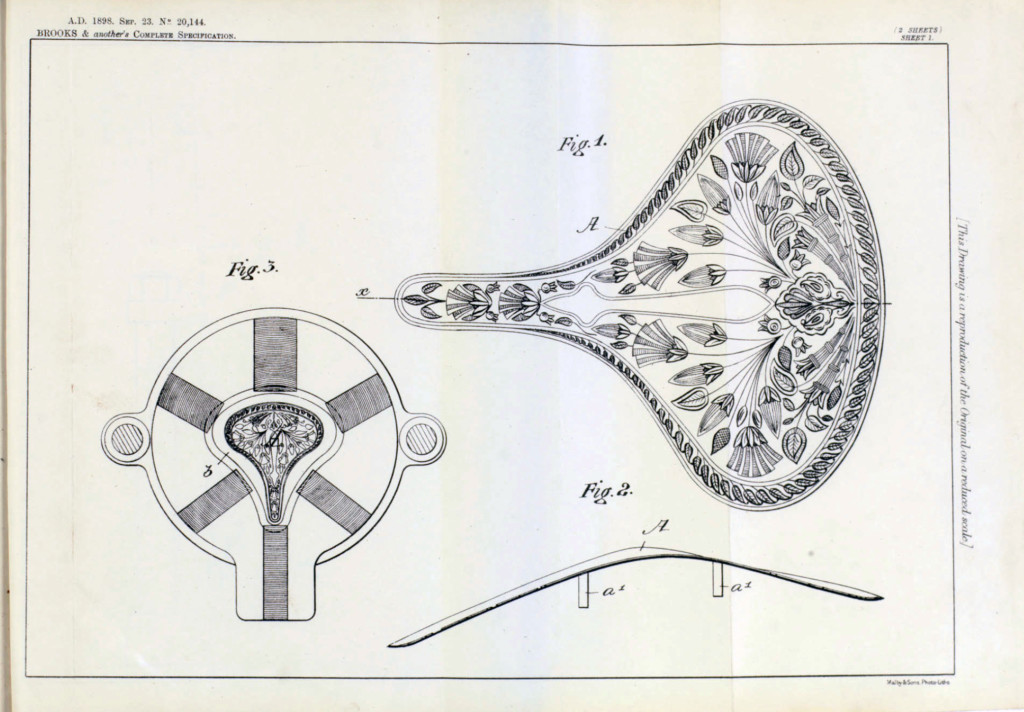
J.B. Brooks & Co Ltd. filed its first patent for a sprung bicycle saddle on October 28, 1882. The business became a limited company on October 22, 1896, by which point it employed some 500 people, and it went public in 1905. Brooks was not shy about defending what it had patented, either. The company saw off infringement claims from J.A. Lamplugh & Co. in 1897 over saddle patents of 1890, 1892 and 1893, and in 1903 it hit a fast-growing Birmingham rival named Lycett with an injunction for infringing patents of its own. Decades later Brooks would simply buy Lycett outright.
The catalogs keep their own running count, and it is a useful one. The 1910 book calls itself the twenty-sixth year of publication, the 1911 the twenty-seventh and so on in step to the 1916 book’s thirty-second, which puts the first Brooks Book at 1885 or thereabouts — a catalog dated for one year was usually issued late in the year before. The 1903 book adds a round figure from the other direction, heading a page for 20 YEARS the Recognised Standard of Perfection and opening with the words since we first began to make Cycle Saddles. That is advertising arithmetic rather than a ledger entry, but it points at about 1883, which sits comfortably between the 1882 patent and the first catalog.
The count also has a hole in it, and the hole is worth more than any of the numbers around it. The 1916 book is the thirty-second year of publication. The 1919 book is the thirty-third. The 1920 book is the thirty-fourth. One increment across three years, which means Brooks issued a single annual catalog between 1916 and 1919 and none at all in two of those years. The 1919 book explains itself on its second page, regretting that owing to the concentration of nearly all our facilities on Government work, we have been unable to cope therewith as promptly and efficiently as usual. An arithmetic gap in a firm’s own numbering, with the firm’s own explanation sitting two pages in.
What the war did to prices is just as plain in the pair of books either side of it. Same models, one year apart, specifications essentially unchanged: the B. 500 motor saddle goes from 65/- to 113/-, a rise of 74 percent; the B. 400 from 52/6 to 78/-, up 49 percent; the B. 28 from 20/- to 33/3, up 66 percent. The 1920 book does not pretend otherwise, printing at the head of its price list that all prices are subject to revision without notice and that orders can only be accepted at the prices current on the date of despatch of goods. Any Brooks price quoted from 1920 deserves that caveat attached to it.
To summarize greatly, things continued growing rather nicely (two devastating wars notwithstanding) well into the 1950s. A history of industry in Birmingham records that of the 2,733,000 cycle saddles manufactured in Britain in 1935, no fewer than 60 percent came out of J.B. Brooks & Company. The peak arrived 20 years after that: by the company’s own account, 1955 found Brooks with a workforce of 1,500 selling some 55,000 leather saddles and 25,000 mattress saddles each week — the most productive bicycle saddle manufacturer on earth at the time.

Several other bicycle saddle manufacturers were absorbed into the Brooks corporate family along the way. The company’s own history puts the Lycett takeover in the 1920s, though outside researchers date it to the late 1930s. The Leatheries Saddle Co. followed in the 1930s, as did a motorcycle maker confusingly named the Brookes Company. Lycett-badged saddles carried on for years afterward, establishing a pattern Brooks would repeat: buy the rival, keep the name, sell a cheaper saddle under it.
Saddles were only ever part of the story, too. By the 1950s the parent company was a genuine conglomerate. It had picked up C.S.A. Industries, makers of English Rose Kitchens, in 1953. It was selling luggage through Antler and Foxcroft. It was turning out steel office furniture as Evertaut. In 1957 the parent renamed itself J.B. Brooks Industries to suit. Anyone who thinks of Brooks strictly as a saddle maker is thinking of one division of a considerably stranger company.
It ran stranger still earlier on. Turn to printed page 72 of the 1910 catalog, past the saddles and the tool bags and the gear cases, and Brooks is selling the Brooks Magneto (Patented) and the Brooks Patent Synchronized Single Trembler Coil, made at Great Charles Street, Birmingham. Ignition equipment, from the saddle people. It appears nowhere else in this archive and it is one of the odder things eight decades of Brooks catalogs will give up.
The Brooks family decided to step away from their core saddle business at the end of the 1950s, selling the saddle division of Brooks Industries Ltd. to the Raleigh Cycle Company. (Brooks dates that sale to 1958; Grace’s Guide records it in 1959, and the exact year remains unsettled.) Raleigh was itself bought by the British Tube Investment Group, or TI, in 1960. TI owned Reynolds Tubing and Sturmey-Archer, maker of the famous internal hub gears, and it shuffled Brooks first into its automotive division and then into its bicycle division.
In 1962 Brooks moved to the Downing Street Works in Smethwick and was combined with the Wright Saddle Company — another TI holding, taken over in 1958 — to form the Raleigh Saddle Division. Brooks was the dominant partner in that pairing, and it was cheaper versions of Brooks designs that went out under the Wrights name, rather than the other way around. Harris & Sheldon bought what remained of J.B. Brooks Industries, kitchens and luggage and furniture and all, the same year. Then in July 1969 the Smethwick works was gutted by fire. Staff salvaged what was left of the plant and stock and kept production going.
Here the corporate thread gets tangled, and the version repeated in most accounts is simply wrong. TI did not hold Brooks into the 1990s. It sold Raleigh, and the bicycle division along with it, to Derby International in 1987. Derby ran the group for over a decade before selling Sturmey-Archer and Brooks together, in July 2000, to a small outfit called Lenark for a nominal 30 pounds. Lenark collapsed within months, taking Sturmey-Archer down with it and coming within a whisker of ending 118 years of Brooks saddle production.

That Brooks survived at all is down to investors John Godfrey Macnaughtan and Adrian Williams, who bought the company out of the wreckage and kept it building saddles in England. In July 2002 they sold it to the Italian saddle conglomerate, Selle Royal. Today Brooks England Ltd. sits under the Selle Royal Group umbrella alongside Fizik, Crankbrothers, PEdALED and Pannier, and the saddles are still made at the Downing Street works in Smethwick, on machinery largely installed in the 1950s.
The scale difference between parent and marque is worth sitting with. Around the time of the sale Selle Royal was turning out something on the order of 80,000 saddles a day, which is roughly what Brooks makes in a year. Germany has long been the largest customer by volume, with the Netherlands leading per head of population and Japan holding the marque in particular esteem. Ride on, global brothers and sisters, ride on.
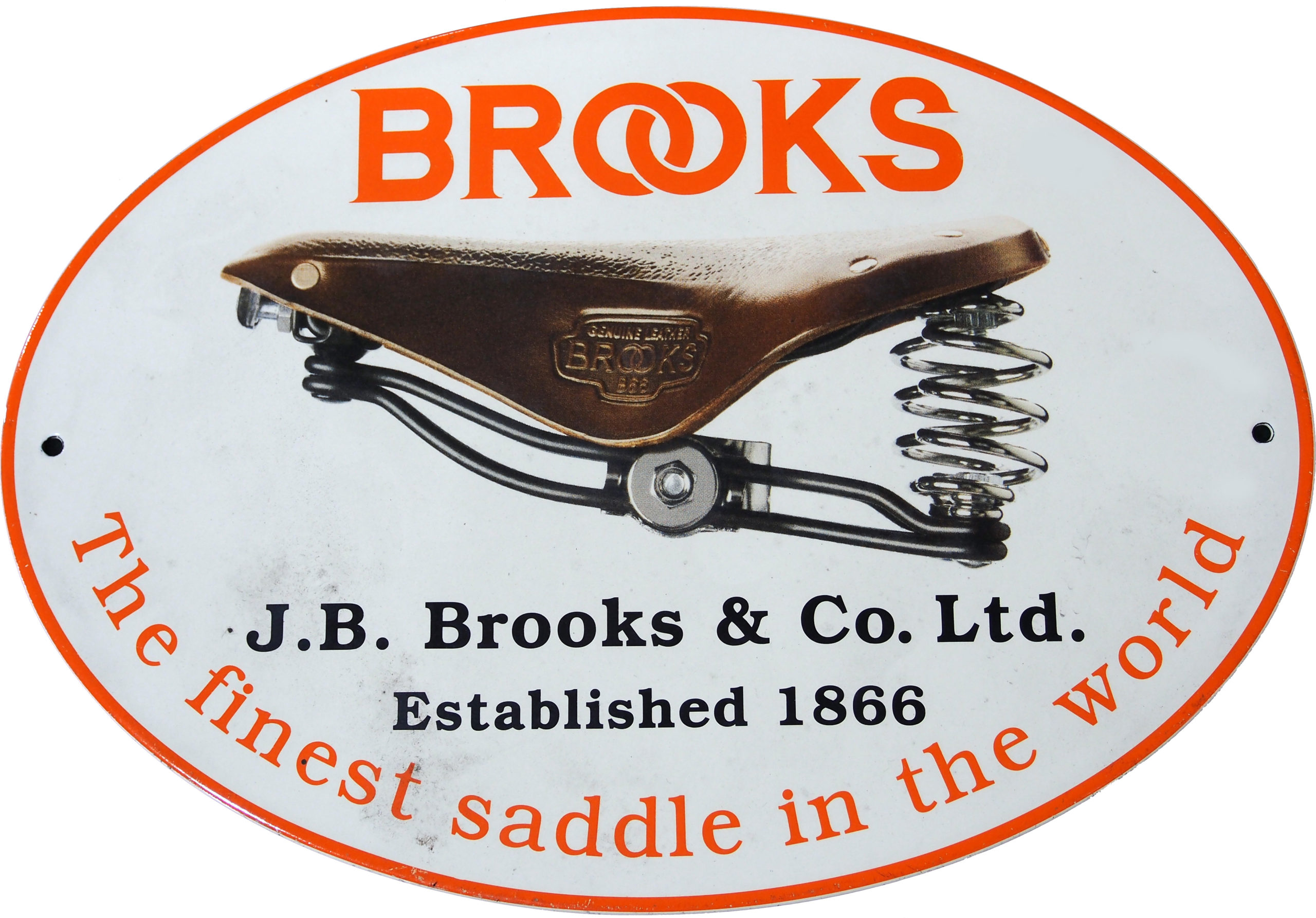
Bicycle saddle suspensions can be categorized into at least two different categories. Brooks saddles have featured both active suspension systems and passive suspension effects in their chassis and seat top designs since first appearing in the 1880s. As pointed out by Bill Laine at Wallingford Bicycle Parts, many Brooks saddles employed and employ the use of both active and passive suspensions in their designs.
A significant majority of saddles in the 1890 catalog have active suspension systems in the form of coil springs and loop springs in each front, rear and front/rear configurations. By comparison, a significant majority of saddles in the 2016 catalog have passive suspensions effects in the form of flexible chassis components and hammock-based seat covers. Brooks has been wise to ensure that today’s weight-conscious riders continue enjoying similar suspension benefits as yesterday’s comfort-conscious riders did.
Still, some 20 saddles with either coil or loop springs remain in modern Brooks catalogs, with loop springs taking a distant second to coil springs in order of availability despite their lighter weight and slimmer profile. Perhaps coil springs are just better at absorbing road shock given their horizontal orientation and larger size.
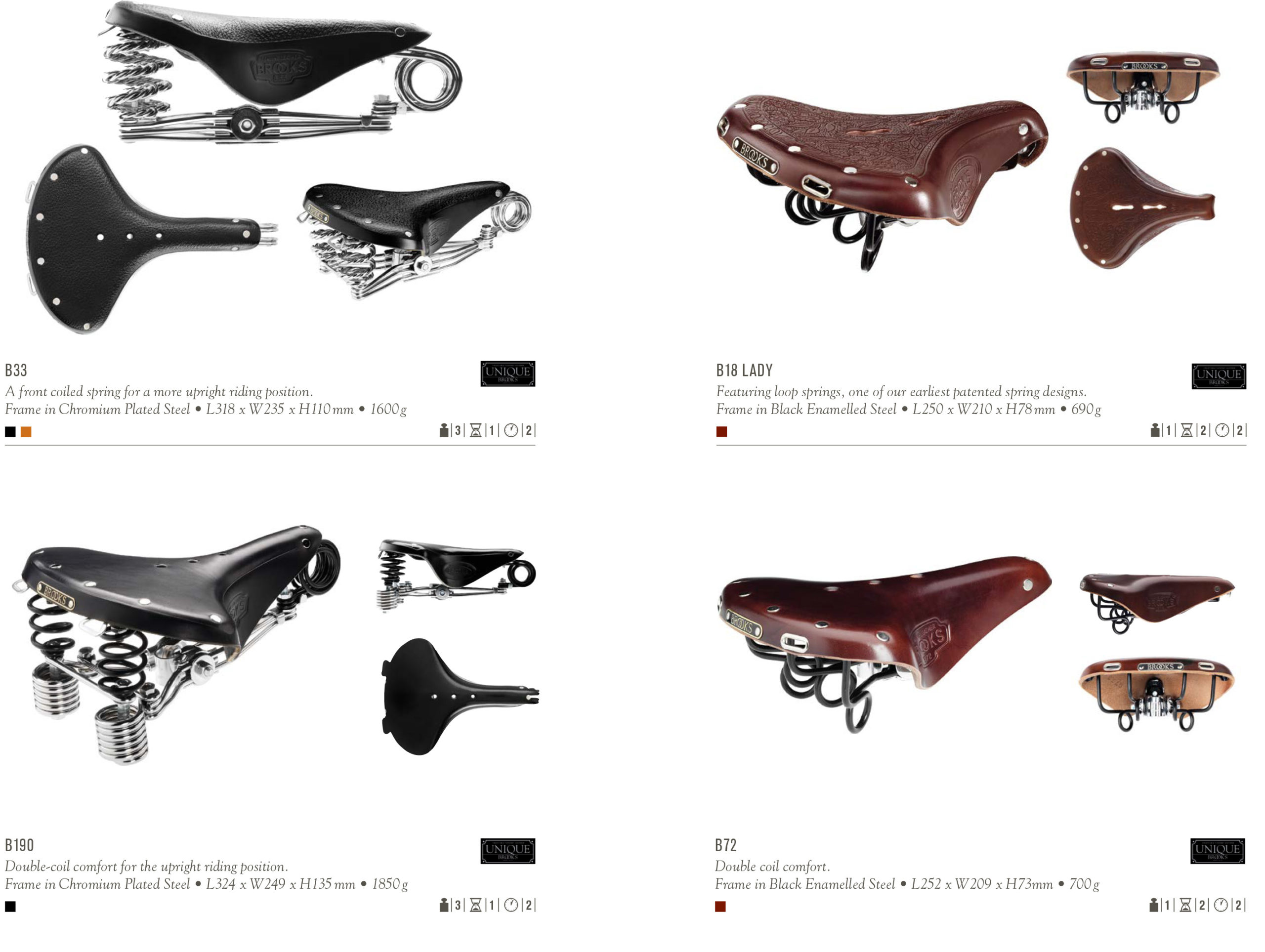
Then take the saddle chassis, which traditionally includes all of the bracketing, framing, railing and wiring on the underside of saddles. (For the purposes of this article, everything but the seat cover and active suspension system, if one is present). Brooks has employed four primary chassis designs since the 1880s, each of which has many secondary sub-designs falling within its primary design category.
Further complicating matters is the fact that many chassis sub-designs have been combined with other chassis sub-designs over the years, creating a perplexing matrix of combinations any math or seat geek would truly appreciate.
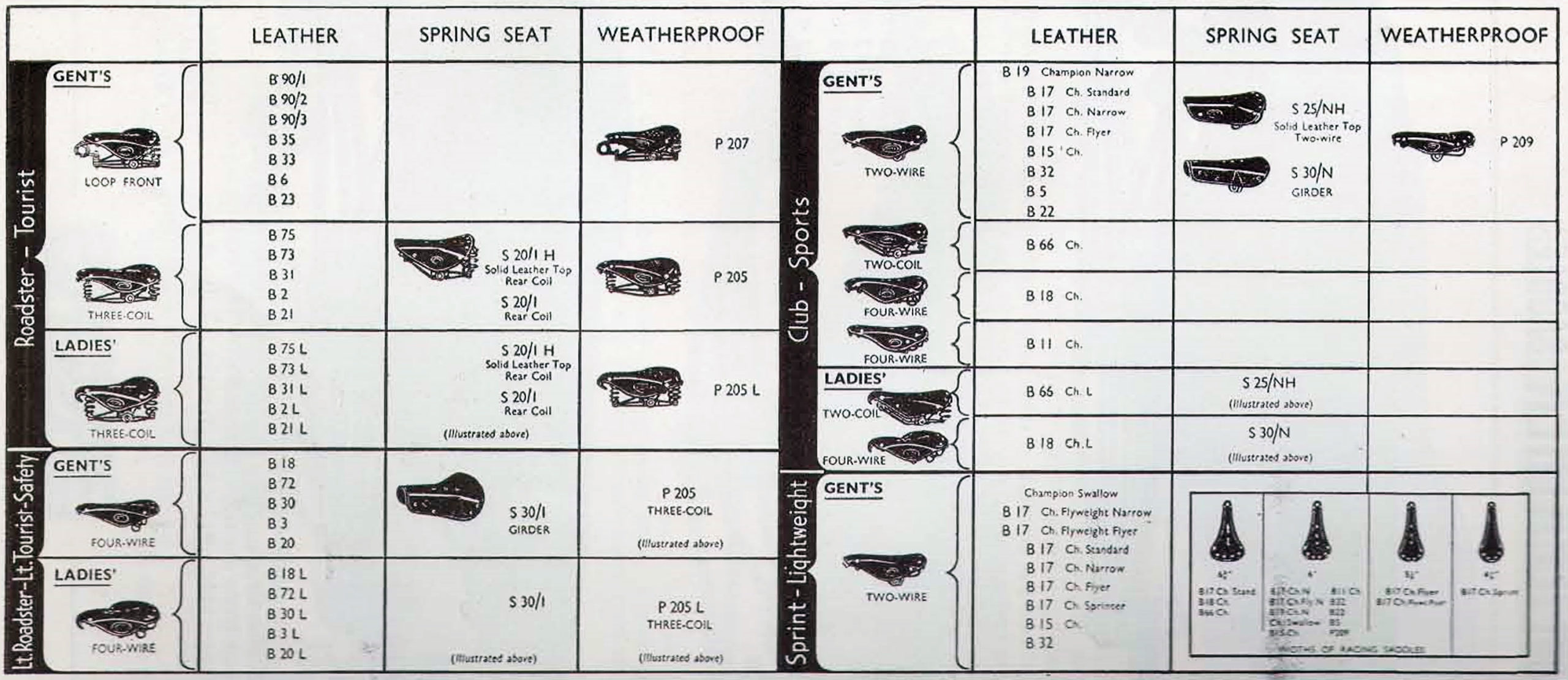
Included here are (our labels, not Brooks’): simple frames, truss-based frames, wires and rails, with rails remaining popular today. Simple frames are wider, usually flatter plates of metal that take the place of modern rails in one of several different ways. Truss-based frames are like simple frames but with internal support structures used to increase the strength and perhaps decrease the weight of the frame.
Wires are thinner gauge metal wiring always used in pairs, triplets or quadruplets on each bilateral side of the saddle since single wires are unable to support a rider’s weight. Which brings us to rails, which are essentially thicker wires able to support a rider using only one rail on each side of the saddle. Like on your bike, right now.
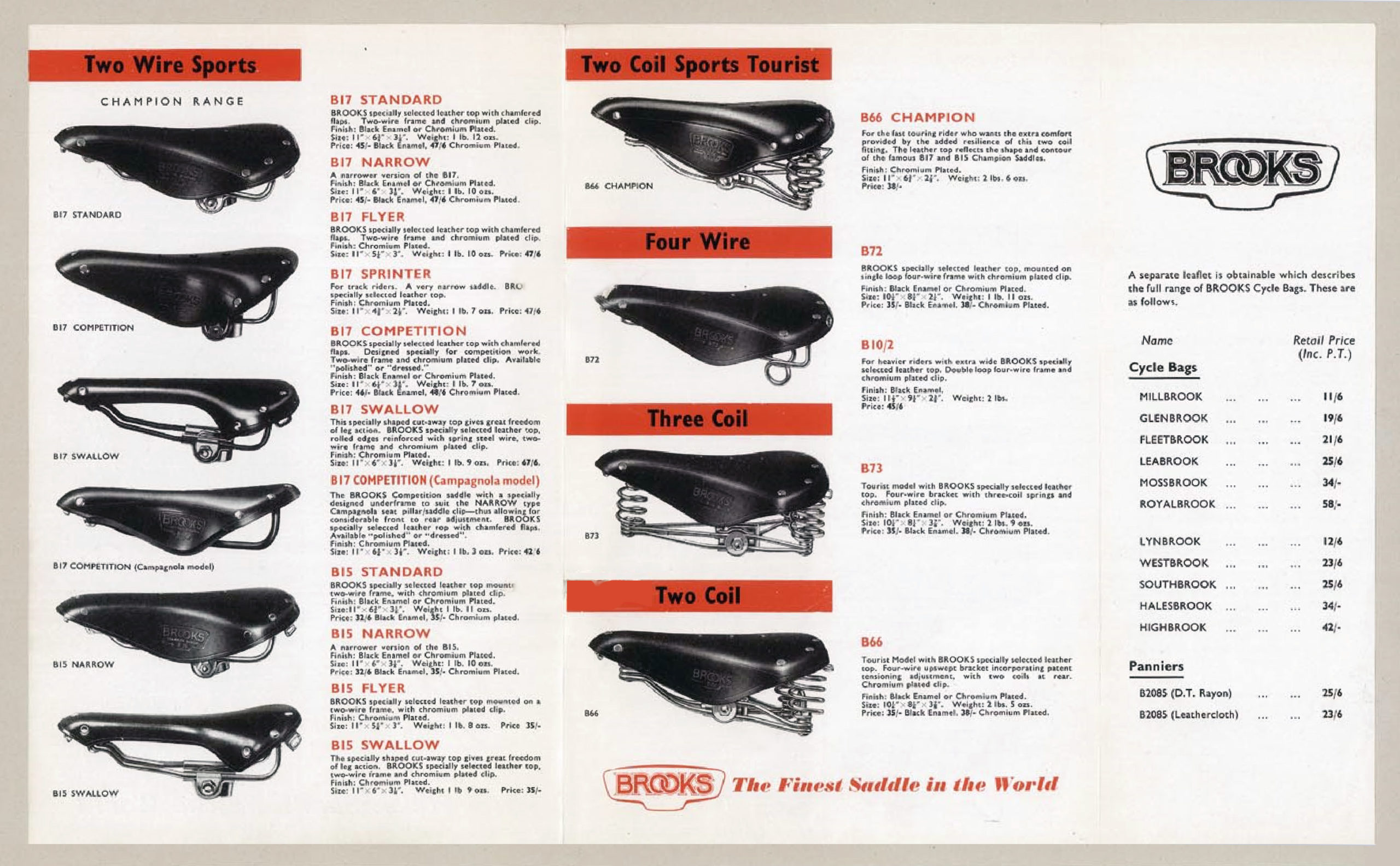
The Chassis Parts section of the 1937 Brooks catalog adds:
“Many types are produced, to suit the variety of purposes embraced by the one word cycling. There are light chassis for racing, stiff girder frames for heavy duty and multi-spring patterns for resilience or where bad roads abound.”
Simple frames, truss-based frames, wires and rails have all been used in different ways over the years. Simple frames change in appearance and size, truss-based frames have many different truss designs, wires have been used in myriad ways and even the humble, basic-seeming rail has gone from solid metal to tubular metal to solid carbon. And for their next act, Brooks will unveil tubular carbon rails — filled with helium, no doubt. (Or nitrogen?)
Chassis finishes have always been limited on Brooks and other quality bicycle saddles. Black enamel paint on steel was the only finish customers could get on the chassis of their Brooks saddles from 1883 through 1899. Optional nickel plated steel finishes were added to the entire saddle line in 1900. Brooks never charged a percentage for them. It charged a flat two shillings to four and sixpence per saddle whatever the model, which works out at roughly a third on top of the enamel price at the turn of the century and closer to a fifth by the middle of the decade. The B. 90 Size 1 is 12/6 in enamel and 16/6 in nickel in the 1904 book, a premium of 32 percent; by 1906 the same saddle is 11/6 and 14/-, a premium of 22 percent, having managed to get larger, heavier and cheaper all at once. Chromium plated steel finishes joined the club sometime in the early to mid-twentieth century, with their first catalog appearance in 1937.
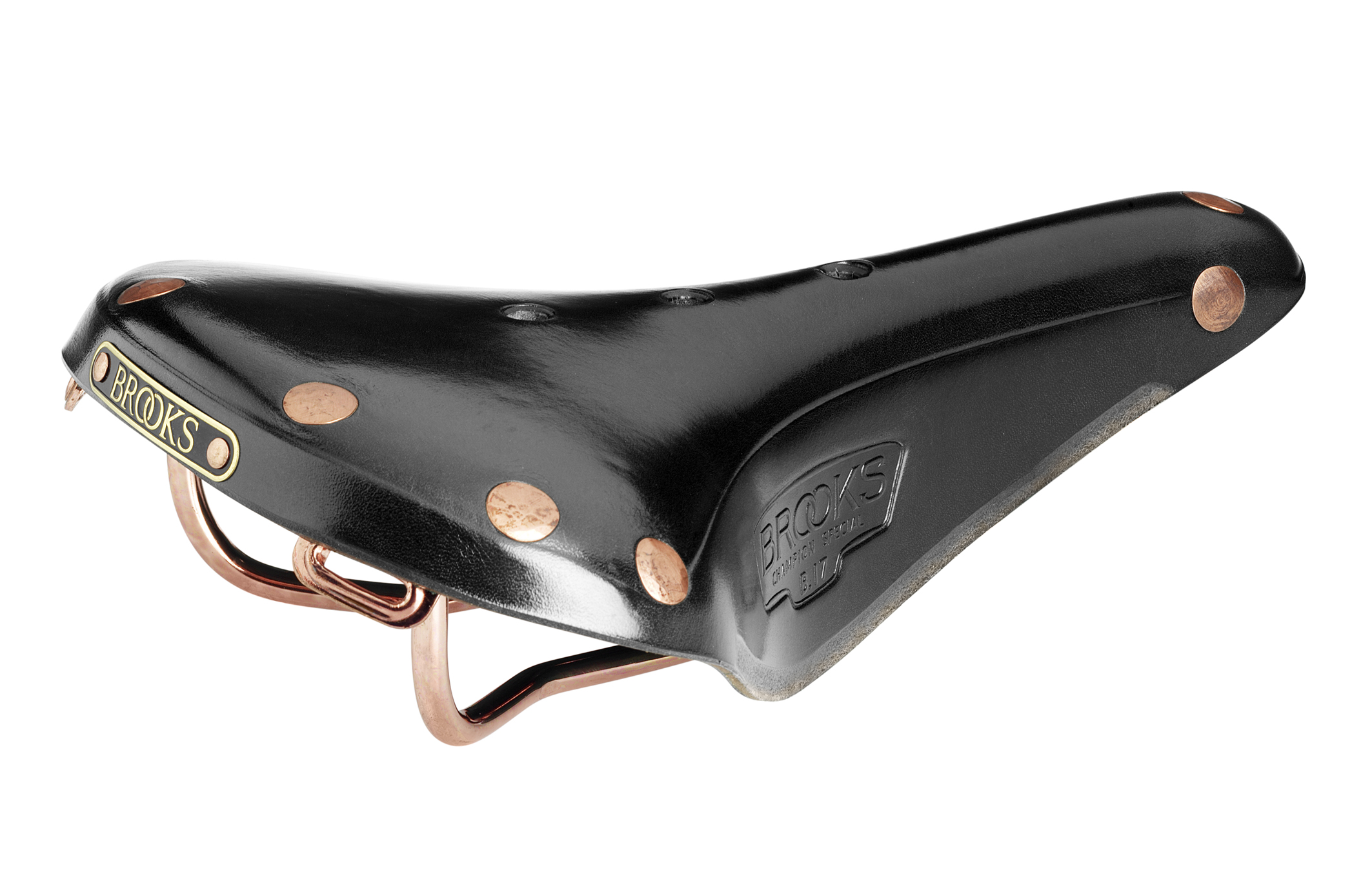
Distinct-looking copper plated steel chassis finishes followed on B. 17 Champion Special and Team Special models starting in 2005 and continuing through present. Brushed titanium finishes were introduced when titanium chassis came about in 2000 or so. And carbon doesn’t count as a real finish, at least not here, not now.

One chassis change can be dated to the year, and Brooks announced it rather than slipping it past anyone. The 1904 catalog gives a paragraph of its own to a new cantle-plate, registered, and claims that with it we have considerably increased the seat-room in the majority of our saddles, without adding to the weight. The same book repeats the line on 16 model pages. The figures bear the claim out: the B. 90 Size 3 is a flat 12 by 9 inches in the 1903 book and wider in the 1904 book at exactly the same three pounds three ounces and exactly the same 14/6 in enamel. The B. 90 Size 1 goes from seven and a half inches across to over eight for two ounces. The same page notes that the rivets are moved back off the seat part of the leather, which is why a 1904 Brooks looks tidier at the back than a 1903 one. A saddle that grew without anyone being asked to carry the difference is a rare enough thing to be worth the paragraph Brooks gave it.
Here’s where things get really interesting. For a brief period starting in 1933, Brooks produced saddles that looked and functioned much like those popular but pricey Idéale duralumin saddles found on the fanciest mid-twentieth century demi-course, randonneur and cyclotouriste bikes from France. Whether Brooks was following the French lead here is less obvious than it first appears. Idéale had its own featherweight No. 54 Duralumin in the range by 1933 as well, so the two houses arrived at the idea more or less together. Brooks did borrow the vocabulary, though, naming its Patent Duralumin Champion in its 1933 marketing materials:
“The association of a duralumin frame with a Brooks solid butt hide top brings to the lightweight enthusiast the most practical solution of the ultra light seat problem. In a saddle of this nature, the importance of a reliable leather top, capable of retaining its shape, cannot be overestimated. This model resembles the B. 17 Champion Narrow, and is strongly recommended for the clubman’s use.”
1933 Brooks Saddles & Riding Kit
The Brooks Patent Duralumin Champion joined another duralumin model that year with another mouthful of a name: the Brooks Supplex S. 30 Duralumin Extra Narrow. Unlike its sportier cousin, The Champ — with its racing pedigree — the Supplex Duralumin Extra Narrow was a spring mattress saddle for fast road riding. (Yes, this was already becoming code-talk for slow road riding, judging by the saddles falling under this catalog header). Brooks suggests it was designed for, “lightweight roadster riders who prefer resilience in the seat itself.” Sounds about right, doesn’t it?
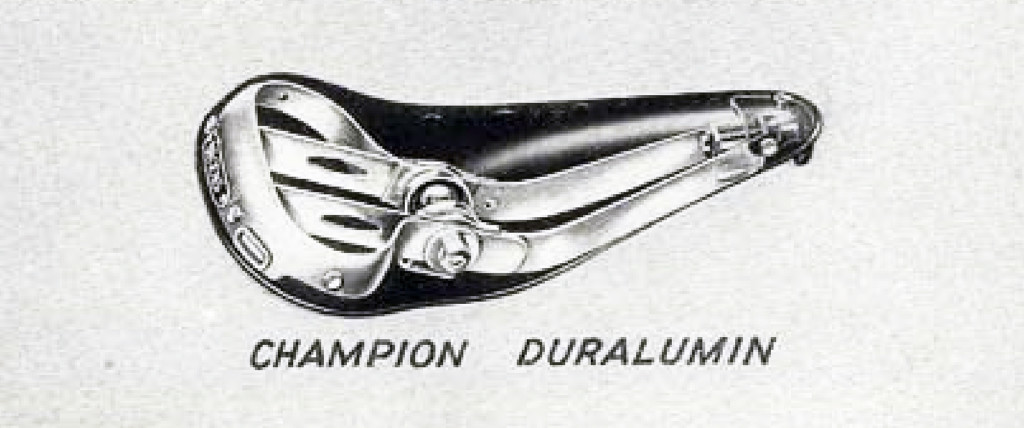
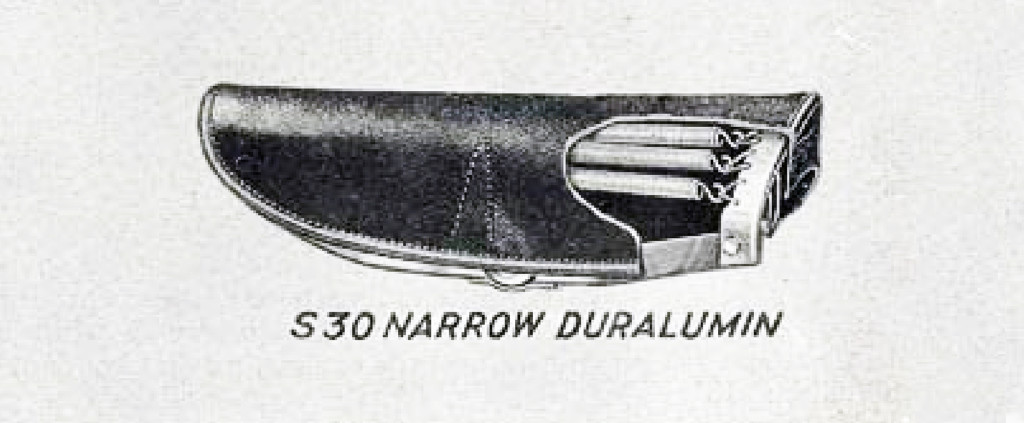
By the following year, two important changes had been made to the only full-aluminum chassis models ever sold by Brooks. First, the duralumin name was dropped in favor of castalumin. That switch makes rather more sense once you know where duralumin came from, because it was not French at all. It was German, coined at Düren from dur and aluminium, and it was a registered trade mark of Dürener Metallwerke AG. A British firm naming a product after a live German trade mark 15 years after the Armistice had two good reasons to think again, and castalumin, which describes the die-cast alloy frame plainly enough, gave Brooks a name of its own. Second, what had been two new duralumin saddle models became two newer yet castalumin saddle models.
The B. 16 Champion Patent Castalumin Frame featured an intriguing “shock absorbing nose shackle” to provide “semi-automatic seat tensioning.” One wonders why on this saddle and not on other concurrent saddles with more traditional Brooks frames. Does steel absorb shock noticeably better than aluminum in saddles, too?
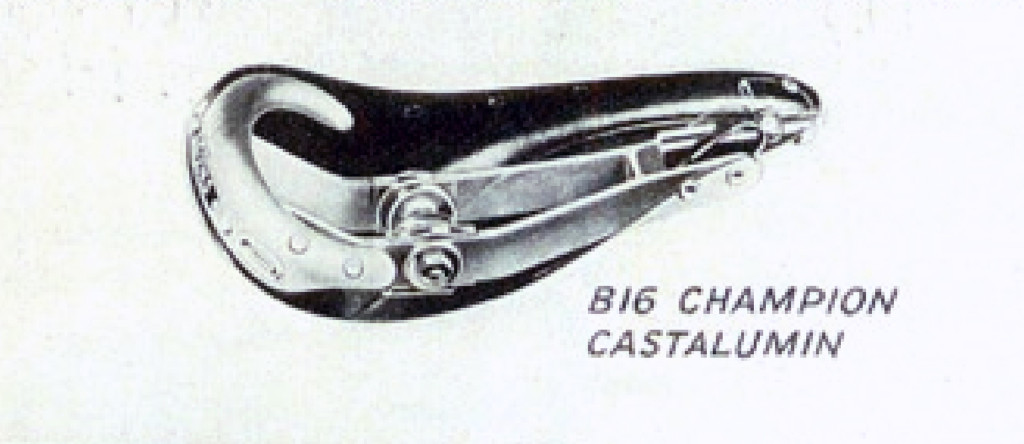
One also wonders why Brooks sought to rectify loose seat tension with shock absorbing nose shackles. Seems rather incongruous on first thought, not to mention a marketing miss. Maybe that’s why the technology was termed a “shock absorbing rubber buffer” by the 1935 catalog. It was not new then, and it did not begin on a motor saddle. The 1907 catalog already describes the B. 28 with the words at the rear, our patent system of rubber buffers is fitted — 18 years before the B. 185 arrived. The 1903, 1904 and 1905 books describe the same saddle without naming rubber at all, crediting its freedom from sagging to a patented arrangement at back, so the buffers themselves land somewhere between 1905 and 1907.
There is a genuine motor-saddle-to-bicycle-saddle transfer in the Brooks story, though, and it is the compound spring rather than the rubber buffer. Brooks put it on the B. 100 motor saddle and explained it on an extra leaf slipped into the 1904 catalog — a leaf the printer had to number 48A, because the book had already been paginated around it. A spring within a spring, the page says beside a cutaway drawing, one spring in tension, the other in compression, the two working in opposite ways so that all shocks and vibrations are absorbed within the spring, and without any tendency to bouncing. The 1906 catalog reprints the drawing beside the B. 120, the lighter bicycle version, and says outright why the B. 120 exists: the great success which has attended our compound spring motor saddle B 100 has decided us to produce a similar saddle on lighter lines for ordinary cycling. That is 1905, three decades before the date this section has been reaching for, and it runs from motor saddle to bicycle rather than the other way about.
Curiously, Brooks changed its mind about how the thing worked. By 1919 and 1920 the books have dropped tension and compression and are arguing instead that the inner and outer springs bounce at their own and totally different speeds, so that the one nullifies the other by counter-action. Two rationales for one spring, 15 years apart, and the earlier pair have the better picture.
The other new castalumin model was the Brooks Supplex S. 40/N Patent Castalumin Frame. Weighing a spry 10 ounces more than the racier B. 16 Castalumin, the S. 40 Castalumin included a generous spring mattress top and “stout” black weatherproof covering underlined with molded leather and felt. It was mounted on an “ingenious” die-cast alloy frame where the mattress springs were hooked to a steel frame cast into the backplate. Take that, Idéale!
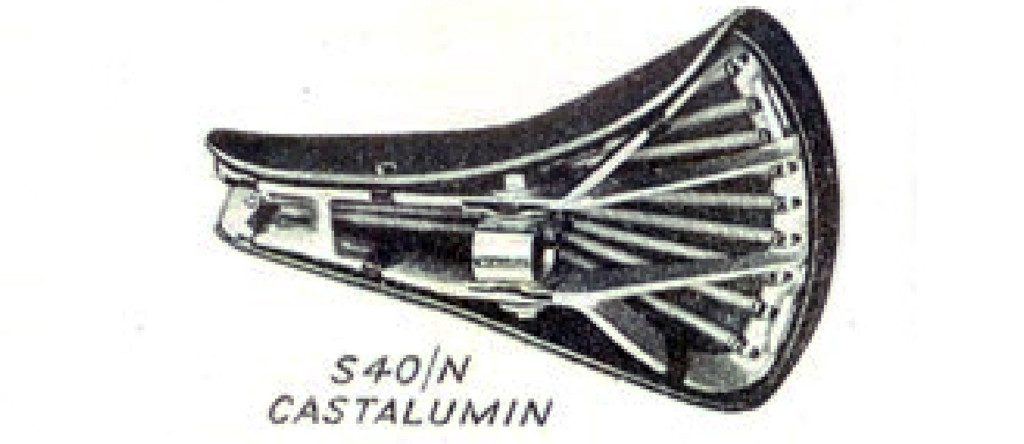
The combined use of aluminum alloy and steel on the S. 40 Castalumin chassis would be a sign of things to come. While the full-aluminum chassis trail goes cold in 1936, new hybrid aluminum alloy/steel chassis designs were introduced just two years later. Idéale never produced hybrid saddle chassis despite selling full-aluminum models for another 50 years.
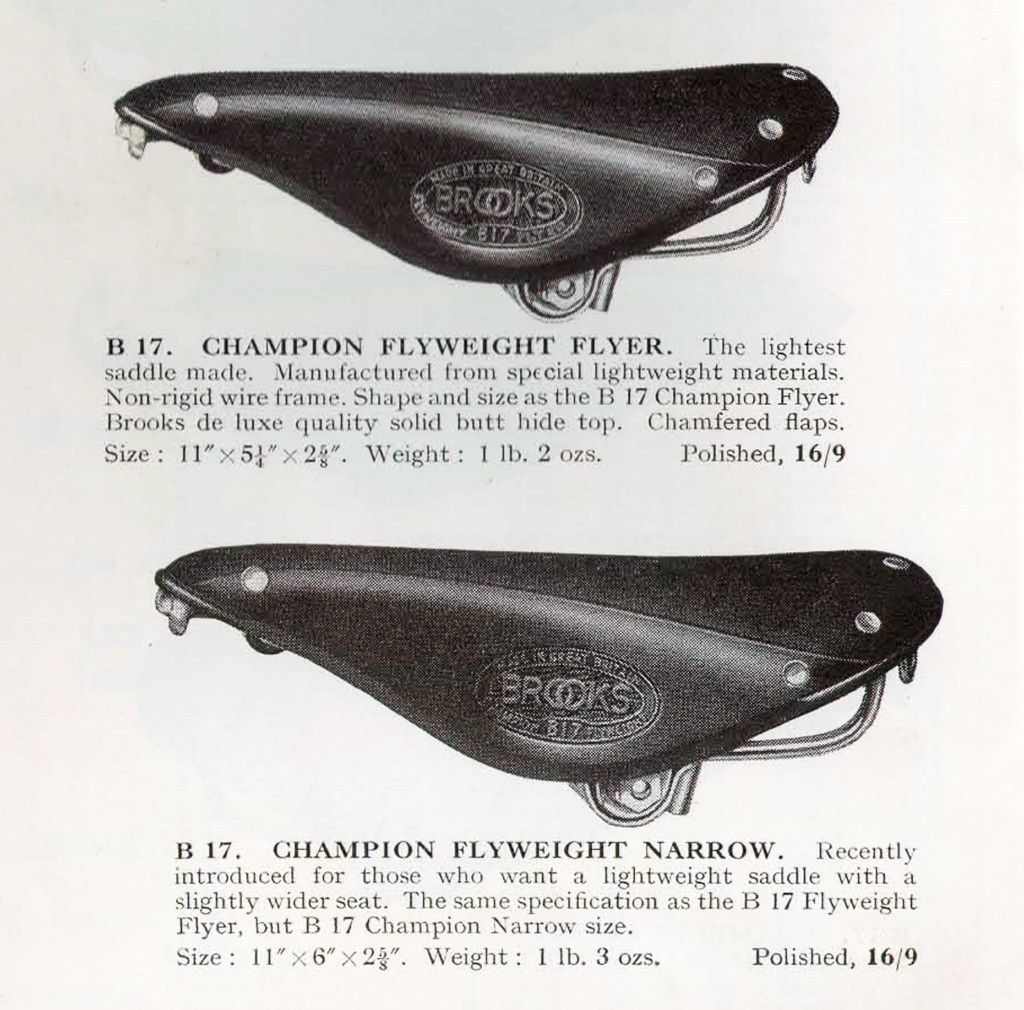
Hybrid chassis were next found on the B. 17 Champion Flyweight Narrow and B. 17 Champion Flyweight Flyer, which at one pound, two ounces was the lightest saddle introduced by Brooks through 1938. (The Flyweight Narrow was 3/4″ wider and weighed one ounce more). Both of these very special B. 17 models featured chrome plated steel rails mounted to an aluminum alloy cantle plate. The B. 17 Flyweights remained in production for two years prior to England’s involvement in World War Two.
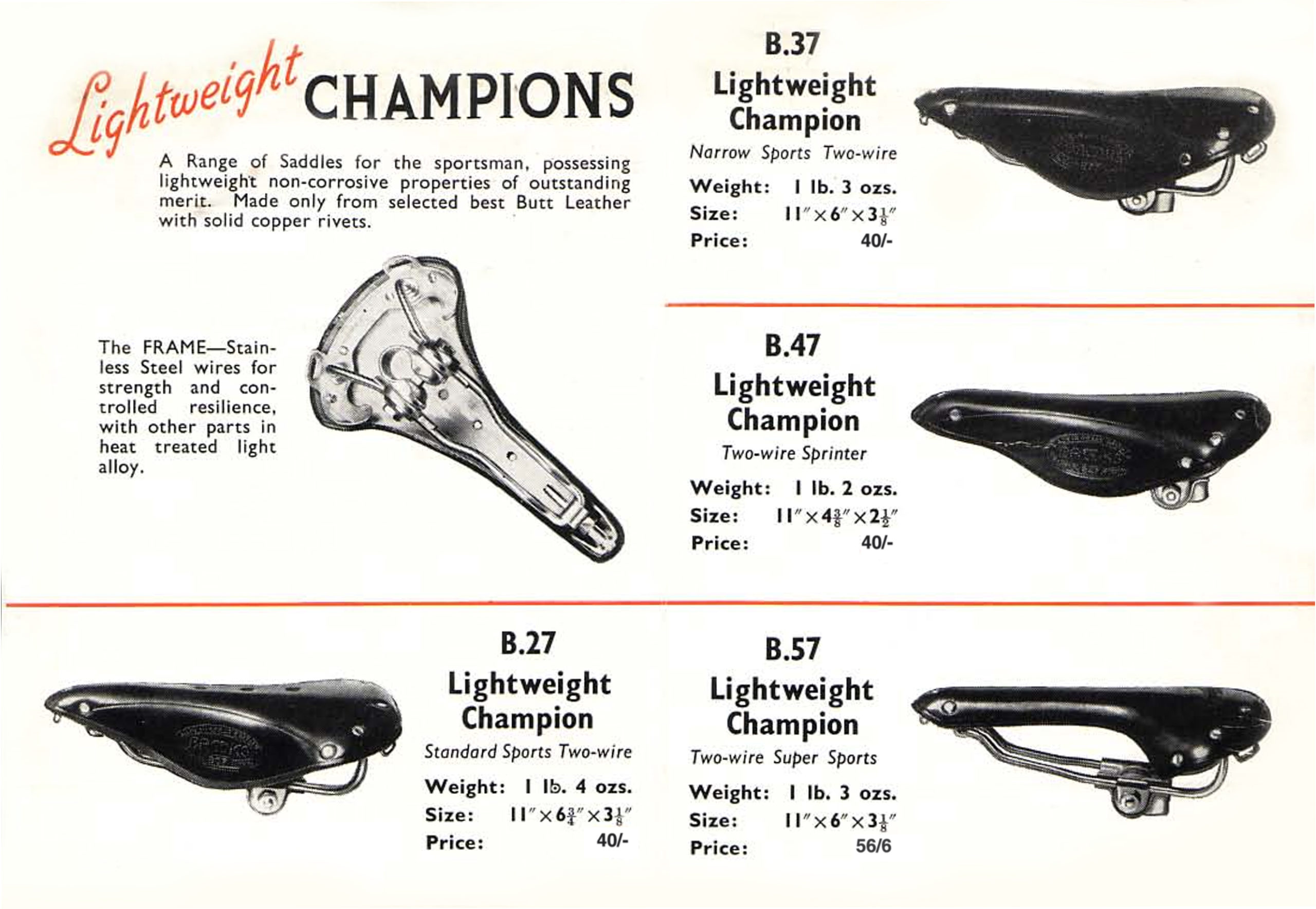
The last hybrid aluminum alloy/steel chassis saddles made by Brooks included the B. 27, B. 37, B. 47 and B. 57 models. Introduced in 1948, these saddles featured steel rails mounted to a heat-treated, light aluminum alloy cantle plate . Stainless steel was used to manufacture these rails, for “strength and controlled resilience.” The B. 27, B. 37, B. 47 and B. 57 were offered for three or four years. And that’s where the Brooks aluminum chassis trail ends altogether.
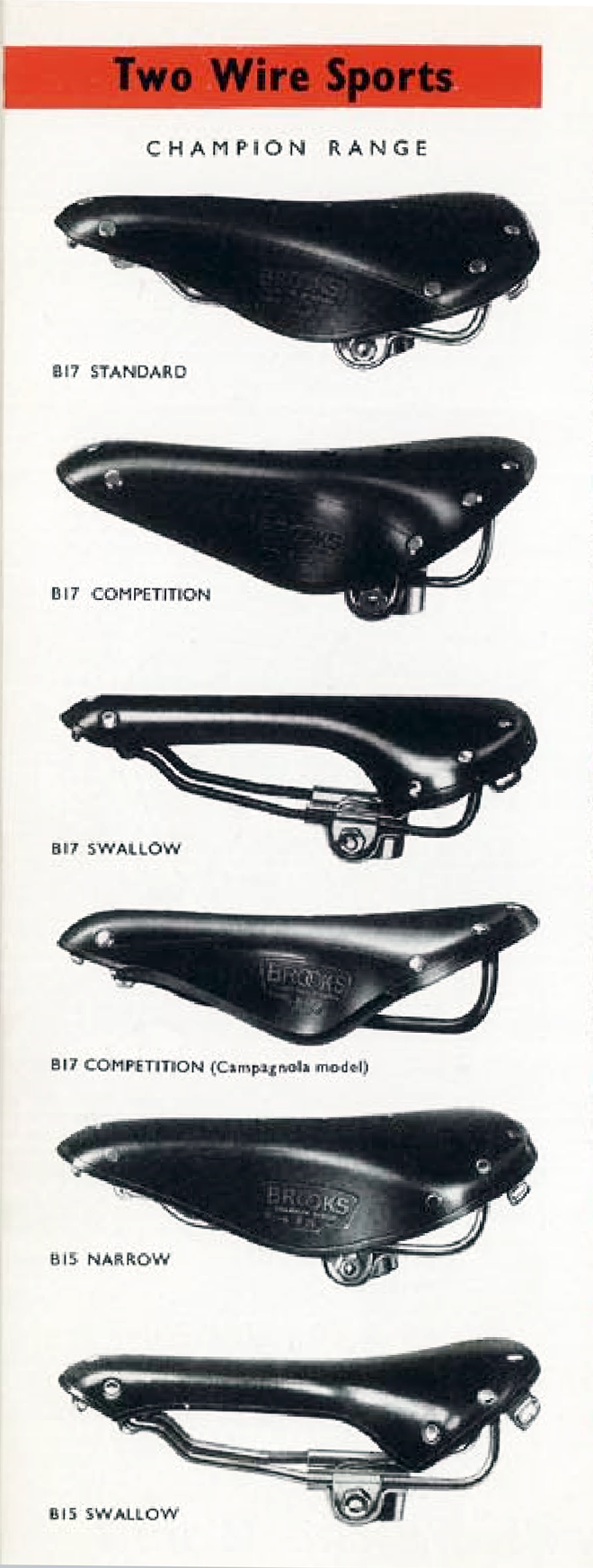
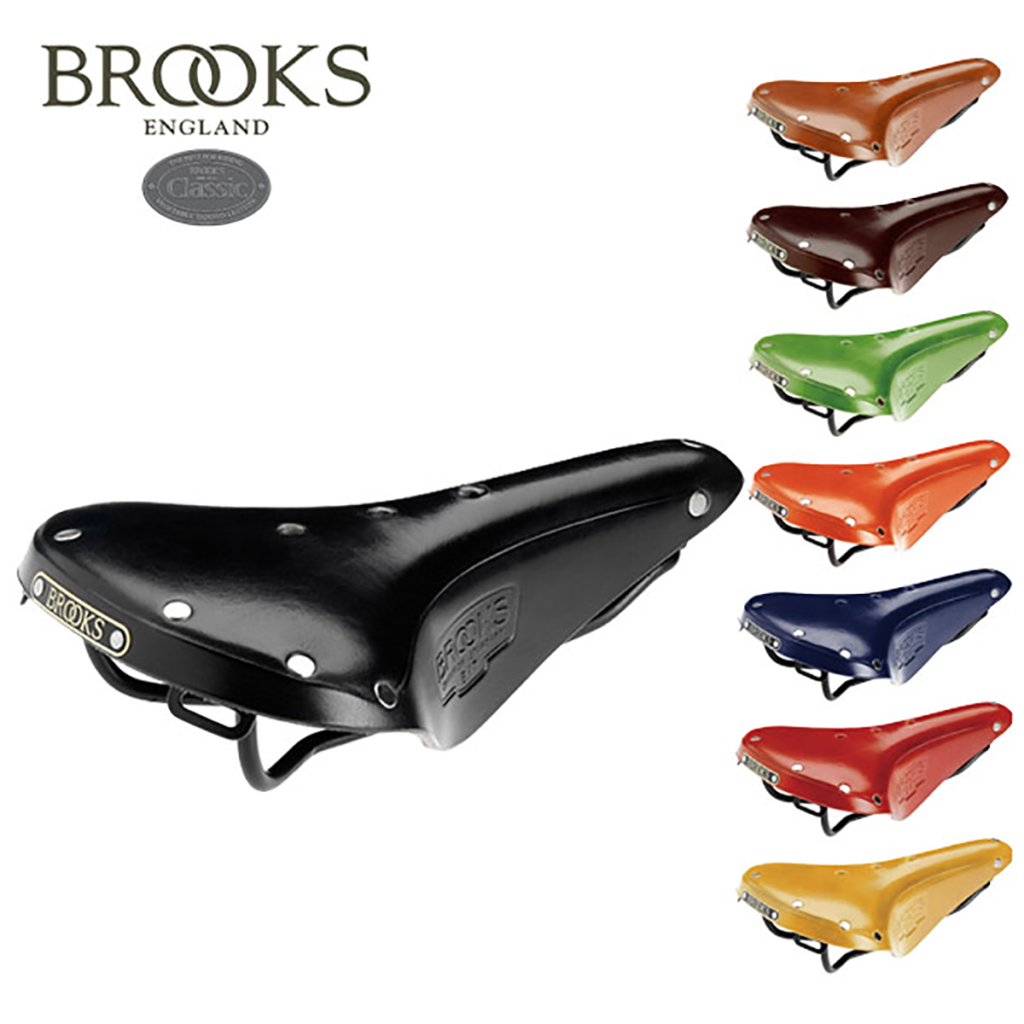
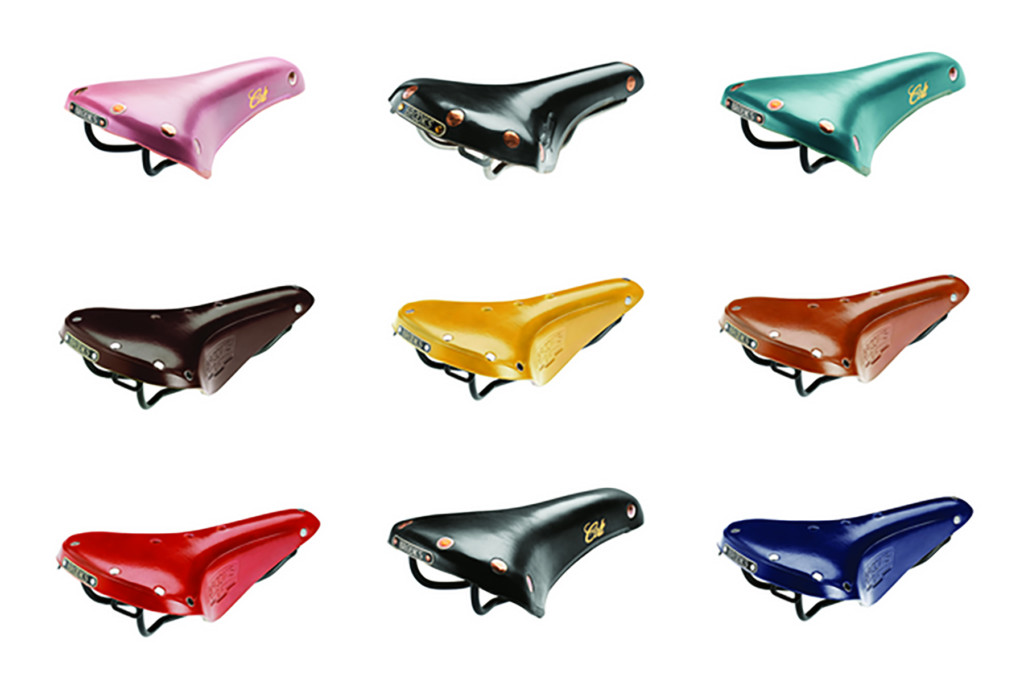
Brooks seat top choices were somewhat limited in color until more recently. You had your pick of black, brown or light colored leather. Additional leather colors started becoming available as leather dyes and dying techniques were refined, with venerable models like the B. 17 loosening up since first being introduced in the mid-1890s — Hilary Stone, who knows these catalogs as well as anyone, notes that the exact year has never been pinned down — to now include a veritable rainbow of colors: Black, Brown, Honey/Light, Natural, Green, Blue, Red and Ochre, of course. Maybe that’s why the timeless B. 17 is the most popular Brooks saddle in the company’s Classic range.
While a broad array of seat top colors may not have been available until recently, Brooks seat tops have always come in different shapes and sizes. Good thing, too, because different kinds of people use different kinds of bikes to do different kinds of things. The smart people at Brooks picked up on this straight away and started catering to all manner of cyclists from day one.
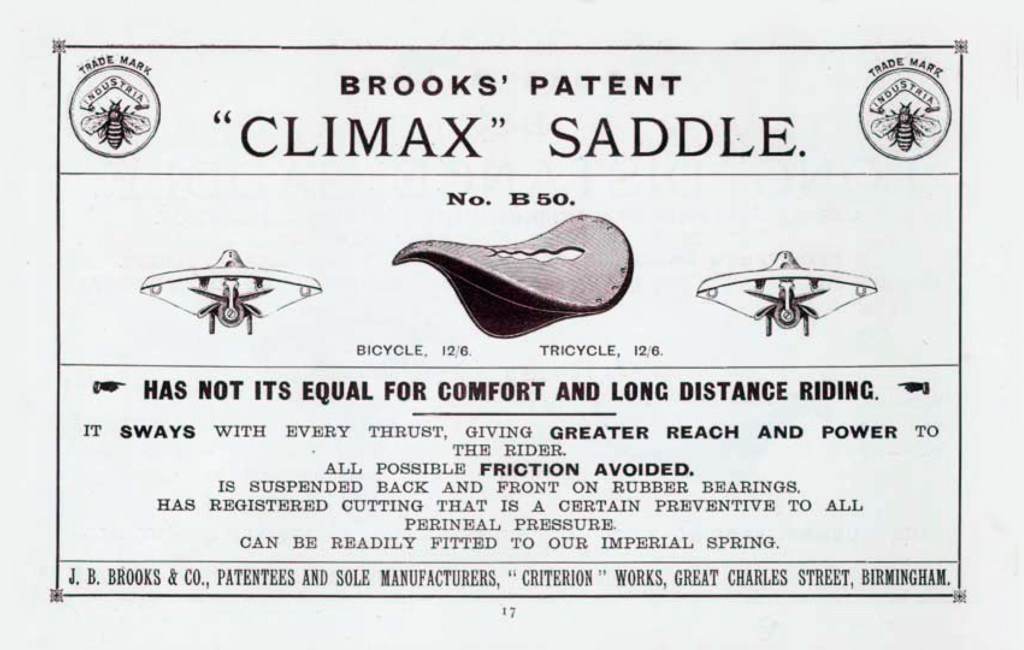
Indeed, the inaugural 1890 catalog had 27 saddle models catering to racing, semi-racing, long distance and spring riders, not to mention three ladies saddles and a peculiar “Climax” saddle presumably meant for all adults to enjoy. (Strange it wasn’t a tandem-only model given how conservative Victorian values were). And so the groundwork was laid for what would become the most exhaustive body of work in cycling history. Anyone have a smoke?
The leather-as-seat-top monopolists reigned supreme at Brooks (mostly, see below) until 2013, when the company finally introduced the C. 17, first of the Cambium line that now includes the C. 13, C. 15, C. 17, C. 19 and C. 67 models, and sub-variations thereof. Made of vulcanized natural rubber and fitted with a stretched organic cotton canvas (or denim) top, the Cambium line is light, modern and undeniably Brooks.
It very much looks the part of a smart update to the traditional company line-up: sturdy but sleek chassis, classic hammock construction, comfortable but competitive top. And it has replaceable rivets holding everything together, including the requisite Brooks nameplate. The future of cycling has arrived and it is now.

Despite the n-way number of Brooks saddle suspension/chassis/top combinations available, most of the company’s saddles tend to look the same over the years. Sure, you would expect many of the same people and machines to make many of the same looking saddles over time, which may partly explain why their saddles look so similar today as they did over a century ago. But something else is afoot here. Something deeper and far richer in the scheme of cycling things.
Breakthrough Alert: Brooks has discovered what makes bicycle saddles great. Part visionary founder and committed historical cast, part dogmatic dedication to finding what works best, part growing body of institutional knowledge just begging for use and reuse, part fearlessness to try new ideas that might just make a better ride — these are the qualities that define the Brooks brand and their saddles. That many tend to look the same over time is a natural by-product of having discovered something great. As the old saying goes, if it ain’t broke, don’t fix it.
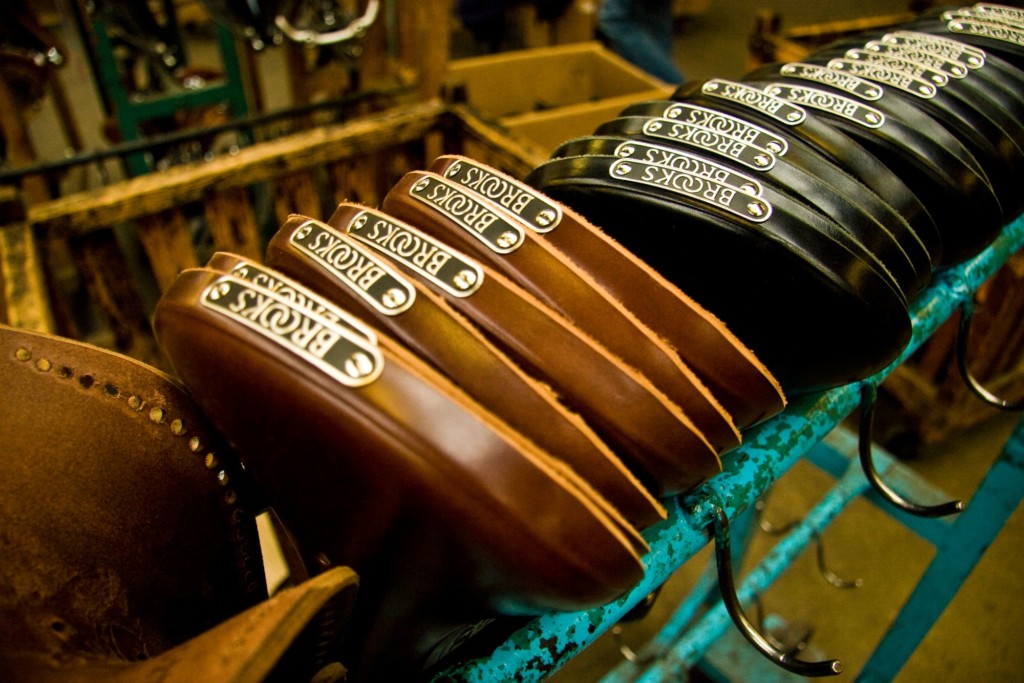
Brooks themselves became so confident in the quality of their saddles they started guaranteeing them for life in the late 1920s. The March 1928 issue of CTC Gazette is said to include an advertisement in which they state, “Brooks Saddles are Guaranteed for Ever.” While not the case for long before or after this ad appeared, most would agree the company still makes a damn fine cycling saddle.
That confidence had a long run-up, and 18 years before the advertisement Brooks had made the same argument from the opposite direction. The 1910 book heads a page Guarantee and Repairs and opens it:
“There are some names which in themselves are guarantees. We are proud to say that BROOKS is one of these, and that its presence on any article creates a perfect confidence, not only in the article itself, but in the fairness and liberality of the Manufacturers, should any question of repair arise during its use. This being so, it is unnecessary for us to issue any stereotyped guarantee.”
So Brooks spent the Edwardian years refusing to give a guarantee on the grounds that the name already was one, then spent the late 1920s advertising a guarantee forever. Same claim about the name, opposite tactic. The epigraph at the head of this article is the earlier form of that very page, printed unchanged from 1903 through 1908 and rewritten for 1910.
There is also an identification test, and Brooks published it themselves. The 1903 catalog gives it a leaf of its own, the 1904 and 1906 books put it on the title page and the 1920 book is still printing it 17 years later in nearly the same words: we wish to impress upon all Cyclists that every saddle made by us bears our name on both flaps, and has at the back the name-plate, Brooks, so well known to all riders. No other saddle is made by us. Name on both flaps, name-plate at the rear. It was written because saddles of various other makes, not bearing the name Brooks, have been passed off upon unsuspecting buyers as Made by Brooks — which tells you something about how well the name was selling by 1903. The mark itself is a bee inside the motto INDUSTRIA, a Birmingham emblem of industry long before it was a Brooks one, and it sits at the head of nearly every page of the Edwardian books.
Dating an undated Brooks book is easier than it looks, because the firm kept changing small things on the title page. The telephone is the best of them. A single number, 1213, runs from 1900 to 1905. Two numbers, 1213 and 5174, use either number, cover 1906 to 1908. Then 2273 Central on two lines for 1910 to 1912, Central 3670 on six lines from 1913 to 1935 and CENtral 3671 on 10 lines by 1937. The printer’s imprint is nearly as good: Cond Bros. of Birmingham to 1907, Silk and Terry from 1908, Buckler and Webb from 1920. And from 1932 the books drop the year in favor of a List No., where 158 is 1932, 168 is 1933, 190 is 1934, 208 is 1935, 247 is 1937 and 265 is 1938.
Two cautions for anyone comparing figures across books. The first is that Brooks measured a saddle the way a bootmaker measures a foot and said so in print six times between 1903 and 1910, so lengths and widths are comparable at least across the Edwardian books — but heights are not. The 1906 book measures height from the centre of the clip-bolt to the under surface of the leather; the 1919 and 1920 books measure to the top surface; the 1932 book is back to the under surface. Check the convention before subtracting one height from another. The second is that the model numbers themselves move. The 1904 catalog quietly folds three saddles into one, printing Formerly B 92 under the new B. 90 Size 1, Formerly B 91 under the Size 2 and Formerly B 90 under the Size 3. A B. 91 in a shed is a B. 90 Size 2 that predates 1904.
Brooks did not have to make that case entirely on its own, either. Page 36 of the 1937 catalog is given over to a feature headed “As Others See Us,” two columns of unsolicited testimonial letters, each one signed with a set of initials and a town. Almost none of them lead with comfort. They lead with mileage.
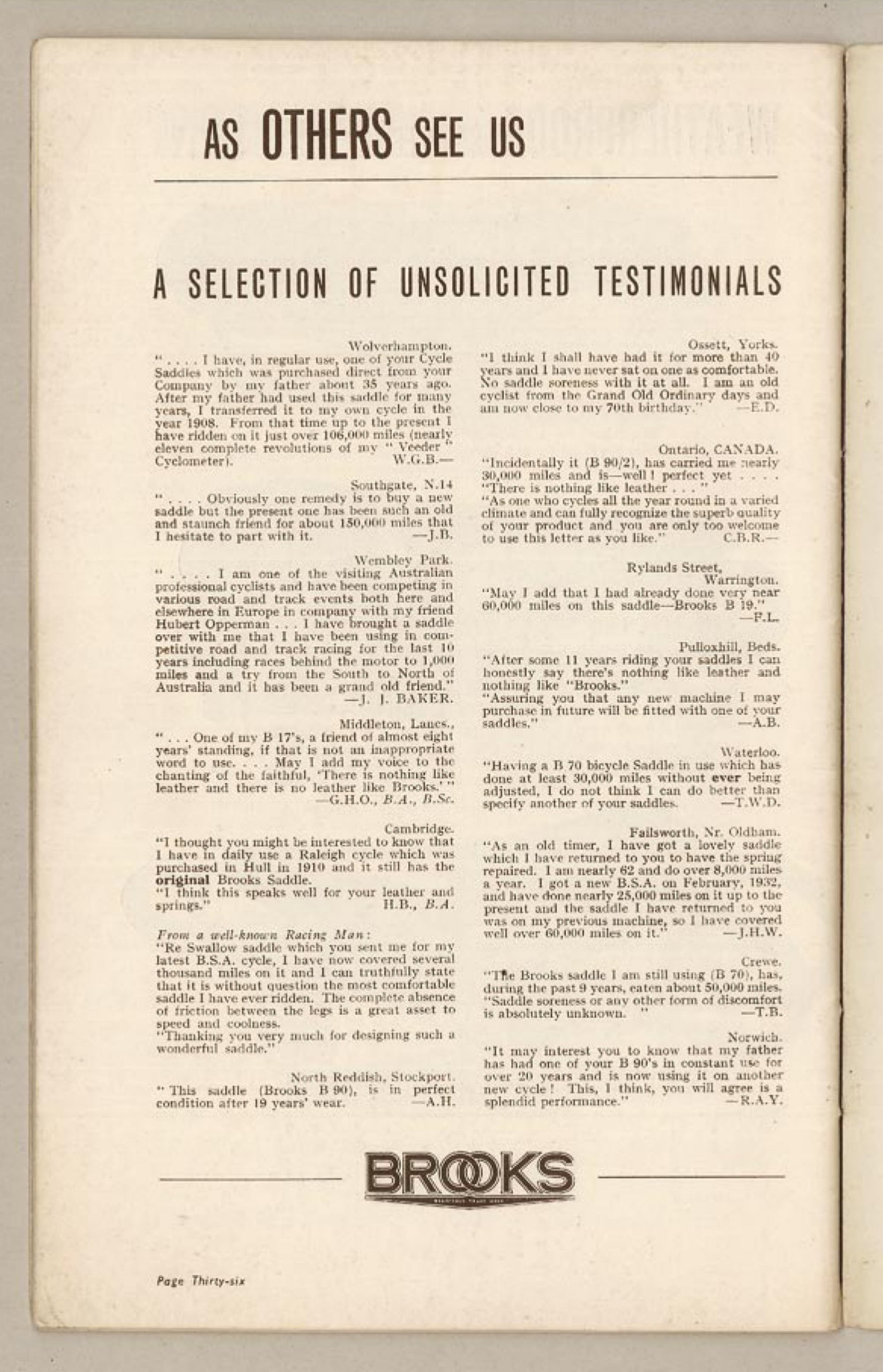
“Obviously one remedy is to buy a new saddle but the present one has been such an old and staunch friend for about 180,000 miles that I hesitate to part with it.”
J.B., Southgate, N.14“I have, in regular use, one of your Cycle Saddles which was purchased direct from your Company by my father about 35 years ago. After my father had used this saddle for many years, I transferred it to my own cycle in the year 1908. From that time up to the present I have ridden on it just over 106,000 miles.”
W.G.B., Wolverhampton“I think I shall have had it for more than 40 years and I have never sat on one as comfortable. No saddle soreness with it at all. I am an old cyclist from the Grand Old Ordinary days and am now close to my 70th birthday.”
E.D., Ossett, Yorks.“This saddle (Brooks B 90), is in perfect condition after 19 years’ wear.”
A.H., North Reddish, Stockport
These are of course a selection, chosen by Brooks from whatever actually arrived in the post, and a reader should weigh them accordingly. What is harder to stage is the arithmetic. A saddle bought around 1902, handed down and still gathering miles in 1937 is a 35-year service life on what the rest of the trade treated as a consumable. One correspondent, J.J. Baker, writes as a visiting Australian professional who had raced on his for 10 years, including events behind the motor out to 1,000 miles and a crack at the south to north crossing of Australia in the company of his friend Hubert Opperman. Another simply supplies the line the entire page is built around: “There is nothing like leather and there is no leather like Brooks.”
So why, then, were there four distinct deviations from the Brooks-as-cycling-saddle-manufacturer master plan along the way? (Well, three and a half, at least). Before attempting to answer that question, let’s have a look at what those deviations were. Together, they represent among the more interesting anomalies in the company’s storied history.
The half deviation in the Brooks storyline belongs to the No. 1, No. 2 and No. 3 saddle models. No, these were not the first, second and third saddles the company ever made. Yes, they were bicycle saddles made by Brooks with a Brooks nameplate affixed to them. And no, they were never all three in the range at once. They were designed by Brooks and adopted by His Majesty’s War Office for exclusive (and then not so exclusive) use on military bicycles, and every catalog page they appear on carries that line beneath the heading.
The three numbers arrive and depart in sequence rather than together, and the catalogs make the sequence exact. The No. 1 and the No. 2 stand side by side in 1903, 1904, 1905, 1906 and 1907. The No. 1 is then dropped and never returns, leaving the No. 2 alone in 1908 and 1910. The No. 3 appears for the first time in 1911, beside the No. 2, and that pair runs through 1914. By 1916 the military range has gone from the civilian book altogether. That is 14 years, five arrangements, and not one of them is Nos. 1, 2 and 3 together. The 1903 catalog is worth being specific about, because it is the book this article used to cite: printed page 54 carries the No. 1 and the No. 2 and nothing else, and the book’s own index says so twice.
The No. 2 Military Saddle was a service version of the civilian B. 10/2. It had a strong canvas support under the leather top, which itself may have been thicker than the B. 10 top. The shorter-lived No. 1 Military Saddle was a service version of the short-lived B. 22/3 saddle. Funny how lack of longevity would seem to run in the family.
A warning for anyone counting numbered Brooks military items in an old catalog, because it has caught better researchers than me. Brooks ran several War Office ranges at once and numbered every one of them the same way. In the 1904 book the military saddles are on printed page 51, the Registered Rifle Clips No. 1 and No. 2 Service Pattern are on page 52 and the Registered Army Tool Bag Service Pattern No. 1 is on page 53. Three consecutive leaves, three separate No. 1 and No. 2 series, all of them adopted by the War Office, and only the first are saddles. The 1903 book spreads the same trap over six pages. Count the headings, not the numbers.

The No. 3 existed to prove otherwise, if not coyingly so. Introduced in 1911 alongside the No. 2 in the Military Saddles range and carried that way through 1914, the No. 3 morphed into a Commercial and Carrier Service-targeted model by 1927. Army service riders are mentioned as suitable users of the saddle in that year’s catalog — third down on the list of suitable riders, just below postmen and above errand boys. Remember: one must remain nimble when responding to the needs of the day.

Brooks military saddles were co-marketed alongside general cycling saddles through at least 1914 and then disappeared from civilian saddle catalogs by 1916. Perhaps the company found some outward benefit from the military/civilian association at the onset of World War One, though this changed within two years despite the No. 2 quietly remaining in production until the late 1930s. While not exactly a major deviation, a deviation nonetheless from the civilian consumer sensibilities otherwise guiding Brooks.
Here’s a deviation many human and motor-powered cyclists already know about: Brooks made motorcycle and even motorized tricycle saddles from 1900 through at least 1938, with motor-specific saddles disappearing by that year’s catalog. Motor saddles were a major deviation for Brooks, representing a core segment of company business for much of the early twentieth century.
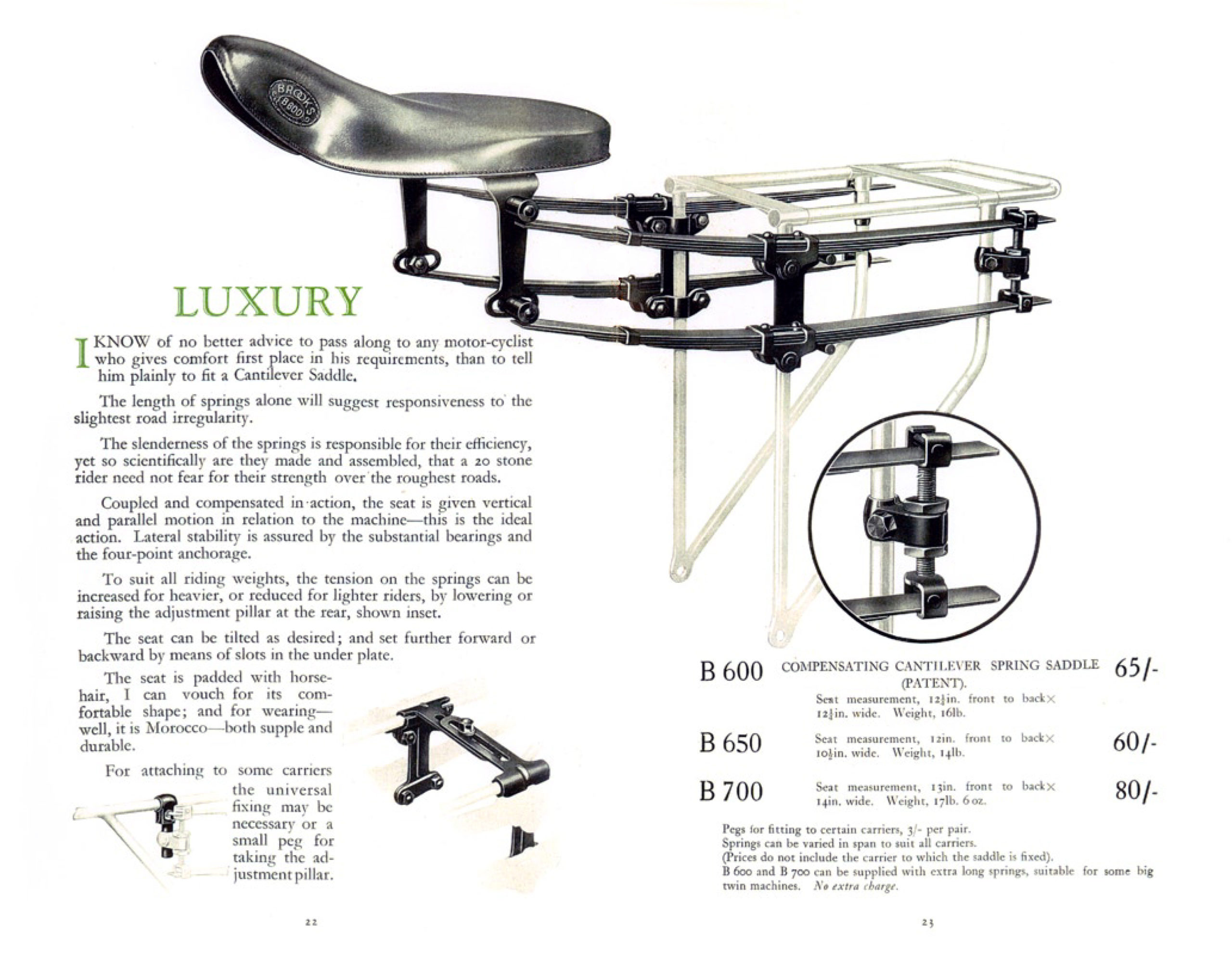
At least 15 Brooks catalogs dedicated exclusively to motor saddles were published between 1907 and 1935. They include over a dozen models made just for motor vehicles, most featuring wide seats supported by heavy frames with active suspension systems. Some Brooks saddles were even made on behalf of motorcycle manufacturers.
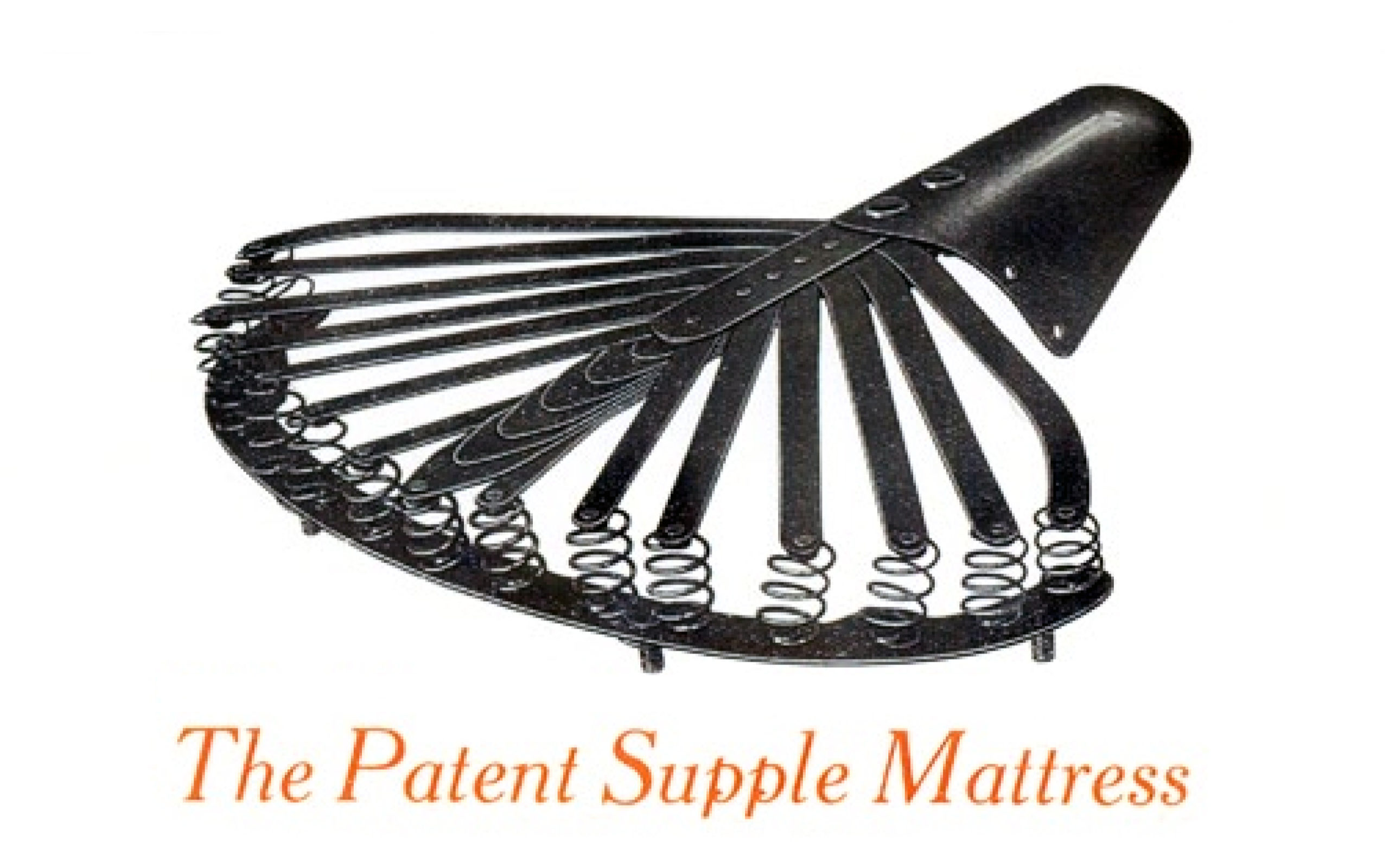
The B. 185 model is a standout, though, even in the world of standout Brooks motor saddles. It featured Brooks’ “famous supple mattress,” which is a skeletal frame system with nine stacked metal leaves forming a flexible center spine — that in turn holds 14 flat springs radiating outward toward the back cantle plate. These horizontal flat springs support the seat top and are sprung with coils wound from “the finest piano wire.” Comprende, maestro?
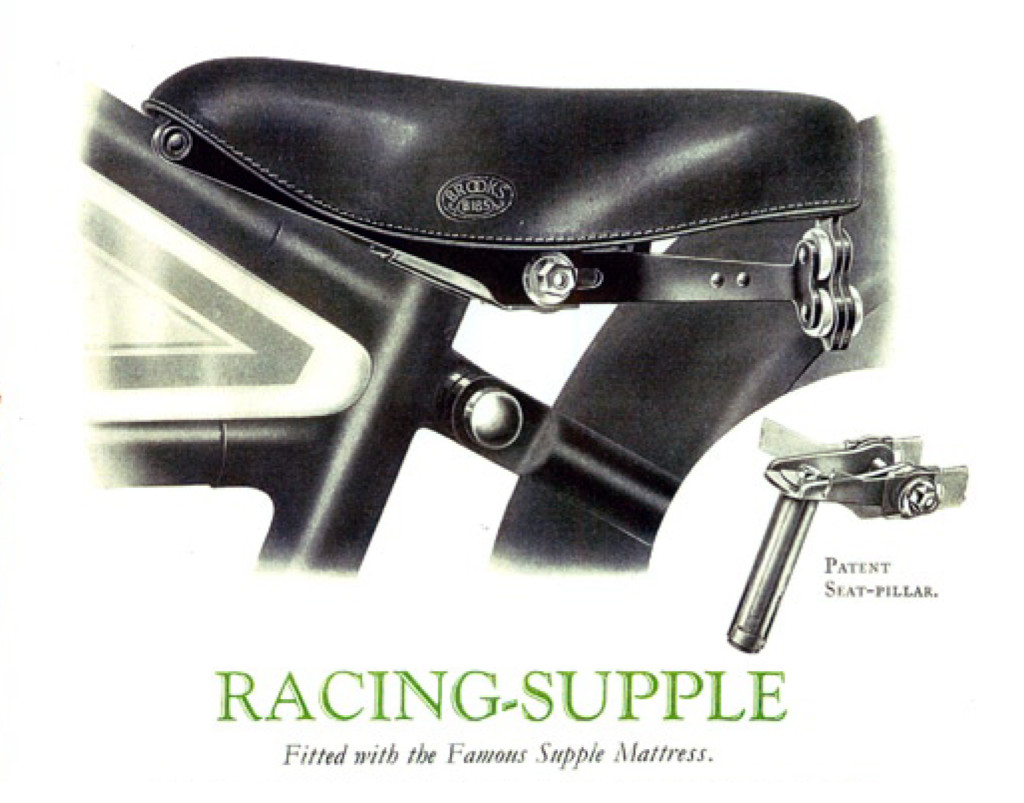
Many Brooks motor saddles featured the supple mattress design, though. What made the B. 185 special was the use of rubber buffer shock absorbers at the rear of the saddle to, “tone down the 80 m.p.h. pot-hole frightfulness” of the bumpy but fast roads back in 1925, the year they were introduced. While the B. 185 placed the shock absorbers between the saddle’s rear cantle plate and motorcycle’s rear mudguard, it took just two years for other saddles in the Brooks line to bring this feature onto saddles themselves.
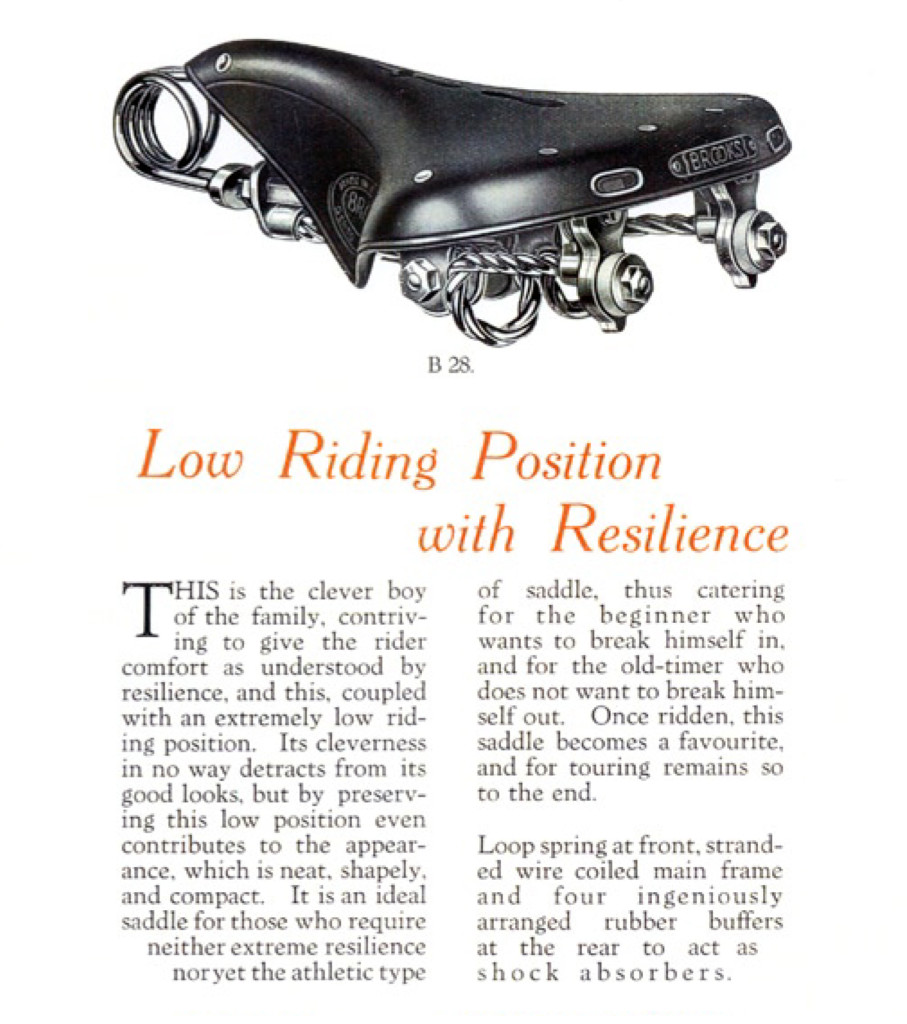
Included here was the B. 28, which this article once dated to 1927. The catalogs say otherwise, and they say it loudly: the B. 28 is on printed page 25 of the 1903 book, where it is already being called this well-known Saddle. Its life then turns out to be a stop-start affair — present from 1903 through 1908, absent from the 1910, 1911 and 1912 ranges entirely, back from 1913 and running through to 1932, by which time the catalog calls its rubber buffer double. In 1910 its old page 17 is taken over by the B. 32, which fights sagging with sliding seat rods instead. And to think Specialized didn’t introduce those vibration-dampening Zertz inserts into their forks, seat stays and seat posts until 80 years later. Wait, did someone say 650B was back in style?
The moment the motor trade overtook the cycle trade at Brooks is visible in a single year of title pages. The 1919 book is Saddles and Bags for Cycles and Motor-Cycles, and it puts the cycle saddles first. The 1920 book is Saddles and Equipment for Motor Cycles and Cycles, and it hands printed pages 6 through 27 to motor cycles before a cycle saddle turns up on page 28. The wording and the running order invert together, in 12 months. Those same books give the B. 500 the best name Brooks ever hung on a saddle: the Pullman of Saddles.
The next deviation from the tried-and-true Brooks master plan concerns no fewer than 10 different sub-brands of saddles. Relatively few Brooks aficionados have ever heard the names Zapho, Impervia, Kaydex and Plyflex, let alone had the privilege of their asses touching one of their saddles. That’s because they were only produced in limited numbers for short periods of time — by Brooks standards.
At least they were also memorialized in Brooks catalogs from the early 20th century. Other sub-brands like Challenge, Flexal, Legion and Royal received no coverage whatsoever in any available Brooks-brand collateral, though they still contributed to the company’s bottom line with all manner of saddle designs starting in the late 1920s.
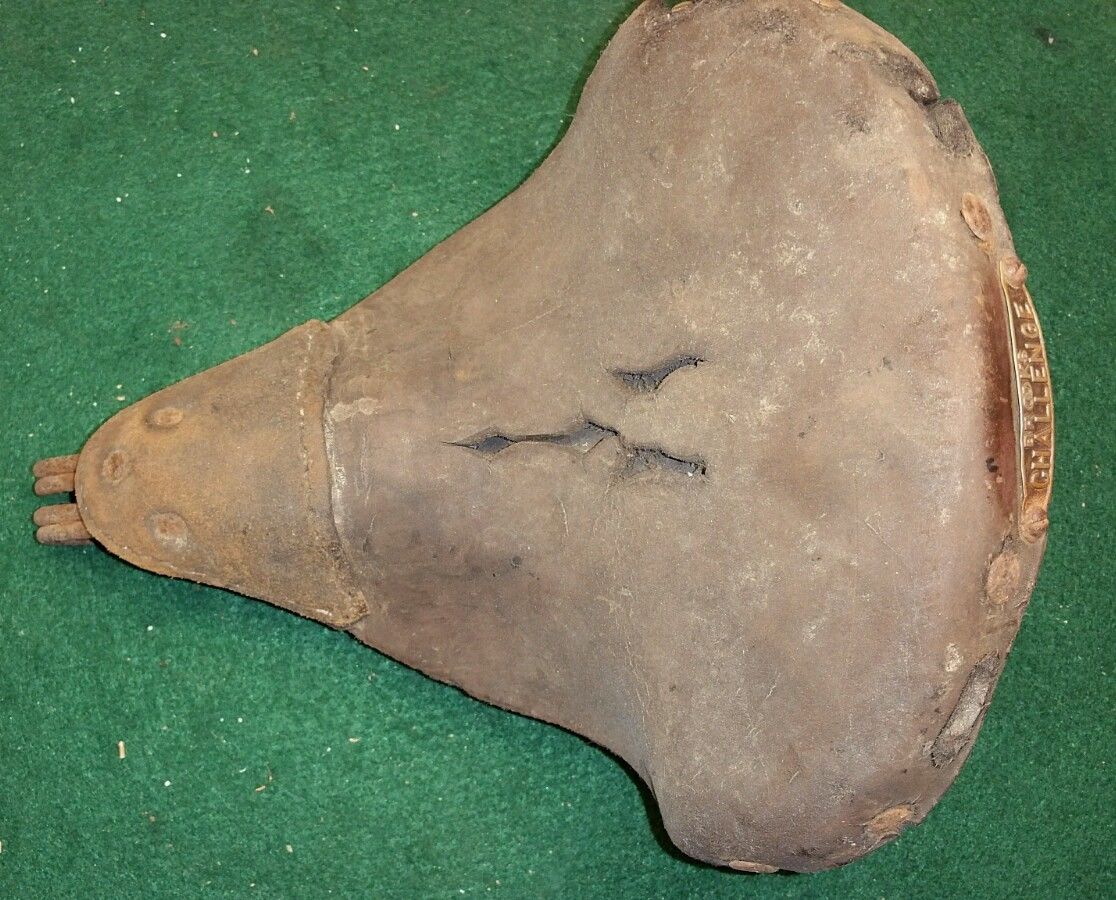


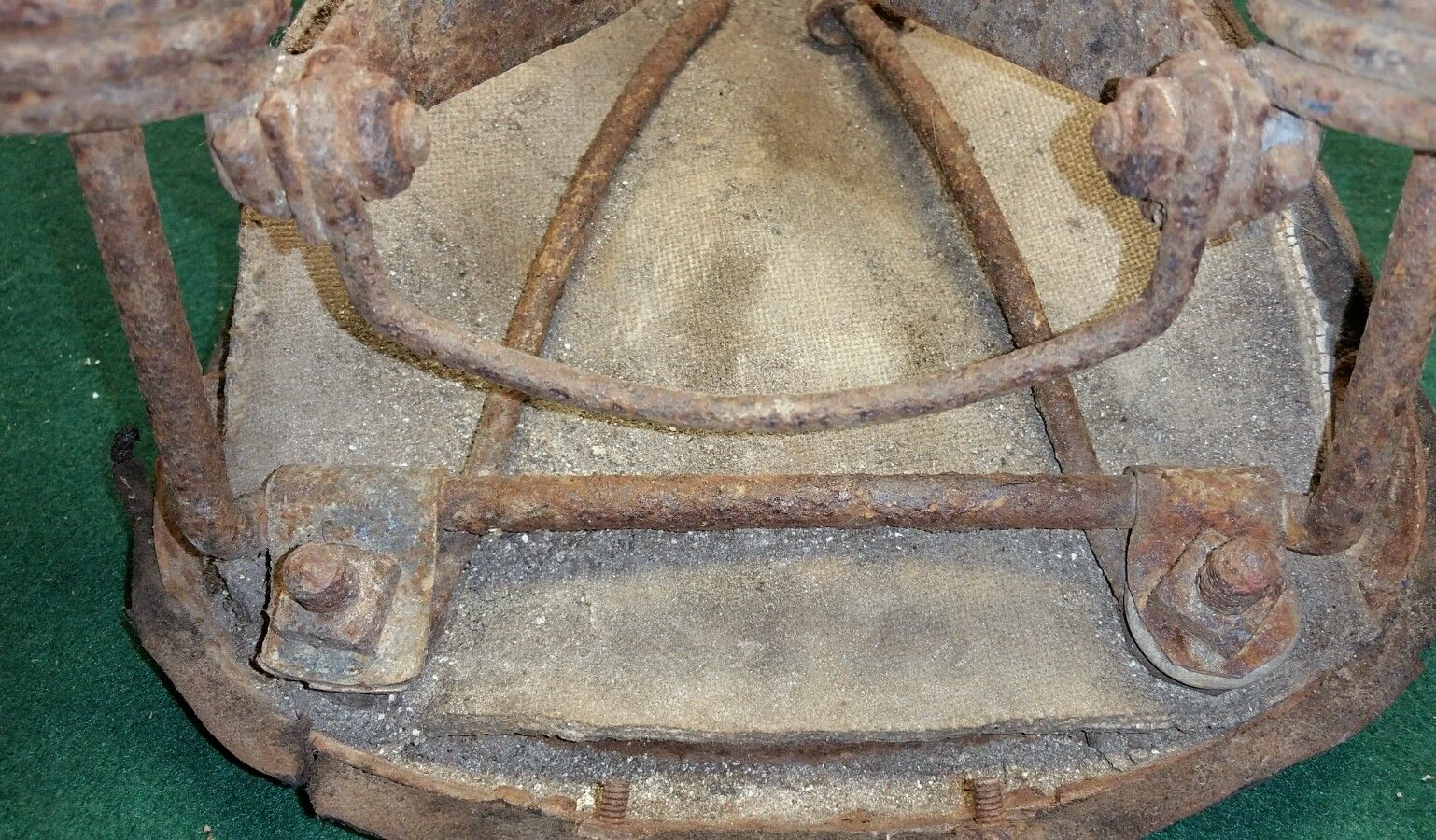


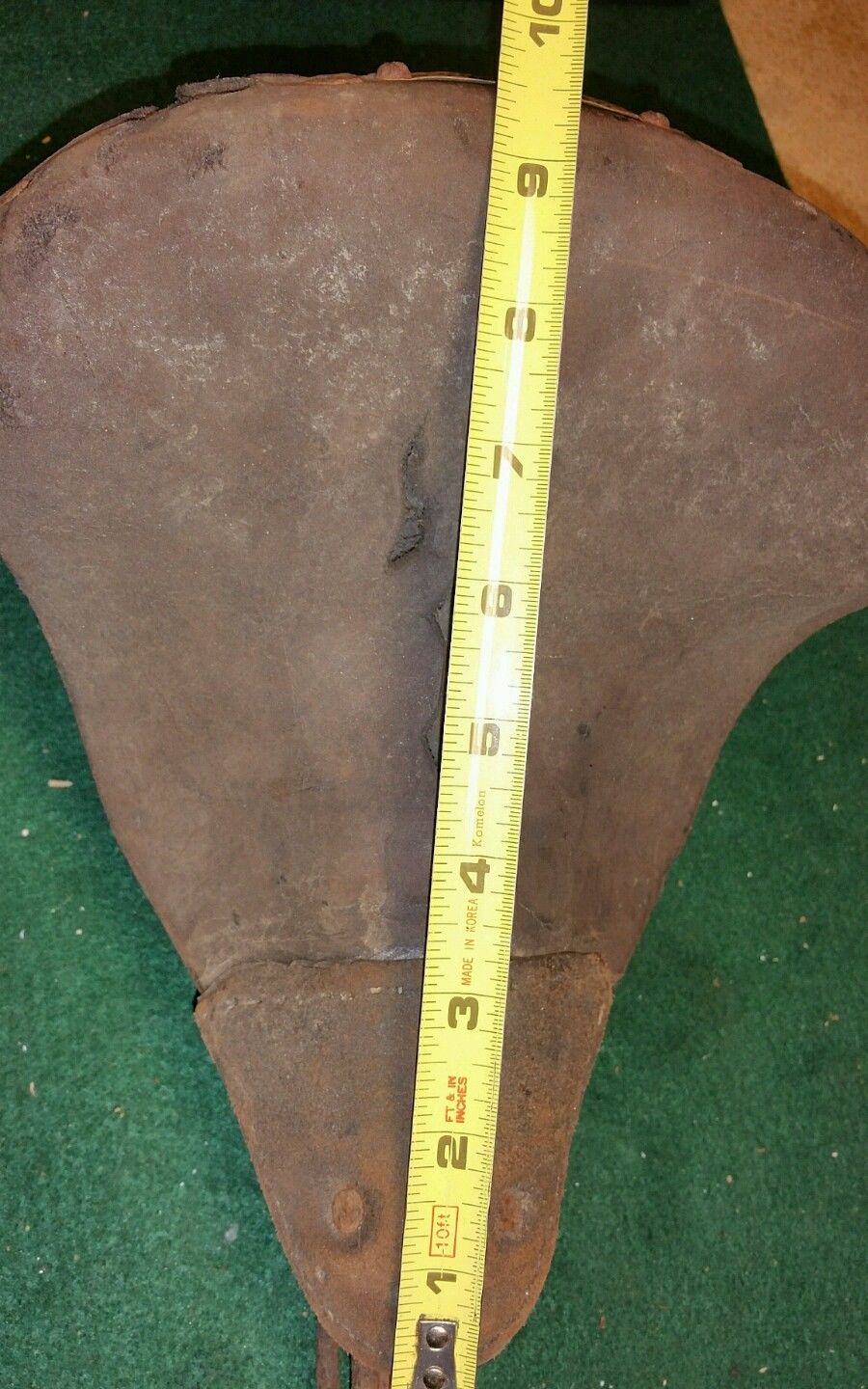
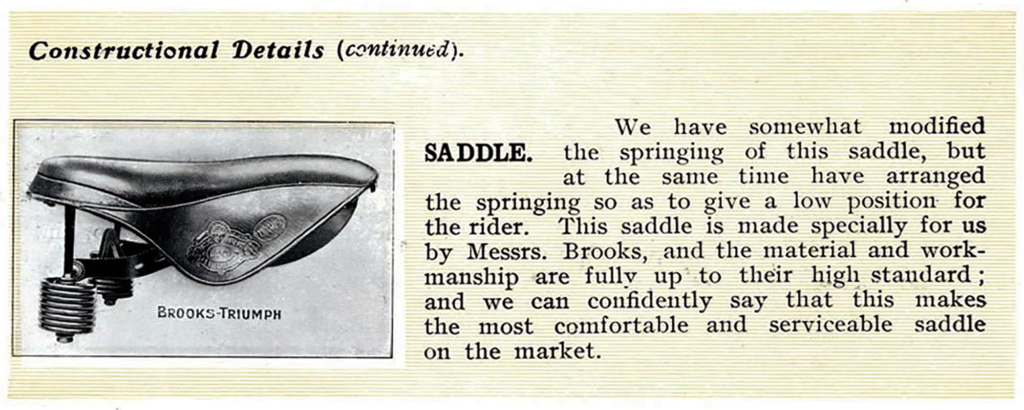
And then there were Brooks motor saddles made exclusively for Sunbeam and Triumph, two popular mid-20th century motorcycle manufacturers. These saddles were made in a similar pattern to other contemporary models, but the Triumph motor saddle carried a smallish “identifier” stamped in an oval towards the nose. It also featured not just one but two Brooks badges to correspond with the exotic serpentine cantle — their only saddle fitted this way, so says a knowledgeable source.


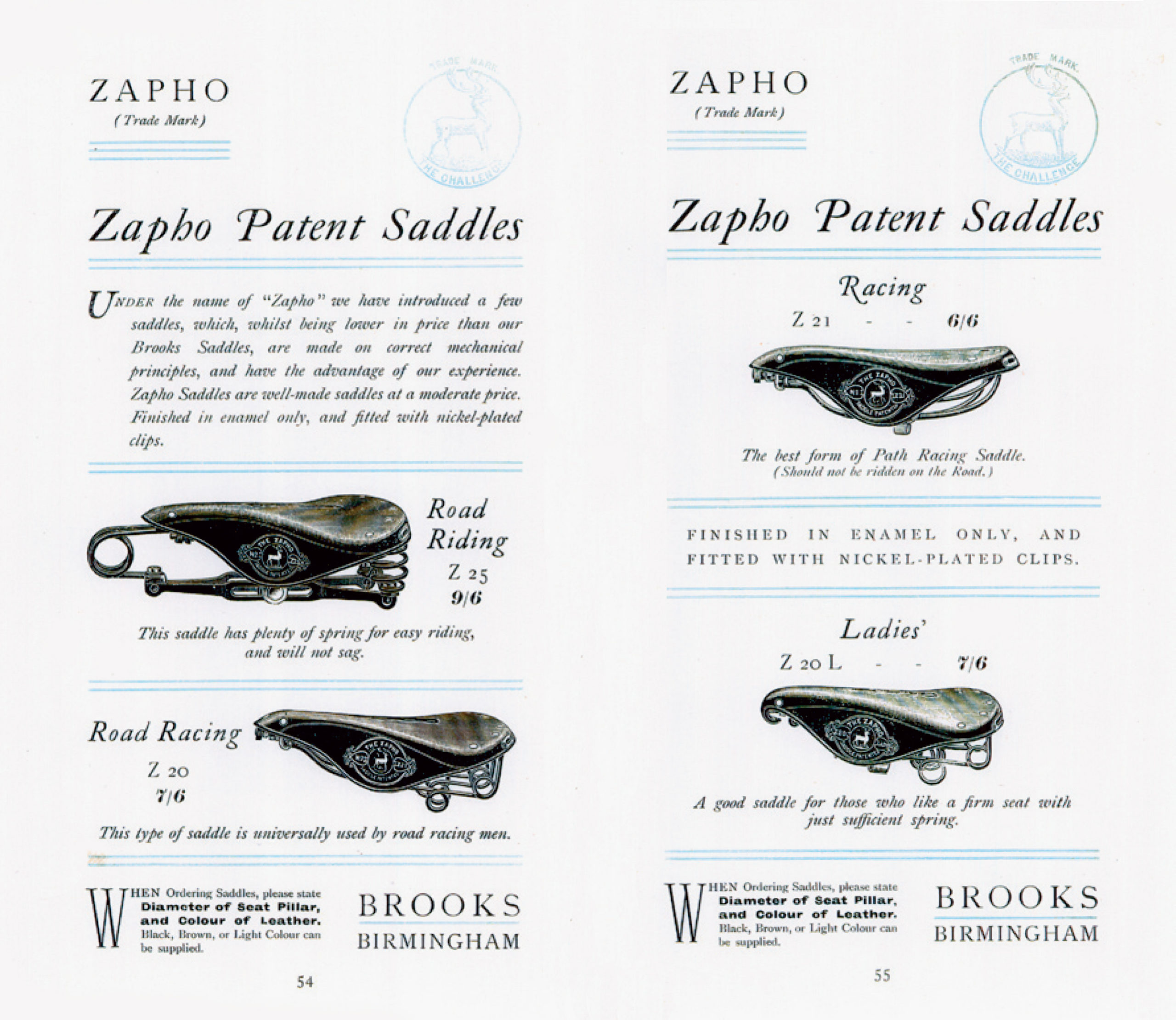
Starting with Zapho, let’s take a closer look at the four sub-brands included in Brooks catalogs. Introduced in the 1901 catalog and gone by 1903, the four Zapho saddles — the Z. 20, Z. 20L, Z. 21 and Z. 25 — were marketed as more economical versions of their basic loop, coil and straight wire Brooks counterparts. While lower in price, Zapho saddles were still made with “correct mechanical principles” but only offered in black enamel finish. Zapho saddles were Brooks’ first foray into different sub-brands.
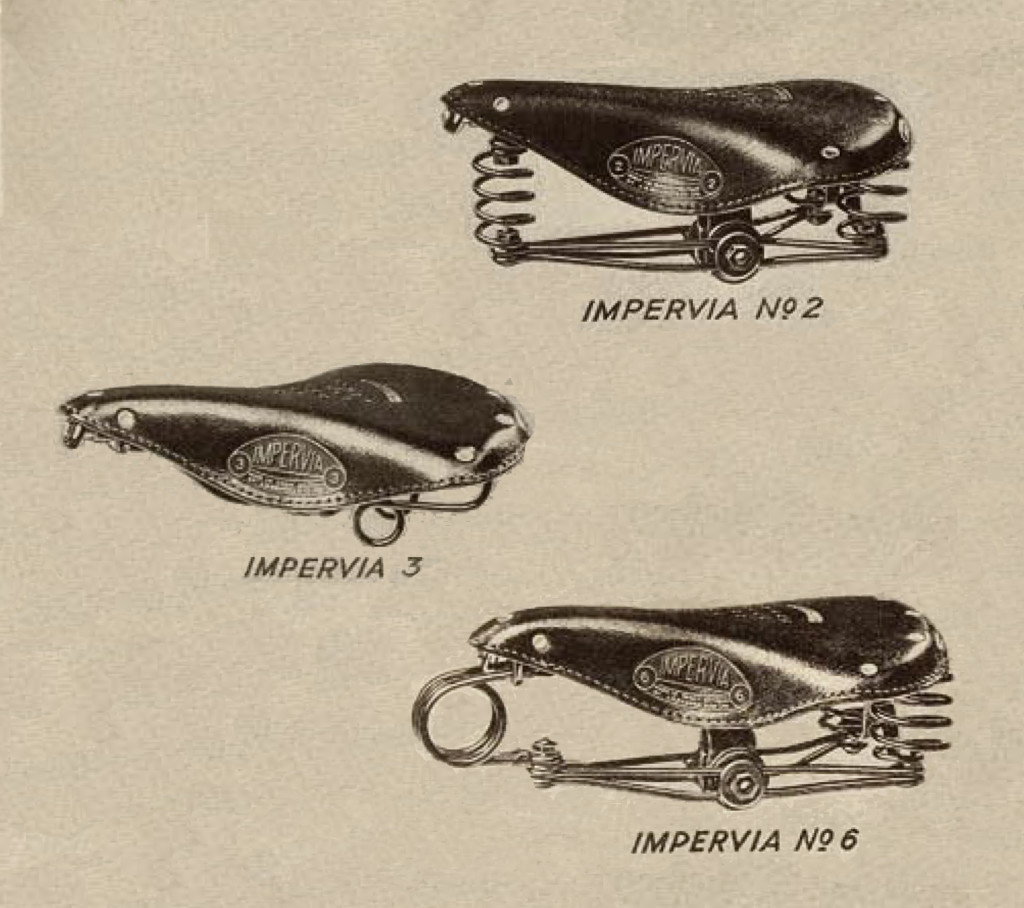
Impervia saddles followed with the R. 2, R. 3 and R. 6 models in the 1933 catalog. Some Impervia saddles employed a two-ply method of construction whereby a weatherproof top was molded to a leather foundation. Marketed as “non-cracking, non-clinging,” it would reason leather tops had at least some problem with cracking and clinging. Impervia saddles had spring mattress suspensions and were available with leather or waterproof tops. They were nonetheless gone by 1936.
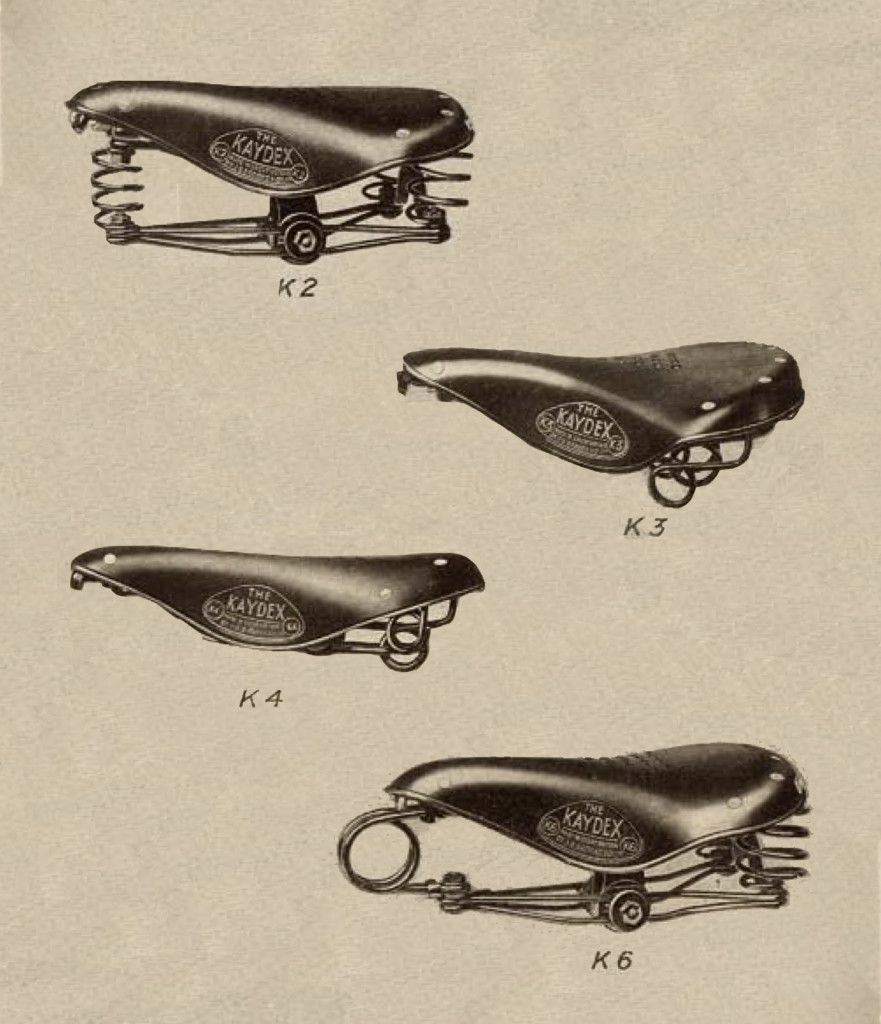
Kaydex saddles came next. Introduced in the 1933 catalog and gone after 1937, Kaydex saddles were relatively economical spring saddles with sturdy leather seat tops. They were meant to provide a “super weatherproof” alternative to Brooks-brand saddles without the added encumbrance of also needing to offer leather seat tops. Most Kaydex saddles were 40% or so cheaper than their roughly equivalent Brooks counterparts.
Plyflex saddles were the last sub-brand of saddles manufactured and co-marketed by Brooks. Introduced as Brooks Plyflex on saddles like the P. 205, P. 206, P. 207, P. 208 and P. 209/L models in the 1933 catalog, the Plyflex molding process would come to constitute its own sub-brand by 1937. Familiarly enough, the Plyflex process used a multi-ply top molded to a leather foundation to provide extra cold and wet weather protection to the seat top.
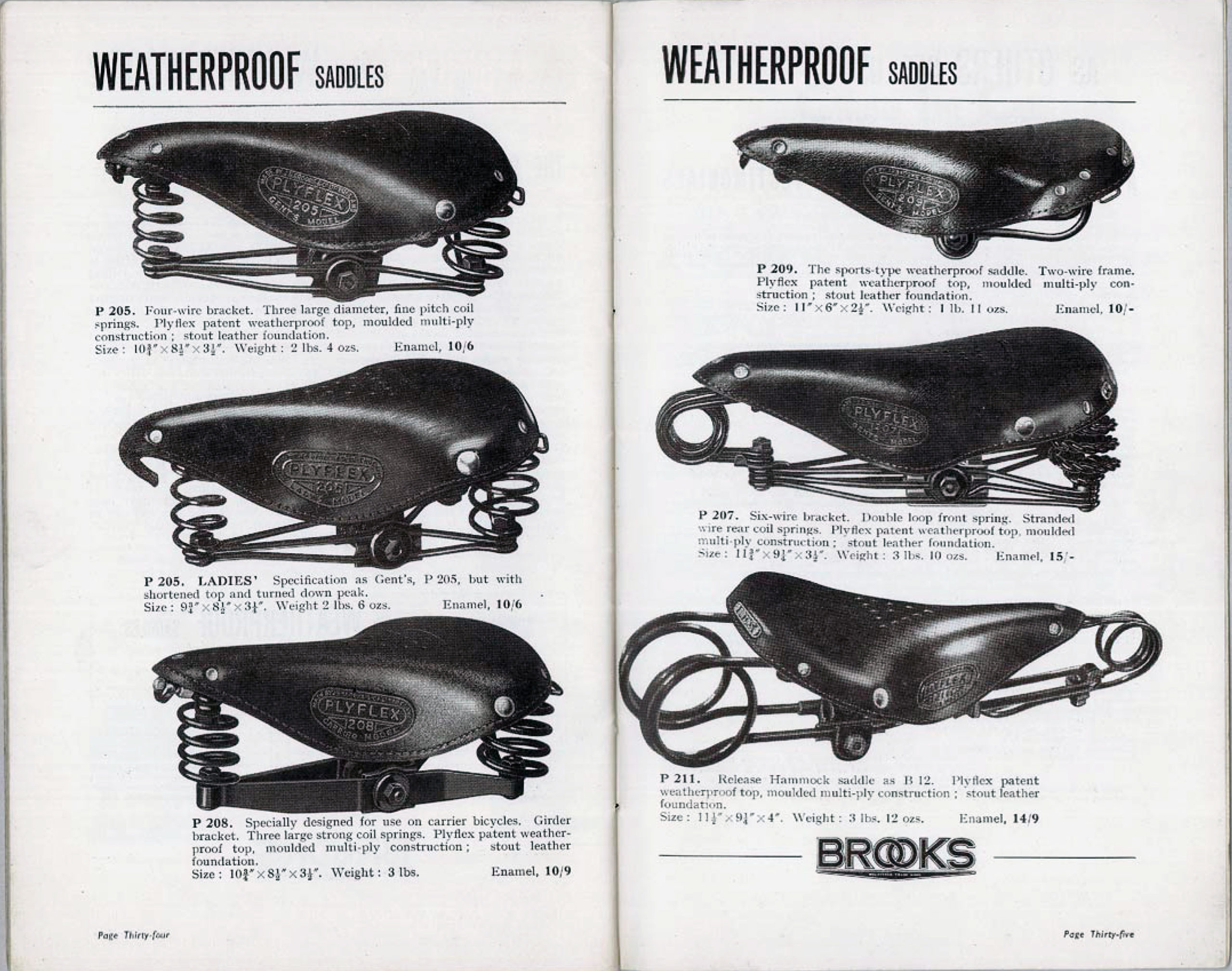
Despite being “a popularly priced weatherproof range,” Plyflex saddles seem to have added an additional third layer of protection compared to their Impervia brethren and sistren, which were only two-ply. Also regarded as non-cracking, non-clinging, flexible and durable, Plyflex saddles disappeared by 1950 and maybe earlier, noting a 10 year gap in available Brooks catalogs from 1940 through 1949.
The 1932 catalog puts the whole sub-brand question on one page, and it is worth the detour. Printed page 7 shows a single three-coil chassis sold seven ways, with nothing changing down the ladder but the top: the B. 85 at 13/6, the B. 75 at 12/3, the B. 73 at 11/3, the Challenge C. 31 at 7/9, the Legion A at 7/-, the Kaydex K. 2 at 5/3 — and the Plyflex P. 205 at 10/3. Read that last one twice. The Plyflex outprices three of the Brooks-badged saddles on the identical frame, so it is not the budget line it usually gets taken for; that job belonged to Kaydex, at about half the Plyflex price and well under half the B. 85. The book states the principle on page 2 with no ceremony at all: with cycle saddles the price is chiefly controlled by the grade of leather used for the top. One chassis, seven prices, and the difference is hide.
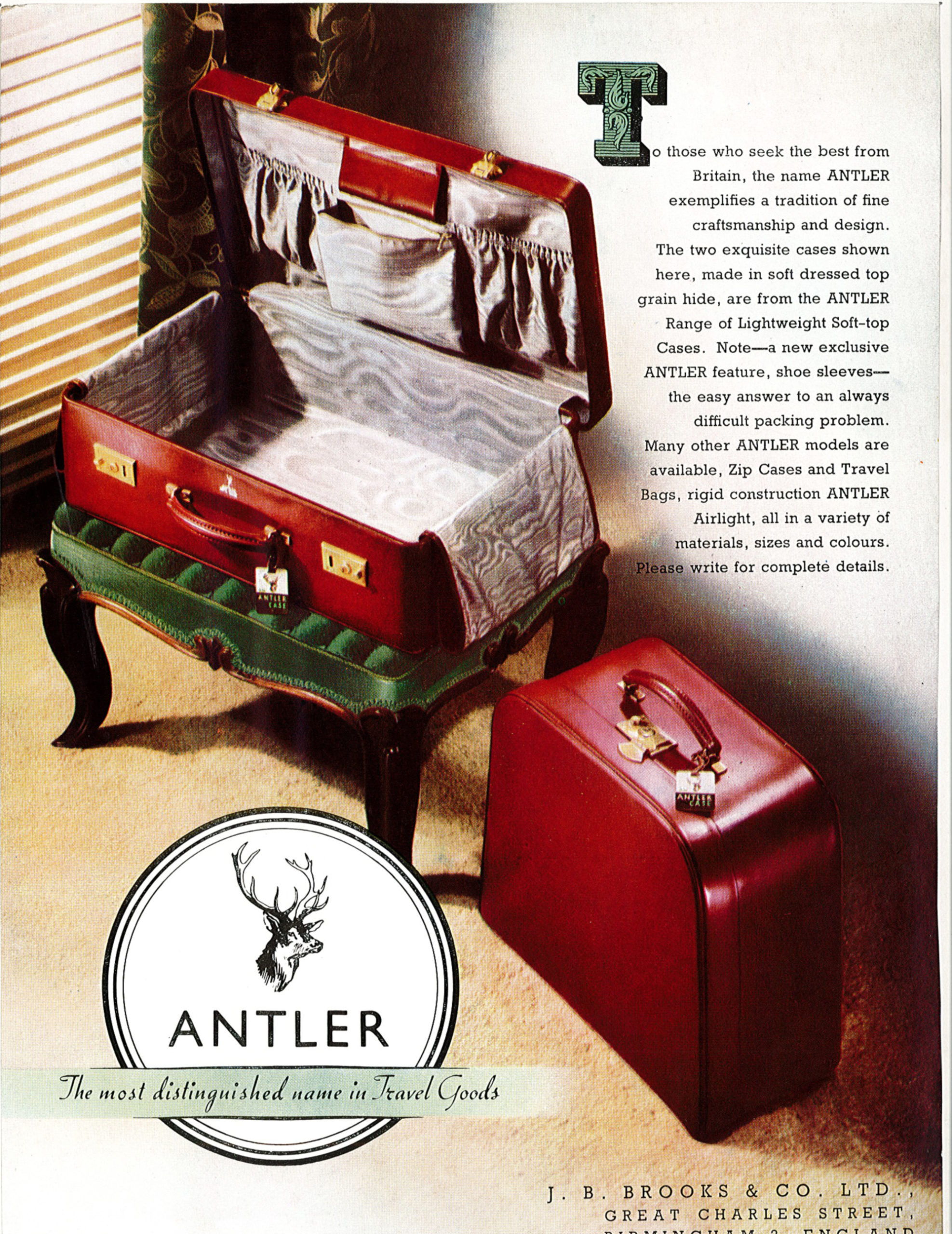
The final deviation from the Brooks master plan concerns a pair of sub-brands unlike anything else in the catalog. Both are older than they look. Antler was created around 1920 by J.B.’s son, who took the name from his interest in wildlife, and it sold leather goods and travelware, with earlier products under the Brooks name providing an obvious bridge to the elegant Antler product line. Think heirloom-quality luggage, picnic sets and purses. Antler launched its first lightweight soft-top suitcase in 1930, covered in patent leather or in Rexine coated cotton.
The Evertaut brand and its products were somewhat less obvious in their historical precedence at Brooks. The name traces to 1925, when J.B. Brooks and Company filed a patent for an “improved seat” that became the E1 stool, and it stood up as a division specializing in steel furniture by 1933. An office and industrial furniture brand, Evertaut sold metal furniture and “tubecraft” — chairs, stools, tables, desks, cabinets, mirrors and such made of tubular metal — for use in “home, hotel or business.” Antler and Evertaut were both incorporated as separate subsidiaries in 1956.
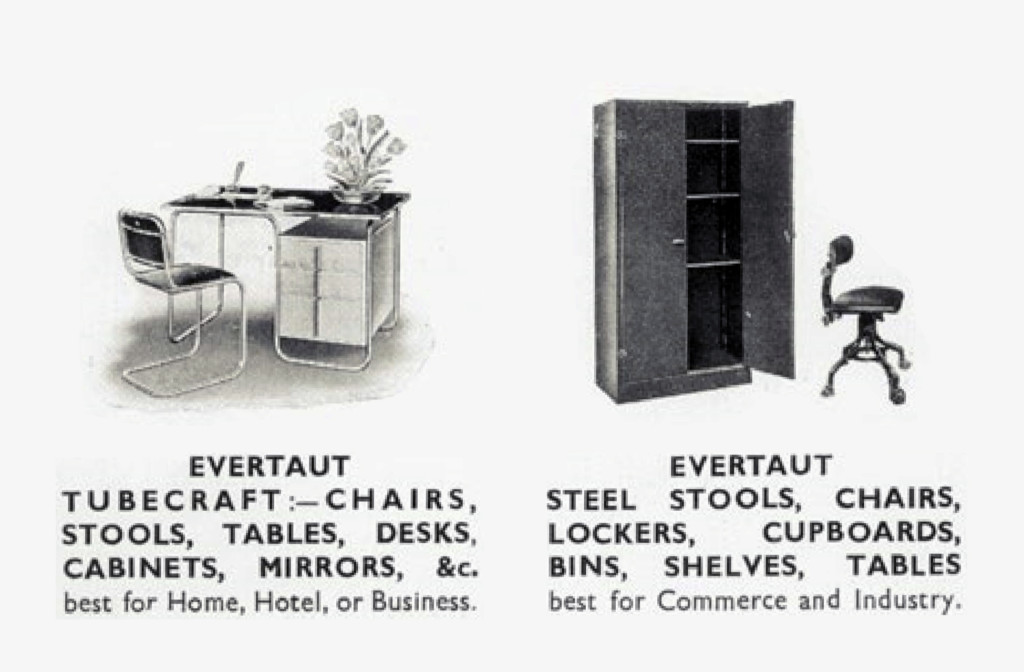
Their designs sit squarely in the tubular steel functionalism of the period, closer to Marcel Breuer’s Wassily chair of 1925 or to the output of PEL, the British tubular steel furniture maker founded in 1931, than to anything with the organic warmth of the later Eames work. Today, companies like Steelcase and MillerKnoll compete for the same market at various ends of the price spectrum.
Products from Antler and Evertaut were only available wholesale when introduced. Why Brooks chose not to get behind selling these products directly remains unknown and something of a mystery, as most other products — including those under the Zapho, Impervia, Kaydex and Plyflex names — were sold directly (and wholesale, too) up to that point. Much like Brooks still does today.
Maybe it had something to do with expanding supply chains and new distribution channels made possible by logistics breakthroughs and growing consumer sophistication. Or maybe it had something to do with leatherware and office furniture not fitting into the master plan. Indeed, Antler and Evertaut fail to elicit the same dreamy thoughts about earthly freedoms as Brooks does.
Regardless, it is intriguing to ponder what Brooks would be now had they continued diversifying into lateral markets in the same way they approached bicycle saddle and bag making. Both sub-brands outlived the arrangement handily. Harris & Sheldon took Evertaut along with the rest of J.B. Brooks Industries in 1962, after which it passed through Wassall, Idem Furniture and a 2002 employee buyout before landing with the family that runs it now from Blackburn, Lancashire. Leather and steel cases in point: both Antler and Evertaut continue producing their fine goods today.
So, what makes a perfect bicycle saddle? Evidently, perfection means different things to different people. Judging by the saddles Brooks has made since J.B. traded his horse for a bike, people’s range of preference has been relatively consistent and narrow over the past 130 some odd years.
Models like the B. 15, B. 17, B. 66/B. 67, Team Professional and Flyer have come to define saddle archetypes that experienced riders now know from aesthetic and functional standpoints. Familiar appearance and ass-feel don’t come easy, but when they do come, they stay with you for a while — like four generations of hardcore cyclists.
The B. 66 is the quiet giant among them. Introduced in 1926, it has at times accounted for better than a third of everything Brooks sells, a remarkable share for a sprung roadster saddle competing against a hundred years of newer ideas. For model-by-model detail across the range, see our Brooks England Saddle Database and Model Guide. For the corporate and technical chronology gathered in one place, see Brooks England: A Timeline of the Eternal Saddle Maker. For a saddle in hand rather than the company behind it, see How to Identify and Date a Vintage Brooks Saddle, and How to Care for a Brooks Saddle for keeping the one you have.
Keeping one perfect is a shorter story than making one, and Brooks has been unusually consistent about it. The 1906 catalog recommends a small quantity of dubbin, or even a little cream, commonly used for brown boots, applied on both sides of the leather, or, at all events, on the underside, with the warning that the leather be allowed to dry gradually, in order to prevent cracking. The same book claims the top will keep its good shape, and even improve after a few months’ use, calling that improvement in use the crucial test of a saddle top. By 1932 the dubbin has a name and a price — Proofide, at 6d. and 3d. a tin — and a rationale that has not changed since: it retains the leather’s own natural greases rather than adding anything, and saddles should be exposed to moisture as little as possible. The same advice 26 years apart, and it is still the advice.


Human anatomy being what it is, there are at least two dimensions separating some bicycle saddles and their riders from others. Width is one. Brooks has offered narrow and wide versions of the same model since the beginning of saddle time, and the catalogs long sorted them by gender, with three ladies saddles in that inaugural 1890 range. Purpose is the other dimension, with saddles built for different types of riding also remaining consistently distinct from each other.
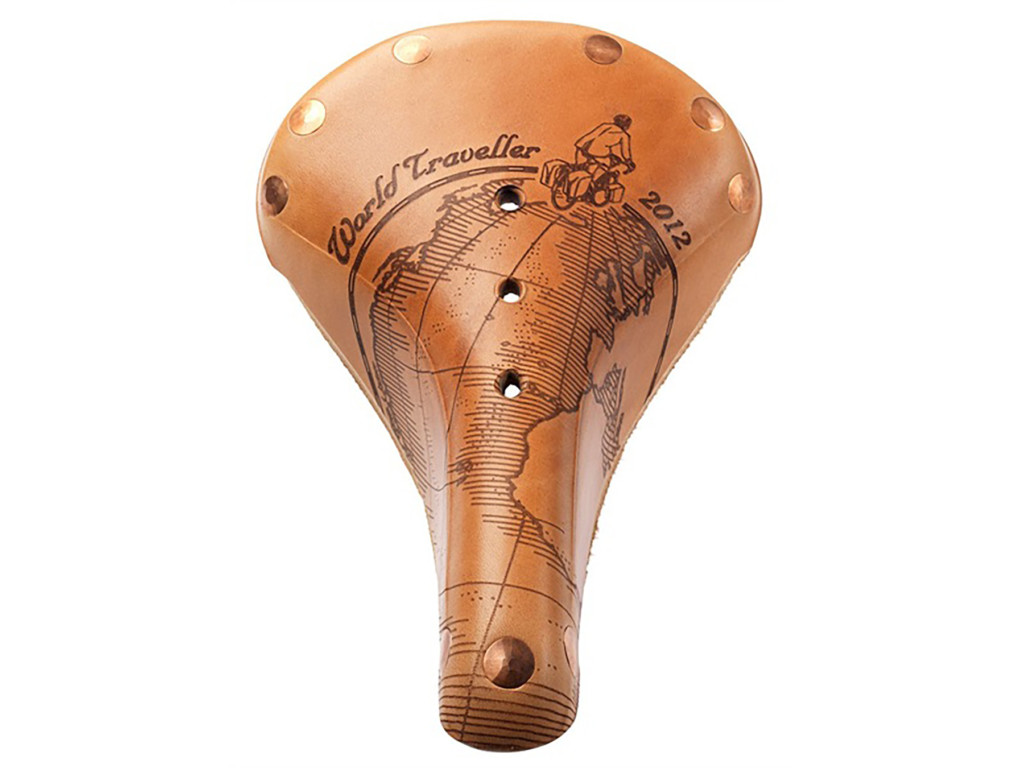
The old shorthand held that men want narrower saddles and women wider ones, and Brooks sorted its catalogs that way for the better part of a century. What actually governs the choice is the distance between your sit bones, which varies far more within either group than between them, and that is why the modern range leans on width and riding position rather than on a ladies page. Sporty types still prefer harder lightweight saddles to the springier ones utility riders favor. See, it is fairly simple in the end: you need to know a few basic facts about yourself and your intentions to pick the right saddle for your next neighborhood outing. Or world travels. Brooks will take care of the rest, just as they have always done since 1883.
Paul Gander
Bill Laine
Brooks catalogs and marketing materials, 1890 through 1959, from the Ebykr collection
Brooks England Ltd., …a Little Bit of History (company history sheet)
The Brooks Book for Cyclists (1907, 1927, 1933, 1934, 1935, 1937, 1938, 1950, 1959)
https://www.brooksengland.com/
https://www.gracesguide.co.uk/J._B._Brooks_and_Co
https://www.classiclightweights.co.uk/classic_designs/brooks-b17-saddle/
https://en.wikipedia.org/wiki/Brooks_England
https://road.cc/content/feature/story-brooks-england-300907
https://bikebiz.com/selle-royal-buys-brooks/
https://bikebiz.com/sturmey-archer-what-went-wrong/
https://evertaut.co.uk/about-us/history/
https://sscycleworks.com/components/Saddles-Lycett.html
https://theradavist.com/brooks-england-factory-shop-visit
https://sites.google.com/view/cyclehistory
http://bikeretrogrouch.blogspot.com/2013/11/brooks-saddles.html
https://www.kurtkaminer.com/brooksbadges.html (archived; original offline as of August 2026)
http://www.go-faster.com/VeteranMotorcycleSaddles.html
 Brooks
Ebykr documents this marque across the archive. Here is the rest of it.
The Ebykr Digest
New articles, timelines, catalog finds and registry activity — assembled from the archive once a month. Your address is never shared.
Double opt-in. One email per month. Unsubscribe at any time with one click.
Join the conversation below, or bring longer discussions and photos to the Ebykr Forums.


[…] “Climax” model from the 1890’s) but actually there is a fantastic piece over on Ebykr which frankly does a better job and is absolutely worth a read, ideally with a nice cup of […]
[…] Brooks England: The Eternal One […]