Brooks England: A Timeline of the Eternal Saddle Maker
Founded in 1866 in Birmingham, England to make horse harnesses and leather goods, Brooks pivoted to bicycle saddles in the winter of 1882 and became the most enduring name in that trade. This timeline traces its long run through changes in ownership, materials and design, from steel to titanium.
Founded in 1866 in Birmingham, England to make horse harnesses and leather goods, Brooks pivoted toward bicycle saddles in the winter of 1882-1883 and became the most enduring name in that trade. Its unbroken run under one original name since 1883, through military and motor-saddle side ventures, four short-lived saddle sub-brands, a conglomerate era that took in luggage, office furniture and kitchens, changes in ownership from the Brooks family to Raleigh and TI to Derby to independent investors to Selle Royal, and chassis materials running from steel to aluminum alloy to titanium, traces the fuller history of the bicycle saddle itself.
Here is a chronological timeline of key corporate and technical events at Brooks England, spanning from 1866 to the present, based on the sources used for an accompanying Ebykr article on its history, “Brooks England: The Eternal One,” together with Brooks England’s own company history sheet and the Grace’s Guide record.
John Boultbee Brooks founded his namesake company in Birmingham, England to make horse harnesses and leather goods.
1878–1882
Founder’s Pivot
An oft-cited chain of events, J.B. Brooks’s horse died, he could not afford a replacement, and he borrowed a friend’s bicycle whose saddle he disliked, set the company on its path toward saddle-making.
October 28, 1882
Patent Milestone
J.B. Brooks & Co Ltd. filed its first patent for a sprung bicycle saddle.
winter 1882–1883
Strategic Pivot
The company began manufacturing bicycle saddles, moving on from its original horse harness and leather goods business.
1883–1899
Brand Identity
Black enamel paint on steel was the only chassis finish available on Brooks saddles during this period.
1890
Product Innovation
Brooks issued its inaugural catalog featuring twenty-seven saddle models, including the original B. 70 designed for the sloped backbone of high-wheel bicycles, alongside three ladies saddles and a Climax model.
mid-1890s
Product Innovation
The B. 17 was introduced, the model that would go on to become the most popular saddle in the Brooks Classic range. The exact year has never been established; 1896 and 1898 both circulate, and Hilary Stone places it simply in the middle of the decade.
October 22, 1896
Corporate Reorganization
The business was incorporated as a limited company, with J.B. Brooks as Chairman and Managing Director and roughly 500 employees on the books. It became a public company in 1905.
1897
Legal Milestone
Brooks successfully defended patent infringement claims brought by J.A. Lamplugh and Co. concerning three cycle saddle patents of 1890, 1892 and 1893.
1900
Product Diversification
Nickel plated steel chassis finishes became available across the saddle line at a 15 to 20 percent premium over enamel, the same year Brooks began producing motor saddles for motorcycles and motorized tricycles.
1901–1903
Product Diversification
Brooks introduced its Zapho sub-brand, the Z. 20, Z. 20L, Z. 21 and Z. 25, as economical loop, coil and straight wire saddles offered only in black enamel.
1903
Product Diversification
Brooks introduced the No. 1 and No. 2 Military Saddles, practical models adopted by His Majesty’s War Office for use on military bicycles.
1903
Legal Milestone
Brooks obtained an injunction against Birmingham rival Lycett, then claiming output of 1,500 saddles a day, for infringing Brooks patents. Brooks would later acquire the company outright.
1907–1935
Product Diversification
Brooks published at least fifteen catalogs dedicated exclusively to motor saddles, covering over a dozen models made for motorcycles and motorized tricycles.
1911
Product Diversification
Brooks produced the Brooks-Triumph saddle, one of several motor saddles made on behalf of specific motorcycle manufacturers.
1913–1914
Product Diversification
The No. 3 Military Saddle was introduced alongside the No. 2 in the Military Saddles range, then reintroduced the following year in the same pairing.
1916
Product Diversification
Brooks military saddles disappeared from civilian catalogs after being co-marketed alongside general cycling saddles through at least 1914, though the No. 2 quietly remained in production into the late 1930s.
c. 1920
Product Diversification
J.B. Brooks’s son established the Antler luggage brand, named for his interest in wildlife, building on the company’s leather trunk and travelware business. Antler introduced the first lightweight soft-top suitcase in 1930.
1920s or late 1930s
Acquisition
Brooks absorbed the saddle maker Lycett into its corporate family. The company’s own history sheet dates the takeover to the 1920s, while outside researchers place it in the late 1930s. Lycett-badged saddles continued for years afterward.
1925
Product Diversification
J.B. Brooks and Company filed a patent for an “improved seat,” the E1 stool, which gave rise to the Evertaut furniture name. Evertaut stood up as a steel furniture division by 1933.
1926
Product Innovation
The B. 66 was introduced. The sprung roadster model became the company’s long-running best seller, at times accounting for better than a third of total saddle sales.
late 1920s
Brand Storytelling
Brooks began marketing several additional sub-brands, including Challenge, Flexal, Legion and Royal, none of which received coverage in the company’s own catalogs.
1925
Product Innovation
The B. 185 motor saddle was introduced, featuring Brooks’s “supple mattress” skeletal frame system and, a rarity at the time, rubber buffer shock absorbers to dampen high speed pot-hole impacts.
1927
Product Innovation
The B. 28 brought rubber buffer shock absorption from motor saddles onto a bicycle saddle for the first time, while the No. 3 Military Saddle was recast as a Commercial and Carrier Service model.
March 1928
Brand Storytelling
The CTC Gazette is said to have carried a Brooks advertisement declaring, “Brooks Saddles are Guaranteed for Ever,” reflecting the company’s confidence in its saddles by the late 1920s.
1930s
Acquisition
Brooks absorbed The Leatheries Saddle Co. into its corporate family, and also purchased a motorcycle maker coincidentally named the Brookes Company.
1933
Product Innovation
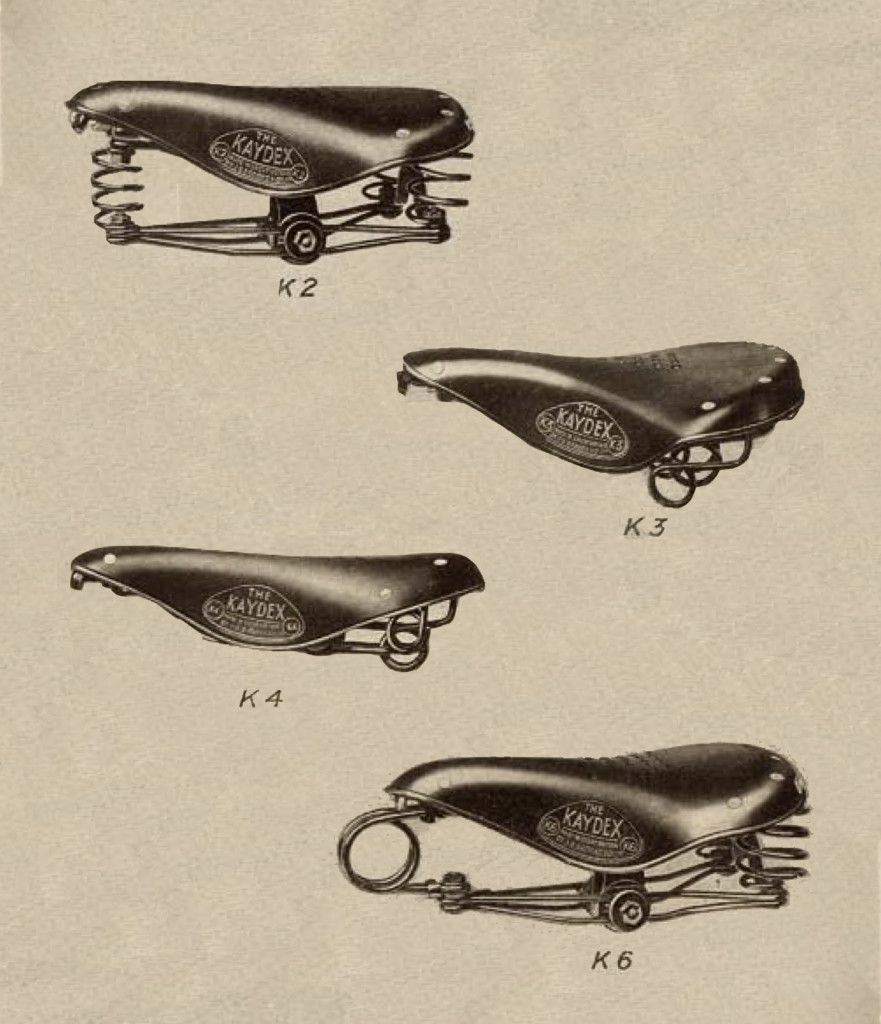
Brooks introduced its only full-aluminum chassis models, the Duralumin Champion and Supplex S. 30 Duralumin Extra Narrow, alongside three new sub-brands, Impervia, Kaydex and Plyflex, offering weatherproof, non-cracking alternatives to its leather-topped saddles.
1934
Brand Identity
Brooks dropped the “duralumin” name in favor of “castalumin,” renaming its two full-aluminum models the B. 16 Champion Patent Castalumin Frame and Supplex S. 40/N Patent Castalumin Frame. Duralumin was not a generic term but a registered trade mark of Germany’s Dürener Metallwerke AG, coined at Düren from dur and aluminium.
1935
Market Position
Of the 2,733,000 cycle saddles manufactured in Britain that year, no fewer than 60 percent came out of J.B. Brooks & Company, according to a history of industry in Birmingham.
1936
Manufacturing Shift
Brooks’s full-aluminum chassis line ended, giving way to hybrid aluminum alloy and steel chassis designs introduced two years later.
1937
Product Innovation
Chromium plated steel chassis finishes made their first catalog appearance, while Kaydex sub-brand saddles disappeared from the line after this year.
1937
Brand Storytelling
Page 36 of the catalog, headed “As Others See Us,” printed a column of unsolicited testimonials, several reporting saddles still in service after 19, 35 and more than 40 years, with one correspondent claiming roughly 180,000 miles on a single seat.
1938
Product Innovation
The hybrid-chassis B. 17 Champion Flyweight Narrow and B. 17 Champion Flyweight Flyer were introduced, the lightest saddles Brooks had made to date, the same year motor saddles disappeared from Brooks catalogs entirely.
1940–1949
Corporate Disruption
A ten-year gap in available Brooks catalogs spanned this period, by which point the Plyflex sub-brand had faded from the line, and possibly earlier.
1948
Product Innovation
Brooks introduced its last hybrid aluminum alloy and steel chassis saddles, the B. 27, B. 37, B. 47 and B. 57, featuring stainless steel rails mounted to heat-treated aluminum alloy cantle plates.
1953
Product Diversification
J.B. Brooks acquired C.S.A. Industries, makers of English Rose Kitchens and Warwick kitchens, extending the company well beyond cycling.
1955
Production Peak
By the company’s own account, Brooks employed a workforce of 1,500 and was selling some 55,000 leather saddles and 25,000 mattress saddles each week, making it the most productive bicycle saddle manufacturer on earth at the time.
1956–1957
Corporate Reorganization
Antler Ltd. and Evertaut Seating were established as separate subsidiaries, and in 1957 the parent renamed itself J.B. Brooks Industries, by then spanning saddles, two luggage companies, office furniture and kitchens.
1958 or 1959
Corporate Reorganization
The Brooks family sold the saddle division of Brooks Industries Ltd. to the Raleigh Cycle Company, stepping away from the core saddle business it had run since 1866. Brooks dates the sale to 1958 and Grace’s Guide to 1959; the year remains unsettled.
1960
Acquisition
Raleigh was bought by the British Tube Investment Group (TI), owner of Reynolds Tubing and Sturmey-Archer, which moved Brooks first into its automotive division and then into its bicycle division.
1962
Corporate Reorganization
Brooks moved to the Downing Street Works in Smethwick and was combined with the Wright Saddle Company, another TI holding taken over in 1958, to form the Raleigh Saddle Division. Brooks was the dominant partner, and cheaper versions of Brooks designs were sold under the Wrights name. Harris & Sheldon acquired the remainder of J.B. Brooks Industries the same year.
July 1969
Corporate Disruption
The Smethwick facility was ravaged by fire and gutted. Staff salvaged what remained of the plant and stock and continued production.
1987
Acquisition
TI sold Raleigh and its bicycle division, Brooks included, to Derby International. Contrary to a widely repeated account, TI did not hold Brooks into the 1990s and neither Raleigh nor TI went bankrupt in 1999.
July 2000
Corporate Liquidation
Derby Cycle sold Sturmey-Archer and Brooks together to a small company called Lenark Ltd. for a nominal £30. Lenark collapsed into liquidation within months, taking Sturmey-Archer with it and very nearly ending Brooks saddle production.
2000–2002
Corporate Reorganization
Investors John Godfrey Macnaughtan and Adrian Williams bought Brooks out of the collapse and kept production in England.
c. 2000
Product Innovation
Titanium chassis were introduced to the Brooks line, with brushed titanium finishes following soon after.
July 2002
Acquisition
Brooks England Ltd. was sold to the Italian saddle conglomerate Selle Royal, under whose umbrella it remains today alongside Fizik, Crankbrothers, PEdALED and Pannier. Saddle production stayed at Downing Street, Smethwick.
2005
Product Innovation
Copper plated steel chassis finishes were introduced on the B. 17 Champion Special and Team Special models.
2013
Product Innovation
Brooks introduced the C. 17, first of its Cambium line, breaking from a leather-only seat top tradition with a vulcanized natural rubber base and stretched organic cotton canvas top.
2016
Centennial Milestone
Brooks marked 150 years of manufacturing in the West Midlands with its 2016 Book for Cyclists, celebrating an unbroken tradition dating to 1866, by which point the company distributed saddles to more than 30 countries.
2025
Brand Storytelling
Brooks opened the Smethwick factory to the public for the first time, by the company’s reckoning the first time it had done so in its near-160-year history. Leather saddles are still cut, soaked, pressed and riveted there on machinery largely dating from the 1950s.
Join the Brooks England Heritage Discussion!
From the B. 17 to the Cambium C. 17, Brooks saddles have shaped generations of rides. Share your saddle finds, dating questions and restoration tips with the community.



 Brooks