About Ebykr
Ebykr celebrates classic and vintage lightweight bicycles through provocative imagery and opinion. Ride along with us.
About Ebykr
Ebykr celebrates classic and vintage lightweight bicycles through provocative imagery and opinion. Ride along with us.

Source: Ebykr archive.
| Marque | Brooks |
|---|---|
| Type | Catalog |
| Year | 1927 |
| Publisher | J. B. Brooks & Co., Ltd. |
| Country | England |
| Language | English |
| Pages | 9 |
| Source | Ebykr archive. |
| Credit | Ebykr archive |
| Transcription | Transcribed by eye |
BROOKS SADDLES —for easy wheeling Criterion Works Birmingham THE BROOKS REGISTERED TRADE MARK BOOK A CATALOGUE of Saddles and Equipment for Cyclists and Motor Cyclists, with much useful information and advice calculated to ensure "easy miles and miles of ease." 1927 J. B. BROOKS & CO. LTD. Criterion Works, Great Charles Street Birmingham England Telephone: …
The Brooks Book for 1927, a catalogue of saddles and equipment for cyclists and motor cyclists issued from the Criterion Works in Great Charles Street, Birmingham. Unlike the Brooks books of the 1930s it carries no List No. at all: the year is simply printed on the title page, which is how every book in this earlier part of the run is dated. The telephone is Central 3670, the same number the 1925, 1933, 1934 and 1935 books print, and a London Depot at 108, Great Portland Street, W.1 now appears beneath it. The 1925 book has no London Depot line, so the depot opens between the two.
Four things make this book worth citing.
The first is the saddle that carries the shock absorber onto the bicycle. On printed page 11 the B 28 is described as having a “Loop spring at front, stranded wire coiled main frame and four ingeniously arranged rubber buffers at the rear to act as shock absorbers.” The same model, with the same rubber buffers and at the same price, is already in the 1925 book on its printed page 10, so 1927 is not the year the feature arrived.
The second is the Carrier No. 3 on printed page 17, headed “For Commercial and Carrier Service” and captioned “Tradesmen’s Carrier No. 3.” The text names the saddle’s users in order: “Government Departments, postmen, army service riders, and the everyday knockabout use given it by carriers and errand boys.” Army service riders sit third in that list, after postmen and before errand boys. The 1925 book already sells the same saddle as a carrier model, and additionally designates it “Army. Mark 3.” The 1927 entry drops that designation, so the explicit army marking recedes as the commercial framing grows.
The third is a dated introduction. On printed page 16 the B 66 is “A NEW model offered for the first time at the 1926 Olympia Show, and well received by the many who inspected it there.” That is a primary source for the B 66’s introduction date.
The fourth is the Supple Mattress, described in full on printed page 28. The Size 2 mattress “consists of fourteen leaf springs and a nine-leaf centre lamination; the rearward ends of which are insulated from the saddle frame by fifteen light coil springs.” That mattress is “common to all 3 models — Tourist, Sports and Racing,” so it is not particular to any one of them; the B 185 Racing-Supple on printed page 31 is the racing member of the set. The phrase about coils wound from finest piano wire, often quoted alongside these numbers, belongs to the 1925 book and not to this one.
Two further points of record. Printed page 3, under the heading “British Throughout,” gives the works as “spacious, up-to-date buildings occupying a floor space of 185,000 square feet, and situated close to the centre of Birmingham.” And printed page 27 introduces the Patent Damper Pivot as a novelty of the year: “For 1927 the Tourist and Sports models of the BROOKS Supple Seats have incorporated in their construction an adjustable damper.” Printed page 8 likewise flags the model year, noting that “The 1927 model has been lightened by the substitution of a 4-wire bracket in place of 6-wire, and single instead of compound springs.”
The book runs to printed pages 2 through 48 across twenty-seven scanned sheets, with no gaps. Every printed page carries a number and the pagination is continuous. This record reproduces the cover, the title page, the opening of the introduction, the saddle-position and care page, and the five pages that carry the citable material. The remaining printed pages, which cover the rest of the cycle range, the motor cycle range, bags, screens, cases and leggings, are held in the Ebykr collection but are not reproduced here.
The scan is a low-resolution one. The embedded images run about 1,020 pixels across per two-page spread, which is roughly 510 pixels per printed page, and the images in this record are presented at twice that. Headings, model numbers, prices and weights read cleanly. The smallest body copy sits at the floor of legibility.
[Front cover. Dark green stock, blocked in gold.]
BROOKS SADDLES
[The wordmark is set inside a gold rectangular panel with a chain-link border, BROOKS in reversed green lettering on the gold ground and SADDLES beneath it.]
—for easy wheeling
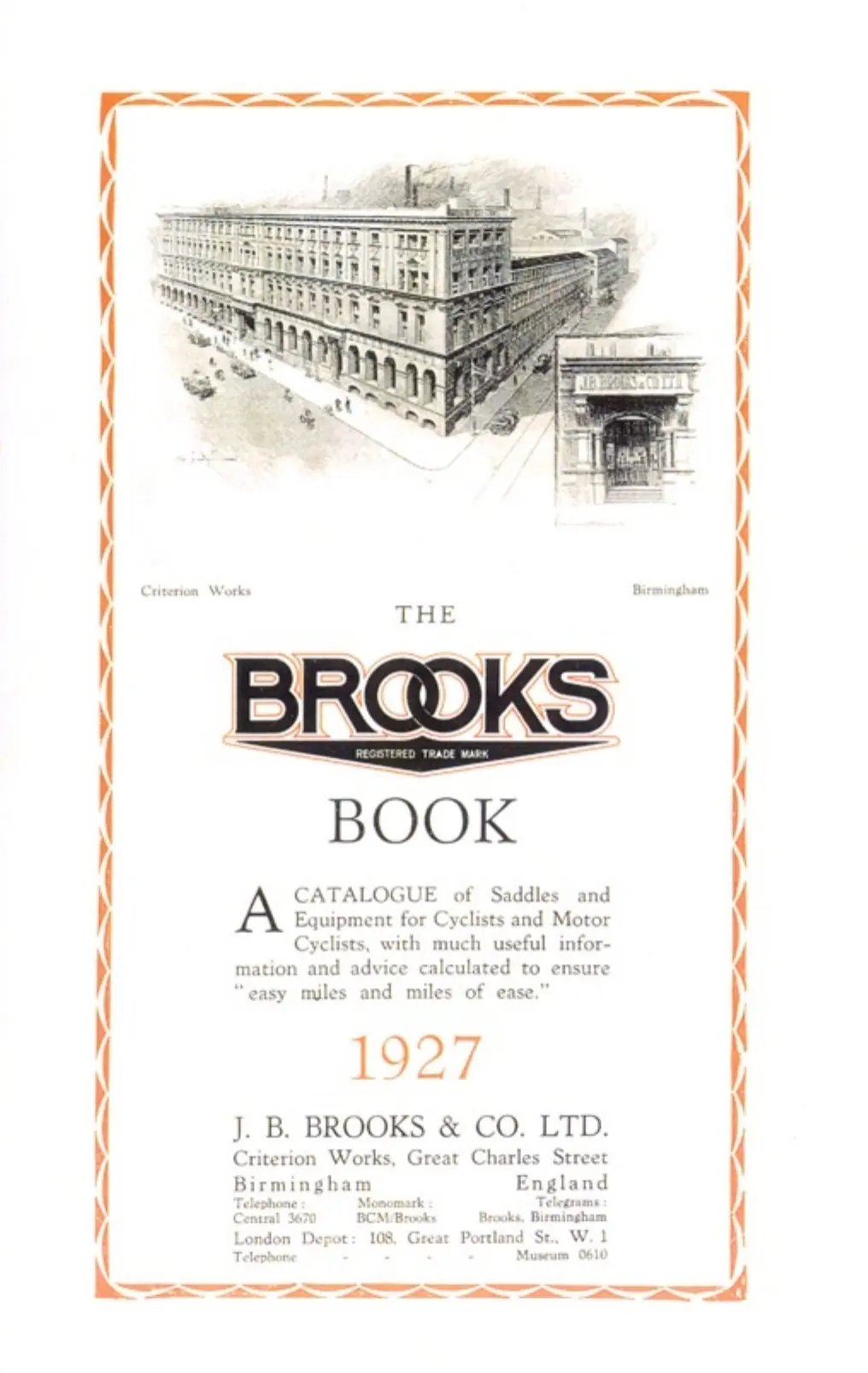
[Title page, printed in black and orange within an orange chain-link border. An engraved view of the works occupies the upper third, with a small inset of the entrance doorway lettered J. B. BROOKS & CO. LTD.]
Criterion Works Birmingham
THE
BROOKS
REGISTERED TRADE MARK
BOOK
A CATALOGUE of Saddles and Equipment for Cyclists and Motor Cyclists, with much useful information and advice calculated to ensure “easy miles and miles of ease.”
1927
J. B. BROOKS & CO. LTD.
Criterion Works, Great Charles Street
Birmingham England
Telephone: Central 3670
Monomark: BCM/Brooks
Telegrams: Brooks, Birmingham
London Depot: 108, Great Portland St., W.1
Telephone – – – Museum 0610
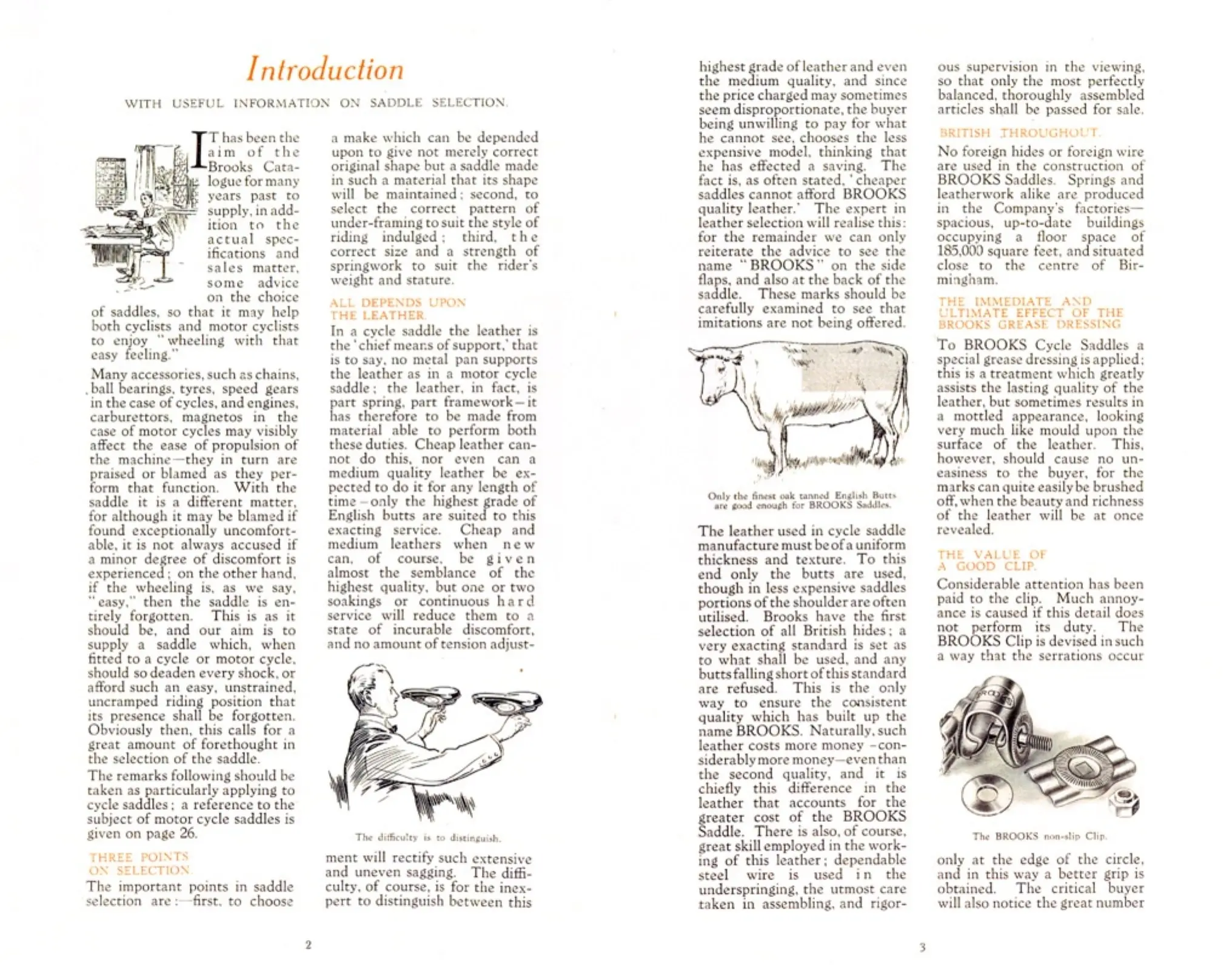
[Printed pages 2 and 3. The opening of the introduction, set in two columns to the page, with a pen drawing of a man at a desk, a drawing of a man holding two saddle tops up to the light, a drawing of a cow, and a drawing of the clip.]
Introduction
WITH USEFUL INFORMATION ON SADDLE SELECTION.
IT has been the aim of the Brooks Catalogue for many years past to supply, in addition to the actual specifications and sales matter, some advice on the choice of saddles, so that it may help both cyclists and motor cyclists to enjoy “wheeling with that easy feeling.”
Many accessories, such as chains, ball bearings, tyres, speed gears in the case of cycles, and engines, carburettors, magnetos in the case of motor cycles may visibly affect the ease of propulsion of the machine—they in turn are praised or blamed as they perform that function. With the saddle it is a different matter, for although it may be blamed if found exceptionally uncomfortable, it is not always accused if a minor degree of discomfort is experienced; on the other hand, if the wheeling is, as we say, “easy,” then the saddle is entirely forgotten. This is as it should be, and our aim is to supply a saddle which, when fitted to a cycle or motor cycle, should so deaden every shock, or afford such an easy, unstrained, uncramped riding position that its presence shall be forgotten. Obviously then, this calls for a great amount of forethought in the selection of the saddle.
The remarks following should be taken as particularly applying to cycle saddles; a reference to the subject of motor cycle saddles is given on page 26.
THREE POINTS ON SELECTION.
The important points in saddle selection are:—first, to choose a make which can be depended upon to give not merely correct original shape but a saddle made in such a material that its shape will be maintained; second, to select the correct pattern of under-framing to suit the style of riding indulged; third, the correct size and a strength of springwork to suit the rider’s weight and stature.
ALL DEPENDS UPON THE LEATHER.
In a cycle saddle the leather is the ‘chief means of support,’ that is to say, no metal pan supports the leather as in a motor cycle saddle; the leather, in fact, is part spring, part framework—it has therefore to be made from material able to perform both these duties. Cheap leather cannot do this, nor even can a medium quality leather be expected to do it for any length of time—only the highest grade of English butts are suited to this exacting service. Cheap and medium leathers when new can, of course, be given almost the semblance of the highest quality, but one or two soakings or continuous hard service will reduce them to a state of incurable discomfort, and no amount of tension adjustment will rectify such extensive and uneven sagging.
[Caption to the drawing of the two saddle tops:] The difficulty is to distinguish.
The difficulty, of course, is for the inexpert to distinguish between this highest grade of leather and even the medium quality, and since the price charged may sometimes seem disproportionate, the buyer being unwilling to pay for what he cannot see, chooses the less expensive model, thinking that he has effected a saving. The fact is, as often stated, ‘cheaper saddles cannot afford BROOKS quality leather.’ The expert in leather selection will realise this: for the remainder we can only reiterate the advice to see the name “BROOKS” on the side flaps, and also at the back of the saddle. These marks should be carefully examined to see that imitations are not being offered.
[Caption to the drawing of the cow:] Only the finest oak tanned English Butts are good enough for BROOKS Saddles.
The leather used in cycle saddle manufacture must be of a uniform thickness and texture. To this end only the butts are used, though in less expensive saddles portions of the shoulder are often utilised. Brooks have the first selection of all British hides; a very exacting standard is set as to what shall be used, and any butts falling short of this standard are refused. This is the only way to ensure the consistent quality which has built up the name BROOKS. Naturally, such leather costs more money—considerably more money—even than the second quality, and it is chiefly this difference in the leather that accounts for the greater cost of the BROOKS Saddle. There is also, of course, great skill employed in the working of this leather; dependable steel wire is used in the underspringing, the utmost care taken in assembling, and rigorous supervision in the viewing, so that only the most perfectly balanced, thoroughly assembled articles shall be passed for sale.
BRITISH THROUGHOUT.
No foreign hides or foreign wire are used in the construction of BROOKS Saddles. Springs and leatherwork alike are produced in the Company’s factories—spacious, up-to-date buildings occupying a floor space of 185,000 square feet, and situated close to the centre of Birmingham.
THE IMMEDIATE AND ULTIMATE EFFECT OF THE BROOKS GREASE DRESSING
To BROOKS Cycle Saddles a special grease dressing is applied; this is a treatment which greatly assists the lasting quality of the leather, but sometimes results in a mottled appearance, looking very much like mould upon the surface of the leather. This, however, should cause no uneasiness to the buyer, for the marks can quite easily be brushed off, when the beauty and richness of the leather will be at once revealed.
THE VALUE OF A GOOD CLIP.
Considerable attention has been paid to the clip. Much annoyance is caused if this detail does not perform its duty. The BROOKS Clip is devised in such a way that the serrations occur only at the edge of the circle, and in this way a better grip is obtained. The critical buyer will also notice the great number
[Caption to the drawing of the clip:] The BROOKS non-slip Clip.
[The text continues on printed page 4.]
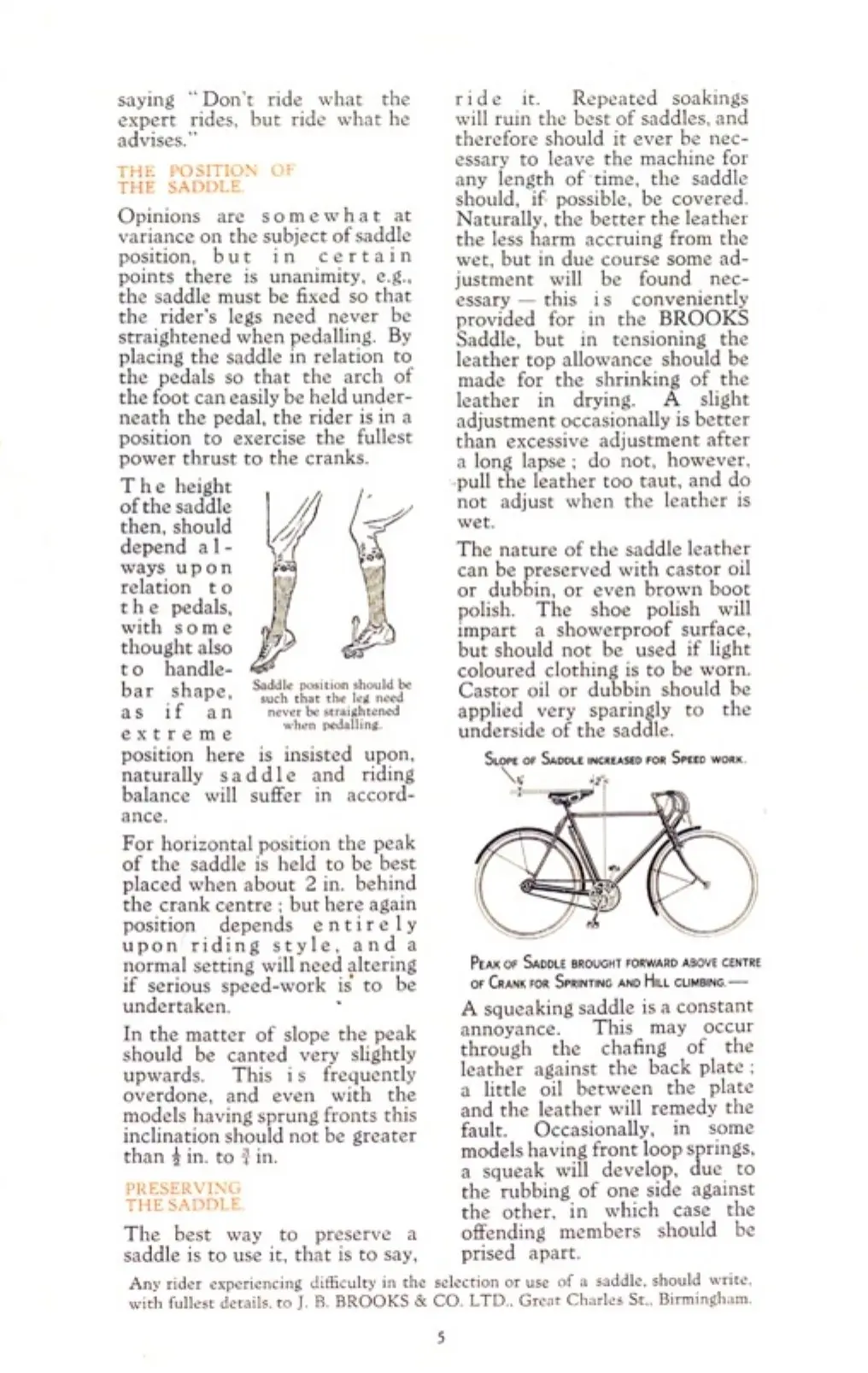
[Printed page 5, the closing page of the introduction. Two columns, with a drawing of a rider’s legs at the pedals and a drawing of a bicycle in side view.]
saying “Don’t ride what the expert rides, but ride what he advises.”
THE POSITION OF THE SADDLE.
Opinions are somewhat at variance on the subject of saddle position, but in certain points there is unanimity, e.g., the saddle must be fixed so that the rider’s legs need never be straightened when pedalling. By placing the saddle in relation to the pedals so that the arch of the foot can easily be held underneath the pedal, the rider is in a position to exercise the fullest power thrust to the cranks.
The height of the saddle then, should depend always upon relation to the pedals, with some thought also to handlebar shape, as if an extreme position here is insisted upon, naturally saddle and riding balance will suffer in accordance.
[Caption to the drawing of the legs:] Saddle position should be such that the leg need never be straightened when pedalling.
For horizontal position the peak of the saddle is held to be best placed when about 2 in. behind the crank centre; but here again position depends entirely upon riding style, and a normal setting will need altering if serious speed-work is to be undertaken.
In the matter of slope the peak should be canted very slightly upwards. This is frequently overdone, and even with the models having sprung fronts this inclination should not be greater than 1/2 in. to 3/4 in.
PRESERVING THE SADDLE.
The best way to preserve a saddle is to use it, that is to say, ride it. Repeated soakings will ruin the best of saddles, and therefore should it ever be necessary to leave the machine for any length of time, the saddle should, if possible, be covered. Naturally, the better the leather the less harm accruing from the wet, but in due course some adjustment will be found necessary — this is conveniently provided for in the BROOKS Saddle, but in tensioning the leather top allowance should be made for the shrinking of the leather in drying. A slight adjustment occasionally is better than excessive adjustment after a long lapse; do not, however, pull the leather too taut, and do not adjust when the leather is wet.
The nature of the saddle leather can be preserved with castor oil or dubbin, or even brown boot polish. The shoe polish will impart a showerproof surface, but should not be used if light coloured clothing is to be worn. Castor oil or dubbin should be applied very sparingly to the underside of the saddle.
[Captions to the drawing of the bicycle:] Slope of Saddle increased for Speed work. — Peak of Saddle brought forward above centre of Crank for Sprinting and Hill climbing.
A squeaking saddle is a constant annoyance. This may occur through the chafing of the leather against the back plate; a little oil between the plate and the leather will remedy the fault. Occasionally, in some models having front loop springs, a squeak will develop, due to the rubbing of one side against the other, in which case the offending members should be prised apart.
Any rider experiencing difficulty in the selection or use of a saddle, should write, with fullest details, to J. B. BROOKS & CO. LTD., Great Charles St., Birmingham.
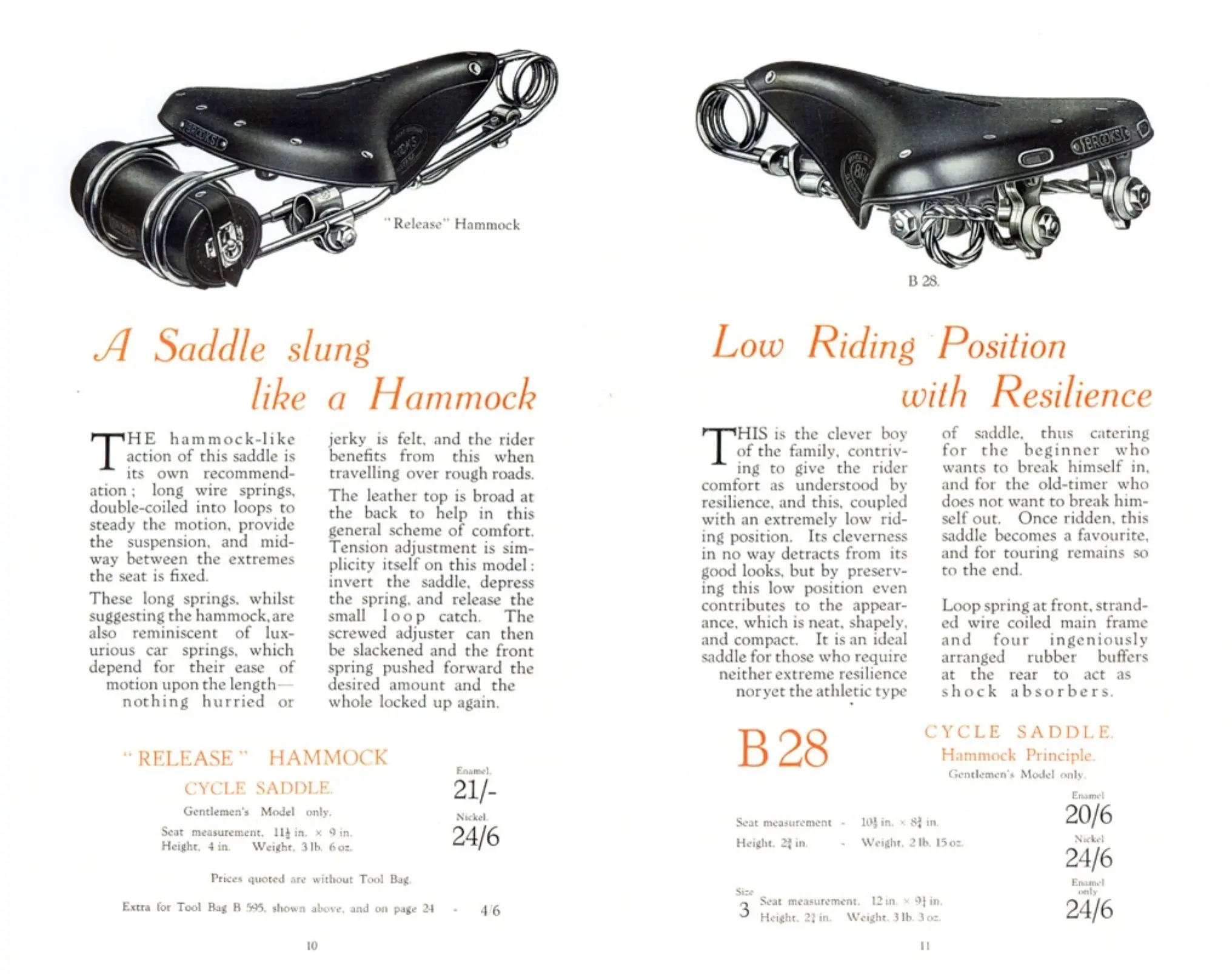
[Printed pages 10 and 11. Two saddles photographed in three-quarter view, the “Release” Hammock with its tool bag slung beneath, and the B 28.]
[Printed page 10.]
“Release” Hammock
A Saddle slung like a Hammock
THE hammock-like action of this saddle is its own recommendation; long wire springs, double-coiled into loops to steady the motion, provide the suspension, and midway between the extremes the seat is fixed.
These long springs, whilst suggesting the hammock, are also reminiscent of luxurious car springs, which depend for their ease of motion upon the length—nothing hurried or jerky is felt, and the rider benefits from this when travelling over rough roads.
The leather top is broad at the back to help in this general scheme of comfort. Tension adjustment is simplicity itself on this model: invert the saddle, depress the spring, and release the small loop catch. The screwed adjuster can then be slackened and the front spring pushed forward the desired amount and the whole locked up again.
“RELEASE” HAMMOCK CYCLE SADDLE.
Gentlemen’s Model only.
Seat measurement, 11 1/2 in. x 9 in. Height, 4 in. Weight, 3 lb. 6 oz.
Enamel 21/-
Nickel 24/6
Prices quoted are without Tool Bag.
Extra for Tool Bag B 595, shown above, and on page 24 – 4/6
[Printed page 11.]
B 28.
Low Riding Position with Resilience
THIS is the clever boy of the family, contriving to give the rider comfort as understood by resilience, and this, coupled with an extremely low riding position. Its cleverness in no way detracts from its good looks, but by preserving this low position even contributes to the appearance, which is neat, shapely, and compact. It is an ideal saddle for those who require neither extreme resilience nor yet the athletic type of saddle, thus catering for the beginner who wants to break himself in, and for the old-timer who does not want to break himself out. Once ridden, this saddle becomes a favourite, and for touring remains so to the end.
Loop spring at front, stranded wire coiled main frame and four ingeniously arranged rubber buffers at the rear to act as shock absorbers.
B 28 CYCLE SADDLE. Hammock Principle.
Gentlemen’s Model only.
Seat measurement – 10 3/4 in. x 8 1/2 in. Height, 2 3/4 in. – Weight, 2 lb. 15 oz.
Enamel 20/6
Nickel 24/6
Size 3 Seat measurement, 12 in. x 9 1/4 in. Height, 2 3/4 in. Weight, 3 lb. 3 oz.
Enamel only 24/6
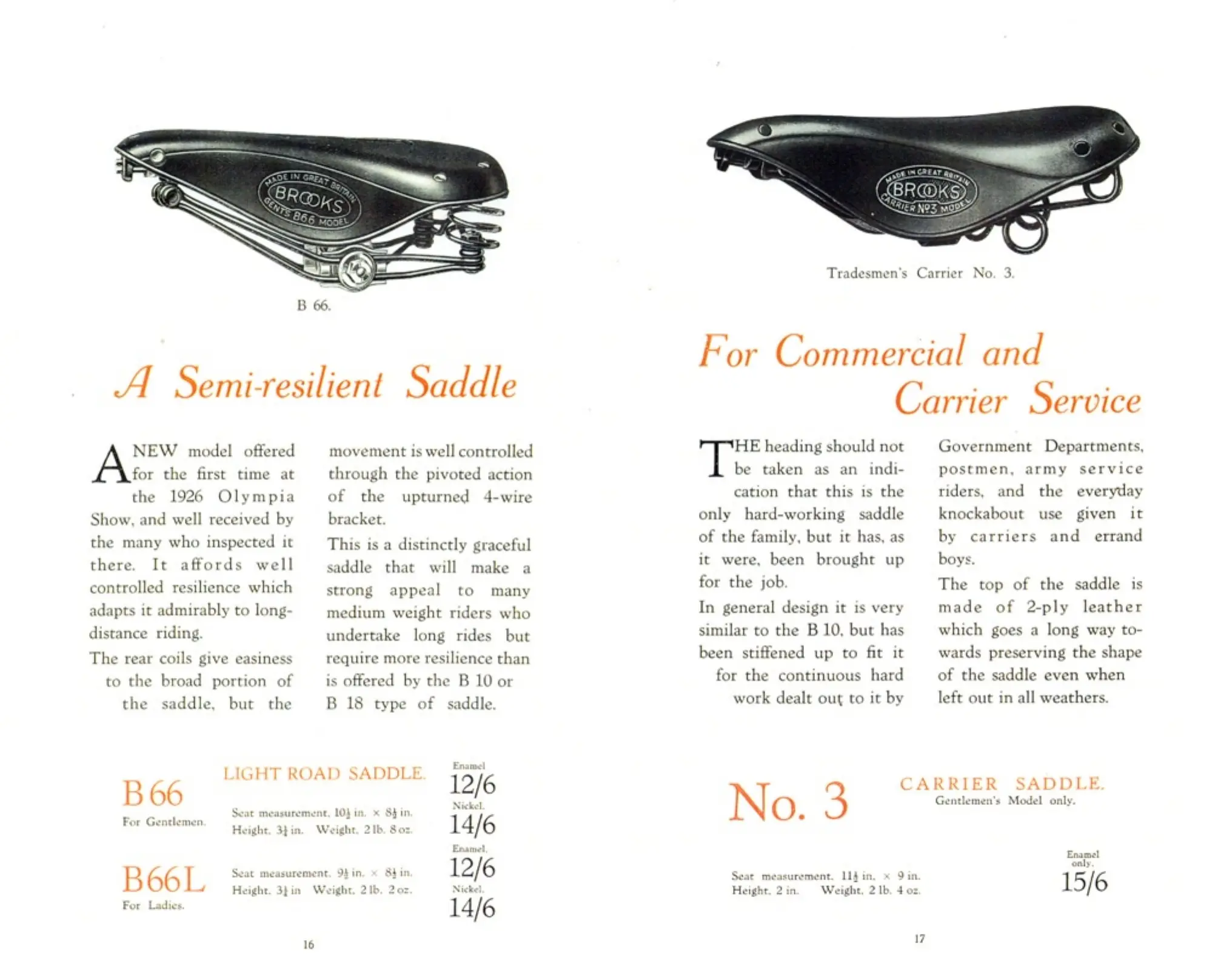
[Printed pages 16 and 17. Two saddles in side view. The B 66 badge reads MADE IN GREAT BRITAIN, BROOKS, GENTS B66 MODEL. The No. 3 badge reads MADE IN GREAT BRITAIN, BROOKS, CARRIER No3 MODEL.]
[Printed page 16.]
B 66.
A Semi-resilient Saddle
A NEW model offered for the first time at the 1926 Olympia Show, and well received by the many who inspected it there. It affords well controlled resilience which adapts it admirably to long-distance riding.
The rear coils give easiness to the broad portion of the saddle, but the movement is well controlled through the pivoted action of the upturned 4-wire bracket.
This is a distinctly graceful saddle that will make a strong appeal to many medium weight riders who undertake long rides but require more resilience than is offered by the B 10 or B 18 type of saddle.
B 66 LIGHT ROAD SADDLE.
For Gentlemen. Seat measurement, 10 1/2 in. x 8 1/2 in. Height, 3 1/4 in. Weight, 2 lb. 8 oz.
Enamel 12/6
Nickel 14/6
B 66 L
For Ladies. Seat measurement, 9 1/2 in. x 8 1/2 in. Height, 3 1/4 in. Weight, 2 lb. 2 oz.
Enamel 12/6
Nickel 14/6
[Printed page 17.]
Tradesmen’s Carrier No. 3.
For Commercial and Carrier Service
THE heading should not be taken as an indication that this is the only hard-working saddle of the family, but it has, as it were, been brought up for the job.
In general design it is very similar to the B 10, but has been stiffened up to fit it for the continuous hard work dealt out to it by Government Departments, postmen, army service riders, and the everyday knockabout use given it by carriers and errand boys.
The top of the saddle is made of 2-ply leather which goes a long way towards preserving the shape of the saddle even when left out in all weathers.
No. 3 CARRIER SADDLE.
Gentlemen’s Model only.
Seat measurement, 11 1/2 in. x 9 in. Height, 2 in. Weight, 2 lb. 4 oz.
Enamel only 15/6
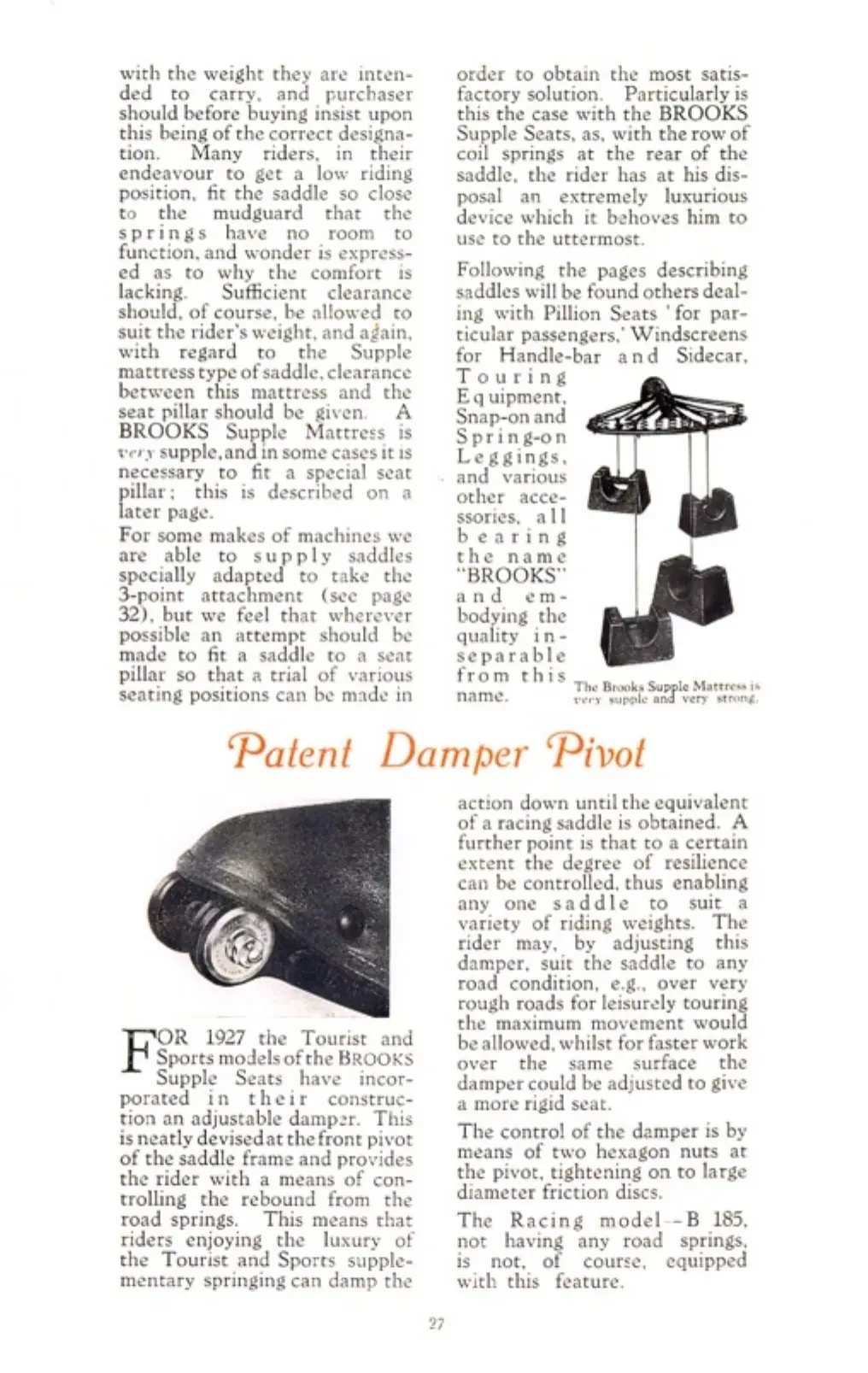
[Printed page 27. The lower half of the page carries the Patent Damper Pivot section with a close photograph of the damper at the front pivot of a saddle frame. The upper half concludes the motor cycle saddle chapter begun on printed page 26, and includes a small photograph of the Brooks Supple Mattress standing on four blocks.]
with the weight they are intended to carry, and purchaser should before buying insist upon this being of the correct designation. Many riders, in their endeavour to get a low riding position, fit the saddle so close to the mudguard that the springs have no room to function, and wonder is expressed as to why the comfort is lacking. Sufficient clearance should, of course, be allowed to suit the rider’s weight, and again, with regard to the Supple mattress type of saddle, clearance between this mattress and the seat pillar should be given. A BROOKS Supple Mattress is very supple, and in some cases it is necessary to fit a special seat pillar; this is described on a later page.
For some makes of machines we are able to supply saddles specially adapted to take the 3-point attachment (see page 32), but we feel that wherever possible an attempt should be made to fit a saddle to a seat pillar so that a trial of various seating positions can be made in order to obtain the most satisfactory solution. Particularly is this the case with the BROOKS Supple Seats, as, with the row of coil springs at the rear of the saddle, the rider has at his disposal an extremely luxurious device which it behoves him to use to the uttermost.
Following the pages describing saddles will be found others dealing with Pillion Seats ‘for particular passengers,’ Windscreens for Handle-bar and Sidecar, Touring Equipment, Snap-on and Spring-on Leggings, and various other accessories, all bearing the name “BROOKS” and embodying the quality inseparable from this name.
[Caption to the small photograph:] The Brooks Supple Mattress is very supple and very strong.
Patent Damper Pivot
FOR 1927 the Tourist and Sports models of the BROOKS Supple Seats have incorporated in their construction an adjustable damper. This is neatly devised at the front pivot of the saddle frame and provides the rider with a means of controlling the rebound from the road springs. This means that riders enjoying the luxury of the Tourist and Sports supplementary springing can damp the action down until the equivalent of a racing saddle is obtained. A further point is that to a certain extent the degree of resilience can be controlled, thus enabling any one saddle to suit a variety of riding weights. The rider may, by adjusting this damper, suit the saddle to any road condition, e.g., over very rough roads for leisurely touring the maximum movement would be allowed, whilst for faster work over the same surface the damper could be adjusted to give a more rigid seat.
The control of the damper is by means of two hexagon nuts at the pivot, tightening on to large diameter friction discs.
The Racing model — B 185, not having any road springs, is not, of course, equipped with this feature.
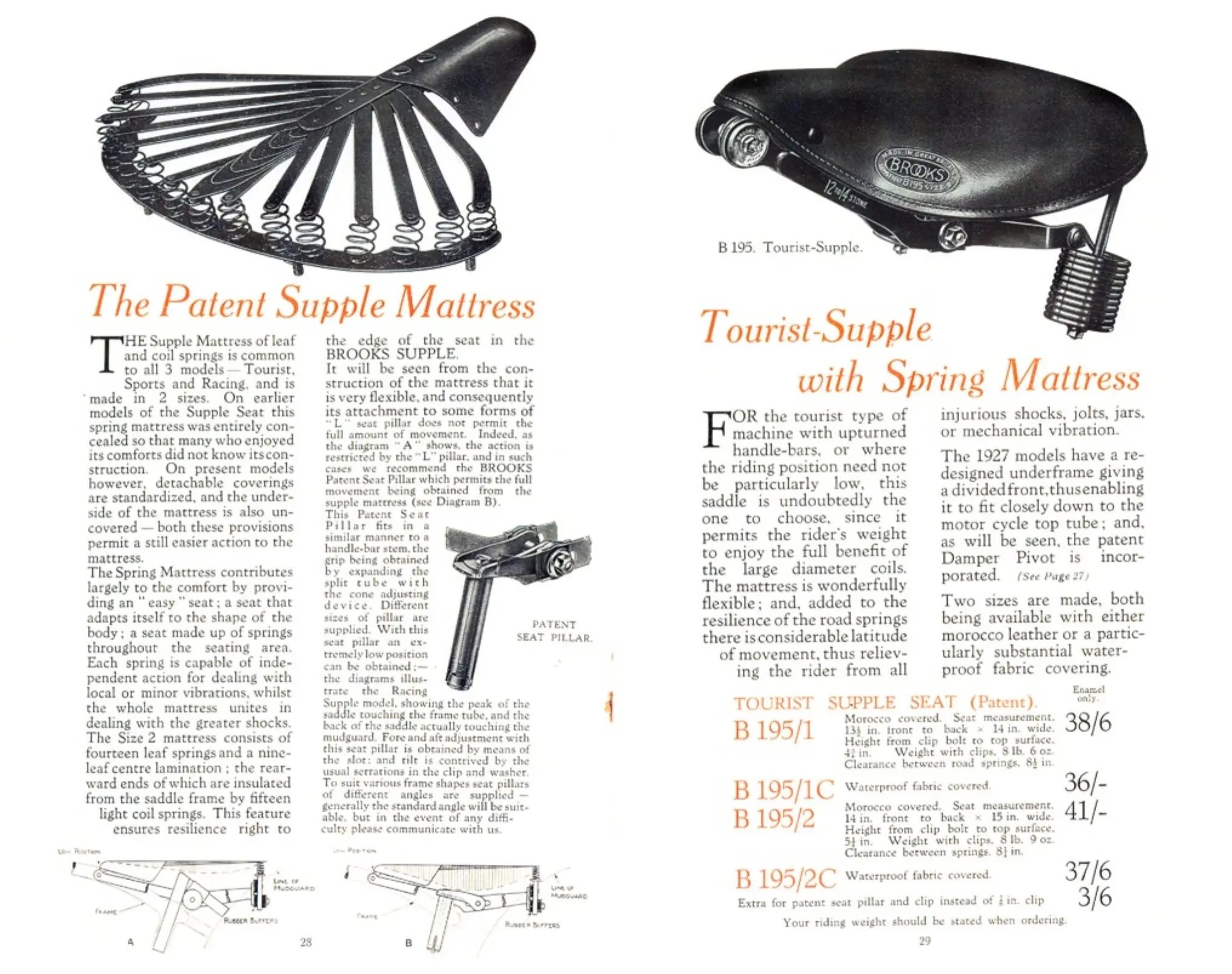
[Printed pages 28 and 29. Printed page 28 is dominated by a photograph of the bare supple mattress, its leaf fingers radiating over a row of coil springs. Two line diagrams at the foot, lettered A and B, show the saddle in low position over the frame and mudguard, each with the rubber buffers indicated. Printed page 29 shows the B 195 Tourist-Supple in side view; its badge reads MADE IN GREAT BRITAIN, BROOKS, PATENT B195 SUPPLE SEAT, and the side flap is stamped 12 to 14 STONE.]
[Printed page 28.]
The Patent Supple Mattress
THE Supple Mattress of leaf and coil springs is common to all 3 models — Tourist, Sports and Racing, and is made in 2 sizes. On earlier models of the Supple Seat this spring mattress was entirely concealed so that many who enjoyed its comforts did not know its construction. On present models however, detachable coverings are standardized, and the underside of the mattress is also uncovered — both these provisions permit a still easier action to the mattress.
The Spring Mattress contributes largely to the comfort by providing an “easy” seat; a seat that adapts itself to the shape of the body; a seat made up of springs throughout the seating area. Each spring is capable of independent action for dealing with local or minor vibrations, whilst the whole mattress unites in dealing with the greater shocks. The Size 2 mattress consists of fourteen leaf springs and a nine-leaf centre lamination; the rearward ends of which are insulated from the saddle frame by fifteen light coil springs. This feature ensures resilience right to the edge of the seat in the BROOKS SUPPLE.
It will be seen from the construction of the mattress that it is very flexible, and consequently its attachment to some forms of “L” seat pillar does not permit the full amount of movement. Indeed, as the diagram “A” shows, the action is restricted by the “L” pillar, and in such cases we recommend the BROOKS Patent Seat Pillar which permits the full movement being obtained from the supple mattress (see Diagram B).
This Patent Seat Pillar fits in a similar manner to a handle-bar stem, the grip being obtained by expanding the split tube with the cone adjusting device. Different sizes of pillar are supplied. With this seat pillar an extremely low position can be obtained;—the diagrams illustrate the Racing Supple model, showing the peak of the saddle touching the frame tube, and the back of the saddle actually touching the mudguard. Fore and aft adjustment with this seat pillar is obtained by means of the slot; and tilt is contrived by the usual serrations in the clip and washer. To suit various frame shapes seat pillars of different angles are supplied — generally the standard angle will be suitable, but in the event of any difficulty please communicate with us.
[Labels on the two diagrams:] LOW POSITION — LINE OF MUDGUARD — FRAME — RUBBER BUFFERS — A — B
[Printed page 29.]
B 195. Tourist-Supple.
Tourist-Supple with Spring Mattress
FOR the tourist type of machine with upturned handle-bars, or where the riding position need not be particularly low, this saddle is undoubtedly the one to choose, since it permits the rider’s weight to enjoy the full benefit of the large diameter coils. The mattress is wonderfully flexible; and, added to the resilience of the road springs there is considerable latitude of movement, thus relieving the rider from all injurious shocks, jolts, jars, or mechanical vibration.
The 1927 models have a redesigned underframe giving a divided front, thus enabling it to fit closely down to the motor cycle top tube; and, as will be seen, the patent Damper Pivot is incorporated. (See Page 27)
Two sizes are made, both being available with either morocco leather or a particularly substantial waterproof fabric covering.
TOURIST SUPPLE SEAT (Patent).
B 195/1 Morocco covered. Seat measurement, 13 1/2 in. front to back x 14 in. wide. Height from clip bolt to top surface, 4 1/2 in. Weight with clips, 8 lb. 6 oz. Clearance between road springs, 8 1/2 in. Enamel only 38/6
B 195/1C Waterproof fabric covered. 36/-
B 195/2 Morocco covered. Seat measurement, 14 in. front to back x 15 in. wide. Height from clip bolt to top surface, 5 1/2 in. Weight with clips, 8 lb. 9 oz. Clearance between springs, 8 1/2 in. 41/-
B 195/2C Waterproof fabric covered. 37/6
Extra for patent seat pillar and clip instead of 7/8 in. clip 3/6
Your riding weight should be stated when ordering.
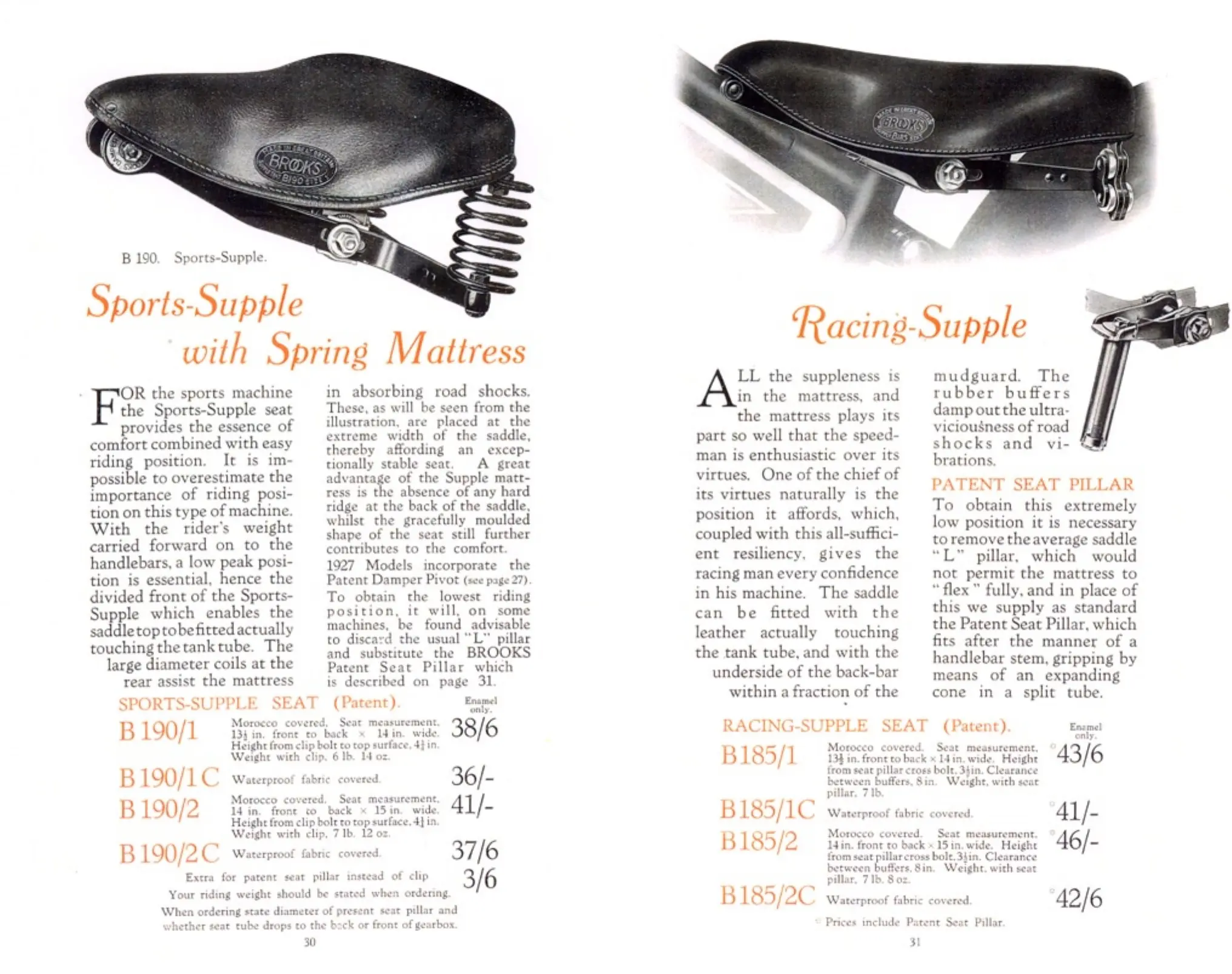
[Printed pages 30 and 31. Two saddles photographed in place on machines. The B 190 badge reads BROOKS PATENT B190 SEAT; the B 185 badge reads BROOKS PATENT B185 SEAT. The Patent Seat Pillar is shown separately on each page.]
[Printed page 30.]
B 190. Sports-Supple.
Sports-Supple with Spring Mattress
FOR the sports machine the Sports-Supple seat provides the essence of comfort combined with easy riding position. It is impossible to overestimate the importance of riding position on this type of machine. With the rider’s weight carried forward on to the handlebars, a low peak position is essential, hence the divided front of the Sports-Supple which enables the saddle top to be fitted actually touching the tank tube. The large diameter coils at the rear assist the mattress in absorbing road shocks. These, as will be seen from the illustration, are placed at the extreme width of the saddle, thereby affording an exceptionally stable seat. A great advantage of the Supple mattress is the absence of any hard ridge at the back of the saddle, whilst the gracefully moulded shape of the seat still further contributes to the comfort.
1927 Models incorporate the Patent Damper Pivot (see page 27).
To obtain the lowest riding position, it will, on some machines, be found advisable to discard the usual “L” pillar and substitute the BROOKS Patent Seat Pillar which is described on page 31.
SPORTS-SUPPLE SEAT (Patent).
B 190/1 Morocco covered. Seat measurement, 13 1/2 in. front to back x 14 in. wide. Height from clip bolt to top surface, 4 1/2 in. Weight with clip, 6 lb. 14 oz. Enamel only 38/6
B 190/1C Waterproof fabric covered. 36/-
B 190/2 Morocco covered. Seat measurement, 14 in. front to back x 15 in. wide. Height from clip bolt to top surface, 4 1/2 in. Weight with clip, 7 lb. 12 oz. 41/-
B 190/2C Waterproof fabric covered. 37/6
Extra for patent seat pillar instead of clip 3/6
Your riding weight should be stated when ordering.
When ordering state diameter of present seat pillar and whether seat tube drops to the back or front of gearbox.
[Printed page 31.]
Racing-Supple
ALL the suppleness is in the mattress, and the mattress plays its part so well that the speedman is enthusiastic over its virtues. One of the chief of its virtues naturally is the position it affords, which, coupled with this all-sufficient resiliency, gives the racing man every confidence in his machine. The saddle can be fitted with the leather actually touching the tank tube, and with the underside of the back-bar within a fraction of the mudguard. The rubber buffers damp out the ultra-viciousness of road shocks and vibrations.
PATENT SEAT PILLAR
To obtain this extremely low position it is necessary to remove the average saddle “L” pillar, which would not permit the mattress to “flex” fully, and in place of this we supply as standard the Patent Seat Pillar, which fits after the manner of a handlebar stem, gripping by means of an expanding cone in a split tube.
RACING-SUPPLE SEAT (Patent).
B 185/1 Morocco covered. Seat measurement, 13 1/2 in. front to back x 14 in. wide. Height from seat pillar cross bolt, 3 1/2 in. Clearance between buffers, 8 in. Weight, with seat pillar, 7 lb. Enamel only 43/6
B 185/1C Waterproof fabric covered. 41/-
B 185/2 Morocco covered. Seat measurement, 14 in. front to back x 15 in. wide. Height from seat pillar cross bolt, 3 1/2 in. Clearance between buffers, 8 in. Weight, with seat pillar, 7 lb. 8 oz. 46/-
B 185/2C Waterproof fabric covered. 42/6
Prices include Patent Seat Pillar.
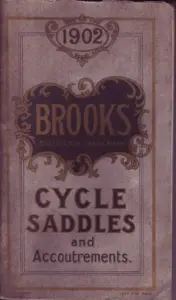 Brooks 1902 Catalog — Cycle Saddles and Accoutrements for 1902
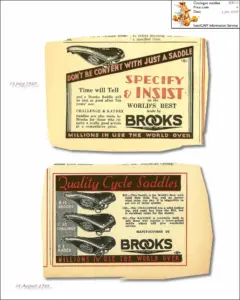 Brooks 1935 Advertisement — Specify and Insist, and Quality Cycle Saddles with Challenge and Kaydex
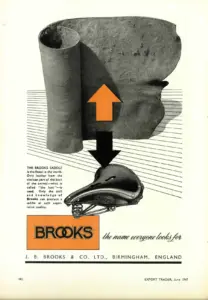 Brooks 1947 Advertisement — The Name Everyone Looks For (Export Trader)
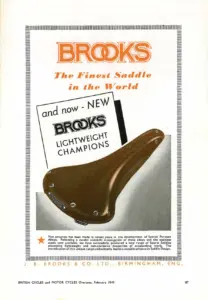 Brooks 1949 Advertisement — The New Lightweight Champions (British Cycles and Motor Cycles Overseas)
 Brooks chez A.F.C.O. — L’Officiel du cycle, 3 November 1951, Brooks Represented in France by AFCO
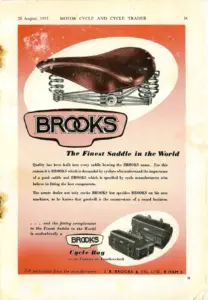 Brooks 1955 Advertisement — It’s the Saddle that Sells the Cycle (Motor Cycle and Cycle Trader)
Ebykr presents this material for research and education. If you hold rights to it or notice an ownership issue, please contact us and we will respond promptly.
The Ebykr Digest
New articles, timelines, catalog finds and registry activity — assembled from the archive once a month. Your address is never shared.
Double opt-in. One email per month. Unsubscribe at any time with one click.