About Ebykr
Ebykr celebrates classic and vintage lightweight bicycles through provocative imagery and opinion. Ride along with us.
About Ebykr
Ebykr celebrates classic and vintage lightweight bicycles through provocative imagery and opinion. Ride along with us.

Source: National Cycle Archive, in partnership with the Veteran-Cycle Club.
| Marque | Brooks |
|---|---|
| Type | Catalog |
| Year | 1938 |
| Publisher | J. B. Brooks & Co., Ltd. |
| Country | England |
| Language | English |
| Pages | 10 |
| Source | National Cycle Archive, in partnership with the Veteran-Cycle Club. |
| Credit | National Cycle Archive, in partnership with the Veteran-Cycle Club |
| Transcription | Transcribed by eye |
SADDLE-Comfort THE HOME OF BROOKS COMFORT SADDLES BROOKS Comfort SADDLE THE HALL-MARK OF QUALITY ON A CYCLE J. B. BROOKS & CO., LTD., CRITERION WORKS, BIRMINGHAM, 3 List No. 265 (2nd Edition) Page Two DO YOU KNOW WHAT "SADDLE-COMFORT" REALLY IS? It seems certain that few cyclists really appreciate the true significance of saddle-comfort. Gallons …
Saddle-Comfort, the Brooks catalog for 1938, issued as List No. 265 (2nd Edition) from the Criterion Works in Birmingham 3. It is a saddle book rather than a general equipment book: the whole of it is given over to leather, spring seat and weatherproof saddles, their measurements, weights, finishes and prices, with a folding selection chart at the center.
Four things make it worth citing.
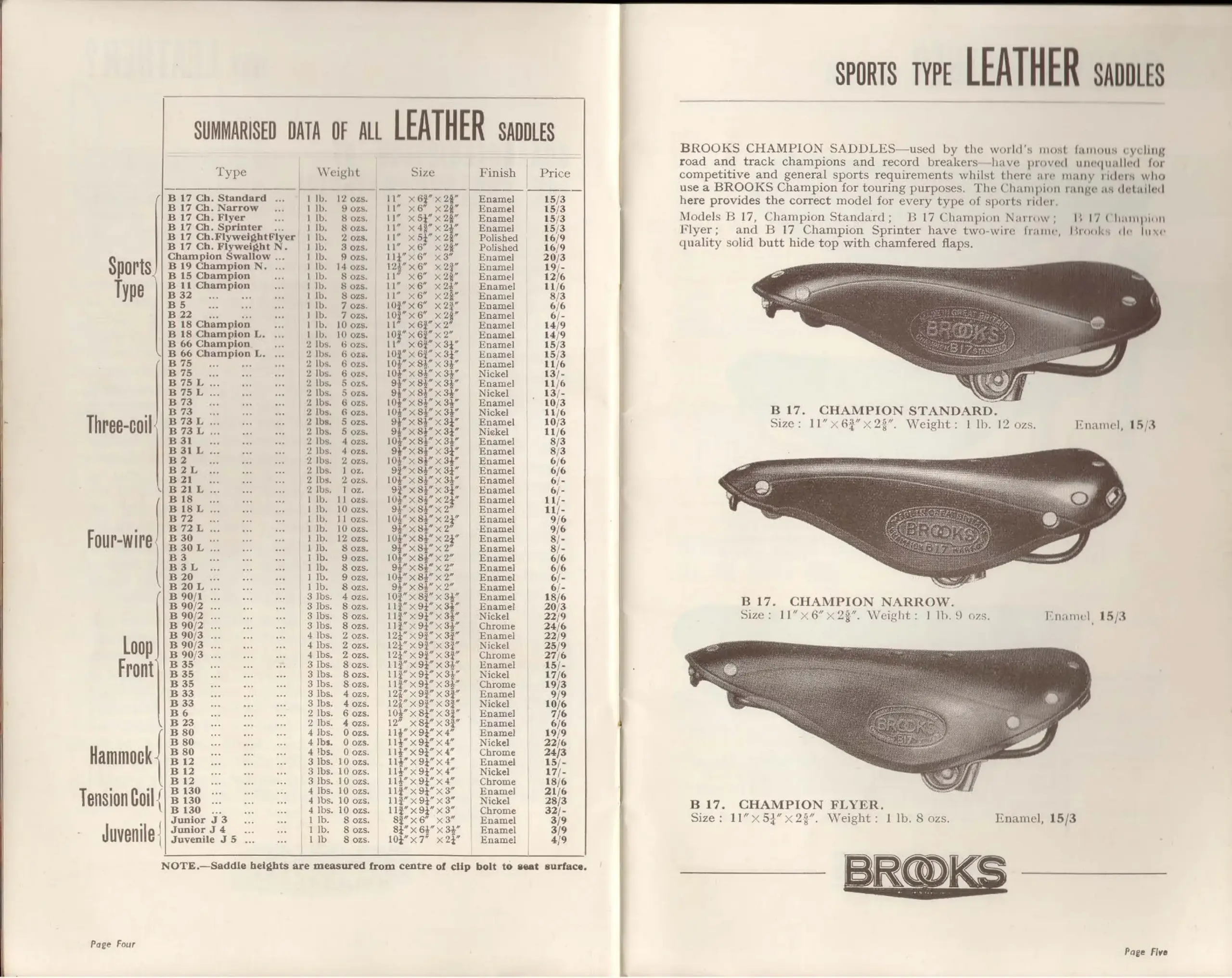
The first is chromium. Every Brooks book in this run from 1933 to 1937 offers two saddle finishes, enamel and nickel, and chromium appears only on toeclips. In this book chromium arrives on the saddles themselves. The summarised data table on printed page 4 lists a Chrome line beside the Enamel and Nickel lines for six models across three ranges: the loop front B 90/2, B 90/3 and B 35, the hammock B 80 and B 12, and the tension coil B 130. It is always the dearest of the three, and the premium over enamel runs from about 20 percent on the B 90/2 and B 90/3 to about 49 percent on the B 130. Chromium is not offered on any sports type saddle. The window for the arrival of chromium as a Brooks saddle finish, which stood at 1937 to 1950, therefore closes to 1937 to 1938.
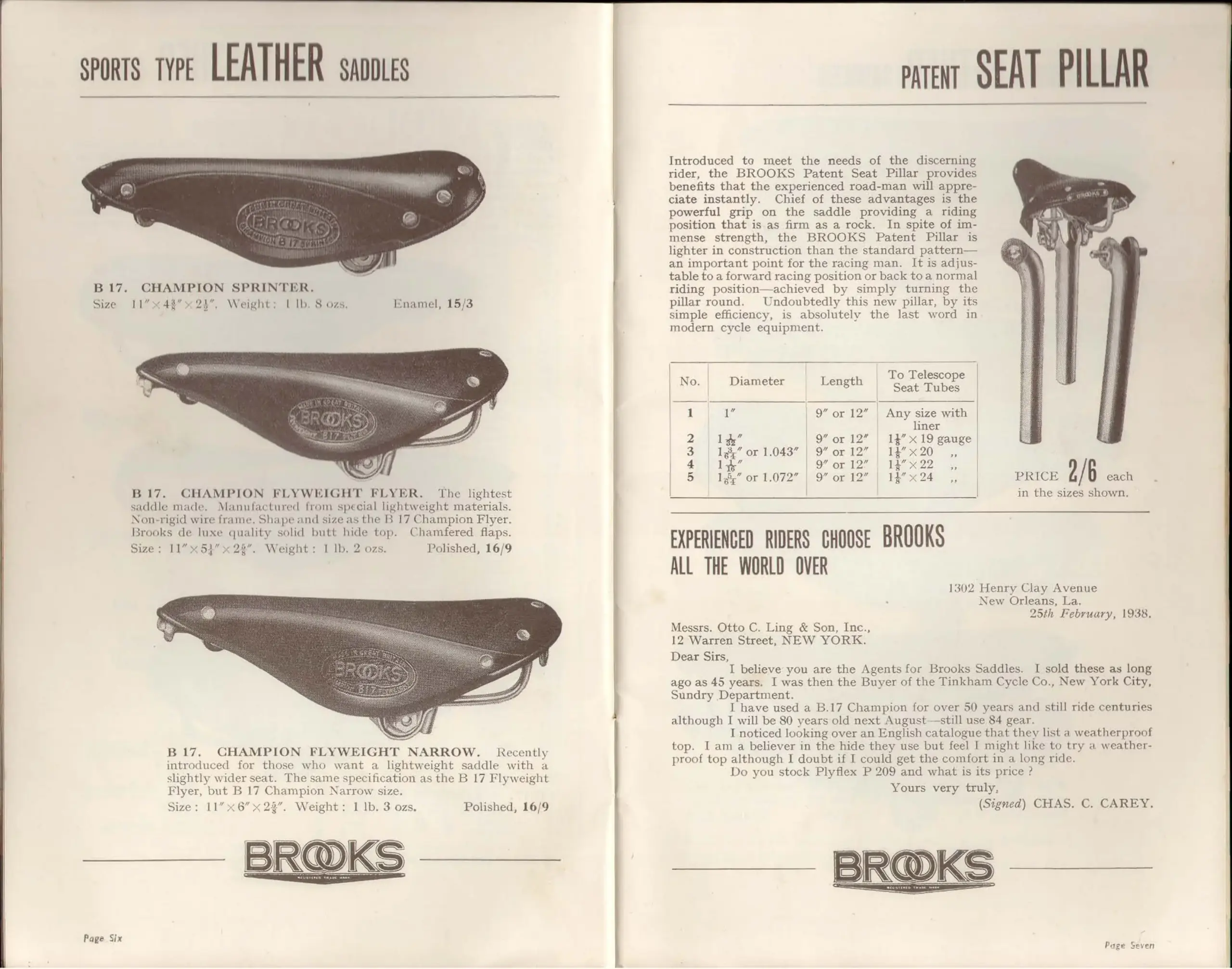
The second is the Champion Flyweight pair on printed page 6. The B 17 Champion Flyweight Flyer is described as the lightest saddle made, manufactured from special lightweight materials on a non-rigid wire frame, shape and size as the B 17 Champion Flyer, with a Brooks de luxe quality solid butt hide top and chamfered flaps. It measures 11 inches by 5 and a quarter by 2 and five eighths and weighs 1 lb. 2 ozs. Beside it the B 17 Champion Flyweight Narrow is recently introduced for those who want a lightweight saddle with a slightly wider seat, the same specification but in Champion Narrow size: 11 inches by 6 by 2 and five eighths, weighing 1 lb. 3 ozs. So the Narrow is three quarters of an inch wider than the Flyer and one ounce heavier. Both are listed as Polished at 16/9, which is a fourth finish word in this run and is used for these two models alone.
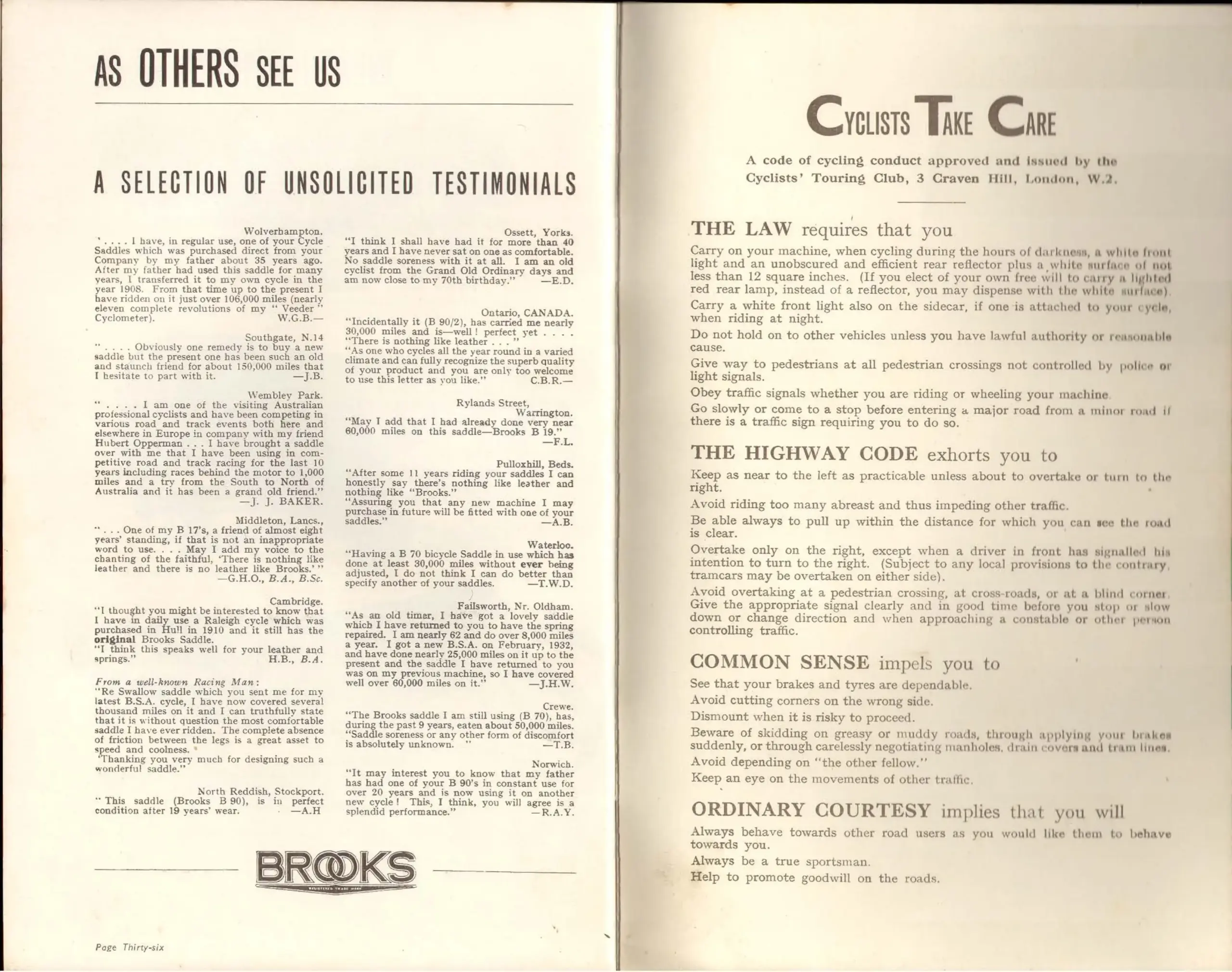
The third is a page number. The section headed As Others See Us, a selection of unsolicited testimonials, is on printed page 36 of this book, facing a Cyclists Take Care code of conduct issued by the Cyclists Touring Club. It is not in the 1937 catalog, where printed pages 36 and 37 carry the Pannier Holdall and the Bag Supports.
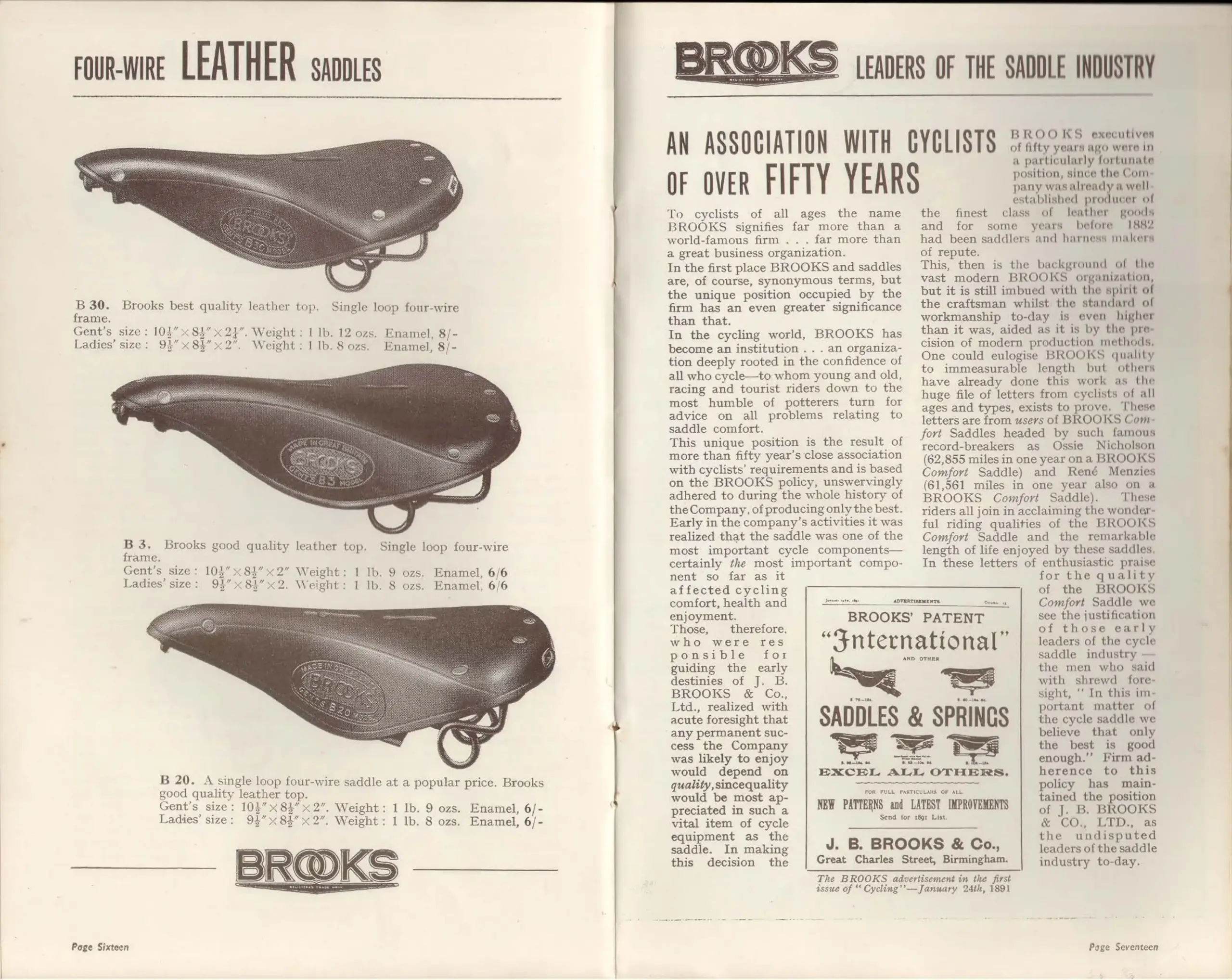
The fourth is the history leaf on printed page 17, headed An Association with Cyclists of over Fifty Years. It states that the company was already a well established producer of the finest class of leather goods and that for some years before 1882 it had been saddlers and harness makers of repute. It names two record breakers, Ossie Nicholson at 62,855 miles in one year and Rene Menzies at 61,561 miles in one year, and it reproduces in facsimile the Brooks advertisement from the first issue of Cycling, January 24th, 1891.
Two notes on the artifact itself. The collection holds this catalog in two printings. One carries the line List No. 265 (2nd Edition) beneath the imprint on the title page; the other has the identical title page with no List No. line at all. They paginate identically, printed pages 1 to 36 between the covers, and where they have been compared page for page the text is the same, including every figure in the summarised data table and both Flyweight specifications. This record reproduces the List No. 265 (2nd Edition) printing, which is the better scan of the two. The date is corroborated inside the book: printed page 7 reproduces a letter dated 25th February, 1938.
This record reproduces the cover, the title page, the two opening argument pages, the summarised data table and the Champion range, the Champion Flyweight page, the fifty years history leaf, the folding Saddle-Comfort chart, the records and hammock leaf, the weatherproof range and the testimonials leaf. The remaining printed pages are held in the Ebykr collection but are not reproduced here.
The scan is a moderate resolution one. The embedded images run about 2,110 pixels across per two-page spread, which is roughly 1,055 pixels per printed page, and the images in this record are presented at about 1.6 times that. Headings, model numbers, prices and weights read cleanly throughout. In the summarised data table the smallest vulgar fractions sit near the floor of legibility and were checked against the larger type on the model pages.
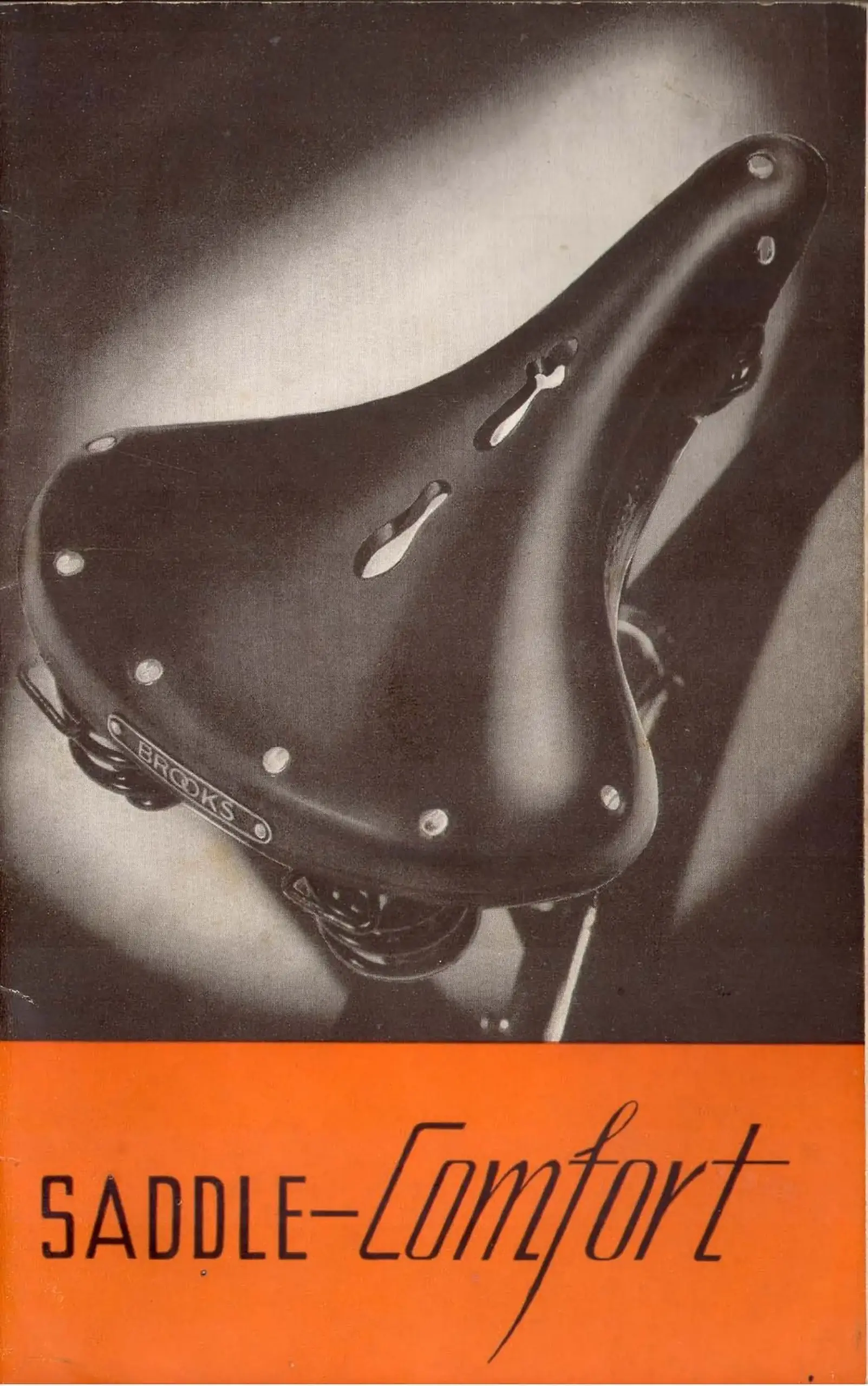
[Front cover. A photographic study of a sprung Brooks saddle, lit from behind against a dark ground, above a broad orange band.]
SADDLE-Comfort
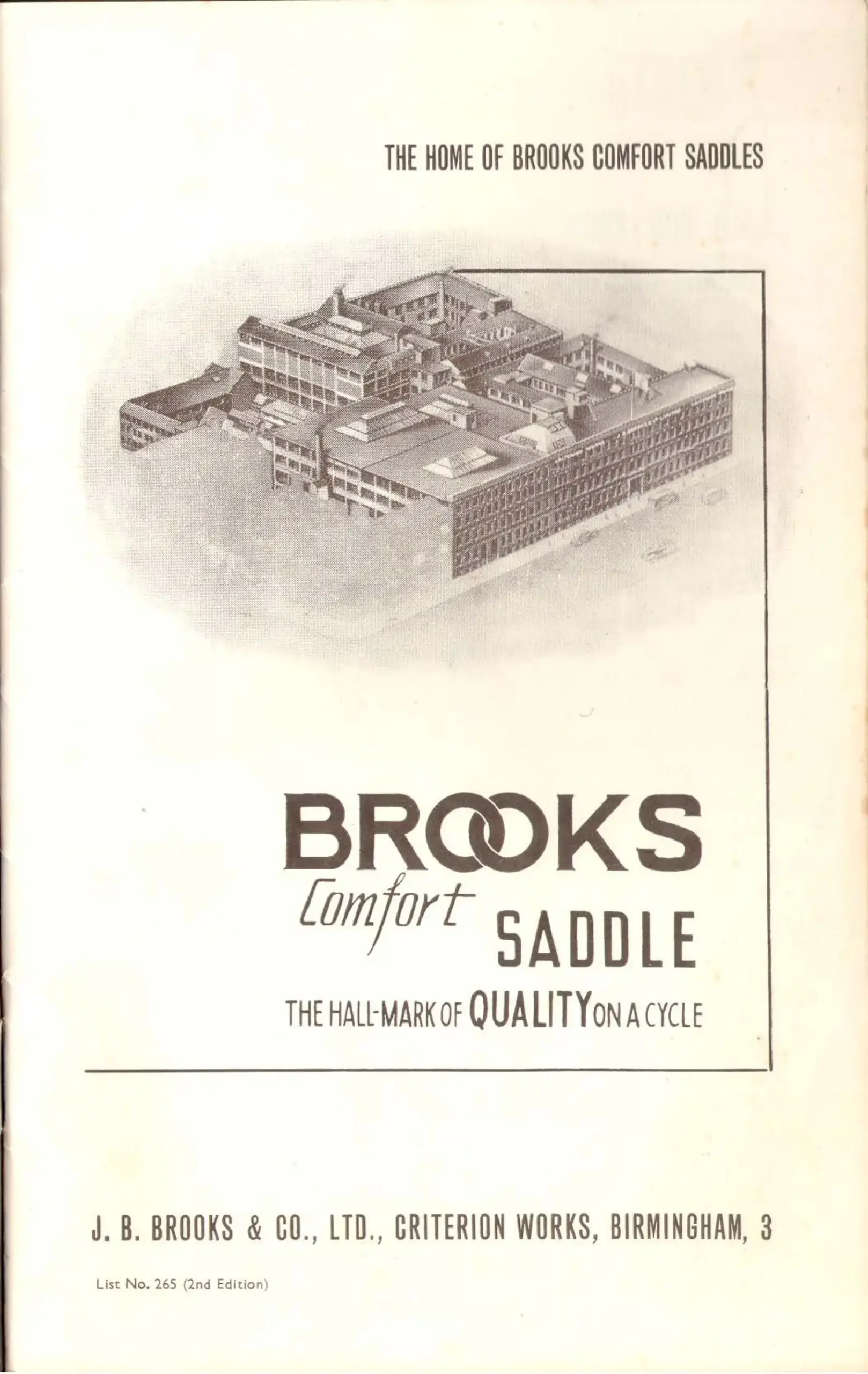
[Title page. A line of small capitals above an isometric drawing of the Criterion Works, then the wordmark in a ruled box, then the imprint.]
THE HOME OF BROOKS COMFORT SADDLES
BROOKS Comfort SADDLE
THE HALL-MARK OF QUALITY ON A CYCLE
J. B. BROOKS & CO., LTD., CRITERION WORKS, BIRMINGHAM, 3
List No. 265 (2nd Edition)
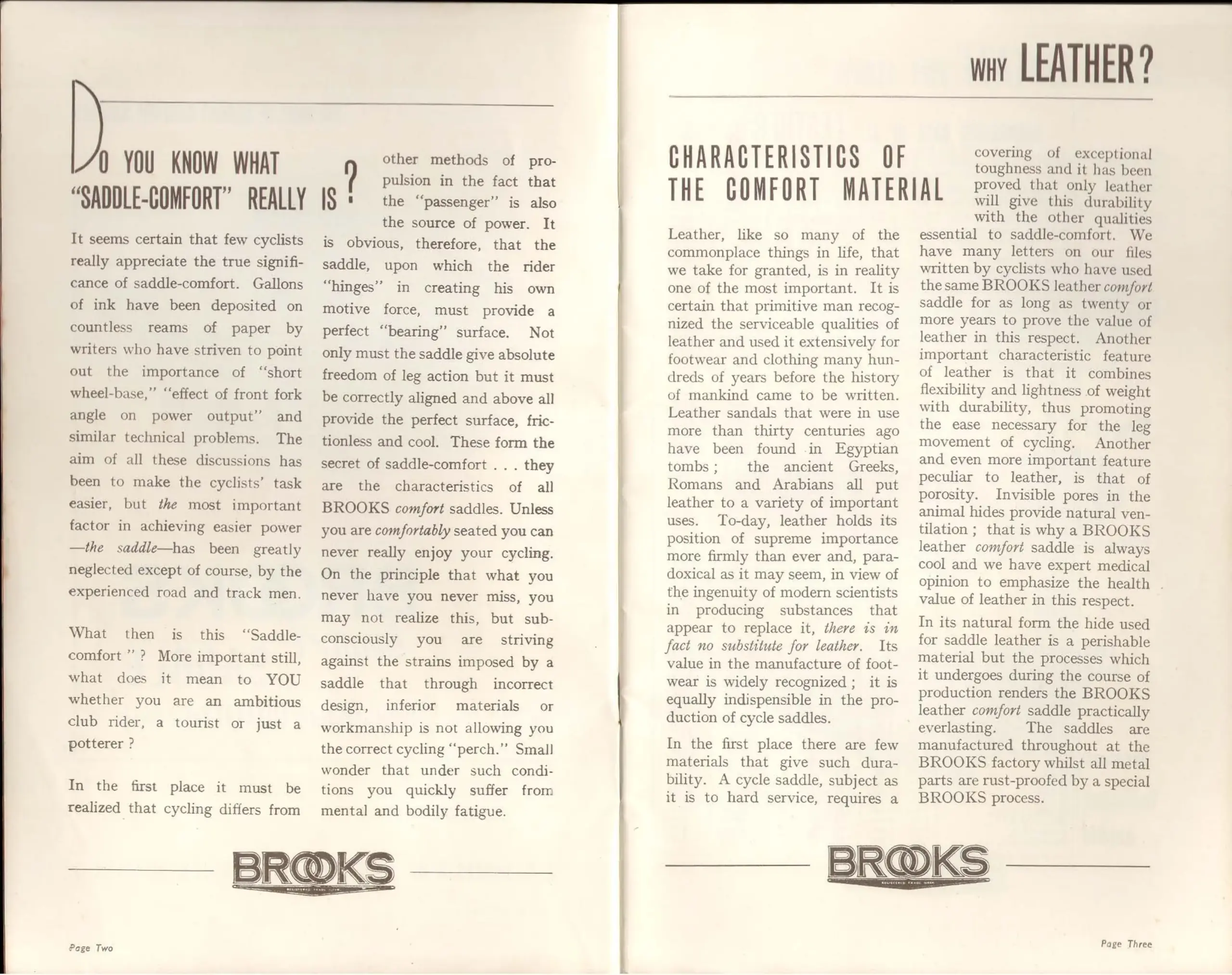
[Printed pages 2 and 3. Two full pages of argument, set in two columns each, the BROOKS wordmark as a rule at the foot of both.]
Page Two
DO YOU KNOW WHAT “SADDLE-COMFORT” REALLY IS?
It seems certain that few cyclists really appreciate the true significance of saddle-comfort. Gallons of ink have been deposited on countless reams of paper by writers who have striven to point out the importance of “short wheel-base,” “effect of front fork angle on power output” and similar technical problems. The aim of all these discussions has been to make the cyclists’ task easier, but the most important factor in achieving easier power, the saddle, has been greatly neglected except of course, by the experienced road and track men.
What then is this “Saddle-comfort”? More important still, what does it mean to YOU whether you are an ambitious club rider, a tourist or just a potterer?
In the first place it must be realized that cycling differs from other methods of propulsion in the fact that the “passenger” is also the source of power. It is obvious, therefore, that the saddle, upon which the rider “hinges” in creating his own motive force, must provide a perfect “bearing” surface. Not only must the saddle give absolute freedom of leg action but it must be correctly aligned and above all provide the perfect surface, frictionless and cool. These form the secret of saddle-comfort, they are the characteristics of all BROOKS comfort saddles. Unless you are comfortably seated you can never really enjoy your cycling. On the principle that what you never have you never miss, you may not realize this, but subconsciously you are striving against the strains imposed by a saddle that through incorrect design, inferior materials or workmanship is not allowing you the correct cycling “perch.” Small wonder that under such conditions you quickly suffer from mental and bodily fatigue.
Page Three
WHY LEATHER?
CHARACTERISTICS OF THE COMFORT MATERIAL
Leather, like so many of the commonplace things in life, that we take for granted, is in reality one of the most important. It is certain that primitive man recognized the serviceable qualities of leather and used it extensively for footwear and clothing many hundreds of years before the history of mankind came to be written. Leather sandals that were in use more than thirty centuries ago have been found in Egyptian tombs; the ancient Greeks, Romans and Arabians all put leather to a variety of important uses. To-day, leather holds its position of supreme importance more firmly than ever and, paradoxical as it may seem, in view of the ingenuity of modern scientists in producing substances that appear to replace it, there is in fact no substitute for leather. Its value in the manufacture of footwear is widely recognized; it is equally indispensible in the production of cycle saddles.
In the first place there are few materials that give such durability. A cycle saddle, subject as it is to hard service, requires a covering of exceptional toughness and it has been proved that only leather will give this durability with the other qualities essential to saddle-comfort. We have many letters on our files written by cyclists who have used the same BROOKS leather comfort saddle for as long as twenty or more years to prove the value of leather in this respect. Another important characteristic feature of leather is that it combines flexibility and lightness of weight with durability, thus promoting the ease necessary for the leg movement of cycling. Another and even more important feature peculiar to leather, is that of porosity. Invisible pores in the animal hides provide natural ventilation; that is why a BROOKS leather comfort saddle is always cool and we have expert medical opinion to emphasize the health value of leather in this respect.
In its natural form the hide used for saddle leather is a perishable material but the processes which it undergoes during the course of production renders the BROOKS leather comfort saddle practically everlasting. The saddles are manufactured throughout at the BROOKS factory whilst all metal parts are rust-proofed by a special BROOKS process.
[Printed pages 4 and 5. On the left, a ruled table filling the page, the ranges bracketed down the left margin. On the right, the opening of the Champion range with three photographs.]
Page Four
SUMMARISED DATA OF ALL LEATHER SADDLES
Columns: Type, Weight, Size, Finish, Price.
Sports Type
B 17 Ch. Standard, 1 lb. 12 ozs., 11″ x 6 1/4″ x 2 5/8″, Enamel, 15/3
B 17 Ch. Narrow, 1 lb. 9 ozs., 11″ x 6″ x 2 5/8″, Enamel, 15/3
B 17 Ch. Flyer, 1 lb. 8 ozs., 11″ x 5 1/4″ x 2 5/8″, Enamel, 15/3
B 17 Ch. Sprinter, 1 lb. 8 ozs., 11″ x 4 3/8″ x 2 1/2″, Enamel, 15/3
B 17 Ch. Flyweight Flyer, 1 lb. 2 ozs., 11″ x 5 1/4″ x 2 5/8″, Polished, 16/9
B 17 Ch. Flyweight N., 1 lb. 3 ozs., 11″ x 6″ x 2 5/8″, Polished, 16/9
Champion Swallow, 1 lb. 9 ozs., 11 1/4″ x 6″ x 3″, Enamel, 20/3
B 19 Champion N., 1 lb. 14 ozs., 12 1/2″ x 6″ x 2 3/4″, Enamel, 19/-
B 15 Champion, 1 lb. 8 ozs., 11″ x 6″ x 2 5/8″, Enamel, 12/6
B 11 Champion, 1 lb. 8 ozs., 11″ x 6″ x 2 1/2″, Enamel, 11/6
B 32, 1 lb. 8 ozs., 11″ x 6″ x 2 5/8″, Enamel, 8/3
B 5, 1 lb. 7 ozs., 10 3/4″ x 6″ x 2 3/4″, Enamel, 6/6
B 22, 1 lb. 7 ozs., 10 1/2″ x 6″ x 2 5/8″, Enamel, 6/-
B 18 Champion, 1 lb. 10 ozs., 11″ x 6 1/4″ x 2″, Enamel, 14/9
B 18 Champion L., 1 lb. 10 ozs., 10 3/4″ x 6 1/4″ x 2″, Enamel, 14/9
B 66 Champion, 2 lbs. 6 ozs., 11″ x 6 1/4″ x 3 1/4″, Enamel, 15/3
B 66 Champion L., 2 lbs. 6 ozs., 10 3/4″ x 6 1/4″ x 3 1/4″, Enamel, 15/3
Three-coil
B 75, 2 lbs. 6 ozs., 10 1/2″ x 8 1/2″ x 3 1/2″, Enamel, 11/6
B 75, 2 lbs. 6 ozs., 10 1/2″ x 8 1/2″ x 3 1/2″, Nickel, 13/-
B 75 L, 2 lbs. 5 ozs., 9 1/2″ x 8 1/2″ x 3 1/2″, Enamel, 11/6
B 75 L, 2 lbs. 5 ozs., 9 1/2″ x 8 1/2″ x 3 1/2″, Nickel, 13/-
B 73, 2 lbs. 6 ozs., 10 1/2″ x 8 1/2″ x 3 1/2″, Enamel, 10/3
B 73, 2 lbs. 6 ozs., 10 1/2″ x 8 1/2″ x 3 1/2″, Nickel, 11/6
B 73 L, 2 lbs. 5 ozs., 9 1/2″ x 8 1/2″ x 3 1/2″, Enamel, 10/3
B 73 L, 2 lbs. 5 ozs., 9 1/2″ x 8 1/2″ x 3 1/2″, Nickel, 11/6
B 31, 2 lbs. 4 ozs., 10 1/2″ x 8 1/2″ x 3 1/4″, Enamel, 8/3
B 31 L, 2 lbs. 4 ozs., 9 1/2″ x 8 1/2″ x 3 1/4″, Enamel, 8/3
B 2, 2 lbs. 2 ozs., 10 1/2″ x 8 1/2″ x 3 1/2″, Enamel, 6/6
B 2 L, 2 lbs. 1 oz., 9 3/4″ x 8 1/2″ x 3 1/4″, Enamel, 6/6
B 21, 2 lbs. 2 ozs., 10 1/2″ x 8 1/2″ x 3 1/4″, Enamel, 6/-
B 21 L, 2 lbs. 1 oz., 9 3/4″ x 8 1/2″ x 3 1/4″, Enamel, 6/-
Four-wire
B 18, 1 lb. 11 ozs., 10 1/2″ x 8 1/2″ x 2 1/4″, Enamel, 11/-
B 18 L, 1 lb. 10 ozs., 9 1/2″ x 8 1/2″ x 2″, Enamel, 11/-
B 72, 1 lb. 11 ozs., 10 1/2″ x 8 1/2″ x 2 1/4″, Enamel, 9/6
B 72 L, 1 lb. 10 ozs., 9 1/2″ x 8 1/2″ x 2″, Enamel, 9/6
B 30, 1 lb. 12 ozs., 10 1/2″ x 8 1/2″ x 2 1/4″, Enamel, 8/-
B 30 L, 1 lb. 8 ozs., 9 1/2″ x 8 1/2″ x 2″, Enamel, 8/-
B 3, 1 lb. 9 ozs., 10 1/2″ x 8 1/2″ x 2″, Enamel, 6/6
B 3 L, 1 lb. 8 ozs., 9 1/2″ x 8 1/2″ x 2″, Enamel, 6/6
B 20, 1 lb. 9 ozs., 10 1/2″ x 8 1/2″ x 2″, Enamel, 6/-
B 20 L, 1 lb. 8 ozs., 9 1/2″ x 8 1/2″ x 2″, Enamel, 6/-
Loop Front
B 90/1, 3 lbs. 4 ozs., 10 3/4″ x 8 3/4″ x 3 1/2″, Enamel, 18/6
B 90/2, 3 lbs. 8 ozs., 11 3/4″ x 9 1/4″ x 3 1/2″, Enamel, 20/3
B 90/2, 3 lbs. 8 ozs., 11 3/4″ x 9 1/4″ x 3 1/2″, Nickel, 22/9
B 90/2, 3 lbs. 8 ozs., 11 3/4″ x 9 1/4″ x 3 1/2″, Chrome, 24/6
B 90/3, 4 lbs. 2 ozs., 12 1/4″ x 9 3/4″ x 3 3/4″, Enamel, 22/9
B 90/3, 4 lbs. 2 ozs., 12 1/4″ x 9 3/4″ x 3 3/4″, Nickel, 25/9
B 90/3, 4 lbs. 2 ozs., 12 1/4″ x 9 3/4″ x 3 3/4″, Chrome, 27/6
B 35, 3 lbs. 8 ozs., 11 3/4″ x 9 1/4″ x 3 1/2″, Enamel, 15/-
B 35, 3 lbs. 8 ozs., 11 3/4″ x 9 1/4″ x 3 1/2″, Nickel, 17/6
B 35, 3 lbs. 8 ozs., 11 3/4″ x 9 1/4″ x 3 1/2″, Chrome, 19/3
B 33, 3 lbs. 4 ozs., 12 1/4″ x 9 3/4″ x 3 3/4″, Enamel, 9/9
B 33, 3 lbs. 4 ozs., 12 1/4″ x 9 3/4″ x 3 3/4″, Nickel, 10/6
B 6, 2 lbs. 6 ozs., 10 1/2″ x 8 1/2″ x 3 3/4″, Enamel, 7/6
B 23, 2 lbs. 4 ozs., 12″ x 8 1/2″ x 3 3/4″, Enamel, 6/6
Hammock
B 80, 4 lbs. 0 ozs., 11 1/2″ x 9 1/4″ x 4″, Enamel, 19/9
B 80, 4 lbs. 0 ozs., 11 1/2″ x 9 1/4″ x 4″, Nickel, 22/6
B 80, 4 lbs. 0 ozs., 11 1/2″ x 9 1/4″ x 4″, Chrome, 24/3
B 12, 3 lbs. 10 ozs., 11 1/2″ x 9 1/4″ x 4″, Enamel, 15/-
B 12, 3 lbs. 10 ozs., 11 1/2″ x 9 1/4″ x 4″, Nickel, 17/-
B 12, 3 lbs. 10 ozs., 11 1/2″ x 9 1/4″ x 4″, Chrome, 18/6
Tension Coil
B 130, 4 lbs. 10 ozs., 11 3/4″ x 9 1/4″ x 3″, Enamel, 21/6
B 130, 4 lbs. 10 ozs., 11 3/4″ x 9 1/4″ x 3″, Nickel, 28/3
B 130, 4 lbs. 10 ozs., 11 3/4″ x 9 1/4″ x 3″, Chrome, 32/-
Juvenile
Junior J 3, 1 lb. 8 ozs., 8 3/4″ x 6″ x 3″, Enamel, 3/9
Junior J 4, 1 lb. 8 ozs., 8 1/4″ x 6 1/2″ x 3 1/2″, Enamel, 3/9
Juvenile J 5, 1 lb 8 ozs., 10 1/2″ x 7″ x 2 1/4″, Enamel, 4/9
NOTE.-Saddle heights are measured from centre of clip bolt to seat surface.
Page Five
SPORTS TYPE LEATHER SADDLES
BROOKS CHAMPION SADDLES-used by the world’s most famous cycling road and track champions and record breakers-have proved unequalled for competitive and general sports requirements whilst there are many riders who use a BROOKS Champion for touring purposes. The Champion range as detailed here provides the correct model for every type of sports rider.
Models B 17, Champion Standard; B 17 Champion Narrow; B 17 Champion Flyer; and B 17 Champion Sprinter have two-wire frame, Brooks de luxe quality solid butt hide top with chamfered flaps.
B 17. CHAMPION STANDARD. Size: 11″ x 6 1/4″ x 2 5/8″. Weight: 1 lb. 12 ozs. Enamel, 15/3
B 17. CHAMPION NARROW. Size: 11″ x 6″ x 2 5/8″. Weight: 1 lb. 9 ozs. Enamel, 15/3
B 17. CHAMPION FLYER. Size: 11″ x 5 1/4″ x 2 5/8″. Weight: 1 lb. 8 ozs. Enamel, 15/3
[Printed pages 6 and 7. Three saddle photographs down the left page, the seat pillar and a testimonial letter on the right.]
Page Six
SPORTS TYPE LEATHER SADDLES
B 17. CHAMPION SPRINTER. Size 11″ x 4 3/8″ x 2 1/2″. Weight: 1 lb. 8 ozs. Enamel, 15/3
B 17. CHAMPION FLYWEIGHT FLYER. The lightest saddle made. Manufactured from special lightweight materials. Non-rigid wire frame. Shape and size as the B 17 Champion Flyer. Brooks de luxe quality solid butt hide top. Chamfered flaps. Size: 11″ x 5 1/4″ x 2 5/8″. Weight: 1 lb. 2 ozs. Polished, 16/9
B 17. CHAMPION FLYWEIGHT NARROW. Recently introduced for those who want a lightweight saddle with a slightly wider seat. The same specification as the B 17 Flyweight Flyer, but B 17 Champion Narrow size. Size: 11″ x 6″ x 2 5/8″. Weight: 1 lb. 3 ozs. Polished, 16/9
Page Seven
PATENT SEAT PILLAR
Introduced to meet the needs of the discerning rider, the BROOKS Patent Seat Pillar provides benefits that the experienced road-man will appreciate instantly. Chief of these advantages is the powerful grip on the saddle providing a riding position that is as firm as a rock. In spite of immense strength, the BROOKS Patent Pillar is lighter in construction than the standard pattern, an important point for the racing man. It is adjustable to a forward racing position or back to a normal riding position, achieved by simply turning the pillar round. Undoubtedly this new pillar, by its simple efficiency, is absolutely the last word in modern cycle equipment.
Columns: No., Diameter, Length, To Telescope Seat Tubes.
1, 1″, 9″ or 12″, Any size with liner
2, 1 1/32″, 9″ or 12″, 1 1/8″ x 19 gauge
3, 1 3/64″ or 1.043″, 9″ or 12″, 1 1/8″ x 20
4, 1 1/16″, 9″ or 12″, 1 1/8″ x 22
5, 1 5/64″ or 1.072″, 9″ or 12″, 1 1/8″ x 24
PRICE 2/6 each in the sizes shown.
EXPERIENCED RIDERS CHOOSE BROOKS ALL THE WORLD OVER
1302 Henry Clay Avenue
New Orleans, La.
25th February, 1938.
Messrs. Otto C. Ling & Son, Inc.,
12 Warren Street, NEW YORK.
Dear Sirs,
I believe you are the Agents for Brooks Saddles. I sold these as long ago as 45 years. I was then the Buyer of the Tinkham Cycle Co., New York City, Sundry Department.
I have used a B.17 Champion for over 50 years and still ride centuries although I will be 80 years old next August, still use 84 gear.
I noticed looking over an English catalogue that they list a weatherproof top. I am a believer in the hide they use but feel I might like to try a weatherproof top although I doubt if I could get the comfort in a long ride.
Do you stock Plyflex P 209 and what is its price?
Yours very truly,
(Signed) CHAS. C. CAREY.
[Printed pages 16 and 17. Three four-wire saddles on the left. On the right, a page of company history with a facsimile of the 1891 advertisement set into the lower middle column.]
Page Sixteen
FOUR-WIRE LEATHER SADDLES
B 30. Brooks best quality leather top. Single loop four-wire frame.
Gent’s size: 10 1/2″ x 8 1/2″ x 2 1/4″. Weight: 1 lb. 12 ozs. Enamel, 8/-
Ladies’ size: 9 1/2″ x 8 1/2″ x 2″. Weight: 1 lb. 8 ozs. Enamel, 8/-
B 3. Brooks good quality leather top. Single loop four-wire frame.
Gent’s size: 10 1/2″ x 8 1/2″ x 2″. Weight: 1 lb. 9 ozs. Enamel, 6/6
Ladies’ size: 9 1/2″ x 8 1/2″ x 2″. Weight: 1 lb. 8 ozs. Enamel, 6/6
B 20. A single loop four-wire saddle at a popular price. Brooks good quality leather top.
Gent’s size: 10 1/2″ x 8 1/2″ x 2″. Weight: 1 lb. 9 ozs. Enamel, 6/-
Ladies’ size: 9 1/2″ x 8 1/2″ x 2″. Weight: 1 lb. 8 ozs. Enamel, 6/-
Page Seventeen
BROOKS LEADERS OF THE SADDLE INDUSTRY
AN ASSOCIATION WITH CYCLISTS OF OVER FIFTY YEARS
To cyclists of all ages the name BROOKS signifies far more than a world-famous firm . . . far more than a great business organization.
In the first place BROOKS and saddles are, of course, synonymous terms, but the unique position occupied by the firm has an even greater significance than that.
In the cycling world, BROOKS has become an institution . . . an organization deeply rooted in the confidence of all who cycle-to whom young and old, racing and tourist riders down to the most humble of potterers turn for advice on all problems relating to saddle comfort.
This unique position is the result of more than fifty year’s close association with cyclists’ requirements and is based on the BROOKS policy, unswervingly adhered to during the whole history of the Company, of producing only the best. Early in the company’s activities it was realized that the saddle was one of the most important cycle components-certainly the most important component so far as it affected cycling comfort, health and enjoyment.
Those, therefore, who were responsible for guiding the early destinies of J. B. BROOKS & Co., Ltd., realized with acute foresight that any permanent success the Company was likely to enjoy would depend on quality, since quality would be most appreciated in such a vital item of cycle equipment as the saddle. In making this decision the BROOKS executives of fifty years ago were in a particularly fortunate position, since the Company was already a well-established producer of the finest class of leather goods and for some years before 1882 had been saddlers and harness makers of repute.
This, then, is the background of the vast modern BROOKS organization, but it is still imbued with the spirit of the craftsman whilst the standard of workmanship to-day is even higher than it was, aided as it is by the precision of modern production methods. One could eulogise BROOKS quality to immeasurable length but others have already done this work as the huge file of letters from cyclists of all ages and types, exists to prove. These letters are from users of BROOKS Comfort Saddles headed by such famous record-breakers as Ossie Nicholson (62,855 miles in one year on a BROOKS Comfort Saddle) and Rene Menzies (61,561 miles in one year also on a BROOKS Comfort Saddle). These riders all join in acclaiming the wonderful riding qualities of the BROOKS Comfort Saddle and the remarkable length of life enjoyed by these saddles.
In these letters of enthusiastic praise for the quality of the BROOKS Comfort Saddle we see the justification of those early leaders of the cycle saddle industry-the men who said with shrewd foresight, “In this important matter of the cycle saddle we believe that only the best is good enough.” Firm adherence to this policy has maintained the position of J. B. BROOKS & CO., LTD., as the undisputed leaders of the saddle industry to-day.
[Facsimile advertisement set into the page.]
BROOKS’ PATENT “International” AND OTHERS
SADDLES & SPRINGS
EXCEL ALL OTHERS.
FOR FULL PARTICULARS OF ALL NEW PATTERNS and LATEST IMPROVEMENTS
Send for 1891 List.
J. B. BROOKS & Co., Great Charles Street, Birmingham.
The BROOKS advertisement in the first issue of “Cycling”-January 24th, 1891
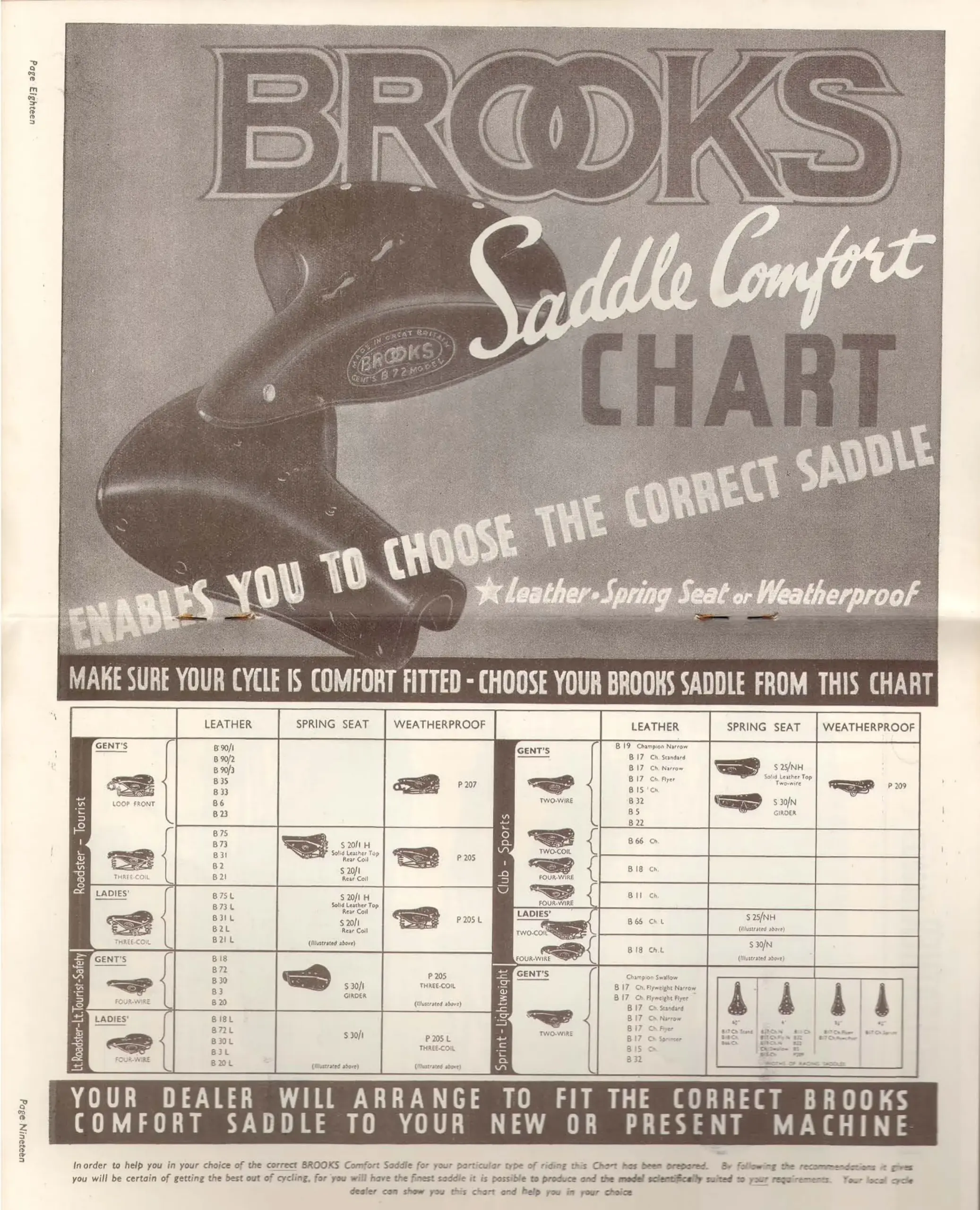
[Printed pages 18 and 19. A single folding leaf, scanned rotated, carrying the page number Eighteen at the head of the left margin and Nineteen at the foot. A large photographic saddle study behind the display lettering, with the selection table beneath.]
BROOKS Saddle Comfort CHART
ENABLES YOU TO CHOOSE THE CORRECT SADDLE
In Leather – Spring Seat or Weatherproof
MAKE SURE YOUR CYCLE IS COMFORT FITTED – CHOOSE YOUR BROOKS SADDLE FROM THIS CHART
[The table is set in two halves, each with the columns LEATHER, SPRING SEAT and WEATHERPROOF against a bracketed riding category down the left.]
Roadster – Tourist
GENT’S, LOOP FRONT: B 90/1, B 90/2, B 90/3, B 35, B 33, B 6, B 23. Weatherproof P 207.
GENT’S, THREE-COIL: B 75, B 73, B 31, B 2, B 21. Spring Seat S 20/1 H Solid Leather Top Rear Coil, S 20/1 Rear Coil. Weatherproof P 205.
LADIES’, THREE-COIL: B 75 L, B 73 L, B 31 L, B 2 L, B 21 L. Spring Seat S 20/1 H Solid Leather Top Rear Coil, S 20/1 Rear Coil. Weatherproof P 205 L.
Lt. Roadster – Lt. Tourist – Safety
GENT’S, FOUR-WIRE: B 18, B 72, B 30, B 3, B 20. Spring Seat S 30/1 GIRDER. Weatherproof P 205 THREE-COIL.
LADIES’, FOUR-WIRE: B 18 L, B 72 L, B 30 L, B 3 L, B 20 L. Spring Seat S 30/1. Weatherproof P 205 L THREE-COIL.
Club – Sports
GENT’S, TWO-WIRE: B 19 Champion Narrow, B 17 Ch. Standard, B 17 Ch. Narrow, B 17 Ch. Flyer, B 15 Ch., B 32, B 5, B 22. Spring Seat S 25/NH Solid Leather Top Two-wire, S 30/N GIRDER. Weatherproof P 209.
GENT’S, TWO-COIL: B 66 Ch.
GENT’S, FOUR-WIRE: B 18 Ch.
GENT’S, FOUR-WIRE: B 11 Ch.
LADIES’, TWO-COIL: B 66 Ch. L. Spring Seat S 25/NH (illustrated above).
LADIES’, FOUR-WIRE: B 18 Ch. L. Spring Seat S 30/N (illustrated above).
Sprint – Lightweight
GENT’S, TWO-WIRE: Champion Swallow, B 17 Ch. Flyweight Narrow, B 17 Ch. Flyweight Flyer, B 17 Ch. Standard, B 17 Ch. Narrow, B 17 Ch. Flyer, B 17 Ch. Sprinter, B 15 Ch., B 32.
[A panel of four saddle outlines at the foot of the right half, captioned by width: 6″ B17 Ch. Stand., B66 Ch., B66 Ch.; 4″ B17 Ch. Narrow, B17 Ch. Flyweight Narrow, B22, B32, B5; 5 1/4″ B17 Ch. Flyer, B17 Ch. Flyweight Flyer; 4 1/2″ B17 Ch. Sprint. Headed WIDTHS OF RACING SADDLES.]
YOUR DEALER WILL ARRANGE TO FIT THE CORRECT BROOKS COMFORT SADDLE TO YOUR NEW OR PRESENT MACHINE
In order to help you in your choice of the correct BROOKS Comfort Saddle for your particular type of riding this Chart has been prepared. By following the recommendations it gives you will be certain of getting the best out of cycling, for you will have the finest saddle it is possible to produce and the model scientifically suited to your requirements. Your local cycle dealer can show you this chart and help you in your choice.
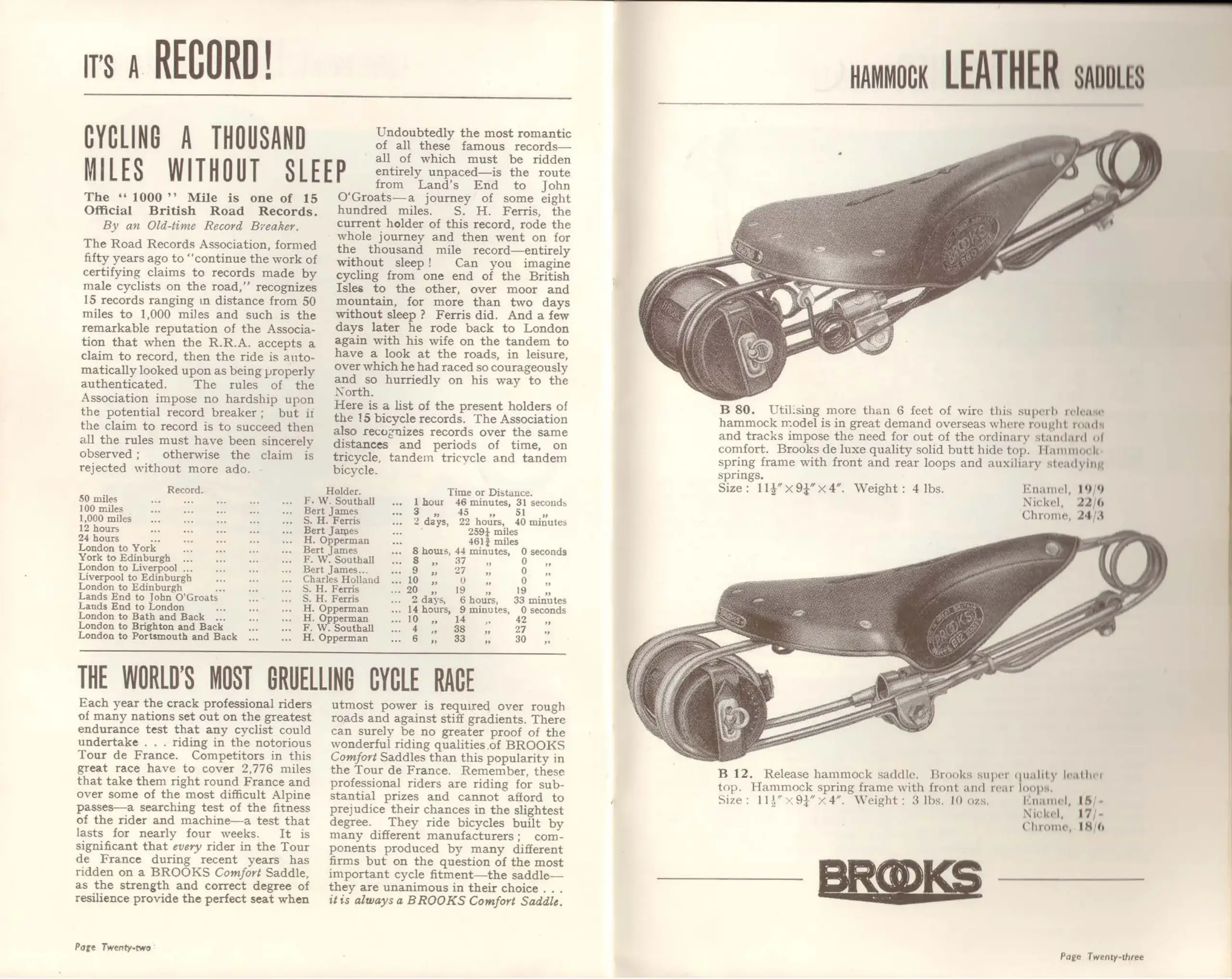
[Printed pages 22 and 23. A page of records on the left, two hammock saddles on the right.]
Page Twenty-two
IT’S A RECORD!
CYCLING A THOUSAND MILES WITHOUT SLEEP
The “1000” Mile is one of 15 Official British Road Records. By an Old-time Record Breaker.
The Road Records Association, formed fifty years ago to “continue the work of certifying claims to records made by male cyclists on the road,” recognizes 15 records ranging in distance from 50 miles to 1,000 miles and such is the remarkable reputation of the Association that when the R.R.A. accepts a claim to record, then the ride is automatically looked upon as being properly authenticated. The rules of the Association impose no hardship upon the potential record breaker; but if the claim to record is to succeed then all the rules must have been sincerely observed; otherwise the claim is rejected without more ado.
Undoubtedly the most romantic of all these famous records-all of which must be ridden entirely unpaced-is the route from Land’s End to John O’Groats-a journey of some eight hundred miles. S. H. Ferris, the current holder of this record, rode the whole journey and then went on for the thousand mile record-entirely without sleep! Can you imagine cycling from one end of the British Isles to the other, over moor and mountain, for more than two days without sleep? Ferris did. And a few days later he rode back to London again with his wife on the tandem to have a look at the roads, in leisure, over which he had raced so courageously and so hurriedly on his way to the North.
Here is a list of the present holders of the 15 bicycle records. The Association also recognizes records over the same distances and periods of time, on tricycle, tandem tricycle and tandem bicycle.
Columns: Record, Holder, Time or Distance.
50 miles, F. W. Southall, 1 hour 46 minutes, 31 seconds
100 miles, Bert James, 3 hours 45 minutes 51 seconds
1,000 miles, S. H. Ferris, 2 days, 22 hours, 40 minutes
12 hours, Bert James, 259 1/4 miles
24 hours, H. Opperman, 461 1/2 miles
London to York, Bert James, 8 hours, 44 minutes, 0 seconds
York to Edinburgh, F. W. Southall, 8 hours 37 minutes 0 seconds
London to Liverpool, Bert James, 9 hours 27 minutes 0 seconds
Liverpool to Edinburgh, Charles Holland, 10 hours 0 minutes 0 seconds
London to Edinburgh, S. H. Ferris, 20 hours 19 minutes 19 seconds
Lands End to John O’Groats, S. H. Ferris, 2 days, 6 hours, 33 minutes
Lands End to London, H. Opperman, 14 hours, 9 minutes, 0 seconds
London to Bath and Back, H. Opperman, 10 hours 14 minutes 42 seconds
London to Brighton and Back, F. W. Southall, 4 hours 38 minutes 27 seconds
London to Portsmouth and Back, H. Opperman, 6 hours 33 minutes 30 seconds
THE WORLD’S MOST GRUELLING CYCLE RACE
Each year the crack professional riders of many nations set out on the greatest endurance test that any cyclist could undertake . . . riding in the notorious Tour de France. Competitors in this great race have to cover 2,776 miles that take them right round France and over some of the most difficult Alpine passes-a searching test of the fitness of the rider and machine-a test that lasts for nearly four weeks. It is significant that every rider in the Tour de France during recent years has ridden on a BROOKS Comfort Saddle, as the strength and correct degree of resilience provide the perfect seat when utmost power is required over rough roads and against stiff gradients. There can surely be no greater proof of the wonderful riding qualities of BROOKS Comfort Saddles than this popularity in the Tour de France. Remember, these professional riders are riding for substantial prizes and cannot afford to prejudice their chances in the slightest degree. They ride bicycles built by many different manufacturers; components produced by many different firms but on the question of the most important cycle fitment-the saddle-they are unanimous in their choice . . . it is always a BROOKS Comfort Saddle.
Page Twenty-three
HAMMOCK LEATHER SADDLES
B 80. Utilising more than 6 feet of wire this superb release hammock model is in great demand overseas where rough roads and tracks impose the need for out of the ordinary standard of comfort. Brooks de luxe quality solid butt hide top. Hammock spring frame with front and rear loops and auxiliary steadying springs.
Size: 11 1/2″ x 9 1/4″ x 4″. Weight: 4 lbs. Enamel, 19/9. Nickel, 22/6. Chrome, 24/3
B 12. Release hammock saddle. Brooks super quality leather top. Hammock spring frame with front and rear loops.
Size: 11 1/2″ x 9 1/4″ x 4″. Weight: 3 lbs. 10 ozs. Enamel, 15/-. Nickel, 17/-. Chrome, 18/6
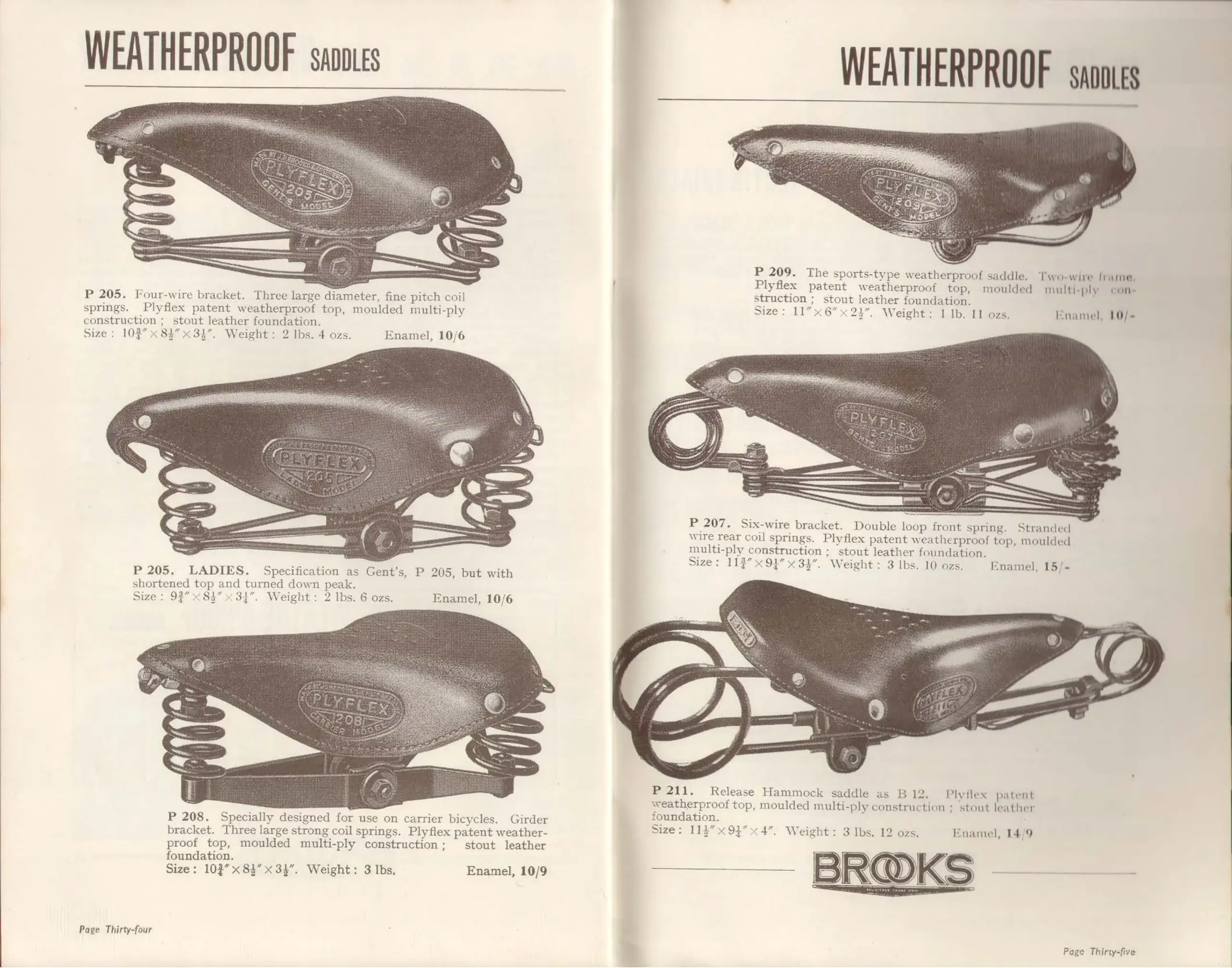
[Printed pages 34 and 35. The weatherproof range, three saddles to each page.]
Page Thirty-four
WEATHERPROOF SADDLES
P 205. Four-wire bracket. Three large diameter, fine pitch coil springs. Plyflex patent weatherproof top, moulded multi-ply construction; stout leather foundation.
Size: 10 3/4″ x 8 1/2″ x 3 1/2″. Weight: 2 lbs. 4 ozs. Enamel, 10/6
P 205. LADIES. Specification as Gent’s, P 205, but with shortened top and turned down peak.
Size: 9 3/4″ x 8 1/2″ x 3 1/4″. Weight: 2 lbs. 6 ozs. Enamel, 10/6
P 208. Specially designed for use on carrier bicycles. Girder bracket. Three large strong coil springs. Plyflex patent weatherproof top, moulded multi-ply construction; stout leather foundation.
Size: 10 3/4″ x 8 1/2″ x 3 1/2″. Weight: 3 lbs. Enamel, 10/9
Page Thirty-five
WEATHERPROOF SADDLES
P 209. The sports-type weatherproof saddle. Two-wire frame. Plyflex patent weatherproof top, moulded multi-ply construction; stout leather foundation.
Size: 11″ x 6″ x 2 1/2″. Weight: 1 lb. 11 ozs. Enamel, 10/-
P 207. Six-wire bracket. Double loop front spring. Stranded wire rear coil springs. Plyflex patent weatherproof top, moulded multi-ply construction; stout leather foundation.
Size: 11 3/4″ x 9 1/4″ x 3 1/2″. Weight: 3 lbs. 10 ozs. Enamel, 15/-
P 211. Release Hammock saddle as B 12. Plyflex patent weatherproof top, moulded multi-ply construction; stout leather foundation.
Size: 11 1/2″ x 9 1/4″ x 4″. Weight: 3 lbs. 12 ozs. Enamel, 14/9
[Printed pages 36 and 37. Testimonials in two columns on the left, the Cyclists Touring Club code on the right. The right-hand page carries no printed page number.]
Page Thirty-six
AS OTHERS SEE US
A SELECTION OF UNSOLICITED TESTIMONIALS
Wolverhampton. “. . . . I have, in regular use, one of your Cycle Saddles which was purchased direct from your Company by my father about 35 years ago. After my father had used this saddle for many years, I transferred it to my own cycle in the year 1908. From that time up to the present I have ridden on it just over 106,000 miles (nearly eleven complete revolutions of my “Veeder” Cyclometer). W.G.B.-
Southgate, N.14. “. . . . Obviously one remedy is to buy a new saddle but the present one has been such an old and staunch friend for about 150,000 miles that I hesitate to part with it. -J.B.
Wembley Park. “. . . . I am one of the visiting Australian professional cyclists and have been competing in various road and track events both here and elsewhere in Europe in company with my friend Hubert Opperman . . . I have brought a saddle over with me that I have been using in competitive road and track racing for the last 10 years including races behind the motor to 1,000 miles and a try from the South to North of Australia and it has been a grand old friend.” -J. J. BAKER.
Middleton, Lancs., “. . . One of my B 17’s, a friend of almost eight years’ standing, if that is not an inappropriate word to use. . . . May I add my voice to the chanting of the faithful, ‘There is nothing like leather and there is no leather like Brooks.’ ” -G.H.O., B.A., B.Sc.
Cambridge. “I thought you might be interested to know that I have in daily use a Raleigh cycle which was purchased in Hull in 1910 and it still has the original Brooks Saddle. “I think this speaks well for your leather and springs.” H.B., B.A.
From a well-known Racing Man: “Re Swallow saddle which you sent me for my latest B.S.A. cycle, I have now covered several thousand miles on it and I can truthfully state that it is without question the most comfortable saddle I have ever ridden. The complete absence of friction between the legs is a great asset to speed and coolness. “Thanking you very much for designing such a wonderful saddle.”
North Reddish, Stockport. “This saddle (Brooks B 90), is in perfect condition after 19 years’ wear. -A.H
Ossett, Yorks. “I think I shall have had it for more than 40 years and I have never sat on one as comfortable. No saddle soreness with it at all. I am an old cyclist from the Grand Old Ordinary days and am now close to my 70th birthday.” -E.D.
Ontario, CANADA. “Incidentally it (B 90/2), has carried me nearly 30,000 miles and is-well! perfect yet . . . . “There is nothing like leather . . . ” “As one who cycles all the year round in a varied climate and can fully recognize the superb quality of your product and you are only too welcome to use this letter as you like.” C.B.R.-
Rylands Street, Warrington. “May I add that I had already done very near 60,000 miles on this saddle-Brooks B 19.” -F.L.
Pulloxhill, Beds. “After some 11 years riding your saddles I can honestly say there’s nothing like leather and nothing like “Brooks.” “Assuring you that any new machine I may purchase in future will be fitted with one of your saddles.” -A.B.
Waterloo. “Having a B 70 bicycle Saddle in use which has done at least 30,000 miles without ever being adjusted, I do not think I can do better than specify another of your saddles. -T.W.D.
Failsworth, Nr. Oldham. “As an old timer, I have got a lovely saddle which I have returned to you to have the spring repaired. I am nearly 62 and do over 8,000 miles a year. I got a new B.S.A. on February, 1932, and have done nearly 25,000 miles on it up to the present and the saddle I have returned to you was on my previous machine, so I have covered well over 60,000 miles on it.” -J.H.W.
Crewe. “The Brooks saddle I am still using (B 70), has, during the past 9 years, eaten about 50,000 miles. “Saddle soreness or any other form of discomfort is absolutely unknown. ” -T.B.
Norwich. “It may interest you to know that my father has had one of your B 90’s in constant use for over 20 years and is now using it on another new cycle! This, I think, you will agree is a splendid performance.” -R.A.Y.
Page Thirty-seven
CYCLISTS TAKE CARE
A code of cycling conduct approved and issued by the Cyclists’ Touring Club, 3 Craven Hill, London, W.2.
THE LAW requires that you
Carry on your machine, when cycling during the hours of darkness, a white front light and an unobscured and efficient rear reflector plus a white surface of not less than 12 square inches. (If you elect of your own free will to carry a lighted red rear lamp, instead of a reflector, you may dispense with the white surface).
Carry a white front light also on the sidecar, if one is attached to your cycle, when riding at night.
Do not hold on to other vehicles unless you have lawful authority or reasonable cause.
Give way to pedestrians at all pedestrian crossings not controlled by police or light signals.
Obey traffic signals whether you are riding or wheeling your machine.
Go slowly or come to a stop before entering a major road from a minor road if there is a traffic sign requiring you to do so.
THE HIGHWAY CODE exhorts you to
Keep as near to the left as practicable unless about to overtake or turn to the right.
Avoid riding too many abreast and thus impeding other traffic.
Be able always to pull up within the distance for which you can see the road is clear.
Overtake only on the right, except when a driver in front has signalled his intention to turn to the right. (Subject to any local provisions to the contrary, tramcars may be overtaken on either side).
Avoid overtaking at a pedestrian crossing, at cross-roads, or at a blind corner.
Give the appropriate signal clearly and in good time before you stop or slow down or change direction and when approaching a constable or other person controlling traffic.
COMMON SENSE impels you to
See that your brakes and tyres are dependable.
Avoid cutting corners on the wrong side.
Dismount when it is risky to proceed.
Beware of skidding on greasy or muddy roads, through applying your brakes suddenly, or through carelessly negotiating manholes, drain covers and tram lines.
Avoid depending on “the other fellow.”
Keep an eye on the movements of other traffic.
ORDINARY COURTESY implies that you will
Always behave towards other road users as you would like them to behave towards you.
Always be a true sportsman.
Help to promote goodwill on the roads.
 Brooks 1902 Catalog — Cycle Saddles and Accoutrements for 1902
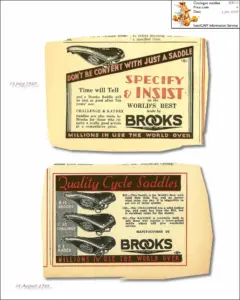 Brooks 1935 Advertisement — Specify and Insist, and Quality Cycle Saddles with Challenge and Kaydex
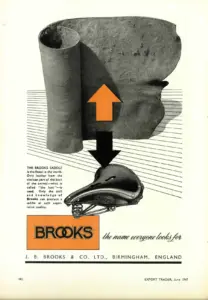 Brooks 1947 Advertisement — The Name Everyone Looks For (Export Trader)
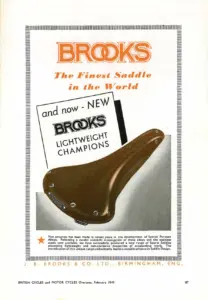 Brooks 1949 Advertisement — The New Lightweight Champions (British Cycles and Motor Cycles Overseas)
 Brooks chez A.F.C.O. — L’Officiel du cycle, 3 November 1951, Brooks Represented in France by AFCO
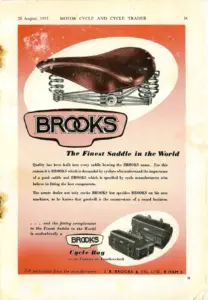 Brooks 1955 Advertisement — It’s the Saddle that Sells the Cycle (Motor Cycle and Cycle Trader)
Ebykr presents this material for research and education. If you hold rights to it or notice an ownership issue, please contact us and we will respond promptly.
The Ebykr Digest
New articles, timelines, catalog finds and registry activity — assembled from the archive once a month. Your address is never shared.
Double opt-in. One email per month. Unsubscribe at any time with one click.