About Ebykr
Ebykr celebrates classic and vintage lightweight bicycles through provocative imagery and opinion. Ride along with us.
About Ebykr
Ebykr celebrates classic and vintage lightweight bicycles through provocative imagery and opinion. Ride along with us.

Source: Ebykr archive.
| Marque | Brooks |
|---|---|
| Type | Catalog |
| Year | 1911 |
| Publisher | J. B. Brooks & Co., Ltd. |
| Country | England |
| Language | English |
| Pages | 6 |
| Source | Ebykr archive. |
| Credit | Ebykr archive |
| Transcription | Transcribed by eye |
The BROOKS (REGISTERED TRADE MARK) BOOK 1911 CYCLIST'S EDITION. THE BROOKS (Registered Trade Mark) BOOK CYCLIST'S EDITION containing full particulars, illustrations, and specifications of the many models of the BROOKS Cycle Saddles and Bags for .. .. 1911 .. .. TWENTY-SEVENTH YEAR OF PUBLICATION. TELEPHONE . . . TWO LINES . . No. 2273 CENTRAL. …
The Brooks Book for 1911, Cyclist’s Edition, from J. B. Brooks & Co. Ltd. of Great Charles Street, Birmingham. Forty-nine printed pages between dark green card covers blocked in gold, the title and the year on the cover and again on the title page, and the title page adding Twenty-seventh Year of Publication.
This book was read to settle a single bounded question, and it settles it. The Brooks height convention changes twice across this collection, from the under surface of the leather to the top surface and back again, and the first of those changes had been bracketed only loosely. The 1911 book carries its own definition on printed page 13, under the heading Size, Weight and Height of BROOKS Saddles, and it measures to the under surface in the words the 1910 book uses. Together with the 1912 book, which repeats it, that closes the first change to the four years between 1912 and 1916.
The definition does not sit where the earlier books put it. It is on printed page 6 in the 1906, 1907 and 1908 books and on printed page 3 in 1910; here it is on printed page 13, because this book opens with a long essay on choosing and fitting a saddle that runs from printed page 2 to printed page 11. Anyone looking for the specification note at a fixed page in this run will not find it.
Four other things make the book worth citing.
The first is an exception that no earlier book in this run carries. The general rule on printed page 13 measures the height to the under surface of the leather, and yet three model entries in this same book give their height to the top surface and say so on the page. All three are padded models: the B 90 Padded on printed page 28, and the B 120 P and B 130 P on printed page 29. The plain versions of the same saddles, on the same pages, carry an unqualified height. So the top surface figure that becomes the general rule in the 1916 book already exists in 1911 as a flagged, per-model exception, and its purpose is plain, because a padded top has a thickness of its own that an under surface figure would not capture. The lesson for anyone using a Brooks height is that the book’s general rule does not govern a line that overrides it. Read the convention out of the model entry, not only out of the front matter.
The second is the B 90, the control model this project has used since the 1907 book to test whether a change in a figure is real. Printed page 28 gives all three sizes at dimensions identical to 1910, 1914 and 1916, but Sizes 2 and 3 are heavier than they were in 1910 by five ounces and three ounces, and they then hold those weights through 1912 and 1914. Size 1 does not move at all. The prices do not move either. So the pre-war weight climb in the B 90 is not a gradual drift across the Edwardian decade. It happens inside the single year between 1910 and 1911, and Brooks did not charge for it.
The third is the military range. Printed page 44 carries the Patent Military Saddle headed No. 2 and No. 3 Military, as adopted by H.M. War Office, which is the heading session 8 identified in this book without a page number. It now has one.
The fourth is a warning rather than a finding. This opening is the clearest demonstration in the whole collection of the confusion this project has fallen into twice. Printed page 44 carries a military saddle headed No. 2 and No. 3 and, directly beneath it, an Army Cycle Tool Bag headed No. 2. The facing page, printed page 45, carries Registered Service Pattern Rifle Clips sold as a No. 1 set and a No. 2 set. One opening therefore holds a No. 1, two No. 2s and a No. 3, belonging to three different classes of product and all described as adopted by the War Office. A number taken from this opening without establishing what it names is worthless.
Two cautions on the figures below. Every height in this book prints as three and a fraction inches, and the fraction does not survive the scan. This book is scanned at about one hundred pixels per inch across a two page spread, so a printed page carries roughly four hundred and forty pixels of width; re-rendering the specification blocks at five times and again at four times leaves the numerator and denominator of the vulgar fractions as an unreadable smudge. The integers, the halves in the size column, the weights and the prices are all firm and are given here. The height fractions are omitted rather than guessed, and where a height is a whole number or a half it is given, because those do survive. Second, this is the Cyclist’s Edition. The 1912 book states that Brooks issued separate catalogues for motor cycle saddles and bags, for car equipment and for general leather goods, so the range in this book is the bicycle range and an absence from it is not an absence from the Brooks range.
The scan passes all three defect checks. No two sheets are exact duplicates anywhere in the book, no adjacent pair is a duplicate, and the printed page numbers run unbroken with the house mapping of sheet N to printed pages 2N minus 4 and 2N minus 3. There is no index; printed pages 3, 5 and 7 are all continuous prose.
The following pages are transcribed in full.
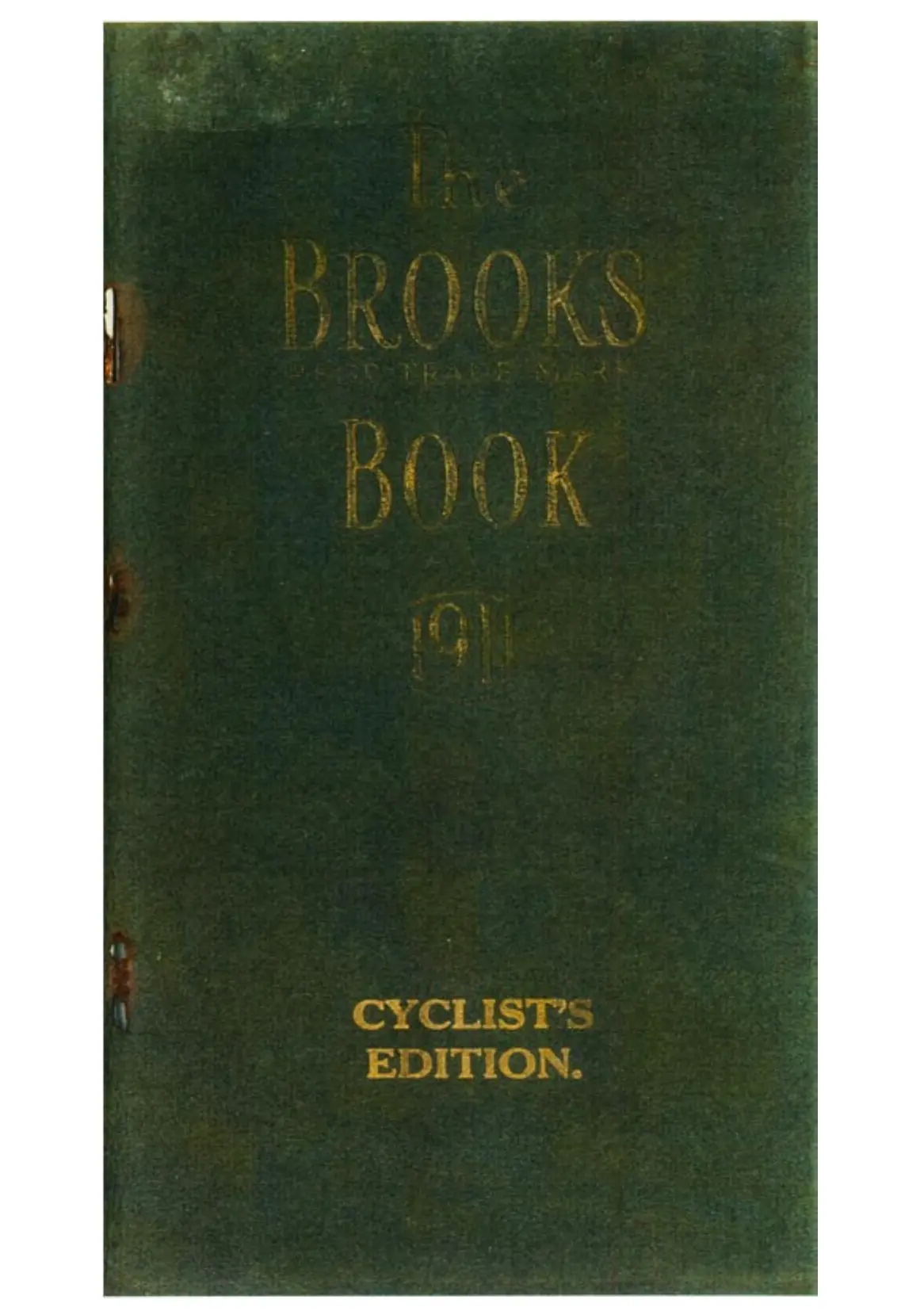
[Front cover. Dark green card, blocked in gold, with three cord stitches visible at the spine edge. The lettering is decorative and the gold has rubbed, so the year reads faintly.]
The BROOKS (REGISTERED TRADE MARK) BOOK 1911
CYCLIST’S EDITION.
— Sheet 2. Inside front cover and printed page 1 —
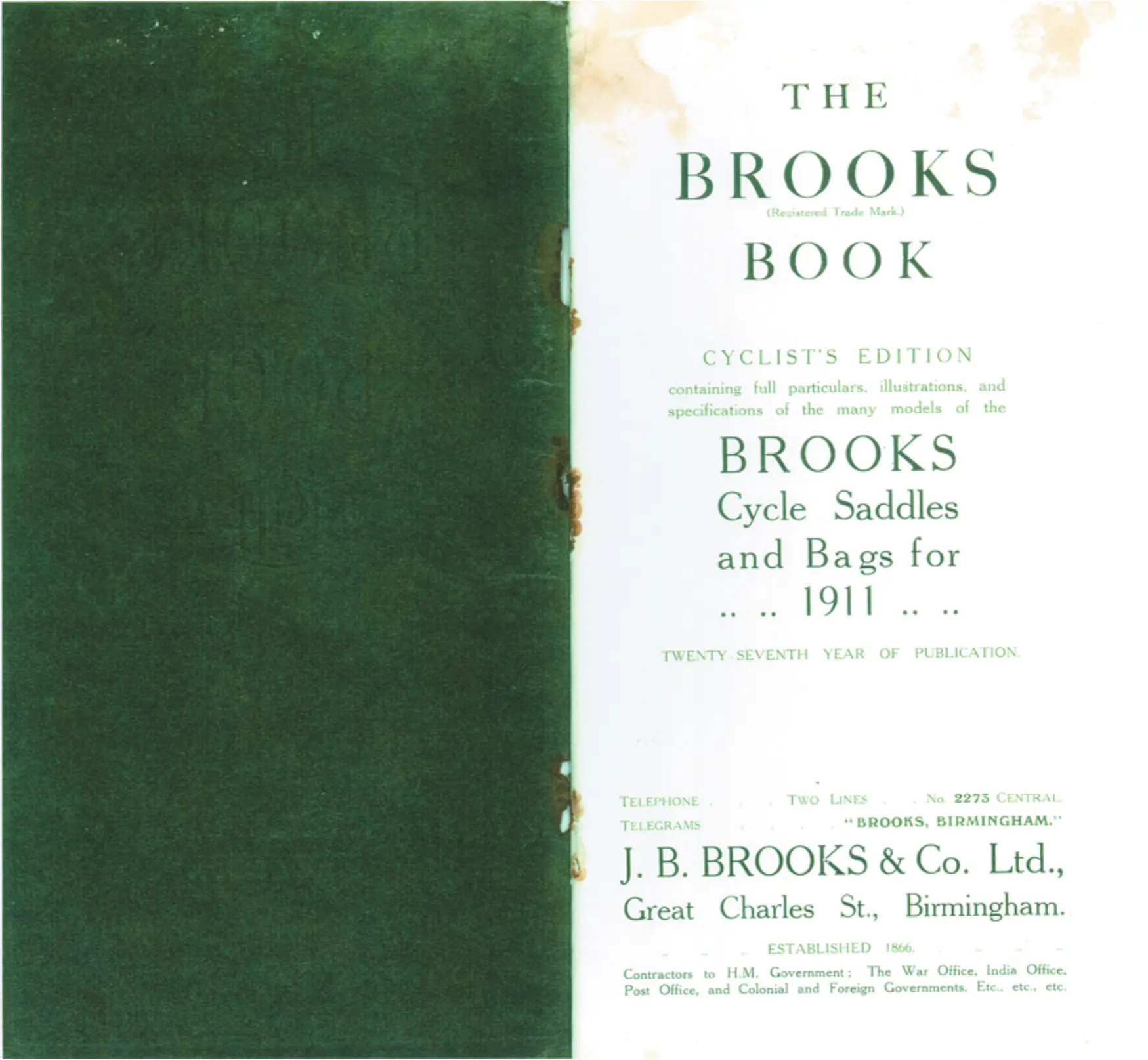
[Two page opening. The verso of the front cover is plain green board and carries no printing. The recto is the title page, printed in green on cream, with a foxed stain at the head.]
[Printed page 1, the title page.]
THE BROOKS (Registered Trade Mark) BOOK
CYCLIST’S EDITION
containing full particulars, illustrations, and specifications of the many models of the
BROOKS Cycle Saddles and Bags for .. .. 1911 .. ..
TWENTY-SEVENTH YEAR OF PUBLICATION.
TELEPHONE . . . TWO LINES . . No. 2273 CENTRAL.
TELEGRAMS . . . “BROOKS, BIRMINGHAM.”
J. B. BROOKS & Co. Ltd., Great Charles St., Birmingham.
ESTABLISHED 1866.
Contractors to H.M. Government; The War Office, India Office, Post Office, and Colonial and Foreign Governments, Etc., etc., etc.
— Sheet 8. Printed pages 12 and 13 —
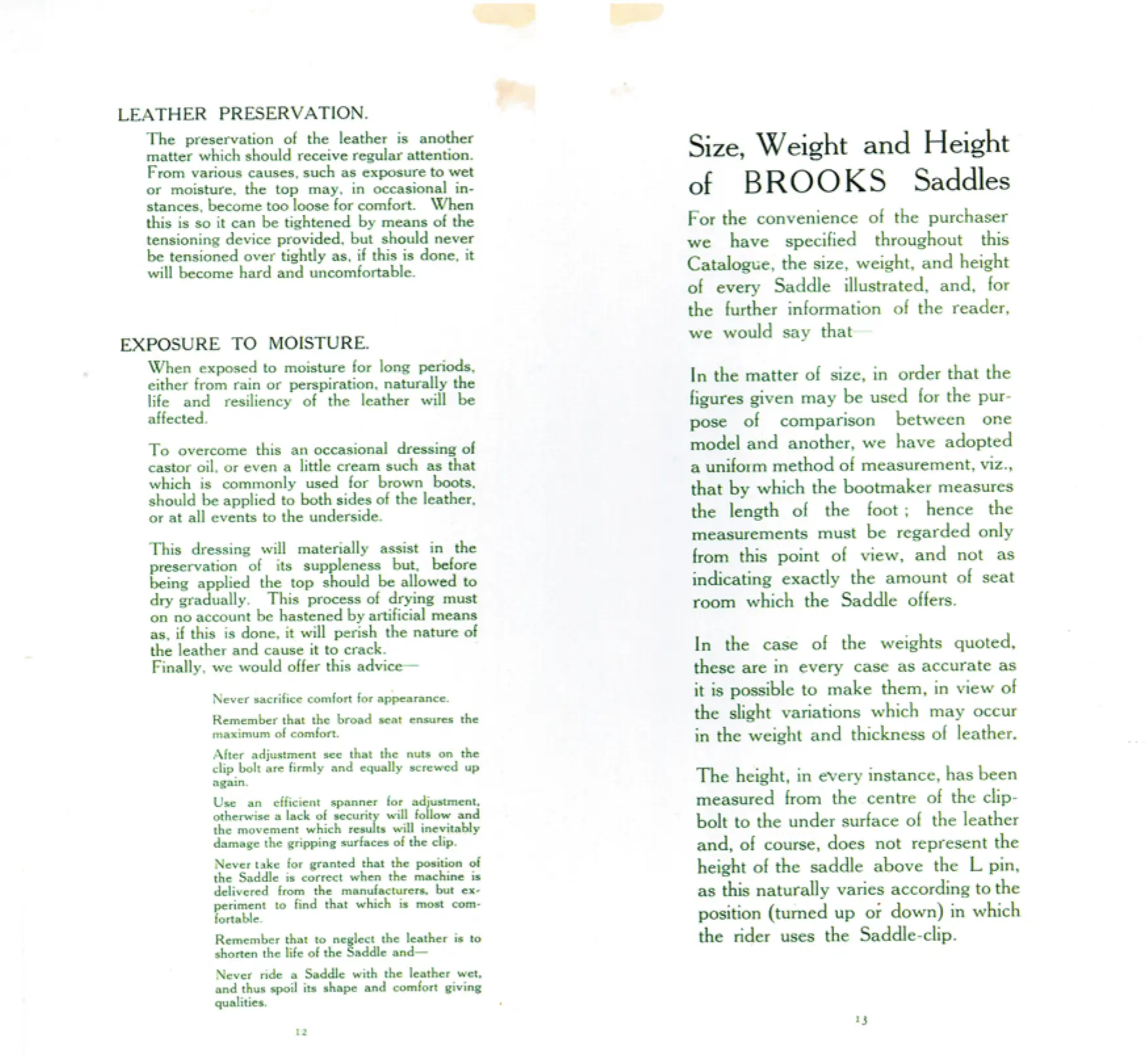
[Two page opening, letterpress throughout, no illustration. The left page closes the fitting essay with two sections on care and a list of parting advice set in smaller type. The right page carries the specification note, which is the reason this leaf was ingested. Both pages are lightly foxed at the head.]
[Printed page 12.]
LEATHER PRESERVATION.
The preservation of the leather is another matter which should receive regular attention. From various causes, such as exposure to wet or moisture, the top may, in occasional instances, become too loose for comfort. When this is so it can be tightened by means of the tensioning device provided, but should never be tensioned over tightly as, if this is done, it will become hard and uncomfortable.
EXPOSURE TO MOISTURE.
When exposed to moisture for long periods, either from rain or perspiration, naturally the life and resiliency of the leather will be affected.
To overcome this an occasional dressing of castor oil, or even a little cream such as that which is commonly used for brown boots, should be applied to both sides of the leather, or at all events to the underside.
This dressing will materially assist in the preservation of its suppleness but, before being applied the top should be allowed to dry gradually. This process of drying must on no account be hastened by artificial means as, if this is done, it will perish the nature of the leather and cause it to crack.
Finally, we would offer this advice-
Never sacrifice comfort for appearance.
Remember that the broad seat ensures the maximum of comfort.
After adjustment see that the nuts on the clip bolt are firmly and equally screwed up again.
Use an efficient spanner for adjustment, otherwise a lack of security will follow and the movement which results will inevitably damage the gripping surfaces of the clip.
Never take for granted that the position of the Saddle is correct when the machine is delivered from the manufacturers, but experiment to find that which is most comfortable.
Remember that to neglect the leather is to shorten the life of the Saddle and-
Never ride a Saddle with the leather wet, and thus spoil its shape and comfort giving qualities.
[Printed page 13.]
Size, Weight and Height of BROOKS Saddles
For the convenience of the purchaser we have specified throughout this Catalogue, the size, weight, and height of every Saddle illustrated, and, for the further information of the reader, we would say that-
In the matter of size, in order that the figures given may be used for the purpose of comparison between one model and another, we have adopted a uniform method of measurement, viz., that by which the bootmaker measures the length of the foot; hence the measurements must be regarded only from this point of view, and not as indicating exactly the amount of seat room which the Saddle offers.
In the case of the weights quoted, these are in every case as accurate as it is possible to make them, in view of the slight variations which may occur in the weight and thickness of leather.
The height, in every instance, has been measured from the centre of the clip-bolt to the under surface of the leather and, of course, does not represent the height of the saddle above the L pin, as this naturally varies according to the position (turned up or down) in which the rider uses the Saddle-clip.
— Sheet 9. Printed pages 14 and 15 —
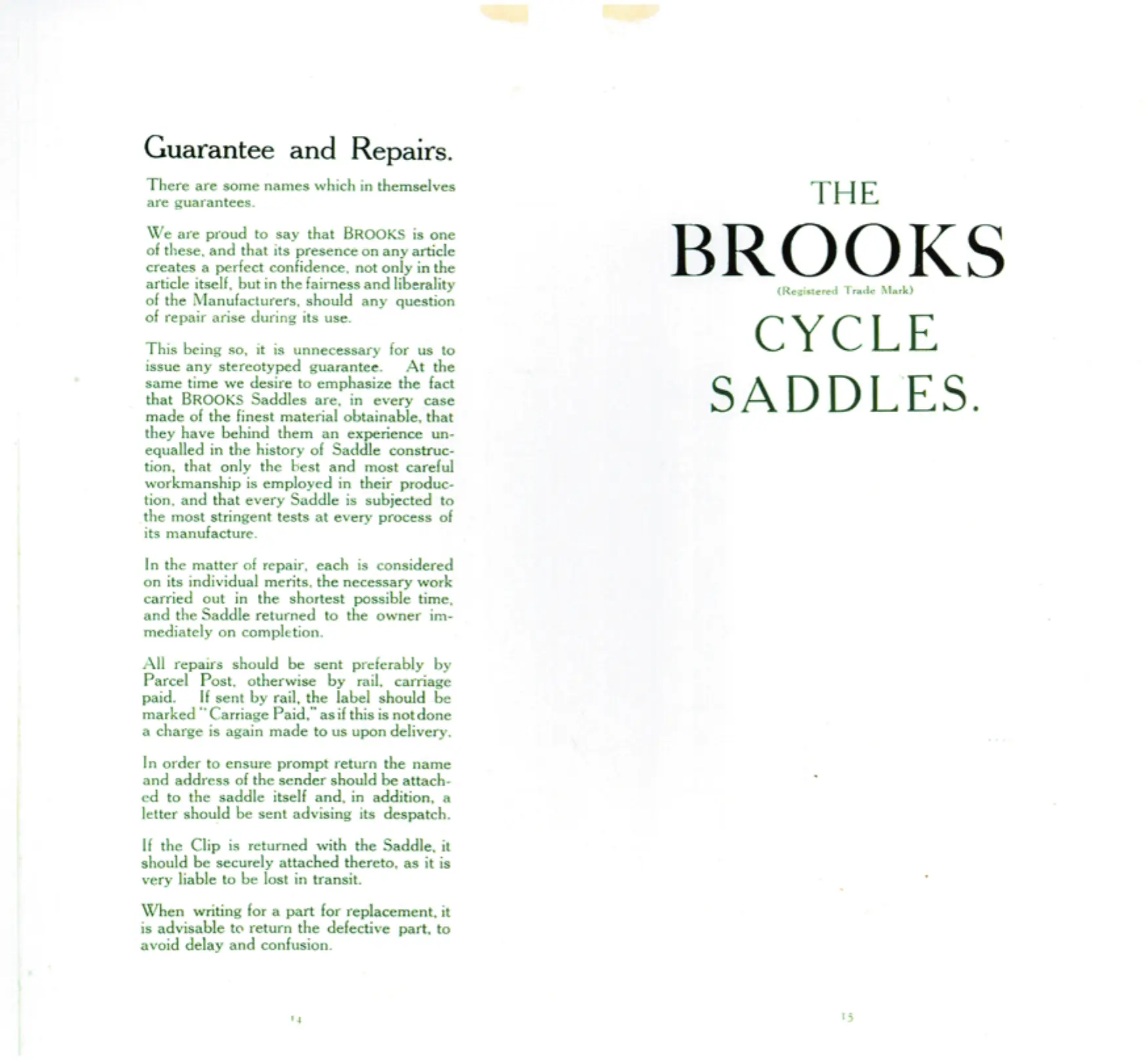
[Two page opening. The left page is letterpress, the guarantee and repairs statement. The right page is a section divider carrying only the display heading, the rest of the page blank.]
[Printed page 14.]
Guarantee and Repairs.
There are some names which in themselves are guarantees.
We are proud to say that BROOKS is one of these, and that its presence on any article creates a perfect confidence, not only in the article itself, but in the fairness and liberality of the Manufacturers, should any question of repair arise during its use.
This being so, it is unnecessary for us to issue any stereotyped guarantee. At the same time we desire to emphasize the fact that BROOKS Saddles are, in every case made of the finest material obtainable, that they have behind them an experience unequalled in the history of Saddle construction, that only the best and most careful workmanship is employed in their production, and that every Saddle is subjected to the most stringent tests at every process of its manufacture.
In the matter of repair, each is considered on its individual merits, the necessary work carried out in the shortest possible time, and the Saddle returned to the owner immediately on completion.
All repairs should be sent preferably by Parcel Post, otherwise by rail, carriage paid. If sent by rail, the label should be marked “Carriage Paid,” as if this is not done a charge is again made to us upon delivery.
In order to ensure prompt return the name and address of the sender should be attached to the saddle itself and, in addition, a letter should be sent advising its despatch.
If the Clip is returned with the Saddle, it should be securely attached thereto, as it is very liable to be lost in transit.
When writing for a part for replacement, it is advisable to return the defective part, to avoid delay and confusion.
[Printed page 15, a section divider, otherwise blank.]
THE BROOKS (Registered Trade Mark) CYCLE SADDLES.
— Sheet 16. Printed pages 28 and 29 —
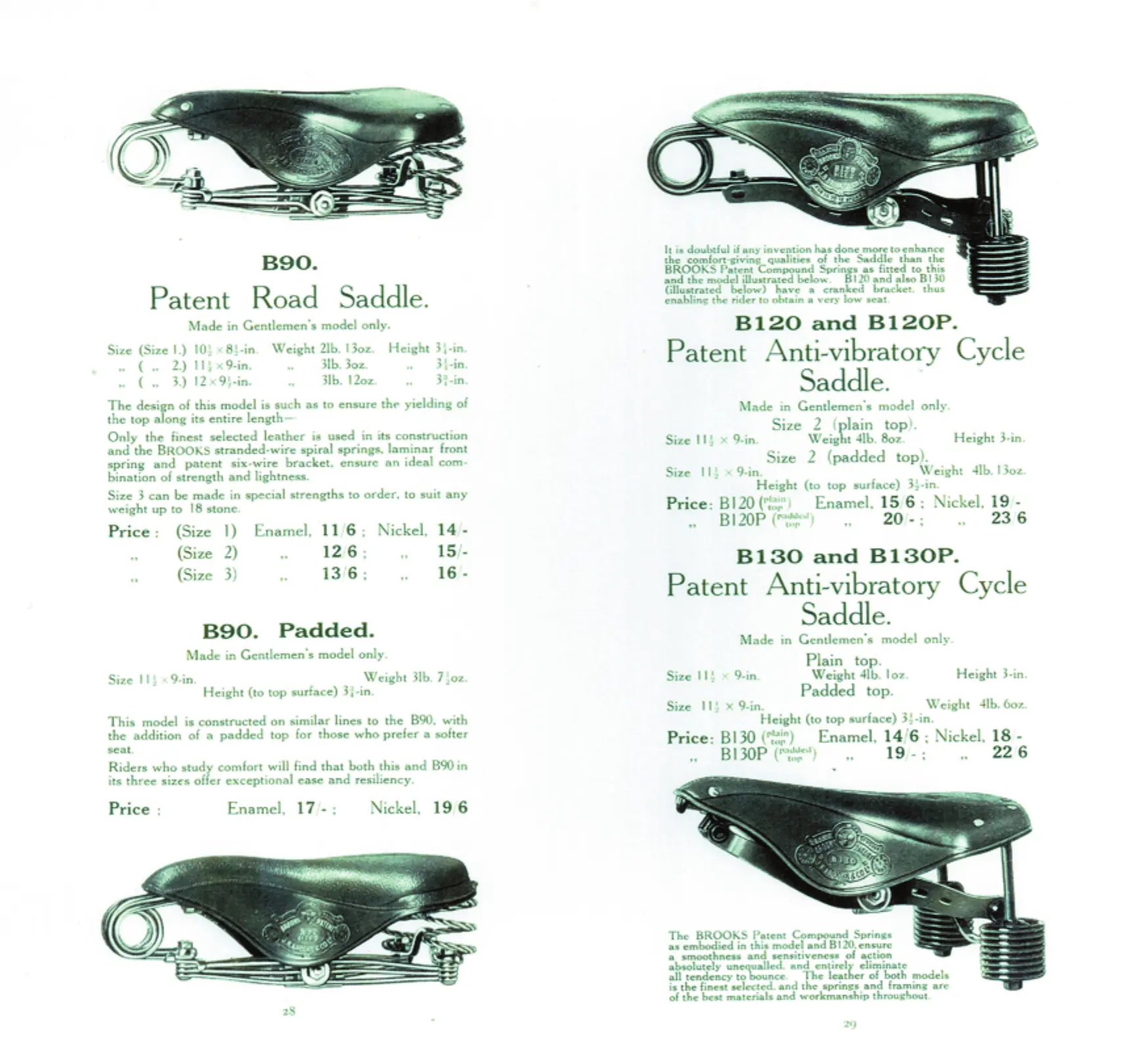
[Two page opening. The left page carries the B 90 in two photographs, the plain model at the head and the padded model at the foot, both in three-quarter view showing the stranded-wire spiral springs and the six-wire bracket. The right page carries the two compound spring models, again one photograph at the head and one at the foot, the coil springs prominent at the rear of each. This is the leaf that carries the control model and the flagged top surface exception.]
[Printed page 28.]
B90.
Patent Road Saddle.
Made in Gentlemen’s model only.
Size (Size 1.) 10 1/2 x 8 1/2-in. Weight 2lb. 13oz. Height 3 in. and a fraction [the vulgar fraction is below this scan’s resolution and is not recorded]
” ( ” 2.) 11 1/2 x 9-in. ” 3lb. 3oz. ” 3 in. and a fraction [not resolved]
” ( ” 3.) 12 x 9 1/2-in. ” 3lb. 12oz. ” 3 in. and a fraction [not resolved]
The design of this model is such as to ensure the yielding of the top along its entire length-
Only the finest selected leather is used in its construction and the BROOKS stranded-wire spiral springs, laminar front spring and patent six-wire bracket, ensure an ideal combination of strength and lightness.
Size 3 can be made in special strengths to order, to suit any weight up to 18 stone.
Price : (Size 1) Enamel, 11/6 ; Nickel, 14/-
” (Size 2) ” 12/6 ; ” 15/-
” (Size 3) ” 13/6 ; ” 16/-
B90. Padded.
Made in Gentlemen’s model only.
Size 11 1/2 x 9-in. Weight 3lb. 7 1/2oz.
Height (to top surface) 3 in. and a fraction [not resolved]
This model is constructed on similar lines to the B90, with the addition of a padded top for those who prefer a softer seat.
Riders who study comfort will find that both this and B90 in its three sizes offer exceptional ease and resiliency.
Price : Enamel, 17/- ; Nickel, 19/6
[Printed page 29.]
[Caption printed beneath the upper photograph.] It is doubtful if any invention has done more to enhance the comfort-giving qualities of the Saddle than the BROOKS Patent Compound Springs as fitted to this and the model illustrated below. B120 and also B130 (illustrated below) have a cranked bracket, thus enabling the rider to obtain a very low seat.
B120 and B120P.
Patent Anti-vibratory Cycle Saddle.
Made in Gentlemen’s model only.
Size 2 (plain top).
Size 11 1/2 x 9-in. Weight 4lb. 8oz. Height 3-in.
Size 2 (padded top).
Size 11 1/2 x 9-in. Weight 4lb. 13oz.
Height (to top surface) 3 1/2-in.
Price: B120 (plain top) Enamel, 15/6 ; Nickel, 19/-
” B120P (padded top) ” 20/- ; ” 23/6
B130 and B130P.
Patent Anti-vibratory Cycle Saddle.
Made in Gentlemen’s model only.
Plain top.
Size 11 1/2 x 9-in. Weight 4lb. 1oz. Height 3-in.
Padded top.
Size 11 1/2 x 9-in. Weight 4lb. 6oz.
Height (to top surface) 3 1/2-in.
Price: B130 (plain top) Enamel, 14/6 ; Nickel, 18/-
” B130P (padded top) ” 19/- ; ” 22/6
[Caption printed beneath the lower photograph.] The BROOKS Patent Compound Springs as embodied in this model and B120, ensure a smoothness and sensitiveness of action absolutely unequalled, and entirely eliminate all tendency to bounce. The leather of both models is the finest selected, and the springs and framing are of the best materials and workmanship throughout.
— Sheet 24. Printed pages 44 and 45 —
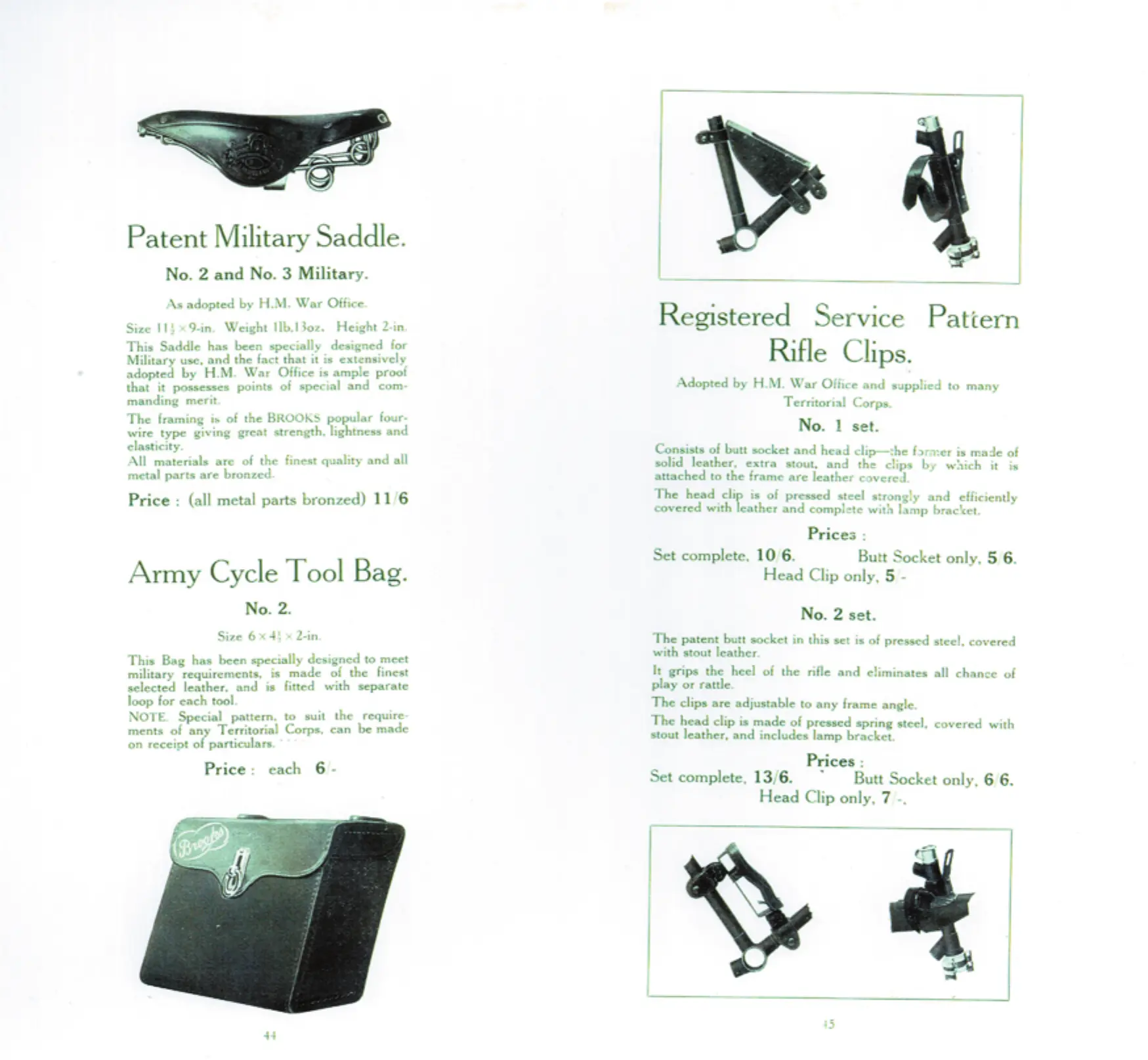
[Two page opening, and the clearest single demonstration in this collection of the No. 1 and No. 2 confusion. The left page carries the military saddle in three-quarter view at the head and the army tool bag photographed at the foot. The right page carries two boxed photographs of rifle clip sets, one at the head and one at the foot, with the letterpress between them. Between the two pages the opening offers a No. 1, two No. 2s and a No. 3, across saddles, bags and clips.]
[Printed page 44.]
Patent Military Saddle.
No. 2 and No. 3 Military.
As adopted by H.M. War Office.
Size 11 1/2 x 9-in. Weight 1lb. 13oz. Height 2-in.
This Saddle has been specially designed for Military use, and the fact that it is extensively adopted by H.M. War Office is ample proof that it possesses points of special and commanding merit.
The framing is of the BROOKS popular four-wire type giving great strength, lightness and elasticity.
All materials are of the finest quality and all metal parts are bronzed.
Price : (all metal parts bronzed) 11/6
Army Cycle Tool Bag.
No. 2.
Size 6 x 4 1/2 x 2-in.
This Bag has been specially designed to meet military requirements, is made of the finest selected leather, and is fitted with separate loop for each tool.
NOTE. Special pattern, to suit the requirements of any Territorial Corps, can be made on receipt of particulars.
Price : each 6/-
[Printed page 45.]
Registered Service Pattern Rifle Clips.
Adopted by H.M. War Office and supplied to many Territorial Corps.
No. 1 set.
Consists of butt socket and head clip-the former is made of solid leather, extra stout, and the clips by which it is attached to the frame are leather covered.
The head clip is of pressed steel strongly and efficiently covered with leather and complete with lamp bracket.
Prices : Set complete, 10/6. Butt Socket only, 5/6. Head Clip only, 5/-
No. 2 set.
The patent butt socket in this set is of pressed steel, covered with stout leather.
It grips the heel of the rifle and eliminates all chance of play or rattle.
The clips are adjustable to any frame angle.
The head clip is made of pressed spring steel, covered with stout leather, and includes lamp bracket.
Prices : Set complete, 13/6. Butt Socket only, 6/6. Head Clip only, 7/-.
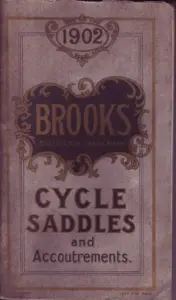 Brooks 1902 Catalog — Cycle Saddles and Accoutrements for 1902
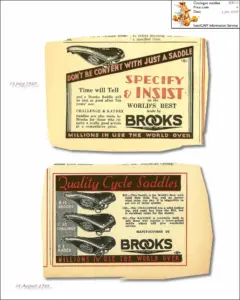 Brooks 1935 Advertisement — Specify and Insist, and Quality Cycle Saddles with Challenge and Kaydex
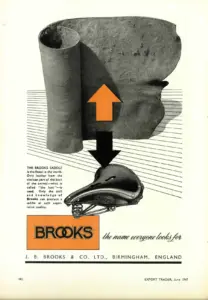 Brooks 1947 Advertisement — The Name Everyone Looks For (Export Trader)
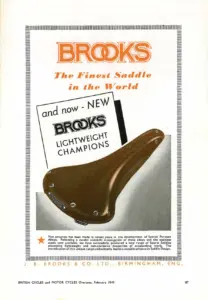 Brooks 1949 Advertisement — The New Lightweight Champions (British Cycles and Motor Cycles Overseas)
 Brooks chez A.F.C.O. — L’Officiel du cycle, 3 November 1951, Brooks Represented in France by AFCO
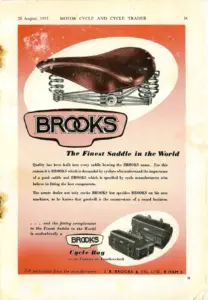 Brooks 1955 Advertisement — It’s the Saddle that Sells the Cycle (Motor Cycle and Cycle Trader)
Ebykr presents this material for research and education. If you hold rights to it or notice an ownership issue, please contact us and we will respond promptly.
The Ebykr Digest
New articles, timelines, catalog finds and registry activity — assembled from the archive once a month. Your address is never shared.
Double opt-in. One email per month. Unsubscribe at any time with one click.