About Ebykr
Ebykr celebrates classic and vintage lightweight bicycles through provocative imagery and opinion. Ride along with us.
About Ebykr
Ebykr celebrates classic and vintage lightweight bicycles through provocative imagery and opinion. Ride along with us.

A practical guide to dating a vintage Motobécane: telling the French bicycles from MBK and the modern imports, what the frame stamps may mean, and how the 1979 catalog, the tubing and the components date the bicycle.

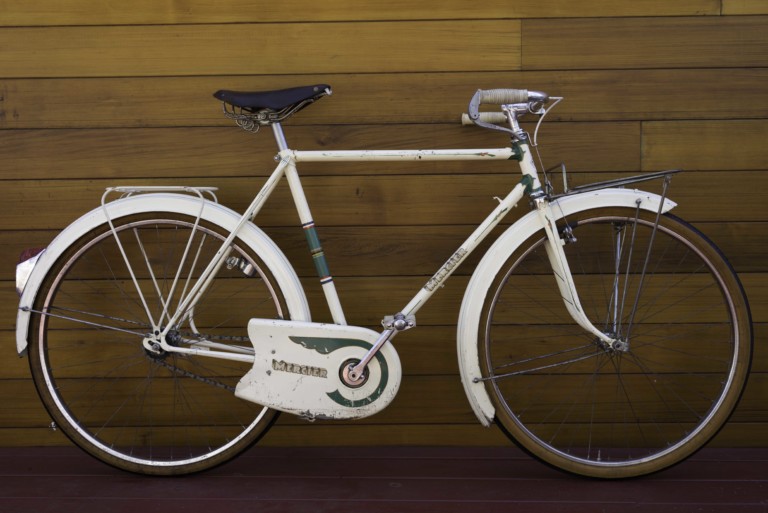
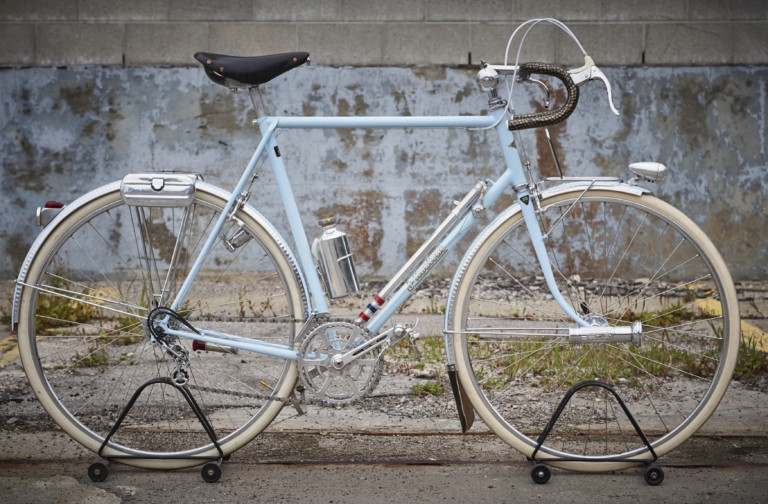
Motobécane was one of the largest bicycle makers in France and in the 1970s it became one of the most common French bicycles in America. Its machines ran from children’s bicycles and plain 10-speeds to the Team Champion racer, and racing frames from the same works carried Luis Ocaña to his 1973 Tour de France win. Many of them are still on the road and the question their owners ask most is the year they were made.
There is no published key to a Motobécane frame number, so the year has to come from the bicycle as a whole: the model, the tubing, the components and the catalog that matches them. This guide starts with the one check that saves the most confusion and then works through the evidence in the order an experienced eye uses it. Readers of Ebykr will be familiar with this method.
The name has had three lives and they are easy to confuse.
A lugged steel road bicycle with French or Japanese parts of the 1970s and a Motobécane transfer belongs to the first group, and that is the bicycle this guide dates.
Motobécane never published a key to its frame numbers and no Motobécane catalog explains them. What exists is a survey by collectors on the Bike Forums classic and vintage board, built up over several years from owners’ reports. It proposes three things:
That is a promising lead and it is not yet more than a lead. We have not been able to test it against frames dated by independent evidence and we found no such test in print. If your frame carries a stamp of either kind, compare it with the dated parts described below: when the stamp and the parts agree, you have confirmed the reading for one more bicycle, and when they disagree, the parts win. Then record it in the Ebykr Serial-Number Registry with the stamp, where it sits and the evidence that dated the bicycle. One more caution: Motobécane’s mopeds have serial charts of their own, and an engine number has nothing to say about a bicycle frame.
Motobécane’s American catalog for 1979 sets out the whole range in one table, and it shows how much the model tells you. It sorts the bicycles into touring, sport and racing families and names the tubing of each.
| Family | Models | Frame as the 1979 catalog describes it | Typical parts |
|---|---|---|---|
| Touring | Nomade, Nomade Sprint, Mirage, Super Mirage | “Fully lugged 2040 high resiliency tubing” | Huret, SunTour or Shimano derailleurs, SR or Shimano cranks, Normandy, Atom or Shimano hubs |
| Touring | Grand Touring | “Double butted VITUS 172 (3 tubes),” oval 438 mm chainstays | SunTour derailleurs, SR crank, Weinmann center-pull brakes, Normandy hubs |
| Sport | Grand Jubilé | “Double butted VITUS 172 (3 tubes),” oval 438 mm chainstays | SunTour Cyclone GT, SR crank, Weinmann Vainqueur 999 brakes, Normandy hubs |
| Sport | Grand Sprint | “Fully lugged VITUS 888 (3 tubes),” 419 mm chainstays | Shimano Altus, Sugino crank, Weinmann side-pull brakes, Atom hubs |
| Sport | Grand Record | “Double butted VITUS 172 (3 tubes)” | Shimano 600 throughout: derailleurs, crank, brakes and hubs |
| Racing | Le Champion | “Double butted REYNOLDS (8 tubes),” Campagnolo dropouts | Campagnolo Nuovo Record derailleurs and Gran Sport crank, brakes and hubs |
| Racing | Team Champion | “Double butted COLUMBUS (8 tubes),” Cinelli bottom bracket shell, Campagnolo dropouts | Campagnolo Record and Super Record |
Two details in that table are worth carrying to the bicycle. The first is the chainstay: the catalog gives its touring frames oval stays of 438 mm “instead of 419 mm,” so a tape measure separates a Grand Touring or Grand Jubilé from the 419 mm Grand Sprint or the racing-stayed Grand Record even when the paint has gone. The second is that tubing changed under a model’s name. Owners report Reynolds 531 main tubes on Grand Records of 1973 and 1974, where the 1979 Grand Record is Vitus 172, so the tubing transfer on the seat tube tells you which Grand Record you have.
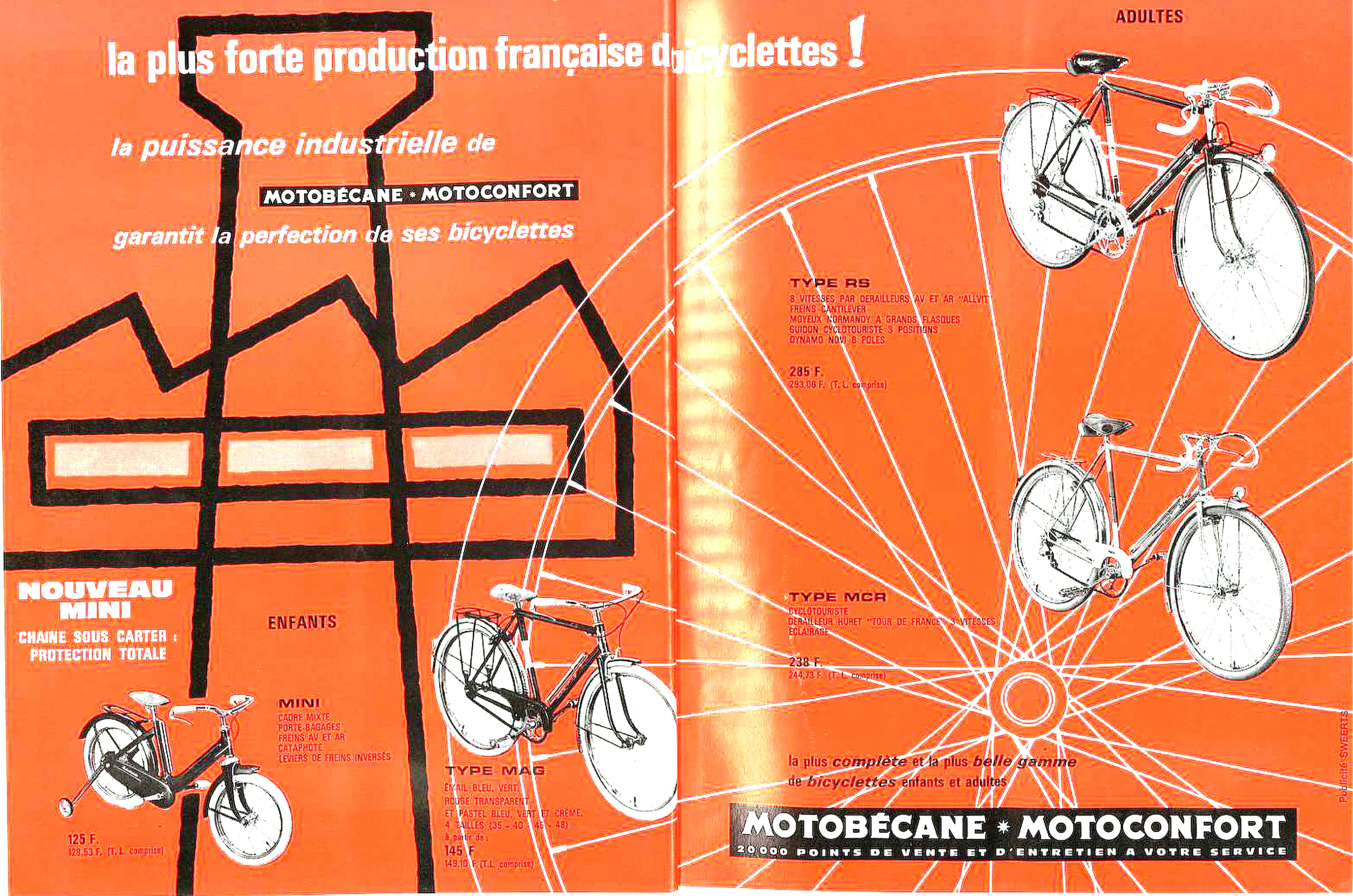
For other years, the French collectors’ site La bible du vélo has gathered Motobécane catalogs for most years from 1967 to 1985, along with a Motoconfort book of 1965. The Ebykr Catalog Archive now holds Motobécane catalogs for 1978, 1979, 1980, 1981, 1982, 1983, 1984 and 1985, five more dated by estimate to about 1973, 1974, 1975, 1976 and 1977, a catalog of the Riviera, Nobly and Nomade and a French MBK catalog of 1984 or later. It also holds Motobécane’s advertisements from the Salons of 1964 and 1966, which show the range of that decade: the RS tourer with eight speeds by Allvit, cantilever brakes and large-flange Normandy hubs in 1964, and the CL, RL and DCL with Allvit derailleurs and chromed Italian-style forks in 1966.
Beyond the tubing transfer, three features narrow the era. Motobécane moved most of its frames to Swiss-threaded bottom brackets in the mid 1970s, where earlier frames are French-threaded, so measure the threads before you order a bottom bracket, and treat the thread as a clue to the decade. The tricolor “M” was Motobécane’s mark through the bike-boom years and the 1979 catalog prints it in blue, white and magenta on its cover. And the catalog’s own words give a late-1970s finish: “All Motobecane bicycle frames are coated with a plastic metalized paint.” None of these gives a single year, but each one moves a bicycle to the correct side of a line.
The parts are the most reliable clock on a Motobécane and on an American one they come in two kinds. The older and lower models carry French equipment, Normandy and Maillard hubs, Huret and Simplex derailleurs and the rest, several of which carry date stamps. By 1979 most of the American range wore Japanese parts from new: SunTour and Shimano derailleurs, SR and Sugino cranks and Shimano hubs. Those parts are original, not later replacements, and Shimano’s two-letter date code reads straight off them. Both the French and the Japanese codes are explained in How to Date a Vintage Bicycle by Its Components, and the Campagnolo on the two racing models is covered in How to Identify and Date Vintage Campagnolo Components.
Remember that a part dates itself. A date taken from a component is the earliest the bicycle can be in its present form, so look for two or three parts that agree before you trust the answer.
Suppose a Grand Record comes in, painted new blue, with a Vitus 172 transfer on the seat tube.
The parts were made late in 1978 and the specification matches the 1979 catalog line for line, so this is a 1979 Grand Record. If its bottom bracket shell also carries a stamp, note what it says, because a reading that agrees with the parts is exactly the evidence the frame-number survey needs.
Motobécane dating will improve only as owners share what their bicycles carry. When you have placed yours, add it to the Ebykr Serial-Number Registry with every stamp, where each one sits, the model and the parts that dated it, and browse the Motobécane documents in the Ebykr Catalog Archive. If you own a Motobécane catalog, a price list or a dealer sheet, even a single page, it becomes a dating tool for everyone once it is in the archive.
The Ebykr Identify and Date series also covers Peugeot, Motobécane’s great French rival, Raleigh, Fuji and Reynolds tubing, with every guide gathered on the Identify and Date hub.
Motobécane documents in the Ebykr Catalog Archive: advertisement, October 1964 and advertisement, October 1966
Motobécane catalogs in the Ebykr Catalog Archive: 1978, 1979, 1980, 1981, 1982, 1983, 1984 and 1985
VeloBase — Motobécane 1979 catalog (United States)
La bible du vélo — Motobécane catalogs, 1965 to 1985
Bike Forums — Motobecane Serial Number Database
Classic Rendezvous — Motobecane
Wikipedia — Motobécane
Wikipédia — Motobécane (French)
MTB Timeline — Motobécane/MBK
Ebykr — How to Date a Vintage Bicycle by Its Components
Ebykr — How to Identify and Date Vintage Campagnolo Components
 Motobecane
Ebykr documents this marque across the archive. Here is the rest of it.
The Ebykr Digest
New articles, timelines, catalog finds and registry activity — assembled from the archive once a month. Your address is never shared.
Double opt-in. One email per month. Unsubscribe at any time with one click.