About Ebykr
Ebykr celebrates classic and vintage lightweight bicycles through provocative imagery and opinion. Ride along with us.
About Ebykr
Ebykr celebrates classic and vintage lightweight bicycles through provocative imagery and opinion. Ride along with us.

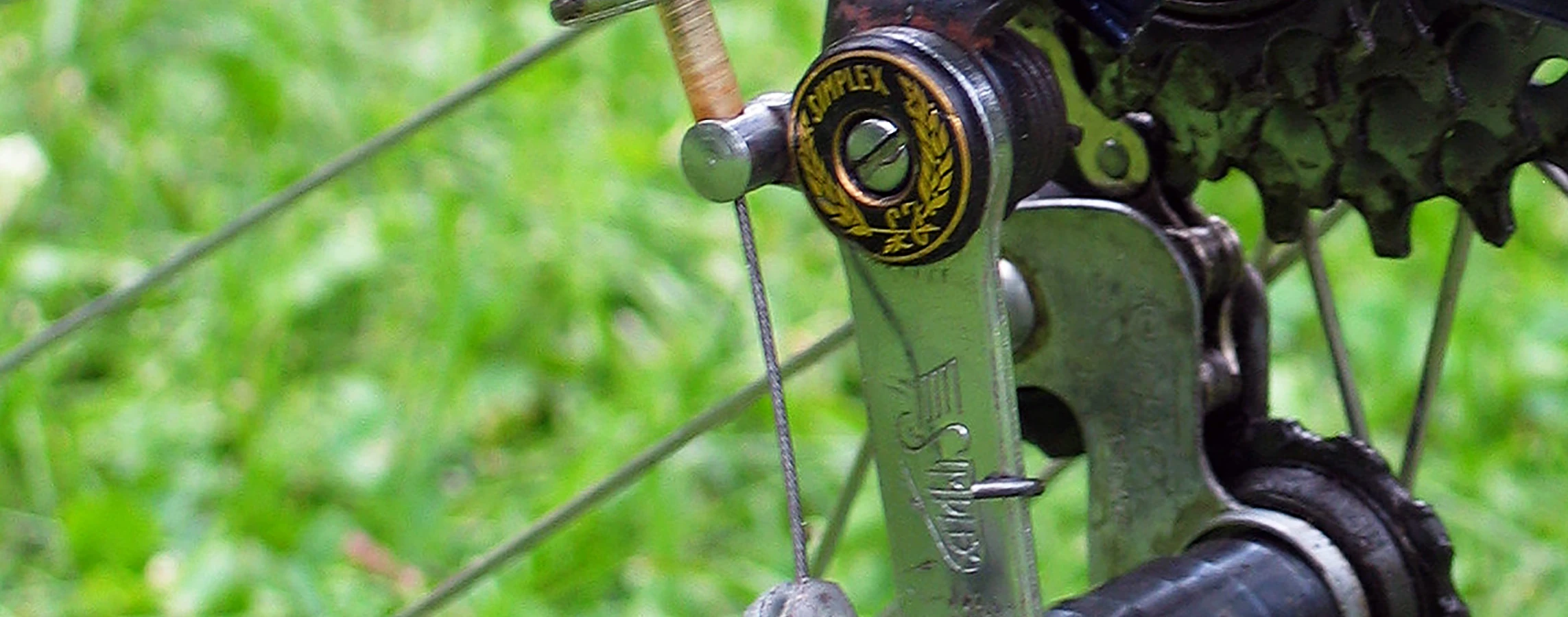
How to tell a Huret from a Simplex and put a year on either: the Huret week-and-year stamp, why a Simplex has no date code to read, the Prestige changes year by year and how to decode a Simplex model reference.
Huret and Simplex made most of the derailleurs on French bicycles from the 1930s to the 1980s, and a great many of those on British and American ones. Both are easy to recognize. Dating them is another matter and the two makers differ sharply on this. A Huret of the mid-1970s or later usually carries a stamped date that you can read in seconds. A Simplex, as far as anyone has been able to show, does not. It is dated by model, materials and the reference number Simplex gave it, read against the catalogs and trade papers of the time.
This guide is built from the documents in the Ebykr archive first: the makers’ own instructions, advertisements and catalogs, and the Paris Salon reports Daniel Rebour drew for Le Cycle. For the story of the two firms, read Huret and Simplex: The Rivals Who Made the French Derailleur.
Both makers put their names on their gears and the form of the name is the first clue to the era.
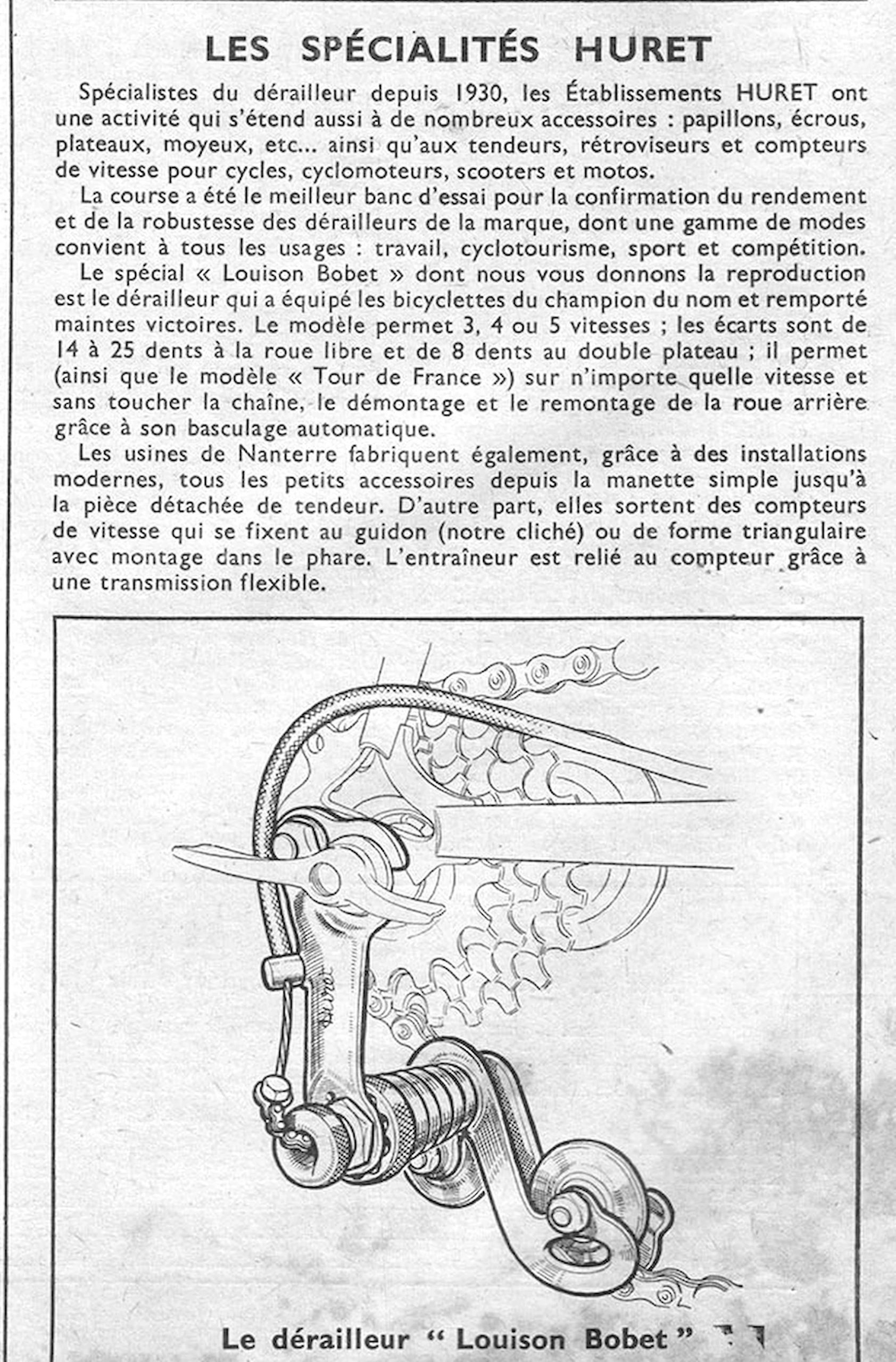
Before you look for any number, look at how the derailleur works. That alone places it within a decade or two.
Many Huret front and rear derailleurs carry a four-digit stamp. The first two digits are the week of the year and the last two the year, so 1182 is the 11th week of 1982. Look on the back of the derailleur body and, on a front changer, on the cage plates. Sachs kept the system after 1980: a Sachs-Huret Rival stamped 0785, the seventh week of 1985, was found on a 1985 Trek.
Two cautions. The week comes first, so 0675 is the sixth week of 1975, not June. And no one knows when Huret began stamping. The Vintage-Trek reference that sets out the code puts the start in the late 1970s, but Disraeli Gears records a Svelto stamped 0675 and a Challenger stamped 2975, so the stamp was in use by 1975. A Huret without a stamp is not necessarily older: not every part carries one.
Huret did not invent the week-and-year form for itself. Maillard and Normandy stamped their hubs the same way, as How to Date a Vintage Bicycle by Its Components explains, so a French bicycle of the late 1970s can often be dated from its hubs and its derailleur together.
Huret gave its later derailleurs reference numbers, which appear in its own literature and often on the part. The table gives the first dated appearance of each model, from the archive wherever a dated document exists. A model can be older than its first appearance in the archive, never younger.
| Model | Reference | First dated | Evidence |
|---|---|---|---|
| Tour de France, Touriste, Randonneur | 1950 | L’Officiel du cycle, October 1950; 1951 advertisement | |
| Louison Bobet | by 1957 | L’Officiel du cycle, March 1957 | |
| Allvit | 1900 in 1974 | 1958 | Collectors’ date; in the archive from 1964; reference in Cyclo-pedia 1974 |
| Svelto | 2000 | 1963 | New at the Brussels Salon, all steel, 240 g (Le Cycle, October 1964) |
| Luxe | 2100 | October 1966 | New at the Paris Salon with the 700 front (Le Cycle, October 1966) |
| Jubilee | 2200, 2248, 2240; front 500 | 1972 | Collectors’ date; in the archive from Raleigh 1973; fitting instructions |
| Challenger | 2440 | 1974 | “New” in Raleigh 1974 |
| Eco | 2490 | by 1980 | Holdsworth 1980 |
| Duopar | by 1984 | Raleigh 1984, titanium-bodied |
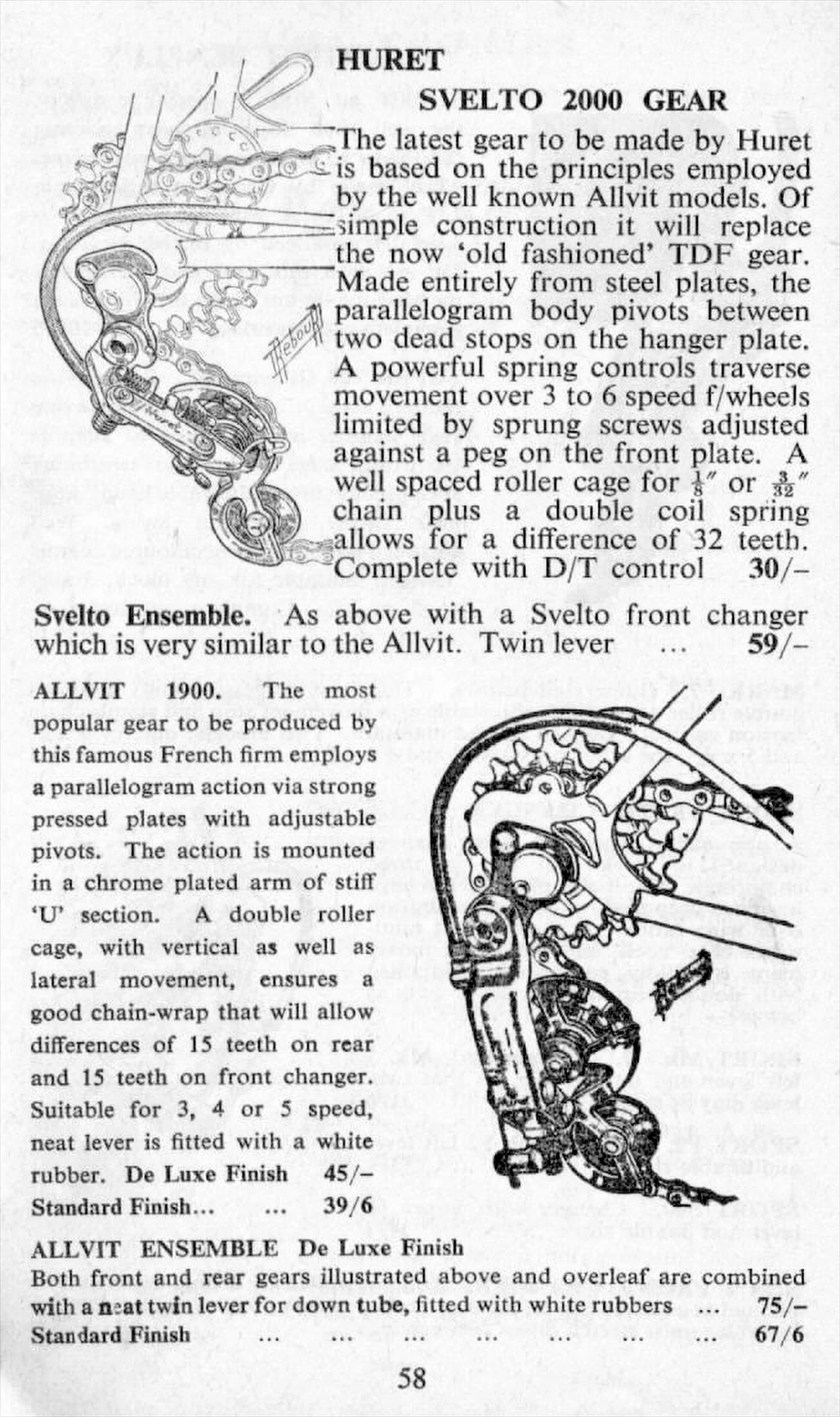
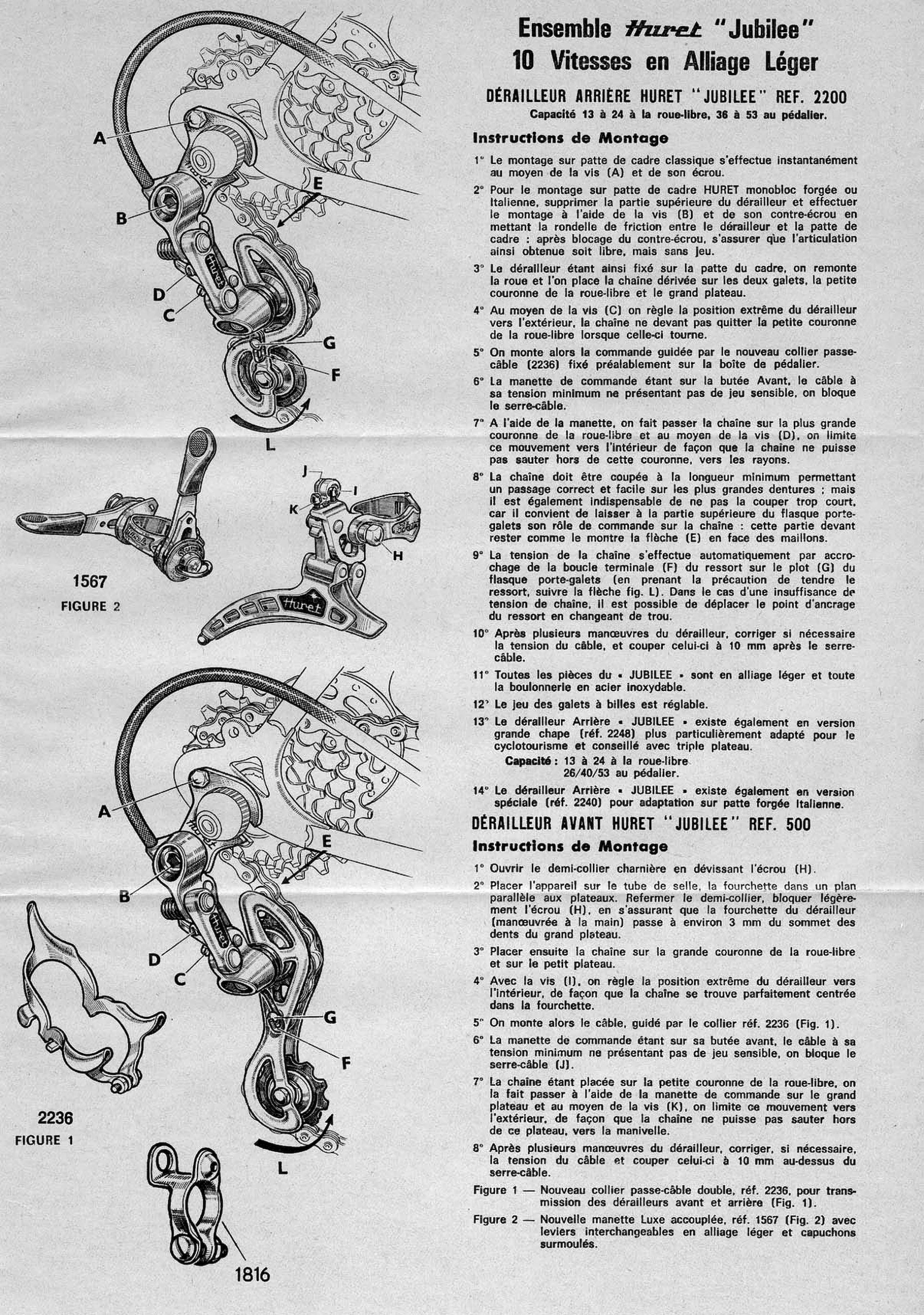
The Jubilee’s three rear versions are worth knowing apart, because the reference tells you what the derailleur was built for. Its fitting instructions give the 2200 for an ordinary forward-slotted dropout, the long-cage 2248 for touring with a triple chainwheel and the 2240 for forged Italian dropouts with a built-in hanger. The same sheet calls every part light alloy and every bolt stainless steel, a useful check on a derailleur sold as a Jubilee.
Ebykr has not found a published key to any Simplex date mark. Some Simplex parts carry small stamped letters and numbers: Disraeli Gears records “D51” on the rear knuckle of one SJ810 and “E26” inside the cage of another derailleur, without a reading for either. Until someone ties marks like these to derailleurs of known date, treat them as unread. If your Simplex carries one, note it together with the model and any dated part on the same bicycle, and share it in the Ebykr forum: enough honest records will settle the question.
Meanwhile, Simplex dates itself well enough by model. The Prestige family is the one most owners meet, and its changes are documented year by year.
For the older gears the 1930s sheet that Simplex reprinted on its 1981 catalog names the Type Route, the Tour de France 34, the Champion de France 36 and the Super-Simplex; Holdsworth sold the Champion du Monde in Britain from 1938, the postwar Tour de France from 1952 and a nylon-roller version by 1958. The Juy 51, the 543 of the mid-1950s and the Juy Record 60 bridge the gap to the parallelogram.
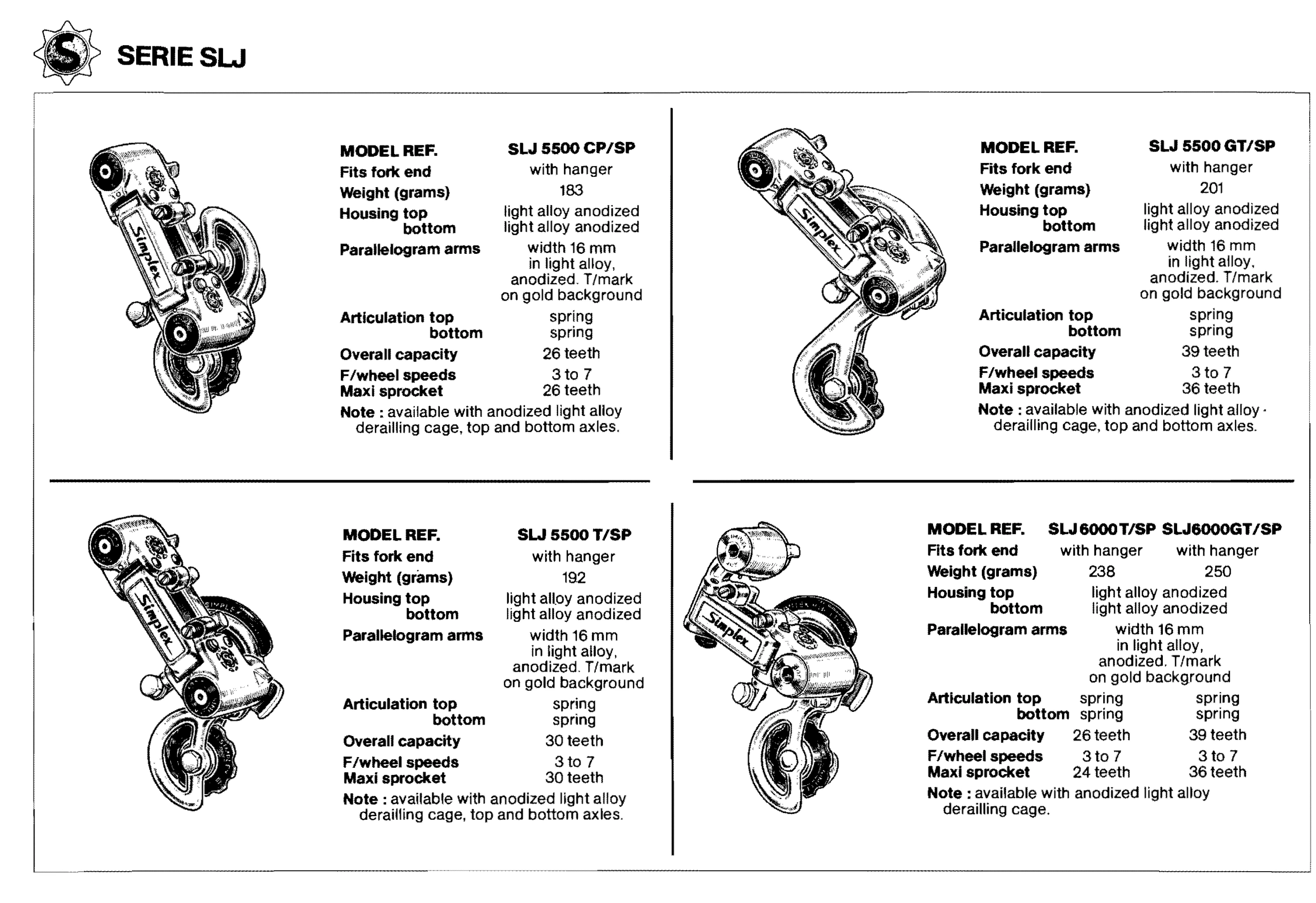
From the 1960s on, Simplex gave its derailleurs references that say what they were built for and the January 1981 catalog sets the system out in full. The letters before the number are the series. For rear derailleurs these run from the S through the SX, SJ and LJ to the SLJ, the Super LJ; front changers add an A, as in the SX A 22 or the SLJ A 502. The letters after the slash describe the cage and the mounting.
| In the reference | What the 1981 catalog says it means |
|---|---|
| /P | Fits a standard fork end |
| /SP | Fits a fork end with a built-in hanger |
| CP | Cage for 26 teeth of total capacity |
| T | Cage for 30 teeth of total capacity on most models (26 on the SLJ 6000 T) |
| GT | Long cage for 39 teeth, largest sprocket 36 |
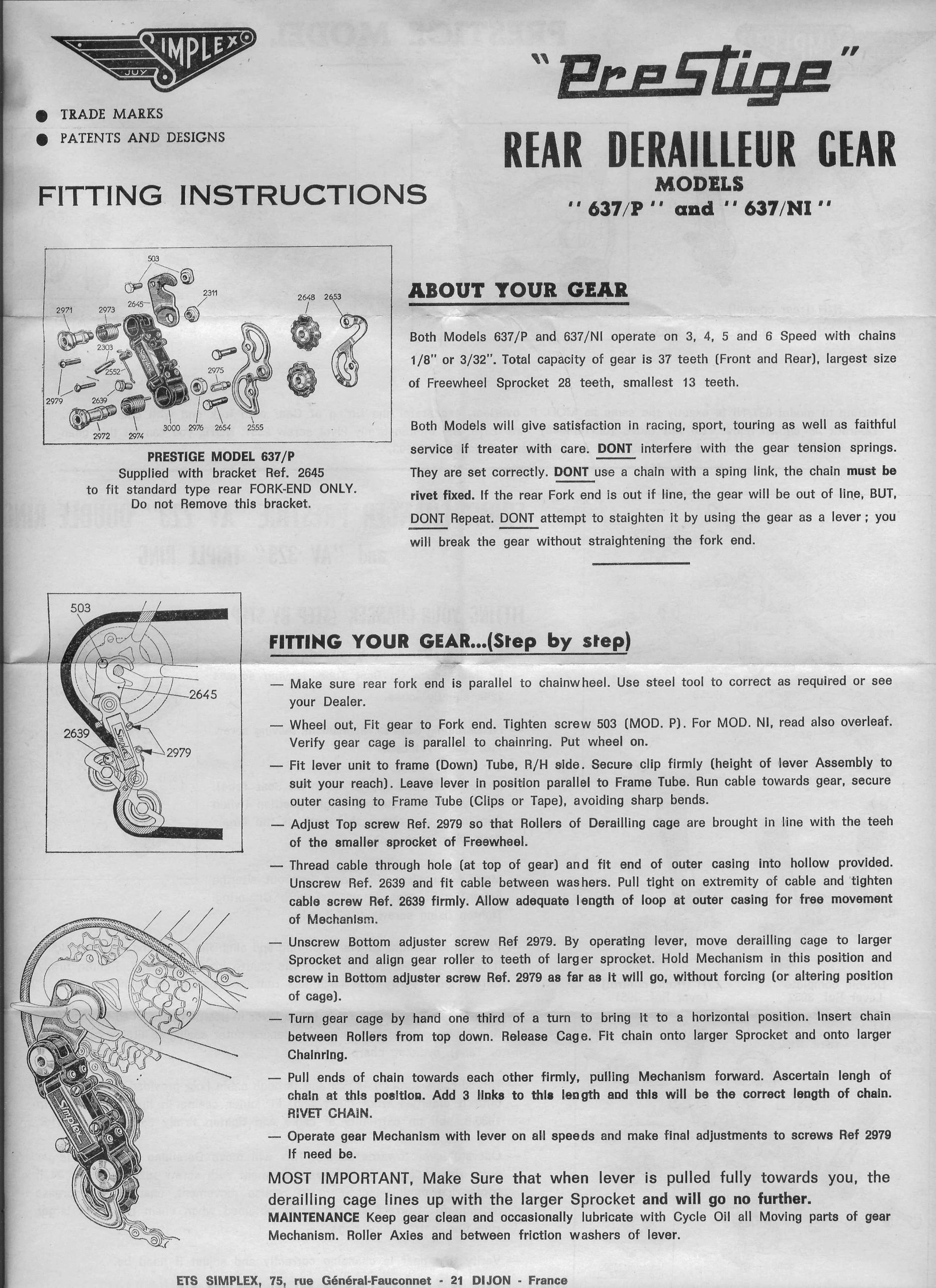
| Prestige 637/P, 637/NI | The same split in the 1960s and 1970s: /P with bracket 2645 for a standard fork end, /NI for a gear hanger |
So an SLJ 5500 GT/SP is a Super LJ with a long touring cage, for a frame with a hanger dropout. The reference will not give you a year on its own, but it tells you whether the derailleur suits the frame it is on and a mismatch is a strong sign of a later swap.
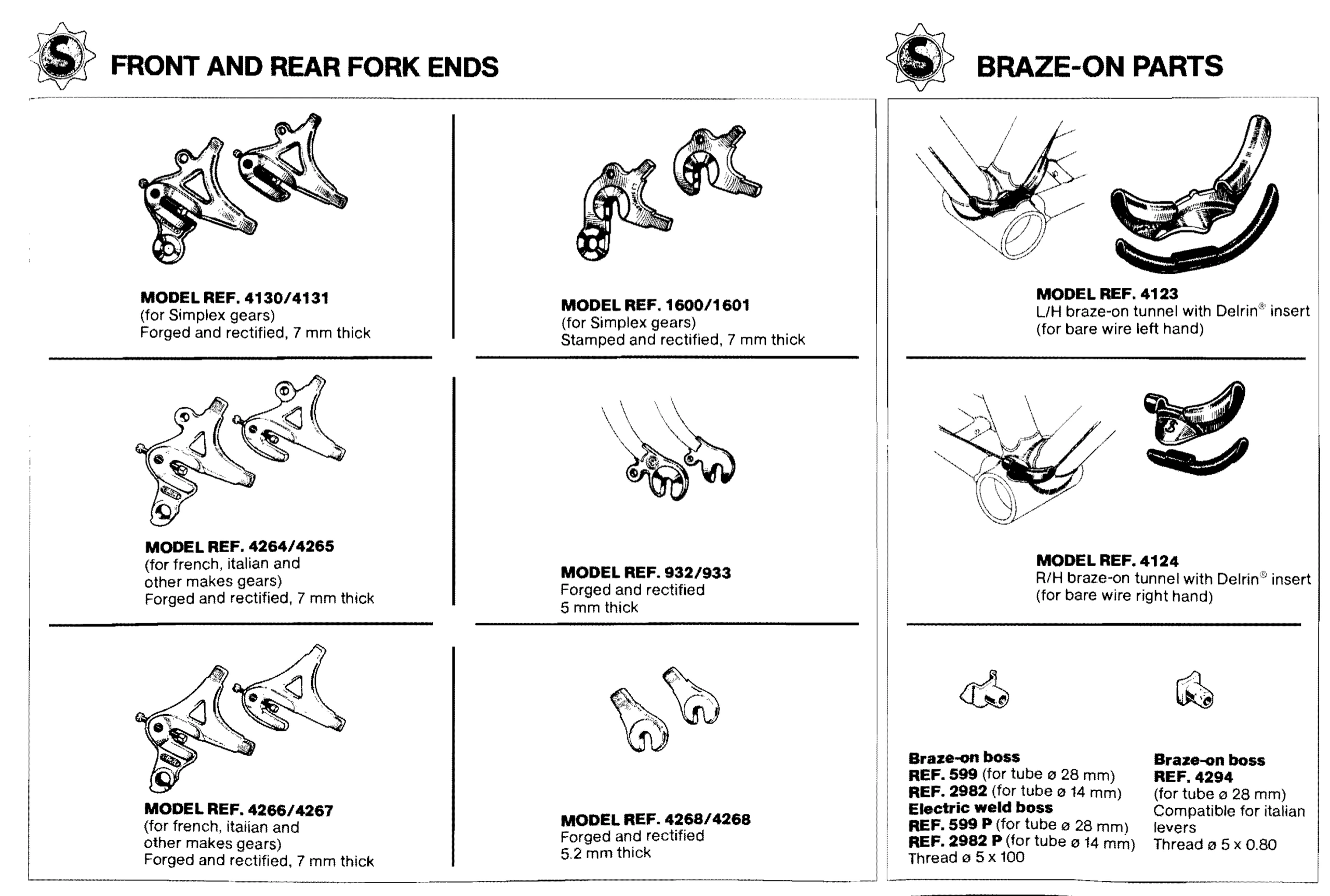
The parts around a derailleur often date a bicycle better than the derailleur, because they are less often changed.
A Huret Challenger stamped 2975. The stamp reads the 29th week of 1975. The Challenger appears as “New” in Raleigh’s 1974 catalog for the United States, so stamp and model agree. A bicycle wearing it as original was assembled in 1975 or a little after and if its hubs carry a Maillard stamp of the same year, the date is close to certain.
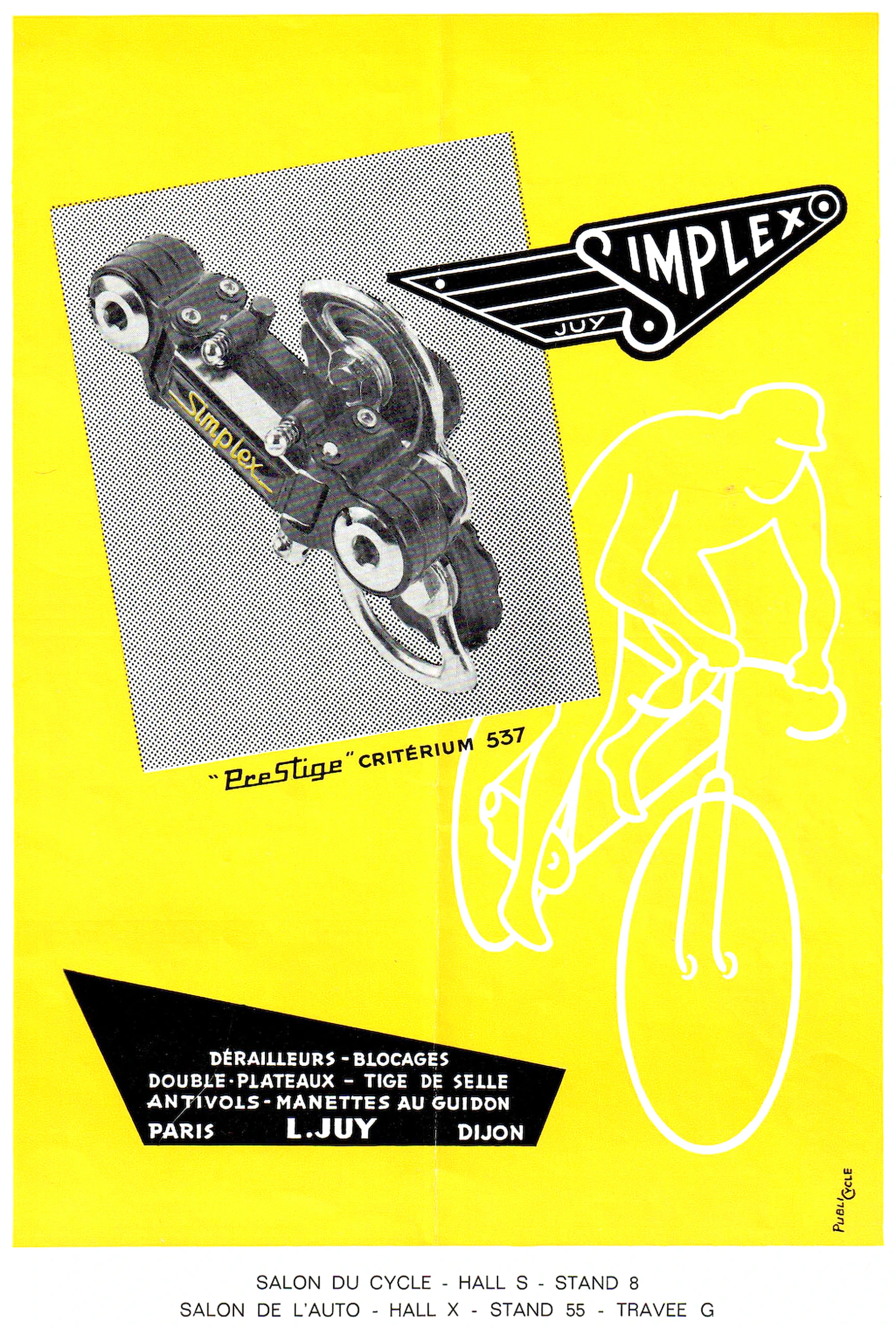
A Simplex Prestige with screws for adjusters but no chromed plates on the outer link. The screws rule out the first Prestige of 1962 to 1965; the missing plates rule out the version shown at the October 1966 Salon. The derailleur is a 537 of 1965 or 1966. It cannot by itself date the bicycle, but nothing else on an original machine should be much later.
A Simplex SLJ 5500 GT/SP. No stamp to read, but the reference says Super LJ, long cage, hanger dropout and the January 1981 catalog lists it. On a frame with a plain forward-slotted dropout and no hanger, it is not the original derailleur.
Browse the makers’ own documents in the Ebykr archive, Huret’s and Simplex’s. For the rest of the bicycle, start with How to Date a Vintage Bicycle by Its Components; for the Italian rival, How to Identify and Date Vintage Campagnolo Components; and for the bicycles that wore Simplex longest, How to Identify and Date a Vintage Peugeot. Every guide in the series is gathered on the Identify and Date hub.
Huret documents in the Ebykr archive: 1951 advertisement, 1964 advertisement, 1966 Luxe advertisement and Jubilee instructions
Simplex documents in the Ebykr archive: 1966 Prestige Critérium advertisement, 1971 advertisement, Prestige 637 instructions and January 1981 catalog
Trade press in the Ebykr archive: L’Officiel du cycle, 21 October 1950 and 30 March 1957; Le Cycle, January 1964, October 1964 (Prestige), October 1964 (Salon) and October 1966
Catalogs in the Ebykr archive: Holdsworth 1952, Holdsworth 1958, Holdsworth 1980, Raleigh 1973, Raleigh 1974, Raleigh 1984 and Gene Portuesi’s Cyclo-pedia 1974
Vintage-Trek — Date of Manufacture for Bicycle Components (Huret and Sachs-Huret)
Disraeli Gears — Huret derailleurs
Disraeli Gears — Huret Svelto 2040
Disraeli Gears — Huret Challenger 2440
Disraeli Gears — Simplex derailleurs
Disraeli Gears — Simplex Prestige 537
Disraeli Gears — Simplex SJ810 GT/P
Classic Lightweights — Simplex Racing Gears (2015)
Ebykr — How to Date a Vintage Bicycle by Its Components
Ebykr — How to Identify and Date Vintage Campagnolo Components
Bike of the Month
Every qualifying bike gets its own page on Ebykr and one each month is named Bike of the Month. Entries for the first Bike of the Year close February 28, 2027.
 Huret
Ebykr documents this marque across the archive. Here is the rest of it.
The Ebykr Digest
New articles, timelines, catalog finds and registry activity — assembled from the archive once a month. Your address is never shared.
Double opt-in. One email per month. Unsubscribe at any time with one click.