About Ebykr
Ebykr celebrates classic and vintage lightweight bicycles through provocative imagery and opinion. Ride along with us.
About Ebykr
Ebykr celebrates classic and vintage lightweight bicycles through provocative imagery and opinion. Ride along with us.

The history of Huret and Simplex, the two great French derailleur makers, told from their own advertisements, instructions and catalogs and the trade press of their day: from wing nuts at Nanterre and a bicycle shop at Dijon to Bobet's Tour victories, the plastic Prestige and the end of the French derailleur.
For half a century two French firms decided how a great many of the world’s lightweight bicycles changed gear. One was Huret, of Nanterre in the western suburbs of Paris. The other was Simplex, the house of Lucien Juy in Dijon. In January 1964 Daniel Rebour, writing in Le Cycle, called them two of the three “grands” of the derailleur, with the third being Campagnolo, and for most of the years between the 1930s and the 1970s a French bicycle (and a good many British and American ones) left the factory wearing one or the other.
Their story is usually told from collectors’ memories and from the one great book on the subject. This account starts somewhere else: in what the two firms and their trade printed at the time. The Ebykr Catalog Archive holds more than 70 documents from the makers’ own hands, split almost evenly between the two firms, and more than a hundred period catalogs, magazine pages and advertisements that name their gears. Where the record is silent, we make no claims and the article says so.
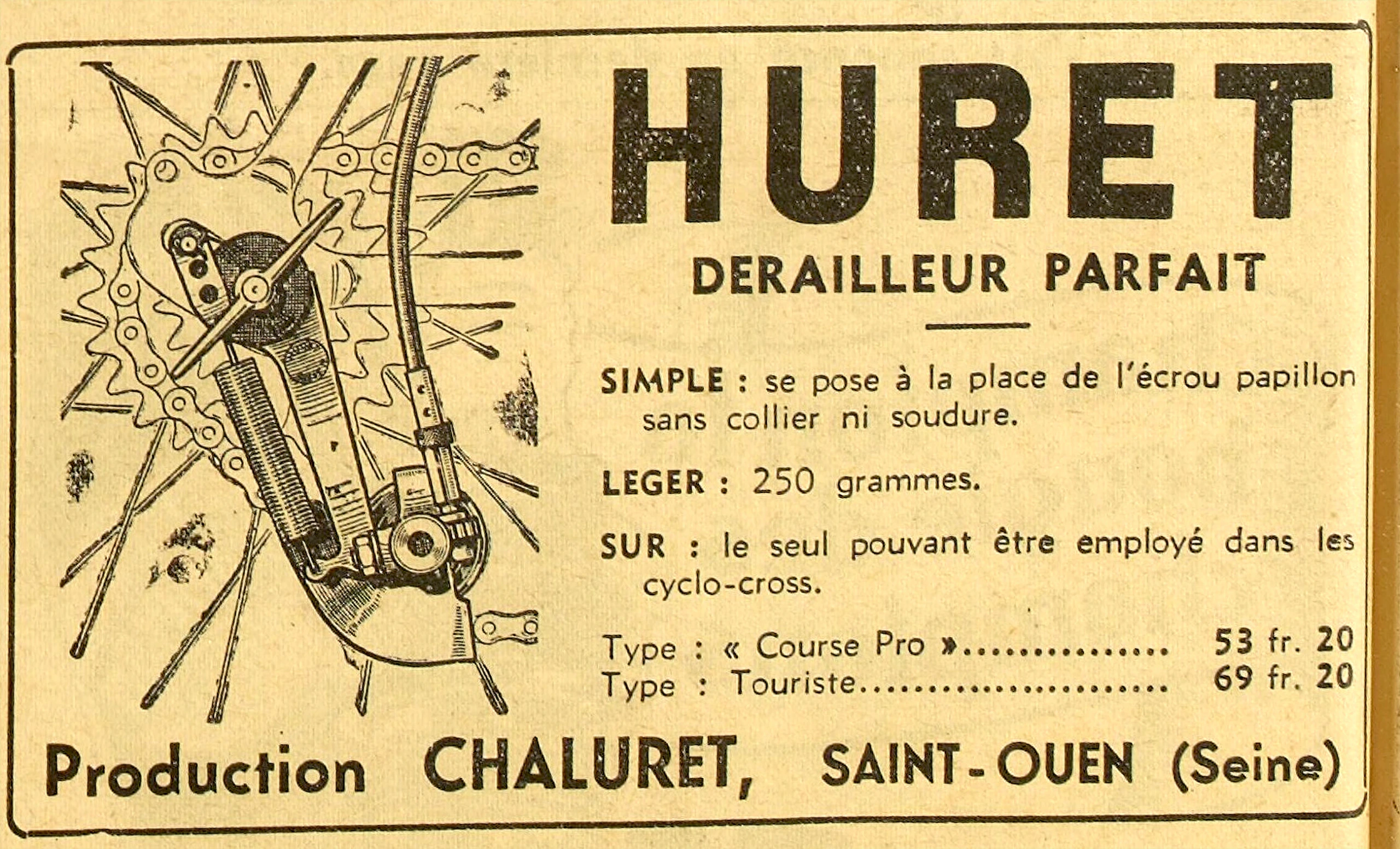
Huret did not start with gears. André Huret founded the firm near Paris in 1920 and its first products were wing nuts for wheel axles. It never gave them up, as many of us can attest, given their prolific nature. A Huret advertisement of October 1951 still drew an open box of them, lettered “JEU DE PAPILLONS-DURAL,” beside its derailleurs, and a trade note of March 1957 lists wing nuts, chainrings, hubs and chain tensioners among the firm’s products before it reaches the speedometers. That same note, in L’Officiel du cycle, calls the Établissements Huret derailleur specialists “since 1930” and places the works, with its modern equipment, at Nanterre. The earliest Huret derailleur patent that the collector and historian Disraeli Gears has found dates from January 1932. By July 1937 an advertisement in L’Auto was calling the firm’s gear the “dérailleur parfait”: 250 grams, in a Course Pro model and a Touriste.
Simplex came to the derailleur about two years before Huret did, by the trade’s own dating, and about 300 kilometers to the southeast. Lucien Juy kept a bicycle shop in Dijon and in 1928 he made his first derailleur. The firm’s own account of those years survives because Simplex reprinted it, half a century later, on the back cover of its January 1981 catalog: a 1930s sheet headed “Historique et palmarès, Le Simplex, 1928-1935.” Its type is small and the scan does not resolve all of it, but the outline is clear enough. In 1928 the maker worked the gear out with riders of the region, in 1929 it won its first races in the Circuit du Jura and the Circuit de l’Allier, and in 1930 it reached the market and big events. As far as the small print can be read, production stood at 40,000 units in 1933 and 60,000 in 1934, and in 1935 Simplex opened new workshops built for more than 100,000 units a year.
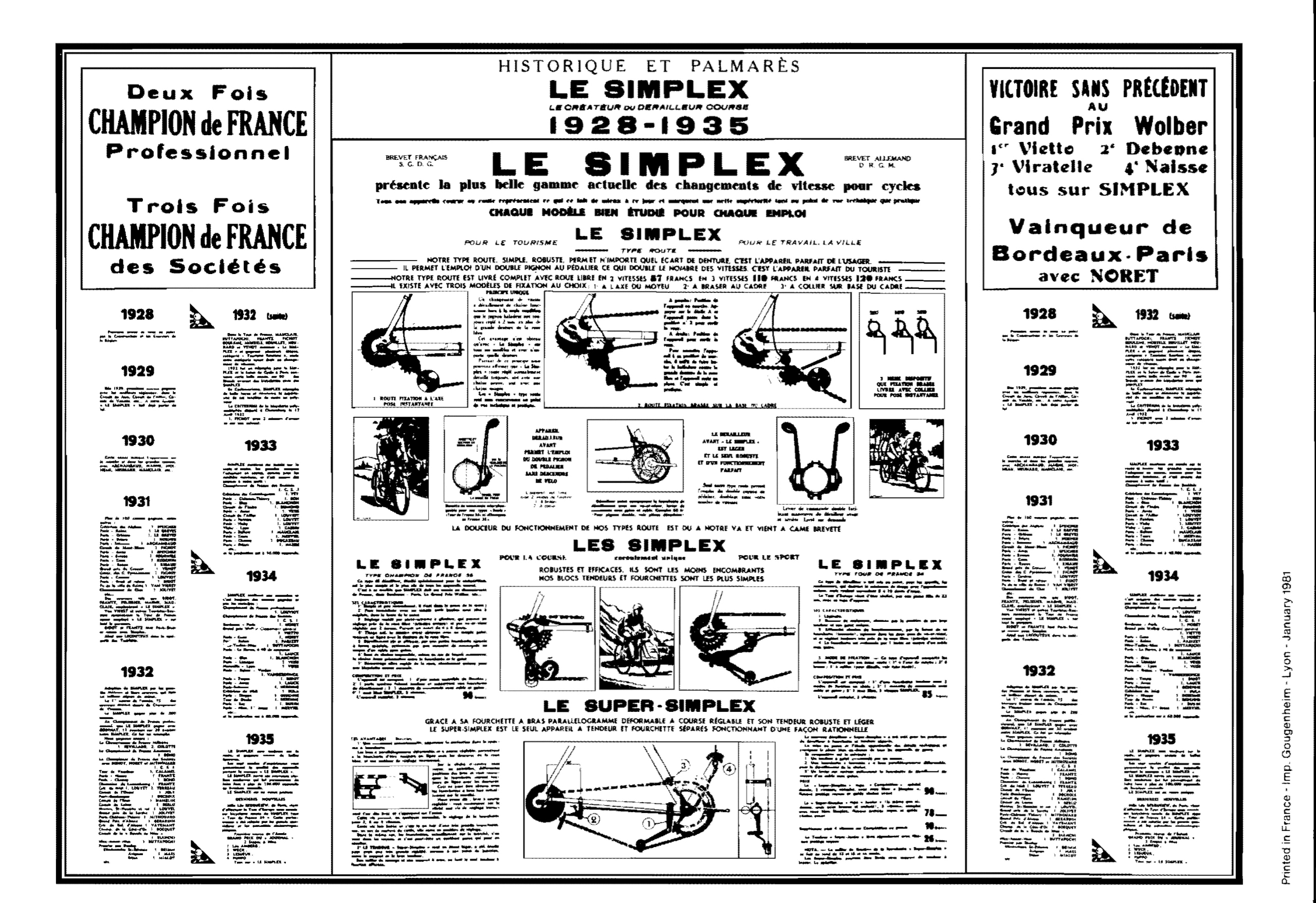
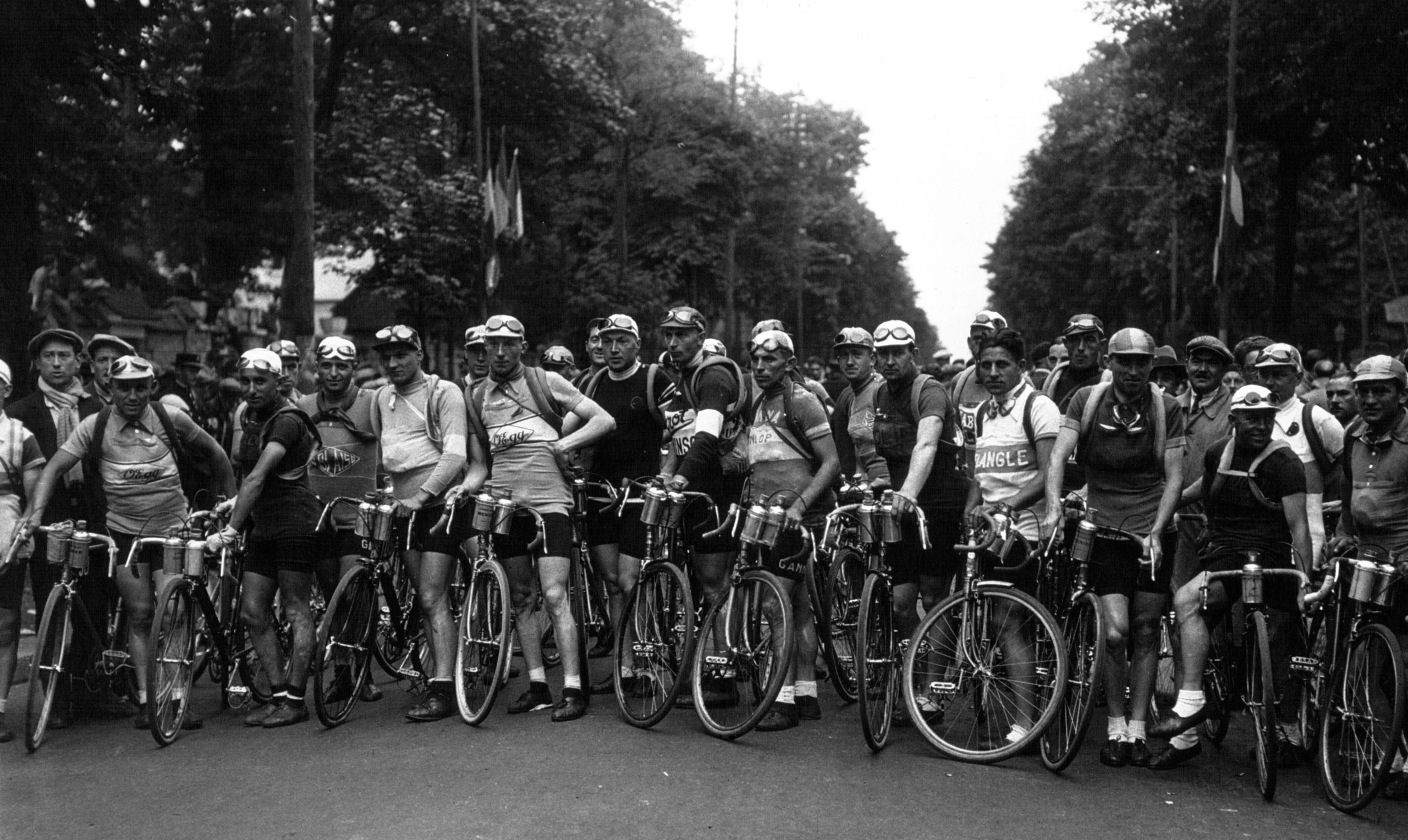
The same back cover holds a detail that explains why the derailleur took so long to reach the front of the field. In the 1932 Tour de France, it says, Simplex riders won stages in the category of “touristes routiers,” the only riders in the race allowed to change gear. The professionals of the national teams still changed gears by stopping, dismounting and turning the rear wheel around, before then remounting and starting again.
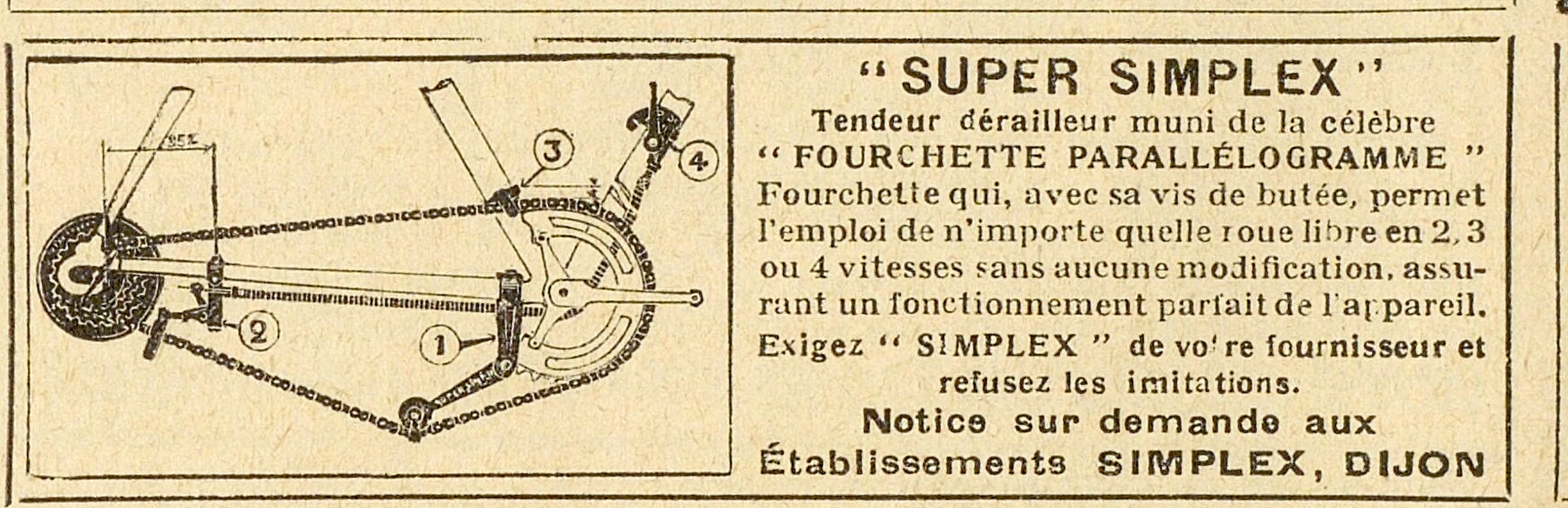
The mid-1930s range on that back cover is already a family of named models: the Type Route for town and touring, with a fixing to the hub axle, a brazed-on boss or a clip; the Tour de France 34 and the Champion de France 36 for racing; and the Super-Simplex, with its separate tensioner and a parallelogram fork. A complete Type Route came with its freewheel at 87 francs for two speeds and 120 francs for four.
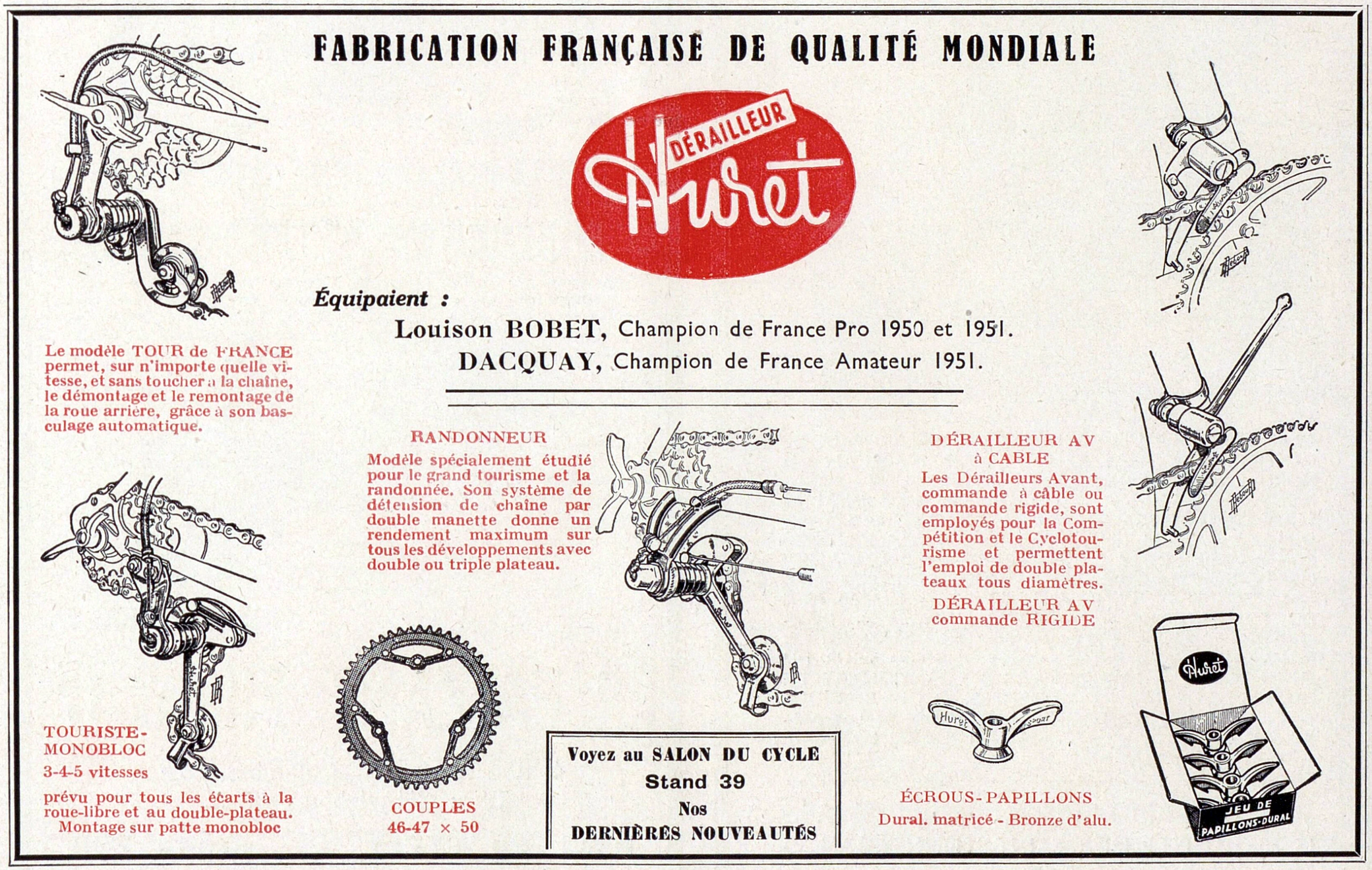
Simplex also crossed the Channel relatively early on. Holdsworth’s Aids to Happy Cycling of 1936 offers the “SIMPLEX Champion of France 3-speed,” and its 1938 and 1939 editions the “SIMPLEX CHAMPION DU MONDE PROFESSIONAL.” Claud Butler’s 1939 catalog fits the Champion du Monde Professional to its racing machines, as do Hetchins in 1938 and Saxon in 1939. On the evidence of the British builders’ own books, the French gear was the racing derailleur of the British club lightweight before the war, and Holdsworth was still selling the Champion du Monde in 1949.
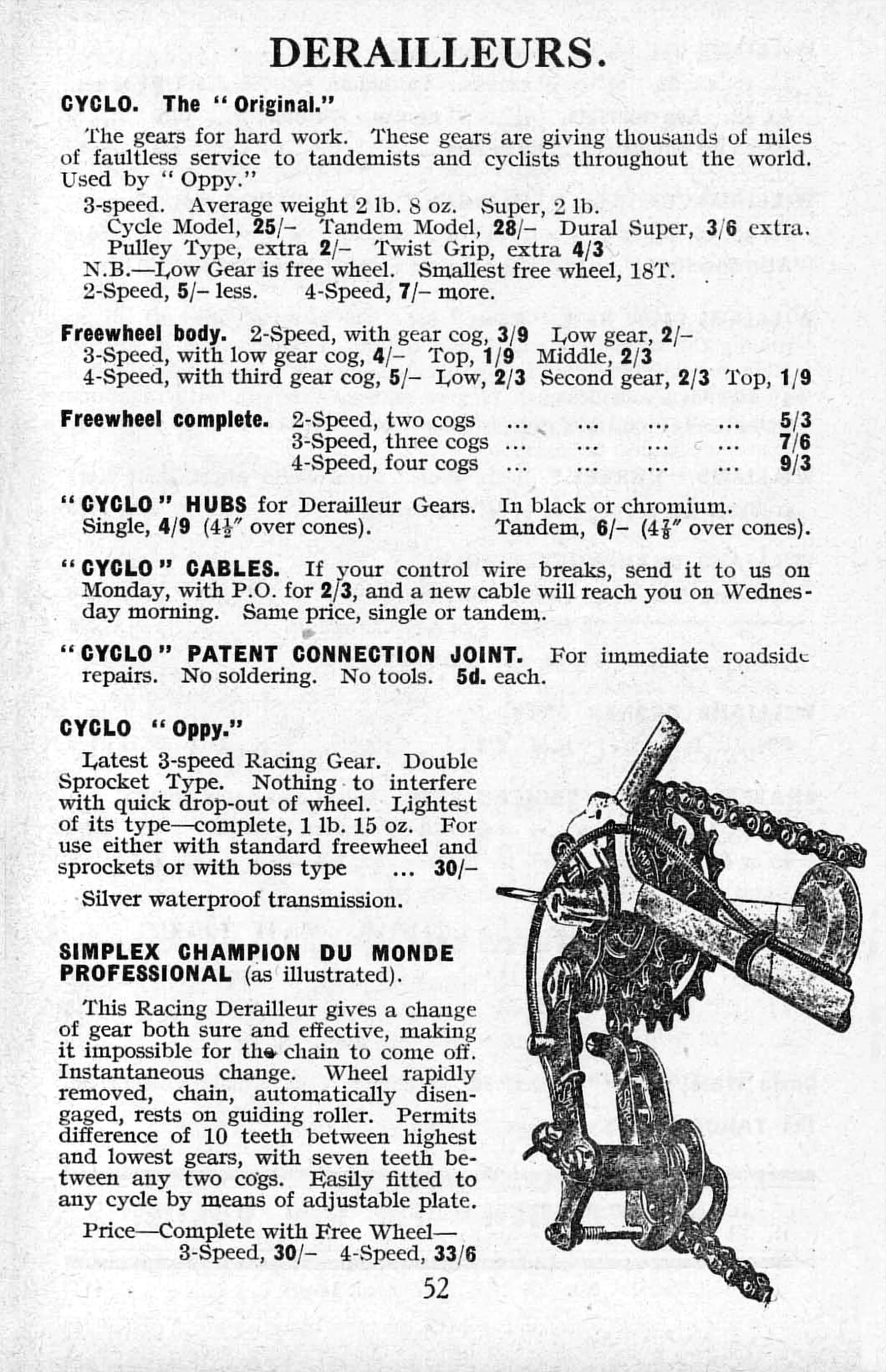
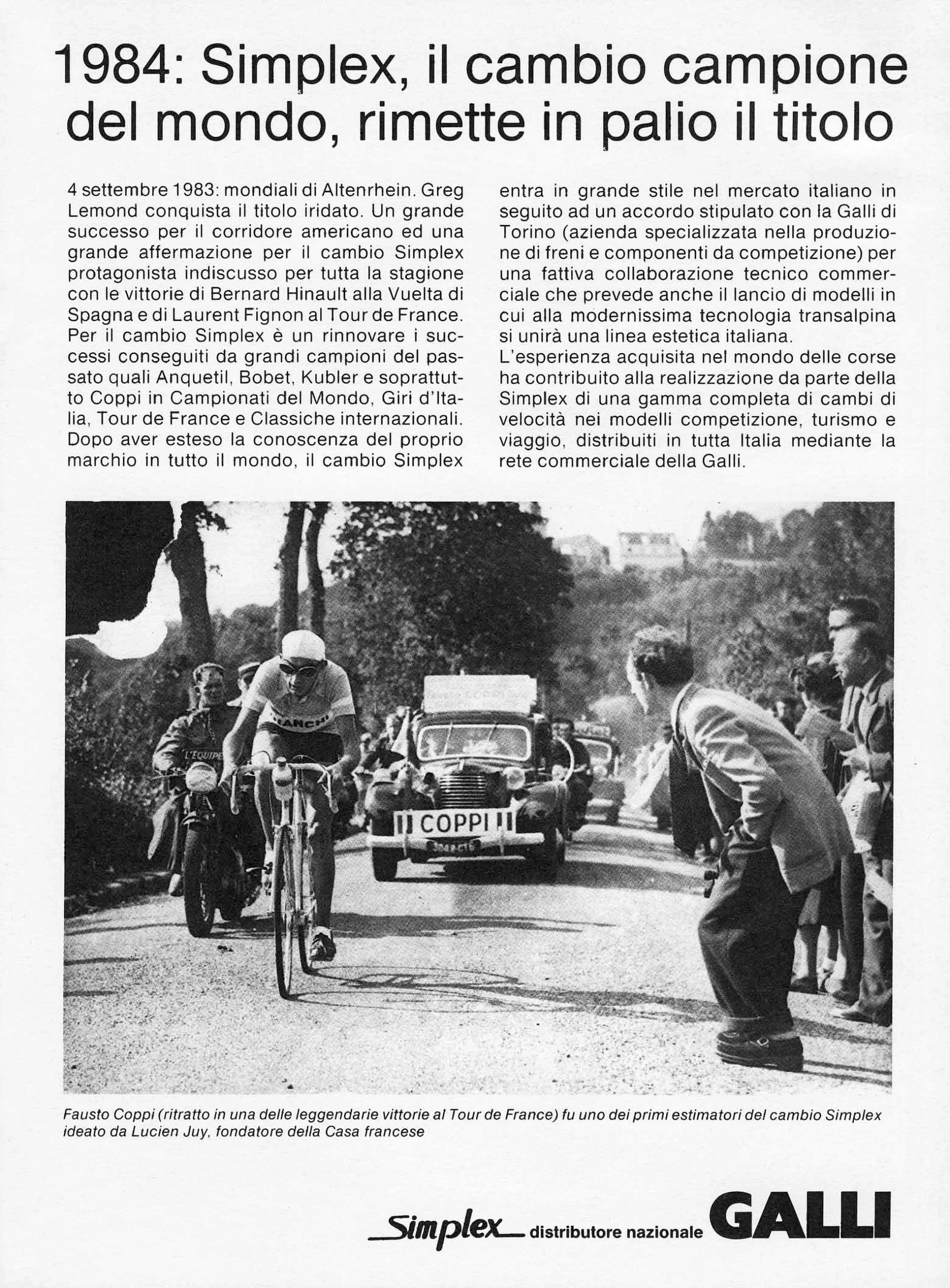
The Tour de France opened to the derailleur at the end of the 1930s and the two French makers spent the next 15 years fighting over it. By the usual account Simplex carried Jean Robic to victory in 1947, Fausto Coppi in 1949 and Ferdi Kübler in 1950. L’Officiel du cycle, reviewing the Paris Salon of October 1950, called Simplex “another great name in derailleurs” that had distinguished itself in the last Tour and at the World Championships, and described its new automatic-tensioning type, which kept the chain slack the same whatever the size of the sprocket. The archive also holds an earlier claim: a Simplex advertisement in L’Équipe of 30 July 1946 names Lazaridès, Vietto and Robic as first, second and third in the “course du Tour de France” and as users of the “nouveau dérailleur” in its 10-speed form.
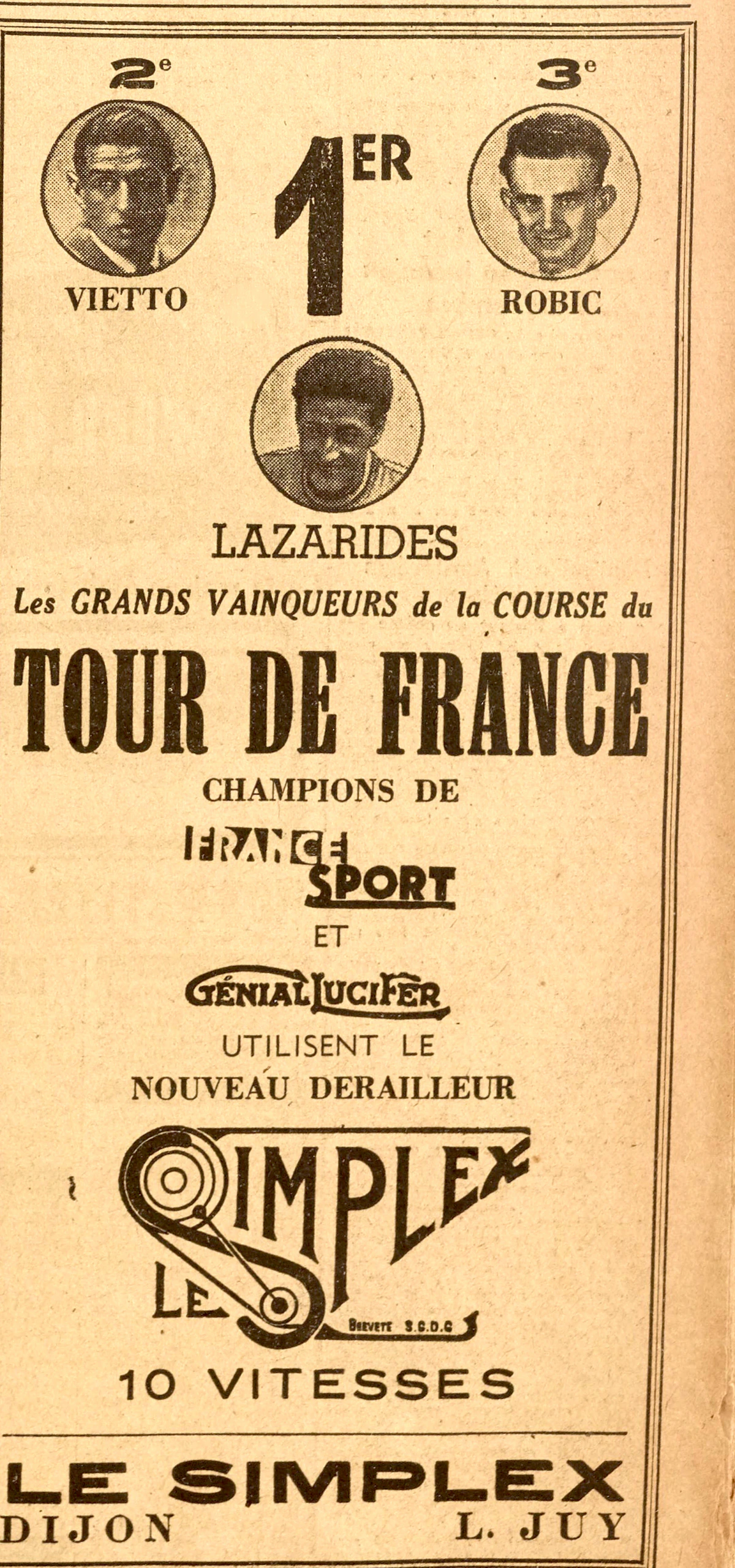
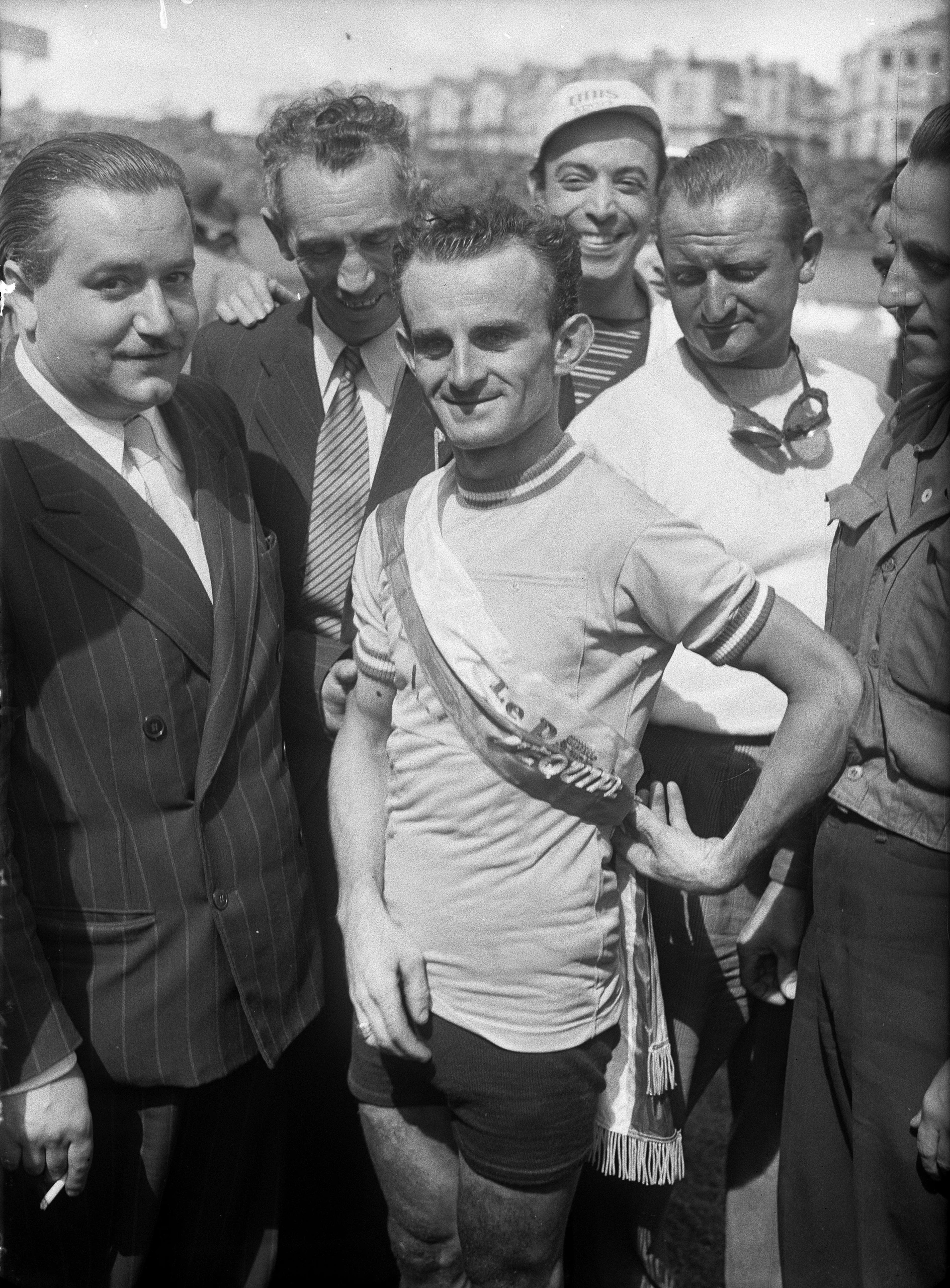
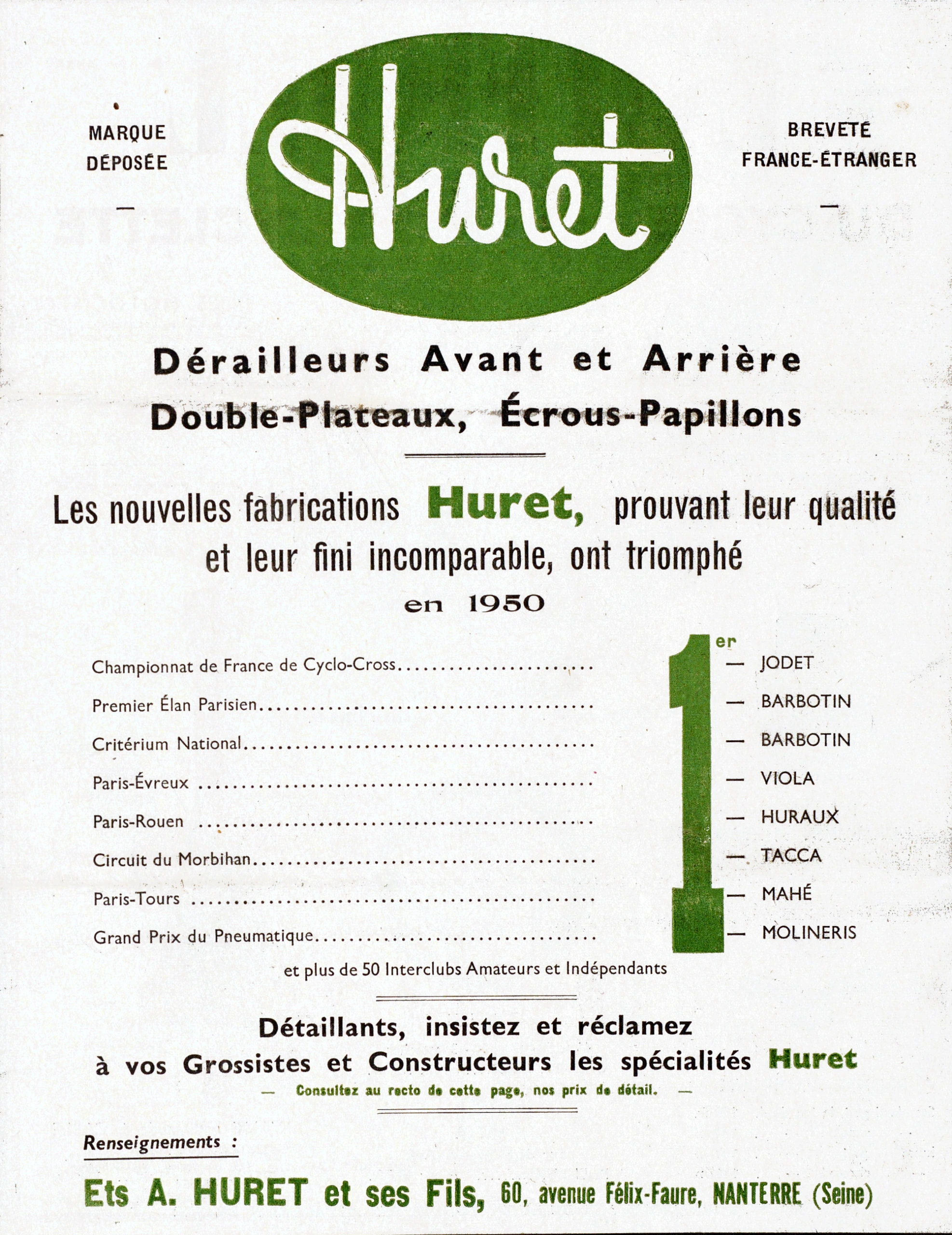
The same review found Huret “specialized in the derailleur,” with a Tour de France model for three to five speeds, a Touriste for the one-piece dropout, a Randonneur that tensioned its chain with a second lever and a Spécial-rétro for the back-pedal brake hub, and it named the famous riders who had won on them, Louison Bobet among them. Huret’s advertisement for the 1951 Salon, its drawings signed by Rebour, proudly claims Bobet, French professional champion in 1950 and 1951, and Dacquay, the amateur champion of 1951. Its Tour de France model swung back on its own to let the rider take out the rear wheel in any gear without touching the chain.
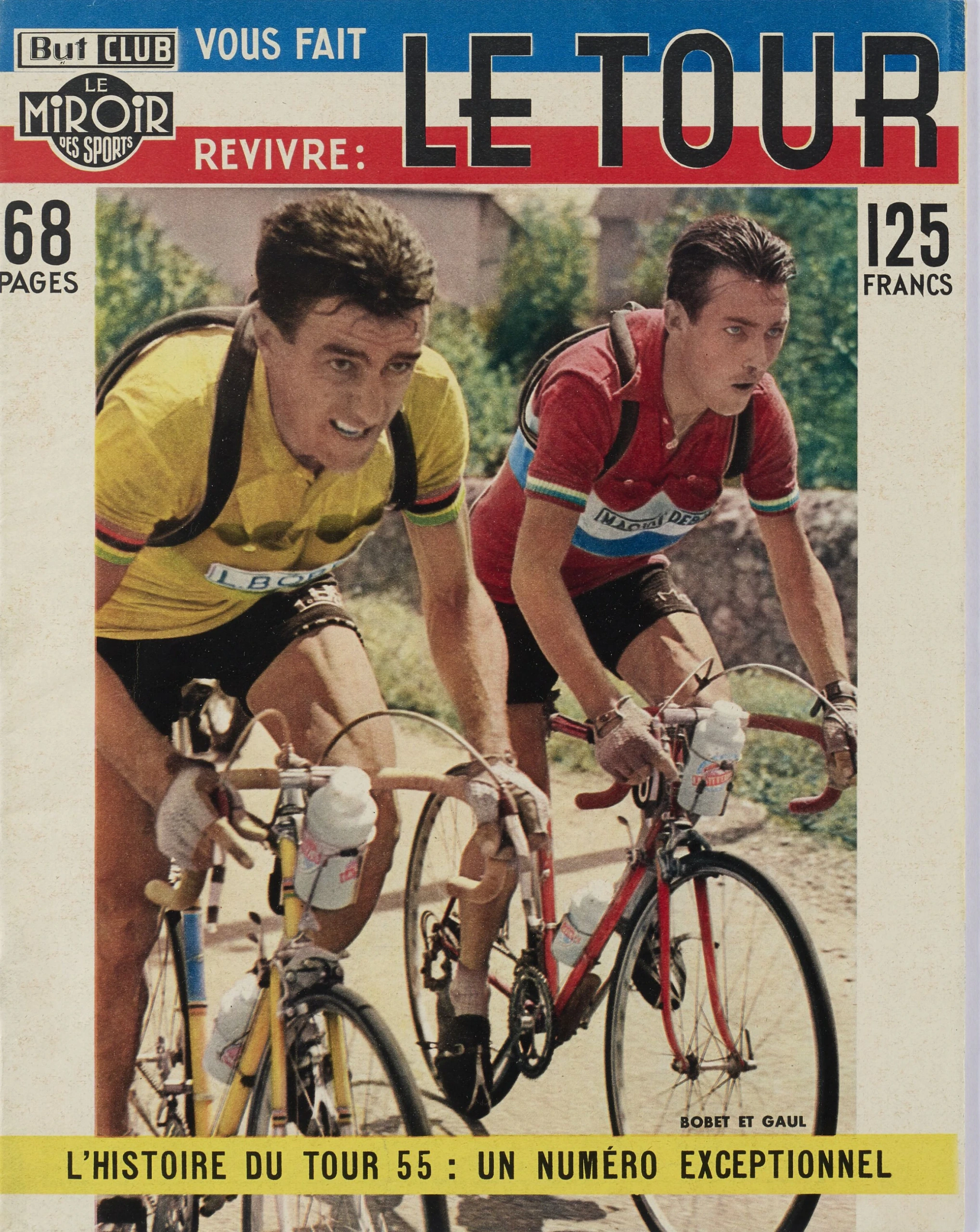
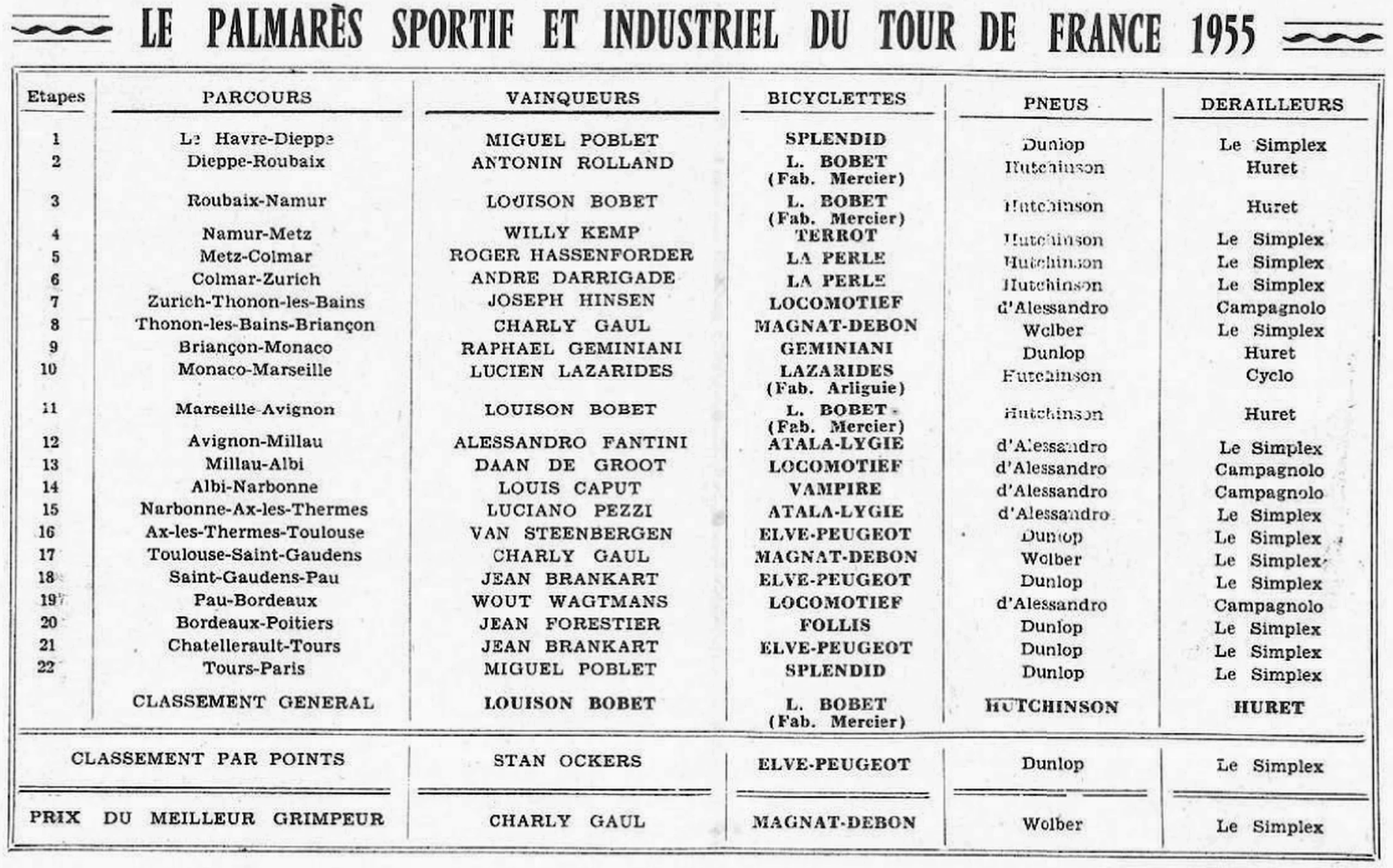
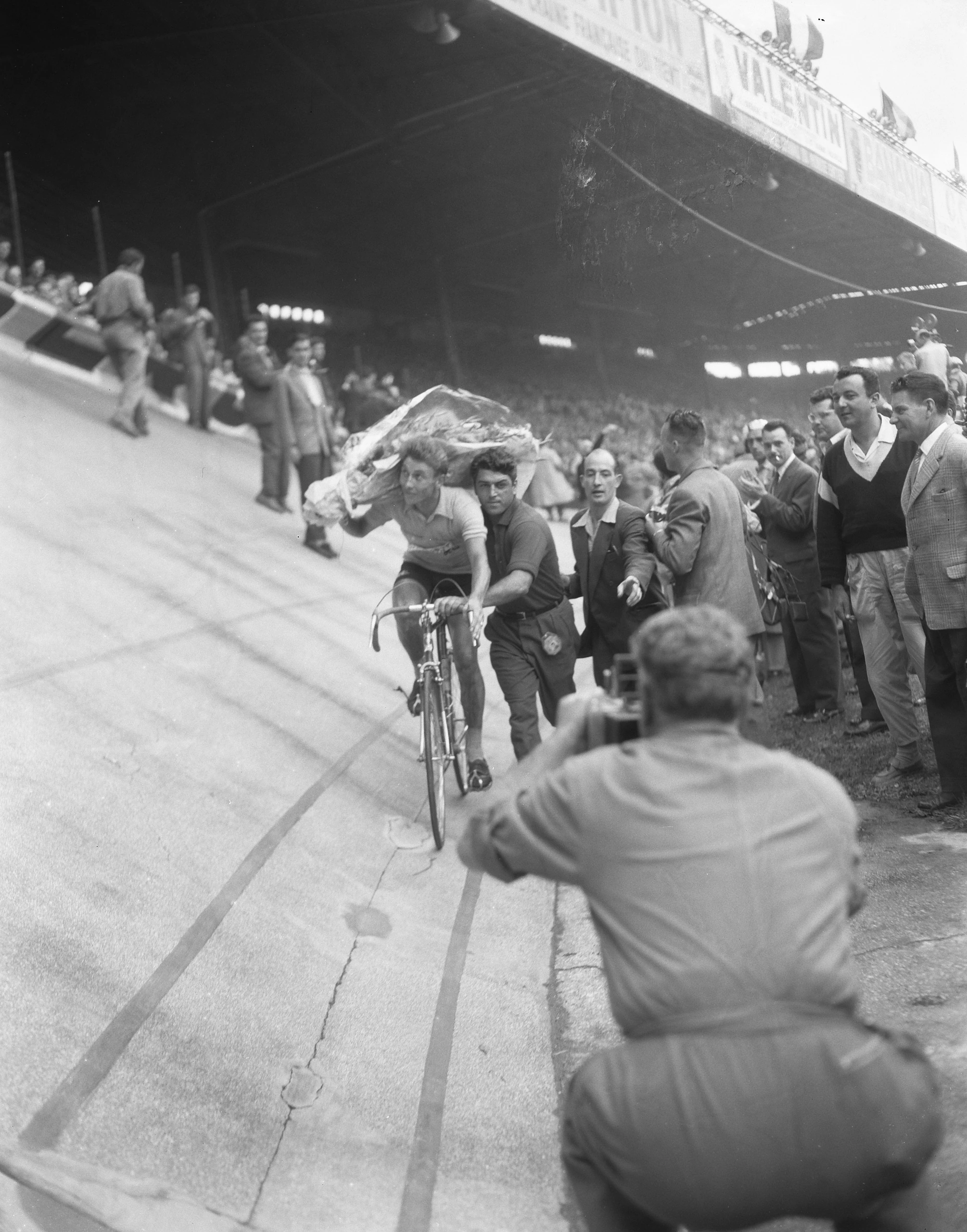
Bobet went on to win the Tour three years running, from 1953 to 1955, and Huret built a “Louison Bobet” derailleur in his name. L’Officiel even drew it in March 1957, the name “Huret” cast along its arm. The archive holds the hardest evidence for the last of those wins. Le Cycle of 13 August 1955 printed a table of the race’s equipment, stage by stage, and it credits Bobet’s overall victory to a Huret. It also shows how the palmarès were spread out among many derailleur makers. Of the 22 stages, Simplex won 13, Huret four, Campagnolo four and Cyclo one. Huret had the yellow jersey, yet Simplex had most of the race.
At home Simplex was the factory standard. Peugeot’s 1952 catalog fits a Simplex to every model it sells with a derailleur, from the three-speed “route léger” of its utility machines through the Rigidex for touring to the Tour de France gear on its sport bicycles and the Simplex front changer on its randonneurs. Charles Pélissier’s 1952 list, Terrot’s 1954 range and the Follis catalog of 1958 all say the same thing. Abroad the two French names now stood side by side: Holdsworth’s catalogs from 1955 to 1958 offer “Simplex or Huret Tour de France” gears at a single price, and by 1958 the Simplex came with nylon jockey wheels.
Simplex renewed its racing gear several times through the decade, giving the models Lucien Juy’s name: the Juy 51, the 543 of 1954 and the Juy Record 60. Jacques Anquetil won his first Tour on a 543 in 1957, by the usual account. But the Italian answer had already arrived by then. Campagnolo’s Gran Sport, with its parallelogram design, went into production in 1951 and the French makers would spend the next decade catching up with it.
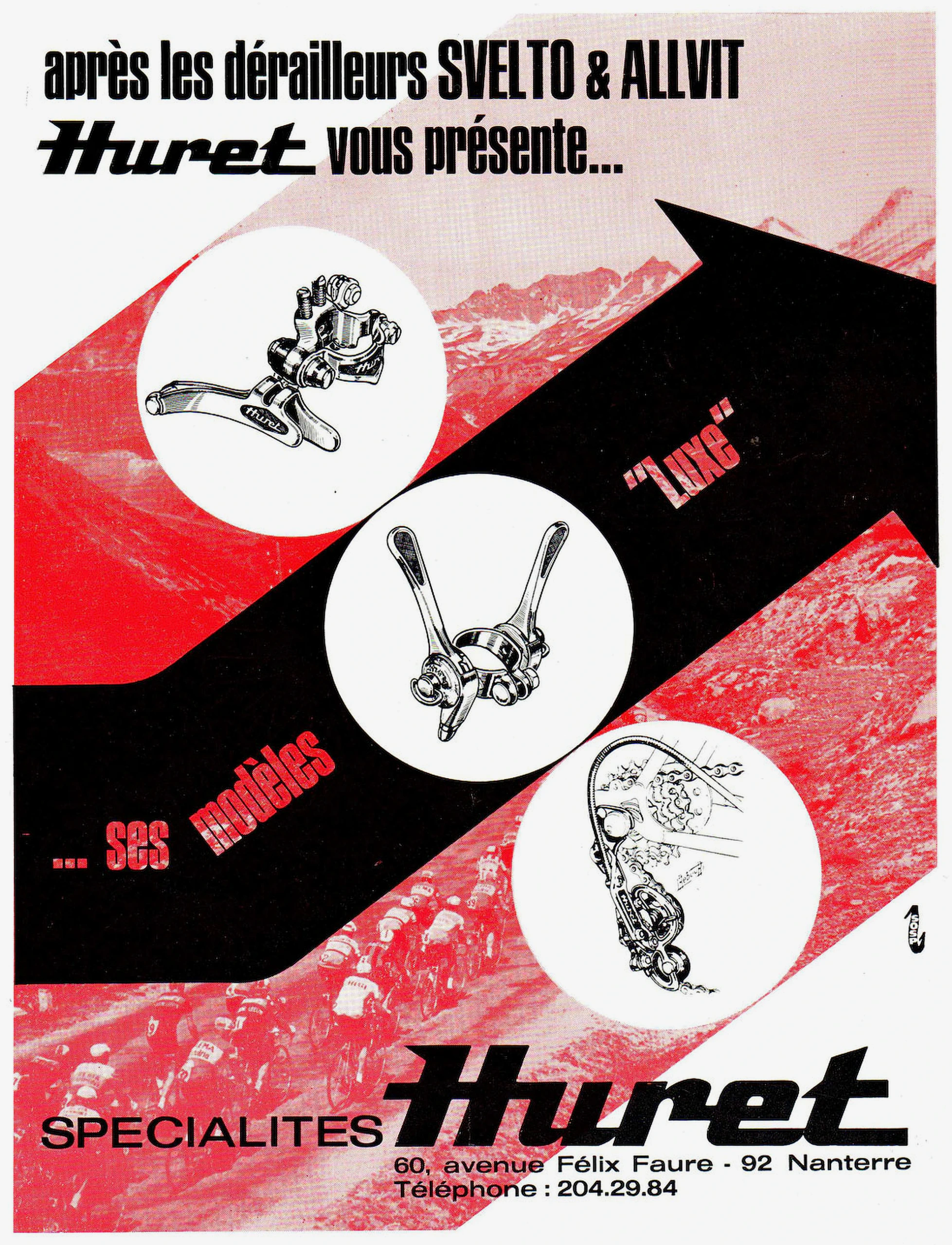
Huret moved first among the French makers. Its Allvit of 1958 was the firm’s first parallelogram derailleur and at the 1963 Brussels Salon it added the Svelto, an all-steel parallelogram that Rebour reported as weighing just 240 grams with a generous capacity of 32 teeth. By 1964 Huret’s advertisements sold the two together, the Allvit for “competition and cyclotouring” with a range of 13 to 30 teeth at the freewheel and 36 to 52 at the chainwheel. At the October 1966 Salon came a third, the Luxe, with a new front derailleur, the 700, and a double lever: a set, Rebour reported, already used by the two winners of that summer’s Paris-Brest-Paris. Field tested? Check.
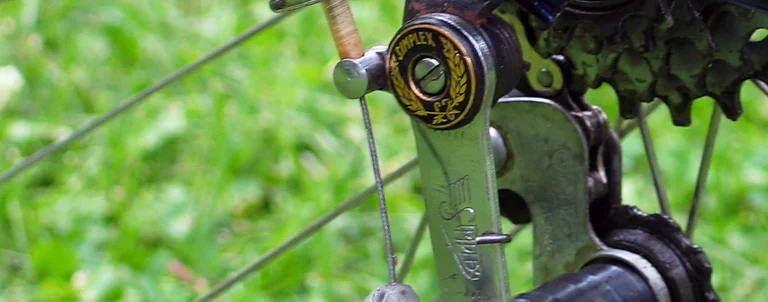
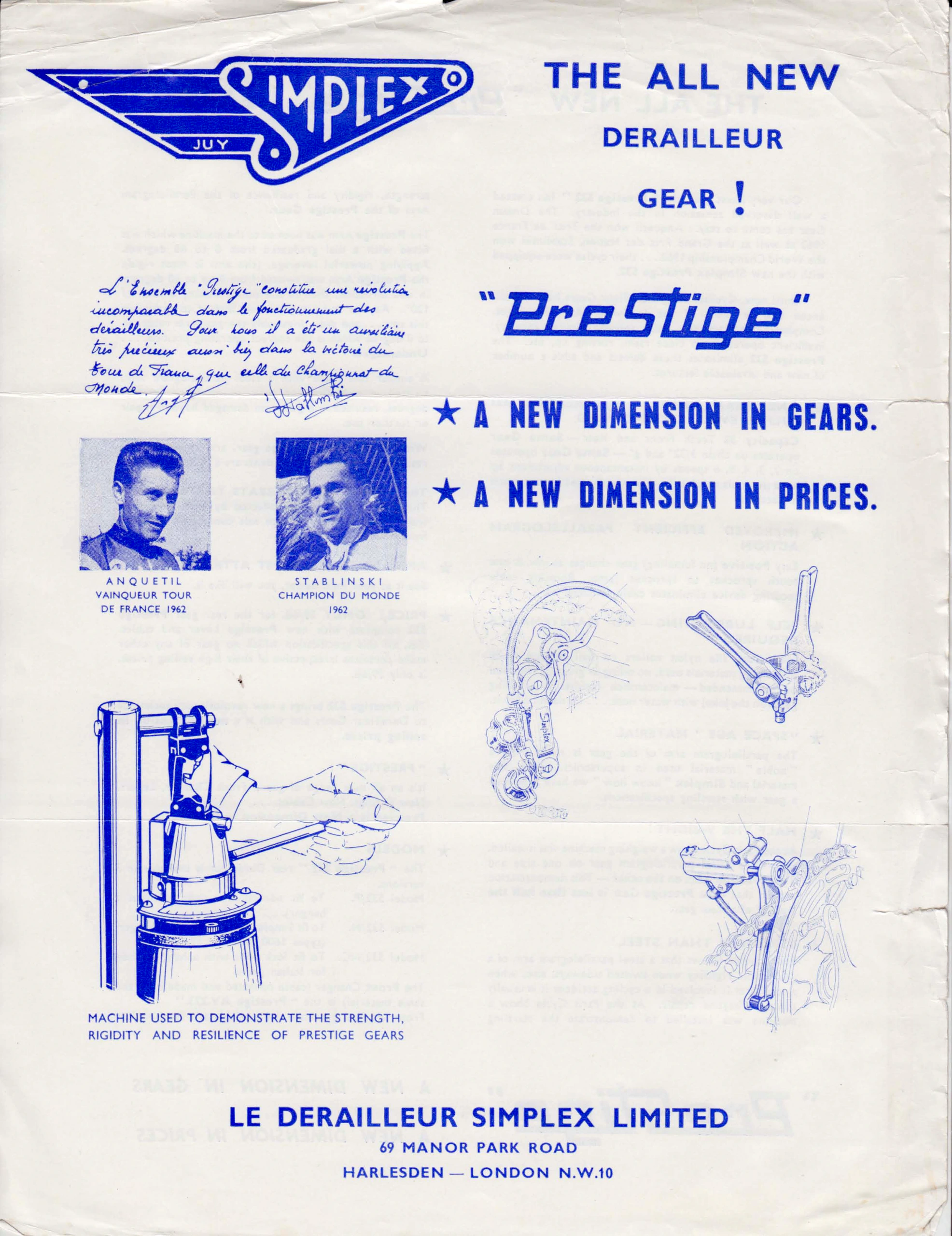
Simplex took a more radical road. Its first parallelogram, the Juy 61, came in 1961, as its name implied, and at the Paris Salon of 1962 it launched the Prestige, whose main parts were molded in what Le Cycle called industrial resin. The pivot supports, link arms, spring housings and even jockey wheels were all made of a high-density plastic. Two years later the magazine credited the material with a victory in the 1962 Tour de France, where the new derailleur was first tried, and a long record of wins in 1963. Simplex’s advertisements of 1964 called the Prestige “une création Lucien JUY,” promised a saving in weight “of the order of 30%” and a mechanism practically immune to shocks, and closed on a boast: “la plus forte, la meilleure production mondiale,” the biggest and best production in the world. Take that, Tullio!
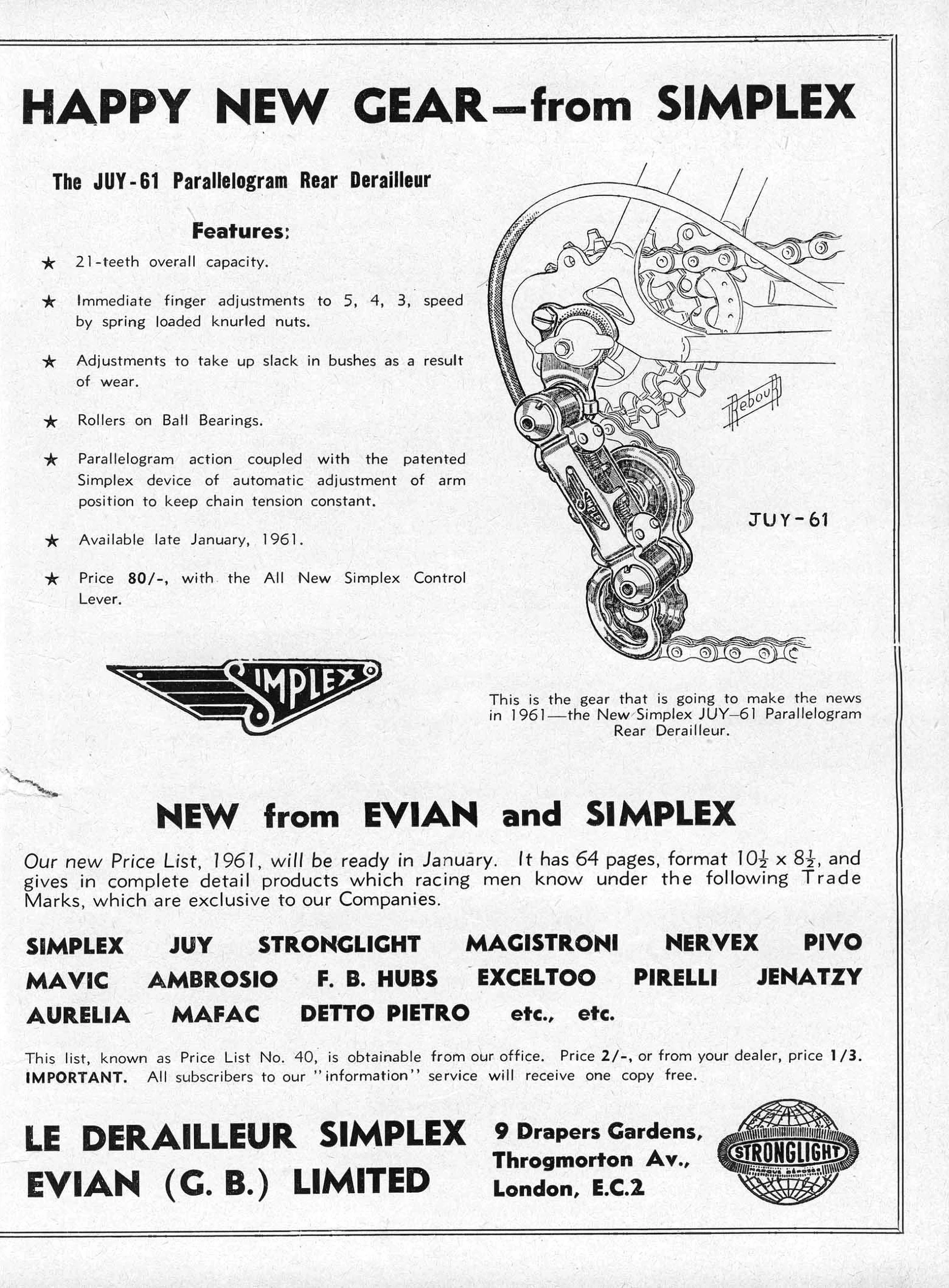
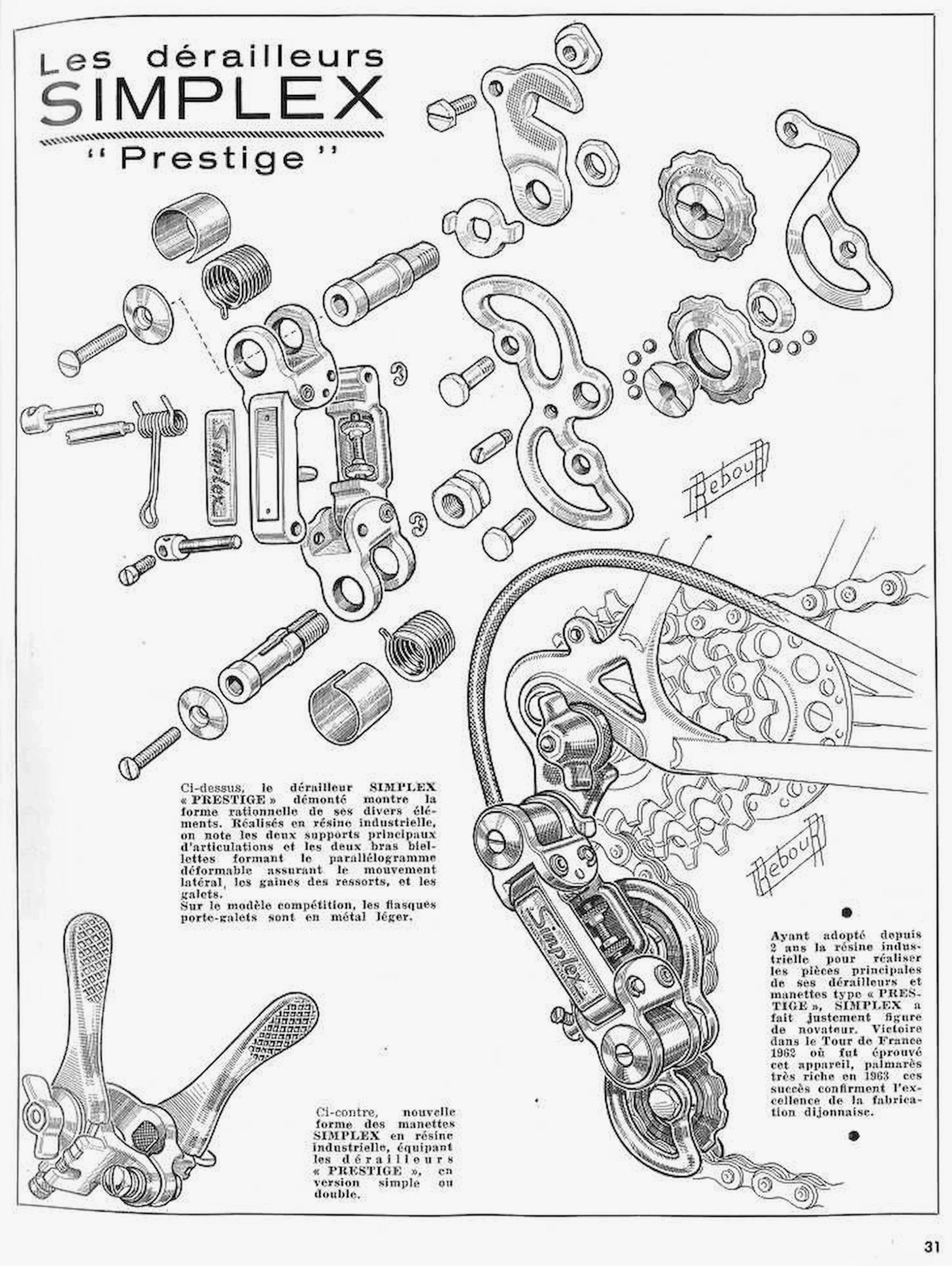
The resin had its critics and later owners remember the early Prestige as being fragile. The Ebykr history of Mafac brakes even lists the fragile plastic Simplex among the French cycling industry’s notable “faux pas.” Simplex kept improving it, though. By the 1966 Salon its capacity had risen to 37 teeth, it came as the Critérium for special dropouts and the type P for any standard one, and two chromed plates now stiffened the outer link that carried the name. Raleigh’s catalogs for the United States fitted the “Simplex Prestige 10-speed” to its sport models in 1967 and 1968, and Sun and Dawes in Britain fitted it loyally into the 1970s.
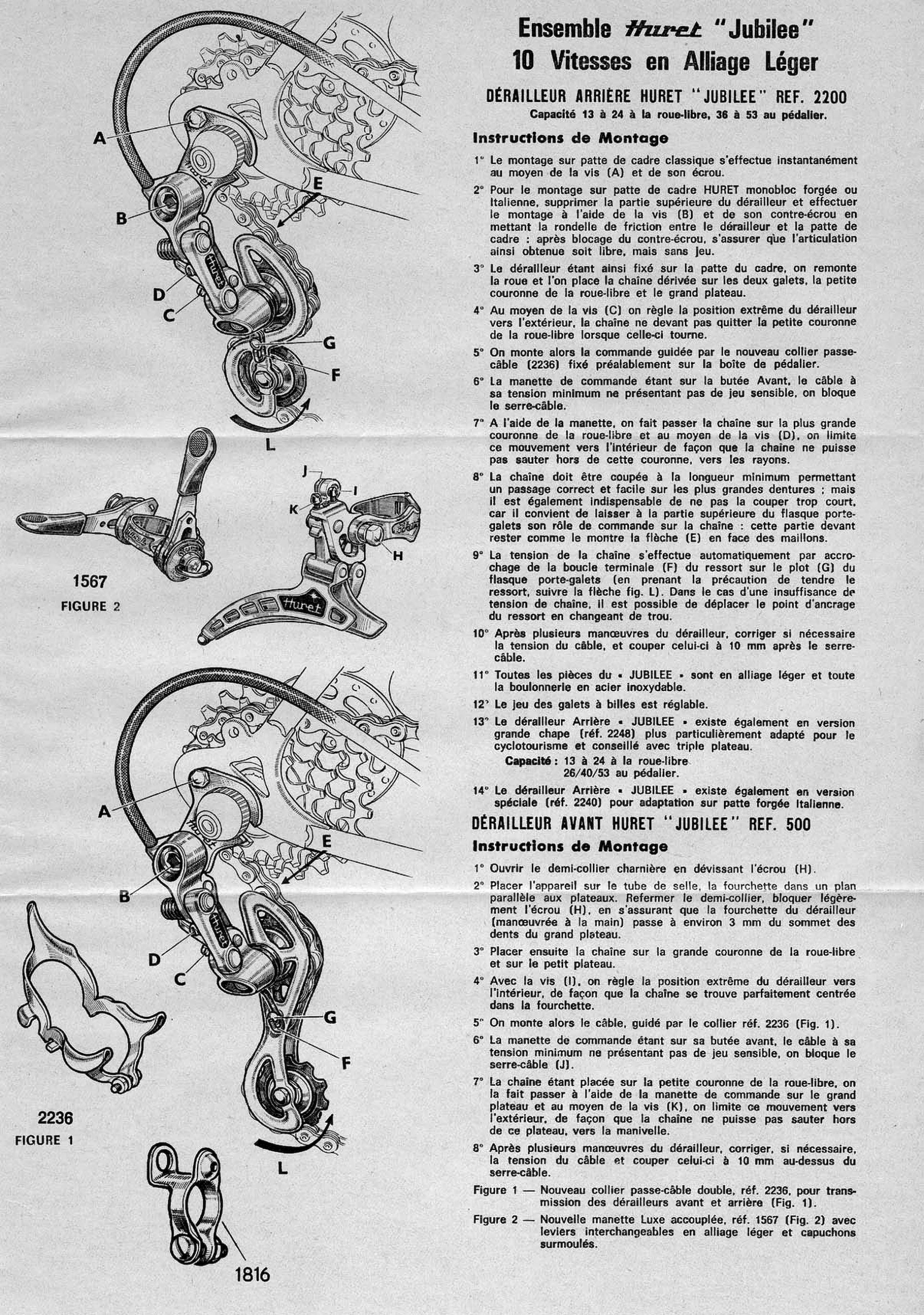
Huret’s answer to the decade of the light bicycle was the Jubilee of 1972. Every part was in light alloy and every bolt was in stainless steel, as its fitting instructions proudly exclaim in French, English and German. It came in three versions: the 2200 for an ordinary dropout, the long-cage 2248 for touring and triple chainwheels and the 2240 for forged Italian dropouts, with a matching front derailleur, the 500. Raleigh’s American catalog of 1973 fits it to its lightweights and the next year’s book adds a “New Huret Challenger.” The Bobet era was long over, but Huret had become a supplier to the big lightweight factories abroad, from Raleigh in Nottingham to Schwinn in Chicago, whose parts book carried Huret derailleurs made to its specification.
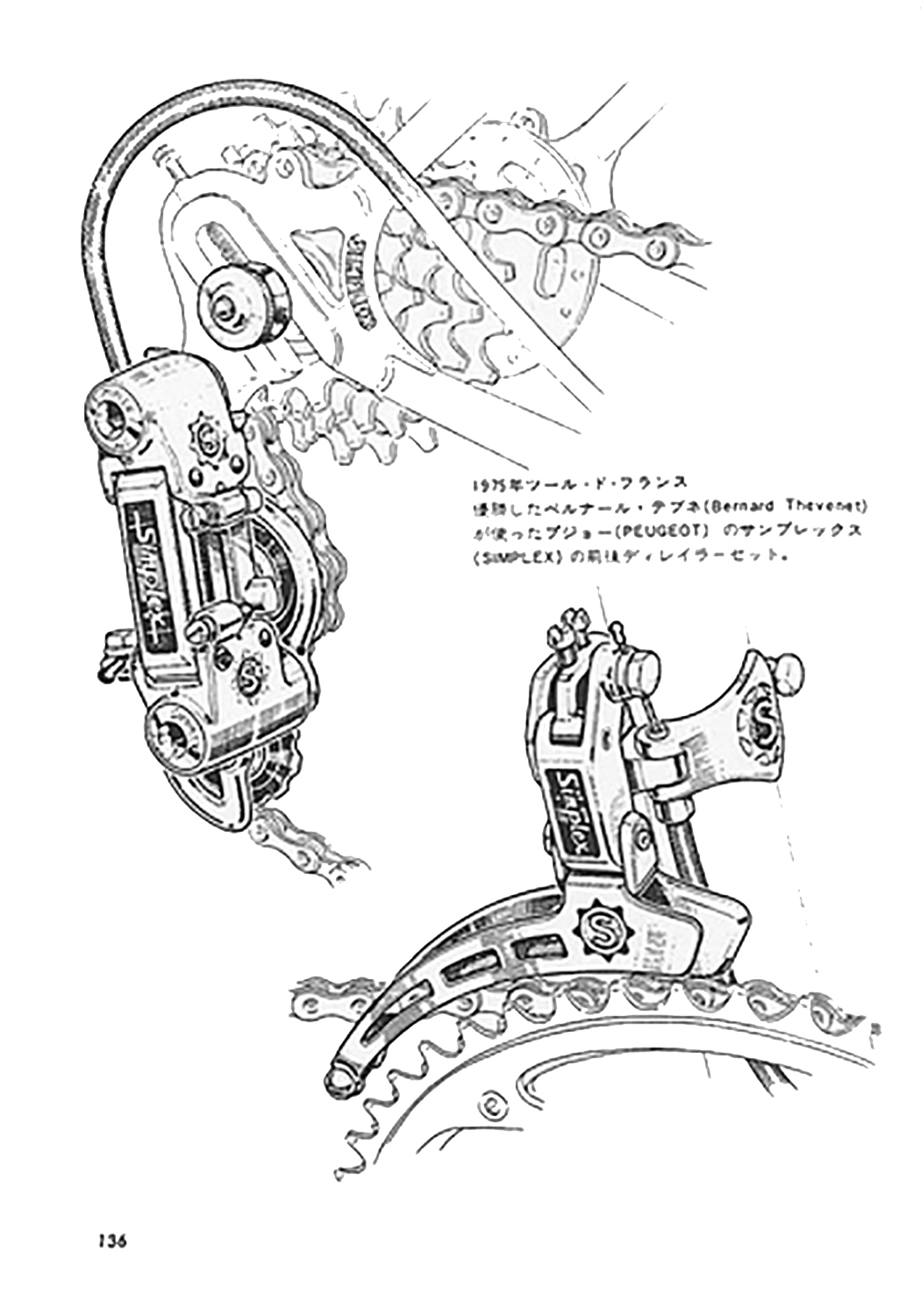
Simplex went back to metal for its best gear. The Super LJ of 1972, its parallelogram in light alloy, carried Bernard Thévenet and his Peugeot to victory in the Tour of 1975, by the usual account. Its most lasting invention of the decade, however, was a lever. The retrofriction shift lever, light to pull against the derailleur spring and stiff when moving with it, was prized well beyond Simplex’s own customers. The January 1981 catalog sells it in two series, the LJ with a Delrin lever and the forged-alloy SLJ, in versions for French and Italian brazed-on bosses.
That 1981 catalog is the portrait of a firm at full stretch. It offers five families of rear derailleur, from the S series through the SX, SJ and LJ to the Super LJ, five families of front changer, levers, quick releases, seat pillars, dropouts and brazed-on parts. The front cover still prints “founder lucien juy” under the winged emblem the firm had used since at least 1964. The back cover, with its reprinted record of 1928 to 1935, looks back to the beginning.
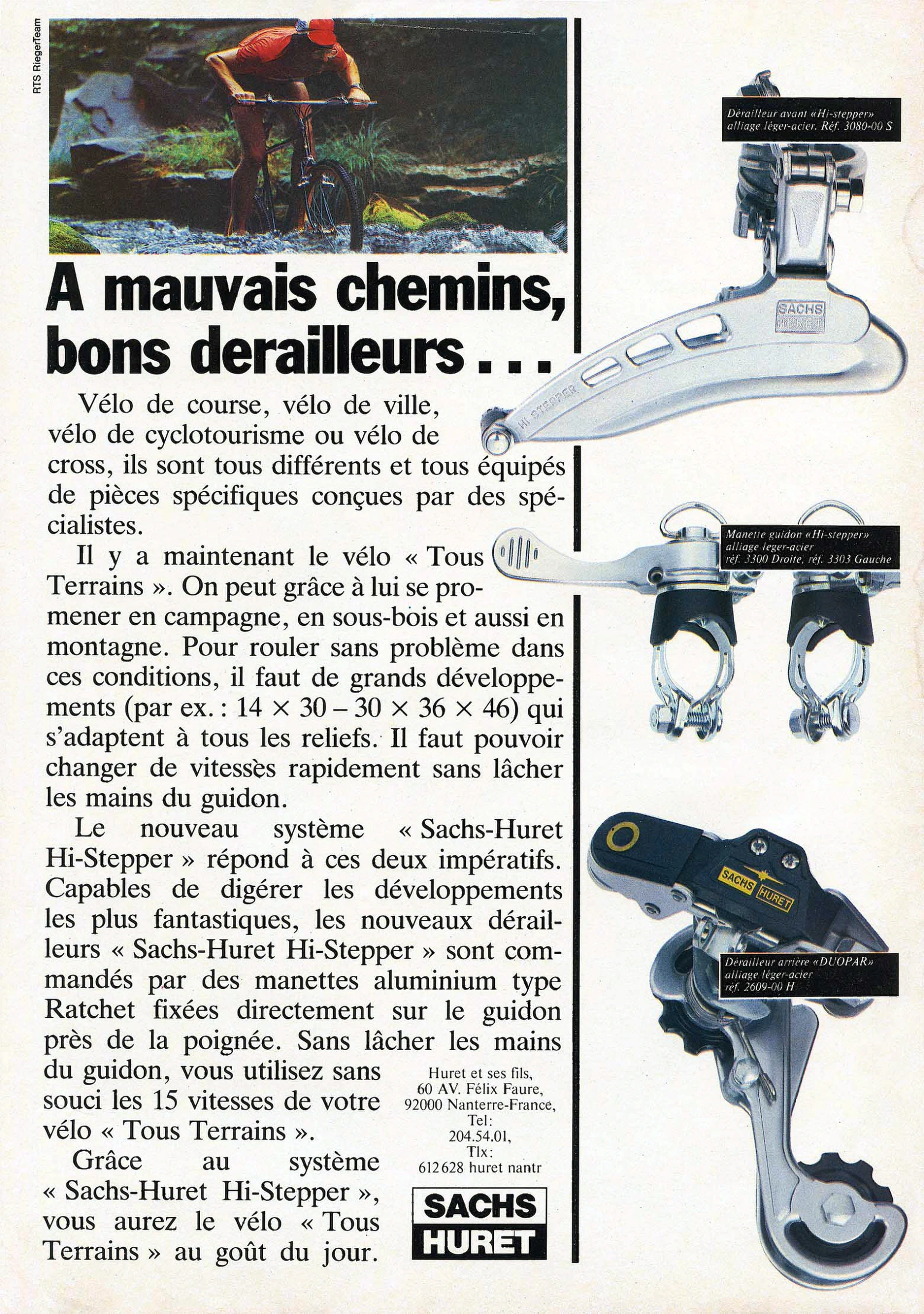
Neither Huret nor Simplex survived the 1980s as an independent firm. Shimano and SunTour sold complete groups, which neither French maker could match alone, and Campagnolo kept the racing market. In 1980 the German group Fichtel & Sachs took a controlling interest in Huret and its derailleurs became Sachs-Huret. Raleigh’s catalogs of 1984 and 1985 still sell the titanium-bodied Huret Duopar and the Eco, and the 1987 book the New Success, but the Nanterre name was now just another brand inside a diversified German group.
Simplex tried an alliance instead. With Maillard, Stronglight and Mafac it offered complete groups under the Spidel name, which made little mark outside France. Peugeot, its most loyal customer, stayed with Simplex until the later 1980s. In January 1989 the British weekly Cycling reported that Mavic had taken over Simplex and by the most detailed collector account the Dijon firm closed for good in 1995.
What they left behind remains on a great many bicycles still in use today. To tell a Huret from a Simplex, and to put a year on either, see How to Identify and Date Vintage Huret and Simplex Derailleurs. The documents quoted here can be read in full in the Ebykr archive: Huret’s and Simplex’s. For the Italian side of the same contest, read Tullio Campagnolo: The Legend, the Patents and the Record.
Huret documents in the Ebykr archive: 1951 Salon advertisement, 1964 advertisement, 1966 Allvit and Svelto advertisement, 1966 Luxe advertisement and Jubilee instructions
Simplex documents in the Ebykr archive: January 1964 Prestige advertisement, 1966 Prestige Critérium advertisement, 1971 advertisement, Prestige 637 instructions and January 1981 catalog
Trade press in the Ebykr archive: L’Officiel du cycle, 21 October 1950, 6 October 1951 and 30 March 1957; Le Cycle, 13 August 1955, January 1964, October 1964 (Prestige), October 1964 (Salon) and October 1966
Builders’ catalogs in the Ebykr archive: Peugeot 1952, Charles Pélissier 1952, Follis 1958, Holdsworth Aids 1936, 1938, 1949, Holdsworth 1957, 1958, Claud Butler 1939, Raleigh 1968 (United States), 1973, 1974 and Raleigh 1984
Disraeli Gears — Huret derailleurs
Disraeli Gears — Simplex derailleurs
Disraeli Gears — Sachs-Huret derailleurs
Classic Lightweights — Simplex Racing Gears (2015)
Cycles Panache — Huret
Frank J. Berto, The Dancing Chain: History and Development of the Derailleur Bicycle
Ebykr — Tullio Campagnolo: The Legend, the Patents and the Record
Ebykr — Campagnolo History: A Timeline of Key Patent, Product and Racing Events
 Huret
Ebykr documents this marque across the archive. Here is the rest of it.
The Ebykr Digest
New articles, timelines, catalog finds and registry activity — assembled from the archive once a month. Your address is never shared.
Double opt-in. One email per month. Unsubscribe at any time with one click.