About Ebykr
Ebykr celebrates classic and vintage lightweight bicycles through provocative imagery and opinion. Ride along with us.
About Ebykr
Ebykr celebrates classic and vintage lightweight bicycles through provocative imagery and opinion. Ride along with us.

Source: Gallica (Bibliothèque nationale de France), L'Officiel du cycle, du motocycle et du camping, 6 October 1951, Numéro spécial du Salon 1951, pages 85, 87, 89, 91, 93, 94, 97, 99, 101, 103, 105, 107, 109, 111 and 112; ark:/12148/bd6t541928909. Source gallica.bnf.fr / BnF.
| Type | Review |
|---|---|
| Year | 1951 |
| Publisher | L'Officiel du cycle |
| Artist | Daniel Rebour |
| Country | France |
| Language | French |
| Pages | 15 |
| Source | Gallica (Bibliothèque nationale de France), L'Officiel du cycle, du motocycle et du camping, 6 October 1951, Numéro spécial du Salon 1951, pages 85, 87, 89, 91, 93, 94, 97, 99, 101, 103, 105, 107, 109, 111 and 112; ark:/12148/bd6t541928909. Source gallica.bnf.fr / BnF. |
| Credit | Ebykr archive; Bibliothèque nationale de France |
| Identifier | Gallica (BnF) ark:/12148/bd6t541928909/f84 |
| Transcription | Headings and specifications transcribed; article text summarized |
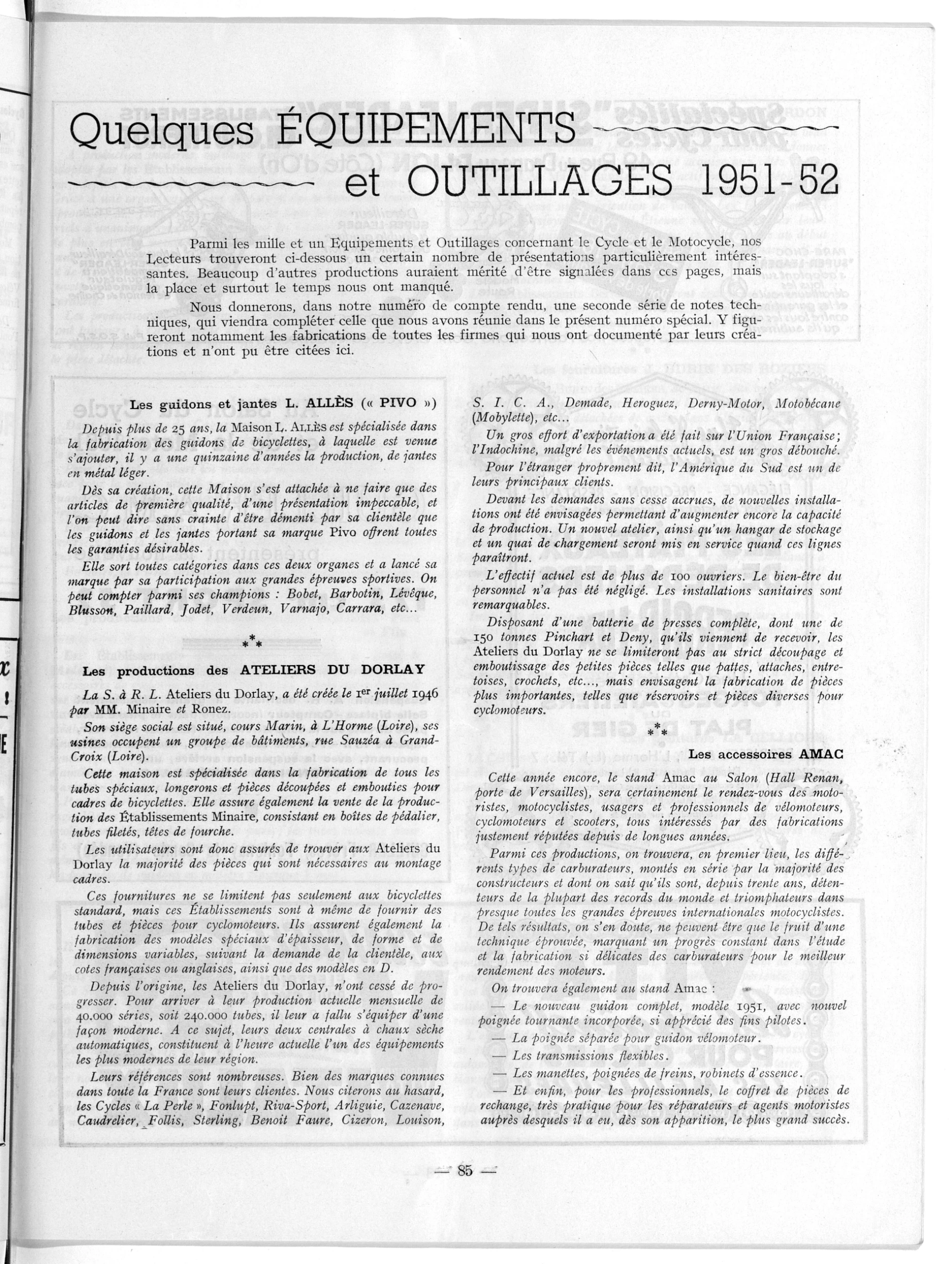
Quelques ÉQUIPEMENTS et OUTILLAGES 1951-52 Les guidons et jantes L. ALLÈS (« PIVO ») Les productions des ATELIERS DU DORLAY Les accessoires AMAC — Le nouveau guidon complet, modèle 1951, avec nouvel poignée tournante incorporée, si apprécié des fins pilotes. — La poignée séparée pour guidon vélomoteur. — Les transmissions flexibles. — Les manettes, poignées …
This is a magazine article, so its running text is summarized here rather than reproduced; the headline, byline, specifications and scores are transcribed as printed.
From L’Officiel du cycle, du motocycle et du camping, 6 October 1951, the paper’s special number for the 1951 Paris Salon du Cycle et du Motocycle and its 60th anniversary, pages 85 to 112: the magazine’s review of components, accessories and tools at the Salon, firm by firm. The title, headings, captions and lists are transcribed as printed; the text is summarized in Ebykr’s words, and the page images carry it in full.
— Page 1 —
Quelques ÉQUIPEMENTS
et OUTILLAGES 1951-52
[Ebykr summary; the article’s text is not reproduced. The paper introduces its survey: from the “thousand and one” items of equipment and tooling for the cycle and motorcycle trade, it presents a selection of particularly interesting ones; many others deserved a place but space and time ran short. A second series of technical notes will follow in the paper’s Salon report number, covering the firms that sent documentation and could not be cited here.]
Les guidons et jantes L. ALLÈS (« PIVO »)
[Ebykr summary; the article’s text is not reproduced. The house of L. Allès has specialized for more than 25 years in bicycle handlebars, and for about fifteen years has also made light-alloy rims. It makes only first-quality articles, and the bars and rims sold under its Pivo mark are said to offer every guarantee. It makes every category of both parts and built its name through the great races; its riders include Bobet, Barbotin, Lévêque, Blusson, Paillard, Jodet, Verdeun, Varnajo and Carrara.]
Les productions des ATELIERS DU DORLAY
[Ebykr summary; the article’s text is not reproduced. The S. à R. L. Ateliers du Dorlay was founded on 1 July 1946 by MM. Minaire and Ronez. Its registered office is on the cours Marin at L’Horme (Loire) and its works occupy a group of buildings on the rue Sauzéa at Grand-Croix (Loire). It specializes in special tubes, frame members and pressed and stamped parts for bicycle frames, and also sells the output of the Établissements Minaire: bottom-bracket shells, threaded tubes and fork crowns, so that frame builders find most of the parts they need in one place. It supplies tubes and parts for cyclomoteurs as well as standard bicycles, and makes special models of varying gauge, shape and size to order, to French or English dimensions, and models in D section. Monthly output is now 40,000 sets, or 240,000 tubes, for which it equipped itself with two automatic dry-lime plants among the most modern in the region. Its customers include the Cycles « La Perle », Fonlupt, Riva-Sport, Arliguie, Cazenave, Caudrelier, Follis, Sterling, Benoit Faure, Cizeron, Louison, S. I. C. A., Demade, Heroguez, Derny-Motor and Motobécane (Mobylette). A large export effort has gone to the Union Française, Indochina being a large outlet despite current events, and South America is a main foreign customer. A new workshop, a storage shed and a loading dock are to open by the time the article appears. The workforce is more than 100, with notable sanitary facilities. With a full battery of presses, including a newly delivered 150-ton Pinchart et Deny press, the firm plans larger pieces such as tanks and various parts for cyclomoteurs beyond small pressings such as dropouts, clips, stays and hooks.]
Les accessoires AMAC
[Ebykr summary; the article’s text is not reproduced. The Amac stand at the Salon (Hall Renan, porte de Versailles) is again expected to draw motorists, motorcyclists and users and tradesmen of vélomoteurs, cyclomoteurs and scooters. First among its products are its carburetors, fitted as standard by most makers and said to have held most world records and won nearly every great international motorcycle event for thirty years. Also on the stand:]
— Le nouveau guidon complet, modèle 1951, avec nouvel poignée tournante incorporée, si apprécié des fins pilotes.
— La poignée séparée pour guidon vélomoteur.
— Les transmissions flexibles.
— Les manettes, poignées de freins, robinets d’essence.
— Et enfin, pour les professionnels, le coffret de pièces de rechange, très pratique pour les réparateurs et agents motoristes auprès desquels il a eu, dès son apparition, le plus grand succès.
— 85 —
[The page is type only, with no drawing or photograph: a two-line title in light capitals with wavy rules, an introduction in roman and the firm notes in italic in two columns, separated by asterisms (three asterisks). The reverse page (an advertisement page) shows through the paper faintly; it is not print on this page.]
[The strip at the left edge of the photograph is part of the facing page and is not part of the record.]
— Page 2 —
Les productions Jean BARON
« J. B. » et « MYLORD »
[Ebykr summary; the article’s text is not reproduced. The Établissements Baron of Fraisses (Loire) follow a formula of modern production and modern tooling and have long had a deserved reputation. M. Jean Baron, well liked in industrial circles, has won a growing clientele through outstanding organization and proven methods. In headsets and bottom-bracket sets of every model (grand luxe included), and in bottom-bracket axles and cups, the J. B. and MYLORD marks are a guarantee. The Jean Baron products, made in a model factory, are said to honor the Saint-Étienne region, called the undisputed cradle of the component trade.]
Les spécialités L. BARRAL
[Ebykr summary; the article’s text is not reproduced. In its works at Cagnes-sur-Mer (Alpes-Maritimes) the house of L. Barral makes well-known brake levers. For sport it makes a model shaped for a comfortable and effective grip, used by Bartali, which proved itself when he won the Pyrenees stage of the Tour de France. For town use it has developed inverted levers, now general on bicycles and cyclomoteurs. It also makes special types for vélomoteurs.]
Les productions des Établissements BAUDET Père et Fils
[Ebykr summary; the article’s text is not reproduced. The Établissements Baudet Père et Fils of Balaives (Ardennes) have made plastic cycle accessories since 1920. After celluloid grips sold as Manufacture Ardennaise, in 1930 they created a brake-cable casing waterproofed with a cellulose covering, and in 1942 they were the first in France to launch a casing covered in synthetic resin, called «Marcassin». Other current products: Vynex lighting wire, a strand of 7 copper wires of 20/100 (insulated in pure polyvinyl chloride); flexible insulating sleeves for lighting wire, in the colors of the wire and of the same composition as its insulation; Sanglier cables; and Vynex plastic handlebar grips.]
Les roues de pédaliers BEAUSSUZET
[Ebykr summary; the article’s text is not reproduced. The Établissements Beaussuzet of Saint-Étienne celebrate their fortieth anniversary at this Salon: M. Beaussuzet senior founded the works in 1911, and his son, well liked in the cycle trade, runs it today. The firm makes chainwheels («roues de pédaliers») of every model and counts most of the great French marques among its customers; forty years of work have won it one of the first places in the market.]
Les productions BERNARDON
[Ebykr summary; the article’s text is not reproduced. The house has fifty years of existence. M. Marcel Bernardon, the active Saint-Étienne manufacturer, guided by experience gained beside his late father, keeps improving its products. The Établissements of the rue Desjoyaux at Saint-Étienne are famous for their PAX pedals, which date from the start of the century; PAX pedals in steel and dural (ordinary and luxe) are found on all the branded machines. The firm also supplies Sprinter hubs in every model, in particular the well-known Sprinter 70 with large flanges («grandes ailettes») in forged duralumin.]
Les fournitures J. BURIN DES ROZIERS
[Ebykr summary; the article’s text is not reproduced. The house of J. Burin des Roziers of Paris exports worldwide and holds the exclusive distribution of many cycle accessories and parts in the Union Française; its catalog lists the best national brands in every specialty of cycle equipment, parts and components.]
Les dispositifs réfléchissants CATAPHOTES
[Ebykr summary; the article’s text is not reproduced. The Société Anonyme Cataphotes was the pioneer of reflectors in France; its « Cataphotes », a registered trademark often taken for a common noun, were already approved in 1939. Its models for bicycles, vélomoteurs and motorcycles conform to the decrees of 2 June and 14 December 1948: round (AGR. T. P. C. 7) and rectangular (AGR. T. P. C. 8) for bicycles, cyclomoteurs and vélomoteurs; its motorcycle models (AGR. T. P. V. 1, 2, 5 and 9) also suit cars and small utility vehicles.]
Les peintures LA CELLIOSE
[Ebykr summary; the article’s text is not reproduced. La Celliose, a société anonyme with a capital of 6.000.000 francs, has been run since its founding in 1929 by MM. F. Guillemot, managing director, and J. Guillemot, deputy director. The first, a graduate chemical engineer and president of the technical commission of the Chambre Syndicale Lyonnaise des Fabricants de Peintures, runs the research and control laboratories; the second runs sales. Since 1936 the company has occupied large premises at Pierre-Bénite (Rhône), producing paint for the largest industries in France and abroad. It has worked especially on enameling cycles and motorcycles: its Celliosprint stoved enamel is the result of much research and decades of experience, a hard, attractive enamel in bright tones, transparent, metallic or opaque. It also makes Superlaques for car bodies, enamel for household and sanitary ware and «blanc glacière». Every paint is referenced, each batch chemically checked and tried in a special application shop.]
— 87 —
[The page is type only, with no drawing or photograph: firm notes in italic, with bold headings, in two columns separated by asterisms (three asterisks). The reverse page (advertisements) shows through the paper faintly; it is not print on this page.]
[The strip at the left edge of the photograph is part of the facing page and is not part of the record.]
— Page 3 —
Les garde-boue et carters CHAZAL-ROUCHOUSE
[Ebykr summary; the article’s text is not reproduced. The Établissements Chazal-Rouchouse, founded a quarter of a century ago, hold one of the first places in French mudguard and chainguard production. The large Saint-Étienne works, run by technicians always seeking perfection, uses modern machines and first-quality metals and supplies the main bicycle marques. Its mudguards include « Le Croco », of surprising popularity; «Iris», adopted by the road stars; the half-balloon « Le Clouté »; and a luxe model in stainless steel. Its chainguards are equally well made, among them a special guard for cyclomoteurs fitted with « Le Poulain ». The firm also does blanking and pressing work and makes exhaust pipes.]
Les cadres spéciaux CIZERON
[Ebykr summary; the article’s text is not reproduced. Playing on the Tour de France, the paper says the special frames built by the Établissements Cizeron of Saint-Étienne are going round the world. M. Cizeron, the active Saint-Étienne manufacturer, has made his works a model factory with modern plant and highly qualified staff. Its special frames for cyclotourists and racers, and its children’s frames, are praised for elegance and strength.]
Les productions C. L. B.
[Ebykr summary; the article’s text is not reproduced. The C. L. B. range: brakes and levers (for road, Demi-course, Demi-ballon, Course, Enfant and Cyclomoteur), carriers, wing nuts («papillons»), small handlebars («guidonnets») and chainguards. New at the Salon: first, a special road lever, curved and very open; second, a sport chainguard to fit the Simplex front derailleur, a model new to the market. In racing, C. L. B. had a resounding 1951 season: 6 stages of the Tour de France, the Tour de France Cyclomoteur, the World Cyclo-Cross Championship and many other events. The High Life model, C. L. B. Tour de France, was used on the spare machines of the 1951 Tour; its front brake has a pivot of special high-strength steel built for the hardest shocks of racing.]
Les freins C. L. E. M.
[Ebykr summary; the article’s text is not reproduced. In 1905 a works making bicycle brakes was set up at Lyon as the Comptoir Lyonnais des Freins de Cycles. Its patented models then included « Le Cyclamen », a center-pull brake with side clamping on the cantilever principle, « Le Japonais », « L’Allobroge », « Le Revard » and « Le Cycliste ». In 1912 a new brake, the Autocycliste, ancestor of present brakes, appeared. In 1913 M. Moreau took over the Comptoir and gave it new impetus, with a fine finish that won connoisseurs. After the 1914-1918 war the « Autocycliste » alone was made, in road and racing forms; in 1921 it evolved into the better-finished C. L. E. M. brake. With technical collaborators the firm launched the famous Pélissier racing brakes in 1925. In 1923 the firm’s name became Comptoir Lyonnais des Freins de Cycles Édouard Moreau (C. L. E. M.). Manufacture improved with nickel plating, chrome plating and duralumin. In 1929 M. Moreau was joined by M. Édouard Boisnard, proven in bicycle manufacture, and the house expanded and tackled the hardest problems of brake design. With forty-five years of experience, its brakes are used by racers and cyclotourists alike. Current models: the Randonneur, for cyclotourists and cyclomoteurs; the C. L. E. M. Sport, light alloy; the C. L. E. M. Touriste; and the Autocycliste.]
Les spécialités COBRA, FLEXILÈNE et FLEXI-RUB
des Éts DRIOT
[Ebykr summary; the article’s text is not reproduced. The Établissements Driot, founded at Saint-Étienne thirty years ago, created the elastic luggage strap («sandow fixe-bagages») and have led that specialty since; Cobra-Vélo and Cobra-Moto are its current versions. Driot also makes casing for brake and derailleur cables and Flexilène lighting wire. The Flexilène casing, with a half-hard steel core, is very flexible, and its rot-proof plastic cover resists oil, petrol, spirit and acids. M. Armand Dupré, the firm’s director, has just launched toe-clip straps. Driot also offers Flexi-Rub plastic handlebar tape, which keeps the bar bright and like new, stays clean, does not fray and comes in the full range of colors.]
— 89 —
[The page is type only, with no drawing or photograph: firm notes in italic, with bold headings, in two columns separated by asterisms (three asterisks). The reverse page (advertisements) shows through the paper faintly; it is not print on this page.]
[The strip at the left edge of the photograph is part of the facing page and is not part of the record.]
— Page 4 —
Les pneus, boyaux et jantes CLÉMENT (Italie)
[Ebykr summary; the article’s text is not reproduced. With more than half a century in the bicycle trade, the Établissements Clément of Milan show the quality of their products worldwide. The variety and colors of their tires are increasingly popular, and their specialization in tubulars («boyaux») and the long life of these have made them the choice of all the great international racers. Their road and racing rims match the tires in quality and elegance. All are distributed in France by the S. O. F. I. R., which sells first-rank international articles to the cycle trade. Clément has a stand at the Salon this year so that French customers can judge its products.]
A la COMPAGNIE CONTINENTALE DE SELLERIE
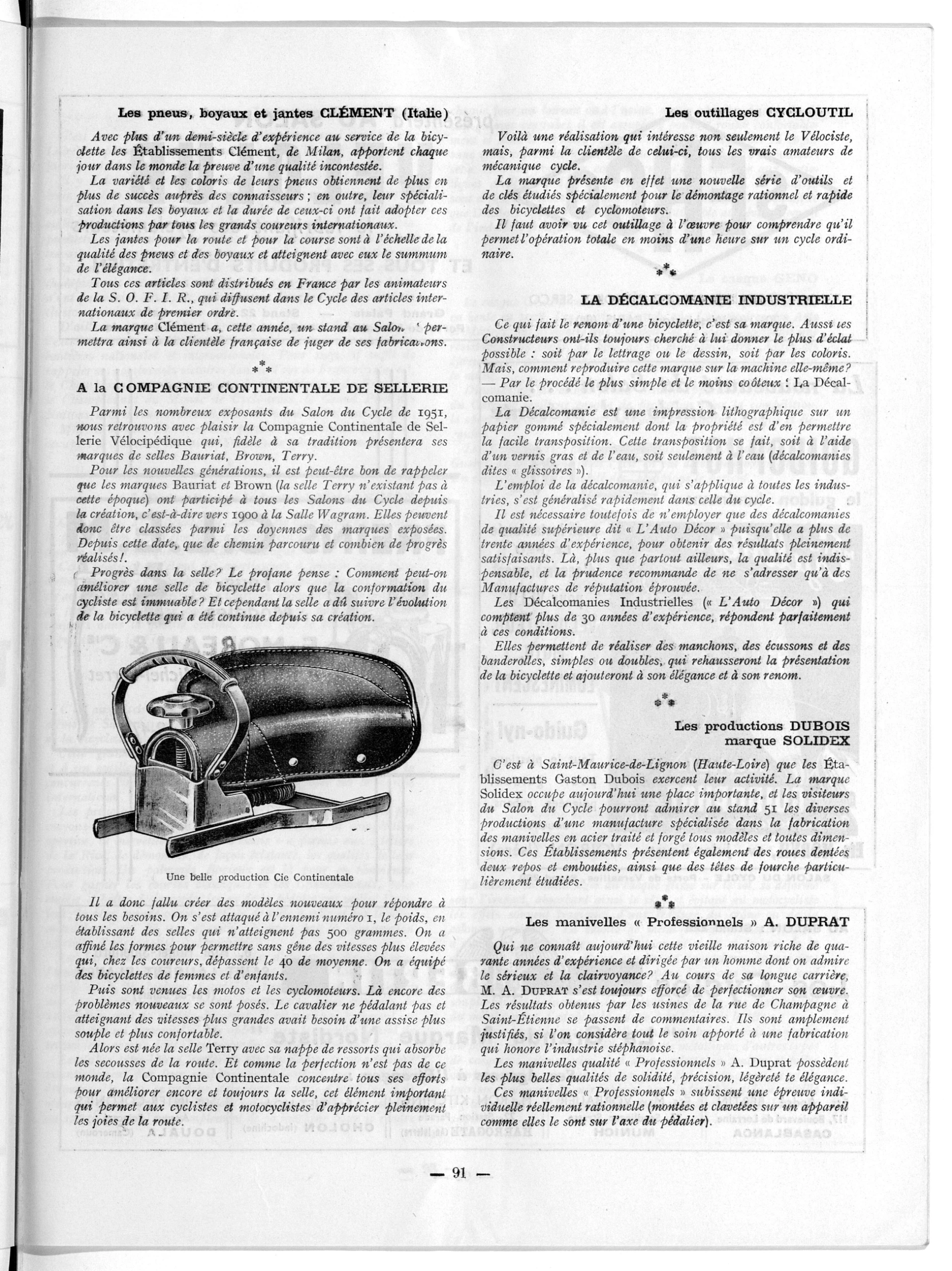
[Ebykr summary; the article’s text is not reproduced. Among the exhibitors at the 1951 Salon du Cycle is the Compagnie Continentale de Sellerie Vélocipédique, showing its saddle marks Bauriat, Brown and Terry. The paper recalls that Bauriat and Brown (the Terry saddle did not yet exist) have been at every Salon du Cycle since the first, about 1900 at the Salle Wagram, among the oldest marks exhibited. Saddles have had to follow the bicycle’s evolution: the firm attacked enemy number 1, weight, with saddles under 500 grams; refined their shapes for racers averaging over 40 km/h; and equipped women’s and children’s bicycles. Motorcycles and cyclomoteurs, whose riders do not pedal and go faster, needed a softer and more comfortable seat, and so the Terry saddle was born, with its spring mattress («nappe de ressorts») that absorbs road shocks. The Compagnie Continentale continues to improve the saddle for cyclists and motorcyclists.]
Une belle production Cie Continentale
[Caption of the drawing in the left column.]
Les outillages CYCLOUTIL
[Ebykr summary; the article’s text is not reproduced. The mark presents a new series of tools and wrenches designed for the methodical and quick dismantling of bicycles and cyclomoteurs, of interest to dealers and amateur mechanics alike; with it a complete overhaul of an ordinary cycle takes less than an hour.]
LA DÉCALCOMANIE INDUSTRIELLE
[Ebykr summary; the article’s text is not reproduced. A bicycle’s reputation rests on its mark, which builders seek to make as striking as possible through lettering, design and colors, and the simplest and cheapest way to apply it to the machine is the decal. A decal is a lithographic print on specially gummed paper made to be transferred, either with a varnish and water or with water alone (the decals called « glissoires »). Its use, common to all industries, spread quickly in the cycle trade. Only decals of superior quality should be used, such as « L’Auto Décor », with more than thirty years of experience: the Décalcomanies Industrielles (« L’Auto Décor »), with more than 30 years of experience, make sleeves («manchons»), badges («écussons») and bands («banderolles»), single or double, that improve the look of the bicycle.]
Les productions DUBOIS
marque SOLIDEX
[Ebykr summary; the article’s text is not reproduced. The Établissements Gaston Dubois work at Saint-Maurice-de-Lignon (Haute-Loire). Their Solidex mark now holds an important place, and visitors to the Salon du Cycle can see at stand 51 the output of a works specializing in cranks of treated and forged steel in every model and size. The firm also shows pressed chainwheels («roues dentées deux repos et embouties») and specially designed fork crowns.]
Les manivelles « Professionnels » A. DUPRAT
[Ebykr summary; the article’s text is not reproduced. An old house with forty years of experience, run by M. A. Duprat, who has always worked to perfect his products; its works are on the rue de Champagne at Saint-Étienne and honor the Saint-Étienne industry. The « Professionnels » quality cranks of A. Duprat are strong, precise, light and elegant, and each is individually tested, mounted and cottered on a fixture as on the bottom-bracket axle.]
— 91 —
[One drawing, in the left column under the Compagnie Continentale note: a fine line engraving of a sprung saddle seen from the front three-quarters, with a stitched leather top fixed by rivets, a curved grab handle with a ribbed grip over the nose, a star-shaped clamping knob on a box clamp, twin rails below and coil springs under the rear. No signature is visible. The rest of the page is type: firm notes in italic, with bold headings, in two columns separated by asterisms (three asterisks). The reverse page (advertisements) shows through the paper faintly; it is not print on this page.]
[The strip at the left edge of the photograph is part of the facing page and is not part of the record.]
— Page 5 —
Les manivelles DURAX
[Ebykr summary; the article’s text is not reproduced. In their modern works at Monistrol-sur-Loire (Haute-Loire) the Fils de P. Limouzin have made their famous « Durax » cranks since 1920. The house, founded in 1860 and so nearly a hundred years old, has given itself entirely to the cycle industry for about thirty years, with cranks as its specialty; the paper believes it leads world production. The great champions of the day, Koblet and Bobet among them, adopted the mark. Its 1951 record includes many Tour de France victories (9 stages), the Championnat de France on the road, the Championnat de France and the world championship of cyclo-cross, the Grand Prix des Nations, the Critérium National and the Critérium de la Polymultipliée. MM. Limouzin Frères and their staff (the Monistrol works employs 150 workers) have made Durax a very great mark.]
L’Emboutissage Industriel Victor SIMON
[Ebykr summary; the article’s text is not reproduced. This firm of Villeurbanne has just set out its production in a clear and methodical catalog: friction bells («avertisseurs à friction») for bicycles, the famous « Rotaphone » for motorcycles, « Rota » brakes in steel and light alloy, the one-piece « Lug » tourisme and various brake levers for men’s, women’s and mixed frames.]
Les tubes extra-légers DURIFORT
[Ebykr summary; the article’s text is not reproduced. Durifort tubes are made by the Ateliers de la Rive, founded in 1931 in the Saint-Étienne region, which proudly calls itself the homeland of the bicycle. With high-precision plant and tooling the mark has met foreign competition and won a place on the international market, and the main cycle houses have adopted it. Racing has been its proving ground: the aces have used Durifort to win classics and championships and to set records, among them the greatest speed from town to town and the flying kilometer. The firm has twenty years of study and experience in extra-light reinforced seamless tubes, made by an elite staff under expert technicians; the tubes are noted for flexibility and proven strength, a guarantee of balance and safety for tourists, sporting riders and commuters alike. The paper points to export statistics as proof that Durifort contributes to the development of French industry.]
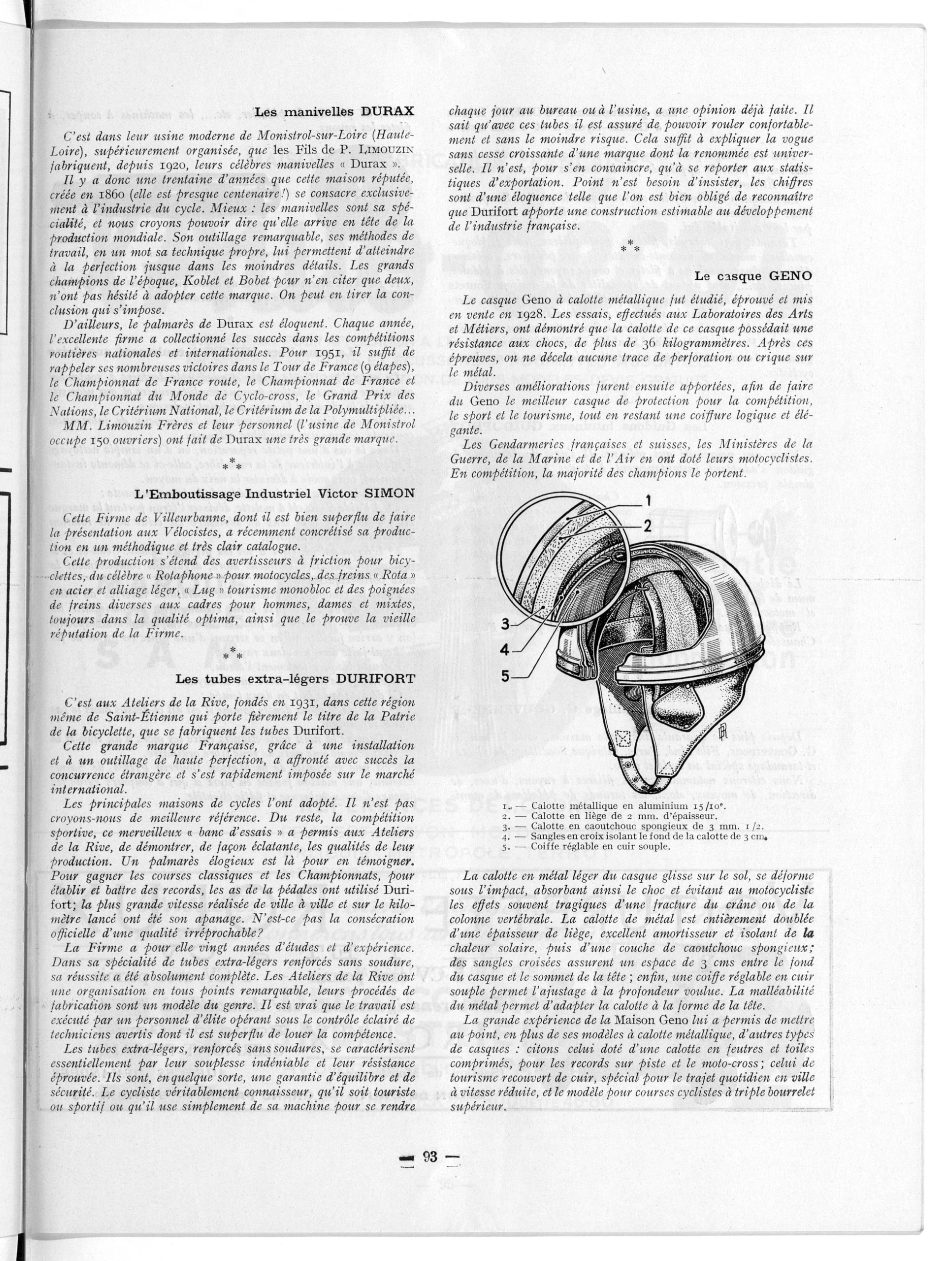
Le casque GENO
[Ebykr summary; the article’s text is not reproduced. The Geno helmet with a metal shell was designed, tested and put on sale in 1928. Tests at the Laboratoires des Arts et Métiers showed the shell resisted impacts of more than 36 kilogram-meters with no trace of perforation or cracking. Later improvements made the Geno the best protective helmet for competition, sport and touring while remaining logical and elegant headwear. The French and Swiss Gendarmeries and the Ministries of War, the Navy and the Air have issued it to their motorcyclists, and most champions wear it in competition.]
1. — Calotte métallique en aluminium 15/10e.
2. — Calotte en liège de 2 mm. d’épaisseur.
3. — Calotte en caoutchouc spongieux de 3 mm. 1/2.
4. — Sangles en croix isolant le fond de la calotte de 3 cm.
5. — Coiffe réglable en cuir souple.
[Ebykr summary, continued; the text is not reproduced. The light-metal shell slides on the ground and deforms under impact, absorbing the shock and sparing the motorcyclist a fractured skull or spine. It is lined with cork, a good shock absorber and insulator against the sun’s heat, then with sponge rubber; crossed straps keep 3 cm between the crown of the helmet and the top of the head; and an adjustable soft leather cap sets the depth. The malleable metal can be shaped to the head. The house of Geno also makes other types: one with a shell of compressed felt and canvas for track records and moto-cross; a leather-covered touring helmet for daily trips in town at low speed; and a model for bicycle racing with a triple upper roll («triple bourrelet supérieur»).]
— 93 —
[One drawing, in the right column under the Geno note: a fine line drawing of the Geno motorcycle helmet seen from the left front three-quarters, a smooth metal shell with a rolled rim and peak, leather ear flaps and a buckled chin strap, the crossed internal straps visible inside; a circular magnifying inset at the upper left shows the shell in section, its layers numbered 1 to 5 by leader lines, keyed by the legend below. A “DR” monogram (the D and R sharing one upright, which runs down below the letters) is drawn at the lower right of the helmet, beside the ear flap. The rest of the page is type: firm notes in italic, with bold headings, in two columns separated by asterisms (three asterisks). The reverse page (advertisements) shows through the paper faintly; it is not print on this page.]
[The strip at the left edge of the photograph is part of the facing page and is not part of the record.]
— Page 6 —
Les productions FOURETS frères
« Outils-Cycle » et « Son’nett »
[Ebykr summary; the article’s text is not reproduced. The house of Fourets Frères of Saint-Étienne offers all the tooling cycle builders and repairers need, under the « Outils-Cycle » mark, noted for its fine finish. Its specialties include taps and tap holders, dies and die holders, cutters, cup lock-rings («bloque-cuvettes»), cup fitting and removing tools for bottom brackets, reamers, chain breakers («dérive-chaînes»), a spoke threading and cutting machine, pedal wrenches and pliers. It also makes the well-known « Son’nett » bicycle bell, simple, light and sturdy, with guaranteed working, adopted by many cyclists.]
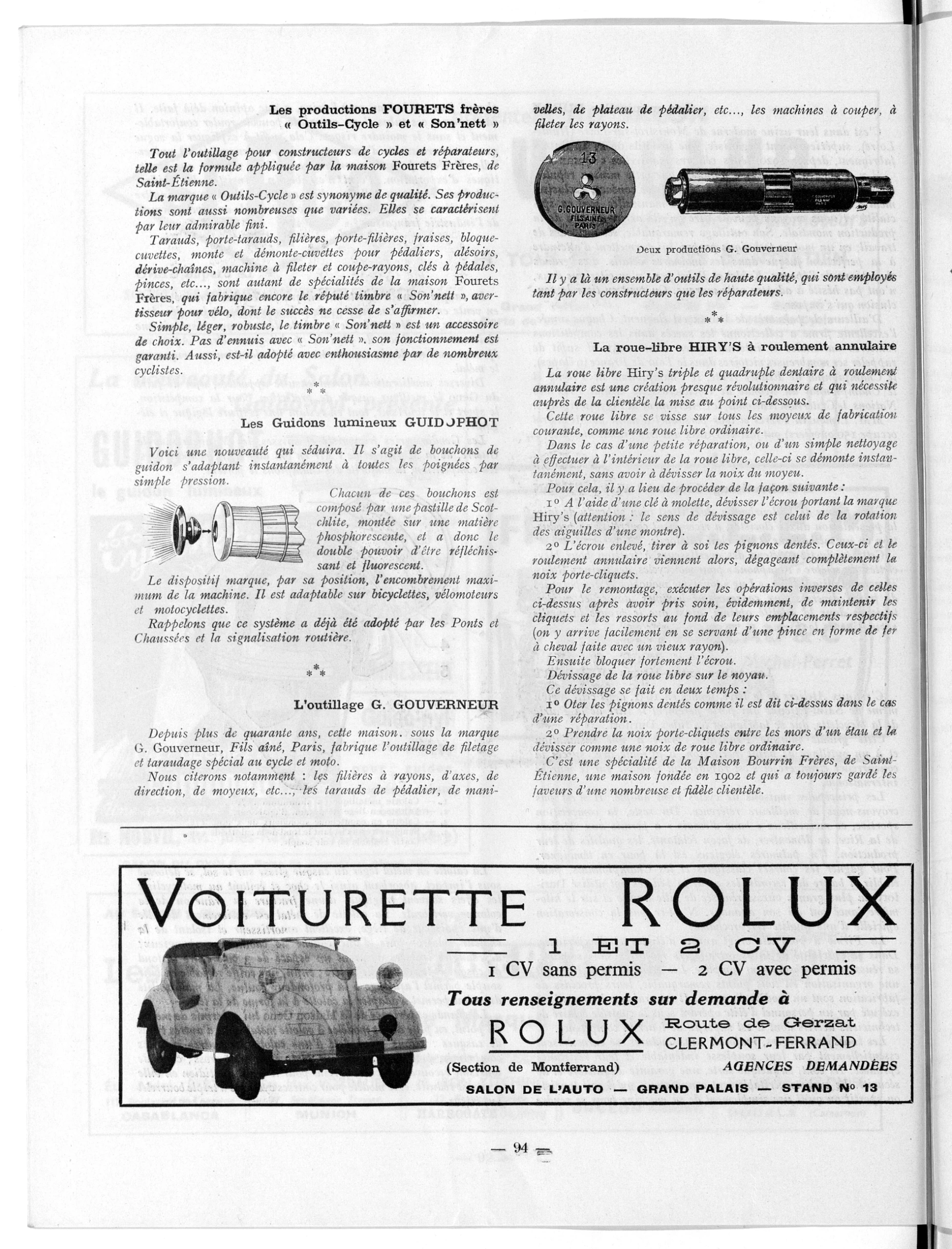
Les Guidons lumineux GUIDOPHOT
[Ebykr summary; the article’s text is not reproduced. A new handlebar end plug that fits any grip by simple pressure. Each plug is made of a Scotchlite disc mounted on a phosphorescent material, so it both reflects and glows. Placed at the machine’s widest point, it marks its full width, and it fits bicycles, vélomoteurs and motorcycles. The system has already been adopted by the Ponts et Chaussées and for road signs.]
L’outillage G. GOUVERNEUR
[Ebykr summary; the article’s text is not reproduced. For more than forty years this house has made special threading and tapping tools for cycles and motorcycles under the mark G. Gouverneur, Fils aîné, Paris: dies for spokes, axles, headsets and hubs, taps for bottom brackets, cranks and chainrings, and spoke cutting and threading machines, a set of high-quality tools used by builders and repairers alike.]
Deux productions G. Gouverneur
[Caption of the photograph in the right column.]
La roue-libre HIRY’S à roulement annulaire
[Ebykr summary; the article’s text is not reproduced. The Hiry’s three- and four-speed freewheel with an annular bearing is called a nearly revolutionary design. It screws onto any ordinary hub like a normal freewheel, and for a small repair or cleaning it comes apart at once without unscrewing the hub body. The paper gives the steps: with an adjustable wrench, unscrew the nut bearing the Hiry’s mark (it unscrews clockwise); pull off the sprockets, which come away with the annular bearing and expose the pawl body. Reassemble in reverse, keeping the pawls and springs in place (a horseshoe clip made from an old spoke helps), then tighten the nut hard. To remove the freewheel from the hub, first take off the sprockets as above, then grip the pawl body in a vise and unscrew it like an ordinary freewheel body. It is a specialty of the Maison Bourrin Frères of Saint-Étienne, founded in 1902.]
— 94 —
[Two illustrations. In the left column, set into the Guidophot note: a line drawing of the plug, a domed reflecting cap with rays drawn around it and an arrow showing it pushed into the end of a handlebar grip wound with cord. In the right column, captioned “Deux productions G. Gouverneur”: a retouched photograph of a round threading die stamped “13” over a trefoil-shaped center hole and “G.GOUVERNEUR / FILS AINE / PARIS”, and of a long cylindrical tool (a tap or die holder) marked “G. GOUVERNEUR / FILS AINE / PARIS” on its body. A small underlined signature, unread (perhaps “Mos” [?]), is written below the right end of the long tool, the retoucher’s or engraver’s mark. The rest of the page is type: firm notes in italic, with bold headings, in two columns separated by asterisms (three asterisks). The reverse page shows through the paper faintly; it is not print on this page.]
[The lower third of the page, below a rule, carries an advertisement for the Voiturette Rolux (Clermont-Ferrand), not part of the record.]
— Page 7 —
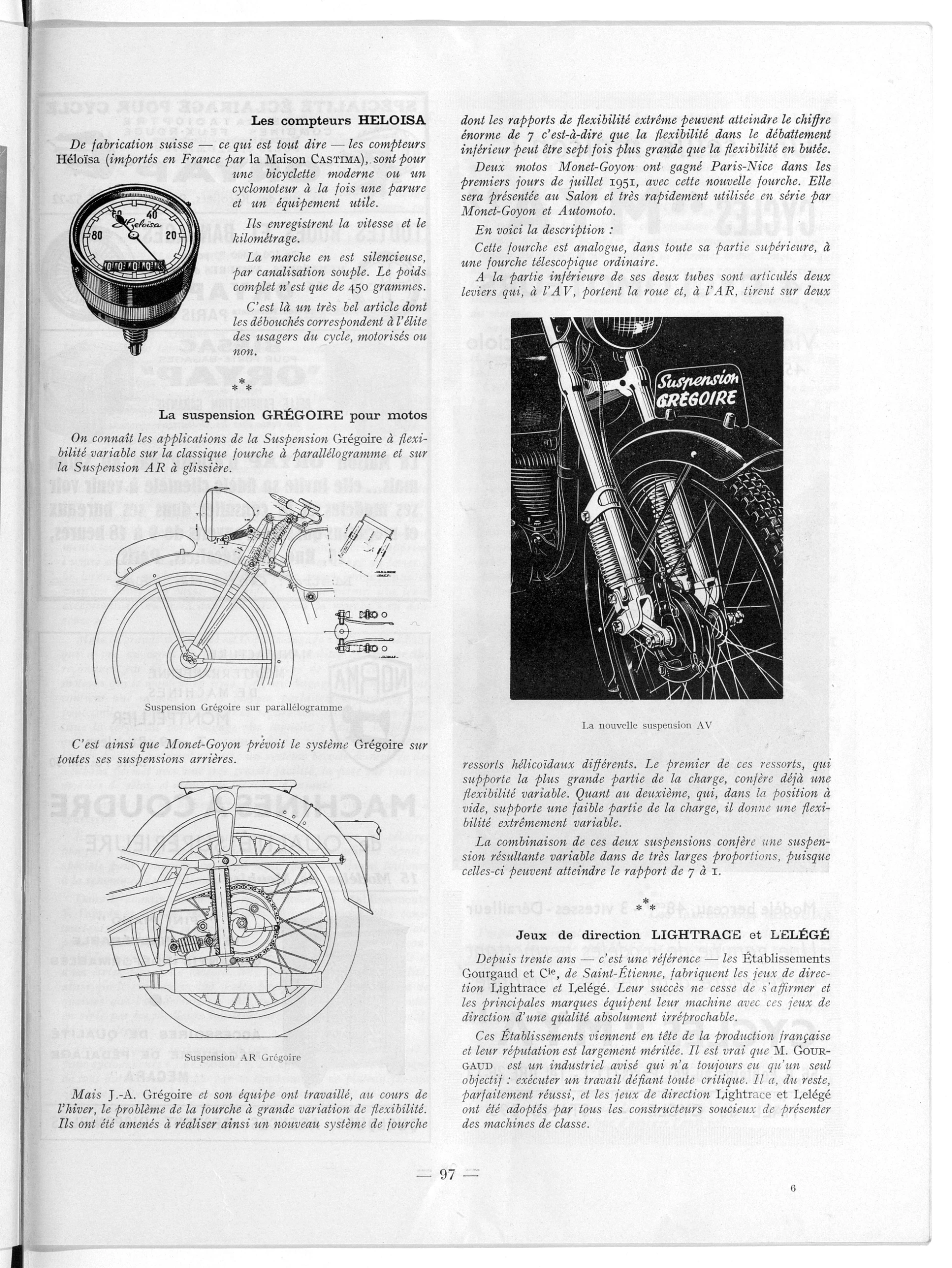
Les compteurs HELOISA
[Ebykr summary; the article’s text is not reproduced. Héloïsa speedometers, made in Switzerland and imported into France by the Maison Castima, are both an ornament and a useful fitting for a modern bicycle or cyclomoteur. They record speed and distance, run silently by a flexible drive and weigh only 450 grams complete, an article for the elite of riders, motorized or not.]
La suspension GRÉGOIRE pour motos
[Ebykr summary; the article’s text is not reproduced. The paper recalls the applications of the Grégoire variable-rate suspension to the classic parallelogram fork and to the sliding rear suspension («Suspension AR à glissière»); Monet-Goyon plans the Grégoire system on all its rear suspensions. Over the winter J.-A. Grégoire and his team worked on a fork of widely variable flexibility, and produced a new fork whose extreme flexibility ratio can reach 7: the flexibility at the bottom of the travel can be seven times that at the stop. Two Monet-Goyon motorcycles won Paris-Nice early in July 1951 with the new fork, which is to be shown at the Salon and soon fitted as standard by Monet-Goyon and Automoto. Its upper part is like an ordinary telescopic fork; at the foot of its two tubes are pivoted two levers that carry the wheel at the front and at the rear pull on two different coil springs. The first spring carries most of the load and already gives a variable rate; the second, carrying little of the load when unladen, gives an extremely variable rate; together they give a resultant rate variable in the ratio of 7 to 1.]
Suspension Grégoire sur parallélogramme
Suspension AR Grégoire
La nouvelle suspension AV
[Captions of the three illustrations, in that order: the two drawings in the left column and the picture in the right column.]
Jeux de direction LIGHTRACE et LELÉGÉ
[Ebykr summary; the article’s text is not reproduced. For thirty years the Établissements Gourgaud et Cie of Saint-Étienne have made the Lightrace and Lelégé headsets, fitted by the main marques. The firm leads French production; M. Gourgaud has only one aim, work beyond criticism, and the Lightrace and Lelégé headsets have been adopted by every builder wanting to offer machines of class.]
— 97 —
6
[Four illustrations. In the left column, set into the Héloïsa note: a line drawing of the round Héloïsa speedometer, its dial lettered “Héloïsa” in script and figured 20, 40, 60 and 80, with an odometer window and a threaded drive boss below. Below the Grégoire heading: a technical line drawing of a motorcycle front end with the Grégoire parallelogram fork (headlamp, coil springs, links and front mudguard), with two small detail views at the right whose tiny titles are not legible; and a technical line drawing of the rear wheel with the Grégoire rear suspension (vertical spring column, chain, carrier, silencer and mudguard). In the right column, framed: a heavily retouched picture, in white line on a black ground, of the new telescopic front fork with its exposed coil springs and pivoted levers, a front brake drum and a knobby tire, with a plate on the mudguard lettered “Suspension GRÉGOIRE” in script and capitals. No signature is visible on any of the four. The rest of the page is type: firm notes in italic, with bold headings, in two columns separated by asterisms (three asterisks). The small “6” below the page number at the right is the printer’s sheet signature. The reverse page (advertisements) shows through the paper faintly; it is not print on this page.]
[The strip at the left edge of the photograph, with a green mark, belongs to the facing page and is not part of the record.]
— Page 8 —
Les dérailleurs HURET
[Ebykr summary; the article’s text is not reproduced. Huret, a name that has become a synonym for the derailleur, brings out for 1951-52 a racing derailleur, type « Tour de France », with chain tensioning («à détension de chaîne»). It has also developed demountable 5-attachment chainring sets «à combinaisons», allowing several rings on one spider («plusieurs couronnes sur un même pignon»).]
Les spécialités J. D. F.
[Ebykr summary; the article’s text is not reproduced. The house of J. Dunois et Fils, founded in 1890, carries on the family tradition. Its new « Alu-Dur » chainguards, in aluminum-manganese alloy 20/10e thick, have taken a leading place this year among quality accessories fitted by the best builders, combining rigidity, coverage, strength and elegance. The new racing brake lever no. 949 was developed after many road trials for professional racers: a special device stops cable wear at the casing stop, the curve of the lever and the shape of the cable guide give a good grip high or low, and a retaining finger gives a firm hold on the brake when climbing out of the saddle («en danseuse»). The great novelty is the « Le Combiné 828 » carrier, fitted as standard this year by many cycle and cyclomoteur makers: a compact carrier holding a well-protected bag under the platform for repair kit, the bag forming the carrier’s body and the platform its lid, kept shut by a strong spring, with a patented stay adjustment that fits it to every bicycle, even children’s; it is supplied heavily cadmium plated. The firm of Vincennes is also known for its « Mistral » pumps in chromed brass and the light-metal « Radieuse Sport » pump for racers. For motorcycles its special « Mistral » pump in chromed brass, 400 × 28, with a detachable metal handle, folding foot stirrup, very long connector and a fine leather piston, is fitted as standard by the best makers of large machines. There is also a « sport » carrier for cyclomoteurs, « Le Combiné », whose platform is the lid of a metal case forming the carrier’s body, already fitted as standard by some makers.]
Les productions Aimé LEDIN
[Ebykr summary; the article’s text is not reproduced. Some parts, such as pedals and freewheels, must harmonize with the bicycle and also have excellent mechanical qualities, smooth bearings and low friction, which calls for technical knowledge, love of the trade and first-class plant designed and built in the maker’s own works and constantly renewed. Among Saint-Étienne’s many craftsmen and manufacturers the paper singles out the Établissements Aimé Ledin, founded in 1902 and run by the founder and his sons. Nearly every pedal model favored by cyclists is said to be an Aimé Ledin, and every Ledin freewheel model was created in its own design office; visits can be arranged. Its Styx, Tank and Merveille pedals and freewheels are the result. The works has electric and fuel-oil furnaces for heat treatment, ultra-modern nickel-chrome plating (soon to be improved further), many machines and an Aimé Ledin design and analysis office, all served by an elite staff.]
Les phares et lanternes LUPPI
[Ebykr summary; the article’s text is not reproduced. The Établissements Luppi, founded in 1891, have followed the evolution of vehicle lighting: from the oil lamp of horse-drawn carriages to acetylene lighting for cars and then motorcycles, for which in 1926 they created the phare-éclipse, the first patented anti-dazzle lamp. In 1930 came the « Ator » dipping headlamp, and production widened from cycle lamps to railway signals and lanterns. In the camping line the works of the Établissements Luppi (now the Manufacture Lyonnaise de Phares et Lanternes) have made cooking equipment for camping whose low weight and bulk give more scope to cyclotourism.]
Les fabrications MAGURA
[Ebykr summary; the article’s text is not reproduced. Twist grips, levers and handlebars for vélomoteurs and motorcycles are the specialty of the Magura mark. Its twist grips never break cables and are carefully made inside and out, with matching dummy grips. Among its levers is the 11/1 ratchet lever, which clamps to 22 and 23,5 handlebars; this multi-purpose device serves as a clutch (giving a neutral for machines without a gearbox) or a brake (slowing or locking), and is recommended for cyclomoteurs and invalids’ vehicles; it can even serve as an anti-theft lock.]
— 99 —
[The page is type only, with no drawing or photograph: firm notes in italic, with bold headings, in two columns separated by asterisms (three asterisks). The heading “Les dérailleurs HURET” is weakly inked, its letters partly missing. The reverse page (advertisements) shows through the paper faintly; it is not print on this page.]
[The strip at the left edge of the photograph is part of the facing page (an advertisement) and is not part of the record.]
— Page 9 —
Les productions MAGNÉTO-FRANCE
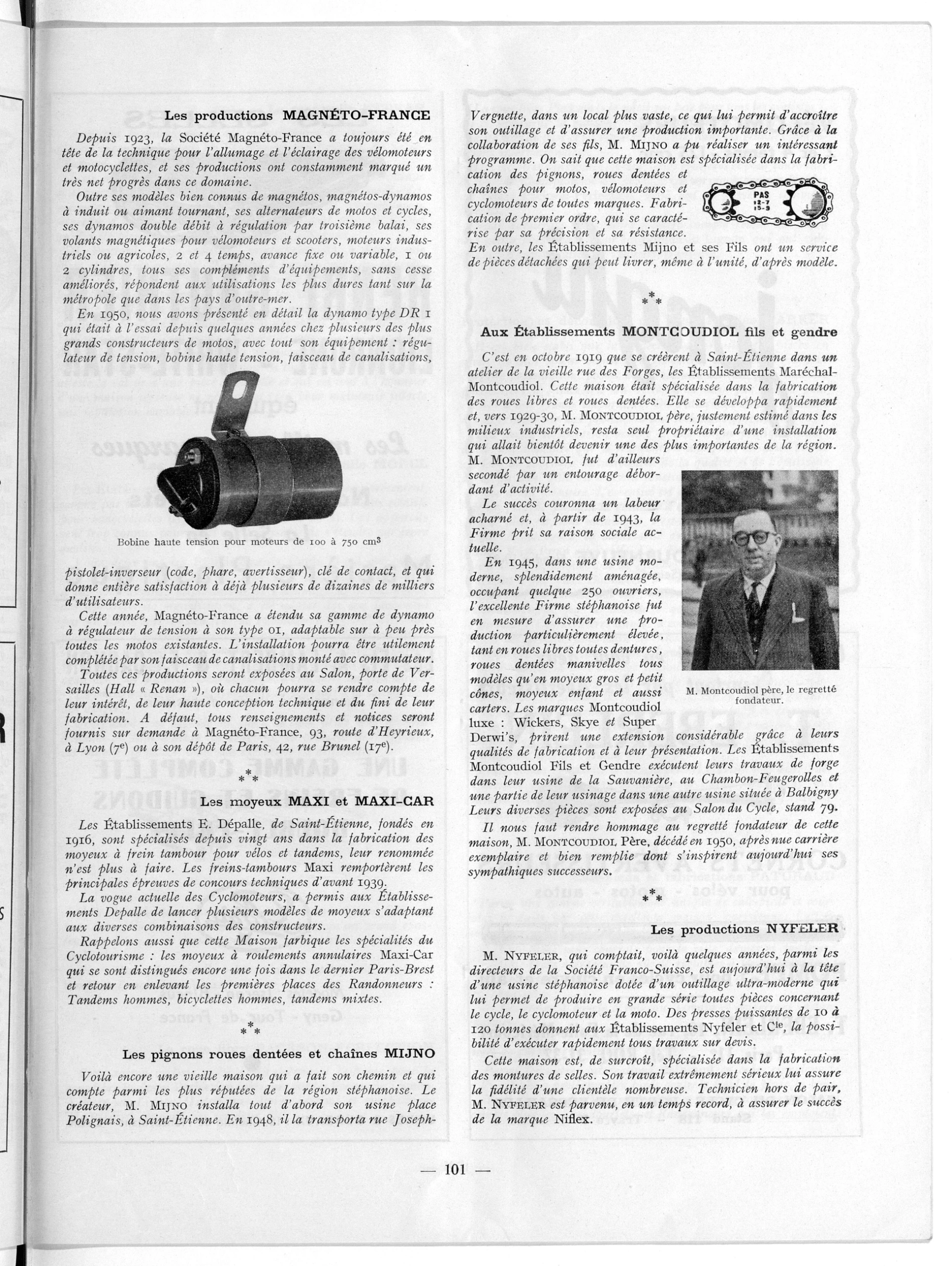
[Ebykr summary; the article’s text is not reproduced. Since 1923 the Société Magnéto-France has led in ignition and lighting for vélomoteurs and motorcycles. Its range: magnetos and magneto-dynamos with rotating armature or magnet, alternators for motorcycles and cycles, dual-output dynamos regulated by a third brush, flywheel magnetos for vélomoteurs and scooters, and magnetos for 2- and 4-stroke industrial or agricultural engines (fixed or variable advance, 1 or 2 cylinders), with all their accessories, for use in metropolitan France and overseas. In 1950 the paper described the type DR 1 dynamo, tested for some years by several of the largest motorcycle makers, with its full equipment: voltage regulator, high-tension coil, wiring harness, switch unit (« code, phare, avertisseur ») and ignition key, now used by several tens of thousands of riders. This year the firm has extended its voltage-regulated dynamo range with the type 01, adaptable to nearly every motorcycle and best completed by its wiring harness with switch. The products are shown at the Salon, porte de Versailles (Hall « Renan »); information and leaflets from Magnéto-France, 93, route d’Heyrieux, Lyon (7e), or its Paris depot, 42, rue Brunel (17e).]
Bobine haute tension pour moteurs de 100 à 750 cm³
Les moyeux MAXI et MAXI-CAR
[Ebykr summary; the article’s text is not reproduced. The Établissements E. Dépalle of Saint-Étienne, founded in 1916, have specialized for twenty years in drum-brake hubs for bicycles and tandems; the Maxi drum brakes won the main technical trials (« concours techniques ») before 1939. The present vogue for cyclomoteurs has led Depalle to launch several hub models suited to various makers’ designs. The firm also makes cyclotouring specialties: the Maxi-Car hubs with annular (cartridge) bearings, which again distinguished themselves in the last Paris-Brest et retour, taking the first places among the Randonneurs in men’s tandems, men’s bicycles and mixed tandems.]
Les pignons roues dentées et chaînes MIJNO
[Ebykr summary; the article’s text is not reproduced. An old and well-regarded firm of the Saint-Étienne region. Its founder, M. Mijno, first set up his works on the place Polignais in Saint-Étienne; in 1948 he moved to larger premises in the rue Joseph-Vergnette, allowing more tooling and a larger output. With his sons’ help M. Mijno has carried out an important program. The firm specializes in sprockets, chainwheels and chains for motorcycles, vélomoteurs and cyclomoteurs of every make, praised for precision and strength. The Établissements Mijno et ses Fils also run a spare-parts service that can supply even single pieces made to a pattern.]
Aux Établissements MONTCOUDIOL fils et gendre
[Ebykr summary; the article’s text is not reproduced. In October 1919 the Établissements Maréchal-Montcoudiol were founded in a workshop in the old rue des Forges, Saint-Étienne, making freewheels and chainwheels. The firm grew quickly and about 1929-30 M. Montcoudiol père became sole owner of what would become one of the region’s largest plants, helped by an energetic staff. From 1943 the firm took its present name. In 1945, in a modern, well-equipped factory employing some 250 workers, it achieved a high output of freewheels of all tooth counts, chainwheels and cranks of all models, large and small-flange hubs, children’s hubs and chain cases (« carters »). The Montcoudiol luxe brands Wickers, Skye and Super Derwi’s grew considerably. The Établissements Montcoudiol Fils et Gendre do their forging at their Sauvanière works at Le Chambon-Feugerolles and part of their machining at another works at Balbigny. Their parts are shown at the Salon du Cycle, stand 79. The paper pays tribute to the late founder, M. Montcoudiol Père, who died in 1950 after an exemplary career that inspires his successors.]
M. Montcoudiol père, le regretté fondateur.
Les productions NYFELER
[Ebykr summary; the article’s text is not reproduced. M. Nyfeler, some years ago one of the directors of the Société Franco-Suisse, now heads a Saint-Étienne factory with ultra-modern tooling that mass-produces all kinds of parts for the cycle, the cyclomoteur and the motorcycle. Presses of 10 to 120 tonnes let the Établissements Nyfeler et Cie carry out any work to quotation quickly. The firm also specializes in saddle frames (« montures de selles »), and M. Nyfeler, an outstanding technician, has quickly made the Niflex brand a success.]
[Illustrations: in the left column, a photograph of a cylindrical Magnéto-France high-tension coil with its mounting bracket and terminal cap, captioned below. In the right column, a line drawing of the Mijno mark: a roller chain running around two sprockets, a small one at the left and a large one at the right, with the words “PAS”, “12-7” and “15-9” in the space between them (the chain pitches, 12.7 and 15.9 mm). Further down the right column, a halftone portrait of M. Montcoudiol père, a heavyset man in glasses, dark suit and tie, captioned below. Small star-cluster ornaments separate the sections. No signatures.]
[At the left edge of the photograph a narrow strip of the facing page shows (the edges of its framed advertisements); print from the other side of the leaf shows through the paper. Neither is part of the record.]
— Page 10 —
La manivelle NERVAR
[Ebykr summary; the article’s text is not reproduced. Among the very first crank makers stand the Établissements Peyrard of Saint-Chamond, whose Nervar brand is known everywhere: Nervar cranks equipped the Swiss champion Koblet, winner of the last Tour de France. M. Peyrard, the active Saint-Chamond industrialist, shows at the 1951 Salon a patented three-arm crimped crank (« manivelle sertie trois branches ») that should interest the makers. Under the control of the Union Technique de l’Automobile et du Cycle it passed tests from March to May with a load of 12 kgs, equal to a distance of 13.500 kms (13,500 km) for two million revolutions, a result favorable on every point.]
Les magnétos et dynamos Émile MOREL
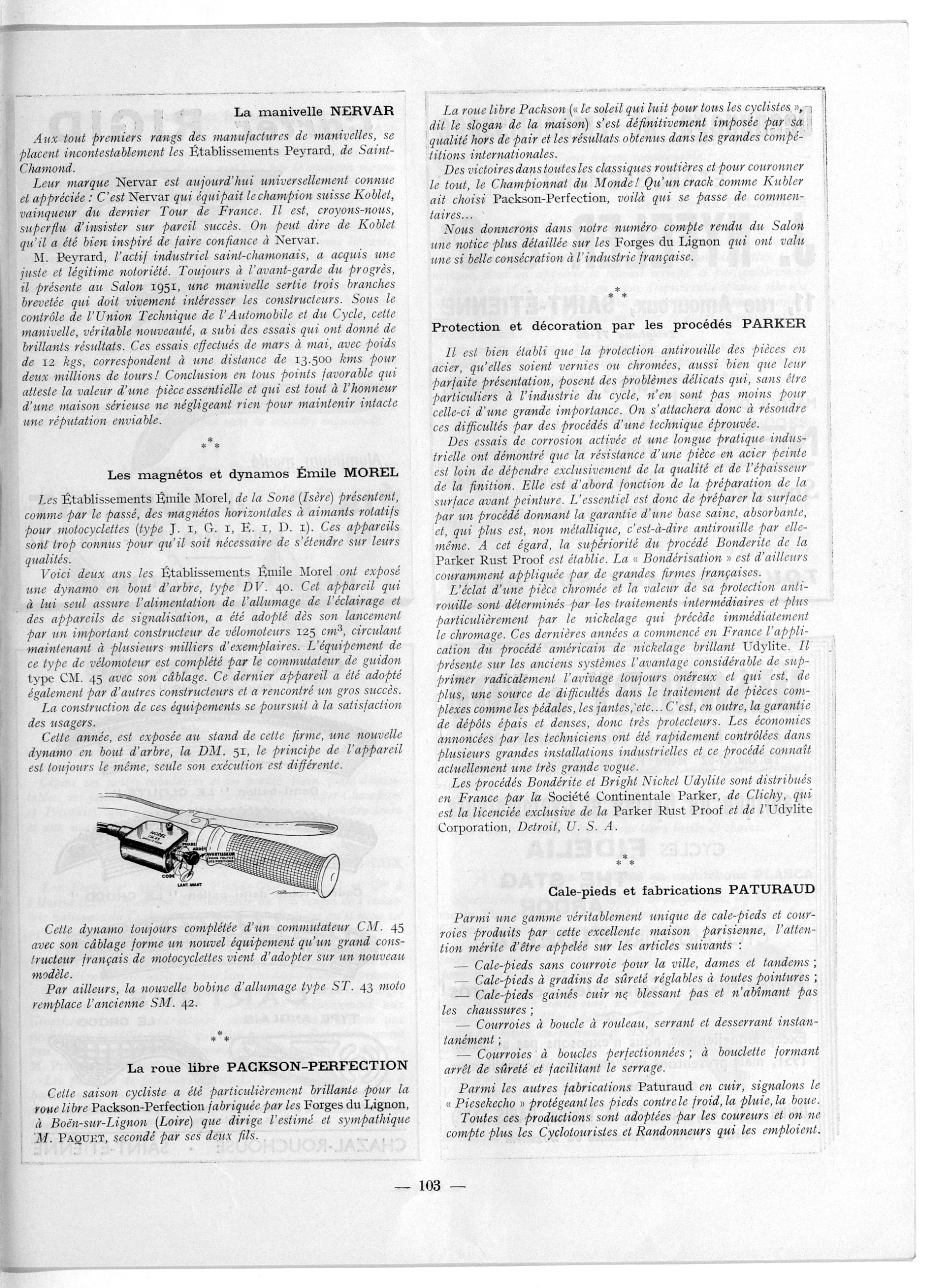
[Ebykr summary; the article’s text is not reproduced. The Établissements Émile Morel of La Sone (Isère) show, as before, horizontal magnetos with rotating magnets for motorcycles (types J. 1, G. 1, E. 1 and D. 1). Two years ago they showed a shaft-end dynamo, type DV. 40, which alone powers the ignition, the lighting and the signaling equipment; it was adopted at its launch by a major maker of 125 cm³ vélomoteurs and several thousand are now in use. That vélomoteur’s equipment is completed by the handlebar switch type CM. 45 with its wiring, also adopted by other makers with great success. This year the firm’s stand shows a new shaft-end dynamo, the DM. 51, on the same principle but differently built. The dynamo, again with the CM. 45 switch and wiring, forms a new set of equipment just adopted by a large French motorcycle maker on a new model, and the new ignition coil type ST. 43 moto replaces the former SM. 42.]
Labels on the drawing:
MOREL
CM 45
BREVETÉ SGDG [?]
PHARE
ARRÊT
AVERTISSEUR
DANS TOUTES
LES POSITIONS
CODE
LANT. AVANT
La roue libre PACKSON-PERFECTION
[Ebykr summary; the article’s text is not reproduced. The cycling season was a brilliant one for the Packson-Perfection freewheel, made by the Forges du Lignon at Boën-sur-Lignon (Loire), directed by M. Paquet, helped by his two sons. The Packson freewheel, whose house slogan is « le soleil qui luit pour tous les cyclistes », has established itself by its quality and by its results in the great international races: wins in all the classic road races and, to crown them, the World Championship, with a « crack » like Kubler choosing Packson-Perfection. The paper promises a more detailed notice on the Forges du Lignon in its report on the Salon.]
Protection et décoration par les procédés PARKER
[Ebykr summary; the article’s text is not reproduced. Rust protection of steel parts, varnished or chrome-plated, together with a perfect finish, is a delicate problem of special importance to the cycle industry. Accelerated corrosion tests and long industrial practice show that the resistance of a painted steel part depends first on preparing the surface before painting with a process that gives a sound, absorbent, non-metallic base, itself rust-resisting; here the Bonderite process of the Parker Rust Proof is superior, and « Bondérisation » is widely applied by large French firms. For chrome-plated parts, the shine and the protection depend on the intermediate treatments, above all the nickel plating before the chrome. In recent years France has begun to apply the American bright-nickel process Udylite, which eliminates the costly buffing (« avivage »), avoids difficulties with complex parts such as pedals and rims, and gives thick, dense and highly protective deposits; its savings have been confirmed in several large plants. The Bondérite and Bright Nickel Udylite processes are distributed in France by the Société Continentale Parker of Clichy, exclusive licensee of the Parker Rust Proof and of the Udylite Corporation, Detroit, U. S. A.]
Cale-pieds et fabrications PATURAUD
[Ebykr summary; the article’s text is not reproduced. From the wide range of toe clips and straps made by this Paris firm, the paper singles out the items listed below; among Paturaud’s other leather goods it notes the « Piesekecho », which protects the feet from cold, rain and mud. All these products are used by racers and by countless cyclotourists and randonneurs.]
— Cale-pieds sans courroie pour la ville, dames et tandems ;
— Cale-pieds à gradins de sûreté réglables à toutes pointures ;
— Cale-pieds gainés cuir ne blessant pas et n’abîmant pas les chaussures ;
— Courroies à boucle à rouleau, serrant et desserrant instantanément ;
— Courroies à boucles perfectionnées ; à bouclette formant arrêt de sûreté et facilitant le serrage.
[Illustrations: in the left column, a line drawing of the Morel CM 45 switch clamped to a motorcycle handlebar beside the knurled grip and the lever, its cable running off at the left, with lettered arrows naming the switch positions (transcribed above). It is signed with an illegible script signature at the lower right, under the grip. Small star-cluster ornaments separate the sections; parts of both columns are boxed by thin printed rules.]
[Print from the other side of the leaf shows through the paper; it is not part of the record.]
— Page 11 —
Les moyeux freins-tambour PERRIN
NEW-STAR
[Ebykr summary; the article’s text is not reproduced. Visitors to the Salon du Cycle will be amazed by the new drum-brake hub perfected by M. E. Perrin, the industrialist who heads the large Lardy works at Boën-sur-Lignon. The new hub for cycles and cyclomoteurs is light and elegant, a small mechanical marvel of perfect efficiency. It has three brake segments instead of two, the third movable and acting in reaction on the other two, which gives a smoother and much more effective braking and a long life. It also gives a perfectly true wheel build, removes the drawbacks in assembly and allows spokes of equal length. The New-Star drum-brake hub is already a brilliant success.]
Les jantes des Établissements PELLET
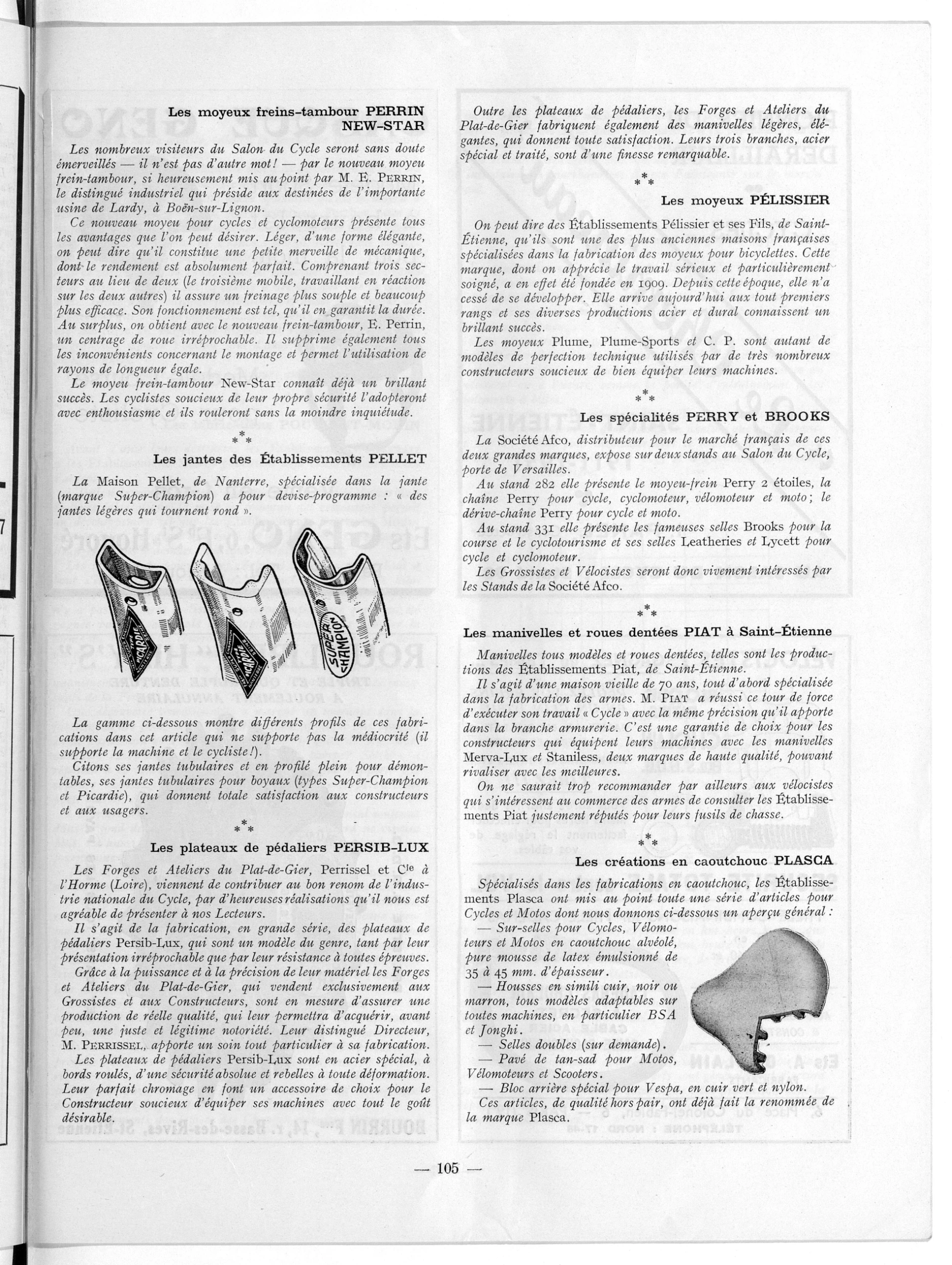
[Ebykr summary; the article’s text is not reproduced. The Maison Pellet of Nanterre, rim specialists (Super-Champion brand), work to the motto « des jantes légères qui tournent rond ». The drawings show different sections of its rims, and the paper quips that the product cannot bear mediocrity (it bears the machine and the cyclist). It cites the tubular and solid-section rims for clincher tires (« démontables ») and the tubular rims for tubulars (« boyaux »), types Super-Champion and Picardie, which fully satisfy makers and users.]
Labels on the drawings:
FAB.on [?] SUPER CHAMPION
TYPE
PICARDIE
NANTERRE SEINE
SUPER
CHAMPION
Les plateaux de pédaliers PERSIB-LUX
[Ebykr summary; the article’s text is not reproduced. The Forges et Ateliers du Plat-de-Gier, Perrissel et Cie, of L’Horme (Loire), mass-produce the Persib-Lux chainwheels, unique of their kind for their finish and their strength. The firm sells only to wholesalers and makers, and its director M. Perrissel gives particular care to the work. The Persib-Lux chainwheels are of special steel with rolled edges, perfectly safe and proof against any deformation, and their chrome plating makes them a choice accessory. Besides chainwheels the firm makes light, elegant cranks whose three arms, of special treated steel, are remarkably fine.]
Les moyeux PÉLISSIER
[Ebykr summary; the article’s text is not reproduced. The Établissements Pélissier et ses Fils of Saint-Étienne, among the oldest French makers of bicycle hubs, were founded in 1909 and have grown ever since; their steel and dural products are a brilliant success. The Plume, Plume-Sports and C. P. hubs are used by many makers who want to equip their machines well.]
Les spécialités PERRY et BROOKS
[Ebykr summary; the article’s text is not reproduced. The Société Afco, distributor for the French market of these two great brands, shows on two stands at the Salon du Cycle, porte de Versailles. At stand 282: the Perry 2 étoiles hub brake, the Perry chain for cycle, cyclomoteur, vélomoteur and motorcycle, and the Perry chain-breaker (« dérive-chaîne ») for cycle and motorcycle. At stand 331: the famous Brooks saddles for racing and cyclotouring, and the Leatheries and Lycett saddles for cycle and cyclomoteur. Wholesalers and dealers (« Grossistes et Vélocistes ») will be keenly interested.]
Les manivelles et roues dentées PIAT à Saint-Étienne
[Ebykr summary; the article’s text is not reproduced. The Établissements Piat of Saint-Étienne make cranks of all models and chainwheels. The house is 70 years old and began as a gun maker; M. Piat brings to his cycle work the same precision as to his arms work. Makers can choose the Merva-Lux and Staniless cranks, two high-quality brands. Dealers interested in the arms trade are recommended to consult Piat, known for its hunting guns.]
Les créations en caoutchouc PLASCA
[Ebykr summary; the article’s text is not reproduced. The Établissements Plasca, rubber specialists, have developed a series of articles for cycles and motorcycles, listed below; these articles have made the Plasca brand’s reputation.]
— Sur-selles pour Cycles, Vélomoteurs et Motos en caoutchouc alvéolé, pure mousse de latex émulsionné de 35 à 45 mm. d’épaisseur.
— Housses en simili cuir, noir ou marron, tous modèles adaptables sur toutes machines, en particulier BSA et Jonghi.
— Selles doubles (sur demande).
— Pavé de tan-sad pour Motos, Vélomoteurs et Scooters.
— Bloc arrière spécial pour Vespa, en cuir vert et nylon.
[Illustrations: in the left column, a line drawing of three short sections of rim, cut to show their profiles: two with diamond-shaped Picardie decals and one with an oval Super-Champion decal (the lettering transcribed above). In the right column, a photograph of a Plasca saddle cover (« sur-selle ») shown at an angle. Small star-cluster ornaments separate the sections; parts of both columns are boxed by thin printed rules. No signatures.]
[At the left edge of the photograph a narrow strip of the facing page shows (the edges of its framed advertisements, with a stray figure “7”); print from the other side of the leaf shows through the paper. Neither is part of the record.]
— Page 12 —
Les moyeux PORTHOR
[Ebykr summary; the article’s text is not reproduced. « Moyeux de haute qualité » is the motto of the Établissements Porthor of Saint-Étienne, which offer a complete range from the ordinary hub to the « luxe » type, as well as the drum-brake hub. Since 1923 the Porthor products for racing, the road and cyclotouring have had growing success, and the « Tour de France » no 50 model, supplied for the Simplex quick release (« blocage Simplex »), is an undisputed success; riders who have used the firm’s hubs can vouch for it. Thanks to fine tooling and capable technicians the French hub industry is worthily represented, and Porthor parts are « chefs-d’œuvres » of the trade: precision, strength and elegance are their first qualities.]
Les fabrications POUTRAIT-MORIN
[Ebykr summary; the article’s text is not reproduced. Before joining forces the Établissements Poutrait and the Établissements Morin could each already celebrate their silver anniversary; pooling their resources put the Établissements Poutrait-Morin, before the war, at the head of French and foreign cycle-equipment makers. The millions of Zef, Zefal and Tornade pumps laid end to end would stretch tens of thousands of kilometers; the Afa and Zefal bells ring around the world; hardly a race of any importance has not been won on Christophe toe clips, shaped to the foot, and the quick-release Lapize straps, of which a new roller-buckle model is fully effective. A major advance in pumps is the Solibloc process, applied to the Zefal duralumin and Tornade light-metal pumps: the body is one compact, solid piece, with no end piece fitted by welding, crimping, screwing or any other fixing, so it cannot leak, and the thread is cut in the thickness of the solid end, so the connector no longer works loose. The polished Zefal and Tornade models are protected by the Chromecla process, like a fine chrome plating; the Zefal bells are colored in the metal itself, and the finishing touch is the tricolor Zefal pump. Years of study have chosen the metals of the bell domes for their pitch and their sustained tone. After France and the Union française, the firm prospects the main countries of the world through the Groupement des Fabricants Exportateurs, F. R. E. X. A., though exchange-control rules and other import restrictions limit the bicycle’s huge prospects abroad; foreign customers welcome the firm’s goods whenever a trade agreement lets them in.]
L’équipement RADIOS type « Z »
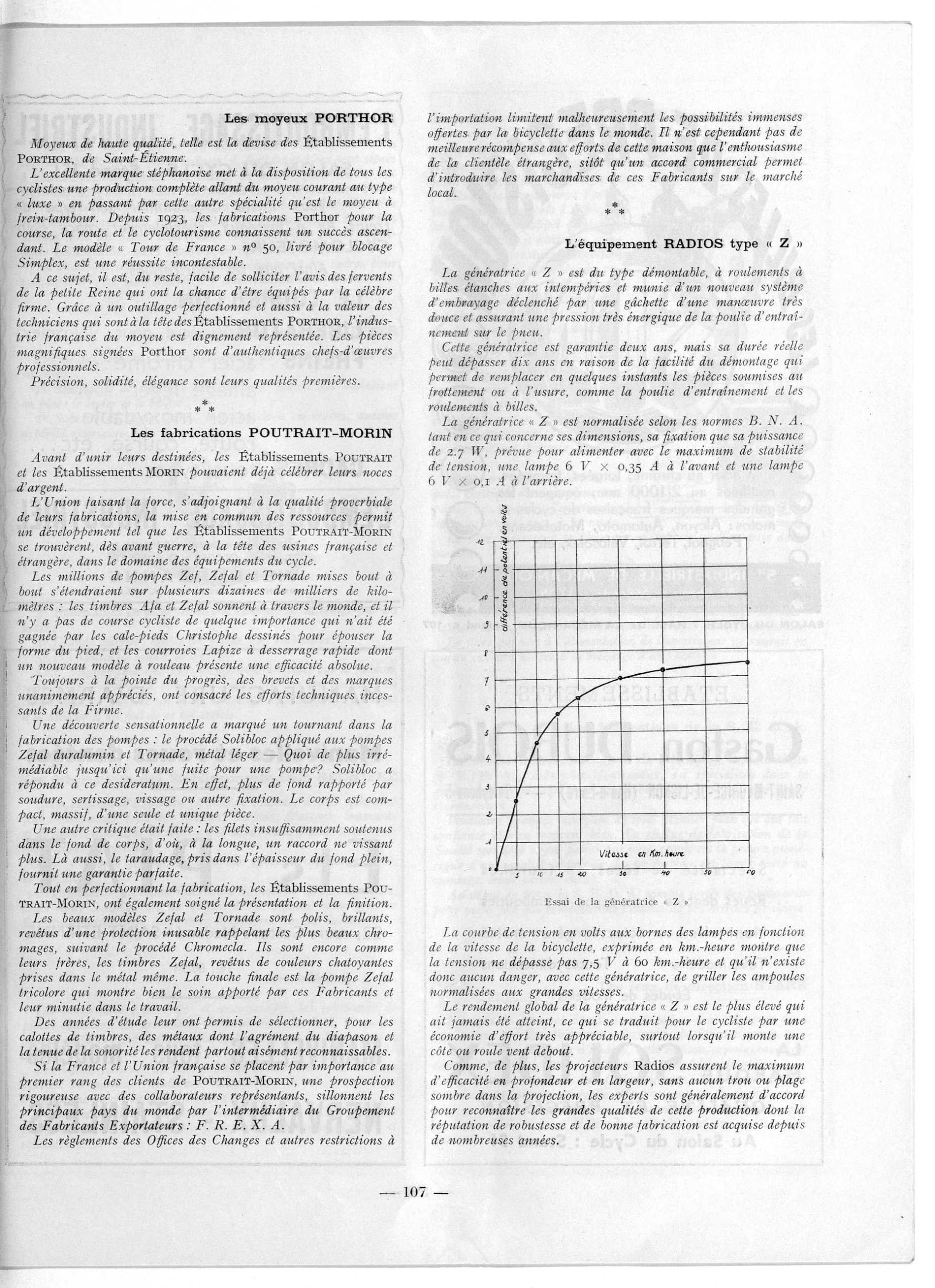
[Ebykr summary; the article’s text is not reproduced. The « Z » generator can be dismantled, runs on weatherproof ball bearings and has a new engagement system released by a trigger, gentle to work and pressing the drive pulley firmly against the tire. It is guaranteed two years, but may last over ten, since the parts subject to friction or wear, such as the drive pulley and the ball bearings, can be replaced in moments. It is standardized to the B. N. A. norms in its dimensions, its mounting and its output of 2.7 W, meant to feed with the best voltage stability a 6 V × 0,35 A lamp at the front and a 6 V × 0,1 A lamp at the rear. The voltage curve at the lamp terminals as a function of speed in km.-heure shows that the voltage does not exceed 7,5 V at 60 km.-heure, so there is no risk of burning out the standard bulbs at high speed. The paper adds that its overall efficiency is the highest yet reached, saving the cyclist effort, above all when climbing or riding into the wind, and that the Radios headlamps give the greatest depth and breadth of light with no dark spots, a reputation for strength and good make earned over many years.]
Graph labels:
différence de potentiel en volts
0 1 2 3 4 5 6 7 8 9 10 11 12
Vitesse en Km.heure
5 10 15 20 30 40 50 60
Essai de la génératrice « Z »
[Illustrations: in the right column, a hand-lettered line graph on a square grid of the « Z » generator test: voltage (« différence de potentiel en volts », 0 to 12) on the vertical axis against speed (« Vitesse en Km.heure », 0 to 60) on the horizontal. The curve, drawn through plotted points, rises steeply from 0 to about 2.5 V at 5 km/h and about 4.6 V at 10 km/h, then flattens: about 5.7 V at 15, 6.3 V at 20, 7.0 V at 30, 7.3 V at 40 and 7.6 V at 60 km/h (values read from the drawing). Small star-cluster ornaments separate the sections; parts of both columns are boxed by thin printed rules. No signatures.]
[Print from the other side of the leaf shows through the paper (including an advertisement for the Établissements Gaston Dubois); it is not part of the record.]
— Page 13 —
Les cadres de luxe ROLL’S
[Ebykr summary; the article’s text is not reproduced. A brand that has made its way, thanks to M. Rollès, a young industrialist whose workshops are at Saint-Priest-en-Jarez. The Roll’s luxury frames have real style and faultless workmanship; Roll’s uses Vitus light and extra-light tubing. Its special models are admired by connoisseurs, and bicycles built on a Roll’s frame are both handsome and perfectly balanced. The firm also builds well-designed frames for cyclomoteurs.]
La poignée de frein F. RUTTER
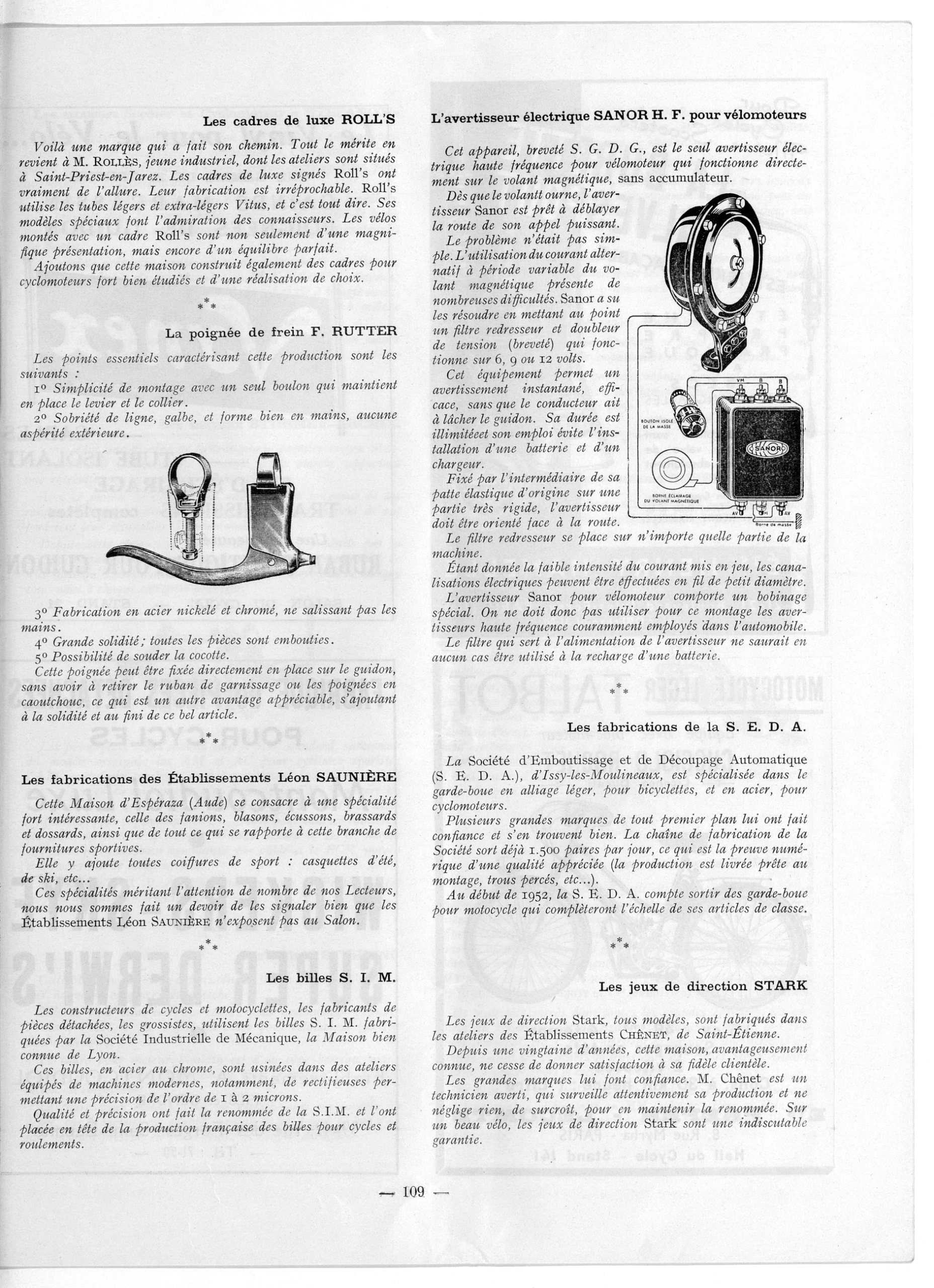
[Ebykr summary; the article’s text is not reproduced. The paper lists the main points of this brake lever, as below. The lever can be fitted directly on the handlebar without removing the handlebar tape or the rubber grips, a further advantage added to its strength and finish.]
1o Simplicité de montage avec un seul boulon qui maintient en place le levier et le collier.
2o Sobriété de ligne, galbe, et forme bien en mains, aucune aspérité extérieure.
3o Fabrication en acier nickelé et chromé, ne salissant pas les mains.
4o Grande solidité ; toutes les pièces sont embouties.
5o Possibilité de souder la cocotte.
Les fabrications des Établissements Léon SAUNIÈRE
[Ebykr summary; the article’s text is not reproduced. This firm of Espéraza (Aude) specializes in pennants, crests, badges, armbands and race numbers (« dossards ») and all sporting supplies of that kind, as well as sports caps for summer, skiing and so on. The paper mentions them for its readers although the Établissements Léon Saunière are not exhibiting at the Salon.]
Les billes S. I. M.
[Ebykr summary; the article’s text is not reproduced. Cycle and motorcycle makers, parts makers and wholesalers use the S. I. M. balls made by the Société Industrielle de Mécanique, the well-known Lyon firm. The chrome-steel balls are machined in modern workshops, notably on grinding machines, to a precision of 1 to 2 microns, and have put the S.I.M. at the head of French production of balls for cycles and bearings.]
L’avertisseur électrique SANOR H. F. pour vélomoteurs
[Ebykr summary; the article’s text is not reproduced. This horn, « breveté S. G. D. G. », is the only high-frequency electric horn for vélomoteurs that works directly from the flywheel magneto, without a battery, as soon as the flywheel turns. The variable-period alternating current of the flywheel magneto posed many problems, which Sanor solved with a patented rectifier filter and voltage doubler working on 6, 9 or 12 volts. The horn gives an instant, effective warning without the rider letting go of the handlebar; its life is unlimited and it does away with a battery and charger. It is mounted by its original elastic bracket on a very rigid part, facing the road, and the rectifier filter can go anywhere on the machine. The low current allows thin wiring. The Sanor vélomoteur horn has a special winding, so the high-frequency horns used on cars must not be used with this setup, and the filter must never be used to charge a battery.]
Labels on the diagram:
VM B B
BOUTON ISOLÉ
DE LA MASSE
SANOR
BORNE ÉCLAIRAGE
DU VOLANT MAGNÉTIQUE
AV M [?] AV
Borne de masse
Les fabrications de la S. E. D. A.
[Ebykr summary; the article’s text is not reproduced. The Société d’Emboutissage et de Découpage Automatique (S. E. D. A.) of Issy-les-Moulineaux specializes in mudguards, of light alloy for bicycles and of steel for cyclomoteurs. Several leading brands use them, and the production line already turns out 1.500 (1,500) pairs a day, delivered ready to fit, holes drilled. At the start of 1952 the S. E. D. A. plans to bring out motorcycle mudguards to complete its range.]
Les jeux de direction STARK
[Ebykr summary; the article’s text is not reproduced. The Stark headsets, all models, are made in the workshops of the Établissements Chênet of Saint-Étienne, a well-known firm that has satisfied its customers for some twenty years. The leading brands trust it, and M. Chênet, a skilled technician, watches his production closely; on a fine bicycle the Stark headset is an undisputed guarantee.]
[Illustrations: in the left column, a drawing of the Rutter brake lever, its clamp band shown above with the single bolt, the band and bolt traced again in dotted outline inside the lever body. In the right column, a wiring diagram of the Sanor H. F. horn: the round horn with its bracket at the top, connected by lines to the rectifier filter box, which bears an oval “SANOR” badge and lettered terminals, to an insulated push button and to the lighting terminal of the flywheel magneto (labels transcribed above). Small star-cluster ornaments separate the sections; parts of both columns are boxed by thin printed rules. No signatures.]
[Print from the other side of the leaf shows through the paper; it is not part of the record.]
— Page 14 —
Les trousses Scooter et Cyclomoteur « STEFANOX »
[Ebykr summary; the article’s text is not reproduced. Until now there was no standard tool kit to go with each cyclomoteur. The Stefanox brand of Saint-Étienne has solved the problem with two kits, an ordinary model and a de luxe model, for cyclomoteur and scooter riders. The ordinary model holds 1) a lacquered 21 spark-plug wrench, 2) lacquered 150 combination pliers, 3) a lacquered 6″ adjustable wrench and 4) a two-position screwdriver. The de luxe model holds 1) a chrome-plated 21 spark-plug wrench, 2) chrome-plated 150 combination pliers, 3) a chrome-plated adjustable wrench and 4) a plastic-handled screwdriver with three tools. The paper wishes Stefanox a deserved success.]
Les moyeux STURMEY-ARCHER
[Ebykr summary; the article’s text is not reproduced. Some fifty years (« une dizaine de lustres ») have passed since the first Sturmey-Archer 3-speed hub came on the market, a technical revolution that let cyclists ride farther with less fatigue, so that hills and headwinds lost their terrors. The British firm’s range has grown ever since, with a hub for every kind of user. The main current types are the AW standard, successor of the original model; the AM and AC for sporting cyclists; the ABC with drum brake, all 3-speed; the FW for the most demanding cycling; the FM, similar but for sporting riders wanting closer gears; and the FC, designed for road racing, these last three 4-speed. There are also the BFC, a front (« AV ») hub with cable-operated drum brake, and the BCR, a rear (« AR ») hub with the same brake. The Société G. I. P. imports these hubs into France.]
Lettering on the drawing:
STURMEY […]
AW-7 [?]
Les cadres STERLING
[Ebykr summary; the article’s text is not reproduced. This firm, more than thirty years old, has adapted to new demands with frames for cyclomoteurs (Poulain, VAP and V. L. T. motors) and a frame for a vélomoteur (Sachs 98 cm³ motor). The frame for the Poulain motor is a very rigid cradle type that holds the motor well. The frame for the Vap motor places the motor, unlike anything done so far, right at the frame’s center of gravity; it is also centered, needs no special cranks and has a very short motor chain run, so the chain no longer wears; the paper expects it to be a great success at the Salon. The frame for the Sachs 98 cm³ motor places the motor very low, with a parallelogram fork in tube or pressed-steel form. Sterling still makes all models of bicycle frames, notably its Luxe models, with a new fork crown cover, new cable stops and a new chain case type. Sterling ranks among the largest French firms by output and is the exclusive world distributor of the famous Swedish « 808 » tubes, winners of the 1950 Tour de France.]
Les productions SUPER-CHAMPION
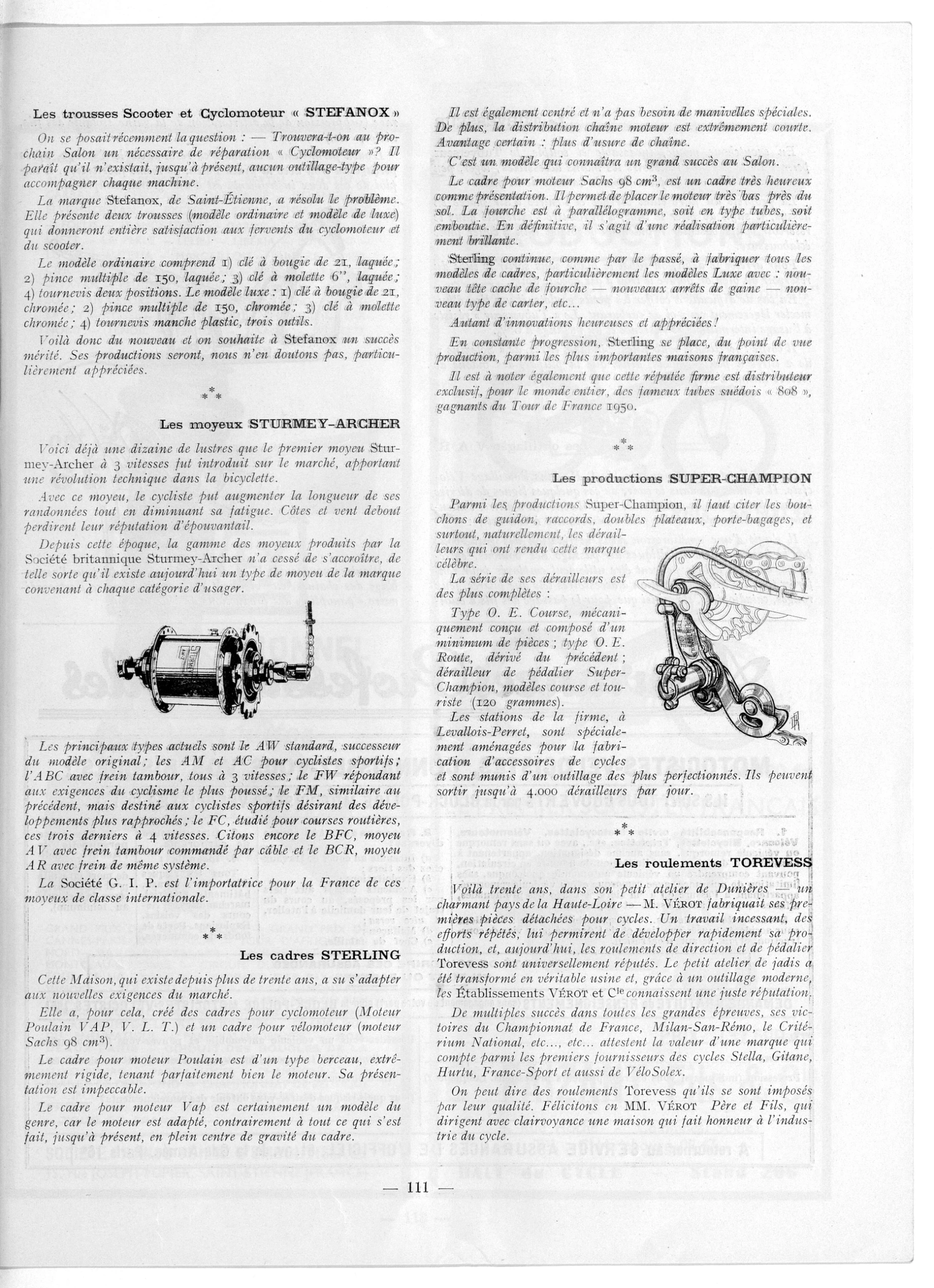
[Ebykr summary; the article’s text is not reproduced. Super-Champion makes handlebar plugs, fittings, double chainwheels and carriers, and above all the derailleurs that made the brand famous. The series includes the Type O. E. Course, mechanically designed with a minimum of parts; the type O. E. Route, derived from it; and the Super-Champion front derailleur (« dérailleur de pédalier »), racing and touring models (120 grammes). The firm’s works at Levallois-Perret, specially laid out for making cycle accessories and fully tooled, can turn out up to 4.000 (4,000) derailleurs a day.]
Les roulements TOREVESS
[Ebykr summary; the article’s text is not reproduced. Thirty years ago, in his small workshop at Dunières, in the Haute-Loire, M. Vérot made his first cycle parts; steady work let him grow quickly, and today the Torevess headset and bottom-bracket bearings are known everywhere. The small workshop has become a real factory with modern tooling, and the Établissements Vérot et Cie have a well-earned reputation. Many successes in the great races, wins in the Championnat de France, Milan-San-Rémo and the Critérium National among them, attest the brand, which is among the leading suppliers of the cycles Stella, Gitane, Hurtu, France-Sport and VéloSolex. The paper congratulates MM. Vérot Père et Fils, who run the firm.]
[Illustrations: in the left column, a drawing of a Sturmey-Archer 3-speed hub seen from the side, with its sprocket, the gear-indicator chain and its rod at the right, and the name lettered on the shell. In the right column, a fine line drawing of a Super-Champion rear derailleur on the frame, with the gear cable, the multiple freewheel and the chain, the body lettered with the name and type (only partly legible); it is signed with a “DR” monogram (the letters joined) at the lower right. Small star-cluster ornaments separate the sections; parts of both columns are boxed by thin printed rules.]
[Print from the other side of the leaf shows through the paper; it is not part of the record.]
— Page 15 —
Le TUBVERSEUR
[Ebykr summary; the article’s text is not reproduced. The Tubverseur, of molded rubber, unbreakable and flexible, reaches the least accessible fuel tanks; it is light and small enough to carry in the motorcycle’s bag. With the filter checked clean and the air inlet on top, the rider bends the tube, puts its end into the tank and tips the can quickly to avoid splashing; to stop the flow, the can is lowered without taking the tube out of the tank, or the air hole is closed with a finger. If it is hard to fit over small necks, these can be moistened with a little fuel. The « Tubverseur » stands intermittent use with gasoline and with the 6 % mixture. It fits jerricans, carboys (« bonbonnes »), 5-liter cans, « Solexine » cans, 2-liter cans with small necks and most reserve cans, even those with a spout. The maker is not named.]
Les outillages V. A. R.
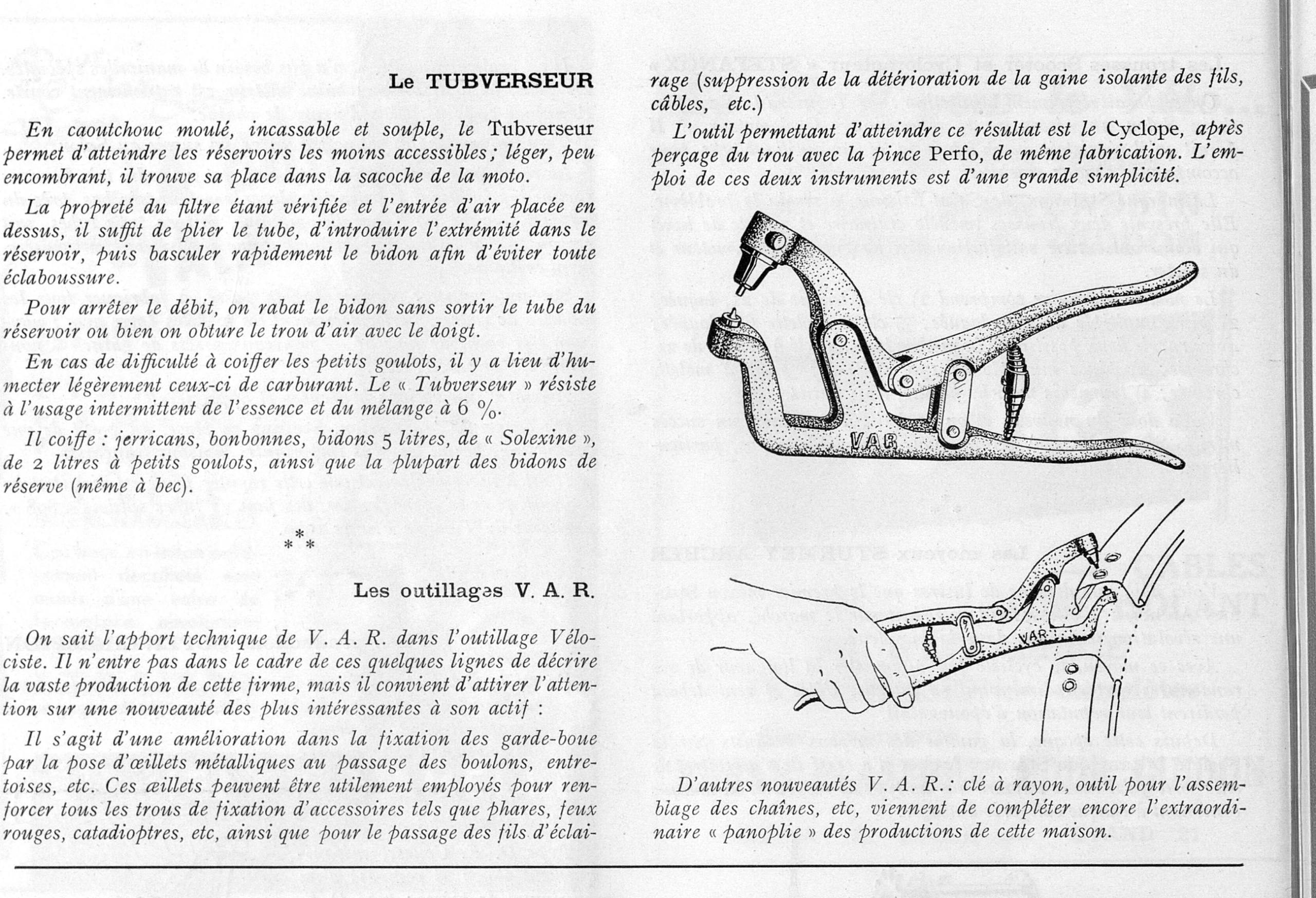
[Ebykr summary; the article’s text is not reproduced. V. A. R. has contributed much to the dealer’s tooling (« l’outillage Vélociste »), and the paper points to one of its newest products: metal eyelets set in mudguards where bolts, stays and the like pass through, also useful to reinforce every mounting hole for accessories such as headlamps, red lamps and reflectors, and the passage of lighting wires (avoiding damage to the insulation of wires, cables and so on). The tool for this is the Cyclope, used after the hole is punched with the Perfo pliers of the same make; both are very simple to use. Other V. A. R. novelties, a spoke wrench and a chain-assembly tool among them, complete the firm’s extraordinary « panoplie ».]
[Illustrations: in the right column, two line drawings of the V. A. R. Cyclope eyelet tool. Above, the plier-like tool alone, stippled, with its two jaws at the left, the long handles at the right, a conical spring between them and “VAR” lettered on the lower handle. Below, a hand holding the tool, also lettered “VAR”, setting an eyelet in a mudguard drawn in outline, with eyelets already set. A small star-cluster ornament separates the two sections. No signatures.]
[Print from the other side of the leaf shows through the paper; it is not part of the record.]
Ebykr presents this material for research and education. If you hold rights to it or notice an ownership issue, please contact us and we will respond promptly.
The Ebykr Digest
New articles, timelines, catalog finds and registry activity — assembled from the archive once a month. Your address is never shared.
Double opt-in. One email per month. Unsubscribe at any time with one click.