About Ebykr
Ebykr celebrates classic and vintage lightweight bicycles through provocative imagery and opinion. Ride along with us.
About Ebykr
Ebykr celebrates classic and vintage lightweight bicycles through provocative imagery and opinion. Ride along with us.

Source: Le Cycle, n° 73, October 1966, pages 27, 29, 31, 33, 35, 37, 43, 45, 47, 49, 50; scan of the issue from Cycle Memory (Mémoire du Cycle), Collection privée.
| Type | Review |
|---|---|
| Year | 1966 |
| Publisher | Le Cycle |
| Artist | Daniel Rebour |
| Country | France |
| Language | French |
| Pages | 11 |
| Source | Le Cycle, n° 73, October 1966, pages 27, 29, 31, 33, 35, 37, 43, 45, 47, 49, 50; scan of the issue from Cycle Memory (Mémoire du Cycle), Collection privée. |
| Credit | Ebykr archive |
| Identifier | Permalink https://cyclememory.org/fr/search-coll-list.php?collectionID=773&docID=B-1-0000000505 |
| Transcription | Headings and specifications transcribed; article text summarized |
LE SALON DE PARIS 1966 doit faire le point sur l’évolution technique de la bicyclette, du cyclomoteur et du vélomoteur moderne par Daniel REBOUR 27 LE SALON DE PARIS -LE SALON DE PARIS - 29 LE SALON DE PARIS -- LE SALON DE PARIS 31 LE SALON DE PARIS -- LE SALON DE PARIS 33 …
This is a magazine article, so its running text is summarized here rather than reproduced; the headline, byline, specifications and scores are transcribed as printed.
Daniel Rebour’s report on the 1966 Paris Salon du Cycle et du Motocycle ran across 11 pages of Le Cycle n° 73, October 1966, the magazine he edited, between pages 27 and 50 among the advertisements. He recalls the 1964 show, then goes stand by stand through the new derailleurs, brakes, rims, saddles, chainsets, lighting and folding bicycles, illustrated with his own pen drawings. The title, running heads, byline and folios are transcribed as printed; the text and captions are summarized in Ebykr’s words, and the page images carry the article in full.
— Page 1 —
LE SALON DE PARIS
1966
doit faire le point sur l’évolution technique de la bicyclette, du cyclomoteur et du vélomoteur moderne
par Daniel REBOUR
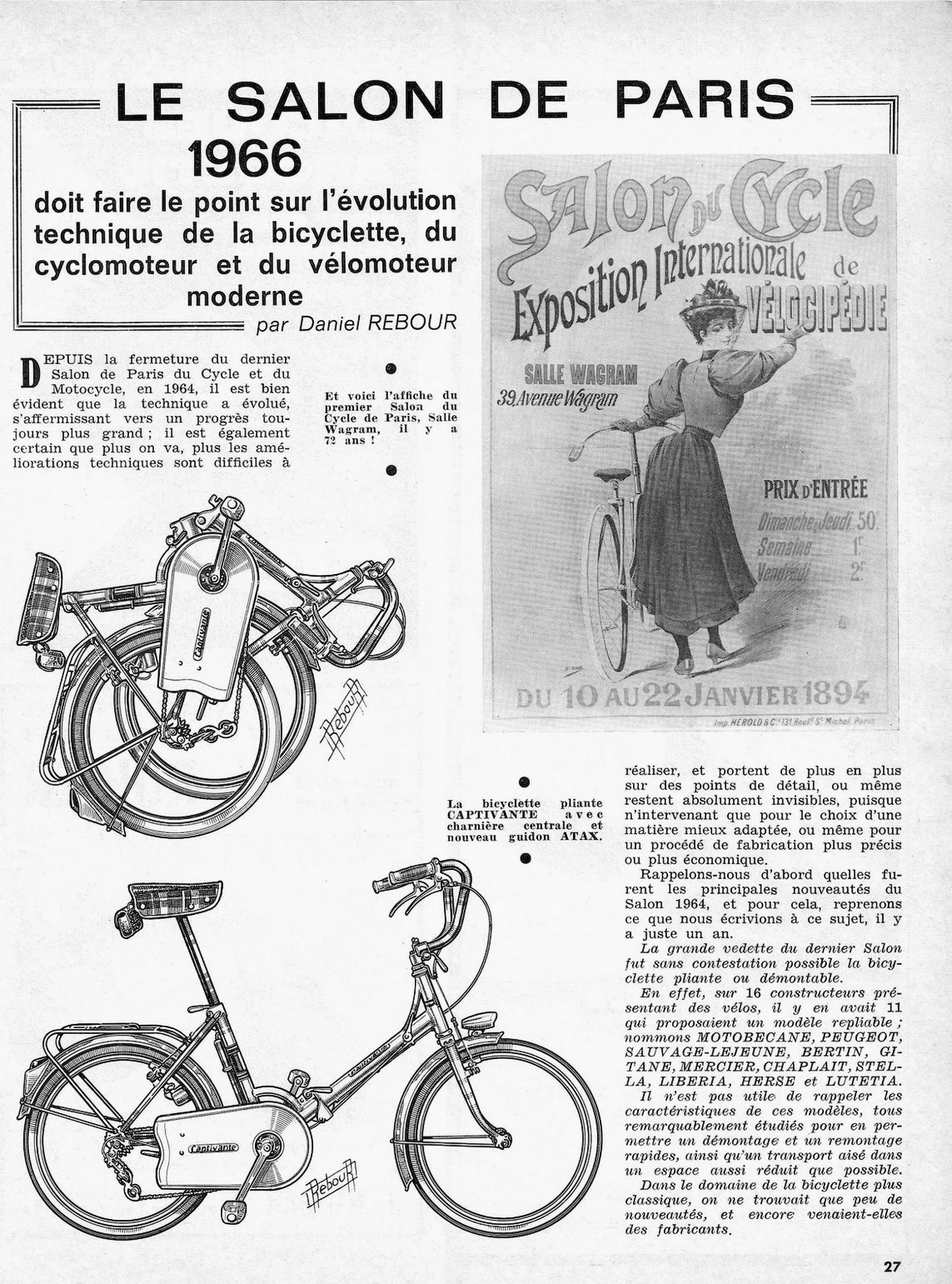
[Ebykr summary; the article’s text is not reproduced. Rebour opens his report on the 1966 Paris Salon by observing that the trade has moved on since the last Salon de Paris du Cycle et du Motocycle, held in 1964, and that technical progress is getting harder to win: improvements now bear on details or stay invisible altogether, coming down to the choice of a better-suited material or a more precise or more economical manufacturing process. He then recalls the chief novelties of the 1964 Salon, repeating what the magazine wrote about them a year earlier. The star of that show was the folding or take-apart bicycle, offered by 11 of the 16 makers showing bicycles: MOTOBECANE, PEUGEOT, SAUVAGE-LEJEUNE, BERTIN, GITANE, MERCIER, CHAPLAIT, STELLA, LIBERIA, HERSE and LUTETIA, all designed for quick dismantling and reassembly and for carrying in as small a space as possible. Among more conventional bicycles there was little that was new, and what there was came from the makers. One caption presents the poster of the first Salon du Cycle de Paris, held at the Salle Wagram 72 years earlier; another presents the CAPTIVANTE folding bicycle with its central hinge and new ATAX handlebar.]
[Three illustrations. Two pen drawings, each signed “Rebour” (two signed drawings on the page), show the CAPTIVANTE folding bicycle: above, folded at its central hinge with the two small wheels side by side, the chain case lettered “Captivante”, a checked saddle, a rear carrier and the handlebar folded down; below, unfolded and ready to ride, with the same checked saddle, rear carrier and lettered chain case and a raised handlebar with brake levers. At upper right a halftone reproduction of the poster headed “Salon du Cycle, Exposition Internationale de Vélocipédie” shows a woman in a plumed hat and long skirt standing beside a bicycle and reaching up toward the lettering; the poster gives the hall as the Salle Wagram, 39, Avenue Wagram, lists the entry prices and dates the show 10 to 22 January 1894, with the printer’s line of Imp. HEROLD & Cie, Paris, along its foot and a small artist’s signature, too small to read, at lower left.]
27
— Page 2 —
LE SALON DE PARIS -LE SALON DE PARIS –
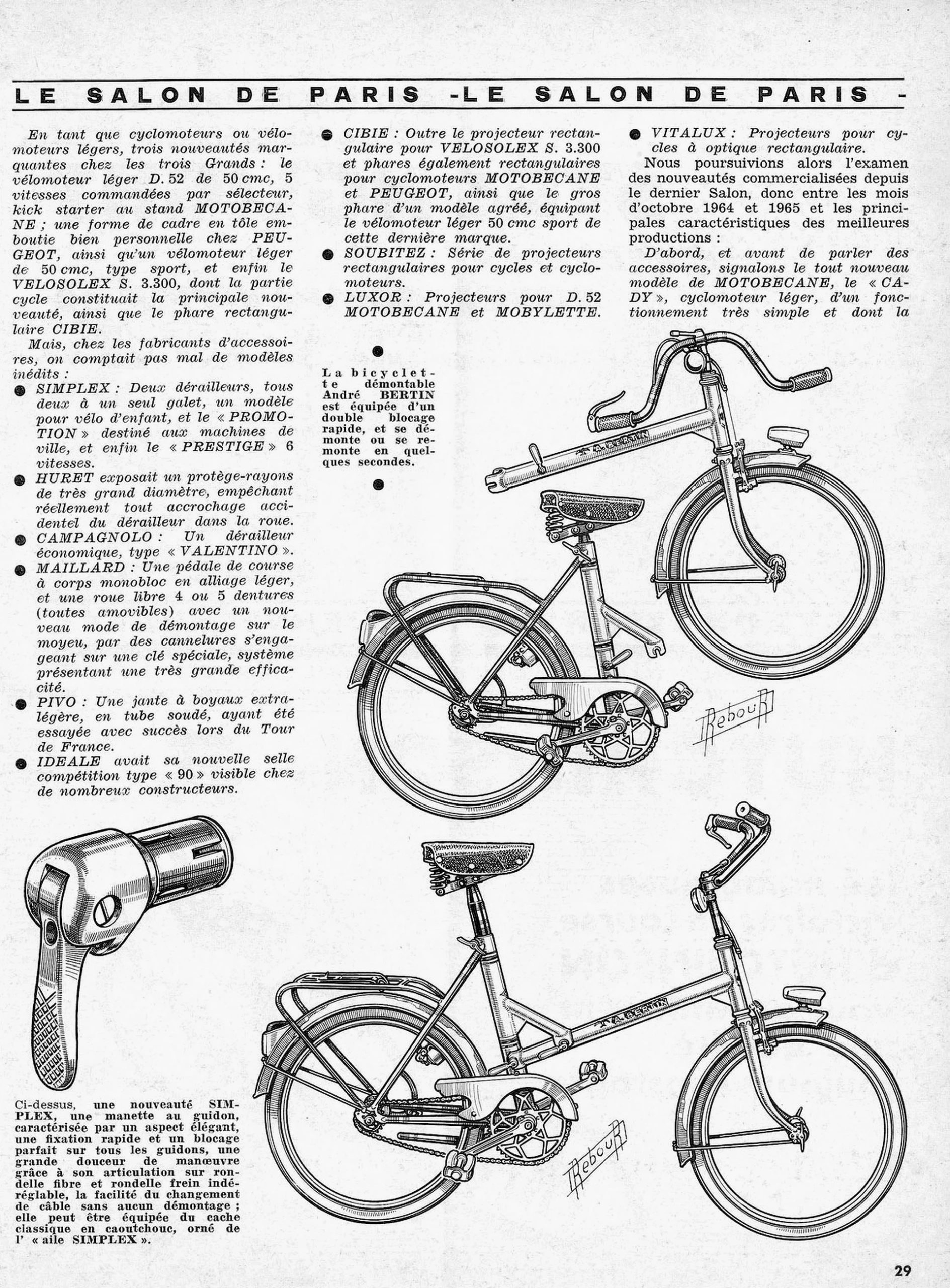
[Ebykr summary; the article’s text is not reproduced. The recap of the 1964 Salon continues. In mopeds and light motorcycles the three Grands each had a notable novelty: at the MOTOBECANE stand the D. 52 light vélomoteur of 50 cmc with five speeds worked by a selector and a kick starter; at PEUGEOT a distinctive pressed-steel frame and a 50 cmc light vélomoteur of the sport type; finally the VELOSOLEX S. 3.300, whose cycle part was the main novelty, along with the CIBIE rectangular headlamp. The accessory makers showed many new models. SIMPLEX had two derailleurs with a single jockey wheel, a model for children’s bicycles and the “PROMOTION” for town machines, as well as the six-speed “PRESTIGE”. HURET showed a very large spoke protector that keeps the derailleur from catching in the wheel. CAMPAGNOLO showed an economical derailleur, the “VALENTINO”. MAILLARD showed a racing pedal with a one-piece light-alloy body and a freewheel with four or five removable sprockets, taken off the hub by a new method using splines that engage a special key. PIVO showed an extra-light tubular rim of welded tube, tried successfully in the Tour de France. IDEALE had its new competition saddle, type “90”, on the bicycles of many builders. CIBIE added, besides the rectangular headlamp for the VELOSOLEX S. 3.300, rectangular headlamps for MOTOBECANE and PEUGEOT mopeds and a large approved headlamp fitted to the PEUGEOT 50 cmc sport light vélomoteur; SOUBITEZ a series of rectangular headlamps for cycles and mopeds; LUXOR headlamps for the D. 52 MOTOBECANE and the MOBYLETTE; VITALUX cycle headlamps with rectangular optics. The earlier report then turned to products marketed since that Salon, between October 1964 and 1965, beginning with the new MOTOBECANE “CADY”, a light moped of very simple operation. One caption describes the André BERTIN take-apart bicycle, fitted with a double quick release and taken apart or put back together in a few seconds. Another describes a new SIMPLEX handlebar shift lever: elegant, quick to fit, locking firmly on any handlebar, smooth thanks to its pivot on a fiber washer and a lock washer that holds its setting, with cable changes made without dismantling; it can take the usual rubber cover bearing the SIMPLEX “aile” emblem.]
[Three pen drawings. At lower left, unsigned, the new SIMPLEX handlebar lever, a slotted cylindrical body with a pivoting lever that has a checkered grip. At upper right the André BERTIN take-apart bicycle is shown separated into two halves, the front section with handlebar, lamp, fork and front wheel lifted clear of the rear section with sprung saddle, carrier, chainguard and rear wheel; at lower right the same bicycle is shown assembled. The top tube in both views is lettered “A. BERTIN”. The two bicycle drawings are each signed “Rebour” (two signed drawings on the page).]
29
— Page 3 —
LE SALON DE PARIS — LE SALON DE PARIS
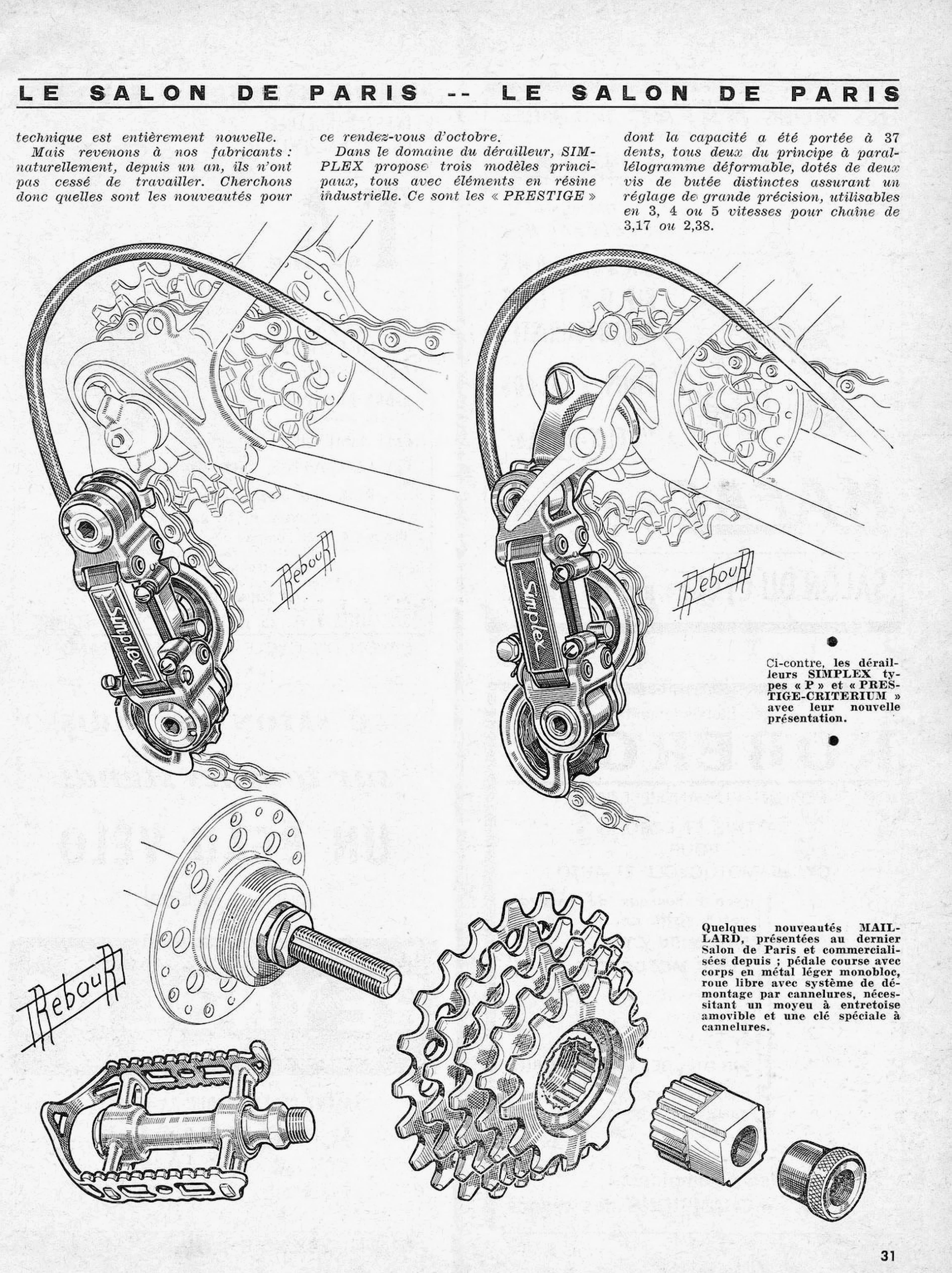
[Ebykr summary; the article’s text is not reproduced. The page completes the description of the MOTOBECANE “CADY” moped, whose technical design is entirely new, and closes the recap of the previous Salon. Rebour then returns to the makers, who have not stopped working in the year since, and sets out to find what is new for this October show. In derailleurs SIMPLEX offers three main models, all with parts in industrial resin; two of them are the “PRESTIGE” derailleurs, whose capacity has been raised to 37 teeth; both work on the deformable-parallelogram principle and have two separate stop screws for very precise adjustment, for use with three, four or five speeds and chain of 3,17 or 2,38 (the two are described on the next page of the article as the “CRITERIUM” and the type “P”). One caption presents the SIMPLEX derailleurs, types “P” and “PRESTIGE-CRITERIUM”, in their new presentation. Another presents MAILLARD novelties shown at the last Paris Salon and marketed since: a racing pedal with a one-piece light-metal body and a freewheel taken off by a spline system that calls for a hub with a removable spacer and a special splined key.]
[Three pen drawings, each signed “Rebour” (three signed drawings on the page). Across the top, two SIMPLEX rear derailleurs are shown fitted at the rear dropout with their cable, chain and freewheel, each with a body plate lettered “Simplex”. Below, a group of MAILLARD parts: the end of a drilled large-flange hub with its axle, a racing pedal with a quill cage, a multiple-sprocket freewheel showing its splined center, a splined removal key and a knurled ring.]
31
— Page 4 —
LE SALON DE PARIS — LE SALON DE PARIS
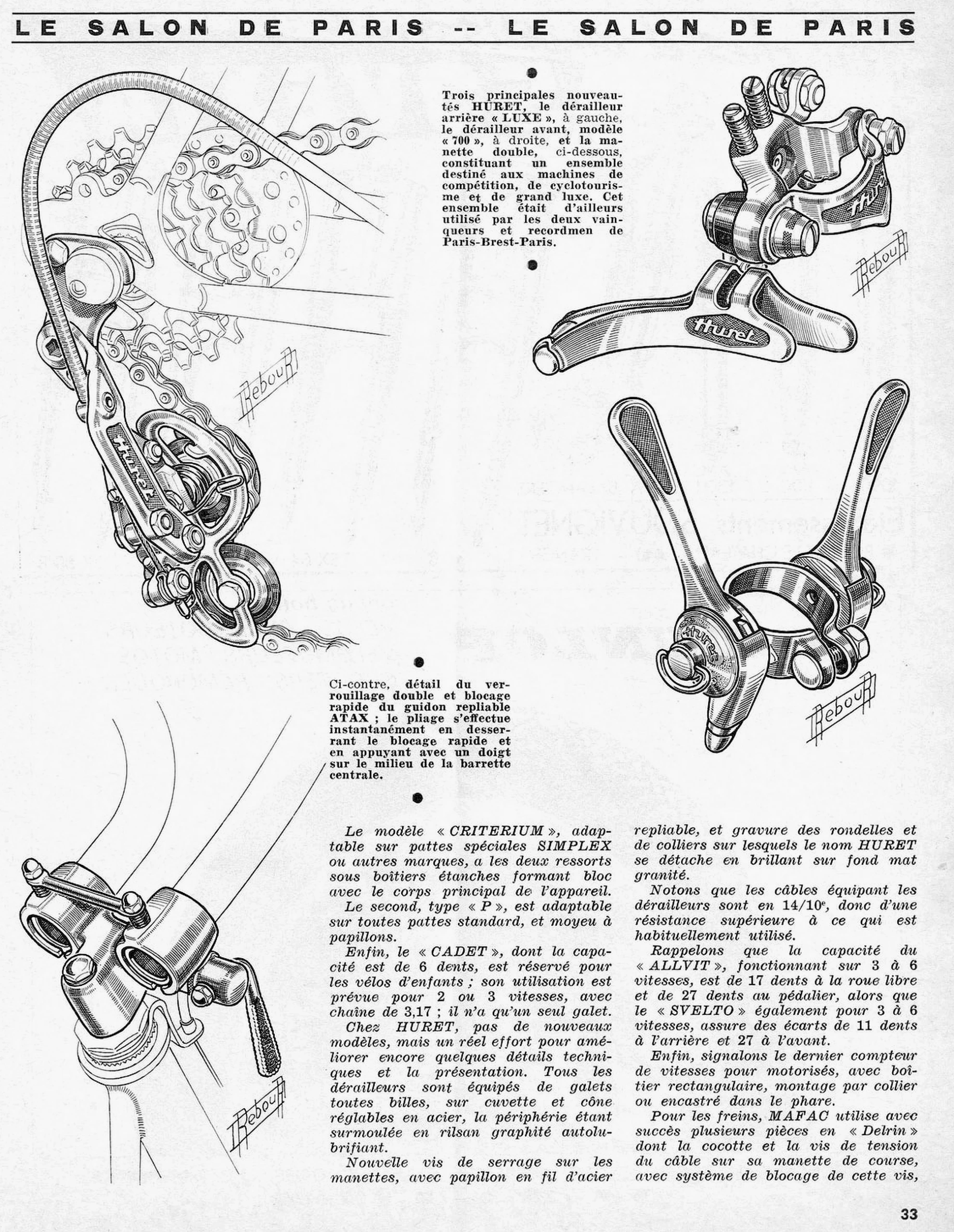
[Ebykr summary; the article’s text is not reproduced. The SIMPLEX range continues: the “CRITERIUM” fits special SIMPLEX dropouts or those of other makes and has its two springs in sealed housings that form one block with the main body; the second, the type “P”, fits any standard dropout and wing-nut hubs. Last comes the “CADET”, with a capacity of six teeth, meant for children’s bicycles, for two or three speeds with 3,17 chain and with a single jockey wheel. HURET has no new models but has worked hard on technical details and finish: every derailleur now has full ball-bearing jockey wheels on adjustable steel cups and cones, their rims overmolded in self-lubricating graphited rilsan; the levers get a new clamp screw with a folding steel-wire wing; washers and clamps are engraved so that the HURET name shows bright on a matte granite ground. Its derailleur cables are 14/10e, stronger than the usual. Rebour recalls that the “ALLVIT”, for three to six speeds, takes 17 teeth of difference at the freewheel and 27 at the chainwheel, while the “SVELTO”, also for three to six speeds, handles differences of 11 teeth at the rear and 27 at the front. He also notes the latest speedometer for motorized cycles, in a rectangular case, fixed by a clamp or built into the headlamp. In brakes, MAFAC is using several parts in “Delrin”, including the cocotte and the cable tension screw on its racing lever, with a locking system for that screw (the sentence runs on to the next page of the article). One caption presents three main HURET novelties, the “LUXE” rear derailleur, the model “700” front derailleur and the double lever, together a set for racing, cyclotouring and luxury machines, used by the two winners and record holders of Paris-Brest-Paris. Another shows the double locking and quick release of the ATAX folding handlebar, folded at once by loosening the quick release and pressing a finger on the middle of the central bar.]
[Four pen drawings, each signed “Rebour” (four signed drawings on the page). At upper left the HURET “LUXE” rear derailleur is shown mounted at the rear dropout with its cable, chain and freewheel, the body lettered “Huret”. At upper right the HURET model “700” front derailleur on its seat-tube clamp, the cage lettered “Huret”. At center right the HURET double shift lever on its clamp band, lettered “Huret”. At lower left the ATAX folding handlebar fitting at the top of the steering head, with its twin clamps joined by a bolted bar and a quick-release lever with a knurled grip.]
33
— Page 5 —
LE SALON DE PARIS — LE SALON DE PARIS
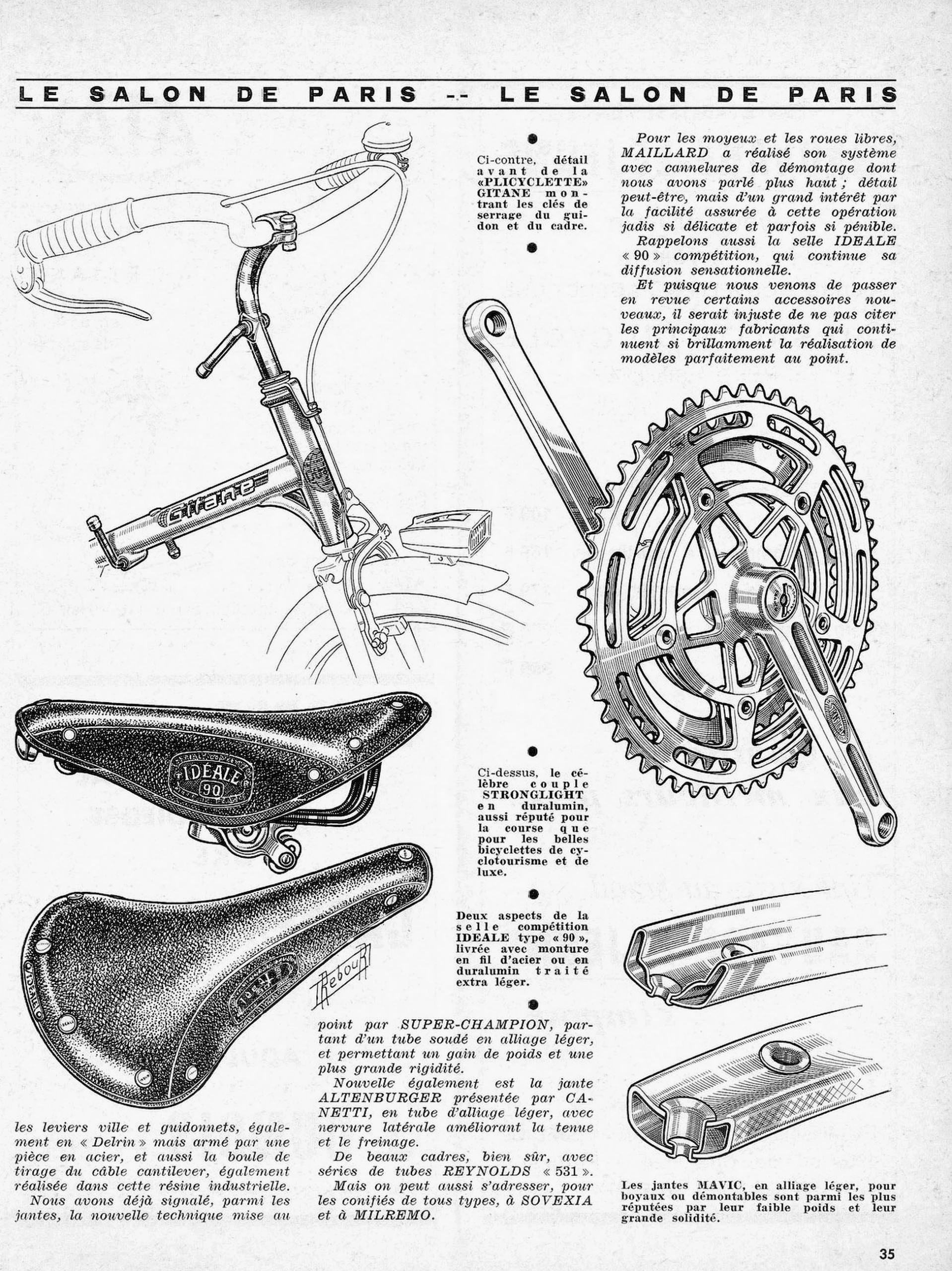
[Ebykr summary; the article’s text is not reproduced. The MAFAC report concludes: the town levers and guidonnets are also in “Delrin” but stiffened by a steel insert, and the pull ball of the cantilever cable is made of the same industrial resin. Among rims, Rebour returns to the new technique developed by SUPER-CHAMPION, which starts from a welded light-alloy tube and gives a saving in weight and greater rigidity. Also new is the ALTENBURGER rim presented by CANETTI, in light-alloy tube with a side rib that improves its hold and its braking. Fine frames are built, of course, with REYNOLDS “531” tube sets, but butted tubes of every type can also be had from SOVEXIA and MILREMO. For hubs and freewheels, MAILLARD has produced the spline removal system mentioned earlier, a detail perhaps but a valuable one for making easy an operation that was once delicate and sometimes laborious. The IDEALE “90” competition saddle continues its sensational spread. Having reviewed some new accessories, Rebour says it would be unjust not to name the principal makers who go on producing thoroughly perfected models, a list that fills the next page of the article. The captions present the front of the GITANE “PLICYCLETTE”, showing the clamping keys of the handlebar and of the frame; the famous STRONGLIGHT duralumin crankset, as highly regarded for racing as for fine cyclotouring and luxury bicycles; two views of the IDEALE type “90” competition saddle, supplied with a steel-wire frame or one of treated extra-light duralumin; last, MAVIC light-alloy rims for tubular or clincher tires, among the most highly regarded for their light weight and great strength.]
[Four pen drawings, of which only the pair of saddle views is signed “Rebour” (one signed drawing on the page). At upper left the front of the GITANE “PLICYCLETTE”: the folding frame with its top tube lettered “Gitane”, the stem and frame clamping keys, a head badge, handlebar with brake lever and bell, headlamp and front mudguard. At right the STRONGLIGHT double-chainring crankset with its drilled spider and slotted chainrings, a medallion on the crank arm. At lower left two views of the IDEALE type “90” competition saddle, from the side with its oval badge lettered “IDÉALE” over “90” and from above with the maker’s name on the cantle plate. At lower right two sectioned MAVIC rims, a clincher rim above and a tubular rim below, each with its spoke eyelet.]
35
— Page 6 —
LE SALON DE PARIS — LE SALON DE PARIS
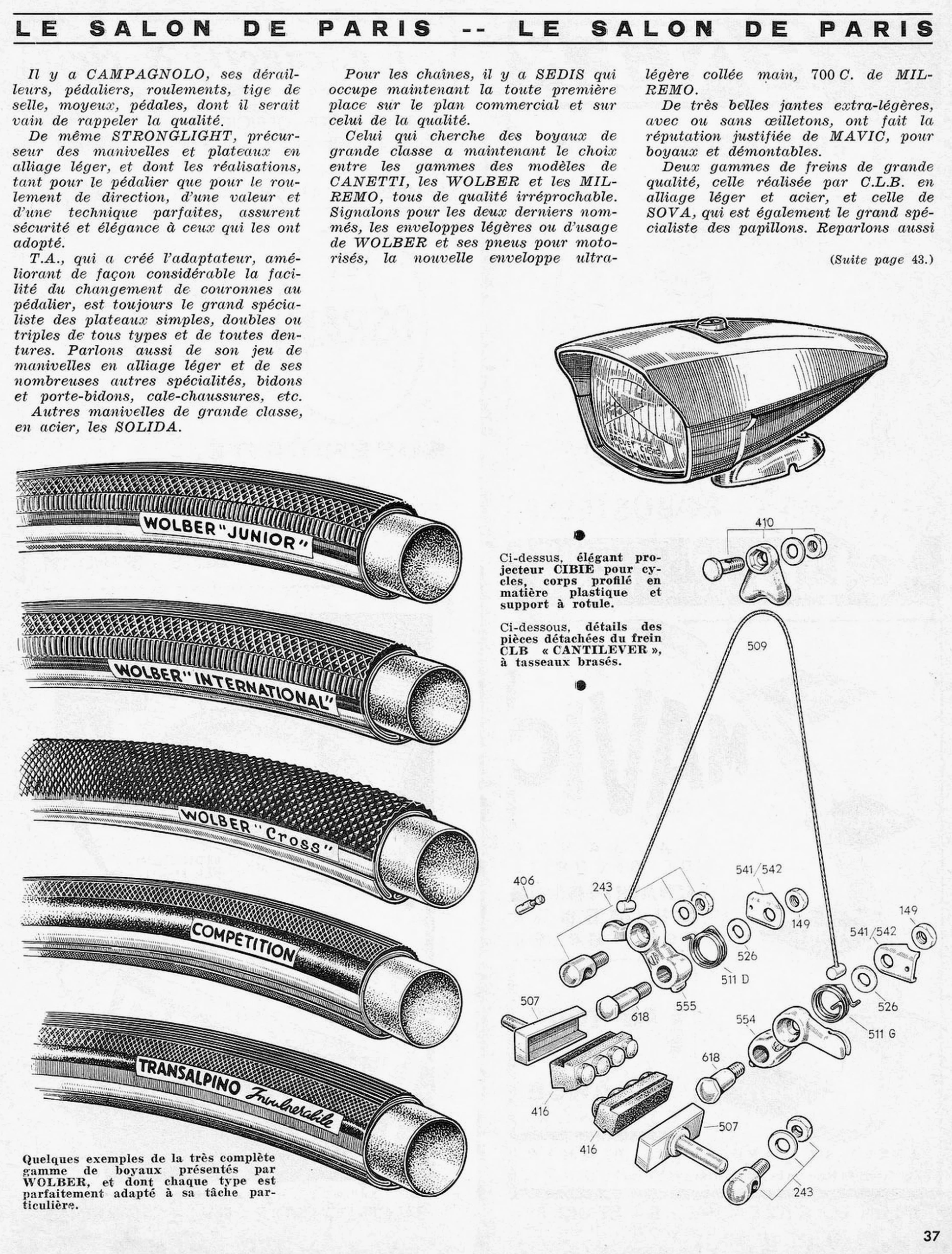
[Ebykr summary; the article’s text is not reproduced. Rebour’s roll of the principal makers begins with CAMPAGNOLO, whose derailleurs, chainsets, bearings, seat pillar, hubs and pedals need no praise. STRONGLIGHT, the pioneer of light-alloy cranks and chainrings, makes bottom-bracket sets and headsets of a value and technique that give safety and elegance to those who fit them. T.A., which created the adaptateur that made changing chainrings far easier, remains the great specialist of single, double and triple chainrings of every type and tooth count, and also makes a light-alloy crankset and many other specialties: bidons and porte-bidons, cale-chaussures and more. The other high-class cranks, in steel, are the SOLIDA. In chains SEDIS now holds first place both commercially and for quality. The buyer of top-class tubulars can choose among the ranges of CANETTI, WOLBER and MILREMO, all of faultless quality; of the last two Rebour notes WOLBER’s light and everyday tires and its tires for motorized cycles, and MILREMO’s new ultra-light hand-glued 700 C. tire. Very fine extra-light rims, with or without eyelets, for tubulars and clinchers, have made the deserved reputation of MAVIC. There are two ranges of high-quality brakes: that made by C.L.B. in light alloy and steel, and that of SOVA, which is also the great specialist of wing nuts. The text breaks off here and is continued on page 43. The captions present an elegant CIBIE headlamp for cycles with a streamlined plastic body and ball-joint mount; the exploded parts of the CLB “CANTILEVER” brake for brazed-on bosses; and a few examples of the very complete range of tubulars shown by WOLBER, each type suited to its own task.]
[Three drawings, none of them signed “Rebour” (no signed drawings on the page). At upper right the CIBIE headlamp, a streamlined body on a small ball-joint bracket, the lens lettered “BREVET CIBIE” over a second line too small to read. At right an exploded parts view of the CLB “CANTILEVER” brake: the straddle cable, cable stops and anchors, the two brake arms, return springs, washers, pivot bolts, shoe holders and brake blocks, keyed by the part numbers 410, 509, 406, 243, 541/542, 149, 526, 511 D, 555, 618, 507, 416, 554 and 511 G. At left five tubular tires cut away to show their section, with tread labels reading WOLBER “JUNIOR”, WOLBER “INTERNATIONAL”, WOLBER “Cross”, COMPÉTITION and TRANSALPINO Invulnerabile.]
(Suite page 43.)
37
— Page 7 —
LE SALON DE PARIS — LE SALON DE PARIS
(Suite de la page 37.)
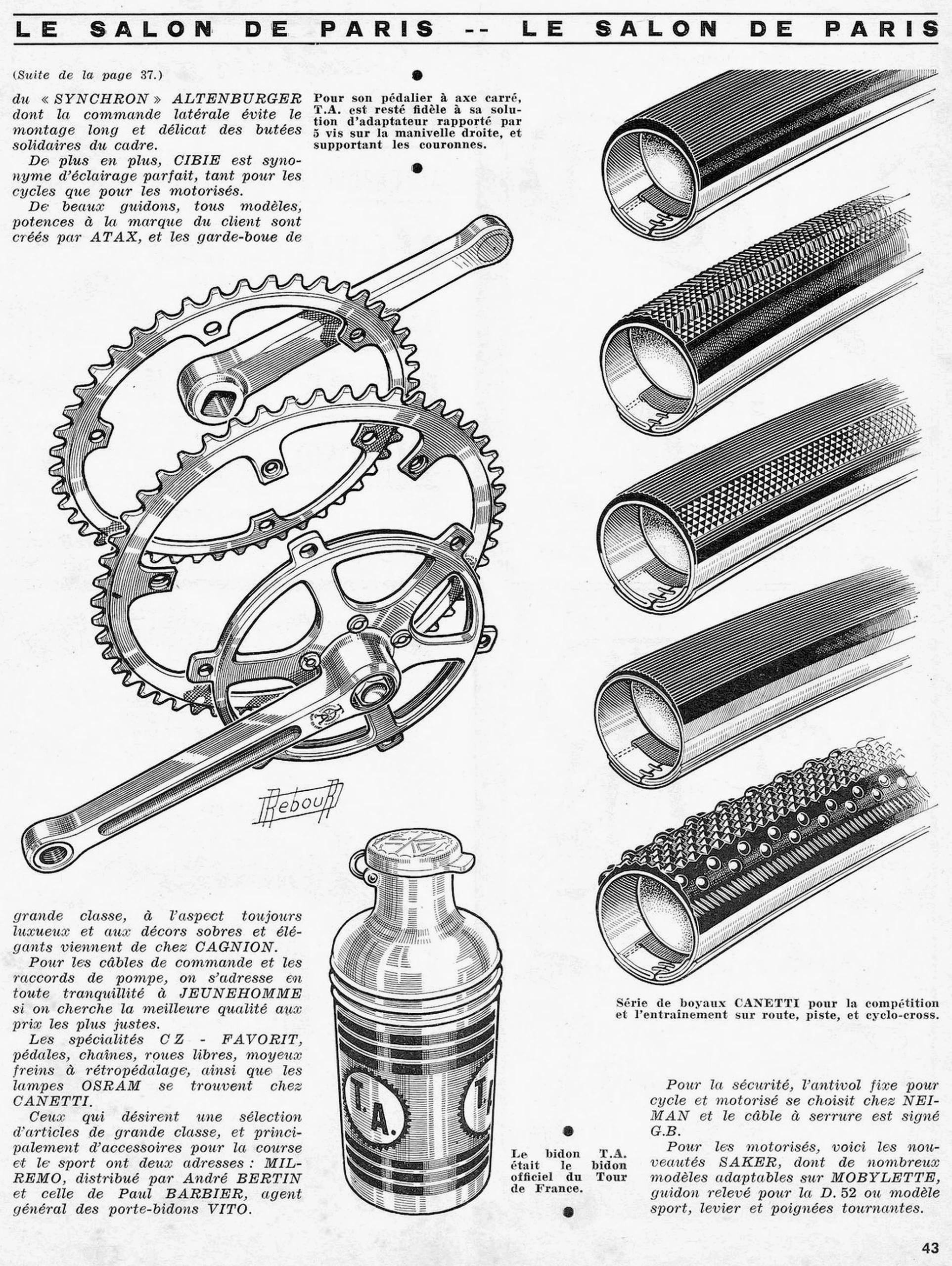
[Ebykr summary; the article’s text is not reproduced. Continued from page 37, Rebour’s Salon round-up closes its note on the « SYNCHRON » ALTENBURGER (the side-pull brake pictured on page 49), whose side-mounted control avoids the long and delicate job of fitting cable stops fixed to the frame. CIBIE is called a byword for good lighting on both bicycles and motorized machines. ATAX makes handlebars of every pattern and stems marked with the customer’s own brand, while high-class mudguards with a luxurious look and sober decoration come from CAGNION. JEUNEHOMME is recommended for control cables and pump connectors at keen prices. CANETTI stocks the C Z – FAVORIT line (pedals, chains, freewheels and coaster-brake hubs) as well as OSRAM lamps. For high-class racing and sporting accessories the page names two addresses: MILREMO, distributed by André BERTIN, and Paul BARBIER, general agent for VITO bottle cages. For security, the NEIMAN fixed lock serves cycles and motorized machines, and a cable lock is signed G.B. For motorized riders, SAKER shows new items, many of them made to fit the MOBYLETTE: a raised handlebar for the D. 52 or a sport model, plus levers and twist grips. A caption set between two bullets says that T.A. keeps, for its square-spindle crankset, its adapter fixed by five screws to the right crank and carrying the chainrings. One caption says the T.A. bottle was the official bottle of the Tour de France; another presents a series of CANETTI tubular tires for racing and training on road, track and cyclo-cross.]
[Three drawings. At left, a T.A. double crankset seen in three-quarter view: both cranks, the square spindle hole in the left crank, the five-arm adapter on the right crank and two drilled chainrings, with the T.A. monogram (a T and an A around a small wheel, ringed with lettering too small to read) on the right crank; it is signed “Rebour” below the chainrings. At bottom center, a T.A. aluminum bottle with a hinged stopper marked with a monogram, ringed with dark bands and two toothed roundels lettered “T.A.”. Down the right side, five CANETTI tubular tires cut away to show the casing and base tape, each with a different tread: fine ribs, a knurled file pattern, a diamond pattern, plain ribs and a studded cyclo-cross tread. The page carries one signed drawing.]
43
— Page 8 —
LE SALON DE PARIS — LE SALON DE PARIS
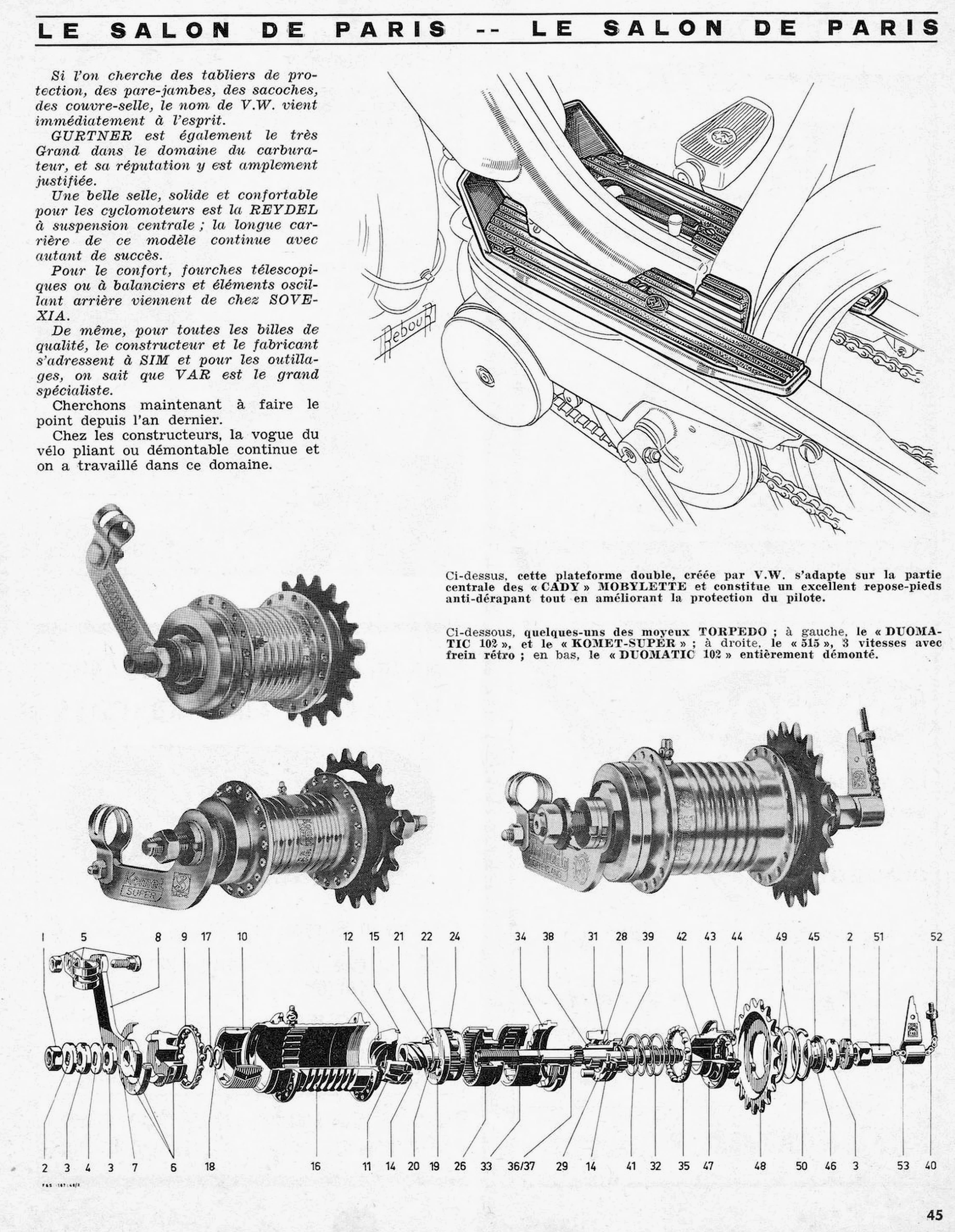
[Ebykr summary; the article’s text is not reproduced. The accessory round-up continues: V.W. is the name that comes to mind for weather aprons, leg shields, bags and saddle covers. GURTNER is praised as a leading name in carburetors with a well-earned reputation. The REYDEL saddle with central suspension is presented as a handsome, sturdy and comfortable seat for mopeds, a long-running model that keeps selling well. SOVEXIA supplies telescopic and leading-link forks and rear swinging-arm units for comfort. Makers and manufacturers turn to SIM for quality balls, and VAR is named as the great specialist in workshop tools. The text then changes from italic to upright type and opens a review of the frame builders’ progress since the previous year, noting that the fashion for folding or take-apart bicycles continues and that makers have been working in that field. One caption describes a double platform created by V.W. that fits the central part of the « CADY » MOBYLETTE and serves as a non-slip footrest while improving the rider’s protection. A second caption presents some of the TORPEDO hubs: the « DUOMATIC 102 » and the « KOMET-SUPER » at left, the « 515 », a three-speed hub with back-pedal brake, at right, and the « DUOMATIC 102 » fully dismantled at the bottom of the page.]
[Two drawings and three photographs. At top right, a line drawing of the V.W. double footboard fitted to the central part of a moped, with ribbed treads, a pedal and the drive chain in view; it is signed “Rebour” at its left edge. Below, three photographs of TORPEDO rear hubs with sprockets and brake arms: at upper left a hub with a long cranked brake arm, at center left a hub whose brake arm is lettered “Komet” in script over “SUPER” beside a maker’s emblem, and at right a larger hub with a gear-change chain at the axle end and lettering on its brake arm too small to read. Across the foot of the page, an unsigned exploded technical drawing of a hub lays out every part along its axle, keyed by numbered callouts running up to 53, with a tiny drawing code at bottom left that appears to read F&S 167:48/2 [?]. The page carries one signed drawing.]
45
— Page 9 —
LE SALON DE PARIS — LE SALON DE PARIS
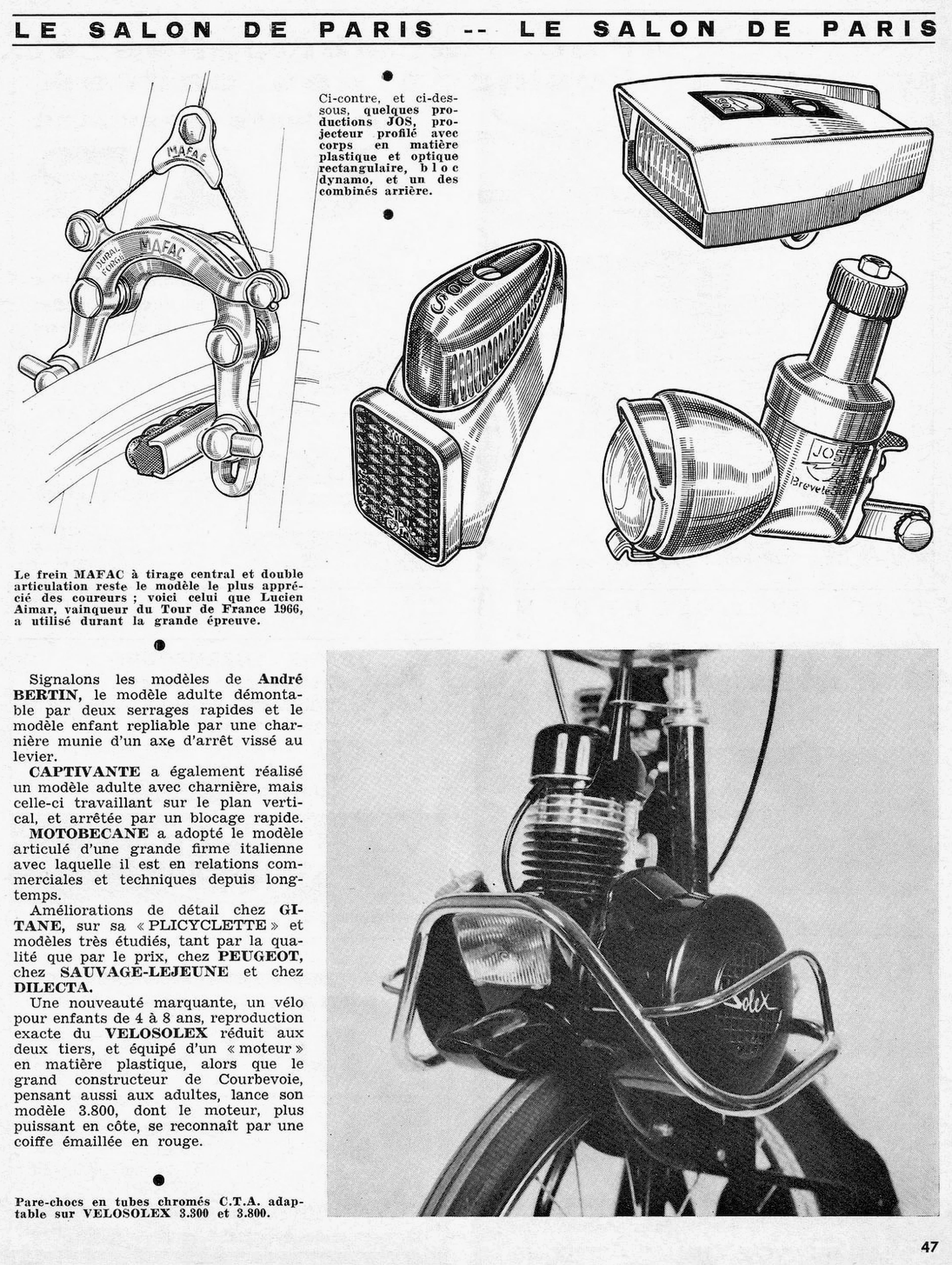
[Ebykr summary; the article’s text is not reproduced. The review of the makers’ folding and take-apart bicycles continues. André BERTIN shows an adult model that comes apart with two quick-release clamps and a child’s model that folds on a hinge fitted with a stop pin screwed to the lever. CAPTIVANTE has also built an adult model with a hinge, but one that works in the vertical plane and is locked by a quick-release. MOTOBECANE has adopted the folding model of a large Italian firm with which it has long had commercial and technical ties. GITANE has made detail improvements to its « PLICYCLETTE », and PEUGEOT, SAUVAGE-LEJEUNE and DILECTA show carefully designed models, praised for both quality and price. A notable novelty is a bicycle for children aged four to eight, an exact copy of the VELOSOLEX scaled down to two thirds and fitted with a plastic dummy engine, while the large maker of Courbevoie also launches, for adults, its model 3.800, whose engine pulls better on hills and is recognized by a red enameled cowl. The captions present some JOS products (a streamlined headlamp with a plastic body and rectangular lens, a dynamo unit and one of the rear combination lamps); the MAFAC center-pull brake with double pivots, still the racers’ favorite, shown as the one Lucien Aimar, winner of the Tour de France 1966, used during the race; and a bumper of chromed tubes by C.T.A. that fits the VELOSOLEX 3.300 and 3.800.]
[Four drawings and one photograph. At top left, a MAFAC center-pull brake mounted on a fork with its straddle cable, yoke, arch and shoe holders, the yoke and arch lettered “MAFAC” and the arch also lettered “DURAL” over “FORG”, its last letter lost in the shading (presumably “FORGÉ”). At top right and center, three JOS lamps: a wedge-shaped headlamp with a rectangular lens, a streamlined rear combination lamp with a square reflector, and a bottle dynamo with its headlamp, the dynamo body marked “JOS” and “Breveté” with the rest of its patent line hidden. At lower right, a photograph of the front of a VELOSOLEX moped showing the engine, its headlamp, a round black housing lettered “Solex” in script and a chromed tubular bumper curving around the front. None of the drawings on this page carries a visible “Rebour” signature.]
47
— Page 10 —
LE SALON DE PARIS — LE SALON DE PARIS
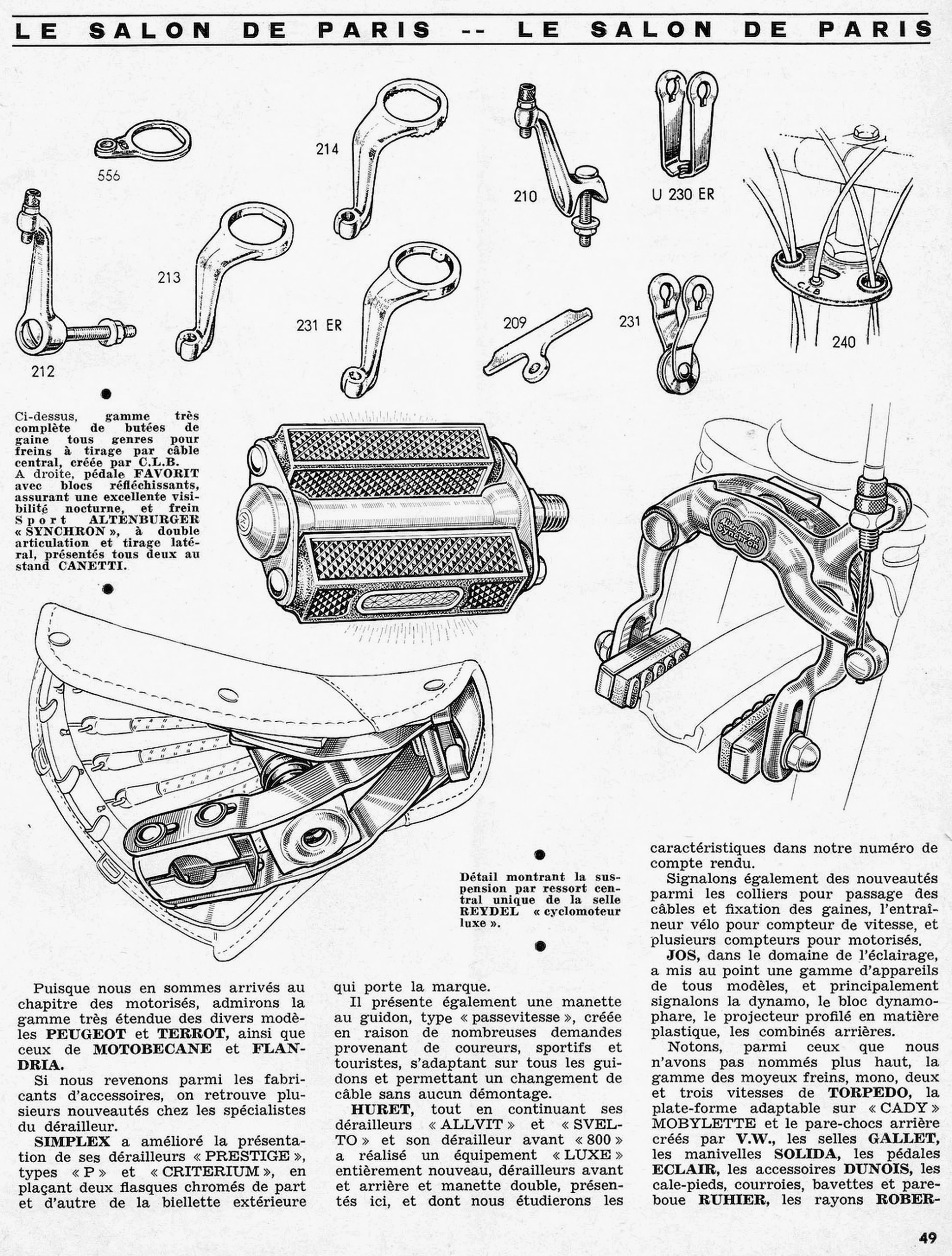
556
212
213
214
231 ER
210
209
U 230 ER
231
240
[Ebykr summary; the article’s text is not reproduced. Turning to motorized machines, Rebour admires the very wide ranges of PEUGEOT and TERROT, as well as those of MOTOBECANE and FLANDRIA. Back among the accessory makers, the derailleur specialists show several novelties. SIMPLEX has smartened its « PRESTIGE » derailleurs, types « P » and « CRITERIUM », with two chromed plates on either side of the outer link that carries the name, and also shows a handlebar lever of the « passevitesse » type, created at the request of many racers, sporting riders and tourists, which fits every handlebar and lets the cable be changed without dismantling anything. HURET, while keeping its « ALLVIT » and « SVELTO » derailleurs and its « 800 » front derailleur, has produced an entirely new « LUXE » outfit of front and rear derailleurs with a double lever, to be examined in the magazine’s Salon report issue. New cable clips and housing fixings, a bicycle drive for a speedometer and several meters for motorized machines are also noted. JOS has developed a full range of lighting, chiefly the dynamo, the dynamo-headlamp unit, the streamlined plastic headlamp and rear combination lamps. Among firms not yet named, Rebour lists the TORPEDO coaster-brake hubs in single-, two- and three-speed form; the platform for the « CADY » MOBYLETTE and the rear bumper created by V.W.; GALLET saddles; SOLIDA cranks; ECLAIR pedals; DUNOIS accessories; RUHIER toe clips, straps, mud flaps and mudguards; and the spokes of ROBERGEL, whose name breaks across the page turn (printed ROBER- here). The captions present a very complete range of cable-housing stops of every kind for center-pull brakes created by C.L.B.; a FAVORIT pedal with reflector blocks for good visibility at night and the ALTENBURGER « SYNCHRON » Sport side-pull brake with double pivots, both shown on the CANETTI stand; and a detail of the single central spring suspension of the REYDEL « cyclomoteur luxe » saddle.]
[Thirteen drawings and no photographs. Across the top, ten small drawings of C.L.B. cable stops, hangers and guides, each labeled with its part number (the numbers above, read column by column from left to right, top before bottom); number 240 shows a plate stamped “C.L.B” clamped under a headset with cables passing through it. At center, a rubber-block pedal with diamond-pattern treads and an oval reflector in its end plate. At lower left, a saddle drawn with its cover lifted to reveal the single central spring unit and the coil springs of the frame. At right, a side-pull brake on a fork crown, its arch carrying an oval badge lettered “Altenburger Synchron” in script. None of the drawings on this page carries a visible “Rebour” signature.]
49
— Page 11 —
LE SALON DE PARIS — LE SALON DE PARIS
Daniel REBOUR.
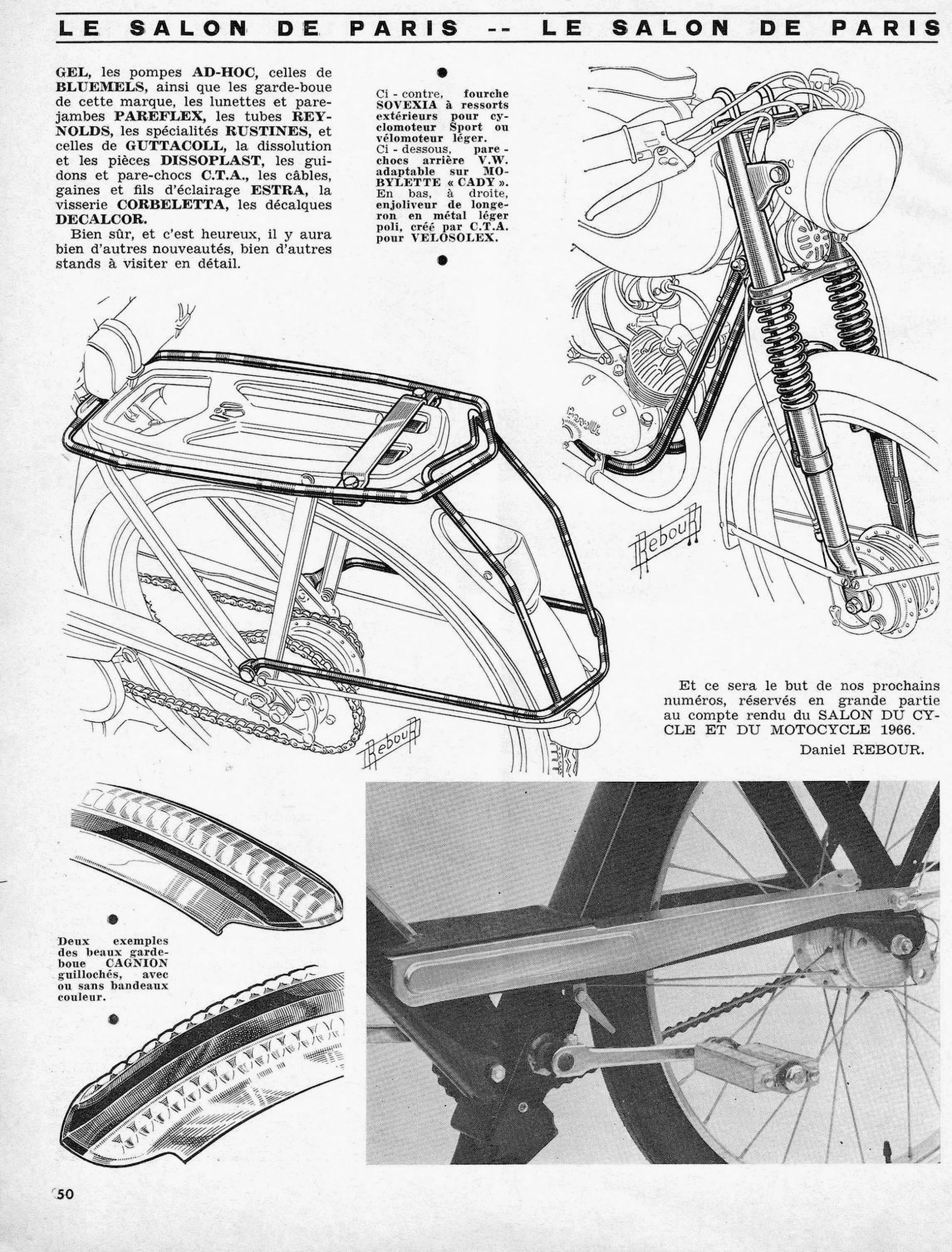
[Ebykr summary; the article’s text is not reproduced. The closing list of firms not named earlier continues from the previous page with the spokes of ROBERGEL (the name runs over from ROBER- to GEL), the AD-HOC pumps and those of BLUEMELS together with that brand’s mudguards, PAREFLEX goggles and leg shields, REYNOLDS tubes, the RUSTINES specialties and those of GUTTACOLL, DISSOPLAST rubber solution and repair parts, C.T.A. handlebars and bumpers, ESTRA cables, housings and lighting wire, CORBELETTA screws and fittings and DECALCOR decals. Rebour adds that there will of course be many more novelties and many more stands to see in detail, and that this will be the work of the coming issues, given over largely to the report on the SALON DU CYCLE ET DU MOTOCYCLE 1966. The article ends with the signature Daniel REBOUR. The captions present a SOVEXIA fork with external springs for a Sport moped or light motorcycle; a V.W. rear bumper that fits the MOBYLETTE « CADY »; a polished light-alloy frame-member trim created by C.T.A. for the VELOSOLEX; and two examples of the handsome engine-turned CAGNION mudguards, with or without colored bands.]
[Four drawings and one photograph. At upper left, a tubular rear bumper framing the carrier and rear wheel of a moped, signed “Rebour” at its lower right. At upper right, the front of a moped with a SOVEXIA fork whose coil springs are exposed, with its headlamp, controls and the engine, the engine casing carrying a script name that appears to read “Benelli” [?]; it is signed “Rebour” below the engine. At lower left, two engine-turned mudguards, one with a ribbed crown and one with a scalloped pattern and a dark band, unsigned. At lower right, a photograph of the rear of a VELOSOLEX showing the polished trim along the frame member, the chain, a crank and pedal and the rear hub. The page carries two signed drawings.]
50
Ebykr presents this material for research and education. If you hold rights to it or notice an ownership issue, please contact us and we will respond promptly.
The Ebykr Digest
New articles, timelines, catalog finds and registry activity — assembled from the archive once a month. Your address is never shared.
Double opt-in. One email per month. Unsubscribe at any time with one click.