About Ebykr
Ebykr celebrates classic and vintage lightweight bicycles through provocative imagery and opinion. Ride along with us.
About Ebykr
Ebykr celebrates classic and vintage lightweight bicycles through provocative imagery and opinion. Ride along with us.

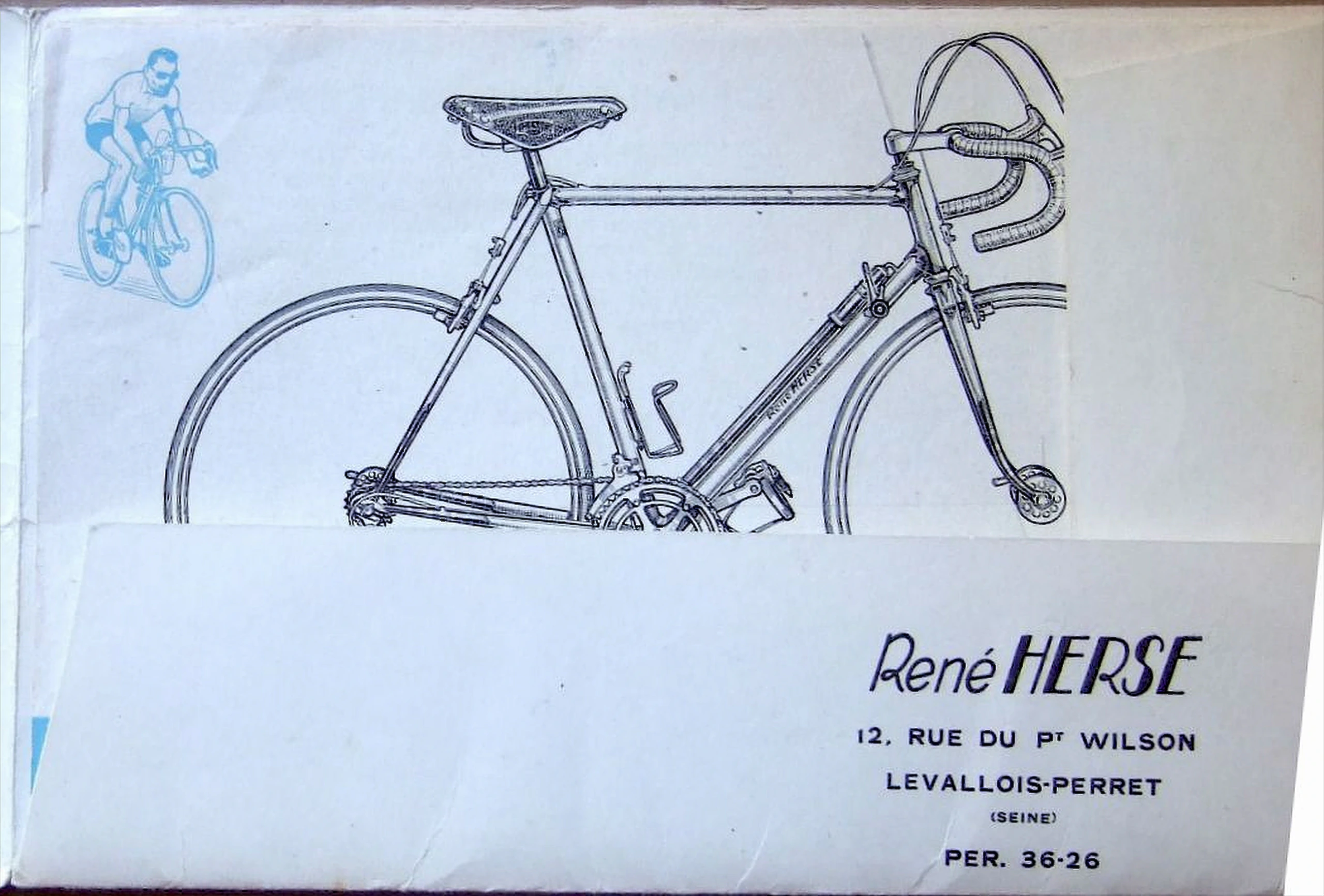
René Herse, the aircraft mechanic who became the greatest of the French constructeurs: his duralumin parts, his wins at the Concours de machines and Paris-Brest-Paris, his champion daughter Lyli and the revival of his name.

When Le Cycle wrote about René Herse in the early 1960s it did not call him a manufacturer, a frame builder or even a constructeur. It called him “le maître artisan de Levallois,” the master artisan of Levallois, and it did so as a matter of course, the way a magazine names someone its readers already know. By then Herse had spent more than two decades in a small workshop on the northwest edge of Paris, making bicycles that won the technical trials of the 1940s, carried randonneurs around Paris-Brest-Paris faster than anyone else had ridden it and took his daughter to the French road championship again and again.
Ebykr has covered his neighbors and rivals for years: Alex Singer a few streets away in Levallois, André Maury in the 15th Arrondissement, Jo Routens in Grenoble. Herse appears in nearly every one of those stories, usually as the name the others are measured against. This is his own story.
René Louis Herse was born on 4 January 1908 in Le Chesnay, on the edge of Versailles, according to the French civil death register. Rene Herse Cycles, the company that carries his name today, adds that his father was killed in the First World War when René was six and that at 15 he won a 60 kilometer youth race run by the Aéro-Sport club of Versailles. By the late 1920s he was a known name in the inter-club racing of the Paris region.
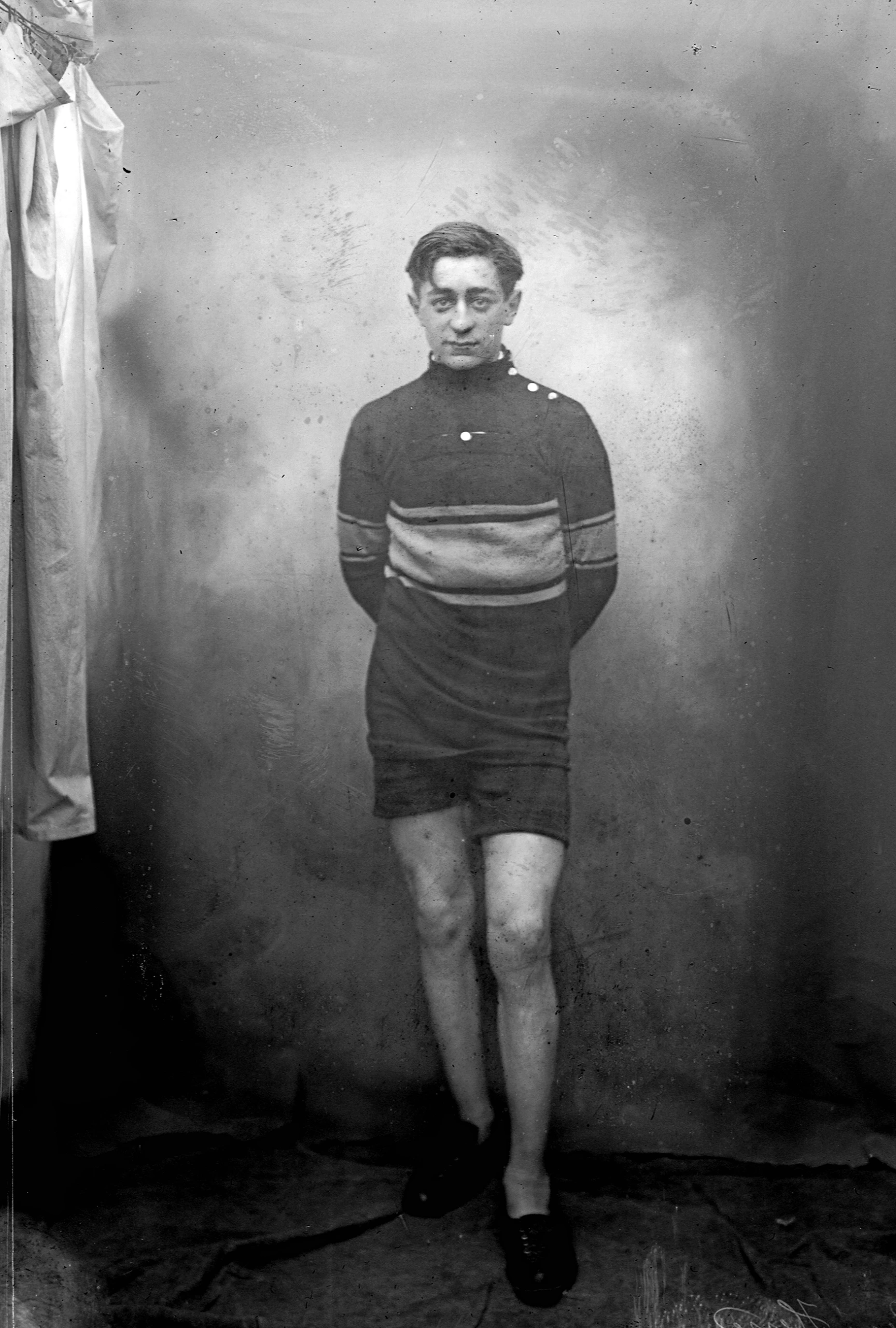
His professional trade was in the aircraft industry. Herse worked in the prototype shops of the Breguet aircraft company, and Jan Heine and Jean-Pierre Pradères record that he worked extensively on the Point d’Interrogation That was the Breguet model in which Dieudonné Costes and Maurice Bellonte flew nonstop from Paris to New York in September 1930, the first airplane to ever make that crossing. Aircraft work taught him to think in grams and to treat light alloy as a structural material rather than a novelty. Already a keen cyclotourist by then, he came to see that a good many bicycle parts could be made better with the materials and methods he used at work.
In the later 1930s he left Breguet and began making light alloy components, including: stems, pedals and cranks made of duralumin. The sources disagree on the year he left. Heine and Pradères tie it to the strikes and upheaval of 1936, while the company’s own history gives 1938. Thankfully they both agreed on what came next. In 1938 Herse entered the Concours de machines, the technical trials in which builders’ bicycles were ridden hard over mountain roads and then examined part by part, with the lightest machine in the field at 7.94 kg. By the company’s account a bottom bracket that developed play cost him first place and the sealed bottom bracket he designed in response would serve his bicycles for decades. Complete bicycles carrying his name followed in 1940, each made with the same attention to detail that had come to define the man behind them.
Herse kept his workshop going through the Occupation in Levallois-Perret, the industrial suburb just across the Paris city line. Among the men who passed through it was Georges Navet, a cabinetmaker and Audax Club Parisien rider who in 1942 and 1943 took a post there as an ajusteur-monteur, a fitter-assembler, and learned to work duralumin. Navet went on to found Spécialités TA, and in later years TA machined crank and chainring blanks for Herse himself.
Herse’s parts were already proving themselves in the hardest amateur events. When Le Cycle ran its first technical drawings signed by Daniel Rebour, in its issue of 1 December 1945, the subjects were Stronglight and Herse components, among them a Herse tandem stem machined from a solid block of duralumin. The accompanying article, a defense of light alloy cranks, cited a rider whose Herse cranks had survived three Polys de Chanteloup, a Critérium des Cyclotouristes and three years of Sunday rides and holidays without the slightest trouble.
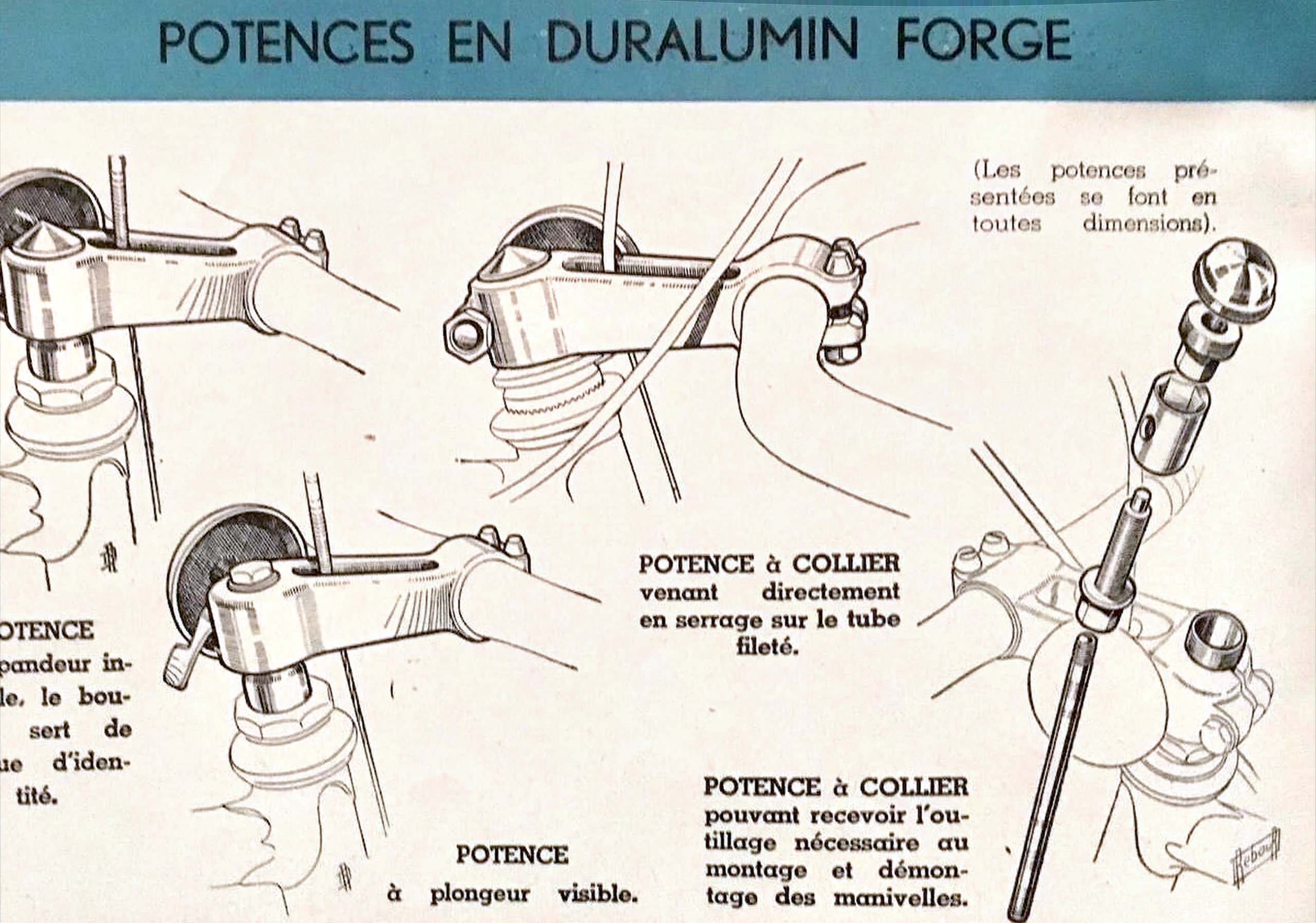
The Concours de machines resumed less than a year after the Liberation and for the rest of the decade it was where the constructeurs proved themselves. A bicycle had to carry four kilograms of luggage, be fully equipped with fenders, lights and racks, and survive hundreds of kilometers of rough roads at speed. Entrants were weighed, inspected and marked down for every failure. Herse’s team had a difficult 1946, by Heine and Pradères’ account, with machines prepared in a hurry, although Rebour’s drawings of that December still found plenty to admire. Included here were: a Herse crankset on Timken bearings that “has long proven its worth,” a reduced Herse brake mounted under the rear triangle of a mixte, a headlight bracket with a hollow axle for the wiring and a stainless steel frame welded with an oxy-acetylene torch, which by the company’s account was never sold. (Ahem, my email is at the bottom of this page should you be ready to part with this mythical specimen…)
In 1947 Herse came back with a machine refined to the last gram. The frame was made of superfine Reynolds tubing 3/10 of a millimeter thick, against the usual 7/10, and it was fillet brazed so there were no lugs to weigh. The front derailleur was aluminum with a shortened lever, the cranks and chainrings were filed to the minimum, the brake levers were drilled and even the pump was shortened. Weighed without tires, as the rules required in a country where light tires could still only be found on the black market, it came to exactly seven kilograms. Ready for the road complete with fenders, lights, racks and full-length pump it was about 7.9 kg. Speed counted in the results, so Herse recruited riders who were fast but careful. The result was decisive: the first four places among the men, and first place among the women and the tandems. Clean sweep, Concours de machines-style.
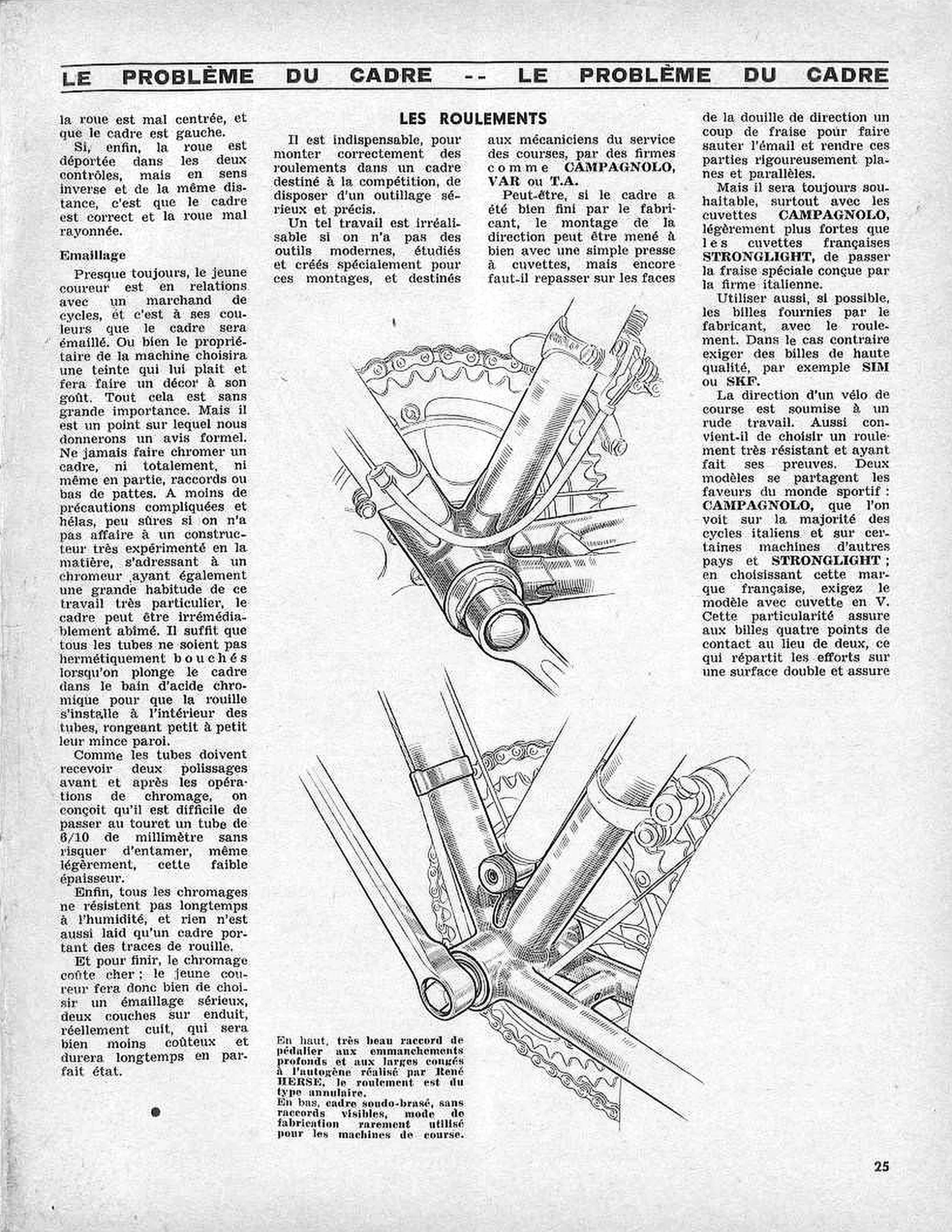
While it may sound cliche to some of you at this point, it worth repeating here. What set a Herse apart was not one part but the way every part belonged to the bicycle. Racks were brazed or bolted to the fork crown, the stem and the brake pivots; lights were wired through the frame; the cantilever brakes, the stem, the cranks and the front derailleur were his own; the bottom bracket ran on bearings of his own design. And so on. Rebour’s sketches from Paris-Brest-Paris in September 1948 are full of such details: a front bag rack fixed to the brake bosses, the fork crown and the stem bolts; a Herse bottom bracket shell with “very generous” fillets for stiffness; a house-made red light on one rider’s machine and a house-made Cyclo shift lever on Jean Dejeans’ very special Herse.

The light figures on the drawing are the dimensions of Jean Dejeans' frame, measured center to center. Les cotes du cadre de Jean Dejeans sont indiquées ici en chiffres maigres. Ces cotes sont données d’axe en axe.
Rebour’s key as printed under the drawing in Le Cycle, 25 September 1948, pp. 10–11. English by Ebykr.
Every Herse was different, made to the measurements and the riding style of the person who ordered it. Heine and Pradères describe a 1950 randonneuse built for a member of the Herse team with the thin fork blades usually seen on Alex Singer’s machines, and a 1952 Salon bicycle with round fork blades, a front rack that also carried the handlebar bag’s support and extra-wide Herse hub flanges, its rear hub built so that the freewheel stayed on the frame when the wheel was removed. A surviving 1951 Herse from the Concours era is documented part by part in Ebykr’s Tech Specs: 1951 René Herse Concours.
Herse was a tandem pilot himself, and his tandems were known for their quality and handling. In 1948 Daniel Rebour and his wife Simone rode a Herse tandem around Paris-Brest-Paris on what amounted to their honeymoon and set a new record for mixed tandems; Rebour’s report of that edition notes, “the Rebour tandem (Herse)” and its Radios headlight mounted far forward. More than half a century later, in 2003, Jan Heine and Jaye Haworth rode a restored 1946 Herse tandem around the same course in 52 hours 45 minutes and finished first among the mixed tandems. Take that, 60 years of supposed innovation in the cycling industry!
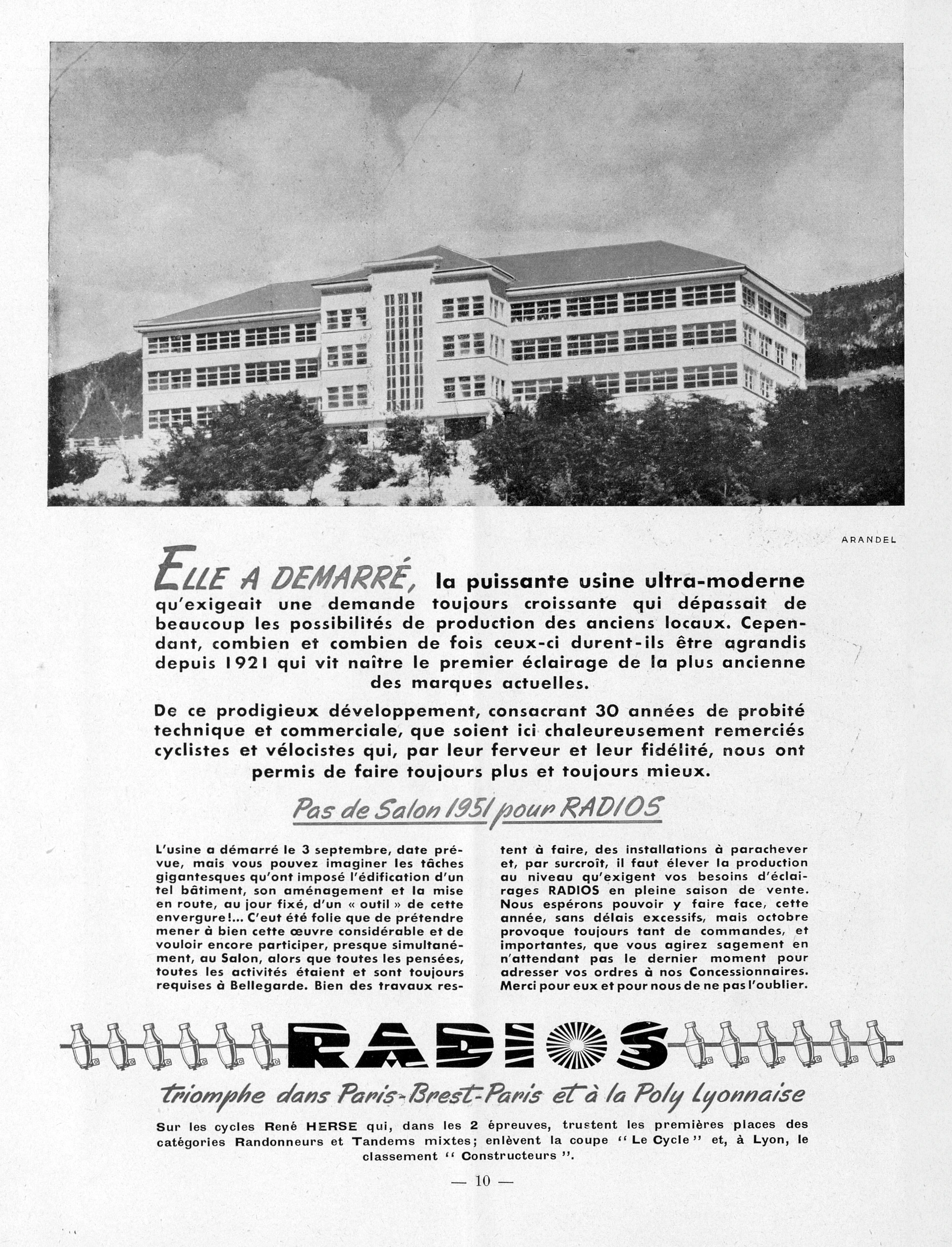
For randonneurs, the highlight on the calendar is Paris-Brest-Paris, a 1,200 kilometer event across France and back, run as a separate event for amateurs since 1931 with a time limit of 90 hours. It is not a race, but there has always been competition within it, and one prize mattered to the builders above all: the Challenge des Constructeurs, awarded to the marque whose riders placed best. Herse’s riders made it theirs. A 1951 advertisement for Radios lighting, held in the Ebykr Catalog Archive, boasts that riders on René Herse cycles took the first places among the randonneurs and the mixed tandems at both Paris-Brest-Paris and the Poly Lyonnaise that year, won the Coupe “Le Cycle” and at Lyon took the builders’ classification. Virtually a clean sweep of such events.
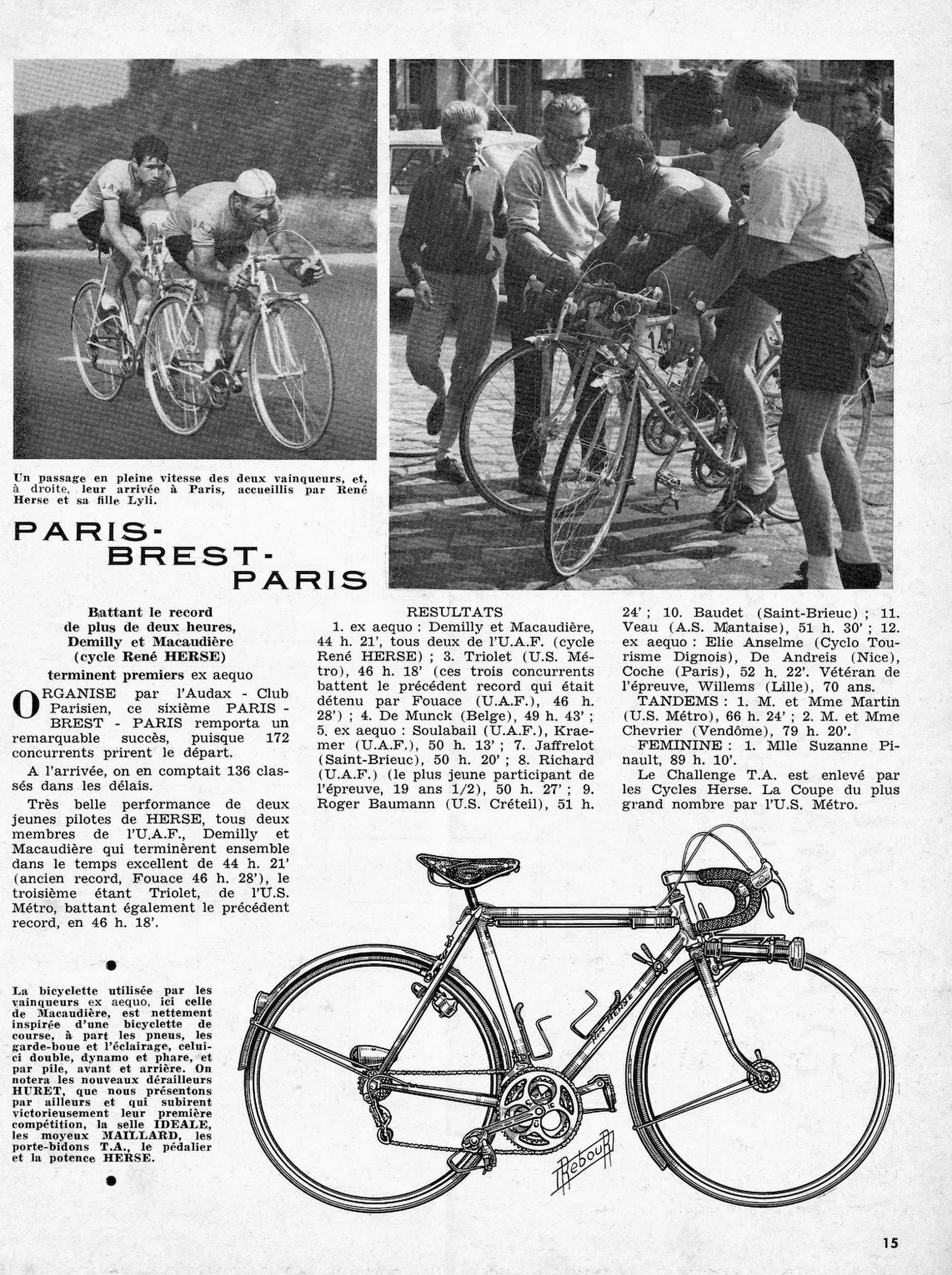
The high point came in September 1966. Maurice Macaudière and Robert Demilly of the U.A.F., both on René Herse bicycles, broke away from the field and rode together through two nights. Demilly faltered and Macaudière towed him for many kilometers, then Macaudière suffered on one of the last climbs and had to stop before he too recovered. They reached Paris together in 44 hours 21 minutes, beating the record by more than two hours, as Le Cycle reported that October. It was, by Heine and Pradères’ count, the fifth time Herse had won the Challenge des Constructeurs, which then took the five best-placed riders into account. Macaudière’s machine was no special lightweight. It weighed 12.2 kg and was as standard as a Herse could be, its only concession to the event two small eyelets on the front rack for a nighttime torch.
Herse’s reach went beyond the randonneur world. In 1957 Le Cycle reported that three riders in turn, Raffaitin, Bauman and finally Gilbert, had broken the unpaced 24-hour world record on one and the same track machine, “studied and built by René Herse,” and remarked that a machine breaking a record three times was a record in itself.
Lysiane “Lyli” Herse, René’s daughter, was born in Caen on 6 January 1928. She grew up in the shop and on the back of its tandems. Le Cycle in April 1948 noted the Herse tandem of Prestat and “Lily” Herse, and period advertisements for Idéale saddles and Lefol fenders in the Ebykr Catalog Archive celebrate the same pair first among the mixed tandems at the Poly. That year she also set a record for the climb of the Puy de Dôme, an event established by MAFAC founder Auguste Bourdel in 1946.
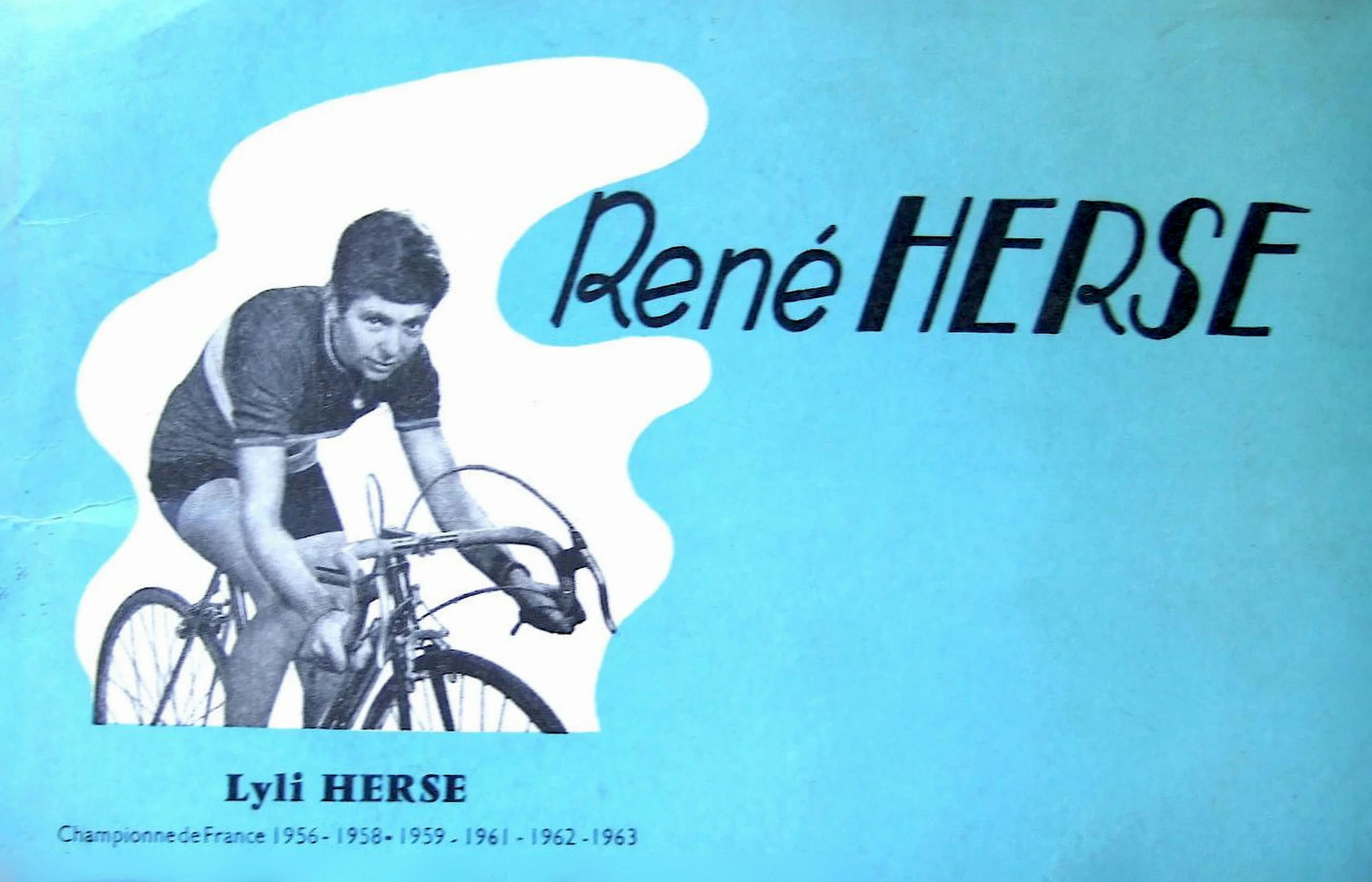
She went on to race, and to win. In November 1961 Le Cycle showed her once again wearing the tricolor jersey of the champion of France on the road, on a machine “naturally” designed and built by her father, with a forged duralumin house stem that doubled as the cable stop for a MAFAC brake fitted with a Herse straddle cable roller. Heine and Pradères credit her with eight French championships; other sources count nine, and the exact tally is one to settle from the federation’s results. Her protégée Geneviève Gambillon won the women’s world road championship at Gap in 1972 on a René Herse built of Reynolds tubing and fitted, as Le Cycle listed it, with Huret Jubilee derailleurs, Maillard and Herse parts and Weinmann brakes. Gambillon won the title again in 1974.
Herse watched the market closely. At the Paris Salon of 1951, Englebert Vélo-Magazine found him showing duralumin luxury bicycles and, a sign of the times, a solo and a tandem fitted with the Mosquito auxiliary engine, kept removable so that each remained a true bicycle for a rider who pedaled all the way.
By the 1960s the market was changing around the constructeurs. Cars were taking the place of trains, and folding small-wheeled bicycles that fit in a car’s trunk swept Europe after the German cycle show of 1960. Herse’s answer, shown in publicity photographs in front of his shop in 1962 and described in Le Cycle that December as “a beautiful take-apart bicycle,” was a fully equipped full-size machine whose frame separated in two. The front of the top tube slid into the rear and locked with a quick release, the down tube was joined by a sliding sleeve with two more, and a quick-release stem and split cable guides did the rest. In Le Cycle‘s account of the 1964 Salon, take-apart bicycles were the star of the show, and Herse was among the 11 exhibitors who offered one.
New customers also came from across the Atlantic. Dr. Clifford Graves, a surgeon in La Jolla, California and the leader of the International Bicycle Touring Society, discovered Herse’s bicycles through the French youth hostel movement and admired their trouble-free hubs and bottom brackets. He spread the word and a small but steady stream of Herse bicycles crossed to the United States. When the American bike boom of the early 1970s arrived, a few hundred Herses and Singers came with it.
René Herse died on 12 May 1976 at Clichy, the town next door to Levallois, at age 68. The shop passed to Lyli and her husband Jean Desbois, who had joined Herse as a 17 year old apprentice and became, by every account, the finest of his frame builders. They kept the name in front of the trade: at the 1981 Salon du Cycle in Paris, the company says, they showed the lightest bicycle of the show at under seven kilograms. But building bicycles by hand was hard and poorly paid work, and a generation of constructeurs was retiring. Lyli and Jean stopped taking orders in 1986 and spent two more years finishing those already placed. The last classic René Herse bicycles were completed in 1988.
The revival came from Seattle of all places. Jan Heine, editor of Bicycle Quarterly, met Lyli Herse and Jean Desbois after riding that 1946 Herse tandem in Paris-Brest-Paris in 2003, and he visited them many times in the years that followed. When Lyli asked him to take over the René Herse name, Heine, by his own account, was not yet ready. He brokered a deal under which his friend Mike Kone took the name, while Heine bought the remaining tools, documents and other physical assets of the company. Kone built a few René Herse bicycles in Colorado before the name passed to Heine. In 2019 Heine’s Compass Cycles became Rene Herse Cycles, which makes tires, cranks and other components under the name. Lyli Herse died in Osny, northwest of Paris, on 4 January 2018, two days short of her 90th birthday.
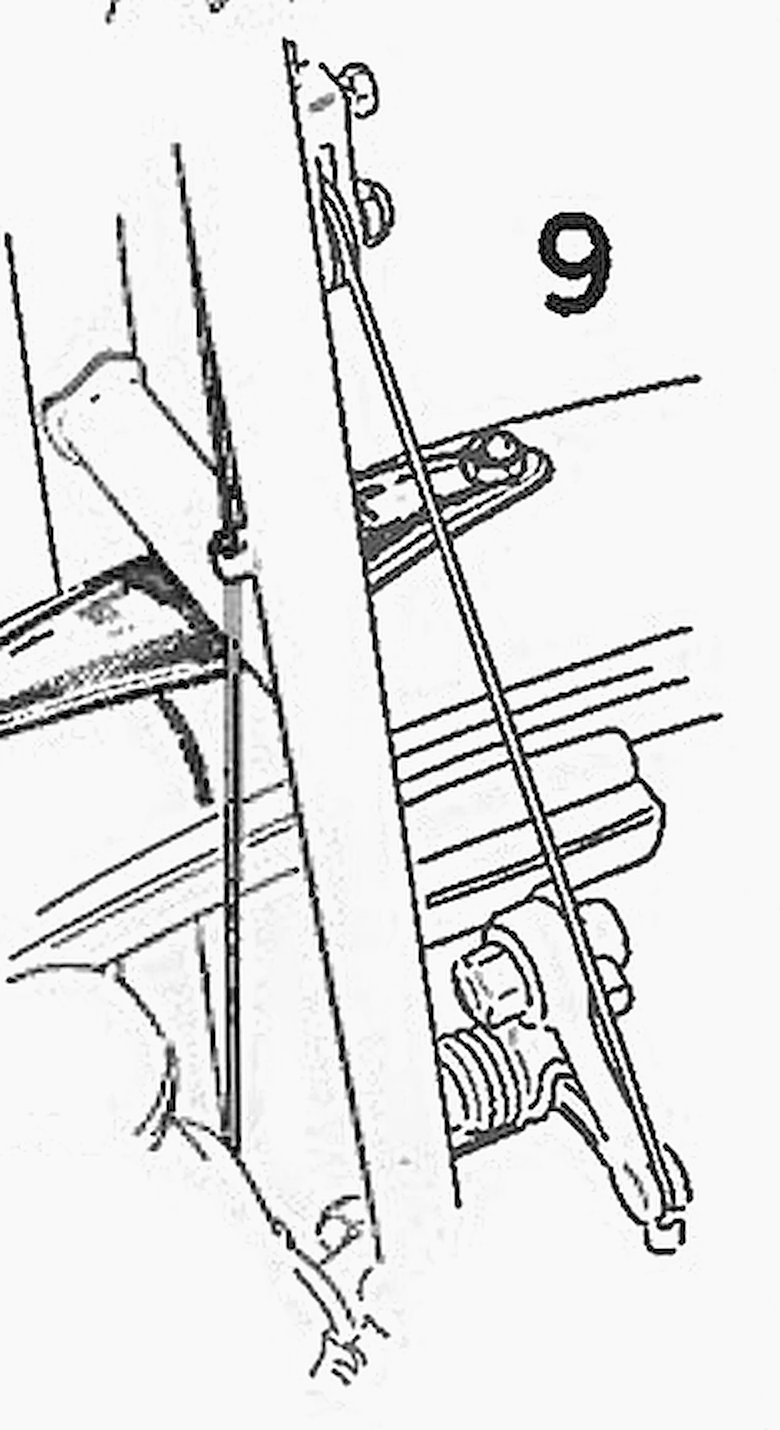
The revival has kept the name alive, but the bicycles that made it are the ones built in Levallois between 1940 and 1988, and the best record of them is still the one kept at the time: Rebour’s drawings in Le Cycle, the results of the Concours and of Paris-Brest-Paris and the advertisements of the parts makers who were proud to say their parts had been on a Herse. To browse what Ebykr holds from those years, search the Catalog Archive for “Herse.”
Le Cycle, October 1966: Paris-Brest-Paris 1966, won on a René Herse (Ebykr Catalog Archive)
Le Cycle, January 1964: Daniel Rebour on the racing frame (Ebykr Catalog Archive)
Radios advertisement, 1951 (Ebykr Catalog Archive)
Lefol advertisement, “Triomphe à la Poly” (Ebykr Catalog Archive)
Englebert Vélo-Magazine, November 1951: the Salon de Paris (Ebykr Catalog Archive)
Le Cycle, October 1966: Daniel Rebour on the Salon de Paris (Ebykr Catalog Archive)
The Daniel Rebour Files (Heiko Strömer): Le Cycle, 1 December 1945, 14 December 1946, 23 August 1947, 24 April 1948, 25 September 1948, 21 September 1957, November 1961, December 1962 and October 1972
French civil death register (INSEE, via matchID): René Louis Herse and Lysiane Herse
Jan Heine and Jean-Pierre Pradères, The Golden Age of Handbuilt Bicycles (Vintage Bicycle Press), French edition L’Âge d’Or des Bicyclettes Artisanales, pages 46, 52, 80, 112, 136 and 146
Jan Heine, René Herse: The Bikes, The Builder, The Riders (Bicycle Quarterly Press, 2012)
Rene Herse Cycles: The Story of Rene Herse Cycles
Rene Herse Cycles: 80 Years of Rene Herse Cycles
 Rene Herse
Ebykr documents this marque across the archive. Here is the rest of it.
The Ebykr Digest
New articles, timelines, catalog finds and registry activity — assembled from the archive once a month. Your address is never shared.
Double opt-in. One email per month. Unsubscribe at any time with one click.