About Ebykr
Ebykr celebrates classic and vintage lightweight bicycles through provocative imagery and opinion. Ride along with us.
About Ebykr
Ebykr celebrates classic and vintage lightweight bicycles through provocative imagery and opinion. Ride along with us.

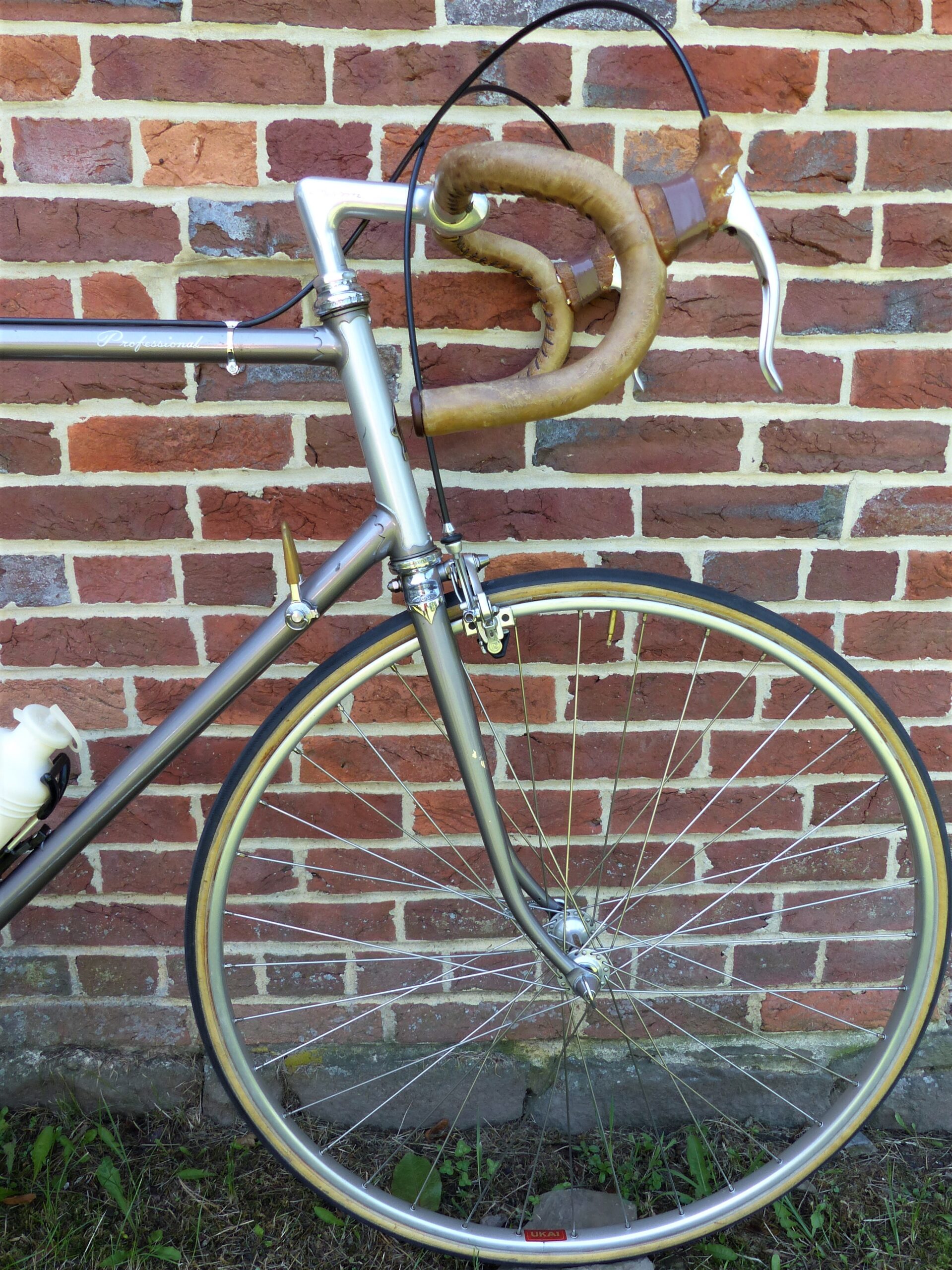
Founded in 1899 as a Tokyo trading house importing American goods, Fuji was Japan's most popular bicycle by the late 1920s and, with the S10-S of 1971, ended the assumption that a serious lightweight had to be European. This is the longer story: the wartime renaming, three Olympic teams designed by a former Asian Games winner, Valite tubing, an early production titanium frame, serial numbers that actually date a frame, two bankruptcies and a brand changing hands again in 2026.
Ask most any American rider of a certain age what changed their mind about Japanese bicycles and there is a pretty good chance the answer is a single model: the Fuji S10-S. It arrived stateside in 1971, cost less than European machines it was compared with, weighed less than American ones usually did and was assembled with an attention to detail that made both look careless. Within a few seasons, the assumption that a serious lightweight had to come from Italy, France or England was gone, and it never came back.
That moment is only one chapter in a much longer story. Fuji is one of the oldest continuously traded bicycle names in the world, founded in 1899, and its history runs from a Meiji-era import house in Tokyo through wartime renaming, three Olympic Games, the American bike boom, an early production titanium frame and two separate bankruptcies, to a brand that in 2026 is once again changing hands. For a marque with this deep of an historical tire track, Fuji is surprisingly poorly documented in the popular literature, and a good deal of what circulates online is company marketing copy repeated verbatim. What follows separates what is well attested from what is claimed, or so we endeavored when drafting this article here on Ebykr.
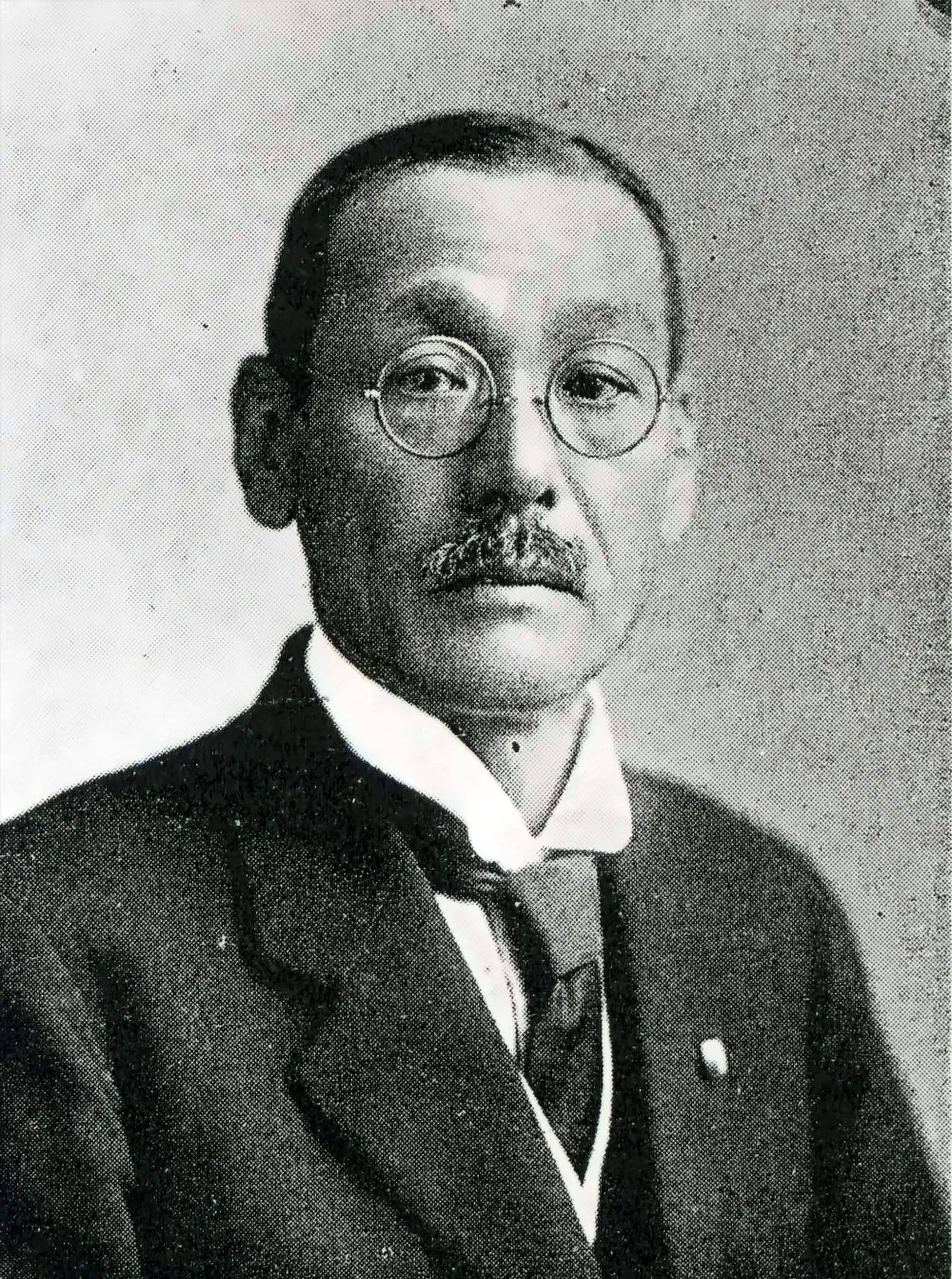
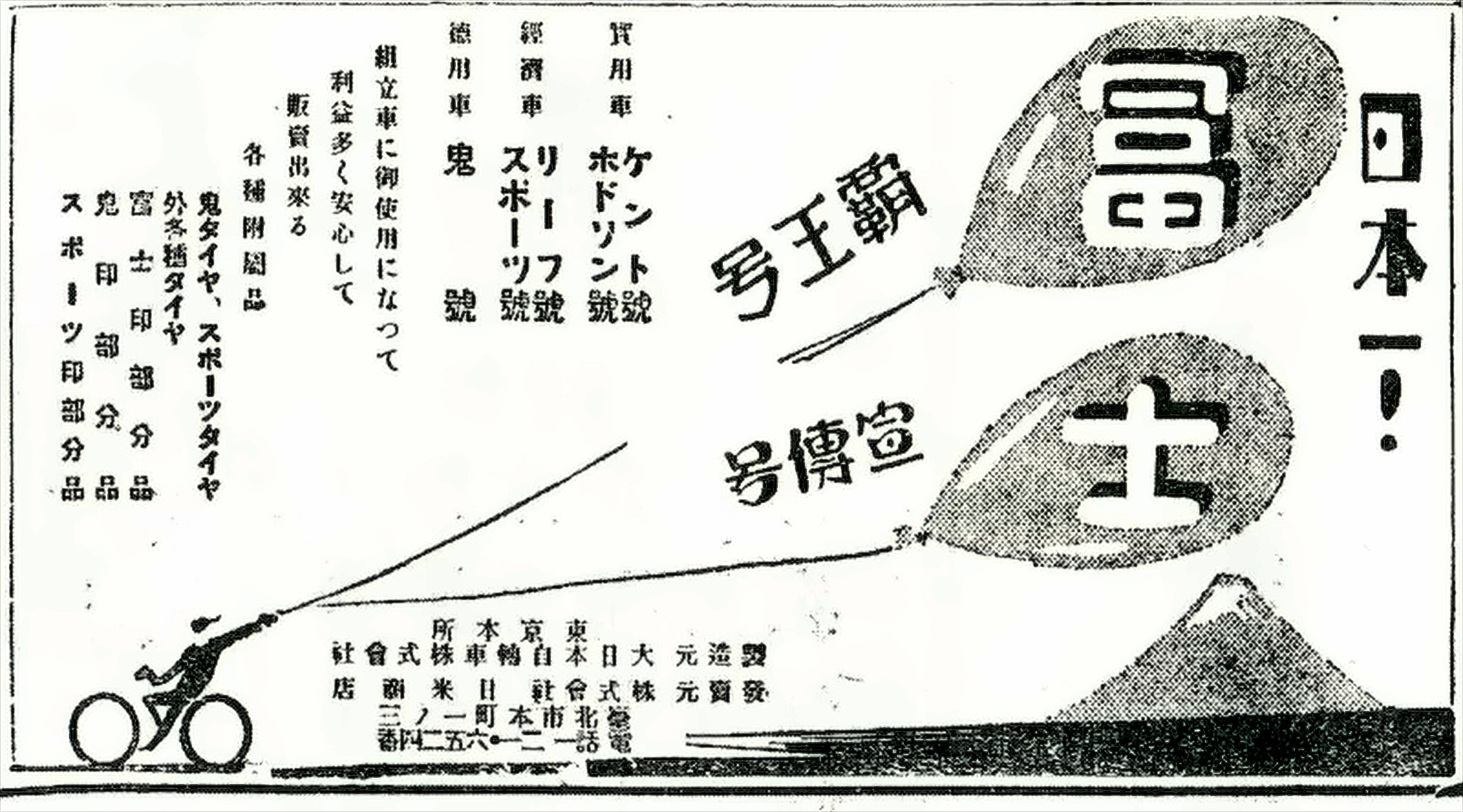
Fuji begins in 1899 with Okazaki Kyūjirō, who established a business that from 1900 traded under the name Nichibei Shōkai, the Japan-America Trading Company. The word nichibei is literally Japan-America, and the name is the whole business plan: the firm imported American goods, bicycles among them, into a Japan that was industrializing at speed and had not yet built a bicycle industry of its own.
Importing turned into assembling and assembling turned into manufacturing, and the Fuji name eventually went onto bicycles actually built in Japan. By the late 1920s, Fuji was the most popular bicycle in the country. That is a remarkable transition in under 30 years, and it happened for the same reason it happened in Britain and France a generation earlier: the bicycle was the practical vehicle of choice in a rapidly industrializing society, and whoever built the most reliable one at the right price won.
Racing followed, as it tends to. In the 1930s, Fuji established the first national stage race in Japan, running between Osaka and Tokyo, and sponsored the winning team. That event is the ancestor of what is now the Tour of Japan, still one of Asia’s premier road races. It is a detail worth holding onto, because it means Fuji was building competition machines and thinking about racing geometry decades before most Western riders had any idea the company even existed.
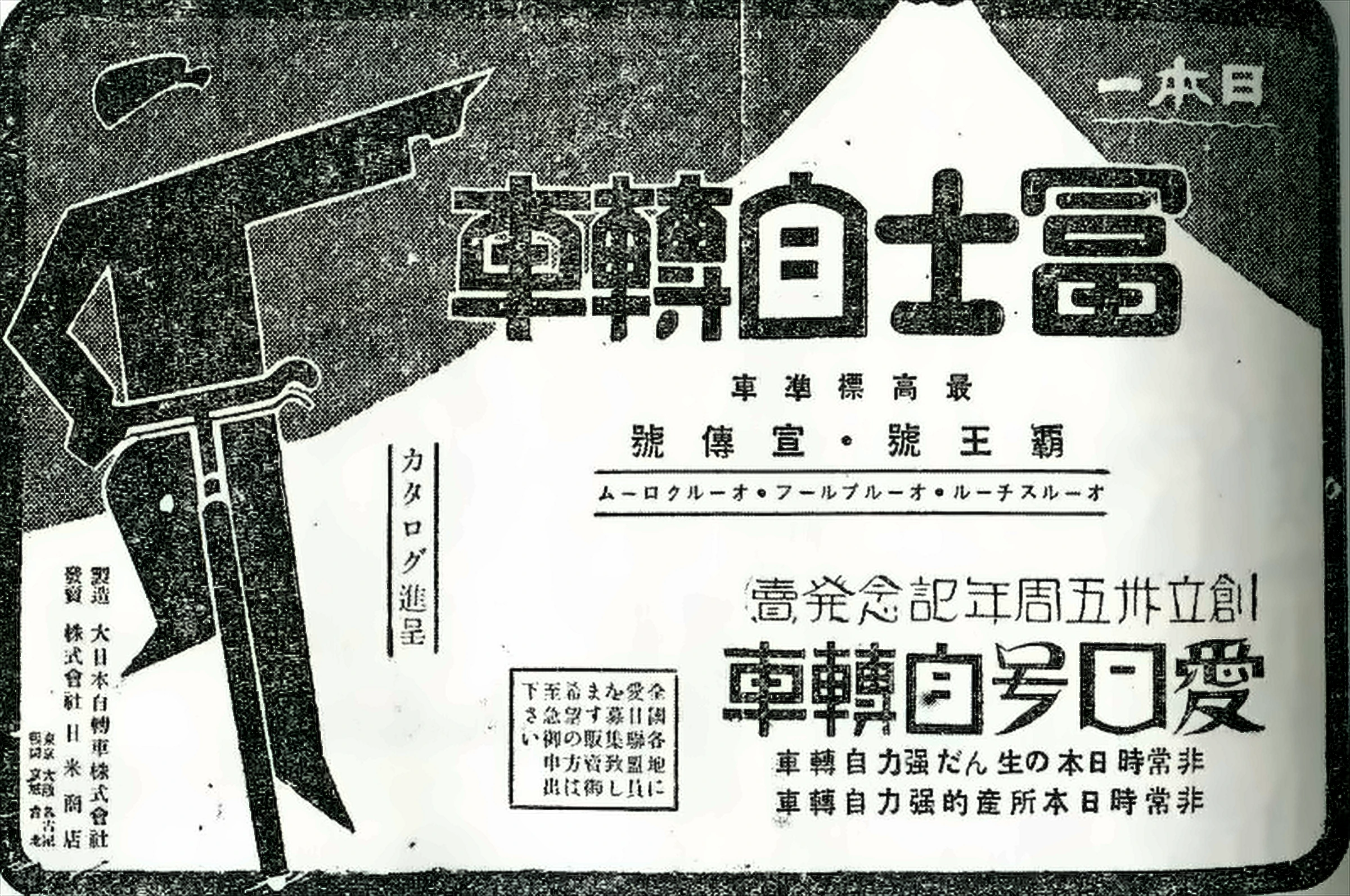
A Japanese company trading under a name that meant Japan-America had an obvious problem in the late 1930s. During the Second World War, the firm was renamed Dainippon Cycle and then reverted afterwards, this time as the Nichibei Fuji Cycle Company. The name change is a small thing on a chronology and a large thing in what it tells you: this is a marque whose identity was built on a commercial relationship with the United States, lost that identity for the duration of a war fought against the United States and then rebuilt itself by selling to the American market more successfully than any Japanese bicycle maker ever had before it.
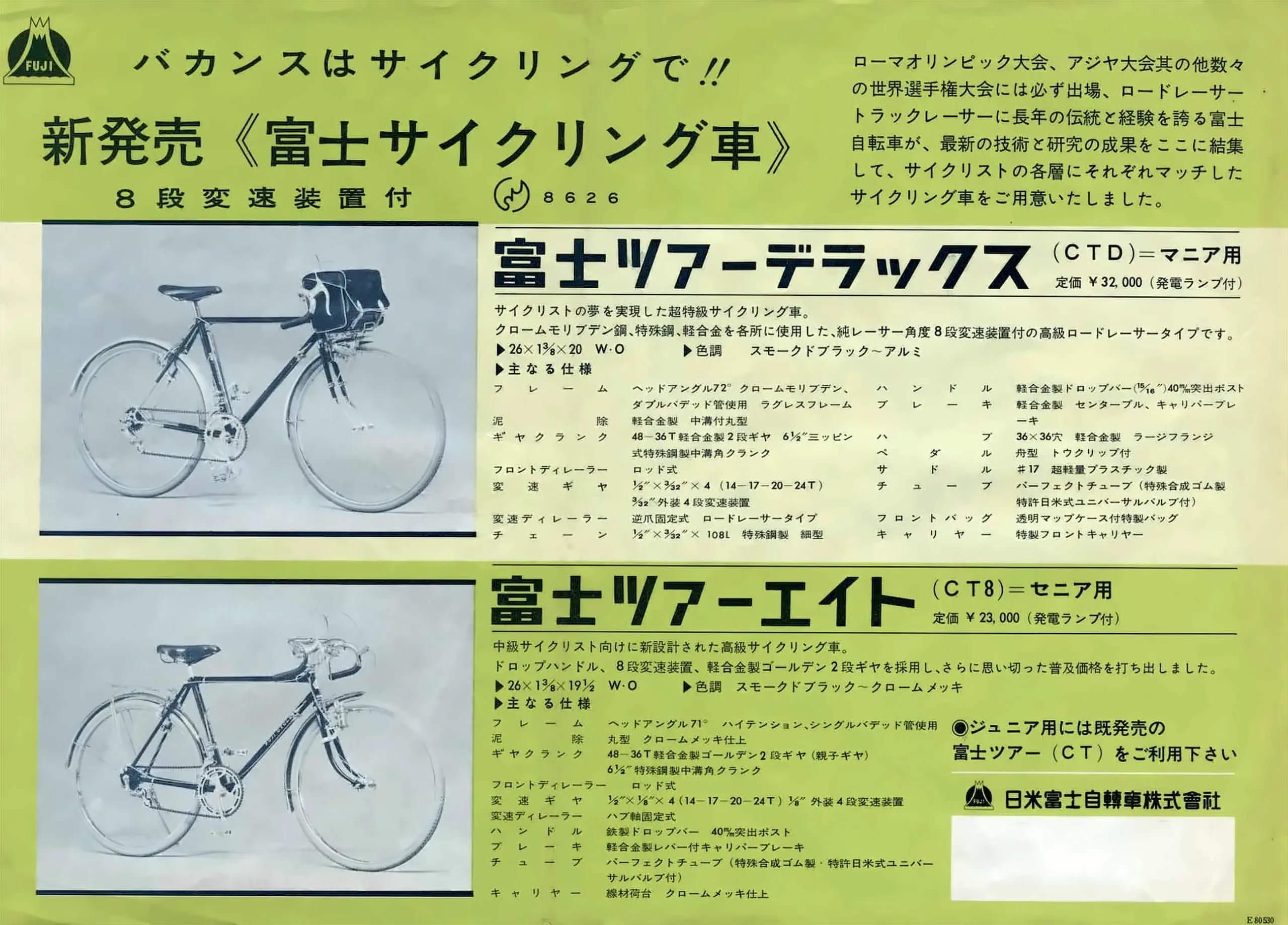
The individual most responsible for connecting Fuji’s racing side with its engineering side was the very talented Dr. Shoichiro Sugihara. He won at the 1951 Asian Games in New Delhi riding a Fuji, and then he became the company’s chief engineer and designer.
In that role, he designed the bicycles ridden by the Japanese national teams at the 1964 Tokyo Olympics, where he also coached the team, as he did again at Mexico City in 1968 and Munich in 1972. A rider who becomes his own team’s frame designer is a familiar figure in European constructeur history, though a much rarer one on a team sponsored by a large manufacturer like Fuji, and it explains a good deal about why their production frames of the following decade had geometry that a racing cyclist recognized rather than geometry arrived at by a marketing department. And riders everywhere could feel the difference.
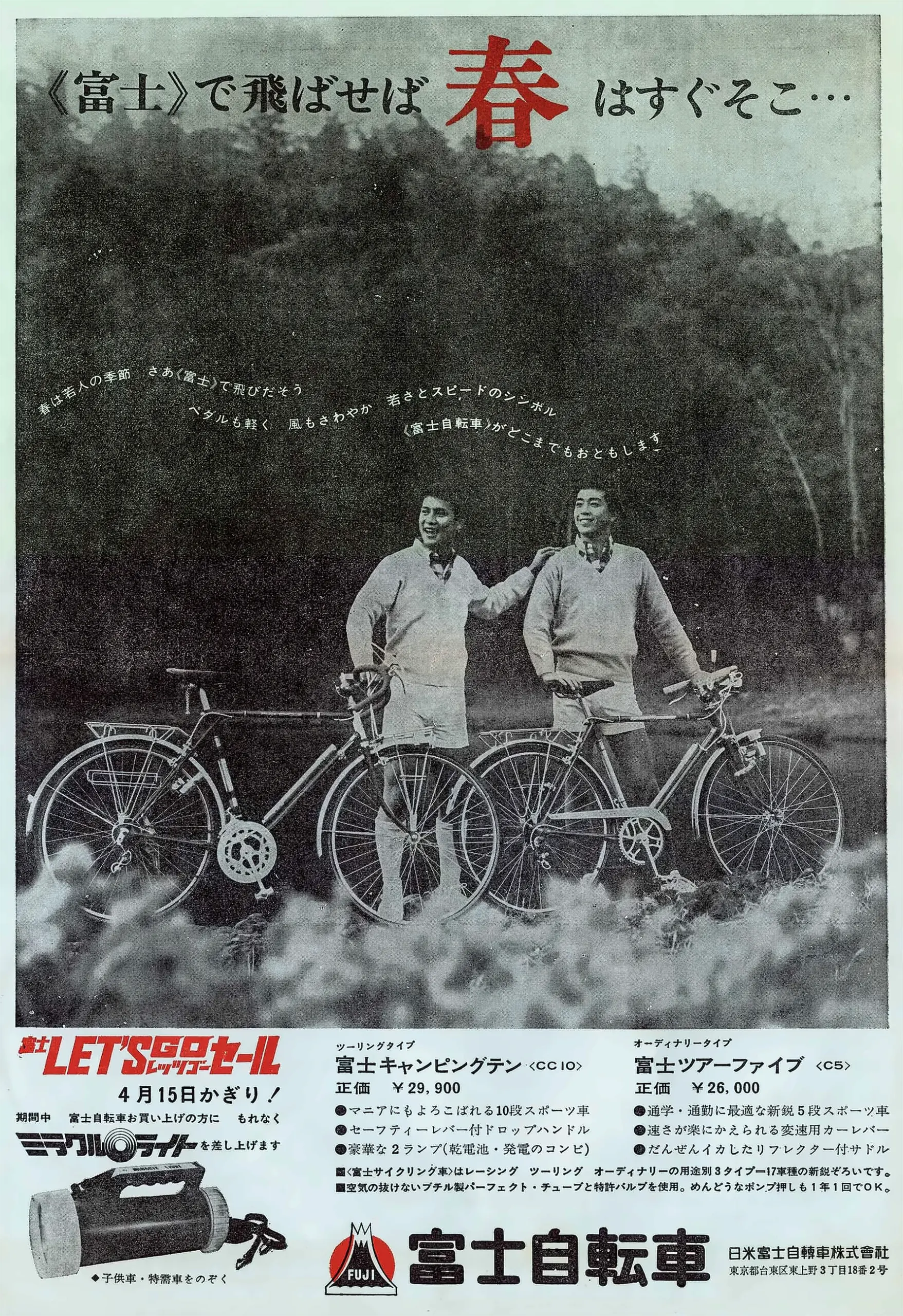
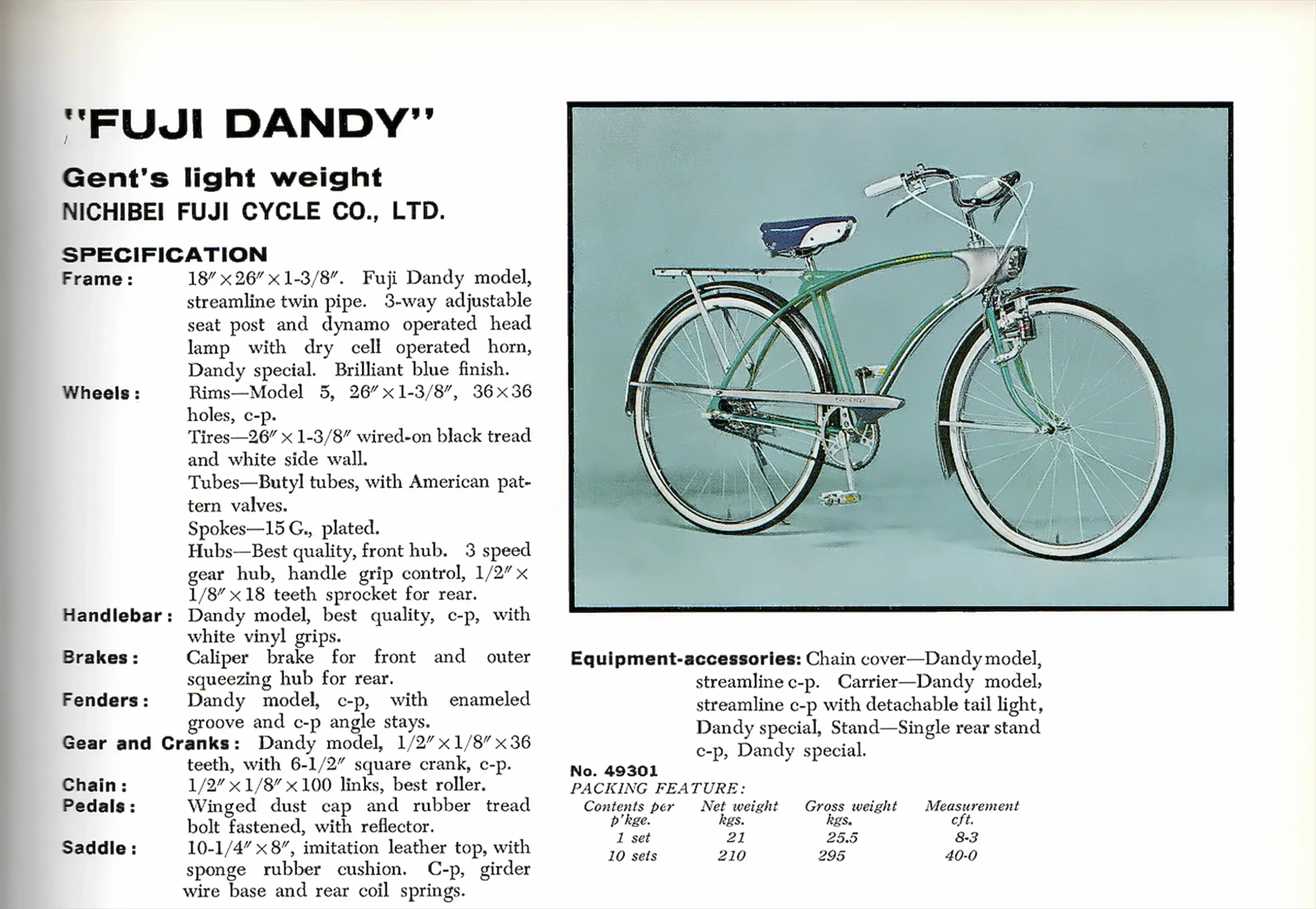
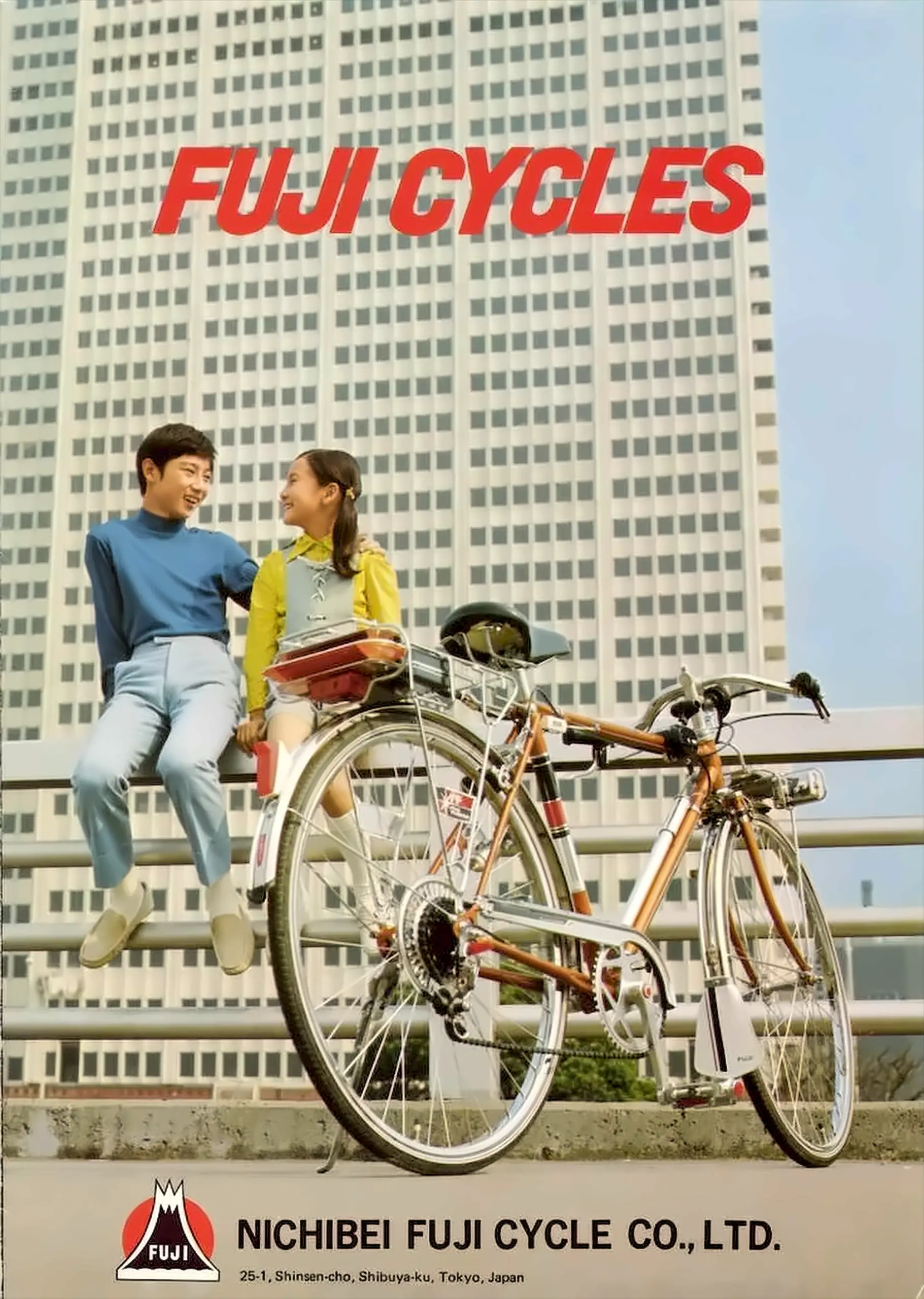
Fuji’s first substantial presence in the United States was anonymous. In the 1950s, Toshoku America acquired the American distribution rights for the brand, and Fuji-built bicycles were sold as private-label goods through Sears, Roebuck and Montgomery Ward, wearing whatever badge the retailer specified.
This is the part of the story most collectors skip and it is worth pausing on. For roughly 15 years, a large number of American households owned a Japanese-built bicycle without even knowing it, at a time when “made in Japan” was still shorthand for cheap. When Fuji finally put its own name on the head badge in the American market, it was hardly entering cold. It was simply revealing itself while rebadging and moving upmarket.
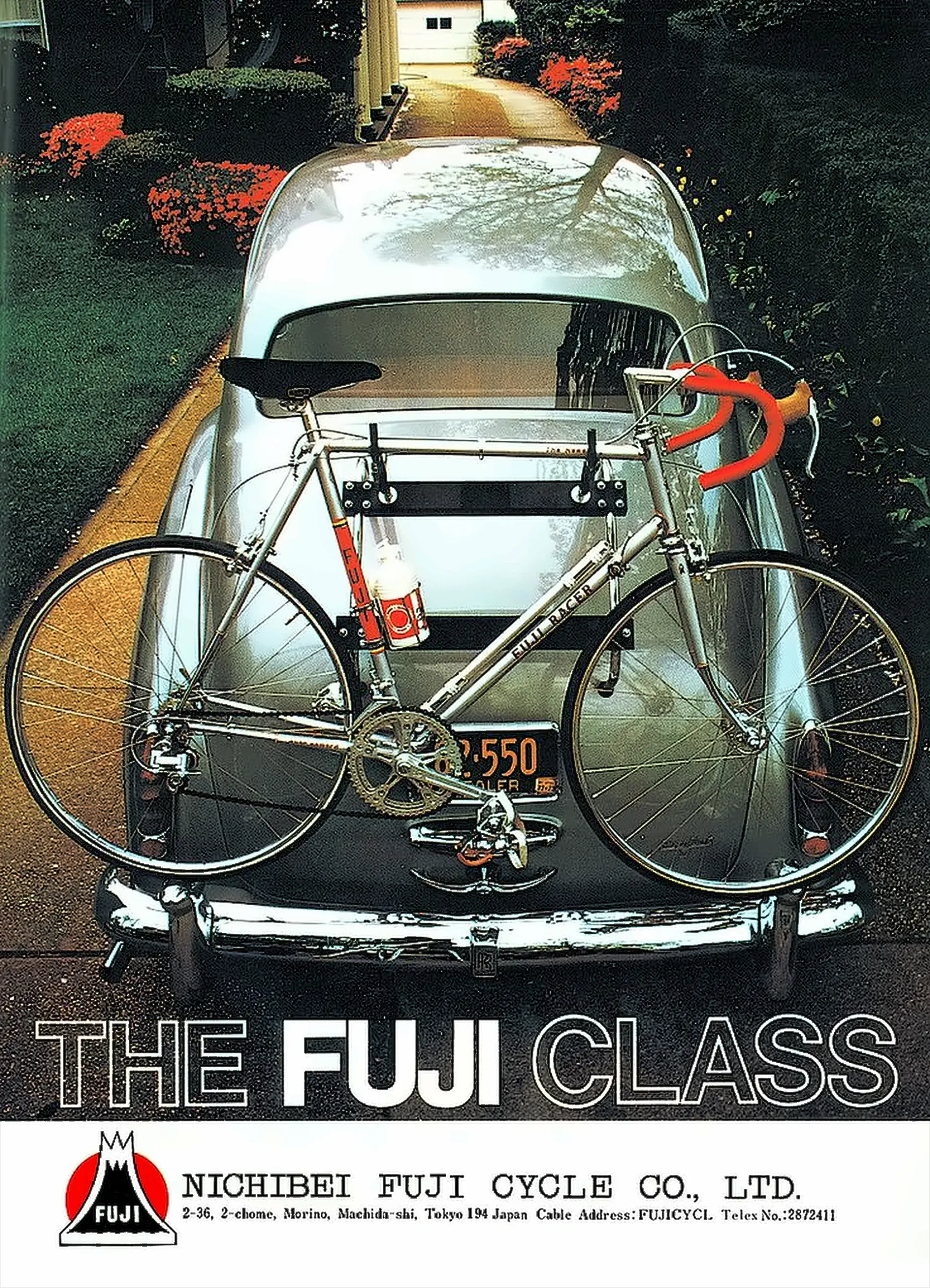
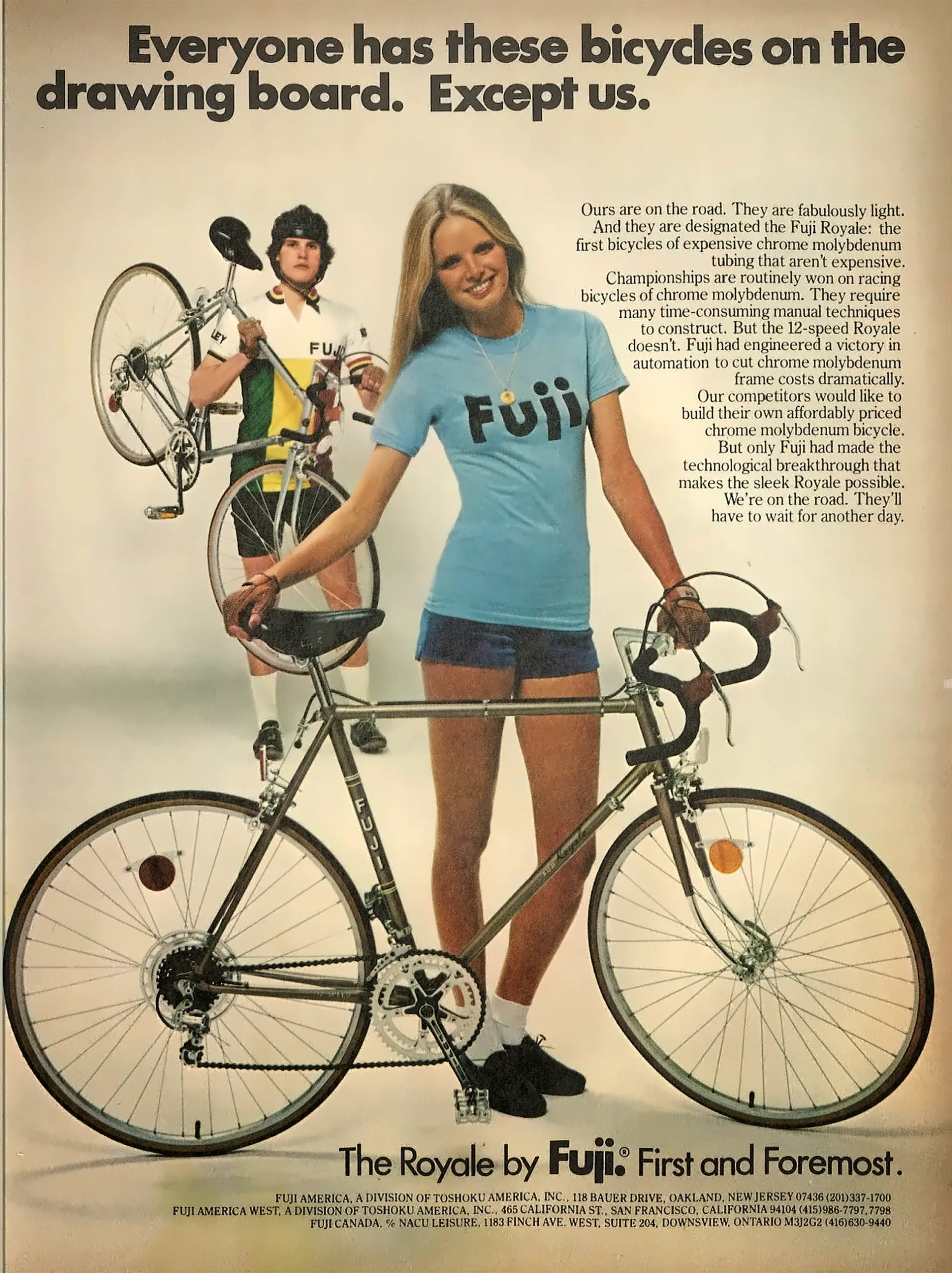
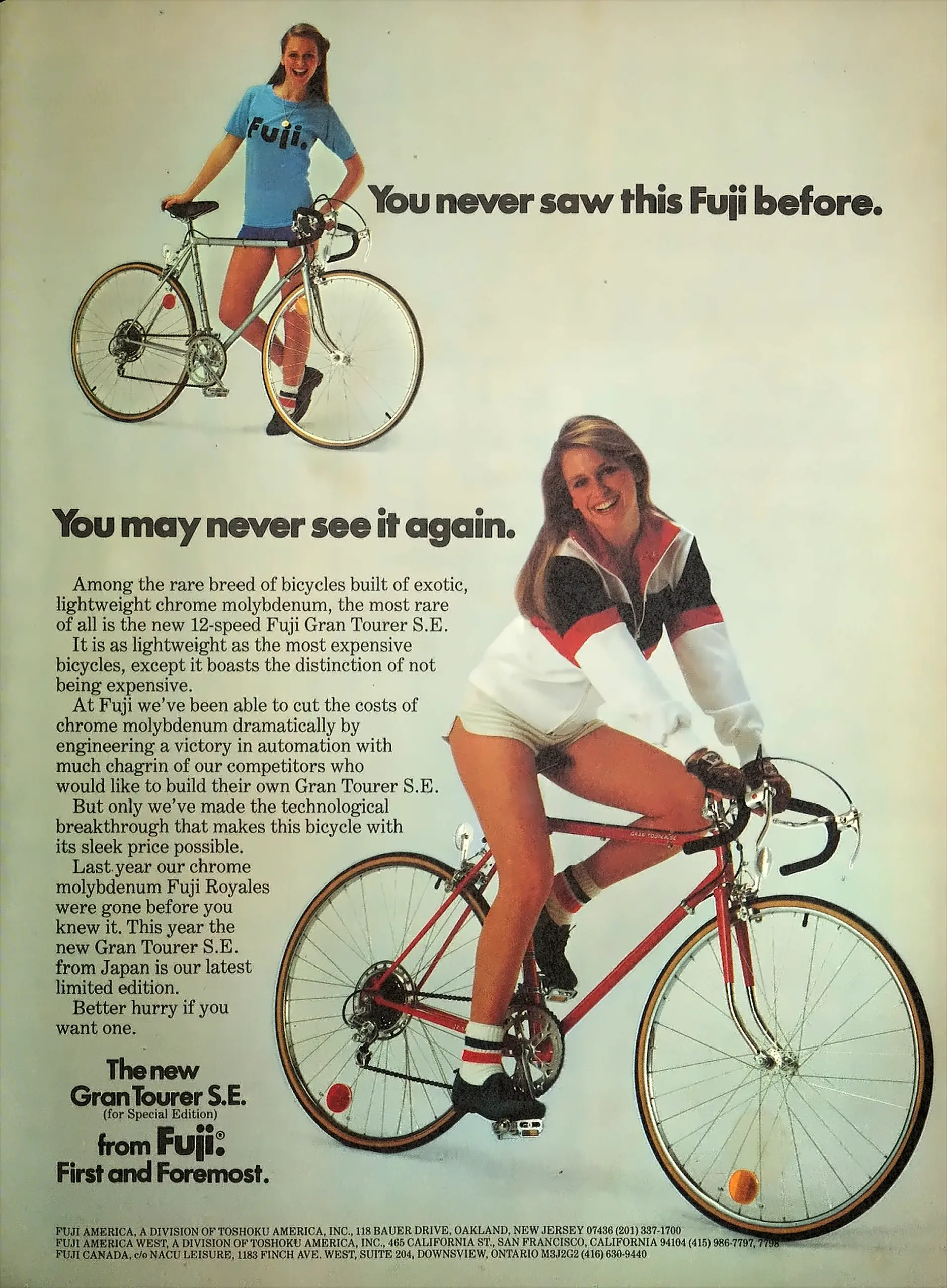
Fuji America was established in 1971 to distribute under the Fuji name and in the same year the S10-S reached the United States. It was a ten-speed road machine on a double-butted high-tension steel frame with unusually clean lug brazing, built to a 73 by 73 degree parallel geometry taken straight from contemporary racing practice while still remaining entirely suitable for light touring.
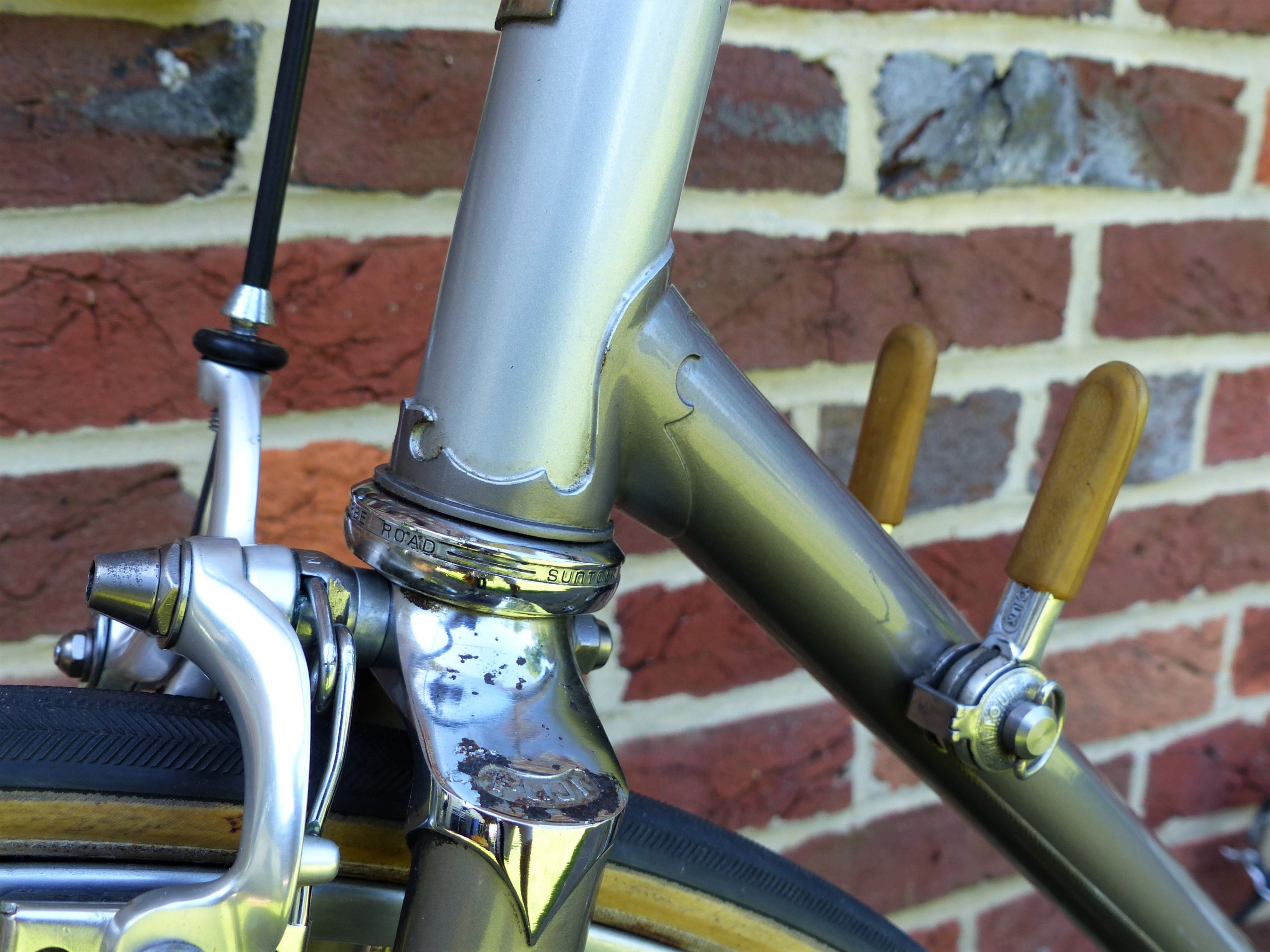
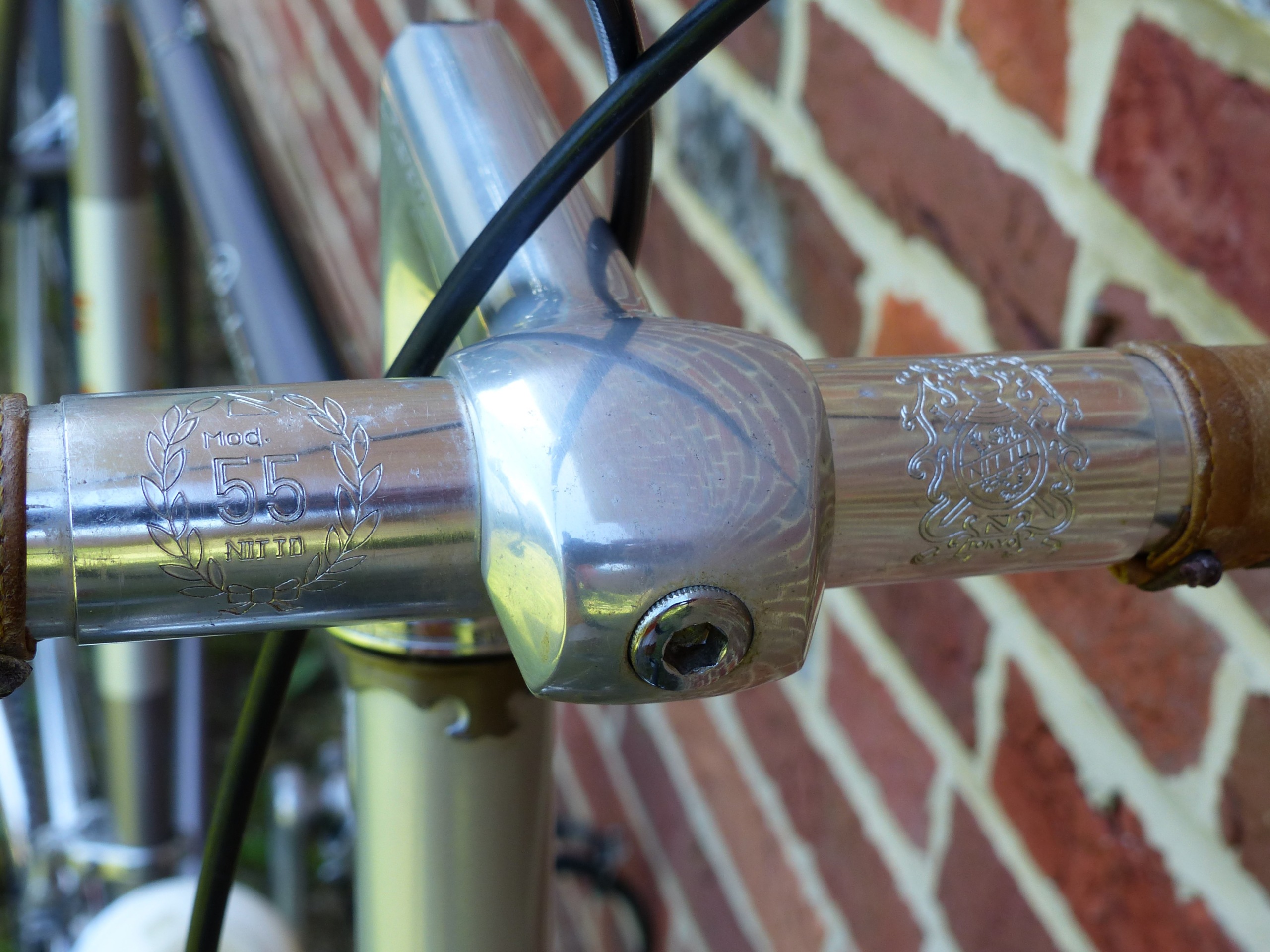
The component specification was thoroughly Japanese and, crucially, coherent: SunTour derailleurs and shifters, Sugino cranks, Dia-Compe brakes, Nitto bars, Sunshine hubs and Ukai rims. Nothing on the bicycle was an obvious compromise. Reviewers, including Consumer Reports, responded with enthusiasm, and Fuji took first place in Consumer Reports bicycle testing in 1974, 1976 and 1980. Richard Ballantine recommended Fuji road bicycles across several price bands in the 1974 edition of Richard’s Bicycle Book, which at that moment was the single most influential cycling book in the English-speaking world.
The effect on the American market was immediate and permanent. The Japanese manufacturers had adopted current European racing geometry, modern steel alloys and up-to-date production methods far faster than the established American builders, and their moderately priced bicycles were lighter and better sorted than the domestic equivalents. Schwinn’s difficulties through the same decade are the mirror image of Fuji’s success, and the two stories are best read together.
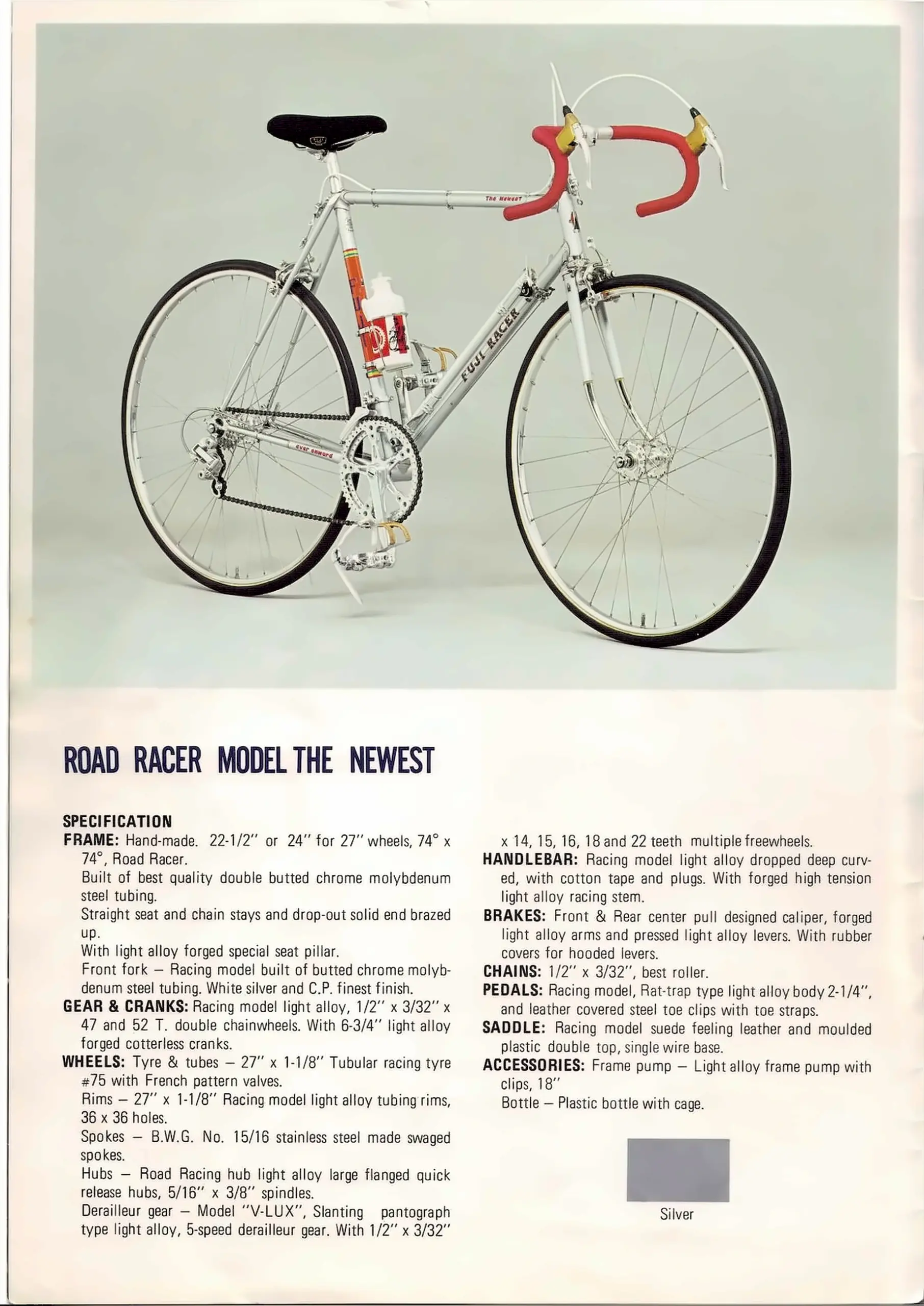
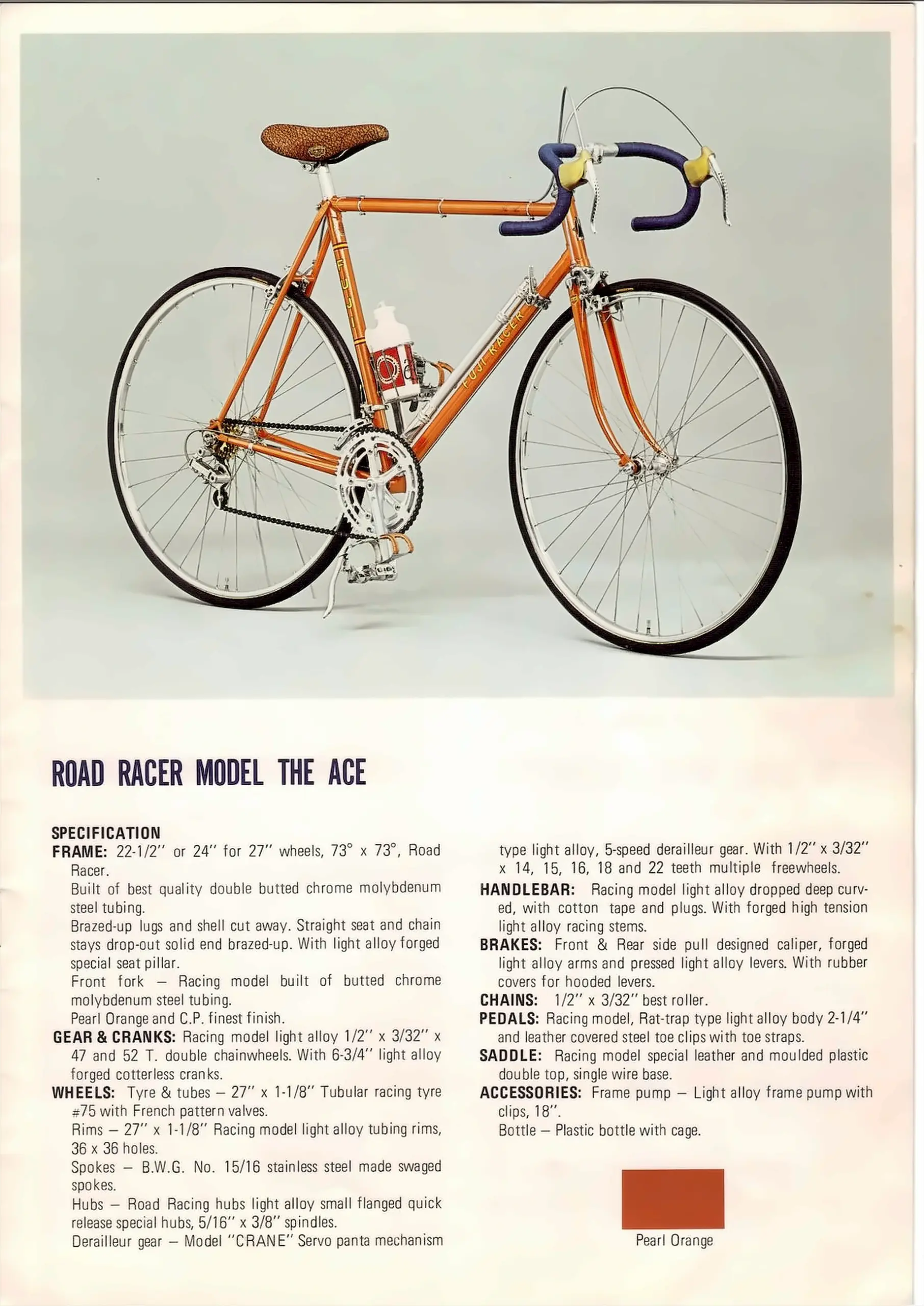
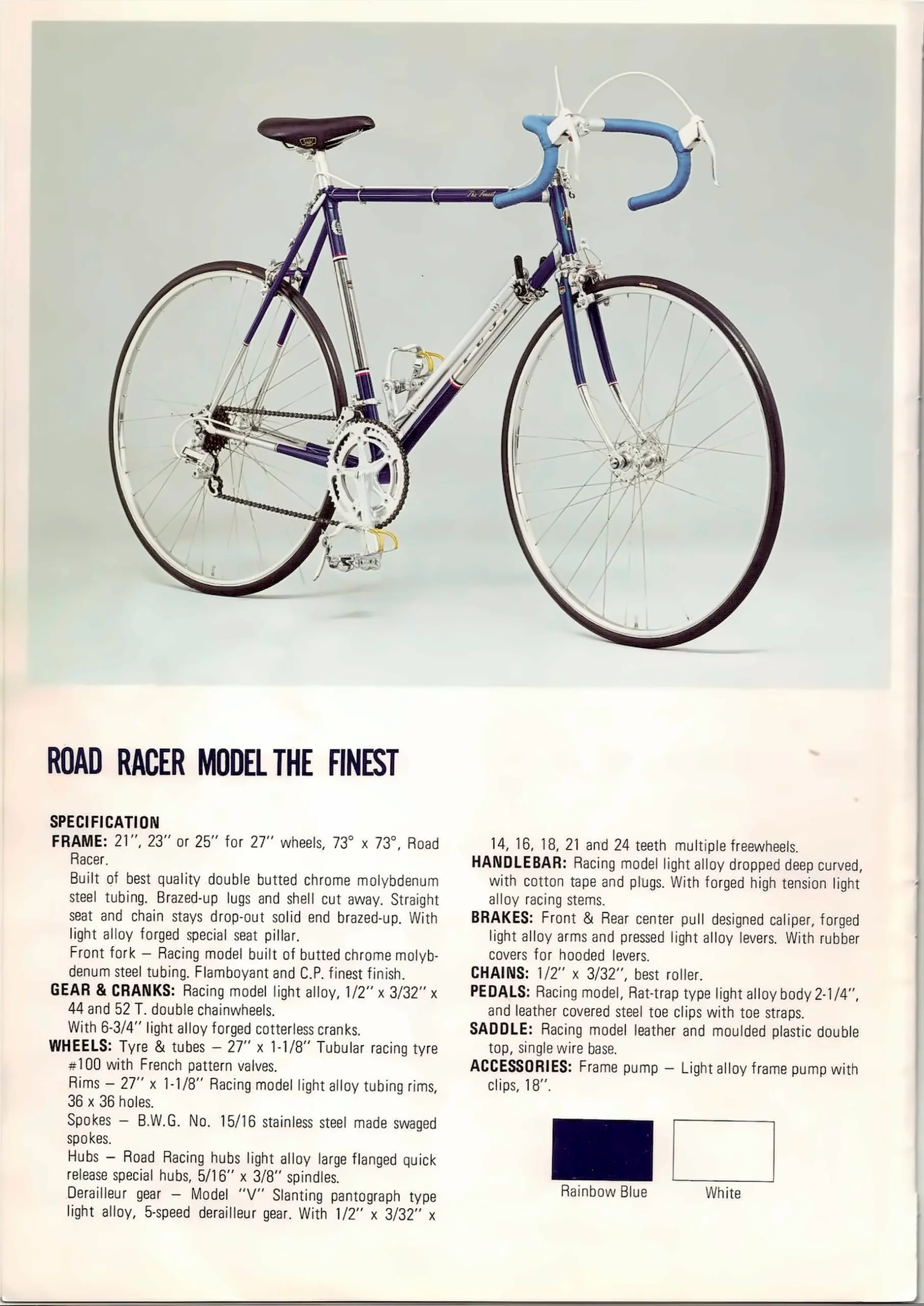
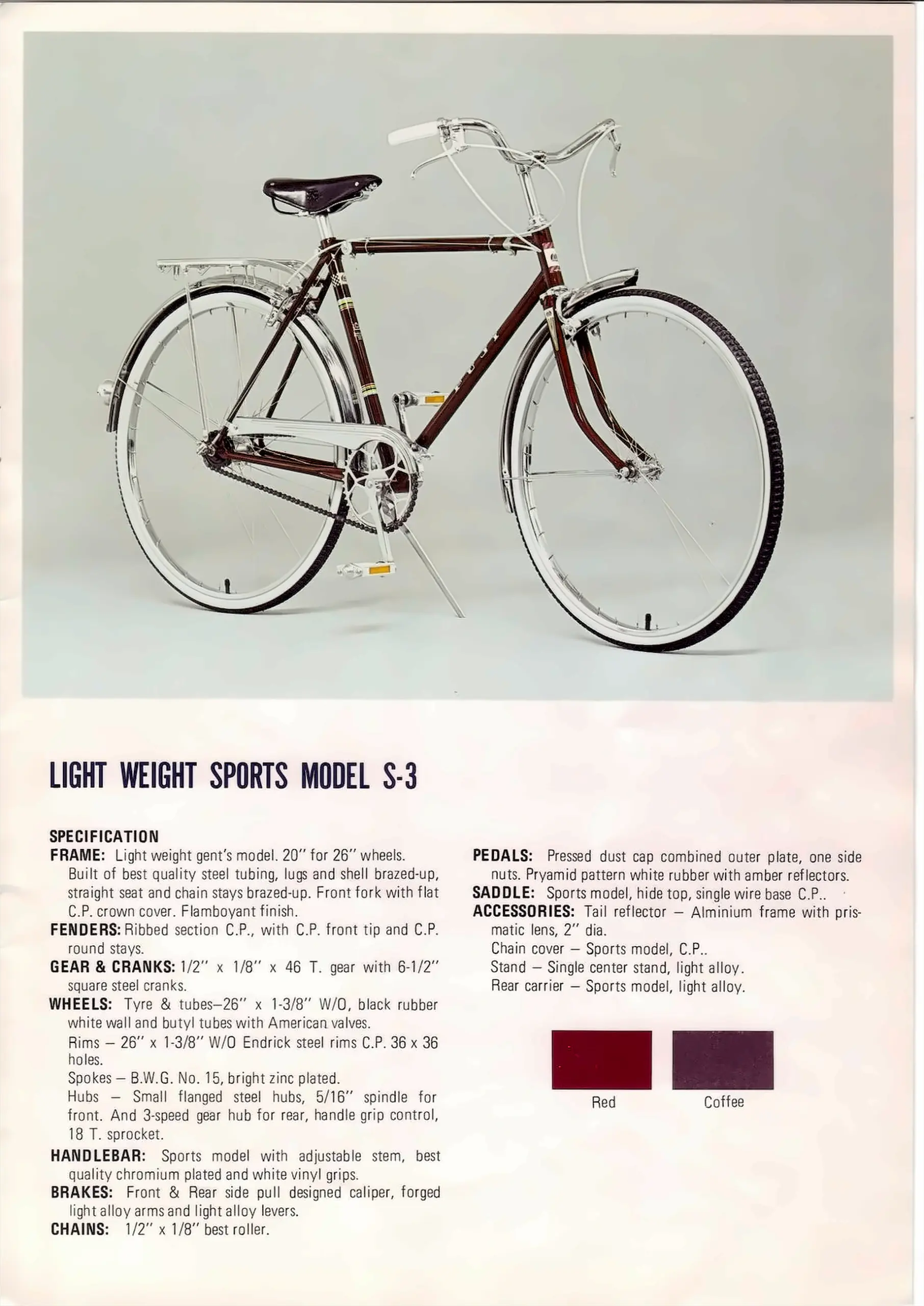
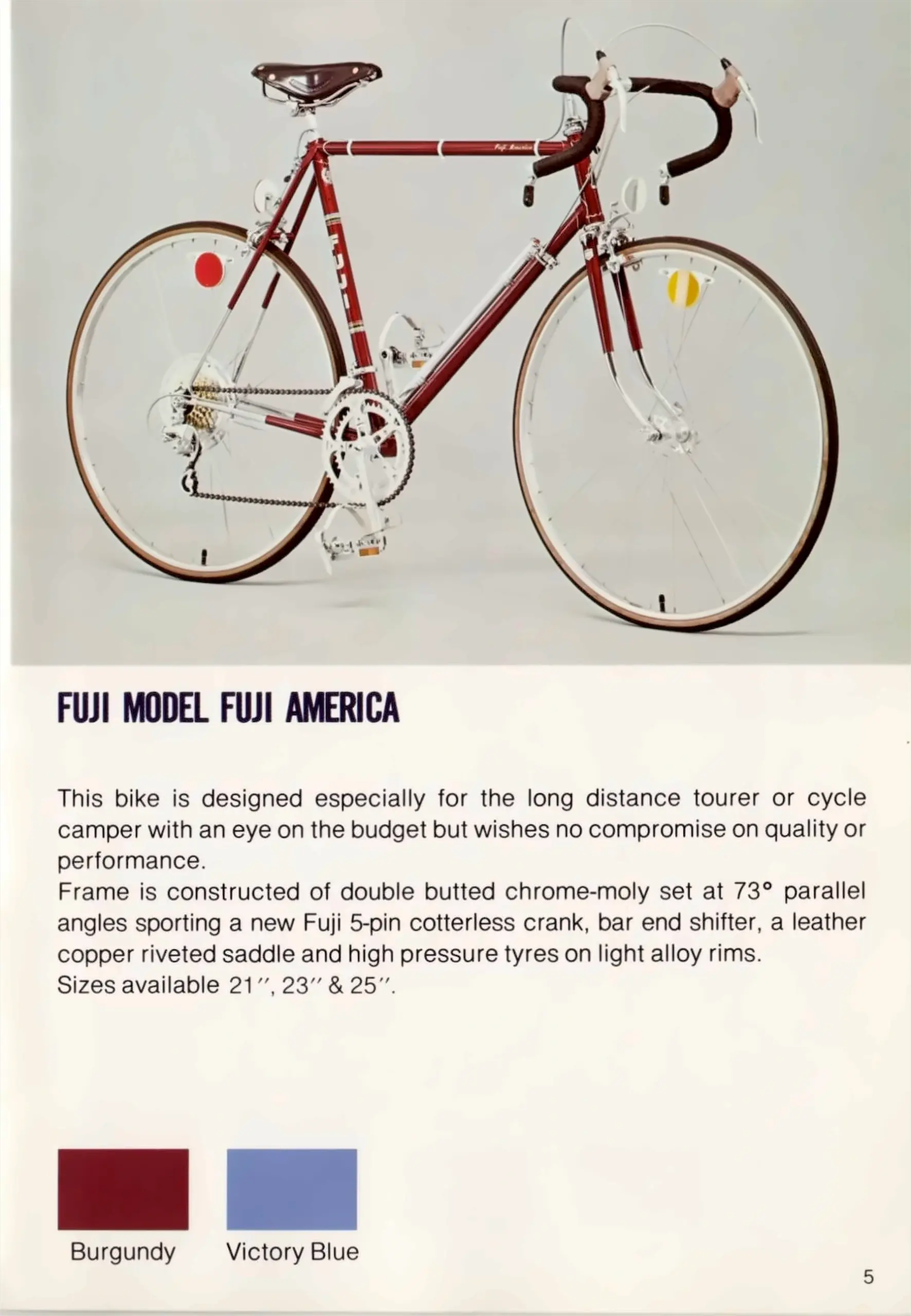
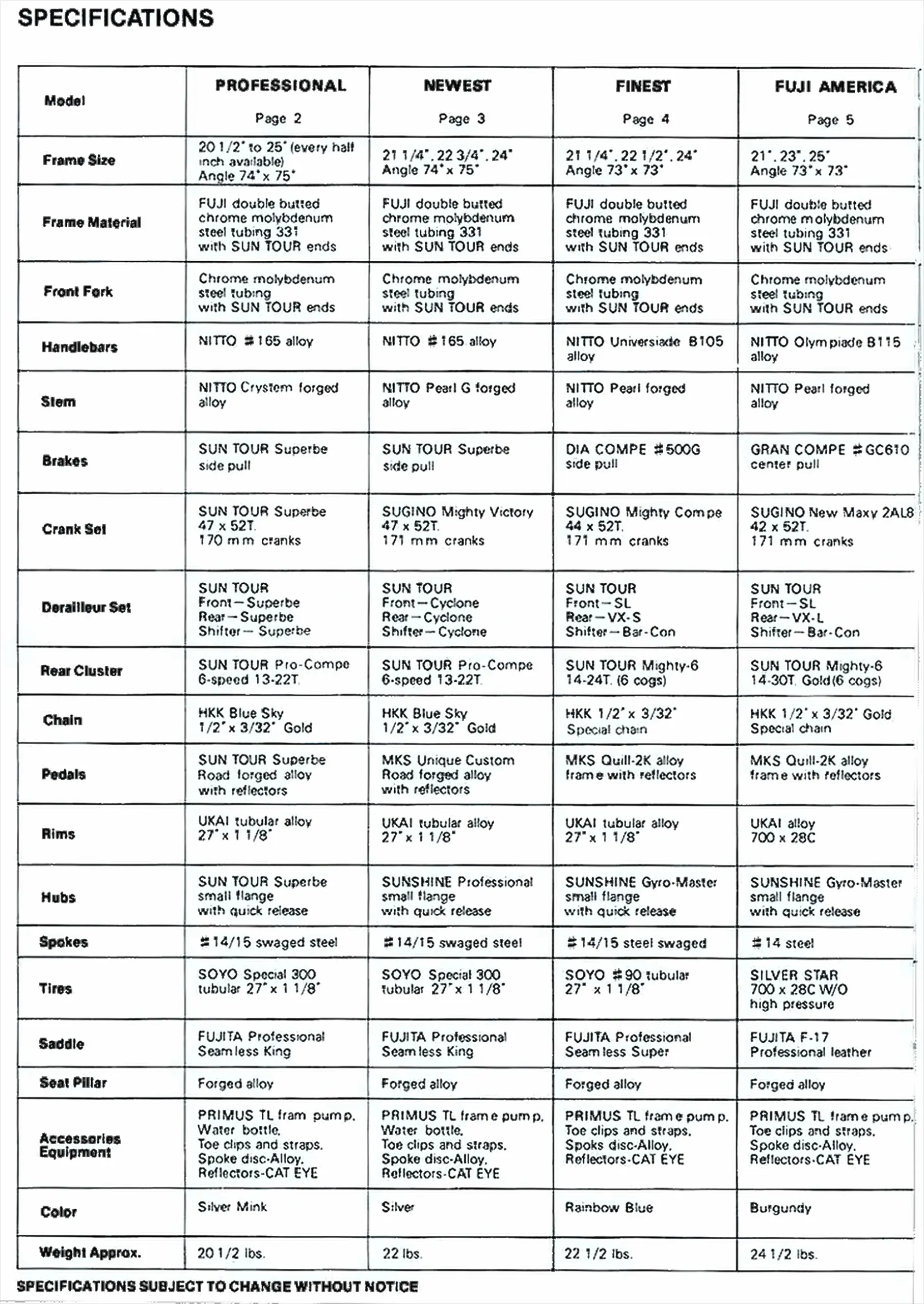
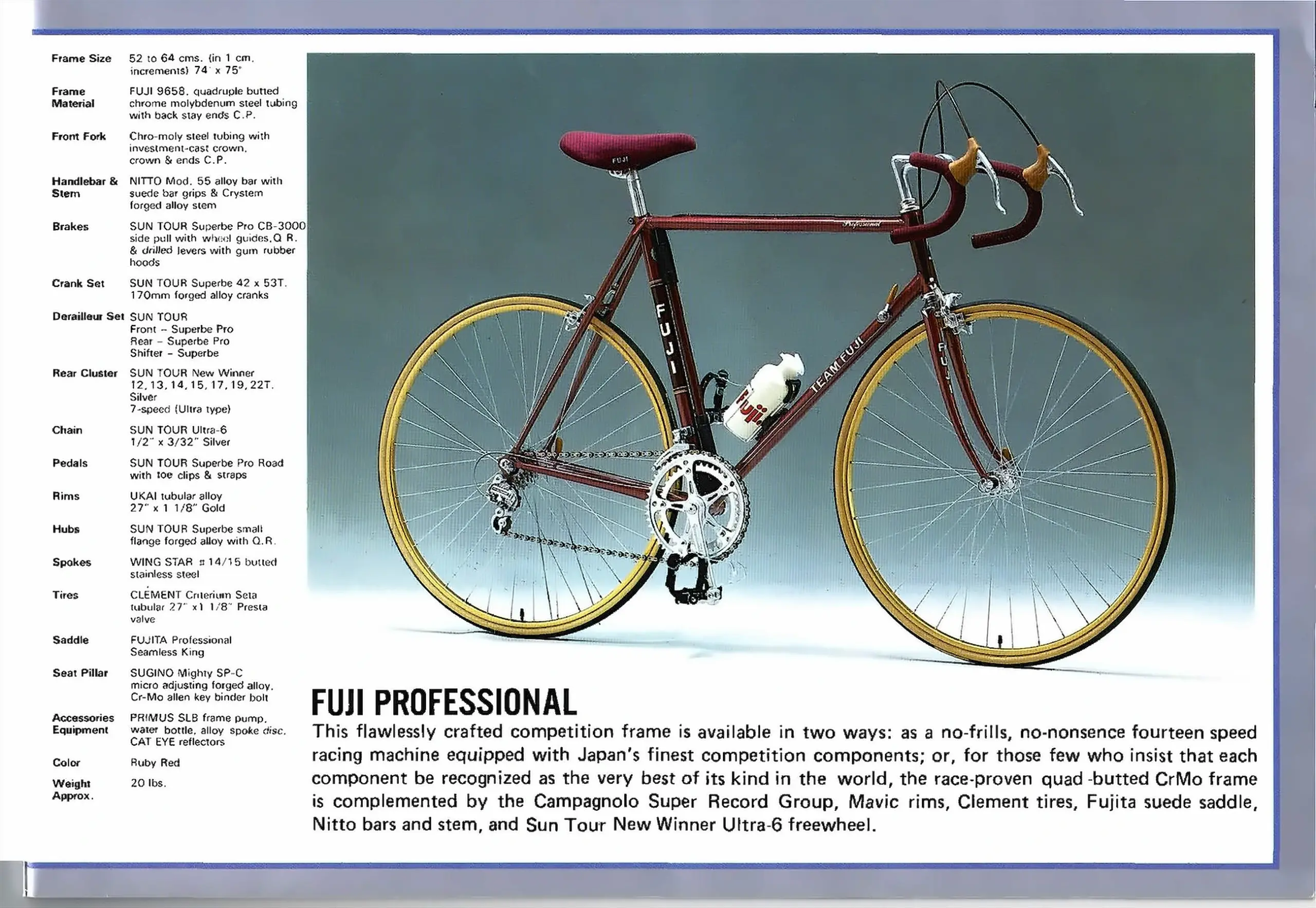
Fuji’s naming is unusual and confuses some newcomers, sometimes because several of the model names are superlatives rather than nouns. The Finest, The Newest and The America are all real models, and they were positioned deliberately (if not confusingly).
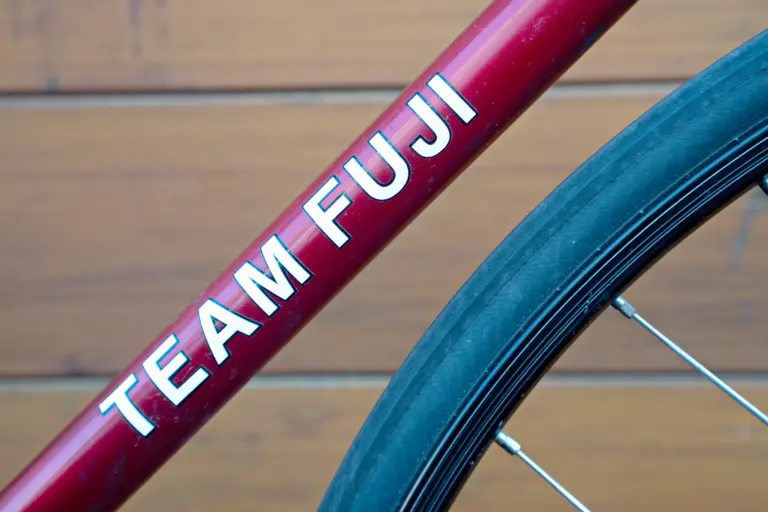
One detail that deserves attention on a Fuji frame is the tubing decal, because Fuji used its own designation rather than only buying in from Tange or Ishiwata. Valite is a seamless, quad-butted chromium-vanadium alloy tubing, and unlike most tubing names it tells you exactly what you have: the number that follows the name is the wall thickness schedule. Valite 1769 is a quad-butted tube of 1.0, 0.7, 0.6 and 0.9 mm walls.
That is an unusually informative decal and it is a good habit to read it before making assumptions about where a given Fuji sat in the range. It is also worth knowing that Valite was positioned as a value alternative to the double-butted chrome-molybdenum used on the earlier premium frames, so a Valite decal is not automatically an upgrade over an unmarked early 1970s chrome-molybdenum frame. Read the model, year and decal together for a better unified understanding of what you are looking at.
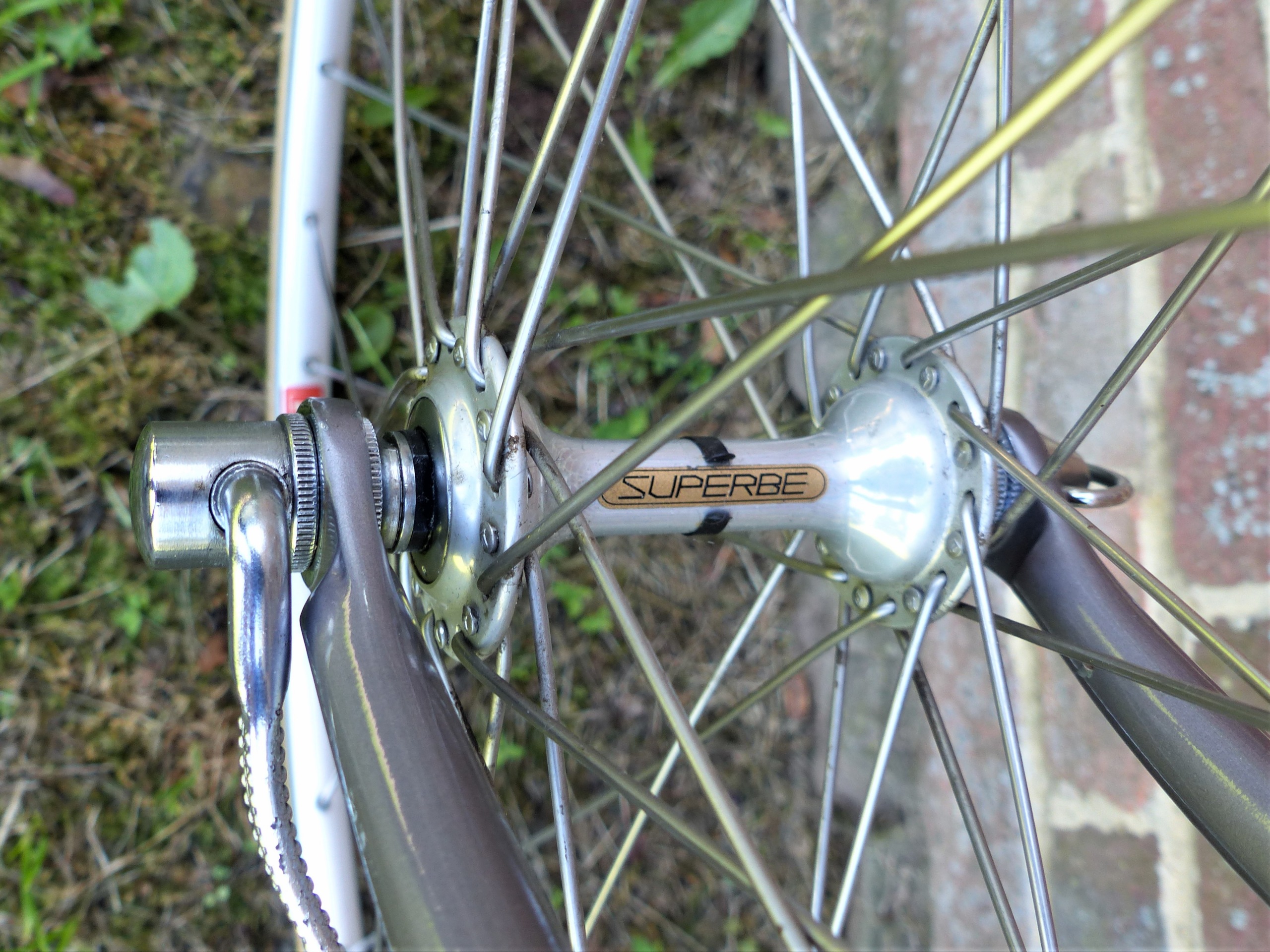
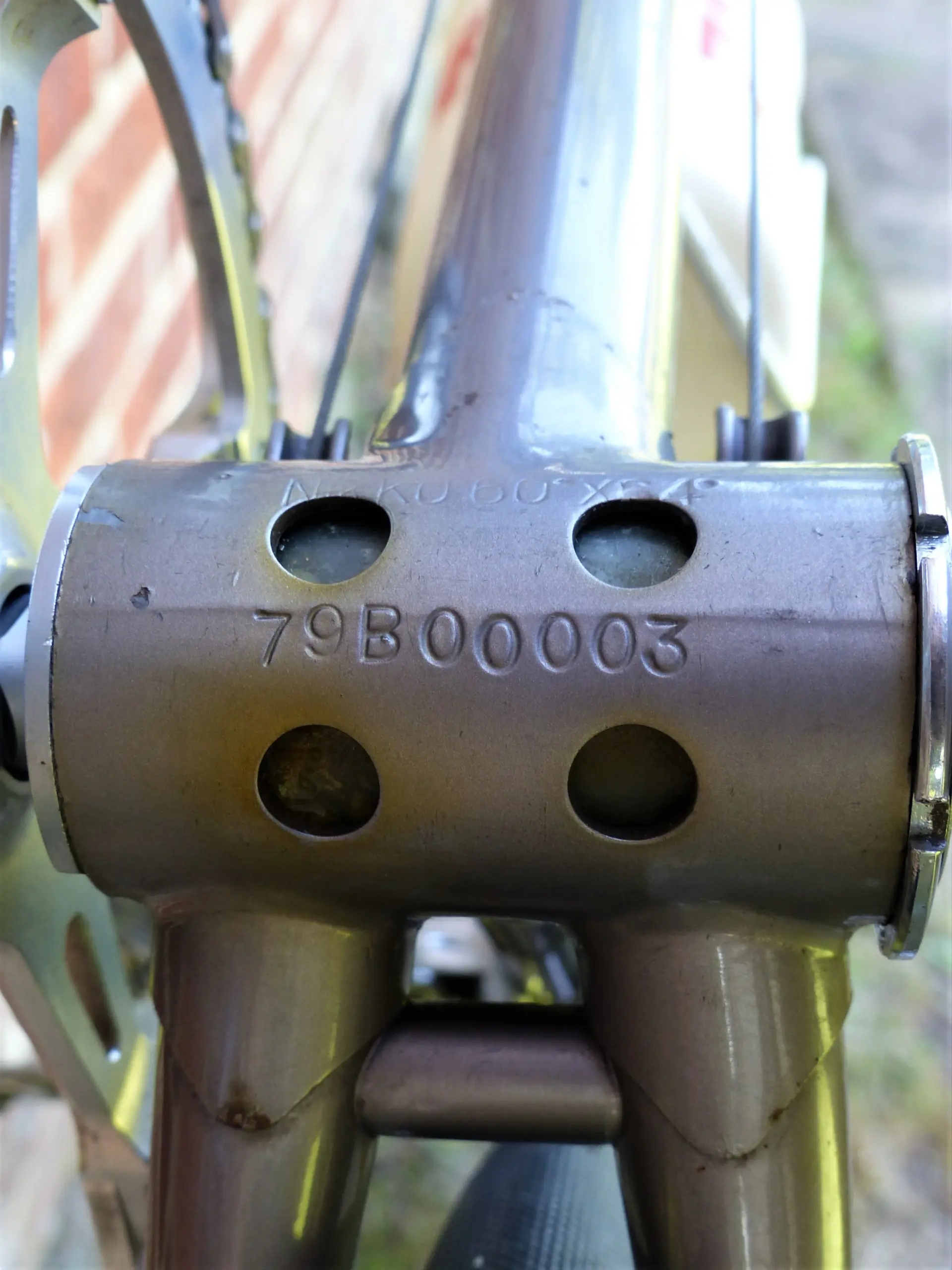
Fuji is one of the more satisfying marques to date because the serial numbers actually encode the date rather than merely counting frames. Look on the underside of the bottom bracket shell first, then the rear dropout. A few high-end models carry the number on the head tube. The month is always a letter, A for January through L for December.
A separate short scheme covers limited hand-built models of 1984 and 1985, and numbers after 1987 follow different systems that are much less well documented. If you decode a Fuji, the Ebykr Serial Number Registry is the place to log it, since the more examples the community records, the more reliable everyone’s dating becomes.
Fuji began manufacturing titanium frames in 1986, and the resulting Titanium Dura-Ace model is the marque’s high-water mark as a manufacturer. It used commercially pure titanium rather than the alloys that later became standard, and weighed about a pound lighter than the Opus had and was corrosion-proof in a way steel never could be.
Fuji and its enthusiasts describe this bicycle as the first production titanium frame and the first production machine specified with a Shimano Dura-Ace groupset. Similar firsts are claimed for Fuji’s early use of double-butted chrome-molybdenum on affordable models and for the first American women’s professional team in 1978. Some of these claims are defensible and some are marketing copy that has been repeated until it reads like fact, so treat the specifics with care. What is not in doubt is that Fuji was working with titanium in production a good deal earlier than most and that surviving Titanium Dura-Ace framesets now change hands for four increasingly generous figures.
Fuji’s decline came from three directions at once and none of them was a failure of engineering.
The first was the mountain bike. The boom of the 1980s was captured by Specialized, Giant and Trek, working with low-cost Taiwanese production, and Fuji was slow into a category that quickly became the largest in the market. The second was currency. The yen appreciated sharply, and a bicycle built in Japan simply cost more in an American shop than a comparable machine built in Taiwan, regardless of how good it was or whether a pro road on it.
The third was the trap that closed on the first two. Fuji moved production to Taiwan to compete on price and immediately hit a perception problem of its own making: American buyers had learned to associate the Fuji name with Japanese manufacture, and treated the Taiwanese-built bicycles as a lesser product, whatever the actual quality. The company was too expensive in one configuration and mistrusted in the other.
Toshoku America filed for bankruptcy in 1997. The Nichibei Fuji Cycle Company followed in 1998, ninety-nine years after Okazaki Kyūjirō opened his trading house.
The Fuji name did not die with the company that made it. Advanced Sports International, established in Philadelphia in 1998, acquired Fuji America’s assets and the worldwide distribution rights, and did something shrewd with them: it moved Fuji out of the sporting-goods channel and back toward independent bicycle dealers, repositioning a name that had drifted downmarket.
It worked for a while. ASI grew revenue from roughly $50 million in 2007 to about $105 million by 2015, assembling a portfolio around Fuji that included Kestrel, SE Bikes, Breezer from 2008, Oval Concepts from 2009, and Tuesday Cycles and Phat Cycles from 2015. In 2004, Ideal Bike Corporation, Taiwan’s third largest complete-bicycle manufacturer, took a 17% stake in the Asian arm, and production settled across Taichung in Taiwan, Dong Guan in China and Kutno in Poland. Fuji returned to professional road racing, too, supplying the Mercury team in 1999, Fuji-Servetto in 2009, Team NetApp-Endura in 2013 and 2014, and Amore & Vita-Prodir in 2018.
And then the expansion went too far, too fast. ASI bought Performance Bicycle and Nashbar in August 2016 under a new parent, Advanced Sports Enterprises, and in November 2018 that parent filed for Chapter 11 with debts over $100 million. (Holy shit: two years in and $100 million down!) In February 2019, ASI was sold at auction for $16.1 million and split three ways: Amain.com took Performance and Nashbar, K&B Investment Corporation took the property, and BikeCo, a partnership involving Tiger Capital Group, took ASI and the wholesale brands including Fuji, Kestrel and SE. What an inglorious ending for such a glorious marque. Or was it the end?
Indeed, Fuji is in play again. In December 2025, Pacific Glory Worldwide, itself owned by Ideal Bike Corporation, announced a dedicated American distribution arm, PGW USA, to take over sales and support for Fuji, SE and Tuesday, with a stated go-live of 1 January 2026 and dealer-direct selling planned through the year. The announcement raised immediate questions in the trade about how that would sit alongside BikeCo, which had been handling those brands since 2019 and themselves expected further inventory in the first quarter of 2026, and the two were reported to be in discussions about the future model.
The backdrop is not a comfortable one. Tariff-driven production shifts have added cost and delay, and Ideal itself posted a net loss of NT$360 million, roughly $11.4 million, across the first three fiscal quarters reported before the announcement. In effect, the Taiwanese manufacturer that has built Fuji bicycles for two decades is taking direct control of the brand in its most important market, which would usually be a reasonable strategy were it not for this uncertain moment in bicycle time.
For classic lightweight enthusiasts like us, none of this really changes the essential point. The Fujis worth seeking out were built in Japan between roughly 1971 and 1987, they are well made, they are properly documented by serial number and they remain among the best value in vintage lightweights, largely because the badge does not carry the European romance that inflates prices elsewhere. A 1970s S10-S is not a Colnago and never pretended to be. It is a beautifully executed production road bicycle from a company that had been racing for 40 years before America noticed, and it deserves much better than to be treated as a beginner’s bike.
Own a Fuji? Decode the serial number and log it in the Ebykr Serial Number Registry, bring your questions to the forums and see the companion Timeline for the full chronology from 1899 to today.
https://en.wikipedia.org/wiki/Fuji_Bikes
https://en.wikipedia.org/wiki/Advanced_Sports_International
https://classicjapanesebicycles.com/fuji/
https://classicjapanesebicycles.com/fuji-serial-numbers/
https://classicfuji.posthaven.com/fuji-serial-number-identification-guide-from-bill-reavis
https://classicjapanesebicycles.com/brand-history/
https://biketips.com/vintage-fuji-bikes/
https://bicycleman.com/fuji-bicycle-history/
https://midlifecycling.blogspot.com/2016/06/fuji-s-10s-it-brought-japanese-bikes-out-of-shadows.html
https://www.bikeforums.net/classic-vintage/804576-fuji-s10-s.html
https://www.bikeforums.net/classic-vintage/814914-fuji-bikes-1970-s.html
https://www.bikeforums.net/classic-vintage/1231015-tange-1-vs-fuji-quad-butted-valite.html
http://bikeretrogrouch.blogspot.com/2014/01/classic-tubes-tange-and-ishiwata.html
https://sheldonbrown.com/vrbn-a-f.html
https://bikexchange.com/bike-brands/fuji-bikes-review/
https://www.bicycleretailer.com/industry-news/2025/12/22/pgw-announcement-raises-questions-about-fuji-and-se-distribution
https://www.bike-eu.com/51442/ideal-bikes-subsidiary-establishes-us-distribution-arm-for-fuji-brands
https://nbda.com/pacific-glory-worldwide-pgw-establishes-u-s-distribution-company-to-strengthen-retailer-relationships-and-brand-support/
https://en.wikipedia.org/wiki/Mercury_Cycling_Team
https://www.cyclingweekly.com/news/latest-news/fuji-servetto-team-profile-70496
https://en.wikipedia.org/wiki/List_of_Japanese_bicycle_brands_and_manufacturers
 Fuji
FujiEbykr documents this marque across the archive. Here is the rest of it.
The Ebykr Digest
New articles, timelines, catalog finds and registry activity — assembled from the archive once a month. Your address is never shared.
Double opt-in. One email per month. Unsubscribe at any time with one click.