About Ebykr
Ebykr celebrates classic and vintage lightweight bicycles through provocative imagery and opinion. Ride along with us.
About Ebykr
Ebykr celebrates classic and vintage lightweight bicycles through provocative imagery and opinion. Ride along with us.

For most of the twentieth century Schwinn was simply the American bicycle, which is exactly why enthusiasts of classic lightweights tend to look past it. Behind the balloon-tire cruisers and the electro-forged Varsity sat a Chicago hand-build shop turning out Paramount racing frames, and a second line of fillet-brazed lightweights so badly marketed that almost nobody recognized what they were. This is the story of a company that built superb bicycles and could never quite bring itself to sell them.

No American bicycle name carries more weight than Schwinn. For most of the twentieth century the word was simply a synonym for bicycle in the United States, stamped on the head badge of the machine a generation learned to ride. That ubiquity is also the reason Schwinn is so often misread by enthusiasts of classic lightweights, who know the marque through department-store cruisers and the leaden Varsity and conclude there is nothing here for them.
They are wrong, and interestingly wrong. Behind the mass-market colossus sat a small hand-build shop in Chicago that produced some of the finest lugged frames ever made in North America, plus a second, stranger line of fillet-brazed lightweights that almost nobody recognized at the time and that collectors now hunt with real determination. The Schwinn story is not one of a company that could not build good bicycles. It is the story of a company that built superb ones and could never quite bring itself to sell them.
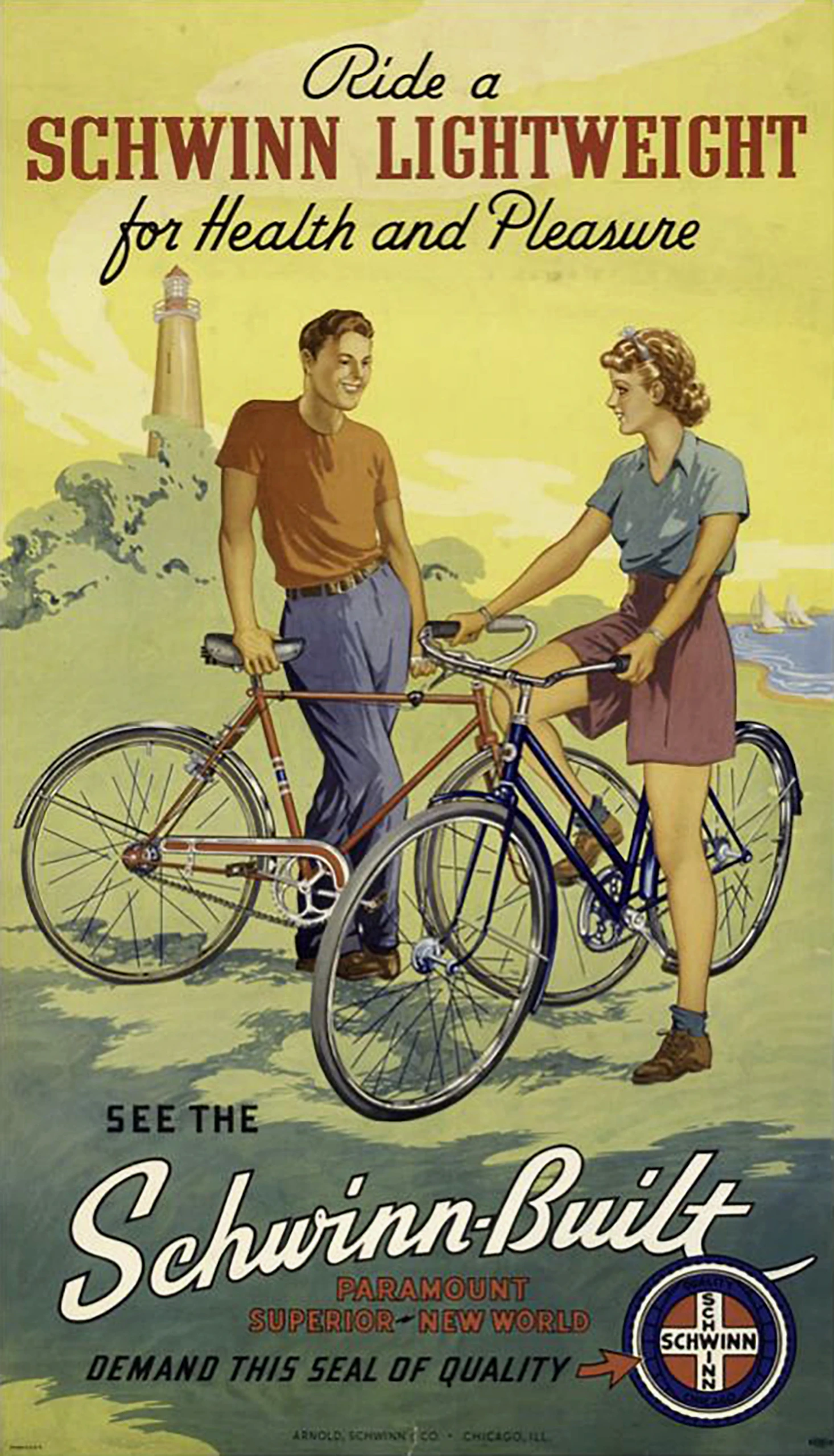
Ignaz Schwinn was born in Hardheim, in the Grand Duchy of Baden, in 1860, and emigrated to the United States in 1891 with experience in the German bicycle trade already behind him. In 1895 he partnered with Adolph Frederick William Arnold, a German-American meat packer with capital, and the two founded Arnold, Schwinn & Company in Chicago.
The timing was both perfect and terrible. The safety bicycle boom of the 1890s had turned Chicago into the center of the American industry, with roughly thirty factories in the city turning out thousands of machines a day, and national output passing 1,000,000 bicycles a year by 1900. Then the bubble burst. By 1905 American bicycle sales had fallen to about a quarter of their 1900 level and only twelve Chicago manufacturers were left standing. Schwinn was one of them, and Ignaz used the wreckage as a shopping list, buying up smaller firms and building a modern plant on the West Side.
He also diversified sideways into motorcycles, purchasing the Excelsior Company in 1912 and adding Henderson in 1917. By 1928 Excelsior-Henderson was the third largest American motorcycle maker behind Indian and Harley-Davidson. That business did not survive the Depression: Ignaz shut it down in 1931, a decision that pushed the company back onto bicycles at exactly the moment the bicycle market had collapsed.
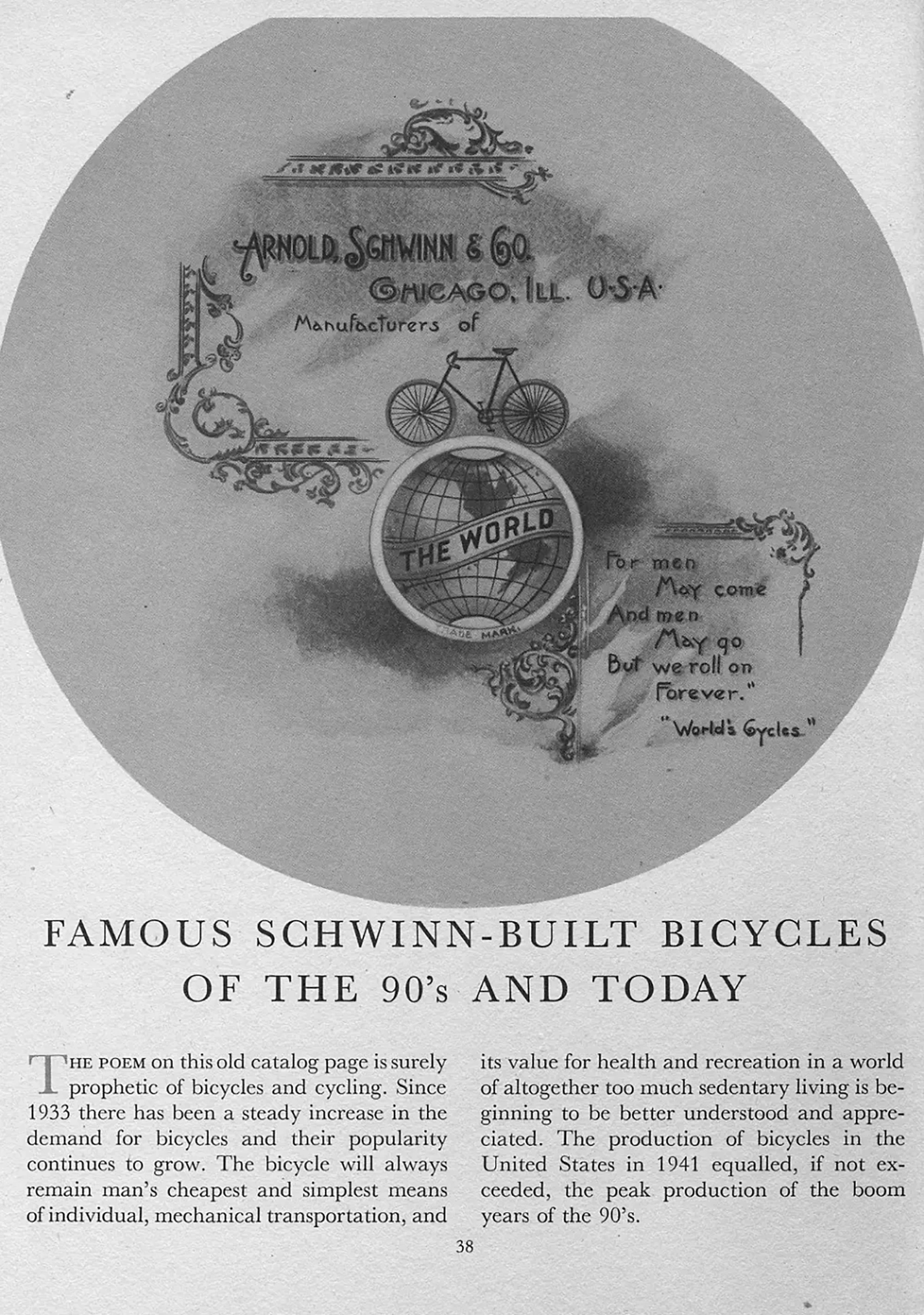
Before the Schwinn name went on a head badge it went on a company, and the bicycles carried model names of their own. The first catalog, issued in 1895 under the title Famous Schwinn Built-Bicycles, led with the World, and the range ran from a 19 pound racing machine through the World Ladies’ Standard Model No. 34, with its rear fender and skirt webbing, to doubles, triples and quadruples. A nineteen-pound racer in the company’s first season is worth reading twice. The lightweight instinct was there from the beginning, which makes what happened 75 later all the stranger.
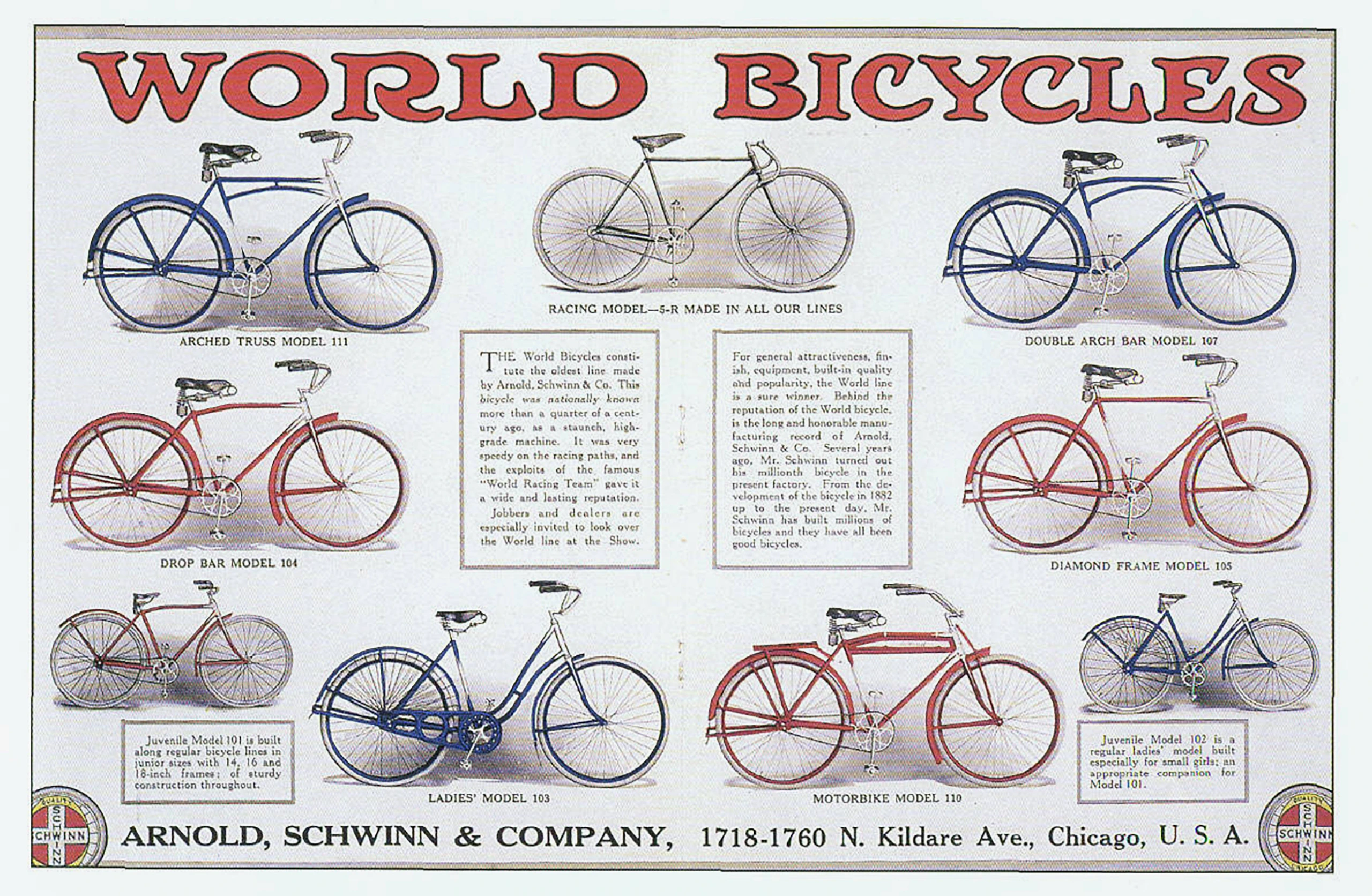
Then the industry tried to consolidate itself out of trouble. In 1899 A. G. Spalding assembled the American Bicycle Company, a trust of roughly 50 firms that claimed control of three-quarters of American bicycle sales. Ignaz Schwinn stayed out of it. The trust burned through $80 million and fell into bankruptcy by 1903, taking a great deal of the industry down with it, and the independence Schwinn had insisted on turned out to be the thing that saved the company.
The market understood this perfectly well. A dealer advertisement placed by Pinney & Robinson of Phoenix in the Arizona Republican in January 1904 offered the World at $35 and the Admiral, which it called the best medium-priced bicycle built, at $25. Its selling argument for the World was a single phrase: not made by the trust, from what the advertisement described as the largest and oldest cycle makers in Chicago. Five years after the trust formed, having stayed out of it was the headline feature.
Adolph Arnold sold his shares to Ignaz Schwinn in 1908, leaving the family in sole control of a company that would carry the Arnold name on its letterhead long after he had gone. When the Supreme Court ruled against the firm sixty years later, the case was still captioned United States v. Arnold, Schwinn & Co.
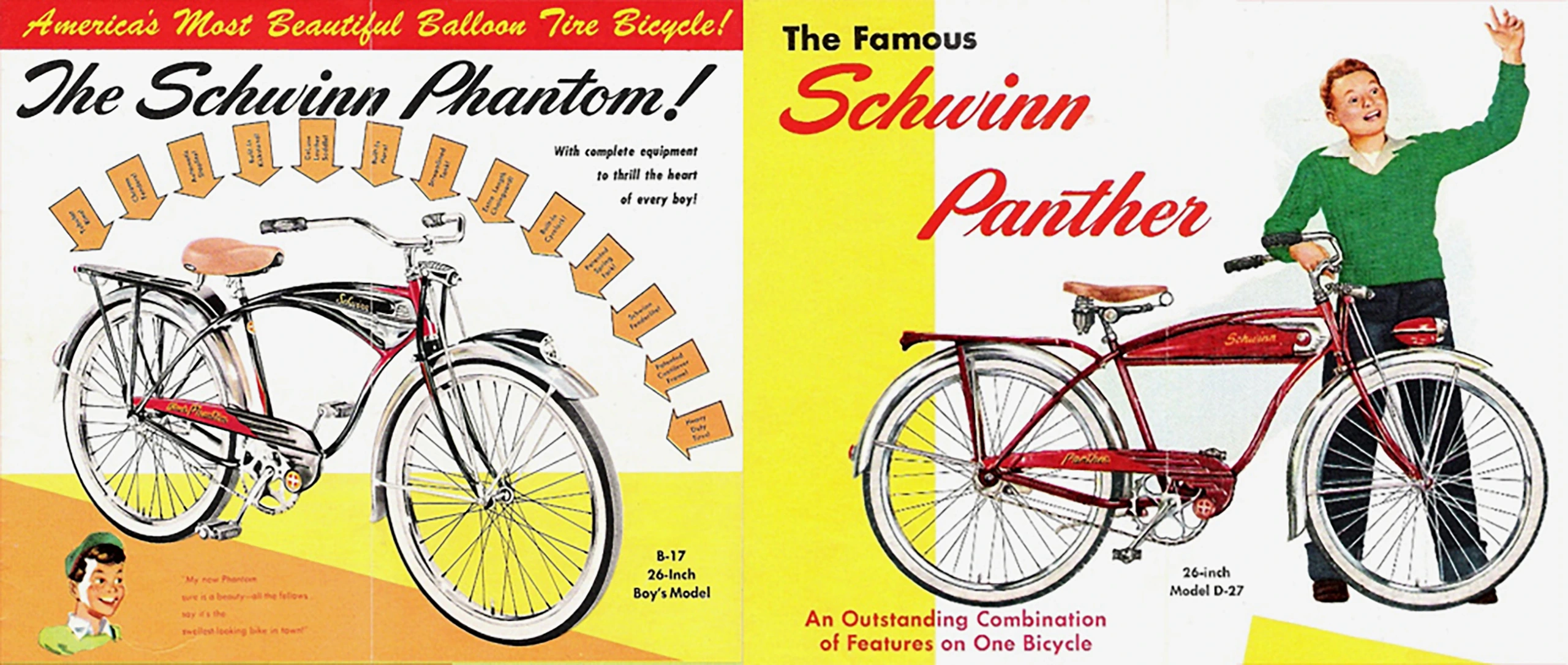
Ignaz’s son Frank W. Schwinn took over day-to-day operations and made a bet that looks obvious now and looked reckless then. In 1933 he introduced the B-10E Motorbike, a youth bicycle styled to imitate a motorcycle, and the following year redesigned it as the Aerocycle: 2.125 inch balloon tires, streamlined fenders, a dummy gas tank and a chrome-plated headlight.
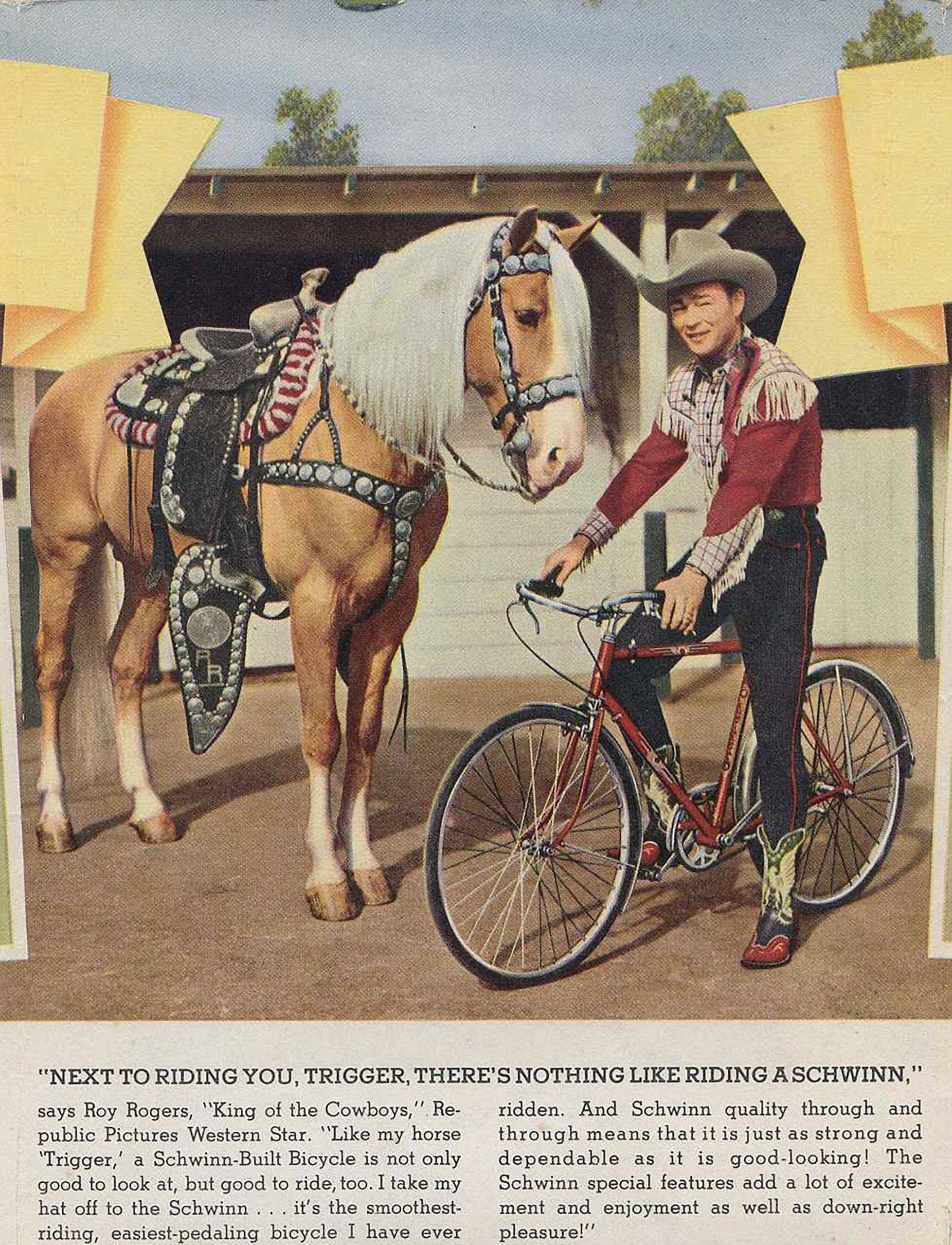
It was heavy, it was flamboyant and it sold. The balloon-tire bicycle gave the American trade a product to build in the 1930s, established the shape that would be called the paperboy bike and later the cruiser, and set Schwinn’s commercial course for four decades. It is worth holding that thought, because those same frames come back into the story in the 1970s in a way nobody at Schwinn anticipated.
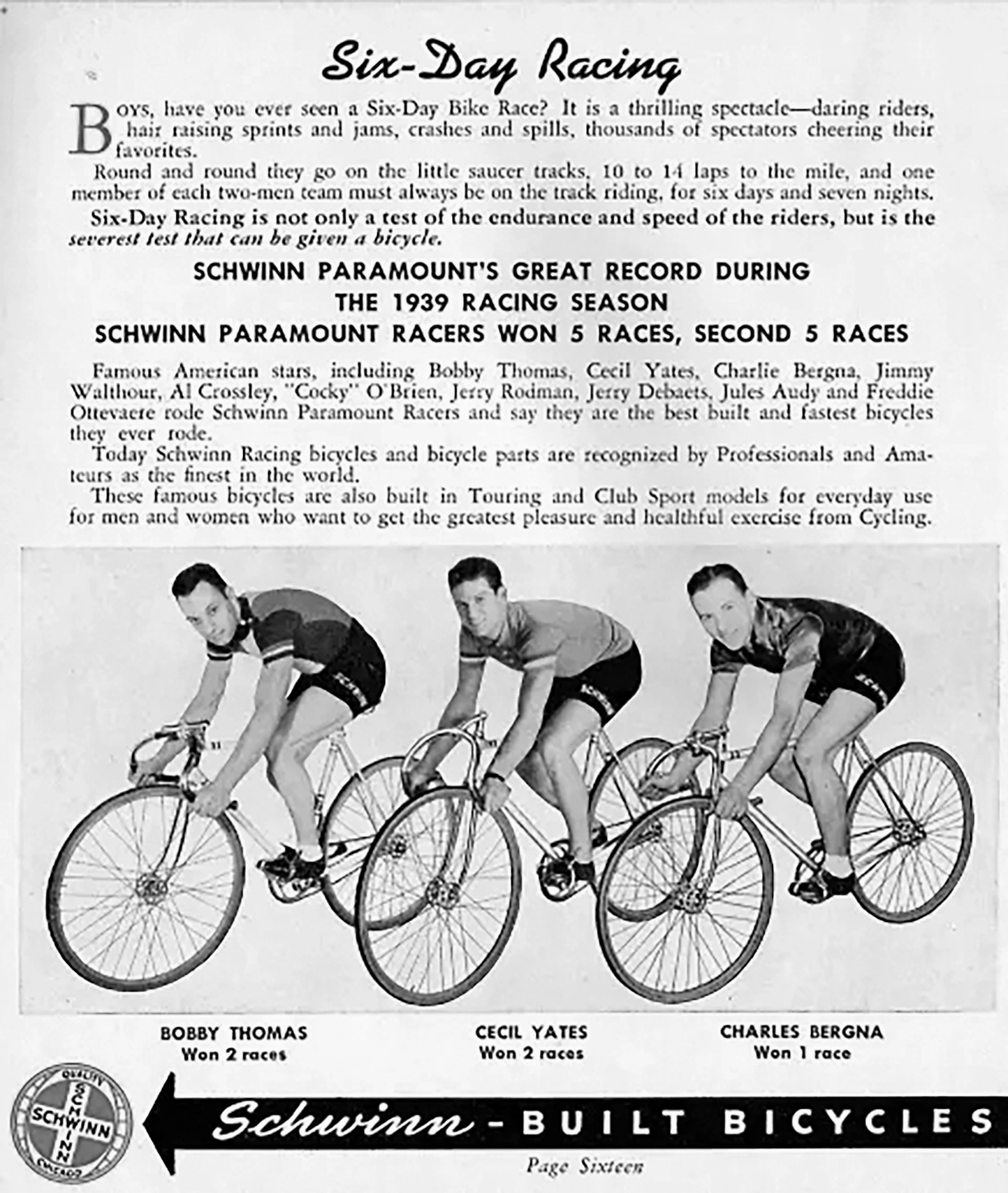
The lightweight thread starts a few streets away. Emil Wastyn was a Belgian master frame builder who ran a shop and frame business on Chicago’s West Side, not far from the Schwinn factory, and in the 1930s he headed the racing team Schwinn sponsored. Six-day racing was a genuine American spectator sport in that era, and Chicago Stadium was one of its cathedrals. The team needed real racing frames, and Wastyn built them.
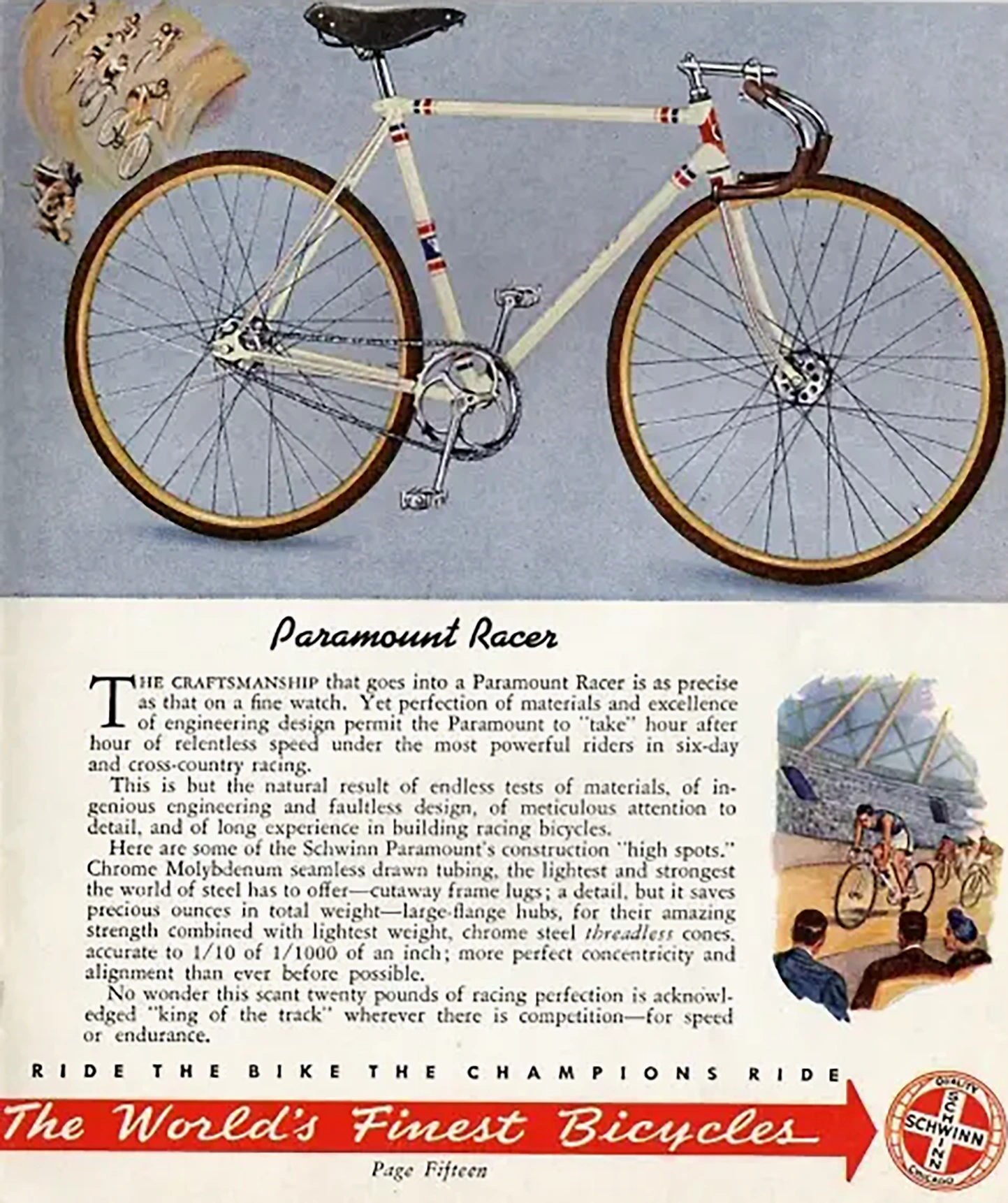
Wastyn designed and built the first Schwinn Paramount in 1937, with Paramount-badged machines appearing late that year under the company’s key six-day riders. Frank W. Schwinn formally introduced the Paramount as a series in 1938. From 1938 to 1941 Emil and his son Oscar built every one of them, using high-strength chrome-molybdenum tubing and expensive brass lug-brazed construction at a moment when most American bicycles were electrically welded gas pipe.
The earliest Paramounts wear Wastyn’s own signature details, including balled-end seat stays and keyhole-shaped lugs. Between 1939 and 1941 the model developed its own visual identity, most notably the slant-trimmed seat stay caps that remained a Paramount marker for the next fifty years. The 1940 catalog listed the team riders by name, among them Bobby Thomas, Cecil Yates and Charlie Bergna, and recorded five wins and five second places for the previous season.
The Paramount’s most spectacular moment came on 17 May 1941, when Alfred Letourneur rode a Paramount behind a motor pace vehicle on a stretch of highway near Bakersfield, California and covered a mile at 108.92 miles per hour. The Wastyn family, meanwhile, never left the business. Oscar Wastyn Sr. built Wastyn Special and Wastyn Custom frames of his own and served as chief mechanic at more than twenty six-day races, and Oscar Wastyn Cycles is still on West Fullerton in Chicago, with a small museum of family-built machines in the back.
What makes the Paramount unusual among American production frames is that it ran, with interruptions, from 1938 to 2009, and that its specification tracks the state of the art in European tubing across that whole span. Catalogs describe chrome-molybdenum seamless drawn tubing in 1940, Accles and Pollock or Reynolds 531 double-butted tubes from the late 1940s through the 1960s, Reynolds 531 as standard through the 1970s, Reynolds 531 with investment-cast lugs by 1982 and Columbus SL or SP with investment-cast lugs by 1986 and 1987.
The mid-century refresh matters. By 1957 the Paramount had drifted: it was still being built to designs and methods laid down in the 1930s while European racing frames had moved on. Schwinn modernized it with Reynolds 531 double-butted tubing, Nervex lugsets and Campagnolo derailleurs, and the result is the Paramount most collectors picture. Crucially, none of that technology migrated down into the mass-market range.
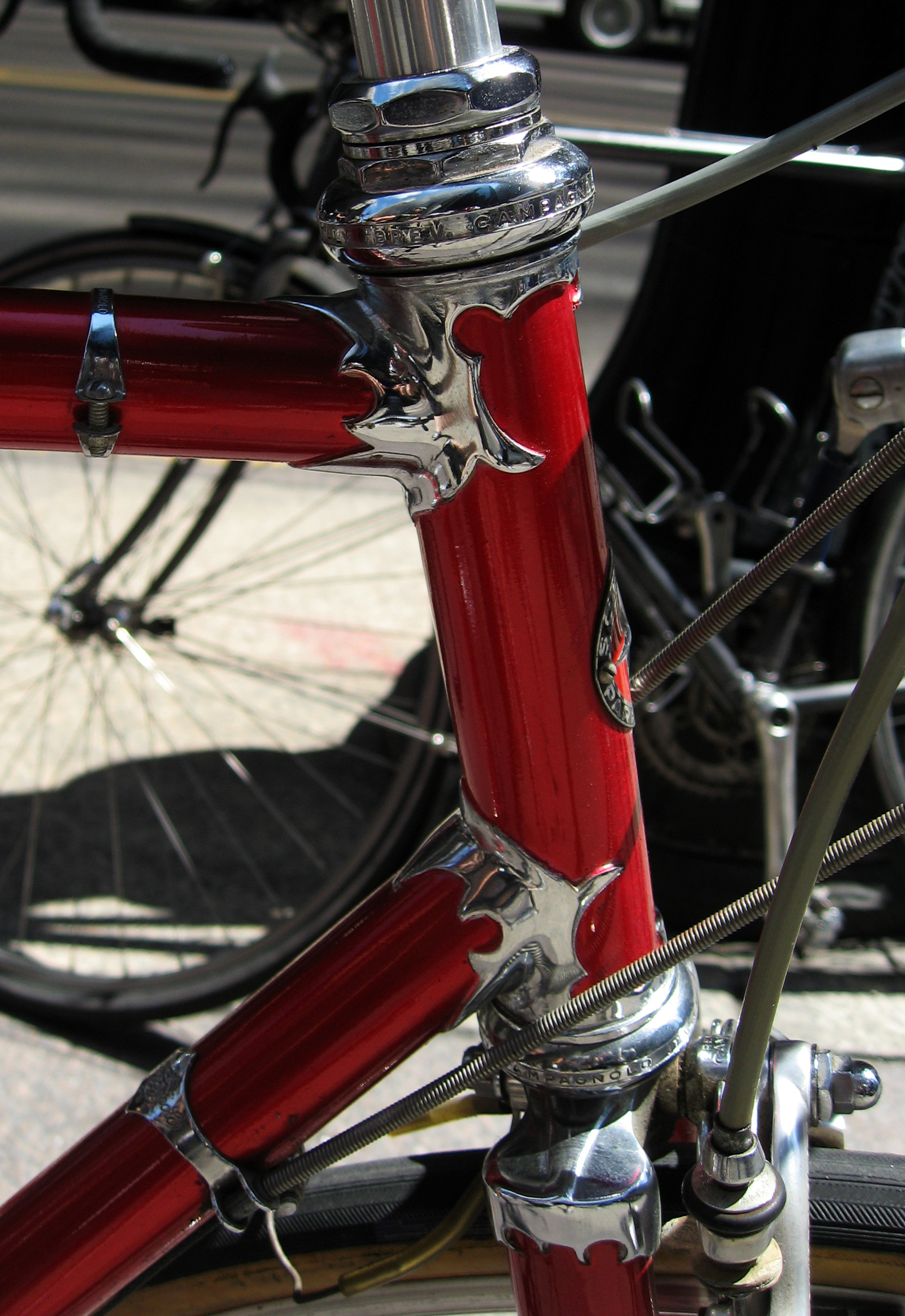
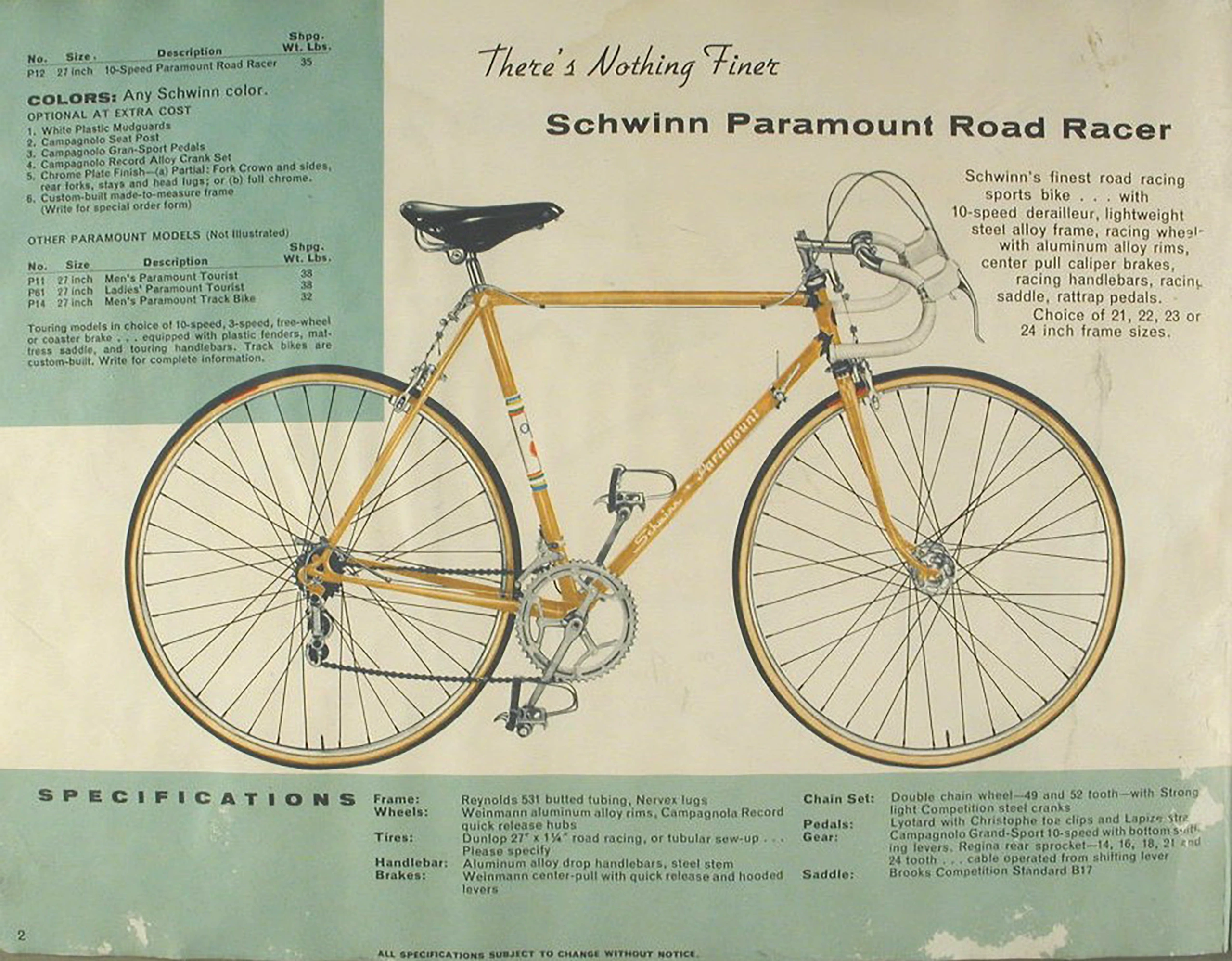
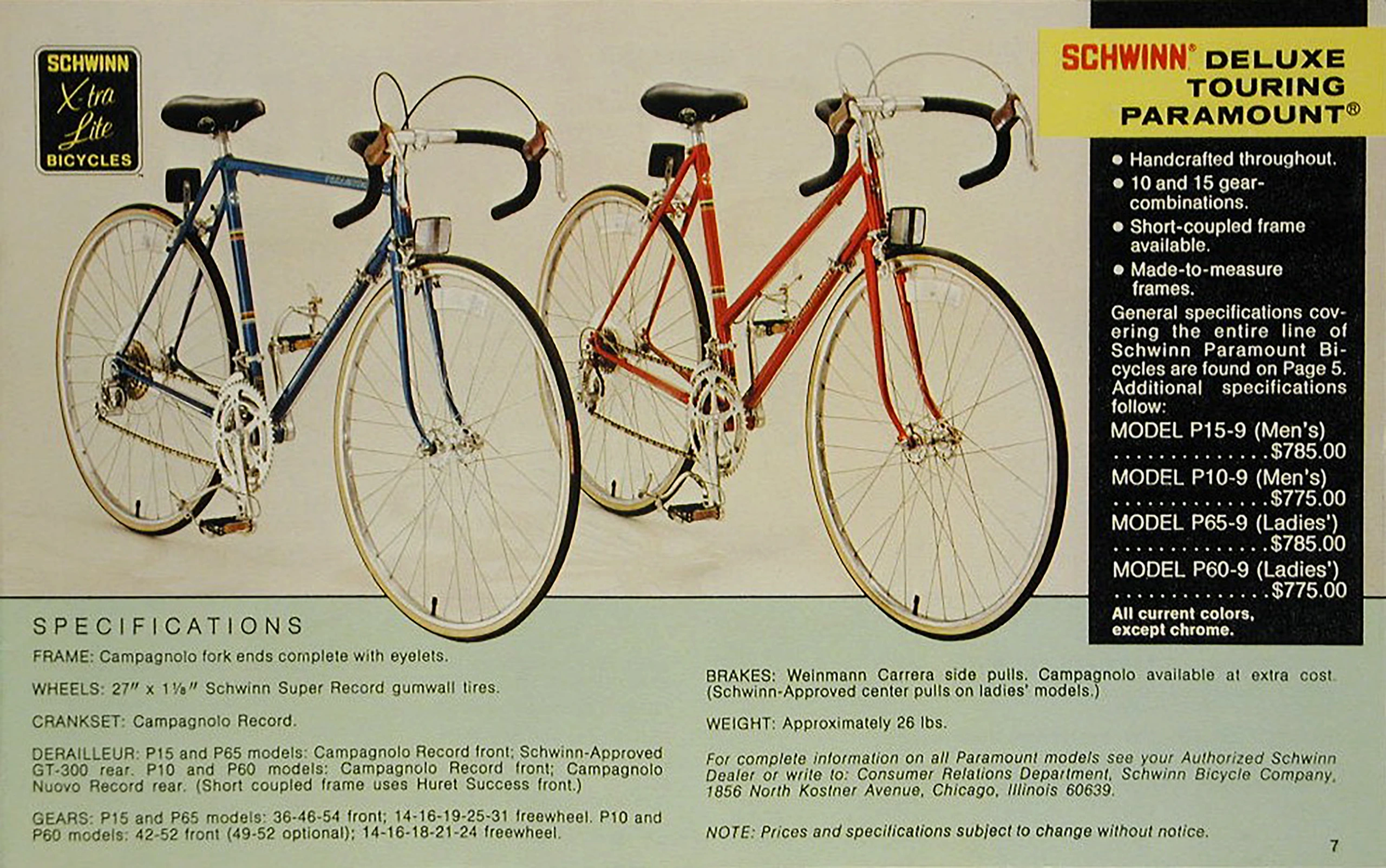
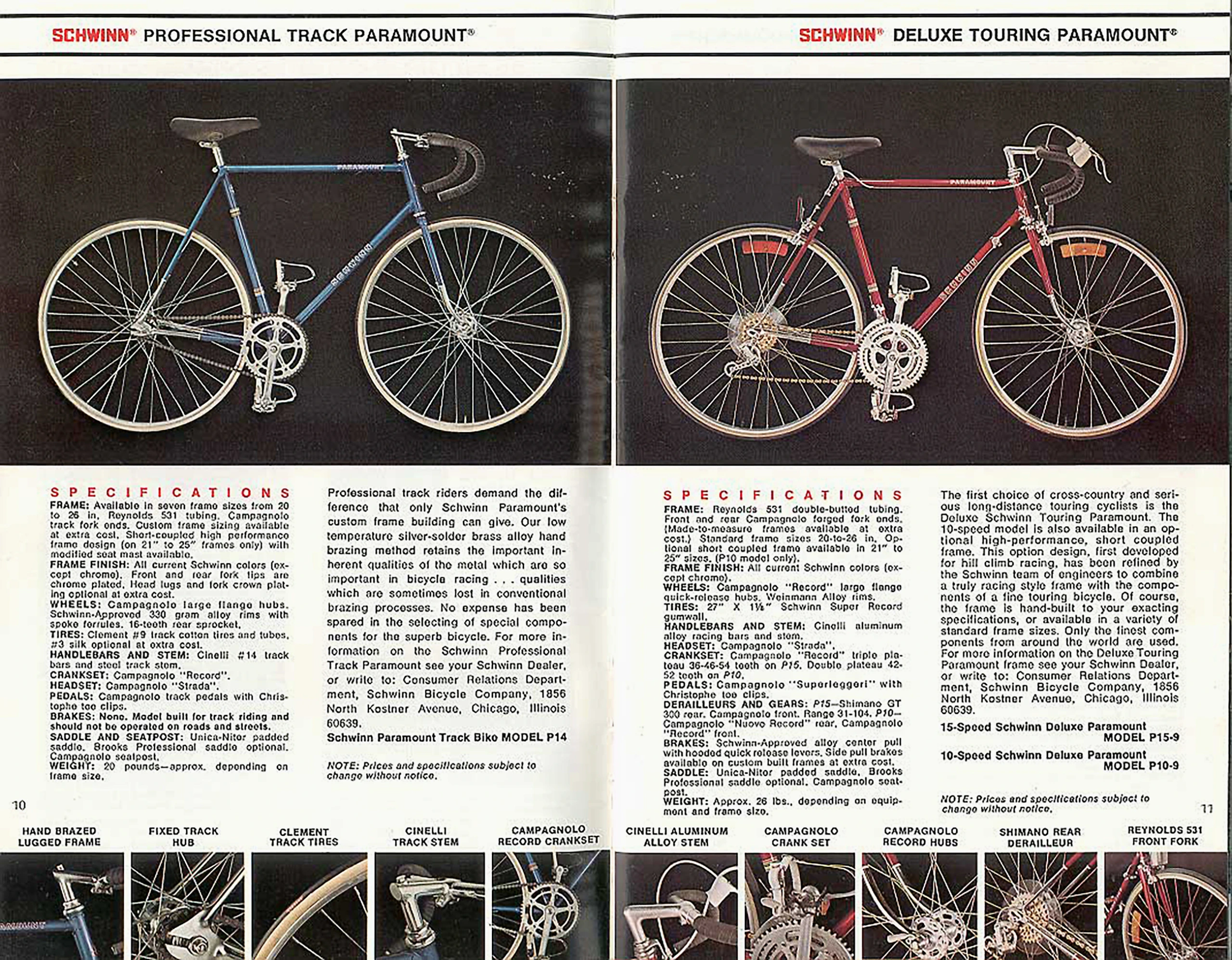
Model numbering is the practical thing to know when you meet one. Paramount P-numbers appear in catalogs from roughly 1951 into the 1970s, with P11 as a tourist model, P12 a road racer, P13 a deluxe road machine and P14 the track frame, a designation that stayed remarkably stable. Ladies’ models carried P60 and P65 numbers into 1979. The range was reshuffled at the turn of the 1970s. The P11 and P12 were gone from the 1969 catalog, and in 1970 the P13 became the Professional Road Racing Paramount, joined that April by the P15, a 15 speed tourer with a Nuovo Record triple crankset and a long-cage rear derailleur for touring gearing. By 1971 the P13 had tightened its chainstays and fork for 700C wheels only, while the P15 kept room for 27 inch clinchers and fenders. The P10 followed in 1973 as the same touring Paramount with a 10 speed double. The P13 came with Weinmann 610 centerpulls as stock, and with Weinmann Carrera sidepulls in the later 1970s. Campagnolo sidepulls were always an extra-cost option on the racer, and by the later 1970s on the touring models as well.
Production was always small. For the first 20 years most Paramounts came out of Wastyn’s frame shop, after which the work moved into a partitioned corner of the enormous Kildare Avenue plant, still hand-built and still measured in hundreds rather than thousands of frames a year. That is why a genuine period Paramount is a rare object today, and why the frames command prices that surprise people who think of Schwinn as a discount brand.
Here is the part of the Schwinn story that rewards Ebykr readers most, because it is genuinely obscure and the bicycles are still findable. For forty-one years, from 1938 to 1978, Schwinn also built a second class of lightweight in Chicago that used no lugs at all. These are the fillet-brazed frames, joined with brass laid into a smooth fillet around each mitered joint and filed clean, so the finished bicycle appears to have no joints at all.
The high-volume years produced three model names that rotated around each other in a way that confuses newcomers. The Superior ran in 1962 and 1963, then returned from 1976 to 1978. The Super Sport occupied the middle, from 1964 to 1973. The Sports Tourer arrived around 1971 as a step above the Super Sport and ran to 1975.
The construction is specific and worth learning to recognize. The tubing is SAE 4130 chrome-molybdenum, seamless and straight-gauge, in an oversize 29.5 mm diameter for the seat and down tubes. Steel sleeves were brazed inside the tubes at the joints for reinforcement, which is why Schwinn described the frames as internally lugged and why the tubing is in effect double-butted by the time the frame is finished. The tell on an unrestored example is the color: gold-toned brass showing at the joint, rather than the ground-smooth steel seam of an electro-forged frame.
Every one of these frames was mitered in a jig by machine and then brazed, filleted, fitted with braze-ons and finished entirely by hand in a separate low-volume shop inside the Chicago factory. List prices ran from $96.50 for a Super Sport in 1964 through 1966 to $229.95 for a Superior in 1977 and 1978.
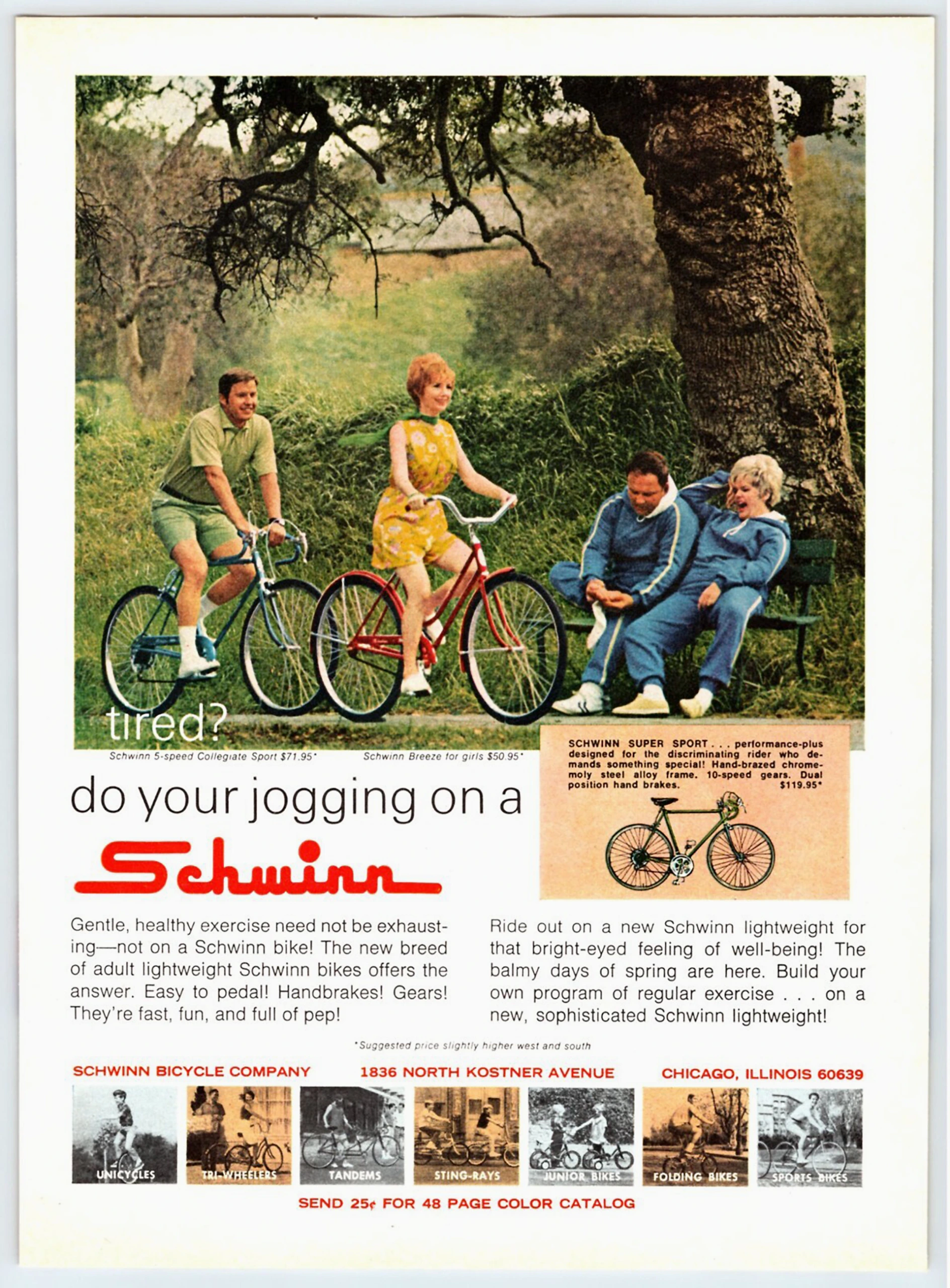
They were discontinued in 1978 for reasons that are almost painful to read. Fillet brazing was virtually unknown in the period as a method of building a superior frame, so the technique carried no prestige. The frames looked, to an untrained eye, more or less identical to the cheap electro-forged Continental and Varsity. And Schwinn never seriously explained the difference in its catalogs or dressed the bicycles in components that would have signaled quality. A hand-built chrome-molybdenum frame was sitting on the same shop floor as a stamped-steel department-store ten-speed, wearing similar paint and similar parts, at a price the buyer could not connect to anything visible. It is one of the great marketing failures in American cycling, and it is exactly why these bicycles are now such good value.
Everything else Chicago built used electro-forged, or flash-welded, construction. The head tube assembly was formed from two special forgings welded together down the centerline and ground smooth, so the seam usually disappears entirely. It is strong, it is cheap at volume and it is heavy, and it is how the Varsity and Continental were made.
Those two models are the ones most people picture. The Varsity arrived in 1960 as an 8 speed and became a 10 speed in mid-1961, joined by the Continental with its tubular front fork, both on the same lugless welded frame with Schwinn’s own Ashtabula one-piece cranksets and heavy chromed stamped-steel rims. In the late 1960s they pioneered auxiliary brake levers on dropped bars and moved the shift levers up to a ring on the head tube. Schwinn sold them by the million.
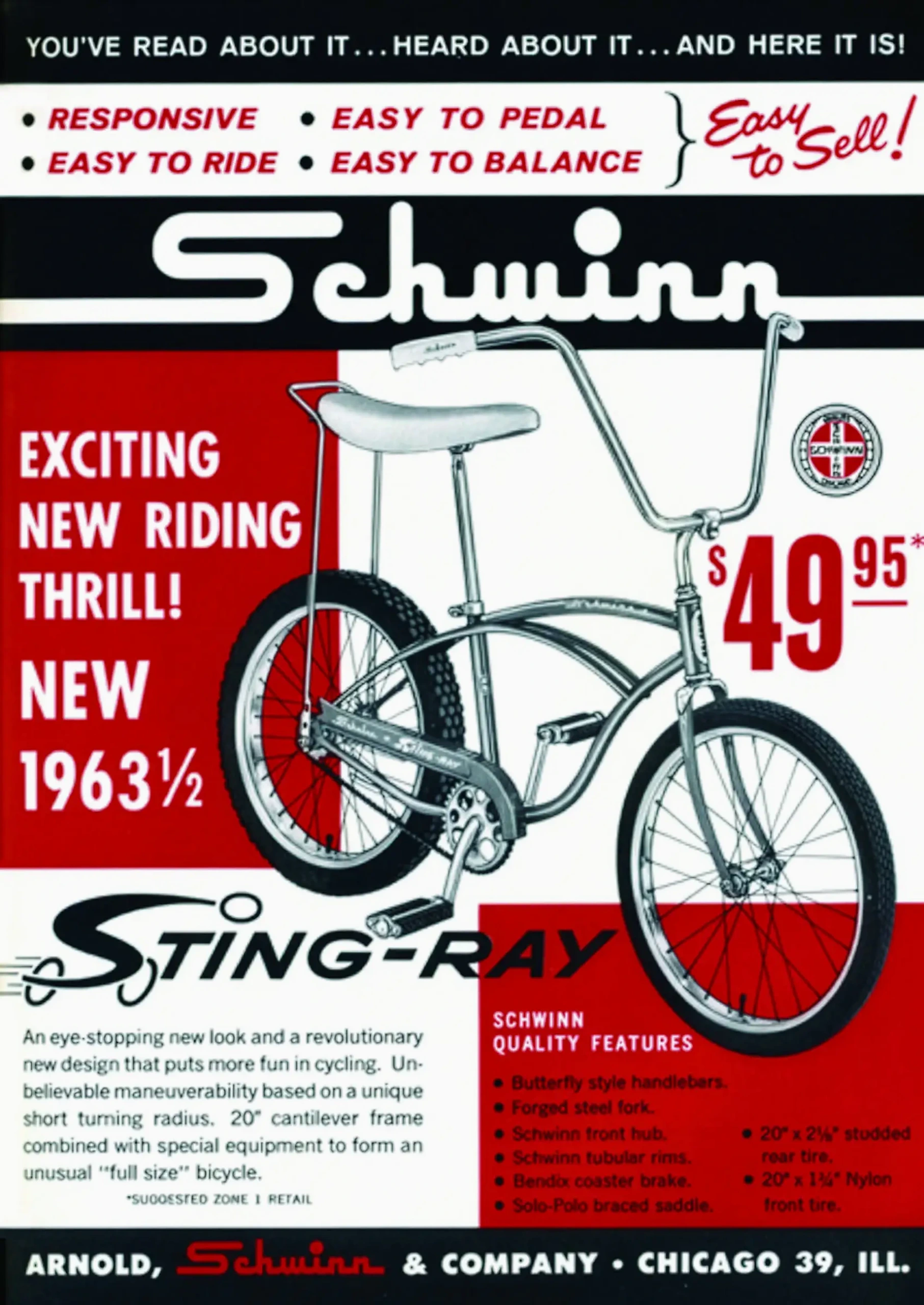
Two identification points save a great deal of frustration. Components stamped simply Schwinn were made in the Chicago factory, while parts marked Schwinn Approved were made elsewhere to Schwinn specification, which is how you tell a genuine in-house part from a supplier item. And Schwinn’s proprietary standards are real: the middleweight models take 26 x 1 3/4 tires on the S-6 rim at ISO 571 mm, which is not the same as the industry 26 x 1.75 at ISO 559 mm despite the two being written almost identically. Schwinn’s own tubular rims, made in house, were among the strongest ever produced, which is small consolation when you are trying to find tires for them.
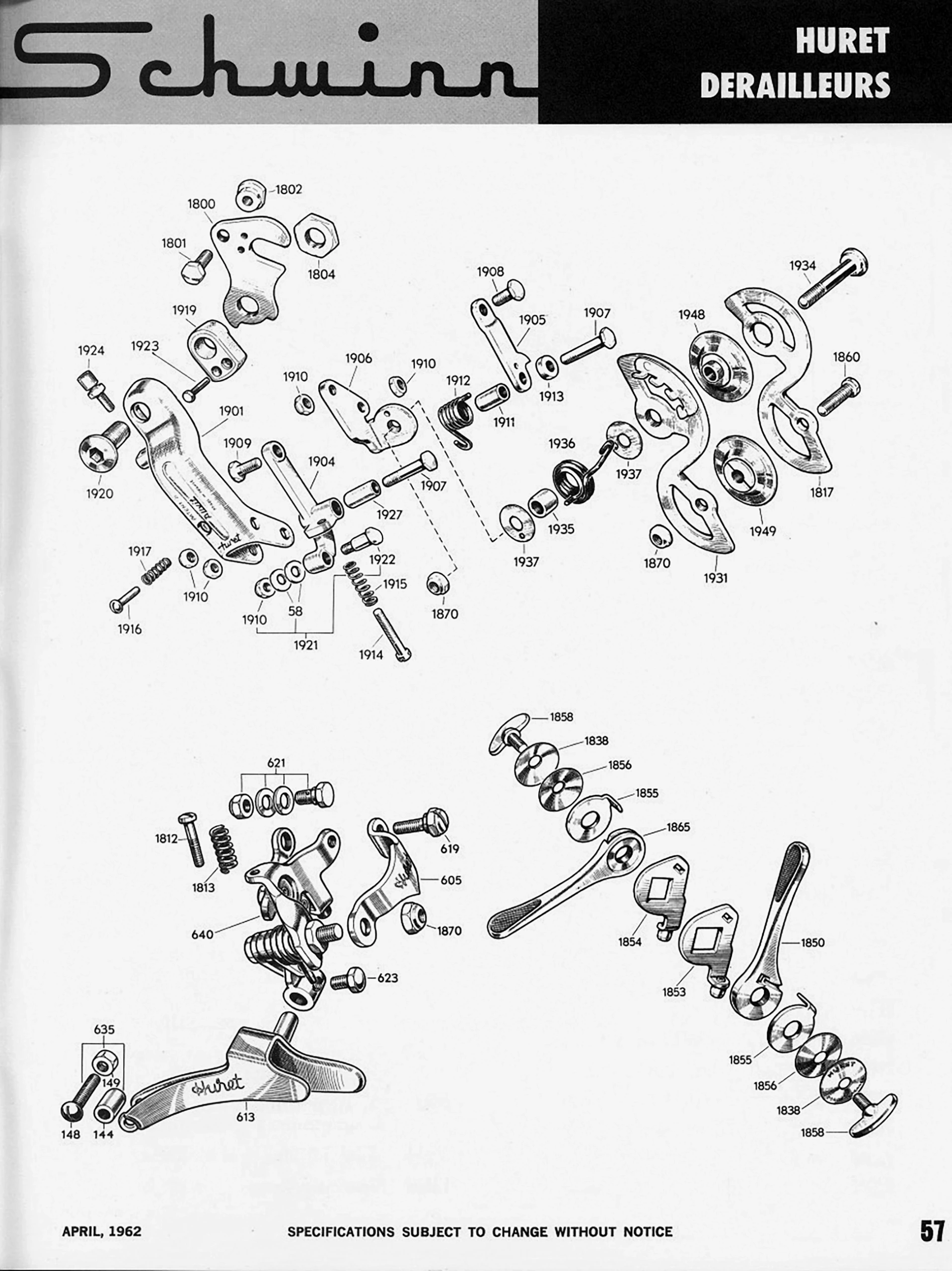
The American bike boom of 1971 to 1975 should have been Schwinn’s coronation. Instead it was the beginning of the end. Schwinn sold roughly 1.5 million bicycles in 1974, a huge number, and still lost the argument, because the buyers driving the boom wanted lightweight derailleur bicycles designed for road riding and touring, and Schwinn offered them either a Paramount they could not afford or an electro-forged frame with a kickstand.
The competition was very specific about who it was building for. Japanese manufacturers in particular adopted contemporary European racing geometry, new steel alloys and modern production methods quickly, and their moderately priced machines with Japanese components weighed less and rode better than the Schwinn equivalents. Fuji and Panasonic built reputations on exactly that combination of quality, price and current design, and by 1975 the mid-priced road and touring buyer had largely gone elsewhere. By 1979 even the Paramount had been overtaken by a new generation of American and foreign custom builders.
Schwinn’s response was to buy in. From 1973 the Schwinn name went onto the Le Tour, a Japanese-built low-cost sport tourer, and the company developed serious relationships with Bridgestone and with Panasonic. Those bicycles were initially treated as an embarrassment and kept out of the consumer catalogs, which was absurd, because they were good: the Panasonic-built World Traveler had a lugged steel frame and Shimano components, and the World Voyager above it used butted Tange chrome-molybdenum tubing with Shimano derailleurs and SunTour bar-end shifters, offering a great deal of what a Paramount offered at roughly half the money. A company that had spent forty years insisting the Schwinn badge meant Chicago manufacture was now, quietly, a marketer of other people’s frames.
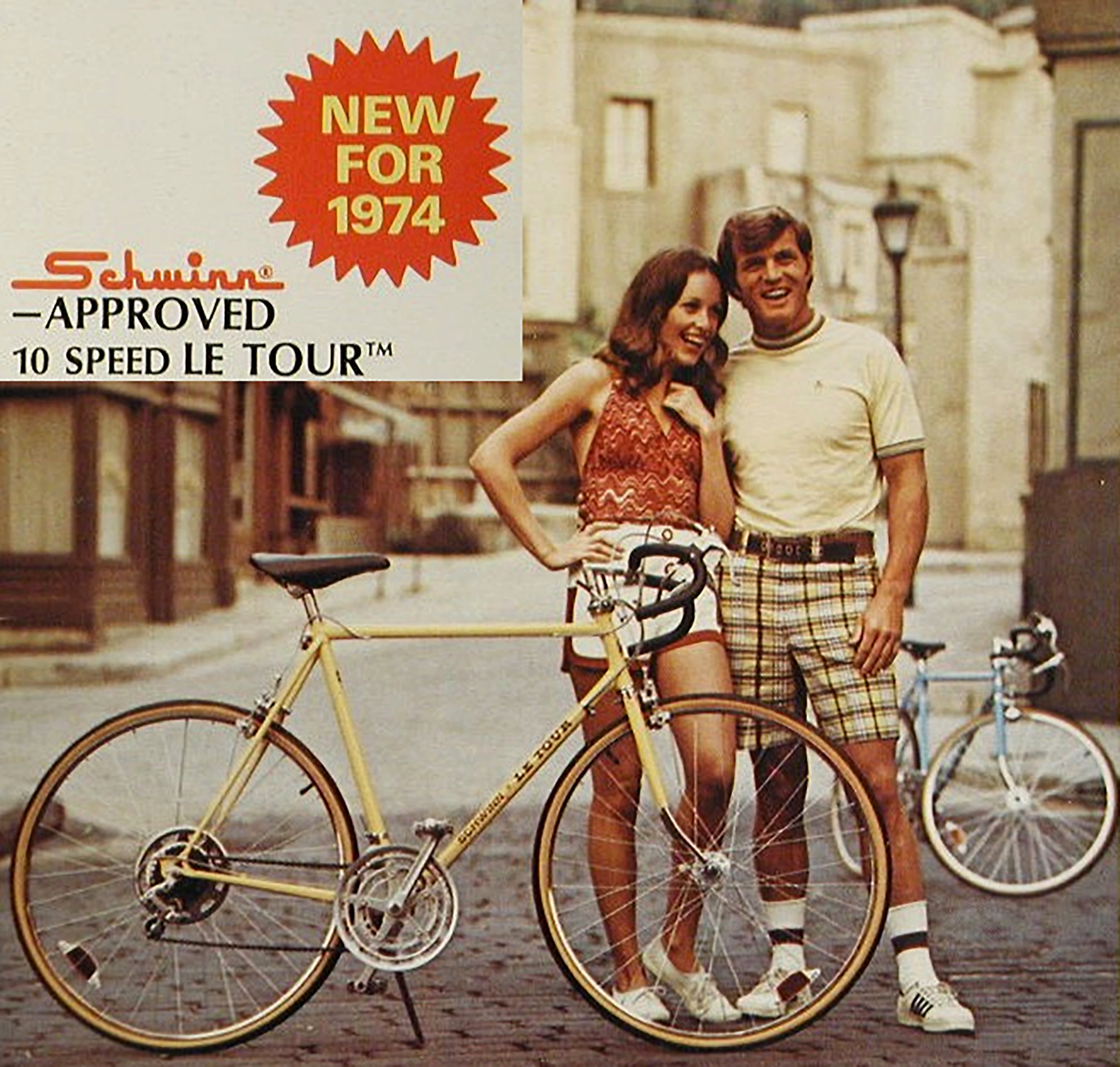
The most enjoyable irony in the Schwinn story is that while the company was failing to sell lightweights, its heaviest product was quietly founding a new sport. In the mid-1970s riders in Marin County, California went hunting through garages and used-bike shops for 1930s and 1940s Schwinn balloon-tire cruisers, stripped them down and rode them hard down the fire roads of Mount Tamalpais. They called them klunkers, and the course they raced was named Repack, after the need to repack the coaster-brake grease that burned out on every descent.
The frame of choice was the Schwinn Excelsior, chosen for its geometry, and on 21 October 1976 a group gathered to race those 50 pound machines down a dirt road dropping 1,300 feet in under two miles. Gary Fisher set the fastest recorded Repack time of 4:22 on 5 December 1976, with Joe Breeze at 4:24 a fortnight later. Breeze then built the first purpose-designed frame for the job in the autumn of 1977, rode Breezer No. 1 to a winning 4:25 and eventually sent the bicycle to the Smithsonian. Schwinn’s marketing department, presented with all this, decided mountain bikes were a fad.
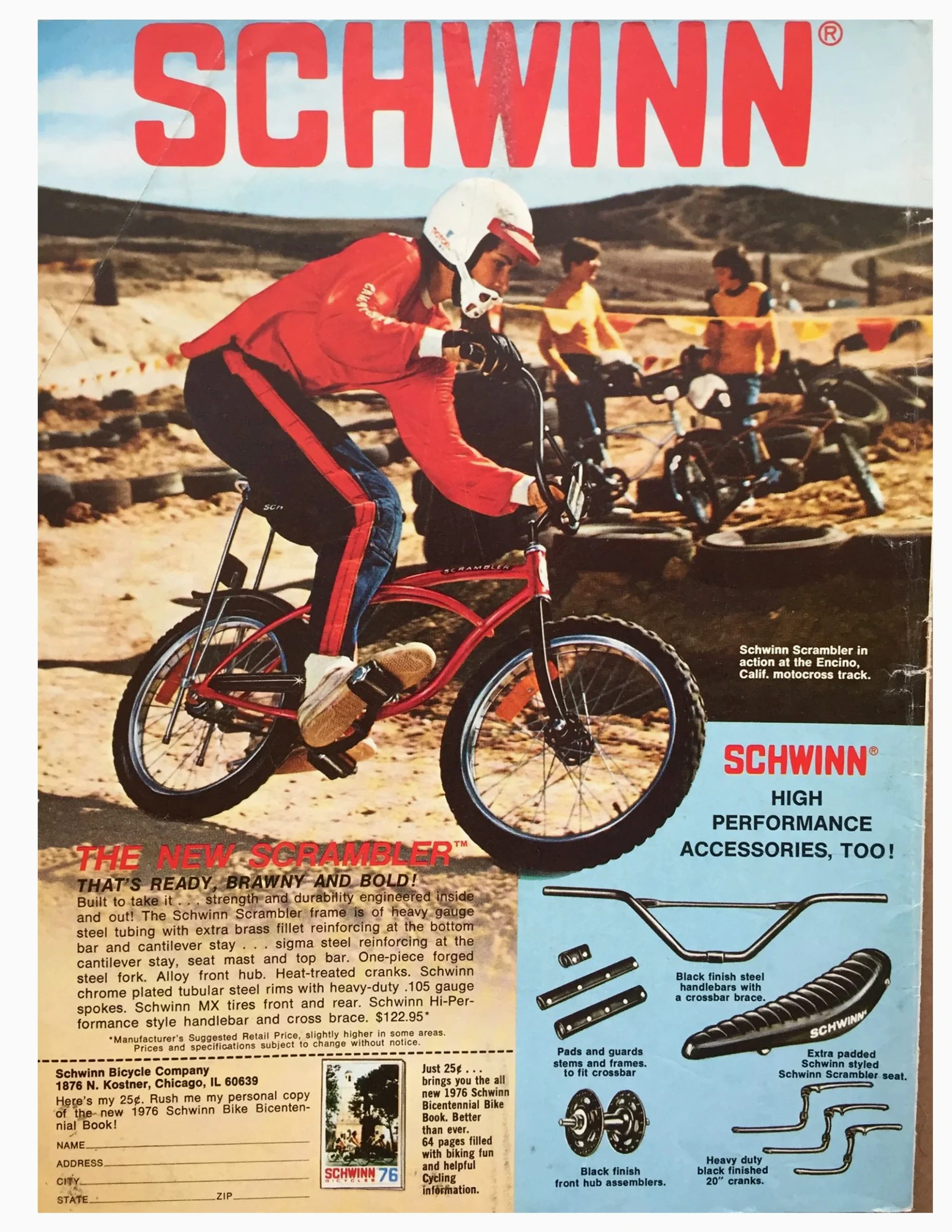
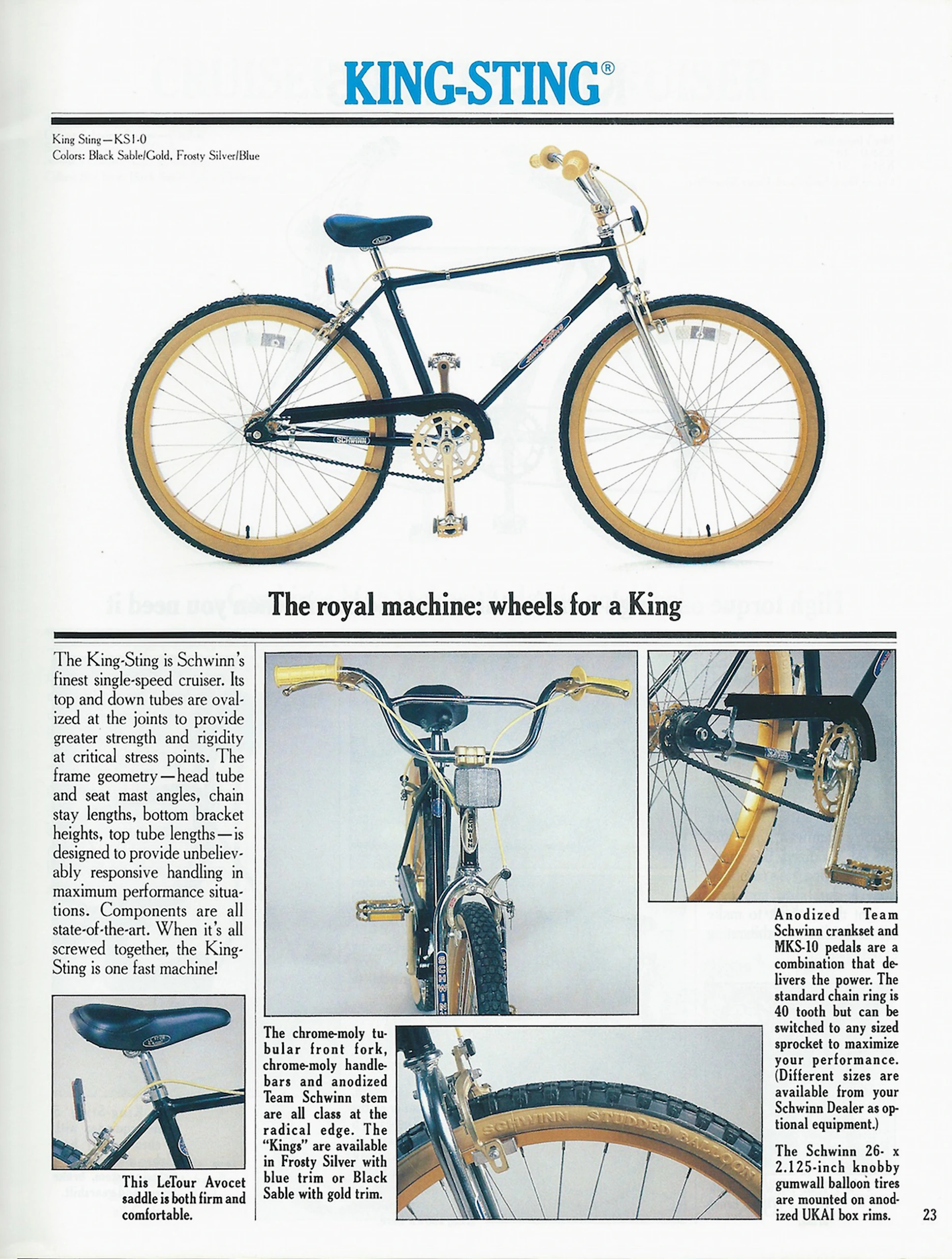
The company did try. The Klunker 5 of 1978 and 1979 used an electro-forged cantilever frame with five speeds and knobby tires, was never really marketed or cataloged and could not survive hard off-road use. The King Sting and Sidewinder that followed were assembled from BMX-derived parts and existing electro-forged designs, arriving just as American startups were building far better frames in Japan and Taiwan using TIG welding. BMX went much the same way: the Scrambler appeared in 1975 after management had first dismissed the sport as dangerous, The Sting of 1979 was a genuinely serious machine built from full Reynolds double-butted chrome-molybdenum tubing in the Paramount assembly area, and the Predator of 1982 took only about eight percent of the BMX market. Schwinn’s factory race team, running from 1976, was excellent. Ned Overend won back-to-back NORBA national mountain bike championships for Schwinn in 1986 and 1987. None of it converted into sales.
The Kildare Avenue plant was, by the late 1970s, an eighty-year-old factory with outdated tooling and antique inventory systems, competing against Japanese and Taiwanese manufacturers that reinvested continuously. A proposal to move to a new plant in Tulsa, Oklahoma was rejected by the board in 1978 because the financing would have required outside and possibly foreign investors.
Edward R. Schwinn Jr. took the presidency from his uncle Frank in October 1979, straight into a labor crisis. Chicago assembly workers organized with the United Auto Workers in late 1980 and struck that September, with 1,400 people out for thirteen weeks. When the strike ended in February 1981, only about 65% of the workforce was recalled. Schwinn shifted remaining American production to a new plant in Greenville, Mississippi, assembling bicycles from Asian-sourced parts away from the union. The Greenville plant was far from headquarters and from the West Coast ports its parts arrived through, it lost money every year and it closed in 1991 with 250 jobs.
Meanwhile the board had voted to source most production from Panasonic and then from Giant in Taiwan. That partnership worked commercially, lifting sales toward 1,000,000 bicycles a year and returning the company to profit in the late 1980s, but it came at a cost: Schwinn transferred frame design and manufacturing expertise to a partner it did not control. When Edward Schwinn Jr. failed to buy a minority stake in Giant and opened a separate production deal with China Bicycle Company, Giant responded by launching Giant-branded bicycles to Schwinn’s own retailers. Both suppliers then used the expertise they had gained to build their own market share.
Trek, Specialized and Cannondale took the rest. Schwinn declared bankruptcy in 1992. The Zell/Chilmark Fund bought the company and name in 1993 and moved headquarters to Boulder, Colorado. Questor Partners Fund bought it in late 1997 and acquired GT Bicycles in 1998 for around $80 million. Schwinn/GT went bankrupt again in September 2001 and was bought at auction by Pacific Cycle, which was itself acquired by Dorel Industries in 2004. In 2021 the Dutch group Pon Holdings agreed to buy Dorel Sports, Schwinn included, in a deal worth roughly $810 million, and Pacific Cycle has run the brand under Pon ever since.
Paramount production had moved out of Chicago to a plant in Waterford, Wisconsin in 1980. When the company collapsed, Richard Schwinn, great-grandson of Ignaz, and frame designer Marc Muller bought that plant in 1993 and began building under the Waterford name the following year. They got the factory but not the right to use the family name on a bicycle, which is a fair summary of what had happened to the company.
Waterford Precision Cycles built roughly 2,000 custom steel frames a year under the Waterford and Gunnar marks, plus frames for other small brands, and for a period it built Paramounts again. The Paramount line itself ran to September 1994, restarted in 1998 and finally ended in 2009 under Dorel ownership.
Waterford closed in June 2023, with seven employees laid off and Richard Schwinn, then 69, among those retiring. It ended more than 130 years of continuous Schwinn family involvement in building bicycles. Speaking to Wisconsin Public Radio, Richard Schwinn put it plainly: “The streak is over.”
Schwinn today is a brand rather than a manufacturer. Pacific Cycle runs it from Madison, Wisconsin under Pon Holdings, alongside Mongoose and Roadmaster, selling mass-merchant bicycles under the Schwinn name and a Signature line through specialty shops, across cruisers, hybrids, kids’ bikes, electric bikes and indoor trainers. The heritage is worked hard in the marketing, and the Sting-Ray has been revived more than once on the strength of it. Pacific Cycle cut its workforce in October 2025, the second such reduction in three years, which suggests the pressures on the mass-market side of the business have not eased.
For anyone who cares about classic lightweights, though, the interesting Schwinn is entirely in the past, and it is unusually accessible. A Chicago Paramount is a serious collector’s frame and priced as one. A fillet-brazed Superior, Super Sport or Sports Tourer is a hand-built chrome-molybdenum frame from the same factory, made by the same kind of labor, that can still be found for a fraction of the money precisely because Schwinn never managed to tell anyone what it was. Sixty years on, the marketing failure is the collector’s opportunity.
Have a Paramount, a fillet-brazed Superior or a Chicago-built Schwinn of any kind? Share the frame numbers, the seat stay details and your restoration questions in the Ebykr forums, and take a look at the companion Timeline for the full chronology from 1895 to the present.
https://en.wikipedia.org/wiki/Schwinn
https://en.wikipedia.org/wiki/Schwinn_Paramount
https://www.loc.gov/resource/sn84020558/1904-01-19/ed-1/?sp=4
https://en.wikipedia.org/wiki/American_Bicycle_Company
https://www.dougbarnesauthor.com/2021/08/a-short-history-of-schwinn-1895-to-1930.html
https://americanbusinesshistory.org/the-american-bicycle-industry-a-short-history/
https://en.wikipedia.org/wiki/Ignaz_Schwinn
https://sheldonbrown.com/schwinn-braze.html
https://sheldonbrown.com/chicago-schwinns.html
https://bikehistory.org/bikes/paramount/
https://waterfordbikes.com/
https://www.wpr.org/news/waterford-bicycle-factory-closes-so-too-does-another-chapter-schwinn-history
https://www.bicycleretailer.com/industry-news/2023/06/19/waterford-precision-cycles-plans-farewell-bike-ride-and-auction
https://en.wikipedia.org/wiki/Waterford_Precision_Cycles
https://wastyn.com/about-us
https://mmbhof.org/mtn-bike-hall-of-fame/history/repack-history/
https://www.sheldonbrown.com/brandt/mtb-history.html
https://en.wikipedia.org/wiki/Joe_Breeze
https://www.wbez.org/curious-city/2024/09/19/you-see-that-schwinn-it-has-a-chicago-history
https://chicago.suntimes.com/chicago-history/2024/10/04/schwinn-bikes-bicycling-chicago-history
https://palaeobicycleology.ca/2025/07/arnold-schwinn-company-north-43rd-kildare-avenue-location/
https://www.pinkbike.com/news/pon-holdings-buys-gt-cannondale-schwinn-and-more-in-810-million-deal.html
https://www.bicycleretailer.com/industry-news/2025/10/03/pacific-cycle-reduces-workforce-second-time-three-years
https://16incheswestofpeoria.wordpress.com/2012/04/29/40-years-later-the-schwinn-sports-tourer/
http://bikeretrogrouch.blogspot.com/2014/09/handbuilt-schwinns.html
 Schwinn
Ebykr documents this marque across the archive. Here is the rest of it.
The Ebykr Digest
New articles, timelines, catalog finds and registry activity — assembled from the archive once a month. Your address is never shared.
Double opt-in. One email per month. Unsubscribe at any time with one click.
Join the conversation below, or bring longer discussions and photos to the Ebykr Forums.


When describing the late-’60s changes in Paramount models, you write “The P13…took Campagnolo Nuovo Record sidepulls as stock, the previous P13 geometry slid down to become the P10, and the P15 was essentially a P13 with a Nuovo Record triple crankset and a long-cage rear derailleur for touring gearing.” The P13 came stock with Weinmann 610 centerpulls and in the later ’70s with Weinmann Carrera sidepulls. Campagnolo sidepulls were always an extra-cost option and were also available on the touring models. The statement about the P15 contains a typo as it was a 15-speed version of the P10, not the P13.
Thank you, Stephen. You are right on both counts, and the 1975 and 1978 catalog pages in the article say so, too. The article and the timeline are now corrected as you graciously noted.