About Ebykr
Ebykr celebrates classic and vintage lightweight bicycles through provocative imagery and opinion. Ride along with us.
About Ebykr
Ebykr celebrates classic and vintage lightweight bicycles through provocative imagery and opinion. Ride along with us.

A practical guide to dating a Pierce bicycle from Buffalo — what the head badge says about who built it, why the first two digits are not the year, where a frame number sits on the ladder of dated examples, what the model numbers mean and which features arrived when.

Pierce is the grand old man of this series. The Buffalo firm was selling bicycles before the safety bicycle had quite settled its shape and was still selling them when the Model T was everywhere, and under a new owner the name carried on all the way to 1940. So a surviving Pierce can be anything from a Queen City of the early 1890s to a racer built in Angola, New York, in the 1930s. There is no date code, no surviving factory register and no known shortcut.
Not to despair, though: what there is turns out to be plenty. The head badge names the company that built the bicycle and Pierce’s companies changed at dated moments. The frame number can be placed on a ladder of numbers pinned to dated print. Pierce’s own model numbers tell you what the bicycle is and a run of period paper shows which features arrived when. Put together, they will usually give you a window of a few years, which for a machine well past its 100th birthday is pretty good going.
Pierce bicycles came out of Buffalo, New York, from a firm that made birdcages and refrigerators. George N. Pierce & Co. took up tricycles and then bicycles around 1889, and its early bicycles were sold as the Queen City. The high-grade Pierce line arrived for the 1895 season and in 1896 the firm was incorporated as The George N. Pierce Company. When it turned to motor cars, the bicycles went to a company of their own: the Pierce Cycle Company was incorporated in September 1906 and kept the Hanover Street works, while the car business moved out to Elmwood Avenue and became the Pierce-Arrow Motor Car Company in 1908.
George N. Pierce died in 1910, the year his cycle company went into receivership. It was sold at auction in 1912 and bought back by his son Percy, and it went on building bicycles in Buffalo until 1918. That September, the Emblem Manufacturing Company of Angola, New York, bought the assets of the bankrupt firm and moved Pierce production to Angola, where a separate Pierce line ran until Emblem itself was dissolved in 1940. A head badge reading Angola, N.Y. therefore marks an Emblem-built Pierce of 1918 or later. Collectors value the Buffalo machines more, so check that a Buffalo badge sits on a Buffalo frame.
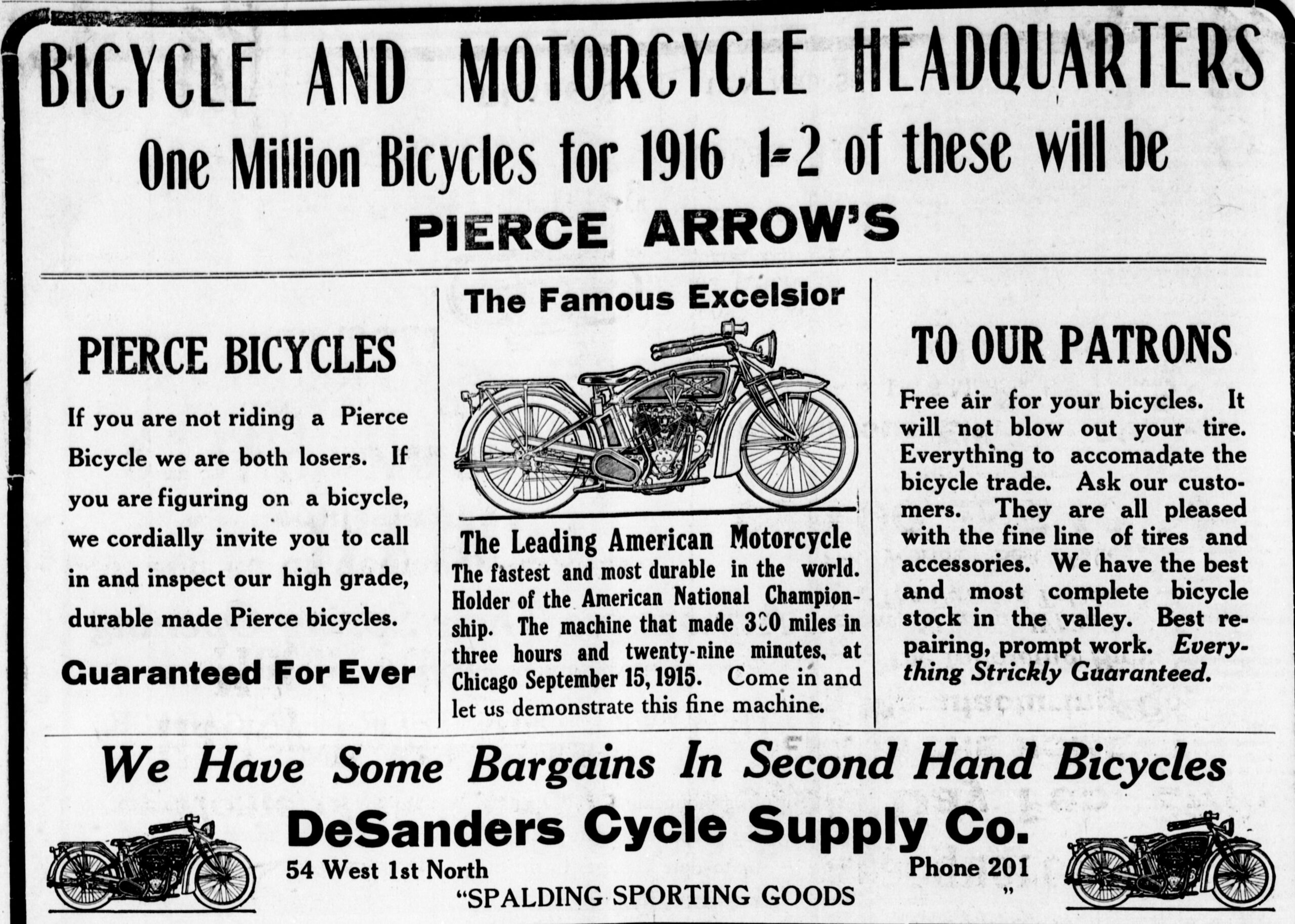
Strictly, then, the bicycles were made by George N. Pierce & Co., The George N. Pierce Company or the Pierce Cycle Company, never by Pierce-Arrow. But do not be too hard on a listing that says Pierce-Arrow, because the name stuck early. The arrow-pierced Pierce trademark was in use by 1894. The cycle company itself advertised a $25 Arrow Cycle in 1907 and wrote of its Pierce Arrow trademark in 1912, and three of the four stolen-bicycle notices of 1918 and 1919 quoted below call the bicycle a Pierce-Arrow. Dealers used the name, too. In February 1916 a shop in Logan, Utah headlined its Pierce stock as PIERCE ARROW’S.
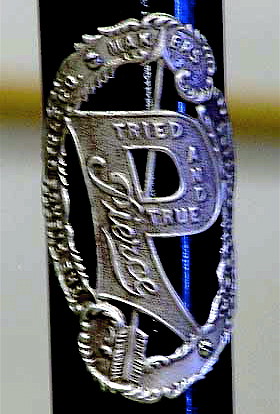
The badge is the quickest way to put a Pierce in its era, because its wording follows the company’s name. Paul Jacobs of the Pierce-Arrow Society sorted the Buffalo badges into four types and the Pierce-Arrow Museum in Buffalo labels its badge display in much the same way:
| Badge | What it says | Era |
|---|---|---|
| Queen City | QUEEN CITY on a diagonal band across an oval | early 1890s |
| Type 1 | GEO. N. PIERCE & CO. MAKERS, with PIERCE across the center and BUFFALO N.Y. U.S.A. | to about 1895 |
| Type 2 | THE GEO. N. PIERCE CO. MAKERS in a wreath, around a large P, an arrow, the Pierce script and a TRIED AND TRUE banner | about 1896 to 1898 |
| Type 3 | as Type 2, in a more flowery wreath | 1898 to about 1907 |
| Type 4 | the same design, reading THE PIERCE CYCLE CO. MAKERS BUFFALO N.Y. U.S.A. | 1907 to 1918 |
| Angola | the same design, reading Pierce Cycle Co., Angola, N.Y., U.S.A. | 1918 to 1940 |
Read the words before the ornament. The sources disagree a little on where Type 1 ends and Type 2 begins, but The Geo. N. Pierce Co. cannot predate the 1896 incorporation, and The Pierce Cycle Co. cannot predate the fall of 1906, so a Type 4 badge can turn up on a 1907-season bicycle built late in 1906. A small plate reading Special under the badge marks one of the Pierce Specials of the later 1890s. And take care with Queen City. A separate Buffalo firm, the Queen City Cycle Company, sold its own Queen City bicycles in 1893 and 1894, and Cincinnati called itself the Queen City as well.
Pierce did not always put its number in the same place and where it sits is a clue in itself. Collectors’ records show a pattern, though not a rule:
On a frame this old, the stamp may be shallow and filled with a century of paint and grime, so clean gently and photograph it in low, raking light before you try to read it. A number you have photographed is a number you can check again later.
First, the shortcut to forget. Collectors sometimes read the first two digits of a Pierce number as its year and the period notices that state a model year sink this right away: 101,192 was a 1903 model and 144,850 a 1909 model. The shortcut survives because three of the four notices of 1918 and 1919 below happen to start with 18 or 19. Pierce numbered its Buffalo frames in one long run that climbed for more than 20 years without ever encoding a date.
No factory register is known to survive. The Pierce-Arrow Museum in Buffalo has said that it does not hold the factory records, so every year attached to a Pierce number comes from period print, especially from stolen bicycle notices, where an owner hoping to see a bicycle again had every reason to give the right number. (Bicycle thieves, it turns out, did future historians a real favor.) These are the firmest rungs we here at Ebykr have found:
| Frame number | What the notice says | Where it was printed |
|---|---|---|
| 22,384 | a “new ’96 Model”, stolen in May 1897 | L.A.W. Bulletin, May 1897 |
| 23,910 | a Pierce Special “built in ’96” | The Wheel, September 1899 |
| 46,957 | an 1898 model, stolen in June 1898 | stolen-bicycle notice |
| 69,427 | a 1900 model | stolen-bicycle notice |
| 74,987 | a 1900 chainless | stolen-bicycle notice |
| 92,503 | a chainless, stolen in November 1902 | stolen-bicycle notice |
| 101,192 | a 1903 Racer, stolen in September 1903 | stolen-bicycle notice |
| 144,850 | a 1909 model, stolen in March 1910 | Perth Amboy Evening News, 22 March 1910 |
| 151,581 | stolen in May 1910 | stolen-bicycle notice |
| 172,448 | a “Pierce-Arrow bicycle”, stolen in January 1918 | Tampa Tribune, 22 January 1918 |
| 184,576 | “A Pierce wheel”, stolen in May 1918 | Salt Lake Herald-Republican, 19 May 1918 |
| 197,201 | a “Pierce Arrow bicycle”, stolen in March 1919 | Macon Telegraph, 14 March 1919 |
| 190,496 | a “Pierce Arrow Bicycle” with a 21 inch blue frame, stolen in April 1919 | Tampa Tribune, 9 April 1919 |
Most of these notices were found by Blue Streak, the Classic and Antique Bicycle Exchange (CABE) member who has spent years combing period papers for Pierce numbers. We have read the ones with a paper named for ourselves. Three things are worth knowing about the ladder. A notice dates the theft rather than the build, so a number without a model year belonged to a bicycle that existed by that date and no more. The run is noisy: owners misremembered, papers misprinted, the two 1919 numbers arrive out of order and numbers from neighboring years overlap, so the ladder places a frame within a few years rather than a single one. And it has a big-ish hole. Nothing dated has turned up between 151,581 in 1910 and 172,448 in 1918, and nobody knows where the Buffalo numbers ended and the Angola ones began. Angola frames run from about 255,000 to past 600,000, but every one of those numbers comes from an owner’s report rather than dated print.
Between the rungs, remember the pace. The numbers climbed fast in the boom years, at something like 10,000 to 15,000 a year in the later 1890s, and much more slowly after 1901, at roughly 4,000 to 8,000 a year, so a gap of 10,000 numbers covers more years in the 1900s than it did in the 1890s.
Every reading here comes from “Read the number against the ladder” in this guide.
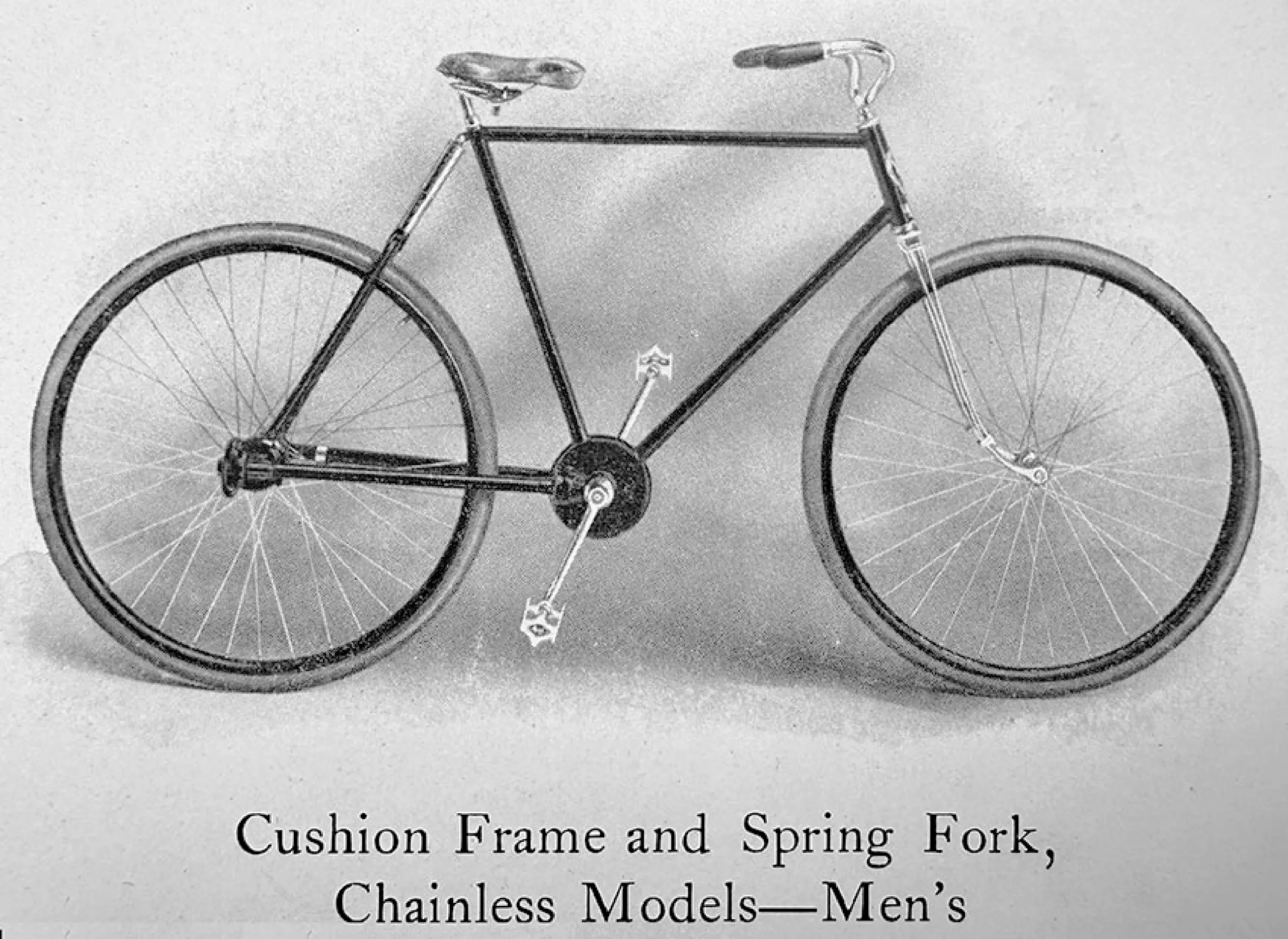
Pierce named its bicycles by number, and the c.1915 brochure shows the system at work. The leading figures give the type of bicycle and the last figure gives the frame size in inches, with a 7 or an 8 for the ladies’ models:
| Model | Model numbers | Price in the c.1915 brochure |
|---|---|---|
| Cushion Frame Chainless | 152 (22 inch), 154 (24 inch), ladies’ 158 (22 inch) | $80 with coaster brake |
| Cushion Frame Chain | 131 (21 inch), 132 (22 inch), 134 (24 inch), ladies’ 138 (22 inch) | $60 with coaster brake |
| Light Roadster or Road Racer | 120 (20 inch), 121 (21 inch) and 122 (22 inch), plus 110, a 20 inch frame with a 26 inch front wheel | $50 without brake |
| Two Piece Hanger Roadster | 20, 21, 22 and 24 by frame size, with ladies’ 27 (20 inch) | $40 with coaster brake |
| One Piece Hanger Service Model | Ladies’ 17 | $35 with coaster brake |
| Pierce-Kramer Special Racer | 21 inch frames only | $60 without brake |
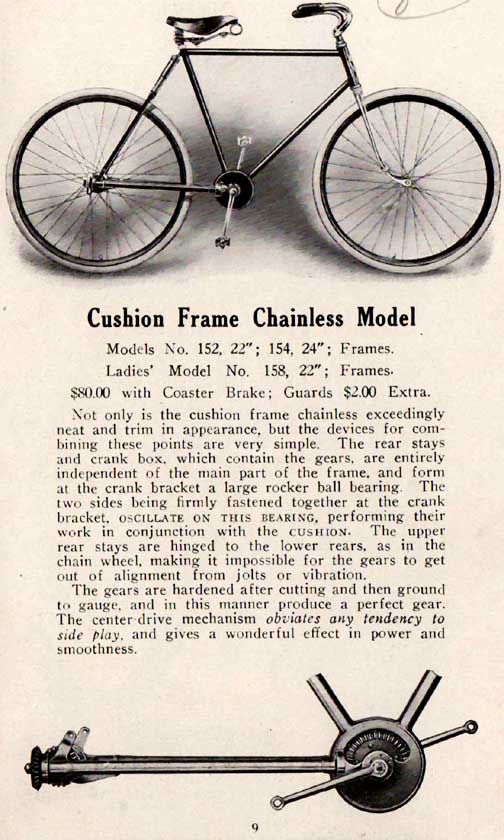
Match your bicycle’s type and frame size to its line and the model number follows. Under the Pierce Cycle Company, the numbers stayed put from 1907 to about 1915, so on a bicycle of those years a model number names the machine without narrowing its date. Before that it was different. The George N. Pierce Company renumbered its range every season, so on an earlier Pierce the model number dates the bicycle to the year:
| Season | Model numbers |
|---|---|
| 1899 | 102 and 104 regular; 131 to 133 racer; 142, the racer Frank Kramer rode |
| 1900 | 242, 244 and the ladies’ 248, the first cushion-frame chainless |
| 1901 | 251 to 299, among them the chainless 292, 294 and 296 and the ladies’ 298 and 299 |
| 1906 | 752, 754 and 756 and the ladies’ 758 and 759, the chainless with spring fork |
| 1907 to about 1915 | 100 to 159, the Pierce Cycle Company’s scheme |
The catch is that the same number can mean different machines. No. 132 was a 22 inch racer in 1899 and a 22 inch cushion-frame chain model by 1907, and No. 131 changed the same way, so always read a model number together with the type of bicycle. And do not expect to find the number on the frame. Collectors report model decals on the down tube only on some machines of about 1898 to 1904, and most surviving Pierces carry none, so the model number is usually something you work out from the catalog rather than read off the bicycle.
Pierce introduced its best ideas at moments the period paper records, so the fittings on a bicycle can rule years in and out:
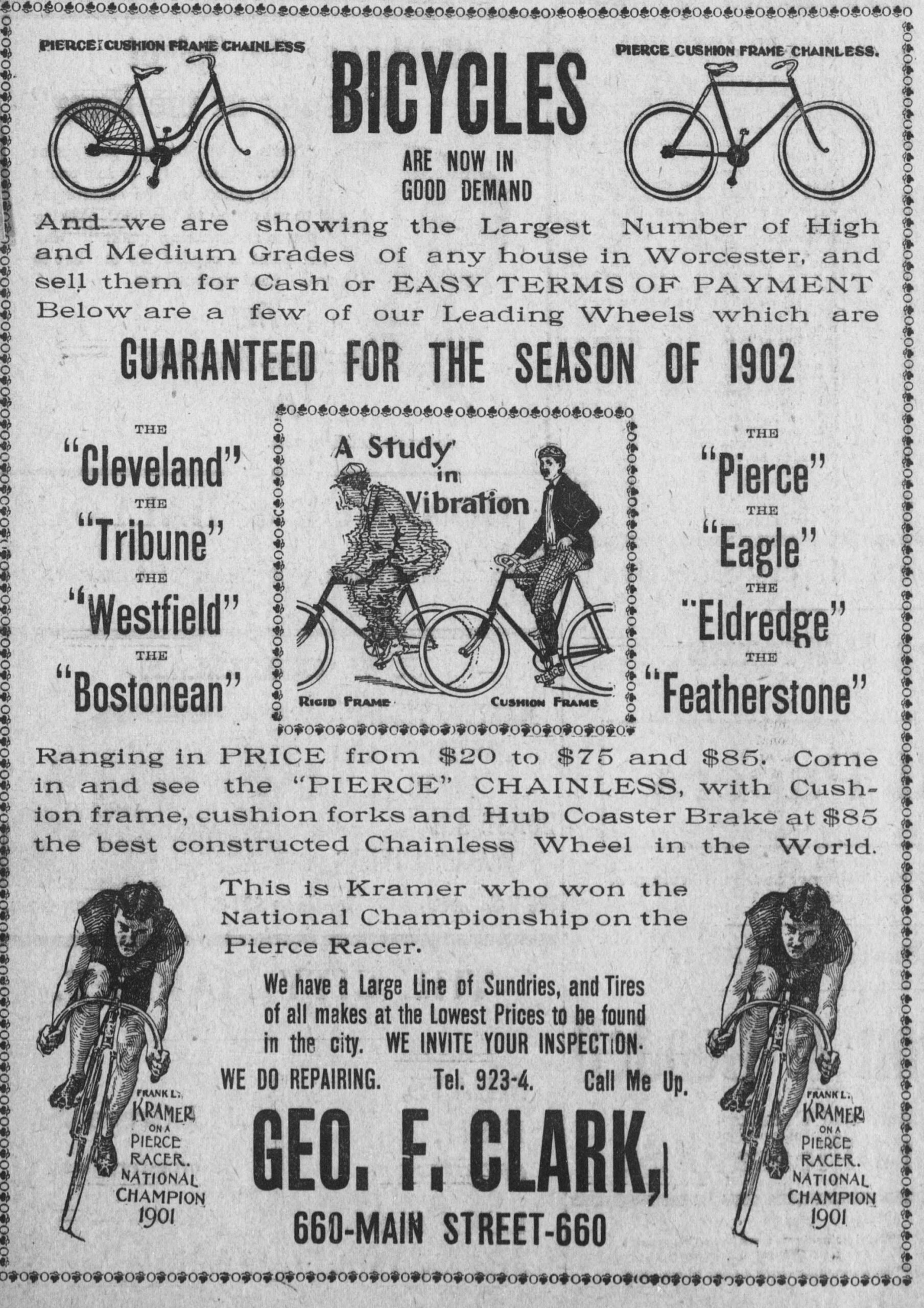
Pierce paper is scarce, and what survives in the Ebykr Catalog Archive is a mix of the maker’s own brochure and dealers’ newspaper advertisements. The advertisements turn out to be wonderfully precise, because a newspaper prints its date. An 1898 column from a Worcester dealer prices the whole range, from the Pierce Leader at $42 to tandems at $100. A 1902 column from another Worcester dealer gives the chainless with its cushion forks and coaster brake. A 1909 Salem gun-store advertisement announces the Heavy Service Model. And the 1916 Logan advertisement shows a dealer still trading happily on the Pierce name, Pierce-Arrow and all.
Pierce’s own catalogs can date themselves. The firm numbered its annual catalogs, the eighth in 1898 and the eleventh in 1901, so the series began in 1891 and a numbered catalog gives its own year. The c.1915 brochure of the Pierce Cycle Company is the one to keep open. It carries no date, but it dates itself: Frank Kramer is “American Professional Champion for fifteen years” and his run began in 1901. It also shows why period paper needs reading with care. Its introduction says the George N. Pierce Company “was organized in 1862,” a year before the 17 year old George Pierce had even arrived in Buffalo, while the firm’s own advertising of the 1890s said 1865. Firms of the day polished their own histories as lovingly as their enamel. If you hold a Pierce catalog, price list or advertisement, add it through Docs Drop and it becomes a dating tool for everyone.
Suppose a man’s cushion-frame chain bicycle turns up with a 22 inch frame, a coaster brake, a spring fork tied with a rubber roller, a head badge reading THE PIERCE CYCLE CO. MAKERS BUFFALO N.Y. U.S.A. and a frame number in the 180,000s stamped on the right rear dropout.
Answer: a Pierce Cycle Company Cushion Frame Chain Model, No. 132, built in Buffalo in the middle or later 1910s. A window rather than a year, but every step of it rests on something printed and not assumed.
Queen City in the early 1890s · Type 1, GEO. N. PIERCE & CO. MAKERS, to about 1895 · Type 2, THE GEO. N. PIERCE CO. MAKERS in a wreath, about 1896 to 1898 · Type 3, in a more flowery wreath, 1898 to about 1907 · Type 4, THE PIERCE CYCLE CO. MAKERS, 1907 to 1918 · Angola, N.Y., 1918 to 1940 · The Geo. N. Pierce Co. cannot predate the 1896 incorporation, nor The Pierce Cycle Co. the fall of 1906
The 1890s: on the head tube · about 1898 to 1910: on the seat tube, just below the seat cluster · the 1910s in Buffalo: on the right rear dropout · Angola, 1918 on: on top of the bottom bracket shell, and a second small stamp under the shell is not the frame number
Lugged joints show until 1897; flush joints came to the Specials in 1897 and to every model from 1898 · an external seat binder until 1899, internal binders from 1899 · the cushion frame was on sale by April 1898, chain models using a flat leaf spring at the crank until 1902 and a bearing-type rocker bracket from 1903 · the cushion was licensed to several makers, so it alone does not make a bicycle a Pierce
The shaft-drive chainless arrived for the 1900 season, always on the cushion frame, and headed the range for the rest of the Buffalo years · the spring fork is new for 1902, an option, and from 1904 its blades are tied with a rubber roller · Morrow coaster brakes in 1899 and 1900, a New Departure hub on the 1901 Pan-American Special and the Pierce New Departure from 1902 · no Pierce list from 1901 to about 1915 offers a two-speed hub
The George N. Pierce Company renumbered its range every season, so on an earlier Pierce the model number dates the bicycle to the year: 102 to 142 in 1899, 242 to 248 in 1900, 251 to 299 in 1901 and 752 to 759 in 1906 · under the Pierce Cycle Company 100 to 159 stayed put from 1907 to about 1915 · the same number can mean different machines, so read it with the type of bicycle
The worked example: a Pierce Cycle Co. badge, a number in the 180,000s on the right rear dropout and a fork tied with a rubber roller, the middle or later 1910s
Every reading here comes from “Put it together: a worked example” in this guide.
Pierce is already among the best-documented marques in the Ebykr Serial-Number Registry. Yours belongs there, too: log the number, the badge, the model and how you know the year, and the ladder gets a little sturdier for the next owner. A dated number from between 1910 and 1918 would be especially welcome, and so would anything that shows where the Angola numbers begin. The General Discussion forum is the place for a machine that will not fit.
For the story of the company, read Pierce Company Bicycles: The Missing Link and the Pierce timeline. The Classic and Antique Bicycle Exchange holds the deepest collector record, and the rest of the Identify and Date series covers Peugeot, Raleigh, the Brooks saddle and dating a bicycle by its components.
Pierce documents in the Ebykr Catalog Archive: the 1898 Putnam & Sprague advertisement (Worcester Daily Spy), the 1902 Geo. F. Clark advertisement (Worcester Spy), the 1909 Hauser Bros. advertisement (Daily Capital Journal, Salem), the c.1915 Pierce Cycle Company brochure and the 1916 DeSanders Cycle Supply advertisement (Logan Republican); newspaper pages via Chronicling America, Library of Congress
Stolen-bicycle notices: the L.A.W. Bulletin and Good Roads (May 1897) and The Wheel and Cycling Trade Review (September 1899), via the Internet Archive; the Perth Amboy Evening News of 22 March 1910, via Chronicling America; the Tampa Tribune (22 January 1918 and 9 April 1919), the Salt Lake Herald-Republican (19 May 1918) and the Macon Telegraph (14 March 1919), from clippings posted by Blue Streak on the Classic and Antique Bicycle Exchange
The George N. Pierce Co. — Eleventh Annual Catalogue, 1901 (Internet Archive)
The Bicycling World, 15 September 1906, on the incorporation of the Pierce Cycle Company (Internet Archive)
Geoffrey N. Stein and Brad L. Utter — The Motorcycle Industry in New York State (second edition, 2023), on the Pierce Cycle Company and the Emblem Manufacturing Company
Paul Jacobs — What Year Is Your Pierce Bicycle? and Pierce Cycle Nameplates (Pierce-Arrow Society)
US Patent 747,789 (the cushion-frame chainless) and US Patent 644,573 (the binders)
The Wheelmen forum — Pierce Cycles (Internet Archive copy), including the Pierce-Arrow Museum’s statement on factory records
The Classic and Antique Bicycle Exchange — Pierce serial-number mega thread
Buffalo Architecture and History — Pierce Cycle Company bicycle brochure (Chuck LaChiusa; brochure courtesy of Bill Alexander)
 Pierce
Ebykr documents this marque across the archive. Here is the rest of it.
The Ebykr Digest
New articles, timelines, catalog finds and registry activity — assembled from the archive once a month. Your address is never shared.
Double opt-in. One email per month. Unsubscribe at any time with one click.