About Ebykr
Ebykr celebrates classic and vintage lightweight bicycles through provocative imagery and opinion. Ride along with us.
About Ebykr
Ebykr celebrates classic and vintage lightweight bicycles through provocative imagery and opinion. Ride along with us.

Source: Buffalo Architecture and History (buffaloah.com), page by Chuck LaChiusa, 2010.
 Page 1
 Page 2
 Page 3
 Page 4
 Page 5
 Page 6
 Page 7
 Page 8
 Page 9
 Page 10
 Page 11
 Page 12
 Page 13
 Page 14
 Page 15
 Page 16
 Page 17
 Page 18
 Page 19
 Page 20
| Marque | Pierce |
|---|---|
| Type | Catalog |
| Year | 1915 (estimated) |
| Publisher | The Pierce Cycle Company |
| Country | United States |
| Language | English |
| Pages | 20 |
| Source | Buffalo Architecture and History (buffaloah.com), page by Chuck LaChiusa, 2010. |
| Credit | Chuck LaChiusa, Buffalo Architecture and History, from the copy made available by Bill Alexander |
| Identifier | Permalink https://buffaloah.com/h/piercebroc/broc.html |
| Transcription | Transcribed by eye |
PIERCE BICYCLES The Evolution of the Bicycle About twenty-five years ago, the world went "bicycle mad." The George N. Pierce Company was organized in 1862. The Essentials of a Good Bicycle THE PIERCE CYCLE CO., Buffalo, N. Y. Brazing "A chain is no stronger than its weakest link." THE PIERCE CYCLE CO., Buffalo, N. Y. …
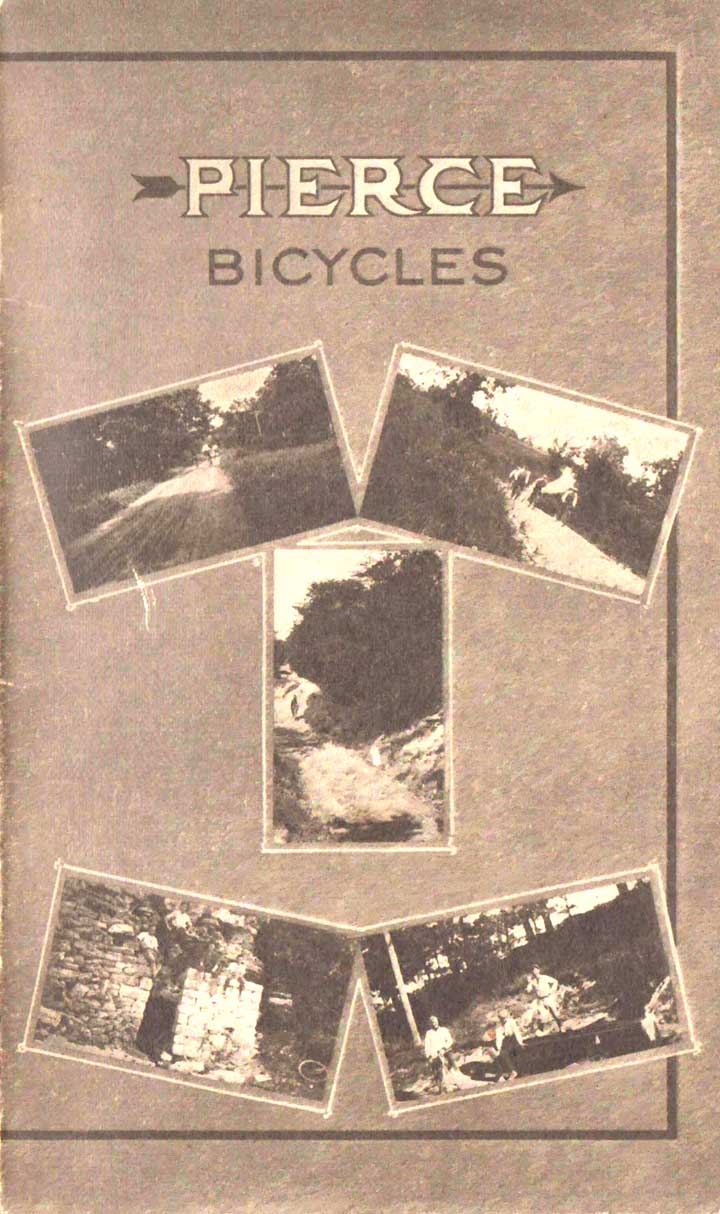
— Front cover —
PIERCE [arrow device] BICYCLES
[The wordmark PIERCE sits between an arrow device and the word BICYCLES, over five photographic
vignettes of club riders: on country roads, at a stone bridge, beside a stream, and resting with
their machines.]
— Introduction —
The Evolution of the Bicycle
About twenty-five years ago, the world went “bicycle mad.”
The George N. Pierce Company was organized in 1862.
[The policy of the founders is given as the belief that the American public “would not for any
length of time pay its good money for other than the best.” Of the hundreds of bicycle factories
founded in the craze years, few survived; from the George N. Pierce Company sprang both the Pierce
Cycle Company and the Pierce-Arrow Motor Car Company. For years, the page states, both Pierce
bicycles and Pierce-Arrow motor cars were made in the present buildings of the Pierce Cycle Company.
The industry benchmark is claimed outright: the highest praise a rival can give its own machine is
that it is “GOOD AS A PIERCE.”
The page closes with a period argument that the automobile will not kill the bicycle. The car’s
purchase price and its running and maintenance costs put it “out of the reach of the average man,”
while the bicycle’s low first cost and near-zero running cost keep it in use.]
— Page 1 —
The Essentials of a Good Bicycle
[Three essentials are named: Quality of Materials, Quality of Workmanship and Simplicity of Design.
Pierce claims the unique position of employing “the second generation of skilled workmen,” fathers
and sons working side by side on the floor.]
THE PIERCE CYCLE CO., Buffalo, N. Y.
— Page 2 —
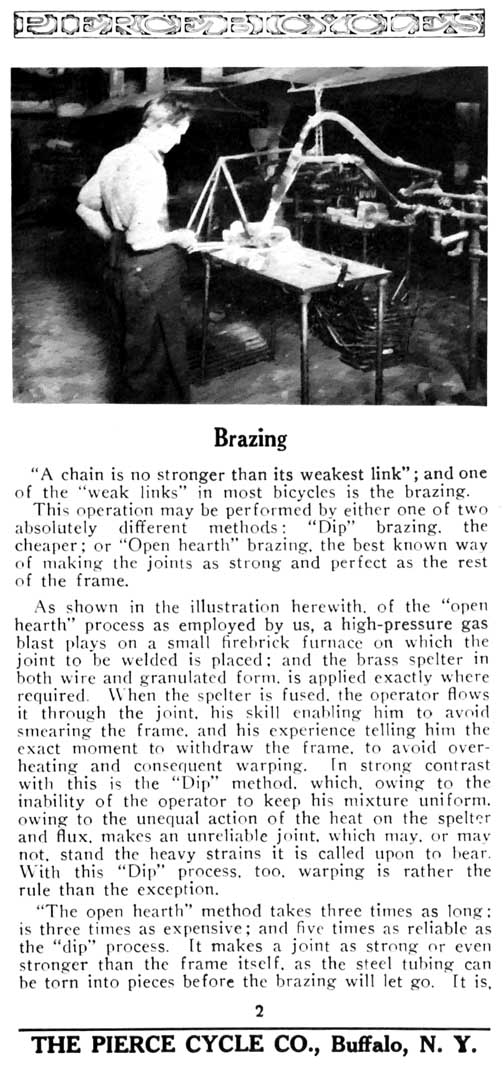
Brazing
“A chain is no stronger than its weakest link.”
[Two methods are set against each other. The cheap method is “dip” brazing; Pierce uses “open
hearth.” A high-pressure gas blast plays on a small firebrick furnace holding the joint, and brass
spelter in both wire and granulated form is applied exactly where required; when the spelter fuses
the operator flows it through the joint, judging by skill when to withdraw the frame to avoid
overheating and warping. Dip brazing cannot keep the mixture uniform and makes an unreliable joint,
with warping “rather the rule than the exception.”
The verdict is given as a plain accounting: open hearth takes three times as long, costs three times
as much and is five times as reliable — a joint as strong as or stronger than the frame itself, such
that the tubing tears before the brazing lets go.]
THE PIERCE CYCLE CO., Buffalo, N. Y.
— Page 3 —
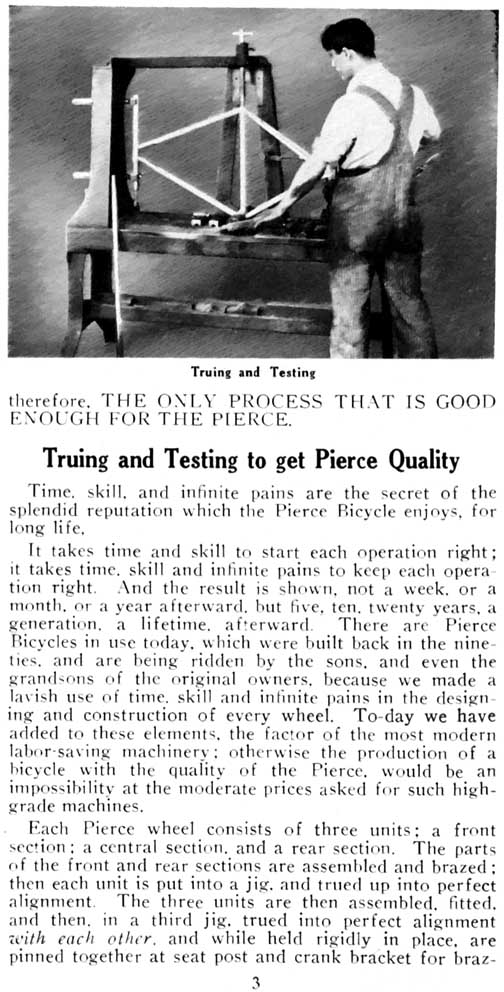
Truing and Testing to be Called Pierce Quality
[Every Pierce frame is built as three units — a front section, a central section and a rear section.
Front and rear sections are assembled and brazed, each unit jigged and trued into alignment; the
three are then assembled, fitted and trued in a third jig into alignment with each other, and while
held rigidly in place are pinned together at the seat post and crank bracket for brazing, then
re-tested at all points. The result is a frame built into shape to stay rather than warped or forced
into shape. Forks are trued in special jigs and gauges, so the finished frame carries forks, crank
hanger and rear wheel in true alignment.
Photograph captioned “Truing and Testing.”]
— Page 4 —
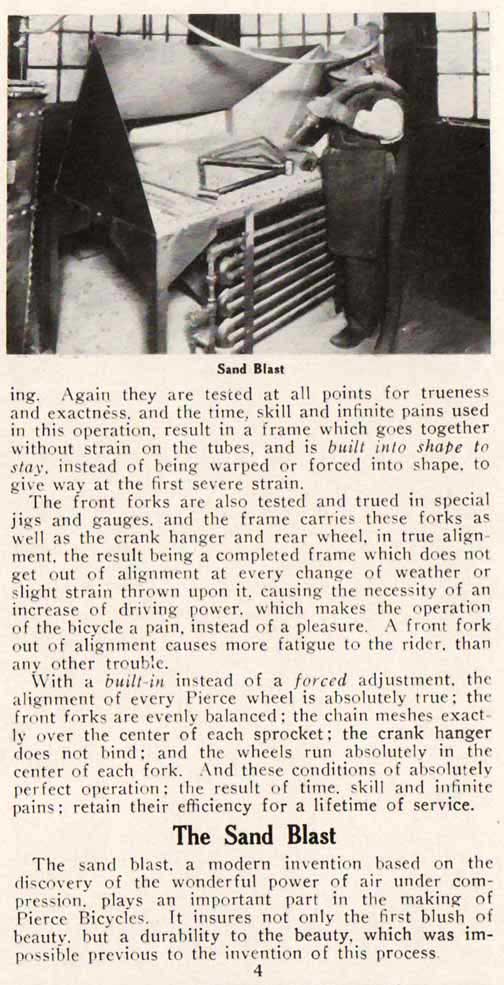
The Sand Blast
[Sharp sand in compressed air cuts away all scale, scours the joints and exposes roughness for the
filers; a second pass removes tool marks and all grease and dirt, matting the surface “resembling
the surface of silver in the French Gray effect.” The mat lets the enamel grip so that it cannot
flake, scale or peel, and keeps rust from reaching the metal.
Photograph captioned “Sand Blast.”]
— Page 5 —
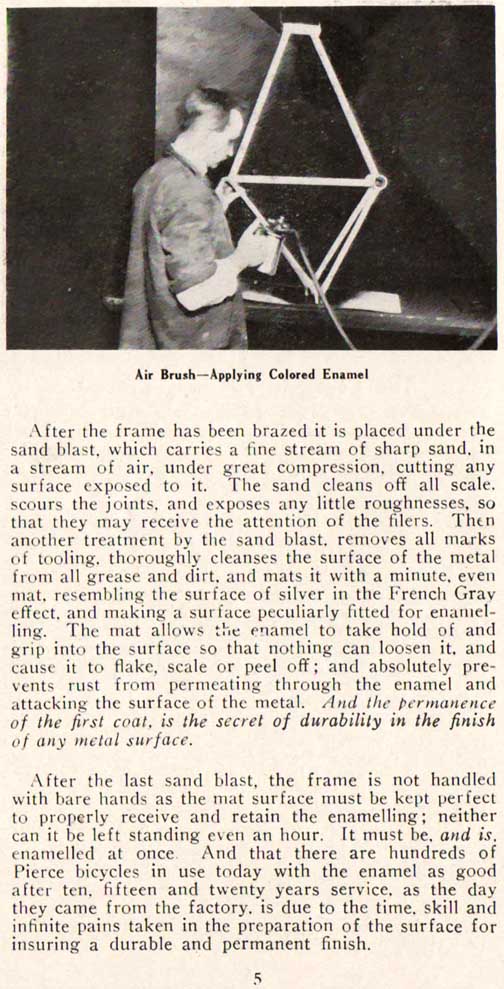
[Enamelling. After the last sand blast the frame is not handled with bare hands and cannot stand
even an hour before being enameled. It is preceded by a “pickle” bath loosening scale, oil and dirt,
and by hand filing to a “plate glass” finish. Four separate coats of enamel are applied, the first
three each rubbed down by hand to the smoothness of ground and polished glass.
The special-formula enamel is described as so tensile that a peeling the length of a tube hangs
together as though elastic, and the tube can be bent and flattened without cracking it — the “piano
polish” that lasts a lifetime.
Photograph captioned “Air Brush—Applying Colored Enamel.”]
— Page 6 —
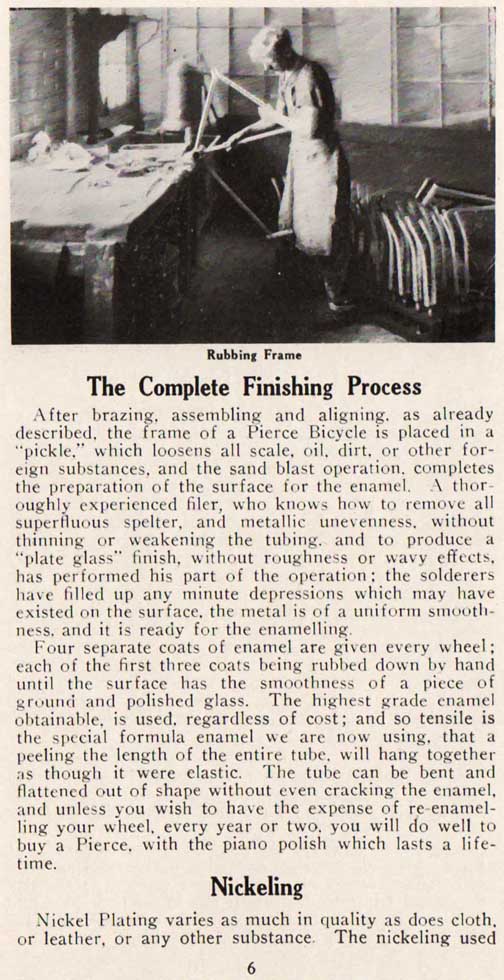
The Complete Finishing Process
Nickeling
[Polishing and grinding wheels of every shape fit every angle and curve; then consecutive pickling
baths, a water wash and an acid bath, a scouring with pumice stone, then further washing and acid.
A heavy coating of copper follows, which both protects the steel from rust and acts as a binder,
copper having a stronger affinity for both steel and nickel than steel and nickel have for each
other. A scientifically calculated amount of copper, another cleansing, then the nickel bath and a
buffing wheel. Every nut and bolt in a Pierce receives the same plating.
Photograph captioned “Rubbing Frame.”]
— Page 7 —
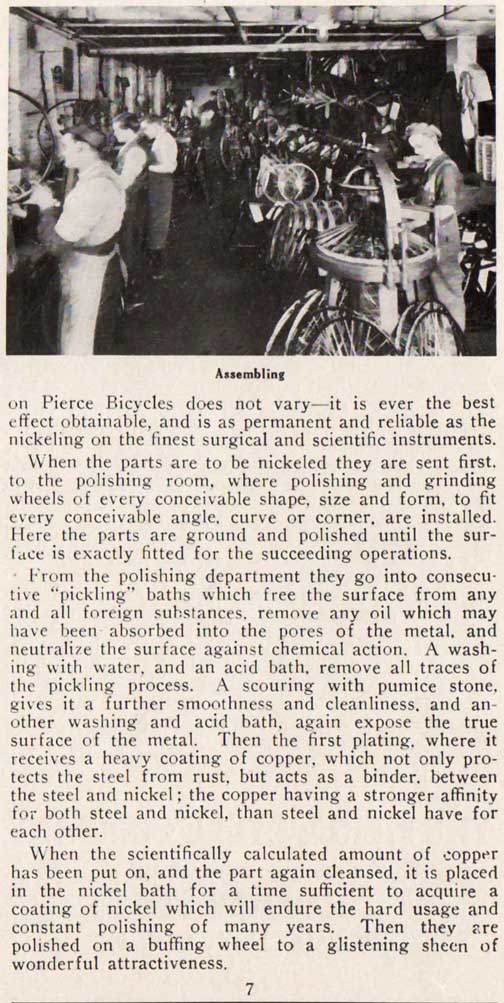
[Nickeling continues, and assembling begins.
Photograph captioned “Assembling.”]
— Page 8 —
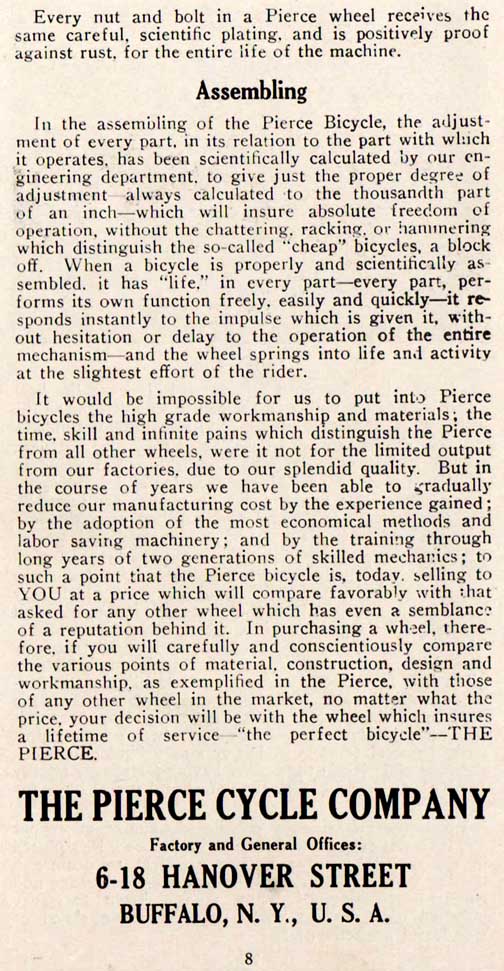
Assembling
[The adjustment of every part relative to the part it works with is calculated by the engineering
department “to the thousandth part of an inch,” to eliminate the chattering, racking and hammering
that distinguish cheap bicycles. Output is deliberately limited by this quality standard; cost has
been reduced over the years only by economical methods, labor-saving machinery and two generations
of trained mechanics.]
THE PIERCE CYCLE COMPANY
Factory and General Offices
6-18 HANOVER STREET
BUFFALO, N. Y., U. S. A.
— Page 9 —
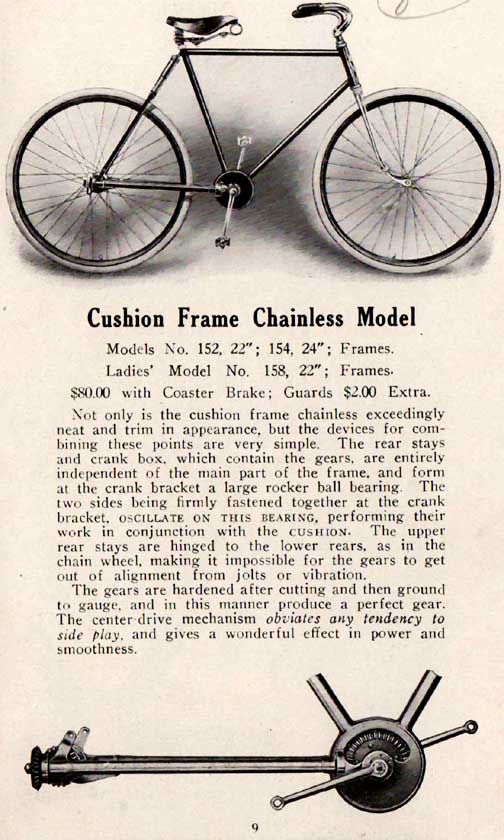
Cushion Frame Chainless Model
Models No. 152, 22″; 154, 24″; Ladies’ Model No. 158, 22″ Frames.
$80.00 with Coaster Brake; Guards $2.00 Extra.
[The rear stays and the crank box containing the gears are entirely independent of the main frame
and form, at the crank bracket, a large rocker ball bearing. The two sides, firmly fastened together
at the bracket, oscillate on that bearing in conjunction with the cushion. The upper rear stays are
hinged to the lower rears, as on the chain model, making it impossible for the gears to fall out of
alignment from jolts or vibration. The gears are hardened after cutting, then ground to gauge. The
center-drive mechanism “obviates any tendency to side play.”
Illustrated with a sectional drawing of the shaft, bevel gear and crank box.]
— Page 10 —
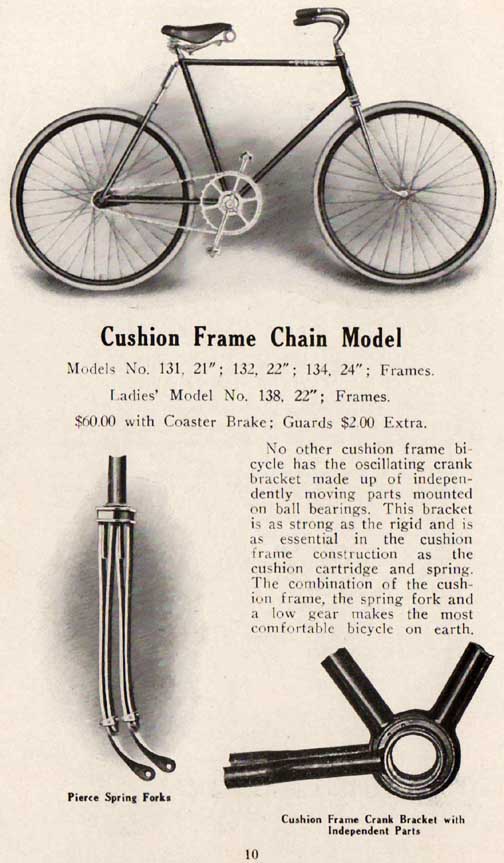
Cushion Frame Chain Model
Models No. 131, 21″; 132, 22″; 134, 24″; Ladies’ Model No. 138, 22″ Frames.
$60.00 with Coaster Brake; Guards $2.00 Extra.
[The oscillating crank bracket is built of independently moving parts on ball bearings — “as strong
as the rigid,” and as essential to the cushion frame as the cushion cartridge and spring itself. The
cushion frame with a Pierce spring fork and a low gear is claimed as “the most comfortable bicycle
on earth.”
Pierce Spring Forks and the cushion-frame crank bracket are shown as separate detail illustrations.]
— Page 11 —
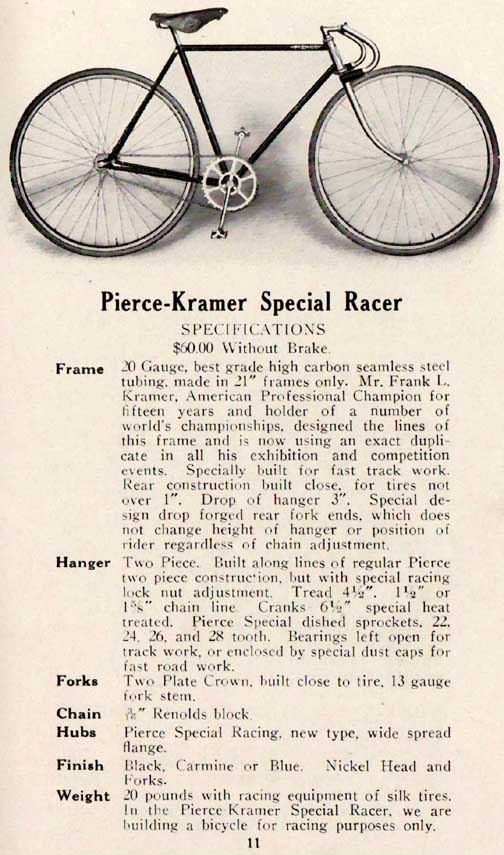
Pierce-Kramer Special Racer
SPECIFICATIONS
$60.00 Without Brake
Frame: 20 Gauge, best grade high carbon seamless steel tubing, made in 21″ frames only. Mr. Frank L.
Kramer, American Professional Champion for fifteen years and holder of a number of world’s
championships, designed the lines of this frame and is now using an exact duplicate in all his
exhibition and competition events. Specially built for fast track work. Rear construction built
close, for tires not over 1″. Drop of hanger 3″. Special design drop forged rear fork ends, which
does not change height of hanger or position of rider regardless of chain adjustment.
Hanger: Two Piece. Built along lines of regular Pierce two piece construction, but with special
racing lock nut adjustment. Tread 4½”. 1½” or 1⅝” chain line. Cranks 6½” special heat treated.
Pierce Special dished sprockets, 22, 24, 26, and 28 tooth. Bearings left open for track work, or
enclosed by special dust caps for fast road work.
Forks: Two Plate Crown, built close to tire, 13 gauge fork stem.
Chain: 3/16″ Renolds block.
Hubs: Pierce Special Racing, new type, wide spread flange.
Finish: Black, Carmine or Blue. Nickel Head and Forks.
Weight: 20 pounds with racing equipment of silk tires. In the Pierce-Kramer Special Racer, we are
building a bicycle for racing purposes only.
— Page 12 —
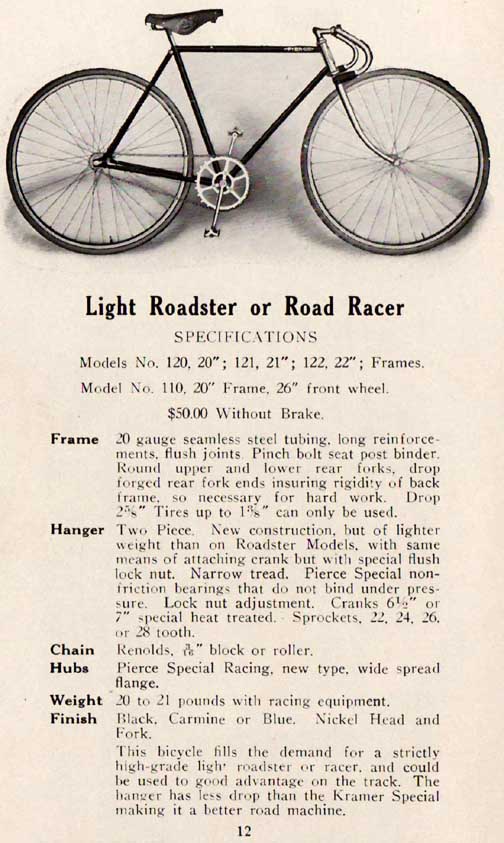
Light Roadster or Road Racer
Models No. 120, 20″; 121, 21″; 122, 22″; and No. 110, 20″ frame with 26″ front wheel.
$50.00 Without Brake
[20 gauge seamless tubing, long reinforcements, flush joints and a pinch-bolt seat post binder.
Round upper and lower rear forks with drop-forged rear fork ends. Hanger drop 2⅝”. Tires up to 1⅜”.
The two-piece hanger is lighter than the roadster’s, with a special flush lock nut, a narrow tread
and Pierce Special non-friction bearings “that do not bind under pressure.” Cranks 6½” or 7″, heat
treated. Sprockets 22, 24, 26 and 28 tooth. Renolds 3/16″ block or roller chain. Pierce Special
Racing hubs, wide spread flange. Weight 20 to 21 pounds with racing equipment. Black, carmine or
blue, with nickel head and fork.
Positioned as a strictly high-grade light roadster or racer usable on the track, but with less
hanger drop than the Kramer Special, “making it a better road machine.”]
— Page 13 —
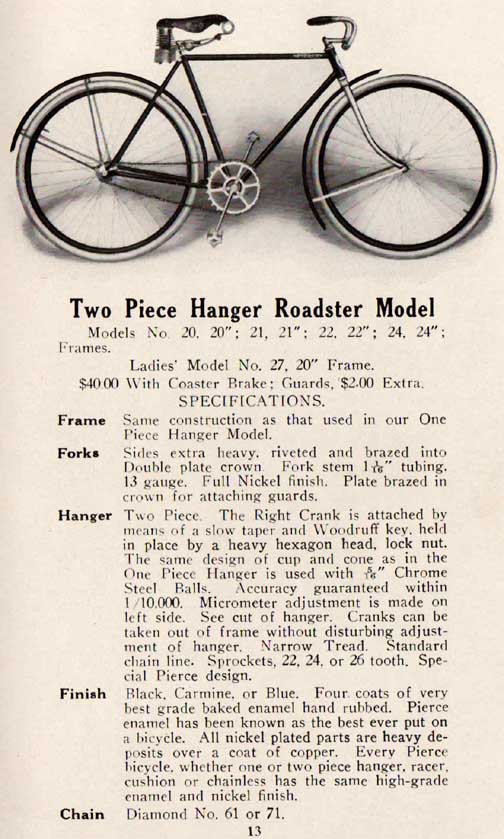
Two Piece Hanger Roadster Model
Models No. 20, 20″; 21, 21″; 22, 22″; 24, 24″; Ladies’ Model No. 27, 20″ Frames.
$40.00 with Coaster Brake; Guards $2.00 Extra.
[Fork sides are extra heavy, riveted and brazed into a double plate crown, with a 1⅛” fork stem of
13 gauge and a full nickel finish; a plate is brazed into the crown for attaching guards.
The two-piece hanger has its right crank attached by a slow taper and a Woodruff key, held by a
heavy hexagon head lock nut, running on 5/16″ chrome steel balls. Accuracy is guaranteed within
1/10,000, with micrometer adjustment on the left side, and the cranks are removable without
disturbing the hanger adjustment. Sprockets 22, 24 and 26 tooth.]
— Page 14 —
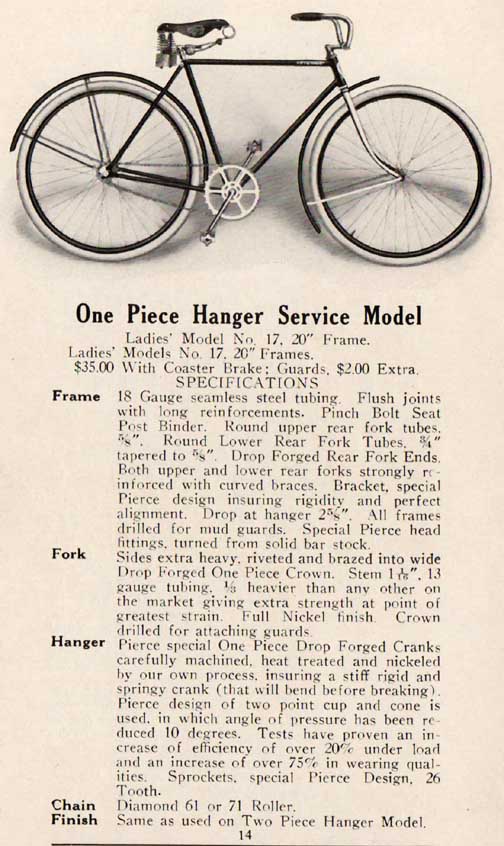
One Piece Hanger Service Model
Ladies’ Model No. 17, 20″; Ladies’ Model No. 17, 26″ Frames.
$35.00 with Coaster Brake; Guards $2.00 Extra.
[Frame of 18 gauge seamless tubing with flush joints and long reinforcements. Round upper rear fork
tubes of 5/8″; lower 3/4″ tapered to 5/8″. Drop-forged rear fork ends, with both upper and lower
rear forks reinforced by curved braces. Hanger drop 2⅝”. All frames drilled for mud guards.
The one-piece hanger uses Pierce special one-piece drop-forged cranks, machined, heat treated and
nickeled in-house, giving “a stiff rigid and springy crank (that will bend before breaking).” The
two-point cup and cone has the angle of pressure reduced 10 degrees, which Pierce claims as an
increase of efficiency of over 20% under load and over 75% in wearing qualities. 26 tooth sprocket.
Chain: Diamond 61 or 71 roller.
Finish on both roadster and service model: black, carmine or blue, in four coats of best-grade baked
enamel, hand rubbed. All nickel-plated parts are heavy deposits over a coat of copper. The same
enamel and nickel are used on every Pierce, whether one or two piece hanger, cushion or chainless.]
— Page 15 —
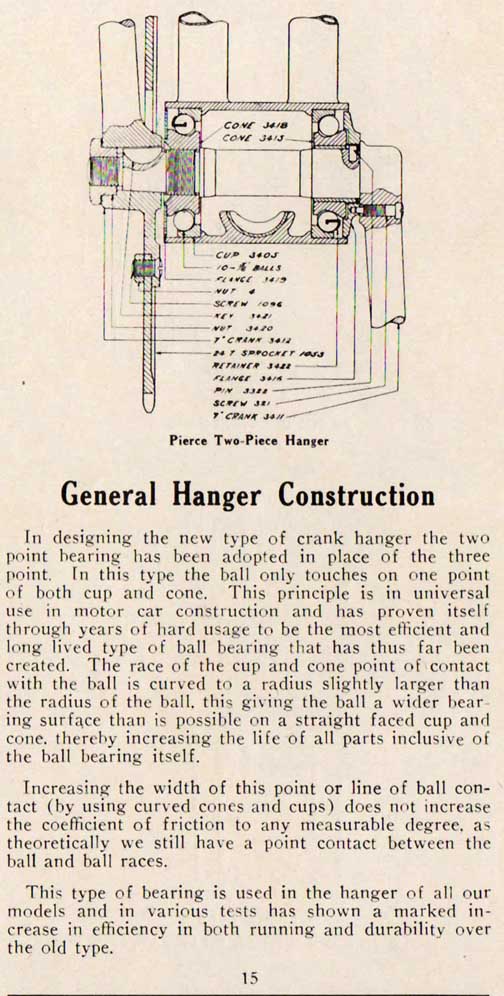
General Hanger Construction
[The new crank hanger adopts a two-point bearing in place of the three-point: the ball touches at
only one point of both cup and cone. The page states this is “in universal use in motor car
construction” and the most efficient and long-lived ball bearing yet created.
The race of cup and cone is curved to a radius slightly larger than the radius of the ball, giving a
wider bearing surface than a straight-faced cup and cone and increasing the life of all parts,
including the ball itself. Widening that line of contact does not measurably increase the
coefficient of friction, since theoretically a point contact remains.
It is used in the hanger of all models, and tests are said to show a marked increase in both running
efficiency and durability over the old type.
Illustrated with a sectional drawing captioned “Pierce Two Piece Hanger.”]
— Page 16 —
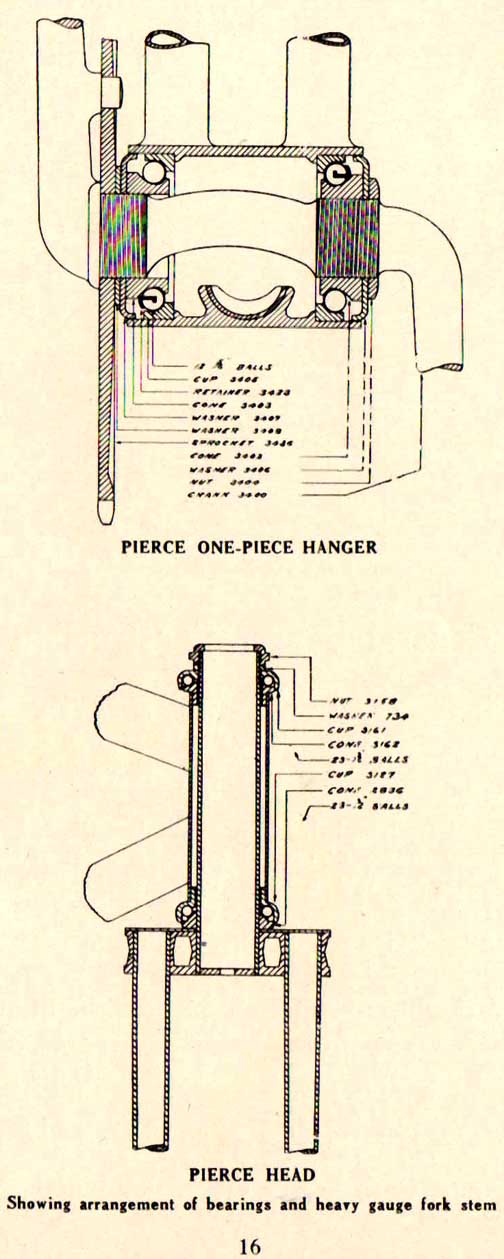
[Two exploded sectional drawings with part numbers.
PIERCE ONE-PIECE HANGER — cup 3405, cones 3403 and 3402, retainer 3423, sprocket 3446, crank 3400.
PIERCE TWO-PIECE HANGER — cup 3405, cones 3418 and 3413, ten balls, retainer 3422, 7″ cranks 3411
and 3412, 24 tooth sprocket 3455.
PIERCE HEAD — showing the bearing arrangement and the heavy gauge fork stem; cups 3161 and 3157,
cones 3162 and 3836, twenty-three balls of 1/8″ and twenty-three of 1/4″.
Caption: “Showing arrangement of bearings and heavy gauge fork stem.”]
— Page 17 —
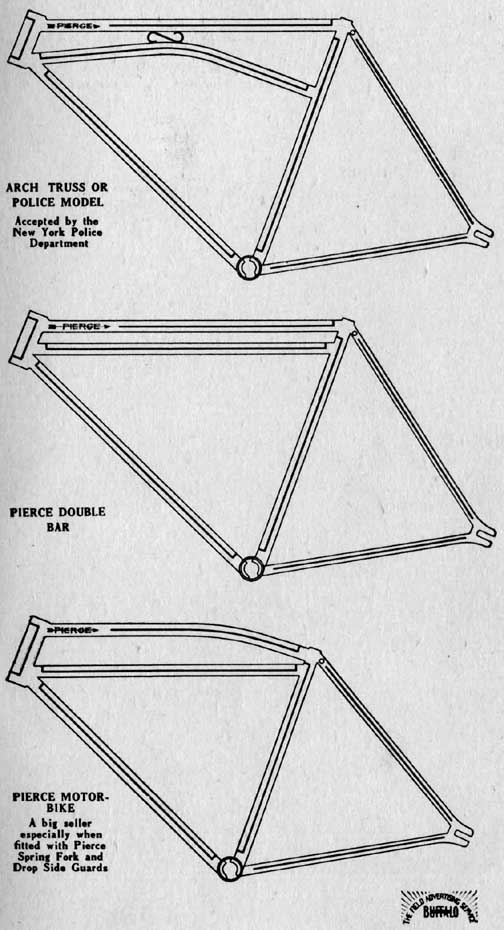
[Three frame styles shown as line drawings, each headbadged PIERCE.]
ARCH TRUSS OR POLICE MODEL
Accepted by the New York Police Department.
PIERCE DOUBLE BAR
PIERCE MOTOR-BIKE
A big seller especially when fitted with Pierce Spring Fork and Drop Side Guards.
The Kelly Advertising Service, Buffalo
— Back cover —
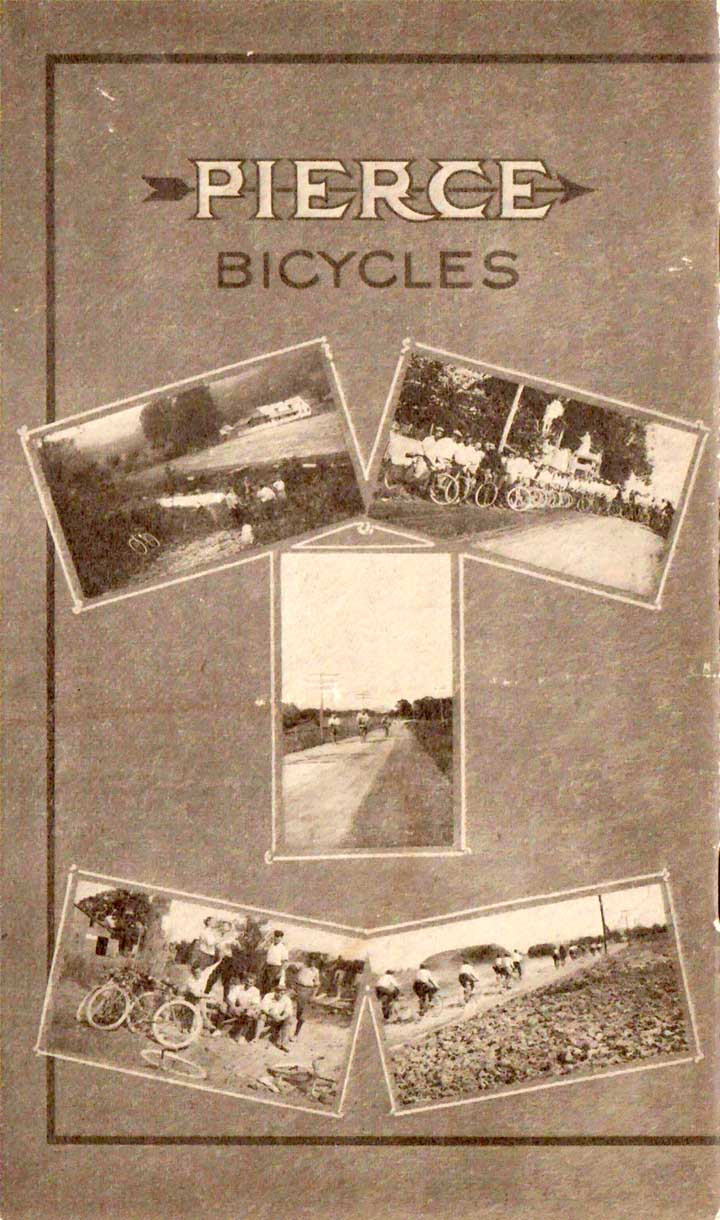
PIERCE [arrow device] BICYCLES
[The same design as the front cover with different photographs, among them a group of riders with
their bicycles beside a steam locomotive, and a road crew at work.]
[A twenty-leaf brochure of The Pierce Cycle Company, Buffalo, New York — front cover, an
introduction, numbered pages 1 to 17 and a back cover. Complete, no gaps. It is the archive’s first
Pierce catalog, and it joins four Pierce newspaper advertisements and two articles.
ON THE TEXT ABOVE, PLAINLY. This is a close reading of the twenty scans rather than a word-for-word
transcription of every line. The specification blocks — the model numbers, frame sizes, prices,
gauges, tooth counts, part numbers and the whole of the Pierce-Kramer page — are given as printed.
The connecting prose is summarized, with the brochure’s own phrases kept inside quotation marks
where they carry the argument. Passages in square brackets describe rather than quote. The reading
was made on 2026-07-27 and is preserved in full at `docs/pierce-brochure-ocr-2026-07-27.md`.
THE DATE IS NOT PRINTED ANYWHERE IN THE BROCHURE. It is placed at about 1915, plausibly a catalog
for the 1916 season, on five independent signals that converge:
1. The decisive one, on page 11. Frank L. Kramer is described as “American Professional Champion for
fifteen years.” Kramer held the American professional sprint title in an unbroken run from 1901
to 1916, so the fifteenth year is 1915. The archive now holds contemporaneous corroboration of
the other end of that run: a Geo. F. Clark advertisement in the Worcester Spy of 23 March 1902
captions him twice as National Champion 1901, on a Pierce Racer.
2. The introduction opens “About twenty-five years ago, the world went ‘bicycle mad'” — the boom
builds from roughly 1890.
3. Pierce-Arrow is discussed in the past tense. The motor cars left Hanover Street for the Elmwood
Avenue plant in 1906.
4. The firm brands itself throughout as The Pierce Cycle Company, incorporated in September 1906
when the bicycle business was separated from the motor car company.
5. The product mix is mid-1910s, including a Pierce Motor-Bike frame style, and the enamel is
praised as still sound “after ten, fifteen and twenty years service” on machines built back in
the nineties and now ridden by the sons and grandsons of their original owners.
WHAT THE BROCHURE SETTLES, AND WHERE IT CONTRADICTS THE RECORD. The introduction states that the
George N. Pierce Company “was organized in 1862” — a year before the seventeen-year-old George
Pierce reached Buffalo in 1863, and sixteen years before the 1878 founding the Ebykr article gives.
It is a clean, citable instance of a period firm backdating itself, most likely reaching back to the
predecessor partnership. The brochure also prints 6-18 Hanover Street as factory and general
offices, which corrects any reading that Pierce vacated Hanover Street for Elmwood Avenue: the motor
car work moved, the bicycle works stayed.
The editorial point of the range is that the cushion-frame chainless still heads it at $80, roughly
fifteen years after its 1900 introduction — not a short-lived turn-of-the-century experiment but the
flagship, held to the end.
RESOLUTION. The interior leaves are 504 pixels wide and the covers 720, below the archive’s usual
working floor. They are published under the two-floors rule: a catalog page is its words, and every
specification, price and part number on these sheets reads cleanly at native size. A better scan
would be welcome and should replace this one.
PROVENANCE AND THANKS. The brochure belonged to a lifetime member of the St. Louis Cycling Club and
was made available for reproduction by his son, Bill Alexander. It was scanned and published by
Chuck LaChiusa on Buffalo Architecture and History (buffaloah.com) in 2010, where the full set
remains online. Ebykr is grateful to all three. The scans carry no watermark and no modification.]
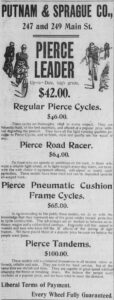 Pierce 1898 Advertisement — Putnam & Sprague Co., the Pierce Line with Prices
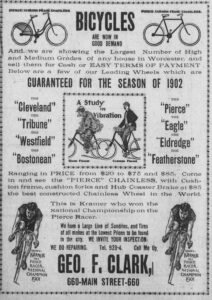 Pierce 1902 Advertisement — Geo. F. Clark, A Study in Vibration and Kramer, National Champion
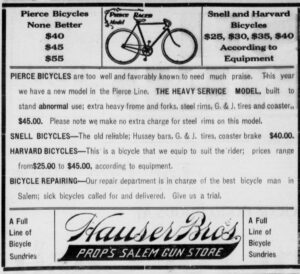 Pierce 1909 Advertisement — Hauser Bros., None Better, and the Heavy Service Model
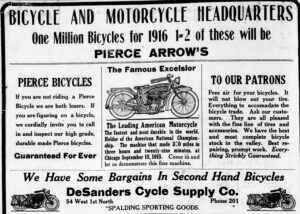 Pierce 1916 Advertisement — DeSanders Cycle Supply Co., Bicycle and Motorcycle Headquarters
Ebykr presents this material for research and education. If you hold rights to it or notice an ownership issue, please contact us and we will respond promptly.
The Ebykr Digest
New articles, timelines, catalog finds and registry activity — assembled from the archive once a month. Your address is never shared.
Double opt-in. One email per month. Unsubscribe at any time with one click.
