From gilded birdcages in a Buffalo workshop to chainless, shaft-driven bicycles that sat at the head of its catalog for 15 years, the history of Pierce is the story of a manufacturer that kept betting on the harder way of doing things. George Norman Pierce arrived in Buffalo as a teenager in 1863, built a household-goods business, walked away from it to found his own company, and then moved through tricycles and safety bicycles into a machine that tried to move beyond the chain altogether.
The same firm also gave rise to the Pierce-Arrow Motor Car Company, though strictly its bicycles were never Pierce-Arrows: from 1906 they were products of the Pierce Cycle Company, made on Hanover Street after the automobile operation had moved across town. This timeline traces the milestones of that Buffalo marque, from the birdcage partnership to the serial numbers collectors still use to date a surviving Pierce bicycle
29 of 29 events
1863
Founder Arrives
A seventeen-year-old George Norman Pierce leaves Friendsville, Pennsylvania for Buffalo, New York in search of opportunity.
1860s–1870s
Early Partnership
Charles Heinz, George Pierce and George Munschauer manufacture household goods together in Buffalo — ornate bathtubs, gilded birdcages, insulated iceboxes and fancy pull wagons. The work gives Pierce his first lessons in industrial manufacturing and market segmentation.
1878
Company Founding
Pierce goes his own way, establishing George N. Pierce & Co. to compete with his former partners. The firm’s own advertising of the 1890s claimed it was established in 1865, and its brochure of about 1915 gave 1862, a year before Pierce had even reached Buffalo.
c. 1888
Product Launch
Within ten years of founding the company, Pierce adds a range of children’s tricycles built for ages 3-15, and finds a new and red-hot market.
1889
Bicycles Introduced
Riding the success of the tricycles, Pierce adds bicycles, sold as the Queen City. By the 1893 season they are offered with cushion or pneumatic tires, the invention John Boyd Dunlop had patented in 1888. Pierce’s safety bicycles have two same-sized wheels.
1895–1896
New Name
The Pierce name goes on a new high-grade line for the 1895 season, and in 1896 the firm is incorporated as The George N. Pierce Company.
May 1896
Trade Advertising
Pierce advertises in the trade journal The Wheel. The firm’s catalog of the same year documents its first seasons in the bicycle trade.
1898
Cushion Frame
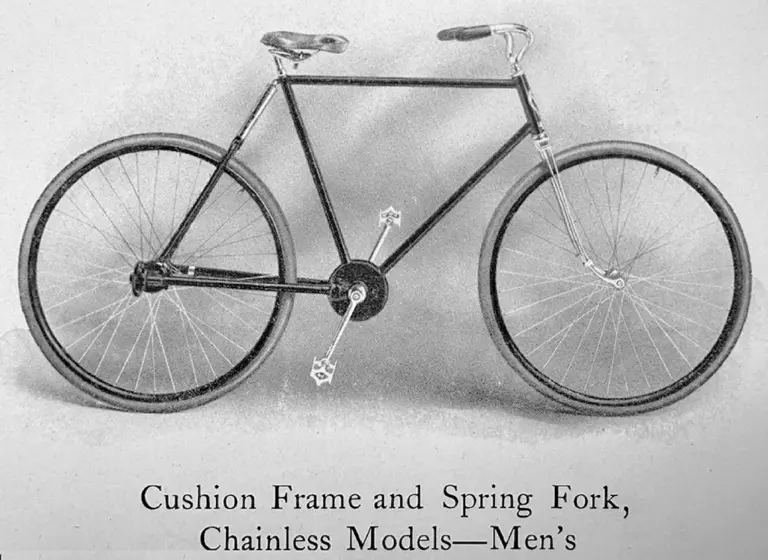
Pierce puts its cushion-frame model on the market, on chain-driven bicycles at first.
1899
Catalog
The George N. Pierce Company catalog and period advertising offer Pierce Special bicycles in men’s and women’s models.
1899
Patent Filed
The patent for the cushion-frame shaft-drive chainless is applied for in September, months before the machine reaches the market. It is granted in December 1903.
1900
Chainless Launch
The shaft drive reaches the market on the cushion frame as Nos. 242, 244 and the women’s 248; the Model 294 is its 24-inch men’s model for 1901. Two bicycles reported stolen as 1900 models carry frame numbers 69,427 and 74,987, the second of them a chainless.
1901
Model Introduced
The cushion-frame chainless with a New Departure hub coaster brake is sold as the Pan-American Special, at $80, named for the Pan-American Exposition in Buffalo. The advertisement “A Study in Vibration” sets the cushion frame’s ride against that of an ordinary machine.
1901
Motor Cars Begin
Pierce introduces the gas-powered Motorette at the Pan-American Exposition in Buffalo. Pierce bicycles are well represented at the same Exposition, including machines used by its police force.
1902
Spring Fork
The spring fork is new for this year, two flat spring leaves a side, and remains one of the firmest cues for dating an early Pierce. A surviving cushion-frame chainless with the fork, frame number 94,344, is dated to 1902 by it.
c. 1906
Relocation
Growth from the Motorette pushes the company to build a new 15-acre plant on Elmwood Avenue at Great Arrow. It is the motor car work that moves there; the bicycle works stay on Hanover Street.
1906
Catalog
The George N. Pierce catalog still shows the cushion-frame chainless at the head of the range, alongside the New Departure coaster brake shared with the chain models and the patented seat and handlebar binders that were pure Pierce.
September 1906
Corporate Split
The Pierce Cycle Company is incorporated, with Percy Pierce as president, and takes over the bicycles and the Hanover Street works.
1907
Founder Departs
George Pierce sells his family interest in the business. He had been founder and principal officer of the bicycle company for more than 20 years, but in the automobile business for only eight.
1908
New Name
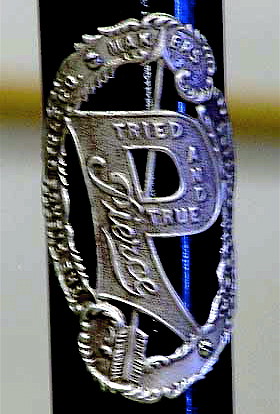
The motor car company takes the name Pierce-Arrow Motor Car Company. The bicycles were never strictly Pierce-Arrows, but the name stuck: the arrow had been on Pierce head badges since the 1890s, and the cycle company itself sold an “Arrow Cycle” in 1907 and wrote of its “Pierce Arrow trademark” in 1912.
1910
Founder Dies
Three years after leaving his namesake company, George N. Pierce dies of a heart attack. His retirement was short, but his legacy in both the bicycle and automobile industries was substantial.
c. 1915
Catalog Range
A Pierce Cycle Company brochure shows the Cushion Frame Chainless still at the head of the range at $80, above the $60 Pierce-Kramer Special Racer and well above the $35 Service Model. Factory and general offices are given as 6-18 Hanover Street, Buffalo. The brochure is dated by its description of Frank Kramer as champion “for fifteen years.”
c. 1915
Signature Racer
The Pierce-Kramer Special Racer carries the name of Frank L. Kramer, American professional champion from 1901 to 1916, who helped shape its lines and rode an exact duplicate in competition. Built in a single 21″ size and weighing about 20 pounds on silk tires, it was, in the company’s own words, a bicycle for racing purposes only.
c. 1915
Institutional Adoption
The Arch Truss, or Police Model, braced with an extra tube arching across the main triangle, is accepted by the New York Police Department.
c. 1915
Manufacturing Practice
Pierce publishes its factory methods: open-hearth brazing rather than the cheaper dip process (three times as long, three times as expensive and five times as reliable, by its own reckoning), frames built as three separately jigged units trued into alignment with each other, and four coats of enamel with the first three rubbed down by hand.
September 1918
New Owner
The Emblem Manufacturing Company of Angola, New York, buys the assets of the bankrupt Pierce Cycle Company and moves production to Angola, where a Pierce line runs until 1940.
1918–1919
Serial Evidence
Pierces listed as stolen in the newspapers of these years carry frame numbers between roughly 172,000 and 197,000. Three of the four happen to begin with the digits of the year, which is how the collectors’ shortcut of reading the first two digits as the year arose; notices that state a model year, such as 101,192 for a 1903 model and 144,850 for a 1909, disprove it.
2005
Museum Record
Surviving Pierce machines are on display at the Pedaling History Bicycle Museum near Buffalo, among them a cushion-frame chainless with spring fork and New Departure hub brake labeled as a 1901.
2009
Museum Closes
The Pedaling History Bicycle Museum closes and its collection is later dispersed at auction.
Present
Legacy
The chainless idea outlived its maker. After a 2000s revival by Massachusetts-based Dynamic Bicycles, since defunct, the concept’s true heirs arrived in another form: the toothed carbon belt drive paired with an internally geared hub, now standard equipment on commuters and touring machines worldwide.
Join the Pierce Discussion!
Do you own a Pierce chainless, a cushion frame or a Buffalo-built roadster? Share your machines, your frame numbers and your questions in our General Discussion forum.



 Pierce