Founded in Chicago in 1895, Schwinn ran an extraordinary double life: a mass-production giant selling balloon-tire cruisers and electro-forged ten-speeds by the million, and a small hand-build shop producing Paramount racing frames and fillet-brazed lightweights that could stand against anything made in Europe. This timeline follows the company from the 1890s boom through the Wastyn Paramounts, the Sting-Ray, the bike boom it failed to capture, two bankruptcies and the 2023 closing of Waterford.
Founded in Chicago in 1895 and for most of the twentieth century the definitive American bicycle, Schwinn ran an extraordinary double life: a mass-production giant selling balloon-tire cruisers and electro-forged ten-speeds by the million, and a small hand-build shop turning out Paramount racing frames and fillet-brazed lightweights that could stand against anything made in Europe. The company survived the 1905 crash, the Depression, two world wars and the arrival of the derailleur, then lost its market in a single decade to Japanese and Taiwanese manufacturers it had helped train.
Here is a chronological timeline of key corporate and product events at Schwinn, spanning 1895 to 2023, drawn from the sources used for the accompanying Ebykr article on the marque’s history, “Schwinn: An American Giant and Its Hand-Built Lightweights.”
55 of 55 events
1860
Founder’s Birth
Ignaz Schwinn was born in Hardheim, in the Grand Duchy of Baden, and entered the German bicycle trade before emigrating to the United States in 1891.
1895
Company Founding
Ignaz Schwinn and German-American meat packer Adolph Frederick William Arnold founded Arnold, Schwinn & Company in Chicago, then the center of an American industry with roughly thirty bicycle factories in the city alone.
1895
Product Launch
The first catalog, Famous Schwinn Built-Bicycles, led with the World and ran from a nineteen-pound racing machine through the World Ladies’ Standard Model No. 34, with its rear fender and skirt webbing, to doubles, triples and quadruples. The lightweight instinct was present in the company’s first season.
1899
Industry Consolidation
A. G. Spalding assembled the American Bicycle Company, a trust of roughly fifty firms claiming control of three-quarters of American bicycle sales. Ignaz Schwinn stayed out of it.
1900
Market Dominance
American bicycle production passed one million units a year at the peak of the safety bicycle boom.
1903
Industry Collapse
The American Bicycle Company trust fell into bankruptcy after burning through $80 million, taking a great deal of the industry with it and vindicating Schwinn’s refusal to join.
January 1904
Brand Storytelling
A dealer advertisement placed by Pinney & Robinson of Phoenix in the Arizona Republican offered the World at $35 and the Admiral, called the best medium-priced bicycle built, at $25, and sold the World on one argument: it was not made by the trust, from what the advertisement described as the largest and oldest cycle makers in Chicago.
c. 1905
Industry Collapse
The boom broke. American sales fell to about a quarter of their 1900 level and only twelve Chicago manufacturers survived. Schwinn was one, and Ignaz bought up failing rivals and built a modern West Side plant.
1908
Corporate Ownership
Adolph Arnold sold his shares to Ignaz Schwinn, leaving the family in sole control of a company that carried the Arnold name on its letterhead long afterwards. The 1967 Supreme Court case was still captioned United States v. Arnold, Schwinn & Co.
1912
Acquisition
Schwinn purchased the Excelsior motorcycle company, adding Henderson in 1917 to create Excelsior-Henderson.
1928
Market Dominance
Excelsior-Henderson ranked as the third largest American motorcycle maker, behind Indian and Harley-Davidson.
1931
Strategic Pivot
The Depression killed the motorcycle business. Ignaz Schwinn discontinued Excelsior-Henderson, and his son Frank W. Schwinn took over operations and refocused the company entirely on bicycles.
1933
Product Innovation
Frank W. Schwinn introduced the B-10E Motorbike, a youth bicycle styled after a motorcycle, redesigned the following year as the Aerocycle with 2.125 inch balloon tires, streamlined fenders, a dummy gas tank and a chrome headlight. The balloon-tire bicycle gave the American trade a product through the Depression and defined the shape later known as the cruiser.
1937
Product Innovation
Emil Wastyn, a Belgian master frame builder running a shop near the Schwinn factory and heading the Schwinn-sponsored racing team, designed and built the first Paramount. Paramount-badged machines appeared late that year under the company’s key six-day riders.
1938
Product Launch
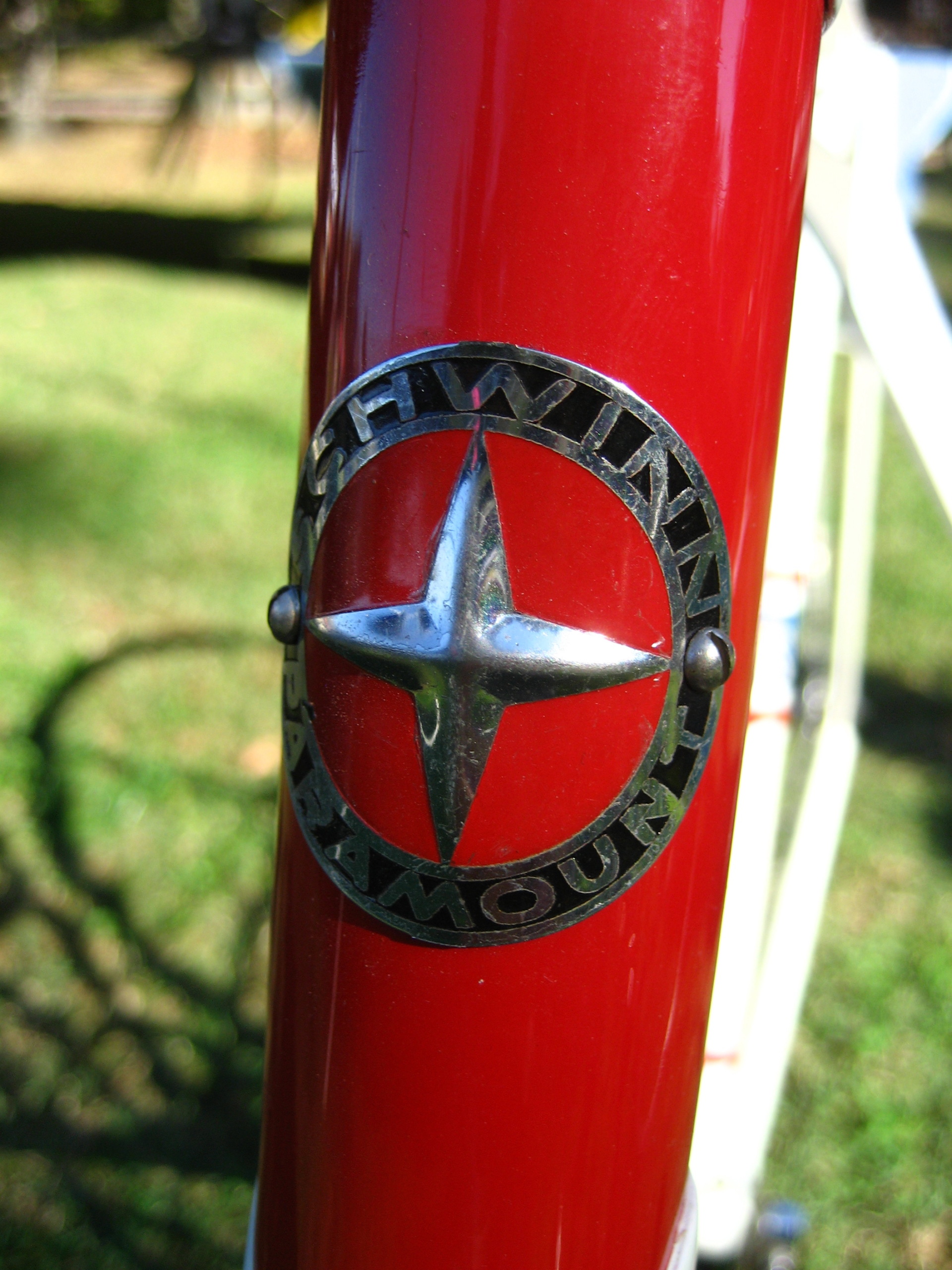
Frank W. Schwinn formally introduced the Paramount series: chrome-molybdenum tubing, brass lug-brazed construction and hand assembly, at a time when most American bicycles were electrically welded. Schwinn also began building fillet-brazed lightweights, a second hand-built line that would run for 41 years.
1938–1941
Manufacturing Detail
Emil Wastyn and his son Oscar built every Paramount. The earliest frames carry Wastyn’s signature balled-end seat stays and keyhole lugs; by 1941 the model had settled into the slant-trimmed seat stay caps it would keep for fifty years.
1939–1940
Racing Program
Schwinn’s catalog listed team riders including Bobby Thomas, Cecil Yates and Charlie Bergna, and recorded five wins and five second places for the season.
17 May 1941
Record Set
Alfred Letourneur rode a Schwinn Paramount behind a motor pace vehicle near Bakersfield, California and covered a mile at 108.92 mph, a motor-paced world speed record.
1946
Market Shift
Postwar imports rose tenfold to 46,840 units, some 95 percent of them British. Schwinn answered with middleweight “English racer” models and joined the industry campaign for tariffs.
1950
Strategic Pivot
Schwinn ended private-label production entirely, insisting the Schwinn name appear on everything it built, and offered distributors wider selling rights in exchange.
1952
Corporate Leadership
F. W. Schwinn assigned a strategy team of marketing supervisor Ray Burch, general manager Bill Stoeffhaas and design supervisor Al Fritz.
August 1955
Trade Policy
The Eisenhower administration imposed a 22.5 percent tariff on three bicycle categories and 11.25 percent on lightweight racers. Imported market share fell to 28.5 percent and stayed under 30 percent through 1964. A further 50 percent tariff followed under President Kennedy in 1961.
1957
Product Innovation
The Paramount, still built to 1930s designs, was modernized with Reynolds 531 double-butted tubing, Nervex lugsets and Campagnolo derailleurs. None of the technology reached the mass-market range.
1957–1967
Legal Action
The Department of Justice sued Schwinn for restraint of trade over its distribution system. The Supreme Court ruled against the company in 1967 in United States v. Arnold, Schwinn & Co., forcing costly reorganization into four regional warehouses just as foreign competition intensified.
1960–1961
Product Launch
The Varsity arrived as an eight-speed and became a ten-speed in mid-1961, joined by the Continental. Both used Schwinn’s lugless electro-forged steel frame with Ashtabula one-piece cranks and chromed stamped-steel rims, and both sold in enormous numbers.
1962–1978
Product Line
Schwinn’s fillet-brazed lightweights reached their high-volume years as the Superior (1962–63, 1976–78), Super Sport (1964–73) and Sports Tourer (1971–75): SAE 4130 chrome-molybdenum tubing in oversize 29.5 mm sections, internally sleeved at the joints and finished by hand in a separate Chicago shop. Prices ran from $96.50 to $229.95.
1963
Product Launch
Al Fritz, acting on reports of California youngsters fitting high-rise bars and banana seats to their bicycles, developed Project J-38 and launched it in June as the Sting-Ray. Sales were slow until the bikes appeared on the street, after which demand became overwhelming.
1963
Corporate Leadership
F. W. Schwinn died. His son Frank Valentine Schwinn took over management of the company.
1969–1973
Product Revision
The Paramount range was reshuffled. The P11 tourist and P12 road racer were gone from the 1969 catalog, and in 1970 the P13 became the Professional Road Racing Paramount, joined in April by the P15 Diamond Jubilee, a 15 speed tourer with a Nuovo Record triple crankset and long-cage rear derailleur. By 1971 the P13 had tighter chainstays and fork for 700C wheels with Weinmann 610 centerpulls, while the P15 kept room for 27 inch clinchers and fenders. The P10 followed in 1973 as the P15’s 10 speed version. Campagnolo sidepulls were an extra-cost option on the P13. The P14 remained the track model.
1973
Manufacturing Shift
Schwinn put its name on the Le Tour, a Japanese-built low-cost sport tourer, and developed supply relationships with Bridgestone and Panasonic. The Panasonic-built World Traveler and butted-Tange World Voyager offered much of what a Paramount offered at roughly half the price, and were initially kept out of the consumer catalogs.
1974
Market Dominance
Schwinn sold roughly 1.5 million bicycles but failed to capture the 1971–75 lightweight boom, whose buyers wanted current racing geometry, alloy components and light tubing that Schwinn’s electro-forged range could not offer.
1975–1976
Cultural Milestone
Riders in Marin County, California stripped down 1930s and 1940s Schwinn balloon-tire cruisers, especially the Excelsior, and raced them down Mount Tamalpais on a course called Repack, named for the coaster-brake grease burned out on every run. On 21 October 1976 a field of these fifty-pound klunkers raced a dirt road dropping 1,300 feet in under two miles. Gary Fisher set the fastest recorded time of 4:22 that December. Schwinn’s marketing department judged mountain bikes a fad.
1977
Product Innovation
Joe Breeze built the first frame purpose-designed for off-road racing, riding Breezer No. 1 to a winning Repack time of 4:25. The prototype is now in the Smithsonian.
1978
Product Discontinued
Schwinn ended fillet-brazed production after 41 years. The frames were superb and effectively unmarketable: the technique carried no prestige, the bicycles looked like the cheap Varsity to an untrained eye and the catalogs never explained the difference. Schwinn’s board also rejected a proposed new factory in Tulsa, Oklahoma because the financing would have required outside investors.
1978–1979
Product Launch
The Klunker 5, an electro-forged cantilever frame with five speeds and knobby tires, was Schwinn’s first mountain bike answer. It was barely marketed, never properly cataloged and could not survive hard off-road use.
October 1979
Corporate Leadership
Edward R. Schwinn, Jr. took the presidency from his uncle Frank.
1979
Product Launch
The Sting, a serious BMX machine built from full Reynolds double-butted chrome-molybdenum tubing in the Paramount assembly area, joined a BMX range that had begun with the 1975 Scrambler after management first dismissed the sport as dangerous.
1980
Manufacturing Shift
Paramount production moved from Chicago to a plant in Waterford, Wisconsin.
September 1980 – February 1981
Labor Dispute
Chicago assembly workers organized with the United Auto Workers and struck. 1,400 workers walked out for thirteen weeks. When the strike ended, only about 65 percent were recalled.
1981
Manufacturing Shift
Schwinn moved remaining American production to Greenville, Mississippi, assembling Asian-sourced parts away from the union. The plant was far from headquarters and from West Coast ports, and lost money every year.
1982
Product Launch
The Predator BMX model captured only about eight percent of its market, despite a factory-supported race team running since 1976.
1985
Manufacturing Shift
Working with Giant Bicycles in Taiwan, Schwinn transferred frame design and manufacturing expertise abroad, lifting sales to around 500,000 bicycles a year and approaching a million by the late 1980s.
1986–1987
Racing Program
Ned Overend won back-to-back NORBA national mountain bike championships riding for Schwinn, at a moment when Specialized and Fisher MountainBikes were taking the commercial market.
1986–1987
Product Revision
The Paramount moved to Columbus SL and SP tubing with investment-cast lugs, having used Reynolds 531 with investment-cast lugs from 1982.
late 1980s
Strategic Error
After failing to buy a minority stake in Giant, Edward Schwinn Jr. opened a separate production deal with China Bicycle Company. Giant retaliated by selling Giant-branded bicycles to Schwinn’s own retailers, and both suppliers used Schwinn’s transferred expertise to build their own brands.
1991
Plant Closure
The Greenville plant closed, laying off 250 workers, and Schwinn sourced its production entirely overseas.
1992
Bankruptcy
Schwinn declared bankruptcy. Trek, Specialized and Cannondale had taken the market the company had spent a decade failing to defend.
1993
Acquisition
The Zell/Chilmark Fund bought the company and name, moving headquarters to Boulder, Colorado. In the same year Richard Schwinn, great-grandson of Ignaz, and frame designer Marc Muller bought the Waterford plant, founding Waterford Precision Cycles the following year. They acquired the factory but not the right to build under the family name.
September 1994
Product Discontinued
Paramount production ceased, restarting in 1998 and ending for good in 2009.
late 1997
Acquisition
Questor Partners Fund, led by Jay Alix and Dan Lufkin, purchased Schwinn. Questor acquired GT Bicycles the following year for approximately $80 million.
September 2001
Bankruptcy
Schwinn/GT declared bankruptcy and was bought at auction by Pacific Cycle, a company built on mass-market brands.
2004
Acquisition
Dorel Industries acquired Pacific Cycle, and with it the Schwinn name.
2010
Brand Storytelling
Dorel launched major campaigns reviving Schwinn on childhood nostalgia, reintroducing the Sting-Ray.
2021
Acquisition
Dutch group Pon Holdings agreed to acquire Dorel Sports, Schwinn included, in a deal worth roughly $810 million. Pacific Cycle continues to run the brand under Pon from Madison, Wisconsin.
June 2023
Company Closure
Waterford Precision Cycles closed, laying off seven employees as Richard Schwinn, then 69, retired. It ended more than 130 years of continuous Schwinn family bicycle building. Waterford had been hand-building roughly two thousand steel frames a year under the Waterford and Gunnar names.
Join the Schwinn Discussion!
Do you ride a Chicago Paramount, a fillet-brazed Superior, a Sports Tourer or a Panasonic-built World Voyager? Share your machines, your serial numbers and your dating questions with the community.


 Schwinn
.jpg)