About Ebykr
Ebykr celebrates classic and vintage lightweight bicycles through provocative imagery and opinion. Ride along with us.
About Ebykr
Ebykr celebrates classic and vintage lightweight bicycles through provocative imagery and opinion. Ride along with us.


A practical guide to dating a vintage Bianchi: why its frame number cannot give you a year, and how the tubing, the transfers, the components and Bianchi's own catalogs from 1912 to the late 1980s can.
A vintage Bianchi is easy to recognize yet surprisingly hard to date. The celeste paint and eagle logo tell you the name from across a parking lot, but the frame number stamped into the steel (or aluminum or carbon or titanium) does not tell you the year, because Bianchi has never published a key to it. Anyone who offers you a Bianchi serial chart is probably offering you a guess.
That is not a dead end, though. It means a Bianchi is dated the way a careful collector dates most Italian bicycles: by everything else around the number. That means the tubing, the components, the transfers and above all the model itself, matched against what Bianchi actually printed in its own catalogs. The Ebykr Catalog Archive holds 13 Bianchi publications from 1912 to the end of the 1980s and this guide is built from them.
Start by finding the number anyway, because it identifies the frame even when it cannot date it. Owners report Bianchi numbers under the bottom bracket shell, on the seat cluster, on the seat tube and now and then on the head tube. The location moved with the era and with the factory that built the frame, and the formats move with it, from plain runs of digits, to letters before digits, to letters in the middle of digits. How very “big bike conglomerate” of them, right?!
What no one has produced is a rule tying any of those formats to a year. None of the 13 catalogs in the archive explains the numbers. The closest thing is the order form at the back of Bianchi’s Reparto Corse book of about 1981, which leaves a blank line for the “SERIAL No.” of the frame being ordered. Some see this as proof that the racing department recorded its numbers, or at least encouraged its customers to, not that it ever published them, let alone the system behind them. Bianchi offers no public lookup today and owners who ask on public forums are sent to Bianchi’s rider support resources.
You will find decoding rules on the web, most often a claim that early 1980s frames carry a year digit, then a month letter, then a series number. It comes from a single forum post, other owners report numbers that do not fit it, and nobody has tied it to a dated document. Treat it as an idea worth testing, not as a rule, and be wary of any chart that repeats it. Several web pages agreeing with one another is still one source, not several, no matter how badly we want to know when that beautiful Bianchi was made.
The way through is to collect numbers alongside the evidence that dates each bicycle individually. If you own a Bianchi, record the number, exactly where it is stamped, the model and any dated parts, and log it in the Ebykr Serial-Number Registry. Enough honest entries will settle the question the forums have not.
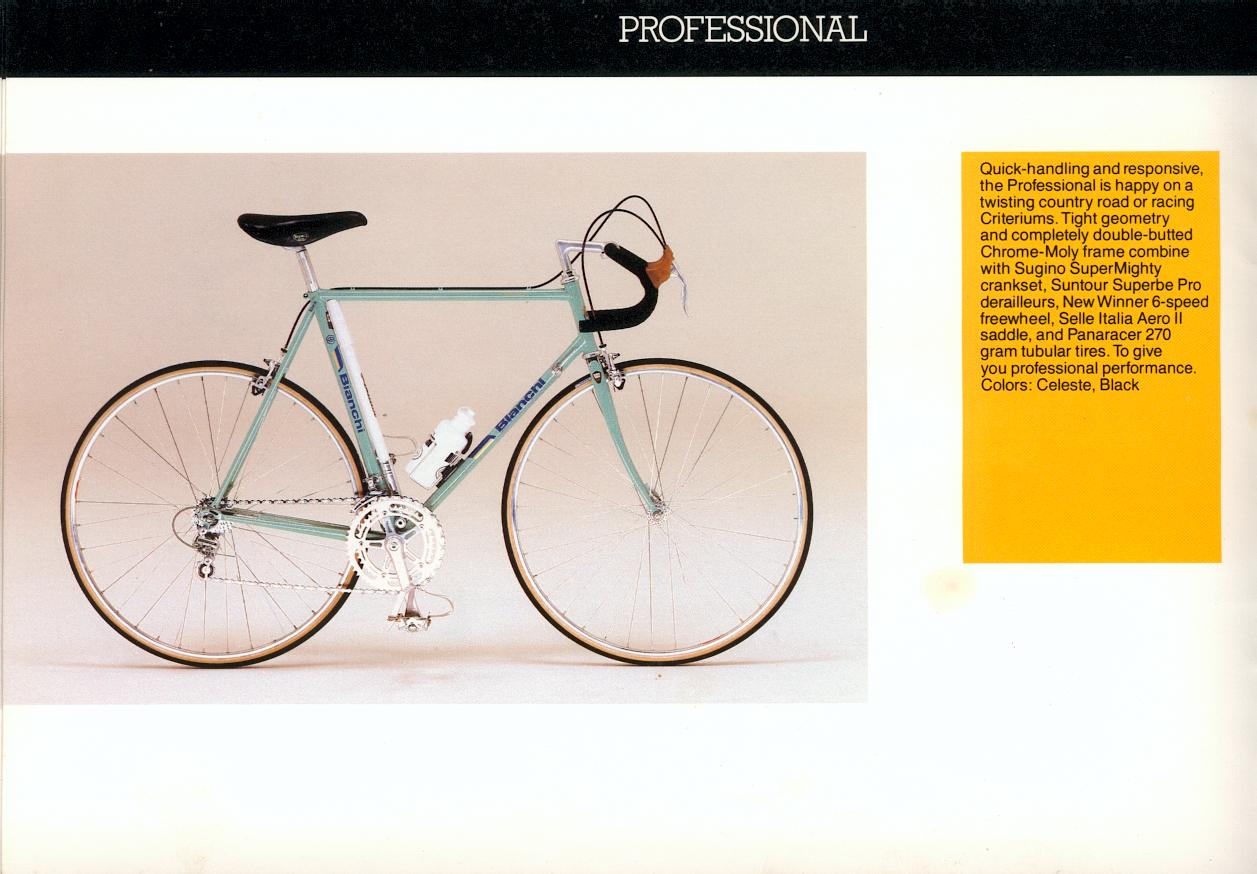
Before you date a Bianchi of the 1980s, work out which kind of Bianchi it is. The American catalogs of that decade sold two families side by side. One was built from Columbus tubing in the Italian tradition. The other used chrome-molybdenum tubing and Japanese components. The catalog of about 1983 already describes its Professional as “an all Chrome-Moly d.b. frame” with a Tange Levin headset, Sugino SuperMighty crankset and Suntour Superbe Pro derailleurs, and the 1987 catalog offers four models on “Tange double-butted Chrome-moly for Bianchi” tubing: the Brava, Sport SX, Premio and Volpe.
Not one of those catalogs prints where a model was built, so let the frame tell you. Three checks can help, with the best listed first here:
Who built the Japanese frames remains unsettled. Forum posts name tubing makers and suppliers, but no Bianchi document we have found names the factory, so this guide does not either. Any additional insight into this would be appreciated if you know more about how Bianchi numbered its Japanese frames.
The most reliable way to date a Bianchi is to find its model, specification and color in a catalog, and then to see which years agree. The table lists the road models each catalog in the archive actually prints, with the tubing and components it names. Several of the books carry no printed year and the “dated by” column says how each one was placed, and the link opens the full book.
| Catalog | Dated by | Road models | Tubing and parts named |
|---|---|---|---|
| 1912 | Printed year | Model M “Giro Italia”, Racer (track), S, D¹, S¹, N, R, B and touring types | Brooks saddles, Renold chains, Pirelli-Bianchi tires |
| 1928 | Printed year | Touring, racing and children’s bicycles | Pirelli Cord tires |
| 1940 | Printed year | Folgore (road racing, celeste), Freccia, Impero and touring models | A gear control “tipo Campagnolo” on the Folgore |
| 1973 | Gimondi, world champion 1973 | Specialissima Professionale, Special, Rekord 74, Rekord Strada | Campagnolo “Rekord” and Gran Sport, Universal brakes |
| About 1981 | Estimated | Reparto Corse hand-made: Super Corsa, Superleggera, Campione del Mondo, made to measure | Columbus, Campagnolo |
| For America, undated | Not dated | Nuovo Racing, Nuovo Touring, Campione del Mondo, Super Leggera, Super Corsa, Super Pista | Campagnolo Nuovo Record and Super Record, Shimano 600, Columbus |
| About 1983 | Cites the 1982 world medal | Nuovo Racing, Professional, Campione d’Italia, Rallye, Campione del Mondo, Tipo Corsa, Super Leggera, Eco Pista, Super Pista | Columbus SP/SL, PS, Tretubi; chrome-moly on the Professional; Campagnolo, Suntour |
| About 1984 | Cites the 1983 world gold | Nuovo Racing, Campione d’Italia, Tipo Corsa, Super Leggera, Eco Pista, Super Pista | Columbus Tretubi, SL/SP, PS; chrome-moly; Campagnolo Super Record |
| About 1985 | “The second hundred years begin.” | Mondiale, Giro, Pista, Centenario | None named |
| 1985, Japan | Prices as of 1 April 1985 | Centenario, Super Leggera, Campione, Campionissimo, Squadra, Speciale-II, Strada and others | Columbus SLX, SL+SP; Campagnolo; Suntour |
| 1987, United States | Back-cover code “MB87” | X4, Mondiale, Giro, Pista, Super Leggera, Trofeo, Nuovo Alloro, Limited, Squadra, Brava, Campione d’Italia, Strada and others | Columbus SLX/SPX, SL/SP, Formula II; Tange; Campagnolo C Record, Shimano Dura-Ace and 600 |
| After 1987 | Revises the 1987 range | C-4 Project, Mondiale, Super Leggera, Pista, Giro, Limited | Campagnolo Chorus Syncro and C-Record Syncro; Columbus; Tange |
Some of the sharpest clues are the smallest ones, naturally for us aficionados. Bianchi spelled it “Rekord” in its own 1973 book. The Super Pista text description is the only thing that separates the books of about 1983 and 1984: one cites a world championship medal of 1982, the next the gold of 1983. The Centenario is the 100th-anniversary model of 1985. A 1987 American Bianchi wears Campagnolo C Record with no Syncro and a GPM “America 87” crankset on the Super Leggera, and the book that followed replaced them with Chorus Syncro, “the latest in Italian technology.” And so on.
Two cautions from the onset. A catalog shows what was offered for a season, not what every shop sold around then, and a bicycle could sit on a showroom floor into the next year or even the year after that. And model names were reused across decades: a Super Leggera of 1984 and one of 1987 are different bicycles, so match the specification, not just the name. For two documented classic builds to compare against, see the Ebykr Tech Specs for the 1955 Campione del Mondo and the 1964 Specialissima.
The crowned eagle is Bianchi’s oldest mark and for all of its intrigue, it is less useful for dating than collectors might hope. It is in the trademarks of the 1912 catalog, on the cover medallion of 1928 and among the trademarks of 1940. It did not lose its crown with the Italian monarchy, either: the cover of the Reparto Corse book of about 1981 is a close-up of a celeste head tube carrying the eagle, still crowned, above an EDOARDO BIANCHI ribbon.
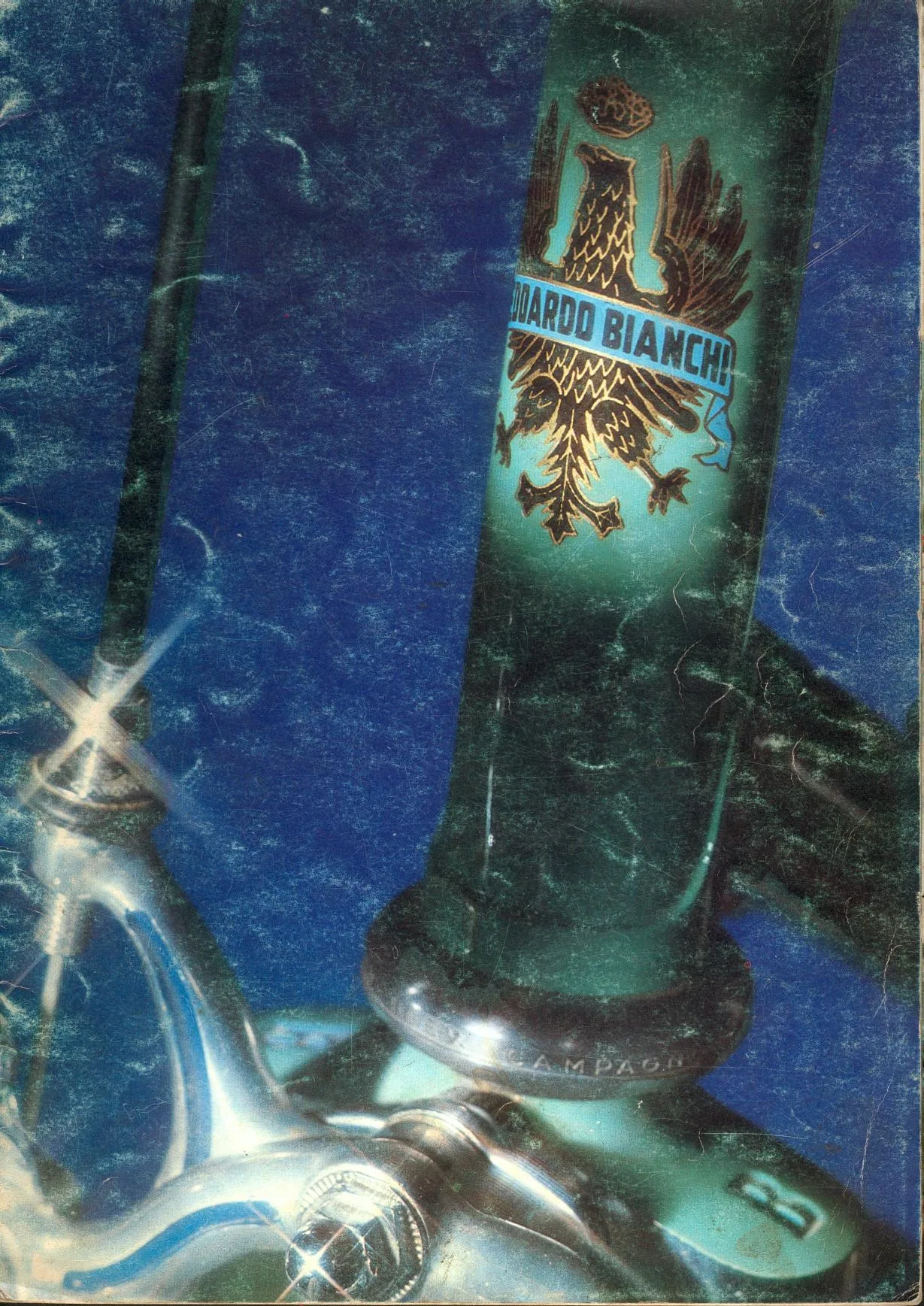
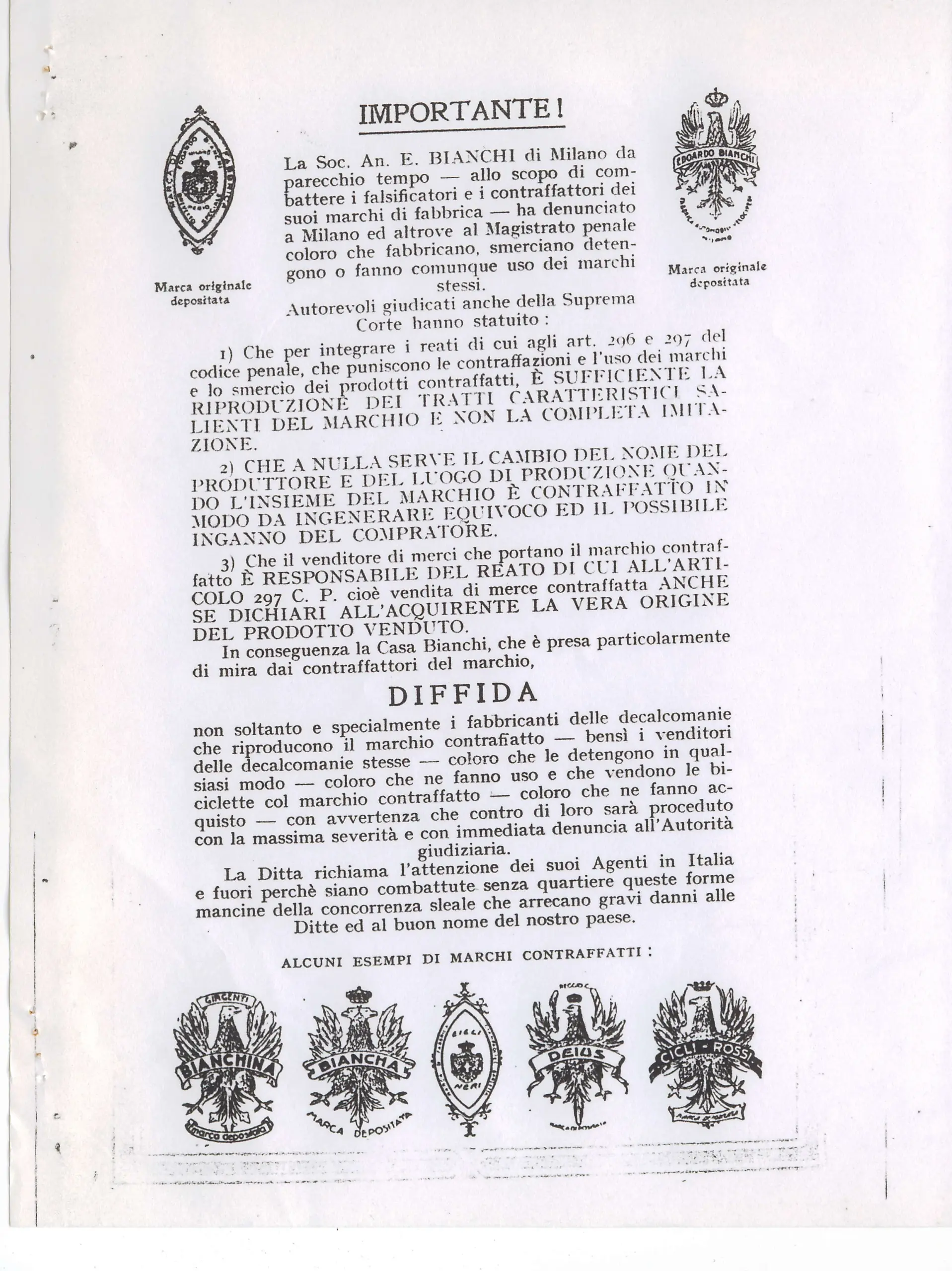
That same 1981 book explains how the graphics were applied in the racing department: the “transfers reproducing the brand are affixed and sealed with one coat of acrylic varnish,” so original transfers on a frame of that era sit under the clear coat. Transfers that sit on top of the paint, or that peel at the edge, deserve a second look. And Bianchi transfers have never proved a Bianchi frame. The 1928 catalog gives a full page to a warning that the company was prosecuting anyone who made, sold or used counterfeit transfers of its marks, so the problem is as old as the marque’s fame.
Celeste is older than many accounts allow. The 1912 catalog already sells the Model M “Giro Italia” and the Racer “verniciato in celeste” as standard, and offers celeste on two other racing models on request. It cannot date a frame on its own because the shade has varied from batch to batch and from decade to decade. The 1987 catalog alone offers Celeste, Metallic Celeste and celeste paired with yellow, turquoise, black and pearlescent white. Use the color to confirm a model, not necessarily to name a year. For the history of the color itself, see the Ebykr Bianchi history.

The company’s legal name changed several times and Bianchi’s own printed materials record each name. Read them as a clock for the paperwork that comes with a bicycle, such as a catalog, a manual, a guarantee card or a receipt. They are not a clock for the frame, because the frame itself carries the eagle and the word Bianchi rather than the legal name.
One trap deserves a sentence of its own. “Milano” on a transfer does not mean a bicycle was built before the move to Treviglio. The 1973 catalog is printed with the Treviglio address and on its Sebino Lusso page it shows a roadster whose enclosed chainguard still reads “Bianchi Milano.” The city stayed in the mark long after the cycle works had left it.

Every reading here comes from “The names on the paperwork” in this guide.
Bianchi’s better bicycles wore Campagnolo and Campagnolo is the most datable equipment of the period. A dated crank arm, stamped hub, derailleur model that ran only a few seasons, any of them will narrow a Bianchi faster than its frame number can. The Ebykr guides cover the codes in detail, so they are not repeated here. Start with How to Date a Vintage Bicycle by Its Components, which also reads Shimano, Simplex and Sturmey-Archer, then How to Identify and Date Vintage Campagnolo Components.
Remember that parts are the easiest thing on a bicycle to change. A date taken from a component is the earliest the bicycle can be in its present form, not proof of when the frame was built. When the parts, transfers and a catalog all agree, you can name the season with relative confidence.
Here is the method at work on a typical American-market Bianchi. Take a celeste Super Leggera with Columbus SL/SP tubing transfers, Modolo Flyer brakes and a Campagnolo C Record rear derailleur. The frame number decodes to nothing, so set it aside.

The answer is the 1987 American range, give or take a season of shop stock, reached without a single digit of the frame number. Check that the crank and the derailleur carry their own dates, and the reading is as firm as a Bianchi reading gets.
Bianchi dating will only get better if owners share what their bicycles carry. When you have placed yours, add it to the Ebykr Serial-Number Registry with the number, where it is stamped, the model and the parts that dated it, and bring photographs and questions to the Ebykr Bianchi forum. Browse every Bianchi document in the Ebykr Catalog Archive, and read the company’s story in Bianchi History: The Ultimate Guide and the Bianchi Timeline.
The Ebykr Identify and Date series also covers Schwinn, Peugeot, Raleigh, Fuji and Reynolds tubing, with every guide gathered on the Identify and Date hub.
Bianchi catalogs in the Ebykr Catalog Archive: 1912, 1928, 1940, 1973, Reparto Corse, about 1981, for America, undated, about 1983, about 1984, about 1985, 1985 range sheet for Japan, 1987, United States, after 1987 and the Specialissima flyer
Retrobike — Bianchi ID? (owner reports on number locations)
BikeRide forums — Bianchi frame origin and threading
Bike Forums — Bianchi serial numbers of the Piaggio era
Ebykr — Bianchi History: The Ultimate Guide to the World’s Oldest Bicycle Empire
Ebykr — Bianchi History: A Timeline of Key Corporate and Technical Events
Ebykr — How to Date a Vintage Bicycle by Its Components
Ebykr — How to Identify and Date Vintage Campagnolo Components
 Bianchi
Ebykr documents this marque across the archive. Here is the rest of it.
The Ebykr Digest
New articles, timelines, catalog finds and registry activity — assembled from the archive once a month. Your address is never shared.
Double opt-in. One email per month. Unsubscribe at any time with one click.