About Ebykr
Ebykr celebrates classic and vintage lightweight bicycles through provocative imagery and opinion. Ride along with us.
About Ebykr
Ebykr celebrates classic and vintage lightweight bicycles through provocative imagery and opinion. Ride along with us.

Source: bulgier.net (Mark Bulgier's catalog archive), scans posted in 2001; 2velo.com serves the same files.
 Page 1
 Page 2
 Page 3
 Page 4
 Page 5
 Page 6
 Page 7
 Page 8
 Page 9
 Page 10
 Page 11
 Page 12
 Page 13
 Page 14
 Page 15
 Page 16
| Marque | Bianchi |
|---|---|
| Type | Catalog |
| Year | 1981 (estimated) |
| Publisher | F.I.V. Edoardo Bianchi S.p.A. |
| Country | Italy |
| Language | English |
| Pages | 16 |
| Source | bulgier.net (Mark Bulgier's catalog archive), scans posted in 2001; 2velo.com serves the same files. |
| Credit | Ebykr archive |
| Identifier | Permalink http://bulgier.net/pics/bike/Catalogs/Bianchi-81b/ |
| Transcription | Transcribed by eye |
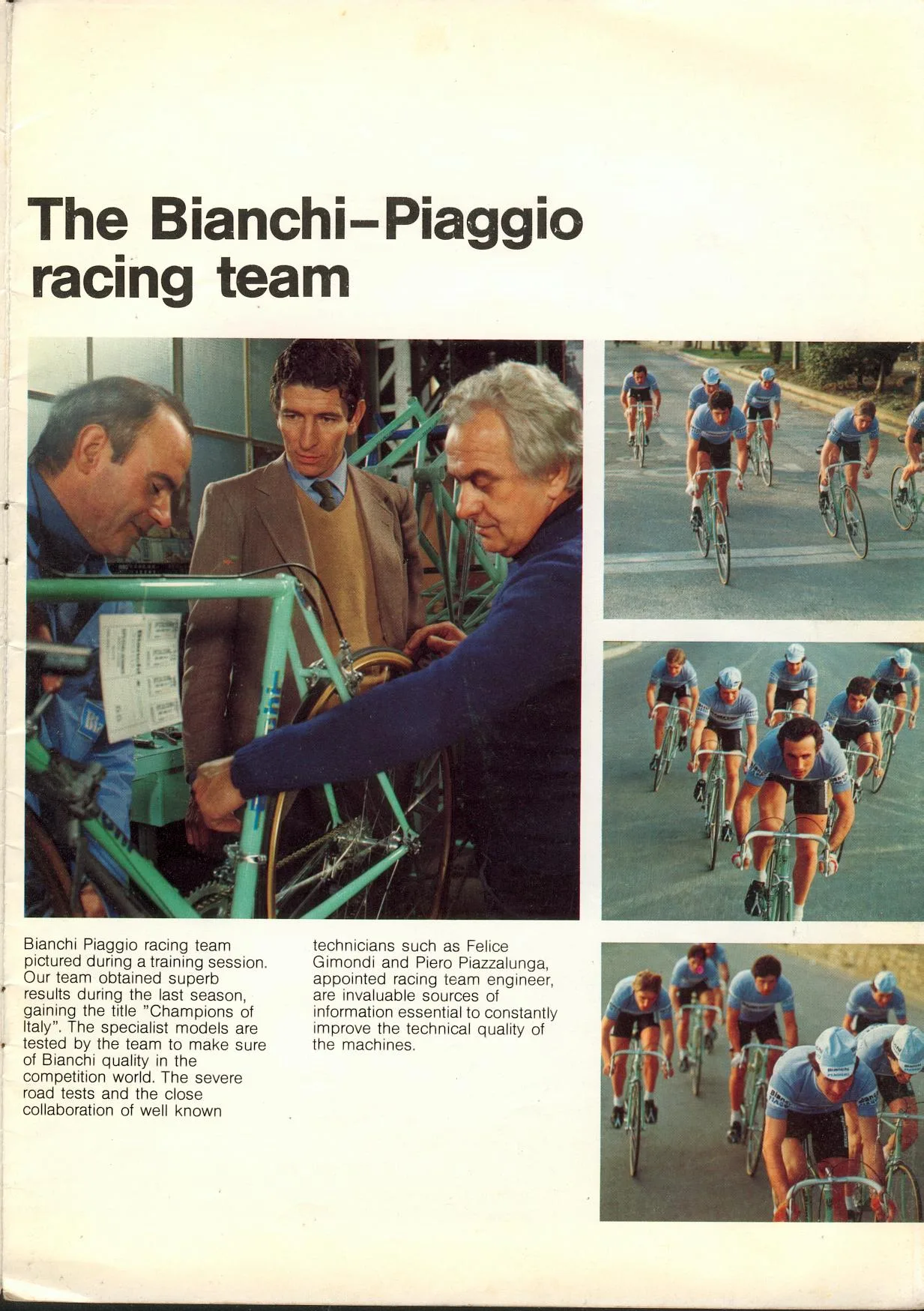
The Bianchi-Piaggio racing team Bianchi Piaggio racing team pictured during a training session. Our team obtained superb results during the last season, gaining the title "Champions of Italy". The specialist models are tested by the team to make sure of Bianchi quality in the competition world. The severe road tests and the close collaboration of …
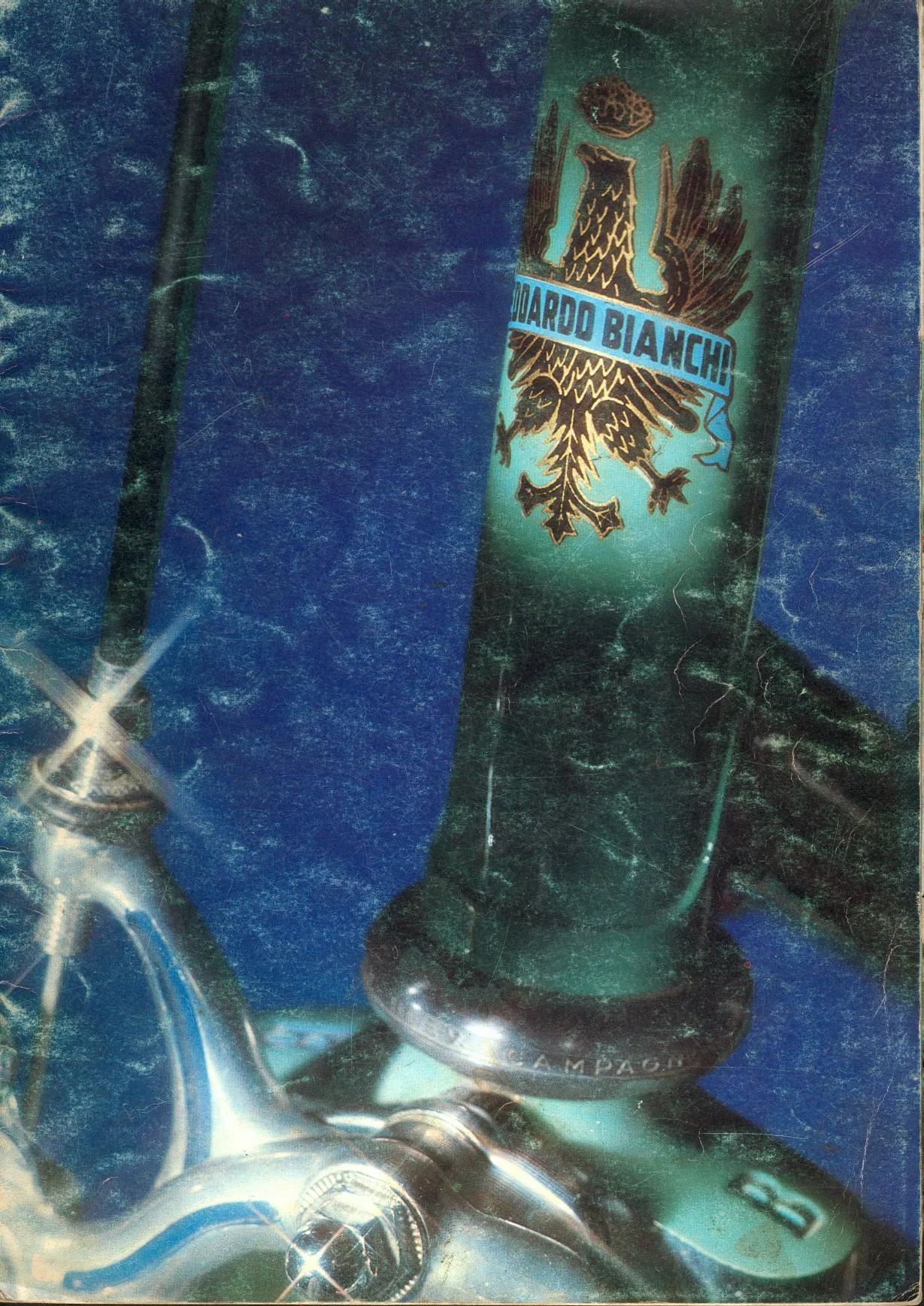
[Front cover: a close-up color photograph, against a deep blue ground, of a Celeste head tube
carrying the gilt EDOARDO BIANCHI eagle head badge, with a chromed Campagnolo headset and fork
crown below. No cover text other than the badge.]
The Bianchi-Piaggio racing team
Bianchi Piaggio racing team pictured during a training session. Our team obtained superb results
during the last season, gaining the title “Champions of Italy”. The specialist models are tested by
the team to make sure of Bianchi quality in the competition world. The severe road tests and the
close collaboration of well known technicians such as Felice Gimondi and Piero Piazzalunga,
appointed racing team engineer, are invaluable sources of information essential to constantly
improve the technical quality of the machines.
[Photographs: mechanics and Felice Gimondi inspecting a Celeste frame in the workshop; three
photographs of the Bianchi-Piaggio squad training in pale blue jerseys on Celeste machines.]
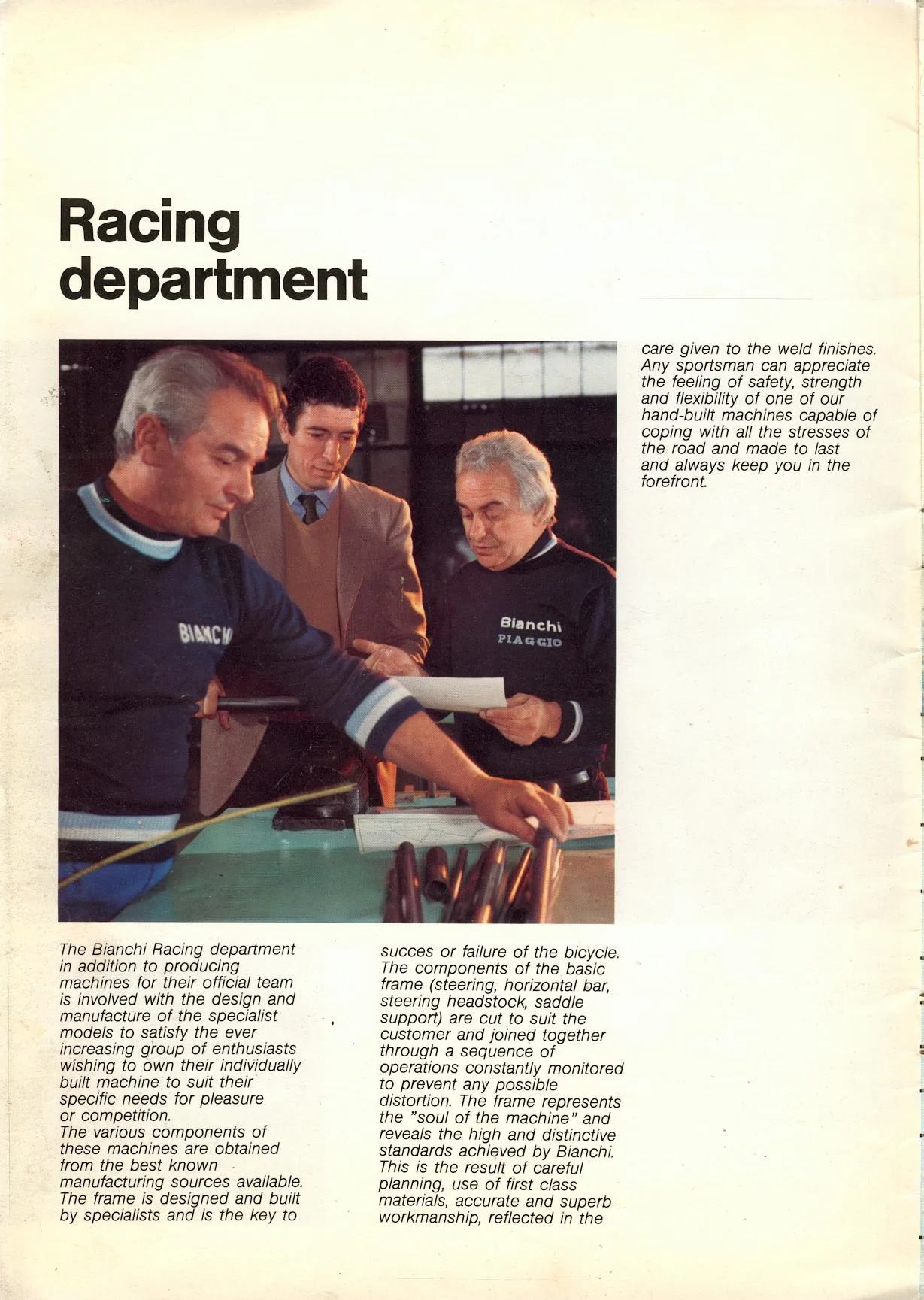
Racing department
The Bianchi Racing department in addition to producing machines for their official team is involved
with the design and manufacture of the specialist models to satisfy the ever increasing group of
enthusiasts wishing to own their individually built machine to suit their specific needs for
pleasure or competition.
The various components of these machines are obtained from the best known manufacturing sources
available. The frame is designed and built by specialists and is the key to succes or failure of
the bicycle. The components of the basic frame (steering, horizontal bar, steering headstock,
saddle support) are cut to suit the customer and joined together through a sequence of operations
constantly monitored to prevent any possible distortion. The frame represents the “soul of the
machine” and reveals the high and distinctive standards achieved by Bianchi. This is the result of
careful planning, use of first class materials, accurate and superb workmanship, reflected in the
care given to the weld finishes. Any sportsman can appreciate the feeling of safety, strength and
flexibility of one of our hand-built machines capable of coping with all the stresses of the road
and made to last and always keep you in the forefront.
[Photograph: two Bianchi Piaggio staff and Felice Gimondi at the bench with cut tubing and
drawings.]
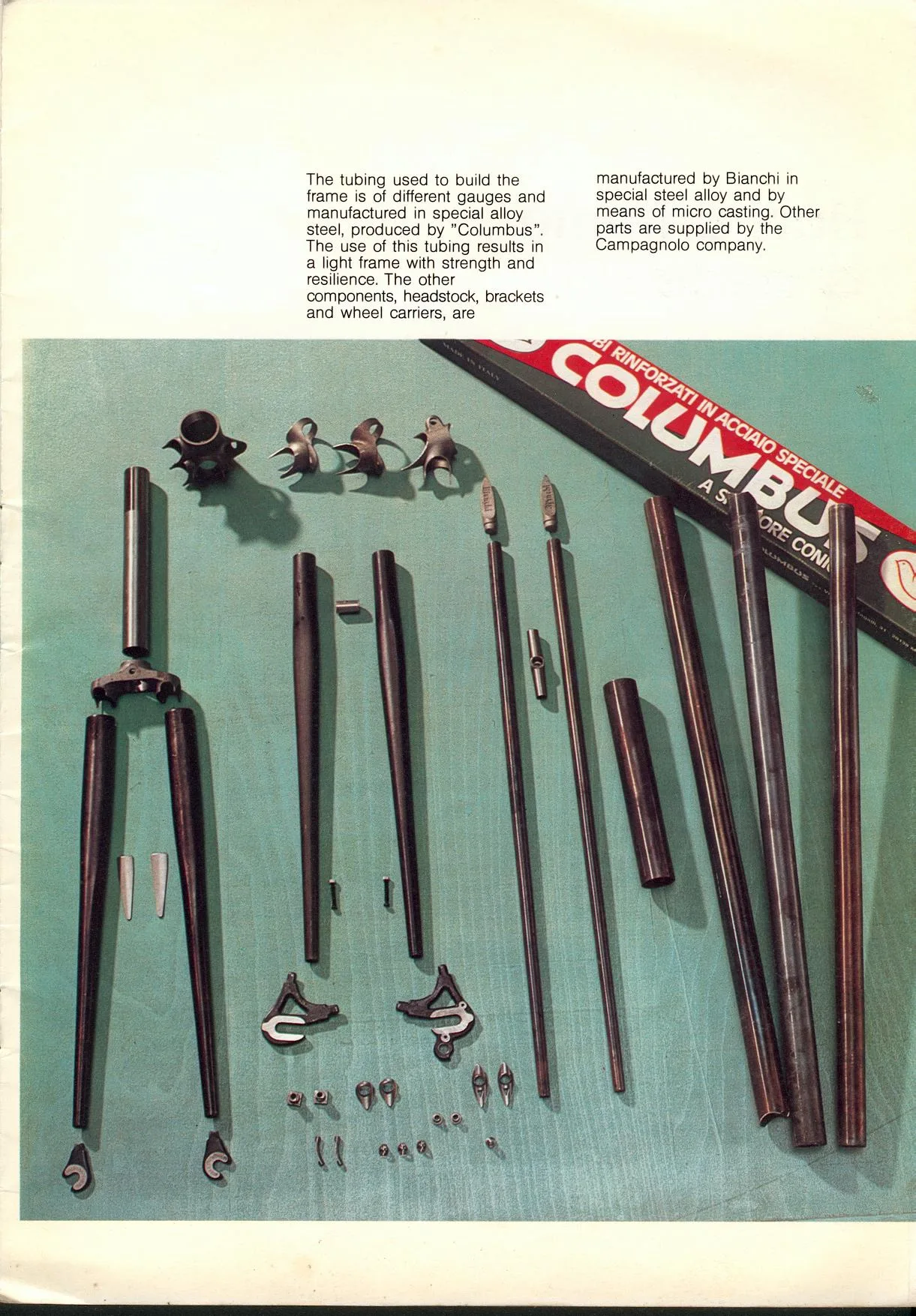
The tubing used to build the frame is of different gauges and manufactured in special alloy steel,
produced by “Columbus”. The use of this tubing results in a light frame with strength and
resilience. The other components, headstock, brackets and wheel carriers, are manufactured by
Bianchi in special steel alloy and by means of micro casting. Other parts are supplied by the
Campagnolo company.
[Photograph: a complete frame kit laid out on a Celeste bench — lugs, bottom bracket shell, fork
blades and crown, dropouts, cable guides and small castings, with a Columbus “TUBI RINFORZATI IN
ACCIAIO SPECIALE” tube-set box.]
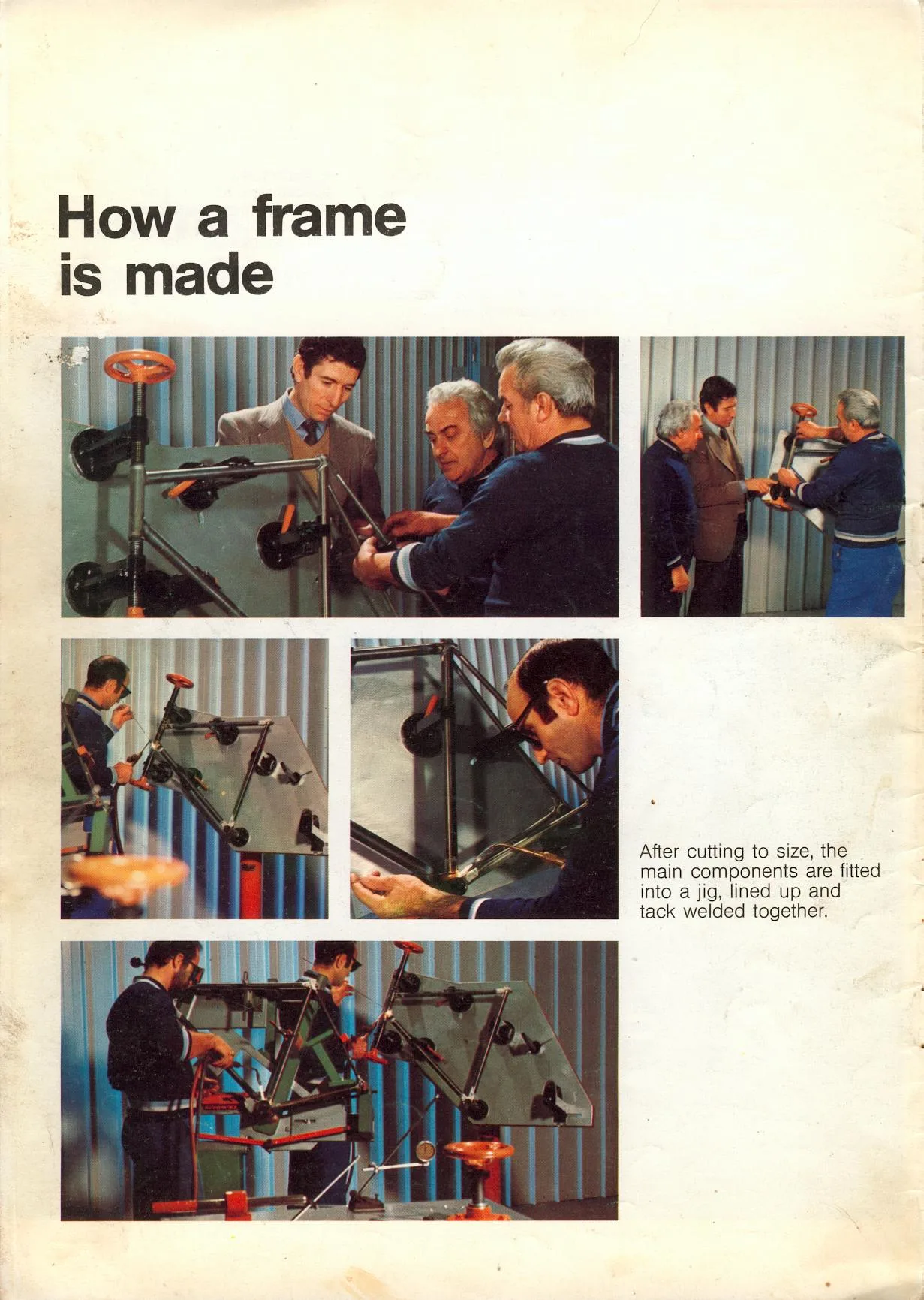
How a frame is made
After cutting to size, the main components are fitted into a jig, lined up and tack welded
together.
[Five workshop photographs of tubes being set into the frame jig and tacked.]
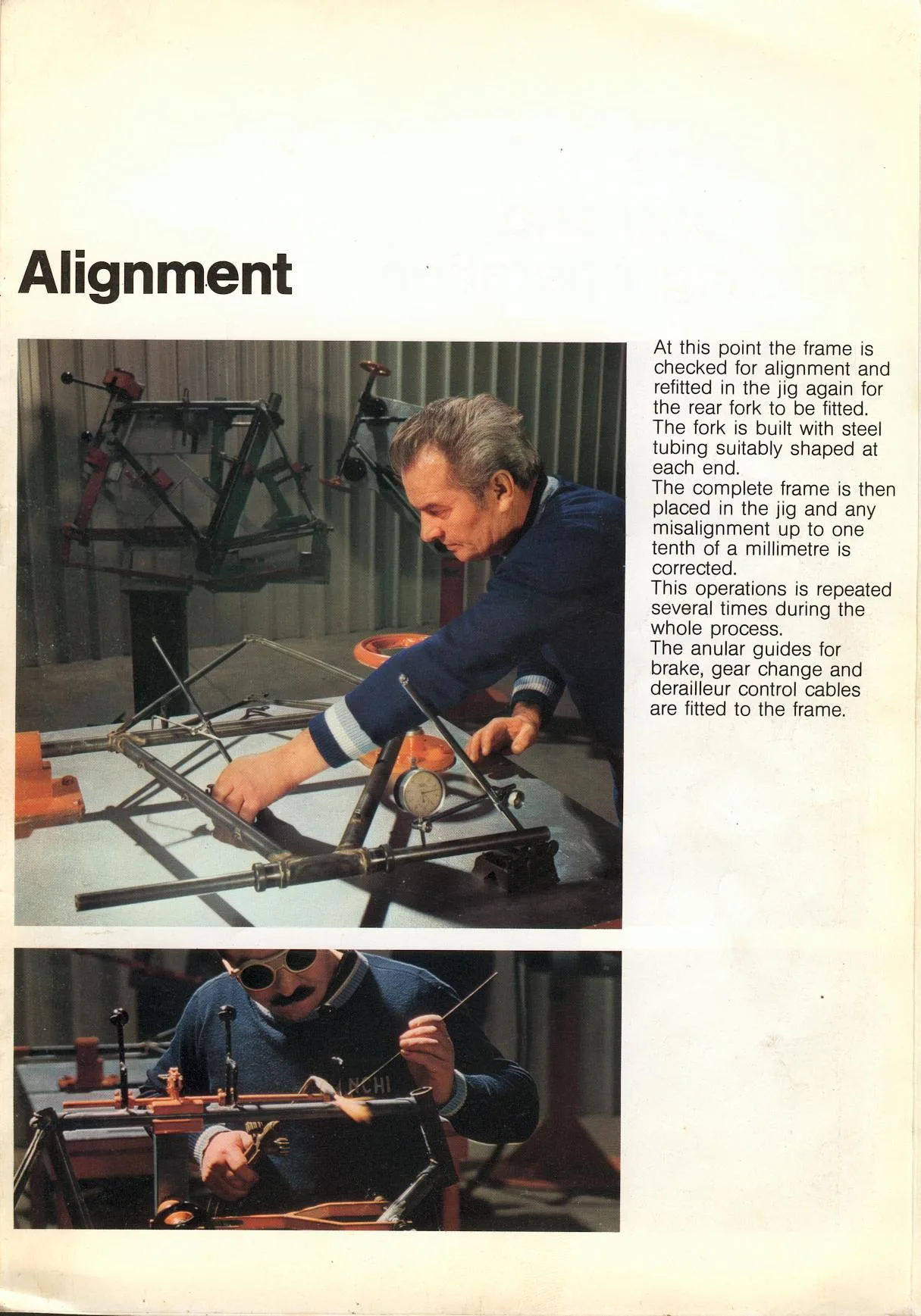
Alignment
At this point the frame is checked for alignment and refitted in the jig again for the rear fork to
be fitted. The fork is built with steel tubing suitably shaped at each end.
The complete frame is then placed in the jig and any misalignment up to one tenth of a millimetre
is corrected.
This operations is repeated several times during the whole process.
The anular guides for brake, gear change and derailleur control cables are fitted to the frame.
[Photographs: a frame being checked on the alignment table with a dial gauge; a brazer working with
a torch.]
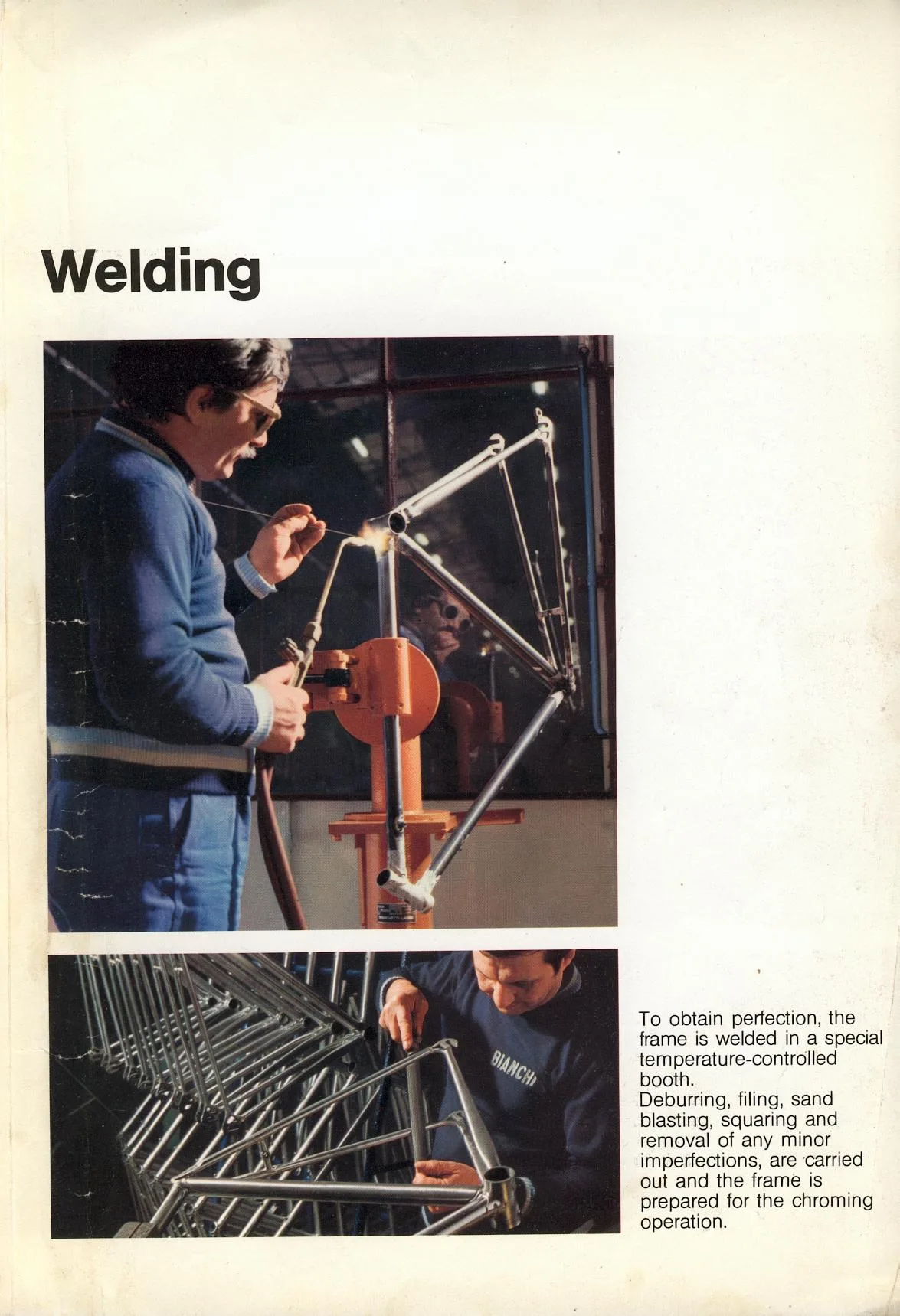
Welding
To obtain perfection, the frame is welded in a special temperature-controlled booth.
Deburring, filing, sand blasting, squaring and removal of any minor imperfections, are carried out
and the frame is prepared for the chroming operation.
[Photographs: brazing a frame on a rotating fixture; a worker filing a finished frame beside a rack
of bare frames.]
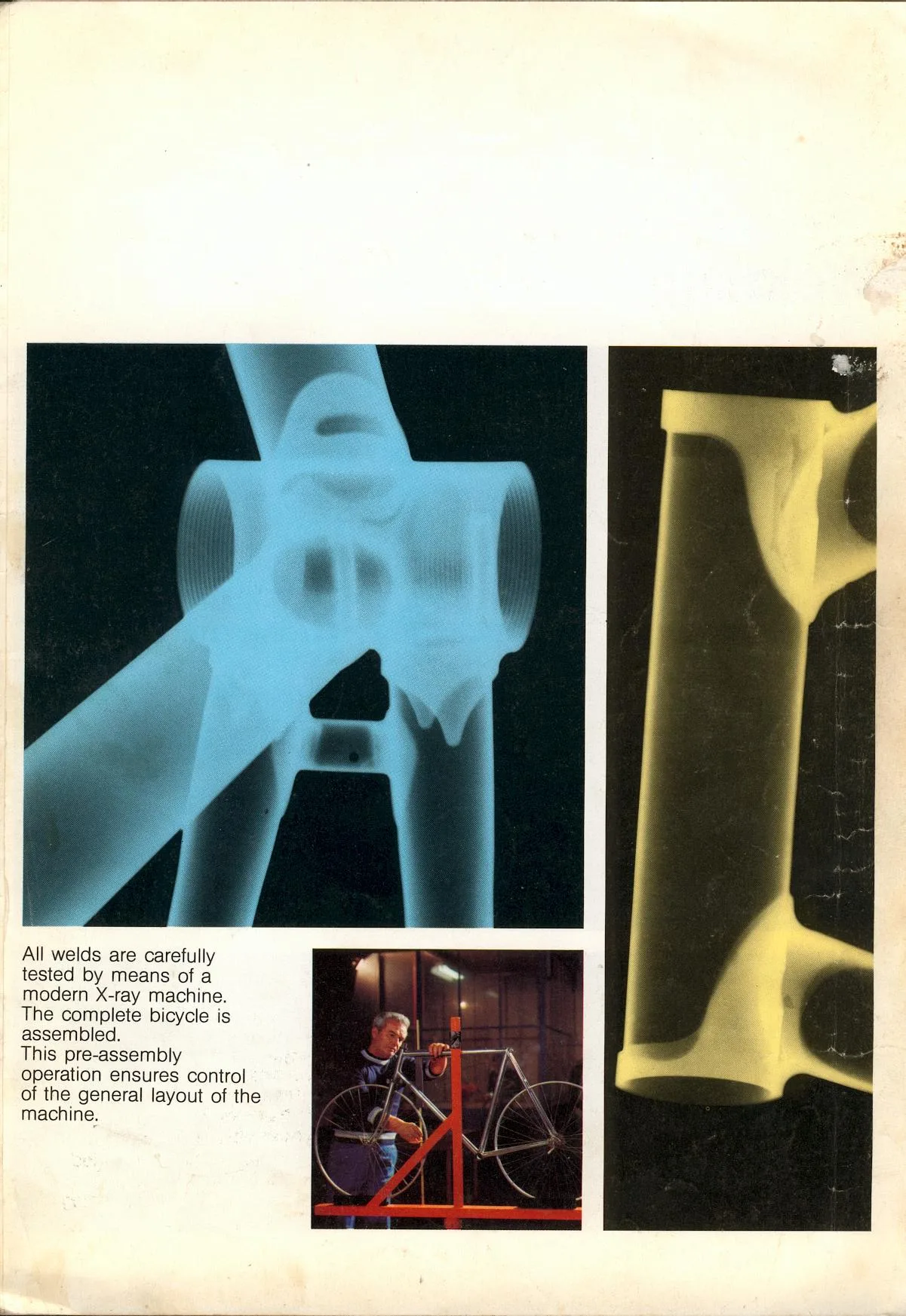
All welds are carefully tested by means of a modern X-ray machine. The complete bicycle is
assembled.
This pre-assembly operation ensures control of the general layout of the machine.
[Photographs: two X-ray plates of a bottom bracket junction and a lugged joint; a worker
pre-assembling a bicycle on a red stand.]
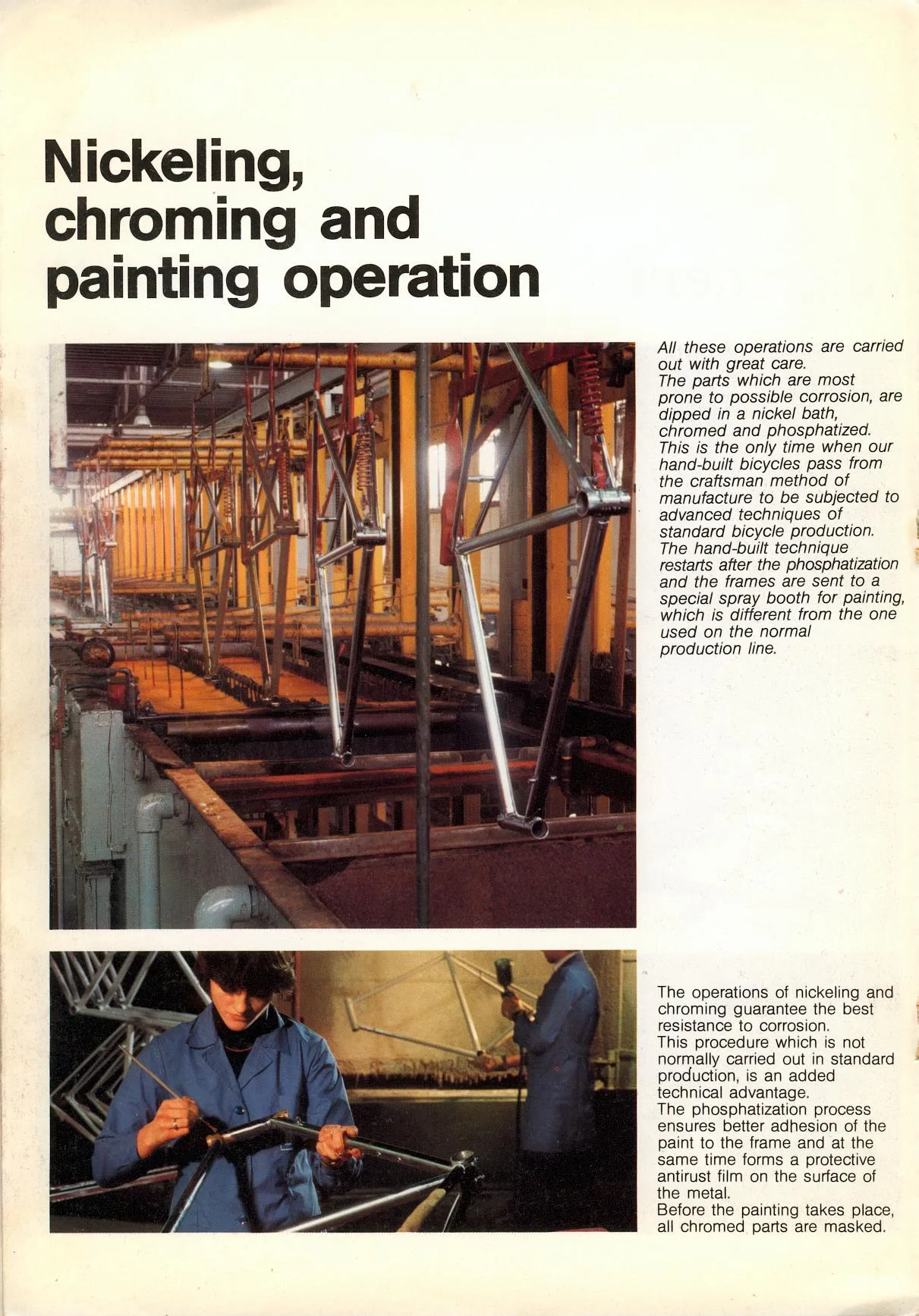
Nickeling, chroming and painting operation
All these operations are carried out with great care.
The parts which are most prone to possible corrosion, are dipped in a nickel bath, chromed and
phosphatized.
This is the only time when our hand-built bicycles pass from the craftsman method of manufacture to
be subjected to advanced techniques of standard bicycle production.
The hand-built technique restarts after the phosphatization and the frames are sent to a special
spray booth for painting, which is different from the one used on the normal production line.
The operations of nickeling and chroming guarantee the best resistance to corrosion.
This procedure which is not normally carried out in standard production, is an added technical
advantage.
The phosphatization process ensures better adhesion of the paint to the frame and at the same time
forms a protective antirust film on the surface of the metal.
Before the painting takes place, all chromed parts are masked.
[Photographs: frames on the plating line; a worker masking chromed parts.]
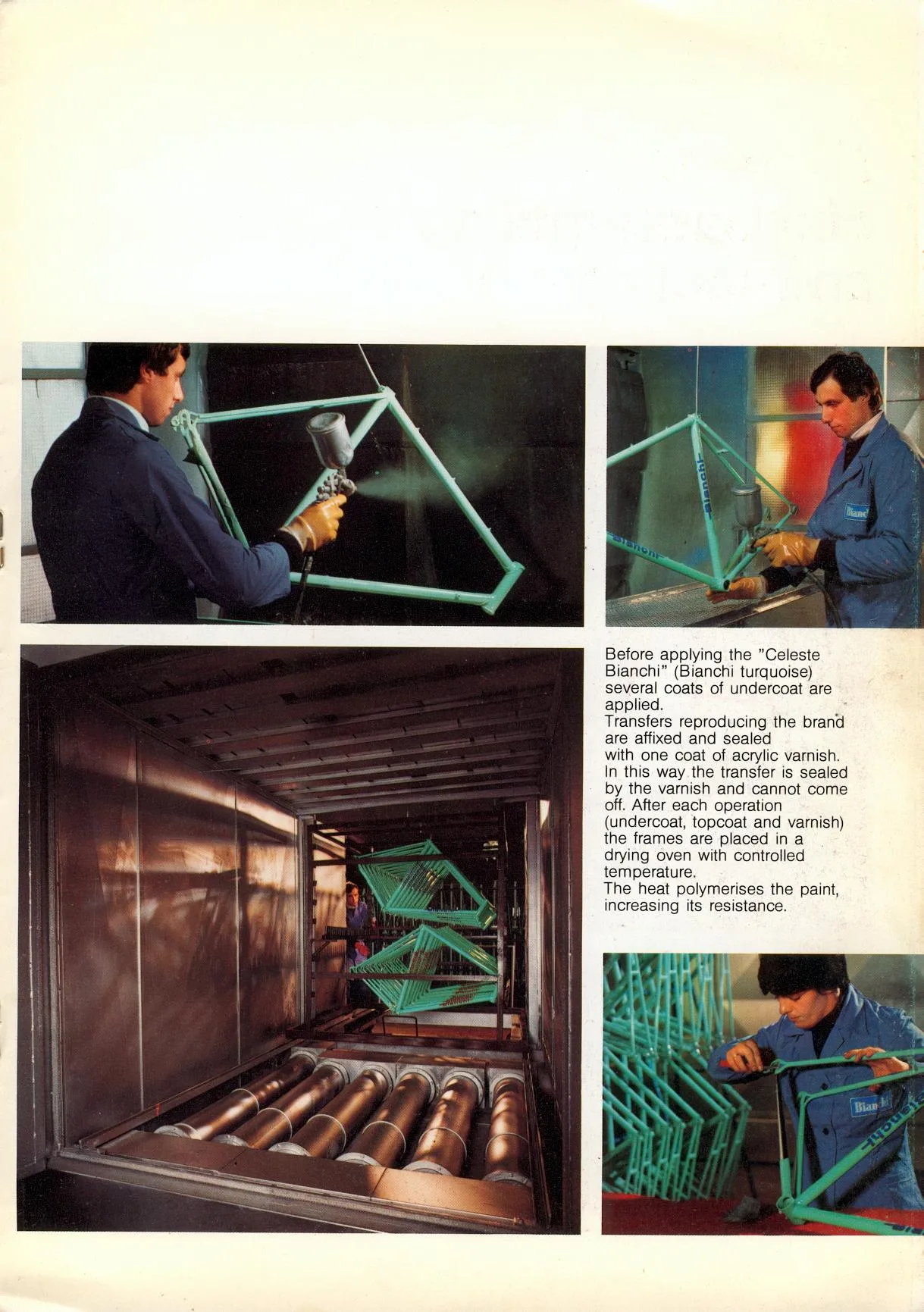
Before applying the “Celeste Bianchi” (Bianchi turquoise) several coats of undercoat are applied.
Transfers reproducing the brand are affixed and sealed with one coat of acrylic varnish. In this
way the transfer is sealed by the varnish and cannot come off. After each operation (undercoat,
topcoat and varnish) the frames are placed in a drying oven with controlled temperature.
The heat polymerises the paint, increasing its resistance.
[Photographs: two spray-booth shots of Celeste frames being painted; the drying oven loaded with
frames; a worker applying transfers.]
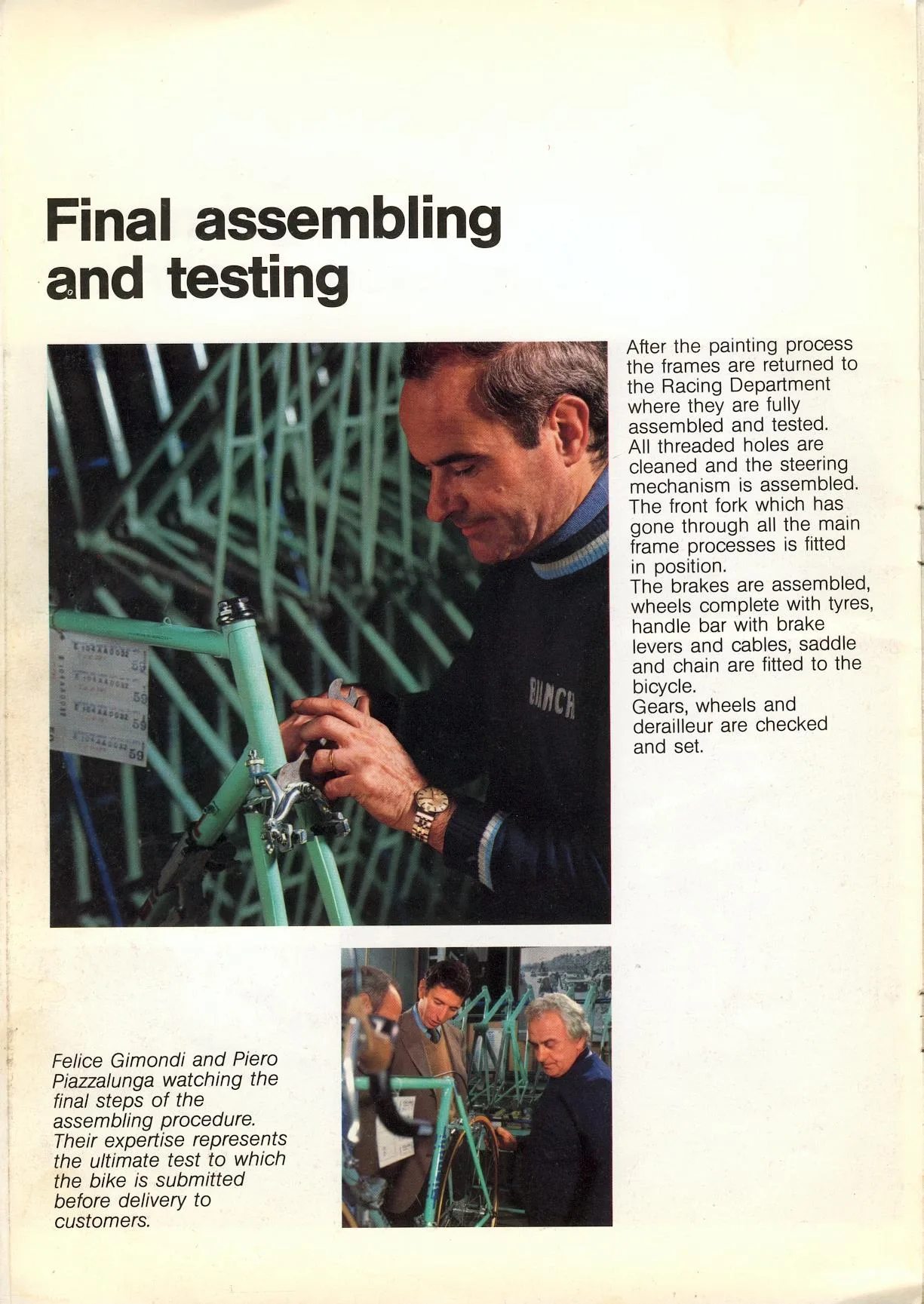
Final assembling and testing
After the painting process the frames are returned to the Racing Department where they are fully
assembled and tested.
All threaded holes are cleaned and the steering mechanism is assembled.
The front fork which has gone through all the main frame processes is fitted in position.
The brakes are assembled, wheels complete with tyres, handle bar with brake levers and cables,
saddle and chain are fitted to the bicycle.
Gears, wheels and derailleur are checked and set.
Felice Gimondi and Piero Piazzalunga watching the final steps of the assembling procedure. Their
expertise represents the ultimate test to which the bike is submitted before delivery to customers.
[Photographs: a mechanic fitting a brake to a Celeste frame carrying a “59” build card; Gimondi and
Piazzalunga at the assembly bench.]
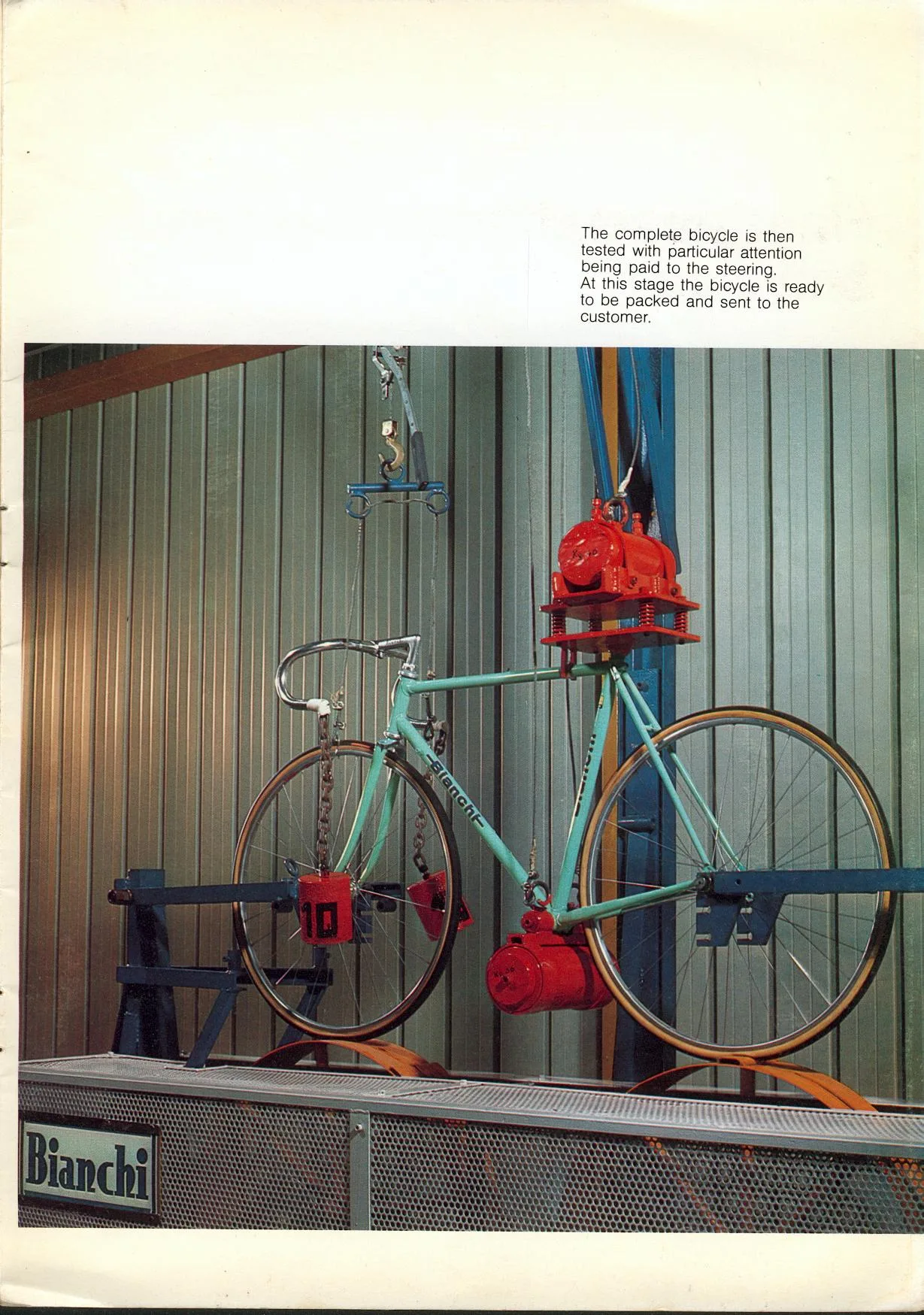
The complete bicycle is then tested with particular attention being paid to the steering.
At this stage the bicycle is ready to be packed and sent to the customer.
[Photograph: a complete Celeste bicycle loaded with red test weights on a Bianchi test rig.]
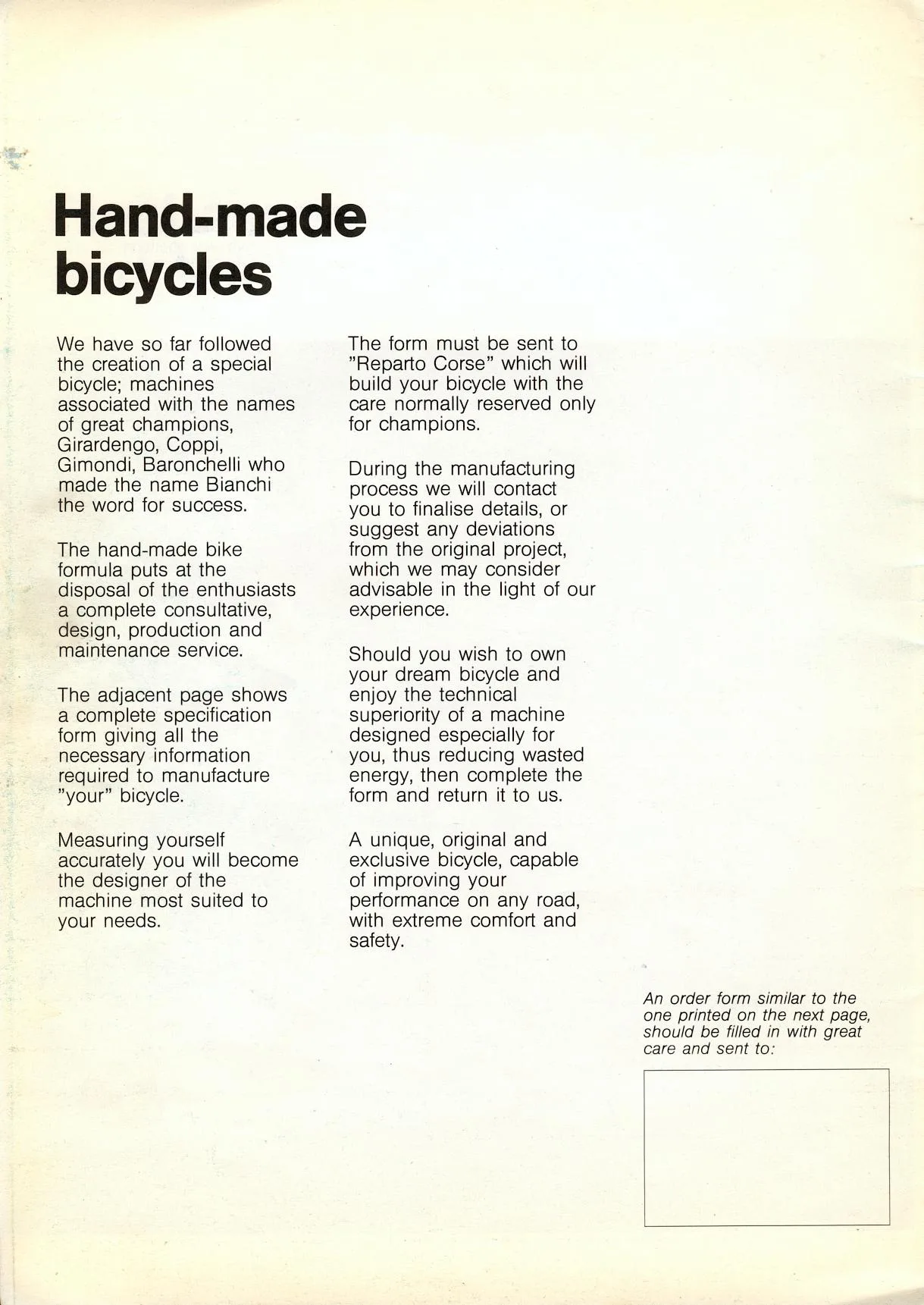
Hand-made bicycles
We have so far followed the creation of a special bicycle; machines associated with the names of
great champions, Girardengo, Coppi, Gimondi, Baronchelli who made the name Bianchi the word for
success.
The hand-made bike formula puts at the disposal of the enthusiasts a complete consultative, design,
production and maintenance service.
The adjacent page shows a complete specification form giving all the necessary information required
to manufacture “your” bicycle.
Measuring yourself accurately you will become the designer of the machine most suited to your
needs.
The form must be sent to “Reparto Corse” which will build your bicycle with the care normally
reserved only for champions.
During the manufacturing process we will contact you to finalise details, or suggest any deviations
from the original project, which we may consider advisable in the light of our experience.
Should you wish to own your dream bicycle and enjoy the technical superiority of a machine designed
especially for you, thus reducing wasted energy, then complete the form and return it to us.
A unique, original and exclusive bicycle, capable of improving your performance on any road, with
extreme comfort and safety.
An order form similar to the one printed on the next page, should be filled in with great care and
sent to: [blank box for the dealer’s stamp]
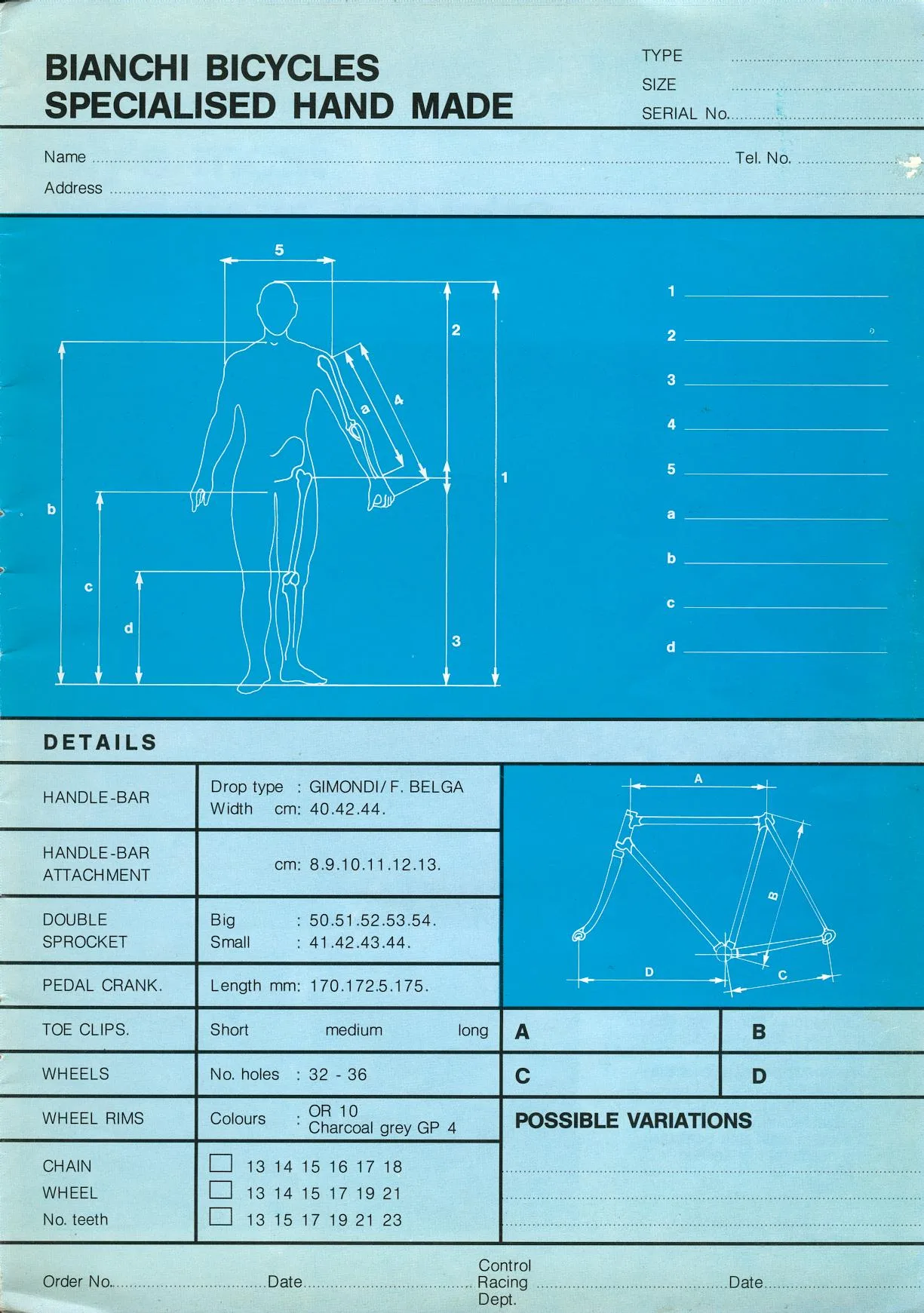
BIANCHI BICYCLES SPECIALISED HAND MADE
TYPE …… SIZE …… SERIAL No. ……
Name …… Tel. No. ……
Address ……
[Rider-measurement diagram keyed 1, 2, 3, 4, 5 and a, b, c, d, with a blank line for each; frame
diagram keyed A, B, C, D.]
DETAILS
HANDLE-BAR — Drop type : GIMONDI / F. BELGA. Width cm: 40.42.44.
HANDLE-BAR ATTACHMENT — cm: 8.9.10.11.12.13.
DOUBLE SPROCKET — Big : 50.51.52.53.54. Small : 41.42.43.44.
PEDAL CRANK — Length mm: 170.172.5.175.
TOE CLIPS — Short / medium / long
WHEELS — No. holes : 32 – 36
WHEEL RIMS — Colours : OR 10 / Charcoal grey GP 4
CHAIN WHEEL No. teeth — 13 14 15 16 17 18 / 13 14 15 17 19 21 / 13 15 17 19 21 23
POSSIBLE VARIATIONS ……
Order No. …… Date …… Control Racing Dept. …… Date ……
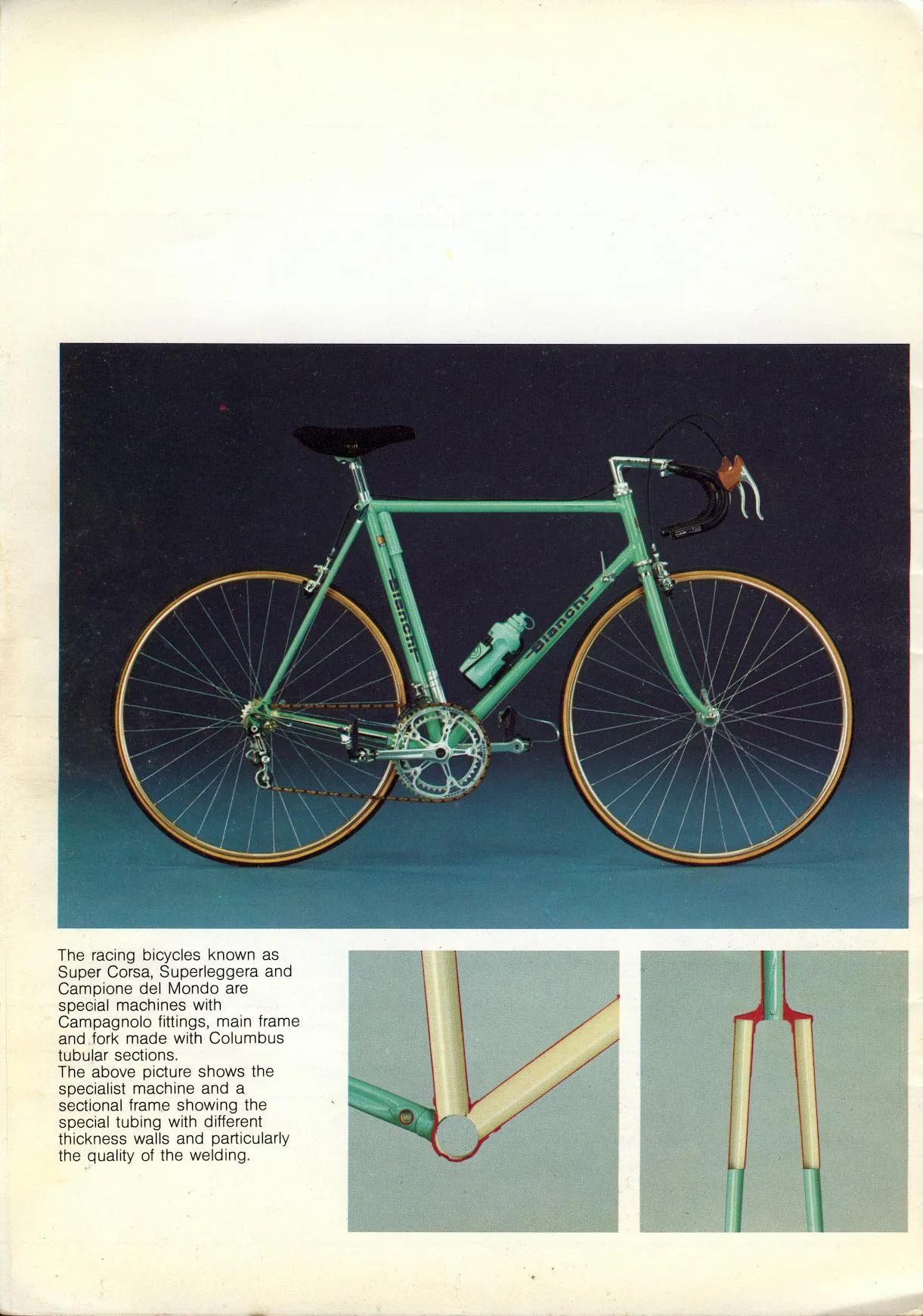
The racing bicycles known as Super Corsa, Superleggera and Campione del Mondo are special machines
with Campagnolo fittings, main frame and fork made with Columbus tubular sections.
The above picture shows the specialist machine and a sectional frame showing the special tubing
with different thickness walls and particularly the quality of the welding.
[Photographs: a complete Celeste racing bicycle with Campagnolo equipment against a blue ground;
two cutaway diagrams of a bottom bracket junction and a fork crown showing butted wall thicknesses.]
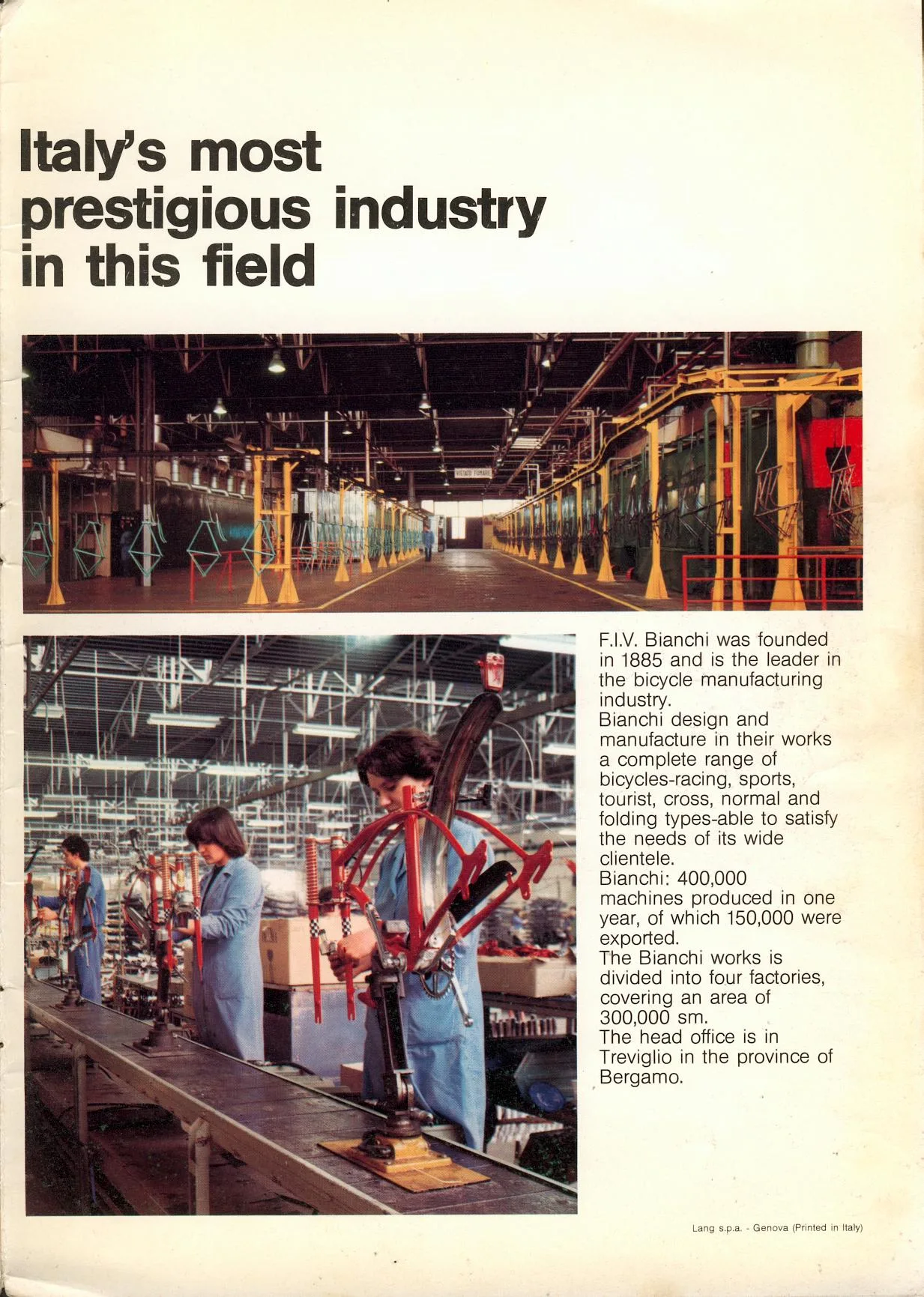
Italy’s most prestigious industry in this field
F.I.V. Bianchi was founded in 1885 and is the leader in the bicycle manufacturing industry.
Bianchi design and manufacture in their works a complete range of bicycles-racing, sports, tourist,
cross, normal and folding types-able to satisfy the needs of its wide clientele.
Bianchi: 400,000 machines produced in one year, of which 150,000 were exported.
The Bianchi works is divided into four factories, covering an area of 300,000 sm.
The head office is in Treviglio in the province of Bergamo.
Lang s.p.a. – Genova (Printed in Italy)
[Photographs: the Treviglio paint shop with overhead conveyors; the assembly line with workers
building frames.]
 Bianchi Catalog of about 1984 — A Bianchi for You: the Nuovo Racing, Tipo Corsa, Super Leggera and Super Pista, with Individual Frame Sets
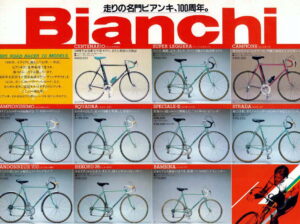 Bianchi 1985 Range Sheet for Japan — 10 Road Racers for the 100th Anniversary, from the Centenario to the Bambina, with Specifications and Prices
 Bianchi Catalog of about 1985 (Five Pages) — The Second Hundred Years Begin: the Professional Series, with the Centenario
 Bianchi Catalog (Undated, after 1987; Five Pages) — The C-4 Project, Mondiale, Super Leggera, Pista, Giro and Limited
 Bianchi Catalog for America (Undated, Nine Pages) — No Substitutes, Only Compromises: from the Nuovo Racing and Nuovo Touring to the Super Corsa and Super Pista
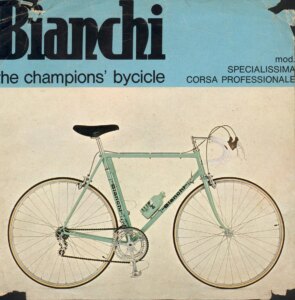 Bianchi Flyer (Undated) — The Specialissima Corsa Professionale
Ebykr presents this material for research and education. If you hold rights to it or notice an ownership issue, please contact us and we will respond promptly.
The Ebykr Digest
New articles, timelines, catalog finds and registry activity — assembled from the archive once a month. Your address is never shared.
Double opt-in. One email per month. Unsubscribe at any time with one click.