About Ebykr
Ebykr celebrates classic and vintage lightweight bicycles through provocative imagery and opinion. Ride along with us.
About Ebykr
Ebykr celebrates classic and vintage lightweight bicycles through provocative imagery and opinion. Ride along with us.

A practical guide to dating an Idéale saddle — why there is no date code, what the initials on the badge tell you, which models arrived when, how the alloy stamps and the rodée main mark narrow the window and how to date the paper.

If Brooks is the English saddle everyone knows, Idéale is the French one everyone wants. For most of the 20th century, the saddles of Pont-Saint-Pierre, in Normandy, sat under randonneurs, racers and constructeurs all over France and well beyond, and a nice one still turns heads at a swap meet. Dating one, however, takes a little more work than reading a stamp.
Because here is the first thing to know: an Idéale carries no date code. No catalog, maker’s statement or collector record describes one, and the numbers you will find on the saddle are something different. The model number sits in the badge on the side. Professionnel-grade saddles carry a serial number on the cantle plate, but it is the number of a guarantee, not a date. From around 1950, the firm issued a numbered, open-ended guarantee voucher with its best saddles and no register survives to turn the number into a year. Saddles on alloy frames carry a two-digit chassis number, which identifies the chassis and nothing more. The only Idéale serial numbers that do encode a date are under the saddles made in Toulouse since 2013, where the first four digits give the year and month the hide arrived, which at least makes one of those gorgeous, modern reissues easier to spot.
What an older Idéale does give you is its model, its badge and its materials, and those changed at moments that the catalogs, the advertising and the French trade press record. Read them together and most Idéales can be placed within a decade or two, often closer.
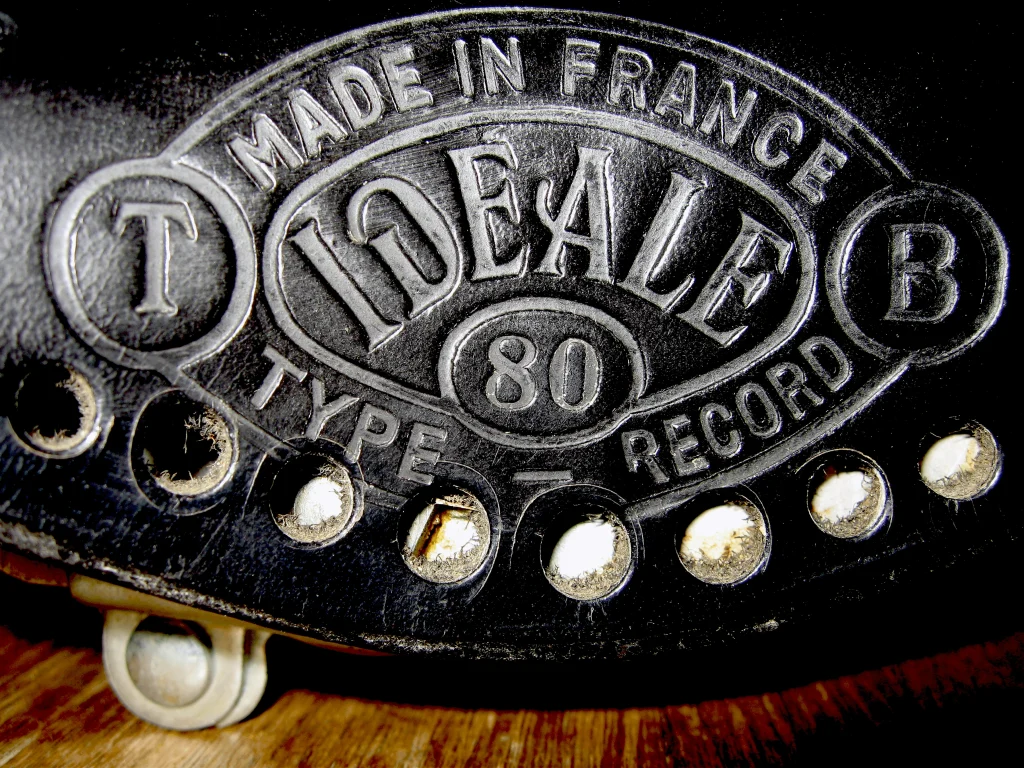
Idéale saddles were made by the Tron family’s firm, at Pont-Saint-Pierre for most of their history. The firm changed its name several times, from Tron et Baillard in 1893 to Tron & Berthet from 1928, but the saddles never spelled it out. The maker appears only as two initials on the leather itself, in the small roundels on either side of the IDÉALE oval in the side badge, and those initials are the first dating clue:
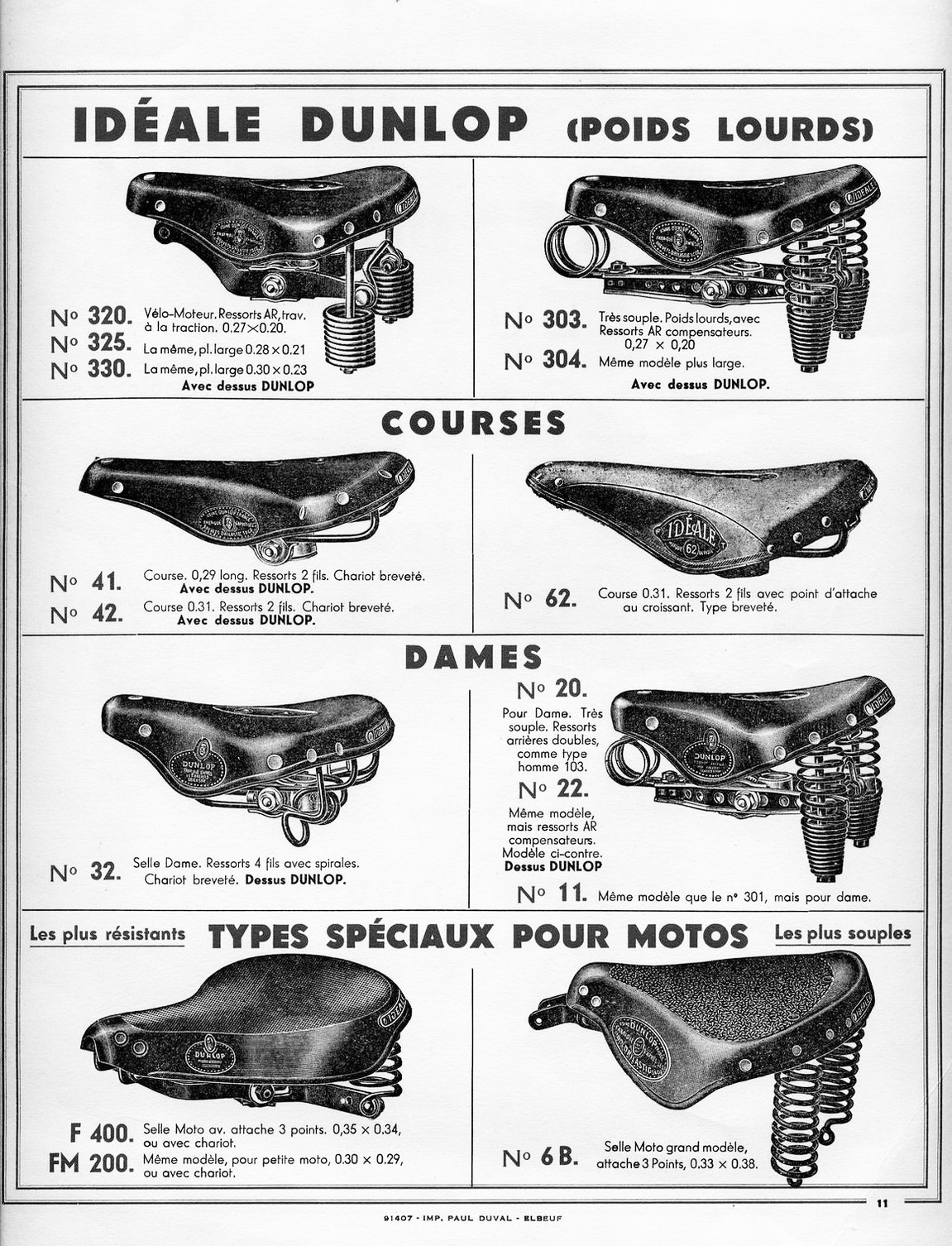
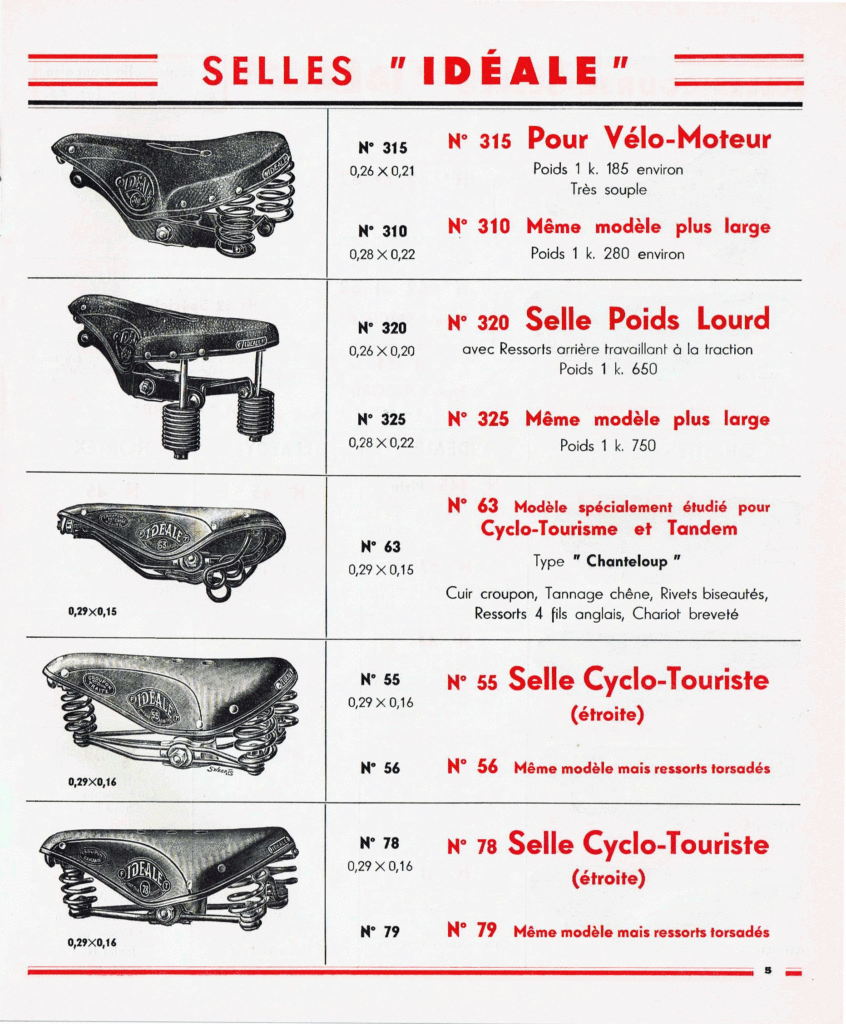
Like Brooks, Tron & Berthet numbered its saddles and put the number on the saddle itself, in a small circle or box inside the side badge. The engravings in the catalog of about 1936 show it there, a 63, a 55 or a 78, and the No. 90 brochure of about 1969 draws a 90 in the same place. Find the number and you have the model, and the model is where dating an Idéale starts. Ignore any letters a catalog adds to it: 90A, 90CR and 90-3 are dealer designations, and the badge on the saddle reads simply 90.
With a number in hand, turn to Ebykr’s Saddle Model Explorer, which lists 91 Idéale models with the catalogs that show them. A few of the numbers you are most likely to meet, with the earliest dated evidence we have found for each:
| Model | Earliest dated evidence | What it is |
|---|---|---|
| 52 | the 1927 Tron & Enfants advertisement | a 29 cm racing saddle on Idéale’s patented single-point fitting, later made in Record and Professionnel grades |
| 51 | the catalog of about 1936 | a 29 cm Type Record racing saddle in oak-tanned leather |
| 57 | the catalog of about 1936 | a racing saddle on an all-alloy chassis, about 430 g, with perforated wings; the catalog calls it the Critérium des Alpes, but the saddles themselves say Type Record |
| 55 and 56 | the catalog of about 1936 | narrow cyclotouring saddles, the 56 with twisted rear springs |
| 63 | the catalog of about 1936 | the Chanteloup type, built for cyclotourism and tandem |
| 48, 49, 53, 58 and 59 | the guarantee card of about 1950 | Professionnel racing saddles, the 49 and 53 in steel and the 48, 58 and 59 in duralumin |
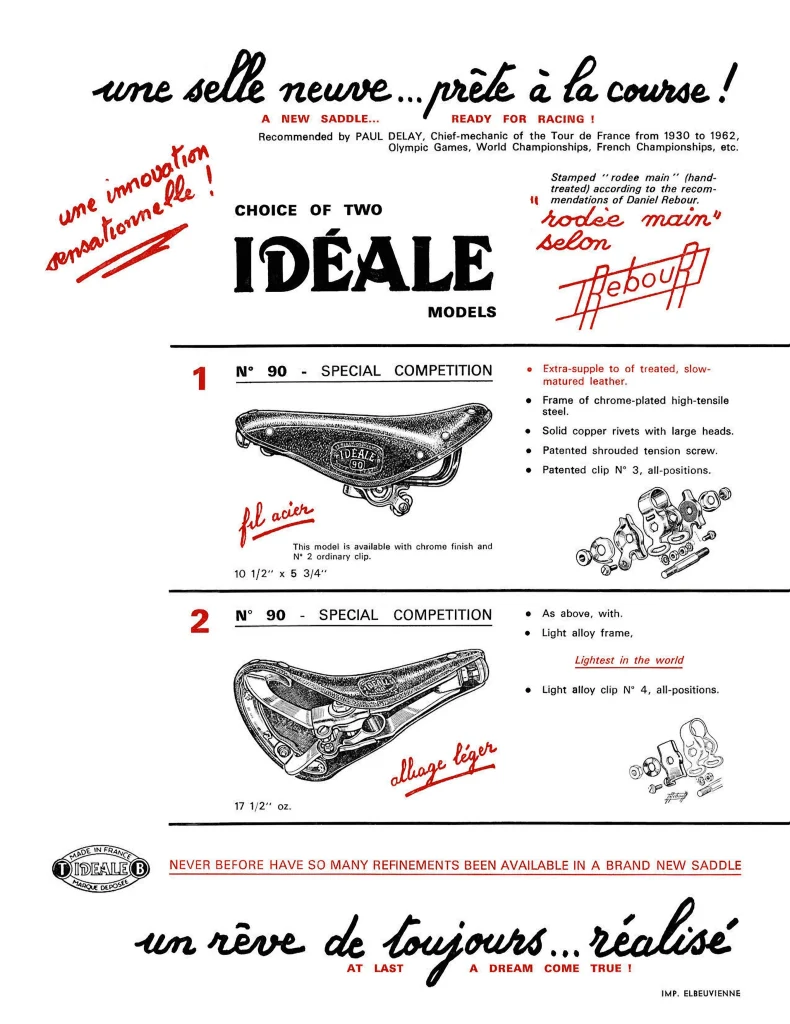
| 90 | shown in Paris in 1964, the maker says; the brochure of about 1969 | the Spéciale Compétition, the flagship, in steel or light alloy |
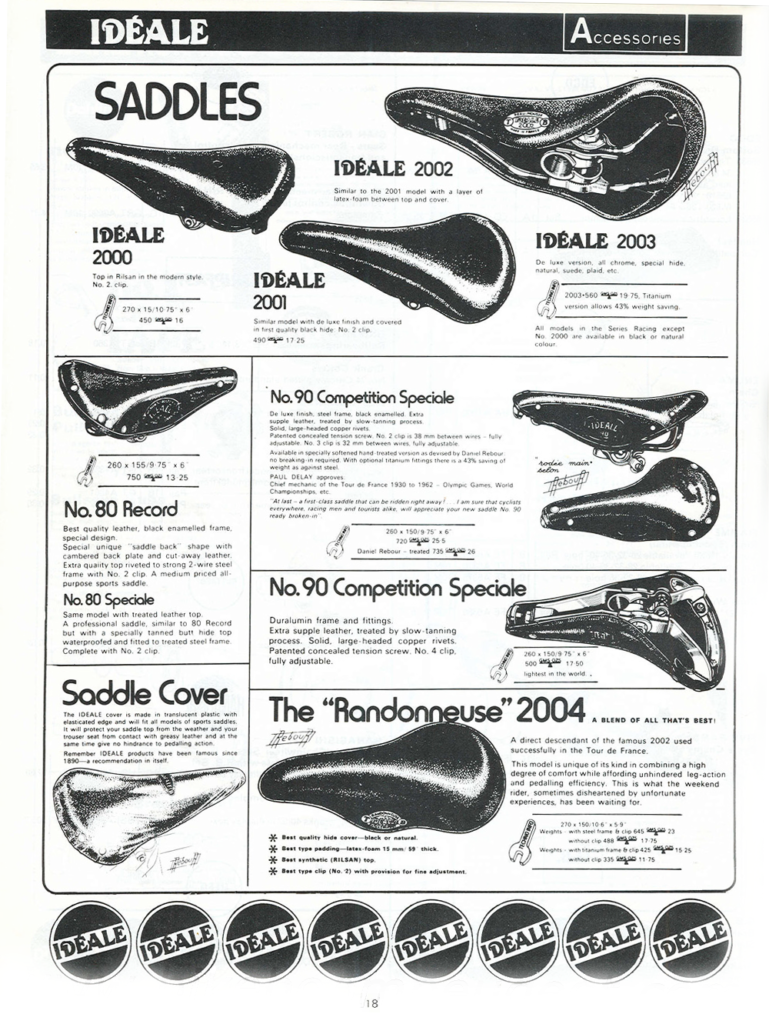
| 2000, 2001 and 2002 | 1973 | the Rilsan series, bare or covered in hide, the 2002 with a layer of foam; the 2003 followed, and the Randonneuse 2004 by 1979 |
| 92 | 1981, “new this year” | the Diagonale touring saddle, 2 cm wider across a flatter cantle plate than the 90 |
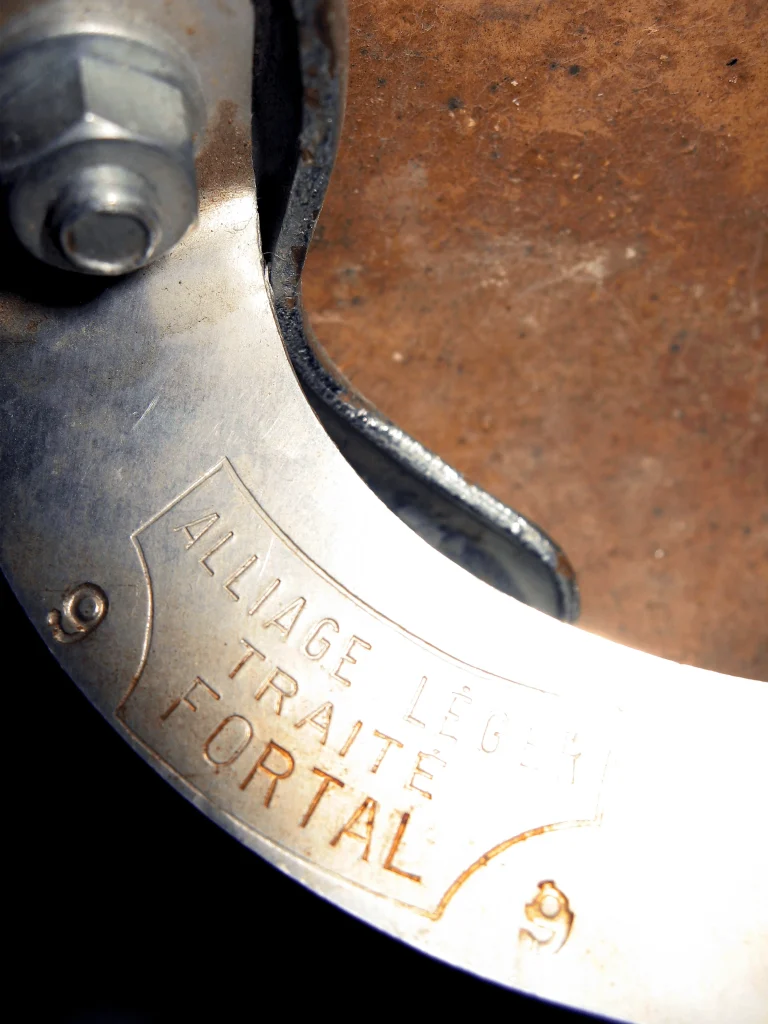
One trap before you settle on a model: Idéale used some numbers twice, or even three times. The No. 80 was a 1930s heavyweight with twisted rear springs, then an 80 Type Record on duralumin rails like the one above, then the 1970s steel-framed 80 Record, Spéciale and Critérium. Three completely different saddles, one common model number, The 88 of 1963 is not the “completely new” low-profile 88 of 1981. The 45, 60, 61, 70 and 134 all changed character, too, and the 1970s range reused 2, 3, 14 and 22 from the 1930s. A number tells you the model only when the saddle in your hands matches the catalog picture for it.
Once you know the model, the materials narrow the dating window further:
The Ebykr Catalog Archive holds 25 Idéale documents, from the 1927 Tron & Enfants advertisement to the British and American mail-order pages of 1979 and 1981, and between them they are the dating tool. The catalog of about 1936 shows the range in its prime, with the cheaper Elaedy and Nortex lines alongside much fancier models. The pages of Gene Portuesi’s Cyclo-pedia, from about 1966 and about 1974, show what an American buyer could actually order, and the 1979 Ron Kitching catalog lays out the last full range, from the 80 Record to the titanium 2003 and the Randonneuse 2004.
Paper can be dated more closely than saddles, because the name printed on it changed over time:
| Name on the paper | In print |
|---|---|
| Tron et Baillard | 1893 to May 1894 |
| Tron et Cie, later F. Tron et Cie | 1894 to 1899 |
| F. Tron | the 1900s and 1910s |
| Tron et Enfants | 1924 to 1928 |
| Tron et Berthet, styled F. & J. Tron & Berthet in 1929 to 1931 | from November 1928 |
| Ets Tron & Berthet | from 1935 |
| Tron & Berthet, 27360 Pont Saint Pierre | 1972 to 1985, by its postcode and telephone number |
Read the pictures with more care than the words. An advertisement’s engraving can be years older than the advertisement: Idéale advertisements of the 1950s and early 1960s still print an F and T engraving of the No. 57, so never date a badge style from an advertisement’s drawing.
The end of the story is a dating tool, too. The Pont-Saint-Pierre works went into compulsory liquidation in 1981, the date the local history supports best, though dates from 1980 to 1984 circulate. The Idéale name carried on under new owners: a Columbia saddle advertised by Ets Lonchampt of Pontault-Combault dates from October 1985 or later by its eight-digit Paris-region telephone number. Since 2013, Idéale saddles have been made again, in Toulouse. If you have an Idéale catalog, price list or advertisement, please add it through Docs Drop and it becomes a dating tool for everyone.
Suppose a black leather racing saddle turns up with large copper rivets, a chromed steel frame, a rodée main selon Rebour stamp toward the back of the top and a badge on the side reading SPÉCIALE COMPÉTITION, T 90 B and MADE IN FRANCE.
Answer: a No. 90, most likely made at Pont-Saint-Pierre between 1969 and the early 1980s. That is a 12 year window rather than a year, but it is an honest one, and if the bicycle it came on can be dated, the saddle often goes along for the ride.
For the model you have in your hands, the Idéale Saddles and Clips model guide lists every model Ebykr has found in the catalogs, with the years that cite it. For the company behind it, read Idéale Saddles: Behind the Leather Curtain and the Idéale timeline, and for the best pictures of the saddles themselves, the Idéale gallery. If yours will not give up its number, or carries a mark this guide does not explain, bring photographs of the side, the cantle and the underside to the Idéale identification topic on the forums. A numbered cantle plate, an alloy stamp or a guarantee card would be especially welcome, because Ebykr holds no photograph of any of them yet. And for its English cousin, see How to Identify and Date a Vintage Brooks Saddle.
Idéale catalogs, brochures and advertisements in the Ebykr Catalog Archive, from 1927 to 1981, among them the numbered guarantee advertisement
Ebykr — Idéale Saddles and Clips, the Saddle Model Explorer
Ebykr — Idéale Saddles: Behind the Leather Curtain
Archives commerciales de la France, 13 June 1894 (the end of Tron et Baillard); L’Usine, 16 November 1928 (Tron et Berthet); L’Officiel de l’automobile, du cycle et de la motocyclette, 1 September 1935 (the Idéale-Dunlop), all via Gallica
Selles Idéale — history and FAQ, including the Toulouse serial numbers
Histoire du Val de Pîtres — Tron et Berthet, la selle Idéale (P. Levacher, 2017)
Dives-sur-Mer — the Cégédur factory
Classic Rendezvous — Idéale (Internet Archive copy)
Classic Bicycles — Idéale, with the guarantee card (Internet Archive copy)
Tontonvelo — alloy rail stamps and chassis numbers
Velobase — Tron & Berthet saddles
 Idéale
Ebykr documents this marque across the archive. Here is the rest of it.
The Ebykr Digest
New articles, timelines, catalog finds and registry activity — assembled from the archive once a month. Your address is never shared.
Double opt-in. One email per month. Unsubscribe at any time with one click.