About Ebykr
Ebykr celebrates classic and vintage lightweight bicycles through provocative imagery and opinion. Ride along with us.
About Ebykr
Ebykr celebrates classic and vintage lightweight bicycles through provocative imagery and opinion. Ride along with us.

A practical guide to identifying and dating Mafac brakes — why there is no date code to rely on, how the Racer's arm markings changed, which models arrived when and how to read Mafac's own three-digit lever code.

Own a French lightweight from the 1950s, 1960s or 1970s and there is a decent chance it stops on Mafac brakes. The Clermont-Ferrand firm made the cantilevers that randonneurs swore by and the Racer center-pull that turned up on a great many French bicycles of the bike boom, and plenty of them are still squealing their way down hills today. (They really do squeal. Consider it part of the charm.)
A Mafac will not hand you a date the way a Shimano part does. What it will do is tell you its model, and Mafac changed its models, its markings and its fittings at moments that its own catalogs and the French cycling press recorded. Read those together and most Mafac brakes can be placed within a decade, often closer, which in turn helps date the bicycle they are fitted to.
Mafac’s story starts in Clermont-Ferrand, in the Auvergne, with a local cycle maker named Auguste Bourdel. At the Paris Salon of October 1946, he showed a brake called the Sécurité, already proven on the road, with a light-alloy lever to match. By the fall of 1947, a new name had taken its place: MAFAC, for Manufacture Arvernoise de Freins et Accessoires de Cycles, Arvernoise after the Arverni, the Gallic people who gave the Auvergne its name. The mark was registered internationally on 24 January 1949 as M.A.F.A.C., with a period after every letter and an underline that grows out of the first A. The periods came and went, as you will see, but the underline stayed with the name to the end, and you will find it on the parts as well as the paper. Weinmann copied Mafac’s cantilevers in the 1970s, so look for the name before anything else.
Mafac paperwork, whether a box or an advertisement, can be dated by its address. In 1948 and the spring of 1949, the firm advertised from 35 rue de la Pradelle in Clermont-Ferrand. By May 1950, it had moved to rue d’Estaing, printed as 25 à 35 rue d’Estaing in 1953 and 1954 and as 25 rue d’Estaing in the 1976 catalog. The name shifted slightly, too: the 1950s catalog spells out Accessoires de Cycles, the 1976 catalog Accessoires pour Cycles.
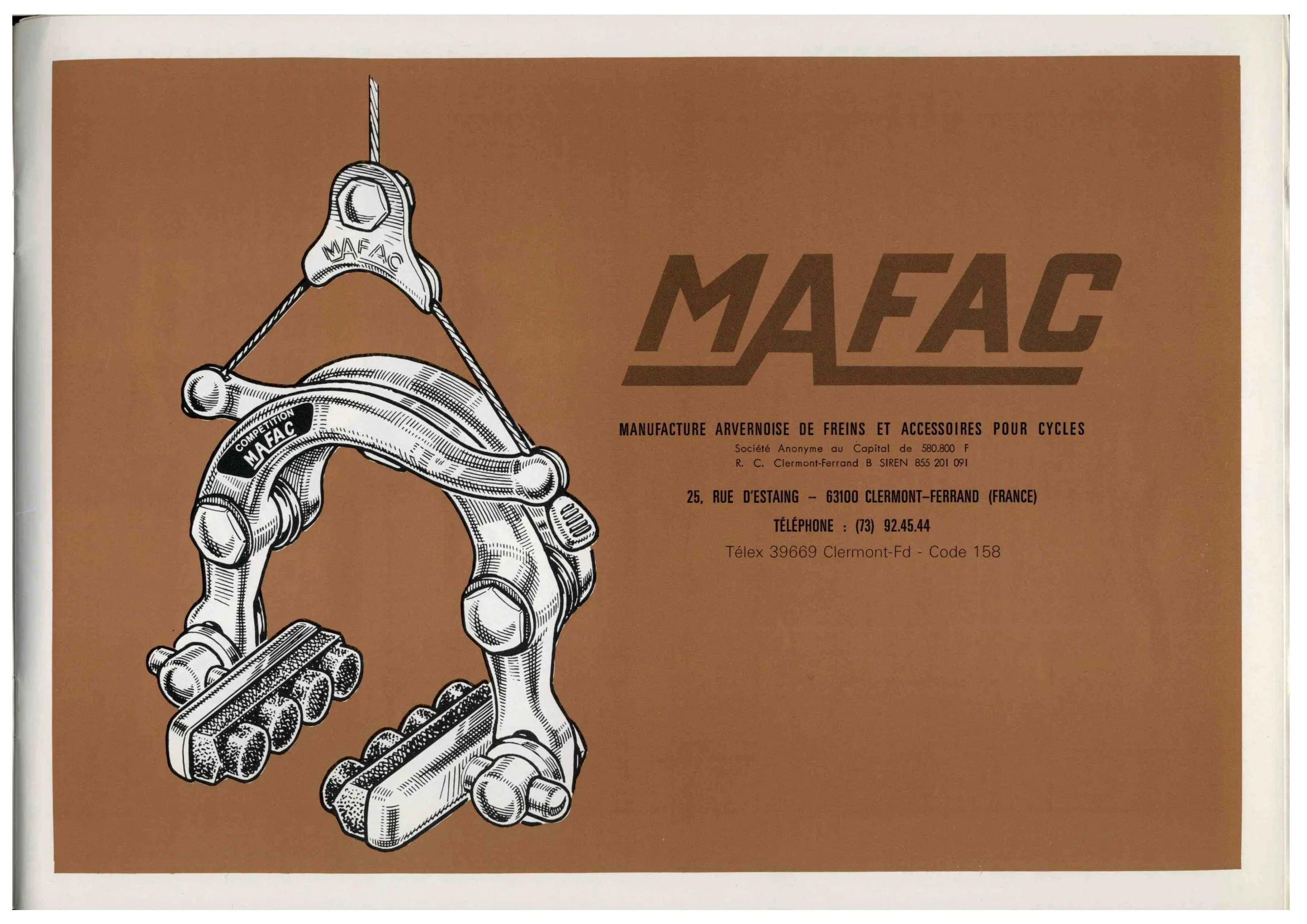
A part marked Sécurité is the rarest find of all, made in 1946 or 1947 before the Mafac name took over. Do not let the word alone convince you, though. Mafac kept “Sécurité du Cycliste” as an advertising slogan into 1948, and its late-1970s range included a racing lever called the Sécurité, sold in English as the Safety lever. Read the word together with the part: an early cantilever or a solid-bladed lever with the Sécurité name is the beginning of the story, while a 1970s safety lever is just a safety lever.
At the other end of the story, Mafac was reported out of business in October 1983, revived by a management buyout a year later and probably gone for good by about 1985. In its last years, some of its parts were also sold under Spidel, the brand that French component makers shared from the late 1970s, so a late Mafac may wear another name.
Not one you can rely on. None of Mafac’s own catalogs, from the 1950s book to the 1979 dealer poster, mentions a date mark, and the numbers you are most likely to find on a Mafac are not dates at all. The 451, 452 or 1451 on the back of a center-pull is a part number. It sits on the arched plate behind the arms that carries their pivots, which Mafac’s catalogs call the stirrup, and it tells you whether that stirrup is the small, the large or the adjustable size. The three-digit numbers collectors use for Mafac levers, the 121, the 218 and the 429, are Mafac’s own catalog codes, decoded further down.
There is one lead worth chasing. Steve Griffith, the Veteran-Cycle Club’s Mafac marque enthusiast, reports that later Competition and 2000 calipers carry a month and a year stamped on the inside of one arm, the earliest he had seen from 1975, and that around 1978 the stamp changed to two letters, one for the year and one for the month. No key to the letters has been published and we have not found a second source, so treat it as a lead rather than a rule. If your Competition or 2000 has marks inside its arms, photograph them and bring them to the forum. A handful of examples on bicycles of known date would be enough to crack it.
Start with the front arm. From the Tiger of about 1960 onward, most of Mafac’s new center-pulls carried their names there, and the Racer joined them around 1970. The exceptions are clues in themselves: the early Racer reads DURAL FORGÉ and MAFAC; the S and the very last Racers read MAFAC alone; the cantilevers simply say MAFAC. The range divides into cantilevers on brazed-on pivots, center-pulls on a single bolt and, at the very end, side-pulls:
| Model | What it is | Dated evidence | How to recognize it |
|---|---|---|---|
| Sécurité | cantilever | Paris Salon, October 1946; the name gave way to MAFAC in the fall of 1947 | the Sécurité name, its r stretched into an underline |
| Critérium | cantilever in forged duralumin | quick-release version new in June 1951; still on the 1979 poster | MAFAC on the arms; a straddle wire that unhooks by hand to free the wheel |
| Cyclomoteur, later Cyclo-Tandem | long-arm steel cantilever for mopeds and tandems | 1950s catalog to the 1979 poster | steel; in 1964 chromed with five-stud pads or zinc-plated with four |
| Jacky | children’s cantilever | 1950s catalog to the late 1970s | small; cut from sheet dural by 1964 |
| Driver | cantilever cast in Alpax | 1964 catalog; reportedly 1962 to 1967 | cast rather than forged; a fixed-length straddle wire with no quick release |
| Kathy | children’s cantilever cast in Alpax | 1964 catalog | cast, in children’s size |
| Racer | center-pull in forged duralumin | Paris Salon, October 1951; made into the 1980s | DURAL FORGÉ and MAFAC, then «RACER», then MAFAC alone (see below) |
| Tiger | center-pull with wider-set arms | about 1960 to the mid-1960s | Tiger, in script; a fixed-length straddle wire |
| Top 63 | center-pull with a two-piece adjustable stirrup | 1962 Paris Salon to the mid-1960s | TOP 63 |
| Competition | short-reach center-pull | about 1974; in the 1976 catalog; into the 1980s | COMPETITION and MAFAC on the front arm |
| 2000 | center-pull | about 1974; in the 1976 catalog | MAFAC 2000 |
| Raid | long-reach center-pull for 650B wheels with fenders | the 1970s; in the 1976 catalog | MAFAC and «Raid» |
| S | economy center-pull | 1975; in the 1976 catalog | MAFAC only; the one Mafac center-pull with conventional brake shoes |
| LS | side-pull | 1978 catalog | LS |
| GT | center-pull with Allen-key fittings and a quick release | 1979 poster | the last of Mafac’s center-pulls |
| LS2 and LC | side-pulls | 1979 poster | the LS2 was also sold as a Spidel |
The dates are the earliest and latest dated evidence we have found in Mafac’s catalogs, its advertising and the French cycling press. They are not proven production runs and a brake could sit on a dealer’s shelf for years after it was made.
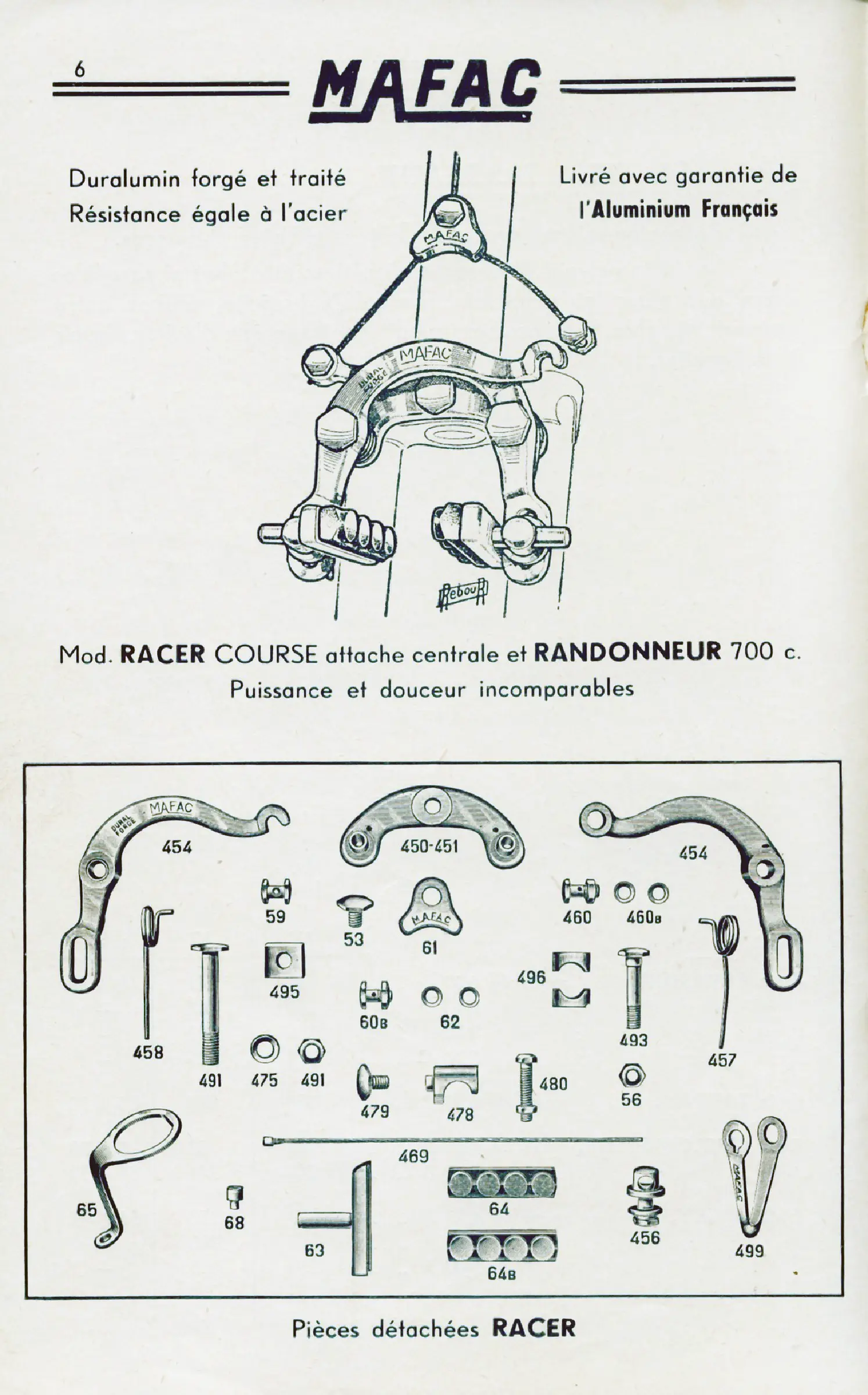
The Racer is the Mafac you are most likely to meet. It was launched at the Paris Salon in October 1951, on stand 267, and it was on the road with the racers by the following spring. That July Raphaël Géminiani rode a pair to a stage win in the Tour de France, at Bagnères-de-Bigorre. In more than 30 years of production, its arms carried three different markings and they are the first thing to read:
The bushings move with the markings. The early arms pivot on bronze bushings, which cannot be replaced. Red plastic bushings arrived at about the same time as the «RACER» stamp, and Griffith has seen transitional DURAL FORGÉ arms that already have them, from the late 1960s or the early 1970s.
Then look beside the pivots. The very first Racers have a tiny oil hole there. The launch announcement of October 1951 promised pivots on bronze bushings with a lubrication hole and the parts drawing in the 1950s catalog shows a hole beside each pivot on the stirrup. The holes were dropped after a year or two, so a Racer that has them is first production, from about 1951 to 1953.
Periods are another early sign. Mafac registered its mark as M.A.F.A.C., and 1950s levers and straddle yokes often carry it that way. The periods had gone before the 1970s. The rule only works in one direction, though: Mafac’s own drawings show MAFAC without periods as early as 1950, so a missing period proves nothing.
Two later markings are worth knowing. Competition brakes of the late 1970s can carry a Spidel or a Peugeot transfer, and Spidel-stamped Mafac levers belong to the same years. Griffith also reports that levers began to read MAFAC FRANCE toward the end of the 1960s. We have not found that in any Mafac document, so if your levers say it, we would love to see them.
Every reading here comes from “Read the stamps” in this guide.
Levers and hoods were swapped more often than any other Mafac part, so treat them as supporting witnesses rather than star ones. They did change in ways the catalogs record, though:
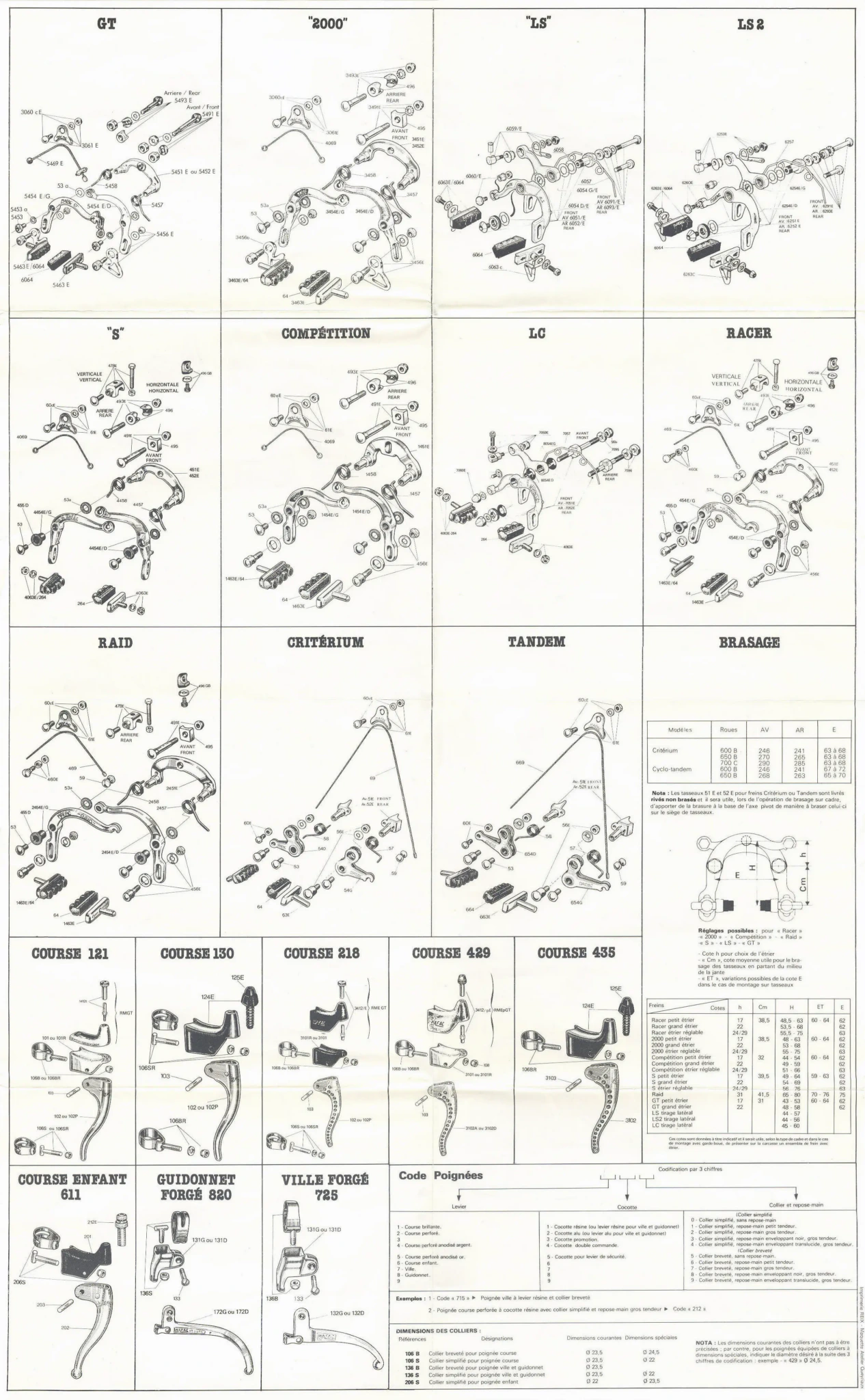
The best key to Mafac levers is printed at the foot of the back of the 1979 dealer poster. It explains the three-digit numbers collectors use for Mafac levers: each digit is a choice from a list, the first for the blade, the second for the body and the third for the clamp and the hood.
| Digit | The choices |
|---|---|
| First: the blade | 1 polished racing 2 drilled racing 4 drilled, anodized silver 5 drilled, anodized gold 6 children’s racing 7 town 8 guidonnet |
| Second: the body | 1 resin (on a town or guidonnet lever, a resin lever) 2 alloy (likewise, an alloy lever) 3 Promotion 4 double control 5 safety lever |
| Third: the clamp and the hood | 0 to 4 with the simplified clamp, 5 to 9 with the patented clamp, each run in the same order: no hood, a hood with a small adjuster, a hood with a large adjuster, a black wraparound hood and a translucent wraparound hood |
So a Course 429 is a drilled blade anodized silver (4) on an alloy body (2), with the patented clamp and a translucent wraparound hood (9), and the poster’s Ville Forgé 725 is a town lever (7) with an alloy blade (2) and the patented clamp but no hood (5). Some online references give the 419 an alloy body and the 429 a plastic one; Mafac’s own key says the reverse. These are catalog codes, the numbers a dealer ordered by, and nobody has shown that Mafac stamped them on the levers. Use a code to name a lever, then, not to date one.
First digit: the blade
Second digit: the body
Third digit: the clamp and the hood
| Hood | Simplified clamp | Patented clamp |
|---|---|---|
| No hood | 0 | 5 |
| A hood with a small adjuster | 1 | 6 |
| A hood with a large adjuster | 2 | 7 |
| A black wraparound hood | 3 | 8 |
| A translucent wraparound hood | 4 | 9 |
Every reading here comes from “Read the levers and the hoods” in this guide.
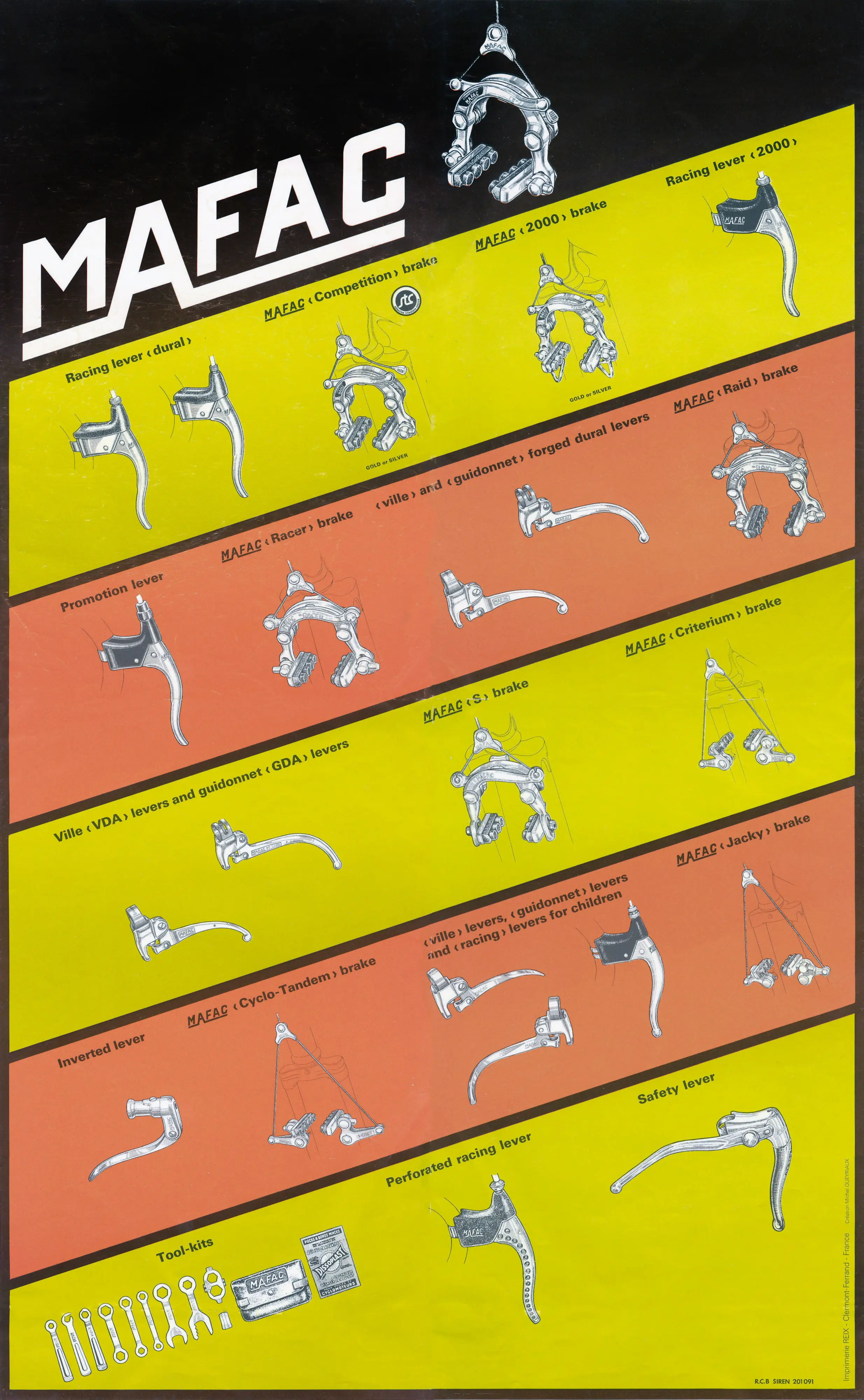
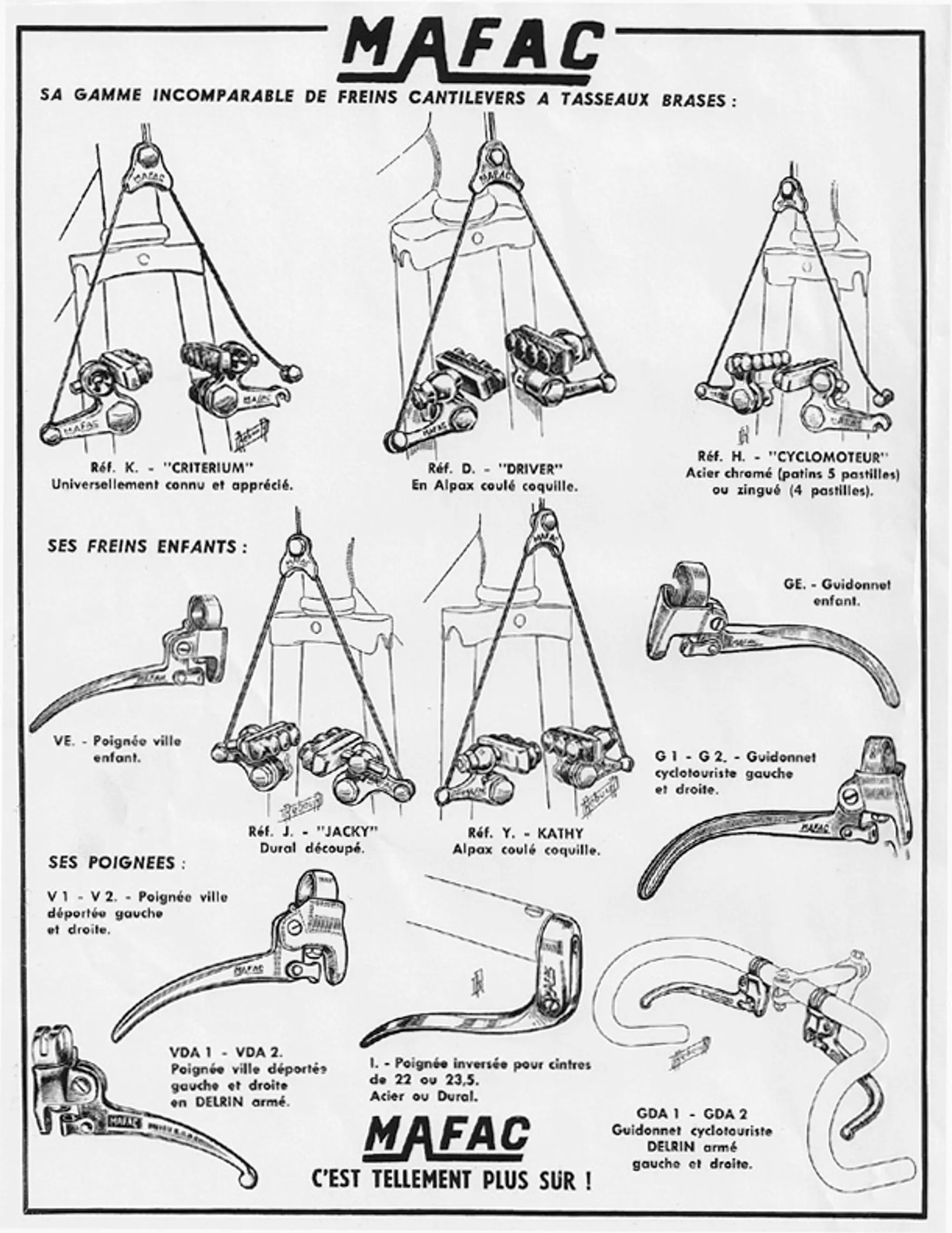
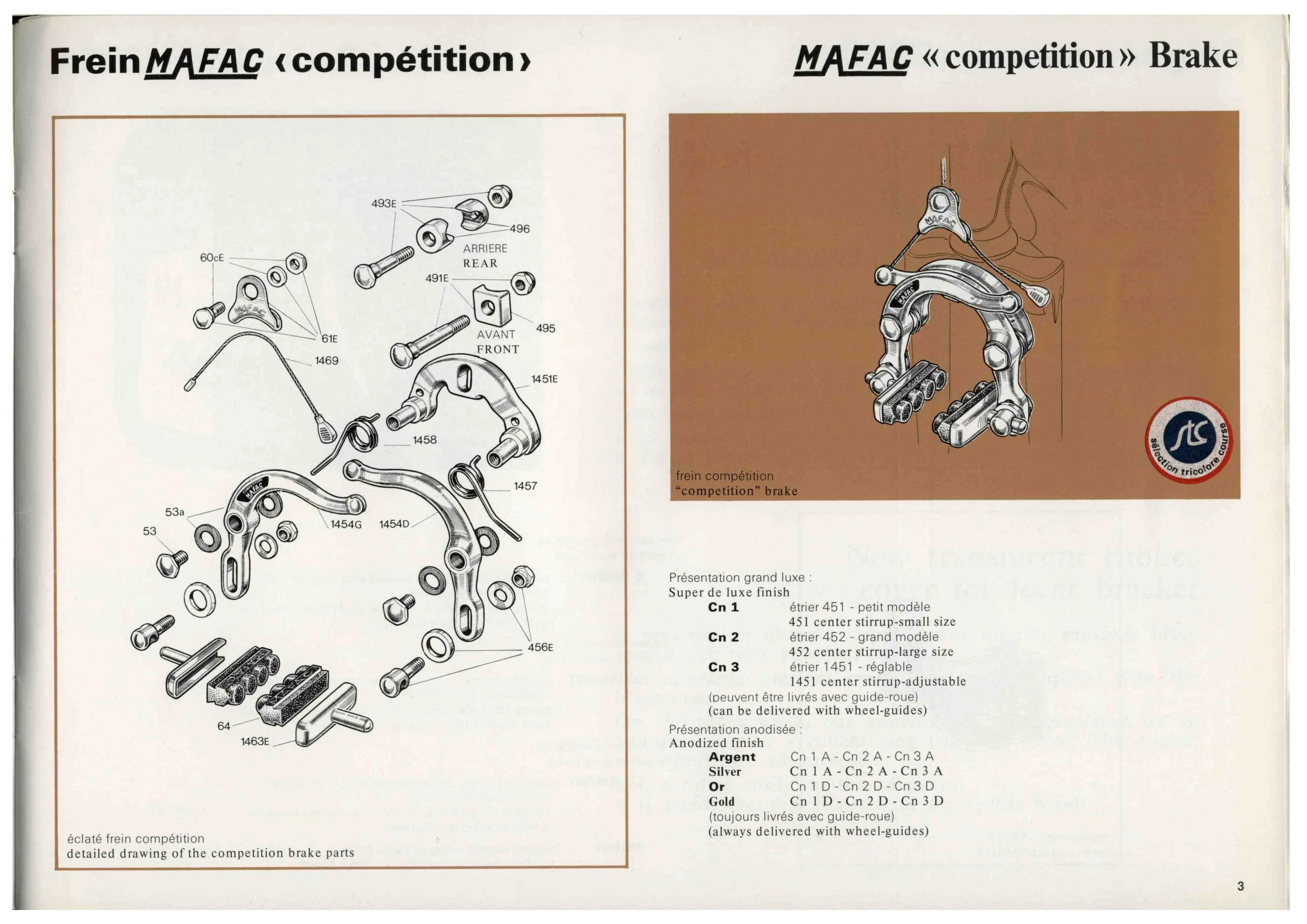
Three Mafac documents in the Ebykr Catalog Archive bracket most of the company’s life. The 1950s catalog, printed while the Racer was still new, gives the Critérium, the children’s Jacky, the tandem and moped cantilevers, the Racer and the levers that went with them, with Rebour’s drawings throughout. The 1976 catalog shows the mature range, the Competition, 2000, Raid, S, Critérium, Jacky and Cyclo-Tandem, with exploded drawings, stirrup sizes, finish codes and the brazing positions for cantilever pivots, wheel size by wheel size. And the 1979 dealer poster lists the last range, with the GT and the LS, LS2 and LC side-pulls alongside the old favorites.
The 1976 catalog repays a close look:
The catalog also gives the reach of each stirrup, measured from the center bolt down to the brake pads, which helps tell a short-reach Competition from a Racer and marks the Raid out from everything else:
| Reach in mm, 1976 | Small stirrup | Large stirrup | Adjustable stirrup |
|---|---|---|---|
| Racer and 2000 | 48.5 to 63 | 53.5 to 68 | 55 to 75 (2000 only) |
| Competition | 43 to 53 | 48 to 58 | 50 to 65 |
| S | 49 to 64 | 54 to 69 | none |
| Raid | one stirrup, 65 to 80 | ||
The 1979 poster adds adjustable stirrups for the Racer and the S, and it gives the new GT the same short reach as the 1976 Competition.
Say a French 10-speed of uncertain age comes home from a garage sale wearing Mafac center-pulls. The front arms read MAFAC «RACER», the arms pivot on red plastic bushings and there is no oil hole beside the pivots. The levers have drilled silver-anodized blades and translucent hoods.
Start with the brakes. «RACER» on the arm puts them after the DURAL FORGÉ years, so around 1970 or later, but before the very last Racers dropped the name. The red bushings agree. On their own, the brakes say the 1970s or the early 1980s.
Now the levers. Drilled blades first appear on the range chart of about 1977, and translucent hoods replaced the black ones in 1976, so if the levers are original the set dates from about 1977 or later. The hoods are the weakest witnesses here, since they were replaced so often; the drilled blades carry more weight.
Then the bicycle. By the rule that runs through this whole series, a bicycle is no older than its newest original part, so this one is about 1977 or later, which is just what you would expect of a late-1970s French 10-speed. Check that against the frame’s own evidence, its serial number and its decals, before you settle on a year. And if the arms had read DURAL FORGÉ, with tiny oil holes beside the pivots, you would be holding a much older story, and very possibly the better garage sale.
For the whole story of the firm, read MAFAC Brakes: History of the Classic French Cantilevers and Center-Pulls and the Mafac timeline. A Mafac brake is one more dated part for the rule that runs through this series, so read it alongside the rest of the machine in How to Date a Vintage Bicycle by Its Components and, for the marque that fitted so many of them, the Peugeot guide. If yours carries a marking this guide does not explain, or a Competition or 2000 shows marks inside its arms, photograph it and bring it to the Mafac topic on the forums.
The rest of the Identify and Date series covers Raleigh and the Brooks saddle.
Mafac documents in the Ebykr Catalog Archive: the 1950s catalog, the 1976 catalog and the 1979 dealer poster
Mafac catalogs of 1964 and 1978, scanned by Mr. Gami (Internet Archive copies)
Classic Lightweights UK — Mafac brakes (Steve Griffith, 2006) and Mafac III (2009), Internet Archive copies
Classic Rendezvous — MAFAC, with Jan Heine and Kevin Sayles (Internet Archive copy)
Cyclo magazine, 15 November 1946 (the Sécurité brake at the Paris Salon); L’Équipe, 1 November 1947 (the Mafac name); Route et piste, 9 October 1951 and 16 October 1951 (the Racer launch), all via Gallica
WIPO Madrid Monitor — international registration 140121, M.A.F.A.C.
Velobase — MAFAC
Ebykr — MAFAC Brakes: History of the Classic French Cantilevers and Center-Pulls
 Mafac
MafacEbykr documents this marque across the archive. Here is the rest of it.
The Ebykr Digest
New articles, timelines, catalog finds and registry activity — assembled from the archive once a month. Your address is never shared.
Double opt-in. One email per month. Unsubscribe at any time with one click.