MAFAC’s story is that of a specialist brake innovator facing the rise of integrated groupsets. For 20 prosperous years, MAFAC filled a crucial gap by creating brakes—like the pioneering Criterium cantilever and revolutionary Racer center-pull models—that were revolutionary in their effectiveness and adjustability, setting the standard for bicycle braking until the late 1960s. As cycling transitioned toward more compact, reliable side-pull brakes perfected by giants like Campagnolo and Shimano, MAFAC’s attempts to adapt with its own side-pull versions proved late and unreliable, leading to a rapid decline despite efforts like the French component partnership Spidel. MAFAC’s legacy lies not in its 40 year duration, but in establishing the foundational designs for effective cantilever and center-pull braking systems that remain influential (well, straight up copied) today.
Here is an historical timeline that includes major MAFAC corporate and product events over the years:
30 of 30 events
1894
Corporate/Personnel
Auguste Bourdel, MAFAC founder, is born.
c. 1920
Corporate/Personnel
Auguste Bourdel begins dedicating himself to industrial interests, including building his own bicycles.
1946
Corporate Founding
The company is founded by Auguste Bourdel in Clermont-Ferrand, post-war France, under the initial name “Securité”.
1946
Product
The “Securité” cantilever brake is introduced at the Paris Salon in October, known as a “foundational triumph”. Its descendants include the Criterium, sold in a quick-release version by 1951, and the 1960s Driver and Kathy. The Criterium series remained in production for some 40 years.
1947 (Autumn/Fall)
Corporate Rebrand
Securité changes its name to MAFAC (Manufacture Arvernoise de Freins et Accessoires pour Cycles).
1948–1950
Corporate
MAFAC advertises from 35, Rue de la Pradelle in Clermont-Ferrand in 1948 and 1949, and by May 1950 has moved to the Rue d’Estaing, its home for the rest of its life (25, Rue d’Estaing in later years) and, by tradition, a former Michelin workshop.
1949
Product
MAFAC introduced rubber brake hoods (initially half-hoods, later full-hoods). By the autumn of 1951 they featured built-in barrel adjusters, allowing riders to fine-tune clearance while riding.
1951 (October)
Product Breakthrough
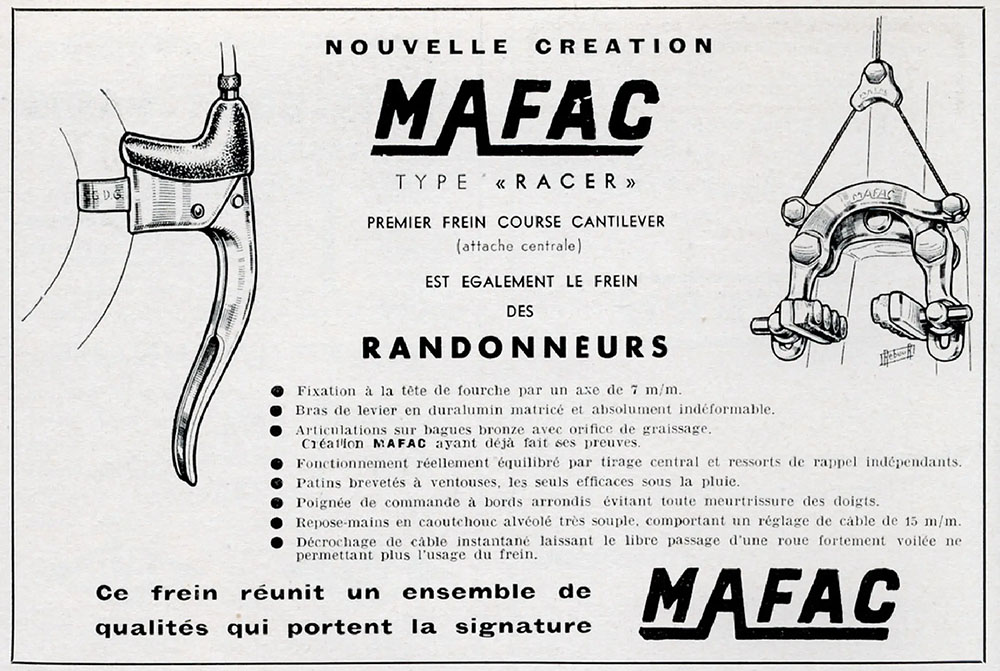
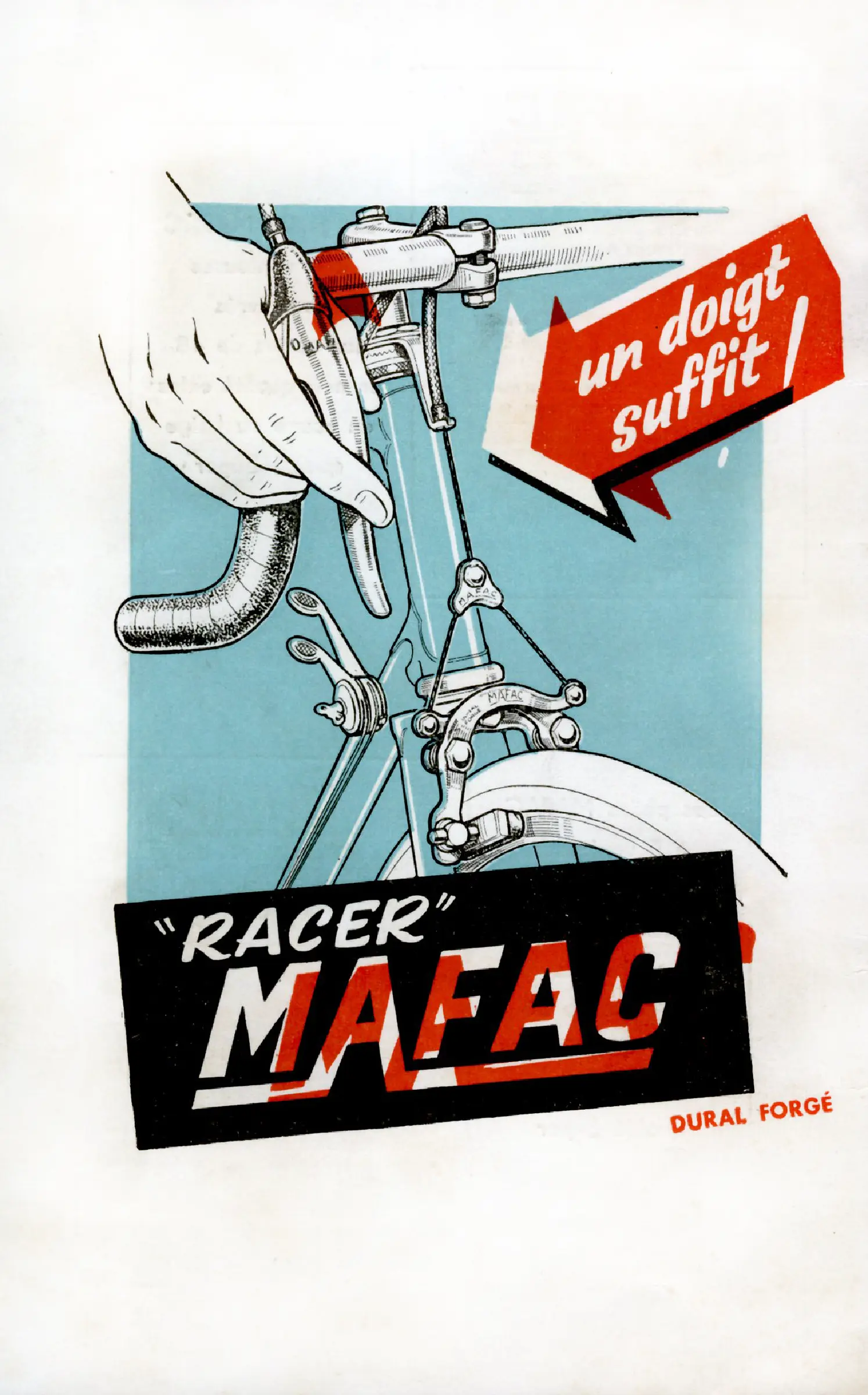
The Racer center-pull brake is unveiled at the Paris bike show, hailed as MAFAC’s “undisputed magnum opus” and the first effective center-pull design. Its superiority allowed for the bold slogan: “Un doigt suffit!” (“Braking with one finger is enough”).
1951 (November)
Product
An advertisement for the MAFAC Racer appears in Le Cycliste.
1951 (Debut Period)
Product
Center-pull calipers were initially forged from durable duralumin and stamped “Dural Forge”.
1951–1953
Product
The first Racers feature tiny oil holes beside the pivots, dropped after a year or two.
1953
Market
The MAFAC center-pull brake design became available in Britain.
1954 (June)
Corporate/Personnel
Founder Auguste Bourdel dies at about 60.
1958
Corporate/Personnel
Paul Bertrand begins his stewardship as manager of the factory.
1960
Corporate/Personnel
Mme. Mazen-Bourdel (Auguste Bourdel’s daughter), who played a pivotal role in advancing sales and industrial capacity after her father’s death, dies in a road accident.
c. 1960
Product
The Tiger center-pull model is introduced, reportedly at the Paris Salon of October 1960, with wider-set arms to increase leverage; it is gone by the mid-1960s.
1962
Product
The Top 63 center-pull brake is introduced at the Paris Salon and made only until the mid-1960s, making it a rare component. This model was advertised in 1964 as being tested at 60 m.p.h. under load.
Late 1960s (reported)
Product
One British specialist reports the stamping on levers changing from “Mafac” to “Mafac France”; no Mafac document confirms it.
1968
Market
Campagnolo launches its first Record caliper, increasing competition for MAFAC.
Around 1970
Product
The stamping on Racer arms changes from “Dural Forge” to “Racer”; sources disagree on whether this came in the late 1960s or the early 1970s. The very last Racers read only “MAFAC”.
1970s
Product
The Raid center-pull model is introduced (it is in the 1976 catalog), with longer arms and a reach of 65 to 80 mm for 650 B wheels with fenders.
1970s
Product
The Racer brake iteration featured red bushings framing the engraved script.
c. 1974
Product
The Competition center-pull model is introduced as a later high-end brake, featuring brass bushings (instead of plastic); from about 1977 it uses a straddle cable with double ball ends.
c. 1974
Product
The MAFAC 2000 model is introduced, offered as a variation of the Racer design and available in gold-anodized finishes.
Late 1970s
Corporate/Market
MAFAC joined the Spidel consortium (with Maillard, Simplex and Stronglight) to compete with groupset manufacturers, supplying Competition and MAFAC 2000 calipers and levers.
Late 1970s – Early 1980s
Product/Market
MAFAC attempted to adapt to new trends by producing side-pull brakes (LC, LS, LSX, and LS2 models) concurrently with their center-pull lines. These models ultimately suffered from reliability problems.
Early 1980s
Product
Production of the legendary Racer brake ceases.
1981
Product
MAFAC cantilever brakes appear on the Specialized Stumpjumper, one of the first commercially built mountain bikes, highlighting their superior tire clearance.
1983–1985
Corporate Closure
Economic pressures and strong competition from Japanese and Italian manufacturers lead to the company’s closure. The British cycling press reports MAFAC out of business in October 1983; a management buyout revives it in 1984, but it is probably gone for good by about 1985.
Post-Closure
Legacy
The engineering principles of MAFAC’s cantilever and center-pull designs influenced later systems by companies like Dia-Compe and Shimano, and their designs are considered current even by modern standards.
Join the MAFAC Heritage Discussion!
Does your build feature rare ‘Dural’ stampings? We are building a visual database of every MAFAC variant. Post your photos and help us expand the definitive guide.


 Mafac
Mafac