About Ebykr
Ebykr celebrates classic and vintage lightweight bicycles through provocative imagery and opinion. Ride along with us.
About Ebykr
Ebykr celebrates classic and vintage lightweight bicycles through provocative imagery and opinion. Ride along with us.


For almost 30 years Daniel Rebour drew the French bicycle for Le Cycle: numbered pen plates that showed readers how the best constructeurs built their machines. The man, his tandem, his pen and the gift that made his drawings worth keeping.

Nearly a century before close-up photographs of every lug were a tap away, a French cyclist who wanted to know how a constructeur’s rack met the fork crown, or where a dynamo cable disappeared into a frame tube, looked for a drawing of that feature signed by a now-familiar name: Rebour. For almost 30 years, Daniel Rebour drew bicycles and their components for the trade magazine Le Cycle, and his plates of numbered pen drawings became the way two generations of riders, builders and collectors learned about classic lightweight bicycles and their true artistry, especially of the exotic, French variety.
Ebykr has leaned on those drawings for years. About 70 of Daniel Rebour’s plates are in the Ebykr Rebour collection, the archive holds his own reports from the Paris Salon and a run of the advertisements he drew, and his plates illustrate our articles from the 1948 Cycle de France build sheet to the history of Idéale saddles. This piece is about the man behind those drawings and about the gift he had that made them so special.
Daniel Robert Marcel Rebour was born in Le Havre on 11 November 1908 and died at Dieppe on 12 May 1987, according to the French national register of deaths. He came from a family of teachers with strong convictions. His father, Raoul Rebour (1879–1952), was born at Octeville near Le Havre, taught at the teacher-training college in Rouen and later sat on the municipal council of Courbevoie as a socialist. His mother, Pauline Rebour, née Boyenval (1878–1956), taught before she became a lawyer, founded the Société féministe du Havre and was a national officer of the French women’s suffrage movement by 1914. Both have entries in the Maitron, the French biographical dictionary of the labor movement.
Daniel had an older brother, Rodolphe (1907–1999), and married Simone (1911–2003), who would ride beside him on a tandem. The couple had no children. Rodolphe’s daughter, Martine Rebour, is Daniel’s heir.
The postwar years made his name. Le Cycle, a magazine for the French cycle trade, began publishing in 1945 and Rebour’s first article appeared in its fourth issue, dated 3 November 1945. His drawings ran in it until the magazine closed in May 1974 after 488 issues and the obituary in the French cycle-touring federation’s magazine remembered him as the chief editor of Le Cycle.
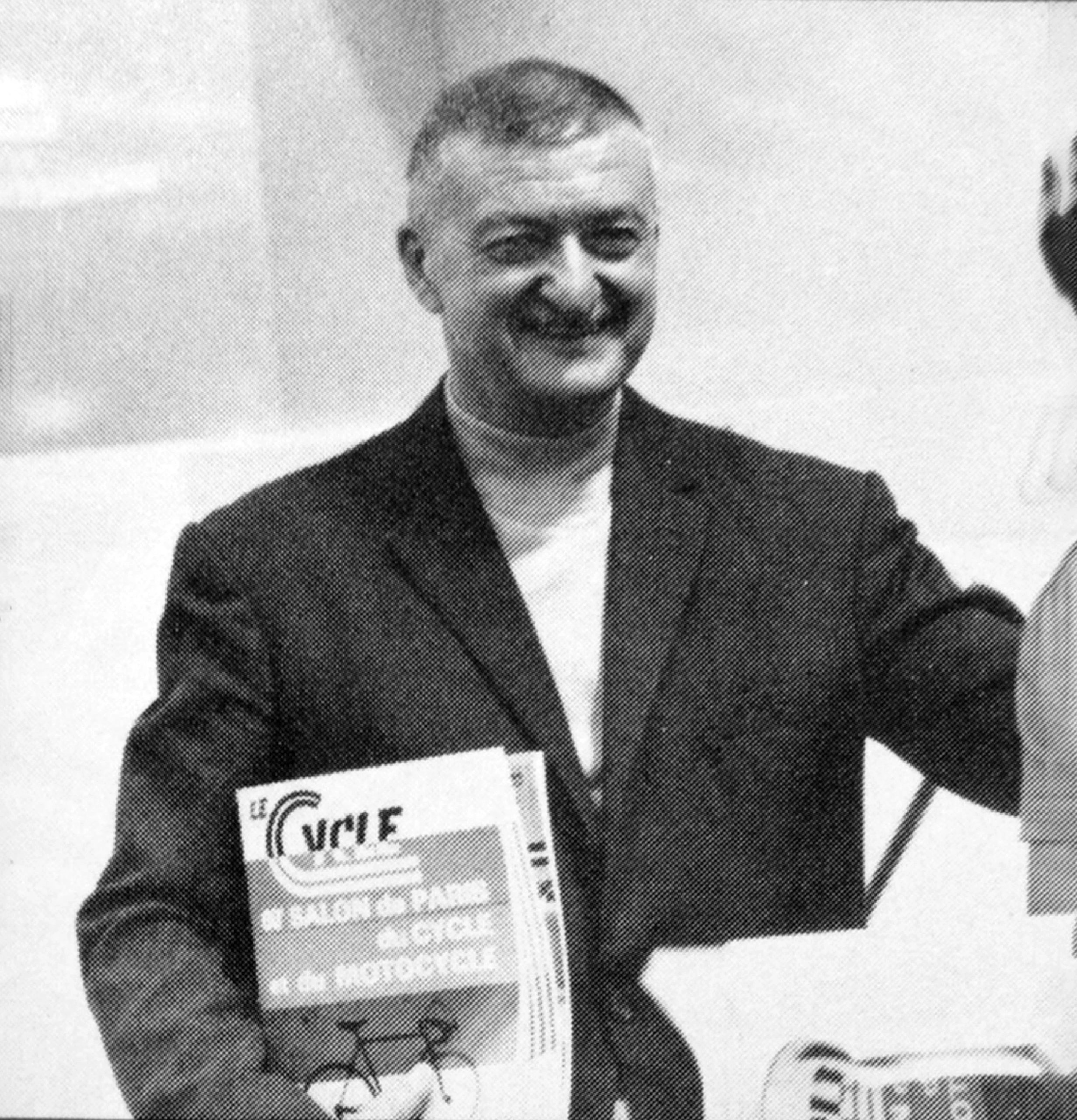
His first piece asked a question every maker faced: does racing pay? Rebour’s answer was that it depended on the maker. A country dealer whose customers were farmers and foresters gained nothing by fielding racers, while a large factory gained a great deal and the small town builder should look after a club. Then he turned to the riders he cared about most, the cyclotouristes, whose technical trials and long brevets had become a test bench for their machines, and concluded that competition paid at every level. The article even carried his first two drawings for the magazine. It also carried a memory of his father, no racer himself, talking about whether Henri Pélissier or Ottavio Bottecchia might win the Tour that year.
Another early article set out his convictions in metal. In December 1945 he asked whether dural was a luxury for light and delicate machines or the right metal for every bicycle, the postman’s and the farm worker’s included, and argued for the second. Over the next few years he wrote on brakes, frames, luggage carriers and handlebars, always illustrated by his own hand. In 1949 he published a book of his own, La Pratique du Vélo, which was 225 pages from Technique et Vulgarisation in Paris with a preface by Claude Tillet, a chapter for each essential part of the bicycle and drawings of the details made by Bourdel, Daudon, Herse, Hugonnier-Routens and Singer. Quite the compendium, one would have to say.
Rebour drew as a rider would. In 1948 he and Simone rode Paris-Brest-Paris on a tandem in the randonneur category, 1,200 kilometers of hilly road by day and night, and Le Cycle reported that they finished first among the mixed tandems. His own account, published on 11 September 1948, reads like an equipment report. The machine was the tandem on which Cordier and Mme Bourgeois had finished third at Chanteloup that year: a short frame of Reynolds tubes with double triangulation, a J. Moyne five-speed freewheel, a Herse front derailleur, Maxi-C.A.R. tandem hubs and two Herse brakes with Mafac levers. Preparing it, he wrote, would have been a matter of setting the saddles and handlebars but for the lighting, which he had tested in the week before the start in the dark alleys of the Bois de Boulogne, between 10 at night and midnight.

A notice of his book the following year introduced him in exactly that order, first a winner of Paris-Brest in a mixed tandem, then a laureate of the main cyclosportive events and finally a writer. The order matters. When Rebour drew a bag support or a brake pivot, he was often drawing a part he had trusted himself, at night, a long way from home. Most artists would have a very difficult time relating to their subjects in the same way Rebour could.
A period photograph could show an entire bicycle. It was poor at showing how one part met another. A pen line could leave the wheel out, cut a tube open to show the cable inside it, turn a bracket to the one angle that explained it and set 16 details from 15 makers side by side on a single page. That is the gift this article is named for: an eye that saw what mattered in a detail and a hand that could show it to a reader who would never stand in the builder’s shop. Rebour drew at the Paris Salon, at the Poly de Chanteloup, at Paris-Brest-Paris and at the shows in Brussels, Geneva, London and Milan, and the numbered plates that came out of those visits are often the best surviving record of how the machines were made.

He was generous with his gift, too. Asked by Rob van der Plas for permission to reproduce his drawings, Rebour replied, in van der Plas’s account: “use anything you like, as long as you don’t omit my signature.” That signature, the name lettered inside a slanted box of ruled lines, is on nearly every plate he drew and it is the first thing to look for when a drawing turns up without a credit.
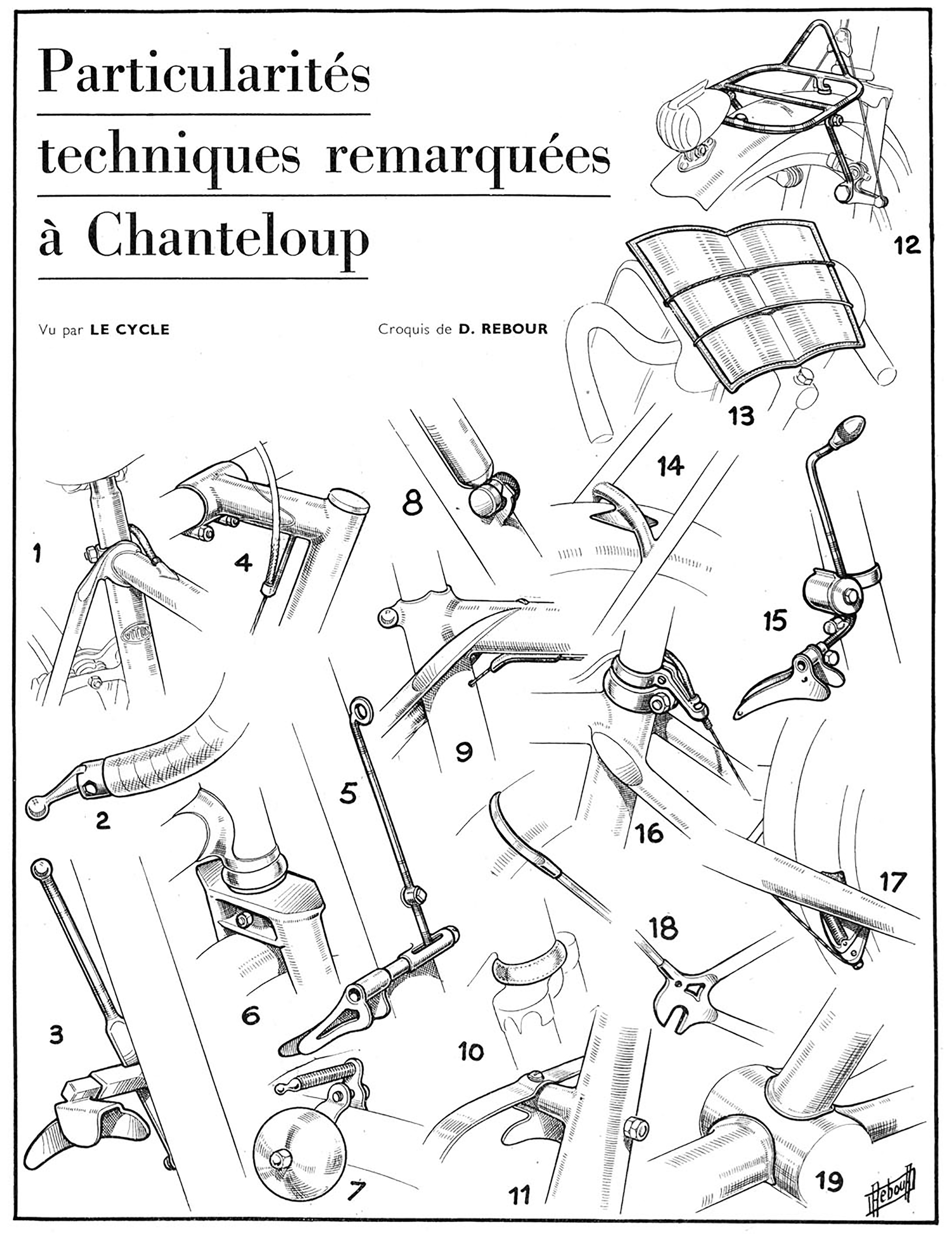
A plate is built to be read in two passes. The heading names the occasion (the Salon, a town where something was “remarqué” or the name of an event) and carries two marks: vu par Le Cycle, the magazine’s claim, and Croquis de D. Rebour, his claim. A caption list runs in number order above or below the drawings and names the maker and the feature for each one. Read the drawing first, then the caption: the caption tells you whose part it is and the drawing tells you how it was made.
Three habits help. Treat the caption list as the citable text, since it names the maker in print. Expect a plate to have two dates: much of his work appeared first in Le Cycle and was reprinted weeks or months later in Le Cycliste, so quote the Le Cycle date where you can find it. And you can even look for Rebour himself in the plates: he drew his own tandem into the 1948 Paris-Brest-Paris plate above, numbered and credited like everyone else’s.

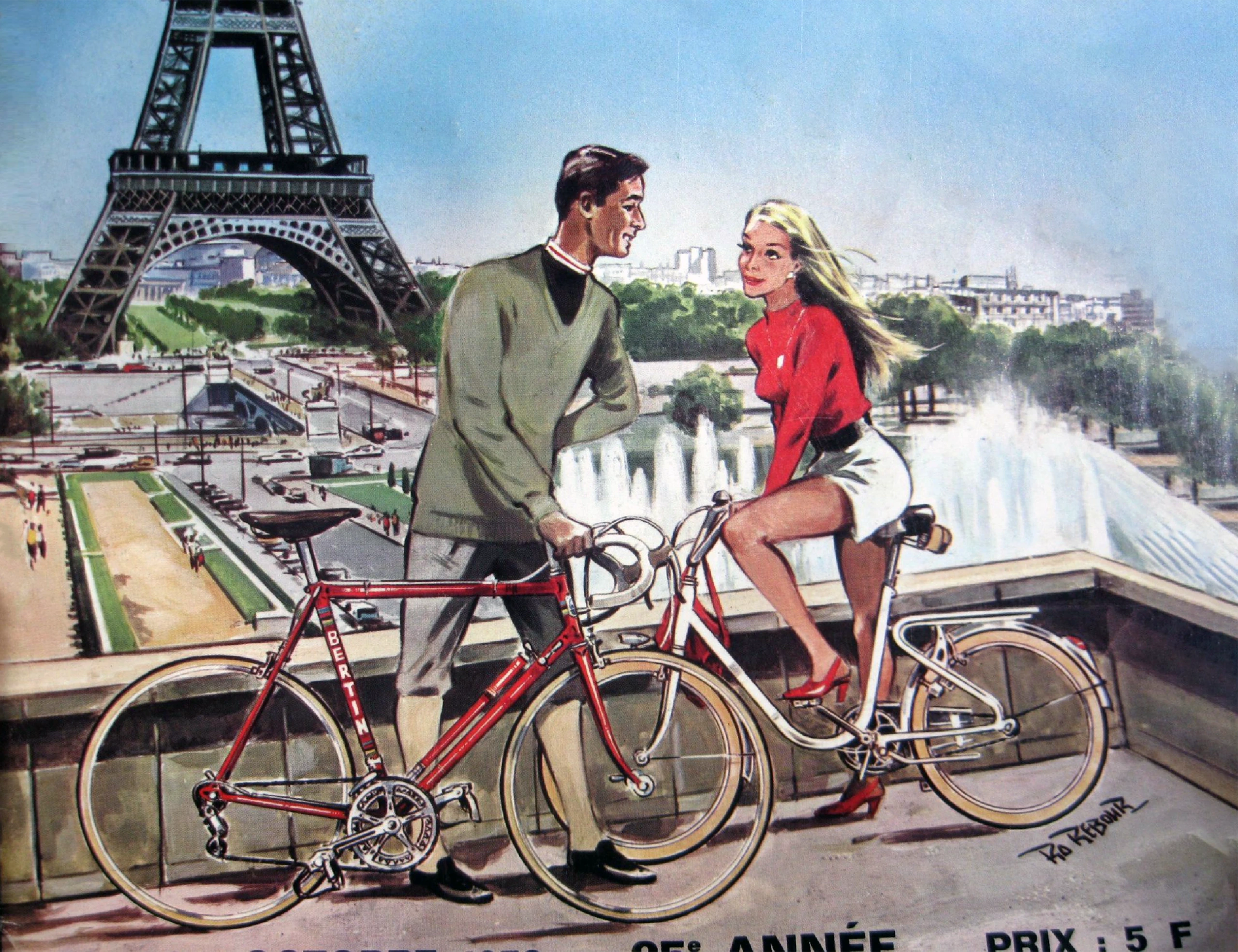
Not every drawing is technical. Rebour also drew cartoons around the headings of his articles, and Heiko, who scanned them all, notes that they show an artistic skill well beyond technical drawing.

One fun question about the drawings is still open and it concerns both Rebour brothers. By Heiko’s account, Rodolphe Rebour trained at the same art school as Daniel but turned toward artistic illustration. A story passed down from Ernest Csuka of Cycles Alex Singer, retold by a member of a 2025 Bike Forums discussion, holds that Rodolphe drew most of the cartoon figures and that Daniel’s first bicycle commission was a late-1940s Alex Singer catalog. Heiko disputes both points. He finds Daniel writing in Le Cycle from November 1945, dates his first Singer drawing to a full-page advertisement of March 1946 and has seen no caricature by Rodolphe.
The Ebykr archive adds one small piece of evidence. Idéale’s advertisement in Le Cycle of May 1971 shows a cow being held by two large hands, a joke on the No. 90 saddle that Idéale sold already hand-treated “selon Rebour”, by Rebour’s method. The phrase on the cow’s flank carries Daniel’s boxed signature. The credit at the lower right reads, “d’aprés RoREBOUR” (accent as printed). If the “Ro” stands for Rodolphe, the advertisement credits the brother for the cartoon and Daniel for the method. It is one line of lettering and we offer it as a question rather than an answer. Any takers?
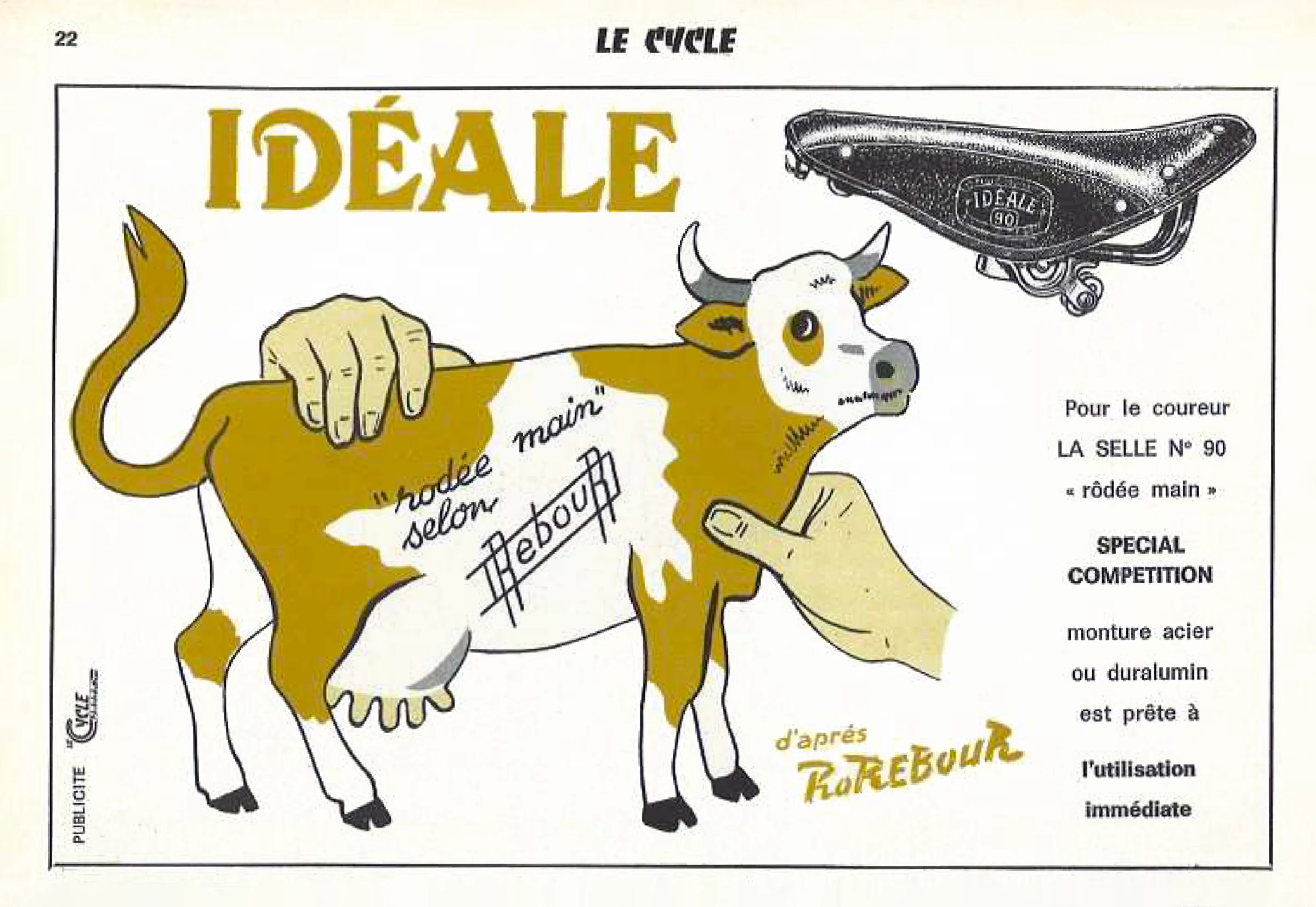
Rebour’s pen reached well past his own magazine. His drawings also carried manufacturers’ advertisements and the Ebykr archive holds a run of them: Mafac’s brakes in 1957 and again in 1966, Huret’s Luxe derailleur in 1966, VAR’s frame-building machines, André Bertin’s Milremo specialties and Nervar’s chainsets, among others. He reported the 1951 Paris Salon for Englebert Vélo-Magazine, which billed him as its correspondent in France. And his drawings crossed the Atlantic in Gene Portuesi’s Cyclo-pedia catalogs: the 1961 edition in our archive carries one of them, signed.
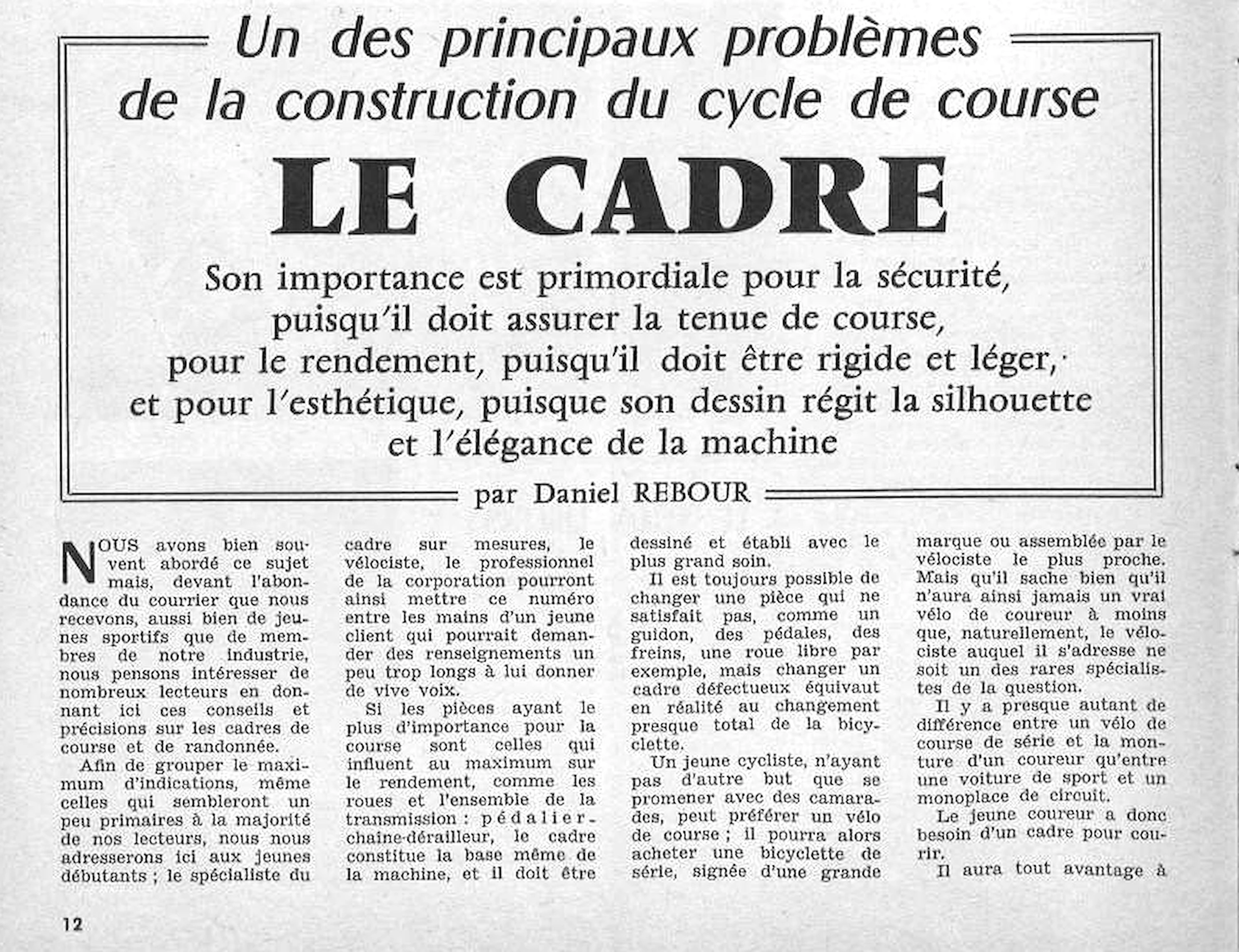
He kept reporting the Salon into the magazine’s last decade. Ebykr’s own copies of Le Cycle hold his Salon report for 1964 and his report for 1966, the January 1964 article on the frame and a 1971 essay on the bicycle’s lasting popularity, each transcribed in the archive. The October 1966 issue also carries his page on that year’s Paris-Brest-Paris, won on a René Herse.
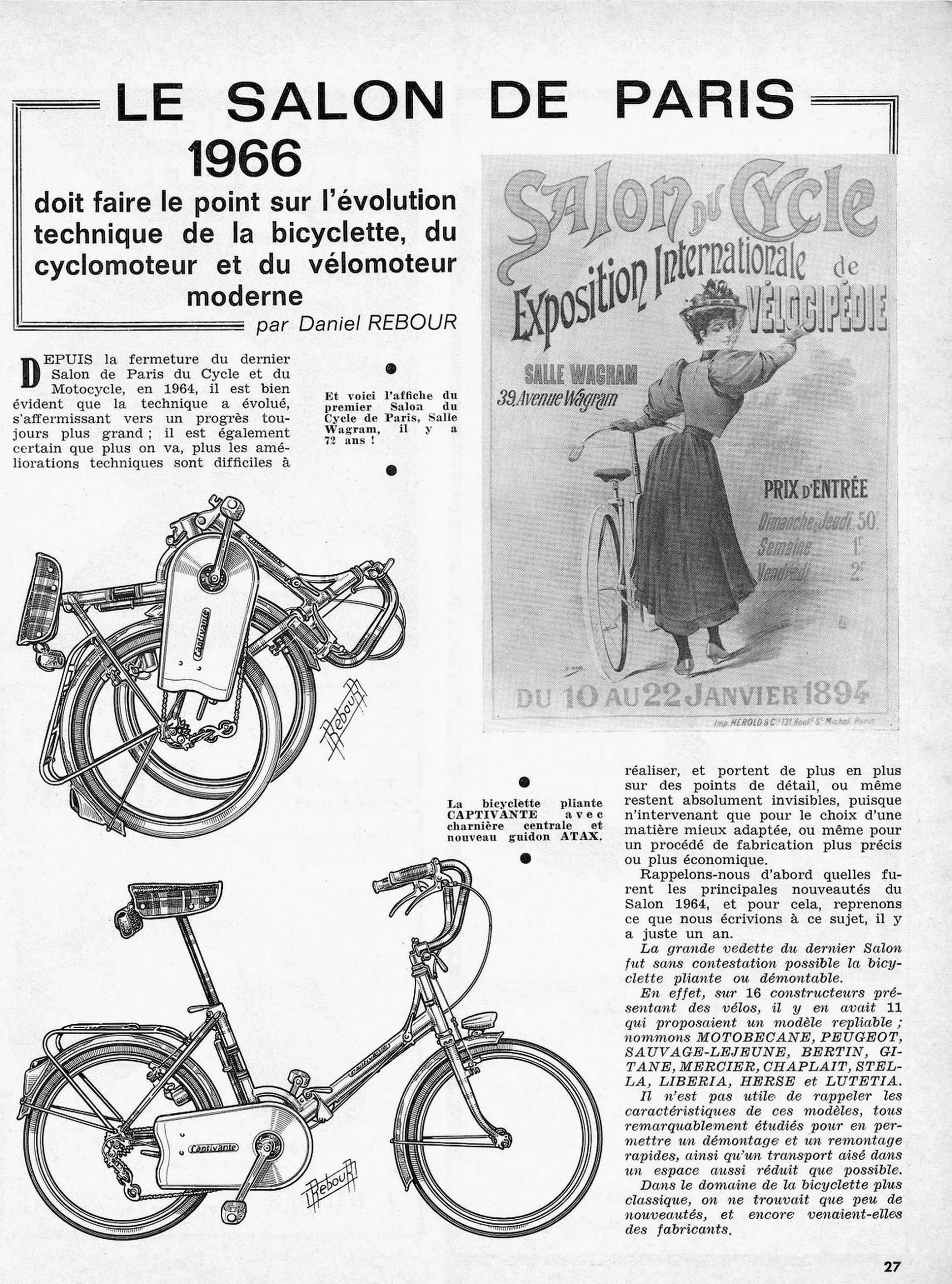
Rebour’s dates here come from the French national register of deaths, which records his birth in Le Havre on 11 November 1908 and his death at Dieppe on 12 May 1987. Some printed accounts place his death in 1991. The obituary in Cyclotourisme, n° 348, September–October 1987, recorded that he left quietly, as he had wished, with a civil funeral at which the French cycle-touring federation was represented by the president of the cycling club of Neufchâtel. Dates for each plate follow Heiko’s index of Le Cycle, which gives the issue, number and page of first appearance.
To Heiko (HeikoS69), whose Daniel Rebour Files made much of this article possible, and to Martine Rebour, whose permission made those files possible. To Joel Metz, whose Blackbird SF index of the plates came first.
Have a Rebour plate, a catalog he illustrated or an advertisement with his boxed signature? Share it in the Ebykr forums, or add it to the archive with Docs Drop.
Heiko (HeikoS69), The Daniel Rebour Files, Flickr album (Le Cycle, 1945 to 1974)
Heiko, The Daniel Rebour Files, PDF of transcriptions and translations (2021)
INSEE, Fichier des personnes décédées (French national register of deaths)
matchID search of the INSEE register: Rebour, Daniel Robert Marcel, 1908–1987
Maitron: Rebour, Raoul, Joseph
Maitron: Rebour, Pauline, née Boyenval
Joel Metz, Blackbird SF, Daniel Rebour: Le Cycliste drawings
Bike Forums, “New Scans of Daniel Rebour drawings” (2021 and 2025)
Le Cycle, January 1964: Le cadre, by Daniel Rebour
Le Cycle, October 1964: the principal novelties of the 1964 Salon, by Daniel Rebour
Le Cycle, October 1966: Le Salon de Paris 1966, by Daniel Rebour
Le Cycle, October 1966: Paris-Brest-Paris 1966, won on a René Herse
Le Cycle, May 1971: La vogue de la bicyclette, by Daniel Rebour
Idéale advertisement, Le Cycle, May 1971
Englebert Vélo-Magazine, November 1951: Le Salon de Paris 1951, by Daniel Rebour
Gene Portuesi’s Cyclo-pedia, 1961
Le Cycle, n° 4, 3 November 1945; n° 20, 11 September 1948; n° 21, 25 September 1948 (as transcribed by Heiko)
Cyclotourisme, n° 348, September–October 1987, p. 63 (as transcribed by Heiko)
The Ebykr Digest
New articles, timelines, catalog finds and registry activity — assembled from the archive once a month. Your address is never shared.
Double opt-in. One email per month. Unsubscribe at any time with one click.

