About Ebykr
Ebykr celebrates classic and vintage lightweight bicycles through provocative imagery and opinion. Ride along with us.
About Ebykr
Ebykr celebrates classic and vintage lightweight bicycles through provocative imagery and opinion. Ride along with us.

Source: Le Cycle, n° 119, May 1971, pages 5, 7; scan of the issue from Cycle Memory (Mémoire du Cycle), Collection privée H.D.
| Type | Review |
|---|---|
| Year | 1971 |
| Publisher | Le Cycle |
| Country | France |
| Language | French |
| Pages | 2 |
| Source | Le Cycle, n° 119, May 1971, pages 5, 7; scan of the issue from Cycle Memory (Mémoire du Cycle), Collection privée H.D. |
| Credit | Ebykr archive |
| Identifier | Permalink https://cyclememory.org/fr/search-coll-list.php?collectionID=773&docID=B-1-0000000811 |
| Transcription | Headings and specifications transcribed; article text summarized |
LE CYCLE La vogue de la bicyclette est toujours bien vivante Daniel REBOUR (Suite page 7) 5 LE CYCLE LA VOGUE DE LA BICYCLETTE • LA VOGUE DE LA BICYCLETTE • LA VOGUE DE (Suite de la page 5) LE CYCLE MOTOS - CYCLOMOTEURS - SCOOTERS NOTRE COUVERTURE Daniel REBOUR. 7
This is a magazine article, so its running text is summarized here rather than reproduced; the headline, byline, specifications and scores are transcribed as printed.
Daniel Rebour’s editorial for Le Cycle n° 119, May 1971, the magazine he edited: “La vogue de la bicyclette est toujours bien vivante”, on the bicycle’s recurring fashions from the Célérifère and the Michaux to the Duralumin revival of the 1930s and the mini-vélo boom after May 1968, on pages 5 and 7, with the note on the cover. The title, byline and signature are transcribed as printed; the text is summarized in Ebykr’s words, and the page images carry it in full.
— Page 1 —
LE CYCLE
La vogue de la bicyclette est toujours bien vivante
Daniel REBOUR
[Ebykr summary; the article’s text is not reproduced. Daniel Rebour’s editorial opens on the saying that life is an endless new beginning and takes the bicycle as his example: even technically, he says, one could trace analogies between very old designs and today’s “nouveautés”. His theme is the vogue of the “petite reine”, which he says comes back in a fairly regular cycle (he notes the pun). At its start the velocipède (printed without its first accent), in turn the Michaux, the Grand Bi and the Safety, an unusual and eccentric-looking machine of somewhat mysterious stability and very costly, was taken up with enthusiasm by high society, and it was fashionable for Parisians, Messieurs et Dames side by side, to pedal round the Bois. Earlier still, before the first bicycles, the Célérifères had been used mostly by the elegant set of the day, the Incroyables, and then the Draisiennes by the Dandies, he suggests because they had so little practical use. Industrial manufacture of velocipèdes brought prices down and turned the promenade and sporting machine into a popular means of transport, which put it out of bounds for the “haute classe”. Bicycles of 1905 to 1930 he calls rather ugly: nickel plating protected poorly and rust soon reached handlebars, bottom bracket (pédalier), hubs, spokes and brakes; the machines were heavy, the tires fragile and hard to mend, and most roads were rough pavés or dirt turned to mud by the first shower; racing bicycles, their clips and accessories held on with thick wrappings of chatterton tape, were no better than town cycles. After a three-dot break: roads improved and bicycles grew lighter as the dérailleur, balloon and half-balloon tires and finally light alloys spread, cutting weight and making parts practically rustproof, and the vogue of the vélo revived. Claude Tillet, the magazine’s late director from 1946 to 1959, explained this return after the Salon du Cycle of 1934 in a booklet published by the Société du Duralumin under the title Kilos en moins, kilomètres en plus, or “Comment le duralumin a rénové le cycle”. A passage set in italics follows: after a brilliant run in 1926, 1927 and 1928 the cycle trade fell into a deep depression, 1929 being passable, 1930 bad and 1931 disastrous; sales dropped sharply, part of the cycling public turned to the motorcycle and the general public lost interest in the great road events, so that the bicycle’s future looked compromised. Some manufacturers sought salvation in massive price cuts, others outbid them, and a price war began that the text says still goes on with countless victims; it asks whether sacrificing quality to price, and finish to speed of manufacture, was really the answer (continued on page 7).]
(Suite page 7)
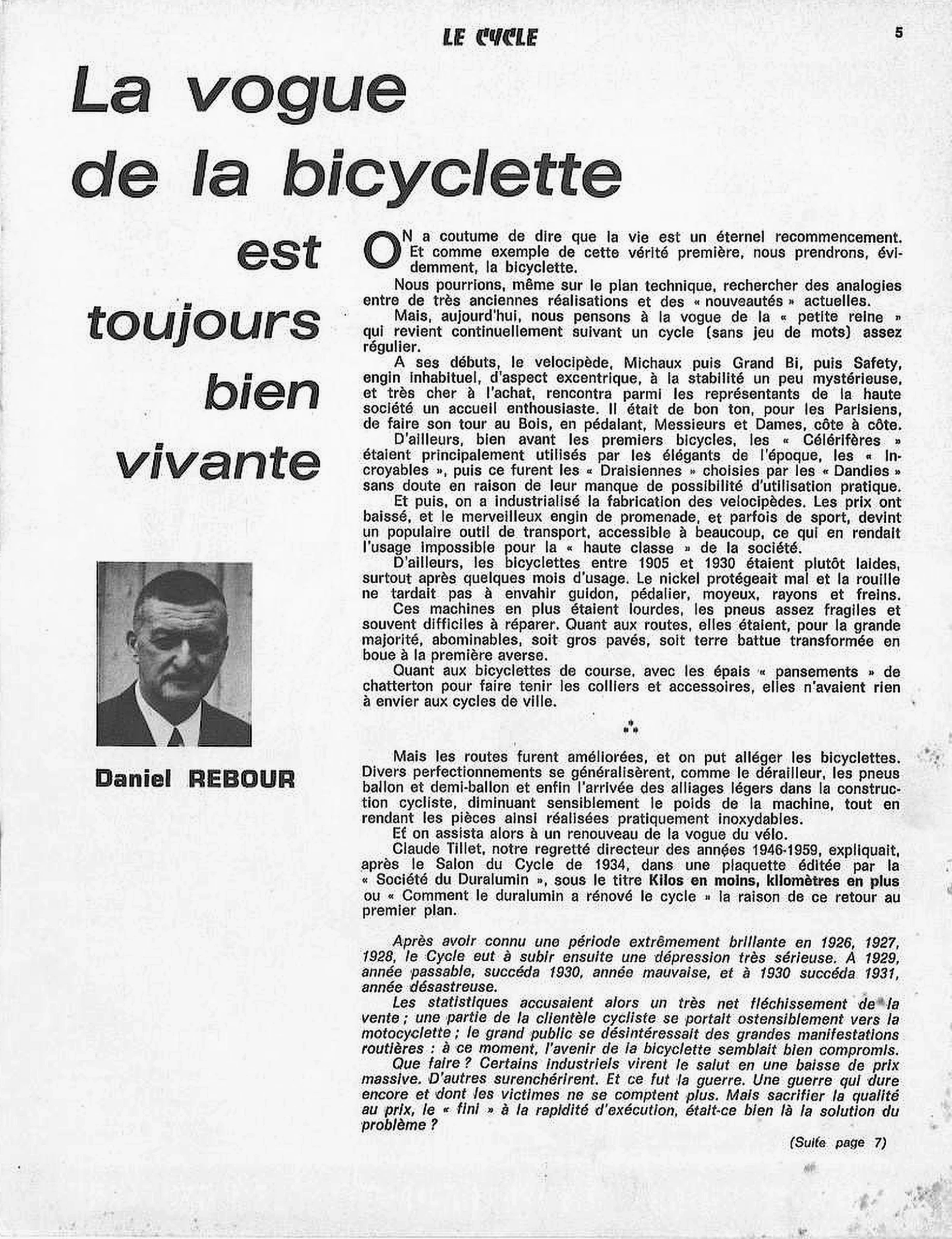
[A head-and-shoulders portrait photograph of Daniel Rebour, in a dark suit and tie before a board wall, stands in the left column below the title, captioned with his name. The page carries no drawings.]
5
— Page 2 —
LE CYCLE
LA VOGUE DE LA BICYCLETTE • LA VOGUE DE LA BICYCLETTE • LA VOGUE DE
(Suite de la page 5)
LE CYCLE
MOTOS – CYCLOMOTEURS – SCOOTERS
NOTRE COUVERTURE
Daniel REBOUR.
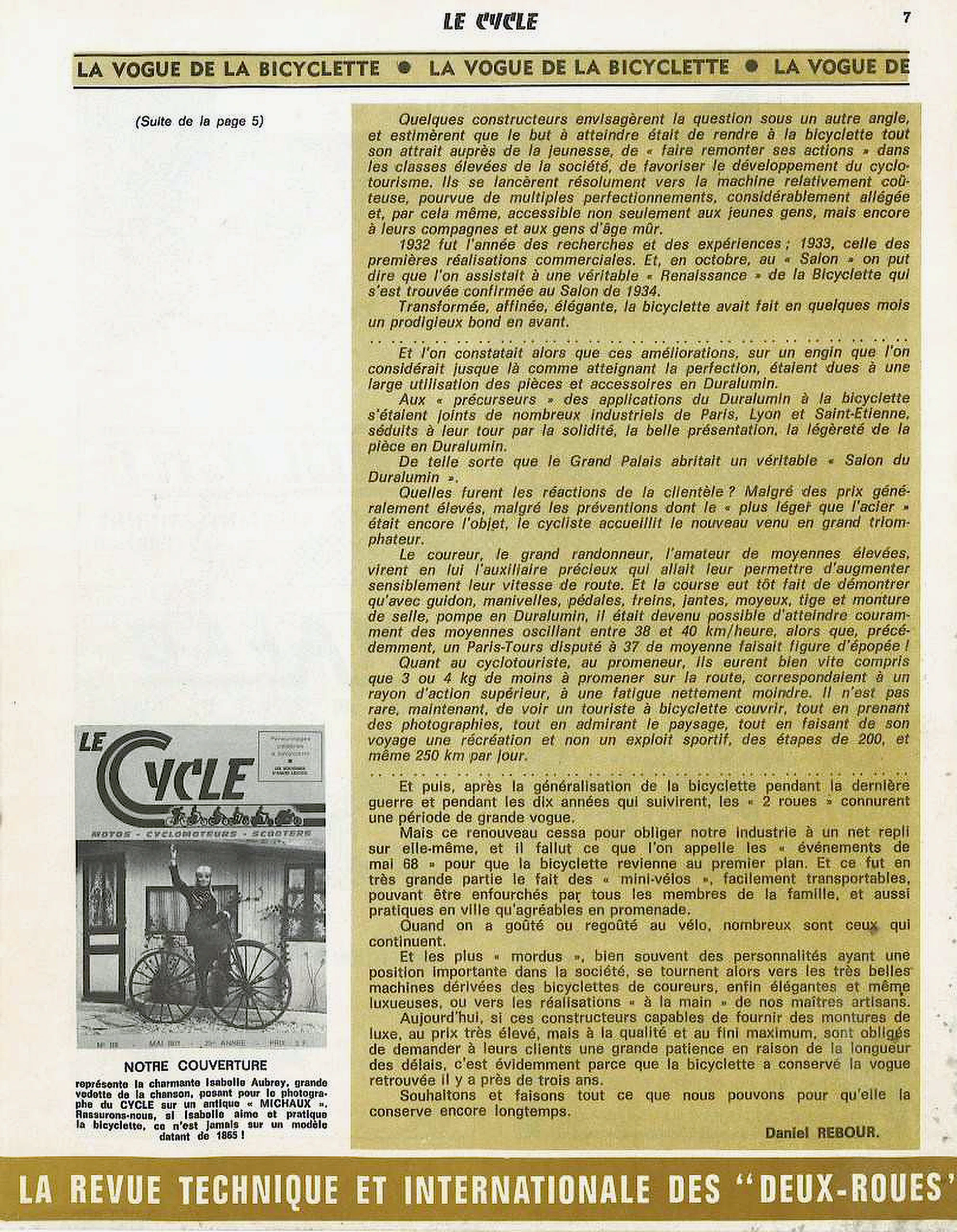
[Ebykr summary; the article’s text is not reproduced. (Continued from page 5.) The passage in italics goes on: some manufacturers took the question from another angle, aiming to win back the young for the bicycle, to raise its standing among the upper classes and to encourage cyclotourisme; they turned resolutely to a relatively costly machine, with many refinements and much lighter, suited not only to young men but also to their companions and to riders of mature age. 1932 was the year of research and trials, 1933 that of the first commercial products, and at the October Salon one could speak of a true Renaissance of the Bicycle, confirmed at the Salon of 1934: transformed, refined and elegant, the bicycle had leapt forward in a few months. After a dotted rule, the passage credits these gains, on a machine thought already perfect, to the wide use of parts and accessories in Duralumin. The early champions of Duralumin on the bicycle were joined by many manufacturers of Paris, Lyon and Saint-Etienne, won over by the strength, fine finish and lightness of Duralumin parts, so that the Grand Palais housed a veritable Salon du Duralumin. Despite generally high prices and lingering distrust of anything lighter than steel, cyclists welcomed the newcomer. Racers, long-distance randonneurs and fast amateurs saw in it a way to raise their road speed, and racing soon showed that with handlebars, cranks, pedals, brakes, rims, hubs, seat post and saddle clip (tige et monture de selle) and pump in Duralumin, averages of 38 to 40 km/heure became routine, where a Paris-Tours run at an average of 37 had once seemed an epic. Cyclotourists and leisure riders found that 3 or 4 kg less meant greater range and much less fatigue, and touring cyclists now ride stages of 200 and even 250 km a day while taking photographs and enjoying the scenery, as recreation rather than sporting feat. After a second dotted rule, the text returns to roman type: after the bicycle’s general use during the last war and the ten years that followed, the “2 roues” enjoyed a great vogue; that revival ended and forced the industry into a sharp retreat, and it took the “événements de mai 68” to bring the bicycle back to the fore, largely through the “mini-vélos”, easily carried, rideable by every member of the family, practical in town and pleasant for outings. Many who take or retake to the vélo keep on, and the keenest, the “mordus”, often people of high social standing, turn to very fine machines derived from racing bicycles, elegant and even luxurious, or to the hand-built work (“à la main”) of master craftsmen. If the builders able to supply luxury frames (montures de luxe), very costly but of the highest quality and finish, must now ask clients for great patience over long delivery times, Rebour says, it is because the bicycle has kept the vogue it regained nearly three years ago, and he closes hoping, and pledging to work, that it keeps it a long time. Under the heading NOTRE COUVERTURE the caption at lower left explains the cover: it shows the charming Isabelle Aubrey, a great star of the chanson, posing for the photographer of LE CYCLE, who is not named, on an antique “MICHAUX”, and it assures readers that although Isabelle loves and rides the bicycle, she never does so on a model dating from 1865.]
[A small black-and-white reproduction of this issue’s front cover stands at the lower left above the NOTRE COUVERTURE caption: the young woman waves from the old velocipede before the board wall of the house, under the LE CYCLE masthead and its band of rider silhouettes; the boxed cover line and the foot line are too small to read in the reproduction. The article’s text is printed on a gold ground panel to the right, the upper left of the page is left blank, and the page carries no drawings.]
7
Ebykr presents this material for research and education. If you hold rights to it or notice an ownership issue, please contact us and we will respond promptly.
The Ebykr Digest
New articles, timelines, catalog finds and registry activity — assembled from the archive once a month. Your address is never shared.
Double opt-in. One email per month. Unsubscribe at any time with one click.