About Ebykr
Ebykr celebrates classic and vintage lightweight bicycles through provoking imagery and opinion. Let's roll together!
About Ebykr
Ebykr celebrates classic and vintage lightweight bicycles through provoking imagery and opinion. Let's roll together!


When reminiscing about the crowded field of mid-20th century Parisian constructeurs, familiar names like Alex Singer and René Herse usually consume the largest share of the conversation. Their machines have come to represent some of the most enduring icons of the Golden Age, celebrated for their integrated elegance and proven randonneuring pedigree. Yet, for the studied enthusiast who prefers a whisper of purpose-defined, user-centered brilliance over the shout of fame, there is always André Maury.
To walk through the 15th Arrondissement in the 1930s was to witness the bicycle transitioning from a utilitarian tool to a “made-to-measure” instrument of prestige. André Maury was a central protagonist in this upmarket transition. Operating from the heart of Paris, Maury practiced a “couturier” market philosophy and brand strategy. Far more than simply selling bicycles, he tailored them to both the body and soul of the rider, compelling his creations to become objects of individuality and personal expression. A two-wheeled masterpiece, just for you and maybe the mademoiselle, built by a true master artist and technical innovator.
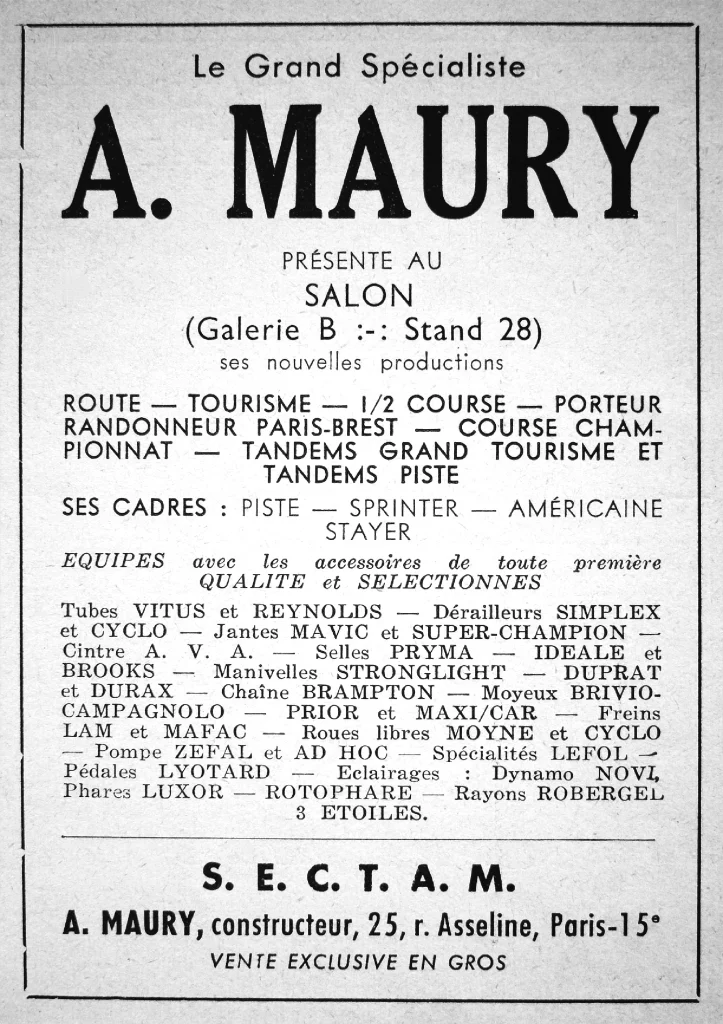
The physical locations of Maury’s workshops serve as a chronological map of his commercial evolution. For the collector, these addresses—found on period advertisements and catalogs, as well as in industry directories and journals—are the primary keys to dating a surviving machine.
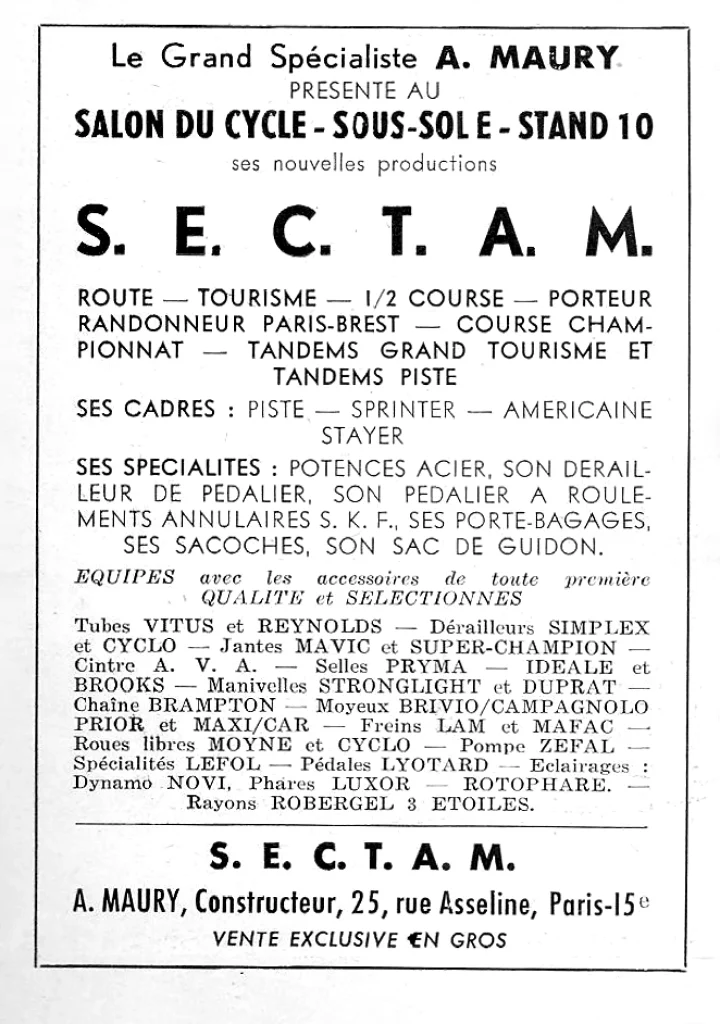
One of the more fascinating footnotes in the Maury story is his relationship with Maurice Emeriau and their shared ties to 13 Boulevard Pasteur. The site was a bicycle shop as early as 1902, operated by Gaudinat. Around 1920, the business transitioned to Emeriau Cycles. Historical directories suggest Maury then purchased the “bicycle manufacturing” business assets of “Emeriau Cycles” in 1926. For a brief period in the early 1930s, his shop was listed as A. Maury et Emeriau.
Whether Maury was simply using an established brand name to gain a foothold or was a former protégé of the Emeriau family remains a subject of debate among enthusiasts. Regardless, by 1933, Maury was asserting his own voice in a letter to Emeriau, writing with a confidence that would come to define his standout career:
“I do everything to the client’s request. If you would deign to honor me with an order, you will not regret it. Perfect care is taken in my construction. It was I, in fact, who made the tandem for…”
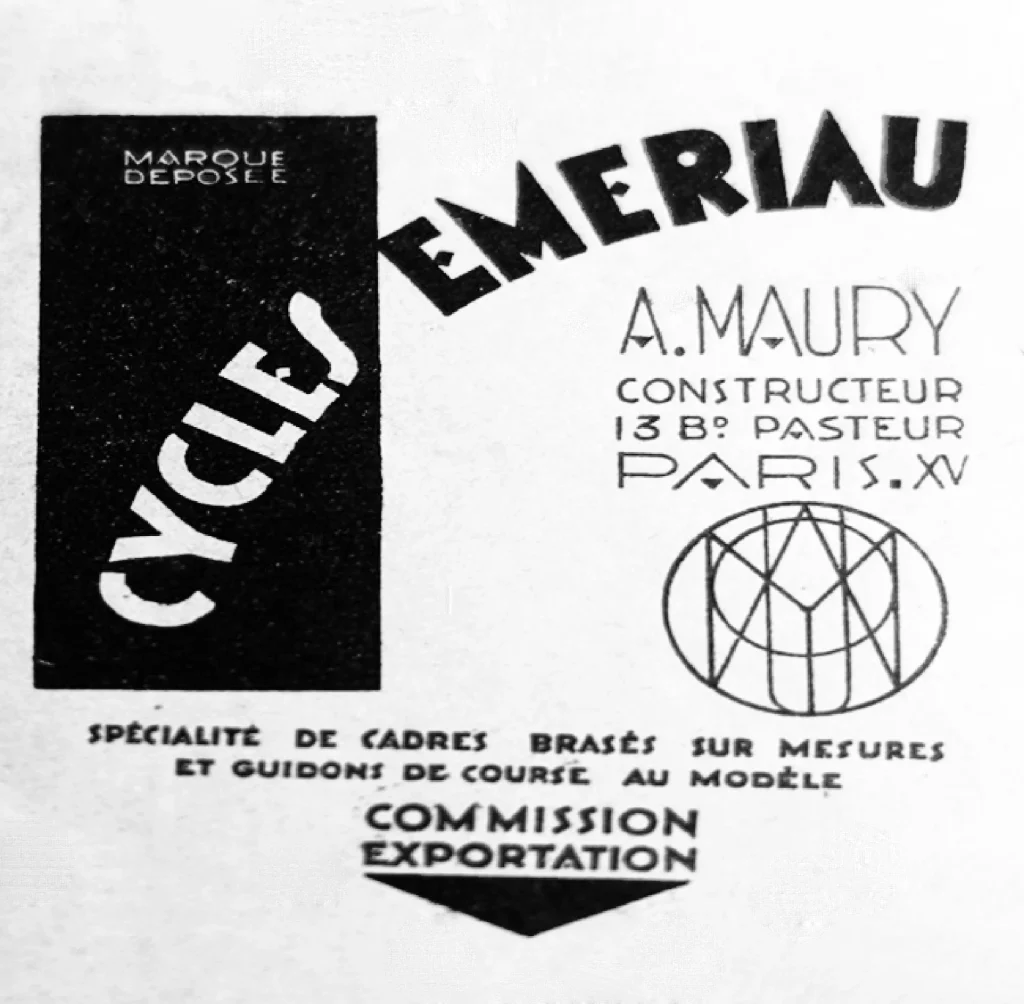
Maury’s real shift occurred around 1932 when he transitioned from selling parts to creating them. This had quietly been underway for some time with house-made handlebars, before things expanded to include custom frames and forks. By 1934, Maury entered the first technical cycling competition, where his machines claimed second and third place overall. The reputation was set: Maury was a builder worthy of the highest ranks.
His technical signature was the fillet-brazed joint – with its smooth, “solder-less” appearance that creates a fluid, organic transition between tubes. While many of Maury’s peers leaned heavily into the aesthetics of lugs, as he himself did in the early 1930s, his use of advanced brazing techniques would come to provide a lighter, stronger and more streamlined connection. It was a functional and visual testament to his mastery of heat and steel, most often rendered in the finest Reynolds 531 or Vitus tubing.

What truly separates a constructeur from a mere frame builder is an unrelenting obsession with the “whole.” And Maury was a consummate innovator to that end. In an era where many challenging cycling problems were being addressed with rudimentary engineering solutions, Maury was looking decades into the future.
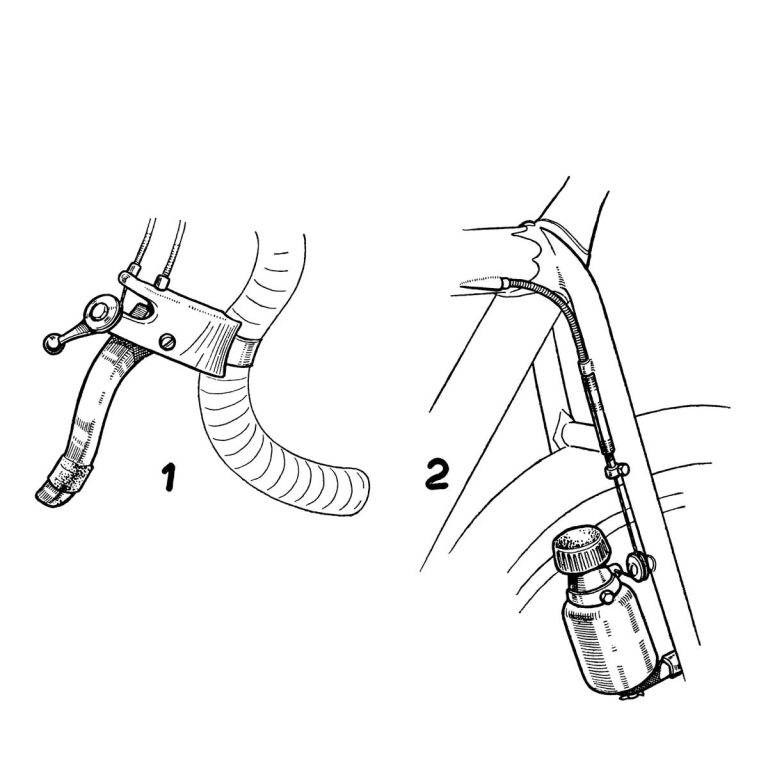
Consider his threadless stem, introduced in 1948 shortly after World War II. Clamped between the upper cup and locknut, it was a radical departure from previous approaches that predated the modern “Aheadset” system by nearly 40 years. This was preceded by Maury’s “Speedy” cantilever brakes a decade before in 1938, praised for their smoothness that felt revolutionary to riders accustomed to the weak, wooden feel of period calipers.
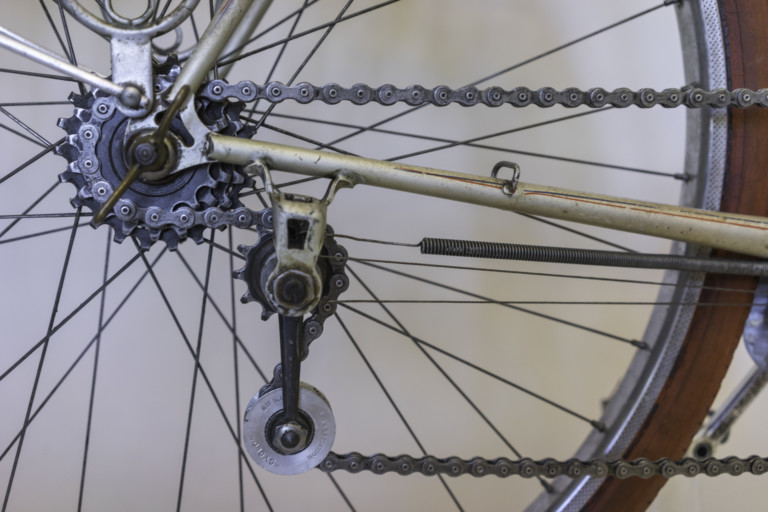
Maury’s innovative range covered the entire bicycle. He advanced and integrated:
A Maury bicycle was never just a frameset and some parts. It was a curated selection of the finest French components of the era, chosen to work together as a unified system whose purpose was to address a rider’s needs and wants. Maury chose his suppliers with the same discernment he applied to his brazing:
It should be noted that while Maury is celebrated for his own brand, forum research suggests he may have acted as a contract builder for other high-end labels. One enthusiast discovered what is likely a post-war Maury frame (serial #2154) that had been rebadged as a Ducheron. This raises an interesting topic for the rest of us: the possibility that several “Ducheron” or other artisanal framesets of the era actually carry the hidden DNA of Maury’s craftsmanship.
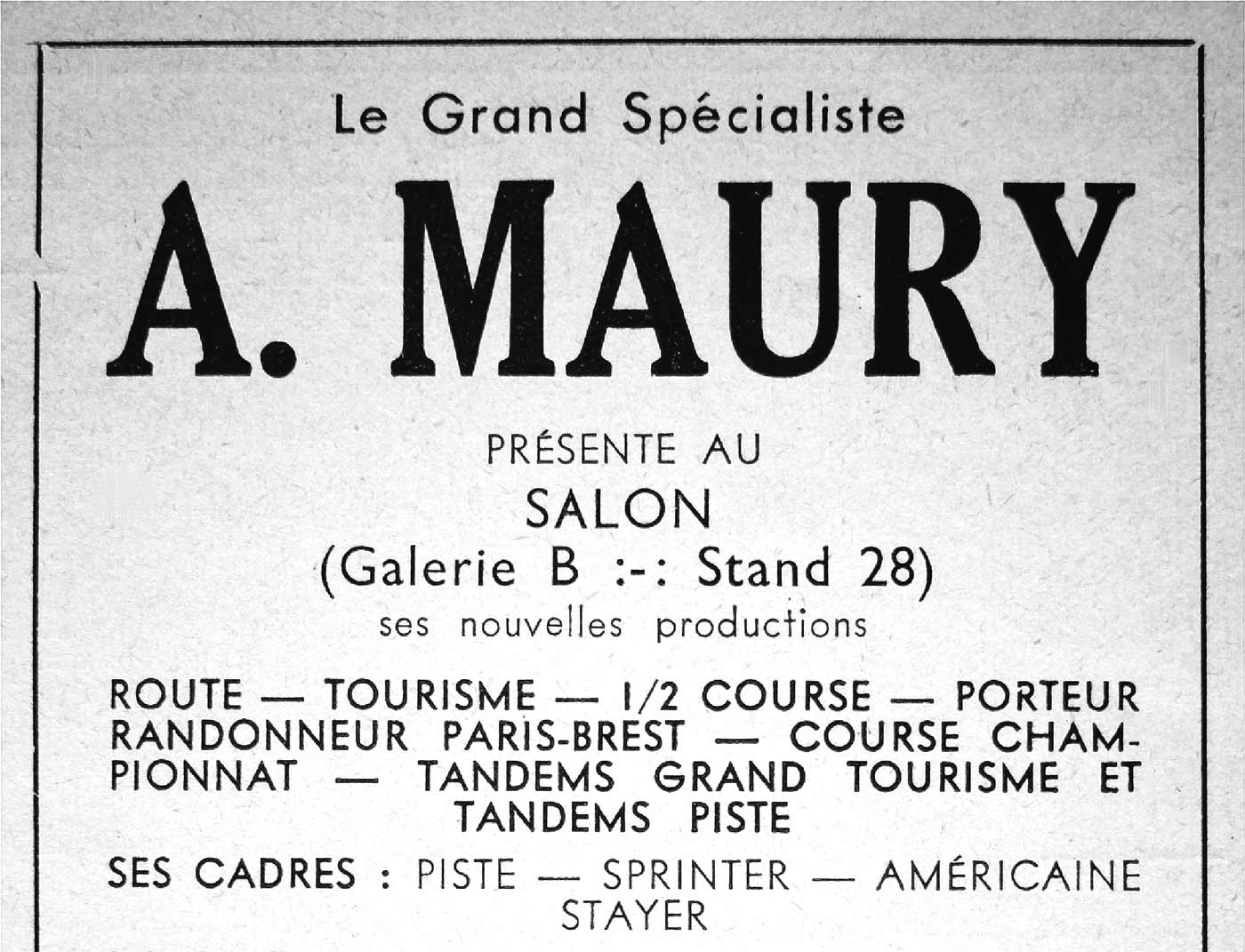
While some mid-20th century builders specialized only in the long-distance tourer, including many standout names from the era, Maury was also a polymath of the path, street and track. His 1950s advertisements for the Salon du Cycle touted him as “Le Grand Specialiste,” offering everything from Grand Tourisme tandems to aggressive, super-rigid Pace Following (Stayer) frames. Included here were:
Perhaps foremost, Maury understood the “Sunday bike” better than most. Even his urban models featured elegant chain guards and lighting, proving that a machine could be as chic as it was capable. This must have pleased his city dweller clientele who valued status and cleanliness as much as mechanical performance. Yet, Maury’s competitive streak was undeniable, too – he built aggressive track bikes that suggested a deep technical understanding of the dynamics of pure speed, much as he built lightweight touring bikes made frugally while remaining strong in all the right places. One touring specimen from the late 1940s—equipped with a 650B frameset, integrated lighting and 38mm tires—weighed approximately 12 kilograms, or just 26.5 pounds, which remains feathery nearly 100 years later.


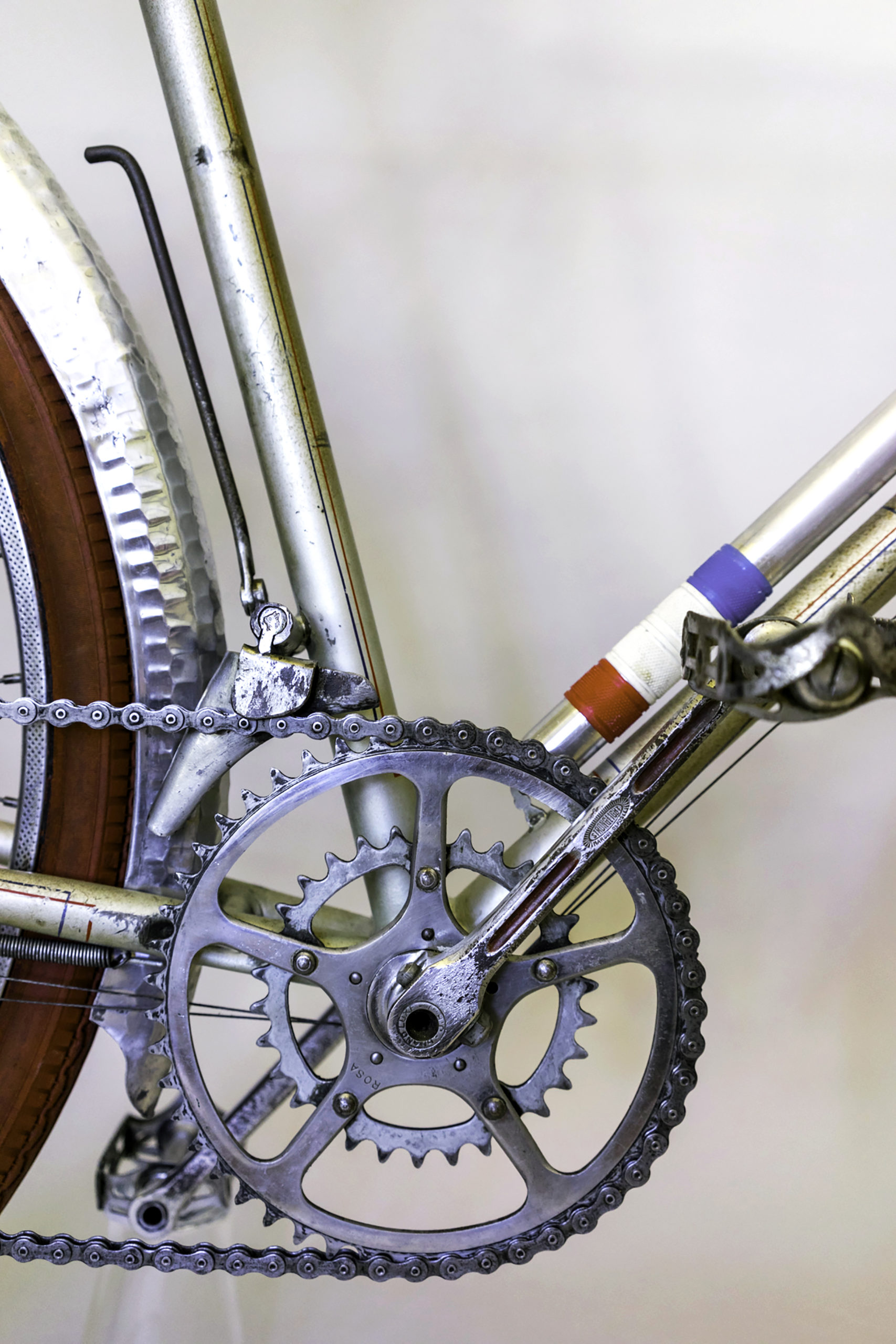


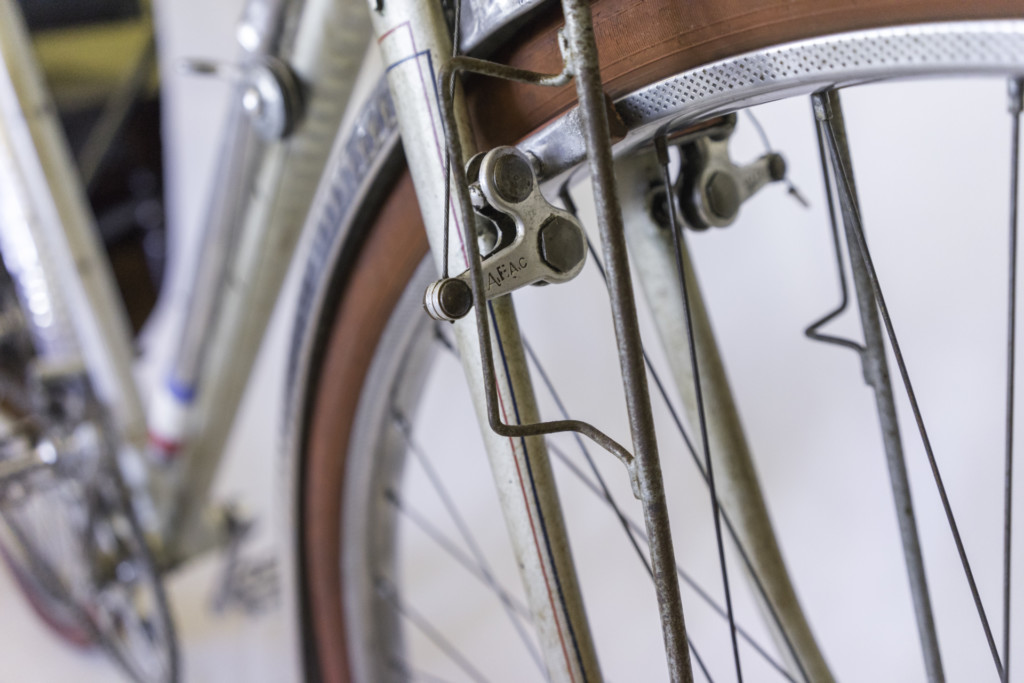

André Maury was the manufacturer behind the “Speedy” brake brand. His workshop produced these minimalist centerpull models starting in 1938, which were highly regarded for their lightweight construction and elegant design. Unlike mass-produced MAFAC brakes that arrived on the scene eight years later in 1946, Speedy brakes were a more artisanal product, often featuring polished finishes and refined hardware.
Here is where it gets interesting: René Herse, the aforementioned Parisian constructeur (aka the “Magician of Levallois”), who did not manufacture the brakes himself, was nonetheless the primary reason for their fame. He spec’d Speedy brakes on his top-tier machines because they complemented his minimalist, high-performance aesthetic. Herse was also known to modify components to meet his exacting standards, often providing custom-machined alloy rollers and straddle wire hangers to improve the performance and look of the Speedy calipers on his bikes. In extreme cases of frugality, Herse would even braze Speedy brakes directly onto a frame and fork (eliminating the need for a central mounting bolt), a hallmark of his integrated, aerospace-influenced design philosophy.
Recent conjecture around this includes a Bicycle Quarterly article in Issue 84 that sought to address something of a long-standing debate among anyone who cares anything about this stuff: Was the “Speedy” brake a René Herse invention manufactured by Maury, or a Maury invention adopted by Herse? The article concludes that while André Maury was the physical manufacturer, René Herse was likely the mastermind behind the design, in what looks to be a classic designer-contractor relationship. (Whatever the evidence behind this conclusion, it aligns well with the deservedly pro-René Herse outlook advanced by our friends at René Herse Cycles, publisher of Bicycle Quarterly.)
While there is no obviously identifiable sequence relating Maury serial numbers to their date of manufacture, the semblance of a pair of systems may make sense to share here, admittedly at the risk of spreading misinformation. As cobbled together by studying various forum sources over the years, including the superb Forum Tonton Vélo, the distinctly unofficial Ebykr hypothesis around dating Maury serial numbers splits the numbering scheme into two distinct eras, one pre-war and the other post-war:
While the “XX-AA” coding and the S.E.C.T.A.M. era sequences offer a somewhat compelling framework for cataloging surviving frames, they remain a collective work-in-progress derived from anecdotal research by enthusiasts. The possible shift to a chronological numbering in 1949 suggests a builder refining his administrative identity alongside the technical peak achieved at his Rue Asseline workshop. Until a definitive factory ledger or additional precisely dated “Rosetta Stone” examples emerge, these serial numbers continue to serve as vital, if speculative, clues in the ongoing effort to document Maury’s limited production of bespoke, “couturier” bicycles.
Maury’s branding was as elegant as his brazing. His downtubes rarely bore loud decals or flashy embellishments. Instead, they featured a simple, hand-painted script: A. Maury. Even the legendary Simone Rebour, wife of the master illustrator Daniel Rebour, chose a Maury for her ascents of the Galibier. To see her in period photographs, perched atop a Maury at the summit, is to see the peak of French cycling culture – graceful, technically peerless and utterly purposeful.

Today, a surviving André Maury is a rare find, with total production estimated in the hundreds to very low thousands. To own one is to hold a fragment of a lost Parisian world – a time when the bicycle was the ultimate expression of individuality, crafted by a man who saw no boundary between the mechanic and the artist.