About Ebykr
Ebykr celebrates classic and vintage lightweight bicycles through provoking imagery and opinion. Let's roll together!
About Ebykr
Ebykr celebrates classic and vintage lightweight bicycles through provoking imagery and opinion. Let's roll together!

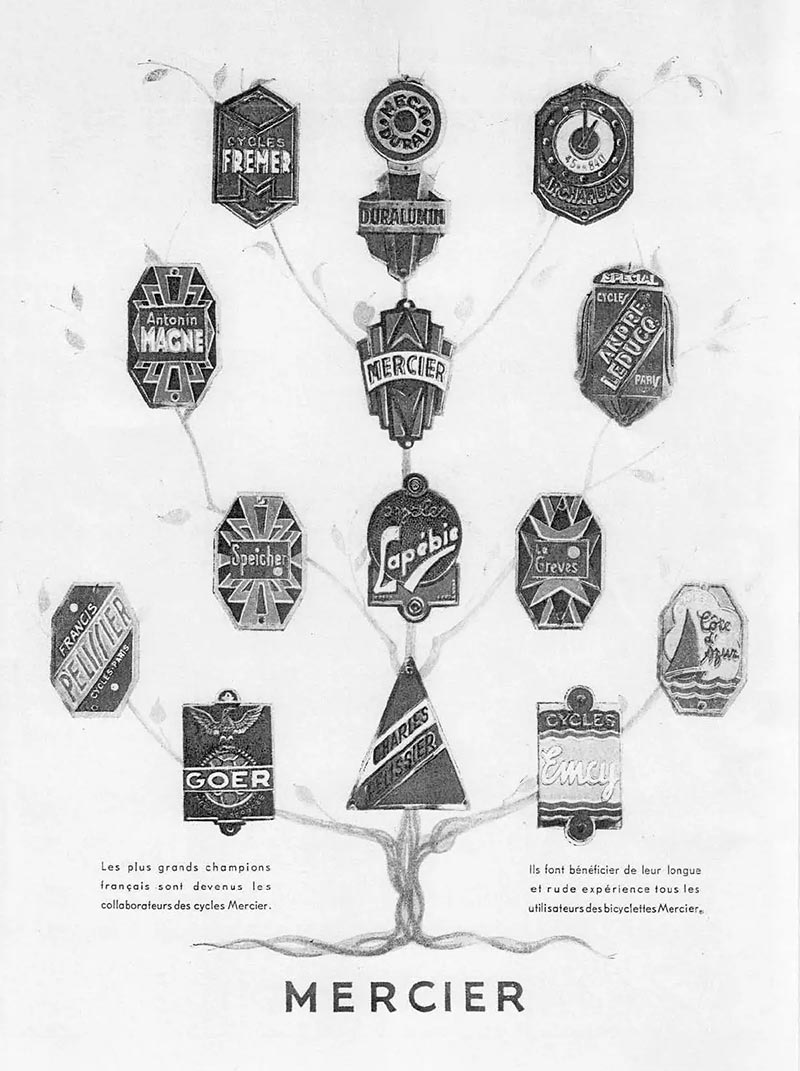

The story of Cycles Mercier is inextricably linked to its master strategy of brand management and horizontal integration, a philosophy that ensured its longevity even as smaller rivals struggled to survive. Over its 66-year reign, Mercier established no fewer than 25 sub-brands and OEM agreements. This network encompassed a wide range of marques from regional staples like Fééric and Monspor, to niche brands focused on specialized aluminum construction like Duravia and La Perle, and even ephemeral political symbols like Spoutnik.
One of the most effective tactical drivers of this brand strategy involved leveraging the names of France’s most celebrated professional bicycle racing heroes, securing agreements to produce and distribute bicycles under the identity of champions like: Louison Bobet, André Leducq, Antonin Magne and Francis Pélissier.
By controlling manufacturing while also allowing others to attach their prestige (and popularity) to the product, Mercier ensured that whether a customer walked into a shop for a top-tier racing machine or a reliable utility cycle, they were buying a segment-specific but broadly-trustworthy product. The resulting proliferation of brands and models allowed Mercier to dominate nearly every segment of the French cycling market, transforming itself into an empire whose reach was defined not by a single name, but by a carefully crafted portfolio of identities.
Here is an enumerated list of those sub-brands and OEM relationships in roughly historical order:
__________________________________________________________________________________________________________
__________________________________________________________________________________________________________
__________________________________________________________________________________________________________
__________________________________________________________________________________________________________
The breadth and complexity of Mercier’s sub-brand and OEM network were likely unmatched until decades later, when Asian manufacturers like Giant and Merida next centralized production on a massive scale. The corporate genius of Émile Mercier lay in controlling the manufacturing process—like producing Méca Dural framesets, perhaps the leading aluminum frame of choice after World War II, which were then supplied to other companies like Duravia and La Perle for rebranding—while simultaneously financing its namesake Cycles Mercier racing program through co-sponsors and the sale of cycling celebrity-endorsed bicycles.
This unique ability to cater to niche markets while remaining a high-volume producer is perhaps best illustrated by the dual life of the Méca Dural frame already mentioned, which served as both a popular mid-range aluminum offering and a critical (but incidental) war tool in Indochina. Whether building the Louison Bobet premium line or supplying frames for the numerous brands named after other racing stars like Georges Spiecher and René le Grévès, Mercier established a template for survival: creating simultaneous, sometimes contradictory, identities. Ultimately, this immense network of 25 brands proves that Cycles Mercier was not merely a bike builder, but a corporate and marketing pioneer whose true legacy is defined by its strategic, multi-faceted mastery of the bicycle market over six-plus decades.

Document the professional pedigree of Saint-Étienne’s finest. Share your Mercier restoration photos and technical observations on frame geometry and lug work.