About Ebykr
Ebykr celebrates classic and vintage lightweight bicycles through provocative imagery and opinion. Ride along with us.
About Ebykr
Ebykr celebrates classic and vintage lightweight bicycles through provocative imagery and opinion. Ride along with us.



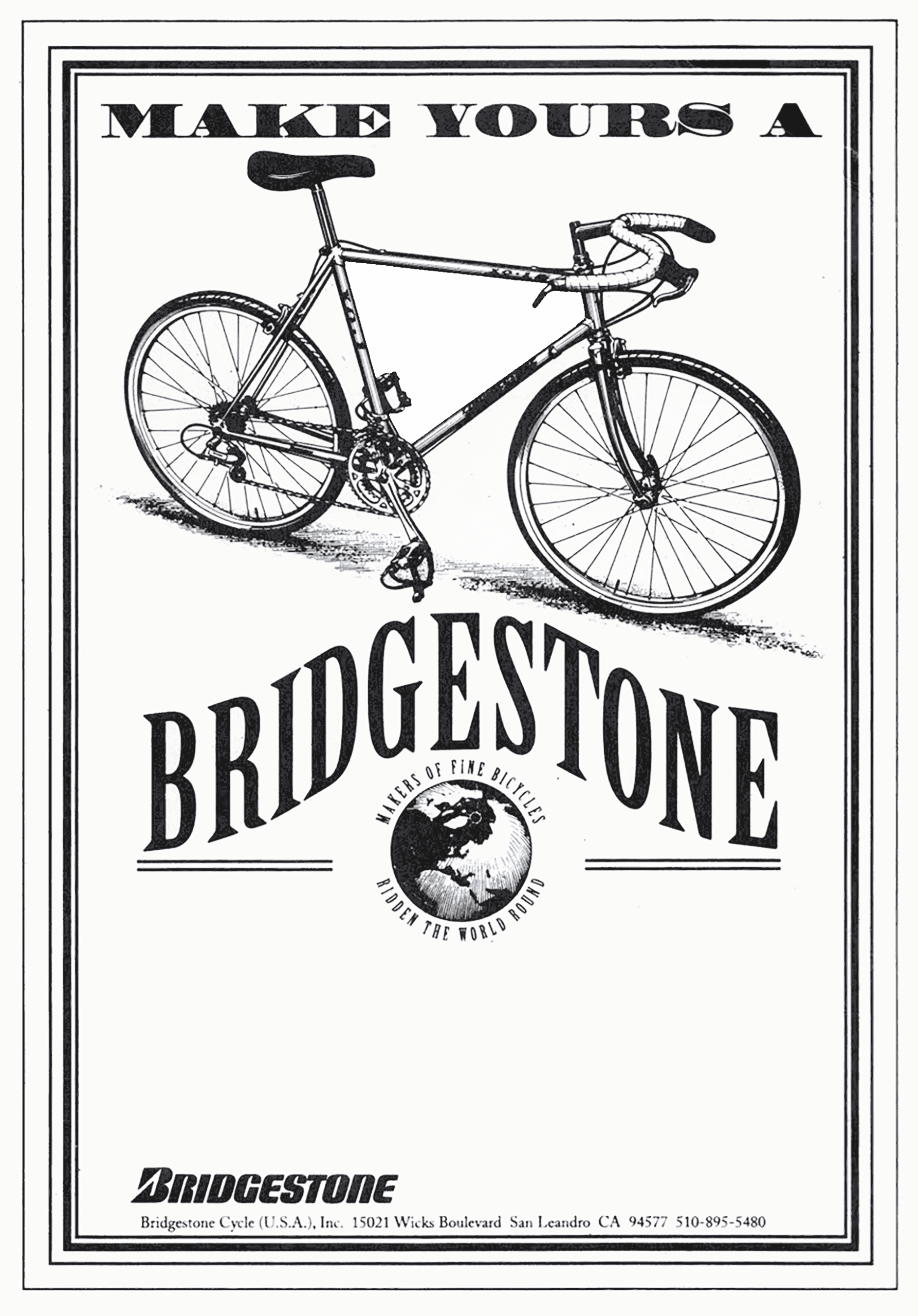
Bridgestone is best known worldwide as a tire giant, yet its bicycle story runs from tabi sandals in the 1920s to a cult-favorite American marketing operation in the 1980s and 1990s, and on to a Japan-only racing program that continues today. The company built bicycles for decades before most American riders ever heard the name and it kept building them for decades after BridgestoneUSA closed its doors.
This timeline traces Bridgestone from founder Shōjirō Ishibashi’s earliest ventures through the Grant Petersen-era RB, MB, CB and XO model lines, the controversial moustache bar, the 1994 closure of the American division and the community of Bridgestone Owners Bunch (BOB) members who kept the marque’s spirit alive online.
Shōjirō Ishibashi, whose name translates as “stone bridge,” begins making tabi, traditional Japanese sandals.
Ishibashi moves the company into tire manufacture. Around this time Bridgestone also establishes its original keystone-shaped corporate symbol carrying the “BS” lettering, a mark used with only minor refinements from the company’s founding through the early 1980s.
Bridgestone builds its first bicycles, alongside the motorcycles, cars and namesake tires the company would also become known for. Early models are Japanese-style city bikes with step-through frames, baskets and generator lights. Apparently the company made sporting bikes as well, though information about its early history is surprisingly hard to find given its size today.
Bridgestone Cycle Co is formally organized as its own entity, decades before BridgestoneUSA existed as a marketing operation.
The origin of what is now Team Bridgestone Cycling can be traced back to this year, making it the traceable starting point of Bridgestone’s competitive racing program in Japan.
During the early-to-mid 1970s bike boom, the same Japanese factory that built Bridgestone bicycles also builds machines for the U.S. market under other trade names, most notably Kabuki, a name chosen because it sounded distinctly and fashionably Japanese to American buyers of the era. As Sheldon Brown put it, “Kabuki was a trade name of Bridgestone (a Japanese company with a non-Japanese name!)”
Bridgestone’s dealer catalog for the year introduces road models including the Altair, Antares L.D.T. touring bicycle and Sirius, each shown with color swatches, Cr-Mo tubing decals and frame-geometry charts.
Grant Petersen, later of Rivendell Bicycle Works, joins Bridgestone as BridgestoneUSA marketing boss, entering a company that already had thirty-five years of frame-building behind it. That same year Bridgestone adopts a new angular, red-accented “B” corporate mark, replacing the older keystone “BS” symbol; the new mark remains in use today.
Bridgestone’s catalog for the year, titled “The Body and The Bike,” features a charcoal drawing of a cyclist in a low aerodynamic tuck on its cover.
A magazine review covers the Bridgestone MB-1 mountain bike, noting its flared drop handlebars and quoting Grant Petersen on Bridgestone’s collaboration with Nitto to produce an affordable “DirtDrop” stem for the bike.
Grant Petersen develops the moustache handlebar during his commute to work, refining the design across five prototypes and thousands of miles of testing. The first prototype is bent by a plumber out of copper tubing.
In a California Bicyclist interview, Petersen states his philosophy for the brand: “The best use of a bicycle is commuting, it’s not racing or competing or recreation or anything like that. Ultimately its best use is getting cars off the roads.”
Bridgestone’s catalog for the year introduces the XO-1, a 650B-inspired all-rounder built on road-bike geometry for 559mm (26-inch) wheels and equipped with the moustache bar, alongside features on fork-crown craftsmanship referencing builders such as Cinelli, Colnago and Richard Sachs.
BridgestoneUSA closes, ending the last year the company sold bicycles in the United States. Some riders blame the controversial moustache bar for the closure, but it was actually a result of the dollar dropping precipitously against the yen. The 1994 catalog also introduces the Bridgestone Owners Bunch (BOB), a club and bimonthly newsletter Petersen had founded before the closure.
Bridgestone’s Japan-based racing program begins competing as Bridgestone-Anchor.
Bridgestone refines its 1984 angular “B” corporate mark with a softer, rounded update, still in use today.
The Japan-based racing squad adopts an all-Japanese roster and its current team name.
From the RB-1 to the trail-ready MB-1 and the genre-bending XO-1, every Bridgestone carries a following and a story. Tell us which one you own, wish you owned, or regret letting go on the Ebykr forum.
 Bridgestone
Ebykr documents this marque across the archive. Here is the rest of it.
The Ebykr Digest
New articles, timelines, catalog finds and registry activity — assembled from the archive once a month. Your address is never shared.
Double opt-in. One email per month. Unsubscribe at any time with one click.