About Ebykr
Ebykr celebrates classic and vintage lightweight bicycles through provocative imagery and opinion. Ride along with us.
About Ebykr
Ebykr celebrates classic and vintage lightweight bicycles through provocative imagery and opinion. Ride along with us.

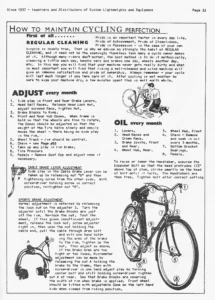
A whole bicycle in one sitting, as a 1961 booklet laid it out: what to clean, what to adjust and what to oil every month, with Rudge’s and Sturmey-Archer’s own hints beside it. The lists are the period’s, from the Ebykr archive; the drawing is Ebykr’s own.
This page shows how period sources looked after a bicycle, in their own words and figures. It does not test or guarantee any repair. Brakes, steering and wheels are safety parts: if you are not sure of an adjustment, ask a bicycle shop to check it before you ride.
On this page The drawing Tools and parts The steps in words What goes wrong Another way Sources
Your system asks for reduced motion, so each step is a still drawing. Play moves from still to still.
In the sources’ own terms; every item is named in them. Tick each one off as you gather it.
The whole job, readable and printable without the drawing. Each step says what it rests on, and can take you back up to its drawing.
Clean methodically, a little each day: the bars and brakes one day, the wheels another, so that the bicycle never gets really dirty. After riding in the wet, wipe it dry.
Take mud off the enamel before it eats it away: brush it off softly, apply paraffin, brush gently and rub down with a dry, soft cloth. Keep plated parts slightly greased in winter and very wet weather, against rust.
Take up side play in the front and rear brake levers, bring the brake blocks to the rims and take up any play in the rim brakes. The whole method is on its own page: Adjust a Side-Pull Brake.
Release the head lock nut, adjust the screwed race and tighten the nut. See Adjust the Head Races.
Adjust the front and rear hub cones by the valve test (Check and Adjust Hub Cones). See that each rim runs central. Check the tire pressure; Rudge says inflate the tires well, especially the back one, and when fitting a tire make sure the molded line on both sides of the cover runs evenly with the edge of the rim.
The chain must not be tight at any point, Rudge warns: a tight chain means wear and loss of power. Keep it oiled; the booklet has it taken off and soaked in oil every three months. At the pedals, take off the dust cap and adjust the cone if it needs it.
Oil the levers, the head races and crown race, the brake joints, both hubs, the bottom bracket bearings and the pedals. Use good oil and not too much: too much oil draws dirt and grit into the bearings, Rudge says, whose rule is a little oil on all bearings about every 100 miles.
A Sturmey-Archer hub gear wants its own oil every fortnight, and its indicator adjustment checked now and then.
Keep all nuts and screws tight. A clicking noise in a bearing means a broken ball or a worn cone, Rudge says: renew it at once to save more damage. And the saddle, Brooks reminds us, is the part most often forgotten: see Dress and Tension a Brooks Saddle.
Each of these is a source’s own warning, except the last, which is what the sources leave out.
The chain’s own page The booklet refers the chain to its page 55, which in the archive’s copy holds no chain method. So the chain gets Rudge’s rule and the three-monthly soak, nothing more.
Three points on maintenance, on the back of the leaflet: change gear as instructed, check the indicator adjustment now and then and oil with Raleigh Industries All-purpose Oil every fortnight. Sturmey-Archer leaflet, record 80978.
Every record opens in the Ebykr archive. Each step above names the page it rests on.
The Cyclo-pedia was the catalog of Gene Portuesi, an importer of lightweights in Detroit. This page puts the sources in Ebykr’s own words and quotes nothing at length.
The Ebykr Digest
New articles, timelines, catalog finds and registry activity — assembled from the archive once a month. Your address is never shared.
Double opt-in. One email per month. Unsubscribe at any time with one click.