About Ebykr
Ebykr celebrates classic and vintage lightweight bicycles through provocative imagery and opinion. Ride along with us.
About Ebykr
Ebykr celebrates classic and vintage lightweight bicycles through provocative imagery and opinion. Ride along with us.

How a 1961 booklet kept a side-pull caliper brake set: the lever’s play taken up, the blocks brought just off the rim, the cable re-set with the arms held to the rim and the arms trued on their center bolt. The method is the period’s, from the Ebykr archive; the drawings are Ebykr’s own.
This page shows how a period source adjusted a brake, step by step, in that source’s words and figures. It does not test or guarantee any repair. Brakes are a safety part: if you are not sure of the adjustment, ask a bicycle shop to check it before you ride.
On this page The drawing Tools and parts The steps in words What goes wrong Another way Sources
Your system asks for reduced motion, so each step is a still drawing. Play moves from still to still.
In the sources’ own terms; every item is named in them. Tick each one off as you gather it.
The booklet names no spanner, though its nuts need one.
The whole job, readable and printable without the drawing. Each step says what it rests on, and can take you back up to its drawing.
If the brake lever moves from side to side, release its nut B and tighten the screw from the other side. Hold the screw in place with a screwdriver while you tighten nut B again.
For the normal adjustment, release the lock nut on the cable adjuster, turn the adjuster until the brake blocks are just clear of the rim, and lock the nut again. Campagnolo’s Record brake of 1981 puts this on the brake itself, a knob and cam for constant adjustment of the cable.
Spin the wheel. It should turn without the blocks touching the rim, and the brake should take hold when the lever is pulled.
If the adjuster has no more to give, release its lock nut and screw it right in. Undo the nut that holds the cable end. Hold the brake arms against the rim with one hand, pull the cable through the draw bolt with the other, and tighten the nut. Then adjust as in step 2.
A Paris maker offered a third hand in 1951. Cholain’s shoe-lock, the bloque-patins, is passed through the spokes and hooked on a shoe holder, and a pull locks the blocks against the rim, leaving both hands free to set the cable. Its two jaws slide on each other and close on a coil spring.
If the arms are too tight or too loose on their pivot, release nut A, which holds the brake to the frame at the rear. Turn the center bolt with a screwdriver to set the play and, still holding the screwdriver, tighten nut A again.
Pull the lever and look: the brake blocks should cover the width of the rim when the brake is on.
Each of these is a source’s own warning, except the last, which is what the sources leave out.
Worn blocks No source here says when a block is worn out or how to fit a new one. This page does not either.
The Record brake of 1981 makes the adjustment part of the brake: a knob with a cam (5, 6) keeps the cable adjustment constant, guides (3) in the shoe holders ease fitting the wheel and two patented flats (1) hold the brake in position while it is fitted to the frame. Campagnolo Record brake sheet, record 75025.
Every record opens in the Ebykr archive. Each step above names the page it rests on.
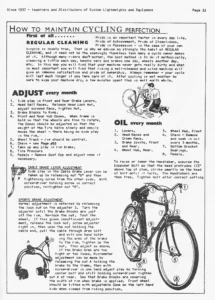
The Cyclo-pedia was the catalog of Gene Portuesi, an importer of lightweights in Detroit. This page puts its method in Ebykr’s own words and quotes nothing at length.
The Ebykr Digest
New articles, timelines, catalog finds and registry activity — assembled from the archive once a month. Your address is never shared.
Double opt-in. One email per month. Unsubscribe at any time with one click.