About Ebykr
Ebykr celebrates classic and vintage lightweight bicycles through provocative imagery and opinion. Ride along with us.
About Ebykr
Ebykr celebrates classic and vintage lightweight bicycles through provocative imagery and opinion. Ride along with us.

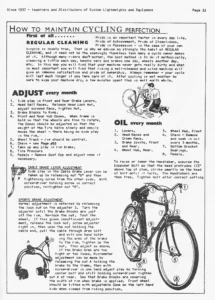
The steering bearings of a classic lightweight, set as the period set them: free to turn with very little shake, the screwed race taken up under its lock nut. From a 1961 booklet, Rudge’s care page and Daniel Rebour’s 1964 notes on fitting a headset, all in the Ebykr archive; the drawings are Ebykr’s own.
This page shows how period sources set a headset, step by step, in their own words and figures. It does not test or guarantee any repair. The steering is a safety part: if you are not sure of the adjustment, ask a bicycle shop to check it before you ride.
On this page The drawing Tools and parts The steps in words What goes wrong Another way Sources
Your system asks for reduced motion, so each step is a still drawing. Play moves from still to still.
In the sources’ own terms; every item is named in them. Tick each one off as you gather it.
No source names a spanner for the screwed race itself.
The whole job, readable and printable without the drawing. Each step says what it rests on, and can take you back up to its drawing.
The head races are bearings like any other, and Rudge’s rule for every bearing holds: free to run, with very little shake. Turn the handlebar; it should swing freely. Then feel for knock in the head.
Release the lock nut at the top of the head. Holdsworth sold a spanner for exactly this, No. 712, for head lock nuts and bracket lock rings.
Turn the screwed race, the upper one, down a little to take up shake, or back a little if the steering is stiff.
Rebour, writing in 1964, warns about two parts between the race and the lock nut. The keyed washer’s flat must match the flat at the back of the steerer. And the ring that serves as the front brake’s cable stop sits between the keyed washer and the lock nut; forgetting it, he says, could be catastrophic.
Hold the screwed race and tighten the lock nut down on it. Rebour adds that there is no sense in overtightening a new headset on the grounds that it will bed in.
Oil the head races and the crown race once a month, the booklet says. When a headset is refitted, Rebour puts the balls in with real Vaseline grease, not thick grease, which can dry out over time. Check again: free steering, very little shake.
Each of these is a source’s own warning, except the last, which is what the sources leave out.
How tight is the lock nut No source in the archive gives a figure or a test for the lock nut. This page does not either.
Fitting the crown race is a frame builder’s job in Rebour’s account: a force fit, filed gradually and driven on square with a long, squarely cut tube and a few mallet blows, never forced onto too large a diameter, since the hard race can split. The faces of the head tube are skimmed flat and parallel first. Le Cycle, January 1964, record 72697, Ebykr’s summary. This page does not cover fitting.
Every record opens in the Ebykr archive. Each step above names the page it rests on.
Rebour’s article is in French; the archive carries its page images in full and Ebykr’s summary in English. This page puts the sources in Ebykr’s own words and quotes nothing at length.
The Ebykr Digest
New articles, timelines, catalog finds and registry activity — assembled from the archive once a month. Your address is never shared.
Double opt-in. One email per month. Unsubscribe at any time with one click.