Carlton Cycles: A Timeline of Britain’s Overlooked Lightweight Marque
Carlton Cycles, founded in Carlton, England in 1896, built wide-tired roadsters before a mid-1930s pivot toward racing and club machines gave rise to one of Britain's most respected, if still under-recognized, lightweight marques. This timeline traces its rise under the O'Donovan family through a 1960 acquisition by Raleigh to its eventual wind-down.
Carlton Cycles, founded in Carlton, England in 1896, built wide-tired roadsters before a mid-1930s pivot toward racing and club machines gave rise to one of Britain’s most respected, if still under-recognized, lightweight marques.
The arrival of salesman-turned-owner Dan O’Donovan in 1937 or 1938 accelerated Carlton’s growth, and the O’Donovan family, Dan and then his son Gerald, guided the company through wartime production, a 1962 factory fire and a 1960 acquisition by Raleigh. Carlton went on to build all of Raleigh’s handbuilt frames at its Worksop factory, supplying the sporting and export lines that fueled Raleigh’s U.S. boom of the early 1970s, before economic pressures and internal brand competition led to the marque’s wind-down between 1974 and 1982.
Here is a chronological timeline of key corporate events at Carlton Cycles, spanning from 1896 to 1982, based on the sources used for an accompanying Ebykr article on its history, “Carlton Cycles: Foundation for Greatness.”
21 of 21 events
1896
Company Founding
Fred Hanstock founded Carlton Cycles in Carlton, England, at the tail end of the first great bike boom, building wide-tired upright roadsters typical of the era for middle-class transport and pleasure riding.
1932
Product Innovation
Carlton built its first lightweight bicycle, a custom machine made for a local racer named Tommy Ashurst.
c. 1936
Strategic Pivot
The Hanstock family reorganized the company to focus design and production on racing and club bicycles aimed at the sporting market, as the utility roadster market stagnated with the spread of cars and public transport.
1937–1938
Corporate Leadership
Dan O’Donovan, previously in the motorcycle trade and possibly employed by Norton, asked for a job at the Carlton booth at a trade show and joined the company as a salesman, quickly building a dealer network that forced the factory to expand.
1937
Brand Identity
A year after the shift toward sporting machines, Carlton offered a range of lightweights with sporting names including The Flyer, Massed Start, Massed Start Special, Super Python, Continental and Silver Clubman.
1939
Corporate Leadership
Dan O’Donovan took over Carlton Cycles, establishing a family legacy that would continue when his son Gerald O’Donovan joined the firm in 1958. Fred Hanstock moved on to build specialty motorcycles under his own name.
1939–1945
Manufacturing Shift
During the Second World War, Carlton produced bicycles for the military and established a large repair facility that kept the company running through the constrained wartime years.
1958
Corporate Leadership
Gerald O’Donovan, son of Dan O’Donovan, joined Carlton Cycles, continuing the family’s management of the firm.
1960
Acquisition
Carlton Cycles became a subsidiary of Raleigh, itself part of the TI Raleigh conglomerate, after former racer Reg Harris, then a Raleigh employee, suggested the larger company acquire an established lightweight maker rather than build up its own racing line from scratch.
1960s
Production Milestone
Following the acquisition, Carlton was assigned the Triumph, Sun, Phillips and Rudge bicycle lines, expanded its payroll to 60 employees, and operated under Gerald O’Donovan.
1960s
Manufacturing Shift
Huffy briefly imported Carlton bicycles into the United States, raising the marque’s profile considerably.
1962
Corporate Tragedy
A fire destroyed Carlton’s factory, though postwar demand for lightweight bicycles was strong enough that the loss did not derail the company’s prosperity.
1963
Racing Legend Signed
Carlton sponsored a racing team whose roster included George Shaw, Michael Coupe, Mike Harpham and Sean Ryan, all notable riders of the period.
1963–1982
Production Milestone
From 1963 until the company’s closure roughly two decades later, all of Raleigh’s handbuilt frames were produced at the Carlton factory in Worksop.
1960s
Brand Storytelling
Amid corporate infighting, the sponsored racing team’s name flip-flopped between Carlton-BMB and Raleigh and back to Carlton over roughly five years, a sign some later read as an early omen of the marque’s eventual demise.
1967
Brand Identity
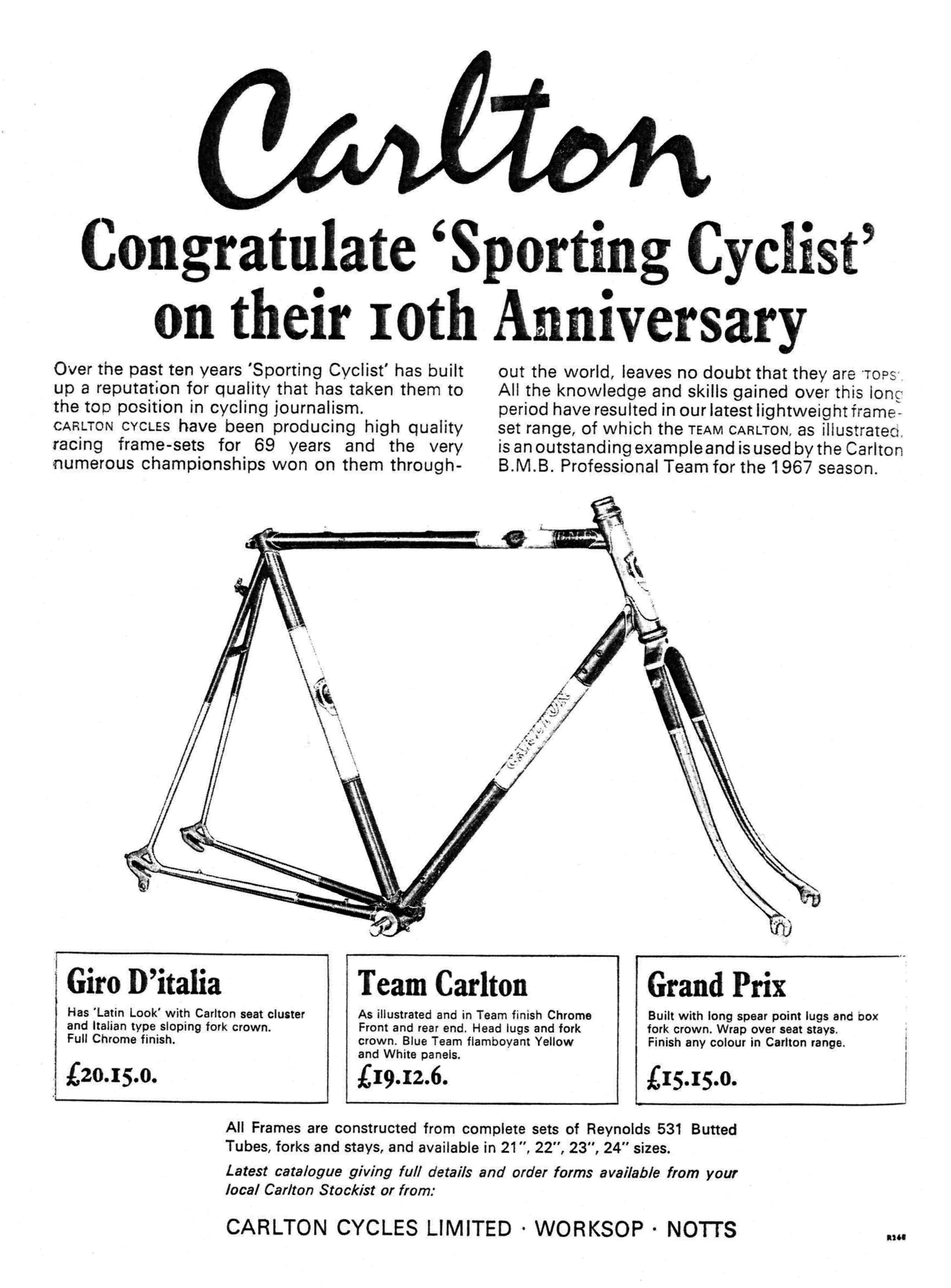
Carlton introduced a new range of frames including the “Team Carlton” finished in trademark blue with flamboyant yellow and white panels, ridden by a team that racked up forty first-place wins in road, track and cyclocross racing that season.
1970–1972
Market Dominance
Citing historian Tony Hadland, demand for lightweight ten-speed cycles in the United States increased forty-fold, and Raleigh Record and Grand Prix models based on Carlton designs sold there in massive numbers, manufactured at Nottingham, at Worksop by Carlton, in the Netherlands by Gazelle, by Raleigh Ireland, and possibly in Malaysia.
1974
Corporate Liquidation
As sales of Carlton bicycles plummeted, amid diluted brand focus within Raleigh and broader economic pressure from the OPEC oil embargo and related recession, the company laid off 100 workers.
1979
Corporate Liquidation
Carlton laid off a further 160 employees as the decline continued.
1981
Corporate Liquidation
Carlton laid off 650 employees, the largest single reduction in the marque’s wind-down.
1982
Corporate Liquidation
On May 29, the last 202 employees left as Raleigh shuttered the Worksop factory, ending Carlton Cycles as a manufacturing operation. Raleigh continued producing a few Carlton models at its Nottingham factory for a short time afterward before the marque faded from the market.
Join the Carlton Cycles Heritage Discussion!
Whether it’s a Flyer, a Professional or a rare Capella-lugged frame, Carlton’s British craftsmanship is unmistakable. Share your restoration photos and technical details with the community.


 Carlton